
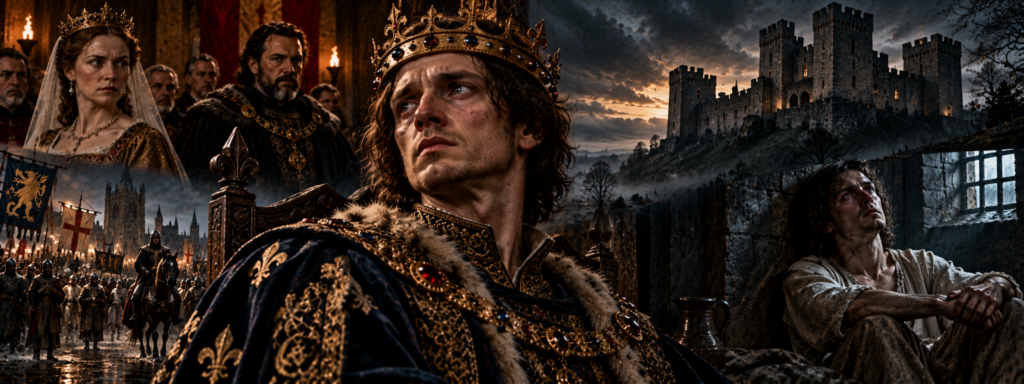
Richard II: The Deposed King Who Disappeared Into Pontefract Castle
Richard II (1367–c. February 1400) | King of England, 1377–1399 | Deposed by Henry Bolingbroke, imprisoned at Pontefract Castle, and probably dead by starvation or deliberate deprivation after a failed attempt to restore him
The King Who Entered Pontefract and Never Came Out Alive
Sometime during the bitter winter of 1399–1400, a prisoner was being held behind the walls of Pontefract Castle in Yorkshire. Only months earlier, servants had bowed before him, nobles had competed for his favor, ambassadors had negotiated in his presence, and opponents had learned that the anger of a king could cost them their lands, liberty, or lives. Now Richard II of England possessed no crown, no household worthy of a monarch, and almost no control over what happened to him. The man who had ruled England for more than twenty years had become the most dangerous kind of prisoner imaginable: a deposed king who was still alive.
His captor was not a foreign conqueror but his own cousin, Henry Bolingbroke, the man who would reign as Henry IV. Bolingbroke had returned from exile in 1399 claiming that he merely intended to recover the inheritance Richard had taken from him after the death of his father, John of Gaunt. Within months, however, Richard had surrendered, Parliament had accepted his deposition, and Bolingbroke had taken the crown. The transition created a problem that no ceremony could solve, because Richard’s physical survival meant that England now contained two men who had been crowned and anointed as kings.
Then, early in 1400, Richard died at Pontefract. Exactly how he died remains uncertain, and contemporary evidence does not provide the kind of detailed account that would settle the question. One tradition claimed that he was deliberately starved after a conspiracy attempted to restore him, while another suggested that he refused food in despair when he realized that his cause had collapsed. Later stories transformed his final days still further, describing assassination, violent struggle, secret survival, and even a mysterious double who supposedly wandered Scotland claiming to be the fallen king.
The likeliest explanations are less theatrical but no less disturbing. Richard probably died through starvation or some form of deliberate deprivation, although historians continue to debate whether food was withheld from him, whether conditions were intentionally allowed to become fatal, or whether he stopped eating after losing hope. What can be said with greater confidence is that his death was extraordinarily convenient for Henry IV. As long as Richard breathed, every rebel dissatisfied with the new king possessed a living alternative around whom resistance could gather.
Richard’s death therefore belongs among the great unresolved regicides of medieval England. Unlike Edward II, whose alleged murder at Berkeley Castle became surrounded by grotesque legends, Richard left behind no universally accepted story of a particular weapon or assassin. His possible murder was quieter, more ambiguous, and in some ways more chilling. A sword leaves a wound and a murderer can leave witnesses, but a prisoner who slowly weakens behind locked doors can be made to disappear without anyone publicly admitting that an execution has taken place.
The path to Pontefract had begun long before Henry Bolingbroke returned to England. Richard had survived rebellion as a teenager, confronted some of the most powerful nobles in the kingdom, cultivated an unusually elevated conception of monarchy, destroyed enemies who had once humiliated him, and finally attempted to govern through fear and carefully controlled loyalty. His downfall was not the sudden collapse of a helpless ruler. It was the violent reversal of a long struggle over what an English king could demand from his subjects and what those subjects could do when they believed the king had gone too far.
The Child Born Into a Dynasty of Warriors
Richard was born at Bordeaux on January 6, 1367, into the Plantagenet dynasty at the height of its military prestige. His father was Edward of Woodstock, the celebrated Black Prince, whose victories during the Hundred Years’ War had made him one of the most famous warriors in Europe. His grandfather was Edward III, whose long reign had been marked by English victories in France and an increasingly elaborate culture of chivalric kingship. Richard therefore inherited not only royal blood but the enormous expectations created by two generations of military success.
His mother, Joan of Kent, was herself a figure of considerable status and an important influence during his youth. Richard’s elder brother Edward died while still a child, leaving Richard as the surviving heir of the Black Prince. Then the Black Prince died in June 1376 after years of declining health. Richard, still only nine years old, suddenly stood directly behind his grandfather in the succession.
Edward III died the following year, and ten-year-old Richard became king on June 21, 1377. The coronation placed an enormous ceremonial burden upon a child who could not realistically govern independently. England was engaged in a costly war with France, royal finances were under pressure, and rival aristocratic interests surrounded the young monarch. His powerful uncles, particularly John of Gaunt, Duke of Lancaster, occupied prominent positions within the political world around him.
The unusual circumstances of Richard’s childhood shaped his later understanding of kingship. He had been elevated above nearly everyone around him before he was old enough to exercise meaningful authority. Courtiers approached him as the anointed ruler even while adults effectively conducted much of the government. The experience may have encouraged the intense concern with royal dignity and obedience that became increasingly visible during his adult reign.
Yet the boy king was not merely a passive ornament. The crisis that erupted in 1381 would give him an opportunity to demonstrate remarkable courage and political instinct. England was about to experience one of the largest popular uprisings of the medieval period. Richard, only fourteen years old, would find himself confronting armed rebels while many experienced men around him struggled to control the situation.
The Peasants’ Revolt and the Fourteen-Year-Old King
The Peasants’ Revolt of 1381 grew from a combustible mixture of taxation, economic pressure, resentment of serfdom, and hostility toward royal officials. The poll taxes imposed to finance war contributed to widespread anger, while social changes following the Black Death had destabilized traditional relationships between laborers and landowners. Rebellion spread through southeastern England with alarming speed. Large groups of insurgents moved toward London, attacking symbols of authority along the way.
The rebels entered the capital, where violence and destruction followed. The Savoy Palace belonging to John of Gaunt was attacked and burned, while officials associated with unpopular government policies became targets. Simon Sudbury, Archbishop of Canterbury and royal chancellor, was seized and killed. The government faced the terrifying possibility that royal authority might collapse in the heart of the kingdom.
Richard personally met groups of rebels during the crisis. At Mile End and later at Smithfield, the teenage king confronted men whose movement had already demonstrated its willingness to use lethal violence. The famous encounter at Smithfield ended with the rebel leader Wat Tyler being struck and killed after a confrontation with royal officials. Richard then addressed the increasingly volatile crowd and helped prevent an immediate massacre.
Later narratives celebrated the king’s composure. The precise wording attributed to Richard by chroniclers cannot be treated as verbatim testimony, but his personal role in defusing the confrontation is well established. For a fourteen-year-old monarch, the performance was extraordinary. He displayed courage, self-possession, and an instinctive understanding of the symbolic power of kingship.
Once the immediate danger had passed, the government withdrew concessions that had been made under pressure and suppressed remaining resistance. Rebel leaders were hunted, tried, and executed. Richard’s apparent willingness to negotiate during the crisis did not produce a lasting transformation of the social order. The monarchy survived, while the revolt was violently contained.
The experience may have reinforced Richard’s belief in the almost mystical authority of the crown. He had faced armed subjects and watched rebellion collapse after direct confrontation with their king. A young ruler could easily interpret such an experience as proof that royal majesty possessed extraordinary power. That conviction would become far more dangerous when Richard later confronted aristocratic opponents who were not as easily dispersed.
Anne of Bohemia and the Queen Richard Loved
In 1382, Richard married Anne of Bohemia, daughter of the Holy Roman Emperor Charles IV and sister of King Wenceslaus. The marriage was politically useful because it connected England with an important European dynasty. It did not bring the enormous financial advantages some English observers might have preferred, and Anne initially faced criticism. Over time, however, she developed a favorable reputation at the English court.
Richard appears to have formed a genuine emotional attachment to his wife. Their marriage produced no children, a fact that would eventually complicate the succession, but contemporary evidence suggests that Anne exercised a moderating influence upon him. She occasionally intervened on behalf of people seeking royal mercy. Her reputation as “Good Queen Anne” developed partly from such acts of intercession.
The marriage also reveals a side of Richard that later political narratives can obscure. He was capable of deep attachment and intense grief, qualities that appeared repeatedly in his relationships. His emotional responses could be powerful, whether directed toward friends, his wife, or enemies. Those personal loyalties would become intertwined with political decisions throughout his reign.
Anne’s death in 1394 devastated him. She died at Sheen Palace, probably from plague, at approximately twenty-eight years old. Richard’s grief was so intense that he ordered the palace where she had died to be demolished, or at least substantially destroyed, according to contemporary evidence. The act suggests the extraordinary emotional significance she held for him.
Her death also removed someone who may have helped soften tensions within the royal court. Richard became increasingly authoritarian during the later years of his reign, although it would be simplistic to claim that Anne’s death caused the transformation. Political conflicts already had deep roots. Nevertheless, the loss marked an important personal turning point.
Richard later arranged an extraordinary double tomb for himself and Anne in Westminster Abbey. Their effigies were depicted side by side, preserving the royal couple in an idealized form. The monument became one of the most intimate expressions of Richard’s conception of kingship and memory. Ironically, Anne would remain peacefully at Westminster while Richard’s own body endured a far more complicated journey after his death.
The King’s Favorites and the Growing Aristocratic Crisis
As Richard matured, tensions developed between the king and powerful nobles who objected to the influence of his favored courtiers. Among the most controversial figures was Robert de Vere, Earl of Oxford and later Duke of Ireland. Richard’s attachment to de Vere became politically explosive because the favorite received exceptional honors and influence. Great nobles resented the elevation of a man they considered undeserving of such extraordinary status.
The exact nature of Richard’s relationship with de Vere has generated speculation. Hostile contemporary and later writers described an intense bond and sometimes implied sexual impropriety. As with similar accusations surrounding Edward II and his favorites, the evidence does not allow historians to reconstruct the men’s private sexual relationship with certainty. What is undeniable is that Richard’s political preference for de Vere angered powerful aristocrats.
Michael de la Pole, Earl of Suffolk and royal chancellor, was another target of opposition. Critics accused Richard’s government of financial mismanagement and poor military policy. Parliament challenged the king’s advisers and attempted to impose restrictions upon royal authority. Richard increasingly viewed such interference as an attack upon the dignity of the crown.
The conflict escalated because neither side trusted the other. Richard believed that magnates were attempting to control a legitimate king through coercion. His opponents believed that irresponsible favorites were manipulating royal government and threatening the political community. Each side could therefore present its actions as defensive.
By 1387, the dispute had become openly confrontational. A group of powerful nobles known as the Lords Appellant moved against Richard’s closest supporters. They included Thomas of Woodstock, Duke of Gloucester, Richard’s uncle; Richard FitzAlan, Earl of Arundel; and Thomas de Beauchamp, Earl of Warwick. Henry Bolingbroke and Thomas Mowbray later joined them.
The presence of Bolingbroke among Richard’s opponents would acquire enormous significance. He was Richard’s cousin and the son of John of Gaunt, one of the wealthiest and most powerful men in England. At this stage, however, Bolingbroke was one member of an aristocratic coalition rather than an obvious future king. The struggle between Richard and the Lords Appellant would plant resentments that erupted with devastating force a decade later.
The Merciless Parliament
In December 1387, forces loyal to Robert de Vere were defeated by the Lords Appellant at Radcot Bridge. De Vere escaped abroad, but Richard’s political position collapsed. The king was effectively placed under the domination of the victorious aristocrats. His favorites and advisers became vulnerable to prosecution.
The Parliament that assembled in February 1388 became known as the Merciless Parliament. The name reflects the severity with which Richard’s associates were treated. Several leading royal advisers were convicted of treason and executed. Others were exiled or removed from power.
Richard was forced to watch while men he trusted were destroyed. The humiliation was profound because it demonstrated that the king could be politically overwhelmed without being formally removed from the throne. His enemies controlled government while preserving the outward structure of monarchy. Richard remained crowned, but his freedom of action had been dramatically restricted.
The experience almost certainly shaped his later conduct. He did not forget the men who had humiliated him or the deaths of his supporters. Yet he was patient enough not to strike immediately. In 1389, Richard declared that he was old enough to govern personally and gradually regained control of royal administration.
For several years, the kingdom experienced relative political stability. Richard worked with many of the nobles who had previously opposed him, and the government functioned without the level of confrontation seen in the late 1380s. This period demonstrates that the king was capable of pragmatic government. The eventual catastrophe was therefore not inevitable.
Beneath the reconciliation, however, memories of the Merciless Parliament remained. Richard had learned that aristocratic opposition could threaten the king himself. The Lords Appellant had learned that coordinated resistance could force royal government to submit. Neither lesson encouraged long-term trust.
A King Obsessed With Majesty
Richard’s conception of monarchy became increasingly elaborate during the 1390s. He emphasized ceremonial dignity, demanded strict forms of deference, and surrounded himself with imagery that presented kingship as elevated above ordinary political competition. The famous Westminster portrait depicts him enthroned in royal splendor. His artistic patronage and court culture projected an image of sacred, almost untouchable authority.
Such behavior should not automatically be dismissed as vanity or evidence of instability. Medieval monarchy depended heavily upon ceremony, symbolism, and public demonstrations of hierarchy. Other kings also emphasized the sacred character of royal authority. Richard’s approach became controversial because it coincided with his increasing intolerance of opposition.
He expected subjects to recognize a clear distinction between legitimate counsel and challenges to royal sovereignty. Men who believed that magnates possessed a traditional right to restrain bad government viewed this attitude with suspicion. Richard remembered the coercion of 1387–1388 and had little desire to repeat it. The question was whether he could secure royal independence without turning government into personal revenge.
The king also cultivated a household and regional affinities upon which he could rely. Cheshire archers became particularly associated with his personal power and acquired a fearsome reputation among opponents. Richard’s critics portrayed these forces as instruments of intimidation. Their presence contributed to an atmosphere in which political disagreement could feel increasingly dangerous.
Richard’s insistence upon majesty also shaped his interactions with Parliament and the aristocracy. He expected obedience not merely to government policy but to the person and dignity of the monarch. Insults or challenges could therefore acquire an almost treasonous significance. Political disputes became personal because Richard’s understanding of kingship made attacks upon his advisers or authority attacks upon himself.
The result was a court increasingly centered upon the king’s will. Richard had survived childhood rebellion and aristocratic domination, and he appeared determined never again to become a prisoner of powerful nobles while still wearing the crown. The strategy succeeded for several years. Then, in 1397, he began settling old scores.
Richard Takes His Revenge
Nearly a decade after the Merciless Parliament, Richard moved against the surviving Lords Appellant. The timing suggests careful preparation rather than sudden rage. In July 1397, the king ordered the arrests of Gloucester, Arundel, and Warwick. The men who had once dominated him were now at his mercy.
Arundel was brought to trial before Parliament and condemned for treason. He was executed by beheading in September 1397. Warwick confessed and was sentenced to death, although the punishment was commuted to imprisonment. Gloucester’s fate was more mysterious and more sinister.
The Duke of Gloucester had been sent to Calais, where he was held under the authority of Thomas Mowbray, Earl of Nottingham. Before he could appear publicly for trial, Gloucester died in custody. A confession attributed to him was produced, but the circumstances of his death generated immediate suspicion. Later accounts claimed that he had been suffocated, perhaps under orders connected with Richard’s government.
The precise responsibility for Gloucester’s death remains uncertain. Richard benefited politically from the disappearance of a dangerous opponent, but surviving evidence does not permit a simple reconstruction of the killing. The episode nevertheless damaged the king’s reputation. A royal uncle had died mysteriously while imprisoned by men loyal to the crown.
Richard used the proceedings to destroy the political power of his former enemies. Estates were confiscated, titles forfeited, and loyal supporters rewarded. The king appeared finally to have reversed the humiliation of 1388. Those who had once threatened his favorites now faced execution, imprisonment, or ruin.
The revenge also sent a terrifying message to the political community. Richard could remember a grievance for years and punish it once circumstances changed. Men who had participated in earlier opposition now had reason to fear that reconciliation offered no permanent protection. The king had secured obedience, but he had made trust increasingly difficult.
The Strange Quarrel Between Bolingbroke and Mowbray
Henry Bolingbroke had participated in the Lords Appellant’s challenge to Richard, but he escaped the destruction that befell Gloucester and Arundel in 1397. He had not been among the king’s most uncompromising enemies, and his relationship with Richard remained complicated. Bolingbroke was also protected by his position as the son of John of Gaunt. His immense inheritance made him too important to treat casually.
In late 1397 and 1398, Bolingbroke became involved in a remarkable dispute with Thomas Mowbray, Duke of Norfolk. Bolingbroke accused Mowbray of making treasonous statements suggesting that the king intended to destroy them. Mowbray denied the allegation. The quarrel threatened to expose the deep distrust that existed beneath Richard’s political settlement.
A judicial duel was arranged at Coventry in September 1398. The two men prepared to fight before the king and an enormous audience. At the last moment, Richard stopped the combat. Instead of allowing the dispute to be settled by battle, he banished both men.
Mowbray received a sentence of exile for life, while Bolingbroke was initially banished for ten years. The decision removed two powerful and potentially dangerous nobles from England. It also gave Richard an opportunity to reduce the political threat posed by Bolingbroke. Yet the king’s handling of the dispute would eventually destroy him.
John of Gaunt died in February 1399. His death made Bolingbroke heir to the vast Lancastrian estates, one of the greatest collections of wealth and territorial power in England. Under normal circumstances, the inheritance would have passed to him despite his exile. Richard instead seized the Lancastrian possessions for the crown.
The decision transformed Bolingbroke’s position. He was no longer merely an exiled noble waiting for permission to return. His hereditary wealth had been taken by the king, raising fears among other aristocrats that their own inheritances might also be vulnerable. Richard had converted a personal rival into a man with a powerful grievance that many nobles could understand.
The Fatal Seizure of the Lancastrian Inheritance
Richard’s confiscation of Bolingbroke’s inheritance was one of the most consequential decisions of his reign. The Lancastrian estates were enormous, and their seizure dramatically expanded royal resources. Yet the action challenged expectations concerning aristocratic inheritance. If the king could permanently confiscate the property of an exiled heir, other noble families had reason to worry.
The political problem extended beyond sympathy for Bolingbroke. Medieval aristocratic society depended upon the transmission of lands, titles, and family influence across generations. Noblemen could tolerate severe royal punishment while still expecting established inheritance customs to be respected. Richard’s decision appeared to threaten that security.
Bolingbroke now possessed an obvious justification for returning to England. He could claim that he sought only to recover the inheritance unlawfully denied to him. Such a position was far less threatening than immediately declaring an intention to seize the crown. It allowed dissatisfied nobles to support him without initially presenting themselves as rebels against the monarchy.
Richard nevertheless appeared confident enough to leave England. In 1399, he traveled to Ireland for a military campaign, taking important supporters with him. His absence created precisely the opportunity Bolingbroke needed. The king had removed himself from the political center at the moment when his most dangerous enemy was preparing to return.
Bolingbroke landed in Yorkshire in the summer of 1399 with a relatively small following. His support expanded rapidly as powerful nobles joined him. Among them was Henry Percy, Earl of Northumberland, whose family possessed enormous influence in northern England. What began as an expedition supposedly intended to recover an inheritance quickly became a national political revolution.
Richard’s government in England collapsed with remarkable speed. Men who had obeyed the king while he was present proved unwilling to risk everything for him while Bolingbroke gathered strength. The fear-based political system Richard had created offered little resilience once his personal authority was absent. By the time he returned from Ireland, the balance of power had shifted dramatically.
Bolingbroke Comes Home
Henry Bolingbroke’s return was carefully framed. He did not initially present himself as a usurper demanding the throne. Instead, he emphasized the injustice done to him through the seizure of his inheritance. This allowed supporters to rally around a grievance that appeared compatible with loyalty to the crown.
As Bolingbroke moved through England, his following grew. Nobles who feared Richard’s government saw an opportunity to secure themselves. Others may have genuinely believed that the Lancastrian inheritance should be restored. Personal ambition, political resentment, and concern for aristocratic rights combined to produce a rapidly expanding coalition.
Richard remained in Ireland while the crisis developed. Communication across the Irish Sea was slow enough to leave him dangerously behind events. When news of Bolingbroke’s progress reached him, the king faced the difficult task of returning to England and rebuilding support. His delay proved disastrous.
The royal forces began to disintegrate. Edmund of Langley, Duke of York, whom Richard had left with responsibilities in England, eventually came to terms with Bolingbroke. Important castles and political centers passed into the invader’s control. The king’s authority appeared to vanish almost as quickly as Edward II’s had during Isabella’s invasion seventy-three years earlier.
Richard eventually returned from Ireland and landed in Wales. His position was already desperate. Supporters deserted, forces dispersed, and the king found himself increasingly isolated. The magnificent ceremonies and demands for obedience that had surrounded his monarchy could not replace an army.
He withdrew toward Conwy Castle, hoping to negotiate. Bolingbroke’s representatives approached him with assurances whose precise terms remain disputed. Richard was eventually induced to leave the security of Conwy. Once he placed himself in his opponents’ hands, his reign was effectively finished.
The King Becomes a Prisoner
Richard was taken into custody and transported under guard. Contemporary descriptions emphasize the extraordinary reversal in his circumstances. The man who had demanded elaborate respect from his subjects was now controlled by men who had rebelled against his authority. His royal identity remained, but the practical power attached to it had disappeared.
He was brought to London, where his humiliation became increasingly public. The political community now had to determine what would happen to a king who had lost control of the kingdom. Simply restoring him while imposing new restrictions risked repeating the political conflicts of the previous decade. Bolingbroke and his supporters increasingly moved toward permanent removal.
Richard’s enemies assembled accusations against his government. These included misuse of royal authority, attacks upon political opponents, financial exactions, and violations of accepted expectations of kingship. The charges were intended to demonstrate that he had failed in the responsibilities attached to the crown. Deposition could then be presented as a response to misgovernment rather than naked conquest.
The process nevertheless faced a fundamental problem. Richard had been crowned and anointed as king, and hereditary succession favored him. Bolingbroke possessed royal blood but was not the obvious heir under every interpretation of succession. Taking the crown therefore required more than military victory.
Richard was pressured to renounce the throne. Accounts of the proceedings differ, and later writers shaped the scene according to their political sympathies. What matters is that his surrender occurred while he was a prisoner with no realistic means of restoring his authority. Whatever formal words were used, the balance of power made genuine freedom of choice impossible.
The king who had spent years insisting upon the sacred dignity of monarchy was forced to participate in the destruction of his own kingship. It was a humiliation more profound than military defeat. Richard had once punished men for challenging his authority; now his enemies claimed the right to decide whether he should remain king at all.
The Deposition of Richard II
On September 30, 1399, Parliament formally accepted Richard’s deposition. A long list of charges was presented to justify his removal. The accusations portrayed him as a ruler who had violated the obligations of kingship and governed according to arbitrary personal will. Whether every charge was fair mattered less politically than the need to construct a legal and moral case against him.
Henry Bolingbroke then claimed the throne. His justification combined hereditary right, conquest, and the need to restore good government. The precise constitutional logic was deliberately broad because no single argument was entirely secure. Bolingbroke possessed enough political and military support to make the claim effective.
He was crowned Henry IV on October 13, 1399. England now had a new king from the House of Lancaster. Richard remained alive, creating an immediate and potentially dangerous contradiction. The country contained a crowned ruler and the living man who had previously been crowned with equal religious solemnity.
Henry’s legitimacy was vulnerable. He had returned claiming to recover his inheritance and ended by taking the kingdom. Many nobles who supported him had grievances against Richard, but support for deposition did not guarantee permanent loyalty to the new dynasty. If political conditions changed, Richard could become useful again.
The problem was familiar from the fate of Edward II. A deposed king remained a threat precisely because he had once possessed legitimate authority. Supporters did not need to invent a rival claimant; the former monarch already existed. Imprisonment could contain his body but could not erase the memory of his kingship.
Richard was therefore removed from London and eventually confined at Pontefract Castle. The location placed him far from the capital and under close supervision. His life now depended upon the government of the cousin who had taken his crown. The question was how long Henry IV could safely allow that life to continue.
Pontefract Castle: A Prison Fit for a King and a Tomb Fit for a Rival
Pontefract Castle was one of the most formidable fortresses in northern England. Its strong defensive position and substantial walls made it an appropriate place to confine an exceptionally important prisoner. The castle had long associations with aristocratic power and would later acquire an ominous reputation through other political deaths. Richard’s imprisonment helped make its name synonymous with the darker side of English royal politics.
The exact conditions under which Richard was held are not fully documented. Later narratives supplied scenes of misery and deliberate degradation, but such descriptions must be treated carefully. He was certainly deprived of freedom and separated from the ceremonial environment that had defined his kingship. For a man intensely conscious of royal dignity, that loss alone must have represented an extraordinary psychological blow.
Henry’s government needed to prevent communication between Richard and potential supporters. Messages, visitors, and servants could all become channels for conspiracy. The former king therefore had to be closely guarded. His imprisonment was political containment rather than ordinary criminal punishment.
Yet confinement could never entirely solve Henry’s problem. Richard remained alive, and rumors concerning him could travel even if the man himself could not. Rebels could claim to act in his name without receiving direct instructions. The mere possibility that he might return gave opposition a powerful symbol.
The uncertainty surrounding Richard’s location and condition also encouraged speculation. Subjects could not independently verify what was happening behind the castle walls. The government controlled information concerning its prisoner. Such secrecy would later make it difficult to determine the circumstances of his death.
Pontefract therefore became both fortress and political vacuum. Richard had disappeared from public life, but he had not disappeared from political imagination. Every crisis faced by Henry IV could revive the question of restoration. That danger became immediate during the first winter of the new reign.
The Epiphany Rising: The Plot That Sealed Richard’s Fate
At the end of 1399, several nobles who had remained loyal to Richard became involved in a conspiracy against Henry IV. The plot is generally known as the Epiphany Rising because it was intended to unfold around the feast of Epiphany in January 1400. The conspirators planned to seize or kill Henry and restore Richard to the throne. Their actions demonstrated exactly why a living former king remained so dangerous.
Among those associated with the conspiracy were men who had benefited from Richard’s favor and suffered under the new regime. They included John Holland, Earl of Huntingdon, and Thomas Holland, Earl of Kent, both of whom were related to Richard through his mother. Other former supporters joined the movement. Their motivations combined loyalty, self-preservation, and hostility toward the Lancastrian government.
The plan failed before it could achieve its principal objectives. Henry received warning and escaped the immediate danger. The conspirators scattered as royal forces and local opposition mobilized against them. Several leading participants were captured and killed, sometimes by local communities rather than through formal royal proceedings.
The failure had profound consequences for Richard. Until that moment, Henry might conceivably have hoped that secure imprisonment would neutralize his cousin. The rising demonstrated that Richard’s supporters were prepared to kill the new king and restore the old one. Whether Richard knew anything about the conspiracy was almost irrelevant to the political danger he represented.
Every future rebellion could potentially use the same justification. As long as Richard lived, opponents of Henry could claim that they were not traitors but loyal subjects attempting to restore the rightful king. Henry’s own title would remain vulnerable to the existence of the man he had displaced. The simplest political solution was also the darkest.
Within weeks of the Epiphany Rising, reports emerged that Richard was dead. The timing has always been one of the strongest reasons for suspecting deliberate action. The failed restoration attempt had transformed Richard from an inconvenient prisoner into an immediate threat to the survival of the Lancastrian regime.
The Last Days at Pontefract
Reliable evidence concerning Richard’s final days is frustratingly limited. No trustworthy eyewitness account describes the moment of death. There is no surviving medical report capable of identifying a cause, and no universally accepted record of an execution order. Historians must therefore reconstruct possibilities from chronicles, political circumstances, and the actions of Henry’s government.
One tradition holds that Richard was deliberately starved to death. This explanation appears in accounts relatively close to the period and fits the political circumstances following the Epiphany Rising. Starvation would allow the former king to die without a public execution. It would also avoid the dramatic physical evidence associated with stabbing, beheading, or other forms of overt violence.
Another version suggests that Richard refused food after learning that the rebellion had failed. According to this interpretation, despair rather than direct murder caused his death. A deposed king who had lost his crown, supporters, freedom, and hope of restoration might conceivably have chosen to stop eating. Yet the story could also serve to absolve Henry’s government of responsibility.
A third possibility is deliberate neglect rather than explicit starvation. Food might have been reduced, care withdrawn, or conditions allowed to deteriorate until death became inevitable. Such a method would blur the boundary between murder and neglect. It would also make responsibility difficult to assign.
The distinction matters historically, but it may have mattered less to the prisoner. Whether food was directly withheld or the conditions of confinement were manipulated, Richard was completely dependent upon his captors. They controlled the resources necessary for his survival. A former king could therefore be killed without anyone entering his chamber with a weapon.
The available evidence makes deliberate starvation or deprivation plausible, perhaps probable, but not conclusively proven. Henry IV had a powerful motive, and Richard died soon after supporters attempted to restore him. Yet historical suspicion cannot substitute for documentation that no longer exists. The darkness surrounding Pontefract is created precisely by that absence.
Did Henry IV Order Richard to Be Starved?
Henry IV was the person who benefited most directly from Richard’s death. His claim to the throne remained vulnerable while his predecessor lived. The Epiphany Rising had shown that restoration was not a theoretical possibility. Richard’s death removed the single most dangerous rival to the Lancastrian monarchy.
This does not prove that Henry personally ordered starvation. Medieval governments could act through intermediaries, and custodians might understand what was politically desired without receiving an explicit written command. Orders concerning a former king’s death would be unlikely to survive in an easily incriminating form even if they had existed. The absence of such a document therefore cannot establish innocence or guilt.
Henry also faced risks if Richard were openly murdered. Regicide could damage his reputation and encourage opponents to portray him as a usurper who had killed an anointed monarch. Richard was his cousin and had formally surrendered the throne. A public execution would make the violent nature of the regime change impossible to disguise.
A quiet death in captivity was politically preferable. If Richard died through illness, despair, or apparent self-starvation, Henry could receive the benefit without accepting responsibility. Even deliberate deprivation could be concealed more easily than an execution. The method attributed to the government therefore makes political sense.
Yet Henry’s conduct after Richard’s death also suggests concern about rumors. The body was displayed publicly during its journey south, apparently so that people could see that Richard was genuinely dead. This helped prevent claims that the former king remained alive and could return. The government understood that uncertainty itself was politically dangerous.
The strongest case against Henry therefore rests upon motive, timing, and political necessity rather than a surviving murder order. Richard’s death solved a problem that imprisonment had failed to solve. The Epiphany Rising demonstrated that the problem was urgent. Whether Henry explicitly commanded the fatal outcome remains one of the unanswered questions of the reign.
Starvation: The Quietest Form of Regicide
Starvation occupies a particularly disturbing place in medieval political violence because it can be made to resemble natural decline. A prisoner weakens gradually rather than dying in a single dramatic moment. Witnesses may observe illness without knowing whether food is being intentionally withheld. Responsibility becomes dispersed among guards, custodians, and officials.
If Richard was deliberately starved, his death may have taken days or weeks. The physical effects would have included increasing weakness, exhaustion, and eventual organ failure. Such a process would be profoundly cruel even without the theatrical violence associated with more famous royal murders. Its quietness would have been part of its political usefulness.
The method also carried a degree of plausible deniability. A government could claim that the prisoner refused food or became ill. Without independent witnesses, outsiders could not easily determine what had occurred. The body itself might reveal emaciation but not necessarily whether starvation had been voluntary.
Later writers therefore struggled to distinguish murder from self-imposed death. Some traditions portrayed Richard as choosing starvation after losing hope. Others described his captors as deliberately depriving him of food. Both explanations may have developed partly because the physical result would look similar.
The possibility of deliberate neglect occupies the uncomfortable territory between them. A prisoner can be killed without an explicit order to starve him if those responsible simply stop ensuring that he receives sufficient nourishment and care. Medieval captivity offered numerous opportunities for such ambiguity. The distinction between execution and abandonment could become almost impossible to prove.
Richard’s probable fate is therefore less visually dramatic than many royal assassinations but potentially more disturbing. There may have been no assassin standing over him and no weapon for chroniclers to describe. The machinery of imprisonment itself could have become the murder weapon. Behind locked doors, deprivation could accomplish what an executioner might have done in public.
The Violent Murder Story
Not every tradition accepted starvation as the cause of Richard’s death. Later accounts developed stories in which he was violently attacked at Pontefract. One version claimed that Sir Piers Exton and armed companions entered Richard’s chamber intending to kill him. The former king supposedly fought back fiercely before being struck down.
The story became particularly famous through William Shakespeare’s Richard II. Shakespeare dramatized Exton as interpreting Henry’s wishes and murdering the deposed king. The scene provides a powerful theatrical ending because Richard dies fighting rather than wasting away in confinement. It also gives the audience an identifiable killer.
Historical evidence for this particular assassination is weak. The narrative appears in later chronicle traditions and cannot be confirmed through contemporary documentation. No secure evidence establishes that Piers Exton killed Richard in hand-to-hand violence. The story should therefore be treated as literary and historical tradition rather than demonstrated fact.
Its appeal is easy to understand. A king murdered by armed men produces a clearer narrative than a prisoner slowly starving behind closed doors. The violent version provides villains, resistance, and a recognizable moment of death. It transforms uncertainty into drama.
The story also allows Richard to recover a measure of heroic dignity. Instead of dying helplessly, he supposedly defends himself and kills attackers before being overwhelmed. Such an ending suited later portrayals of the deposed king as a tragic victim. It gave his death the qualities of martyrdom and resistance.
The more restrained historical conclusion remains that the violent assassination cannot be substantiated. Richard probably died through starvation or deprivation, whether imposed or self-inflicted. The Exton story belongs to the mythology that grew around the mystery. Its survival demonstrates how uncomfortable later generations were with a death that may have left no dramatic scene at all.
When Did Richard Actually Die?
Richard’s precise date of death is not completely secure. He was probably dead by the middle of February 1400, and the government began publicly communicating the news around that period. Some traditional dates place his death on February 14. The surviving evidence does not permit absolute certainty concerning the exact day.
The uncertainty is itself significant. A reigning king’s death would normally be an event of immediate national importance, recorded and proclaimed with precision because succession depended upon it. Richard, however, was no longer officially king. His captors controlled both his body and the information concerning his condition.
The delay between death and widespread public knowledge could therefore be politically managed. Henry’s government needed to demonstrate that Richard was dead while preventing rumors of secret survival. The handling of the corpse became part of that strategy. A former king could remain politically dangerous even after death if people believed he might still be alive.
Richard’s body was transported south from Pontefract. It was displayed publicly at several locations, allowing observers to see the face. The exhibition was intended to counter claims that the government had merely hidden him. Death had to be demonstrated.
Yet the display created its own questions. Some later accounts claimed that only part of the face was visible or that observers could not examine the body closely enough to be certain. Such details encouraged survival legends. Once distrust existed, even a corpse could fail to settle the matter.
The government’s need to exhibit Richard reveals the extraordinary fragility of Henry’s position. The new king could not simply announce that his predecessor was dead and expect universal belief. People needed physical confirmation. The body had become an instrument of political legitimacy.
The Dead King on Display
The journey of Richard’s corpse southward was a grim inversion of royal progress. During his reign, he had traveled surrounded by ceremony, household officers, guards, and symbols of majesty. Now his body was carried through the kingdom under the control of the dynasty that had replaced him. The display was designed not to celebrate royal power but to prove that a political threat had ended.
Contemporary and near-contemporary accounts describe the body being shown publicly. The face was reportedly exposed so observers could identify him. This was important because rumors of survival could inspire rebellion. Henry needed subjects to believe that Richard could never return.
The corpse eventually reached London, where further public display occurred. The former king did not receive burial at Westminster beside Anne, despite the double tomb he had commissioned. Instead, Henry’s government chose a less politically charged location. Richard was buried at King’s Langley in Hertfordshire.
The decision itself carried symbolic significance. Westminster Abbey was the heart of English royal memory and contained the tombs of kings and queens. Burying Richard there immediately might have encouraged sympathy or created a focus for opposition. King’s Langley offered a respectable burial without placing the deposed monarch at the ceremonial center of the dynasty.
Henry could not erase Richard entirely, however. The dead king’s memory continued to circulate through rumor, prophecy, and political opposition. The body had been displayed precisely because people might otherwise believe he lived. That fear proved justified.
Within a short time, stories emerged suggesting that Richard had survived. The government’s public demonstration of death therefore failed to eliminate uncertainty. The fallen king became politically useful even as a ghostly possibility.
The Man in Scotland Who Claimed to Be Richard II
One of the strangest episodes following Richard’s supposed death involved a man in Scotland who was treated by some as if he were the deposed king. The individual lived for years under Scottish protection and became associated with claims that Richard had escaped from England. His existence provided enemies of Henry IV with a potentially useful political weapon. Whether anyone genuinely believed the claimant was Richard is much harder to determine.
The Scottish government had obvious reasons to encourage uncertainty. England and Scotland remained political and military rivals. A surviving Richard could undermine Henry’s legitimacy and create internal division. Even an impostor could therefore possess diplomatic value.
English authorities dismissed the claimant as fraudulent. Some accounts identified him as a man named Thomas Ward of Trumpington or offered other explanations for his identity. The details remain uncertain. What matters politically is that Richard’s supposed survival remained credible enough to be exploited.
The episode demonstrates the problem created by deposition followed by secretive death. Because few people had witnessed Richard’s final days, rumors could flourish. Subjects who disliked Henry could choose to believe that the former king remained alive. Political hope could sustain a story even when evidence was weak.
Similar survival legends appeared around other rulers whose deaths occurred under suspicious circumstances. A missing or privately killed monarch could become almost impossible to bury politically. Pretenders, rumors, and prophetic expectations filled the gap left by uncertainty. Richard joined that long tradition.
Most historians do not regard the Scottish claimant as the genuine Richard II. The evidence supporting his identity is extremely weak. Nevertheless, his existence reveals how profoundly Henry’s legitimacy remained connected to the fate of the man he had overthrown. Even a false Richard could be dangerous because the real Richard had died under circumstances few people could verify.
Queen Isabella: The Child Bride Left Behind
Richard’s second wife was Isabella of Valois, daughter of Charles VI of France. Their marriage in 1396 formed part of a diplomatic settlement between England and France. Isabella was only six years old at the time of the marriage. The union was therefore political rather than immediately marital in the adult sense.
Richard appears to have treated the young queen with affection and ceremonial respect. Because of her age, she lived within an appropriate household and the marriage remained unconsummated. Her position nevertheless connected Richard to the French royal family. After his deposition, her fate became another diplomatic complication.
Henry IV considered possible arrangements involving Isabella and the new Lancastrian dynasty. There were suggestions that she might marry Henry’s son, the future Henry V. The proposal would have absorbed the symbolic value of Richard’s widow into the new regime. Isabella and the French court did not ultimately accept such a settlement.
She eventually returned to France. Richard’s death had transformed her from child queen into a royal widow before she reached adolescence. Her brief English queenship became another casualty of the revolution that destroyed her husband’s reign. She later married Charles, Duke of Orléans, and died in childbirth in 1409.
Isabella’s story emphasizes how abruptly Richard’s political world disappeared. Courtiers lost positions, supporters lost lands, and a young queen lost the future that had been arranged for her. The deposition was not simply the replacement of one man by another. It reorganized networks of loyalty, marriage, property, and international diplomacy.
Richard’s first queen, Anne, had died before his political catastrophe. His second survived him but could do nothing to alter his fate. The two marriages frame the emotional trajectory of his reign: the beloved adult queen whose death devastated him and the child bride whose diplomatic union could not save him. Neither relationship produced the heir who might have strengthened his dynasty.
Henry IV and the Crown He Could Never Wear Easily
Richard’s death removed the most obvious rival to Henry IV, but it did not secure the new king’s reign. Henry faced repeated rebellions, aristocratic disputes, and challenges to his legitimacy. The manner in which he had taken the throne remained impossible to forget. Every political opponent knew that one king had already been removed.
The Percy family, which had played an important role in Bolingbroke’s return, eventually turned against Henry. The conflict culminated in the Battle of Shrewsbury in 1403, where Henry defeated a rebellion led by Henry “Hotspur” Percy. The uprising demonstrated how quickly alliances formed during Richard’s deposition could collapse. Men who helped create the Lancastrian monarchy did not necessarily remain loyal to it.
Welsh rebellion under Owain Glyndŵr created another major challenge. Beginning in 1400, the revolt developed into a prolonged struggle against English rule. Glyndŵr’s movement interacted with broader opposition to Henry’s government. The kingdom remained politically unstable for years after Richard’s death.
Rumors concerning Richard’s survival could therefore remain useful. Opponents of Henry did not need to prove that the former king lived in order to exploit uncertainty. The suggestion alone undermined the idea that the succession had been permanently settled. Henry’s government repeatedly had to defend its legitimacy.
The king also suffered increasingly serious health problems during his later years. Medieval observers sometimes interpreted illness through moral or providential frameworks, connecting suffering with political wrongdoing. Richard’s supporters could therefore imagine Henry’s difficulties as punishment for usurpation. Such interpretations reveal the continuing power of the fallen king’s memory.
Henry IV died in 1413 and was succeeded by his son Henry V. The Lancastrian dynasty survived, but the constitutional wound created in 1399 never completely disappeared. The precedent that allowed Bolingbroke to take the throne could later be used against his descendants.
Richard’s Body Returns to Westminster
Henry V made an important symbolic decision after succeeding his father. In 1413, he ordered Richard II’s remains transferred from King’s Langley to Westminster Abbey. The dead king was finally placed beside Anne of Bohemia in the tomb they had prepared. The act reunited the royal couple in death nearly twenty years after Anne’s burial.
The reburial served several purposes. Henry V could demonstrate respect for Richard without threatening his own position. By this point, Richard had been dead for more than a decade and the Lancastrian dynasty was established. Honoring him could help reconcile memories of the previous reign.
The gesture also distanced Henry V from the darker aspects of his father’s seizure of power. A respectful reburial suggested that the new king did not fear Richard’s memory. It restored the deposed monarch to the ceremonial community of English kings. The body that Henry IV had kept away from Westminster was now returned to its intended resting place.
Richard’s tomb remains one of the most striking surviving expressions of his royal identity. His effigy lies beside Anne’s, presenting an image of dynastic dignity far removed from the uncertainty of Pontefract. The monument had been designed during his lifetime, before deposition transformed his future. Its survival creates an extraordinary contrast between how Richard imagined his death and how he probably experienced it.
The reburial did not settle the historical question of how he died. It changed the political meaning of his memory rather than providing new evidence. Richard could now be honored as a former king without becoming a practical alternative to Lancastrian rule. Death had finally made reconciliation possible.
Yet the irony remains powerful. Richard had constructed an elaborate resting place beside the woman he loved, only to be denied it after his downfall. His body had to wait for the son of his usurper to complete the burial he intended. Even in death, his fate depended upon the Lancastrian dynasty.
Shakespeare’s Richard and the Making of a Tragic King
Richard II’s historical reputation was transformed by literature, particularly William Shakespeare’s play Richard II. Written nearly two centuries after the deposition, the drama presents the king’s fall as a meditation on monarchy, identity, political legitimacy, and the destruction of sacred kingship. Shakespeare’s Richard is eloquent, theatrical, self-conscious, and increasingly tragic. The literary character has profoundly influenced how later generations imagine the historical ruler.
The play emphasizes the emotional spectacle of deposition. Richard’s loss of the crown becomes not merely a political event but an existential collapse. A man who understood himself through kingship must discover who he is when kingship is taken away. That theme resonates strongly with what is known about the historical Richard’s concern for royal dignity.
Shakespeare also dramatized Richard’s death through violent assassination. Sir Piers Exton enters the prison with armed men, and Richard fights before being killed. The scene is memorable and dramatically satisfying. It is not reliable evidence for the historical manner of death.
The play helped preserve the idea that Henry bore moral responsibility even if he had not issued an explicit command. Shakespeare’s Exton believes that he has understood the king’s desire for Richard’s removal. The implication captures a genuine historical possibility: rulers did not always need to write down what politically useful subordinates understood. Yet the theatrical version cannot establish that such an exchange actually occurred.
Literature also softened aspects of Richard’s historical reputation. The vindictive ruler of 1397–1399 became a tragic figure confronting the loss of identity and divine authority. His political failures remained, but audiences could sympathize with his suffering. Deposition transformed arrogance into vulnerability.
The historical Richard existed somewhere beyond both hostile chronicle and tragic drama. He was capable of courage, affection, patience, vindictiveness, political intelligence, and catastrophic miscalculation. His complexity helps explain why his story remains compelling. He was neither merely a tyrant nor merely an innocent martyr.
Was Richard II a Tyrant?
Richard’s opponents justified his deposition partly by portraying his government as tyrannical. His actions after 1397 gave substance to some of their accusations. He punished former enemies, confiscated estates, manipulated political institutions, and cultivated a climate of fear. His understanding of royal authority left limited room for organized aristocratic resistance.
Yet “tyrant” was also a politically useful label. Bolingbroke needed to justify removing a legitimate king. Presenting Richard as a ruler who had violated the obligations of kingship helped transform rebellion into corrective action. The deposition narrative therefore cannot be accepted without considering the interests of those who created it.
Richard’s earlier reign complicates the picture. From 1389 through much of the 1390s, he governed with considerable effectiveness and avoided the extreme conflict of his youth. He pursued peace with France and demonstrated the ability to work with political elites. His later authoritarian turn was not the only form his kingship took.
The king also had genuine reasons to distrust some of the nobles around him. The Lords Appellant had used armed force against his government and executed his supporters. Gloucester and others had previously demonstrated that they were willing to challenge royal authority aggressively. Richard’s fear of renewed aristocratic coercion was not imaginary.
His response, however, created the conditions for his destruction. By seeking permanent security through intimidation and revenge, he made opponents believe that their own survival required his removal. The seizure of Bolingbroke’s inheritance then widened the threat beyond old enemies. Aristocrats who might not have loved Lancaster could still fear the precedent Richard had established.
Richard’s tragedy lies partly in that cycle. He became authoritarian because he feared the men who had once humiliated him, and his authoritarianism persuaded those men and others that they could not safely live under his rule. The attempt to make kingship unassailable ultimately left the king almost entirely alone.
Richard II and Edward II: Two Deposed Kings, Two Mysterious Deaths
The similarities between Richard II and Edward II are striking. Both kings developed controversial relationships with favorites, clashed with powerful aristocrats, suffered major political rebellions, and were eventually deposed. Both were succeeded by men whose governments benefited enormously from their deaths. Both died in captivity under circumstances that remain disputed.
The comparison would not have been lost on politically aware people in Richard’s time. Edward II had been removed in 1327 and officially died at Berkeley Castle later that year. His son Edward III then became one of England’s most successful kings. The precedent demonstrated that deposition could be survived by the monarchy even if it proved fatal to the deposed ruler.
Richard’s situation differed in important ways. Edward II was replaced by his own son, preserving the direct hereditary succession. Richard was replaced by a cousin whose hereditary claim was more contestable. His survival therefore posed an even more obvious challenge to the new king.
The methods traditionally associated with their deaths also differ. Edward II acquired the sensational legend of the red-hot poker, although that story is historically doubtful. Richard’s likely death by starvation or deprivation lacks a comparable physical spectacle. His possible murder was bureaucratic rather than theatrical.
Both cases reveal the same underlying political problem. Deposition did not neutralize an anointed king because legitimacy remained attached to his person. The new government could imprison him, but supporters might attempt restoration. Death provided the only permanent solution.
The pattern would recur in English history. Henry VI died in the Tower of London after Edward IV regained the throne in 1471, almost certainly eliminating another dangerous former king. Edward V disappeared after his deposition in 1483. Medieval England repeatedly discovered that removing a king from his throne was easier than deciding what to do with him afterward.
A Murder Without a Weapon
Richard II’s death is unusual among famous royal murders because the probable mechanism requires no assassin in the conventional sense. If he was deliberately starved, there may have been no single fatal act. Guards needed only to obey instructions, servants needed only to reduce food, and officials needed only to ensure that no rescue occurred. Death could emerge from a sequence of controlled absences.
That possibility makes responsibility difficult to assign. Henry IV may have issued a direct command, communicated an expectation indirectly, or simply allowed subordinates to understand that Richard must not remain a problem. Alternatively, Richard may genuinely have refused food. The evidence does not reveal which mechanism operated.
The political context nevertheless remains damning. Richard died soon after a conspiracy demonstrated that his restoration remained a serious threat. Henry’s government urgently needed certainty. A living Richard meant future rebellions could continue to invoke his name.
His death transformed that political landscape immediately. Rebels could still claim loyalty to his memory, but they could no longer produce the former king himself. Henry became the only living crowned adult monarch within England. The most obvious alternative had vanished.
This is why Richard belongs in the history of regicide even though his murder cannot be proven in the same manner as the stabbing of Thomas Becket or the assassination of other rulers before witnesses. The evidence strongly suggests that his death was inseparable from political necessity. The precise degree of intentionality remains the unresolved issue.
A murder does not become less political because it leaves no dramatic wound. If Richard was deliberately deprived of food, the silence surrounding his death was part of the method. The absence of a weapon may have been exactly what made starvation attractive.
The Curse of the Usurped Crown
Richard’s deposition cast a long shadow over the fifteenth century. Henry IV successfully established himself, and Henry V’s victories later gave the Lancastrian dynasty enormous prestige. Yet the manner in which the crown had changed hands remained part of English political memory. Hereditary legitimacy had been complicated by the precedent of successful usurpation.
Henry VI inherited the consequences. His long and troubled reign eventually collapsed amid the dynastic conflicts known as the Wars of the Roses. The rival House of York could construct hereditary arguments challenging Lancastrian possession of the throne. Political weakness turned genealogy into a weapon.
The events of 1399 therefore mattered far beyond Richard’s personal fate. Bolingbroke demonstrated that a sufficiently powerful noble with royal blood and political support could remove a reigning king. Once that precedent existed, future rulers could never entirely ignore it. Kingship remained sacred, but sacred kings could be deposed.
Richard’s own behavior contributed substantially to the crisis. His seizure of Bolingbroke’s inheritance and increasingly coercive government created the coalition that destroyed him. Yet the solution adopted by his enemies introduced new instability. They answered the problem of an authoritarian king by demonstrating that kingship itself could be seized.
Richard’s probable killing completed the revolution. Deposition changed the legal and political order, while death prevented reversal. The combination made Henry’s accession permanent. It also established a grim logic that later rulers would understand.
The fifteenth century repeatedly produced imprisoned princes, deposed kings, disputed heirs, and suspicious deaths. Richard’s journey to Pontefract therefore looks less like an isolated tragedy than the beginning of a darker political age. Once the crown became something that could be taken, those who lost it became dangerously expendable.
The King Behind the Legend
Richard II is difficult to separate from the images created after his death. Lancastrian narratives had reasons to portray him as a failed tyrant whose deposition saved the kingdom. Later sympathetic traditions transformed him into a tragic victim. Shakespeare turned him into one of literature’s most haunting studies of fallen monarchy.
The historical king was more complicated than any of these versions. At fourteen, he had displayed remarkable courage during the Peasants’ Revolt. As an adult, he demonstrated patience after the humiliation of the Merciless Parliament and governed relatively peacefully for several years. He was capable of political calculation as well as emotional intensity.
He was also capable of vindictive and dangerous behavior. His revenge against the Lords Appellant destroyed opponents who believed earlier conflicts had been settled. His treatment of Gloucester remains particularly troubling. The seizure of Bolingbroke’s inheritance was a profound political miscalculation.
Richard’s elevated conception of kingship was not madness, despite occasional attempts to interpret his conduct through modern psychological categories. His ideas belonged to recognizable medieval traditions of sacred monarchy. The problem was the extent to which he attempted to translate those ideas into political obedience. His demand for security eventually became incompatible with the expectations of powerful subjects.
His personal life also resists easy simplification. He appears to have loved Anne deeply, maintained intense friendships, valued art and ceremony, and cultivated an unusually sophisticated royal image. These qualities coexist with political ruthlessness. Medieval rulers rarely fit comfortably into categories of hero or villain.
Understanding Richard’s death therefore requires understanding the man his enemies feared. He was not merely a defeated ruler who happened to remain alive. He was a former king with decades of political relationships, supporters, and sacred legitimacy. That made his continued existence intolerable to a regime founded upon his removal.
The King They Could Depose but Could Not Safely Leave Alive
Richard II became king at ten years old and learned almost immediately that monarchy existed in a world of violence. At fourteen, he faced rebels in London while royal officials were being dragged to their deaths. In his twenties, powerful nobles defeated his favorite, executed his advisers, and reduced him to political submission. Those experiences taught him that a king who could not control his enemies might eventually become their prisoner.
For years, Richard appeared to have learned patience. He recovered authority, governed with relative stability, and cultivated an image of kingship more elaborate than that of many of his predecessors. Yet beneath the ceremonies remained the memory of humiliation. When circumstances allowed, he turned against the men who had once controlled him.
The revenge of 1397 transformed old political wounds into a new climate of fear. Arundel died on the scaffold, Warwick was imprisoned, and Gloucester died mysteriously in custody. Richard had finally defeated the Lords Appellant. In doing so, he convinced other nobles that reconciliation with him might never be permanent.
His seizure of the Lancastrian inheritance then created the enemy who would destroy him. Henry Bolingbroke returned to England claiming his lands and discovered that the king’s support was astonishingly fragile. Richard came back from Ireland to find his authority collapsing around him. Within months, the ruler who had demanded extraordinary obedience was himself under guard.
The deposition of 1399 stripped Richard of his crown but could not strip him of his political significance. He remained the man who had been anointed king of England. Every opponent of Henry IV could look toward Pontefract and imagine restoration. The Epiphany Rising proved that some were prepared to kill for that possibility.
After the conspiracy failed, Richard’s continued survival became even more dangerous. Within weeks, he was dead. No reliable witness left a detailed account of his final moments, and no surviving order proves that Henry commanded his death. The silence surrounding Pontefract is therefore both the source of the mystery and part of what makes the episode so unsettling.
The traditional explanation of deliberate starvation remains plausible and is probably the strongest interpretation of the surviving evidence. Richard may instead have refused food in despair, or his custodians may have allowed deprivation and neglect to accomplish what no public execution could safely achieve. A violent assassination by armed men belongs primarily to later tradition. None of these possibilities can be established with absolute certainty.
Henry IV certainly had motive. Richard’s death eliminated the only man who could personally reverse the revolution of 1399. It deprived rebels of a living alternative and transformed restoration from a practical political objective into a matter of memory and rumor. The timing following the Epiphany Rising makes coincidence difficult to accept without question.
Yet Henry could not completely control what followed. Richard’s corpse had to be carried south and displayed because subjects might otherwise believe that he still lived. Even then, rumors survived. Scotland sheltered a man presented by some as the former king, while stories of Richard’s escape circulated among those unwilling to accept the official account.
The body eventually rested at King’s Langley rather than beside Anne in Westminster Abbey. Henry IV had taken Richard’s kingdom and apparently feared even the symbolic power of his remains. Only after Henry IV himself was dead did Henry V bring Richard back to Westminster. The former king was finally laid beside the wife whose tomb he had prepared years before his downfall.
The image preserved there is peaceful. Richard and Anne lie together in royal dignity, their effigies untouched by the fear, betrayal, and political violence that consumed the final years of his life. Nothing in the monument reveals Pontefract’s locked chambers or the uncertainty surrounding the prisoner’s last days. It presents the king as he wished kingship to be remembered rather than as his enemies forced him to experience it.
Richard II’s death remains one of medieval England’s most disturbing political mysteries precisely because it may have required so little visible violence. There was no public scaffold, no acknowledged executioner, and probably no spectacular weapon. If the darkest interpretation is correct, a government simply kept a dangerous prisoner behind stone walls until hunger accomplished what an execution would have made impossible to deny. The former king weakened while another man wore his crown, and when the doors of Pontefract finally opened, Richard II was no longer a rival who could ever reclaim it.
His enemies had solved the immediate political problem, but they had created something far more enduring. They could depose Richard, imprison him, display his corpse, and bury him away from the royal tomb he had chosen for himself. What they could never completely control was the question left behind by the silence of Pontefract: whether England’s fallen king had simply died there, or whether the first Lancastrian monarchy secured its future by quietly starving the man whose crown it had taken.