
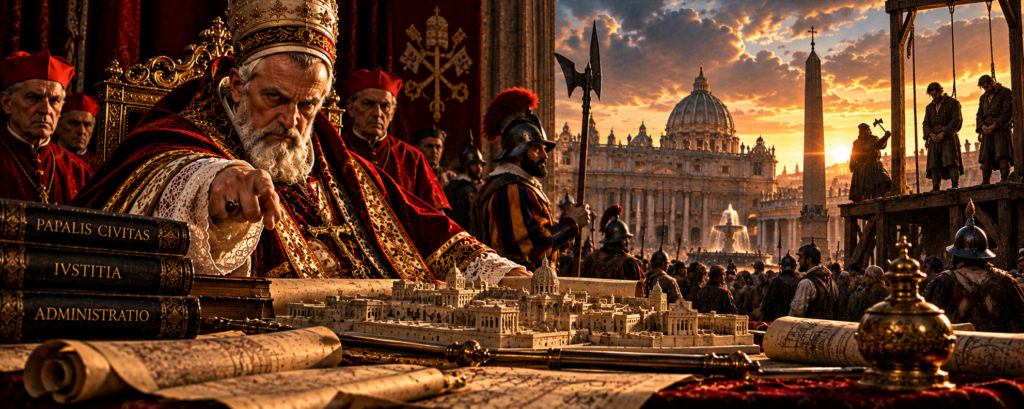
Sixtus V: The Iron Pope Who Ruled Rome Through Fear
Pope Sixtus V (1521–1590) | Reigned 1585–1590
The Morning Rome Discovered What Kind of Pope It Had
Rome had learned to live with violence. By the spring of 1585, armed bandits haunted the roads of the Papal States, feuding noble families protected criminals when it suited them, and travelers approaching the capital could never be entirely certain whether they would reach its gates with their possessions intact. Murder, robbery, kidnapping, and private revenge had become serious problems, while the government of Gregory XIII had struggled to impose order. Then Felice Peretti became Pope Sixtus V, and the atmosphere changed with astonishing speed.
The new pope had no intention of negotiating endlessly with criminals or the aristocrats who sheltered them. Executions became one of the most visible instruments of his government, and the machinery of punishment was deliberately placed where people could see it. Heads and bodies of executed offenders were displayed as warnings, while officials pursued fugitives who had previously treated papal justice as an inconvenience rather than a serious threat. Sixtus wanted fear to travel faster than the bandits did.
Stories about the brutality of his campaign multiplied almost immediately. Later writers claimed that severed heads became so numerous that Rome’s bridges and public places resembled grotesque exhibitions, and some accounts attributed thousands of executions to his short pontificate. Many of these figures are difficult or impossible to verify, and the more sensational anecdotes about Sixtus frequently grew in the retelling. What is not seriously disputed is the underlying reality: he used capital punishment aggressively, made punishment highly visible, and cultivated a reputation for terrifying severity.
That reputation was not an accidental consequence of his policies. Fear was part of the policy. Sixtus understood that a government unable to arrest every criminal could still persuade potential offenders that the consequences of being caught would be catastrophic. Public punishment therefore became a form of political communication, announcing that the weakness of the previous administration had ended.
The results impressed even people who disliked his methods. Roads became safer, organized banditry was attacked with far greater energy, and noble protectors discovered that their status did not guarantee immunity. Papal authority, which had appeared dangerously weak in parts of central Italy, became formidable again. Sixtus restored a degree of order that his predecessor had failed to achieve.
Yet there was something deeply unsettling about the efficiency. The pope did not merely strengthen courts and improve policing; he governed through the deliberate spectacle of punishment. Justice under Sixtus could be swift, uncompromising, and terrifyingly final. The restoration of order came with gallows, decapitations, confiscations, and a ruler determined to make examples of those who challenged him.
This was the contradiction at the center of his reign. Sixtus V became one of the most energetic administrators ever to occupy the papal throne, reorganizing the government of the Church, rebuilding Rome, restoring an ancient aqueduct, moving monumental obelisks, strengthening papal finances, and transforming the physical landscape of the capital. He was intelligent, disciplined, extraordinarily hardworking, and capable of thinking on a scale that few rulers could match.
He was also feared. His government demonstrated how quickly effective administration could become authoritarian when a ruler regarded terror as a legitimate instrument of order. Sixtus did not belong among the Wicked Popes because he lived a life of extravagant sexual corruption or transformed the Vatican into a playground for an enormous dynasty. He belongs because his remarkable achievements were accompanied by a philosophy of government in which mercy often seemed far less useful than fear.
Felice Peretti: The Poor Boy Behind the Iron Pope
Felice Peretti was born on December 13, 1521, at Grottammare in the Marche, then part of the Papal States. His family was of modest circumstances, far removed from the aristocratic worlds of the Medici, Farnese, and Borgia popes. His father, Piergentile, had roots in the nearby community of Montalto, which would later become closely associated with Felice’s identity. The future pope’s beginnings became an important part of the legend surrounding him.
Later stories exaggerated his poverty into picturesque tales of an almost destitute childhood. The most famous tradition portrayed him as a swineherd before entering religious life, an image perfectly suited to the dramatic story of a poor shepherd boy rising to command the Catholic world. The precise details of these anecdotes are uncertain, and some were undoubtedly embellished by later biographers. Nevertheless, his family lacked the wealth and political influence normally associated with elite ecclesiastical careers.
Felice entered the Franciscan order as a young man. Religious life offered education, discipline, and opportunities that might otherwise have remained inaccessible to someone of his background. He proved intellectually capable and developed a reputation for intense study. Theology, preaching, and religious discipline became central to his advancement.
His temperament was already becoming apparent. Felice could be forceful, argumentative, and intensely certain of his own judgment. He did not possess the smooth diplomatic charm expected of a courtier. Those qualities would create enemies throughout his career, but they also helped establish his reputation as a man unwilling to be intimidated.
He was ordained a priest in 1547 and became known as an effective preacher. His abilities brought him increasingly important responsibilities within the Franciscan order. The Catholic Church was then undergoing the enormous transformation associated with the Counter-Reformation. A disciplined friar committed to doctrinal orthodoxy could find powerful patrons.
Felice’s rise therefore reflected both talent and historical opportunity. The Church needed preachers, administrators, inquisitors, and reformers willing to enforce the standards emerging from the Council of Trent. He possessed the determination required for that environment. His lack of aristocratic birth may even have strengthened his hostility toward privileged men who believed themselves beyond discipline.
The future Sixtus V would never forget the value of authority. His early career taught him that institutions functioned only when their rules could actually be enforced. He also learned that enemies accumulated quickly around officials who refused compromise. Both lessons would define his papacy.
The Inquisitor Who Made Enemies
Felice Peretti became involved in inquisitorial work during the middle decades of the sixteenth century. The Roman Inquisition had been established in 1542 and had become a central institution of Catholic efforts to suppress Protestantism and other beliefs condemned as heretical. Its officials investigated suspected doctrinal deviations, examined books, questioned witnesses, and prosecuted individuals accused of religious offenses. Peretti’s seriousness and orthodoxy made him suitable for such responsibilities.
His assignments included service in Venice, where relations between local political authorities and ecclesiastical institutions could be delicate. Venice jealously guarded its independence and did not always welcome aggressive interference from Rome. An inquisitor who insisted upon exercising authority without sufficient diplomatic sensitivity could quickly create conflict. Peretti’s personality was not naturally suited to cautious compromise.
His work consequently generated friction. He developed a reputation for severity and became involved in disputes that eventually led to his recall. The episode demonstrated a recurring pattern in his career: he could perform difficult tasks energetically while simultaneously antagonizing people whose cooperation might have made those tasks easier. His confidence often crossed into inflexibility.
Yet his failures did not end his advancement. Powerful churchmen recognized his abilities, particularly Cardinal Michele Ghislieri, the future Pius V. Ghislieri shared Peretti’s commitment to strict Catholic reform and understood the usefulness of determined officials. Their relationship would become crucial.
When Ghislieri became Pius V in 1566, Peretti’s career accelerated. He was appointed bishop of Sant’Agata de’ Goti and later became a cardinal in 1570. The elevation brought him into the College of Cardinals and placed the papal throne within the realm of possibility. He was still far from being the obvious future pope, but his position had changed dramatically.
As cardinal, he became known as Cardinal Montalto, reflecting his family’s association with that town. He maintained a reputation for austerity and scholarship while continuing to navigate the factional politics of Rome. He also developed an important household around his relatives, demonstrating that his later papacy would not be entirely free from family patronage. The man who would punish aristocratic privilege could still recognize the usefulness of kinship.
His relationship with Gregory XIII was more difficult. Gregory’s pontificate favored a different political style, and Montalto frequently found himself away from the center of power. He appeared comparatively withdrawn and devoted much of his time to study, building, and managing his affairs. Some contemporaries underestimated him.
That underestimation would become part of the legend surrounding his election. Later stories claimed that he deliberately pretended to be frail, humble, or politically harmless so that cardinals would elect him, only to straighten his supposedly bent body the moment the tiara was secured. Such tales are colorful but should not be mistaken for reliable eyewitness evidence. They reflect the astonishment produced by the energy he displayed once elected.
Gregory XIII Leaves Behind a Dangerous Inheritance
Gregory XIII died on April 10, 1585, after nearly thirteen years as pope. His reign had produced extraordinary achievements, including the Gregorian calendar, major educational institutions, and extensive missionary support. Yet his domestic government had become increasingly troubled. Banditry and noble violence were serious problems throughout parts of the Papal States.
The causes were complicated. Gregory’s attempts to recover feudal rights and revenues had antagonized powerful families, while financial pressures and local rivalries contributed to disorder. Armed retainers and bandit groups could operate with protection from influential patrons. Criminal activity became entangled with aristocratic politics.
The geography of the Papal States made enforcement difficult. The territories stretched across central Italy and contained cities, rural districts, mountains, and areas where local loyalties could outweigh obedience to distant officials. Criminal groups could move through difficult terrain and cross political boundaries. Effective suppression required coordination that earlier governments had struggled to achieve.
Banditry was not simply romantic outlawry. Armed groups robbed travelers, extorted communities, kidnapped victims, and participated in violent feuds. Rural populations could find themselves trapped between criminals and government forces. Merchants and pilgrims faced dangerous roads.
The nobility complicated matters further. Powerful families sometimes protected offenders or used armed men to pursue private disputes. Social status could obstruct justice when officials feared retaliation. The impression that wealthy patrons enjoyed practical immunity weakened the credibility of papal government.
Rome itself remained a city where violence could erupt suddenly. The capital contained clerics, diplomats, servants, merchants, laborers, soldiers, pilgrims, and aristocratic households with armed retainers. Personal disputes could become lethal. Carrying weapons was common enough to create constant concern.
Gregory’s government had attempted to address the problem but never fully restored control. By the time of his death, the next pope faced widespread expectations that stronger action was necessary. The cardinals therefore needed more than a theologian or ceremonial leader. They needed a ruler.
Felice Peretti was about to prove that he could be one. The question was not whether he would act decisively. The question was how much blood decisive government would require.
The Conclave That Chose a Supposedly Harmless Old Cardinal
The conclave of April 1585 assembled amid the familiar pressures of European politics. Spain, France, Italian states, and powerful cardinal factions all possessed interests in the outcome. The ideal candidate needed sufficient support to survive these rivalries without appearing completely controlled by one faction. Cardinal Montalto emerged as an acceptable compromise.
He was sixty-three years old, experienced, and respected for personal discipline. His years outside the center of Gregory XIII’s government may have made him appear less threatening than more politically active candidates. He also possessed relationships with important reforming churchmen. His candidacy gained momentum rapidly.
On April 24, 1585, Felice Peretti was elected pope. He chose the name Sixtus V, linking himself with an earlier Franciscan pope, Sixtus IV. The new pontiff immediately revealed enormous energy. Whatever impressions of frailty had existed before the conclave vanished.
The famous story that he threw aside his walking stick and stood upright after his election captures the dramatic transformation imagined by contemporaries and later writers. It should be treated as legend rather than established fact. Yet the story survived because it seemed to express something true about his character. Rome had expected an aging Franciscan and discovered a ruler of extraordinary force.
Sixtus immediately turned his attention toward the restoration of order. He believed that the credibility of government depended upon its ability to punish lawbreakers. Delay encouraged defiance, while visible punishment created obedience. His approach was simple enough to understand and terrifying to experience.
Officials received instructions to pursue bandits aggressively. Rewards encouraged the capture or killing of wanted men, while communities could face pressure to surrender criminals. Those who sheltered offenders risked severe consequences. The protective networks surrounding banditry became targets alongside the bandits themselves.
The new pope was also prepared to challenge nobles who expected preferential treatment. Aristocratic status would not automatically protect offenders from prosecution. This willingness helped make his campaign popular among some ordinary subjects who resented elite impunity. It also made powerful enemies.
Within a remarkably short period, Sixtus established the tone of his government. Rome would no longer mistake papal patience for weakness. The pope intended to rule, and he wanted every criminal in the Papal States to understand what that meant.
The Gallows Become an Instrument of Government
Capital punishment was common in early modern Europe, and Sixtus V did not invent public execution. Governments throughout the continent used hanging, beheading, burning, mutilation, and other punishments to enforce law and demonstrate authority. Executions were often deliberately public because rulers believed spectacle strengthened deterrence. Sixtus inherited this political culture and pushed its logic with unusual determination.
His campaign against violent crime relied heavily upon visible punishment. Executed offenders could be displayed in prominent locations, turning their bodies into warnings. Severed heads were sometimes exhibited as evidence that notorious criminals had been captured. The government wanted the population to see that punishment was no longer theoretical.
Contemporary and later accounts repeatedly emphasize the frequency of executions. Some stories claim that heads appeared around Rome in astonishing numbers almost immediately after Sixtus’s coronation. Exact totals are difficult to establish, and sensational figures should be treated cautiously. Writers fascinated or horrified by Sixtus had strong incentives to exaggerate.
The exaggerations themselves reveal something important about his reputation. People believed extreme stories because they fit the government’s visible character. Sixtus wanted criminals to think that punishment was relentless. A terrifying rumor could therefore serve the same deterrent purpose as an execution.
One famous tradition claims that the pope remarked upon the large number of heads displayed around Rome as evidence of his success. Variations of the anecdote appear in later accounts, but the wording cannot be treated as reliable. Sixtus’s government left enough genuine evidence of severity without requiring invented dialogue. The historical reality is disturbing enough.
Executions under his rule extended beyond notorious bandit chiefs. The government imposed harsh penalties for a range of crimes and treated challenges to public order seriously. The possibility of clemency existed, but Sixtus was not famous for generous pardons. His reputation rested upon the opposite quality.
The philosophy behind the campaign was deterrence through certainty and fear. A bandit who expected endless delays might continue operating, while one who believed capture meant rapid death might reconsider. Sixtus wanted the second expectation to dominate. He turned the state’s punitive power into a psychological weapon.
The ethical problem is obvious from a modern perspective, but it was also visible to some contemporaries. Severe punishment could restore order while creating a government feared almost as much as the criminals it pursued. The streets might become safer, but the gallows became part of the landscape. Sixtus’s Rome exchanged one form of terror for another.
The War Against the Bandits
Banditry posed a direct challenge to papal sovereignty because armed groups controlled territory through fear. They could rob roads, intimidate villages, and retreat into terrain difficult for government forces to penetrate. Some enjoyed support from local populations, whether through loyalty, fear, or resentment toward officials. Others benefited from aristocratic patrons who used them for private purposes.
Sixtus attacked these networks systematically. Government forces pursued known leaders, while rewards encouraged informants and rivals to betray them. Harboring fugitives became dangerous. Communities that protected bandits could face collective consequences.
The campaign also targeted the social structure supporting outlawry. A criminal sheltered by a powerful noble was harder to capture than one isolated from political protection. Sixtus therefore challenged patrons as well as offenders. His willingness to confront aristocratic privilege distinguished his approach.
This did not create a modern system of impartial justice. Early modern legal institutions remained shaped by social hierarchy, political influence, and procedures very different from contemporary criminal law. Torture could be used in judicial investigations, and standards of evidence did not always resemble modern expectations. Sixtus strengthened an authoritarian legal system rather than creating liberal equality before the law.
Nevertheless, his refusal to tolerate certain forms of elite protection had real consequences. Noble families could no longer assume that connections would automatically shield violent retainers. Officials received stronger backing from Rome. The political cost of sheltering criminals increased.
The government’s success became increasingly apparent. Bandit groups were disrupted, leaders were killed or captured, and travel became safer in important areas. Sixtus’s reputation spread beyond the Papal States. Admirers pointed to the restored order as evidence of extraordinary administrative ability.
Critics saw a darker picture. The campaign depended upon ruthless enforcement and a willingness to impose severe punishment rapidly. Innocent people could suffer when communities were pressured for information or when accusations became entangled with personal rivalries. A government obsessed with deterrence risked treating mercy as weakness.
The campaign therefore remains difficult to evaluate in simple terms. Sixtus confronted a genuine security crisis and achieved results where weaker measures had failed. Yet he did so through methods designed to terrify. His success cannot be separated from the violence that produced it.
The Nobles Discover They Are Not Untouchable
One reason Sixtus’s campaign became so famous was his willingness to challenge aristocratic privilege. Noble families had long dominated Italian political life, maintaining armed households and extensive patronage networks. Their connections could frustrate prosecution. Some expected officials to treat their relatives and dependents differently from ordinary criminals.
Sixtus found such assumptions intolerable when they interfered with his authority. A noble who sheltered bandits was not merely protecting a criminal; he was challenging the pope’s government. The issue therefore became one of sovereignty. Sixtus wanted no uncertainty about which authority was supreme within the Papal States.
His policies could consequently win support among people who resented elite impunity. The spectacle of a well-connected offender facing punishment demonstrated that status did not guarantee safety. This aspect of his government complicates the image of simple tyranny. Some of his severity was directed upward against privileged groups rather than only downward against the powerless.
Yet the system still revolved around the will of an extraordinarily powerful ruler. Equality before Sixtus’s punishments was not equivalent to equality under modern law. The pope could intervene personally and shape enforcement priorities. His government depended heavily upon centralized authority.
Noble resistance also created practical dangers. Powerful families possessed wealth, armed retainers, and relationships extending beyond papal territory. Excessive pressure could provoke political instability. Sixtus therefore needed to combine intimidation with calculation.
His ability to do so contributed to his success. He understood that a few highly visible punishments could influence far larger groups. The execution of a protected offender sent a message to every potential patron. Fear multiplied the reach of the government.
The approach resembled his treatment of bandits themselves. Sixtus did not need to punish everyone if he could make everyone believe punishment was possible. The psychological dimension of government mattered enormously. Authority became strongest when people disciplined themselves because they feared what would happen otherwise.
This was one of the secrets of the Iron Pope’s rule. He restored order not merely through soldiers and judges but through reputation. His name became a warning. For five years, that warning carried remarkable power.
Justice, Terror, and the Legends of Sixtus V
Sixtus attracted legends with unusual speed. Stories portrayed him disguising himself to investigate crime, setting elaborate traps for offenders, and devising punishments with theatrical precision. Other anecdotes depicted criminals discovering too late that the apparently harmless pope had anticipated their plans. Many are entertaining, but their historical reliability varies enormously.
One famous group of stories concerns the speed with which severed heads supposedly appeared around Rome after his election. Some later writers supplied precise and enormous numbers, presenting the capital as almost overwhelmed by the remains of executed criminals. Such claims should not be repeated as established statistics. Surviving evidence supports severe enforcement but not every sensational total.
Another tradition portrays Sixtus as using deceptive proclamations to lure criminals from hiding. The pope supposedly offered pardons or safe conduct before finding ways to punish offenders who trusted him. Versions of these stories circulated widely because they portrayed him as cunning as well as ruthless. Their details often belong more to political folklore than secure documentation.
The persistence of such legends nevertheless matters. People rarely invent the same type of story repeatedly around a ruler whose reputation points in the opposite direction. Sixtus became associated with terrifying cleverness because his government genuinely cultivated fear. The legends exaggerated a recognizable reality.
Some stories also reveal admiration. The pope who outwitted criminals could appear as a hero restoring justice to a society plagued by lawlessness. Ordinary people suffering from robbery or aristocratic violence might welcome a ruler willing to act decisively. Severity could look like protection when the alternative was insecurity.
Other observers saw tyranny. A ruler celebrated for bypassing obstacles could also bypass restraint. The same decisiveness admired in stories of captured bandits became frightening when applied to less obvious offenses. Sixtus’s reputation therefore divided contemporaries as much as later historians.
Responsible history requires separating folklore from documented policy. The dramatic legends should be identified as legends rather than woven into the narrative as fact. Sixtus’s real achievements and punishments provide ample material without exaggeration. His government was severe enough to inspire the myths.
The mythology ultimately became part of his legacy. It transformed a five-year pontificate into the reign of an almost superhuman disciplinarian. The pope became larger than life, a figure who seemed capable of seeing every crime and punishing every offender. Fear had survived the man who created it.
Sin Becomes a Matter for the Criminal Law
Sixtus’s harsh approach to government extended beyond robbery and murder. Like other Counter-Reformation rulers, he believed civil authority should defend Christian morality. Behaviors regarded today as private moral matters could therefore become subjects of criminal law. The boundary between sin and crime remained narrow.
The pope issued severe legislation concerning sexual conduct. Adultery, prostitution, and other offenses attracted his attention, while policies concerning abortion became particularly harsh. In 1588, the bull Effraenatam imposed extraordinarily severe ecclesiastical penalties relating to abortion and expanded the circumstances under which they applied. The legislation reflected Sixtus’s determination to use law aggressively in defense of moral teaching.
His successor Gregory XIV substantially modified aspects of the abortion policy in 1591. The rapid revision suggests that Sixtus’s approach had gone further than later church authorities considered workable or appropriate. This is an important reminder that his severity was not simply inevitable because of the era. Even within the sixteenth-century Church, policies could be judged excessively rigid.
Sixtus also took a harsh approach toward prostitution. Earlier popes had alternated between regulation, taxation, segregation, and attempts at suppression. Rome’s large population of clergy, visitors, and transient workers had long sustained commercial sex. Eliminating it proved far more difficult than issuing prohibitions.
Women involved in prostitution were particularly vulnerable to policies framed primarily around punishment. Economic necessity, exploitation, and limited employment opportunities shaped many lives. Moral legislation rarely addressed those underlying conditions. The government could punish behavior more easily than it could eliminate the social circumstances producing it.
The pope’s approach reflected his broader philosophy. Disorder, whether criminal or moral, required decisive correction. Tolerance encouraged repetition, while punishment established boundaries. The state therefore became an instrument of moral discipline.
This mentality was not unique to Catholic government. Protestant rulers also criminalized behavior considered sinful and attempted to enforce religious morality. Early modern Europe generally did not recognize a broad private sphere protected from religious legislation. Sixtus nevertheless stood out for the intensity with which he pursued enforcement.
His moral policies reveal why his legacy cannot be reduced to the successful suppression of violent banditry. The same punitive instincts extended into personal conduct. Once fear became a preferred instrument of government, the range of behaviors subject to coercion could expand. The Iron Pope wanted not merely safer roads but a more obedient society.
Nepotism Returns Through the Peretti Family
Sixtus V had risen from modest circumstances and possessed none of the dynastic background of the Medici or Farnese popes. Yet once elected, he did not entirely escape the familiar papal temptation to advance relatives. Family remained an important source of trusted allies in Renaissance and Counter-Reformation government. The Peretti household benefited significantly from his elevation.
His grandnephew Alessandro Damasceni Peretti was created a cardinal in 1585 while still very young. The appointment immediately placed a member of the family within the highest ranks of the Church. Alessandro became commonly known as Cardinal Montalto. His rapid advancement owed far more to kinship than to decades of ecclesiastical achievement.
Other relatives also benefited from titles, property, and advantageous marriages. Sixtus worked to establish the family’s social position among the Italian elite. The poor origins celebrated in stories of his youth were being replaced by aristocratic status. Papal power offered the means to accomplish that transformation rapidly.
His nepotism was not identical in scale or character to that of Alexander VI or Paul III. Sixtus did not organize his entire pontificate around building a territorial dynasty for a son. His relatives benefited, but his government remained dominated by broader administrative objectives. Nevertheless, the contradiction is obvious.
The pope demanded discipline from others while accepting family advancement as part of government. A young relative could reach the cardinalate because the pope trusted and favored him. Merit therefore operated alongside blood relationship. The practice remained deeply embedded within the papal system.
Sixtus may have regarded trusted relatives as useful instruments rather than simply beneficiaries. A pope surrounded by rival factions needed loyal administrators. Family ties could provide confidence unavailable from ambitious strangers. This logic had justified nepotism for generations.
Yet the practice undermined claims that the reformed papacy had fully abandoned Renaissance habits. The Council of Trent had strengthened institutional discipline, but it had not eliminated the political value of kinship. Sixtus’s government demonstrated that even an austere reformer could participate in the system. His war against privilege stopped short of abolishing privileges useful to himself.
Fifteen Congregations and a New Machinery of Papal Government
If Sixtus V had done nothing beyond suppressing banditry, his reign would still be memorable. His most enduring institutional achievement, however, came through the reorganization of the Roman Curia. He sought to make papal administration more systematic, specialized, and manageable. The reform profoundly influenced the government of the Catholic Church.
In 1588, the apostolic constitution Immensa aeterni Dei reorganized the work of the Curia around fifteen permanent congregations. These bodies were assigned responsibility for particular areas of church government and administration. The system reduced reliance upon temporary committees created for individual problems. It gave the papacy a more stable bureaucratic structure.
Some congregations dealt with religious matters, while others addressed the administration of the Papal States. Responsibilities could include the Inquisition, bishops, religious orders, roads, finances, and other governmental concerns. Cardinals served within these institutions alongside officials and advisers. Decision-making became more specialized.
The reform reflected Sixtus’s practical intelligence. He understood that a pope could not personally manage every issue reaching Rome. Effective government required institutions capable of processing information and making recommendations. Centralization without organization would simply overwhelm the ruler.
His administrative reforms also strengthened papal control. Specialized congregations allowed Rome to supervise church affairs more systematically. Bishops, religious orders, and local institutions became increasingly connected to centralized procedures. The papacy developed greater bureaucratic capacity.
The system evolved substantially after Sixtus’s death, and later popes modified the congregations repeatedly. Nevertheless, the basic principle of permanent specialized departments endured. Modern structures of Vatican government ultimately developed through this longer institutional history. Sixtus’s reforms therefore had consequences extending far beyond his lifetime.
This achievement complicates any simple portrayal of him as merely a brutal disciplinarian. He was not simply an executioner wearing a tiara. He was a sophisticated administrator capable of designing durable governmental institutions. His talent for organization was genuine.
Yet the bureaucratic and punitive sides of his personality were connected. Sixtus believed government should function efficiently because authority mattered. He wanted institutions capable of implementing decisions rather than endlessly discussing them. Whether reorganizing the Curia or hunting bandits, he approached disorder as a problem to be conquered.
Seventy Cardinals and the Shape of the Church
Sixtus also imposed an important limit upon the size of the College of Cardinals. In 1586, he established seventy as the maximum number of cardinals, drawing symbolic inspiration from the seventy elders associated with Moses in biblical tradition. The limit remained influential for centuries. It represented another attempt to impose structure upon an institution that had developed through changing political circumstances.
The College of Cardinals performed multiple roles. Its members advised the pope, governed important institutions, served as diplomats, and elected future pontiffs. The number of cardinals therefore affected both administration and the political balance of the Church. Sixtus wanted a more clearly regulated system.
The reform did not eliminate political appointments. Cardinals continued to emerge from powerful families and international networks. European monarchs sought influence over appointments, while popes rewarded trusted supporters. The College remained deeply connected with politics.
Nevertheless, establishing a formal numerical limit demonstrated Sixtus’s preference for defined structures. He disliked institutions that operated through vague custom when rules could provide greater clarity. His government repeatedly converted flexible arrangements into organized systems. The same instinct shaped his financial and territorial administration.
The number seventy remained the formal maximum until the twentieth century. Later popes eventually expanded the College as the Catholic Church became more global. The longevity of Sixtus’s rule demonstrates its institutional significance. Few administrative decisions from his reign lasted so long.
The reform also strengthened the image of the papacy as an ordered monarchy. The pope stood at the center of a hierarchy whose principal institutions were increasingly regulated. Counter-Reformation Catholicism emphasized discipline and organization. Sixtus embodied those values with unusual intensity.
His critics could interpret such centralization as authoritarian. Supporters regarded it as necessary reform. Both perspectives contain elements of truth. Sixtus made papal government more effective partly by concentrating authority within clearly controlled structures.
The achievement again raises the central question of his reign. Efficiency is not automatically benevolent. A well-organized government can educate, build, and administer effectively, but it can also punish more efficiently. Sixtus strengthened the machinery of the papacy in both senses.
The Pope Who Filled the Treasury
Sixtus inherited serious financial challenges and became determined to strengthen papal finances. He pursued revenue aggressively, reorganized aspects of taxation, and accumulated substantial reserves. His success in building the treasury became famous. Contemporaries marveled at the sums he managed to store.
Large quantities of money were deposited in Castel Sant’Angelo, the massive fortress near the Vatican traditionally associated with papal security. Sixtus treated these reserves as protection against emergencies. A pope without money could not raise troops, respond to famine, support allies, or defend the Papal States. Financial independence was therefore a political weapon.
His fiscal discipline contrasted with governments that spent heavily without maintaining reserves. Sixtus wanted the papacy prepared for crisis. He established rules governing circumstances under which portions of the reserve could be used. The system reflected his desire to impose order upon finances just as he imposed order elsewhere.
Yet accumulating money required extracting it from somewhere. Taxes and fiscal measures placed burdens upon the population. Sixtus expanded certain revenues and pursued financial claims energetically. Subjects who admired safer roads might feel differently when confronted with increased taxation.
He also sold offices and employed financial practices common among early modern governments. Such methods could generate immediate income but carried long-term administrative costs. Offices treated partly as financial assets did not always align neatly with ideals of merit-based government. The supposedly austere pope remained constrained by the fiscal realities of his age.
His building projects also required enormous expenditure. Rome was transformed through aqueducts, streets, monuments, and churches. The pope simultaneously accumulated reserves and spent heavily on urban development. Managing both objectives required intense fiscal pressure.
Some later observers criticized him for hoarding excessive funds. Money locked away for emergencies could not circulate through ordinary economic activity or relieve immediate hardship. The wisdom of his financial strategy therefore remained debatable. What looked like prudent saving to one observer could look like oppressive extraction to another.
Nevertheless, Sixtus left the papacy financially stronger than he had found it. His ability to accumulate reserves demonstrated extraordinary administrative discipline. The achievement enhanced papal independence. It also reinforced the reputation of a ruler determined to make every resource serve the state.
Rome Becomes a Construction Site
Sixtus V approached the physical city of Rome with the same impatience he brought to government. Medieval and Renaissance Rome contained ancient monuments, narrow streets, sprawling neighborhoods, pilgrimage churches, ruins, and rapidly developing districts. Moving through the city could be difficult. The pope envisioned a capital reorganized around major religious sites.
His principal architect and engineer was Domenico Fontana. Together, they launched an ambitious program of urban development. New roads connected important basilicas, while monumental projects reshaped the city’s visual landscape. Sixtus wanted Rome to function as a coherent Christian capital.
The program had practical and symbolic objectives. Straight roads improved movement through the city and helped pilgrims travel between major churches. They also created dramatic vistas ending in monuments or basilicas. Urban planning became a form of religious theater.
Sixtus’s Rome was intended to proclaim the triumph of Christianity over antiquity while simultaneously appropriating the grandeur of the ancient city. Pagan monuments could be moved, crowned with crosses, and incorporated into a Christian landscape. Ancient engineering could serve papal purposes. The city itself became an argument about historical succession.
The construction required enormous resources. Buildings were demolished or altered when they obstructed new projects. Ancient remains could be treated with less reverence than modern preservation standards would demand. Sixtus cared about transforming Rome more than preserving every layer of its past.
His projects changed the city’s development for centuries. Roads established during his pontificate influenced later urban growth. Monumental axes helped create the Rome encountered by Baroque architects. His short reign left an extraordinary physical imprint.
The contrast with his punitive government was striking. The same ruler responsible for gallows and executions also created fountains, avenues, and monumental spaces. His capacity for destruction and construction emerged from the same restless energy. Sixtus wanted disorder removed whether it appeared as banditry or urban confusion.
Few popes accomplished so much in only five years. The speed itself became part of his legend. Rome seemed to be rebuilt almost as relentlessly as it was disciplined. Under Sixtus, even stone appeared subject to papal command.
Bringing Water Back to the Hills
One of Sixtus’s most important practical achievements was the restoration of an ancient water supply serving the higher districts of Rome. Parts of the city lacked adequate access to fresh water because ancient aqueduct systems had deteriorated over centuries. Population growth and urban expansion made the problem increasingly serious. Sixtus understood that development required infrastructure.
The new aqueduct became known as the Acqua Felice, taking its name from the pope’s baptismal name, Felice. It incorporated and restored elements of ancient water systems while extending supply toward areas Sixtus wanted to develop. The project was a major engineering undertaking. Domenico Fontana played an important role in its construction.
Water transformed possibilities for settlement. Neighborhoods on higher ground became more practical for residences, religious houses, gardens, and other development. Fountains supplied public needs while also serving as monuments to papal patronage. Infrastructure and propaganda worked together.
The terminal fountain, known as the Fontana dell’Acqua Felice or Fountain of Moses, became a conspicuous symbol of the project. Its monumental design proclaimed the pope’s achievement. The figure of Moses reinforced the association between water, divine authority, and leadership. Sixtus placed his own heraldic symbols prominently within the composition.
The artistic quality of the fountain has received mixed judgments, particularly regarding its famous statue of Moses. Yet the engineering achievement mattered more than aesthetic criticism. Rome had gained a significant new water supply. The project improved everyday urban life.
Sixtus’s investment in water demonstrates that his government cannot be described simply as punitive. He understood the material requirements of a functioning city. Roads, aqueducts, and administrative institutions were as important to him as criminal enforcement. His authoritarianism existed alongside genuine public works.
The project also reflected his obsession with permanence. Executions created immediate fear, but infrastructure shaped generations. Sixtus wanted his authority carved into the city itself. Water flowing through Rome became another reminder of what his government had accomplished.
The Acqua Felice survived him, unlike the terror inspired by many individual punishments. It remains part of the physical history of Rome. The Iron Pope’s legacy therefore exists not only in chronicles of severed heads but in water, streets, and stone.
Moving the Vatican Obelisk
Perhaps no single event captured Sixtus V’s determination more dramatically than the relocation of the Vatican Obelisk in 1586. The enormous ancient Egyptian monument had stood near the old site of Nero’s circus for centuries. Moving it to the square before St. Peter’s Basilica presented an extraordinary engineering challenge. Failure could destroy the monument and humiliate the pope.
Domenico Fontana designed the operation. Hundreds of workers, dozens of horses, ropes, winches, and wooden structures were required. The project demanded careful coordination. Even a small error could cause catastrophe.
On April 30, 1586, the obelisk was lowered from its ancient position. Months later, on September 10, it was raised at its new location. The operation became one of the great engineering spectacles of Renaissance Rome. Sixtus had accomplished something many considered almost impossible.
A famous legend claims that absolute silence was ordered during the raising and that anyone who spoke faced death. According to the story, a sailor named Bresca noticed the ropes overheating or stretching and shouted that they should be wetted, thereby saving the operation. The pope supposedly rewarded him rather than punishing him. The anecdote became enormously popular, but its details should be treated as traditional lore rather than unquestioned fact.
What is certain is that the relocation required remarkable engineering skill. The obelisk was successfully erected and crowned with Christian symbolism. An ancient monument associated with imperial Rome had been transformed into part of the papal landscape. Sixtus understood the symbolic power perfectly.
The project proclaimed Christian conquest over pagan antiquity. Rather than destroying the monument, the pope appropriated it. The obelisk now served the Church whose basilica dominated the surrounding area. Ancient imperial grandeur had been incorporated into Catholic Rome.
Sixtus subsequently moved or re-erected other ancient obelisks at important locations. They became markers within his urban plan, helping connect major churches through visual axes. Rome’s ancient past was reorganized around its Christian present. Monumental archaeology became an instrument of papal ideology.
The obelisks remain among the most visible symbols of his reign. They demonstrate the astonishing scale of his ambition. A pope who refused to accept lawlessness also refused to accept the city as he had inherited it. Criminals, bureaucracies, streets, water systems, and ancient monuments were all expected to move when Sixtus commanded.
The Destruction Hidden Inside the Rebuilding
Sixtus’s transformation of Rome came at a cost. Renaissance attitudes toward ancient monuments differed substantially from modern archaeological preservation. Ruins could be quarried for building materials, altered for new purposes, or demolished when they obstructed development. The pope’s determination to remake the city sometimes threatened surviving structures.
His treatment of the Septizodium became particularly notorious. This monumental ancient façade, associated with the emperor Septimius Severus, had survived in a damaged but impressive state near the Palatine. Sixtus ordered its demolition. Materials were reused in other construction projects.
From his perspective, ancient ruins possessed value when they could serve Christian Rome. A monument with little practical purpose could become a source of marble and stone. The historical significance later generations would attach to such remains did not always determine sixteenth-century decisions. Utility and symbolism mattered more.
The destruction demonstrates the aggressive character of Sixtus’s urban vision. He was not preserving Rome as a museum. He was rebuilding it as a functioning capital. Anything that interfered with that objective could become expendable.
Other projects similarly altered the ancient and medieval city. Streets cut through established neighborhoods, while buildings were modified or removed. Urban transformation always creates winners and losers. Sixtus’s methods left little room for sentimental resistance.
His approach mirrored his government more broadly. Disorder was not something to negotiate with indefinitely. It was something to clear away. The physical city received the same treatment as its criminal population.
The results were undeniably impressive. Rome became easier to navigate, major religious sites were connected, and new infrastructure supported expansion. Yet lost monuments could never be restored. The price of modernization included irreversible destruction.
Sixtus’s architectural legacy therefore contains the same moral complexity as his criminal policy. He accomplished extraordinary things because he was willing to act with extraordinary force. The question repeatedly raised by his reign is whether effectiveness alone can justify the damage inflicted along the way.
St. Peter’s Dome Rises Over Rome
Construction of the new St. Peter’s Basilica had begun decades before Sixtus V, but progress remained incomplete when he became pope. Michelangelo’s enormous dome had been designed but not yet fully constructed. Sixtus wanted the project advanced rapidly. Once again, he turned to Domenico Fontana and other skilled architects and engineers.
The work accelerated during his pontificate. Giacomo della Porta modified aspects of Michelangelo’s design and supervised construction of the dome with Fontana. The project required enormous resources and technical expertise. Sixtus supplied both money and political pressure.
By 1590, the great dome had been substantially completed, though finishing work continued after Sixtus’s death. Its rise transformed the Roman skyline. The basilica became an increasingly dominant symbol of Catholic renewal. Few architectural projects could have better expressed the confidence of the Counter-Reformation papacy.
Sixtus did not live to see every aspect of St. Peter’s completed. The basilica itself would require additional decades of construction. Nevertheless, his contribution was decisive. His insistence upon speed helped push the dome toward completion.
The project illustrates another side of his financial policy. The reserves he accumulated did not prevent him from spending heavily on works he considered essential. Sixtus could be simultaneously frugal and extravagant depending upon the purpose. Money was valuable because it allowed authority to act.
The dome also provided a symbolic counterpoint to Protestant Europe. Rome’s monumental churches proclaimed the strength and permanence of Catholicism. Architecture became an argument expressed in stone. Sixtus understood the political meaning of magnificence.
The skyline created during his era remains central to popular images of Rome. Visitors rarely associate its beauty with the severe criminal policies of the pope who helped produce it. Yet the two histories belong together. The city rising magnificently above the horizon was governed by the same man whose gallows terrified offenders below.
Printing the Bible—and Creating Another Problem
Sixtus V also became involved in the complicated history of producing an authoritative Latin Bible. The Council of Trent had affirmed the importance of the Vulgate, the traditional Latin biblical text used by the Western Church. Yet surviving manuscripts and printed editions contained variations. Catholic authorities wanted a reliable standardized edition.
Sixtus approached the problem with characteristic impatience. Scholars had spent years examining manuscripts and debating textual questions. The pope became dissatisfied with the pace of the work and intervened directly. He pushed the project toward completion.
The resulting edition, commonly known as the Sixtine Vulgate, appeared in 1590. Sixtus personally took a strong interest in the text and made numerous editorial decisions. He intended the edition to possess authoritative status. The project represented his desire to impose order upon another complicated institution.
Problems quickly became apparent. The edition contained printing errors and controversial textual choices. Sixtus died shortly after its publication. His successors withdrew the edition and prepared a revised version.
Under Clement VIII, a new edition appeared in 1592, commonly called the Sixto-Clementine Vulgate. The awkward naming helped preserve institutional continuity while quietly correcting the problems associated with Sixtus’s text. The episode became an embarrassing example of excessive papal intervention in scholarly work. A project intended to establish certainty instead required rapid revision.
The failure reveals an important limitation in Sixtus’s governing style. Decisiveness can solve problems created by hesitation, but scholarship does not always benefit from impatience. Textual criticism requires careful comparison, uncertainty, and revision. The pope’s instinct to force completion could become counterproductive.
His involvement also demonstrates the extraordinary range of his interests. Criminal justice, finance, urban planning, church administration, biblical scholarship, and international politics all received his attention. He possessed almost relentless intellectual and administrative energy. Few areas seemed beyond his desire to intervene.
The Vulgate episode offers a useful warning about his reign. Sixtus often succeeded because he refused to tolerate delay. In this case, the same quality produced a flawed result. The Iron Pope could make decisions quickly, but speed did not guarantee correctness.
Elizabeth I and the Spanish Armada
International politics presented Sixtus with problems that could not be solved through executions or administrative decrees. Protestant England remained a major concern for the papacy. Elizabeth I had been excommunicated by Pius V in 1570, and subsequent popes continued hoping for the restoration of Catholic rule. By the 1580s, conflict between England and Catholic Spain was approaching open war.
Philip II of Spain planned an enormous naval expedition against England. The enterprise became known as the Spanish Armada. Its objectives involved military, dynastic, and religious considerations. Rome watched the preparations with intense interest.
Sixtus supported the goal of restoring Catholicism in England but remained cautious about committing papal money before success appeared likely. He negotiated with Philip and promised financial assistance under conditions connected with the expedition’s progress. The pope did not simply hand Spain unlimited funds. His famous financial caution remained evident.
The execution of Mary, Queen of Scots, in February 1587 intensified Catholic outrage. Mary had been a Catholic claimant to the English throne and had become involved in conspiracies against Elizabeth. Her death eliminated a major dynastic alternative. Sixtus condemned the execution.
Preparations for invasion continued. In 1588, the Spanish Armada sailed toward the English Channel, intending to coordinate with forces under the Duke of Parma in the Netherlands. The operation encountered logistical difficulties, English resistance, and disastrous weather. The fleet failed to achieve its objective.
Sixtus’s reaction was characteristically pragmatic. He had supported the Catholic cause but was unwilling to sacrifice papal resources blindly. His relationship with Philip II contained tension because the pope feared excessive Spanish dominance in Italy as much as he opposed Protestant England. Catholic solidarity did not erase political rivalry.
The Armada’s failure demonstrated the limits of papal influence. Sixtus could bless an enterprise, negotiate subsidies, and encourage Catholic rulers. He could not control winds, naval strategy, or the competing interests of European monarchies. International politics resisted the absolute authority he exercised at home.
The episode also reveals why portraying Sixtus simply as an agent of Spain would be inaccurate. He wanted Protestant England restored to Catholicism, but he did not want Philip II to become overwhelmingly powerful. His diplomacy balanced religious objectives against Italian political realities. Even the Iron Pope had to compromise when dealing with kings he could not execute.
Henry of Navarre and the Problem of France
France presented an equally complicated challenge. The French Wars of Religion had continued for decades, dividing Catholics and Huguenots while weakening royal authority. By the late 1580s, the succession itself had become entangled with religious conflict. Henry of Navarre, a Protestant, stood increasingly close to inheriting the French crown.
For Sixtus, the possibility of a Protestant king ruling France was unacceptable. France was one of Europe’s great Catholic monarchies. Its conversion into a Protestant-led kingdom could transform the balance of religious power. The pope therefore became deeply involved in the succession crisis.
In 1585, Sixtus issued a declaration against Henry of Navarre and Henry of Condé, asserting consequences for their dynastic claims because of their Protestantism. The action reflected the papacy’s continuing belief that religious authority could influence political legitimacy. It echoed earlier confrontations between popes and Protestant monarchs.
Yet French politics were extraordinarily complicated. The Catholic League, dominated by the Guise family, opposed Henry of Navarre and exerted pressure upon King Henry III. Philip II of Spain supported militant Catholic interests. The French monarchy struggled to preserve its independence from both internal factions and foreign intervention.
Sixtus did not trust Spain enough to support every Spanish objective. He also became uneasy with the growing power of the Catholic League. A France dominated by Philip II could threaten the political balance of Italy. Religious solidarity again collided with geopolitical calculation.
The crisis intensified dramatically in 1588 when Henry III ordered the assassination of Henry, Duke of Guise, and his brother Cardinal Louis of Guise. The killing of a cardinal created an explosive confrontation with Rome. Sixtus demanded explanations and placed pressure upon the French king. The relationship deteriorated severely.
Henry III was himself assassinated in August 1589 by Jacques Clément, a Dominican friar. The dying king recognized Henry of Navarre as his successor. France now faced the possibility that the man Sixtus had condemned would become Henry IV. The political landscape had changed again.
Sixtus began reconsidering his position as the danger of Spanish domination became more obvious. He did not live long enough to witness Henry IV’s conversion to Catholicism in 1593 or his eventual reconciliation with Rome. His final policy toward France remained caught between religious rigidity and political necessity. The situation exposed the limits of absolutism in diplomacy.
The Pope Who Could Not Control Catholic Kings
Sixtus’s relations with Philip II reveal an important contradiction in papal power. Within the Papal States, the pope could issue commands backed by police, courts, and executions. In international affairs, he had to negotiate with rulers possessing armies and resources far greater than his own. The difference forced him into a diplomacy he sometimes found frustrating.
Philip II presented himself as a defender of Catholicism. His monarchy fought Protestant rebels in the Netherlands, confronted England, and supported Catholic interests in France. Yet Spanish power also threatened Italian political independence. A pope could admire Philip’s religious objectives while fearing his political dominance.
Sixtus repeatedly attempted to preserve room for papal maneuver. He did not want Rome reduced to an instrument of Spanish policy. Financial negotiations over the Armada demonstrated his caution. His handling of France revealed similar concerns.
The pope’s temper sometimes complicated diplomacy. Ambassadors encountered a ruler capable of forceful and unpredictable reactions. Sixtus could speak passionately and change tactical positions as circumstances evolved. Foreign courts found him difficult to manage.
Yet this unpredictability also protected papal independence. Philip could never assume that Sixtus would automatically support Spain simply because both were Catholic. The pope maintained his own interests. He understood that the survival of papal political autonomy required balancing stronger powers.
The French crisis made this particularly clear. Supporting the Catholic League too strongly could strengthen Spanish influence, while tolerating Henry of Navarre risked accepting a Protestant ruler. Sixtus moved between these dangers. Neither option satisfied his religious and political objectives simultaneously.
His inability to dictate outcomes abroad contrasted sharply with his reputation at home. Bandits could be executed, but kings had to be persuaded. Noble families within the Papal States could be intimidated, but Philip II commanded a global empire. International politics imposed limits even Sixtus could not ignore.
The contrast humanizes his government without excusing its severity. Sixtus was not an omnipotent tyrant. He was a ruler operating within a complicated European balance of power. His harshness was greatest where his authority was strongest.
The Famine and the Limits of Iron Government
The later 1580s brought serious economic difficulties to parts of Italy. Poor harvests and disruptions contributed to food shortages. Governments faced the challenge of securing grain for urban populations. Rome, with its large population and dependence upon imported food, was particularly vulnerable.
Sixtus attempted to manage grain supplies through government intervention. The papal administration regulated aspects of the market and sought additional sources of food. Such measures reflected longstanding practices in Italian cities. Ensuring affordable bread was a basic political responsibility.
Yet economic problems could not be solved as easily as banditry. A poor harvest could not be executed, and grain could not be frightened into growing. Market controls could create unintended consequences. The pope’s preference for command encountered the complexity of economic life.
His government invested in agricultural projects and attempted to encourage cultivation. Sixtus also pursued plans involving the drainage of marshes and the improvement of land. Some projects achieved limited results, while others proved expensive or difficult. The ambition remained characteristic.
Food shortages intensified public resentment toward taxation and government controls. People who had admired the suppression of criminals could still resent high prices. The benefits of monumental building projects offered little comfort to families struggling to purchase bread. Political legitimacy depended upon daily survival as well as spectacular achievements.
Sixtus’s financial reserves attracted particular criticism during periods of hardship. Money stored in Castel Sant’Angelo represented security from the government’s perspective. To suffering subjects, enormous reserves could appear as wealth withheld while ordinary people struggled. The distinction between prudent finance and excessive hoarding became politically sensitive.
The crisis revealed the limits of authoritarian efficiency. Sixtus could command officials and punish corruption, but he could not eliminate every structural problem through force. Economic systems responded to weather, trade, incentives, and local conditions. Government power remained substantial but incomplete.
These difficulties did not erase his accomplishments. They demonstrate that even the most energetic ruler faced problems beyond personal will. The Iron Pope could make Rome fear him. He could not make nature obey.
The Jewish Communities Under Sixtus V
Sixtus’s policies toward Jewish communities differed significantly from those of Pius V. The earlier pope had expelled Jews from most of the Papal States in 1569, allowing residence primarily in Rome and Ancona. Gregory XIII had maintained a system of discrimination while sometimes moderating particular restrictions. Sixtus adopted a somewhat more pragmatic approach.
In 1586, he issued the bull Christiana pietas, which relaxed some of the restrictions imposed upon Jewish residence and economic activity. Jews were again permitted to settle in several cities of the Papal States. The policy reflected economic considerations as well as administrative pragmatism. Sixtus recognized the commercial usefulness of Jewish communities.
The measure did not establish religious equality. Jews remained subject to special restrictions, taxes, and the broader discriminatory framework of papal society. Conversion remained a desired objective of church policy. Christian supremacy was assumed rather than questioned.
Nevertheless, the change mattered to families previously excluded from papal territories. Opportunities for residence and commerce expanded. Communities could re-establish themselves in places from which earlier policies had driven them. The decision partially reversed one of Pius V’s harshest measures.
Sixtus’s motives were not necessarily modern ideas of tolerance. Economic benefit and effective administration influenced his government. He could recognize that discriminatory restrictions harmed commerce without embracing religious pluralism as a principle. Practicality sometimes moderated ideology.
His policy demonstrates why placing popes into simple categories can obscure important differences. The same ruler who executed criminals with terrifying severity could adopt a comparatively less restrictive policy toward Jewish residence. Historical actors rarely behave according to a single consistent moral pattern. Sixtus’s authoritarianism did not automatically produce maximum repression in every area.
Later popes would reverse some of his concessions. The instability of Jewish legal status remained a recurring feature of papal government. Communities depended heavily upon the preferences of individual pontiffs. Rights granted by one ruler could disappear under another.
For Sixtus’s legacy, the episode provides an important counterweight. His government was capable of pragmatic relaxation as well as brutal enforcement. He was not uniformly harsher than every predecessor in every policy. The darkness of his reign lies primarily in his philosophy of punitive government rather than indiscriminate hostility toward every minority.
The Pope Who Wanted to Rebuild the World
Sixtus’s extraordinary building program extended beyond the most famous projects. He improved streets, developed religious complexes, supported the Lateran Palace, and reshaped important approaches to Rome’s basilicas. His vision was comprehensive. The city would become a more ordered expression of Catholic authority.
He was particularly interested in connecting major pilgrimage churches. Straight avenues helped pilgrims move through Rome while creating dramatic visual relationships between sacred sites. Obelisks served as markers within this network. The city became easier to understand physically and symbolically.
The Lateran, historically associated with the papacy before the Vatican became dominant, received substantial attention. Sixtus ordered major reconstruction of the Lateran Palace. The project reinforced the importance of the basilica and surrounding complex. Once again, medieval structures could be sacrificed to the new vision.
He also completed or advanced work at Santa Maria Maggiore, a basilica closely associated with his personal devotion and eventual burial. The magnificent Sistine Chapel there, not to be confused with the Vatican’s Sistine Chapel named for Sixtus IV, became an important monument to his pontificate. His tomb would eventually occupy this setting.
The pope’s heraldic imagery appeared throughout his projects. Lions, pears, stars, and other symbols associated with the Peretti arms proclaimed patronage. Urban development became inseparable from personal commemoration. Sixtus wanted future generations to know who had transformed the city.
This desire for permanence was hardly unusual among popes. Renaissance and Baroque Rome emerged through repeated efforts by pontiffs to leave visible monuments. Sixtus distinguished himself through the extraordinary concentration of projects within a short period. Five years produced changes that might have occupied another ruler for decades.
The speed depended upon centralized decision-making and substantial financial resources. Consultation could be limited when the pope had already decided what should happen. The same authoritarianism that frightened criminals allowed construction projects to proceed rapidly. Political method and architectural achievement were intertwined.
Rome still bears the imprint of those decisions. Visitors encounter his obelisks, fountains, streets, and architectural projects without necessarily knowing the government behind them. Beauty has outlived fear. Yet the two emerged from the same relentless desire to impose order.
Five Years That Felt Like a Generation
Sixtus V reigned for only a little more than five years. The brevity of the pontificate makes the scale of his accomplishments remarkable. He reorganized the Curia, regulated the College of Cardinals, strengthened finances, suppressed banditry, transformed Rome, built infrastructure, intervened in European politics, and pursued biblical and ecclesiastical reforms. Few rulers compressed so much activity into such a short period.
His work habits became legendary. Sixtus demanded reports, reviewed projects, and involved himself deeply in administration. Officials could find the pace exhausting. The pope expected government to move at his speed.
His temperament contributed to the intensity. He could become angry quickly and possessed little patience for incompetence. People approaching him had reason to prepare carefully. His approval could accelerate a career, while his displeasure could be dangerous.
The government therefore depended heavily upon his personal energy. This produced remarkable results while he remained healthy enough to supervise affairs. It also created risks because systems centered upon a powerful individual can change rapidly after that person’s death. Some of his policies were indeed reversed by successors.
His financial reserves survived, although later governments used them differently. His administrative reforms endured in modified form. His urban projects became permanent features of Rome. His severe criminal policies, however, lost some of their intensity.
The contrast demonstrates which achievements depended upon institutions and which depended upon personality. Roads and aqueducts remained after the pope disappeared. Fear required continual reinforcement. Once the source of terror died, the atmosphere could change quickly.
Sixtus understood the importance of institutional permanence, which explains his Curial reforms. Yet his public-order strategy remained closely associated with his own fearsome reputation. Criminals were not merely afraid of papal law. They were afraid of Sixtus.
By 1590, that name had become one of the most powerful symbols in Italy. Admirers regarded him as the ruler who rescued the Papal States from lawlessness. Enemies regarded him as a tyrant. Both were waiting to see what would happen when the Iron Pope was gone.
The Death of Sixtus V
During the summer of 1590, Sixtus’s health deteriorated. He was approaching his sixty-ninth birthday and had governed with relentless intensity for five years. Fever and illness weakened him. The ruler who had seemed capable of commanding everything finally encountered an enemy beyond punishment.
Sixtus V died on August 27, 1590, at the Quirinal Palace. His death immediately transformed the political atmosphere. Rome had lost a ruler whose personality had dominated the city. The fear that had surrounded his government no longer possessed the same force.
Contemporary hostility became dramatically visible. Reports indicate that crowds expressed anger toward his memory, and a statue erected in his honor on the Capitoline was attacked and destroyed. Such reactions reflected resentment accumulated during years of taxation, severe punishment, and authoritarian rule. The pope who had made criminals fear the government had also made many subjects fear the pope.
His supporters could point to an extraordinary record. The roads were safer, finances stronger, Rome transformed, and papal administration more organized. Banditry had been suppressed with an effectiveness Gregory XIII had never achieved. The physical and institutional evidence of success was everywhere.
His critics remembered the cost. Executions had become a spectacle of government, taxes had been burdensome, and Sixtus’s temper had created enemies. His relentless interventions could feel oppressive. The order he imposed had rarely been gentle.
The destruction of his statue offered an ironic conclusion to a reign obsessed with monumental permanence. Sixtus had filled Rome with objects intended to proclaim his authority for centuries. Yet one image of the pope could not survive the immediate anger following his death. Stone proved more vulnerable than reputation.
His body was eventually buried at Santa Maria Maggiore in the chapel he had commissioned. The magnificent monument reflected the grandeur of his papacy. The friar from modest beginnings had become one of the great builders of Rome. His remains rested within a city permanently altered by his will.
Yet his death did not settle the question of his legacy. Was he the tyrant who covered Rome with severed heads, or the administrator who rescued the Papal States from chaos? The answer depends partly upon whose experience is being considered. Sixtus had been both protector and terror.
Rome After the Iron Pope
The papacy entered an unstable period after Sixtus’s death. His immediate successor, Urban VII, died after only thirteen days as pope and never even reached a coronation. Gregory XIV followed and reversed or modified some of Sixtus’s policies. The rapid succession of pontiffs demonstrated how quickly papal priorities could change.
Banditry did not disappear permanently because Sixtus had executed large numbers of offenders. Social and economic conditions continued producing crime, while political instability created new opportunities for armed groups. His campaign had suppressed the problem rather than eliminating its underlying causes. Later governments still had to confront disorder.
His financial system also changed. Successors drew upon the reserves he had accumulated. The enormous sums stored in Castel Sant’Angelo had been intended for emergencies, and subsequent rulers found reasons to use them. Hoarded wealth could not remain untouched indefinitely.
The Curial reforms proved more durable. Permanent congregations continued shaping church administration. Their responsibilities changed over time, but the organizational principle survived. Sixtus had created structures capable of outliving his personality.
His urban transformation was even more permanent. Roads, obelisks, fountains, and architectural projects continued defining Rome. Later popes built upon the framework he established. The Baroque city developed partly from the axes and monumental planning of the Sixtine period.
The contrast between temporary fear and permanent infrastructure is revealing. Executions dominated contemporary impressions, but the gallows disappeared. Water systems and streets remained. Sixtus’s most constructive achievements ultimately proved more durable than his terror.
Yet memory preserved the darker side. Stories about his punishments circulated for generations. Writers portrayed him as the archetype of the ruler who restored order through ruthless severity. The distinction between history and legend became increasingly blurred.
His reputation therefore survived in two parallel forms. One Sixtus was the brilliant reformer and builder. The other was the terrifying pope who supposedly filled Rome with severed heads. The historical man existed somewhere between them, complicated enough to sustain both traditions.
Was Sixtus V Really a Wicked Pope?
Sixtus V does not fit the traditional image of a corrupt Renaissance pope. He was not famous for mistresses, luxurious banquets, or the creation of an enormous dynasty for illegitimate children. His personal habits were comparatively disciplined. He took the responsibilities of government extraordinarily seriously.
He also inherited a genuine crisis. Banditry, violent crime, noble feuds, and weak enforcement threatened public security. Travelers and ordinary residents suffered from lawlessness. A ruler who restored order provided a real public benefit.
Sixtus succeeded where Gregory XIII had struggled. Criminal networks were attacked, noble protection became less reliable, and papal authority was restored. Roads became safer and government commands carried greater weight. These were meaningful achievements rather than propaganda inventions.
His administrative accomplishments were even more impressive. The Curia became more systematically organized, the College of Cardinals received a formal numerical limit, finances were strengthened, and Rome underwent enormous physical transformation. The Acqua Felice improved the city’s water supply, while new streets and monuments influenced urban development for centuries. The dome of St. Peter’s rose rapidly during his reign.
Yet effective government does not automatically mean humane government. Sixtus deliberately used fear as an instrument of political control. Public executions and the display of bodies communicated authority through terror. His reputation for severity was cultivated because he believed deterrence required people to fear punishment.
The exact number of executions attributed to him remains uncertain, and the most extravagant totals should not be repeated uncritically. Legends accumulated around his reign because later writers enjoyed portraying him as almost supernaturally ruthless. Historical caution therefore requires separating documented severity from sensational folklore. There is no need to exaggerate his actions to recognize their brutality.
His moral legislation also demonstrates the wider reach of his punitive instincts. Sixtus was willing to use state and ecclesiastical power to regulate behavior far beyond violent crime. His 1588 abortion legislation proved so severe that aspects were substantially revised shortly after his death. Even within his own religious tradition, later authorities did not preserve every extreme measure.
His nepotism further complicates the image of impartial discipline. The pope who challenged aristocratic privilege still advanced members of his own family. His grandnephew’s rapid elevation to the cardinalate demonstrated that kinship retained political value. Sixtus punished one form of privilege while participating in another.
For the Wicked Popes category, his strongest claim therefore rests upon authoritarian severity rather than private corruption. He was capable, intelligent, disciplined, and extraordinarily productive. He was also willing to make death a highly visible instrument of administration. The disturbing feature of his reign is not incompetence but the effectiveness with which fear could be organized.
The Price of Order
Sixtus V forces historians to confront an uncomfortable question about government. What happens when a ruler confronts a genuine crisis, adopts brutal methods, and succeeds? It is easy to condemn cruelty when it produces only chaos. Judgment becomes more complicated when severe methods produce safer roads, stronger institutions, and functioning administration.
The bandits Sixtus pursued were not imaginary enemies invented to justify repression. Violent crime genuinely threatened the Papal States. Noble protection really could obstruct justice. Gregory XIII’s government had struggled with the problem.
Sixtus’s response therefore appealed to people who had suffered from insecurity. A merchant robbed on a dangerous road might care little about the rights of the bandit responsible. A village intimidated by armed criminals might welcome soldiers capable of defeating them. Order possesses enormous value when disorder becomes frightening.
Yet the state acquires dangerous habits when fear becomes its preferred language. A ruler who learns that terror works against murderers may apply similar methods to lesser offenders. Punitive power can expand from protecting society into controlling it. Sixtus’s moral legislation illustrates that possibility.
There is also the problem of proportionality. Severe punishment may deter crime without being necessary in every case. Public displays of executed bodies were intended to humiliate and frighten as well as incapacitate offenders. The spectacle itself became part of government.
Modern readers should avoid imposing contemporary legal standards mechanically upon sixteenth-century society. Capital punishment and public execution were widespread throughout Europe. Sixtus operated within a world that accepted forms of punishment now regarded as cruel. His policies nevertheless attracted attention even among contemporaries because of their intensity.
Context explains severity without erasing it. Sixtus made choices within the range available to him. Other popes confronted similar problems with different levels of punishment. His distinctive reputation emerged precisely because his approach was unusually forceful.
The price of order under Sixtus was therefore not simply the lives of criminals. It was the creation of a political culture in which fear became evidence that government was working. That legacy deserves scrutiny even when the resulting order was real.
The Builder and the Executioner
The easiest way to misunderstand Sixtus V is to choose only one version of him. The heroic interpretation celebrates the poor Franciscan who rose through talent, defeated bandits, reorganized the Church, filled the treasury, and rebuilt Rome. The darker interpretation sees an authoritarian ruler obsessed with punishment, taxation, and control. Both contain substantial truth.
His architecture cannot be separated from his politics. The roads, fountains, aqueducts, and obelisks expressed the same determination to impose order visible in his criminal policies. Sixtus looked at chaos and imagined straight lines. Whether the chaos consisted of tangled streets or armed bandits, his instinct was to force it into submission.
His administrative reforms followed the same pattern. The Curia became a collection of specialized congregations because Sixtus disliked institutional confusion. The College of Cardinals received a numerical limit because he preferred defined structures. Financial reserves accumulated because he feared vulnerability.
Even his mistakes reflected the same temperament. The Sixtine Vulgate suffered because the pope pushed scholarship toward completion before every problem had been resolved. His severe moral legislation demonstrated impatience with gradual change. The qualities responsible for his greatest successes could also produce excess.
This makes him more historically interesting than a merely corrupt ruler. Sixtus did not fail because he lacked discipline. He sometimes became dangerous because he possessed too much certainty in the value of discipline. He believed strongly in the ability of authority to correct disorder.
The contrast between his background and his eventual power is equally striking. The boy from a modest family became a ruler before whom princes, nobles, criminals, architects, and cardinals had to calculate their words carefully. He used the papacy to remake both his family and his city. His rise remains one of the most extraordinary social ascents in papal history.
His monuments still dominate Rome, while most of the people he executed have disappeared into archival fragments or complete anonymity. Power determines which lives receive marble tombs and which become warnings displayed above a bridge. Sixtus understood that imbalance instinctively. He spent his pontificate making certain that history would remember who had ruled.
The Pope Who Made Rome Afraid
Sixtus V inherited a Papal State troubled by violent crime, aristocratic defiance, financial weakness, and administrative disorder. In five extraordinary years, he attacked those problems with an intensity few rulers could match. Banditry was suppressed, noble protection of criminals became more dangerous, the treasury accumulated enormous reserves, and the machinery of papal government was reorganized. Rome itself was transformed through roads, aqueducts, fountains, obelisks, churches, and monumental construction.
The achievement was real, and dismissing it would distort the history of his pontificate. Sixtus possessed extraordinary administrative talent and an almost relentless capacity for work. He could understand an institutional problem, decide upon a solution, and force officials to implement it. Many rulers promise order, but Sixtus actually produced it.
The disturbing question concerns the methods he considered acceptable. Executions became conspicuous demonstrations of authority, bodies became warnings, and the pope deliberately cultivated a reputation capable of frightening potential offenders. Some later stories exaggerated the number and theatricality of his punishments, but the legends grew from an authentic foundation of severe government. Sixtus wanted fear to reinforce the law, and for a time it worked.
His reign therefore resists the comforting assumption that cruel rulers must also be incompetent rulers. Sixtus was often brutally effective. The same personality that could reorganize the Curia and restore Rome’s water supply could make punishment into political theater. Efficiency and severity strengthened one another rather than existing as opposites.
His legacy can still be read across Rome. Water flows from the system he restored, obelisks stand where his engineers raised them, streets follow the lines his planners imposed, and the dome of St. Peter’s rose dramatically during his reign. The city remembers the builder even when visitors know nothing about the executions that helped define his reputation. Stone has preserved the grandeur more visibly than the fear.
Yet the fear belongs to the story just as much as the fountains and monuments do. Sixtus V demonstrated how easily the desire for order can become a justification for brutality when the ruler believes results are the highest proof of justice. He made the Papal States more governable, but he also made papal punishment something people were expected to dread. The Iron Pope’s darkest legacy is therefore not that his government failed, but that so much of it succeeded—and that its success made ruthless authority look frighteningly persuasive.