
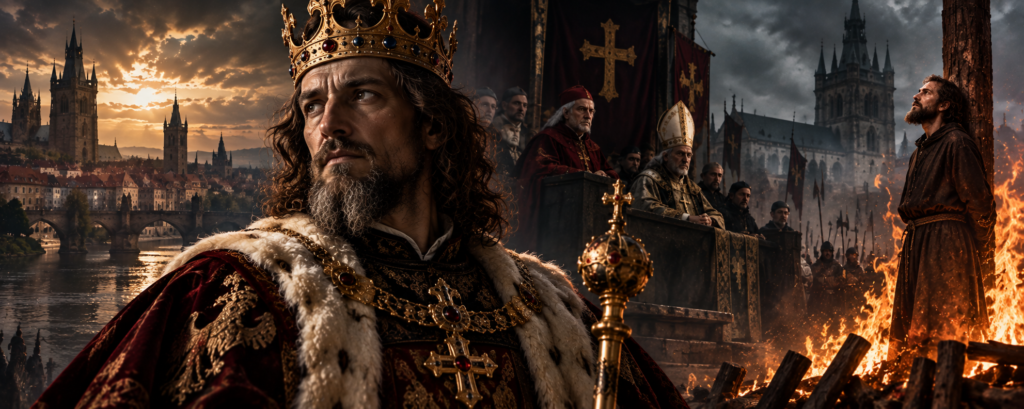
Sigismund: The Emperor Who Burned a Reformer and Set a Kingdom on Fire
King of Hungary and Croatia, 1387–1437 | King of the Romans, 1411–1437 | King of Bohemia, 1419–1437 | Holy Roman Emperor, 1433–1437 | Jan Hus, the Council of Constance, the Hussite Wars, Dynastic Betrayal, Crusading Disaster, and the Ruthless Politics of a Restless Emperor
The Emperor Who Wanted to Save Christendom
Few medieval rulers dreamed on the scale of Sigismund of Luxembourg. He imagined himself not simply as the ruler of Hungary, Germany, Bohemia, and eventually the Holy Roman Empire, but as a statesman capable of imposing order upon a fractured Christian world. He fought the Ottoman Turks, maneuvered among rival popes, traveled across Europe attempting to reconcile kingdoms, helped bring the Great Western Schism toward an end, founded a chivalric order dedicated to defending Christendom, and spent decades pursuing crowns that seemed perpetually just beyond his grasp. By the end of his life, he had accumulated an extraordinary collection of titles and had finally been crowned Holy Roman Emperor in Rome, apparently fulfilling the enormous dynastic ambitions of his father, Charles IV.
Yet Sigismund’s triumphs left a trail of bitterness behind them. To generations of Czechs, he became something very different from the brilliant international statesman celebrated elsewhere in Europe. He was remembered as the man who had given Jan Hus a promise of safe-conduct, watched as the reformer was condemned for heresy, and accepted his execution by burning at the Council of Constance in 1415. When Bohemia exploded in fury, Sigismund did not heal the breach. He became the royal face of the crusades sent against the Hussites, and armies marching beneath the banner of the cross repeatedly invaded the kingdom he claimed as his own inheritance.
The result was one of the strangest contradictions in medieval European history. Sigismund helped end a catastrophic division within the Catholic Church, yet his handling of Hus contributed to another religious crisis that consumed Bohemia for years. He possessed formidable intelligence, remarkable political energy, linguistic ability, personal charisma, and an almost inexhaustible appetite for diplomacy, yet he repeatedly made decisions whose consequences proved disastrous. He could negotiate across Europe but failed spectacularly to understand the depth of religious and national anger developing in the lands of his own family.
This was not clinical madness. There is no convincing evidence that Sigismund suffered from psychosis, delusions, mania, or another severe psychiatric disorder, and his extraordinarily complicated political career demonstrates sustained intellectual and diplomatic ability over many decades. His place among the Mad Monarchs rests instead upon the older political meaning of madness: reckless ambition, theatrical self-confidence, ruthless pragmatism, catastrophic miscalculation, and a willingness to pursue enormous goals even after the cost had become horrifyingly clear.
His enemies saw arrogance where Sigismund saw imperial dignity. They saw betrayal where he saw political necessity, religious duty, or legal limitation. They saw a foreign tyrant marching crusaders into Bohemia while he saw a legitimate king attempting to suppress rebellion and heresy. The difference between those perspectives would eventually be measured in ruined towns, burned villages, devastated armies, religious executions, and thousands of dead.
Sigismund wanted to restore order to Christendom. In attempting to do so, he helped set part of it on fire.
The Younger Son of an Emperor
Sigismund was born in Nuremberg on 15 February 1368, the son of Holy Roman Emperor Charles IV and Charles’s fourth wife, Elizabeth of Pomerania. He entered a dynasty already accustomed to thinking on an imperial scale. Charles had made Prague one of Europe’s great political and cultural capitals, secured the Bohemian crown for the Luxembourg family, and arranged the election of Sigismund’s older half-brother Wenceslaus as King of the Romans while Charles was still alive.
That meant Sigismund grew up beneath two enormous shadows. One belonged to his father, whose reputation for careful diplomacy and dynastic planning made him one of the most successful rulers of the fourteenth century. The other belonged to Wenceslaus, the older brother who initially inherited the central position within the Luxembourg political system.
Sigismund was therefore forced to construct his own power elsewhere. Charles arranged his betrothal to Mary, daughter of King Louis I of Hungary and Poland, opening the possibility that the younger Luxembourg prince might acquire a kingdom through marriage. When Louis died in 1382, however, the succession became far more complicated than any dynastic contract could resolve.
Mary was crowned queen of Hungary, while her mother, Elizabeth of Bosnia, exercised enormous influence. Powerful Hungarian factions resisted Sigismund, and the struggle over Mary’s marriage and the crown became violent. Charles of Durazzo briefly seized the Hungarian throne before being assassinated in 1386, while Mary and her mother were captured by their enemies.
Elizabeth was subsequently murdered while Mary remained a prisoner. Sigismund eventually helped restore his position and was crowned King of Hungary in 1387, but his kingship began amid civil conflict, kidnapping, assassination, factional rivalry, and uncertainty about his own legitimacy. He had acquired a crown, but he had learned early that crowns could be seized, manipulated, or destroyed by men ruthless enough to act.
That lesson would follow him throughout his life.
A Restless King in a Dangerous Kingdom
Hungary placed Sigismund directly on one of the most dangerous frontiers in Europe. Ottoman power was expanding through the Balkans, and the collapse or weakening of neighboring Christian states increasingly exposed Hungary to military pressure. Sigismund understood that the threat could not simply be ignored, and his response eventually became one of the great international crusading projects of the late Middle Ages.
He also faced formidable domestic opposition. Hungarian magnates were not passive servants of the crown, and Sigismund’s position depended upon building alliances, distributing offices, rewarding supporters, and navigating aristocratic factions. His foreign origins and reliance upon outsiders could become political liabilities, while his frequent need for money made royal finance a constant source of pressure.
The young king nevertheless displayed qualities that would define him for decades. He was energetic, ambitious, mobile, and extraordinarily willing to involve himself in several political arenas at once. Where Wenceslaus acquired a reputation for withdrawal and avoidance, Sigismund seemed almost incapable of remaining still.
He traveled, negotiated, planned, borrowed, pledged, promised, and improvised. He could be charming when charm served him and threatening when intimidation seemed more useful. He repeatedly survived situations that appeared politically fatal.
This adaptability was one of his greatest strengths. It was also connected to one of his greatest weaknesses, because Sigismund sometimes behaved as though any disaster could be escaped through another maneuver. He became a master of surviving consequences without necessarily learning to avoid creating them.
Nicopolis: The Crusade That Became a Massacre
In 1396, Sigismund participated in one of the most ambitious crusading expeditions of the age. Warriors from France, Burgundy, Hungary, the Holy Roman Empire, and other parts of Europe gathered for a campaign intended to strike against Ottoman power. The enterprise attracted some of the most confident members of Europe’s aristocratic warrior elite.
The army advanced toward Nicopolis on the Danube, where it confronted the forces of Sultan Bayezid I. The crusading host contained experienced fighters, but it was plagued by conflicting priorities and disagreements over strategy. French and Burgundian knights, eager for glory, were particularly reluctant to subordinate themselves to Sigismund’s more cautious plans.
The Battle of Nicopolis on 25 September 1396 became a catastrophe. The French-led assault initially drove forward but became disordered and exhausted before encountering the full strength of the Ottoman army. Bayezid’s forces counterattacked, and the crusading army collapsed.
Many crusaders were killed, captured, or later executed. Wealthy prisoners could be held for enormous ransoms, while others faced a far darker fate. Sigismund escaped the battlefield and eventually fled by ship, traveling through the eastern Mediterranean before making his way back toward his kingdom.
Later legend and hostile interpretation sometimes turned his escape into evidence of cowardice or delusional self-justification. Claims that he subsequently represented the catastrophe as some kind of magnificent personal victory should be treated cautiously, because medieval diplomatic rhetoric routinely attempted to minimize defeats and preserve prestige. What cannot be minimized is the scale of the failure itself.
Nicopolis should have been the great crusading triumph of Sigismund’s early reign. Instead, it became one of the most humiliating Christian military disasters of the late fourteenth century. The king survived, but survival would become an unsettling pattern in his career: armies could be shattered, alliances destroyed, and political plans ruined while Sigismund somehow emerged ready to begin another enormous project.
The Brother Who Became a Prisoner
Sigismund’s relationship with his older half-brother Wenceslaus was complicated by affection, rivalry, dynastic obligation, and naked political ambition. Wenceslaus had inherited Bohemia and had been elected King of the Romans during their father’s lifetime, but his reputation deteriorated as conflicts with nobles and German princes multiplied. In 1400, several prince-electors declared Wenceslaus deposed as King of the Romans, although he never accepted their authority to remove him.
Sigismund could present himself as the more energetic Luxembourg alternative. He intervened repeatedly in Bohemian affairs and became involved in arrangements supposedly intended to stabilize his brother’s position. Yet assistance and exploitation became increasingly difficult to distinguish.
In 1402, Wenceslaus was effectively seized and placed under restraint, eventually being held in Vienna. Sigismund assumed extensive authority in Bohemia while his older brother remained a prisoner. It was an extraordinary act within a family already accustomed to brutal political maneuvering.
This episode deserves more attention than simplistic descriptions of Sigismund as merely a responsible brother trying to rescue a failing kingdom. He was pursuing his own interests, and control of Wenceslaus offered enormous political advantages. The man who would later condemn Bohemian rebels for resisting legitimate monarchy had himself demonstrated a striking willingness to control a crowned monarch when circumstances made it useful.
Wenceslaus escaped in 1403 and returned to Bohemia. The relationship between the brothers would continue, but the imprisonment revealed something essential about Sigismund’s political personality. Family loyalty mattered, but it did not automatically outweigh power.
The Order of the Dragon
In 1408, Sigismund and his second wife, Barbara of Cilli, established what became known as the Order of the Dragon. Its members were bound together by loyalty to the monarchy, defense of the Christian faith, and opposition to enemies including the Ottoman Turks. The order also served as a political network connecting important nobles to Sigismund and Barbara.
Its imagery was dramatic. The dragon emblem, often depicted curled upon itself and associated with the cross, has encouraged later writers to describe the order as mysterious, occult, or almost cult-like. That interpretation goes considerably beyond the evidence.
Chivalric orders using elaborate religious symbolism were common features of late medieval aristocratic culture. Dragons, saints, crosses, relics, vows, and heraldic devices belonged to a symbolic world that did not require secret occult beliefs. The Order of the Dragon was unusual and politically significant, but it was fundamentally a Christian chivalric and dynastic organization rather than a hidden magical society.
Its later fame owes much to one particular connection. Vlad II of Wallachia became associated with the order and acquired the epithet Dracul, connected with the dragon. His son, Vlad III, would eventually become known as Dracula, a name that centuries later acquired an entirely different cultural life.
Sigismund could never have imagined that one of the most recognizable echoes of his order would eventually belong to vampire fiction. In his own world, the dragon represented power, loyalty, crusading identity, and resistance to enemies of the Christian realm. It was one more example of Sigismund’s fascination with magnificent political symbolism.
Three Popes and a Broken Church
By the early fifteenth century, western Christendom was enduring one of the most damaging institutional crises in the history of the medieval Church. The Great Western Schism had begun in 1378 and eventually produced competing papal claimants supported by different kingdoms and political factions. By 1409, an attempted solution at the Council of Pisa had made matters worse, leaving three rival claimants rather than resolving the dispute.
Sigismund recognized both the danger and the opportunity. Ending the schism could restore unity to the Church while simultaneously establishing him as the great secular peacemaker of Christendom. It was exactly the kind of enormous international project that appealed to him.
He became instrumental in bringing about the Council of Constance, which opened in 1414. The council would address the papal schism, church reform, and accusations of heresy. Sigismund traveled extensively and used his diplomatic influence to encourage participation and recognition of the council’s authority.
His role in resolving the schism became one of the genuine achievements of his career. Pope John XXIII of the Pisan line fled Constance but was eventually deposed. Gregory XII of the Roman line authorized his representatives to convoke the council formally and resigned, while Benedict XIII of the Avignon line refused to surrender but was ultimately marginalized.
In 1417, the council elected Martin V. Nearly forty years after the schism had begun, western Christendom again possessed a pope who would achieve broad recognition. Sigismund had every reason to consider Constance a triumph.
But another man had arrived at the council carrying Sigismund’s protection.
His name was Jan Hus.
Jan Hus Comes to Constance
Jan Hus was a Czech priest, theologian, university master, and preacher whose criticism of abuses within the Church had made him one of the most controversial religious figures in central Europe. Influenced in important ways by the writings of the English theologian John Wycliffe, Hus attacked clerical corruption and challenged practices he believed contradicted Christian truth. His preaching attracted enormous support in Bohemia.
It also attracted dangerous enemies. Hus had been excommunicated, and disputes surrounding his teachings became entangled with conflicts within the University of Prague, tensions between Czech and German intellectual communities, ecclesiastical politics, and the broader crisis of church authority. By the time of the Council of Constance, his case had become impossible to separate from the larger struggle over reform.
Sigismund encouraged Hus to appear before the council. Hus hoped to explain and defend his teachings, and Sigismund provided a safe-conduct intended to facilitate his journey and protection. That document would eventually become one of the most controversial promises in medieval history.
Hus reached Constance in November 1414. Within weeks, ecclesiastical authorities arrested him.
Sigismund was not present in the city when the arrest initially occurred. When he learned what had happened, he objected, in part because the detention threatened his honor and the credibility of his protection. Yet the matter quickly became entangled in arguments over the limits of secular authority and the council’s right to proceed against a suspected heretic.
Eventually, Sigismund accepted the continuation of the proceedings. That decision would follow him long after almost everything else accomplished at Constance had faded from popular memory.
Did Sigismund Betray His Safe-Conduct?
The familiar version of the story is brutally simple. Sigismund promised Hus safety, lured him to Constance, and then broke his word by allowing him to be burned. From the perspective of Hus’s supporters, that interpretation was emotionally and politically irresistible.
The historical reality is more complicated, although not necessarily more flattering to Sigismund. The safe-conduct facilitated Hus’s travel under royal protection, but Sigismund did not possess uncontested legal authority to prevent an ecclesiastical council from prosecuting someone accused of heresy. Medieval distinctions between secular guarantees and ecclesiastical jurisdiction mattered greatly to the participants, even if those distinctions appeared worthless to people who believed the king had promised Hus safety.
Sigismund initially reacted angrily to Hus’s imprisonment. He understood that his personal honor was implicated. Yet he was also attempting to preserve the Council of Constance and achieve the much larger goal of ending the Western Schism.
As the proceedings continued, Sigismund did not destroy the council to rescue Hus. He did not order armed men to break the reformer out of confinement, nor did he allow the safe-conduct dispute to derail his larger ecclesiastical program. Hus became, in effect, subordinate to the political and religious project Sigismund considered more important.
The frequently repeated idea that Sigismund simply accepted a universal medieval rule that “no faith need be kept with heretics” oversimplifies a far more complicated legal and theological dispute. Later polemics hardened the story into a straightforward betrayal, while defenders of Sigismund emphasized the limits of his authority. Neither extreme completely captures the uncomfortable position he occupied.
Yet from Bohemia, legal subtleties mattered very little. A king had offered protection. The protected man had been arrested, condemned, and killed while that king stood among the most powerful figures at the council.
That was the memory that survived.
The Burning of Jan Hus
Hus was subjected to lengthy examinations concerning his teachings and his relationship to propositions associated with Wycliffe. He insisted that positions falsely attributed to him should not be treated as his beliefs and expressed willingness to abandon errors if they could be demonstrated from Scripture. The council demanded a form of submission and recantation that Hus believed would require him to confess to teaching doctrines he denied having taught.
The confrontation became increasingly impossible to resolve. To the council, Hus represented dangerous doctrinal defiance at a moment when institutional unity was desperately needed. To Hus, recanting propositions he did not believe he had taught would mean lying.
On 6 July 1415, Hus was formally condemned. He was stripped of priestly status and handed over to secular authorities. He was then taken outside the city and burned at the stake.
Sigismund did not personally light the fire, and describing the execution as though it were his unilateral order distorts the institutional reality of the council. Nevertheless, he had accepted the process that ended there, and his political prestige helped sustain the gathering in which it occurred. To Hussites, distinctions between council, Church, empire, and secular executioner could not absolve the king who had offered Hus protection.
The execution created a martyr. News traveled back to Bohemia, where outrage spread among nobles, clergy, scholars, and ordinary believers sympathetic to reform. Hus’s death did not extinguish his movement.
It transformed it.
The Political Miscalculation of a Lifetime
If Sigismund believed the execution of Hus would eliminate a troublesome reformer while allowing the larger work of church reunification to continue, he catastrophically underestimated the situation in Bohemia. Hus was not an isolated intellectual whose disappearance would end a theological controversy. He had become the symbol of a movement embedded in Czech religious and political life.
Bohemian and Moravian nobles protested his execution. The accusation that Sigismund had violated his safe-conduct became inseparable from broader resentment toward ecclesiastical authority and foreign interference. Religious reform increasingly merged with political resistance.
The death of Jerome of Prague made matters worse. Jerome, another reformer associated with Hus, had traveled to Constance, was arrested, and eventually recanted before withdrawing that recantation. He too was burned, in May 1416.
Two reformers had entered the orbit of Sigismund’s great council and emerged as ashes. To Catholic authorities, their deaths represented the lawful suppression of heresy. To their supporters, Constance had revealed an institution willing to murder men who spoke uncomfortable truths.
Sigismund had helped heal the Western Schism, but the price of that achievement now included an entirely new fracture. It would not remain a theological argument for long.
Wenceslaus Dies and Sigismund Claims Bohemia
Wenceslaus IV remained King of Bohemia until 1419. His relationship with the growing Hussite movement was inconsistent, reflecting both political calculation and the increasing difficulty of controlling factions that were becoming more radical. The First Defenestration of Prague in July 1419, during which municipal officials were thrown from windows and killed, demonstrated how far the crisis had escalated.
Wenceslaus died on 16 August 1419. Sigismund, as his half-brother and dynastic heir, expected to succeed him. From the standpoint of hereditary politics, his claim was formidable.
From the standpoint of many Hussites, the situation was intolerable. The man associated above all others with the broken safe-conduct of Jan Hus now intended to become King of Bohemia. Sigismund did not enter the succession as a neutral dynastic claimant; he entered it carrying the memory of Constance.
His reputation was worsened by hostile statements and threats attributed to him. Some of the most bloodcurdling language must be treated cautiously because propaganda flourished on both sides, but there is no doubt that Sigismund intended to suppress what he regarded as heresy and rebellion. Compromise became increasingly difficult as religious conviction hardened.
The result was the Hussite Wars, one of the most extraordinary military and religious conflicts of the fifteenth century. Sigismund had spent years attempting to unify Christendom.
Now he prepared to fight a substantial portion of his own prospective kingdom.
Crusade Against His Own Crown
In 1420, Pope Martin V proclaimed a crusade against the Hussites. Sigismund assembled forces and advanced into Bohemia, expecting that overwhelming military pressure could restore royal and Catholic authority. Instead, the conflict revealed just how badly conventional European elites had underestimated the Hussite movement.
Prague became a major center of resistance. Among the Hussite commanders who emerged was Jan Žižka, a veteran warrior whose military reputation would become legendary. Despite eventually losing his remaining eyesight, Žižka proved one of the most formidable commanders of the medieval period.
The Hussites developed an effective military system involving fortified wagon formations, disciplined infantry, firearms, crossbows, artillery, and aggressive counterattacks. War wagons could be arranged defensively, creating mobile fortifications capable of disrupting cavalry assaults. Their tactics were not magical innovations created from nothing, but their disciplined combination under skilled commanders proved devastating.
Sigismund’s forces discovered that religious rebels could not simply be scattered by aristocratic cavalry. At Vítkov Hill outside Prague in July 1420, Hussite defenders resisted a major attack and helped prevent Sigismund from crushing the capital. He was nevertheless crowned King of Bohemia at St. Vitus Cathedral shortly afterward, but the coronation did not translate into effective control of the kingdom.
He possessed the crown.
Much of Bohemia refused to accept the king.
Five Crusades and Repeated Humiliation
Over the following years, repeated crusading campaigns were launched against the Hussites. Historians commonly speak of five major anti-Hussite crusades between 1420 and 1431, although the complex sequence of expeditions, armies, and campaigns does not always fit neatly into a simple numbered list. What matters is that enormous efforts repeatedly failed to produce the decisive victory Sigismund and his allies desired.
The second major campaign of 1421–1422 ended disastrously. At Kutná Hora, Sigismund initially appeared to have maneuvered effectively against Žižka, but the Hussite commander escaped and counterattacked. Sigismund’s army retreated and suffered further defeat.
Additional crusading efforts produced more humiliation. In 1427, a large crusader force collapsed near Tachov. In 1431, another major army disintegrated at Domažlice, where panic spread before a decisive conventional battle could even develop fully.
Later tradition romanticized the Hussites as virtually invincible warriors whose hymns alone could terrify crusading armies into flight. The reality was more complicated, but their military record was genuinely extraordinary. Repeatedly, forces assembled under religious and imperial authority entered Bohemia expecting victory and instead encountered disciplined resistance.
For Sigismund, the irony was brutal. He had survived the catastrophe of Nicopolis decades earlier and had spent much of his career presenting himself as a defender of Christendom. Now crusading armies associated with his effort to secure Bohemia were suffering humiliation at the hands of Christian rebels who considered themselves the true defenders of religious reform.
Was This Political Madness?
It is tempting to describe Sigismund’s persistence as madness. Campaign after campaign failed, yet military pressure continued. The kingdom he wanted to rule was devastated while resistance hardened.
But the situation was not irrational from his perspective. Sigismund believed he possessed a legitimate dynastic claim to Bohemia. The papacy regarded important Hussite teachings as heretical, while radical factions challenged ecclesiastical and social structures in ways that terrified neighboring rulers.
Abandoning Bohemia would have meant surrendering a dynastic crown and accepting a religious revolution that could spread beyond its borders. Medieval rulers rarely responded to such challenges by quietly acknowledging that rebels had won. Sigismund’s persistence was ruthless, costly, and often ineffective, but it arose from recognizable political calculations.
The madness lay more convincingly in the scale of the miscalculation. He repeatedly underestimated the strength of Hussite commitment and overestimated what external military force could achieve. Each invasion gave the movement new evidence that its enemies intended to destroy it.
Sigismund wanted submission. His methods repeatedly produced resistance.
Jan Žižka: The Enemy Sigismund Could Not Break
Jan Žižka became the military embodiment of Sigismund’s failure in Bohemia. He had participated in warfare before the Hussite Revolution and brought extensive practical experience to the movement. Under his leadership, comparatively unconventional forces repeatedly defeated enemies who often possessed greater aristocratic prestige and resources.
Žižka’s blindness made his reputation even more extraordinary. Already impaired in one eye, he eventually lost the other, yet continued commanding armies. His victories became part of Hussite legend and a source of humiliation for opponents.
Sigismund never achieved the decisive victory over Žižka that might have transformed the war. The commander died in 1424, reportedly from disease, undefeated in battle according to the tradition that formed around him. His followers continued the struggle.
The inability to crush the Hussites forced Sigismund gradually toward a reality he had resisted. The conflict could not be resolved simply through invasion. Negotiation, internal division among the Hussites, and political compromise would ultimately accomplish what repeated crusades could not.
That change did not come quickly. By the time diplomacy became decisive, Bohemia had already endured years of warfare.
A King Perpetually Short of Money
Sigismund’s enormous ambitions required enormous resources, and he was chronically short of them. Maintaining courts, armies, diplomatic missions, royal households, political alliances, and international travel was extraordinarily expensive. His finances frequently failed to match his plans.
He therefore relied heavily upon pledges, loans, territorial arrangements, taxation, and grants designed to secure immediate political support. Critics interpreted this as evidence of financial recklessness, and there was truth in the accusation. Sigismund often behaved like a ruler attempting to finance continental ambitions from revenues that could not sustain them.
The history of Brandenburg illustrates the complexity of these arrangements. Sigismund had held the Brandenburg inheritance within the Luxembourg dynastic world, but financial and political pressures repeatedly affected its administration. Frederick VI of Nuremberg, a member of the Hohenzollern family and an important supporter of Sigismund, was appointed to govern Brandenburg and was formally invested with the electorate in the 1410s.
It is misleading to say that Sigismund simply “sold the entire Electorate of Brandenburg because he was broke,” although money and debt were important elements in the transfer. The arrangement was part of a broader political bargain that rewarded Frederick’s service while helping Sigismund address his own needs. The consequences were enormous.
The Hohenzollerns would retain Brandenburg and eventually build a political power that developed into Brandenburg-Prussia and, centuries later, played a central role in German unification. Sigismund’s immediate financial and political calculations therefore helped facilitate one of the most consequential dynastic transfers in European history.
The Magnificent Emperor Who Could Not Pay His Bills
Stories about Sigismund’s debts became part of his colorful reputation. He cultivated magnificence because medieval monarchy required display, but magnificence cost money. A ruler traveling through Europe with an impressive entourage could impose substantial burdens upon the towns, courts, and hosts expected to receive him.
Contemporaries noticed the contradiction between imperial grandeur and financial insecurity. Sigismund could appear in magnificent clothing, surround himself with ceremonial splendor, and speak in the language of universal Christian politics while struggling to finance the machinery behind the performance. His enemies found the contrast irresistible.
Later anecdotes embellished the image further, presenting him as a ruler surrounded by expensive luxuries while creditors waited outside the door. Stories of extravagant drinking vessels and spectacular possessions belong partly to this broader tradition of Sigismund as the magnificent debtor. Individual anecdotes require verification before being treated as fact, but the underlying financial difficulty was real.
It would be wrong, however, to interpret medieval royal debt exactly like modern personal bankruptcy. Credit, pledges, territorial revenues, gifts, loans, and political obligations were embedded within aristocratic government. Many rulers were frequently short of ready money.
Sigismund’s problem was scale. His imagination was continental, while his treasury was not.
The Emperor Above Grammar
One of the most famous anecdotes associated with Sigismund supposedly occurred during the Council of Constance. According to the story, he made a grammatical error in Latin and was corrected by someone present. Sigismund allegedly responded that he was King of the Romans and therefore “above grammar.”
The line is magnificent because it captures the image of imperial arrogance perfectly. It has consequently been repeated for centuries as evidence of a ruler whose pride extended even to believing that grammar should submit to monarchy. Unfortunately, its historical reliability is doubtful.
Versions of the anecdote appear in later traditions, and the exact wording should not be treated as a securely documented statement from Sigismund’s mouth. Like many perfect historical quotations, it may tell us more about the reputation of the speaker than about what he actually said. It survived because audiences found it believable.
The story nevertheless reflects a real feature of Sigismund’s public personality. He possessed a powerful sense of imperial dignity and could behave theatrically in ways that emphasized his status. His international travels repeatedly brought him into situations where the theoretical claims of Roman kingship collided with the sovereignty, customs, and pride of other courts.
Whether he ever declared himself above grammar is uncertain. He unquestionably spent much of his life behaving as though the office he sought placed him near the summit of the Christian political world.
The Emperor Who Knighted Another King’s Subject
Another famous story from Sigismund’s travels concerns his visit to France. While present in Paris, he reportedly conferred knighthood upon a Frenchman, an action that provoked resentment because a foreign ruler had exercised a royal prerogative within another monarch’s kingdom. The episode appears in discussions of medieval sovereignty precisely because it exposed the tension between Sigismund’s imperial pretensions and French ideas of independent kingship.
To Sigismund, the act could be understood through the universal prestige traditionally attached to the Roman monarchy. To the French political establishment, it could appear as an intrusion into jurisdiction that belonged to their own king. The disagreement was not evidence of mental instability; it was a collision between incompatible ideas of authority.
Yet it illustrates why Sigismund could seem extraordinarily arrogant. He moved across Europe carrying an understanding of imperial status that did not always respect the boundaries other rulers believed essential. His gestures could therefore become diplomatic provocations even when he intended them as demonstrations of magnificence.
This theatricality was part of his political method. Sigismund understood that monarchy was performed as well as administered. Clothing, ceremony, titles, chivalric gestures, entourages, symbols, and public appearances all communicated power.
The danger came when performance outran reality. Sigismund repeatedly projected universal authority while depending upon negotiation, loans, allies, and local cooperation to make that authority effective.
Barbara of Cilli: The Empress Beside Him
Sigismund’s second wife, Barbara of Cilli, deserves far more than a passing mention. They married in the early fifteenth century, and Barbara became one of the most politically significant women of her age. She came from the powerful Counts of Cilli and brought dynastic connections valuable to Sigismund’s position in central Europe.
Barbara participated actively in politics and managed extensive properties. She was crowned Queen of Hungary and later became Holy Roman Empress. Her wealth and political influence made her a formidable figure in her own right.
Predictably, hostile traditions transformed an influential medieval woman into something darker. Later writers accused Barbara of sexual immorality, religious skepticism, occult interests, and almost every vice conventionally attached to politically powerful women. Some of these stories helped create her later nickname, the “Black Queen.”
Such accusations require considerable caution. Political enemies frequently sexualized and demonized women who exercised unusual authority. Barbara certainly pursued her own interests and could be politically hard-headed, but lurid descriptions of depravity and occultism cannot simply be accepted as fact.
Her relationship with Sigismund was also politically complicated. They cooperated extensively, but tensions developed, particularly near the end of his life when succession became urgent. Like so many relationships surrounding Sigismund, marriage combined personal connection with dynastic calculation.
The Daughter Who Would Carry the Dynasty
Sigismund and Barbara had one surviving child, Elizabeth of Luxembourg. Because Sigismund had no legitimate surviving son, Elizabeth became crucial to the future of his dynastic possessions. Her marriage to Albert V, Duke of Austria, linked the Luxembourg inheritance to the Habsburg dynasty.
This succession arrangement would have enormous consequences. Sigismund’s death in 1437 effectively ended the male line of the Luxembourg dynasty that had produced Charles IV, Wenceslaus, and Sigismund himself. Through Elizabeth, much of the dynastic inheritance passed toward the Habsburgs.
The irony is striking. Sigismund spent decades accumulating crowns, manipulating alliances, fighting wars, and asserting the dignity of his house, yet the Luxembourg male line ended with him. The future belonged to another dynasty.
The Habsburgs would eventually make the Holy Roman imperial title almost hereditary in practice. The imperial world Sigismund had struggled so hard to dominate would increasingly become associated with their family. His daughter therefore became the bridge between two dynastic ages.
For a ruler obsessed with legacy, this was both achievement and extinction. His blood continued, but his name did not remain attached to the dynasty that inherited much of his political world.
The Hussites Turn Against One Another
The Hussite movement was never politically or theologically unified. Moderate Utraquists sought reforms including communion under both kinds for the laity, while more radical factions pursued deeper transformations. Groups such as the Taborites developed revolutionary religious communities and military organizations that frightened both Catholics and moderate Hussites.
These divisions eventually accomplished what external crusades had failed to achieve. As the war continued, moderate Hussites increasingly feared the radicalism and permanent warfare represented by the more militant factions. Negotiations with the Council of Basel opened possibilities for compromise.
In 1434, the internal struggle culminated at the Battle of Lipany. Moderate Utraquists allied with Catholics against the radical Taborite and Orphan forces. The radicals were defeated decisively.
Lipany changed the political landscape. The military movement that had humiliated crusading armies was now fractured from within. Negotiated settlement became increasingly possible.
This was the opening Sigismund had needed for years. He had not conquered Bohemia through overwhelming military force. Instead, exhaustion, factional division, diplomacy, and compromise finally created a path toward recognition.
The man who had repeatedly tried to batter his way into his kingdom would ultimately enter it through negotiation.
The Compacts and the Crown
The negotiations surrounding the Compactata of Basel provided a framework through which moderate Hussites could reconcile with the wider Church while retaining important religious concessions. Communion under both kinds became central to the settlement, although the precise theological and jurisdictional arrangements remained complicated. Neither side received everything it wanted.
For Sigismund, compromise offered what crusade had repeatedly denied him. In 1436, after years of warfare and negotiation, he was finally accepted more broadly as King of Bohemia. Nearly seventeen years had passed since Wenceslaus’s death.
The cost was staggering. Bohemia had endured prolonged warfare, repeated invasions, religious violence, economic disruption, political fragmentation, and enormous loss of life. Sigismund had spent a substantial portion of his later career trying to possess a crown that dynastic logic suggested should have fallen naturally into his hands.
His eventual recognition was therefore a triumph stripped of simplicity. He had won, but only after abandoning the expectation that victory meant forcing Bohemia back into exactly the religious and political condition that had existed before Hus. The kingdom had changed permanently.
Sigismund could finally enter Prague as king. He could not resurrect the world that had existed before Constance.
Revenge After Victory
Sigismund’s reconciliation with Bohemia did not mean universal forgiveness. Radical opponents remained, and the restored monarchy moved against figures considered dangerous. The most famous was Jan Roháč of Dubá, a Hussite noble and commander who continued resisting after the broader settlement.
Roháč was captured in 1437 after the fall of his stronghold at Sion. He and other prisoners were taken to Prague and executed. Later Czech memory treated the episode as another example of Sigismund’s cruelty and vindictiveness.
The executions reinforced the image of a king who had learned little from decades of conflict. Yet from Sigismund’s perspective, men continuing armed resistance after a negotiated settlement were rebels against royal authority. Medieval kings frequently answered such defiance with exemplary punishment.
That does not make the executions less brutal. It demonstrates instead how different the two historical memories had become. What Sigismund could regard as the restoration of lawful authority could be remembered by his opponents as the final cruelty of a foreign tyrant.
He had finally become accepted King of Bohemia. The hatred surrounding his name had not disappeared.
The Long Road to the Imperial Crown
Sigismund’s imperial career developed alongside the crises in Hungary and Bohemia. After the death of Rupert of the Palatinate in 1410, competing elections created another political struggle over the German monarchy. Sigismund ultimately emerged as the recognized King of the Romans, strengthening his claim to the imperial tradition his father had embodied.
Yet becoming Holy Roman Emperor required more than election in Germany. Imperial coronation traditionally involved Italy and the papacy, and Sigismund’s complicated political world delayed the final ceremony for years. He spent much of his reign possessing the substance or claim of imperial leadership without the ultimate title.
In 1433, Pope Eugene IV crowned Sigismund Holy Roman Emperor in Rome. He was sixty-five years old. The younger son of Charles IV, who had spent decades acquiring crowns and surviving disasters, had finally reached the summit of medieval secular prestige.
The achievement was genuine. Sigismund had outlived Wenceslaus, survived aristocratic conspiracies, recovered from Nicopolis, navigated the Western Schism, endured the Hussite Wars, and traveled across an extraordinary portion of Europe. Few rulers of his generation possessed comparable experience.
Yet the imperial coronation came very late. Sigismund would hold the title for only four years.
The crown he had pursued for much of his life arrived when his life was almost over.
The Modern Statue That Became a Medieval Legend
One colorful claim associated with Sigismund requires especially clear separation between history and modern satire. Visitors to Constance today can see the enormous rotating statue known as Imperia, depicting a provocatively dressed woman holding tiny naked figures representing papal and imperial authority. One of those figures is associated with Sigismund.
The monument is not medieval. It was created by artist Peter Lenk and erected in 1993, inspired in part by literary satire connected with the Council of Constance. It therefore cannot be used as evidence that medieval townspeople erected a humiliating statue because Sigismund failed to pay his bills.
Its popularity demonstrates how readily Sigismund still fits the role of a flamboyant, morally ambiguous ruler. The historical Council of Constance was filled with politics, religious conflict, diplomacy, luxury, commerce, clerics, aristocrats, servants, and the ordinary human appetites that accompanied enormous gatherings. Modern satire transforms that world into something deliberately irreverent.
Sigismund would probably have despised the monument’s treatment of imperial dignity. That makes it wonderfully suited to his posthumous reputation, but it remains a modern work rather than a surviving medieval insult.
His actual contemporaries found plenty of ways to criticize him without needing a twentieth-century statue.
The Myth of the Mad Emperor
Sigismund accumulated enough eccentric stories to make retrospective psychological speculation tempting. He was theatrical, enormously ambitious, financially troubled, frequently mobile, sometimes arrogant, and capable of abrupt political reversals. He pursued enormous international projects even after spectacular failures.
None of those qualities proves mental illness. His career actually requires a remarkable degree of sustained cognition. He negotiated complicated dynastic agreements, conducted international diplomacy, understood several political cultures, managed shifting alliances, and remained a major European statesman for approximately half a century.
Nor should his political failures be mistaken automatically for irrationality. Nicopolis resulted partly from coalition problems beyond his personal control. The Hussite Wars developed from religious and political forces far more complicated than one man’s decisions. His debts reflected the chronic financial limitations of late medieval monarchy as well as his own enormous ambitions.
Where Sigismund becomes genuinely disturbing is not in supposed insanity but in the ease with which he could subordinate individual lives and regional suffering to larger political goals. Hus could be sacrificed to the council’s authority. Bohemia could be invaded repeatedly in pursuit of dynastic and religious submission. Family members could be restrained when their freedom obstructed political objectives.
That is not madness in a clinical sense. It is something history encounters far more often: ruthless rationality attached to enormous ambition.
The Safe-Conduct That Would Not Die
Of all Sigismund’s decisions, his handling of Jan Hus became the one from which his reputation in Bohemia could never escape. The legal arguments surrounding safe-conduct may explain his position, but they could not erase the moral force of the story. Hus traveled under the protection of a king and died at the stake while that king remained one of the central political figures at Constance.
Sigismund understood that the arrest threatened his honor. His initial objections demonstrate that he did not regard the safe-conduct as meaningless. Yet when forced to choose between protecting Hus at enormous political cost and preserving the broader work of the council, he chose the council.
That decision made sense within Sigismund’s hierarchy of priorities. Ending the Western Schism affected all western Christendom. The fate of one controversial Czech preacher could appear small beside the possibility of restoring unity to the Church.
History exposed the flaw in that calculation. Hus was not politically small.
His execution created consequences Sigismund could not contain. The dead preacher became more powerful as a symbol than he had ever been as a living university master.
For the rest of Sigismund’s life, armies would march through the consequences of that misjudgment.
The Emperor and the Antichrist’s Shadow
Religious propaganda in the Hussite era was ferocious. Both sides believed they were participating in a struggle whose significance extended beyond ordinary politics. Opponents could be described not merely as mistaken but as servants of evil, enemies of Christ, heretics, persecutors, or agents of apocalyptic corruption.
Sigismund became a particularly hated figure within Hussite memory. His association with Hus’s death, his dynastic claim to Bohemia, and his role in the crusading campaigns made him an ideal embodiment of hostile authority. The conflict therefore acquired a personal dimension that went far beyond ordinary resistance to a monarch.
This reputation should not be mistaken for a neutral description of his character. Hussite writers had every reason to portray him as monstrous, just as Catholic polemicists had every reason to portray radical Hussites as savage heretics. Medieval political and religious propaganda rarely sought balance.
Yet propaganda becomes effective when attached to real grievances. Sigismund could not dismiss the memory of Hus because Hus really had died after receiving his safe-conduct. He could not dismiss the memory of crusading violence because crusading armies really had entered Bohemia.
His enemies exaggerated him, but he had supplied them with powerful material.
The Restless Monarch
One of the most remarkable things about Sigismund is how much of Europe he personally encountered. His political life carried him through Hungary, Germany, Bohemia, Italy, France, England, the Balkans, and other regions. He negotiated with kings, popes, councils, princes, bishops, republics, and military commanders.
This extraordinary mobility contributed to his reputation for restlessness. He was the opposite of a monarch content to remain inside a single capital. His government operated through movement, personal diplomacy, spectacle, and the constant creation of relationships.
That style could be exhausting for everyone around him. Large royal entourages consumed resources, and hosts could find the honor of receiving a monarch financially painful. Sigismund’s own chronic shortage of money magnified the problem.
Yet his mobility also explains his success at Constance. Ending the Western Schism required a ruler willing to think beyond one kingdom and devote enormous energy to international negotiation. Sigismund possessed exactly that temperament.
The same personality that could appear reckless in one setting could become indispensable in another. His restlessness was neither inherently genius nor inherently madness.
It was a force whose consequences depended upon where he directed it.
What Sigismund Actually Accomplished
It would be easy to reduce Sigismund to Hus, the Hussite Wars, and spectacular political failures. Doing so would create a distorted portrait. He was one of the most significant European rulers of the early fifteenth century and played a major role in international politics over several decades.
His involvement in the Council of Constance helped make possible the resolution of the Western Schism. He strengthened Luxembourg influence across central Europe, defended Hungary against enormous external pressures, cultivated alliances, and eventually secured the imperial crown. His diplomacy ranged across kingdoms that rarely cooperated easily.
He was also capable of learning, even if slowly. The eventual settlement in Bohemia depended upon negotiation and compromise rather than the complete military annihilation of the Hussites. Sigismund ultimately accepted a political reality that years of crusading had failed to eliminate.
His failures were equally substantial. Nicopolis was catastrophic, his finances were chronically strained, his handling of Wenceslaus revealed ruthless dynastic opportunism, and his treatment of the Hussite crisis helped turn a religious dispute into a prolonged war. The man who helped reunify the institutional Church simultaneously became one of the most hated monarchs in Czech historical memory.
Both versions belong to the same ruler. Sigismund was neither a brilliant peacemaker misunderstood by everyone nor a deranged tyrant stumbling from catastrophe to catastrophe. He was a formidable statesman whose ambition repeatedly exceeded his ability to control the consequences of his decisions.
The Emperor Finally Enters Prague
Sigismund’s eventual acceptance in Bohemia in 1436 must have felt like the closing of a circle. He had claimed the crown since Wenceslaus’s death in 1419. For most of the intervening years, possession of that crown had been contested by men who regarded him as the betrayer of Hus and the enemy of their religious movement.
By the time he achieved recognition, Sigismund was an old man by medieval standards. His health was declining, and the energetic traveler who had crossed Europe pursuing councils, alliances, crowns, and crusades could not have had many illusions about how little time remained. The victory had taken almost two decades.
Prague had changed. Bohemia had changed. The religious settlement ensured that the kingdom he finally possessed was not simply the kingdom Wenceslaus had left behind.
Sigismund had spent years trying to impose his terms upon Bohemia. In the end, he had to accept Bohemia’s transformation in order to rule it.
There was no triumphant restoration of the old world. There was only an exhausted settlement after years of blood.
The Last Journey
Sigismund’s health deteriorated during 1437. He suffered from serious illness, traditionally described in connection with gout and other debilitating conditions, and the question of succession became increasingly urgent. Without a surviving legitimate son, his son-in-law Albert of Austria stood at the center of his dynastic plans.
Barbara of Cilli’s political position complicated the final months. Sigismund reportedly became suspicious of maneuvering surrounding the succession and took steps to secure Albert’s position. The imperial family that had spent generations building power was preparing for another transfer.
Sigismund left Prague and traveled toward Hungary. His condition worsened. On 9 December 1437, he died at Znojmo in Moravia.
Tradition describes him facing death with extraordinary theatricality, supposedly dressed in imperial robes and seated upon a throne before burial preparations. Details of such deathbed scenes should be approached cautiously, because medieval chroniclers often shaped royal deaths into symbolic conclusions. Yet the image fits the Sigismund remembered by history almost too perfectly.
He had spent his life performing monarchy on the largest stage available. It was fitting that posterity imagined him refusing to stop even when death arrived.
A Dynasty Ends
Sigismund’s death marked the extinction of the legitimate male line of the Luxembourg dynasty. Charles IV had built one of the most impressive dynastic systems of medieval central Europe. Wenceslaus had struggled beneath its expectations, while Sigismund had spent decades trying to reconstruct and expand its authority.
Now there was no Luxembourg son to inherit it. Albert of Austria succeeded to important crowns through his marriage to Elizabeth, bringing Habsburg power into the center of the inheritance. The political future of central Europe began shifting toward the dynasty that would dominate the imperial title for centuries.
Sigismund’s accomplishments therefore outlived him in forms he could not completely control. Brandenburg had moved into Hohenzollern hands. His daughter carried Luxembourg inheritance toward the Habsburgs. Bohemia retained the religious transformations created by the Hussite Revolution.
The man who spent his life accumulating power ended by dispersing his legacy among future dynasties. His titles had been enormous, but titles alone could not preserve his house.
There is something almost cruelly appropriate in that ending. Sigismund repeatedly behaved as though sufficient political skill could rearrange the world. Death demonstrated the limits of even his remarkable ability to maneuver.
Was Sigismund a Mad Monarch?
If madness means severe mental illness, Sigismund does not belong in the category. There is no credible evidence that he experienced psychotic episodes, lost contact with reality, suffered delusions of the kind documented in genuinely incapacitated rulers, or became mentally incapable of governing. His extraordinarily active political career argues strongly against such a characterization.
If the category instead explores rulers whose contemporaries or later generations regarded their behavior as bizarre, reckless, tyrannical, obsessive, or catastrophically self-defeating, Sigismund becomes far more interesting. He was capable of astonishing political calculation while making astonishing political mistakes. His ambition could appear limitless, his diplomacy theatrical, his finances precarious, and his confidence almost impossible to extinguish.
He survived Nicopolis and continued crusading politics. He helped resolve the Western Schism but allowed the Hus affair to poison his relationship with Bohemia. He pursued the Bohemian crown through years of warfare even after repeated crusading defeats demonstrated that military conquest alone could not solve the problem.
None of this requires a diagnosis. Sigismund’s psychology cannot be reconstructed with clinical precision from chronicles, letters, legal records, and hostile propaganda. Terms such as narcissism, mania, or delusions of grandeur may sound tempting, but they impose modern medical categories upon evidence incapable of supporting them.
The more historically compelling explanation is that Sigismund possessed an extraordinary degree of confidence in his own ability to survive and maneuver. Experience repeatedly reinforced that confidence because he did, in fact, survive. Catastrophes that destroyed other men’s careers became temporary setbacks in his.
The danger was that survival could look like vindication. Sigismund lived long enough to escape so many disasters that he could continue believing another political reversal was always possible.
Sometimes he was right.
Thousands of other people paid for the occasions when he was wrong.
The Man Who Saved One Church and Divided Another Kingdom
Sigismund’s reputation cannot be reduced to villainy. The Council of Constance achieved something western Christendom desperately needed. The papal schism had damaged ecclesiastical legitimacy for decades, and bringing it toward resolution required diplomacy on a scale few rulers were capable of attempting.
Sigismund deserves substantial credit for his role in that achievement. His travel, negotiations, pressure, and prestige helped sustain the council through moments when it might otherwise have collapsed. Martin V’s election in 1417 marked a genuine turning point.
Yet Constance also produced the event that poisoned Sigismund’s Bohemian inheritance. The same council that restored papal unity condemned Jan Hus. The same ruler celebrated as a peacemaker elsewhere became remembered as a betrayer in Prague.
This contradiction is not incidental to Sigismund’s life. It defines it.
He thought in continental terms. His decisions were often designed around dynasties, kingdoms, councils, crusades, and Christendom as a whole. Individuals and local grievances could appear small beside those enormous objectives.
Jan Hus demonstrated how dangerous that perspective could be. One condemned preacher became the symbol around which a kingdom’s fury crystallized.
Sigismund understood Europe.
He disastrously underestimated Bohemia.
The King Who Could Never Stop Moving
Sigismund spent much of his life pursuing the next solution. When Hungary resisted him, he maneuvered. When the Ottomans threatened, he crusaded. When Wenceslaus weakened, he intervened. When the Church fractured, he convened and negotiated.
When Hus became inconvenient, the council proceeded. When Bohemia rebelled, armies marched. When those armies failed, new campaigns followed. When military victory proved impossible, negotiations eventually replaced invasion.
This extraordinary adaptability makes Sigismund difficult to classify morally. He could be ruthless without being rigid and pragmatic without being moderate. He changed methods while rarely surrendering ultimate objectives.
That flexibility explains both his longevity and the distrust he inspired. Allies could never be entirely certain that today’s arrangement would remain tomorrow’s policy. Enemies who expected him to disappear after defeat repeatedly discovered that he had returned through another route.
He was less like a ruler walking toward a fixed destination than water moving around obstacles. He changed direction, found openings, and continued flowing toward power.
The image of an irrational madman therefore fails completely. Sigismund was often frightening precisely because he was rational enough to adapt.
The Fire at Constance
For all the crowns, councils, battles, dynastic marriages, diplomatic journeys, and imperial ceremonies, Sigismund’s legacy repeatedly returns to one summer day in 1415. Jan Hus stood condemned outside Constance while the political and religious world Sigismund had worked so hard to assemble continued around him. The reformer died in fire, and his ashes were reportedly cast into the Rhine so that no relics could remain.
The attempt to erase Hus achieved the opposite. His physical body disappeared, but his name traveled back to Bohemia with extraordinary power. He became a martyr, and the accusation that Sigismund had betrayed his protection became part of the emotional foundation of resistance.
Sigismund could point to law, jurisdiction, conciliar authority, and the enormous importance of ending the Western Schism. None of those arguments could compete with the simplicity of the Hussite story. The king had promised safety, and Hus had burned.
Historical memory often works that way. Complicated political realities collapse into images capable of surviving centuries.
For Sigismund, the image was fire.
The Emperor Who Won Too Late
Sigismund ultimately achieved almost everything he had pursued. He became King of Hungary, King of the Romans, King of Bohemia, and Holy Roman Emperor. He helped end the Western Schism and eventually gained recognition in the kingdom that had resisted him for years.
Yet nearly every triumph arrived scarred. Hungary had been acquired through factional struggle. The crusade of Nicopolis ended in catastrophe. His relationship with Wenceslaus included imprisonment and betrayal. Constance restored ecclesiastical unity while producing the martyr whose death helped ignite the Hussite Revolution.
The imperial crown came in 1433, when Sigismund was already in his sixties. Bohemian recognition came in 1436, after years of devastating warfare. Death followed in 1437.
His life therefore has the strange shape of a victory that never quite feels victorious. Sigismund kept reaching the destinations he wanted only to discover that the journey had changed their meaning.
He wanted a united Church and received one haunted by the ashes of Hus. He wanted Bohemia and received a kingdom permanently transformed by Hussitism. He wanted an enduring Luxembourg imperial legacy and died without a legitimate son.
He won.
But history presented him with the bill.
Sigismund’s Dark Legacy
The easiest version of Sigismund is the villain of the Hussite story: the faithless king who promised Jan Hus safety, permitted him to burn, and then unleashed crusaders against the people who refused to forget. That version contains enough truth to remain powerful, but it is incomplete. Sigismund did not single-handedly condemn Hus, did not possess unlimited authority over the Council of Constance, and did not personally invent the religious conflict that consumed Bohemia. He operated within institutions, legal traditions, dynastic expectations, and theological assumptions that were larger than any one ruler.
Yet explaining those structures does not erase his responsibility. Sigismund made choices within them, and one of the most important was his decision not to make the protection of Hus a cause worth destroying his larger political project. He chose the council, ecclesiastical unity, and the struggle against heresy over the man whose journey he had protected. Whatever medieval legal arguments could be made in defense of that choice, its political consequences were catastrophic.
The Hussite Wars revealed the limits of Sigismund’s worldview even more dramatically. He understood courts, councils, princes, bishops, dynasties, and diplomatic bargains with remarkable sophistication. What he initially failed to understand was the power of a religious movement that could mobilize townspeople, lesser nobles, preachers, peasants, soldiers, and communities around a shared conviction that resistance itself had become sacred. Armies could invade such a movement, but military defeat did not necessarily destroy it.
Sigismund kept trying because persistence had served him throughout his life. He had survived the massacre at Nicopolis, aristocratic opposition in Hungary, dynastic rivalry, papal chaos, political humiliation, debt, imprisonment schemes, and the endless instability of central European politics. Every escape taught him that catastrophe was temporary. Every return strengthened the belief that another maneuver might reverse another defeat.
In Bohemia, that instinct became ruinously expensive. Crusades failed, armies fled, towns suffered, villages burned, and generations grew up knowing Sigismund not as the brilliant emperor of international diplomacy but as the enemy marching beneath the cross. By the time negotiation finally opened the way to his recognition, conquest had already demonstrated its limits again and again.
This is where Sigismund belongs most convincingly among the Mad Monarchs. He was not mad because he lacked reason. He was dangerous because his reason operated on an enormous scale and could justify enormous suffering in pursuit of goals he considered legitimate. He could view the death of an individual through the needs of a council, a devastated kingdom through the rights of a dynasty, and repeated warfare through the necessity of restoring Christian order.
His eccentricities add color to the portrait but should not overwhelm it. The famous boast about being above grammar is probably legendary or at least insecurely attested. The modern Imperia statue at Constance is twentieth-century satire, not a medieval monument erected by furious creditors. The Order of the Dragon was not an occult cult but a chivalric and political organization whose symbolism later acquired a far stranger afterlife through the Dracula name.
The authentic Sigismund needs little embellishment. He really did survive the catastrophe of Nicopolis. He really did become one of the most important political forces behind the Council of Constance. Hus really did travel under his safe-conduct and die at the stake, and Sigismund really did spend years struggling to impose his kingship upon the Hussite kingdom that emerged afterward.
He also really did reach the summit. In Rome in 1433, Sigismund finally received the imperial crown his father Charles IV had worn before him. The younger Luxembourg prince who had once seemed destined to live behind Wenceslaus had outlasted his brother and transformed himself into the most prestigious secular ruler in Latin Christendom.
The moment should have represented complete vindication. Instead, Sigismund still had Bohemia waiting for him, and Bohemia remembered Constance.
Three years later, he finally secured meaningful recognition there. The old emperor could at last claim the crown he had pursued since 1419, but there was little time left to enjoy it. In December 1437, Sigismund died at Znojmo, leaving his immense collection of political achievements to a world already preparing to move beyond the Luxembourg dynasty.
His death ended an era. The family of Charles IV had produced kings and emperors, transformed Prague, shaped the Holy Roman Empire, and dominated central European politics for generations. Now its legitimate male line was gone, while Habsburg and Hohenzollern dynasties stood positioned to inherit parts of the political landscape the Luxembourgs had helped create.
Jan Hus, meanwhile, had no crown, dynasty, army, or surviving body. He had died twenty-two years earlier as a condemned heretic, and his executioners had attempted to prevent even his remains from becoming relics. Yet his name survived with extraordinary force.
That may be the darkest irony of Sigismund’s career. The emperor spent a lifetime acquiring titles designed to make his authority permanent, while the preacher whose death he accepted acquired something no coronation could provide. Hus became a memory powerful enough to mobilize a kingdom.
Sigismund helped end a schism that had divided popes, survived a crusade that annihilated armies, maneuvered around kings, imprisoned his own brother, crossed Europe in pursuit of diplomacy, founded the Order of the Dragon, fought the Hussites, reached Rome, became emperor, and finally entered the Bohemian kingdom that had resisted him for almost two decades. By every conventional measure of medieval political ambition, his life was extraordinary.
Yet when the smoke clears, one of the most enduring images of his reign remains a condemned man standing before a fire at Constance.
That is the paradox at the heart of Sigismund. He was intelligent enough to manipulate the most complicated political system in Europe, ambitious enough to imagine himself as the architect of Christian unity, and resilient enough to survive disasters that would have destroyed lesser rulers. He was also capable of misjudging one preacher so profoundly that the consequences consumed decades of his reign.
Sigismund was not a mad emperor in the medical sense. He was something historically more common and, in its own way, more unsettling: a gifted ruler whose immense confidence persuaded him that almost every disaster could eventually be mastered by another campaign, another council, another bargain, or another display of imperial authority. Sometimes he was correct, and that was precisely what made the pattern so difficult to break.
By the time he finally possessed the imperial crown and the Bohemian throne, Sigismund had proved that he could survive almost anything. What he could never do was reverse the fire at Constance, resurrect Jan Hus, or persuade the people who revered him that the promise of a king had not been betrayed. His armies could cross Bohemia, his diplomats could negotiate settlements, and his coronations could proclaim legitimacy, but none of those things could command memory.
In the end, Sigismund conquered far more territory than he conquered the story told about him. To some of Europe he remained the emperor who helped heal the Church; to much of Czech historical memory he became the ruler associated with Hus’s death and the wars that followed. Both legacies grew from the same restless, ambitious, calculating man, and together they explain why Sigismund belongs in the darker history of monarchy—not because he lost his mind, but because he repeatedly believed that power, persistence, and political necessity could master consequences that had already grown beyond his control.