
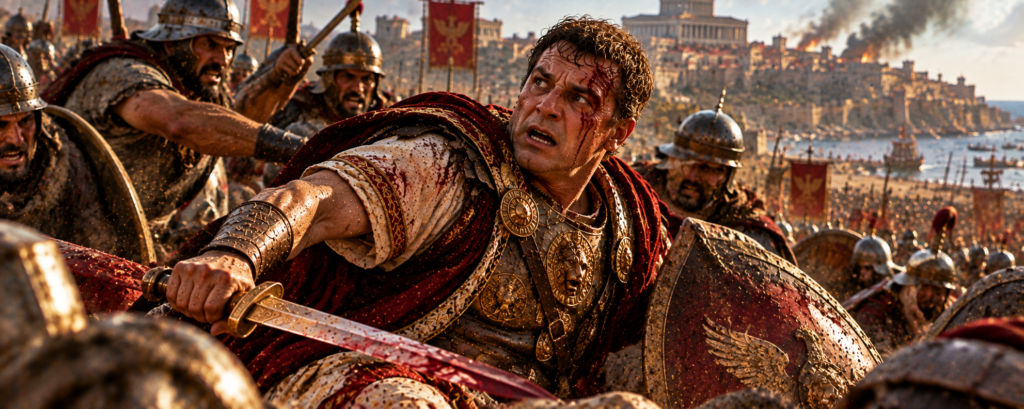
Gordian II: The Twenty-Two-Day Emperor Killed in Battle During Rome’s Year of Six Emperors
Marcus Antonius Gordianus Sempronianus Romanus Africanus (c. 192–238 CE) | Roman Emperor, 238 CE | Killed in Battle Near Carthage
The Emperor Who Rode Into Battle and Never Came Back
In the spring of 238 CE, an army gathered outside Carthage to defend a revolution that was barely three weeks old. At its head stood Gordian II, a newly proclaimed Roman emperor whose elevation had come so suddenly that he had scarcely had time to become accustomed to the title before he was required to fight for it. His father, Gordian I, had been pushed onto the throne by rebels determined to overthrow Maximinus Thrax, and the younger Gordian had been raised alongside him as co-emperor. Their cause had spread with astonishing speed, winning support from the Roman Senate and turning a provincial tax revolt into a struggle for control of the empire.
The danger came from Numidia. Capelianus, the provincial governor there, remained loyal to Maximinus and commanded experienced soldiers, including forces associated with Legio III Augusta. He had both political and personal reasons to oppose the Gordians, and he understood that their rebellion threatened his position. While Rome celebrated the apparent downfall of Maximinus, Capelianus marched toward Carthage with troops who knew how to fight.
Gordian II went out to meet him with an army that looked impressive in numbers but was dangerously deficient in military experience. Many of the men supporting the Gordian cause were civilians, local volunteers, or hastily armed supporters rather than seasoned legionaries. They carried whatever weapons could be found, and enthusiasm had to substitute for discipline. Across the field stood soldiers trained to maintain formation, obey commands, and kill efficiently.
The battle ended in catastrophe. Gordian II’s forces were overwhelmed, the inexperienced defenders broke, and the emperor disappeared into the slaughter. Ancient accounts report that he was killed during the fighting and that his body could not be recovered afterward. Somewhere amid the crush of fleeing men, weapons, dust, and bodies, one of Rome’s newest emperors died before his reign had lasted even a month.
News of the defeat reached Carthage. Gordian I, an elderly man who had never sought to lead a prolonged civil war, learned that his son was dead and that their rebellion had effectively collapsed in Africa. According to the surviving tradition, he withdrew into private quarters and hanged himself with his belt. Father and son, proclaimed emperors together only weeks earlier, were dead on the same day or within a very short interval.
Gordian II therefore occupies an unusual place in the history of assassinated rulers and regicides. He was not assassinated in the conventional sense, because the evidence indicates that he died in open battle rather than through a secret murder plot or deliberate execution after capture. Yet his death belongs naturally within the broader history of violent regime change, because he was killed while fighting for an imperial title that another emperor still claimed. His battlefield death was part of a civil war in which political legitimacy was being decided by force.
His story is brief in chronological terms but enormous in consequence. The deaths of the two Gordians did not end the rebellion against Maximinus. Instead, they forced the Senate to choose new emperors, deepened the civil war, contributed to the march of Maximinus into Italy, and helped produce one of the most chaotic years in Roman imperial history. Gordian II ruled for roughly three weeks, yet his death helped propel Rome deeper into the violent political crisis that would define much of the third century.
Born Into Wealth, Privilege, and Uncertainty
Gordian II was probably born around 192 CE, although the precise date is uncertain. His full name is usually reconstructed as Marcus Antonius Gordianus Sempronianus Romanus Africanus, reflecting the elaborate naming conventions of the Roman elite. He was the son of the future Gordian I, a wealthy senator who enjoyed a long and distinguished career. The identity of Gordian II’s mother is less securely established.
Much of what ancient sources say about the younger Gordian’s ancestry must be approached cautiously. The Historia Augusta provides an impressive collection of genealogical claims connecting the Gordians with distinguished families and celebrated figures from Rome’s past. Unfortunately, the work is notorious for inventions, fabricated documents, and unreliable biographical details. Its elegant family trees cannot simply be accepted as historical fact.
What is clear is that the Gordians belonged to the wealthy Roman aristocracy. Gordian I possessed considerable estates and had achieved the consulship before becoming governor of Africa. The family’s social position stood in dramatic contrast with the background traditionally attributed to Maximinus Thrax, the soldier-emperor they would eventually challenge. The conflict of 238 therefore acquired an unmistakable social dimension in the narratives written by elite Romans.
The younger Gordian appears to have benefited from the opportunities available to an aristocratic son. Ancient traditions portray him as highly educated and interested in literature. The Historia Augusta claims that he possessed an enormous personal library and wrote various works. Such specific assertions cannot be trusted without corroboration, but an aristocratic literary education would have been entirely plausible.
He also pursued the public career expected of a senator. Gordian II served as quaestor and praetor and eventually reached the consulship. He held provincial commands or administrative responsibilities before joining his father in Africa. The details of some appointments remain uncertain because the surviving evidence is incomplete and occasionally contradictory.
Later writers embellished his personal life. The Historia Augusta attributes numerous concubines to him and presents him as a man of considerable sexual appetite. Those claims fit the source’s taste for scandal and numerical exaggeration and should not be repeated as established fact. They tell us more about ancient biographical storytelling than they necessarily tell us about Gordian II.
The historical figure behind the embellishment appears to have been a wealthy middle-aged senator with political experience but little evidence of distinguished battlefield command. That distinction would become critically important in 238. Rome was about to place him at the head of an army during a military crisis. His aristocratic education would offer little protection against professional legionaries.
Rome Under Maximinus Thrax
The political world that eventually made Gordian II emperor had been transformed by the murder of Alexander Severus in 235 CE. Alexander and his mother, Julia Mamaea, were killed by mutinous soldiers on the German frontier. The troops proclaimed Maximinus Thrax emperor. The Severan dynasty, which had ruled Rome for more than four decades, abruptly ended.
Maximinus represented a different model of imperial power. He was a career soldier whose origins lay far from the traditional Roman aristocracy, although the more sensational stories about his supposed barbarian ancestry and gigantic proportions are unreliable. His authority came overwhelmingly from the army. He remained focused upon military campaigning rather than establishing himself personally within Rome.
The Senate accepted his accession because it possessed little practical ability to oppose the troops that supported him. Acceptance did not mean affection. Many senators regarded Maximinus with hostility, and ancient sources portray the emperor as equally suspicious of the aristocracy. The relationship between ruler and Senate deteriorated rapidly.
Military campaigning required enormous resources. Maximinus fought aggressively along the northern frontiers, and those operations demanded money, supplies, equipment, animals, and manpower. The burden ultimately fell upon the empire’s taxpayers and local communities. Resentment intensified as imperial officials sought the revenue necessary to maintain the emperor’s military machine.
Ancient sources portray Maximinus’s fiscal policies as exceptionally oppressive. Herodian describes confiscations and demands affecting wealthy individuals, municipal funds, and resources dedicated to public purposes. Some details may reflect the hostility of elite writers, but the rebellion of 238 provides strong evidence that financial grievances had become politically explosive. The emperor’s need to satisfy soldiers increasingly alienated civilians.
Africa was particularly important to Rome. The province was wealthy, agriculturally productive, and deeply integrated into the economic life of the empire. Large estates provided substantial income to members of the aristocracy. Heavy-handed fiscal enforcement therefore threatened people with both wealth and political connections.
The rebellion that elevated Gordian II would begin not as an ideological movement to restore republican liberty, but as resistance to imperial financial pressure. That local grievance quickly became something much larger. Once blood was spilled, there would be no safe return to obedience.
The Tax Collector Who Helped Start a Revolution
The immediate spark for the African revolt involved an imperial financial official whose demands angered local landowners. Herodian portrays the official as aggressively enforcing Maximinus’s fiscal policies and using confiscations or legal pressure against wealthy inhabitants. The exact administrative title and every detail of the dispute are not entirely secure. What matters is that resistance to imperial revenue collection turned violent.
A group of young aristocratic landowners decided to act. They gathered supporters and killed the imperial official. This was no minor act of protest. Murdering a representative of the emperor transformed a tax dispute into treason.
The conspirators immediately understood their danger. Maximinus was not known for forgiving rebellion, and the men responsible could expect execution if imperial authority was restored. Their families and allies might also face punishment. Having crossed the line into violence, they needed political protection.
Their solution was to create another emperor. If Maximinus ceased to be legitimate, then resistance to his officials could be reframed as loyalty to a new ruler. The rebels therefore turned toward the governor of Africa, Gordian I. His age, wealth, senatorial status, and respected reputation made him an ideal figurehead.
Gordian I was approximately eighty years old. Ancient accounts portray him as reluctant to accept the imperial title, perhaps genuinely recognizing the extraordinary danger involved. Refusal, however, might not have saved him. Once rebels had gathered around him, Maximinus could easily regard the governor as compromised.
The conspirators proclaimed Gordian emperor at Thysdrus, modern El Jem in Tunisia, around March 238. The old senator accepted the title and took the imperial name Africanus. A provincial tax revolt had become an imperial rebellion. The participants now needed the rest of the empire to choose between two rulers.
Gordian II was drawn immediately into the revolution. He was proclaimed co-emperor alongside his father and received the same imperial surname, Africanus. The younger man had not spent years building a military faction or planning to seize the throne. Within days, circumstances had transformed him from senator into Augustus.
Father and Son Become Emperors
The joint elevation of the two Gordians solved several political problems. Gordian I possessed prestige and experience, but his advanced age made long-term rule uncertain. Gordian II was decades younger and could provide continuity. Together they offered both aristocratic respectability and the promise of succession.
The arrangement also strengthened the rebellion’s appeal to the Senate. The Gordians belonged to the social world of Rome’s political elite. Unlike Maximinus, they represented familiar aristocratic values. Senators who despised the soldier-emperor could imagine the Gordians restoring a more cooperative style of government.
The rebels moved their headquarters to Carthage, one of the greatest cities of the Roman Empire. Carthage offered administrative resources, wealth, population, and symbolic importance. From there, the new emperors could communicate with Rome and seek recognition. Their revolt was no longer confined to the estate owners who had started it.
Messages were sent to the capital. The Gordians appealed to the Senate and presented themselves as liberators from Maximinus’s tyranny. They needed recognition quickly because military power remained overwhelmingly uncertain. Maximinus commanded experienced frontier armies.
The Senate responded dramatically. It recognized the Gordians as emperors and declared Maximinus an enemy of the state. This decision transformed the African revolt into an empire-wide political confrontation. Senators who supported the Gordians were now personally committed to Maximinus’s destruction.
Officials loyal to Maximinus became targets. In Rome, the praetorian prefect Vitalianus was murdered through a conspiracy designed to prevent him from suppressing the revolt. Crowds celebrated the new regime. Statues and images associated with Maximinus were attacked.
For a brief moment, the revolution seemed astonishingly successful. Gordian I and Gordian II had acquired recognition from the Senate without marching an army into Italy. Maximinus was far from Rome. The hated soldier-emperor appeared politically isolated.
Yet the celebration concealed a fatal weakness. Political legitimacy had shifted faster than military power. The Gordians controlled Africa, but they did not control every armed force in the region. One of the most dangerous men in North Africa remained loyal to Maximinus.
Capelianus: The Enemy Next Door
The governor of Numidia was Capelianus, sometimes rendered Capellianus in modern works. His precise full name and background remain uncertain, but his political importance in 238 is unmistakable. He commanded a province with a substantial military presence. Most importantly, he controlled troops associated with Legio III Augusta.
Numidia was different from senatorial Africa Proconsularis. Its military responsibilities required professional forces experienced in frontier security. The Third Augustan Legion had a long history in North Africa and provided a disciplined military core. These were not hastily armed civilians.
Capelianus also appears to have had a personal conflict with Gordian I. Herodian reports a legal dispute between them, although the details are obscure. The elder Gordian reportedly ordered Capelianus removed from office after becoming emperor. If true, the order gave the Numidian governor another powerful reason to resist.
Personal hostility alone, however, was not necessary to explain his decision. Capelianus had been appointed under Maximinus and remained loyal to the existing emperor. Recognizing the Gordians would mean joining a rebellion whose military prospects were uncertain. Remaining loyal allowed him to present himself as defender of lawful imperial authority.
He therefore mobilized his forces and marched toward Carthage. The speed of his response was crucial. The Gordians had not yet consolidated their position or built a professional army capable of meeting him. The revolution had expanded politically faster than it could prepare militarily.
News of Capelianus’s advance forced Gordian II into a role for which the surviving evidence gives little reason to think he was prepared. He would have to command the defense of Carthage. His father was too old to lead an army personally. The younger emperor became the military hope of the rebellion.
The approaching confrontation contained a cruel imbalance. Gordian II possessed the imperial title and widespread enthusiasm. Capelianus possessed trained soldiers. On the battlefield, titles and enthusiasm would matter far less than discipline.
Carthage Prepares for War
Carthage had once challenged Rome for mastery of the Mediterranean, but by the third century CE it had long been one of the empire’s greatest provincial cities. Its inhabitants were Roman citizens living within a wealthy and highly developed urban center. They were not expecting to become the center of a civil war. The Gordian revolt forced them into one almost overnight.
The city possessed a large population capable of producing substantial numbers of supporters. Local elites had strong reasons to defend the new emperors because their fortunes were tied to the rebellion. If Maximinus regained control, those associated with the uprising could face confiscation, exile, or death. Resistance therefore became a matter of survival.
Weapons were gathered wherever possible. Herodian emphasizes the inadequate military equipment available to many of the rebels. Some men carried ordinary weapons suitable for hunting or private use rather than organized warfare. Others improvised whatever they could.
Numbers could create confidence. A large crowd of enthusiastic supporters might appear formidable, particularly to people with little battlefield experience. Yet a mass of armed civilians was not equivalent to a legion. Roman professional soldiers trained to move, fight, and respond to commands as organized units.
Gordian II nevertheless had to use the forces available. Waiting inside Carthage might allow Capelianus to isolate or besiege the city. Meeting him outside offered the possibility of defeating the loyalist army before it could threaten the capital of the revolt. The younger emperor chose battle.
The decision should not automatically be dismissed as reckless. The Gordians faced severe strategic limitations, and allowing Capelianus complete freedom of movement could have been equally dangerous. Gordian II needed a victory to secure Africa and prove that the rebellion possessed military strength. Political momentum alone could not defeat Maximinus.
The stakes could hardly have been higher. If Gordian II won, the African revolt would eliminate its most dangerous regional opponent and strengthen the Senate’s challenge to Maximinus. If he lost, there was no second professional army waiting behind him. The survival of the new dynasty depended upon men who had scarcely had time to become soldiers.
The Army That Looked Larger Than It Was
Ancient sources emphasize the numerical strength of Gordian II’s supporters, but precise troop figures cannot be established. The rebel force probably included local volunteers, estate dependents, urban supporters, and whatever organized personnel could be gathered quickly. Their enthusiasm was genuine. Their military preparation was not.
Many had never experienced a major battle. They lacked the habitual discipline that allowed legionaries to maintain formation amid noise, blood, confusion, and fear. They also lacked standardized equipment on the scale available to Capelianus’s troops. Courage could not easily compensate for those disadvantages.
The army of Numidia had a completely different character. Legionaries and auxiliaries stationed in the region had trained together and understood military command. They were accustomed to weapons, marching, and coordinated action. Their officers possessed practical experience.
Capelianus also appears to have possessed cavalry, giving him another advantage. Mounted troops could exploit a collapsing formation, pursue fleeing enemies, and turn a retreat into slaughter. An inexperienced army was particularly vulnerable once panic began. The battlefield could become lethal within minutes.
Gordian II may have understood these weaknesses but lacked alternatives. The rebellion needed him to behave as an emperor, and Roman emperors were expected to defend their claims. Refusing battle might appear cowardly and encourage defections. The political pressure for action was enormous.
His aristocratic status may also have created unrealistic expectations. Roman elite culture celebrated military achievement even when individual senators had limited combat experience. Holding public office did not automatically make a man an effective battlefield commander. Gordian II was about to discover the difference under the worst possible circumstances.
The approaching armies therefore represented two very different forms of power. Gordian II carried the legitimacy of the Senate and the enthusiasm of a popular uprising. Capelianus carried the discipline of professional soldiers. The battlefield would decide which mattered more.
The Battle Outside Carthage
The precise location of the battle is uncertain, but it occurred near Carthage after Capelianus’s forces advanced against the Gordian regime. Ancient accounts provide far less tactical detail than modern readers might wish. There is no reliable minute-by-minute reconstruction of troop movements. The broad outcome, however, is clear.
Gordian II led his forces into battle. His supporters confronted the Numidian army with enthusiasm but lacked comparable training and equipment. Once serious fighting began, those deficiencies became decisive. Capelianus’s soldiers overwhelmed the rebel force.
Herodian describes the Carthaginian supporters as unable to withstand professional troops. Their improvised weapons and lack of military experience left them vulnerable. The battle turned into a rout. Panic spread through the Gordian ranks.
Once an ancient army began fleeing, casualties could rise dramatically. Men who maintained formation possessed some ability to defend themselves. Men running individually could be pursued and killed by cavalry or infantry. The collapse of cohesion therefore transformed defeat into massacre.
Gordian II was caught in the disaster. The surviving sources do not preserve a trustworthy account of exactly how he died. He may have been killed during the main fighting or during the chaotic retreat. There is no secure evidence that Capelianus personally ordered a special assassination squad to target him.
His body was reportedly never recovered. That detail conveys the scale of the chaos more effectively than any invented final speech could. The emperor disappeared among the dead. His supporters could not even retrieve him for an honorable funeral.
The reign of Gordian II had lasted only about twenty-two days according to the traditional chronology. He had gone from senator to emperor to corpse in roughly three weeks. Rome’s political revolution had collided with military reality.
No Final Speech, No Heroic Last Stand
The temptation to dramatize Gordian II’s final moments is strong. A newly proclaimed emperor leading inexperienced citizens against professional legionaries seems almost designed for a tragic final scene. Yet the evidence does not provide one. There is no reliable record of a stirring last speech, a heroic duel, or a deliberate final charge.
Historical accuracy requires accepting that some deaths remain obscure. Gordian II vanished amid a battlefield collapse. The sources preserve the result rather than the individual moment. His death was significant because of who he was, not because ancient writers recorded how the fatal blow landed.
This uncertainty also distinguishes his death from many assassinations in Roman history. Julius Caesar’s killers planned his murder and attacked him during a Senate meeting. Caligula was ambushed by conspirators. Caracalla was deliberately struck down while traveling during his eastern campaign.
Gordian II appears instead to have died as a combatant in civil war. His enemies were trying to defeat the army he commanded and destroy the rebellion he represented. They certainly had political reasons to want him dead, but his death occurred within an open battle. Calling it assassination without qualification would therefore be misleading.
The broader category of violent ruler deaths accommodates him more comfortably. He was an emperor killed because rival forces rejected his claim to power. His death helped determine who would control the Roman state. In that sense, it belongs to the same brutal political world as regicide and imperial assassination.
The distinction matters because historical categories should clarify rather than distort events. Gordian II’s story does not need to be transformed into a secret murder to become dramatic. The reality is dark enough. A man became emperor during a revolt and was swallowed by a battlefield before his government had existed for a month.
The Body That Could Not Be Found
The reported inability to recover Gordian II’s body became one of the most haunting details of the defeat. Roman elites placed enormous importance upon funerary ritual, commemoration, and the respectful treatment of the dead. An emperor would normally receive ceremonies reflecting his rank. Gordian II received none of that immediately after battle.
His disappearance suggests that the fighting and retreat produced severe confusion. Bodies may have been stripped, trampled, buried collectively, or left scattered across the battlefield. Identifying one individual among large numbers of dead could be difficult, especially if clothing and insignia had been removed. The imperial title offered no protection against the physical anonymity of mass death.
The absence of a body also denied Gordian I the consolation of burying his son. He received news rather than remains. The younger emperor had left Carthage to defend their shared throne and simply did not return. The old emperor was left to imagine what had happened.
Ancient political narratives often turn the bodies of rulers into symbols. The corpse of Pertinax was decapitated after his murder. Elagabalus’s body was abused and thrown into the Tiber. Maximinus’s head would soon be severed and carried toward Rome.
Gordian II’s fate was different. His body disappeared into the anonymous wreckage of battle. There was no spectacular public desecration because there was apparently no recovered imperial corpse to display. The absence itself became part of the tragedy.
His supporters could still honor his memory, and the Senate would later deify both Gordians. Yet the physical man had vanished. An emperor whose portrait had begun appearing on coins had become indistinguishable from the soldiers and civilians who died around him. Imperial power had collapsed into battlefield anonymity.
A Father’s Last Hours
The news that reached Gordian I was devastating. His army had been destroyed, Capelianus was victorious, and his son was dead. The African revolt no longer possessed the military strength necessary to defend Carthage. The elderly emperor faced almost certain capture if he remained.
Ancient sources report that Gordian I responded by taking his own life. He reportedly used a belt to hang himself. The detail appears in the surviving historical tradition and is generally accepted, although the private circumstances cannot be independently reconstructed. He died after ruling for only a few weeks.
His suicide was both personal and political. He had lost his son, but he had also lost the rebellion upon which their survival depended. Maximinus remained alive, and Capelianus’s army had crushed the principal Gordian force. Capture could mean execution and public humiliation.
The relationship between father and son makes their deaths particularly poignant. They had been proclaimed emperors together, perhaps because the elder Gordian’s age made a younger colleague necessary. Their imperial identities were inseparable from the beginning. When Gordian II died, the father’s political future effectively died with him.
Later writers naturally emphasized the grief of a father unable to survive his son’s death. That emotional interpretation is plausible, but political desperation should not be ignored. Gordian I had participated in an unsuccessful rebellion against a ruler known for severe retaliation. Suicide offered control over an otherwise terrifying fate.
The deaths of both emperors might have ended the entire revolt. The original African uprising had been defeated, its military force destroyed, and its leaders dead. Yet events in Rome had already moved beyond them. The Senate had publicly condemned Maximinus and could no longer retreat safely.
The Gordians died, but their rebellion survived them. That fact would make their twenty-two-day reign far more consequential than its brevity suggests. Their deaths did not restore Maximinus. They pushed Rome deeper into civil war.
Capelianus Takes Carthage
After defeating Gordian II, Capelianus gained control of Carthage. Ancient sources portray the aftermath as brutal. Herodian describes soldiers plundering property and attacking supporters of the rebellion. The victorious army had both political and material incentives to punish the defeated city.
The extent of the violence cannot be quantified with precision. Hostile ancient accounts of civil war often emphasize looting, murder, and destruction. Yet Carthage had openly supported emperors declared in rebellion against Maximinus, making reprisals highly plausible. Those who had expected liberation now faced the consequences of defeat.
Capelianus’s victory demonstrated how quickly political enthusiasm could collapse without military power. Only days earlier, the Gordians had been recognized by the Senate and celebrated as emperors. Their portraits and titles proclaimed a new regime. One battlefield defeat destroyed their control of Africa.
The governor’s loyalty to Maximinus appeared vindicated. He had resisted the Senate-backed revolution and eliminated both African emperors. Yet the victory did not save Maximinus in the long term. Events had already escaped the control of any single provincial commander.
Capelianus’s later fate is obscure. He disappears from the surviving narrative after playing his decisive role in the destruction of the Gordians. His troops and the Third Augustan Legion would experience political consequences under subsequent regimes. The memory of their role in suppressing the revolt remained controversial.
For the people of Carthage, however, the immediate consequences were painfully real. A political movement born from resentment against imperial oppression had brought battle and retaliation to their region. The city had briefly become the capital of an alternative Roman Empire. It now became the site of a defeated revolution.
Rome Receives the Catastrophic News
The Senate had celebrated the Gordians before their military position was secure. Their recognition had allowed senators to imagine that Maximinus’s reign was collapsing. When news arrived that Gordian II had been killed and Gordian I was dead, the political situation changed instantly. The men who had declared Maximinus an enemy now faced the possibility of his revenge.
Panic would have been understandable. Maximinus commanded veteran troops and had every reason to punish the Senate. The African rebellion had failed. There was no longer a recognized emperor capable of leading the opposition.
Simply submitting was not a safe option. Senators who had publicly supported the Gordians could not trust Maximinus to forgive them. The emperor had already developed a reputation for suspicion and harsh punishment. Reconciliation might merely allow him to identify and eliminate his enemies.
The Senate therefore did something extraordinary. Rather than abandon the rebellion, it continued it. A group of senior senators selected two new emperors, Pupienus and Balbinus. The struggle against Maximinus became a senatorial war for survival.
The Roman population complicated the arrangement. The Gordians had become popular symbols of resistance, and crowds demanded that their family remain represented in the new regime. The young grandson of Gordian I, remembered as Gordian III, was therefore elevated as Caesar. The dead emperors acquired a living dynastic successor.
Gordian II’s death had thus failed to erase his family’s political significance. His nephew became the focus of popular loyalty. Within months, Gordian III would emerge as sole emperor. The dynasty created in a provincial rebellion survived through a child who had not participated in the African battle.
This outcome gives Gordian II’s death an unusual afterlife. He lost the battle that destroyed his own reign, yet the political movement associated with his family ultimately prevailed over Maximinus. The dead emperor became more useful as a martyr than he had been as a commander.
Maximinus Marches Toward Revenge
Maximinus responded to the rebellion with fury and military preparation. The defeat of the Gordians removed one set of rivals, but the Senate’s continued resistance meant that the crisis remained unresolved. Pupienus and Balbinus now claimed the imperial title. Gordian III represented the surviving family of the African rebels.
The emperor gathered his forces and marched toward Italy. His army included experienced frontier troops accustomed to difficult campaigning. Maximinus expected military strength to crush political opposition. He had little reason to believe the Senate’s hastily organized resistance could defeat him in open battle.
Italian communities prepared to resist. Supplies were removed or destroyed along potential invasion routes. Bridges and roads became strategic obstacles. The defenders understood that an army could be weakened without meeting it directly.
Aquileia became the decisive barrier. The city closed its gates and refused to recognize Maximinus. Its inhabitants prepared for siege under experienced leadership. The emperor who had expected to march toward Rome instead found himself trapped outside a fortified Roman city.
The siege dragged on while supplies dwindled. Maximinus’s soldiers suffered hunger, exhaustion, and frustration. Repeated attacks failed to break the defenders. The emperor’s anger increasingly turned toward his own officers and troops.
The men who had once elevated Maximinus began reconsidering their loyalty. Soldiers associated with the Second Parthian Legion feared for families living near Rome and saw little benefit in continuing the disastrous campaign. They eventually turned against the emperor and killed both Maximinus and his son. The ruler who had survived the Gordian rebellion died because his own army no longer wished to fight for him.
Gordian II had therefore died months before his political enemy, but the rebellion he helped lead contributed directly to Maximinus’s destruction. His defeat at Carthage looked final only in the immediate moment. The civil war had already acquired momentum that no battlefield victory in Africa could stop.
The Dead Gordians Become Martyrs
Political memory transformed Gordian I and Gordian II after their deaths. The Senate had already committed itself to their cause and had little reason to portray their rebellion as a foolish disaster. Instead, the two men could be remembered as respectable aristocrats who sacrificed themselves opposing tyranny. Their defeat became martyrdom.
Both Gordians were eventually deified. Divine honors elevated their memory and confirmed the legitimacy of their imperial status. The men who had ruled for only a few weeks received recognition denied to some emperors who governed for years. Political success was not always necessary for favorable commemoration.
Their family connection to Gordian III strengthened this process. The young emperor benefited from presenting his grandfather and uncle as legitimate predecessors. Their deaths justified his own position. The failed rebellion became the foundation of a new dynasty.
Coins and official titles helped preserve their memory. Gordian II had possessed little time to establish an independent imperial image, yet his portrait entered the visual language of Roman power. The shortness of his reign made his surviving coinage particularly interesting to later collectors and historians. Material evidence confirms that the rebellion was treated as a genuine imperial government rather than merely a local uprising.
The favorable tradition should still be approached cautiously. Maximinus’s enemies controlled much of the later narrative surrounding the revolt. Gordian II’s weaknesses as a commander could be minimized while his courage and aristocratic virtues were emphasized. Political memory rarely develops neutrally after civil war.
His death nevertheless offered powerful symbolism. He had gone into battle for a cause supported by the Senate and died confronting professional forces loyal to a condemned emperor. The military defeat could therefore be reframed as honorable sacrifice. Rome has always been skilled at turning disaster into legend.
Was Gordian II Actually a Good Commander?
There is little evidence that Gordian II possessed significant battlefield experience before 238. His senatorial career may have included provincial responsibilities, but administrative office was not equivalent to command during a civil war. The battle near Carthage confronted him with a task for which he may have been poorly prepared. His opponent possessed both professional troops and military advantages.
It would nevertheless be unfair to blame the entire defeat upon personal incompetence. Gordian II inherited an extremely weak strategic position. His rebellion had been created suddenly and possessed no large professional army in Africa Proconsularis. Capelianus controlled the nearest major legionary force.
Even an exceptional commander would have struggled to transform civilians into soldiers within a few weeks. Military discipline requires time, training, and experienced officers. Gordian II had almost none of those advantages. Political events moved too quickly for proper preparation.
His decision to confront Capelianus can also be defended strategically. Allowing the Numidian army to advance unchallenged toward Carthage could have destroyed morale and encouraged defections. A victory in the field might have secured Africa and strengthened the rebellion enormously. The potential reward justified considerable risk.
The problem was that the odds were terrible. Enthusiastic volunteers could not reliably withstand professional legionaries once formations began to break. Capelianus possessed the type of force designed to exploit exactly that weakness. Gordian II’s army was politically powerful but militarily fragile.
His death therefore reflects the limitations of aristocratic legitimacy in a militarized empire. The Senate could declare a man emperor. Crowds could cheer him. Wealthy landowners could provide money and volunteers. None of those things automatically produced an army capable of defeating a legion.
Battlefield Death or Political Killing?
For an Assassinated Rulers & Regicides collection, Gordian II requires a clear historical qualification. The surviving evidence does not support describing him as assassinated. He died during an open battle fought between rival Roman political factions. His death was therefore a battlefield casualty of civil war.
That distinction does not make his story less relevant to the broader theme of rulers deliberately destroyed during struggles for power. Capelianus marched against the Gordian regime specifically because he rejected its claim to imperial authority and remained loyal to Maximinus. Defeating Gordian II meant eliminating a rival emperor. The battle was political from beginning to end.
Yet intention matters when defining assassination. A ruler killed by an assassin selected to murder him personally occupies a different historical category from a ruler who dies while commanding troops in battle. Gordian II belongs with rulers killed in civil wars and armed rebellions. His death was violent regime change rather than a classic assassination.
The term regicide can be used more broadly, particularly when discussing the deliberate killing of sovereigns during political conflict. Even then, Gordian II’s case sits near the boundary. He was not captured and executed after defeat. He appears to have been killed amid the fighting itself.
That ambiguity makes him valuable rather than inconvenient. Categories of violent ruler deaths are not always neat. Monarchs and emperors can die through assassination, execution, lynching, battlefield defeat, mutiny, coup, or circumstances that combine several of these. Historical accuracy requires acknowledging those differences.
Gordian II therefore belongs in the collection with a note explaining that his inclusion is broader than assassination in the strict sense. His death helped destroy one imperial regime and reshape another. The political consequences were those of regicide even if the immediate mechanism was battle.
A Reign Measured in Days
The traditional chronology gives the joint reign of Gordian I and Gordian II approximately twenty-two days. Ancient chronological evidence is not perfect, but there is no doubt that their rule was extraordinarily brief. They belong among the shortest-reigning recognized emperors in Roman history. Their entire imperial career unfolded within a single season.
The brevity creates difficulties for biography. Gordian II had almost no opportunity to develop distinctive imperial policies. He did not spend years issuing reforms, constructing monuments, reshaping religious institutions, or developing a recognizable style of government. His reign was essentially a revolution followed immediately by war.
That does not mean his story lacks depth. The circumstances surrounding his accession reveal fundamental problems within the Roman Empire. Taxation, military expenditure, senatorial resentment, provincial administration, and uncertain succession all converged in the African revolt. Gordian II became emperor because those pressures exploded simultaneously.
His death reveals another problem. Political legitimacy had become inseparable from military power. The Senate’s recognition could not protect an emperor who lacked professional soldiers. The Roman state had reached a point where battlefield outcomes could overturn constitutional claims almost overnight.
The younger Gordian’s personal experience must have been dizzying, although his private thoughts are lost. Within weeks he moved from provincial aristocrat to co-ruler of the Roman world, then commander of an improvised army, and finally one of thousands of dead on a battlefield. Few imperial careers illustrate the instability of the third century more dramatically.
His twenty-two days therefore matter precisely because they were so short. They demonstrate how quickly imperial power could appear and disappear. The title Augustus could elevate a man above almost everyone in the Roman world, but it could not guarantee that he would survive the month.
The Year When Emperors Became Disposable
The year 238 is conventionally remembered as the Year of the Six Emperors. Maximinus Thrax began the year as ruler. Gordian I and Gordian II rose against him in Africa. Pupienus and Balbinus were subsequently chosen by the Senate, while Gordian III eventually emerged as sole emperor.
The sequence was astonishingly violent. Gordian II died in battle. Gordian I committed suicide. Maximinus and his son were murdered by their own soldiers outside Aquileia. Pupienus and Balbinus were later murdered by the Praetorian Guard.
Only Gordian III remained. A child survived where experienced soldiers and elderly senators had died. His youth made him less threatening to competing political factions. Rome briefly found stability through a ruler who could not yet dominate the system around him.
The events demonstrated how dangerously fragmented imperial legitimacy had become. Maximinus possessed the support of frontier troops. The Gordians possessed senatorial sympathy and provincial enthusiasm. Pupienus and Balbinus possessed formal senatorial appointment.
None of those sources of authority guaranteed survival. Armies could reject emperors, crowds could challenge senatorial decisions, and provincial revolts could create rival rulers. The imperial office remained immensely powerful while individual emperors became increasingly expendable. That contradiction would haunt Rome throughout the third century.
Gordian II’s battlefield death stands near the beginning of this pattern. He was not the victim of a hidden dagger or palace conspiracy. He was the victim of a political system in which rival claims to supreme power increasingly required armed resolution. His brief reign was one of the first dramatic warnings of what the Crisis of the Third Century would become.
The Third Augustan Legion and the Price of Loyalty
Legio III Augusta played a central role in the military structure of Roman North Africa. Its soldiers defended frontier regions, maintained security, and supported imperial administration. During the revolt of 238, the legion’s association with Capelianus placed it firmly on the side of Maximinus. Its effectiveness helped destroy Gordian II.
From a purely military perspective, the legionaries had performed their duty successfully. They followed their recognized commander and defeated forces supporting rival emperors. Political circumstances, however, changed rapidly after Maximinus’s death. Loyalty to yesterday’s emperor could become treason under tomorrow’s government.
The Gordian regime ultimately prevailed through Gordian III. The Third Augustan Legion was subsequently dissolved, although the precise political calculations surrounding its punishment require careful interpretation. Its role in the death of Gordian II undoubtedly made it vulnerable under a government associated with his family. Military victory had produced long-term political consequences.
The legion would later be restored because Rome still required experienced troops in North Africa. Practical military necessity eventually outweighed dynastic resentment. The episode demonstrates the tension between political punishment and frontier security. Emperors could condemn soldiers, but the empire still needed armies.
For Gordian II, however, the legion represented the fatal imbalance of the African revolt. His supporters possessed enthusiasm and numbers. Capelianus possessed professional military force. The outcome showed which mattered most when imperial claims reached the battlefield.
The men who killed Gordian II may never have known which soldier struck the fatal blow. They were participating in organized combat rather than an individual assassination. Yet their collective action ended an emperor’s reign. In the politics of 238, a legion could become an executioner without ever staging an execution.
The Nephew Who Inherited the Dead Men’s Cause
The survival of Gordian III transformed the meaning of the African disaster. He was the grandson of Gordian I through the elder Gordian’s daughter and therefore the nephew of Gordian II. The precise details of his parentage have generated scholarly discussion, but his relationship to the Gordian household was central to his political identity. He became the living representative of the dead emperors.
Popular pressure in Rome helped secure his elevation as Caesar under Pupienus and Balbinus. The people had embraced the Gordian name and were reluctant to see it disappear. A child could embody the memory of the African revolt without threatening senior politicians immediately. His youth became politically useful.
After Maximinus was murdered at Aquileia, Pupienus and Balbinus remained as joint emperors. Their relationship deteriorated, and the Praetorian Guard resented them. In July 238, the guards seized and murdered both men. Gordian III was then acclaimed sole emperor.
The outcome was extraordinary. Gordian I and Gordian II had lost their rebellion militarily in Africa. Both had died within weeks of their proclamation. Yet a member of their family occupied the throne before the year ended.
Their defeat had therefore become a dynastic victory. The Senate’s rebellion against Maximinus survived every leader who initially directed it. The political appeal of the Gordian name outlived the men themselves. Gordian II’s blood relationship to the surviving boy gave his death lasting significance.
Gordian III would rule until 244, when he died during the Persian campaign under circumstances that remain disputed. Once again, the Gordian family would become associated with an uncertain imperial death. The dynasty born in rebellion never escaped the violence of third-century politics.
The Human Cost Behind the Imperial Story
Imperial history naturally focuses upon emperors because their decisions shaped enormous territories. Yet the battle that killed Gordian II also killed many people whose names disappeared completely from the historical record. Volunteers from Carthage, estate workers, local aristocrats, servants, soldiers, and civilians became participants in a conflict created by political decisions far above them. Their deaths rarely receive individual attention.
Many supporters probably joined the rebellion because they feared Maximinus’s financial policies. Others may have followed patrons or local leaders. Some may have been motivated by enthusiasm for the Gordians. The surviving sources do not allow their motives to be reconstructed individually.
When the battle collapsed, their political reasons mattered little. Professional soldiers pursued fleeing opponents. Men carrying improvised weapons faced trained legionaries. The battlefield reduced the grand language of liberation and tyranny to immediate questions of survival.
The inability to recover Gordian II’s body suggests the scale of the carnage. If the emperor himself could disappear among the dead, ordinary casualties were even less likely to receive individual burial or remembrance. Their families would have experienced the consequences long after imperial politics moved on. The rebellion’s failure was not merely a change in government.
Capelianus’s subsequent occupation of Carthage added further suffering. Property was vulnerable to looting, supporters of the Gordians faced retaliation, and communities that had celebrated the revolution suddenly confronted defeat. Political enthusiasm had turned into fear. Civil war rarely respects the distinction between decision-makers and bystanders.
Remembering those people gives Gordian II’s death a darker context. He was not a solitary tragic hero falling on an empty field. He died amid a mass political catastrophe in which thousands of people had been drawn into a struggle over who should rule Rome. His imperial title made his death famous, but it did not make his death unique.
What Gordian II Actually Changed
Because Gordian II ruled for such a short time, it is easy to dismiss him as a historical footnote. He issued no transformative legal code and conquered no vast territory. He had almost no opportunity to develop an independent imperial program. Yet his role in 238 was consequential.
His joint accession helped give the African revolt dynastic credibility. An eighty-year-old emperor alone might appear temporary. The presence of a younger co-ruler suggested continuity. The rebellion could claim to offer Rome not merely a protest but a replacement government.
His death then forced the Senate into a decisive choice. Had Gordian II defeated Capelianus, the African regime might have survived long enough to coordinate more effectively with Rome. Instead, the Senate suddenly found itself without either emperor it had recognized. It had to create another government while Maximinus remained militarily powerful.
That emergency produced Pupienus and Balbinus. Their appointment intensified tensions between senatorial authority, popular enthusiasm, and Praetorian influence. Gordian III was elevated partly because the population demanded continuation of the Gordian cause. The younger Gordian’s death therefore indirectly shaped the political structure that followed him.
The collapse in Africa also encouraged Maximinus to believe he could recover control by invading Italy. His march led to the siege of Aquileia. The siege led to military discontent. That discontent led to his assassination.
Gordian II lost his only major battle, but the political chain of events initiated by his rebellion eventually destroyed the emperor he opposed. History does not always reward battlefield victors with lasting success. Capelianus won at Carthage, while the cause he defended collapsed only weeks later.
The Strange Victory of a Dead Emperor
There is a peculiar sense in which Gordian II achieved after death what he could not achieve in life. He failed to defeat Maximinus’s supporters in Africa. His army was destroyed, his body lost, and his father committed suicide. By every immediate measure, the rebellion had failed.
Yet the Senate refused to surrender. Italy resisted Maximinus. Aquileia stopped his advance. His own soldiers eventually murdered him.
Meanwhile, the Gordian name became politically powerful. The dead father and son were remembered favorably, while the young Gordian III inherited their legitimacy. Their portraits, titles, and deification transformed a failed provincial uprising into the foundation of a new imperial regime. Memory reversed military defeat.
This transformation illustrates the importance of political narrative in Roman succession. Winning a battle did not determine how history would remember a ruler. The victors also needed to control the institutions that produced honors, condemnations, inscriptions, and official memory. Maximinus lost that struggle completely.
Gordian II therefore became a legitimate emperor rather than a condemned rebel. His approximately twenty-two-day reign entered official imperial chronology. The Senate that had supported him survived long enough to ensure that his claim was recognized. His nephew’s accession reinforced that judgment.
The battlefield outside Carthage had declared Gordian II defeated. Roman political memory declared him legitimate. The contradiction is one of the most fascinating features of his story. An emperor could lose his army, his throne, and his life while still winning the historical argument over whether he had been an emperor at all.
Was the Revolt Doomed From the Beginning?
The African rebellion faced serious military weaknesses from its first days. The Gordians controlled a wealthy province but lacked the professional forces necessary to defend it against Numidia. Capelianus’s loyalty to Maximinus created an immediate strategic threat. The rebels needed either to neutralize him politically or defeat him militarily.
Their political strategy initially worked brilliantly elsewhere. The Senate recognized them, Maximinus was condemned, and opposition spread rapidly. If Capelianus had defected, the rebellion might have acquired the military strength necessary to survive. His refusal changed everything.
Time also worked against the Gordians. They needed weeks or months to organize forces, secure neighboring provinces, and coordinate with supporters in Italy. Capelianus attacked before that consolidation could occur. The revolution was forced into battle while still militarily immature.
Gordian II’s defeat was therefore not necessarily proof that the rebellion itself had been irrational. Maximinus was genuinely unpopular among influential groups, and the Senate proved willing to support his overthrow. The revolt eventually contributed to his death. Its political assessment of his vulnerability was not entirely wrong.
The fatal mistake was assuming political momentum could compensate for immediate military weakness. Rome’s empire remained an armed state. Provincial governors with professional troops could determine the fate of emperors. The Gordians learned that lesson before they had time to build an army of their own.
Their uprising was both doomed and successful in different senses. The original African regime could not survive Capelianus’s attack. The wider anti-Maximinus movement it unleashed ultimately succeeded. Gordian II died during the failure of the first while helping create the second.
A Different Kind of Regicide
The word regicide usually evokes a ruler deliberately executed or murdered because of his position. Charles I of England standing before the executioner’s block, Louis XVI facing the guillotine, or an emperor stabbed by conspirators fits the concept easily. Gordian II presents a more complicated case. His death occurred in a battle where both sides openly fought for political control.
Yet ancient civil war often blurred the distinction between combat and political killing. Capelianus’s army was not fighting an anonymous foreign commander. Gordian II was a rival Augustus whose survival threatened Maximinus’s authority. Defeating his army and killing him had direct constitutional consequences.
Had Gordian II been captured alive, it is difficult to imagine Maximinus allowing him to retire peacefully. A living rival emperor was inherently dangerous. Roman political practice made execution or forced suicide highly probable. The battlefield simply resolved the problem first.
His death therefore belongs to a spectrum of ruler-killing rather than a narrow category. At one end are secret assassinations carried out by individual conspirators. At another are formal executions ordered by revolutionary governments. Gordian II stands among sovereigns killed while actively fighting rival regimes.
This distinction should remain visible in any historical treatment. Calling him simply “assassinated” would erase the nature of the Battle of Carthage. Calling his death politically irrelevant because it occurred in battle would be equally misleading. He died because Rome contained two competing claims to supreme authority and armed force decided between them.
For an Assassinated Rulers & Regicides category, his inclusion works best precisely because it expands the reader’s understanding of how rulers can be violently removed. Not every regicide happens in a palace corridor or on an execution scaffold. Sometimes an emperor disappears beneath the feet of a collapsing army.
The Emperor History Barely Had Time to Know
Gordian II remains more difficult to understand as a personality than many longer-reigning emperors. Ancient writers preserve anecdotes, but the reliability of those anecdotes is uneven. His brief reign produced little opportunity for independent policy. Even his accession occurred alongside his father rather than as a solitary claim.
The Historia Augusta attempts to fill the silence with colorful personal details. It portrays him as handsome, cultivated, wealthy, and sexually prolific. Such material creates an entertaining character but cannot be accepted uncritically. The source routinely decorates imperial biographies with invented or exaggerated information.
Herodian is more useful for understanding the political events of 238. His narrative focuses less upon private scandal and more upon the rebellion, Capelianus’s response, and the disastrous battle. Even Herodian must be read as a literary historian rather than a modern reporter. His speeches and moral framing are part of his historical method.
Material evidence provides another perspective. Coins issued in Gordian II’s name demonstrate the seriousness of his imperial claim. His titles and portrait were distributed through the mechanisms available to the new regime. The rebellion immediately adopted the visual language of legitimate Roman power.
Yet the man behind the portrait remains elusive. We know the offices he held, the family to which he belonged, the revolt that made him emperor, and the battle that killed him. His private ambitions are harder to recover. It is not even clear how eagerly he embraced the imperial title.
That uncertainty should be preserved rather than filled with invented psychology. Gordian II’s story is compelling precisely because history caught him in motion. He appears suddenly as emperor, rides toward battle, and disappears. The brevity leaves a silhouette where a longer reign might have left a portrait.
From Carthage to the Crisis of the Third Century
The events of 238 belong to the opening phase of the Crisis of the Third Century. Alexander Severus’s murder in 235 had ended the Severan dynasty and elevated Maximinus through military rebellion. Gordian II’s revolt demonstrated how quickly provincial and senatorial opposition could create competing emperors. The year exposed the instability of imperial succession with extraordinary clarity.
The empire did not collapse immediately. Administrative institutions continued functioning, trade persisted, and provincial society remained resilient in many regions. The phrase “Crisis of the Third Century” should not be understood as fifty uninterrupted years of universal chaos. Nevertheless, political and military instability became severe.
Foreign pressures intensified. The Sasanian Persian Empire threatened Rome’s eastern provinces, while Germanic groups challenged the Rhine and Danube frontiers. Emperors needed military success to maintain authority. Failure could encourage their own troops to support another commander.
Civil war worsened those external threats. Every army marching against a rival emperor was an army unavailable for frontier defense. Every political purge removed experienced officials. Every contested succession consumed money needed elsewhere.
Gordian II’s death demonstrates the mechanism in miniature. A fiscal dispute created rebellion. Rebellion produced rival emperors. Rival emperors required armies. Armies turned Roman provinces into battlefields.
The same pattern would recur repeatedly. Generals would become emperors because their soldiers proclaimed them. Rival generals would challenge them. Some rulers would survive only months before assassination or battlefield death. Gordian II’s twenty-two-day reign was an extreme example of a broader political disease.
A Son’s Death That Destroyed a Father
Among all the political consequences of the Battle of Carthage, the most immediate was intensely personal. Gordian I had entered the rebellion as an elderly man surrounded by conspirators who needed an emperor. His son became his partner in power. Their shared reign bound their political survival together.
When Gordian II left to confront Capelianus, the elder emperor remained in Carthage. He had to wait for news from a battle upon which everything depended. The ancient world offered no instantaneous communication. Rumors and frightened survivors would have carried the result back toward the city.
The message that finally reached him could hardly have been worse. The army had been destroyed. His son was dead. The body could not be recovered.
Gordian I’s reported suicide followed almost immediately. Grief almost certainly mattered, but political despair was equally powerful. The old emperor had no realistic military means of continuing resistance in Africa. Capelianus was approaching victorious.
The father therefore died because the son’s defeat destroyed both his emotional and political world. Their reign had begun together and ended together. Few imperial partnerships have collapsed so quickly or completely. Within roughly three weeks, the Gordians had moved from respected provincial aristocrats to emperors to dead rebels whose cause survived without them.
Their shared fate helped create the martyr image that later surrounded them. A father and son rising against a hated ruler, dying within hours of one another, and leaving a child relative to continue the dynasty possessed all the ingredients of political legend. Rome remembered the tragedy long after the tactical details of the battle faded.
The Empire That Ate Its Emperors
The speed with which Gordian II rose and fell reveals something disturbing about Roman imperial politics in the third century. Becoming emperor did not necessarily represent the culmination of a long and secure political ascent. It could happen suddenly when soldiers, provincial elites, or senators needed a figure around whom to organize. The title could become a weapon before it became a government.
That made the throne extraordinarily dangerous. Accepting the purple immediately created enemies who could not safely tolerate the claimant’s survival. Rival emperors could not easily coexist because each represented a legitimate focus for rebellion against the other. Political competition therefore became existential.
Gordian II had little opportunity to enjoy imperial power. Almost immediately, he had to defend it against Capelianus. The ceremonial language of Augustus concealed the reality that his government possessed no secure monopoly on violence. His reign was a military emergency from beginning to end.
The same danger consumed Maximinus. He had become emperor through the murder of Alexander Severus and was himself murdered three years later. Pupienus and Balbinus survived Maximinus only to be killed by the Praetorians. Gordian III would eventually die on campaign under circumstances still debated.
The imperial office remained the most powerful position in the Roman world, yet it increasingly resembled a trap. Every successful claimant inherited the enemies of his predecessor and created new rivals simply by surviving. Military commanders became potential usurpers whether they wanted the role or not. Soldiers understood that choosing an emperor could determine their own fate.
Gordian II’s short reign captures this deadly acceleration. He was not destroyed after years of accumulated mistakes. He barely had time to make mistakes. The political system itself placed him in a position where one military defeat meant death.
The Emperor Lost Among the Dead
Gordian II did not spend years plotting his path to the Roman throne. He did not march upon Rome at the head of a veteran army or murder a predecessor inside an imperial palace. His elevation emerged from a provincial rebellion that began with anger over taxation and the killing of an imperial official. Within days, the revolt needed an emperor, and the Gordian family was pushed into the most dangerous position in the Roman world.
His father brought age, wealth, and senatorial prestige to the rebellion. Gordian II brought youth relative to the eighty-year-old elder emperor and the possibility of dynastic continuity. Together they offered the Senate an alternative to Maximinus Thrax, the soldier-emperor whose financial demands and hostility toward aristocratic elites had generated widespread resentment. For a brief moment, their revolution appeared capable of succeeding without a major civil war.
Rome recognized them. The Senate declared Maximinus an enemy. Crowds celebrated, officials loyal to the old regime were attacked, and the African rebellion suddenly looked like an imperial transformation. Political legitimacy seemed to have changed hands almost effortlessly.
Then Capelianus marched from Numidia.
He brought something the Gordians did not possess: professional soldiers. The younger emperor gathered supporters from Carthage and the surrounding region, but enthusiasm could not manufacture years of military training. The army that marched out with Gordian II was fighting for a popular cause, yet many of its members were disastrously unprepared for the violence waiting ahead.
When battle began, the difference became fatal. Capelianus’s troops maintained the discipline expected of experienced soldiers. Gordian II’s force collapsed under pressure. Once retreat became panic, defeat became slaughter.
Somewhere inside that chaos, the emperor died. The surviving sources cannot tell us who killed him, what weapon struck him, or whether he understood in his final moments that the rebellion was lost. They preserve no trustworthy last words. His body was not recovered.
That absence makes his death unusually haunting. Roman emperors normally left bodies that could be honored, mutilated, displayed, burned, buried, or condemned. Gordian II simply vanished into the wreckage of his own defeated army. The man who had been proclaimed Augustus only weeks earlier became one unidentified corpse among many.
His father’s response completed the tragedy. Gordian I learned that his son was dead and that the army defending their regime had been destroyed. With Capelianus victorious and Carthage exposed, the elderly emperor saw no future. He took his own life.
By every immediate measure, the Gordian revolution had failed. Its emperors were dead, its army was destroyed, and its African stronghold lay vulnerable to retaliation. Maximinus remained alive and commanded one of the strongest military forces in the empire. The Senate appeared to have backed a disastrous rebellion.
Yet the story did not end there. The Senate refused to submit and appointed Pupienus and Balbinus. The people of Rome demanded that the Gordian family remain represented, bringing the young Gordian III into the new regime. Maximinus marched toward Italy to destroy his enemies and became trapped outside Aquileia.
There, the soldier-emperor discovered the same truth that had destroyed Gordian II from the opposite direction. Political authority could not survive without military loyalty. His exhausted troops eventually murdered him and his son. The emperor who had defeated the Gordians through a loyal army was destroyed when another army decided it no longer wished to obey.
Pupienus and Balbinus soon followed him into violent death. The Praetorian Guard murdered them, leaving Gordian III as sole emperor. The family whose rebellion had been annihilated outside Carthage ended the year in possession of the throne. Defeat had somehow become dynastic survival.
Gordian II therefore belongs among the violent ruler deaths of Roman history even though he was not assassinated in the strict sense. His death was a battlefield killing during an imperial civil war, not a palace ambush or secret conspiracy. That distinction should remain clear, because the real circumstances are more revealing than an inaccurate label could ever be.
He died because political legitimacy in third-century Rome increasingly depended upon armed force. The Senate could recognize an emperor, citizens could cheer him, aristocrats could finance him, and coins could proclaim his authority throughout a province. None of it mattered if the opposing side arrived with the stronger army.
His reign lasted approximately three weeks, but those weeks helped change the empire. The African revolt shattered whatever remained of stable relations between Maximinus and the Senate. Gordian II’s death forced Rome to create new emperors, Maximinus’s response led him toward Aquileia, and the resulting crisis ended with the soldier-emperor’s assassination. The battle Gordian II lost became one step in the process that destroyed the man who defeated him.
There is no need to invent a heroic last stand for Gordian II. There is something darker in the reality. He rode out from Carthage carrying the title of Augustus, surrounded by men who believed they were fighting to free Rome from a tyrant, and encountered soldiers who believed they were defending the lawful emperor. Hours later, his army had ceased to exist as an effective force, and no one could even find his body.
That is where Gordian II belongs in the history of rulers killed during struggles for power. He was not stabbed by conspirators in a corridor, dragged before an executioner, or murdered by his bodyguards while sleeping. He was consumed by the battlefield created by his own imperial claim, one more ruler sacrificed to the growing conviction that Rome’s throne could be settled only by violence.
The most unsettling part of his story is not that a Roman emperor could die so quickly. By the middle of the third century, that would become horrifyingly familiar. It is that Gordian II barely had time to become emperor before the title itself required him to risk everything in its defense. He entered the Battle of Carthage as one of the most powerful men in the Roman world and disappeared among the dead before his reign had lasted a month; yet the cause that survived him would outlive his victor, destroy Maximinus, and place another Gordian on the throne, leaving behind one of Rome’s strangest political epitaphs: the emperor who lost his battle, lost his body, and still belonged to the dynasty that ultimately won.