
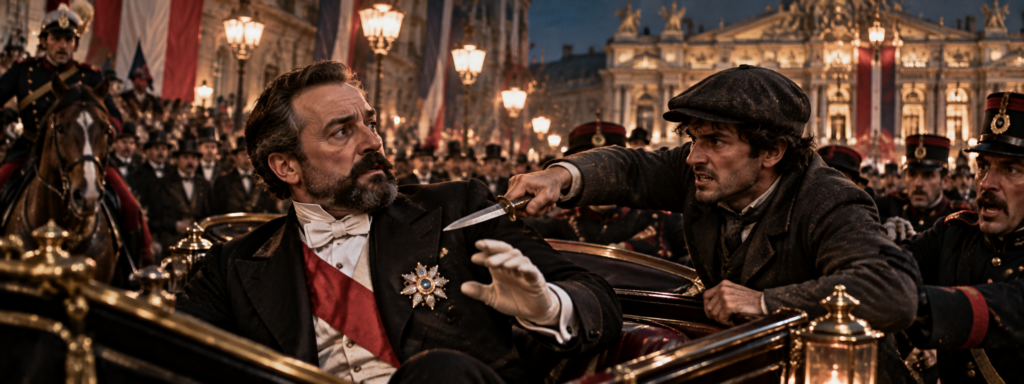
Sadi Carnot: The President Stabbed in the Streets of Lyon
Marie François Sadi Carnot (1837–1894) | President of the French Third Republic, 1887–1894 | Engineer, republican politician, former minister, and grandson of revolutionary military organizer Lazare Carnot | Elected president after the resignation of Jules Grévy during the decorations scandal | Guided the presidency through the Boulanger crisis, political scandal, labor unrest, and a growing wave of anarchist violence | Refused to pardon anarchist bomber Auguste Vaillant after the 1893 attack on the Chamber of Deputies | Visited Lyon in June 1894 for an international and colonial exhibition | Attended an official banquet on June 24 before departing for an evening appearance at the Grand Théâtre | Stabbed while riding through Lyon in an open presidential carriage by the Italian anarchist Sante Geronimo Caserio | Mortally wounded in the abdomen and died shortly after midnight on June 25, 1894 | His assassination triggered anti-Italian violence, intensified the French government’s campaign against anarchism, and produced an enormous national funeral | Caserio was convicted and guillotined in Lyon on August 16, 1894.
The Knife in the Crowd
The evening of June 24, 1894, should have ended as another carefully choreographed demonstration of republican confidence. President Sadi Carnot had spent a long day in Lyon attending ceremonies connected with the city’s international and colonial exhibition, receiving officials, reviewing troops, appearing before crowds, and participating in the kind of public rituals expected of the head of the French Republic. That evening he attended an official banquet before preparing to travel to the Grand Théâtre, where another public engagement awaited him. Lyon was illuminated, the streets were crowded, and the president rode through the city surrounded by the visible symbols of a state that had survived monarchy, empire, invasion, revolution, attempted coups, and repeated political crises.
Among the thousands lining the route was a young Italian baker named Sante Geronimo Caserio. He was not an assassin hired by a rival government, a monarchist agent attempting to restore a king, or a conspirator seeking the presidency for himself. He was an anarchist who believed political authority itself was oppressive and who had absorbed the increasingly violent culture of anarchist retaliation that had developed across Europe. In his mind, the president passing before him was not simply Sadi Carnot the man; he represented the state that had imprisoned and executed anarchists.
Carnot’s carriage moved through the Rue de la République as spectators pressed toward the procession. Caserio forced his way close enough to reach the vehicle, apparently taking advantage of the confusion created by people approaching to cheer and present petitions or flowers. Then he lunged toward the president and drove a dagger into his abdomen. The attack took only moments, but the wound was devastating.
At first, many people around the carriage did not understand what had happened. Public ceremonies regularly involved sudden movement, shouting, and crowds surging toward prominent visitors, and the assassin’s approach could disappear amid that confusion. Then Carnot collapsed, blood became visible, and the presidential procession transformed into an emergency. Caserio was seized while the mortally wounded president was rushed away for medical attention.
The blade had penetrated deeply and damaged major blood vessels in the region of the liver. Surgeons attempted to save him, but late nineteenth-century medicine could do little against catastrophic internal bleeding of this kind. Carnot remained alive for several hours as officials, doctors, and members of his family gathered around him. Shortly after midnight, in the opening hours of June 25, the president of France died.
France awoke to the news that its head of state had been murdered in a public street. The assassination was shocking not because political violence was unfamiliar but because violence had become frighteningly familiar. Bombings, executions, anarchist manifestos, sensational trials, and retaliatory legislation had created an atmosphere in which state and revolutionary violence seemed to answer one another. Carnot’s murder would become one of the darkest episodes in that cycle.
The assassin did not flee successfully, disguise his identity, or deny what he had done. Caserio embraced the political meaning of the attack and was soon prosecuted as the president’s murderer. Less than two months later, he would follow several of the anarchists he admired to the executioner. The French Republic answered the knife with the guillotine, and the cycle of violence acquired another corpse.
A President Born in the Shadow of Revolution
Marie François Sadi Carnot was born in Limoges on August 11, 1837, into a family whose name was already deeply embedded in French political history. His grandfather, Lazare Carnot, had been one of the most important figures of the French Revolution, a member of the Committee of Public Safety and the military organizer famously remembered as the “Organizer of Victory.” The Carnot family therefore carried associations with republicanism, public service, science, engineering, and the turbulent political transformations that had reshaped France since 1789. Sadi Carnot inherited a surname that connected him to revolutionary history long before he entered politics himself.
His father, Hippolyte Carnot, was also politically active and served as minister of public instruction during the Second Republic of 1848. The younger Carnot consequently grew up in a household where republican ideas were not abstract philosophical concepts but part of family identity. France during his youth moved through the July Monarchy, the Revolution of 1848, the Second Republic, and eventually the authoritarian Second Empire of Napoleon III. Political instability was not something Carnot learned from history books; it surrounded his formative years.
Unlike many politicians whose careers were built primarily through journalism, law, or military service, Carnot trained as an engineer. He studied at the École Polytechnique and later the École des Ponts et Chaussées, institutions closely associated with the technical and administrative elite of France. Engineering suited the temperament later attributed to him by admirers: disciplined, methodical, restrained, and more comfortable with administrative responsibility than theatrical political performance. His career began in public works rather than revolutionary agitation.
Carnot worked on engineering projects and developed expertise in infrastructure and public administration. That technical background would remain important to his political identity because it distinguished him from the flamboyant demagogues, polemicists, and adventurers who repeatedly disturbed Third Republic politics. He was not an electrifying public speaker and did not cultivate a romantic image. His strength lay in competence, respectability, and the appearance of dependable republican service.
The contrast between his personality and the violence of his death would later seem especially striking. Carnot was not remembered as a dictator, military strongman, or political extremist. He became president largely because he appeared safe, respectable, and comparatively untainted by scandal. Yet in an age when anarchists increasingly treated heads of state as embodiments of oppressive systems, moderation did not provide protection.
To Caserio, the personal qualities of the president mattered less than the office he occupied. Carnot represented the French Republic, and the Republic had executed anarchists. The assassin’s political logic therefore erased the distinction between an individual and the state he symbolized. A quiet engineer could become a legitimate target simply because he rode in the presidential carriage.
The Republic Born From Defeat
Carnot’s political career developed during one of the most traumatic transformations in modern French history. Napoleon III’s Second Empire collapsed during the Franco-Prussian War of 1870 after catastrophic military defeat. The emperor was captured at Sedan, the Republic was proclaimed in Paris, and France faced invasion, siege, and eventual defeat. The political system later known as the Third Republic emerged from national humiliation rather than confident revolutionary triumph.
The crisis deepened in 1871 with the Paris Commune. Following France’s defeat and the establishment of a conservative National Assembly, revolutionary government briefly seized control of Paris. The Commune was crushed during the Bloody Week of May 1871, when government forces retook the capital amid ferocious street fighting and mass killing. Thousands died, and thousands more were arrested, imprisoned, deported, or exiled.
The memory of the Commune haunted French politics for decades. Conservatives remembered it as proof that revolutionary radicalism could plunge society into chaos, while socialists and anarchists remembered the repression as evidence of the brutality underlying bourgeois republican government. These competing memories mattered enormously when political violence revived in the 1890s. Neither the state nor its revolutionary enemies approached violence without historical baggage.
Carnot entered national politics during this unstable period. He was elected to the National Assembly in 1871 and aligned himself with republican politics. The Republic itself was not yet secure, and monarchists initially possessed considerable influence. France spent years uncertain whether republican government would survive or be replaced by another monarchy.
Carnot gradually developed a reputation as a serious administrator and financial specialist. He held government positions including minister of public works and later minister of finance. His political style was not defined by ideological flamboyance. He represented the kind of institutional republicanism that sought to make the regime permanent through administration, law, infrastructure, and parliamentary government.
By the 1880s, the Third Republic had survived long enough to begin appearing durable. Yet durability did not mean tranquility. Monarchists still dreamed of restoration, Bonapartists remained active, radical republicans demanded deeper reforms, socialists challenged the existing economic order, and nationalist movements could mobilize enormous public emotion. The Republic had survived its birth, but it remained surrounded by enemies who wanted very different futures for France.
The Scandal That Made Carnot President
Sadi Carnot did not become president because he had built an overwhelming personal movement. He reached the Élysée Palace partly because another presidency collapsed under scandal. President Jules Grévy’s administration became engulfed in the decorations scandal of 1887, involving allegations that Grévy’s son-in-law, Daniel Wilson, had exploited political connections in connection with the sale of honors and decorations. Although Grévy himself was not shown to have personally sold decorations, the scandal made his position politically untenable.
Grévy resigned in December 1887. Parliament then had to choose a replacement at a moment when the Republic desperately needed someone who appeared respectable. Carnot’s reputation for personal honesty and administrative competence became exceptionally valuable. In a political environment polluted by accusations of corruption, the grandson of Lazare Carnot seemed reassuringly clean.
Carnot was elected president on December 3, 1887. The office under the constitutional structure of the Third Republic was significant but did not make him an executive ruler in the modern presidential sense. Ministers responsible to parliament conducted much of the daily work of government. Carnot nevertheless became the symbolic head of the Republic and exercised influence through appointments, consultation, public representation, and the prestige of the presidency.
His election strengthened his public reputation as a figure of republican respectability. He was serious, dignified, and personally restrained. He lacked the flamboyance that might have created an intense popular cult around him, but this very absence of theatrical ambition made him useful. After scandal, France wanted a president who looked dependable.
That reputation would become important during later crises. Carnot’s presidency coincided with threats from nationalist populism, corruption scandals, labor unrest, and anarchist violence. He became a symbol of institutional continuity precisely because the political world around him was anything but stable. The engineer-president increasingly represented the Republic’s determination to endure.
The irony was severe. Carnot’s political strength came from embodying the state rather than dominating it. He was no Caesar, Napoleon, or revolutionary dictator. Yet symbolic authority can make a person a target just as surely as absolute power, and anarchist violence increasingly focused upon representatives of political and economic systems rather than only upon personally tyrannical rulers.
General Boulanger and the Republic’s Brush With Disaster
One of the first great threats of Carnot’s presidency came from General Georges Boulanger. Handsome, charismatic, nationalist, and surrounded by an increasingly passionate political movement, Boulanger attracted supporters from an extraordinary range of backgrounds. Some wanted revenge against Germany for the loss of Alsace-Lorraine, while others hated parliamentary corruption or dreamed of constitutional revision. Monarchists, Bonapartists, nationalists, and disillusioned radicals could all project their hopes onto him.
The movement became known as Boulangism. Its ideological contradictions did not diminish its danger because Boulanger’s personal popularity offered a rallying point for people united more by dissatisfaction than by a coherent program. Crowds celebrated the general, newspapers magnified his image, and republican politicians feared that he might use electoral popularity to overthrow parliamentary government. France seemed to be approaching another possible authoritarian rupture.
Carnot’s role in defeating Boulangism should not be exaggerated into that of a solitary savior. Parliamentary politicians, government ministers, legal authorities, and Boulanger’s own hesitation all contributed to the movement’s collapse. Yet Carnot represented constitutional continuity during the crisis. The presidency did not panic into abandoning republican legality.
In January 1889, Boulanger won a spectacular electoral victory in Paris. Supporters urged him to seize power, but he did not march on the Élysée or launch the coup many expected. The government eventually moved against him legally, and Boulanger fled France rather than risk arrest. His political movement rapidly disintegrated.
Boulanger later committed suicide in Brussels in 1891 beside the grave of his mistress, Marguerite de Bonnemains. The dramatic ending suited a movement that had depended heavily upon personality and emotion. The Republic survived, and Carnot emerged with increased prestige. A political system that had seemed vulnerable proved capable of outlasting another would-be savior.
Yet the Boulanger crisis exposed deep dissatisfaction beneath republican stability. Many French citizens believed parliamentary politics were corrupt, ineffective, or detached from ordinary suffering. That distrust would feed movements far removed from Boulanger’s nationalism. Among the most radical were anarchists who concluded that reforming the political system was pointless because the system itself had to be destroyed.
Panama and the Smell of Corruption
The Republic survived Boulanger only to face another devastating scandal. The collapse of the French Panama Canal Company produced enormous financial losses and exposed a network of bribery involving politicians, journalists, and intermediaries. Hundreds of thousands of investors had been drawn into the project, many of them ordinary people whose savings disappeared. The scandal reinforced the belief that parliamentary politics served wealthy insiders.
Investigations revealed that money had been used to influence political figures and suppress damaging information. Newspapers published sensational accusations, some accurate and others exaggerated or weaponized for political purposes. Antisemitic propagandists exploited the scandal by focusing upon Jewish financiers and intermediaries, turning legitimate anger over corruption into poisonous conspiracy theories. The Republic once again appeared morally compromised.
Carnot himself was not established as a participant in the bribery network. His personal reputation for honesty largely survived. Yet as president, he could not escape the political damage suffered by the regime he represented. Anarchists did not distinguish neatly between corrupt deputies and a president personally untouched by the scandal.
For radicals, Panama confirmed a larger indictment of bourgeois society. Politicians spoke of liberty while financial elites manipulated institutions, workers struggled, and police protected property. Parliamentary elections appeared incapable of transforming the social order. To those already attracted to anarchism, corruption could be interpreted as evidence that the state was inherently illegitimate.
Carnot therefore occupied an increasingly paradoxical position. His personal honesty made him a reassuring symbol to moderate republicans, but his office made him a symbol of corruption to revolutionaries who rejected the distinction between individuals and institutions. The cleaner his personal reputation remained, the more clearly the ideological nature of anarchist hostility became. Caserio would not kill Carnot because he believed the president had stolen money; he would kill him because Carnot represented authority itself.
Anarchism and the Dream of Destroying Authority
Nineteenth-century anarchism was not a single unified organization with a central command structure. It included competing thinkers, activists, workers, intellectuals, collectivists, communists, syndicalists, and individualists who disagreed about strategy and even about the precise society they hoped would follow the destruction of coercive institutions. Many anarchists never participated in violence. Some explicitly rejected individual acts of assassination as ineffective or morally wrong.
Yet a militant current embraced what became known as “propaganda by the deed.” The concept suggested that dramatic actions could expose the vulnerability of governments, inspire revolt, avenge repression, and awaken people more effectively than speeches or pamphlets. Assassinations and bombings offered small groups or isolated individuals a way to strike at powerful institutions. Modern explosives and mass newspapers magnified the impact of even a single attacker.
The phenomenon was international. Monarchs, presidents, ministers, industrialists, police officials, and other representatives of authority became targets across Europe and the Americas. Anarchist assassins would eventually kill figures including Empress Elisabeth of Austria, King Umberto I of Italy, and United States President William McKinley. Carnot’s murder belonged to this wider transnational age of political assassination.
France became one of the central theaters of anarchist violence during the early 1890s. Social conflict, memories of the Commune, labor unrest, and police repression created fertile ground for radicalization. Bombings generated sensational newspaper coverage. Government retaliation then reinforced anarchist narratives of an oppressive state.
This cycle did not mean that every anarchist attack was centrally coordinated. Quite the opposite: individual initiative was one of the defining difficulties confronting police. An assassin could act largely alone, inspired by publications, trials, executions, and the examples of previous militants. There did not need to be a vast secret organization directing every knife and bomb.
Sante Caserio belonged to this world. He would later be investigated for possible accomplices and broader conspiracy, but the evidence did not establish that a central anarchist command had ordered him to kill Carnot. His assassination was politically motivated without requiring a conventional conspiracy. That distinction is important because the frightening power of propaganda by the deed lay precisely in the ability of an individual believer to transform ideology into violence.
Ravachol and the Beginning of the Bombing Cycle
François Claudius Koenigstein, better known as Ravachol, became one of the most notorious early figures in the French anarchist violence of the 1890s. His criminal history included acts that were not straightforwardly political, and his transformation into an anarchist martyr later simplified a much messier biography. He became famous for bomb attacks directed against judicial officials connected with the prosecution of anarchists. The explosions caused enormous public alarm.
Ravachol was arrested in 1892 after being recognized and betrayed to police. He faced trials for bombings and other crimes, including murder. Although one jury did not sentence him to death for the bombing offenses, a subsequent conviction for earlier murders resulted in a death sentence. He was guillotined in July 1892.
His execution transformed him into a martyr within parts of the anarchist movement. Songs, articles, and political rhetoric celebrated his defiance. To supporters, he represented retaliation against a state that imprisoned and executed the poor while protecting wealthy exploiters. To the broader public, he embodied the terrifying image of the anarchist bomber.
The cycle of violence intensified because each side interpreted the other’s actions as justification for further escalation. Bombings produced arrests and executions, while arrests and executions produced calls for revenge. Newspapers ensured that each spectacular act reached audiences far beyond the immediate victims. The political theater of violence became almost as important as the physical destruction.
Carnot’s eventual assassin absorbed this culture of martyrdom. Caserio admired executed anarchists and regarded state punishment as murder disguised by law. The guillotine, in this worldview, was not legitimate justice simply because judges and officials authorized it. If the state killed anarchists, anarchists could answer by killing representatives of the state.
That logic would place the president directly in danger. Carnot possessed constitutional authority over requests for presidential clemency in capital cases. When anarchists were condemned to death and pardons were refused, militants could therefore attach the executions personally to him. The president who rarely appeared radical enough to dominate ordinary politics became, in anarchist imagination, one of the men responsible for sending comrades to the guillotine.
Auguste Vaillant Throws a Bomb
On December 9, 1893, anarchist Auguste Vaillant entered the Chamber of Deputies in Paris and threw a bomb from the public gallery. The device exploded among the legislators and spectators, injuring a number of people but killing no one. The attack was designed as a spectacular assault upon the parliamentary system itself. France reacted with fury and fear.
Vaillant’s background included poverty and frustration, and he presented the bombing as an attack on a society that condemned the poor to misery. His device appears to have been intended more to wound and terrorize than to produce mass slaughter, although using explosives in a crowded chamber obviously risked death. The distinction did little to calm public outrage. The National Assembly had been attacked inside its own chamber.
The government responded with legislation aimed at anarchist activity and propaganda. These measures became notorious among critics as the lois scélérates, or “villainous laws.” They expanded the state’s ability to prosecute anarchist advocacy and restrict publications associated with violent revolutionary ideology. Civil libertarians condemned the laws as dangerously broad.
Vaillant was tried, convicted, and sentenced to death. Appeals for clemency followed, and Carnot possessed the presidential power to commute the sentence. He refused to intervene. Vaillant was guillotined on February 5, 1894.
That refusal would later become central to explanations for Carnot’s assassination. Caserio regarded Vaillant as one of the anarchist martyrs killed by the French state. Carnot’s role in denying clemency made the president personally significant within the politics of vengeance. The decision did not make Carnot responsible for creating anarchist violence, but it helped identify him as a symbolic target.
It is tempting to construct a direct line from Vaillant’s execution to Carnot’s murder, but Caserio’s motivations were broader. Ravachol had already been executed, and another anarchist, Émile Henry, would soon follow. Caserio understood himself as striking against a system of repression rather than avenging only one man. Carnot became the personification of that system.
Émile Henry and the Café Bomb
If Vaillant’s attack could be framed as violence directed at politicians, Émile Henry’s bombing of the Café Terminus destroyed any comforting assumption that anarchist violence would remain confined to representatives of government. On February 12, 1894, Henry threw a bomb into the crowded café near the Gare Saint-Lazare in Paris. One person died and many others were injured. The target was ordinary bourgeois society.
Henry defended a radical logic of collective responsibility. In his view, the respectable bourgeois public benefited from an oppressive social system and therefore could not claim innocence. This reasoning dramatically expanded the category of legitimate targets. The distinction between political assassination and indiscriminate terrorism was collapsing.
Henry was arrested, tried, and condemned to death. His courtroom statements became widely circulated and contributed to his notoriety. He refused to repudiate his beliefs. On May 21, 1894, he was guillotined.
Carnot again declined to exercise clemency. Less than five weeks later, he would be stabbed in Lyon. For anarchists committed to retaliation, the president’s refusal to save condemned militants could be interpreted as direct participation in state killing.
The sequence of executions intensified the atmosphere surrounding the presidency. Ravachol, Vaillant, and Henry became names invoked within anarchist circles as examples of men killed by the state. Their individual actions and philosophies differed, but martyrdom blurred distinctions. Death beneath the guillotine transformed them into symbols.
Caserio would carry those symbols toward Lyon. His knife was not the product of a sudden personal quarrel with Carnot. It emerged from a political culture in which every execution could become a grievance demanding another act of vengeance. The Republic believed punishment would deter violence; militants could interpret the same punishment as a reason to continue it.
Sante Geronimo Caserio
Sante Geronimo Caserio was born on September 8, 1873, at Motta Visconti in Lombardy, Italy. He came from a large, relatively poor family and lost his father while still young. Like many working-class Europeans of the period, he entered employment early. He eventually trained and worked as a baker.
Caserio became involved with anarchist circles while still a young man. His political development took place in an Italy marked by poverty, social inequality, labor conflict, and aggressive policing of revolutionary movements. Authorities became interested in his activities, and he left Italy. He spent time in Switzerland and France while continuing to work in his trade.
He was not an important anarchist theoretician comparable to figures such as Peter Kropotkin or Errico Malatesta. His significance came from action rather than intellectual originality. He absorbed a militant interpretation of anarchism in which individual violence against representatives of authority could become morally legitimate. Executed anarchists were heroes rather than criminals in this worldview.
By 1894, Caserio was working in the south of France. News of the executions of Vaillant and Henry intensified his hostility toward the French state. He later portrayed his attack on Carnot as an act of vengeance and revolutionary commitment. The president’s position as head of state and his refusal to grant clemency made him an obvious symbolic target.
Questions quickly arose about whether Caserio belonged to a larger conspiracy. Police had every reason to search for accomplices because an international anarchist network seemed capable of producing further attacks. Yet no convincing evidence established that a centralized group had commissioned the assassination. Caserio appears to have acted largely on his own initiative.
That individualism made him particularly difficult to stop. Protecting a president from an organized conspiracy is challenging, but organized plots can generate communications, meetings, money transfers, informants, and other evidence. A determined individual carrying a knife requires much less preparation. Caserio needed only an opportunity to approach the presidential carriage.
The Journey Toward Lyon
Caserio’s movements before the assassination reveal the simplicity that made such attacks terrifying. He did not command a team of professional assassins or possess sophisticated explosives. He traveled toward Lyon knowing that the president would be appearing publicly. The weapon he selected was a dagger rather than a bomb or firearm.
Carnot’s visit to Lyon was no secret. Presidential tours were public events designed to bring the head of state into visible contact with citizens. Newspapers reported schedules, crowds gathered along routes, and municipal authorities decorated streets. The very openness that gave republican ceremonies their political meaning also created vulnerability.
The nineteenth-century presidency did not operate behind the security barriers associated with modern heads of state. Police and soldiers were present, but crowds could approach remarkably close to carriages and public platforms. Political leaders were expected to be seen. A president surrounded by an impenetrable security zone would have defeated part of the purpose of the ceremony.
Caserio exploited this environment rather than overcoming a fortress. He did not need to infiltrate the Élysée Palace. He could wait among citizens gathered to greet the president. The Republic itself brought Carnot within reach.
The choice of Lyon also carried broader revolutionary associations, although there is no need to assume Caserio selected the city for elaborate historical symbolism. Lyon had a powerful industrial working-class tradition and a long history of political unrest. The city had experienced labor revolts and radical movements throughout the nineteenth century. It was therefore a fitting, if accidental, stage for an assassination born from social conflict.
By June 24, Caserio had positioned himself for the attack. Carnot remained unaware that the routine dangers of public office had become immediate. The president continued through a schedule packed with official ceremonies. Somewhere beyond the reception lines and decorated streets, a baker carrying a knife waited for the procession.
Lyon Celebrates the President
Carnot arrived in Lyon for ceremonies associated with the Exposition internationale et coloniale. Such exhibitions were showcases of industry, commerce, technology, imperial ambition, and civic pride. They projected confidence in progress at a time when European states were expanding economically and colonially. For Carnot, attendance was part of the ceremonial work of the presidency.
The visit involved the exhausting sequence typical of official tours. There were receptions, speeches, military honors, inspections, public appearances, and meals. Crowds wanted to see the president, local dignitaries wanted recognition, and officials expected carefully staged demonstrations of national unity. Carnot fulfilled these obligations despite the physical demands of the schedule.
On the evening of June 24, he attended an official banquet at the Palais du Commerce. This detail has sometimes been compressed in retellings into the claim that he was assassinated “at a banquet.” In fact, the fatal attack occurred after the banquet, when Carnot was traveling through Lyon toward another engagement. The distinction matters because the assassin struck not within a guarded dining hall but during the vulnerable transition through crowded streets.
The president was expected at the Grand Théâtre. An open carriage carried him through the illuminated city, accompanied by officials and surrounded by an escort. Spectators packed the route. Cheers, movement, uniforms, horses, lights, and decorations created exactly the kind of sensory confusion in which a lone attacker could disappear until the final seconds.
Carnot had reason to understand that political violence existed. France had experienced bombings, and anarchist threats were widely discussed. Yet presidents could not simply abandon public appearances without surrendering an important part of republican political culture. The head of state was expected to embody accessibility and national unity.
That expectation brought him into the Rue de la République. The presidential carriage continued through the crowd. Caserio moved closer. Within moments, a ceremonial procession became the scene of an assassination.
The Assassin Reaches the Carriage
The exact choreography of the attack has been reconstructed from eyewitness testimony, police reports, and later accounts, but minor details vary. Caserio approached the carriage as it traveled along the crowded route. He appears to have exploited the fact that people could move toward the president to offer greetings or petitions. Security personnel had only seconds to distinguish enthusiasm from attack.
Caserio suddenly reached toward Carnot and thrust his dagger into the president’s body. The blade entered the upper abdomen, producing a wound far more serious than its external appearance may initially have suggested. Major internal structures were damaged, causing severe hemorrhage. Carnot immediately began collapsing.
The attack demonstrated the terrifying effectiveness of a simple weapon at close range. Firearms create noise and can miss; bombs require preparation and may fail. Caserio’s knife required proximity but offered little warning once he had reached the carriage. The president’s accessibility became the assassin’s greatest advantage.
Officials and guards reacted rapidly once the attack was understood. Caserio was seized before he could escape into the crowd. He reportedly proclaimed anarchist slogans, though exact wording in popular retellings should be treated cautiously because dramatic assassination scenes quickly accumulate memorable quotations. There was never serious doubt about the identity of the attacker.
Carnot was removed from the scene and rushed for medical treatment. The festive procession disintegrated into panic and confusion. News traveled rapidly through Lyon that the president had been stabbed. Crowds that had gathered to celebrate suddenly confronted the possibility that they had witnessed the final public appearance of a dying man.
The speed of the transformation was brutal. Minutes earlier, Carnot had represented the stability and ceremony of the Republic. Now doctors were fighting to keep him alive while police dragged his attacker into custody. A knife had converted a national celebration into a political crisis.
A Wound Medicine Could Not Repair
Carnot’s wound was catastrophic because the dagger penetrated deeply into the abdominal region and damaged major blood vessels near the liver. Accounts commonly identify injury to the portal venous system as a central cause of the fatal hemorrhage. Whatever the precise anatomical description used by contemporary doctors, the fundamental problem was massive internal bleeding. Nineteenth-century surgery had advanced enormously, but injuries of this severity remained extraordinarily difficult to treat.
The president was taken to the prefecture, where physicians attempted emergency intervention. His condition deteriorated despite their efforts. Family members and senior officials gathered as it became increasingly clear that the wound was likely fatal. France’s head of state was dying not on a battlefield or in a palace coup but inside a government residence after being stabbed in a public street.
Carnot remained alive for several hours after the attack. Reports of his condition spread through telegraph networks and newspapers, creating anxious anticipation beyond Lyon. Political leaders understood immediately that the death of a president could produce both constitutional and public-order consequences. Police also feared retaliatory violence against Italians.
Shortly after midnight on June 25, 1894, Sadi Carnot died. He was fifty-six years old and approaching the end of his presidential term. There had already been discussion about whether he would seek or accept another term, and he was widely expected to leave office in the normal constitutional manner. Caserio ensured that he would leave it through assassination instead.
The timing made the murder particularly senseless from the perspective of ordinary political strategy. Carnot was not attempting to establish a dictatorship or remain president indefinitely. Killing him did not overthrow the Republic or fundamentally change its institutions. Parliament could simply elect another president.
For Caserio, however, immediate institutional results were not the only measure of success. Propaganda by the deed sought symbolic impact. The assassination demonstrated that even the head of the French state could be reached by an individual militant. In that grim sense, the knife achieved exactly the spectacle for which it had been carried to Lyon.
France Learns Its President Is Dead
The assassination generated enormous shock throughout France. Carnot had acquired considerable respect during nearly seven years in office, and his personal reputation remained stronger than that of many politicians around him. He represented stability after repeated scandals and crises. His violent death therefore felt like an attack on the Republic itself.
Newspapers produced extensive coverage of the assassination, the president’s final hours, Caserio’s background, and the anarchist movement. Some reports inevitably contained errors, rumors, and sensational details as journalists competed to satisfy public demand. The late nineteenth-century press had become a powerful engine of mass politics. An assassination was not merely an event; it became a national spectacle reproduced through columns, illustrations, special editions, and public discussion.
The government moved quickly to preserve constitutional continuity. Jean Casimir-Perier was elected president on June 27. The transition demonstrated the institutional strength of the Third Republic. An assassin could kill the president without decapitating the state.
That constitutional stability distinguished Carnot’s death from older forms of regicide. Killing a medieval king could trigger a succession war because sovereignty was concentrated in a dynasty. Killing the president of a parliamentary republic produced mourning and political shock but not a vacuum of sovereignty. The office survived its occupant.
Yet emotional reactions could not be contained as neatly as constitutional procedure. Caserio’s Italian nationality became a focus of public anger. Italians living in France suddenly faced collective blame for an act committed by one anarchist. In Lyon and elsewhere, violence threatened immigrant communities.
The assassination therefore created victims beyond Carnot himself. Shops and businesses associated with Italians were attacked, and anti-Italian sentiment surged. The pattern was familiar: political violence committed by an individual was transformed into suspicion against an entire population. The state had to confront both anarchist violence and retaliatory xenophobia.
The Anti-Italian Backlash
France contained a substantial Italian immigrant population by the 1890s. Italians worked in construction, industry, agriculture, commerce, and other sectors, often under difficult conditions. Economic competition and existing prejudice had already generated tensions in some communities. Carnot’s assassination provided an explosive new grievance.
Crowds attacked Italian-owned businesses and property in Lyon after the murder. Italians who had no connection whatsoever to Caserio could suddenly find themselves treated as accomplices simply because they shared his nationality. Rumor and anger spread faster than careful distinctions between anarchist ideology and Italian identity. Xenophobia transformed the assassination into collective punishment.
This reaction was especially bitter because anarchism was international by definition. French anarchists had committed spectacular acts of violence, while Italian anarchists operated across borders. Caserio’s nationality mattered biographically, but his political identity cannot be reduced to Italian nationalism. He killed Carnot as an anarchist, not as an agent of the Italian government or an Italian nationalist cause.
Italian authorities themselves had strong reasons to oppose anarchist violence. King Umberto I would eventually be assassinated by the Italian-American anarchist Gaetano Bresci in 1900. European governments increasingly cooperated in monitoring revolutionary networks. Caserio’s attack therefore did not represent a conflict between France and Italy.
The French government attempted to contain the diplomatic and social consequences. Official condemnation of the murder did not require blaming the Italian population. Nevertheless, public anger demonstrated how easily assassination could inflame existing ethnic tensions. One man’s knife had the potential to damage relations between communities far removed from his political objectives.
Caserio’s act was intended as revolutionary propaganda against authority. Instead, part of its immediate consequence was violence against vulnerable immigrants. This unintended result illustrates a recurring problem with political terrorism. Attackers may imagine they control the meaning of their violence, but once blood is spilled in public, others decide what the act signifies.
The President and the Guillotine
The most powerful explanation for Caserio’s choice of target involved Carnot’s relationship to the executions of anarchists. As president, Carnot possessed the authority to grant clemency in capital cases. He had declined to commute the death sentences of figures including Vaillant and Émile Henry. Anarchists interpreted those decisions as participation in state murder.
The legal reality was more complicated than the slogan of presidential responsibility. Vaillant and Henry had been convicted by courts under French law, and Carnot did not personally sentence them. His role came at the final stage, when clemency could have prevented execution. Refusing clemency nevertheless gave militants a direct reason to associate their deaths with him.
Caserio’s statements after arrest made clear that the executions mattered deeply to his motivation. He viewed the assassination as retaliation for anarchists killed by the state. Carnot represented the system that had sent them to the guillotine. The president’s personal moderation was irrelevant within that framework.
There is a grim symmetry between Carnot’s decision not to spare condemned anarchists and Caserio’s decision not to spare Carnot. Yet the symmetry should not become moral equivalence. Vaillant had bombed the Chamber of Deputies, Henry had bombed a crowded café, and both received trials before execution. Caserio unilaterally selected a human being for death on ideological grounds and attacked without judicial process.
At the same time, anarchists explicitly rejected the state’s claim to moral superiority. They argued that government violence remained violence even when surrounded by judges, laws, uniforms, and official ceremonies. Caserio’s worldview treated the guillotine and the dagger as competing instruments within a social war. The state naturally rejected that reasoning because accepting it would undermine the distinction between law and private vengeance.
The confrontation between those views made Carnot’s murder more than a personal assassination. It became part of a debate about whether political authority could legitimately use violence while denying the same right to revolutionary opponents. Caserio answered that question with a knife. France answered him with another execution.
Caserio in Custody
Caserio did not attempt to portray himself as an innocent man wrongly accused. His identity as the assassin was clear, and he embraced the political character of his act. Investigators therefore focused partly upon determining whether other anarchists had assisted him. The possibility of a wider conspiracy naturally terrified authorities.
Interrogations and police inquiries examined his contacts, movements, and political associations. Anarchism’s international networks encouraged suspicion that the assassination might have been planned collectively. Yet association with anarchists did not prove participation in the murder. Authorities never established a commanding organization that had ordered Caserio to stab Carnot.
Caserio’s behavior reinforced the image of an ideologically committed assassin. He defended anarchist beliefs and showed little inclination to express conventional remorse for killing the president. His statements presented the murder as political retaliation rather than personal hatred. He had never needed to know Carnot personally because the president’s symbolic identity was sufficient.
This distinction horrified the public. Traditional murder could often be explained through greed, jealousy, revenge, inheritance, or personal conflict. Political assassination by a stranger suggested that anyone occupying a symbolic office could become a target. The victim did not need to have wronged the killer individually.
Caserio’s youth also attracted attention. He was only twenty years old when he killed Carnot. The contrast between his age and the magnitude of his act made the assassination seem even more disturbing. A young itinerant baker had killed the president of one of Europe’s great powers with a knife.
His case rapidly moved toward trial. There was little realistic possibility of acquittal. The central questions concerned motive, accomplices, and punishment rather than identity. France had the man who killed its president, and the machinery of justice began moving toward a conclusion that few doubted.
The Funeral of a Republican Martyr
Carnot’s body was returned to Paris amid extraordinary national mourning. The Republic transformed the murdered president into a symbol of civic sacrifice. Funeral ceremonies provided an opportunity to display continuity, unity, and institutional strength after an act intended to strike at authority. The state would answer assassination not only with prosecution but with ritual.
Carnot received a grand national funeral on July 1, 1894. Enormous crowds participated in or watched the ceremonies. Political leaders, military representatives, foreign dignitaries, and ordinary citizens joined the public mourning. The assassination had elevated a respected but sometimes politically understated president into a republican martyr.
He was buried in the Panthéon alongside his grandfather Lazare Carnot. The placement carried powerful historical symbolism. Lazare represented the revolutionary generation that had defended France during the wars of the 1790s, while Sadi represented the republican state built after the disasters of 1870–1871. The Carnot family became physically embedded within the Republic’s national shrine.
The funeral also helped reclaim the meaning of the assassination from Caserio. The anarchist intended the killing as an indictment of state authority. The Republic presented Carnot’s death as proof of the need to defend lawful government against political violence. Both sides understood that symbolism mattered.
Public mourning could also obscure political complexity. Carnot had presided over a France divided by class conflict, corruption scandals, nationalist agitation, colonial expansion, and repression of radical movements. His death did not erase those conflicts. It temporarily reorganized them around sympathy for a murdered president.
The assassin had hoped to strike authority. Instead, he strengthened Carnot’s symbolic association with the Republic. Death accomplished what political life rarely had: it transformed a restrained administrator into an emotionally powerful national figure. The knife that destroyed the man enlarged the memory.
The Trial of Sante Caserio
Caserio went on trial in Lyon in August 1894. The evidence that he had killed Carnot was overwhelming. He had been seized at the scene, the weapon was recovered, and he did not deny the essential act. The courtroom therefore became a stage for political meaning rather than a genuine mystery about guilt.
Caserio defended his anarchist beliefs and explained the assassination as retaliation against a social and political system he regarded as oppressive. He invoked the deaths of anarchists and presented himself as an enemy of authority rather than a conventional murderer. The strategy could not realistically save him. If anything, it reinforced the prosecution’s portrayal of the killing as deliberate and ideological.
The court also considered whether he had accomplices. Police investigations had searched widely for evidence of conspiracy. Caserio resisted efforts to implicate others and maintained the individual character of his action. No broad assassination network was proved at trial.
He was convicted and sentenced to death. Appeals for clemency had little political chance after the murder of the president. Carnot had refused mercy to anarchists condemned for political violence, and his successor was not likely to spare the man who killed him. The cycle of execution and retaliation moved toward another turn.
Caserio remained defiant as his execution approached. Later accounts attribute various statements and cries to him, some more securely documented than others, and the mythology surrounding anarchist executions makes caution necessary. What is certain is that he did not renounce anarchism in a manner that would transform his final days into a story of repentance. He faced death as a political militant.
On August 16, 1894, Sante Geronimo Caserio was guillotined in Lyon. He was twenty years old. Less than two months had passed since his knife entered Carnot’s body.
The Guillotine Answers the Dagger
Caserio’s execution completed an almost ritual sequence. Ravachol had been guillotined, Vaillant had been guillotined, Émile Henry had been guillotined, and Caserio had responded by killing the president associated with the refusal of clemency. France then guillotined Caserio. Each side could interpret the next death as proof that its own violence was necessary.
The government hoped punishment would demonstrate that assassination could not intimidate the Republic. Anarchists could interpret Caserio’s death as another martyrdom. The logic was circular because execution did not erase the political meaning militants attached to previous executions. It could create new symbols for future radicals.
This did not mean the French state had an easy alternative. Caserio had deliberately murdered the president in public, and nineteenth-century France retained capital punishment for serious crimes. A government already accused by conservatives of weakness toward anarchism would have faced enormous pressure had it spared him. Clemency after Carnot’s murder would have been politically explosive.
Yet the sequence reveals the limits of deterrence through spectacular punishment. The guillotine had not frightened Caserio away from assassination. He understood perfectly well that killing Carnot could lead to his own death. The willingness to die undermined one of the assumptions upon which deterrence depends.
Anarchist propaganda could transform execution into victory by treating the condemned as martyrs. Courage before death became part of the political message. The state intended the scaffold to demonstrate authority, while militants could interpret the same scaffold as proof of persecution. One public ritual generated opposite meanings.
Carnot and Caserio therefore became linked by more than murderer and victim. Each death became part of a struggle over the legitimacy of political violence. The president represented the state’s claim that punishment under law differed fundamentally from assassination. Caserio died rejecting that distinction.
The “Villainous Laws”
Carnot’s assassination occurred during an already aggressive government campaign against anarchist propaganda. The first of the measures later called the lois scélérates had followed the Vaillant bombing. They expanded criminal liability for incitement and anarchist advocacy and increased the state’s ability to suppress publications. Critics argued that the laws threatened freedom of expression far beyond direct participation in violence.
After Carnot’s murder, the political appetite for stronger measures intensified. A further law adopted in July 1894 targeted anarchist propaganda and publications. Authorities gained broader powers to prosecute people accused of encouraging anarchist crimes. The assassination therefore helped accelerate a shift from prosecuting violent acts toward suppressing ideological advocacy associated with them.
Supporters of the legislation argued that anarchist newspapers and propaganda could inspire isolated individuals such as Caserio. If violent militants were being radicalized through publications celebrating assassination, waiting until a bomb exploded or a president was stabbed seemed irresponsible. Prevention required attacking the ideological infrastructure surrounding violence. In the frightened atmosphere after Carnot’s murder, this argument carried enormous force.
Critics saw a dangerous precedent. A government could define radical political expression as complicity in crimes committed by others. Journalists, editors, printers, and activists who had not personally attacked anyone could become targets of prosecution. The boundaries between suppressing terrorism and suppressing dissent became contested.
The debate has a strikingly modern quality. Governments confronting ideologically motivated violence repeatedly face the problem of distinguishing advocacy, incitement, association, and direct participation. Carnot’s assassination intensified precisely this problem in France. A lone attacker had been inspired by a broader political culture without requiring formal orders from an organization.
The state responded by attempting to disrupt that culture. Whether the laws prevented attacks or primarily drove anarchist activity underground remains debated. What is undeniable is that Caserio’s knife produced legal consequences far beyond his own trial. Political assassination changed the boundaries of permissible speech.
Was Carnot Personally Responsible for the Repression?
Anarchist rhetoric frequently personalized state violence by attaching responsibility to prominent officials. Carnot’s refusal to grant clemency made him an especially convenient target. Yet the Third Republic was not an autocracy in which the president personally dictated criminal justice. Courts, prosecutors, parliament, ministers, police, and administrative institutions all participated in the state’s response to anarchism.
Carnot nevertheless possessed genuine discretionary authority in clemency matters. He cannot be treated as having no connection whatsoever to the executions that angered Caserio. When petitions reached the presidency, he could choose whether to commute a death sentence. His refusal allowed executions to proceed.
The moral significance of those decisions depends partly upon how the condemned are understood. Vaillant had thrown a bomb into the Chamber of Deputies, while Henry had deliberately attacked a crowded café. Their actions endangered or killed people who were not personally responsible for their grievances. Carnot’s refusal to pardon them occurred within a government attempting to respond to escalating political violence.
Anarchists rejected that framing because they viewed bourgeois society itself as violent. Poverty, exploitation, military coercion, prisons, and executions were treated as forms of systemic violence hidden behind law. From that perspective, attacking representatives of the state could be presented as self-defense or retaliation. Caserio carried this logic to its most direct conclusion.
The historical task is to explain that worldview without endorsing it. Caserio’s motivation was political and intelligible within the radical ideology he embraced, but ideological coherence does not establish moral justification. Carnot did not become individually guilty of every injustice attributed to French society simply because he served as president. Caserio chose to collapse the distinction.
That collapse is fundamental to political assassination. The target becomes a symbol rather than merely a person. Once Carnot was transformed into “the state,” his personal life, intentions, and limitations ceased to matter. Caserio could stab a symbol and kill a human being.
Carnot the Man Behind the Presidency
Sadi Carnot’s restrained personality has often left him overshadowed by more colorful figures of the Third Republic. He lacked Boulanger’s charisma, Georges Clemenceau’s verbal aggression, or the later notoriety surrounding politicians of the Dreyfus era. His public image emphasized duty, seriousness, and personal respectability. These qualities made him important precisely because his presidency unfolded amid instability.
Carnot married Cécile Dupont-White in 1863, and the couple had children. His family life was conventional compared with the scandals surrounding numerous political contemporaries. Cécile became France’s first lady in the social rather than official constitutional sense, participating in the ceremonial world surrounding the presidency. Carnot’s assassination abruptly transformed the family from occupants of the Élysée into mourners at the center of a national tragedy.
The president’s methodical temperament could sometimes be interpreted as coldness or lack of imagination. He was not the kind of politician who inspired mass enthusiasm through fiery speeches. Yet this very reserve contributed to his reputation for dignity. In a republic repeatedly embarrassed by corruption, theatrical ambition, and personal scandal, dull respectability could become a political virtue.
His engineering background remained an important element of that identity. Carnot belonged to a tradition of republican administrators who imagined the state as something to be constructed, maintained, and improved rather than merely conquered. Roads, bridges, budgets, institutions, and legal continuity mattered. His presidency reflected this administrative conception of republican government.
That makes his death especially revealing. Caserio did not assassinate a man who had built a personal dictatorship around himself. He killed a functionary elevated to symbolic importance by the office he held. The assassination was therefore directed less against Carnot’s personality than against the idea of government embodied in his body.
The body proved vulnerable even when the institution was not. Carnot died within hours, but the Republic replaced him within days. Caserio succeeded completely at murder and failed completely at destroying the political system. The contrast between those outcomes defines the tragedy of the assassination.
A Republic That Could Replace Its President
Jean Casimir-Perier was elected president shortly after Carnot’s death. The speed and constitutional normality of the succession demonstrated something fundamental about the Third Republic. Unlike dynastic monarchies, the state did not depend upon the survival of a particular family or individual. Assassination could create shock without producing a succession crisis.
This institutional resilience limited the practical political achievement of Caserio’s act. There was no anarchist uprising following Carnot’s death. Parliament did not collapse. The army did not defect, and the presidency did not disappear.
Indeed, the assassination strengthened demands for repression. Instead of weakening the state, Caserio gave it a powerful emotional justification for targeting anarchist networks and publications. Public sympathy flowed overwhelmingly toward the murdered president. The revolutionary act produced consequences almost opposite to those an anarchist seeking the destruction of authority might have desired.
This pattern recurs frequently in the history of political assassination. Killing a symbolic leader can radicalize supporters of the existing system and justify emergency measures. The attacker controls the moment of violence but not the political response. Martyrdom can strengthen institutions as easily as it can destabilize them.
Carnot’s death therefore illustrates the difference between assassination and revolution. A knife can remove a person instantly. Transforming a political order requires institutions, mass support, organization, and an alternative capable of replacing what has been destroyed. Caserio possessed the knife but none of the rest.
The Republic survived because it was larger than Carnot. That fact does not diminish the horror of his murder. It explains why the assassination became primarily a human and symbolic tragedy rather than a successful seizure of power.
An Age of Assassins
Carnot’s murder was not an isolated event in the political history of the late nineteenth and early twentieth centuries. Europe and the Americas entered an extraordinary period of attacks upon heads of state and senior political figures. Improved transportation allowed militants to cross borders, newspapers spread ideological messages rapidly, and political movements became increasingly international. A lone assassin could achieve global notoriety.
In 1898, Italian anarchist Luigi Lucheni assassinated Empress Elisabeth of Austria in Geneva. In 1900, Gaetano Bresci killed King Umberto I of Italy. In 1901, Leon Czolgosz assassinated United States President William McKinley. Other political leaders faced bombings, shootings, and stabbing attempts.
The attackers did not all belong to the same organization, and their motives varied. Yet the pattern terrified governments because modern political assassination required remarkably few resources. A pistol, knife, or homemade explosive could allow an obscure individual to penetrate the world of presidents and monarchs. Public prominence created exposure.
Governments responded with surveillance, international police cooperation, immigration restrictions, censorship, and expanded security. Anarchism became associated in popular imagination with bombs and assassinations even though many anarchists rejected such tactics. The stereotype would shape policing and political discourse for decades.
Carnot’s death stands near the beginning of this notorious wave. It demonstrated that even the president of a major republic could be killed during a routine public appearance. Security planners across Europe could understand the implication. Ceremony had become a battlefield.
Yet the increased security surrounding political leaders carried democratic costs. A head of state protected from assassination by distance also becomes protected from ordinary citizens by the same distance. The knife in Lyon therefore contributed to a broader transformation in the relationship between public figures and public space. Political accessibility had acquired a lethal price.
The Strange Failure of Caserio’s Victory
Caserio unquestionably achieved his immediate objective. He intended to kill Sadi Carnot, reached the presidential carriage, stabbed him, and inflicted the wound from which he died. Few political assassinations can be described as more tactically successful. The assassin did exactly what he came to Lyon to do.
Politically, however, the results were almost entirely different. The French Republic did not collapse. The presidency continued, anarchists faced harsher laws, police repression increased, and public sympathy gathered around Carnot rather than his killer. Caserio himself was captured immediately and executed.
If propaganda by the deed was intended to inspire revolutionary awakening, Carnot’s assassination provided little evidence of success. There was outrage, fear, and fascination, but no mass anarchist revolt. Instead, ordinary citizens who might have shared grievances about inequality could recoil from a movement associated with killing a widely respected president. Violence could alienate the very population militants hoped to awaken.
Caserio’s supporters could still interpret his death as martyrdom. Revolutionary movements are capable of measuring success symbolically rather than institutionally. Demonstrating courage, exposing state violence, or proving that rulers were vulnerable could be considered achievements even when immediate political change failed. By that measure, his act had meaning within anarchist mythology.
The problem was that governments could also exploit the symbolism. Carnot became a martyr of the Republic, and his funeral dramatized national unity. The state possessed vastly greater resources for shaping public ritual than the anarchist underground. Caserio created the spectacle, but the Republic dominated its aftermath.
The assassination therefore became a battle over memory that the assassin could not control. Carnot was remembered as the president murdered while serving France. Caserio was remembered primarily as the anarchist who stabbed him. The larger social revolution the killer imagined remained unrealized.
A Different Kind of Regicide
Sadi Carnot was not a king, and his murder was not regicide in the narrow technical sense of killing a monarch. Yet he belongs naturally within a broader history of assassinated rulers and heads of state. By the nineteenth century, political sovereignty had increasingly moved from royal bodies into constitutional institutions. Presidents could become targets once reserved for kings.
The symbolism remained surprisingly similar. A monarch embodied the dynasty, while a president could embody the Republic. Attacking either could be intended as an attack upon the political system represented by the individual. Caserio’s choice of Carnot demonstrates how revolutionary violence adapted to republican government.
There was also an important difference. Hereditary monarchy could make the physical body of the ruler central to political continuity. Killing a king without a clear heir might unleash civil war. A constitutional republic possessed procedures designed precisely to survive the death of officeholders.
Carnot’s assassination tested that system and proved its resilience. France mourned, elected another president, prosecuted the assassin, and continued governing. The state did not need Sadi Carnot to remain the French Republic. That institutional strength was one of the assassin’s greatest miscalculations.
Nevertheless, the president’s body retained enormous symbolic importance. Caserio understood that newspapers would report the assassination across Europe precisely because the victim was France’s head of state. Killing an unknown official would not produce the same shock. Political hierarchy determined the propaganda value of murder.
Carnot therefore occupied the strange position of being both replaceable and symbolically priceless. Constitutionally, another president could take office almost immediately. Emotionally and politically, the assassination of the man occupying the presidency could terrify an entire country. Modern political assassination thrives upon that contradiction.
The Knife and the State
The story of Carnot and Caserio is often told as a simple confrontation between respectable government and anarchist fanaticism. There is considerable truth in that framing because Caserio deliberately murdered an unarmed man in pursuit of an ideological objective. Yet the larger historical context is more complicated. France in the 1890s was experiencing genuine inequality, harsh labor conditions, political corruption, and aggressive state repression.
Those conditions help explain why anarchism attracted militants. They do not make assassination inevitable or justified. Most people experiencing poverty did not become assassins, and many anarchists themselves rejected individual terrorism. Caserio made a personal political choice within a broader social environment.
The French state likewise faced a genuine security threat. Bombs had been thrown into parliament and cafés. People had been injured and killed. Government officials could not reasonably treat every act of political violence as harmless protest.
The danger emerged when each side used the other’s violence to justify expanding its own. Anarchists cited executions as reasons for assassination. Governments cited assassination as reasons for repression. Each new corpse became evidence in an argument already written before the person died.
Carnot stood at the center of this cycle because the presidency connected law, punishment, and symbolism. He did not invent the social order Caserio hated. He did not personally prosecute every anarchist. Yet his constitutional authority over clemency allowed the assassin to transform him into a human representation of the guillotine.
Caserio answered the guillotine with a dagger, and France answered the dagger with the guillotine. Neither side lacked a justification it considered sufficient. The dead accumulated while the political argument remained unresolved.
The President Who Was Almost Finished
There is another cruel element in Carnot’s assassination that is easy to overlook. His presidential term was nearing its end. He had taken office in December 1887, and by the summer of 1894 he had already served longer than many French political figures managed to remain at the center of power. He was not a ruler desperately clinging to office.
Carnot had indicated that he did not intend to seek another presidential term. Had he survived the visit to Lyon, he would likely have left the Élysée through ordinary constitutional transition. His public life might have ended with retirement, ceremonial respect, and the reputation of a president who had guided the Republic through difficult years. Instead, his name became permanently attached to assassination.
This fact makes Caserio’s political logic appear even more detached from conventional strategic calculation. Removing Carnot did not prevent an impending dictatorship or stop him from entrenching himself in office. The presidency would soon have changed hands anyway. The assassin targeted the symbol rather than the future actions of the man.
For Carnot’s family, such distinctions were meaningless in the immediate aftermath. A husband and father had been killed. Political movements could transform him into a martyr, villain, representative, or historical symbol, but none of those abstractions altered the personal loss. Assassination always contains this collision between public symbolism and private grief.
The same collision existed on Caserio’s side. Executed anarchists were transformed into martyrs by comrades, but they too had families and personal histories more complicated than political slogans. Revolutionary culture compressed human beings into symbols. The state often did the same.
Carnot’s final journey through Lyon therefore reveals something larger than a security failure. It shows how ideological conflict can strip individuals of individuality. Caserio did not need to hate Carnot the husband, engineer, father, or private citizen. He needed only to hate the president.
What the Assassin Could Not Kill
The Third Republic would survive for another forty-six years after Carnot’s assassination. It endured the Dreyfus Affair, intense church-state conflict, political scandals, labor struggles, the First World War, and the upheavals of the interwar period. It finally collapsed not because of an anarchist assassin but under the catastrophic German invasion of 1940. Caserio’s knife barely interrupted its constitutional existence.
Carnot’s murder therefore offers a powerful example of the limits of political assassination. Removing an individual can transform history when institutions depend heavily upon that person. In other cases, the state simply fills the vacancy. The assassin achieves death without achieving revolution.
This does not mean the attack was politically meaningless. It intensified repression against anarchists, contributed to debates about political violence and free expression, strengthened security concerns, and created a republican martyr. It also aggravated anti-Italian prejudice and produced violence against innocent immigrants. The consequences were substantial even though they were not the consequences Caserio wanted.
The assassination also became part of an international pattern that forced governments to reconsider protection of public figures. The age of casual proximity between rulers and crowds was becoming increasingly dangerous. Political leaders would gradually acquire larger security apparatuses. Modern executive protection emerged partly from the blood of assassinated presidents, monarchs, and ministers.
Carnot’s death thus changed the relationship between political power and public space. The open carriage symbolized accessibility, ceremony, and confidence. After Lyon, it could also symbolize vulnerability. Every cheering crowd contained the possibility of a hidden attacker.
The lesson was uncomfortable for democratic government. Leaders were supposed to belong to the public, but belonging to the public meant entering physical spaces the public could reach. The more governments protected them, the more distant they appeared. Caserio’s dagger exposed a contradiction that modern democracies still struggle to solve.
The Memory of Sadi Carnot
Sadi Carnot is less internationally famous today than many assassinated leaders. He lacks the global recognition of Abraham Lincoln, Archduke Franz Ferdinand, or John F. Kennedy. Even within histories of France, he can be overshadowed by the enormous political controversies surrounding figures such as Georges Boulanger, Georges Clemenceau, Jean Jaurès, or Alfred Dreyfus. Yet his assassination illuminates an extraordinary moment in European political history.
His presidency bridged several major crises of the Third Republic. He entered office because scandal destroyed his predecessor, survived the challenge of Boulangism, remained personally respected through the Panama scandal, and confronted the rise of anarchist terrorism. His tenure demonstrated both the resilience and fragility of republican government. France survived each crisis while repeatedly appearing close to political rupture.
Carnot himself became an increasingly reassuring symbol precisely because he was not flamboyant. He represented institutional continuity. His murder therefore shocked France in a way the killing of a more polarizing figure might not have done. Caserio struck a president whose greatest political strength was respectability.
His burial in the Panthéon ensured that the Republic formally incorporated him into its national memory. He rested near the grandfather whose revolutionary service had made the Carnot name famous. One Carnot had helped defend revolutionary France against foreign armies; another died from the knife of a revolutionary militant. The family history contained the contradictions of modern France itself.
The comparison should not be pushed into artificial symmetry. Lazare Carnot belonged to a very different political world, and Sadi did not simply reenact his grandfather’s history. Yet the juxtaposition remains striking. Revolution had elevated the Carnot name, and revolutionary violence ultimately killed one of its most prominent descendants.
Sadi Carnot’s legacy is therefore not merely that of a victim. His life represents the consolidation of republican government during an era when France still had powerful reasons to doubt whether republicanism would endure. His death tested that achievement. The Republic survived him, which may be the most significant measure of the political order he represented.
The President, the Assassin, and the Blade Between Them
On the evening of June 24, 1894, Lyon was supposed to display the confidence of modern France. Streets were decorated, crowds gathered, officials attended ceremonies, and the president moved through the city as the visible representative of a Republic that had survived extraordinary political turmoil. The international exhibition celebrated industry, commerce, technology, empire, and progress. Everything about the occasion suggested a society looking toward the future.
Yet another nineteenth century existed beneath the electric lights and ceremonial banners. It was a world of poverty, labor conflict, political corruption, police surveillance, revolutionary exile, bombings, executions, and bitter arguments over whether the modern state represented liberty or oppression. Anarchists believed civilization’s polished institutions concealed coercion. Governments believed anarchist violence threatened civilization itself.
Sante Geronimo Caserio carried that conflict toward the presidential carriage. He was young, obscure, poor, politically radicalized, and armed with a simple blade. He possessed none of the machinery of the state he hated. He did not need it.
Sadi Carnot represented almost everything Caserio opposed. He was president, bourgeois, administrator, symbol of law, and constitutional guardian of a political order anarchists wanted destroyed. More immediately, he had refused clemency to condemned militants whom Caserio regarded as martyrs. The president’s body therefore became a substitute target for the entire French state.
Carnot had not personally built the guillotine, invented capital punishment, created poverty, or ordered every act of repression committed under the Third Republic. He had not personally prosecuted Vaillant or Émile Henry. Yet political assassination rarely depends upon such careful distinctions. Symbols are valuable precisely because they compress complicated institutions into one vulnerable human form.
The banquet ended, and Carnot entered the open carriage. Crowds surrounded the procession as it moved toward the Grand Théâtre. Republican ceremony placed the president close enough to citizens that hands could almost reach him. One of those hands held a dagger.
Caserio pushed forward and struck. There was no long duel, elaborate conspiracy unfolding at the final moment, or dramatic exchange of words between assassin and victim. The political meaning came afterward. The physical act itself required only proximity, surprise, and enough force to drive steel into a human body.
Carnot’s wound proved catastrophic. Doctors confronted internal bleeding they could not control. The president who had survived Boulanger, Panama, anarchist bombs, and years of parliamentary instability could not survive the damage caused by a single knife. Shortly after midnight, France had no living president.
Constitutionally, the Republic barely hesitated. Another president was elected. Government ministries continued functioning, soldiers remained under command, parliament remained in session, and France did not descend into civil war. Caserio had killed the man but failed to kill the office.
Emotionally, the consequences were far less orderly. France mourned, newspapers raged, anarchists were hunted, and Italians faced retaliatory attacks despite having nothing to do with the murder. Fear demanded targets. Caserio’s individual act became a burden placed upon entire communities and political movements.
The government also strengthened repression. Laws aimed at anarchist propaganda expanded the state’s power over speech and publications. Supporters argued that bombings and assassination proved such measures necessary. Critics warned that terrorism was becoming the excuse through which government could suppress radical ideas as well as violent acts.
Caserio himself offered no mystery capable of sustaining years of investigation. He had killed Carnot and accepted political responsibility. Authorities searched for conspirators, but no grand command structure was established. The terrifying explanation was simpler: one committed individual had been enough.
That fact disturbed European governments profoundly. Modern states had armies, police forces, bureaucracies, prisons, and intelligence networks. Yet a twenty-year-old baker could walk toward a public procession carrying a knife. The imbalance of power between state and assassin could disappear in the few inches separating a crowd from an open carriage.
Caserio’s trial ended predictably. The Republic classified his act as murder and sentenced him to death. He continued to defend anarchism rather than seeking redemption through political surrender. The man who killed the president knew what the state was likely to do with him.
On August 16, the guillotine completed the cycle. Caserio died by the same instrument that had killed anarchists whose executions helped motivate his attack. The state intended his death as punishment. Militants could remember it as martyrdom.
There is a bleak circularity to the sequence. Ravachol died, and anarchists remembered him. Vaillant died, and anarchists remembered him. Émile Henry died, and Caserio carried their memory toward Carnot.
Then Carnot died, and France remembered him. Caserio died, and anarchists remembered him. Every side acquired another dead man through whom violence could be justified, condemned, romanticized, or avenged. The chain could continue indefinitely if someone always believed the previous corpse required another.
This is what makes Carnot’s assassination more than a curious episode involving a forgotten president and a young anarchist. It reveals the mechanics of retaliatory political violence with disturbing clarity. Each participant believes his own violence belongs to a different moral category from the violence of his enemy. The state calls one justice and the other murder, while revolutionaries reverse the language.
Historical analysis does not require pretending those acts are identical. A judicial execution following trial and an assassination committed without warning operate through profoundly different legal and political processes. Yet Caserio’s worldview deliberately denied the moral legitimacy of that distinction. Understanding why he rejected it helps explain his action without requiring us to accept his conclusion.
Carnot’s murder also demonstrates why assassination is often politically self-defeating. Caserio wanted to strike authority and instead strengthened the state’s argument for repression. He wanted to avenge anarchists and contributed to a backlash against anarchist publications and organizations. He wanted to attack the French ruling order and instead gave the Republic a martyr.
The most immediate unintended victims were Italians who had never heard of Caserio or rejected everything he represented. Their shops could be attacked because an Italian had killed the president. Revolutionary violence intended to expose oppression produced another form of collective injustice. The assassin could not control where public anger traveled once the knife left his hand.
Carnot himself became larger in death than he had often seemed in life. His restrained presidency had rarely generated the passionate devotion associated with charismatic leaders. Assassination transformed administrative respectability into sacrifice. The Republic wrapped itself around his memory.
His funeral procession reversed the assassin’s intended symbolism. Caserio had shown that the president could bleed like any other man. France responded by presenting the dead man as an embodiment of republican continuity. The vulnerable body became a national icon precisely because it had been destroyed.
Yet beneath the ceremony remained a widow, children, relatives, colleagues, and friends confronting an irreversible private loss. Political assassination encourages us to view victims through their offices because that is how assassins choose them. The human being disappears beneath the title. Carnot’s death reminds us that the body inside the symbol remains a body.
The same uncomfortable humanity extends even to Caserio. He was not born carrying a dagger toward a president. He was a working-class child who became a baker, entered radical political circles, absorbed a culture of revolutionary vengeance, and eventually decided that killing a stranger could become an act of justice. Understanding that path is more useful than imagining assassins as creatures born outside ordinary humanity.
Nothing about understanding requires sympathy with the murder. It reveals instead how ideology can reorganize moral perception. Caserio looked at Carnot and did not see primarily an individual. He saw president, state, repression, guillotine, and enemy.
Carnot’s own government had faced a similar danger in reverse. Once anarchists were understood primarily as an existential threat, distinctions between violent conspirators, propagandists, sympathizers, and radical writers could blur. Fear encourages categories to expand. The lois scélérates demonstrated how assassination could alter the balance between security and liberty.
That tension outlived both men. Democracies still confront the question of how to defend themselves against people willing to use violence without allowing fear to erode the freedoms being defended. Political leaders still move uneasily between public accessibility and physical protection. Extremists still seek spectacular attacks precisely because a single act can command global attention.
Sadi Carnot therefore belongs within the history of assassinated rulers not because he wielded the absolute authority of a king but because his body carried the symbolic weight of the state. Caserio understood that perfectly. He did not need to destroy the Republic if he could make the Republic bleed before thousands of witnesses.
What he discovered was that institutions can survive wounds that kill individuals. Carnot died before dawn, but France continued without him. The presidency passed to another man, parliament continued its work, and the Republic remained standing. A blade had reached the head of state without reaching the foundations of the state.
That failure does not make the assassination insignificant. It makes its human cost more haunting. Carnot was killed for a political transformation that did not occur, Caserio was executed for a murder that did not weaken the Republic, innocent Italians suffered retaliation for a crime they had not committed, and the government gained justification for laws restricting political expression. Violence multiplied consequences while solving almost nothing.
The final image is therefore not simply the assassin lunging toward the carriage. It is the chain of events surrounding that instant: the executed anarchists behind Caserio, the dying president before him, the guillotine waiting ahead, and a frightened society struggling to decide how much violence could be justified in the name of ending violence. The knife lasted only seconds, but the argument surrounding it had been building for years.
Sadi Carnot entered Lyon as the ceremonial head of a Republic celebrating progress. He left it as a corpse, murdered by a man who believed progress required the destruction of the very state Carnot represented. Caserio followed him into death less than two months later, convinced that his own violence belonged to a higher justice. Neither man lived to see the larger verdict of history.
The Republic endured. The anarchist revolution Caserio imagined did not come, and the assassination became one more warning from an era crowded with bombs, daggers, revolvers, and political funerals. Yet the survival of the state cannot erase what happened inside the carriage that night. A president who represented millions was reduced in an instant to one mortally wounded man, and a young baker who believed he was striking at an entire social order discovered that a knife can kill a ruler far more easily than it can kill the world the ruler represents.