
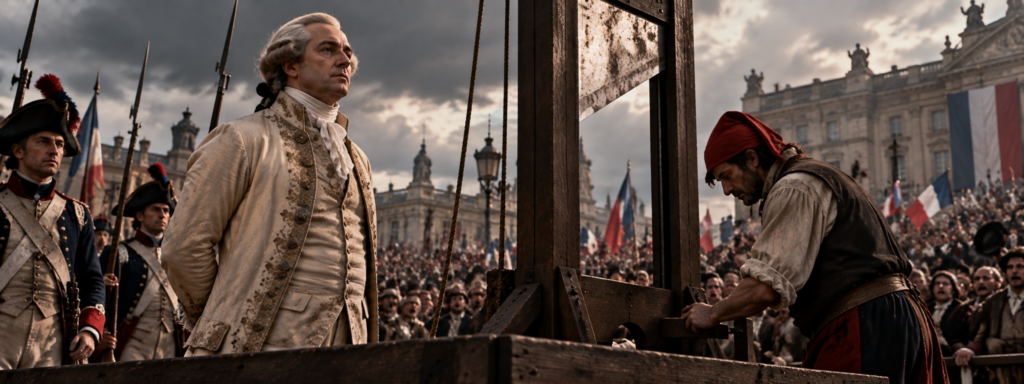
Louis XVI: The King Who Lost His Crown, Faced His Accusers, and Died Beneath the Guillotine
Louis XVI of France (1754–1793) | King of France, r. 1774–1792 | King of the French under the constitutional monarchy, 1791–1792 | Son of Louis, Dauphin of France, and Maria Josepha of Saxony | Grandson of Louis XV | Husband of Marie Antoinette of Austria | Father of Louis XVII and Marie-Thérèse Charlotte | Inherited a monarchy burdened by debt, political resistance, and growing demands for reform | Summoned the Estates-General in 1789 | Lost control of the Revolution that followed | Attempted to flee France in June 1791 but was captured at Varennes | Suspended from royal authority after the insurrection of August 10, 1792 | Deposed when the National Convention abolished the monarchy in September 1792 | Tried as Citizen Louis Capet and convicted of conspiracy against public liberty and the general security of the state | Sentenced to death by the National Convention | Executed by guillotine at the Place de la Révolution in Paris on January 21, 1793, aged thirty-eight | His death marked one of the most consequential acts of regicide in European history.
The King Who Walked Toward the Blade
On the morning of January 21, 1793, a former king of France was taken through the streets of Paris toward a wooden scaffold standing in the Place de la Révolution. Soldiers lined the route, drums accompanied the procession, and thousands of people gathered to witness an event that would have seemed almost unimaginable a generation earlier. The prisoner was Louis XVI, the man who had once ruled one of Europe’s most powerful kingdoms from the magnificent palace of Versailles. Now he was being transported to his execution under the authority of a revolutionary government that no longer recognized the sacred privileges of kingship.
Louis was thirty-eight years old, a husband, a father, and the last reigning monarch of the Bourbon dynasty before the French Revolution destroyed the monarchy. He had spent the previous months imprisoned in the medieval Temple complex, separated from the political world he had once governed and increasingly aware that his enemies intended to put him on trial. The crown had already been taken from him, his authority abolished, and his name reduced in official proceedings to Louis Capet, a designation intended to strip away the grandeur of royal identity. What remained was the question of whether the Revolution would allow its former sovereign to live.
The answer had been delivered only days earlier. The National Convention had found Louis guilty of conspiring against public liberty and the security of the state, and a narrow, bitterly contested series of votes had produced a death sentence. His defenders had argued that he should not be executed, while his enemies insisted that the survival of the Republic required the destruction of the former king. By the time the execution procession entered the square, the political arguments had ended, and the machinery of punishment was waiting.
The guillotine stood where royal ceremonies and public celebrations had once helped reinforce the authority of the French monarchy. It was a stark instrument of execution, designed to sever a human head swiftly and with a degree of mechanical reliability that its advocates considered more humane than older methods. The symbolism was impossible to ignore. A king whose ancestors had claimed to rule by divine right was about to be killed by a machine operating under the authority of representatives who claimed sovereignty belonged to the nation.
Louis approached the scaffold with a composure noted even by some observers who had little sympathy for his reign. Accounts of his final words differ, but several describe him attempting to declare his innocence and forgive those responsible for his death. The drums were sounded, preventing much of what he said from being heard clearly by the crowd. Within moments, the executioner Charles-Henri Sanson and his assistants had secured him beneath the blade.
At approximately ten twenty-two that morning, the guillotine fell. The man who had inherited the throne of France at nineteen was dead, and the executioner displayed his severed head to the assembled spectators. Some witnesses described cries of approval, while others remembered a more complicated atmosphere of shock, silence, and uneasy fascination. The reactions were not uniform because France itself was not united over the killing of its former king.
Louis XVI had not been murdered by a lone assassin hiding in a crowd or a conspirator slipping into a palace. He had been condemned through a political and judicial process conducted by the revolutionary government that had replaced his monarchy. His execution was deliberate, public, and intended to demonstrate that no individual, however exalted by birth, stood above the authority of the nation. It was regicide transformed from a clandestine crime into an act of state.
Yet the blade that killed Louis did not settle the Revolution’s deepest conflicts. His death intensified war with foreign powers, strengthened the fears of European monarchies, and became one of the defining events leading into the increasingly violent struggle for control of revolutionary France. The execution also transformed Louis from a failed and controversial ruler into a martyr in the eyes of royalists. The man who had struggled for years to govern his kingdom would become far more politically powerful in death than he had been during the final months of his reign.
A Prince Born Beneath the Weight of Versailles
Louis-Auguste was born on August 23, 1754, at Versailles, the royal palace that had become the most visible symbol of Bourbon magnificence. His grandfather, Louis XV, occupied the French throne, while his father, Louis, Dauphin of France, stood next in the line of succession. The young prince was not originally expected to become king because his elder brother, Louis-Joseph, Duke of Burgundy, stood ahead of him. Like many royal children, however, his future would be shaped by deaths that transformed the order of inheritance.
His elder brother died in 1761, leaving Louis-Auguste as the principal surviving male heir of his generation. His father died in 1765, followed by his mother, Maria Josepha of Saxony, in 1767. By the age of twelve, Louis had lost both parents and inherited the position of dauphin, placing him directly behind his grandfather in the succession. The boy who would eventually be condemned by a revolutionary tribunal had already experienced the instability that could exist beneath the apparent permanence of monarchy.
Louis received an education intended to prepare him for kingship. His tutors emphasized religion, history, geography, languages, morality, and the responsibilities of government. He developed serious intellectual interests and became particularly fond of geography, scientific instruments, mechanics, and locksmithing. These pursuits later contributed to the familiar image of Louis as an awkward, practical-minded man more comfortable with tools than politics.
That image contains some truth but has often been exaggerated into caricature. Louis was not an unintelligent man, and his interests were broader than the stories about locks and workshops suggest. He possessed considerable knowledge and could work diligently when a subject engaged him. His difficulty lay less in an absence of intelligence than in his uncertainty when forced to make decisions amid competing pressures.
The court of Versailles was an unforgiving environment for someone who lacked effortless social confidence. Aristocrats watched every gesture, court etiquette transformed ordinary activities into ceremonies, and political influence depended heavily upon personal relationships. Louis was often reserved and hesitant, qualities that could be interpreted as seriousness by sympathetic observers and weakness by hostile ones. Those characteristics would become increasingly consequential when France entered a crisis demanding rapid and decisive political leadership.
The Austrian Princess and the Marriage of Two Dynasties
In 1770, Louis married Marie Antoinette, the young daughter of Empress Maria Theresa of Austria. The marriage was arranged to reinforce the diplomatic alliance between the Bourbon and Habsburg dynasties, two royal houses whose rivalry had shaped European politics for generations. Marie Antoinette was only fourteen, while Louis was fifteen. Their marriage was therefore a political arrangement between adolescents expected to carry the ambitions of two great monarchies.
The young couple initially struggled to produce children. Their marriage was not consummated for several years, a situation that generated embarrassment, speculation, and diplomatic concern. Later writers often attributed the delay to a particular medical condition supposedly affecting Louis, but the surviving evidence does not establish a definitive diagnosis. The problem may have involved inexperience, anxiety, physical difficulties, or a combination of factors.
Whatever the cause, the absence of children became a subject of gossip. Versailles was a court where private matters could quickly become political weapons, and the marriage’s difficulties attracted attention from both French and Austrian observers. Marie Antoinette’s mother repeatedly expressed concern about the situation. Louis’s reserve and the couple’s youth made an already awkward problem even more difficult.
Their relationship eventually developed into a more settled marriage, and Marie Antoinette gave birth to their first child, Marie-Thérèse Charlotte, in 1778. Sons followed, including Louis-Joseph in 1781 and Louis-Charles in 1785. The birth of male heirs strengthened the dynasty and temporarily reduced anxieties about the succession. Yet the royal marriage would never escape public scrutiny, and Marie Antoinette’s reputation would become one of the most damaging vulnerabilities of Louis’s reign.
A Crown Inherited Too Young
Louis XV died of smallpox on May 10, 1774, leaving the throne to his nineteen-year-old grandson. Louis XVI inherited a kingdom possessing enormous wealth, a large population, international prestige, and a powerful monarchy whose ceremonial traditions reached back centuries. Beneath that impressive exterior, however, France faced serious financial and administrative problems. The new king would discover that royal authority was much easier to inherit than to exercise effectively.
The French monarchy had accumulated substantial debt through decades of warfare and expensive government. The Seven Years’ War had been particularly damaging, while the tax system remained unequal and inefficient. Privileged groups enjoyed exemptions and protections that complicated attempts to increase revenue. The crown possessed considerable theoretical authority but often struggled to force reforms through institutions determined to defend established rights.
Louis initially appeared willing to pursue reform. He appointed ministers who sought to improve government finances, reduce unnecessary expenditure, and stimulate economic activity. Among the most important was Anne-Robert-Jacques Turgot, a reform-minded administrator whose proposals challenged entrenched interests. Turgot attempted to liberalize aspects of the economy and reduce obstacles to more efficient taxation.
The reforms encountered fierce resistance. Court factions, privileged interests, and political institutions opposed changes that threatened their influence or financial position. Louis sometimes supported reformers but repeatedly hesitated when opposition intensified. His dismissal of Turgot in 1776 became an early demonstration of the monarchy’s difficulty in sustaining controversial policies.
The king’s indecision was not the sole cause of France’s problems. The financial system had developed over generations, and powerful groups possessed institutional means of obstructing change. Nevertheless, Louis’s tendency to retreat under pressure weakened confidence in his government. The pattern would repeat throughout his reign, with increasingly disastrous consequences.
The American War and the Debt That Haunted France
France’s involvement in the American War of Independence became one of the most consequential decisions of Louis’s reign. The monarchy supported the American colonists against Britain, hoping to weaken a longstanding rival and recover some of the international prestige lost during the Seven Years’ War. French assistance included money, military supplies, naval operations, and eventually direct participation in the conflict. The intervention contributed significantly to the American victory.
From a strategic perspective, the war brought genuine benefits. Britain suffered a major defeat, and France demonstrated that it remained capable of challenging British power overseas. French officers who served in America, including the Marquis de Lafayette, returned with experiences that influenced their understanding of political liberty. The conflict also strengthened intellectual connections between France and the emerging United States.
Financially, however, the war imposed an enormous burden. The French government relied heavily upon borrowing rather than undertaking the politically difficult tax reforms needed to finance the intervention. Debt servicing consumed an increasingly dangerous share of royal revenue. The monarchy had helped secure independence for another nation while worsening its own fiscal vulnerability.
The American example did not directly cause the French Revolution, but it contributed to the atmosphere in which revolutionary ideas developed. French observers had seen a monarchy challenged successfully through claims about representation and political rights. Those ideas interacted with Enlightenment thought and domestic grievances already present in France. The contradiction between supporting liberty abroad and preserving privilege at home became increasingly difficult to ignore.
By the late 1780s, the monarchy’s financial position had become critical. Louis’s ministers struggled to secure new revenue while avoiding political confrontation with privileged groups. The government could no longer rely indefinitely upon borrowing. A crisis that had developed over decades was approaching the point where ordinary administrative solutions would no longer suffice.
The Queen France Learned to Hate
Marie Antoinette became one of the most recognizable targets of criticism during the final years of the monarchy. Her Austrian birth made her vulnerable to accusations of foreign influence, while her court expenses and personal relationships provided material for scandal. Hostile pamphlets portrayed her as extravagant, sexually corrupt, politically manipulative, and indifferent to the suffering of ordinary French people. Much of this literature was deliberately sensational and should not be confused with reliable evidence.
The queen’s spending was not the principal cause of France’s financial crisis. Military expenditure, debt servicing, and structural weaknesses in taxation were far more important. Nevertheless, Marie Antoinette became a convenient symbol of aristocratic excess. Her clothing, entertainments, and private retreat at the Petit Trianon were presented as proof that the royal family lived in luxury while the population suffered.
The Affair of the Diamond Necklace in 1785 further damaged her reputation. The scandal involved a costly necklace, forged correspondence, and individuals who manipulated Cardinal de Rohan into believing he was acting on the queen’s behalf. Marie Antoinette was not responsible for the fraud, but public opinion frequently treated her as though she had been implicated. The episode demonstrated how completely her image had become detached from the evidence.
The famous accusation that she responded to bread shortages by saying the people should eat cake is also unsupported. Versions of the anecdote circulated before Marie Antoinette became queen, and there is no credible evidence that she made the remark. Its survival reveals how effectively the image of an indifferent queen became embedded in popular memory. The story endured because it seemed to express what critics already believed about Versailles.
Louis’s relationship with his wife became increasingly important as the monarchy weakened. Marie Antoinette was more politically active than the stereotype of a frivolous queen suggests, and she developed strong views about how the crown should respond to revolutionary demands. Her influence sometimes encouraged resistance to concessions that might have preserved constitutional compromise. Yet portraying her as the sole architect of royal policy ignores Louis’s own convictions and responsibilities.
The Kingdom Begins to Starve
The years immediately preceding the Revolution brought serious economic hardship. Poor harvests, particularly in 1788, contributed to rising bread prices and widespread anxiety about food supplies. Bread was a central component of ordinary diets, making price increases especially devastating for poorer households. Economic distress combined with unemployment and financial uncertainty to produce an increasingly volatile atmosphere.
Food shortages did not affect everyone equally. Wealthier households possessed resources that allowed them to withstand price increases more easily, while laborers and urban families could spend much of their income simply obtaining bread. Rural communities also faced pressures involving taxes, dues, and obligations inherited from the feudal system. Resentment toward privilege intensified as hardship spread.
The monarchy struggled to respond effectively. Government officials attempted various measures, but the underlying financial crisis limited the crown’s options. Public confidence deteriorated as people questioned whether the king understood their suffering. The distance between Versailles and ordinary French life became politically dangerous.
Louis was not personally indifferent to every hardship facing his subjects. He possessed a sincere sense of royal duty and supported charitable activities, and he could express concern for the welfare of the population. Yet good intentions could not compensate for ineffective institutions and repeated political hesitation. By 1789, the monarchy faced a crisis of legitimacy as well as finance.
The Estates-General Opens the Door
Unable to resolve the financial crisis through ordinary methods, Louis agreed to summon the Estates-General in 1789. The assembly had not met since 1614, and its revival created enormous expectations across France. Representatives were elected from the clergy, nobility, and Third Estate, the latter representing the overwhelming majority of the population outside the two privileged orders. Many hoped the meeting would produce financial reform and a more equitable political system.
The central dispute concerned how the assembly would vote. Traditional procedures favored voting by estate, allowing the clergy and nobility potentially to outvote the Third Estate despite representing a much smaller portion of the population. Representatives of the Third Estate demanded voting by head, which would give individual deputies greater influence. The disagreement quickly became a struggle over the nature of political representation.
Louis failed to resolve the conflict before it became revolutionary. His government alternated between concessions and attempts to preserve traditional authority. The Third Estate increasingly concluded that the monarchy and privileged orders were obstructing necessary reform. On June 17, 1789, its representatives declared themselves the National Assembly.
Three days later, finding their usual meeting place unavailable, deputies gathered in an indoor tennis court and swore not to separate until France had a constitution. The Tennis Court Oath became one of the defining moments of the Revolution. It asserted that political authority could be exercised by representatives of the nation rather than remaining entirely dependent upon royal permission. Louis’s government had summoned an assembly to solve a financial problem and instead confronted a challenge to the foundations of absolute monarchy.
The king initially resisted but eventually ordered the remaining estates to join the new assembly. The concession reflected the monarchy’s weakening position. Louis still possessed soldiers, ministers, and the ceremonial authority of kingship, but he no longer controlled the political process he had initiated. The Revolution had begun to develop an independent momentum.
The Bastille Falls and Royal Authority Cracks
During the summer of 1789, fears spread through Paris that royal troops might be used to suppress the National Assembly. The dismissal of the popular finance minister Jacques Necker intensified suspicion and anger. Crowds gathered, weapons were sought, and political unrest became increasingly difficult to contain. The city approached a confrontation with royal authority.
On July 14, insurgents stormed the Bastille, the fortress-prison that had become a symbol of arbitrary royal power. Although only a small number of prisoners were held there, the fortress possessed enormous symbolic importance. The fighting resulted in deaths on both sides, and the governor, Bernard-René de Launay, was killed after surrendering. His severed head was carried through Paris, revealing the violence that could accompany revolutionary triumph.
The fall of the Bastille shocked the monarchy. Louis was forced to recognize that Paris could mobilize against royal authority and that military force might produce uncontrollable consequences. The king visited the capital and accepted revolutionary symbols, including the tricolor cockade. His actions suggested accommodation, but the underlying question of who possessed ultimate authority remained unresolved.
Across the countryside, rumors of aristocratic plots contributed to the Great Fear. Peasants attacked symbols of feudal authority, destroyed records of obligations, and demanded relief from longstanding burdens. The National Assembly responded with sweeping measures associated with the abolition of feudal privileges. France was undergoing a transformation that extended far beyond the immediate dispute over taxation.
In August, the Assembly adopted the Declaration of the Rights of Man and of the Citizen. The document proclaimed principles of liberty, legal equality, and national sovereignty that challenged the traditional foundations of monarchy. Louis’s position became increasingly contradictory because he remained king while the political order beneath him was being reconstructed. The crown had not yet been abolished, but its meaning was changing rapidly.
The Women Who Marched on Versailles
By October 1789, food shortages and political suspicion had produced renewed unrest in Paris. On October 5, large crowds, prominently including market women, marched toward Versailles demanding bread and action from the king. The demonstration reflected genuine economic desperation but also became a political confrontation over the monarchy’s relationship with the capital. The royal family soon found itself surrounded by an increasingly hostile movement.
The following morning, violence erupted inside the palace complex. Protesters entered parts of Versailles, royal guards were killed, and Marie Antoinette narrowly escaped danger. The situation was chaotic, and the royal family faced the possibility that the palace could no longer protect them. Lafayette and the National Guard played important roles in restoring a measure of order.
Louis agreed to travel to Paris with his family. The procession brought the king, queen, and their children to the Tuileries Palace, where they would live under the close observation of the revolutionary capital. Officially, the move could be presented as a reconciliation between monarch and people. In practice, it marked the end of the royal family’s freedom to govern from Versailles.
The king was now physically separated from the palace that had symbolized Bourbon authority for generations. His movements were increasingly constrained, and political decisions unfolded under pressure from Parisian crowds and revolutionary institutions. The monarchy had not yet become a formal prisoner of the Revolution, but the distinction was narrowing. Louis’s authority was being reduced in ways that no royal ceremony could conceal.
A Constitutional King Who Distrusted His Constitution
During 1790 and 1791, the National Assembly continued reconstructing France’s political institutions. Administrative divisions were reorganized, noble privileges were dismantled, and the relationship between church and state became a major source of conflict. The Civil Constitution of the Clergy attempted to place the Catholic Church in France under a new national framework. The measure deeply divided religious opinion and created serious difficulties for the devoutly Catholic king.
Louis’s religious convictions were sincere and important to his political outlook. He struggled with reforms that appeared to undermine the Church’s traditional authority and its relationship with Rome. The requirement that clergy swear loyalty to the new ecclesiastical arrangements created divisions among priests and congregations. The king’s discomfort with the policy intensified his doubts about the direction of the Revolution.
At the same time, constitutional reformers hoped to preserve monarchy within a new political system. They envisioned a king whose powers would be limited by law and representative institutions but who would remain an essential part of government. Such a settlement might have preserved the Bourbon dynasty while ending absolutism. Its success depended heavily upon mutual trust.
That trust was steadily disappearing. Revolutionaries suspected that Louis secretly intended to reverse their reforms, while the king feared that the Assembly was dismantling institutions essential to legitimate government. His public acceptance of measures did not always reflect private agreement. The contradiction between outward cooperation and inward resistance would become disastrous.
Louis faced genuine dilemmas, but his handling of them repeatedly worsened his position. He could neither fully embrace the Revolution nor successfully organize an alternative political settlement. Every hesitation encouraged suspicion, while every concession alienated those who expected him to defend traditional monarchy. The constitutional compromise was weakening before it had fully taken shape.
The Flight That Destroyed the King’s Credibility
In June 1791, Louis and Marie Antoinette attempted to escape Paris with their children and close attendants. The plan involved traveling eastward toward forces loyal to the monarchy, with the ultimate objective of restoring the king’s freedom of action. The royal family left the Tuileries in disguise during the night of June 20–21. Their departure was intended to transform the political situation before revolutionary authorities could respond.
The escape was poorly executed. The large carriage, delays, complicated arrangements, and difficulties coordinating the journey increased the danger of discovery. Louis was recognized at Sainte-Menehould, traditionally through comparison with his image on currency, although accounts of the identification vary. The royal party was stopped at Varennes before reaching safety.
The capture was politically devastating. Revolutionaries who had defended constitutional monarchy now faced evidence that the king had attempted to leave the political system he was supposed to support. Louis had also left a declaration explaining his grievances against the Revolution, further exposing the distance between his public compliance and private convictions. The attempt made it much harder to believe that he would faithfully uphold a constitutional settlement.
The return to Paris was humiliating. Crowds watched the royal family pass through the streets, and the atmosphere differed sharply from the ceremonial triumphs once associated with royal travel. Louis had not merely failed to escape. He had undermined the credibility upon which his remaining authority depended.
The Flight to Varennes became a turning point because it transformed suspicion into a crisis of legitimacy. The king’s supporters attempted to preserve the monarchy by minimizing the political implications of the escape. Republicans increasingly argued that France could no longer trust a ruler who had tried to abandon the revolutionary settlement. The possibility of abolishing monarchy began to acquire greater force.
The Bloodshed at the Champ de Mars
The political consequences of Varennes quickly reached the streets. On July 17, 1791, demonstrators gathered at the Champ de Mars in Paris to support demands associated with removing the king. The National Guard, commanded by Lafayette, confronted the crowd amid rising tensions. Soldiers eventually opened fire, killing an uncertain number of demonstrators.
The massacre exposed deep divisions within the revolutionary movement. Constitutional monarchists feared that demands for a republic could destabilize France and produce further violence. More radical revolutionaries regarded the defense of Louis as a betrayal of the principles proclaimed in 1789. The Revolution was increasingly divided over whether the king could remain part of the new political order.
Louis was not personally directing the National Guard’s actions at the Champ de Mars, but the violence became associated with the struggle over his future. The event damaged the reputation of moderate leaders who had attempted to preserve constitutional monarchy. It also deepened hostility between different revolutionary factions. The political center was becoming harder to sustain.
In September 1791, Louis formally accepted the new constitution. The settlement established a constitutional monarchy and reduced the king’s authority substantially. Yet the acceptance came after Varennes, when many revolutionaries already doubted his sincerity. France possessed a constitutional king whose subjects increasingly suspected that he wished to escape the constitution.
War Turns the King Into a Suspect
In April 1792, France declared war on Austria, beginning a conflict that would soon expand across Europe. The decision emerged from a complicated mixture of revolutionary ideology, fear of foreign intervention, political ambition, and calculations made by different factions. Louis supported war for reasons that remain debated, including the possibility that conflict might strengthen the monarchy or expose the Revolution’s weaknesses. Whatever his expectations, the war rapidly made his position more dangerous.
French armies initially performed poorly, and military setbacks encouraged fears of treachery. Revolutionaries suspected that officers, aristocrats, and royal sympathizers were undermining the war effort. Marie Antoinette’s Austrian family connections intensified accusations against the court. The royal household became increasingly associated with the possibility of foreign intervention.
Louis’s use of his constitutional veto further damaged relations with the Legislative Assembly. He resisted measures directed against émigrés and refractory clergy, arguing from political and religious convictions that many revolutionaries interpreted as hostility toward national security. The veto was a lawful constitutional power, but its exercise became politically explosive. Each dispute made the king appear less like a constitutional partner and more like an obstacle.
On June 20, 1792, crowds invaded the Tuileries and confronted the royal family. Louis endured the demonstration without surrendering all the demands placed upon him, but the event revealed how vulnerable the palace had become. The king’s authority was now challenged directly by crowds capable of entering his residence. The monarchy was approaching its final crisis.
The Brunswick Manifesto and the Fear of Betrayal
In July 1792, the Duke of Brunswick, commanding forces associated with the invading coalition, issued a manifesto threatening severe consequences if the French royal family were harmed. The document was intended to intimidate revolutionaries and protect the monarchy. Instead, it intensified suspicion that Louis was connected with foreign enemies preparing to invade France. The manifesto became one of the most damaging pieces of political propaganda against the king.
The threat against Paris was particularly inflammatory. Revolutionaries interpreted it as evidence that foreign armies intended to restore royal authority through force. Even those who had previously supported constitutional monarchy found it increasingly difficult to defend a king apparently favored by invading powers. The distinction between protecting the royal family and supporting foreign intervention became blurred in public debate.
Louis did not write the manifesto, and the extent of his direct involvement in the coalition’s plans must be distinguished from the claims made by his enemies. Nevertheless, the royal family’s communications and hopes for outside assistance had already undermined confidence in their loyalty to the Revolution. The manifesto reinforced fears that the monarchy might welcome foreign military success. In a country at war, those fears carried potentially fatal consequences.
Paris became increasingly radicalized during the summer. Armed volunteers, political clubs, sections of the city, and revolutionary leaders demanded stronger measures against perceived enemies. The monarchy was no longer simply unpopular. It was being portrayed as a danger to the nation’s survival.
August 10: The Day the Monarchy Fell
On August 10, 1792, an insurrectionary movement attacked the Tuileries Palace. Revolutionary forces, including armed Parisian militants and fédérés from the provinces, confronted the defenders of the royal residence. The palace was guarded in part by Swiss Guards, whose loyalty and discipline made them formidable opponents. The resulting fighting was among the bloodiest episodes of the Revolution in Paris.
Louis and his family left the palace and sought refuge with the Legislative Assembly. Their departure deprived the defenders of clear political direction at a moment when violence was escalating. Fighting continued, and many Swiss Guards were killed during the assault or afterward. The precise sequence of orders and responsibility for particular deaths has been debated, but the scale of the catastrophe is beyond dispute.
The insurrection effectively ended the monarchy as an operating institution. The Legislative Assembly suspended Louis from his functions and arranged for the royal family to be placed under guard. The king who had once commanded France’s armies could no longer protect his own residence. His political authority had collapsed under the combined pressure of war, popular insurrection, and revolutionary suspicion.
The royal family was eventually imprisoned in the Temple complex. Louis, Marie Antoinette, their children, and Madame Élisabeth entered captivity under conditions that became increasingly restrictive. The move represented a complete reversal of royal life. The family that had once occupied Versailles was now confined within a fortress controlled by the revolutionary authorities.
The August insurrection also transformed the Revolution’s political direction. A new National Convention was elected, and the possibility of a republic moved from radical demand to immediate political reality. Louis remained alive, but the institution that had made him king was effectively finished. The next question was whether the former monarch would be allowed to survive its destruction.
The September Massacres and the Republic
During early September 1792, fear of foreign invasion and internal conspiracy contributed to massacres in Parisian prisons. Crowds and armed groups killed large numbers of prisoners, including clergy, political suspects, and ordinary detainees. The violence was fueled by rumors that imprisoned enemies would rise against the Revolution while foreign armies approached. The killings revealed the terrifying power of political panic.
Louis and his family remained imprisoned while the massacres unfolded. The royal household had become a symbol of the alleged conspiracy between domestic enemies and foreign invaders. Although the former king was not directly responsible for the prison killings, the atmosphere made his prospects increasingly bleak. Calls for severe action against enemies of the Revolution gained strength.
On September 20, French forces achieved an important success at Valmy against the invading Prussian army. The following day, the National Convention met and abolished the monarchy. France became a republic, ending the Bourbon monarchy that Louis had inherited in 1774. The political transformation was extraordinary because it replaced hereditary sovereignty with a government claiming authority from the nation.
Louis was no longer officially recognized as king. Revolutionary authorities increasingly referred to him as Louis Capet, invoking the medieval Capetian ancestry of the French royal family while rejecting his royal title. The name was politically useful because it reduced a former sovereign to the status of an ordinary citizen. Yet that very transformation created a legal and constitutional dilemma.
If Louis was an ordinary citizen, he could theoretically be judged for crimes. If he had been an inviolable constitutional monarch, however, the legality of prosecuting him for acts committed while king was disputed. The Revolution would have to decide whether its own principles required a trial or whether the former king’s political existence was itself intolerable. The argument would divide the National Convention.
The Iron Chest and the King’s Secret Papers
In November 1792, the discovery of a concealed collection of royal documents intensified the case against Louis. The papers were found in a hidden compartment at the Tuileries, commonly remembered as the armoire de fer, or iron chest. They contained evidence of secret political communications and arrangements that undermined the king’s public presentation of loyalty to the constitutional order. The discovery damaged the credibility of those still attempting to defend him.
Among the most important revelations were documents relating to covert political dealings and efforts to influence public figures. The papers implicated Mirabeau, the influential revolutionary orator who had secretly advised the court while publicly supporting constitutional reform. His posthumous reputation suffered severely when the relationship became known. The documents suggested that the monarchy had attempted to manipulate revolutionary politics from behind the scenes.
Not every paper demonstrated treason in the narrow legal sense. Monarchs and governments routinely maintained confidential correspondence, and political secrecy was not automatically criminal. The significance of the documents lay in their relationship to Louis’s repeated assurances of constitutional cooperation. They strengthened the argument that he had acted against the political order he publicly accepted.
The discovery also altered the political atmosphere surrounding his trial. Deputies who had hoped to preserve the former king’s life now faced greater pressure to explain why he should be spared. Radical revolutionaries portrayed the documents as proof of deliberate conspiracy. The case against Louis was becoming both a judicial proceeding and a struggle over the future of the Republic.
Could a King Be Put on Trial?
The decision to try Louis raised fundamental questions about sovereignty and law. Under the Constitution of 1791, the king had possessed a form of personal inviolability, and his ministers were generally responsible for governmental acts. Revolutionaries now had to decide whether that protection survived the destruction of the monarchy. The question was not merely technical because the answer would determine whether Louis could legally be condemned.
Some deputies argued that Louis should be judged through ordinary procedures, with evidence presented and a defense permitted. Others believed that the former king had already been condemned politically by the nation through the insurrection of August 10. For them, a trial risked treating the sovereign people as though they needed judicial permission to abolish tyranny. The debate exposed tensions between revolutionary legality and revolutionary necessity.
Maximilien Robespierre became one of the most prominent advocates of the view that Louis’s continued existence threatened the Republic. His argument emphasized the political danger posed by the former monarch rather than relying solely upon ordinary criminal procedure. Louis could become a rallying point for foreign powers and domestic royalists. The Revolution, in this interpretation, could not safely preserve the life of the man whose monarchy it had destroyed.
Other deputies feared the consequences of execution. Killing Louis might provoke foreign intervention, deepen civil conflict, and make reconciliation impossible. Some supported imprisonment, exile, or a public referendum instead. The Convention therefore faced a choice that combined legal principle, political calculation, fear, and ideological conviction.
The trial eventually proceeded before the National Convention itself. This arrangement meant that the deputies who had abolished the monarchy would also judge the former king. Critics could reasonably question whether such a body could act as an impartial court. Supporters argued that the Convention represented the sovereign nation and possessed the authority necessary to resolve the crisis.
Louis Capet Faces His Accusers
Louis appeared before the National Convention on December 11, 1792. The proceedings were conducted in a political atmosphere filled with suspicion, anger, and anxiety about France’s survival. The former king was confronted with accusations concerning his actions during the Revolution, including attempts to undermine constitutional government and dealings with forces hostile to the nation. He responded to the charges and denied many of the allegations.
The sight of Louis standing before representatives of the nation carried enormous symbolic significance. For centuries, French kings had been the source of justice, with courts operating under royal authority. Now a former king was being questioned by men who rejected the political system that had given him power. The relationship between ruler and subject had been reversed.
Louis’s defense team included Raymond de Sèze, François Denis Tronchet, and the former royal minister Chrétien Guillaume de Lamoignon de Malesherbes. Their task was extraordinarily difficult because the proceedings involved questions that could not be separated from the political survival of the Republic. They attempted to challenge the accusations, invoke legal protections, and argue against condemning the former monarch. Their advocacy required considerable courage in an atmosphere where defending Louis could attract suspicion.
De Sèze delivered a substantial defense on December 26. He challenged the legal basis of the prosecution and sought to distinguish the king’s actions from the crimes alleged against him. The defense emphasized that Louis had operated within a constitutional framework that recognized royal powers and protections. It also attempted to remind the deputies that political disagreement should not automatically become a capital offense.
The arguments did not erase the political reality. Many deputies had already concluded that Louis’s survival endangered the Republic. Others remained uncertain or opposed execution while accepting that the former king had committed serious wrongs. The Convention would now determine whether its verdict should end in imprisonment, exile, or death.
The Charges Against the Former King
The accusations against Louis concerned his alleged conspiracy against public liberty and the general security of the state. They drew upon events throughout the Revolution, including the Flight to Varennes, the use of royal powers against revolutionary measures, secret political communications, and suspected cooperation with enemies of France. The prosecution presented these actions as evidence of a consistent effort to undermine the nation. Louis’s defenders challenged both the interpretation of particular events and the legality of judging him under the proposed standards.
The Flight to Varennes was especially damaging because it had publicly exposed the king’s desire to escape the constraints of the revolutionary government. Louis argued from a position shaped by his understanding of royal authority and the pressures placed upon him. Revolutionaries interpreted the attempt as abandonment of constitutional duty. The event had already destroyed much of the trust necessary for compromise.
The royal family’s relationship with foreign powers also occupied a central place in the case. Marie Antoinette’s Austrian connections and the monarchy’s hopes for outside support contributed to accusations that the king had placed dynastic interests above France’s security. The prosecution viewed such contacts through the experience of war and invasion. The defense disputed the extent to which Louis could be held responsible for every action taken by foreign monarchies.
The iron chest documents strengthened claims that Louis had concealed political activities while publicly cooperating with the Revolution. Secret payments and communications suggested an effort to influence or obstruct revolutionary institutions. Yet the meaning of individual documents required interpretation, and not every confidential political act constituted treason. The trial was therefore not simply a matter of presenting an undisputed confession.
Louis’s responsibility for the violence of August 10 was another major issue. The insurrection had produced substantial casualties, and the king’s opponents regarded the defense of the Tuileries as evidence of hostility toward the people. His defenders could argue that protecting the royal residence was not automatically criminal under the constitutional order then in existence. The broader question remained whether a monarch could be condemned for resisting the movement that ultimately overthrew him.
The Convention Votes on a King’s Life
In January 1793, the National Convention began the decisive votes concerning Louis’s fate. The deputies first addressed his guilt, and the Convention overwhelmingly found him guilty, with no votes recorded for acquittal in the principal roll call. The next question concerned whether the verdict should be referred to the people for ratification. A majority rejected that proposal, leaving the decision in the hands of the Convention.
The vote on punishment was far more divisive. Deputies were called individually to declare their positions, producing a long and emotionally charged proceeding. Some demanded immediate execution, while others proposed imprisonment, detention until peace, or death subject to conditions or delay. The different formulations make the exact numerical interpretation of the vote more complicated than the familiar claim that a simple one-vote majority condemned the king.
A majority ultimately supported death, and a narrower margin favored the immediate death sentence without the alternatives proposed by other deputies. The frequently cited figure of 361 votes reflects one important grouping in the voting, but the roll calls contained multiple categories and subsequent decisions. The essential result was unmistakable: the Convention sentenced Louis to execution. The Republic had decided that its former king would not be allowed to live.
The voting exposed divisions that would continue shaping revolutionary politics. Deputies differed not only over Louis personally but over the meaning of justice, the dangers of royalist conspiracy, and the limits of revolutionary power. Some believed execution was necessary to secure the Republic. Others feared that killing a defenseless prisoner would damage the Revolution’s moral legitimacy.
Louis’s fate was therefore decided through a process that was both political and judicial. The Convention had examined accusations and heard a defense, but it was also deciding whether the Republic could coexist with a living former king. The execution would remove a potential symbol of counterrevolution while demonstrating the sovereignty of the revolutionary state. Whether that made the sentence just or unjust became one of the great controversies of modern European history.
Philippe Égalité and the Vote That Shocked France
One of the most notorious votes came from Louis Philippe Joseph, Duke of Orléans, a cousin of the king who had adopted the revolutionary name Philippe Égalité. He belonged to the Bourbon royal family but had become associated with revolutionary politics. His position made him a particularly striking participant in the proceedings. When he voted for Louis’s death, the decision shocked royalists and reinforced the impression that the old dynastic order had disintegrated.
The relationship between the Bourbon branches had long involved rivalry and political tension. The Orléans family possessed enormous wealth and prestige, and its members had sometimes opposed the policies of the reigning monarchy. Philippe Égalité’s revolutionary sympathies were therefore part of a broader political history. His vote nevertheless carried an unmistakable personal and symbolic weight.
Later writers frequently portrayed the vote as an act of calculated betrayal intended to advance his own ambitions. Some suggested that he hoped to replace Louis or secure political advantage through the destruction of the senior Bourbon line. His precise motives remain difficult to establish with certainty. Political conviction, self-preservation, rivalry, and ambition may all have influenced his conduct.
The irony of his position became apparent later in 1793. Philippe Égalité himself was arrested and executed during the Revolution’s radical phase. His vote for Louis’s death did not protect him from the political violence that followed. The Revolution was becoming increasingly dangerous even for those who had supported its most dramatic acts.
The Last Days in the Temple
After the death sentence, Louis returned to the Temple knowing that his remaining time was short. The prison had already stripped away the public ceremonies and privileges that once defined his existence. He lived under guard, separated from political power and dependent upon revolutionary authorities for ordinary necessities. The final days were dominated by preparations for death and concern for his family.
Louis requested permission to see Marie Antoinette, their children, and his sister Madame Élisabeth. The family meeting took place on the evening of January 20 and became one of the most emotionally charged episodes of the royal captivity. Accounts describe grief, embraces, and the anguish of relatives who understood that they were almost certainly seeing one another for the last time. The precise words exchanged were recorded through later recollections and should not all be treated as verbatim transcripts.
The king’s children were still young. His daughter Marie-Thérèse was fourteen, while Louis-Charles, the surviving dauphin, was seven. Neither could fully understand the political forces that had destroyed their family’s position. Their father’s death would leave them imprisoned under increasingly dangerous circumstances.
Marie Antoinette had endured years of public hatred, political humiliation, and personal fear. She had watched the monarchy collapse and her husband become a prisoner of the government that replaced it. The final meeting forced her to confront the immediate reality of his execution. Within months, she would face her own trial and death.
Louis’s religious faith became especially important during his final hours. He received spiritual assistance from Henry Essex Edgeworth, an Irish-born Catholic priest known as the Abbé Edgeworth de Firmont. The king prepared himself through prayer and confession, seeking to meet death with Christian resignation. His conduct during these hours contributed significantly to the later royalist image of Louis as a martyr.
The Testament of a Condemned King
Louis had prepared a testament in December 1792, before the final verdict was delivered. The document expressed his religious convictions, concern for his family, and desire to forgive those he believed had wronged him. It also contained reflections upon his conduct and responsibilities. The testament became an important source for understanding how Louis wished to present himself at the end of his life.
He did not portray himself as a revolutionary convert or renounce the principles of monarchy. His religious faith and sense of royal duty remained central to his identity. At the same time, the testament emphasized forgiveness and concern for those who had suffered through the political crisis. It revealed a man attempting to reconcile personal conscience with the catastrophe surrounding him.
Royalists later treated the testament as evidence of saintly character. Revolutionary opponents could interpret it as the final statement of a ruler who had failed to understand the transformation of France. Both readings risk reducing the document to propaganda. It is most valuable as evidence of Louis’s beliefs and the manner in which he wished to face death.
The testament also illustrates the difference between the historical king and the caricatures produced by his enemies. Louis could be hesitant, politically ineffective, and deeply attached to traditional monarchy while also possessing sincere religious convictions and genuine affection for his family. His execution did not erase the mistakes of his reign. Neither did those mistakes make his private humanity irrelevant.
January 21, 1793: The Journey Through Paris
The morning of the execution began under heavy security. Revolutionary authorities feared that royalists might attempt a rescue or that public disorder could interfere with the sentence. Troops were positioned along the route, and the movement of the prisoner was carefully controlled. The government intended the execution to demonstrate authority rather than become another scene of unpredictable street violence.
Louis left the Temple accompanied by the Abbé Edgeworth. He traveled in a carriage toward the Place de la Révolution, the square formerly known as the Place Louis XV. The change of name reflected the political transformation that had overtaken France. A public space once associated with royal grandeur had become the setting for the destruction of the monarchy’s former head.
The journey took place through a city whose relationship with Louis had changed beyond recognition. In 1774, his accession had been celebrated as the beginning of a new reign. In 1789, crowds had demanded bread and reform while still addressing him as king. By 1793, the Republic had declared him guilty and ordered his death.
The atmosphere was tense rather than uniformly triumphant. Revolutionary supporters regarded the execution as necessary justice, while royalists saw it as sacrilege and murder. Many ordinary spectators may have experienced a mixture of curiosity, fear, satisfaction, and disbelief. The surviving descriptions reflect the political sympathies of those who recorded them.
Louis reportedly spent part of the journey in prayer or religious reflection. Accounts emphasize his composure, although they differ over particular gestures and conversations. Such details were especially important to later writers who wished to portray him either as a dignified victim or as a defeated tyrant. The broad picture remains that he approached the execution without the public panic his enemies might have expected.
The Guillotine and the New Language of Death
The guillotine had entered French penal practice during the Revolution as part of efforts to standardize capital punishment. Its advocates argued that a mechanical device could provide a swift and comparatively equal method of execution. Under the old system, punishments varied according to crime and social status, with noble offenders often receiving methods different from those imposed upon commoners. The new approach reflected revolutionary claims that citizens should be equal before the law.
Joseph-Ignace Guillotin had advocated a uniform method of execution, but he did not personally invent the machine that bore his name. The device was developed through the work of others, including the physician Antoine Louis and the instrument maker Tobias Schmidt. Earlier European societies had also used mechanical decapitation devices. The French guillotine nevertheless became uniquely associated with revolutionary justice.
The first execution using the new machine took place in April 1792. By January 1793, it had become an established instrument of capital punishment. Its use against Louis carried a particular symbolic force because the former king would die by the same method available for other condemned people. The Revolution was rejecting the idea that royal blood required a separate form of justice.
The guillotine also transformed execution into a mechanical process. The blade descended rapidly, reducing the need for an executioner’s skill with sword or axe. Supporters regarded that reliability as an improvement over older methods that could produce prolonged suffering. Critics later saw the machine as a symbol of impersonal state violence.
For Louis, the device represented the final destruction of the distinction between king and subject. He had once occupied a position defined by hereditary privilege and sacred ceremony. At the scaffold, his body would be treated according to the sentence imposed by the revolutionary government. The machinery of equality had become the machinery of regicide.
The Execution of Louis XVI
When the carriage reached the Place de la Révolution, Louis was brought toward the scaffold. Charles-Henri Sanson, the official executioner of Paris, supervised the procedure with his assistants. The king’s hands were secured, and preparations were made to place him beneath the blade. Accounts differ over whether he initially resisted particular aspects of the procedure, but they generally describe him maintaining composure.
Louis attempted to address the crowd before his death. Several accounts preserve versions of a declaration in which he asserted his innocence and forgave those responsible for his execution. The exact wording cannot be established with complete certainty because witnesses recorded different versions. The central point is that he sought to speak publicly before the sentence was carried out.
The drums were sounded, drowning out much of the attempted speech. The decision to prevent the crowd from hearing him has often been interpreted as an effort to deny the former king a final opportunity to influence public opinion. Whether every detail of that interpretation can be proved, the effect was clear. Louis’s last public words did not become a sustained address to the nation.
The executioners positioned him beneath the guillotine. The blade fell, severing his head in a single movement. Sanson displayed the head to the crowd, completing the ritual of public execution. The former king of France was dead.
The body was removed for burial, and the authorities moved to prevent the remains from becoming an immediate royalist shrine. Louis was buried in the cemetery of the Madeleine in Paris. His remains would later be recovered during the Bourbon Restoration and transferred to the Basilica of Saint-Denis. The changing treatment of his body reflected the changing political fortunes of monarchy in France.
The execution was intended to close the question of Louis’s political role permanently. Yet the spectacle created a new kind of presence for him within French politics. Royalists could now remember him as an innocent victim, while revolutionaries could invoke his death as proof that the Republic had broken decisively with the old regime. The guillotine ended his life but not the struggle over his meaning.
Was Louis XVI Guilty of Treason?
The question of Louis’s guilt remains inseparable from the political circumstances of his trial. The Convention found him guilty of conspiracy against public liberty and the security of the state. Evidence of secret political dealings, resistance to revolutionary measures, and attempts to escape the constitutional order provided substantial grounds for accusing him of acting against the Revolution. His conduct had repeatedly undermined the trust necessary for constitutional monarchy.
Yet the legal framework was contested. Louis had been king under a system that granted him powers and protections later rejected by the revolutionary government. His defenders argued that the Convention was applying new political standards to actions undertaken within an earlier constitutional order. The fact that his judges were also political participants in the overthrow of monarchy complicated claims of impartiality.
The distinction between political guilt and criminal guilt is therefore important. Louis clearly opposed important aspects of the Revolution and sought ways to recover greater freedom and authority. Whether every such act constituted treason under a consistent legal standard is a more difficult question. The Convention’s judgment was shaped by war, fear of counterrevolution, and the perceived necessity of protecting the Republic.
His execution also raises the separate question of whether death was necessary. Some deputies believed imprisonment or exile could remove him from political power without making him a martyr. Others feared that a living Louis would remain a rallying point for foreign armies and domestic royalists. The choice was therefore influenced by predictions about future danger as much as by punishment for past conduct.
A historically responsible account need not declare Louis entirely innocent or wholly deserving of death. His political decisions contributed significantly to the collapse of constitutional compromise. At the same time, the revolutionary government chose to execute a prisoner who no longer possessed effective political power. The morality and legality of that decision have remained contested ever since.
The Queen Who Followed Him to the Scaffold
Marie Antoinette remained imprisoned after her husband’s execution. Her position became increasingly dangerous as the Revolution entered a more radical phase. The queen had long been a target of hostile propaganda, and her Austrian ancestry intensified suspicion during France’s war with European powers. The death of Louis removed the last major personal and dynastic protection associated with her former status.
In 1793, Marie Antoinette was transferred to the Conciergerie prison and brought before the Revolutionary Tribunal. The accusations against her included political offenses and allegations arising from the hostile literature that had surrounded her for years. Some charges were supported by political circumstances, while others were sensational or deeply questionable. Her trial unfolded in an atmosphere where acquittal was highly unlikely.
She was condemned and executed on October 16, 1793. Unlike Louis, whose execution had occurred in winter, Marie Antoinette traveled to the scaffold during the autumn months of the Revolution’s increasingly violent phase. Her death completed the destruction of the former royal couple. Their children remained imprisoned, deprived of both parents.
The executions of Louis and Marie Antoinette became inseparable in royalist memory. Their deaths were presented as a family tragedy and as evidence of revolutionary cruelty. Revolutionary supporters regarded them as the removal of figures associated with counterrevolutionary danger. The same events therefore continued producing radically different moral interpretations.
The Children Left Behind
The execution of Louis XVI left his children in a particularly vulnerable position. Marie-Thérèse Charlotte, the eldest surviving child, remained imprisoned and endured the deaths of her father, mother, and aunt. Her younger brother Louis-Charles became the focus of royalist hopes after his father’s execution. To supporters of hereditary monarchy, the boy was now Louis XVII.
The Republic did not recognize his kingship. He remained a prisoner in the Temple, where his conditions deteriorated severely. The child was separated from his family and subjected to neglect and mistreatment. He died in June 1795 at the age of ten, most likely from tuberculosis and complications associated with his confinement.
His death generated one of the most persistent mysteries in French royal history. Rumors circulated that the boy had escaped and that another child had died in his place. Numerous claimants later appeared, asserting that they were the surviving Louis XVII. Modern scientific investigation has strongly supported the identification of the child who died in the Temple as the dauphin.
Marie-Thérèse survived imprisonment and was eventually released in December 1795. She later married her cousin Louis-Antoine, Duke of Angoulême, and became an important figure in Bourbon royalist circles. Her survival provided a living connection to the destroyed family of Louis XVI. She carried the memory of the Revolution’s treatment of her parents and brother into the nineteenth century.
The children’s experiences complicate any simple political narrative. They had not governed France, directed royal policy, or made the decisions for which their father was condemned. Yet they suffered profoundly because of their birth. The Revolution’s struggle against monarchy extended into the lives of children whose only political significance came from their ancestry.
Europe Reacts to the Death of a King
Louis’s execution shocked the courts of Europe. Monarchs who had already viewed the French Revolution with alarm now confronted the deliberate killing of a fellow sovereign by a revolutionary government. The event seemed to threaten the principles of hereditary monarchy upon which much of European political order depended. Even rulers who had criticized Louis’s policies could regard his execution as a dangerous precedent.
France was already at war with Austria and Prussia, but the execution contributed to the expansion of the conflict. Britain and the Dutch Republic entered war with revolutionary France in February 1793, while other powers joined the growing coalition. The execution was not the sole cause of these developments, which also involved strategic interests and French expansion. Nevertheless, it intensified the ideological character of the struggle.
The death of Louis also strengthened royalist resistance within France. Opponents of the Republic could portray the execution as proof that revolutionary leaders intended to destroy religion, tradition, and legitimate authority. Such arguments became particularly powerful in regions already hostile to revolutionary policies. The conflict increasingly acquired the character of a struggle over the moral foundations of society.
For revolutionaries, the execution represented a decisive break with the past. France had demonstrated that sovereignty belonged to the nation rather than to a hereditary monarch. The Republic could no longer easily retreat to constitutional monarchy after killing the former king. The act therefore committed the Revolution to a more radical political future.
The Vendée and the Civil War That Followed
In western France, opposition to revolutionary policies contributed to the uprising in the Vendée during 1793. The causes included resentment of conscription, religious grievances, local political tensions, and hostility toward the revolutionary government. The execution of Louis formed part of the broader atmosphere in which royalist resistance developed. It was not the single cause of the revolt, but it strengthened the symbolic appeal of monarchy among opponents of the Republic.
The conflict became extraordinarily brutal. Republican armies and insurgent forces committed acts of violence against combatants and civilians, while communities were devastated by military operations. The struggle involved massacres, reprisals, destruction of property, and severe suffering among ordinary people. The scale and interpretation of the violence remain subjects of historical debate.
Royalist leaders could invoke the dead king as a symbol of legitimate authority. His execution provided a powerful emotional image through which resistance to the Republic could be justified. Yet the uprising also reflected local grievances that cannot be reduced to personal loyalty toward Louis. Many participants were motivated by religious and social concerns as much as dynastic conviction.
The Vendée demonstrated that the execution had not eliminated royalism. It had instead provided opponents of the Republic with a martyr whose memory could inspire resistance. The Convention had removed the former king’s physical presence but could not destroy the political meaning attached to him. Regicide had created a new symbol around which counterrevolution could gather.
From the King’s Execution to the Reign of Terror
The months following Louis’s death witnessed the radicalization of revolutionary government. France faced foreign invasion, internal rebellion, economic distress, and intense factional conflict. Revolutionary leaders increasingly argued that extraordinary measures were necessary to defend the Republic. The execution of the former king became part of a broader political environment in which violence was presented as an instrument of national survival.
The Committee of Public Safety acquired growing influence, while the Revolutionary Tribunal prosecuted individuals accused of threatening the Revolution. The period remembered as the Reign of Terror developed through 1793 and 1794. Thousands of people were executed, and many others died through imprisonment, warfare, and political repression. The guillotine became the most recognizable symbol of the period.
Louis’s execution did not mechanically cause the Terror. The radicalization of revolutionary politics involved multiple pressures, including military emergencies, factional struggles, and fears of conspiracy. Nevertheless, the killing of the former king helped normalize the idea that political survival could require the physical elimination of enemies. The precedent possessed enormous symbolic significance.
The Revolution eventually turned against some of its own leading figures. Georges Danton was executed in April 1794, while Robespierre and several associates followed him to the guillotine in July. The machinery of revolutionary punishment did not remain confined to royalists and aristocrats. It consumed men who had helped construct the political order responsible for Louis’s death.
The pattern reveals one of the Revolution’s darkest contradictions. A movement proclaiming liberty and equality became associated with extraordinary coercion and political execution. Its leaders believed they were defending the Republic against existential threats, but the definition of an enemy could expand rapidly. Louis’s death was only one episode in a much larger struggle over the relationship between justice, fear, and state violence.
The Burial of a King Without a Crown
After his execution, Louis was buried in the cemetery of the Madeleine in Paris. The burial lacked the traditional magnificence associated with French royal funerals. There was no elaborate dynastic ceremony celebrating the continuity of monarchy. The former king was placed in the ground under the authority of the government that had condemned him.
The treatment of his remains reflected the Revolution’s determination to prevent royal memory from challenging republican legitimacy. A public royal tomb could become a gathering place for opponents of the new regime. The authorities therefore had political reasons to avoid creating an immediate shrine. The burial was part of the wider effort to remove monarchy from public life.
The Bourbon Restoration later reversed that treatment. After Napoleon’s defeat and the return of the monarchy, Louis XVIII ordered efforts to recover the remains of Louis XVI and Marie Antoinette. Their remains were transferred to the royal necropolis at Saint-Denis in 1815. The ceremony restored them symbolically to the dynastic tradition from which the Revolution had expelled them.
The restoration of the bodies did not settle the historical argument. Royalists regarded the reburial as an act of justice toward murdered sovereigns. Republicans could interpret it as an attempt to reverse the Revolution’s political meaning. The remains of Louis and Marie Antoinette continued to serve as symbols in France’s struggle over its past.
The contrast between the two burials was striking. In 1793, Louis had been placed in an ordinary cemetery after execution as a condemned citizen. In 1815, he was returned to the resting place of French kings. The treatment of his body changed with the political regime, demonstrating how even death could not free him from the conflict over monarchy.
The King Who Was Neither Monster Nor Martyr
Louis XVI has often been portrayed through two opposing stereotypes. In revolutionary narratives, he appears as a weak or treacherous monarch whose resistance to reform helped bring about his own destruction. In royalist accounts, he becomes a virtuous Christian king unjustly murdered by fanatics. Both images contain elements connected to historical reality, but neither adequately explains the complexity of his reign.
Louis possessed genuine virtues. He was personally devout, intellectually curious, and capable of concern for his subjects. He supported reforms at various points and did not exhibit the personal cruelty associated with some earlier monarchs. His private conduct was often more restrained than that of many royal predecessors.
Yet his political weaknesses were serious. He struggled to maintain consistent policies, repeatedly retreated under pressure, and failed to understand how rapidly public expectations were changing. His attempted flight in 1791 destroyed trust at a critical moment. His secret political dealings further undermined the credibility of constitutional monarchy.
He also remained deeply attached to the traditional foundations of royal authority. Although he accepted constitutional limitations publicly, he never fully reconciled himself to the Revolution’s transformation of sovereignty. His religious convictions intensified his resistance to certain reforms. The resulting contradictions made effective cooperation increasingly difficult.
Louis was therefore neither simply an innocent victim nor the sole author of his downfall. He inherited structural problems that had developed over generations and confronted revolutionary forces far beyond his personal control. His decisions nevertheless influenced how those forces developed. Understanding his death requires recognizing both the limitations of his agency and the consequences of his choices.
Was the Execution an Act of Justice or Political Murder?
The execution of Louis XVI remains one of the most controversial examples of state-sanctioned regicide. The National Convention claimed to act on behalf of the French nation and conducted proceedings that included accusations, a defense, and votes. From the revolutionary perspective, the former king had betrayed the people and endangered the Republic. His death could therefore be presented as a lawful punishment imposed by sovereign authority.
Royalists rejected that interpretation. They regarded Louis as the legitimate king whose sacred position could not be erased by revolutionary decrees. For them, the Convention was not a lawful court but a rebellious assembly that had usurped royal authority. The execution was therefore murder, regardless of the procedures used to authorize it.
Modern historical analysis must distinguish legal procedure from political legitimacy. The Convention possessed effective governing power and established the process through which Louis was condemned. Yet its members were deeply involved in the political struggle that had overthrown him. The trial therefore cannot be understood as an ordinary criminal proceeding detached from revolutionary conflict.
The question of necessity remains equally difficult. Louis was imprisoned and no longer exercised royal authority, but his survival could have provided a symbol for foreign intervention and domestic restoration. Deputies who demanded execution believed they were protecting the Republic. Those who opposed it feared that killing him would deepen the Revolution’s violence and create a martyr.
The event can therefore be described accurately as a judicial execution and an act of regicide without pretending that its moral interpretation is universally settled. The Convention deliberately ordered the death of a deposed monarch. The killing was not an accidental consequence of battle or a secret assassination. It was a public political decision whose legitimacy has remained disputed for more than two centuries.
Why Louis XVI Belongs Among the Regicides
Louis XVI’s death represents a different form of regicide from the palace murders and assassinations that fill much of European royal history. He was not killed by a rival claimant, an ambitious minister, or a religious fanatic acting alone. His death was authorized by a revolutionary legislature claiming to represent the nation. The execution therefore marked a fundamental transformation in the relationship between rulers and political authority.
Earlier regicides often involved attempts to replace one monarch with another. A king might be murdered so that a brother, cousin, son, or rival dynasty could seize the throne. Louis’s execution was different because the revolutionary government intended to abolish monarchy as a political institution. The goal was not merely to remove an individual ruler but to destroy the system that had made him sovereign.
The symbolism of the guillotine reinforced that objective. Louis died through the same mechanism used against other condemned people, demonstrating the rejection of special royal privilege. The machine became an instrument through which revolutionary equality was asserted in its most severe form. The former king’s body was subjected to the authority of the state he had once ruled.
His death also transformed the future of Europe. It intensified the ideological struggle between revolutionary France and hereditary monarchies, contributed to the development of royalist resistance, and became a defining moment in the history of modern political violence. The execution demonstrated that an established European monarchy could be destroyed from within. Its consequences extended far beyond France.
For the history of assassinated rulers and regicides, Louis XVI therefore occupies a central place. His death was deliberate, politically motivated, and intended to demonstrate a new principle of sovereignty. It ended the life of a king who had failed to preserve his authority and helped define the revolutionary age that followed. Few executions have carried such profound constitutional and symbolic significance.
The Crown Beneath the Guillotine
Louis XVI was born into a world where monarchy appeared almost inseparable from the natural order of society. His grandfather ruled France from Versailles, royal ceremonies reinforced the sacred dignity of kingship, and the Bourbon dynasty seemed firmly established. The young prince grew up surrounded by institutions that had survived wars, rebellions, and dynastic crises for generations. Nothing in his childhood suggested that he would one day stand before a revolutionary tribunal accused of betraying the nation he had inherited.
His accession in 1774 initially offered hope. Louis was young, serious, and personally more restrained than many of the royal figures whose extravagance had damaged the monarchy’s reputation. He possessed a sincere sense of duty and showed interest in reform. Yet the kingdom he inherited contained financial and political weaknesses that demanded more decisive leadership than he could consistently provide.
The monarchy’s problems were not created by Louis alone. Debt had accumulated through generations of warfare, taxation remained unequal, and privileged institutions resisted reforms that threatened established interests. The king faced a political system capable of obstructing change while demanding that he solve the financial crisis. His hesitation made those problems worse, but even a more forceful ruler would have confronted formidable resistance.
The American War of Independence intensified the financial danger. France helped defeat Britain and secure American independence, gaining prestige while increasing its own debt. The monarchy borrowed heavily to finance the intervention, postponing the reforms necessary to stabilize revenue. By the late 1780s, the government was approaching a crisis it could no longer manage through ordinary methods.
Economic hardship transformed financial weakness into public anger. Poor harvests and rising bread prices placed enormous pressure upon ordinary households, while aristocratic privilege became increasingly difficult to defend. Versailles appeared distant from the suffering of the population. Marie Antoinette’s reputation, already damaged by scandal and hostile propaganda, became a convenient symbol of everything critics believed was wrong with the monarchy.
Louis summoned the Estates-General hoping to resolve the financial crisis. Instead, he opened a political struggle over representation, sovereignty, and the foundations of royal authority. The Third Estate declared itself the National Assembly, deputies swore the Tennis Court Oath, and the Bastille fell to revolutionary crowds. The king had called representatives together to save the monarchy and found himself confronting a movement capable of transforming France.
The Revolution did not immediately demand his death. Many reformers hoped to preserve a constitutional monarchy in which Louis would continue reigning under new limitations. Such a settlement might have allowed the Bourbon dynasty to survive while political authority became more representative. Its success required trust between the king and the revolutionary institutions.
That trust steadily disappeared. Louis resisted reforms affecting the Church, struggled to accept limitations upon his authority, and attempted to escape Paris in June 1791. The failed Flight to Varennes exposed his desire to recover freedom from revolutionary control. His return as a guarded prisoner damaged the credibility of constitutional monarchy more severely than any single speech by his opponents could have done.
The king remained on the throne for another year, but the relationship had changed. He was no longer simply a monarch negotiating with representatives of his people. He had become a figure whose loyalty to the constitutional order was openly questioned. Every political disagreement now carried the suspicion that he might be preparing to reverse the Revolution.
War made that suspicion increasingly dangerous. France faced foreign armies, military setbacks, and fears of internal conspiracy. The Brunswick Manifesto intensified the belief that foreign powers intended to restore royal authority through force. Louis’s family connections and secret political dealings made it easier for opponents to portray him as a threat to national security.
On August 10, 1792, the monarchy collapsed under armed insurrection. The Tuileries was attacked, the Swiss Guards suffered devastating losses, and the royal family sought refuge with the Legislative Assembly. Louis was suspended from his functions and imprisoned in the Temple. The king who had once commanded France could no longer command the guards protecting his own residence.
The National Convention abolished monarchy in September. France became a republic, and Louis was reduced officially to a former king whose future depended upon the revolutionary government. His imprisonment did not eliminate the political danger associated with his existence. Foreign monarchies could still invoke his cause, while domestic royalists could regard him as the legitimate sovereign.
The discovery of secret royal papers strengthened the case against him. Documents from the iron chest revealed political dealings that undermined his public claims of cooperation with the Revolution. The evidence contributed to the belief that Louis had repeatedly acted against the constitutional order. Yet the legal meaning of those actions remained contested because the political system under which they occurred had itself been destroyed.
The Convention chose to judge him. Deputies debated whether a former king could be tried, whether the Constitution of 1791 protected him, and whether the Republic could safely allow him to live. Some regarded execution as necessary justice. Others feared that killing him would turn political victory into an act of irreversible violence.
Louis faced the proceedings with a defense team that challenged the accusations and the legal basis of the trial. He denied many charges and attempted to explain his conduct. His lawyers argued that the revolutionary government could not simply discard earlier constitutional protections whenever they became inconvenient. Their efforts failed to persuade the Convention to spare his life.
The votes in January 1793 sealed his fate. The deputies found him guilty and rejected the proposal to refer the judgment to the people. The punishment vote exposed deep divisions, but death ultimately prevailed. The Revolution had decided that the former king would not survive the destruction of his monarchy.
Louis returned to the Temple as a condemned man. He had lost his crown, his authority, his freedom, and the political world in which he had been raised. What remained was his family, his religious faith, and the limited time before execution. The final meeting with Marie Antoinette and their children became a private tragedy inside a national political catastrophe.
The king’s children could not have understood the full significance of the decision. Marie-Thérèse was fourteen, while Louis-Charles was only seven. Their father had once been the center of a royal household surrounded by attendants and ceremonial privilege. Now he was a prisoner being prepared for death by the government that had abolished his throne.
The final night revealed a side of Louis often obscured by political caricature. He sought religious consolation, prepared himself for execution, and attempted to meet death with composure. His faith remained sincere even after the collapse of the monarchy he believed had been entrusted to him. Whatever judgment historians make about his reign, the personal ordeal of those final hours was real.
On January 21, the former king traveled through Paris under heavy guard. The city had once celebrated his accession and later demanded reform in his name. Now soldiers lined the streets to ensure that the sentence could be carried out without interruption. The procession represented the complete reversal of the relationship between monarch and people.
At the Place de la Révolution, the guillotine stood ready. The device had been adopted as a uniform method of capital punishment, reflecting revolutionary claims that all citizens should be equal before the law. Louis would receive no special method of death because he had once been king. The Republic intended his execution to demonstrate that hereditary privilege no longer placed anyone beyond its authority.
He attempted to speak before the blade fell. Accounts describe him asserting his innocence and forgiving those responsible for his death, although the precise wording remains uncertain. The drums prevented much of his attempted address from reaching the crowd. The government would not allow the former king’s final words to become a sustained public appeal.
The execution was swift. Louis was secured beneath the guillotine, the blade descended, and Charles-Henri Sanson displayed the severed head. The man who had inherited one of Europe’s greatest crowns was dead at thirty-eight. His reign had ended months earlier, but the execution gave the Revolution a final and irreversible victory over his person.
The crowd’s reactions reflected the divisions that continued tearing France apart. Some spectators welcomed the death as justice against a ruler accused of betraying the nation. Others regarded the spectacle with horror or disbelief. Royalists would remember it as murder, while committed republicans could celebrate it as the destruction of tyranny.
The execution did not bring the peace its supporters hoped to secure. Foreign war expanded, royalist resistance intensified, and revolutionary politics became increasingly violent. The Vendée rose against the Republic, while the government adopted extraordinary measures against perceived enemies. The death of the king had removed one political symbol but had not eliminated the conflicts surrounding him.
Within months, Marie Antoinette followed her husband to the guillotine. Their surviving son remained imprisoned and died in 1795, while their daughter endured years of captivity before her release. The Revolution destroyed not only the political authority of the royal family but much of the family itself. The children paid a terrible price for a conflict in which they had possessed no meaningful power.
Louis’s death also changed how he was remembered. During his reign, critics had mocked his hesitation, questioned his competence, and accused him of betraying the Revolution. After his execution, royalists increasingly portrayed him as a Christian martyr whose suffering exposed the cruelty of revolutionary government. The historical man became a symbol through which later generations fought over the meaning of the Revolution.
Neither image fully captures his life. Louis was not the monstrous tyrant imagined by some revolutionary propaganda, nor was he the flawless saint of royalist memory. He possessed intelligence, religious conviction, and genuine concern for his subjects, but he also made decisions that undermined constitutional compromise. His failure was political as well as personal, shaped by circumstances he inherited and choices he made.
The tragedy of Louis XVI lies partly in the gap between intention and consequence. He did not begin his reign seeking to destroy France or provoke revolution. He hoped to govern responsibly, preserve the monarchy, and address problems that had burdened his predecessors. Yet his hesitation, resistance to reform, and inability to establish trust contributed to the collapse of the institution he wished to preserve.
His execution raises questions that extend beyond the French Revolution. Can a ruler be judged for actions committed under a political system that has since been abolished? Does revolutionary necessity justify procedures that would be unacceptable under ordinary law? Can killing a deposed monarch secure a new political order, or does it create a martyr whose memory perpetuates conflict?
The National Convention answered those questions through the guillotine. Its members believed, or at least a majority accepted, that the former king’s death was necessary for the Republic. The decision was deliberate and public, unlike the secret assassinations that had removed many earlier rulers. It transformed regicide into an assertion of national sovereignty.
Yet the execution also revealed the dangers of political certainty. Deputies who believed they were defending liberty accepted the killing of a prisoner as an instrument of state security. The Revolution’s enemies regarded that act as proof that revolutionary justice had become political vengeance. The competing interpretations would shape French political memory for generations.
Louis’s death was not the end of monarchy in France forever. Napoleon would later establish an empire, the Bourbons would return, and France would experience further revolutions and changes of regime. The crown that seemed permanently destroyed in 1793 would reappear under different circumstances. Nevertheless, the execution permanently changed the relationship between French monarchy and political legitimacy.
After January 21, no French king could entirely escape the knowledge that hereditary authority might be challenged by the nation. The execution had demonstrated that sacred ceremony, dynastic ancestry, and centuries of tradition could not guarantee survival. A monarch could be judged, condemned, and killed by representatives claiming a higher source of sovereignty. The precedent was more enduring than the immediate political regime that created it.
The physical scene remains haunting because it reduced an immense historical transformation to a single human body. The Revolution had begun with arguments about taxation, representation, privilege, and reform. It had developed through assemblies, riots, declarations, wars, and insurrections. On that winter morning, its conflict with monarchy ended with a man lying beneath a falling blade.
Louis XVI had once been the center of a kingdom containing millions of people. His commands had carried the force of law, his image appeared on currency, and his presence transformed ordinary rooms into spaces of royal ceremony. By January 1793, those symbols had been stripped away. He stood before the executioner not as the source of justice but as its condemned subject.
That reversal is what makes his death one of history’s most consequential acts of regicide. The Revolution did not simply remove a king who had failed to govern effectively. It asserted that the nation possessed the authority to destroy the monarchy’s former head. The execution was both punishment and political declaration.
For Louis himself, however, the great constitutional questions ended in a far more immediate reality. He would never again see his children, speak with his wife, or return to the private pursuits that had once offered relief from the burdens of kingship. His future had narrowed to the scaffold standing before him. The institutions that had surrounded him since birth could no longer offer protection.
His execution did not erase the suffering of the French people under the old regime. It did not solve the economic problems that had helped produce the Revolution or end the wars threatening the Republic. It did not prevent further political executions or reconcile the factions that divided France. The blade ended one life while leaving the nation’s deepest struggles unresolved.
In the centuries that followed, Louis XVI would be remembered as a failed king, a tragic prisoner, a political criminal, a Christian martyr, and a symbol of the dangers of revolutionary violence. Each interpretation reveals something about the people who adopted it. The historical Louis remains more complicated than any single judgment. His life was shaped by the collapse of a political world that had once seemed permanent.
On January 21, 1793, that world reached its most dramatic point of destruction. The king who had inherited Versailles walked beneath the guillotine in a square renamed by the Revolution. His executioners acted under the authority of a Republic that rejected the divine right of kings. The crowd witnessed not merely the death of Louis XVI but the public destruction of the sacred distance that had once separated monarchs from ordinary people.
The crown had already fallen before the blade descended. The throne had been abolished, the royal family imprisoned, and the king condemned by representatives of the nation. Yet the execution gave those political changes a terrible physical finality. France had decided that the man who once embodied the monarchy must die so that the Republic could live.
The guillotine fell, and Louis XVI became the most famous royal victim of the French Revolution. His death did not end the struggle between monarchy and revolution, but it ensured that the struggle could never again be understood in the same way. The king who had been born to rule by inheritance died under a sentence imposed in the name of the people.
And beneath the blade that severed his head, France severed one of the oldest assumptions upon which its monarchy had stood: that a king, simply because he was a king, could never be made to answer with his life.