
Joanna of Castile: The Queen They Called Mad, the Dead Husband She Could Not Escape, and Forty-Six Years Behind the Walls of Tordesillas
Queen of Castile, 1504–1555 | Known as Juana la Loca (Joanna the Mad)
The Queen Who Disappeared Behind a Locked Door
When Joanna of Castile died on April 12, 1555, she had technically been Queen of Castile for more than fifty years. Hers had been one of the longest royal reigns in European history, yet there was almost nothing conventional about it. For roughly forty-six of those years, Joanna lived under confinement at Tordesillas, separated from the ordinary exercise of government while other people ruled the kingdoms that were legally hers. Her father Ferdinand governed in her place, and after his death her son Charles maintained the arrangement while building an empire that stretched across Europe and the Atlantic world. Joanna remained queen in title and law, but increasingly became a living shadow at the edge of her own monarchy.
History eventually supplied an explanation that seemed to make the entire disturbing story understandable: Joanna was mad. Juana la Loca—Joanna the Mad—became the name by which millions would know her, reducing an extraordinarily complicated woman to a diagnosis that no modern physician could possibly verify. According to the familiar legend, Joanna had been driven insane by her obsessive love for her handsome and chronically unfaithful husband, Philip of Burgundy. When Philip died unexpectedly in 1506, her mind supposedly shattered completely, leaving behind a jealous widow who traveled through the darkness beside his coffin, unable to relinquish his body and still terrified that other women might somehow come between them.
It is a magnificent gothic story, filled with everything historical legend loves: betrayal, sexual obsession, sudden death, candlelit roads, a beautiful corpse, a grieving queen, frozen nights, locked doors, and madness. It is also far less straightforward than generations of retellings have suggested. Joanna unquestionably displayed behavior that alarmed people around her, and those concerns began before she inherited Castile. Her own mother, Isabella I, worried about episodes of extreme emotional agitation, religious resistance, refusal to eat, sleeplessness, and an extraordinary determination to reunite with Philip. It would therefore be misleading to claim that Joanna’s mental difficulties were simply invented from nothing by a conspiracy of ambitious men.
Yet it would be equally misleading to accept the traditional portrait of a hopelessly insane queen whose confinement was an obvious necessity. Joanna occupied one of the most politically valuable positions in Europe, and every judgment about her mental capacity carried enormous consequences. Her husband Philip benefited when she was treated as incapable of exercising independent authority. Her father Ferdinand benefited after Philip’s death, and her son Charles benefited when he inherited the political arrangement that kept his mother away from government. The people defining Joanna’s incapacity were repeatedly the same people whose power became more secure because of it.
That uncomfortable overlap between genuine psychological distress and ruthless political advantage is the heart of Joanna’s story. She may indeed have suffered from serious mental illness, perhaps intermittently and perhaps worsening under extraordinary pressure, but no responsible modern diagnosis can be made with certainty from politically compromised reports written five centuries ago. What can be demonstrated much more clearly is that her condition was exploited, her behavior was interpreted through the interests of those around her, and her confinement continued long after the immediate crises that had first justified it had disappeared. Joanna’s tragedy was not merely that people called her mad; it was that once they did, almost everything she subsequently said or did could be made to prove them right.
A Daughter of Ferdinand and Isabella
Joanna was born at Toledo on November 6, 1479, into one of the most formidable royal families in Europe. Her mother, Isabella I of Castile, had fought for her crown and established herself as a powerful sovereign in her own right, while her father, Ferdinand II of Aragon, developed into one of the most calculating statesmen of his age. Together, the so-called Catholic Monarchs strengthened royal authority, completed the conquest of the Nasrid kingdom of Granada, supported the Spanish Inquisition, expelled practicing Jews who refused conversion in 1492, and sponsored Christopher Columbus’s first Atlantic voyage. Their court was intensely political, deeply Catholic, and governed by the expectation that members of the royal family would subordinate personal desires to dynastic duty.
Joanna received the sophisticated education expected of a Renaissance princess. She studied Latin, religion, music, courtly accomplishments, and other subjects intended to prepare an elite woman for marriage into another ruling dynasty. There is no persuasive evidence that she was intellectually deficient, and even hostile accounts do not suggest that she lacked intelligence. The later image of a permanently irrational woman should therefore not be projected backward onto a childhood in which she appears to have been capable, educated, and entirely suitable for the diplomatic role expected of her.
Nor was Joanna originally expected to become queen. Her brother John, Prince of Asturias, stood ahead of her in the succession, while her elder sister Isabella and that sister’s descendants also preceded her. Joanna was consequently valuable less as a future sovereign than as a dynastic bride, and Ferdinand and Isabella intended to use their children’s marriages to strengthen a European alliance network directed particularly against France. John married Margaret of Austria, while Joanna was sent to marry Margaret’s brother Philip, son of Maximilian of Habsburg and Mary of Burgundy.
Philip possessed wealth, dynastic importance, and an appearance sufficiently admired by contemporaries to earn him the enduring epithet “the Handsome.” Joanna sailed north in 1496 to enter his Burgundian world, leaving behind the disciplined court of her parents for an environment with different customs, political interests, and expectations. She was only sixteen when the marriage took place. Neither Joanna nor anyone around her could have known that the union would eventually determine the inheritance of vast territories or that her relationship with Philip would become the foundation upon which the legend of Joanna the Mad was built.
Philip the Handsome and a Marriage Built on Desire, Betrayal, and Power
Joanna and Philip married in October 1496, and later writers transformed their early relationship into a tale of overwhelming physical attraction. Some versions claim that the young couple were so immediately consumed by desire that they insisted upon having the marriage blessed and consummated without waiting for the elaborate ceremonies expected of their rank. The more theatrical details of these stories are difficult to establish securely, but the marriage was certainly fertile. Joanna gave birth to six children who survived infancy, several of whom would become kings, queens, governors, and emperors.
Whatever attraction existed between Joanna and Philip did not produce a peaceful marriage. Philip repeatedly pursued other women, behavior that was common enough among elite men but which Joanna appears to have experienced as an unbearable humiliation. Her jealousy became notorious at the Burgundian court, where servants, diplomats, and political observers reported confrontations and emotional crises connected with her husband’s infidelities. Because Joanna was a foreign princess surrounded by Philip’s household, the people observing those crises were rarely neutral witnesses to an ordinary domestic dispute.
One famous incident claims that Joanna confronted a woman believed to be Philip’s mistress and attacked her, cutting or ordering the cutting of the woman’s hair. Versions of the episode differ, and the precise details should not be repeated with the confidence sometimes found in popular biographies. What can be said more safely is that Joanna’s jealousy was considered extreme by contemporaries and that her confrontations with Philip became sufficiently intense to attract political attention. Philip’s response was not to abandon his affairs but increasingly to portray his wife’s behavior as irrational.
The dynamic was poisonous. Philip betrayed Joanna, Joanna reacted violently or desperately to the betrayal, and those reactions could then be used as evidence that Philip was dealing with an unstable wife. If Joanna attempted to resist restrictions placed upon her, the resistance itself became another symptom. The more her emotional life deteriorated, the easier it became for people within Philip’s circle to interpret her distress as a defect within Joanna rather than as something occurring inside a humiliating and politically unequal marriage.
There is evidence that Joanna’s difficulties extended beyond ordinary jealousy. Reports describe episodes of sleeplessness, food refusal, withdrawal, agitation, and emotional volatility, although their meaning remains uncertain. Modern writers have proposed depression, bipolar disorder, psychotic illnesses, schizophrenia, and other diagnoses, but retrospective psychiatry is particularly dangerous in Joanna’s case because the surviving descriptions were created in a radically different medical culture and often by people with political interests in the outcome. It is entirely possible that she suffered from serious psychiatric problems, but the surviving evidence cannot tell us exactly what those problems were.
The question became dramatically more important when a succession that had once seemed secure began collapsing through a sequence of premature deaths. Joanna’s private misery was about to become a European political crisis, because the wife Philip could describe as unstable was moving unexpectedly close to one of the greatest crowns in Christendom.
Death After Death: The Unexpected Heiress
The first devastating blow came in October 1497 when Joanna’s only brother, John, Prince of Asturias, died at nineteen. John had recently married Margaret of Austria, Philip’s sister, and Margaret was pregnant when he died, preserving for a brief moment the possibility of a posthumous heir. That hope ended when the child was stillborn. The succession then moved to Joanna’s elder sister Isabella, who was married into the Portuguese royal family.
Isabella herself died in 1498 after giving birth to a son, Miguel da Paz. The infant briefly became heir to an extraordinary combination of kingdoms, potentially uniting Portugal with Castile and Aragon. Had Miguel survived, the political development of the Iberian Peninsula might have taken an entirely different course, and Joanna could have remained a powerful but secondary Habsburg princess. Instead, Miguel died in 1500 before reaching his second birthday, leaving Joanna suddenly standing directly in the path of succession.
Within only a few years, Joanna had lost a brother, a sister, and a young nephew, while repeatedly enduring pregnancy and an increasingly destructive marriage. She had not been raised with the expectation that she would become sovereign, yet she now stood to inherit Castile and eventually Aragon. Philip’s position changed just as dramatically. The handsome Burgundian prince was no longer simply married to one of Ferdinand and Isabella’s daughters; he was married to their principal surviving heiress.
From that moment, every report concerning Joanna’s mental condition acquired constitutional significance. If she could govern independently, Philip was the consort of a ruling queen rather than the unquestioned master of Castile. If she could not govern, someone would have to exercise authority for her, and both her husband and father possessed obvious claims and enormous ambitions. Joanna’s emotions, which had once been the subject of court gossip, were becoming evidence in a struggle for control of kingdoms.
The Locked Gates of La Mota
Joanna and Philip traveled to Spain in 1501–1502 so that their position in the succession could be formally recognized. Philip disliked remaining there and soon wished to return to his northern territories, while Joanna, who was pregnant, stayed behind. Their separation appears to have intensified her distress. Despite Philip’s infidelities and the misery of their marriage, Joanna remained powerfully attached to him and became increasingly desperate to return north.
The crisis reached a disturbing point in late 1503 at the castle of La Mota in Medina del Campo. Joanna demanded to leave Spain, but Isabella opposed immediate travel, partly because war and international tensions made the journey dangerous. When Joanna was denied access to horses and prevented from departing, she reacted with extraordinary intensity. Contemporary evidence indicates that she remained for a prolonged period near the gates or outer areas despite the cold, refusing to submit quietly and insisting that she be permitted to go.
Later retellings embellished the episode into a spectacular night of screaming, weeping, pounding upon doors, and refusing warm clothing while horrified attendants watched. Not every dramatic detail can be established, but Isabella’s own concern about her daughter’s conduct is important because it predates Joanna’s accession and Ferdinand’s later regency. The queen who had successfully navigated civil war, aristocratic rebellion, and dynastic politics did not dismiss Joanna’s behavior as ordinary marital frustration. Isabella believed something was seriously wrong.
Even here, however, context matters. Joanna was an adult woman whose mother was physically preventing her from returning to her husband. Philip’s repeated infidelities may have made prolonged separation particularly unbearable because Joanna knew exactly what he was likely to do in her absence. Her behavior could therefore have been profoundly dysregulated without demonstrating permanent incapacity to govern. The episode reveals genuine distress, but it does not provide the neat psychiatric verdict later generations have sometimes demanded from it.
More importantly, La Mota established a pattern that would follow Joanna for the rest of her life. When other people restricted her movements, she sometimes reacted intensely. Those reactions then became evidence that she needed to be restricted. The cycle was already beginning before she wore a crown.
A Princess Who Troubled Her Mother’s Faith
Joanna also caused concern through her religious behavior. Raised by rulers whose identity was inseparable from Catholic orthodoxy, she sometimes resisted confession, attendance at religious services, or other devotional expectations. Isabella regarded these refusals seriously, and later accounts used them as additional evidence that Joanna’s behavior had become abnormal. In a dynasty that had supported the Inquisition and made religious uniformity a pillar of government, even private resistance could become politically dangerous.
Some modern retellings have transformed Joanna into a secret skeptic who rejected the religious fanaticism of her parents. The evidence is not strong enough to support such a confident interpretation. Refusing confession or worship could have arisen from anger, depression, emotional crisis, theological doubt, political resistance, or some combination of these factors. What is clear is that religious conflict remained part of Joanna’s life long after Isabella’s death and later became another battleground between the imprisoned queen and her custodians.
There are also highly sensational claims that Ferdinand and Isabella subjected Joanna to la cuerda, a form of coercion or torture involving ropes and, in some versions, weights attached to the body. Such specific stories require much greater caution than popular accounts usually provide. Joanna unquestionably experienced coercion during her life, but the image of the Catholic Monarchs systematically suspending their daughter with iron weights as punishment for religious defiance should not be stated as established fact without stronger documentation. The political and familial pressure surrounding her was severe enough without adding uncertain torture narratives.
Isabella’s anxiety nevertheless cannot be dismissed. By the final years of her life she had genuine doubts about Joanna’s ability to function as the sovereign who would succeed her. Those doubts would soon be written into the arrangements surrounding the Castilian succession, creating a pathway by which concern for Joanna could be transformed into government without Joanna.
Isabella Dies and the Crown Becomes a Weapon
Isabella I died on November 26, 1504, and Joanna became Queen of Castile. Legally, the crown was hers. Politically, however, her accession opened an immediate struggle between two men who both claimed legitimate reasons to exercise influence over her kingdom: her father Ferdinand and her husband Philip. Isabella’s testament had already anticipated difficulties, providing for Ferdinand to administer Castile under circumstances in which Joanna was absent or incapable of governing effectively.
The provision reflected genuine concern, but it also handed Ferdinand a powerful mechanism for preserving his authority. Castile was Joanna’s inheritance from her mother, not Ferdinand’s hereditary possession, and his continuing right to rule depended heavily upon Joanna’s inability or unwillingness to exercise government herself. Philip had equally obvious reasons to resist this arrangement. He intended to enjoy the political consequences of being married to the Queen of Castile and cultivated Castilian nobles who resented Ferdinand’s continued dominance.
Joanna was therefore trapped between father and husband at precisely the moment she should have emerged as sovereign. Both men could speak in the language of protecting her interests while maneuvering for control of her crown. Both had reason to emphasize evidence that she could not rule independently. Neither needed to depose her outright, because her legal title was useful so long as actual authority could be exercised by someone else.
This is where the question of Joanna’s mental health becomes almost impossible to disentangle from politics. Her condition may have been genuinely serious, but the people making decisions about that condition were not neutral physicians examining a private patient. They were rulers, ambassadors, nobles, and courtiers deciding who would control Castile. A description of Joanna as incapable was not merely a medical observation; it was an argument about sovereignty.
Philip Takes Castile—and Dies Almost Immediately
Philip returned to the struggle with substantial support among the Castilian nobility. Joanna accompanied him toward Spain in 1506, and storms forced their fleet to England, where they spent time at the court of Henry VII before continuing their journey. Once in Castile, Philip’s political position strengthened rapidly. Ferdinand, despite his experience and formidable reputation, found himself increasingly isolated and eventually withdrew from direct control.
Philip had achieved what he wanted, but his victory lasted only months. In September 1506, while at Burgos, the twenty-eight-year-old king became seriously ill. His condition deteriorated rapidly, and he died after several days of sickness. Rumors of poisoning inevitably circulated, and later suspicion sometimes fell upon Ferdinand, but there is no convincing evidence that Joanna’s father arranged Philip’s death. An acute infectious disease is generally considered more plausible, although the precise cause cannot be established.
Joanna was pregnant with their sixth child when Philip died. She was only twenty-six, had endured years of marital betrayal, and now found herself widowed while political factions continued struggling around her. Her grief appears to have been profound and may have intensified whatever psychological vulnerabilities already existed. Instead of releasing her from Philip’s power, his death created the circumstances from which the most famous accusations of madness would emerge.
The dead Philip became more politically potent than the living husband had ever been. Joanna’s treatment of his remains would be watched, reported, embellished, and eventually transformed into one of the darkest legends in royal history. The image of the grieving queen and the dead king would come to define Joanna so completely that the political struggle occurring around them nearly disappeared from view.
The Coffin on the Road
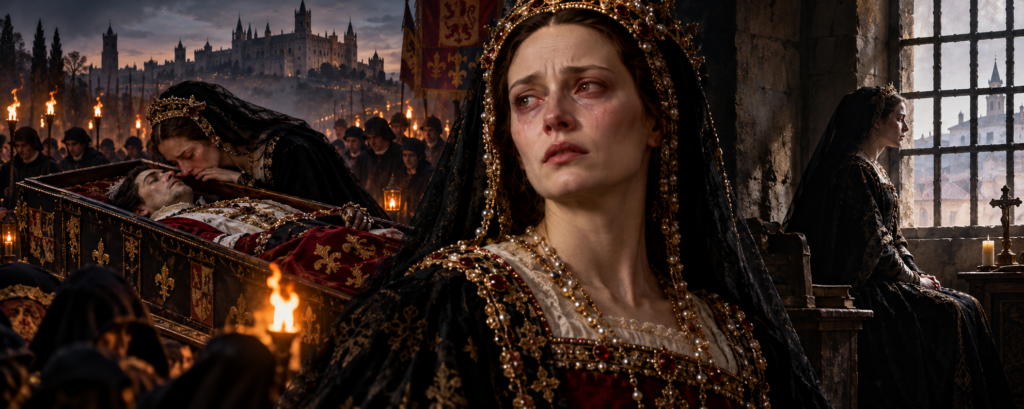
Philip was intended for burial in Granada, but his remains did not immediately reach their final destination. Joanna accompanied the coffin during a prolonged journey through Castile, and this funeral progress became the foundation of the famous story that she wandered endlessly through Spain with her husband’s corpse. Later writers turned the journey into something approaching a medieval horror tale, with a black-clad queen traveling only after sunset while torches flickered around the coffin of the man she could not bear to surrender.
The reality was strange enough without requiring all of the later embellishments. Joanna did travel with Philip’s remains, and parts of the journey took place at night. Yet transporting a royal body toward its intended burial place was not inherently irrational, while nocturnal travel could be influenced by practical, ceremonial, seasonal, and personal considerations. Joanna was also heavily pregnant during the months after Philip’s death and gave birth to their daughter Catherine in January 1507, circumstances often pushed into the background when the journey is presented as nothing more than a mad widow’s obsession.
One of the most famous incidents occurred when the entourage stopped at a religious establishment and Joanna discovered that it was occupied by women. Historical accounts indicate that she ordered the party to move away, an action later interpreted as evidence that her jealousy survived Philip’s death. Over generations, the story grew more grotesque, until Joanna was said to have feared that nuns might somehow look upon, approach, or even metaphorically “seduce” her dead husband. The underlying incident has historical support, but the most psychologically theatrical explanations were sharpened by later storytelling.
The same caution applies to claims that Joanna constantly opened Philip’s coffin to kiss, embrace, or inspect his decomposing remains. There is evidence that the coffin was opened on limited occasions, but repeated necrophilic encounters belong much more securely to legend than to demonstrable history. Royal remains might be inspected for identification or ceremonial reasons, and an isolated opening is very different from the obsessive behavior portrayed in nineteenth-century paintings and popular biographies. Joanna’s grief may have been extreme, but extreme grief does not give historians permission to treat every macabre anecdote as fact.
What mattered politically was the impression these events created. A queen traveling beside her dead husband’s coffin was a powerful image, particularly when reports of previous instability already existed. Joanna’s enemies did not need to invent every detail for the journey to damage her reputation. The spectacle itself could be interpreted as evidence that the Queen of Castile was emotionally incapable of governing a kingdom.
Ferdinand Returns to His Daughter’s Kingdom
Philip’s death removed Ferdinand’s principal rival and created a vacuum in Castilian government. Joanna remained the lawful queen, but her ability to administer the realm was increasingly questioned, and Ferdinand returned to exercise authority. From one perspective, this was an understandable response to instability. Ferdinand possessed decades of governing experience, while his daughter’s behavior had caused concern even before Isabella’s death.
From another perspective, the arrangement was extraordinarily convenient. Ferdinand regained control of Castile without needing to dispossess Joanna formally. She remained queen, preserving the legitimacy of the succession, while her father governed because she was considered incapable. The more severe her incapacity appeared, the stronger his justification became.
In 1509 Ferdinand had Joanna established at Tordesillas, in a royal residence adjoining the convent of Santa Clara. She was not placed in an underground dungeon or chained to a wall, as melodramatic accounts sometimes imply, but neither was this voluntary retirement. Her movements were restricted, access to her was controlled, and she was effectively removed from political life. Her youngest daughter Catherine remained with her, providing one of the few intimate relationships left in Joanna’s shrinking world.
Tordesillas solved a political problem with chilling efficiency. Joanna could not easily become the center of a rival faction if access to her was supervised. She could not independently summon nobles, issue commands, or travel through her kingdom. Ferdinand did not need to destroy his daughter’s royal title because confinement neutralized the woman while preserving the legal usefulness of the queen.
Forty-Six Years Inside Tordesillas
Joanna remained at Tordesillas from 1509 until 1555, an imprisonment so long that its scale can disappear behind the simple statement of dates. Nearly half a century passed while she lived under varying degrees of restriction. Children grew into adults and died, rulers rose and fell, the Reformation tore through Europe, Spanish armies fought across the continent, and conquistadors transformed the political landscape of the Americas. Joanna remained in essentially the same place while history accelerated beyond the walls.
The conditions of her confinement changed over time and should not be simplified into a single image of relentless physical torture. Joanna retained royal status, possessed attendants and household goods, and at various moments had access to music and other comforts appropriate to her rank. Yet material comfort did not make her free. Her correspondence, visitors, servants, movements, and access to political information could all be controlled by people responsible to the rulers governing in her name.
Reports from Tordesillas describe increasingly troubling behavior. Joanna sometimes refused food, neglected personal care, resisted religious observance, became withdrawn, or reacted angrily toward attendants. These accounts may indeed reflect severe psychiatric illness, particularly as the years passed. They must also be read against the psychological effects of prolonged confinement, loss, separation from children, lack of autonomy, and the knowledge that almost every act of resistance could be reported as another symptom of madness.
Her relationship with Catherine became particularly important. The young princess had remained with her mother and grew up within the restricted environment of Tordesillas, creating an intense bond between them. When Catherine was eventually removed to pursue the dynastic future expected of a Habsburg princess, Joanna’s reaction was reportedly severe. To those supervising her, the episode supplied more evidence of instability; to a mother whose world had been reduced largely to one daughter, the anguish also had an obvious human explanation.
Food itself became a battlefield. Joanna’s refusal to eat during certain periods was dangerous enough to alarm her custodians, and later accounts describe coercive efforts to make her consume food or comply with household routines. Whether such episodes were manifestations of depression, another psychiatric condition, deliberate hunger strikes, or a mixture of illness and resistance cannot be established. What is striking is how little remained under Joanna’s control. When almost every external decision belonged to someone else, control over her own body may have been one of the few weapons she still possessed.
Ferdinand Dies, but the Prison Remains
Ferdinand died in January 1516. His death is important because it exposes one of the weaknesses in the simplest version of Joanna’s story. If her alleged madness had been entirely invented by Ferdinand for the sole purpose of retaining Castile, then his death might have ended the arrangement. Instead, Joanna remained confined because the next man to benefit from her political absence was her own son.
Charles, Joanna and Philip’s eldest son, inherited an extraordinary collection of dynastic claims. Through his mother came Castile and its expanding overseas territories; through the wider family came Aragonese, Burgundian, and Habsburg possessions. He would eventually become Holy Roman Emperor Charles V and one of the most powerful rulers in Europe. Yet when he arrived in Spain, his mother was still the lawful Queen of Castile.
Officially, mother and son could be named together. In practical terms, Charles governed while Joanna remained at Tordesillas. Restoring her to independent political authority would have created obvious dangers, particularly if Castilian factions gained access to her and persuaded her to challenge policies enacted in her name. Charles therefore maintained a system that had begun under his grandfather.
This does not prove that Charles believed his mother perfectly sane and imprisoned her solely from greed. He may genuinely have believed that she was incapable of governing and vulnerable to manipulation. Political necessity and sincere concern can exist simultaneously. Yet the result for Joanna was the same: Ferdinand’s death changed the identity of the man exercising power, but it did not open the door.
The daughter confined by her father became the mother confined by her son.
The Comuneros Discover the Queen Behind the Walls
In 1520, resentment against Charles’s government exploded into the Revolt of the Comuneros. Castilian communities objected to taxation, foreign influence, and aspects of the young king’s government, particularly after Charles left Spain to pursue his imperial ambitions. As the rebellion expanded, its leaders recognized that an extraordinary source of legitimacy was sitting at Tordesillas. Joanna was not merely the emperor’s mother; she was still Queen of Castile.
The rebels gained access to her and attempted to secure her support. If Joanna signed their documents or formally endorsed their cause, they could claim that they were acting for the legitimate sovereign rather than rebelling against monarchy. For the first time in years, Joanna found herself at the center of active politics. Representatives spoke with her, presented grievances, and sought the authority that only her signature could provide.
Accounts of these encounters complicate the image of a woman completely detached from reality. Joanna appears to have been capable of listening to political arguments and understanding at least something of the circumstances around her. Yet she ultimately did not provide the rebels with the decisive authorization they wanted. Whether this reflected loyalty to Charles, suspicion of the Comuneros, fear of civil war, indecision, or psychological incapacity remains disputed.
Her refusal is particularly fascinating because almost any choice would have been dangerous. If she supported the rebellion, she risked becoming a weapon against her own son and perhaps unleashing a deeper dynastic crisis. If she refused, she surrendered one of the few opportunities she would ever receive to recover political relevance. Joanna chose—or failed to choose—a course that left the existing structure intact.
Royal forces eventually regained Tordesillas, and the Comunero rebellion was defeated. For Charles, the episode demonstrated exactly why his mother’s existence remained politically dangerous. A queen considered powerless could become immensely important the moment opponents gained access to her. After the crisis, Joanna’s isolation continued, and meaningful opportunities for independent political action virtually disappeared.
The Prison That Could Create Its Own Madness
The psychological consequences of Joanna’s confinement are impossible to measure, but they cannot responsibly be ignored. Human beings deprived of autonomy for years can develop depression, anger, withdrawal, self-neglect, and other severe psychological symptoms even when no major disorder existed beforehand. Joanna may already have suffered from serious mental illness, which would make prolonged isolation and coercion even more damaging. Either way, Tordesillas was hardly an environment designed to restore emotional stability.
Her custodians faced genuine difficulties if she refused food, resisted hygiene, rejected religious services, or became physically aggressive, but they were also part of a political structure designed to prevent her from acting as queen. Their reports traveled to people who had reason to maintain that structure. Joanna therefore lived within an almost impossible evidentiary trap: the people restricting her behavior were also among the principal sources describing why restriction remained necessary.
This did not require a coordinated conspiracy in which everyone knowingly lied. Institutions can preserve themselves without every participant acting dishonestly. A custodian might truthfully report that Joanna had refused to eat for several days; Charles could sincerely interpret that report as proof that his mother could not govern; ministers could then conclude that tighter supervision was essential. None of them needed to fabricate the episode for the political consequences to favor continued confinement.
The darker possibility is that confinement and illness gradually became impossible to separate. Joanna’s psychological problems helped justify imprisonment, while imprisonment may have intensified her psychological problems, which then provided additional justification for imprisonment. After decades, even an independent observer would have struggled to determine where the original condition ended and the damage caused by isolation began.
The Mother of Kings Who Could Not Leave Her Rooms
Joanna’s six children became some of the most important dynastic figures of sixteenth-century Europe. Eleanor became queen first of Portugal and later of France. Charles became king and emperor. Isabella became queen of Denmark, Norway, and Sweden. Ferdinand eventually became Holy Roman Emperor. Mary became queen of Hungary and Bohemia and later governed the Habsburg Netherlands, while Catherine became queen of Portugal.
Few mothers in European history produced a generation with comparable political reach. Joanna’s blood ran through courts from Lisbon to Vienna, and her descendants would shape European history for generations. Yet the mother at the center of this astonishing dynasty exercised almost none of the international power her children inherited.
The contrast is particularly stark in the case of Charles. His enormous authority depended substantially upon Joanna’s inheritance, yet her continued existence complicated the legitimacy of his independent rule in Castile. Charles could honor his mother ceremonially while ensuring that she remained politically inactive. He did not need to hate her for her confinement to be useful to him.
Joanna therefore became a strange living foundation beneath Habsburg power. Her children could rule because of who she was, while she herself could not rule because of what she was believed to be. The dynasty expanded outward across Europe and the Atlantic while the woman through whom much of that inheritance had passed remained confined within a shrinking personal world.
There is something particularly unsettling about that contradiction. Joanna was not forgotten because she was irrelevant; she was kept under control precisely because she remained relevant. The locked queen was dangerous because the crown on her head had never legally vanished.
Witchcraft, Love Potions, and the Stories That Grew Around Her
Later accounts attached increasingly lurid stories to Joanna’s relationship with Philip. One tradition claims that she sought magical assistance to recover her husband’s affection, employing practitioners who prepared love potions or performed forbidden rituals. More sensational versions introduce Moorish sorcerers, witches, dolls pierced with needles, and dark ceremonies intended to bind Philip’s desire to his wife.
Such claims should be treated with considerable skepticism. Late medieval and early modern European courts were saturated with rumors of magic, poison, charms, astrology, and sexual enchantment. Women accused of excessive sexuality, jealousy, or political manipulation were particularly vulnerable to allegations involving supernatural practices. Once Joanna had acquired a reputation for obsessive jealousy, stories of love magic fit her legend almost too perfectly.
That does not mean she could never have consulted people offering remedies, charms, or other practices that contemporaries might have regarded as magical. Elite Europeans regularly inhabited a world in which medicine, astrology, folk belief, religion, and magic could overlap in ways that modern categories do not capture neatly. What cannot safely be claimed is that Joanna’s use of pierced dolls or elaborate occult ceremonies is securely documented historical fact.
The evolution of these stories reveals how royal reputations are manufactured. Once Joanna was remembered as a madly jealous wife, anecdotes that reinforced that image became easier to believe and repeat. The historical woman gradually accumulated the behavior expected of the legendary one until separating the two became extraordinarily difficult.
The Corpse She Supposedly Could Not Surrender
No legend attached to Joanna is more powerful than the claim that she repeatedly opened Philip’s coffin to gaze upon, kiss, or embrace his remains. The image has inspired paintings, novels, biographies, and popular histories because it appears to capture madness in a single horrifying scene. A queen who cannot tolerate another woman looking at her husband while he is alive is disturbing; a queen who remains jealous of women after he is dead belongs almost to gothic fiction.
There is a historical foundation beneath the legend because Joanna did accompany Philip’s remains and the coffin was apparently opened on limited occasions. What is far more questionable is the assumption that she repeatedly demanded access to a progressively decomposing body for romantic or sexual reasons. Royal corpses could be inspected for identification and ceremonial purposes, particularly during complicated transfers between burial locations. Later writers frequently stripped such actions of context and presented them as evidence of pathological obsession.
The transformation of Joanna’s mourning into necrophilic legend also reflects changing attitudes toward grief. Early modern royal mourning could involve prolonged ritual, elaborate ceremonial behavior, preservation and movement of bodies, and practices that appear strange to modern observers. Joanna’s conduct may still have been regarded as excessive even by contemporary standards, but excess should not automatically be translated into insanity.
Philip’s corpse nevertheless became the perfect symbol for everything people wanted to believe about his widow. It represented her jealousy, grief, sexuality, inability to let go, and supposed detachment from reason. The dead husband became more famous in Joanna’s legend than the living men who benefited from her political disappearance.
That imbalance should make us suspicious.
Was Joanna Actually Mentally Ill?
The evidence does not support a confident answer in either direction. Claims that Joanna was unquestionably insane oversimplify politically compromised sources and centuries of hostile legend, while claims that modern historians have proved she was entirely sane go beyond what the evidence can sustain. There are too many reports of serious disturbance, beginning before her accession, to dismiss every concern as fabricated propaganda.
Her symptoms, as described by contemporaries, included episodes of extreme jealousy, agitation, insomnia, refusal of food, withdrawal, religious resistance, and behavior that those closest to her considered alarming. Some of these descriptions came from people with obvious political motives, but not all can easily be reduced to a single conspiracy. Isabella’s concern is particularly significant because it emerged before Joanna became the center of the later struggle between Philip and Ferdinand.
Modern diagnostic labels do little to resolve the problem. Joanna has been described retrospectively as suffering from depression, bipolar disorder, schizophrenia, psychosis, personality disorders, and other conditions. The evidence is simply insufficient to choose reliably among them, and symptoms described in politically charged sixteenth-century language cannot be mapped neatly onto modern psychiatric criteria.
Pregnancy and childbirth further complicate the picture. Joanna experienced repeated pregnancies over a relatively short period, and some historians have considered whether reproductive events could have contributed to episodes of depression or other psychological disturbance. Again, the surviving evidence cannot establish a diagnosis. What it does reveal is a woman living under an extraordinary accumulation of physical and emotional pressures.
The most plausible historical position may therefore be the least dramatic one: Joanna probably experienced genuine and sometimes severe psychological distress, but the precise nature of her illness is unknowable, and her difficulties were politically exploited by people around her. Mental illness and political victimization are not opposites. A woman can be psychologically vulnerable and still be manipulated, mistreated, and deprived of authority by people who benefit from emphasizing that vulnerability.
A Trap From Which Sanity Could Not Rescue Her
Once Joanna had been classified as incapable, proving otherwise became extraordinarily difficult. If she shouted at guards or attendants, her anger could be recorded as madness. If she refused food, the refusal became madness. If she rejected confession or Mass, that became evidence of disorder. If she mourned Philip intensely, grief confirmed obsession, while silence and withdrawal could be interpreted as further symptoms.
Even resistance to confinement could be turned against her. A person who insists that she is being unjustly imprisoned might naturally become angry, but in Joanna’s case anger could demonstrate why imprisonment was supposedly necessary. The structure was almost impossible to escape because the interpretation came before the behavior. Once observers expected madness, they could find it in nearly everything.
Her isolation made the problem still worse. Joanna rarely appeared before independent audiences capable of observing her over prolonged periods. Access was mediated through custodians, relatives, ministers, and political authorities. Reports about her condition therefore passed through the same structures responsible for keeping her away from government.
The Comunero episode briefly offered another view. Joanna could engage with political representatives and apparently understand aspects of their demands, but even this could not settle the question. Her refusal to endorse them could be interpreted as wise restraint, dynastic loyalty, fear, indecision, or incapacity depending upon what the observer already believed.
Joanna had become trapped not merely inside Tordesillas but inside a story about herself. There was no single conversation, signature, meal, prayer, or calm afternoon capable of undoing years of accumulated reputation. Her supposed madness had ceased to be a diagnosis and become a political fact.
Growing Old in a World That Had Left Her Behind
As Joanna aged, the distance between her life and the outside world became almost surreal. She had been born in 1479, before the conquest of Granada and before Columbus’s first Atlantic voyage. She lived to see Castilian power expand across the Americas, the Protestant Reformation divide western Christianity, and her son Charles struggle to maintain a vast European empire. The political universe of her childhood had disappeared, yet Joanna remained at Tordesillas.
Her health deteriorated with age, and reports from her later years describe increasing physical difficulties alongside continued problems involving food, hygiene, and religious observance. The approach of death made her spiritual condition a matter of urgent concern to those around her. In a deeply Catholic society, a queen refusing expected religious practices near the end of life raised fears not merely about scandal but about salvation.
Francisco de Borja, the future Saint Francis Borgia, became involved in efforts to minister to her. Accounts of Joanna’s final religious state vary and have themselves been shaped by later confessional concerns. As throughout her life, even her relationship with God became something other people documented, interpreted, and debated.
Joanna died on April 12, 1555, at seventy-five years old. She had spent the overwhelming majority of her adult life under some form of political control and nearly forty-six consecutive years at Tordesillas. Philip had been dead for almost half a century, Ferdinand for nearly four decades, and Isabella for more than fifty years. The people and circumstances that had originally produced her confinement had vanished, but the system survived them all.
Granada and the Family Reunited in Death
Joanna was eventually buried in the Royal Chapel of Granada, where her remains lie alongside Philip and near those of Ferdinand and Isabella. The arrangement creates an appearance of dynastic harmony that their lives never possessed. Marble tombs place the family together peacefully, erasing the jealousy, rivalry, coercion, and political maneuvering that had defined so much of Joanna’s adult existence.
There is a grim irony in her burial beside Philip. The husband whose infidelities tormented her, whose household helped establish her reputation for instability, and whose corpse became the central object in the legend of her madness became her companion in death. Ferdinand, who confined her, rests nearby, as does Isabella, whose concerns about her daughter’s behavior helped shape the succession arrangements that followed.
Yet Joanna’s presence in the royal mausoleum also restores something her confinement could never entirely erase. She had been Queen of Castile. Her legal status had survived decades of imprisonment, and her descendants had inherited much of the world created by her parents.
The tomb therefore contains both triumph and tragedy. Joanna helped transmit an inheritance that made the Habsburg monarchy enormously powerful, but she herself received almost none of the freedom that such power should have brought.
Joanna the Mad or Joanna the Captive?
Joanna belongs in the history of troubled monarchs precisely because her case refuses to provide the certainty that her nickname promises. She was not simply a healthy woman maliciously declared insane by three evil men, because evidence of serious psychological distress appears too early and too consistently for that explanation to be convincing. Neither was she simply an obviously insane queen whose family reluctantly confined her for the good of the kingdom, because every major decision concerning her incapacity benefited people who wanted access to her authority.
Her husband had reason to diminish her independence. Her father had reason to govern Castile in her place. Her son had reason to prevent opponents from using her legal authority against him. These interests do not prove that the men involved fabricated her symptoms, but they make unquestioning acceptance of their conclusions impossible.
The most unsettling possibility is that Joanna was both ill and exploited. Her psychological vulnerability may have been genuine, while the political response to that vulnerability was shaped by ambition rather than compassion. Instead of receiving anything resembling treatment, she experienced control, separation, surveillance, and decades of confinement. Whatever mental difficulties she possessed at the beginning of the process cannot be cleanly separated from what such a life might have done to her afterward.
This interpretation also restores something important to Joanna’s humanity. Mental illness, if she suffered from it, did not automatically erase her intelligence, political rights, emotions, or capacity to understand when people around her were controlling her. A person can behave irrationally during periods of crisis and still recognize betrayal. A queen can be psychologically unstable without making forty-six years of imprisonment morally or politically inevitable.
Her story is therefore not frightening because historians can confidently diagnose a madwoman across five centuries. It is frightening because they cannot, while the people around Joanna acted as though the verdict were settled.
The Queen Who Outlived Almost Everyone
The length of Joanna’s captivity is ultimately more disturbing than any legend about Philip’s coffin. A dramatic episode can be imagined in torchlight and painted on a canvas, but forty-six years of confinement is harder to visualize. It consisted not of one spectacular tragedy but thousands of ordinary days: guarded doors, supervised visitors, restricted letters, meals, arguments, prayers refused or accepted, servants entering and leaving, news arriving from a world Joanna could no longer participate in, and seasons passing outside the same walls.
Philip died in 1506, yet Joanna remained confined decades after the husband supposedly responsible for her emotional collapse had vanished. Ferdinand died in 1516, but his daughter’s confinement continued. Her children grew older and became rulers in their own right, while Joanna remained legally queen without recovering the ordinary freedom possessed by far less powerful people. Even the rebellion that briefly restored her political importance ended without opening the prison around her.
This is why reducing Joanna to the woman who traveled with a corpse does such violence to her history. The coffin journey lasted a comparatively short period; Tordesillas consumed nearly half a century. The gothic widow is memorable, but the aging prisoner is more important. Joanna’s tragedy was not merely that grief may have overwhelmed her after Philip died, but that the world eventually decided that her grief, her anger, her resistance, her religious difficulties, and her reputation could justify taking the rest of her life away.
Perhaps Joanna truly was seriously mentally ill. Perhaps her condition fluctuated, leaving periods of relative clarity between episodes of severe disturbance. Perhaps decades of confinement deepened problems that had once been manageable. The surviving evidence permits possibilities but denies certainty, and any account claiming to have solved Joanna’s mind completely is promising more than history can deliver.
What history can show is what happened after people decided she was mad. Her husband attempted to dominate the kingdom inherited through her. Her father governed in her place. Her son preserved the confinement that secured his own position. Her behavior was filtered through custodians and political observers, while stories about jealousy, witchcraft, corpses, and madness accumulated around her name until the legend became more famous than the queen.
Joanna of Castile possessed royal blood, legal authority, formidable parents, powerful children, and a claim to one of the richest crowns in Europe, yet none of it could open the doors of Tordesillas. Her family conquered kingdoms, crossed oceans, commanded armies, and helped reshape Europe, while Joanna’s world contracted to a guarded residence from which she could not freely depart. The contrast is darker than any story about madness because it exposes how fragile even a queen’s power could become once others gained the authority to define her as incapable.
When Joanna finally died in 1555, she had outlived the husband whose betrayals had tormented her, the father who had confined her, and most of the political generation that had first debated whether she could rule. The arguments had changed, the rulers had changed, and Europe itself had changed, but the conclusion reached about Joanna decades earlier had become almost impossible to reverse. She had been transformed from a woman experiencing distress into a political category: the Mad Queen who must remain contained.
That may be the most haunting part of her story. We can never know precisely what Joanna experienced inside her own mind, and we should resist pretending otherwise. We can, however, see what happened when uncertainty about a woman’s mental state collided with dynastic ambition, misogyny, inheritance, and the enormous rewards of controlling a crown. Joanna may have been ill, but illness alone does not explain why so many powerful people found her continued absence useful.
The famous image of Joanna following Philip’s coffin through the darkness will probably never disappear. It is too dramatic, too romantic, and too disturbing. Yet there is another image that comes closer to the tragedy of her life: an elderly queen at Tordesillas, decades after Philip was buried and Ferdinand was dead, still living behind walls while her son governed an empire partly inherited through her. She had been Queen of Castile since 1504, and she would remain queen until the moment she died, but the crown had long since become something other people wore in everything but name.
Joanna’s life therefore leaves behind a question far more unsettling than whether Juana la Loca was truly mad. It asks how much of a person’s identity can survive when every expression of grief is treated as pathology, every act of resistance becomes evidence of incapacity, and the people making the diagnosis are also the people who inherit the power she loses. For Joanna of Castile, no final medical answer survives. What survives is the locked palace at the center of the story, the decades that disappeared behind it, and the terrible possibility that once a queen had been successfully called mad, no amount of sanity could ever make her free again.