
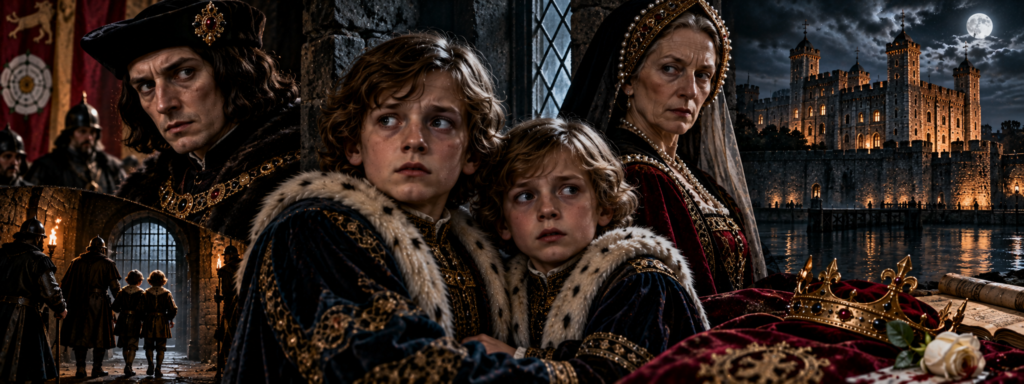
Edward V: The Boy King Who Vanished in the Tower and the Murder Mystery That Haunts England
Edward V (1470–disappeared 1483) | King of England, April 9–June 26, 1483 | Deposed by his uncle Richard III and vanished alongside his younger brother, Richard of Shrewsbury, Duke of York. Both boys are presumed to have been murdered, but their deaths remain unproven, and the identities of those responsible have never been established.
Two Princes, One Tower, and a Secret England Never Uncovered
During the summer of 1483, two young brothers disappeared behind the walls of the Tower of London. The elder was Edward V, a twelve-year-old boy who had inherited the English throne only weeks earlier. His younger brother, Richard of Shrewsbury, Duke of York, was just nine years old. Both were sons of the recently deceased Edward IV, and both possessed royal blood that made them extraordinarily valuable to anyone seeking control of England.
At first, their presence in the Tower was not particularly alarming. The fortress was a royal residence as well as a prison, and English monarchs traditionally stayed there before their coronations. Edward was supposed to emerge from its gates wearing the crown that had belonged to his father. Instead, his coronation was postponed, his protectors were arrested or executed, and his uncle Richard, Duke of Gloucester, took the throne for himself.
Then the boys stopped appearing in public. Reports suggested that they had been seen playing within the Tower grounds, but those sightings eventually ceased. Rumors spread that the princes had been murdered, although nobody could produce their bodies or identify a reliable eyewitness to their deaths. The children who had stood between several ambitious adults and the English crown had simply vanished.
For more than five centuries, the most familiar explanation has been that Richard III ordered his nephews killed. He had taken their inheritance, controlled their imprisonment, and possessed an obvious reason to prevent their restoration. Later Tudor historians accused him of arranging their suffocation, and William Shakespeare transformed the accusation into one of the most notorious crimes in English literature. Richard became the murderous uncle whose ambition demanded the deaths of two defenseless children.
Yet the case has never been conclusively solved, and Richard was not the only person who might have benefited from the princes’ disappearance. Henry Stafford, Duke of Buckingham, possessed political ambitions of his own and had played a central role in Richard’s seizure of power. Henry Tudor, the future Henry VII, stood to gain from the elimination of rival claimants. Most controversially, Margaret Beaufort, Henry Tudor’s formidable mother, has emerged in some modern interpretations as another possible suspect.
The theory involving Margaret Beaufort is particularly intriguing because it turns the familiar story inside out. Instead of a murderous Yorkist uncle eliminating his nephews, it imagines a politically ambitious Lancastrian mother helping remove the boys who stood between her son and the throne. Margaret possessed intelligence, connections, determination, and an extraordinary commitment to Henry Tudor’s future. She also became involved in the conspiracies that helped bring down Richard III.
But motive is not proof, and the evidence connecting Margaret to the princes’ deaths is substantially weaker than the evidence establishing Richard’s control over them. No surviving contemporary document shows that she ordered their murder, arranged access to their chambers, or even knew precisely what had happened to them. Any serious examination must therefore distinguish what Margaret could theoretically have wanted from what she can actually be shown to have done.
The disappearance of Edward V is not simply a mystery about two children. It is a story about a collapsing dynasty, a terrified mother, a powerful uncle, a succession crisis, a possible political conspiracy, and a kingdom in which the possession of royal blood could become a death sentence. To understand why the princes vanished, it is necessary to return to the violent world that produced them.
Born Into the Wars of the Roses
Edward V was born on November 2, 1470, at Westminster Abbey, where his mother, Elizabeth Woodville, had taken sanctuary during one of the most dangerous moments of the Wars of the Roses. His father, Edward IV, had been driven from England by enemies who restored the Lancastrian king Henry VI. Elizabeth was heavily pregnant and surrounded by uncertainty. The child who would one day become Edward V entered the world while his father was in exile and his family’s possession of the throne appeared to have collapsed.
The Wars of the Roses had already devastated England’s political elite. The rival houses of Lancaster and York, both descended from Edward III, had fought over the crown through rebellion, deposition, execution, and battlefield slaughter. Edward IV had originally taken the throne in 1461 after defeating Lancastrian forces at Towton. His reign, however, remained vulnerable to the ambitions of powerful nobles.
The most dangerous of those nobles was Richard Neville, Earl of Warwick, later remembered as the Kingmaker. Warwick had helped Edward obtain the crown but eventually turned against him. His rebellion forced Edward into exile in 1470 and briefly restored Henry VI. Elizabeth Woodville’s sanctuary at Westminster reflected the uncertainty of a kingdom where royal families could become fugitives almost overnight.
Edward IV returned in 1471 and reclaimed his throne after victories at Barnet and Tewkesbury. Warwick was killed, Henry VI’s only son died, and Henry himself was murdered in the Tower shortly afterward, almost certainly with the approval of Edward’s regime. The restored Yorkist monarchy appeared secure. The infant Edward, born during his father’s exile, became heir to a dynasty that had survived its most dangerous challenge.
His childhood unfolded within a royal family that seemed increasingly prosperous. Edward IV and Elizabeth Woodville had numerous children, including several daughters and two surviving sons. The elder Edward was Prince of Wales, while his younger brother Richard of Shrewsbury became Duke of York. Their father intended them to inherit a powerful and stable monarchy.
Yet the apparent stability concealed bitter resentments. Elizabeth Woodville’s relatives had risen rapidly through royal marriage, receiving offices, titles, and advantageous marriages. Older aristocratic families resented their influence. Edward IV’s younger brother Richard, Duke of Gloucester, remained loyal to the king, but tensions between the Woodvilles and other powerful interests would become explosive after Edward’s death.
The young Edward therefore inherited more than a crown. He inherited a political world in which noble families remembered old grievances, royal bloodlines competed for legitimacy, and the survival of children could determine the fortunes of entire dynasties. His father’s military victories had secured the Yorkist throne for the moment. They had not eliminated the possibility that another ambitious relative might seize it.
The Young Prince at Ludlow
Edward spent much of his childhood at Ludlow Castle, the traditional center of administration for the Prince of Wales. His household was supervised by his maternal uncle Anthony Woodville, Earl Rivers, an educated and accomplished nobleman. Rivers was known for his literary interests, religious devotion, and cultivated manners. He was also a leading representative of the Woodville family whose influence many aristocrats distrusted.
The prince received an education designed to prepare him for kingship. His household followed a structured routine, and contemporary arrangements emphasized discipline, religious instruction, appropriate recreation, and moral development. Edward was not simply a neglected child waiting for his father to die. Considerable attention was devoted to shaping him into a ruler.
The influence of Earl Rivers was especially important. Rivers combined aristocratic military experience with unusual intellectual interests, including connections to the early English printing industry. His guardianship suggests that Edward IV wanted his heir to receive a sophisticated education. The young prince’s upbringing therefore offered genuine promise.
Edward’s younger brother Richard remained more closely associated with the royal court. Born in 1473, Richard was married in childhood to Anne de Mowbray, a wealthy heiress, in 1478. The marriage was arranged for dynastic and financial reasons, as was common among royal families. Neither child could have understood the full political significance of the union.
The brothers’ childhoods were therefore shaped by different households and responsibilities. Edward was being prepared to govern from Ludlow, while Richard remained within the orbit of his parents and the court. Their separation was normal for royal children. It would later make their reunion in the Tower particularly tragic.
Nothing in Edward’s early life suggested that he would become one of England’s most famous missing persons. He was the legitimate heir of a reigning king who had defeated his enemies and produced surviving sons. His succession should have been straightforward. Everything changed when Edward IV died unexpectedly in April 1483.
The Sudden Death of Edward IV
Edward IV died on April 9, 1483, at the age of forty. His final illness remains uncertain, although contemporary accounts suggest that his health deteriorated rapidly. The king had enjoyed a reputation for physical strength and military vigor. His death therefore shocked a political community that had expected him to rule for many more years.
His eldest son immediately became Edward V. At twelve years old, the new king was old enough to understand something of his position but too young to govern independently. A minority government would be necessary until he reached adulthood. That created an immediate struggle over who would control the king and the machinery of royal authority.
Edward IV had reportedly designated his brother Richard, Duke of Gloucester, as protector. Richard was an experienced military commander who had remained loyal during the crises of the previous reign. He possessed substantial power in northern England and enjoyed a reputation for administrative competence. From one perspective, he was an obvious choice to protect his nephew.
The Woodville family had different interests. Elizabeth Woodville was the new king’s mother, while Anthony Woodville controlled Edward’s household at Ludlow. Other relatives occupied important positions at court. They had little reason to surrender their influence willingly to Gloucester.
The danger was not necessarily that one side immediately intended murder. The more immediate issue was control of the young king’s person. Whoever possessed Edward could influence appointments, ceremonies, access to government, and eventually the direction of the reign. In a medieval monarchy, custody of a child king was an extraordinarily valuable political asset.
The succession therefore became a race. Edward V began traveling from Ludlow toward London under the supervision of his Woodville relatives. Gloucester moved south from the north. The two parties were heading toward a confrontation that would determine whether Edward V ever exercised power.
The Arrest at Stony Stratford
In late April 1483, Richard of Gloucester met Anthony Woodville and other members of Edward V’s entourage near Northampton. The initial encounter appeared outwardly cordial. Gloucester was the new king’s paternal uncle and officially presented himself as a loyal protector. Yet the atmosphere changed dramatically during the following hours.
On April 30, Gloucester took control of Edward V’s party at Stony Stratford. Anthony Woodville, Richard Grey, the king’s maternal half-brother, and Thomas Vaughan, a trusted royal servant, were arrested. The young king suddenly found himself separated from men who had supervised his upbringing. His uncle now controlled his movements.
Gloucester justified the arrests by alleging that the Woodvilles intended to dominate or endanger the new government. Whether a genuine conspiracy existed remains disputed. The Woodville family certainly wanted influence, but the evidence does not establish that they intended to murder Gloucester. Their political ambitions were real; the accusations used to justify their arrest are less secure.
For Edward, the experience must have been deeply unsettling. The men who had escorted him toward his coronation were now prisoners. His uncle controlled his household and determined who could approach him. The young king was still addressed as monarch, but his freedom had already been severely reduced.
News of the arrests reached Elizabeth Woodville in London. She understood that Gloucester’s actions threatened her family’s position and potentially her children’s safety. Rather than remain exposed at court, she fled into sanctuary at Westminster Abbey with her younger children. Among them was Richard of Shrewsbury.
The royal family had split into opposing camps. Edward was under Gloucester’s control, while his mother and younger brother remained in sanctuary. The king’s coronation was still officially expected. Yet the political struggle had already moved far beyond ordinary preparations for a minority reign.
A Mother Retreats Into Sanctuary
Elizabeth Woodville’s flight to Westminster Abbey was not an act of irrational panic. She had experienced sanctuary before, including during the crisis surrounding Edward V’s birth. She knew how quickly a royal family’s fortunes could collapse. The arrest of her brother and son provided ample reason to fear Gloucester’s intentions.
Sanctuary offered a degree of protection under religious custom. Armed men could not simply enter Westminster Abbey and seize its occupants without risking political and spiritual consequences. Elizabeth gathered her children and possessions within the protected precincts. The scene reflected the extraordinary reversal of her position.
Only weeks earlier, Elizabeth had been queen consort of England. Now she was the widowed mother of a child king whose custody had passed to a potentially hostile relative. Her brother was imprisoned, her eldest son from her first marriage had been arrested, and her younger children were hiding behind sanctuary walls. The royal household had become a battlefield without a formal battle.
Richard of Shrewsbury was especially important. As Edward V’s younger brother, he stood next in the direct line of succession. If Edward died, Richard could become king. His presence with Elizabeth therefore gave the Woodville family a second royal claimant beyond Gloucester’s immediate control.
Gloucester could not easily secure his position while Richard remained in sanctuary. Even if Edward V were controlled or displaced, the younger prince could become the focus of resistance. Bringing both brothers together would eliminate that uncertainty. It would also place the entire male line of Edward IV under Gloucester’s authority.
The confrontation over sanctuary became one of the decisive episodes of 1483. Elizabeth was eventually persuaded to surrender Richard into Gloucester’s custody. The boy was taken to join his elder brother at the Tower. His mother would never knowingly see either son again.
The Tower Was Supposed to Be the Beginning
Edward V arrived in London on May 4, 1483. He was initially lodged at the Bishop of London’s palace before being moved to the Tower. At this stage, the move did not necessarily indicate imprisonment. The Tower was a traditional royal residence used by monarchs preparing for coronation.
Preparations for Edward’s coronation continued, at least outwardly. The ceremony had originally been scheduled for May and was postponed to June 22. Coins and official arrangements were made in his name. Gloucester publicly maintained the appearance of protecting his nephew’s accession.
The situation nevertheless became increasingly ominous. Gloucester accumulated political authority while Edward remained under supervision. The young king’s supporters were being removed from positions of influence. The coronation date approached without any certainty that the ceremony would take place.
On June 13, Gloucester abruptly arrested William Hastings, a powerful nobleman who had been a close supporter of Edward IV. Hastings was executed at the Tower without an ordinary trial. The circumstances remain disputed, but the event demonstrated Gloucester’s willingness to use lethal force against prominent political opponents. It also shattered any remaining illusion that the succession crisis would be resolved through routine council government.
Three days later, on June 16, Richard of Shrewsbury was brought from sanctuary to join Edward. Archbishop Thomas Bourchier of Canterbury played an important role in persuading Elizabeth Woodville to release the child. The official justification emphasized the brothers’ reunion and the forthcoming coronation. Elizabeth’s reluctance suggests that she understood the danger.
The two princes were now together inside the Tower. Edward had been separated from his original protectors, and Richard had been removed from his mother’s sanctuary. Their uncle controlled both children. The circumstances that would make their disappearance possible were complete.
The Execution of the Woodvilles
While the princes remained in London, Gloucester moved against the men arrested during Edward V’s journey south. Anthony Woodville, Earl Rivers, Richard Grey, and Thomas Vaughan were taken to Pontefract. On June 25, 1483, they were executed. The killings removed several of the most important figures associated with the young king’s original household.
The executions were politically significant because they destroyed men who might have defended Edward’s interests. Rivers had supervised the prince’s upbringing and possessed considerable influence. Richard Grey was Edward’s maternal half-brother. Vaughan had served the young king closely.
The men were accused of threatening Gloucester and the stability of the realm. Yet the speed and circumstances of their deaths raise serious questions about the fairness of the proceedings. They were eliminated while Gloucester was consolidating power. Their removal served his interests regardless of whether every allegation against them was true.
Edward V lost more than political advisers. He lost relatives and familiar protectors who had been part of his childhood. The executions demonstrated that Gloucester was prepared to kill people closely connected with his nephews. They also reduced the likelihood that anyone within the government would openly challenge his next move.
The Woodville family had been effectively broken as a political force. Elizabeth remained in sanctuary, and her eldest surviving sons were under Gloucester’s control. Other relatives had fled or were attempting to protect themselves. The family that had dominated Edward IV’s court now faced imprisonment, execution, and political exclusion.
With opposition weakened, Gloucester moved toward the crown itself. The argument used to justify his accession would strike directly at the legitimacy of Edward V and his siblings. It would transform the children of Edward IV from royal heirs into alleged bastards.
The Marriage That Supposedly Never Counted
In June 1483, allegations emerged that Edward IV’s marriage to Elizabeth Woodville had been invalid. The central claim was that Edward had previously entered into a binding marriage contract with Eleanor Talbot, also known as Lady Eleanor Butler. Under medieval canon law, a valid prior marriage contract could invalidate a subsequent marriage. If the allegation were true, Edward’s children by Elizabeth could be declared illegitimate.
The claim was politically devastating. Edward V’s right to the throne depended upon his legitimacy as Edward IV’s eldest surviving son. If his parents’ marriage were invalid, his succession could be challenged. His younger brother Richard would be similarly affected.
The evidence for the alleged precontract remains uncertain. Eleanor Talbot had died in 1468, long before the controversy erupted. The claim was associated with Robert Stillington, Bishop of Bath and Wells, but no surviving contemporary evidence conclusively proves that Edward IV had entered into the alleged binding arrangement. The timing of the accusation made its political purpose obvious.
Gloucester’s supporters used the claim to argue that Edward IV’s children could not inherit the crown. Other allegations concerning Edward IV’s legitimacy also circulated, further demonstrating how genealogy and sexual reputation could become political weapons. The accusations were not merely personal insults. They provided a legal framework for replacing one branch of the royal family with another.
On June 26, Gloucester accepted the crown as Richard III. His coronation followed on July 6. The legal argument concerning the princes’ illegitimacy was later formalized in the parliamentary act known as Titulus Regius in 1484. By then, the boys had already disappeared from public life.
Edward V had been king for less than three months. He was never crowned. His uncle had transformed himself from protector into monarch while the legitimate heir remained inside the Tower.
Richard III Takes the Throne
Richard III’s accession was one of the most controversial political reversals of the Wars of the Roses. He had been a loyal brother to Edward IV and had initially presented himself as the protector of Edward’s son. Within weeks, he had arrested the young king’s advisers, executed leading opponents, challenged the legitimacy of his brother’s marriage, and taken the crown. The transformation was extraordinarily rapid.
Richard’s supporters could argue that he was responding to a genuine succession crisis. If Edward IV’s marriage had been invalid, the children of that marriage would not possess the hereditary rights normally attributed to them. Richard, as Edward IV’s surviving brother after the deaths of Edmund of Rutland and George of Clarence, could present himself as the rightful heir. The legal argument was coherent in principle, but its factual foundation remains disputed.
The circumstances also raise questions about Richard’s intentions. Did he begin by seeking a genuine protectorate and gradually decide that the throne was necessary for his security? Did he believe the Woodvilles were planning to destroy him? Or had he intended to seize the crown from the beginning?
The surviving evidence does not establish precisely when Richard decided to become king. His actions nevertheless followed a clear pattern of accumulating control. He removed the Woodville leadership, secured both princes, eliminated Hastings, and accepted the crown. By the end of June, there was no effective political obstacle left within London.
The princes themselves remained a problem. Declaring them illegitimate weakened their legal claims, but it did not eliminate their political value. Supporters could reject the precontract allegation or argue that Richard had manipulated the succession. A living Edward V could become the center of rebellion.
Richard therefore possessed an obvious motive for ensuring that his nephews never returned to public life. Whether he acted upon that motive is the central question. The disappearance of the princes occurred while they were under his authority, but the precise circumstances remain unknown.
The Last Sightings of Edward and Richard
The most important contemporary account of the princes’ disappearance comes from Dominic Mancini, an Italian visitor who observed events in England during 1483. Mancini left England in July and later wrote an account of the succession crisis. His narrative is invaluable because it was composed close to the events rather than decades afterward. It also has limitations because Mancini relied partly upon informants and did not personally witness everything he described.
Mancini reported that the princes were withdrawn into the inner apartments of the Tower. They were seen less frequently until eventually they ceased appearing altogether. He also recorded that suspicion had already arisen concerning the fate of the elder boy. Yet he explicitly acknowledged that he did not know whether Edward had been killed or how such a death might have occurred.
The account includes a disturbing description of Edward’s apparent state of mind. According to information Mancini received, a physician who had attended the young king reported that Edward behaved as though he expected death. The boy supposedly sought spiritual preparation through confession and religious devotion. These details are secondhand and cannot be treated as direct testimony from Edward himself.
Other evidence suggests that the princes were seen playing in the Tower grounds during the summer. The Great Chronicle of London, compiled later, preserved a tradition of the children being observed in the garden. The precise timing of the last reliable sighting remains uncertain. What is clear is that public appearances eventually stopped.
The disappearance did not immediately produce an official announcement of death. Richard III did not publicly display bodies or issue a clear explanation of what had happened. The boys simply ceased to be visible. Rumors filled the silence.
This absence of information became one of the most damaging features of Richard’s reign. A king who had taken his nephews into custody could not provide convincing public reassurance that they remained alive and safe. Even if Richard did not order their deaths, his failure to establish their whereabouts encouraged suspicion. The mystery began while he controlled the Tower.
The Case Against Richard III
Richard III remains the principal suspect for several powerful reasons. He possessed custody of the princes, controlled the government, and had recently displaced Edward V from the throne. Their continued existence threatened his legitimacy. Their disappearance occurred while he was the reigning king.
Opportunity is the strongest part of the case. The princes were confined within a royal fortress whose officers ultimately answered to Richard’s government. He possessed the authority to control their movements, attendants, and access to visitors. A killing ordered by the king would have been far easier to arrange than one organized by an outsider.
Motive is equally apparent. Edward V had already been recognized as king following his father’s death. Richard’s claim depended upon persuading the political community that Edward and his siblings were illegitimate. If the allegation were rejected, Edward could become the focus of a restoration movement. His younger brother offered a second potential claimant.
The precedent of Henry VI was still within living memory. Edward IV had kept Henry imprisoned, only to see him restored in 1470. After Edward regained power, Henry died in the Tower under circumstances strongly suggesting murder. Richard had participated in the Yorkist restoration and understood the dangers posed by a living deposed monarch.
Richard’s own actions in 1483 also make suspicion reasonable. He had authorized or permitted the execution of several men associated with Edward V’s household. Hastings had been killed, and Rivers, Grey, and Vaughan had been executed. These deaths demonstrated that Richard’s government was willing to eliminate political opponents.
The most damaging circumstance is that the princes disappeared without a credible explanation. Richard could have attempted to reassure the kingdom by producing them publicly. Instead, rumors of their deaths spread. His silence did not prove murder, but it allowed the accusation to become politically devastating.
The case against Richard is therefore substantial even without accepting every later Tudor allegation. He had motive, means, custody, and political responsibility. The principal weakness is the absence of direct evidence showing that he ordered the killings. Suspicion is strong, but the final step from suspicion to proof remains missing.
Why Richard III Might Not Have Ordered Their Murder
The argument for Richard’s innocence begins with an important observation: declaring the princes illegitimate had already removed them from the official succession. If Richard genuinely believed the precontract allegation, he might have considered their political claims legally extinguished. Killing them could create greater danger than keeping them safely confined. Their deaths would invite precisely the accusations that later damaged his reputation.
Richard also had other royal relatives whose existence complicated the succession. His nephew Edward, Earl of Warwick, son of George, Duke of Clarence, remained alive during Richard’s reign. Warwick possessed royal blood and could become politically useful to opponents. Richard did not order his death.
The comparison is not conclusive because Warwick’s claim was complicated by his father’s attainder, and his political position differed from that of Edward V. Nevertheless, it demonstrates that Richard did not automatically eliminate every possible dynastic rival. He could tolerate some claimants under supervision. The princes might theoretically have been treated similarly.
Another argument concerns Richard’s political judgment. He was an experienced administrator and military commander who understood the importance of reputation. Murdering two children would create enormous hostility, especially among people already suspicious of his accession. A calculating ruler might recognize that the crime could destroy the legitimacy it was intended to protect.
There is also the question of timing. Richard’s reign was brief, and the precise date of the princes’ disappearance remains uncertain. Some later accounts placed their deaths during the summer of 1483, while other possibilities extend the uncertainty further. Without a secure death date, reconstructing who possessed immediate access at the critical moment becomes difficult.
Finally, Richard’s enemies had strong reasons to portray him as a murderer. Henry Tudor’s eventual victory created a dynasty that benefited from presenting Richard as a tyrant. Tudor historians shaped the surviving narrative, and Shakespeare later made the accusation unforgettable. Some details may have been exaggerated or invented.
These arguments justify caution, but they do not establish innocence. Richard’s control of the princes remains a formidable obstacle to alternative explanations. A convincing defense must explain not only why Richard might have spared them but how they disappeared while under his authority. That question has never received a definitive answer.
The Duke of Buckingham: An Ambitious Man With Dangerous Connections
Henry Stafford, Duke of Buckingham, was one of Richard’s most important supporters during the succession crisis. He helped Gloucester consolidate power and played a prominent role in the political movement that brought him to the throne. Buckingham possessed royal ancestry, substantial wealth, and ambitions that were not necessarily limited to serving another man. His later rebellion made him an obvious figure of interest in the princes’ disappearance.
Buckingham’s relationship with Richard deteriorated rapidly after the accession. By October 1483, he was involved in a rebellion against the king. The uprising failed, and Buckingham was captured and executed in November. The speed of the reversal remains striking.
One theory suggests that Buckingham may have arranged the princes’ deaths independently. If he possessed access to the Tower or influence over men responsible for its security, he might theoretically have acted without Richard’s direct authorization. Such an action could have been intended to secure Richard’s position, advance Buckingham’s own ambitions, or create a crisis that weakened the king.
Buckingham’s possible motive is complicated. He possessed a distant hereditary claim through the Beaufort line, although it was not straightforward. He might have hoped to profit from dynastic confusion. Alternatively, eliminating the princes could have made Richard more secure rather than less.
There is no surviving contemporary evidence proving that Buckingham murdered the boys. His access to them at the necessary moment is not established. His rebellion and execution demonstrate political ambition and disloyalty, but they do not establish involvement in the disappearance. The theory remains possible rather than demonstrated.
Buckingham matters particularly because he provides a potential connection between Richard’s government and the later conspiracies involving Margaret Beaufort. He was initially close to Richard and subsequently turned against him. If an alternative murderer existed within the political elite of 1483, Buckingham is one of the figures whose position deserves examination. The difficulty is moving from a plausible opportunity to actual evidence.
Margaret Beaufort: The Woman Behind the Tudor Dynasty
Margaret Beaufort was born in 1443 into a family descended from John of Gaunt, Duke of Lancaster, and Katherine Swynford. Through the Beaufort line, she possessed royal ancestry that would eventually become central to her son’s claim to the throne. Her childhood unfolded amid the dynastic tensions that produced the Wars of the Roses. By the time the princes disappeared, she had spent decades navigating political danger.
Margaret became a mother at only thirteen years old. Her son, Henry Tudor, was born in January 1457 after the death of her husband Edmund Tudor. The childbirth was exceptionally difficult, and Margaret had no further children. Henry became the central dynastic figure in her life.
Her devotion to her son’s advancement was extraordinary. Henry’s ancestry connected him to the Lancastrian royal family, but his claim to the throne was relatively weak. The Beaufort line had originally been born outside marriage and later legitimized, with an exclusion from royal succession associated with Henry IV’s confirmation of their status. The precise legal implications remained debatable, but Henry Tudor was not an obvious heir while stronger claimants survived.
During the Yorkist ascendancy, Henry spent much of his youth in exile. Margaret remained in England and worked to protect his interests. She married Thomas Stanley, a powerful nobleman whose political connections placed her near the center of English government. The marriage gave her access to influential networks during a period when direct political action was dangerous.
Margaret was intelligent, determined, religious, and politically resourceful. She understood the value of alliances, marriages, inheritance, and personal loyalty. Her later success in helping secure Henry Tudor’s accession demonstrates considerable political ability. She was not merely a passive mother waiting for events to unfold.
These qualities have encouraged some modern writers to consider whether Margaret could have been involved in the disappearance of Edward V and his brother. She had a son whose claim might benefit from the removal of rival Yorkist heirs. She possessed connections among powerful nobles and eventually participated in opposition to Richard III. The theory begins with genuine political circumstances, but it becomes much more uncertain when asked to explain an actual murder.
The Argument Against Margaret Beaufort: Motive
The most obvious argument for Margaret Beaufort’s possible involvement is dynastic ambition. Her son Henry Tudor had spent years outside England while the Yorkists controlled the throne. His claim was remote and vulnerable. Removing Edward V and Richard of Shrewsbury could reduce the number of royal males standing ahead of him.
Margaret’s later political conduct demonstrates that she wanted Henry to become king. During the crisis of 1483, she became involved in plans linking her son’s future with Elizabeth of York, the eldest daughter of Edward IV. The proposed marriage could unite Lancastrian and Yorkist interests. It offered a powerful means of attracting supporters dissatisfied with Richard III.
If Edward V and his brother were alive, however, their claims would remain stronger than that of their sister under ordinary hereditary expectations. A marriage between Henry Tudor and Elizabeth of York would not automatically eliminate the brothers’ rights. Their disappearance therefore made the proposed union more politically valuable. Henry could present himself as the man who would marry the leading Yorkist heiress and reconcile the rival dynasties.
This is the central motive advanced by proponents of the Margaret Beaufort theory. The princes’ deaths would remove two obstacles to her son’s ambitions. Their absence would also encourage Yorkist supporters to transfer their hopes to Elizabeth of York. Margaret could then help construct a coalition around Henry Tudor.
The argument is politically coherent, but it has a major weakness. In the summer of 1483, Henry Tudor was still an exiled noble with a relatively weak claim and no guarantee of military success. Margaret could not know that he would defeat Richard III two years later. Murdering the princes would not automatically place Henry on the throne.
Indeed, the boys’ deaths could strengthen Richard’s position by eliminating the most obvious alternatives to his rule. Margaret would therefore have been taking an enormous risk if she arranged their murder without a broader plan already capable of replacing Richard. The theory requires more than ambition. It requires evidence that Margaret believed the killings would advance a practical political strategy.
Could Margaret Beaufort Have Reached the Princes?
The question of opportunity is far more difficult for the Margaret Beaufort theory than the question of motive. Richard III controlled the Tower and the royal government. Margaret did not. To arrange the princes’ deaths, she would have needed access through servants, guards, officials, or powerful intermediaries.
Her marriage to Thomas Stanley gave her valuable political connections. Stanley was a major nobleman whose loyalties were famously flexible. He held positions within Richard’s political world while maintaining interests that could eventually align with Henry Tudor. Margaret’s household and family relationships therefore placed her within networks capable of exchanging sensitive information.
Yet general political influence is not the same as access to prisoners. No surviving record establishes that Margaret controlled the Tower’s guards or could order officials to admit assassins. There is no contemporary testimony identifying a servant who carried her instructions to the princes. The necessary operational link is missing.
Some speculative reconstructions suggest that Margaret could have worked through Buckingham. Because Buckingham initially enjoyed Richard’s confidence, he might have possessed greater access to royal arrangements. If he later became involved in a conspiracy with Margaret or other opponents of Richard, the theory imagines that the same network could have arranged the boys’ deaths. The difficulty is that the evidence does not establish such a murder agreement.
The chronology is also problematic. Buckingham’s rebellion developed during the autumn of 1483, while the princes’ public disappearance had already become apparent during the summer. Margaret’s precise role in earlier conspiratorial activity is difficult to reconstruct. It cannot simply be assumed that a later political alliance existed in fully developed form when the boys vanished.
A theory involving Margaret therefore requires several unproven steps. She must have decided that the boys should die, found an intermediary with access, arranged the killing without discovery, and successfully concealed her involvement. None of these steps is impossible in principle. None is demonstrated by surviving evidence.
Margaret Beaufort and the Buckingham Rebellion
The rebellion of October 1483 provides the strongest documented connection between Margaret Beaufort and the political movement against Richard III. Buckingham turned against the king, and opposition networks began coordinating around the possibility of replacing Richard. Henry Tudor emerged as an increasingly important figure. Margaret played a role in the developing plans.
One crucial element was the proposed marriage between Henry Tudor and Elizabeth of York. Elizabeth was Edward IV’s eldest daughter and, in the absence of her brothers, a leading representative of the Yorkist line. Marriage to her could provide Henry with a powerful claim to dynastic reconciliation. Margaret’s involvement in promoting the arrangement demonstrates political foresight.
The conspiracy also involved Elizabeth Woodville, the princes’ mother, according to later accounts. This connection is particularly important. If Elizabeth believed that her sons were dead, she might have supported a marriage that offered her surviving daughter a future as queen. If she still hoped her sons were alive, the arrangement would have carried different implications. The surviving evidence does not allow her precise knowledge or motives to be established.
Margaret’s participation in the anti-Richard movement shows that she was willing to take considerable political risks. The rebellion failed, and Buckingham was executed. Margaret avoided the fate of some other conspirators, although her property and freedom of action were restricted. Her survival depended partly upon her powerful husband and the political calculations of Richard’s government.
Supporters of the Margaret-as-murderer theory sometimes argue that the rebellion’s development suggests she already knew the princes were dead. Their disappearance made Henry Tudor’s marriage to Elizabeth of York more valuable. Margaret may therefore have been among those who benefited from the uncertainty surrounding the boys.
Yet benefiting from a disappearance is not evidence of causing it. Margaret could have exploited circumstances created by Richard or another killer. She could also have acted upon rumors without knowing whether the boys were alive. The rebellion proves political opposition to Richard, not participation in the princes’ murder.
Would Margaret Have Murdered Children for Her Son?
The most emotionally provocative version of the Margaret Beaufort theory portrays her as a mother willing to kill two children to make her own child king. It is a compelling dramatic reversal because Margaret later acquired a reputation for intense religious devotion. The contrast between public piety and alleged secret murder makes the accusation particularly sensational. Yet historical judgment cannot rest upon dramatic irony.
Margaret was certainly ambitious for Henry Tudor. Her letters, political relationships, and later conduct reveal a woman deeply invested in her son’s fortunes. She was also capable of operating within dangerous political networks. These facts justify examining her potential motives.
They do not establish that she was willing to murder children. No reliable contemporary source accuses her of ordering the princes’ deaths. There is no confession, surviving instruction, or testimony from an alleged accomplice connecting her to such a crime. The accusation rests largely upon retrospective reasoning about who benefited.
The theory also risks interpreting Margaret’s later success as evidence of an earlier master plan. Because Henry Tudor eventually became Henry VII, it is tempting to imagine that Margaret had been orchestrating every step toward that outcome since 1483. In reality, the future was uncertain. Richard III possessed the crown, military resources, and powerful supporters.
Margaret’s religious reputation should not automatically prove innocence, just as it should not be used to create an image of concealed hypocrisy. Medieval political figures could combine sincere devotion with ruthless behavior. But the possibility that a pious person might commit murder is not evidence that this particular person did. Character analysis cannot replace documentation.
The responsible conclusion is that Margaret possessed a possible dynastic motive and political connections that make the theory worth discussing. The case becomes much weaker when examined for opportunity, chronology, and direct evidence. Richard III remains more closely connected to the disappearance because the boys were under his control.
The Mother Who Would Have Had to Betray Another Mother
One of the most difficult questions for the Margaret Beaufort theory concerns Elizabeth Woodville. The princes were Elizabeth’s sons, and Margaret’s political plans eventually became connected with Elizabeth’s surviving daughter. If Margaret arranged the boys’ deaths, she would have been secretly destroying the children of a woman whose cooperation she later sought. Such a betrayal is possible in the brutal politics of the period, but it requires evidence.
Elizabeth Woodville had every reason to distrust Richard III. He had arrested and executed her relatives, taken custody of her sons, and invalidated her marriage to Edward IV. She remained in sanctuary while the fate of her children became uncertain. Her willingness to consider an alliance with Henry Tudor can be explained without assuming that Margaret had murdered the princes.
The proposed marriage between Henry and Elizabeth of York offered Elizabeth Woodville a possible means of restoring her family’s political influence. If her sons were believed dead, her daughter became central to the Yorkist inheritance. If the boys were alive but inaccessible, the marriage still offered a potential strategy against Richard. Political alliances often developed amid uncertainty.
For Margaret to have murdered the princes and then successfully cooperated with their mother would have required extraordinary concealment. Elizabeth would have needed either to remain ignorant of Margaret’s involvement or to accept an alliance despite knowing the truth. There is no reliable evidence supporting either scenario. The theory therefore introduces another major assumption.
Some speculative interpretations attempt to solve this problem by suggesting that Elizabeth knew or suspected Margaret’s involvement but chose political advantage. Such claims are especially weak because they attribute hidden motives and knowledge without documentation. They risk turning every unexplained decision into evidence of conspiracy. Historical uncertainty does not justify unlimited invention.
The relationship between the two mothers is better understood as an alliance formed amid dynastic crisis. Both had children whose futures depended upon the outcome of the struggle against Richard. Margaret wanted Henry Tudor advanced, while Elizabeth wanted security and status for her surviving family. Their interests could converge without either woman having arranged the deaths of Edward and Richard.
Henry Tudor: Another Possible Beneficiary
Henry Tudor was living in exile when the princes disappeared. He had spent years outside England and possessed limited direct power within the kingdom. His claim to the throne derived through the Beaufort line and was weaker than those of several Yorkist descendants. Nevertheless, the destruction of Edward IV’s male heirs eventually made his ambitions more plausible.
Henry’s position changed dramatically after the events of 1483. Richard’s seizure of the crown alienated some Yorkist supporters, while the disappearance of the princes created uncertainty over the legitimate succession. Henry could offer himself as an alternative. His proposed marriage to Elizabeth of York strengthened that appeal.
Some theories suggest that Henry himself might have ordered the princes killed after taking the throne in 1485, assuming they survived Richard’s reign. This would make their disappearance from public view under Richard a matter of concealment rather than immediate murder. Henry VII would then have eliminated them to secure his new dynasty. The theory is possible only if the boys survived long enough for Henry to gain access to them.
The evidence for such survival is weak. Reports of their disappearance and suspected deaths circulated during Richard’s reign. Henry Tudor was not in control of the Tower in 1483. A theory that places the murders after Bosworth must explain why the princes remained hidden for approximately two years without reliable evidence of their continued existence.
Henry VII also had reasons to establish what had happened to the boys. His marriage to Elizabeth of York required the repeal of the legislation declaring Edward IV’s children illegitimate. Their survival would create serious complications for his wife’s dynastic position and his own legitimacy. Yet Henry did not produce a definitive public account of their fate.
That silence has encouraged suspicion, but it does not prove guilt. Henry may simply have lacked reliable information or preferred not to reopen a politically dangerous mystery. His failure to explain the disappearance is troubling, but it is not equivalent to evidence that he arranged murder. The theory remains speculative.
The Marriage That Helped Create the Tudor Dynasty
After defeating Richard III at Bosworth in August 1485, Henry Tudor became Henry VII. He fulfilled the promise to marry Elizabeth of York in January 1486. Their union symbolically joined the rival houses of Lancaster and York. Tudor propaganda later celebrated the marriage as the healing of the Wars of the Roses.
The disappearance of Elizabeth’s brothers made her position especially important. If Edward V and Richard of Shrewsbury were dead, she represented the senior surviving line of Edward IV’s legitimate children. Her marriage therefore strengthened Henry’s claim and helped attract Yorkist loyalty. The political benefit was substantial.
Henry VII repealed Titulus Regius, restoring the legitimacy of Edward IV’s marriage and children. This decision created an awkward implication. If Edward V and his brother were alive, they would possess stronger hereditary claims than Henry himself. Their absence was therefore essential to the stability of the new dynasty.
Supporters of the Margaret Beaufort theory emphasize this point. The princes’ deaths made the Tudor marriage politically effective. Margaret had worked to secure that marriage and had devoted her life to advancing Henry. The disappearance therefore served the interests of both mother and son.
Yet the same benefit would have existed if Richard III had killed the princes. Margaret did not need to arrange their deaths to exploit the resulting political situation. Ambitious figures frequently benefit from events they did not cause. The distinction is fundamental.
The Tudor dynasty’s later efforts to portray Richard III as a murderer also deserve scrutiny. Henry VII had an interest in discrediting the king he defeated. Nevertheless, propaganda alone does not establish that the underlying accusation was false. Richard’s control over the boys remains an independent historical fact.
Thomas More and the Story of the Smothered Princes
The most famous detailed account of the princes’ murder was written by Thomas More in the early sixteenth century. More described Richard III arranging for Sir James Tyrrell to organize the killings. According to the narrative, two men named Miles Forest and John Dighton entered the princes’ chamber and smothered them in their beds. Their bodies were then buried secretly.
The account is horrifying because of its intimate violence. The victims were children lying in bed, not armed opponents on a battlefield. The killers allegedly used bedding to suffocate them, turning an ordinary place of sleep into a murder scene. The description helped establish the enduring image of the princes as innocent victims of their uncle’s ambition.
More was not an eyewitness. He wrote decades after the events and lived under the Tudor dynasty. His work also possessed moral and literary purposes beyond straightforward historical reporting. These circumstances require caution.
Yet dismissing More entirely as Tudor propaganda would also be simplistic. His account includes names and details that may have originated from people connected with the events. Modern research has explored his possible access to relatives of the alleged killers. Such connections raise the possibility that parts of the story preserve genuine information.
The difficulty is determining which details are reliable. More’s narrative contains dramatic reconstruction, and the alleged confession attributed to Tyrrell does not survive as an independently verifiable document. The precise circumstances of the murders cannot therefore be established from his account alone. It remains an important source rather than a solved case.
The story’s influence became enormous. Later chroniclers repeated its central accusation, and Shakespeare transformed Richard III into the embodiment of murderous ambition. For centuries, the princes’ disappearance was understood through More’s narrative. The possibility of alternative suspects received far less attention.
Sir James Tyrrell and the Missing Confession
Sir James Tyrrell was a Yorkist knight who served Richard III and later Henry VII. According to More’s account, Richard selected him to arrange the princes’ murder. Tyrrell allegedly delegated the killing to two subordinates. The story became one of the principal foundations of the traditional accusation against Richard.
Tyrrell was executed for treason in 1502 during Henry VII’s reign. Later accounts claimed that he confessed to involvement in the princes’ deaths before his execution. No surviving contemporary confession can be independently examined. This absence creates a major evidentiary problem.
If Tyrrell genuinely confessed, the statement could provide powerful support for the traditional murder account. Yet the wording, circumstances, and reliability of the alleged confession remain uncertain. It is not possible to determine whether the claim accurately reflects a lost statement or later narrative development. Historians must therefore avoid treating it as conclusive proof.
Tyrrell’s service under both Richard III and Henry VII also complicates simplistic political interpretations. Medieval nobles and royal servants frequently changed allegiance after regime changes. His continued career under Henry does not establish innocence or guilt. It does demonstrate that political survival often required accommodation with former enemies.
The alleged involvement of Miles Forest and John Dighton has attracted renewed historical attention. Research into their families and later connections suggests that More may have had access to information closer to the events than previously assumed. This does not prove the entire story, but it makes wholesale dismissal less satisfactory. The traditional account may contain a historical core.
For the Margaret Beaufort theory, Tyrrell presents a difficulty. The surviving murder tradition connects him to Richard III, not Margaret. Reassigning the same operation to Margaret requires independent evidence of her involvement. No such evidence has emerged.
The Bones Beneath the Staircase
In 1674, workmen at the Tower of London discovered human remains beneath a staircase in the White Tower. The bones appeared to belong to children. Because of the longstanding mystery, they were identified as the possible remains of Edward V and Richard of Shrewsbury. King Charles II ordered them placed in Westminster Abbey.
The discovery seemed to offer a dramatic solution. Two missing princes had supposedly been murdered and secretly buried within the Tower. Nearly two centuries later, two sets of children’s remains had been found beneath a staircase. The resemblance to the traditional account was striking.
Yet the identification was never scientifically established. The remains were discovered long after the alleged murders, and their original archaeological context was not documented to modern standards. Other human and animal bones were associated with the material. The possibility of earlier or unrelated burials cannot be excluded.
In 1933, the remains were examined by specialists. Their assessment suggested that the bones could belong to children of approximately the princes’ ages. However, the methods available at the time were limited, and later researchers have questioned the certainty of the conclusions. The examination did not establish the children’s identities beyond doubt.
Modern DNA analysis could potentially provide more information, although the feasibility of obtaining reliable genetic material and suitable comparative samples would require careful assessment. The remains have not undergone a definitive modern identification establishing that they are Edward and Richard. Their presence in Westminster Abbey therefore remains an unresolved part of the mystery.
The discovery is important but cannot identify the murderer. Even if the bones were conclusively proven to belong to the princes, the remains would not automatically reveal who ordered their deaths. The location might support murder within the Tower, but the precise date and responsibility would still require investigation. The mystery could become narrower without disappearing.
The Other Bodies and the Problem of Identification
The 1674 discovery was not the only occasion on which remains associated with the princes attracted attention. Other bones discovered at the Tower have also been connected with the story. The fortress possessed a long and complicated history of construction, burial, imprisonment, and violence. Human remains found within its grounds cannot automatically be assigned to famous prisoners.
The problem is compounded by the passage of centuries. Medieval and early modern building work disturbed earlier deposits, while documentation was often incomplete. Remains could be moved, mixed, or reburied. A discovery that appears dramatic may therefore be archaeologically ambiguous.
The Westminster bones have nevertheless retained enormous symbolic importance. Their urn bears an inscription asserting that the princes were murdered by their uncle Richard III. The wording reflects the accepted interpretation of the late seventeenth century rather than a modern forensic conclusion. It is a monument to historical belief as much as to identified remains.
If future testing established that the bones belonged to the princes, it would provide powerful evidence that both died young. If the remains belonged to unrelated children, the central mystery would remain entirely open. Either result would be historically significant. Neither would automatically establish Margaret Beaufort’s guilt or Richard III’s innocence.
The fascination with the bones reflects a deeper desire for certainty. The disappearance of children creates a particularly painful historical absence. People want bodies, names, causes of death, and identifiable perpetrators. The princes’ story has resisted all four.
The remains therefore occupy an uncomfortable position between evidence and legend. They may be the physical traces of one of England’s most notorious crimes. They may also belong to children whose identities have been forgotten for entirely different reasons. Until stronger evidence emerges, certainty would be premature.
The Pretenders Who Claimed the Lost Princes Had Survived
The disappearance of the princes created opportunities for impostors and political pretenders. If nobody could prove that the boys were dead, ambitious figures could claim to be one of them. Such claims threatened Henry VII because a surviving son of Edward IV would possess a powerful hereditary argument against the Tudor monarchy. The uncertainty surrounding the Tower therefore continued to destabilize England after Richard III’s death.
Lambert Simnel became the focus of a Yorkist rebellion in 1487. He was presented as Edward, Earl of Warwick, although the precise development of the impersonation remains debated. His supporters crowned him in Dublin and attempted to overthrow Henry VII. The rebellion ended in defeat at the Battle of Stoke Field.
A more directly relevant claimant appeared in the 1490s. Perkin Warbeck claimed to be Richard of Shrewsbury, the younger prince who had vanished in the Tower. He attracted support from foreign rulers and Yorkist opponents of Henry VII. His claim created a serious diplomatic and political challenge.
Warbeck’s story depended upon the possibility that at least one prince had survived. He claimed to have escaped the fate of his brother and lived under another identity. The narrative was useful to those who wanted to undermine Henry VII. It also exploited the government’s inability to produce a definitive account of the princes’ deaths.
Henry VII eventually captured Warbeck, who confessed to being an impostor. The confession was obtained under circumstances that require caution, and some modern writers have questioned aspects of the official narrative. Nevertheless, the evidence supporting Warbeck’s identity as Richard of Shrewsbury remains weak. Most historians regard him as a pretender rather than the genuine prince.
The episode demonstrates the enduring political power of the missing children. More than a decade after their disappearance, their identities could still be used to challenge a reigning monarch. The mystery had become a weapon. Even if the princes were dead, uncertainty allowed them to return as political ghosts.
Could One or Both Princes Have Survived?
Survival theories have become increasingly popular among some writers interested in reassessing Richard III. These theories suggest that the boys may have been secretly removed from the Tower and hidden elsewhere. Some versions propose that one prince survived while the other died. Others imagine that both lived under assumed identities.
The strongest argument for survival is the absence of conclusive proof of death. No contemporary eyewitness account of the murders survives. The Westminster bones have not been definitively identified. The precise date and method of disappearance remain unknown.
Yet absence of proof is not evidence of survival. The princes vanished from public life while possessing extraordinary political significance. If either survived, someone would have needed to maintain secrecy for years despite the enormous value of producing a genuine royal claimant. Such concealment is possible but requires explanation.
The early rumors of death also weigh against survival. Suspicion arose during Richard III’s reign, before Tudor historians developed the familiar murder narrative. The disappearance was therefore not simply invented after Bosworth. Contemporaries already feared that something terrible had happened.
Survival theories must also explain why Richard III did not publicly produce the boys when accusations damaged his reputation. If they were safely hidden under his authority, demonstrating their survival could have weakened his enemies’ propaganda. If they had escaped beyond his control, the absence of reliable evidence concerning their later lives remains problematic.
The possibility cannot be absolutely excluded, but murder remains the more widely accepted explanation. The children disappeared under circumstances that strongly suggest deliberate concealment and likely death. The identity of the person who ordered that death remains less certain. Survival theories are worth examining, but they should not be treated as established alternatives merely because the murder cannot be proved.
Why the Margaret Beaufort Theory Remains Attractive
The theory involving Margaret Beaufort has gained attention partly because it challenges a story that has seemed settled for centuries. Richard III has long occupied the role of villain, while Margaret is remembered as the devout mother of the Tudor dynasty. Reversing those roles creates an immediately compelling mystery. It also encourages readers to question whether Tudor political interests shaped the surviving narrative.
Margaret certainly possessed qualities that make her an intriguing political suspect. She was intelligent, ambitious for her son, skilled at cultivating alliances, and willing to participate in dangerous opposition to Richard III. Her later success demonstrates that she understood the importance of dynastic legitimacy. The princes’ disappearance ultimately benefited Henry Tudor’s claim.
The theory also highlights an important historical truth: women could exercise substantial political influence in late medieval England. Margaret was not a powerless observer simply because she did not command armies personally. Through family relationships, marriage alliances, household networks, and correspondence, she could affect major political developments. Her role in Henry Tudor’s rise deserves serious attention.
But the theory becomes weaker when it moves from political influence to murder. No contemporary source identifies Margaret as responsible. No documented intermediary connects her to the princes’ chambers. No reliable evidence establishes that she knew the boys were dead before others did.
The theory also depends heavily upon hindsight. Because Henry Tudor eventually became king, his mother’s earlier actions can appear to form part of a carefully executed plan. In 1483, however, Henry’s victory was far from inevitable. Margaret could not know that Richard would die at Bosworth in 1485.
The most defensible conclusion is therefore that Margaret Beaufort was a major political beneficiary of the princes’ disappearance and a possible speculative suspect. Her motive deserves discussion, particularly in relation to the proposed marriage between Henry Tudor and Elizabeth of York. Yet the evidence against her remains circumstantial and substantially less direct than the evidence connecting Richard III to the boys’ custody.
A Comparison of the Principal Suspects
Richard III possessed the clearest combination of motive and opportunity. He controlled the Tower, had displaced Edward V, and needed to secure his own crown. The princes’ disappearance occurred during his reign, and early rumors of their deaths circulated while he remained in power. These circumstances make him the leading suspect.
Buckingham possessed political ambition and a position close to Richard’s government. He later rebelled, demonstrating that his loyalty was unstable. His possible involvement could explain a murder committed by someone other than Richard personally. Yet his access to the princes and any direct role in their deaths remain unproven.
Margaret Beaufort possessed a dynastic motive connected with Henry Tudor’s future. She was politically resourceful and participated in opposition to Richard. The disappearance made her son’s eventual marriage to Elizabeth of York more valuable. However, no reliable evidence establishes that she arranged access to the boys or ordered their deaths.
Henry Tudor benefited from the disappearance and later had reasons to suppress uncertainty about the princes’ fate. Yet he was in exile during the crucial summer of 1483. A theory that he murdered them after 1485 requires their survival through Richard’s reign without reliable documentation. That makes the argument highly speculative.
Other possibilities include unauthorized actions by officials or servants seeking favor with powerful patrons. Medieval political systems sometimes encouraged subordinates to anticipate a ruler’s wishes. A murder could conceivably occur without an explicit royal command. But no surviving evidence identifies an independent killer acting for personal reasons.
The strongest historical judgment therefore favors Richard III’s responsibility, whether through direct orders or actions carried out within his regime. Buckingham remains a plausible alternative worth examining. Margaret Beaufort and Henry Tudor are more speculative suspects whose possible motives are easier to establish than their opportunity or involvement. None can be convicted through the surviving evidence alone.
The Problem With Tudor Propaganda
The Tudor dynasty had powerful reasons to portray Richard III as a usurper and murderer. Henry VII had defeated him in battle and needed to justify his own accession. A narrative in which Richard murdered innocent nephews made the Tudor victory appear morally necessary. The image of the wicked uncle served political legitimacy.
Later Tudor writers developed this interpretation. Thomas More’s history portrayed Richard as calculating and cruel, while Shakespeare’s play transformed him into a theatrical villain. The dramatic version became more influential than the surviving documentary record. Generations encountered Richard primarily through the story of his crimes.
Yet propaganda does not necessarily mean invention. Political writers can exaggerate genuine events, select damaging details, or interpret uncertain evidence in ways favorable to their patrons. The fact that Tudor authors benefited from accusing Richard does not establish that Richard was innocent. It simply means their accounts require critical examination.
The earliest suspicions concerning the princes predate the Tudor dynasty. Mancini recorded rumors during Richard’s reign, and other near-contemporary material indicates that concern about the boys’ fate emerged before Bosworth. This is a serious problem for arguments claiming that the entire murder accusation was fabricated by Henry VII. The mystery existed while Richard was still king.
The Tudor narrative also failed to answer every question. Henry VII did not produce a definitive explanation of the princes’ deaths. He repealed the legislation declaring them illegitimate but did not establish their fate through a public investigation whose findings survive. His government benefited from their absence while leaving the mystery unresolved.
A balanced assessment must therefore reject two extremes. Richard III should not be declared guilty solely because Tudor writers accused him. Nor should he be declared innocent simply because those writers were politically hostile. The strongest evidence lies in the events of 1483 themselves, particularly custody, disappearance, motive, and the early circulation of rumors.
The Children Behind the Political Theories
The debate over suspects can obscure the most important fact about the case: Edward V and Richard of Shrewsbury were children. Edward was twelve years old when his father died, and Richard was nine. Neither had chosen the political struggle that surrounded them. Their danger came from the royal blood they inherited.
Edward had been educated to become king. His household at Ludlow had prepared him for government, religious responsibility, and public ceremony. He had grown up expecting eventually to succeed his father. The sudden death of Edward IV transformed that expectation into reality before he was ready.
Within weeks, everything familiar disappeared. His maternal uncle was arrested, his household was reorganized, and his coronation was postponed. His mother fled into sanctuary, and his younger brother was brought to join him in the Tower. The men who controlled his life were no longer the people who had raised him.
Richard of Shrewsbury was even younger. His childhood marriage, noble title, and royal position had been arranged by adults pursuing dynastic advantage. He possessed no independent political power. Yet his place in the succession made him dangerous to anyone who wanted the Yorkist line controlled or extinguished.
The brothers’ disappearance reveals the brutality of hereditary monarchy. Children could become threats without committing any act of rebellion. Their existence alone could justify imprisonment or murder in the minds of ambitious adults. Political innocence offered little protection.
Whatever happened in the Tower, the boys were deprived of the futures prepared for them. Edward never received his coronation. Richard never reached adulthood in any securely documented account. Their names survived because of the mystery, but the ordinary details of their personalities and final experiences were largely lost.
The Crown That Destroyed Its Own Children
The Wars of the Roses repeatedly demonstrated that royal blood could be both privilege and danger. Henry VI had been murdered in the Tower after losing his throne. His son Edward of Westminster died at Tewkesbury. Richard III’s nephews disappeared after being declared illegitimate. The struggle for succession consumed the very families it was supposed to elevate.
The princes’ case is especially disturbing because their removal was not followed by a clear public explanation. Their uncle took the crown, and the boys vanished. Later rulers inherited the political consequences without resolving the mystery. The absence of certainty allowed accusations to survive across generations.
Richard III’s reign lasted only two years. He faced rebellion, lost his wife Anne Neville and his only legitimate son Edward of Middleham, and eventually died fighting Henry Tudor at Bosworth. His death prevented any later interrogation or defense concerning the princes. The man most closely associated with their disappearance left no definitive account of what happened.
Margaret Beaufort survived to see her son crowned Henry VII. She became one of the most influential women of the early Tudor court and devoted considerable resources to religious and educational foundations. Her political achievements were extraordinary. Yet modern speculation about her possible involvement in the princes’ deaths demonstrates how the mystery continues to cast suspicion beyond Richard’s family.
Henry VII established a dynasty that would rule England for more than a century. His marriage to Elizabeth of York helped reconcile rival hereditary claims, at least symbolically. Their descendants included Henry VIII and Elizabeth I. The Tudor dynasty therefore emerged from a political landscape transformed by the disappearance of Edward V and his brother.
The boys themselves never received such a future. They became historical absences around which other people’s ambitions were organized. Their disappearance helped shape the succession, the Tudor monarchy, and the reputation of Richard III. The children who possessed almost no control over events became central to one of England’s longest-running historical controversies.
The Princes Who Never Came Home
Edward V inherited the English crown on April 9, 1483, after the unexpected death of his father. He was twelve years old, educated for kingship, and surrounded by powerful relatives who claimed to act in his interests. Within weeks, his maternal protectors had been arrested, his mother had fled into sanctuary, and his uncle Richard controlled his movements. Before the summer ended, Edward had lost his throne and disappeared from public life.
His younger brother Richard of Shrewsbury followed him into the Tower. The nine-year-old prince was removed from his mother’s protection after assurances connected with the expected coronation. Instead of watching Edward become king, he witnessed the collapse of their family’s position. The brothers were together again, but the reunion placed both within the power of the man who would replace Edward.
Richard III remains the leading suspect in their presumed murders. He possessed custody, motive, and authority over the fortress in which they disappeared. His accession depended upon denying their legitimacy, and their continued survival offered opponents a powerful alternative to his rule. The early rumors of death that circulated during his reign make it difficult to dismiss the accusation as a purely Tudor invention.
Yet the evidence does not permit certainty. No surviving order establishes that Richard commanded the killings, and no reliable eyewitness account describes the boys’ final moments. Thomas More’s later narrative may preserve genuine information, but its dramatic details cannot all be independently verified. The bones discovered in 1674 have never been conclusively identified as those of the princes.
Buckingham remains a possible alternative suspect because of his political position and later rebellion. His ambitions and access to powerful networks make the theory worth considering. Yet there is no direct evidence that he arranged the murders. The possibility remains an unresolved hypothesis rather than an established explanation.
Margaret Beaufort presents an even more controversial alternative. She possessed extraordinary political determination and worked tirelessly to advance her son Henry Tudor. The disappearance of Edward V and Richard of Shrewsbury eventually benefited Henry’s claim by removing two powerful Yorkist rivals. Margaret’s involvement in anti-Richard conspiracies and the proposed marriage between Henry and Elizabeth of York provides genuine historical context for examining her motives.
But the case against Margaret remains speculative. No contemporary evidence shows that she ordered the boys killed, controlled their guards, or arranged access to the Tower. Her later political success cannot establish that she orchestrated their disappearance. The theory is intriguing precisely because it offers a dramatic reversal of the familiar narrative, but intrigue must not be confused with proof.
Henry Tudor himself also benefited from the disappearance, and his government never provided a definitive public explanation. Yet he was in exile when the princes vanished, and theories placing their murders after Bosworth require unsupported assumptions about their survival. His silence is historically interesting but not evidence of personal involvement. The same caution applies to attempts to transform every political beneficiary into a murderer.
The most probable explanation remains that the princes died while under Richard III’s authority, whether by his direct command or through actions taken within his regime. That judgment rests upon custody, political motive, the chronology of disappearance, and contemporary suspicion. It does not require accepting every accusation made by Tudor writers. It also leaves room for uncertainty concerning the actual killers and the precise circumstances of death.
The mystery has survived because the evidence is incomplete at precisely the points where certainty matters most. We do not know when the boys died, how they died, or where their bodies were originally placed. We cannot establish whether the remains at Westminster Abbey belong to them. We cannot produce a surviving confession or order that identifies the person responsible beyond reasonable doubt.
What we can establish is that two children were swallowed by a political struggle they had done nothing to create. Their father had fought his way to the throne through years of civil war, hoping to secure the Yorkist succession. His death exposed them to the ambitions of adults who understood that controlling a royal child could mean controlling a kingdom. Their inheritance became the source of their danger.
Edward V’s tragedy is especially bitter because his reign was so brief. He never received the crown in the coronation ceremony prepared for him. He never governed independently, led an army, negotiated a treaty, or had the opportunity to become the ruler his education was intended to produce. His place in history was determined almost entirely by the actions of others.
Richard of Shrewsbury suffered an even quieter disappearance. He was not the reigning king, but his position as Edward’s younger brother made him impossible to ignore. If Edward were restored, Richard would remain close to the throne. If Edward died, Richard could become the next claimant. His existence was therefore politically dangerous in its own right.
The story also exposes the limits of historical reputation. Richard III became the archetypal murderous uncle, while Margaret Beaufort became the revered mother of the Tudor dynasty. Later generations have questioned both images, sometimes replacing one certainty with another. Yet neither traditional condemnation nor modern revisionism can overcome the absence of decisive evidence.
The possibility that Margaret Beaufort participated in the crime deserves examination because powerful women were fully capable of political conspiracy in medieval England. Her ambitions were real, her connections were substantial, and her son’s eventual accession benefited from the disappearance. But there is a vast distance between possessing a motive and arranging the murder of two children inside a fortress controlled by another ruler. Until evidence bridges that distance, the accusation must remain a theory.
Richard III’s position is different because he controlled the boys when they vanished. That fact gives the case against him a foundation that the Margaret theory lacks. He may have ordered their deaths, permitted subordinates to act, or failed to prevent a crime committed by someone else. The surviving record does not establish which possibility is correct.
The princes’ disappearance became one of the defining mysteries of English monarchy because it revealed something deeply unsettling about royal power. A crown could make a child the most important person in the kingdom while leaving him almost completely defenseless. The same blood that promised sovereignty could make his continued existence intolerable to ambitious relatives and political enemies. Edward V and his brother stood at the center of that contradiction.
More than five centuries later, their fate remains unresolved. Richard III may have ordered their murder, Buckingham may have played a role, and Margaret Beaufort’s ambitions may have intersected with the consequences of their disappearance. The boys may lie beneath the marble monument at Westminster, or their remains may still be hidden somewhere else. Each possibility continues to attract investigation because none has been conclusively established.
The Tower of London still stands, its walls carrying the memories of kings, queens, prisoners, executions, and political betrayals. Visitors can walk through the fortress where Edward and Richard were last securely known to have lived. They can examine the places associated with their imprisonment and consider the competing theories that have accumulated over centuries. What they cannot do is recover the final moments of two boys whose disappearance changed English history.
Perhaps that is the most haunting part of the story. Edward V was not merely a name in a disputed succession, and Richard of Shrewsbury was not merely an obstacle to someone’s ambition. They were brothers, children of a recently dead father and a mother who had desperately tried to protect them. They entered the Tower expecting, or at least being told, that Edward’s coronation lay ahead.
Instead, the crown passed to their uncle, their protectors were killed, and their world narrowed until they were no longer seen. England continued without them, producing new kings, new dynasties, and new accusations. Richard III died at Bosworth, Margaret Beaufort saw her son become king, and the Tudors transformed the political landscape. The two children whose disappearance helped make those events possible never returned to explain what happened.
The mystery of the Princes in the Tower endures because the final answer remains hidden behind centuries of silence. The most likely suspect is identifiable, but certainty remains beyond reach. Alternative theories reveal the ambitions and opportunities of other powerful figures, yet they also demonstrate how easily speculation can fill gaps in the historical record. The truth may eventually emerge through new documentary or scientific evidence, but until then the case remains open.
Edward V was king of England for less than three months. His brother Richard was only nine when he vanished beside him. Their names have survived for more than five hundred years, but the circumstances of their deaths remain unknown. Somewhere between the Tower’s guarded chambers, the ambitions of rival dynasties, and the silence of those who knew what happened, two children disappeared—and England has never stopped searching for them.