
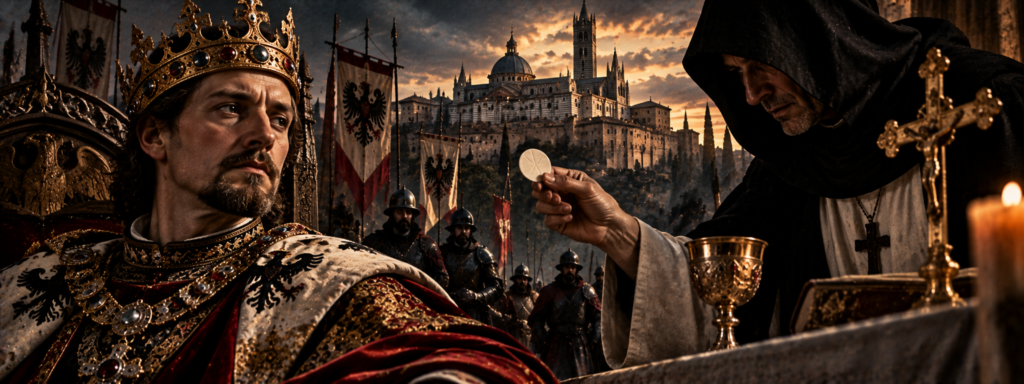
Henry VII: The Emperor, the Poisoned Communion Wafer, and the Death That Shattered an Empire
The Holy Roman Emperor Who Marched Into Italy to Restore Imperial Glory, Defied Kings and Popes, and Died Amid Terrifying Rumors of Murder at the Altar
Henry VII of Luxembourg (c. 1275–24 August 1313) was King of the Romans from 1308 and Holy Roman Emperor from 1312 until his death in 1313. Born into the House of Luxembourg, he inherited the county of Luxembourg and rose unexpectedly to the German kingship following the assassination of Albert I of Habsburg. A capable diplomat and ambitious ruler, Henry sought to restore imperial authority in Italy after decades of political division, entering the peninsula in 1310 with the declared intention of reconciling rival factions and reviving the prestige of the Holy Roman Empire. His campaign became entangled in the bitter struggles between Guelphs and Ghibellines, the ambitions of powerful Italian cities, and the opposition of King Robert of Naples. Crowned emperor in Rome on 29 June 1312, Henry continued fighting to establish his authority before suddenly falling ill and dying at Buonconvento, near Siena, on 24 August 1313. His death, probably caused by disease, immediately inspired accusations that he had been poisoned by a Dominican friar who allegedly administered a contaminated communion wafer during Mass. The poisoning allegation was never conclusively established, and medieval accounts differ over its circumstances and credibility. Henry’s unexpected death ended one of the most ambitious attempts to revive imperial power in medieval Italy and left behind an enduring mystery in which political assassination, religious fear, and the collapse of imperial dreams became inseparable.
The Emperor Who Died After Receiving Holy Communion
In August 1313, the Holy Roman Emperor was preparing for another campaign in a country that seemed determined to destroy him. Henry VII had crossed the Alps nearly three years earlier with visions of restoring peace, reconciling enemies, and reviving the authority of the empire in Italy. Instead, he had encountered rebellious cities, bitter factional rivalries, military resistance, and a political struggle that threatened to consume everything he had accomplished. Now, at approximately thirty-eight years old, the emperor was seriously ill, and the army upon which his ambitions depended was watching its leader deteriorate.
His final days unfolded near Buonconvento, a small Tuscan town south of Siena. Henry had been gathering strength for a campaign against King Robert of Naples, one of the most determined opponents of imperial intervention in Italy. The emperor’s forces had already endured years of exhausting marches, sieges, disease, and political uncertainty. The prospect of losing their ruler at such a moment threatened to transform a difficult campaign into a complete disaster.
Henry died on 24 August 1313, and the suddenness of his death immediately encouraged suspicion. Medieval political life was filled with accusations of poisoning, particularly when a powerful ruler died unexpectedly and left enemies who stood to benefit. Henry had made formidable opponents during his Italian expedition, including wealthy cities and a king whose authority he had openly challenged. His death removed a dangerous adversary at precisely the moment when another military confrontation appeared imminent.
The most disturbing accusation concerned an act that should have been sacred. According to a tradition that circulated after Henry’s death, a Dominican friar had poisoned the consecrated communion wafer administered to the emperor during Mass. The story transformed the Eucharist, one of Christianity’s holiest sacraments, into the supposed instrument of political murder. It suggested that an assassin had exploited Henry’s religious devotion to deliver a fatal substance beneath the appearance of spiritual care.
The accusation was horrifying because it violated more than the emperor’s personal safety. A ruler might expect danger from soldiers, political rivals, or treacherous advisers, but the communion wafer represented the body of Christ within medieval Catholic belief. To imagine that it had been deliberately contaminated was to picture murder committed through an act of sacrilege. The alleged assassin was not merely a killer but a religious figure accused of corrupting the sacrament itself.
The story spread in an atmosphere of grief, anger, and political suspicion. Henry’s supporters struggled to understand how a ruler who had survived so many dangers could suddenly die before confronting his greatest Italian enemy. The poisoning accusation offered an explanation that connected his death directly with the hostility he had encountered. It also provided a villain whose supposed betrayal seemed almost unimaginably wicked.
Yet the historical evidence does not establish that Henry was murdered. His illness is documented, but the precise cause remains uncertain, and modern historians generally regard natural disease as a more plausible explanation than the alleged poisoned communion wafer. The accusation belongs to the history of Henry’s death, but it must not be mistaken for proof of assassination. No surviving evidence securely identifies a murderer, demonstrates that poison was administered, or establishes that the Eucharist caused his fatal illness.
The uncertainty makes Henry’s story more fascinating rather than less. He was a ruler who had risen unexpectedly to the imperial throne, attempted to transform the politics of Italy, and died while pursuing a campaign that might have altered the balance of power across Europe. His death inspired one of the most unsettling poisoning legends of the Middle Ages. To understand why the rumor seemed believable, it is necessary to examine the dangerous world into which Henry carried his imperial ambitions.
A Count From Luxembourg Who Was Never Supposed to Become Emperor
Henry was born around 1275 into the House of Luxembourg, a noble dynasty whose territories lay between the political worlds of France and the German kingdom. His father was Henry VI, Count of Luxembourg, and his mother was Beatrice of Avesnes. The family possessed important regional connections but did not command the immense territorial resources of the most powerful European royal houses. Henry’s eventual elevation to the imperial throne was therefore far from inevitable.
Luxembourg occupied a strategically valuable position within the Holy Roman Empire. Its rulers maintained relationships with neighboring princes, bishops, and the French monarchy. The county’s location encouraged diplomatic flexibility because its political interests crossed linguistic and territorial boundaries. Henry grew up in an environment where negotiation and dynastic alliances were essential to survival.
His father’s death in 1288 brought Henry into the inheritance of the county while he was still young. The circumstances of the death were connected with the Battle of Worringen, a major conflict over the succession to the Duchy of Limburg. The battle reshaped political relationships in the region and demonstrated the dangers facing noble families involved in territorial disputes. Henry inherited both the opportunities and vulnerabilities of his family’s position.
His marriage to Margaret of Brabant strengthened his connections with another important regional dynasty. The marriage produced children, including John, later King of Bohemia, whose descendants would extend Luxembourg influence across central Europe. Dynastic marriage was a central instrument of medieval politics, allowing rulers to acquire allies, claims, and prestige without necessarily resorting to war. Henry’s family relationships would become crucial to his later political success.
As Count of Luxembourg, Henry developed a reputation for capable administration and diplomatic judgment. He operated within the political environment of the French monarchy while maintaining his position as an imperial prince. His ability to navigate these competing spheres made him an attractive candidate when the German throne became vacant. He was not powerful enough to dominate the electors by force, but he possessed connections that could help secure agreement.
The opportunity came through an assassination. On 1 May 1308, King Albert I of Habsburg was murdered by his nephew John of Swabia and accomplices near the Reuss River in what is now Switzerland. The killing removed the reigning German king and created a succession crisis. The imperial electors now faced the task of choosing a new ruler.
The assassination of Albert I was a reminder that medieval kingship offered no guarantee of personal security. Even a ruler surrounded by dynastic prestige and political authority could fall victim to family grievances and conspiracy. Henry’s rise therefore began in the aftermath of a genuine political murder. Five years later, his own sudden death would inspire another assassination story, although the evidence for the two cases is very different.
Henry’s selection reflected the calculations of the prince-electors. They sought a candidate capable of governing without overwhelming their own independence. The powerful Habsburg dynasty remained a possible source of candidates, while the French monarchy also possessed interests in the election. Henry emerged as a compromise figure whose connections and reputation made him acceptable to influential electors.
The count from Luxembourg was about to receive a crown that would transform his life. He had spent his career managing a relatively modest principality, but he would soon claim authority over the German kingdom and seek the imperial title in Rome. His rise was extraordinary, and it placed him within a political system where ambition could bring glory or destruction. The crown offered opportunities far beyond Luxembourg, but it also carried dangers that would eventually prove fatal.
The Murder of Albert I and the Crown That Changed Hands
Albert I’s assassination in 1308 was one of the most shocking political crimes of the period. The king had been killed by his own nephew, John of Swabia, whose grievances concerned disputed inheritance rights and family property. The murder exposed the tensions within the Habsburg dynasty and removed a ruler who had spent years consolidating royal authority. It also created an opportunity for rival families seeking influence within the empire.
The German kingship was elective rather than automatically hereditary. Although dynastic connections mattered, the prince-electors possessed the formal authority to choose the next king. Their decisions reflected territorial interests, political alliances, and concerns about the balance of power. The death of Albert therefore opened a contest in which several powerful groups hoped to shape the future of the monarchy.
Henry benefited from the support of influential ecclesiastical electors, particularly his brother Baldwin, Archbishop of Trier. Baldwin’s position gave the Luxembourg family an important voice within the electoral system. The archbishop was an ambitious and capable political figure who recognized the opportunity presented by Albert’s death. His support helped make Henry’s candidacy viable.
Other electors also found Henry acceptable. He possessed aristocratic legitimacy and diplomatic experience but lacked the overwhelming territorial resources that might threaten their independence. The selection of a relatively modest count could preserve the balance among the empire’s leading princes. Henry’s candidacy therefore represented both personal opportunity and political compromise.
On 27 November 1308, Henry was elected King of the Romans at Frankfurt. He was crowned at Aachen on 6 January 1309, entering the ceremonial tradition associated with Charlemagne and the German monarchy. The coronation elevated him from regional count to ruler of one of Europe’s most important political systems. His new position brought authority, prestige, and immense expectations.
Yet the title did not automatically make him Holy Roman Emperor. The imperial coronation traditionally required a journey to Italy and cooperation with the papacy. German kings could rule for years without receiving the imperial crown. Henry understood that obtaining the title would require diplomatic preparation and possibly military intervention.
His election also created new opportunities for his family. The Luxembourg dynasty could now compete with the Habsburgs and other great houses for influence across central Europe. Henry began strengthening his position through alliances, appointments, and dynastic arrangements. The most important of these would involve the Kingdom of Bohemia.
The new king initially approached his responsibilities with a reputation for moderation. He sought to establish legitimacy among the German princes and maintain workable relationships with neighboring rulers. His diplomatic experience served him well during the early phase of his reign. Yet his ambitions soon expanded toward Italy, where the imperial title promised a level of prestige that German kingship alone could not provide.
The Luxembourg Dynasty Reaches for Bohemia
Henry’s reign produced one of the most consequential dynastic developments in central European history. The Kingdom of Bohemia had entered a period of instability following the extinction of the male Přemyslid royal line in 1306. Rival claimants and aristocratic factions competed over the crown. The resulting uncertainty created an opportunity for the newly elected German king.
Henry’s son John became central to the Luxembourg family’s ambitions. In 1310, John married Elisabeth of Bohemia, a member of the Přemyslid dynasty whose inheritance strengthened his claim to the kingdom. The marriage linked the Luxembourg family with one of the most important royal houses in central Europe. It also provided a political foundation for John’s elevation.
Henry supported his son’s claim, and John became King of Bohemia. The achievement greatly expanded Luxembourg influence beyond its original territorial base. Bohemia possessed substantial resources, strategic importance, and a royal title that elevated the family’s standing. The dynasty was becoming a major European power.
The acquisition of Bohemia also demonstrated Henry’s ability to combine diplomacy with dynastic strategy. He did not rely solely upon military conquest. Marriage, aristocratic support, and political negotiation played essential roles in securing the kingdom. The arrangement would have consequences lasting far beyond Henry’s lifetime.
John’s reign in Bohemia would later produce Charles IV, one of the most important Holy Roman Emperors of the fourteenth century. Through this dynastic connection, Henry became the grandfather of a ruler whose imperial achievements would far exceed his own short reign. The Luxembourg dynasty’s later prominence rested partly upon the foundations Henry established. His political legacy was therefore not limited to his unsuccessful Italian expedition.
The Bohemian success also strengthened Henry’s confidence. He had risen unexpectedly to the German kingship and secured a major royal crown for his family. His political achievements suggested that the Luxembourg dynasty could compete with the most established European houses. The next step was to claim the imperial dignity in Rome.
Yet the pursuit of that crown would carry him into a far more dangerous political environment. The Italian cities possessed wealth, military resources, and traditions of independence that made imperial intervention difficult. Their internal rivalries could turn allies into enemies with alarming speed. Henry would discover that the diplomacy which served him well in central Europe was not always sufficient to control the conflicts of Italy.
Italy: The Beautiful Country Torn Apart by Rivalry
Italy in the early fourteenth century was not a unified kingdom awaiting the arrival of an emperor. It was a complicated political landscape of communes, lordships, ecclesiastical territories, and competing dynastic interests. Wealthy cities such as Florence, Milan, Genoa, Pisa, and Siena possessed substantial resources and powerful political traditions. Their rivalries had shaped the peninsula for generations.
The conflict between Guelphs and Ghibellines formed one of the most recognizable divisions in Italian politics. Broadly speaking, Guelphs were associated with support for papal interests, while Ghibellines were associated with imperial authority. Yet these labels often concealed local family rivalries, commercial competition, and struggles for civic control. A city’s allegiance could shift according to circumstances.
The papacy had long competed with the empire over authority in Italy. Popes sought to protect the independence of the church and maintain influence over central Italian territories. Emperors claimed rights derived from the medieval imperial tradition and earlier German interventions. The resulting conflict had contributed to centuries of political instability.
By Henry’s time, the papacy itself was undergoing major changes. Pope Clement V had been elected in 1305 and remained outside Rome, eventually establishing the papal residence at Avignon. The movement reflected the growing influence of the French monarchy and the difficulties facing papal government in Italy. Henry’s imperial ambitions therefore unfolded during a period when the pope was not securely established in the traditional papal city.
The Kingdom of Naples represented another major obstacle. Ruled by the Angevin dynasty, it possessed strong connections with the papacy and the French political world. King Robert of Naples was an intelligent and ambitious ruler whose interests often conflicted with imperial intervention. He would become Henry’s most determined enemy in Italy.
The Italian communes had their own reasons to resist outside domination. Their wealth depended upon trade, banking, manufacturing, and control over surrounding territories. Imperial taxation, military occupation, or interference in civic government could threaten established interests. Even cities willing to welcome Henry initially might turn against him if his policies appeared too intrusive.
Henry entered this environment with an ambitious vision of reconciliation. He hoped to restore imperial authority while ending factional conflict. His early proclamations emphasized peace and the legitimacy of imperial government. The message appealed to Italians exhausted by decades of internal violence.
Yet the promise of peace was difficult to reconcile with the reality of competing interests. Every city possessed factions that expected imperial intervention to benefit their own position. Exiled families hoped Henry would restore them, while ruling groups feared losing power. The emperor’s attempt to act as an impartial judge would repeatedly place him in conflict with those who had initially welcomed him.
The Emperor Who Promised Peace and Brought War
Henry crossed the Alps into Italy in the autumn of 1310. His arrival was greeted with considerable enthusiasm in some regions, particularly among those who hoped imperial authority would restore political stability. Supporters imagined that a legitimate emperor could end the destructive rivalries between Guelphs and Ghibellines. The expedition initially appeared to offer the possibility of a new political settlement.
Henry presented himself as a ruler above local factional divisions. He sought to reconcile exiles with their cities, restore civic order, and establish imperial representatives capable of maintaining peace. The program reflected his diplomatic background and his belief that imperial authority could provide a framework for political cooperation. It also assumed that rival factions would accept decisions that did not necessarily favor their interests.
The first serious difficulties emerged in northern Italy. Cities that had welcomed Henry began resisting his attempts to impose authority. Local rulers feared losing control over their governments, while exiled factions demanded restoration and revenge. The emperor discovered that reconciliation could produce new conflicts rather than resolve old ones.
Milan became one of the most important centers of his early Italian campaign. Henry received the Iron Crown of Lombardy in January 1311, strengthening his claim to the traditional royal authority of northern Italy. The ceremony represented a major symbolic achievement. Yet the political situation remained unstable, and his efforts to govern the city provoked resistance.
The powerful Visconti family and rival Milanese factions competed for influence. Henry attempted to balance their interests, but his intervention contributed to further tensions. His demand for financial contributions and his assertion of imperial rights alienated important groups. The promise of impartial government became increasingly difficult to sustain.
Rebellion soon spread to other cities. Brescia resisted imperial authority, forcing Henry into a prolonged siege in 1311. The campaign consumed time, money, and lives, while disease and military hardship weakened his forces. The emperor who had entered Italy as a peacemaker was now conducting destructive military operations against cities he claimed to govern.
The siege of Brescia was particularly costly. The defenders resisted fiercely, and the imperial army endured severe difficulties. Henry eventually secured the city’s submission, but the victory came at a high price. His forces were weakened, and the political goodwill that had accompanied his arrival was steadily disappearing.
The transformation was tragic but not surprising. Henry’s vision depended upon Italian cities accepting imperial arbitration, yet those cities possessed deeply rooted political interests. His attempts to impose settlements inevitably favored some factions over others. The more he enforced his authority, the more resistance he provoked. The expedition was becoming a war of conquest and coercion rather than a peaceful restoration.
The Siege of Brescia and the Cost of Imperial Ambition
Brescia became a symbol of the difficulties Henry encountered in Italy. The city resisted his authority during 1311, forcing him to commit substantial military resources to its reduction. The siege lasted for months and placed enormous strain upon the imperial army. It demonstrated that even a ruler possessing legitimate imperial claims could face determined resistance from wealthy Italian communes.
The defenders had strong reasons to resist. Imperial intervention threatened existing political arrangements and could restore exiled rivals to power. The city’s leaders understood that surrender might bring punishment, financial demands, and changes in government. Their resistance was therefore a struggle over local autonomy as well as opposition to Henry personally.
Henry’s army faced the familiar problems of medieval siege warfare. Supplies had to be gathered, soldiers maintained, and defensive positions overcome. Disease could spread rapidly through camps where sanitation was poor and large numbers of men lived in close quarters. The prolonged operation weakened the emperor’s forces even as it increased pressure upon the city.
The siege also affected Henry’s household. His brother Walram, an important supporter, died during the Italian campaign in 1311. The loss deprived the emperor of a close family ally at a moment when personal loyalty was essential. Medieval rulers depended heavily upon relatives and trusted nobles to command troops and administer territories. Such deaths could have political consequences far beyond the immediate grief they caused.
The eventual submission of Brescia did not solve Henry’s larger problems. Other cities remained hostile, while Florence and the Angevin monarchy continued resisting imperial expansion. The campaign had consumed resources that might otherwise have supported a rapid advance toward Rome. Henry’s authority was becoming increasingly associated with military coercion.
The brutality of siege warfare also damaged the moral appeal of his mission. A ruler who promised peace could find himself responsible for destruction, punishment, and the suffering of civilians. The contradiction was not unique to Henry, but it was particularly damaging to his political program. His claim to act as a universal peacemaker became harder to sustain as the war intensified.
The emperor’s supporters could argue that rebellion made military action unavoidable. If imperial authority was legitimate, cities refusing obedience could be treated as defiant subjects. Yet from the perspective of those cities, Henry was an outside ruler attempting to impose control over established institutions. The conflict involved competing conceptions of legitimate government.
Brescia therefore marked a turning point in the expedition. Henry had entered Italy hoping to restore order through reconciliation, but he increasingly relied upon force. The military costs were substantial, and the political benefits uncertain. His march toward Rome continued, but the foundations of his authority were becoming more fragile with every victory.
Margaret of Brabant: The Empress Who Never Reached the Crown
Henry’s wife, Margaret of Brabant, accompanied him during the Italian expedition. Their marriage had long been an important dynastic alliance, and Margaret’s presence reflected the political and ceremonial role expected of a royal consort. She was not merely a private companion but part of the imperial household whose status helped communicate the legitimacy of Henry’s rule. Her participation in the campaign placed her amid the dangers of medieval warfare and travel.
The journey through Italy exposed the royal household to disease, exhaustion, and political instability. Margaret became ill during the expedition and died at Genoa in December 1311. Her death occurred before Henry received the imperial crown in Rome. The loss was both personal and ceremonial, depriving him of the woman who might otherwise have been crowned empress beside him.
The circumstances of her death illustrate the human cost of the campaign. Medieval royal families were not insulated from the illnesses that afflicted soldiers and civilians. Travel through unfamiliar environments, crowded quarters, and the stresses of prolonged military operations could be dangerous. Even a queen or empress-to-be could die far from home without effective medical treatment.
Margaret’s death also weakened the emotional and dynastic foundations of Henry’s Italian enterprise. She had been his wife for many years and the mother of his children. Her presence connected the emperor’s public ambitions with his private family life. Losing her during the campaign added another burden to an already difficult expedition.
The tragedy was particularly bitter because Henry’s imperial coronation remained ahead of him. The ceremony would represent the fulfillment of one of his greatest ambitions, yet Margaret would not share it. The emperor continued toward Rome without his wife. His pursuit of imperial glory was increasingly accompanied by personal loss.
Her burial at Genoa created a lasting memorial to the Luxembourg presence in Italy. The tomb commissioned for her became an important example of medieval funerary sculpture, reflecting both her status and the grief associated with her death. Such monuments served political as well as personal purposes, preserving dynastic memory in places connected with royal history. Margaret’s death remained part of the story of Henry’s Italian campaign.
The loss also foreshadowed the emperor’s own fate. Both husband and wife died during the same expedition, far from the lands where their family had established its power. Their deaths were separated by less than two years. The campaign that was supposed to elevate the Luxembourg dynasty through imperial triumph instead consumed both members of the royal couple.
Margaret’s death did not stop Henry’s ambitions. He continued toward Rome, determined to receive the imperial crown and establish his authority. Yet the expedition had already exacted a terrible price. The emperor was approaching the most important ceremony of his life with a weakened army, powerful enemies, and the memory of his wife’s death behind him.
Florence: The Republic That Refused to Bow
Florence emerged as one of Henry’s most determined opponents. The city was wealthy, politically influential, and deeply involved in the rivalries of central Italy. Its ruling interests feared that a restored imperial authority would threaten their autonomy and strengthen hostile factions. Henry’s attempts to impose his political program therefore encountered firm resistance.
The Florentine government belonged to the Guelph political tradition, although its internal divisions were complicated. The city had experienced intense factional struggles, including conflicts between the White and Black Guelphs. Exiled groups hoped imperial intervention might restore their fortunes, while those in power feared losing control. Henry’s arrival threatened to reopen disputes that had already produced violence and exile.
Florence also possessed considerable financial resources. Its merchants and bankers operated across Europe, giving the city influence far beyond Tuscany. The government could use money to support allies, hire soldiers, and resist imperial pressure. Henry therefore faced an opponent whose strength was not measured solely by the size of its territory.
The city’s opposition helped shape the wider anti-imperial coalition. Florence maintained relationships with other Guelph powers and supported resistance to Henry’s intervention. Its political leaders understood that the emperor’s success could alter the balance of power throughout central Italy. They were prepared to spend substantial resources to prevent that outcome.
Henry responded by treating Florence as a major enemy. He condemned its resistance and eventually undertook military operations against it. His forces approached the city in 1312, but he lacked the resources necessary to secure a decisive conquest. The campaign demonstrated the limits of imperial military power against a wealthy and determined commune.
The conflict also carried an ideological dimension. Henry claimed to represent universal imperial authority, while Florence defended its political independence and established institutions. Both sides could present their position as legitimate. The emperor regarded resistance as rebellion, while Florentine leaders could portray his intervention as a threat to civic liberty.
The struggle became deeply entangled with the political writings of Dante Alighieri. Dante had been exiled from Florence and viewed Henry’s arrival as an opportunity for the restoration of lawful imperial authority. His support gave the emperor’s campaign a literary and philosophical significance extending beyond military events. Yet Dante’s hopes would be disappointed by Henry’s death.
Florence survived the immediate imperial threat. Its resistance contributed to the failure of Henry’s attempt to establish lasting authority in central Italy. The city’s success also demonstrated that the wealthy communes could challenge imperial ambitions through alliances, finance, and determined political organization. Henry’s dream of reconciliation had become a struggle against some of the most powerful cities in Europe.
Dante and the Emperor Who Seemed Sent to Save Italy
Dante Alighieri was among the most remarkable supporters of Henry’s Italian expedition. The poet had been exiled from Florence in 1302 and remained deeply involved in the political and moral conflicts of his age. His experiences shaped his views of the relationship between imperial authority, civic government, and the papacy. Henry’s arrival appeared to offer the possibility of a political transformation Dante had long desired.
Dante believed that legitimate imperial authority could provide a framework for peace in Italy. He regarded the endless rivalries among cities and factions as destructive consequences of political disorder. The emperor, in his conception, possessed a universal role that could restrain competing interests. Henry’s expedition seemed to embody that ideal.
The poet welcomed the new ruler with extraordinary enthusiasm. His political letters urged Italian communities to recognize imperial authority and condemned those who resisted. Florence became a particular target of his anger because its government opposed Henry’s intervention. Dante’s language reflected the intensity of his political hopes.
His support was not simply personal admiration for Henry. It rested upon a broader theory of monarchy and the relationship between spiritual and temporal power. Dante believed that humanity required a legitimate universal political authority distinct from the papacy’s spiritual responsibilities. The emperor could provide justice and peace by standing above the rival interests of individual cities. Henry appeared to offer a practical realization of that vision.
The relationship between Dante’s political thought and Henry’s actual campaign was complicated. The emperor’s forces conducted sieges, imposed demands, and became entangled in the very factional conflicts he hoped to resolve. Dante’s ideal of universal justice did not always correspond with the practical realities of imperial intervention. Yet his enthusiasm demonstrates how powerful Henry’s symbolic position could be.
Henry’s death devastated the hopes of those who believed his expedition might transform Italy. Dante’s later writings preserved a sense of the emperor’s significance within a larger moral and political order. In the Divine Comedy, Henry appears in the heavenly vision of Paradiso, associated with a place prepared for him among the blessed. The literary tribute helped secure his memory long after his political campaign had failed.
Dante’s portrayal also contributed to the idealization of Henry as a ruler whose ambitions were noble but whose life was tragically shortened. The emperor became a symbol of lost opportunity. His death could be interpreted as the destruction of a chance to restore justice and peace. Such interpretations helped create an atmosphere in which the poisoning rumor might appear morally and politically meaningful.
The historical Henry was more complicated than the ideal emperor of Dante’s hopes. He possessed genuine diplomatic ability and an ambitious conception of imperial authority, but his campaign also involved coercion, military violence, and political miscalculation. His supporters saw a peacemaker, while his enemies saw a threatening foreign ruler. The contrast between these perspectives became central to his posthumous reputation.
Rome Without a Pope: The Coronation of 1312
Henry finally reached Rome in 1312, but the city was deeply divided. Pope Clement V remained outside Italy, and the political situation prevented the straightforward imperial coronation Henry had hoped to receive. Rival factions controlled different parts of Rome, while Angevin forces supported opposition to the emperor. The sacred city was once again a battlefield of competing interests.
The emperor’s arrival did not produce universal acceptance. Supporters of King Robert of Naples and other anti-imperial factions resisted his authority. Armed conflict occurred within the city, complicating access to important religious sites. Henry’s attempt to receive the crown therefore became inseparable from military struggle.
The traditional coronation site was St. Peter’s Basilica, but hostile forces prevented Henry from using it. The ceremony instead took place at the Lateran Basilica. On 29 June 1312, representatives of the papacy crowned Henry Holy Roman Emperor. The coronation fulfilled the ambition that had brought him into Italy.
The ceremony was a major symbolic triumph. Henry became the first Holy Roman Emperor crowned since Frederick II in the thirteenth century. The long interruption had weakened the practical connection between the German kingship and the Roman imperial title. Henry’s coronation appeared to restore that tradition.
Yet the circumstances revealed the limits of his achievement. The pope was absent, Rome remained divided, and the emperor’s enemies continued resisting his authority. The crown gave him prestige but did not provide the military resources necessary to impose obedience. His political position remained precarious.
The coronation also intensified the conflict with Robert of Naples. The Angevin king regarded Henry’s imperial claims as a threat to his interests in Italy. Their rivalry had already shaped the political situation in Rome. After the coronation, the struggle became increasingly direct.
Henry now possessed the imperial title he had sought, but the ceremony did not end his campaign. Instead, it raised expectations that he would enforce imperial rights throughout Italy. His supporters wanted decisive action against hostile cities and rulers. The emperor faced growing pressure to turn symbolic authority into military victory.
The contrast between ceremony and reality was striking. Henry had received one of the most prestigious titles in medieval Christendom, yet he could not secure undisputed control over the city where he was crowned. His imperial authority existed alongside political fragmentation and military resistance. The crown represented the fulfillment of his ambition, but it also drew him deeper into the conflicts that would consume the final year of his life.
Robert of Naples: The King Who Stood in the Emperor’s Way
King Robert of Naples was one of the most formidable opponents Henry encountered in Italy. A member of the Angevin dynasty, Robert ruled a wealthy and strategically important kingdom in southern Italy. His political influence extended into central and northern Italy through alliances with Guelph cities and other supporters. He possessed the resources and diplomatic connections necessary to challenge imperial expansion.
Robert’s interests conflicted directly with Henry’s vision of restored imperial authority. A powerful emperor operating in Italy could threaten Angevin influence and the political arrangements upon which Robert depended. The king therefore supported resistance to Henry’s intervention. Their rivalry became one of the defining conflicts of the emperor’s final years.
The relationship was complicated by the papacy. Robert maintained close connections with papal interests, while Henry claimed rights derived from the imperial tradition. The pope’s position was not identical to Robert’s in every respect, but the political environment favored resistance to an overly powerful emperor. The struggle involved overlapping dynastic, territorial, and ecclesiastical interests.
Henry increasingly treated Robert as a rebellious subject of imperial authority. He condemned the king’s opposition and pursued legal and political measures against him. The dispute raised fundamental questions about the relationship between the empire and the Kingdom of Naples. Robert rejected the emperor’s claims and defended his own sovereignty.
The conflict became more dangerous after Henry’s coronation in 1312. The emperor sought to organize military action against the Angevin kingdom. His supporters hoped that a successful campaign would destroy the principal obstacle to imperial dominance in Italy. Robert and his allies prepared to resist.
The rivalry also involved the maritime powers of Italy. Genoa and Pisa possessed important interests in the conflict, and their support could affect the movement of troops and supplies. Henry’s campaign therefore required coordination across land and sea. The logistical challenges were considerable.
Robert’s opposition helped make Henry’s final campaign especially dangerous. The emperor was already weakened by years of warfare, disease, and political resistance. His forces had suffered losses, and his authority remained contested. A major expedition against Naples promised further hardship even if it succeeded.
The sudden death of Henry in August 1313 removed Robert’s most immediate imperial enemy. The Angevin king benefited politically from the emperor’s disappearance, although benefit does not establish responsibility for murder. His rivalry with Henry nevertheless provided an obvious motive for later suspicion. In an age accustomed to interpreting sudden royal deaths through political conspiracy, the king’s interests could easily become part of the poisoning narrative.
The Final Campaign: Marching Toward a Kingdom of Enemies
By the summer of 1313, Henry was preparing for a major campaign against Robert of Naples. His forces gathered in Tuscany, where the emperor hoped to organize an offensive capable of breaking Angevin resistance. The campaign represented the culmination of his Italian ambitions. A decisive victory might have strengthened imperial authority and forced hostile cities to reconsider their positions.
The emperor’s army had already endured years of exhausting operations. Soldiers had marched across difficult terrain, besieged fortified cities, and faced repeated shortages of supplies. Disease remained a constant danger in military camps. The demands of maintaining a large force placed heavy burdens upon both soldiers and surrounding communities.
Henry’s political position was also complicated by the shifting loyalties of Italian allies. Cities and nobles supported the emperor when doing so served their interests, but their commitment could weaken when the military situation changed. The emperor needed reliable cooperation to conduct a campaign against Naples. His authority was not sufficient to guarantee it.
The preparations brought Henry into the region around Siena. The emperor’s movements reflected his intention to continue the war despite the difficulties of the preceding years. His supporters still believed that imperial victory was possible. The campaign had not yet reached its decisive confrontation when illness intervened.
Henry became seriously ill during August 1313. The precise course of the disease is difficult to reconstruct because the surviving sources do not provide a complete medical record. Some accounts suggest a rapid deterioration, while others imply that his condition developed over a period of days. The uncertainty later encouraged speculation about poisoning.
The emperor’s illness immediately threatened the military expedition. A medieval army depended heavily upon the personal authority of its commander, particularly when that commander was also the sovereign. Henry’s officers could continue certain operations, but his death would create political uncertainty far beyond the battlefield. The campaign against Naples was therefore endangered before the army could achieve its objective.
The situation was especially bitter because Henry had already sacrificed so much for the Italian expedition. His wife had died in Genoa, his forces had suffered severe losses, and his efforts at reconciliation had repeatedly produced war. He had finally obtained the imperial crown, but the political order he hoped to establish remained unfinished. His illness threatened to make the entire enterprise a costly failure.
The emperor’s final days unfolded under the shadow of that uncertainty. His supporters faced the possibility that their ruler would die without completing the campaign. His enemies had reason to hope that his military ambitions would collapse. The atmosphere was ripe for rumors, and the circumstances of his death would soon become one of the most disturbing stories of medieval imperial history.
The Last Mass and the Alleged Poisoned Wafer
The poisoning tradition centers upon the Eucharist, the Christian sacrament in which consecrated bread and wine are received during Mass. According to the accusation, Henry was given a poisoned communion wafer by a Dominican friar shortly before his death. The story suggested that the emperor’s religious devotion had been exploited by someone entrusted with administering a sacred rite. Its implications were both political and sacrilegious.
The alleged method was particularly shocking within medieval Catholic belief. The consecrated host was understood to be the body of Christ, making deliberate contamination an offense of extraordinary religious gravity. A priest or friar who used the sacrament to commit murder would violate the most sacred responsibilities of his vocation. The accusation therefore portrayed the supposed assassin as guilty of both homicide and profound spiritual corruption.
The story circulated after Henry’s death and became associated with his sudden illness. Some versions identified a Dominican friar as the perpetrator, while other accounts differed in their treatment of the allegation. The identity of the supposed assassin and the precise circumstances of the alleged poisoning remain uncertain. The surviving evidence does not establish a reliable chain of events connecting the Eucharist with Henry’s death.
The accusation also reflected the political atmosphere surrounding the emperor. Henry had powerful enemies who might benefit from his death, particularly Robert of Naples and the anti-imperial cities. The idea that one of those enemies had arranged a secret murder offered an explanation for the abrupt collapse of the campaign. Yet the existence of political motives does not demonstrate that a conspiracy occurred.
The alleged involvement of a Dominican friar made the story especially troubling. The Dominican Order was a major religious institution whose members served as preachers, theologians, and advisers throughout Europe. Accusing one of its members of poisoning the Eucharist threatened the reputation of the order as well as the sanctity of the sacrament. The allegation therefore carried consequences beyond the death of the emperor.
Later discussions of the story sometimes treated the poisoning as fact, while others expressed skepticism. Medieval chroniclers frequently recorded rumors surrounding the deaths of powerful rulers, particularly when those deaths occurred during political crises. The distinction between reporting an accusation and verifying it was not always clearly maintained. A story could become widely repeated without acquiring stronger evidence.
The chronology of Henry’s illness also complicates the allegation. The surviving accounts do not provide sufficient medical detail to determine whether his symptoms were consistent with poisoning or natural disease. Even if he received communion shortly before death, that would have been entirely normal for a dying Christian ruler. The temporal proximity of a religious rite and death cannot establish causation.
The most responsible conclusion is that Henry’s death inspired a serious poisoning rumor, but the accusation remains unproven. No reliable evidence demonstrates that a Dominican friar deliberately contaminated the communion wafer or that Henry died from poison. The story deserves attention because it shaped the memory of his death and reflected the fears of his contemporaries. It should not be presented as a confirmed act of assassination.
Why a Poisoned Communion Wafer Was Such a Terrifying Accusation
The Eucharist occupied a central place in medieval Christian life. Catholics believed that the consecrated bread and wine became the body and blood of Christ, making the sacrament an essential expression of religious devotion. Receiving communion could be particularly important during serious illness or preparation for death. The idea that the sacrament itself might be used to kill a ruler therefore struck at the heart of religious trust.
Medieval rulers frequently surrounded themselves with clerics who provided spiritual guidance and performed religious ceremonies. Confessors, chaplains, and other religious advisers could possess access to the ruler’s private life that ordinary political figures did not enjoy. Their presence was expected and often necessary. The poisoning story exploited precisely that relationship of trust.
The alleged method also inverted the meaning of communion. A rite intended to provide spiritual nourishment and union with Christ became, in the accusation, an instrument of bodily destruction. The contrast made the story memorable and emotionally powerful. It suggested that even the most sacred institutions could be corrupted by political hatred.
The accusation was also dangerous because it implicated the clergy in political violence. A Dominican friar was supposed to serve religious truth and pastoral responsibility. If such a figure deliberately poisoned the emperor, the crime would represent a betrayal of both spiritual and temporal authority. The resulting scandal could damage confidence in religious institutions.
The story’s religious symbolism helped it survive. A ruler dying after receiving communion might ordinarily be remembered as having prepared for death through the sacraments. The poisoning legend transformed that pious final act into evidence of murder. It offered a dramatic explanation that combined holiness, betrayal, and political conspiracy.
Yet the very power of the symbolism should encourage caution. Medieval historical writing often interpreted events through moral and religious patterns. Sudden deaths could be presented as divine punishment, martyrdom, or the result of wicked conspiracy. Such interpretations reflected the beliefs and anxieties of the writers as much as the facts of the events.
The poisoning accusation also reveals how vulnerable medieval rulers could appear despite their authority. An emperor might command armies and issue judgments, but he still depended upon servants, advisers, and religious figures for everyday needs. Access to his person could become a source of danger. The alleged communion poisoning dramatized the fear that an enemy might reach a ruler through the very institutions designed to protect his soul.
For Henry’s supporters, the story offered an explanation that preserved the emperor’s heroic reputation. He had not simply succumbed to illness during a difficult campaign; he had supposedly been destroyed through sacrilegious treachery. The narrative transformed political failure into martyr-like suffering. Its emotional appeal helps explain why the rumor endured despite the absence of conclusive evidence.
Disease, Exhaustion, or Murder?
The question of Henry’s cause of death has attracted attention because the surviving evidence is incomplete. He became seriously ill during the final stage of his Italian campaign and died at Buonconvento on 24 August 1313. The sources establish the death and its political circumstances but do not provide a modern medical diagnosis. Any attempt to identify the precise disease must therefore remain cautious.
Malaria has sometimes been suggested as a possible explanation. The disease was historically present in parts of Italy and could cause severe fever, weakness, and fatal complications. Medieval armies operating in unfamiliar environments were particularly vulnerable to infectious illness. Henry’s prolonged campaign would have exposed him to conditions in which disease could spread.
Other illnesses are also possible. Medieval populations faced infections that could produce rapid deterioration, particularly when medical treatment was limited. The physical demands of campaigning, inadequate sanitation, and repeated exposure to disease increased the risks. Henry’s relatively young age did not make him immune to these dangers.
The possibility of poisoning cannot be excluded with absolute certainty. Political assassination through poison was a genuine fear in medieval courts, and Henry possessed powerful enemies. Yet the historical question is not whether poisoning was possible but whether reliable evidence demonstrates that it occurred. The surviving sources do not provide such proof.
The alleged communion wafer presents additional difficulties. A consecrated host would ordinarily contain a small quantity of bread, and any claim that it carried a fatal substance requires evidence about the poison, administration, and resulting symptoms. The medieval accounts do not supply that information in a reliable form. The story therefore remains an accusation rather than a medically established cause of death.
The political context explains why suspicion spread. Henry had challenged Robert of Naples, threatened the interests of wealthy Italian cities, and attempted to restore imperial authority in a region deeply divided by factional conflict. His death benefited opponents who feared his military campaign. Such circumstances could encourage rumors even when the actual cause was natural.
The emperor’s supporters also had emotional reasons to reject the idea of ordinary illness. Henry had endured years of hardship and finally received the imperial crown. His sudden death before a decisive campaign seemed almost too cruel to accept as chance. The poisoning story provided a human enemy who could be blamed for the collapse of their hopes.
Modern historical interpretation generally favors natural disease over a proven assassination, although the precise illness remains uncertain. The evidence does not justify identifying a Dominican friar as Henry’s murderer. His death belongs among disputed royal deaths and alleged poisonings rather than confirmed regicides. The distinction preserves both the drama of the story and the integrity of the historical record.
The Dominican Friar Who Became the Villain of a Legend
The Dominican Order was one of the most influential religious institutions of medieval Europe. Founded in the early thirteenth century, it emphasized preaching, theological education, and religious discipline. Dominican friars served in universities, courts, and communities across Christendom. Their reputation for learning and spiritual authority made them prominent figures in public life.
The poisoning accusation placed one of these friars at the center of an extraordinary crime. According to the rumor, a member of the order had used the Eucharist to murder the Holy Roman Emperor. The allegation was deeply damaging because it associated a religious vocation with deliberate sacrilege. It also suggested that political enemies could corrupt the clergy to accomplish their purposes.
The identity of the alleged friar is not securely established by reliable evidence. Later accounts and traditions vary, and the surviving record does not provide a convincing reconstruction of the supposed plot. It would therefore be irresponsible to present a particular Dominican as a proven assassin. The story is better understood as an accusation that circulated in the aftermath of Henry’s death.
The rumor also created problems for the Dominican Order. A claim that one of its members had poisoned communion threatened the trust upon which its religious work depended. The order had strong reasons to reject or challenge such allegations. The controversy therefore became part of the wider struggle over the interpretation of Henry’s death.
The accusation may also reflect the political associations of particular religious communities. Medieval clerics were not always detached from political conflicts, and members of religious orders could possess sympathies shaped by local and dynastic interests. Yet political sympathy does not establish participation in murder. The existence of religious figures within hostile political networks cannot be treated as evidence of a poisoning conspiracy.
The story’s persistence reveals the attraction of a betrayal committed by someone trusted. An emperor killed by an enemy soldier would have been a familiar casualty of war. An emperor supposedly poisoned by a friar during communion represented a far more disturbing violation of expectations. The alleged assassin’s religious identity became essential to the tale’s emotional force.
Later retellings could exaggerate the friar’s role because the accusation offered a complete explanation for Henry’s sudden death. The emperor had enemies, the campaign was dangerous, and his death was unexpected. A secret murderer provided a satisfying connection between those facts. Yet the historical evidence does not establish that the connection existed.
The Dominican friar therefore remains a figure of allegation rather than demonstrated guilt. His supposed role belongs to the history of rumor and political memory. The story illustrates how a religious institution could become entangled in accusations generated by a major political death. It also shows why historians must distinguish the circulation of a charge from proof that the charge was true.
The Emperor’s Death and the Collapse of the Italian Dream
Henry’s death immediately disrupted the campaign against Robert of Naples. The emperor had been the central figure holding together a coalition of German nobles, Italian allies, and military forces. His personal authority provided legitimacy and direction to the expedition. Without him, the army faced uncertainty about its future.
The planned offensive against Naples lost its principal leader. Henry’s supporters could no longer rely upon the promise of imperial victory to sustain their alliances. Italian cities and nobles began reconsidering their positions. The political momentum that had supported the expedition rapidly weakened.
The death also created a vacancy in the German kingship and imperial leadership. Henry’s son John possessed the Bohemian crown but did not automatically inherit the German kingship. The prince-electors retained the authority to choose the next ruler. The succession would therefore become another political struggle.
The Italian expedition had already consumed substantial resources. Years of campaigning had weakened the army and strained the financial foundations of the enterprise. Henry’s death removed the possibility that a final victory might justify those sacrifices. The result was a costly and unfinished campaign.
His enemies benefited from the collapse. Robert of Naples no longer faced the immediate threat of an imperial invasion, while Florence and other resistant cities gained relief from military pressure. The political balance in Italy shifted away from Henry’s supporters. The emperor’s death therefore had consequences far beyond the personal tragedy of his household.
The imperial title itself remained vacant until a new ruler could secure the necessary political and ceremonial recognition. The absence of an emperor weakened the possibility of coordinated imperial intervention in Italy. Local powers continued pursuing their interests. Henry’s attempt to restore a strong imperial presence had failed to produce a durable settlement.
The collapse also affected the ideological hopes associated with the expedition. Supporters such as Dante had imagined Henry as a ruler capable of restoring justice and peace. His death seemed to destroy that possibility. The disappointment contributed to the idealization of Henry as a tragic figure whose mission had been interrupted.
The poisoning rumor fitted naturally into this atmosphere. If Henry had been murdered, the failure of the expedition could be blamed upon treachery rather than political miscalculation or disease. His enemies could be portrayed as having destroyed a legitimate emperor through sacrilegious means. The story preserved the grandeur of his ambitions while explaining their failure through betrayal.
Pisa: The City That Received the Dead Emperor
After Henry’s death, his remains were transported to Pisa, one of the Italian cities that had supported his imperial cause. Pisa possessed a long tradition of rivalry with Florence and had reasons to favor a strong imperial presence in Tuscany. Its loyalty made it a fitting place for the emperor’s burial. The city became the guardian of his memory.
Henry was buried in Pisa Cathedral, where his tomb became an important monument to his reign. The funerary sculpture associated with Tino di Camaino reflected the dignity of the imperial office and the desire to preserve the ruler’s reputation. Such monuments were not merely expressions of grief. They also communicated political allegiance and dynastic prestige.
The choice of Pisa carried symbolic significance. Henry had attempted to restore imperial authority across Italy, but his body remained in a city whose support reflected the peninsula’s continuing divisions. Florence and other opponents had resisted him, while Pisa honored his memory. His burial therefore preserved the political geography of his final campaign.
The tomb also became a place where the emperor’s unfinished ambitions could be remembered. Visitors could contemplate the ruler who had crossed the Alps seeking the imperial crown and died before completing his mission. The monument transformed a failed military expedition into a lasting historical presence. Henry’s political defeat did not erase his prestige.
His burial in Italy also distinguished him from many German rulers whose remains rested north of the Alps. Henry had invested the final years of his life in the peninsula, and his death bound his memory to that landscape. Pisa became the final destination of a journey that had begun with hopes of reconciliation and imperial renewal. The emperor never returned to Luxembourg or the German lands he had ruled.
The funeral also reflected the practical difficulties of medieval political succession. The army and household had to preserve the dignity of the dead ruler while responding to the collapse of his command. The burial provided ceremonial closure but could not resolve the political crisis. His supporters faced an uncertain future.
The tomb’s survival helped preserve Henry’s reputation through later centuries. His Italian campaign continued to attract attention because of its connection with Dante, the Guelph-Ghibelline conflict, and the history of imperial authority. The poisoning legend became another element of that memory. The emperor’s death remained a subject of fascination long after the immediate political struggle had ended.
Pisa therefore holds an important place in the story. It was not merely the city where Henry was buried but a community that had supported his ambitions and preserved his memory. His tomb became a reminder of an imperial project that had reached its ceremonial height in Rome but ended in illness and uncertainty in Tuscany. The dead emperor remained a symbol of political hopes that had not been fulfilled.
A Crown Without an Emperor: The Succession Crisis
Henry’s death left the German kingdom without a clear successor. His son John was King of Bohemia, but the German crown was not automatically hereditary. The prince-electors possessed the authority to choose a new ruler, and their interests were divided. The resulting struggle would become one of the most important political consequences of Henry’s death.
The principal contenders included Louis of Bavaria and Frederick the Fair of Habsburg. Both possessed powerful dynastic connections and supporters among the electors. Their rivalry reflected the continuing competition between major princely houses. Henry’s death had reopened the struggle for control of the monarchy.
In 1314, rival elections produced competing claims to the German kingship. Louis and Frederick each received support from different groups of electors, creating a prolonged political conflict. The dispute demonstrated the instability of a monarchy in which electoral legitimacy could be contested. Henry’s unexpected death had removed a ruler whose authority might otherwise have preserved continuity.
The rivalry eventually led to military confrontation. The Battle of Mühldorf in 1322 resulted in a decisive victory for Louis over Frederick. The conflict had consumed years of political energy and military resources. It also delayed the restoration of stable imperial authority.
The succession crisis affected the wider empire. Princes and cities aligned themselves with competing claimants according to their interests. The absence of an uncontested ruler weakened central coordination. Regional powers gained opportunities to strengthen their independence.
Henry’s family nevertheless retained important advantages. The Luxembourg dynasty continued ruling Bohemia through John and later produced Charles IV. The family’s long-term influence therefore survived the emperor’s death. His dynastic achievements proved more durable than his Italian political program.
The contrast is significant. Henry failed to establish lasting imperial authority in Italy, but his acquisition of Bohemia transformed the future of his dynasty. His descendants would eventually achieve political successes that he had not lived to see. The Luxembourg house remained one of the major forces in European politics.
The succession crisis also demonstrates why Henry’s death mattered so profoundly. The loss of a ruler could destabilize an entire political system, particularly when no direct succession arrangement had been secured. Whether he died from disease or poison, the consequences were enormous. His death created opportunities for rivals and prolonged the struggle over imperial authority.
The Poisoning Rumor and the Politics of Blame
The accusation that Henry had been poisoned did not arise in a political vacuum. His Italian expedition had created powerful enemies whose interests were threatened by his ambitions. Robert of Naples, Florence, and other anti-imperial forces benefited from the collapse of his campaign. The coincidence between their political advantage and Henry’s sudden death encouraged suspicion.
Medieval political culture frequently interpreted unexpected deaths through the possibility of conspiracy. Rulers possessed enemies, and poison offered a method of murder that could be difficult to detect. When a powerful figure died without an obvious explanation, rumors could spread rapidly. The absence of reliable medical evidence created space for competing narratives.
Henry’s supporters had particular reasons to suspect foul play. They had endured years of campaigning and believed that the emperor was pursuing a legitimate mission. His death before a decisive confrontation seemed almost intolerably cruel. A poisoning plot offered an explanation that preserved the dignity of his cause.
The accusation also allowed blame to be directed toward religious and political opponents. If a Dominican friar had administered poison, the emperor’s death could be portrayed as the result of sacrilegious treachery. The story transformed a military and political failure into a moral outrage. It suggested that Henry’s enemies had resorted to methods too wicked for open warfare.
Yet the evidence does not establish that Robert of Naples or any other political opponent arranged an assassination. Their motives and opportunities remain matters of speculation. The fact that they benefited from Henry’s death cannot prove responsibility. Historical analysis must distinguish political advantage from criminal involvement.
The rumor also illustrates the difficulty of separating contemporary belief from later embellishment. A story might begin as suspicion among grieving supporters and acquire more detailed accusations through repetition. Chroniclers could preserve the rumor without verifying it. Later writers might then treat the accumulated narrative as established history.
The alleged communion poisoning was especially memorable because it combined political conspiracy with religious sacrilege. A ruler murdered by an ordinary poisoner would have been shocking, but a ruler killed through the Eucharist represented a deeper violation of trust. The story’s emotional force helped sustain it. Its survival, however, does not establish its truth.
The politics of blame therefore became part of Henry’s legacy. His death was remembered not only as the end of an imperial campaign but as a possible act of treachery. The accusation shaped the moral interpretation of his enemies and supporters. The historical uncertainty remained unresolved beneath the power of the narrative.
The Emperor Who Tried to End Italy’s Wars and Became Part of Them
Henry’s Italian expedition began with a promise of reconciliation. He hoped to restore imperial authority while ending the factional conflicts that had divided the peninsula. His proclamations emphasized peace, justice, and the legitimacy of imperial government. The message appealed to those who believed that Italy needed an authority capable of standing above local rivalries.
Yet the expedition gradually became another source of conflict. Henry’s attempts to restore exiles and impose imperial representatives threatened established governments. Cities resisted, forcing him into military campaigns. His claim to act as a universal peacemaker became increasingly difficult to reconcile with the violence of his operations.
The contradiction reflected the structure of Italian politics. The communes possessed strong traditions of autonomy and deeply rooted factional divisions. Any attempt to impose a settlement would benefit some groups and threaten others. Henry could not remain impartial while enforcing decisions that altered the balance of power.
His military resources were also limited. The German monarchy did not possess a permanent centralized army capable of imposing authority across Italy. Henry depended upon noble followers, mercenaries, and Italian allies whose loyalty could change. The expedition therefore required constant negotiation and financial support.
The emperor’s personal qualities were not sufficient to overcome these structural problems. He possessed diplomatic skill and a genuine ambition to restore order. Yet his political program demanded more resources and cooperation than he could reliably obtain. The longer the campaign continued, the more his authority became entangled in local struggles.
His death prevented any final resolution. It is possible that a successful campaign against Naples might have strengthened his position, but such an outcome cannot be assumed. Robert of Naples possessed substantial resources, and Florence remained hostile. The emperor faced formidable opposition even before his illness.
The poisoning legend transformed these political difficulties into a story of betrayal. Instead of emphasizing the structural limits of imperial authority, it imagined that a secret murderer destroyed Henry’s mission. The narrative offered a clear villain and a dramatic explanation for failure. It was emotionally satisfying but historically uncertain.
Henry’s career is more revealing when understood in its full complexity. He attempted to restore a political order that had weakened over generations, but the forces resisting him were powerful and deeply rooted. His ambitions were impressive, yet his methods contributed to the conflicts he hoped to end. His death was tragic because it interrupted a difficult experiment whose outcome remained uncertain.
The Religious Horror of Murder at the Altar
The alleged poisoning of Henry VII through communion occupies a distinctive place among medieval assassination stories. It combines the vulnerability of a ruler with the violation of a sacred rite. The accusation suggested that the emperor was attacked at a moment when he should have been spiritually protected. The contrast made the story especially disturbing.
The medieval church taught that the Eucharist was central to Christian life. Receiving communion involved profound religious significance, particularly for a ruler facing danger or illness. The idea that the consecrated host could be deliberately contaminated challenged the trust placed in clergy and sacramental practice. It was an accusation capable of provoking horror far beyond ordinary political murder.
The story also exploited the special relationship between emperor and church. Henry had sought the imperial crown through a ceremony associated with papal authority. His political legitimacy was expressed through religious ritual. The alleged poisoning suggested that the same religious world which conferred imperial dignity could become the instrument of his destruction.
Such symbolism was powerful in an age when political events were frequently interpreted through divine providence. Supporters might regard Henry as a ruler whose mission had been thwarted by wicked enemies. The alleged sacrilege could make his death appear martyr-like. His enemies, meanwhile, might reject the accusation as an attempt to explain military failure through conspiracy.
The historical evidence remains insufficient to establish the crime. The story’s religious horror cannot substitute for proof that poison was administered. Nor can the alleged involvement of a Dominican friar be accepted without reliable testimony. The accusation must remain part of the history of rumor rather than confirmed murder.
The persistence of the tale nevertheless reveals important anxieties about medieval power. Rulers depended upon religious institutions for legitimacy, counsel, and spiritual care. That dependence created relationships of trust which, in the imagination of contemporaries, could be exploited by enemies. The poisoning story dramatized the fear that sacred authority itself might be corrupted.
It also reflects the difficulty of explaining sudden death in a world without modern medical knowledge. Disease could strike unexpectedly, and symptoms might be interpreted according to political expectations. A ruler with enemies was especially vulnerable to posthumous accusations of poisoning. The Eucharist provided a dramatic setting for such a suspicion.
The alleged crime therefore remains historically significant even if it never occurred. It shaped the memory of Henry’s death and revealed the fears of a society in which politics and religion were deeply intertwined. The story’s power lies in its combination of sacred trust and concealed violence. Its weakness lies in the absence of evidence sufficient to prove the accusation.
Henry VII and the Long Shadow of Medieval Imperial Ambition
Henry’s reign was brief, but its consequences extended across several generations. His election in 1308 elevated the Luxembourg dynasty into the highest ranks of European politics. His acquisition of Bohemia for his son established a territorial foundation that would later support the imperial career of Charles IV. These achievements survived the failure of his Italian expedition.
His attempt to restore imperial authority in Italy also influenced political thought. Dante’s support gave the campaign a lasting literary significance, while the conflicts with Florence and Robert of Naples illustrated the changing balance between empire, papacy, and independent political communities. Henry became a symbol of an imperial ideal that could inspire enthusiasm even when its practical realization proved difficult. His death reinforced the sense of a lost opportunity.
The Italian expedition also demonstrated the limits of medieval imperial power. The emperor possessed a prestigious title and legitimate claims, but he lacked the resources necessary to impose lasting authority across the peninsula. Wealthy communes, regional rulers, and the Angevin monarchy could resist his intervention. The empire’s symbolic grandeur exceeded its practical capacity for centralized government.
Henry’s personal reputation remained relatively favorable among many later commentators. He was often remembered as an ambitious ruler who sought peace and justice rather than merely territorial conquest. Yet his campaign involved sieges, coercion, and political conflict. His legacy must therefore include both the ideals he proclaimed and the violence through which he attempted to enforce them.
The poisoning legend added another dimension to that reputation. It portrayed Henry as the victim of treachery committed through one of Christianity’s holiest rites. The accusation allowed supporters to interpret his death as a moral outrage rather than the ordinary consequence of illness. Its persistence helped transform the emperor into a tragic figure.
Yet the most enduring political achievement of his reign was not the imperial coronation in Rome. It was the dynastic expansion that brought Bohemia into Luxembourg hands. Through John of Bohemia and Charles IV, Henry’s family would continue shaping the empire long after his death. The dynasty survived even though his personal imperial project failed.
The contrast between those outcomes is striking. Henry succeeded in building a lasting dynastic foundation in central Europe but failed to restore permanent imperial authority in Italy. His death ended the immediate campaign against Naples and left the succession unsettled. Yet the family he elevated would eventually return to the imperial throne.
Henry VII therefore deserves to be remembered as more than the subject of a poisoning rumor. His reign illuminates the political ambitions, institutional weaknesses, and dynastic strategies of the early fourteenth century. His death remains mysterious, but his life reveals a ruler attempting to revive an imperial order that had become increasingly difficult to sustain. The legend of the poisoned communion wafer is only one part of a much larger historical tragedy.
The Death That Turned a Political Failure Into a Murder Mystery
The story of Henry VII’s death demonstrates how historical events can acquire meanings far beyond the available evidence. A ruler died unexpectedly during a military campaign, leaving powerful enemies and disappointed supporters. His death ended an ambitious political project and altered the balance of power in Italy. Those circumstances created ideal conditions for rumors of assassination.
The alleged poisoned communion wafer offered a dramatic explanation. It connected Henry’s death with his religious devotion and the hostility of his political opponents. The story transformed a medical uncertainty into a narrative of betrayal. It also gave the emperor’s supporters a reason to view his failure as the consequence of wicked conspiracy rather than political miscalculation.
The accusation’s persistence reflects the appeal of moral symmetry. Henry had sought the imperial crown through the sacred authority of the church, and the legend imagined him dying through a corrupted sacrament. He had attempted to restore peace, but his enemies supposedly destroyed him through secret violence. The story turned the collapse of his ambitions into a tragedy with a clear villain.
Yet history rarely provides such complete explanations. The emperor’s illness may have resulted from disease, and the available sources do not establish poisoning. His political enemies certainly benefited from his death, but their advantage does not prove responsibility. The Dominican friar remains an alleged figure rather than a demonstrated murderer.
The uncertainty also reveals the limits of medieval evidence. Chroniclers recorded events through the perspectives of their communities and patrons, often combining observation with rumor and moral interpretation. Medical descriptions were incomplete, and political accusations could spread without forensic proof. The historian must therefore evaluate the reliability of each claim rather than accepting the most dramatic version.
Henry’s death was nevertheless catastrophic for his supporters. The campaign against Naples collapsed, the German succession became contested, and the dream of renewed imperial authority in Italy faded. The emperor’s body was buried at Pisa while the political world he had attempted to reshape continued without him. His death changed history regardless of its medical cause.
The poisoning legend survived because it offered something the historical record could not provide: certainty. It identified a murderer, supplied a method, and connected the death directly with political hostility. The story was memorable precisely because it resolved ambiguity. Yet that resolution was achieved through accusation rather than proof.
The most compelling account of Henry VII must therefore preserve the mystery. His death may have been natural, and the available evidence does not justify declaring it murder. The rumor remains important because it shaped his reputation and reflected the fears of his age. The emperor’s final illness became a political crime story not because the crime was proven, but because the circumstances made the accusation irresistible.
The Emperor Who Received a Crown and Died Beneath a Shadow
Henry VII began life as a count from Luxembourg and rose unexpectedly to the German kingship after the assassination of Albert I in 1308. His election reflected the calculations of powerful princes who sought a ruler capable of maintaining political balance. Yet Henry possessed ambitions far greater than the management of a modest dynasty. He intended to restore the prestige of the Holy Roman Empire and revive imperial authority in Italy.
His early achievements were substantial. He strengthened the Luxembourg dynasty, secured the Bohemian crown for his son, and established relationships that would influence central European politics for generations. His diplomatic abilities helped him navigate the complex world of imperial elections and dynastic alliances. These successes encouraged him to pursue the imperial crown in Rome.
The Italian expedition transformed his reign. Henry entered the peninsula promising peace and reconciliation, but his efforts became entangled in the bitter rivalries of Guelphs and Ghibellines. Cities resisted his authority, military campaigns consumed resources, and his wife Margaret died during the expedition. The emperor who had hoped to restore order increasingly found himself fighting to impose it.
His coronation in Rome on 29 June 1312 represented the fulfillment of his greatest ambition. Yet the ceremony took place amid political division, with the pope absent and hostile forces controlling parts of the city. The imperial crown brought prestige but not uncontested authority. Henry continued fighting against Florence, Robert of Naples, and other opponents who refused to accept his claims.
By the summer of 1313, he was preparing for a major campaign against Naples. His army had endured years of hardship, but the emperor remained determined to pursue victory. Then illness struck near Buonconvento, and Henry died on 24 August 1313 at approximately thirty-eight years old. His death ended the expedition before its final confrontation could take place.
The poisoning rumor emerged from the shock of that collapse. According to the accusation, a Dominican friar had administered a poisoned communion wafer to the emperor during Mass. The story was horrifying because it transformed one of Christianity’s holiest sacraments into an alleged instrument of murder. It also provided an explanation that connected Henry’s death with the enemies who benefited from his disappearance.
Yet the evidence does not establish that Henry was poisoned. His precise cause of death remains uncertain, and disease is generally considered a more plausible explanation. No reliable surviving account proves that a Dominican friar contaminated the Eucharist or that Robert of Naples or another political opponent arranged an assassination. The story remains a legend of alleged political murder rather than a confirmed regicide.
The consequences of Henry’s death were immediate. His campaign against Naples collapsed, the German succession became contested, and the imperial ambitions that had brought him into Italy were left unfinished. His body was buried at Pisa, while the Luxembourg dynasty continued through his son and descendants. The political achievements of his family survived even though his personal imperial project failed.
The tragedy of Henry VII lies in the extraordinary distance between the empire he imagined and the circumstances of his death. He crossed the Alps believing that imperial authority could reconcile Italy’s warring factions, restore justice, and revive the grandeur of Rome. Instead, he encountered cities that resisted him, rulers who defied him, and a war that consumed his resources and the lives of those closest to him. He finally received the imperial crown, but its prestige could not guarantee victory or protect him from the dangers of campaigning. When he died near Buonconvento, his supporters were left with a question that history has never conclusively answered. Had the emperor succumbed to disease, or had an enemy reached him through the sacred ritual of communion? The poisoned wafer became one of the most unsettling rumors of medieval political history, transforming a sudden illness into a tale of sacrilege and betrayal. Yet the absence of proof is as important as the accusation itself, for the emperor’s death does not need an invented murderer to become tragic. Henry VII had risen from the county of Luxembourg to the imperial throne, pursued a vision of renewed Roman authority, and died before discovering whether his campaign could succeed. His enemies survived, his army dispersed, and his dream of a reconciled Italy faded almost as quickly as it had appeared. More than seven centuries later, the image of an emperor dying after allegedly receiving poisoned communion remains haunting, but the greater tragedy is certain: a ruler who sought to restore an empire was defeated by a death whose cause remains unknown, leaving behind a crown, an unfinished war, and a mystery that history has never been able to close.