
Louis V “the Do-Nothing”: The Last Carolingian King and the Mysterious Death That Changed France
Louis V (c. 966/967–987) | King of West Francia, r. 986–987 | Son of King Lothair and Queen Emma of Italy | Great-great-grandson of Charlemagne | Married Adelaide-Blanche of Anjou in an unsuccessful political marriage | Crowned during his father’s lifetime and became sole king after Lothair’s death in March 986 | Inherited a bitter struggle involving Archbishop Adalbero of Reims, Hugh Capet, his uncle Charles of Lower Lorraine, and the Ottonian rulers of the Holy Roman Empire | Died suddenly on May 21, 987, at roughly twenty years old after a hunting accident according to the traditional account | Later accusations and political suspicions implicated his mother Emma and Archbishop Adalbero in poisoning or conspiracy, but no reliable evidence proves that Louis was murdered | Died without a legitimate heir | His uncle Charles of Lower Lorraine possessed a Carolingian blood claim but failed to secure the crown | The magnates instead elected Hugh Capet, beginning the Capetian dynasty and ending direct Carolingian kingship in West Francia.
The Young King Who Rode Into the Forest
In the spring of 987, the king of West Francia was barely twenty years old, childless, politically embattled, and preparing to confront men he believed had betrayed his dynasty. Louis V had inherited a crown that still carried the immense prestige of Charlemagne but no longer commanded anything resembling Charlemagne’s power. Great princes controlled territories, armies, churches, fortresses, and networks of loyalty that could rival or surpass those available to the king himself. Louis possessed one of the greatest royal names in European history, but names could not command obedience on their own.
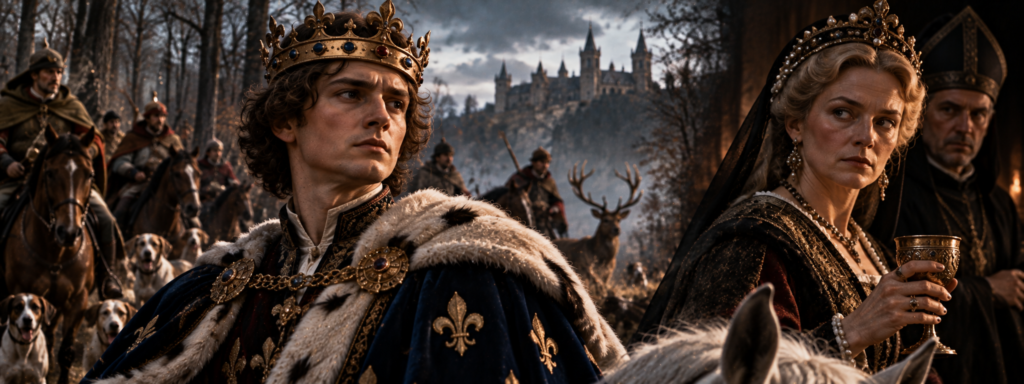
On May 21, 987, Louis died suddenly after what later accounts described as a hunting accident in the forest near Senlis. The details are frustratingly thin, and the surviving evidence does not permit a confident reconstruction of precisely what happened. He may have fallen from his horse, suffered an injury during the hunt, or died from complications connected with an accident. What matters beyond dispute is that the young king was alive one moment and dead soon afterward, leaving no son to inherit the throne.
The timing was extraordinary. Louis had been preparing proceedings against Archbishop Adalbero of Reims, one of the most politically influential churchmen in the kingdom and a figure closely connected with the Ottonian imperial world. The king’s mother, Queen Emma, had herself been accused during earlier political struggles of improper relations with Adalbero, accusations that were bound up with factional hostility and cannot simply be accepted as fact. Louis’s relationship with his mother had become entangled in the same poisonous network of accusations, alliances, dynastic rivalries, and suspicions.
It was therefore almost inevitable that a sudden royal death would inspire darker explanations. Later traditions and hostile political narratives suggested that Louis had been poisoned and that his own mother might have been involved. Emma’s connections to the Ottonian dynasty and her association with Adalbero provided material from which conspiracy could easily be constructed. A young king dying immediately before a confrontation with powerful enemies was precisely the kind of event medieval political culture rarely allowed to remain an accident.
Yet suspicion is not proof. There is no secure contemporary evidence demonstrating that Emma poisoned her son, nor is there convincing evidence that Adalbero, Hugh Capet, or agents of the Holy Roman Empire arranged Louis’s death. The hunting accident remains the traditional explanation, while murder belongs to the realm of allegation and unresolved possibility. The mystery survives because the evidence is too poor to close the case in either direction.
What followed is much clearer. Louis V died without an heir, and with him the direct Carolingian royal line in West Francia came to an abrupt end. His uncle Charles of Lower Lorraine survived and possessed Carolingian blood, but blood alone would no longer decide who wore the crown. Within weeks, the great magnates selected Hugh Capet as king.
A dynasty that traced its royal legitimacy back through centuries disappeared from the throne with astonishing speed. Louis’s death did not merely remove a twenty-year-old ruler. It opened the door through which the Capetians would enter French history and remain, through their direct and collateral branches, at the center of French monarchy for centuries. Whether Louis died because of a horse, an accident, an injury, illness, poison, or some combination lost to history, the consequences were immense.
The Last Heir of Charlemagne
To understand why Louis’s death mattered so much, it is necessary to understand the dynasty dying with him. Louis belonged to the Carolingians, the family that had produced Charlemagne and transformed the political landscape of western Europe. Charlemagne had been crowned emperor in Rome on Christmas Day in 800, and his empire stretched across much of what is now France, Germany, the Low Countries, northern Italy, and neighboring regions. By Louis V’s lifetime, that imperial structure had fragmented, but the Carolingian name retained enormous prestige.
West Francia, the kingdom from which medieval France gradually developed, had emerged from the divisions of the Carolingian Empire among Charlemagne’s descendants. Royal succession had become increasingly complicated as kings competed with powerful regional aristocrats and rival branches of the dynasty. The crown remained important, but the king did not rule a centralized nation-state resembling later France. His direct resources could be painfully limited.
The tenth century had already demonstrated how vulnerable Carolingian kingship had become. The Robertian family, ancestors of the Capetians, repeatedly challenged Carolingian dominance. Odo of Paris had become king in 888 after gaining fame defending Paris against Viking attack, while Robert I later became king in opposition to Charles the Simple. Robert’s son Hugh the Great never became king himself, but he became one of the most powerful men in West Francia.
The crown consequently moved through an unstable world in which hereditary principle competed with aristocratic election and political necessity. Carolingian descent remained immensely valuable, but it did not guarantee possession of the throne. Kings needed recognition from the great men of the realm. A royal bloodline without sufficient political support could be bypassed.
Louis was born into this dangerous inheritance around 966 or 967. His father, Lothair, had been king of West Francia since 954. His mother Emma was a daughter of Lothair II of Italy and Adelaide of Burgundy, making her closely connected with the Ottonian imperial dynasty through her mother’s later marriage to Emperor Otto I.
This meant that Louis’s family connections crossed the increasingly important political boundary between West Francia and the German-centered empire to the east. Those connections could provide diplomatic opportunities, but they also generated suspicion. When West Frankish and imperial interests collided, Queen Emma’s ancestry could be used against her. A queen with powerful relatives across the frontier could easily be portrayed as a foreign influence inside the royal household.
Louis therefore entered the world surrounded by both prestigious blood and dangerous relationships. He descended from Charlemagne through his father and belonged through his mother to a network reaching into Italy and the Ottonian Empire. His ancestry should have made him secure. Instead, it placed him at the center of competing dynastic systems.
Lothair and the Struggle for Lorraine
Louis’s father, King Lothair, spent much of his reign attempting to strengthen Carolingian authority in circumstances that rarely favored him. One of the central issues was Lotharingia, the contested region lying between West Francia and the eastern kingdom ruled by the Ottonians. The territory carried political, strategic, and dynastic importance. Carolingian rulers in the west had never entirely abandoned hopes of recovering influence there.
In 978, Lothair launched a dramatic campaign against Emperor Otto II. West Frankish forces advanced toward Aachen, one of the most symbolically important centers of Carolingian imperial memory. Otto and his family escaped capture, and Lothair’s forces withdrew. Otto retaliated by invading West Francia and advancing toward Paris.
The campaign ultimately failed to overthrow Lothair. Hugh Capet, son of Hugh the Great, played an important role in resisting the imperial invasion. This was one of the ironies of late Carolingian politics: the man whose family represented the greatest alternative to Carolingian kingship could also defend the Carolingian kingdom against an external enemy. Alliances were shaped by immediate political interests rather than simple dynastic camps.
The conflict with the Ottonians left deep scars. Lothair continued to pursue ambitions in Lotharingia, particularly after Otto II died in 983 and the imperial succession passed to the child Otto III. A regency struggle surrounding the young emperor created opportunities for ambitious neighbors. Lothair hoped to exploit them.
Queen Emma’s position became increasingly uncomfortable within this context. Her mother Adelaide was a central figure in the Ottonian imperial family and eventually served as one of the influential guardians of Otto III. Emma therefore stood between her husband’s political ambitions and her maternal relatives. Medieval politics often turned family connections into accusations of divided loyalty.
The tension would later matter enormously in stories surrounding Louis V. If Emma could be portrayed as sympathetic to the Ottonians against her husband’s ambitions, it required only another step to portray her as an enemy of her own son’s policies. Once that image existed, a sudden death could be interpreted as murder. The conspiracy theory did not arise from nothing, but neither did its political plausibility make it true.
A Boy Crowned Before His Father’s Death
Lothair understood that succession could not be taken for granted. Carolingian blood gave Louis a strong claim, but the history of West Francia had already shown that magnates could choose another family. One way to strengthen the succession was to have an heir crowned during the reigning king’s lifetime. This created an anointed king before the old ruler died and made a rival election more difficult.
Louis was crowned at Compiègne in June 979 while still a child. The ceremony made him junior king alongside his father. This practice had precedents in both Carolingian and other medieval dynasties, and it served an obvious purpose. Lothair wanted to ensure that the crown remained within his immediate family.
The coronation also meant that Louis carried royal status long before he exercised independent authority. He grew up not merely as a prince expecting someday to become king but as a consecrated ruler whose future had already been publicly declared. Yet his youth prevented him from dominating policy. Lothair remained the effective ruler.
The relationship between father and son is difficult to reconstruct intimately because the sources do not provide the personal detail modern readers might want. There is no reliable diary revealing Louis’s frustrations, ambitions, or fears. Later chroniclers viewed him largely through the political significance of his short reign. His personality remains one of the most elusive elements of the story.
That absence helped later generations attach a dismissive nickname to him. Louis V became known as Louis le Fainéant, commonly translated as “Louis the Do-Nothing” or “Louis the Lazy.” The label creates an image of an idle young king wasting his inheritance. It is profoundly misleading if treated as an objective description of his character.
Louis simply did not reign long enough to accomplish very much. His sole reign lasted only from March 986 until May 987, roughly fourteen months. Judging a twenty-year-old king as historically useless because he failed to transform his kingdom within little more than a year tells us more about later historiographical judgment than about Louis himself. Death, not laziness, prevented him from developing a substantial independent reign.
The Marriage That Became a Disaster
Long before Louis inherited the kingdom, his father attempted to use marriage to expand Carolingian influence. Around 982, the teenage Louis was married to Adelaide-Blanche of Anjou, a woman significantly older than he was. Adelaide belonged to a powerful aristocratic network and had already been married before. The union was designed around politics rather than romantic compatibility.
Through the marriage, Louis became associated with Aquitaine and was apparently crowned king in that southern context. Lothair hoped to extend Carolingian influence into regions where royal authority was weak. Marriage offered a way to build alliances without relying entirely upon military conquest. In theory, the arrangement could have strengthened Louis before he ever inherited his father’s main kingdom.
In practice, the marriage failed spectacularly. Louis and Adelaide were separated by a substantial age difference, different political interests, and a court environment in which the young prince apparently struggled to establish authority. The surviving narratives are not detailed enough to reconstruct every stage confidently. What is clear is that the relationship did not endure.
Adelaide eventually left Louis, and the marriage effectively collapsed. Later accounts portray the couple as fundamentally incompatible. Some descriptions emphasize Louis’s youth and immaturity, while others suggest that political circumstances made the arrangement unworkable from the beginning. There is no need to invent a dramatic personal hatred where the sources provide only the evidence of failure.
The episode nevertheless damaged the image of the young Carolingian prince. He had been sent south with expectations of extending royal influence and returned without having secured either the marriage or the political position intended for him. For a dynasty already struggling to convert prestige into practical authority, the failure mattered. Louis’s first major political experiment had ended badly.
The marriage also produced no heir. That fact would become enormously important in 987. Had Louis fathered a legitimate son, the succession following his death might have unfolded very differently. Instead, the Carolingian crown would be left without a direct descendant of the dead king.
Queen Emma and the Archbishop of Reims
The most dangerous scandal surrounding Louis’s family involved his mother Emma and Archbishop Adalbero of Laon, who must be distinguished from the more famous Archbishop Adalbero of Reims. During Lothair’s reign, accusations arose that Emma had committed adultery with Adalbero of Laon. The charge was politically explosive because adultery by a queen could threaten dynastic legitimacy as well as personal reputation. Emma and the bishop were subjected to proceedings but were cleared.
The accusation should not be repeated as established fact. Medieval political struggles frequently generated sexual allegations against powerful women, especially queens whose foreign connections or political influence made them controversial. Accusing a queen of adultery could undermine her authority, isolate her from her husband, and cast suspicion upon the legitimacy of royal children. The usefulness of such accusations requires historians to approach them cautiously.
Emma nevertheless remained politically entangled with churchmen who favored accommodation with the Ottonian Empire. Archbishop Adalbero of Reims was especially important in this wider network. Reims was not simply another bishopric; its archbishop possessed enormous ecclesiastical and political influence, and the church had a central role in legitimizing kingship. An archbishop who turned against a king could become a formidable opponent.
Adalbero of Reims was closely associated with the intellectual and political circle of Gerbert of Aurillac, the brilliant scholar who would eventually become Pope Sylvester II. Both men operated within a political world in which the Ottonian imperial dynasty represented a major source of order and patronage. Their sympathies did not always align with Lothair’s aggressive policy toward Lotharingia. This created a potentially treasonous appearance from the Carolingian perspective.
Lothair increasingly suspected Adalbero of working against him. The king’s attempts to expand eastward collided with an ecclesiastical faction that favored the Ottonian connection. Queen Emma’s own imperial family ties made her position especially vulnerable to suspicion. The political dispute could therefore be recast as a family betrayal.
Louis would inherit this poisonous situation. When his father died, the young king did not inherit merely a crown. He inherited accusations of treason involving one of the most powerful churchmen in the kingdom and suspicions surrounding his own mother. Within fourteen months, he would be dead.
The Sudden Death of King Lothair
King Lothair died on March 2, 986. His death left Louis as sole king of West Francia. Because Louis had already been crowned years earlier, there was no serious uncertainty about his immediate succession. The precaution Lothair had taken in 979 worked exactly as intended.
Yet the young king inherited unresolved political conflict. Lothair had been preparing to act against Archbishop Adalbero of Reims, whom he suspected of treasonous dealings with the Ottonian court. Louis continued the confrontation rather than abandoning it. This alone complicates the later image of him as a passive “Do-Nothing.”
Louis appears to have been determined to pursue Adalbero. The archbishop’s political position was dangerous because ecclesiastical authority, aristocratic alliances, and international connections converged around him. Bringing him to judgment could strengthen Carolingian royal authority. It could also provoke powerful opposition.
Queen Emma’s relationship with her son appears to have deteriorated in this environment. Sources suggest that she favored reconciliation with Adalbero and the Ottonian sphere, while Louis followed the more confrontational policy inherited from his father. The extent of their personal estrangement is difficult to determine. Political disagreement, however, is clear enough to explain why later suspicion fell upon her.
Louis was young, but he was no longer a child being crowned beside his father. He now possessed independent royal authority and had inherited his father’s enemies. His decisions during this brief period suggest that he intended to act. The tragedy is that history gave him almost no time to show what kind of king he might become.
His reign therefore moved quickly toward confrontation. Adalbero was summoned to answer charges. A political reckoning appeared imminent. Then the king went hunting.
The Trial That Never Happened
Louis summoned an assembly at Compiègne in May 987 to consider the accusations against Archbishop Adalbero of Reims. The proceedings were potentially momentous. If the archbishop were convicted of treason, Louis could weaken one of the strongest pro-Ottonian figures in West Francia. The case might also strengthen the king’s authority over an aristocracy accustomed to royal weakness.
Hugh Capet occupied an ambiguous position in this confrontation. He was the most powerful prince in the kingdom and had his own complicated relationships with Adalbero and the Ottonian world. His family had alternated between supporting and rivaling the Carolingians for generations. Whatever Louis decided about the archbishop could affect Hugh’s own political future.
The assembly did not produce the decisive condemnation Louis may have wanted. Political maneuvering delayed or complicated the proceedings. Medieval rulers could summon assemblies, but powerful bishops and princes were not easily destroyed simply because a king accused them. Royal authority depended upon cooperation from the very elites whose independence could frustrate it.
Louis remained determined enough that the dispute had not disappeared when he left the immediate political gathering. This is one reason his death has always appeared suspicious to those searching for conspiracy. He died while a major political conflict remained unresolved. The man facing royal prosecution would soon become one of the central figures in selecting Louis’s successor.
That sequence deserves attention, but it must not be mistaken for proof. People frequently die at politically convenient moments without having been murdered. Medieval hunting was genuinely dangerous, medical care was limited, and sudden death among young adults was hardly unknown. Historical suspicion begins with motive and opportunity, but a murder case requires more.
Louis’s death removed the prosecution immediately. Adalbero survived and soon played an important role in the political transition that placed Hugh Capet on the throne. This created an almost irresistible narrative: the king threatened the archbishop, the king died, and the archbishop helped choose the next king. The sequence is real; the conclusion that Adalbero arranged the death is not established.
The Fatal Hunt
The traditional account places Louis’s fatal accident during a hunt near Senlis, often associated with the forest of Halatte. Hunting was a central aristocratic activity, combining recreation, martial training, display, and elite sociability. It was also dangerous. Horses could stumble, riders could be thrown, animals could attack, weapons could cause accidents, and injuries that would be survivable today could become fatal.
Louis reportedly suffered an accident while hunting and died on May 21, 987. Some later accounts describe a fall from his horse. The surviving sources are not detailed enough to establish a precise medical reconstruction, and modern retellings sometimes supply certainty that the medieval evidence does not justify. We do not know exactly what injury killed him.
He was only around twenty years old. The abruptness of the death intensified its political impact because there had been no long illness allowing factions to prepare openly for succession. One day the Carolingian king was pursuing his enemies; almost immediately afterward, the kingdom had no direct Carolingian heir. Sudden death is fertile ground for conspiracy precisely because it denies contemporaries the psychological preparation that prolonged illness provides.
The hunt itself also provided an ideal setting for suspicion. A royal hunting party involved movement through forests, scattered attendants, weapons, horses, and moments when the king might be separated from large numbers of witnesses. If someone wished to disguise murder as accident, a hunt offered obvious possibilities. That observation establishes plausibility, not evidence.
There is no reliable surviving testimony identifying a person who pushed Louis from his horse, sabotaged his equipment, deliberately caused an accident, or attacked him during the hunt. Nor is there a trustworthy medical description proving poison. The basic historical fact remains frustratingly simple: Louis suffered a fatal event connected with hunting and died. Everything beyond that requires degrees of caution.
Yet almost immediately, politics transformed the death. The question was no longer merely how Louis had died. It was who would benefit from a world in which he no longer existed. The list of beneficiaries was formidable.
Did Queen Emma Poison Her Son?
The darkest accusation places Louis’s own mother at the center of the mystery. Emma had imperial family connections, political disagreements with the Carolingian faction surrounding her son, and associations with churchmen whom Louis regarded with suspicion. Later traditions claimed that she poisoned him. Few accusations could be more shocking than a queen murdering her only royal son.
The first problem is evidentiary. There is no solid contemporary proof that Emma administered poison to Louis. The sources closest to the events do not provide the kind of detailed accusation, witness testimony, physical symptoms, confession, or investigative record necessary to establish matricide. The poisoning story belongs to a tradition shaped by political hostility and later interpretation.
The second problem is motive. Emma may have disagreed with her son’s policies, but killing him would also destroy her own position as queen mother of a reigning Carolingian king. Louis was the source of much of her political status in West Francia after Lothair’s death. His removal created enormous uncertainty and ultimately placed a different dynasty on the throne.
It is possible to construct a more complicated motive involving Emma’s loyalty to the Ottonian dynasty. If Louis intended to continue his father’s aggressive eastern policy and prosecute Ottonian allies such as Adalbero, perhaps his removal benefited her imperial relatives. This is the foundation upon which the larger conspiracy theory rests. Yet constructing a coherent motive after the fact is not the same as proving a plot existed.
Medieval queens were especially vulnerable to allegations of poisoning. Poison was imagined as a secretive weapon suited to court intrigue, domestic access, and hidden betrayal. Women who lacked conventional military power could easily be accused of using food, drink, medicine, or household access to accomplish what men did with swords. Such stories often reveal contemporary anxieties about female influence as much as actual criminal behavior.
Emma should therefore not be transformed into a proven murderer simply because her son’s death was politically convenient for some of her associates. The accusation is historically significant because it circulated and because it reveals the depth of mistrust surrounding the Carolingian court. It remains an accusation. Louis’s mother belongs among the suspects of legend and political rumor, not among convicted regicides.
Poison, Accident, or Political Storytelling?
Poisoning stories flourished in medieval chronicles because sudden death demanded explanation. A ruler who died unexpectedly could rarely be allowed the ordinary anonymity of disease or accident. Powerful people were assumed to have powerful enemies. When succession changed dramatically after a death, contemporaries and later writers naturally searched for intentional causes.
Diagnosing poison centuries later is usually impossible without unusually detailed evidence or physical remains suitable for modern analysis. Medieval descriptions of poisoning can overlap with symptoms produced by infection, internal injury, gastrointestinal disease, stroke, or countless other conditions. In Louis’s case, even this limited diagnostic material is largely absent. There is no reliable symptom sequence from which a particular toxin can responsibly be inferred.
The hunting accident has the advantage of being the traditional straightforward explanation and fitting an activity known to be dangerous. It does not require a secret conspiracy for which evidence has vanished. Yet historians should not turn the absence of evidence for murder into absolute proof of accident either. The surviving record is simply too sparse.
One possibility is that Louis was injured during the hunt and died from trauma or internal bleeding. A fall from a horse can produce severe head, spinal, abdominal, or thoracic injuries without leaving an immediately obvious external wound. In a world without modern imaging, transfusions, antiseptic surgery, or intensive care, such injuries could become rapidly fatal. A young and otherwise healthy king was not protected from mechanical catastrophe.
Another possibility is that the hunting story itself simplified a more complicated illness or death. Medieval chronicles often compressed events. Later retellings could then harden a vague report into a precise scene. We should therefore resist describing the fatal moment with cinematic certainty.
The responsible conclusion is uncomfortable because mystery invites certainty. Louis V died suddenly in circumstances associated with hunting, and murder accusations later attached themselves to the event. Poisoning is possible in the abstract, but it is not demonstrated. The historical mystery survives precisely because neither accusation nor accident can be reconstructed in forensic detail.
The Holy Roman Empire in the Shadows
The suggestion that Louis’s death involved a wider imperial conspiracy arises from the tangled relationship between the Carolingians and Ottonians. Queen Emma was closely connected to the imperial family. Archbishop Adalbero of Reims and Gerbert of Aurillac maintained important connections within the Ottonian political sphere. Louis and his father had pursued policies that threatened imperial interests in Lotharingia.
By 987, Otto III was still a child. His mother Theophanu and grandmother Adelaide had played major roles in governing the empire during his minority. Adelaide was Emma’s mother, making the West Frankish queen the young emperor’s aunt. The dynastic connection was direct and politically significant.
A strong Carolingian monarchy committed to expansion into Lotharingia could pose problems for the Ottonian regime. A weaker or friendlier ruler in West Francia might therefore appear advantageous. Hugh Capet, whose political relationships with Adalbero and the imperial sphere were less confrontational, could be seen as a more acceptable neighbor. From this perspective, Louis’s death undeniably changed the geopolitical balance.
But again, benefit is not evidence of murder. States and dynasties benefit constantly from the natural deaths of rivals. There is no surviving document from the Ottonian court ordering Louis’s assassination, no confession from an agent, and no trustworthy account identifying imperial involvement. The conspiracy remains hypothetical.
Indeed, the politics surrounding Louis’s death were sufficiently complex that no single faction controlled every consequence. Hugh Capet’s accession created a new dynasty whose descendants would eventually build a powerful French monarchy capable of challenging emperors repeatedly. If Ottonian strategists had somehow engineered the transition, the long-term outcome would have been profoundly ironic. The Capetian state ultimately became far more formidable than the late Carolingian monarchy they supposedly removed.
Historical conspiracies often appear more coherent in retrospect than politics actually was. Louis’s death benefited Hugh immediately, relieved Adalbero from royal danger, and removed a potentially hostile king from the Ottonians’ western frontier. Those facts make suspicion understandable. They do not transform suspicion into a solved assassination.
The Man Who Benefited Most
No one benefited more visibly from Louis’s death than Hugh Capet. He was Duke of the Franks, one of the most powerful magnates in West Francia, and heir to a family that had already produced kings. His father Hugh the Great had dominated politics without taking the crown. By 987, the younger Hugh stood within reach of what his family had pursued for generations.
This makes Hugh an obvious figure in any conspiracy theory. Yet there is no reliable evidence that he arranged Louis’s death. Political benefit after an unexpected death is not proof of participation in it. Hugh did not need to murder Louis to possess a plausible path toward eventual kingship.
Louis’s lack of a son created the decisive opportunity. The obvious Carolingian alternative was his paternal uncle Charles, Duke of Lower Lorraine. Charles was a son of King Louis IV and therefore belonged unmistakably to the Carolingian royal house. If succession had followed strict hereditary logic, his claim was formidable.
But tenth-century West Frankish kingship was not governed by an automatic law of primogeniture. Magnates and bishops expected to participate in the choice of a king. Political suitability mattered alongside blood. This allowed Hugh’s supporters to argue that Charles should be rejected.
Archbishop Adalbero of Reims became crucial. At the assembly that considered the succession, he advocated Hugh’s election and challenged the idea that royal blood alone should determine kingship. The argument was politically convenient and constitutionally transformative. A man whom Louis had been preparing to prosecute helped determine who inherited the dead king’s crown.
This sequence has naturally fueled suspicion for centuries. Adalbero escaped danger, Charles was bypassed, and Hugh became king. Yet the transition can be explained through known political interests without requiring Louis’s murder. The aftermath tells us who exploited the king’s death, not necessarily who caused it.
Charles of Lower Lorraine: The Carolingian Who Was Passed Over
Louis’s uncle Charles was the most obvious surviving Carolingian claimant. He was the younger brother of the late King Lothair and therefore a grandson of Charles the Simple. In dynastic terms, he stood close to the throne. Yet his political career had alienated important West Frankish elites.
Charles had become Duke of Lower Lorraine under the Ottonians. This connection allowed his enemies to portray him as compromised by service to a foreign ruler. In the emerging political language of West Francia, dependence upon the German king or emperor could be used against a candidate for the western crown. Ironically, the same imperial world connected to Queen Emma and Adalbero could be invoked to disqualify Charles.
His personal choices also provided ammunition. Adalbero’s famous argument against him emphasized that Charles had not behaved with the dignity expected of a king and had married a woman considered beneath his rank. Such claims reveal how aristocratic prejudice and political convenience could shape royal succession. Blood mattered, but elites could always discover reasons why an inconvenient prince was unsuitable.
Hugh Capet offered advantages Charles did not. He possessed enormous territorial and aristocratic power within West Francia. His family had repeatedly defended the realm and participated in royal politics. Most importantly, enough of the leading men believed they could work with him.
The decision to choose Hugh was not necessarily understood by contemporaries as the dramatic founding of a dynasty that would rule for centuries. He was elected because he was the strongest viable candidate in a particular political crisis. The future permanence of the Capetians was not yet visible. In 987, Hugh’s crown could have proved as temporary as those held by earlier Robertian kings.
Charles did not accept the outcome quietly. He continued to press his claim and eventually seized Laon. The struggle between Carolingian and Capetian legitimacy continued after Hugh’s coronation. Louis’s death had opened the succession, but it had not instantly eliminated Carolingian resistance.
Adalbero Chooses a King
The role of Archbishop Adalbero of Reims in Hugh Capet’s election is one of the most striking elements of the entire story. Only weeks earlier, Louis had been moving against him on accusations of treason. Now the king was dead, and Adalbero possessed enormous influence over the succession. Few reversals could have been more dramatic.
At the electoral assembly, traditionally associated with Senlis, Adalbero argued in favor of Hugh. Accounts of his speech survive through sources shaped by the politics of the period, particularly the writings associated with Richer of Reims. The core argument was that kingship should not belong automatically to the nearest hereditary claimant if that claimant lacked the qualities or political standing required for rule. Hugh was presented as the superior choice.
This argument should not be mistaken for modern democratic constitutionalism. The electorate consisted of a narrow aristocratic and ecclesiastical elite. Ordinary inhabitants of West Francia were not choosing their king. The principle at stake concerned aristocratic selection among elite candidates rather than popular sovereignty.
Nevertheless, the decision was momentous. Hugh Capet was elected and crowned at Noyon on July 3, 987. Less than two months had passed since Louis’s death. The speed of the transition helped prevent a prolonged vacuum.
Adalbero’s involvement is one reason conspiracy theories remain seductive. The archbishop moved from threatened defendant to kingmaker with extraordinary speed. If Louis had lived, Adalbero might have faced condemnation; after Louis died, Adalbero helped create a new monarchy. Motive and benefit appear almost too neatly aligned.
Yet history often produces such reversals without murder. Adalbero’s political skill allowed him to exploit a crisis he may not have created. Unless stronger evidence emerges, that distinction must remain. He was unquestionably a beneficiary and political architect of the aftermath, but not a proven assassin.
Hugh Capet Takes the Crown
Hugh Capet’s coronation marked the beginning of one of the most consequential dynastic transitions in European history. The direct Carolingian line had ruled West Francia intermittently and then continuously for generations. Now the crown passed to the Robertian family, soon known to history as the Capetians. At the time, however, the permanence of this change was anything but guaranteed.
Hugh controlled important territories around Paris and Orléans, but many great princes possessed enormous independence. The dukes of Normandy and Aquitaine, counts of Flanders, Anjou, Blois, and other lords could exercise power that dwarfed royal authority within their own regions. The king’s direct domain was limited. Hugh inherited a prestigious title more readily than centralized control.
He quickly adopted the same succession strategy used by the Carolingians. Hugh had his son Robert crowned during his own lifetime. The decision reduced the opportunity for magnates to choose a rival after Hugh’s death. What had helped Louis V inherit from Lothair now helped the Capetians establish themselves.
This practice proved enormously successful. Generation after generation, the early Capetians managed to produce sons and associate heirs with the crown. The monarchy gradually became hereditary in practice even while the theoretical memory of election persisted. What began as a politically contingent choice hardened into dynasty.
The irony is difficult to miss. Louis’s father had crowned him early precisely to protect Carolingian hereditary continuity. Louis died childless before he could do the same for a son. Hugh then adopted the technique and used it to prevent the Carolingians from returning.
A hunting accident therefore stands at the hinge between two dynastic worlds. If Louis had lived long enough to father and crown a son, Hugh Capet’s opportunity might never have arrived. Instead, the technique designed to preserve Carolingian monarchy became one of the mechanisms by which the Capetians secured its replacement.
Was Louis Really “the Do-Nothing”?
The nickname attached to Louis V has done enormous damage to his historical reputation. Le Fainéant suggests laziness, uselessness, or passive incompetence. It places him alongside the stereotype of the later Merovingian rois fainéants, kings supposedly dominated by powerful mayors of the palace. Yet Louis’s short life provides little basis for such a sweeping judgment.
His independent reign lasted approximately fourteen months. During that time, he inherited a difficult international situation, conflict with major churchmen, tension within his family, and a monarchy whose practical resources were already limited. He pursued action against Adalbero rather than simply surrendering authority. His reign ended before any longer program could emerge.
Even the failed southern marriage belongs primarily to his adolescence. Louis was placed into a political arrangement devised by older rulers. Its collapse cannot fairly summarize his entire capacity as a king. Medieval princes were frequently used as pieces in marriage strategies they had little power to design.
The nickname appears to reflect later judgment based largely upon the absence of major achievements. But absence of achievement can have many causes. A ruler who reigns for decades and does nothing invites one kind of judgment; a ruler who dies at twenty after barely a year of independent kingship presents another. Louis belongs firmly in the second category.
Calling him the “Do-Nothing” also obscures the political intensity of his final months. He was preparing to bring one of the most important archbishops in the kingdom to judgment. His relations with his mother were strained by major dynastic issues. The kingdom stood at the intersection of Carolingian, Capetian, and Ottonian ambitions.
Louis may ultimately have failed as a ruler had he lived. He might have lost wars, alienated magnates, or proved incapable of restoring Carolingian power. We simply do not know. Death turned potential history into speculation and then allowed a mocking nickname to fill the empty space.
A Twenty-Year-Old Surrounded by Older Players
One of the most striking features of Louis’s final year is how young he was compared with the political figures surrounding him. Queen Emma had decades of dynastic experience and powerful family connections. Hugh Capet had spent years navigating the treacherous politics of West Francia. Archbishop Adalbero operated within sophisticated ecclesiastical and imperial networks.
Louis inherited their conflicts at an age when modern societies would barely consider someone fully established in adult life. Medieval rulers could exercise authority young, but youth still mattered. Experience in court politics, patronage, military command, and negotiation accumulated over time. Louis had been denied much of that time.
His father’s death forced him abruptly from junior kingship into independent responsibility. He could no longer rely upon Lothair to define policy. Every inherited enemy now became his enemy, and every disagreement within the royal family became his problem. The crown accelerated adulthood.
This context may help explain his determination to proceed against Adalbero. A young king inheriting a weakened monarchy could not afford to appear incapable of punishing treason. Royal authority depended partly upon performance. Failure to act against a suspected disloyal archbishop might advertise weakness to every magnate in the kingdom.
At the same time, acting aggressively carried risks. Adalbero possessed allies Louis could not easily ignore. Hugh Capet was powerful enough that alienating him could be disastrous. The Ottonian connection gave the dispute an international dimension.
Louis therefore faced a problem with no safe solution. Compromise could look weak, while prosecution could unite powerful enemies against him. Before history could reveal which path he would choose successfully, the hunt ended the question.
Could Louis Have Saved the Carolingian Dynasty?
Counterfactual history must be handled cautiously, but Louis’s death invites the question almost irresistibly. If he had survived the hunt, could the Carolingians have remained kings of West Francia? The answer is that survival was possible but by no means guaranteed. The dynasty was weakened, yet it was not already doomed beyond recovery.
Louis had the enormous advantage of legitimate royal consecration and Carolingian ancestry. His family still possessed prestige that Hugh Capet could not simply erase. If Louis had fathered a son and arranged an early coronation, hereditary continuity might have been strengthened for another generation. Time itself could have worked in his favor.
He would still have faced formidable structural problems. Royal lands were limited, great princes exercised substantial autonomy, and the monarchy depended heavily upon ecclesiastical cooperation. Hugh Capet’s family remained powerful. Conflict over Lotharingia could also continue draining resources.
A successful Louis might have reconciled with some rivals while isolating others. He might have brought Adalbero under control, reached accommodation with the Ottonians, and strengthened royal authority gradually. Alternatively, an aggressive policy could have provoked rebellion and accelerated his downfall. Both possibilities are plausible.
What cannot responsibly be said is that Hugh Capet’s accession was inevitable before May 987. Historical outcomes often appear inevitable only after they occur. Louis’s death removed the one person whose survival most directly obstructed Hugh’s path. That was contingency of the highest order.
The Capetian dynasty eventually became so central to French history that Louis can appear merely as the weak final figure before an unavoidable transition. That perspective reads the future backward. In the forest near Senlis, the future of France had not yet been decided. A twenty-year-old king’s survival could still have altered it.
The Carolingian Uncle Fights Back
Charles of Lower Lorraine refused to disappear simply because Hugh had been crowned. He possessed the bloodline Hugh lacked and could appeal to supporters who regarded Carolingian legitimacy as superior. The resulting struggle demonstrated that the dynastic transition of 987 was contested. Hugh’s election did not magically erase centuries of royal tradition.
Charles eventually captured Laon, one of the most important Carolingian centers, and established a serious challenge to Hugh. He also gained control of Reims for a period through the actions of Archbishop Arnulf, an illegitimate son of King Lothair and therefore another member of the Carolingian family. The conflict became tangled in betrayal, ecclesiastical politics, and competing claims of loyalty. The new dynasty remained vulnerable.
Hugh eventually prevailed not through a spectacular battlefield annihilation but through political maneuvering. Charles was betrayed and captured in 991 by Adalbero, bishop of Laon, a different churchman from the late archbishop of Reims. He was imprisoned and died in captivity. The principal adult Carolingian challenger was thereby removed.
The fate of Charles reinforces how misleading it is to say simply that Louis’s death “ended the Carolingians.” It ended the direct succession of reigning Carolingian kings in West Francia, but members of the family survived and resisted. The dynasty had to be politically defeated after Louis was buried. Hugh’s crown was won in stages.
Nevertheless, Louis’s death created the opening without which this struggle might never have occurred. Charles could challenge Hugh because Louis left no son. Hugh could be elected because the throne became vacant under uncertain hereditary circumstances. Every subsequent event rested upon that sudden absence.
The mysterious hunt therefore remained the decisive turning point even after the political struggle continued. Louis did not live long enough to fight Hugh himself. His uncle inherited the dynastic battle and lost it. The Carolingian monarchy disappeared not in one dramatic execution but through a sequence beginning with an unexplained young death.
A Dynasty Ends Without a Battlefield
There is something strangely quiet about the end of Carolingian kingship in West Francia. Dynasties often fall amid invasions, palace coups, public executions, massacres, or decisive battles. Louis V did not die defending a fortress or fighting a usurper. He went hunting and never returned alive.
That quietness may partly explain why poisoning stories became attractive. An event of enormous historical consequence seemed to demand an equally enormous cause. Could the dynasty of Charlemagne really lose the throne because a young man fell from a horse or suffered an accident in the woods? Conspiracy offers a scale of explanation equal to the scale of the consequences.
History does not always provide that symmetry. A minor physical event can produce enormous political change if institutions are already fragile. A horse stumbling at the wrong moment can matter more than an army. An infection can redirect a dynasty as decisively as a battle.
Louis’s monarchy was precisely such a fragile system. He had no legitimate child. His uncle was politically controversial. Hugh Capet was powerful and available. Adalbero possessed both motive to oppose the Carolingians and influence over the succession.
The king’s death therefore acted like a spark falling into prepared material. It did not create every political condition that followed. Those conditions had accumulated over generations. His death merely removed the final barrier preventing them from igniting.
Whether that spark was accidental or deliberately struck remains unknown. The political fire it produced is not mysterious at all. Within weeks, France had a new royal house.
Emma After Her Son’s Death
Queen Emma’s later life does not provide the dramatic confession conspiracy enthusiasts might hope to find. She did not emerge publicly admitting that she had removed her son for the benefit of the Ottonians. Nor did contemporaries produce conclusive evidence establishing her guilt. The accusation remained part of the murky political atmosphere surrounding the dynasty’s collapse.
Her position after Louis’s death was fundamentally altered. As mother of the reigning king, she could have expected continuing influence if Louis survived and their relationship recovered. Once Hugh Capet took the crown, she belonged to the displaced dynasty. This complicates the idea that she obviously benefited from Louis’s murder.
One could still imagine ideological or family motives outweighing her personal position. Her connections with the imperial dynasty might theoretically have mattered more to her than preserving her son’s policies. But this is speculation built upon speculation. Historians cannot responsibly transform possibility into biography.
The accusation against Emma also fits a long tradition in which politically active queens became convenient explanations for male political failure or unexpected death. Women at court possessed access that outsiders lacked, making poison an especially common accusation. Foreign-born queens were doubly vulnerable because political opponents could portray them as agents of another power.
Emma was both politically connected and foreign-associated enough to fit the stereotype perfectly. She was an Italian-born queen with close Ottonian family ties, involved in disputes surrounding powerful bishops, and estranged politically from her son. When Louis died unexpectedly, she became an almost inevitable suspect. Historical inevitability of suspicion, however, is not historical proof of guilt.
Her reputation deserves the same caution granted to Louis. Neither should be reduced to a nickname or accusation created by later political storytelling. Louis was more than “the Do-Nothing,” and Emma was more than the mother accused of poisoning him. The surviving evidence leaves both figures partially hidden.
The Capetian Future Nobody Could Yet See
Hugh Capet’s accession would eventually appear to be one of the great turning points in French history. His descendants ruled France in the direct male line until 1328. Collateral Capetian branches—the Valois and Bourbons—continued the dynasty’s broader lineage for centuries afterward. Even the kings executed or overthrown during later revolutions belonged to the dynastic world that began with Hugh’s election.
None of this was obvious in 987. Hugh was a powerful duke who had secured a crown under uncertain circumstances. His direct authority remained limited. Regional princes could behave with near-independence.
The early Capetians succeeded partly through patience. They concentrated upon securing their own domain, building alliances with the church, arranging marriages, and ensuring succession. They did not instantly create the centralized French monarchy familiar from later centuries. Their achievement accumulated generation by generation.
Louis V’s death therefore did not instantly create France as a Capetian state. It created an opportunity. Hugh and his descendants converted that opportunity into dynastic permanence. The distinction matters because it preserves the contingency of the original event.
Had Hugh failed to secure his son’s succession, 987 might have become merely another temporary Robertian interruption in Carolingian rule. Had Charles captured Hugh and won sufficient aristocratic support, the Carolingians might have returned. Had Louis survived, the election might never have occurred. History remained open long after the hunting accident.
What makes Louis’s death extraordinary is not that it mechanically caused everything that followed. It changed who possessed the opportunity to shape what followed. The king’s absence rearranged the political board. Hugh Capet proved best able to exploit the new position.
Murder Without Evidence, Mystery Without Resolution
For an Assassinated Rulers & Regicides collection, Louis V occupies an unusual but valuable place. Unlike Henry IV, Julius Caesar, or Sadi Carnot, he cannot be confidently described as an assassination victim. No known murderer can be placed beside him. No weapon survives in the narrative with certainty.
His inclusion rests upon the longstanding allegation that his sudden death concealed political murder. The rumor itself belongs to the history of royal death because contemporaries and later writers understood how politically convenient his disappearance was. The possibility cannot be eliminated entirely. The evidence, however, does not permit a verdict of assassination.
This distinction makes Louis more interesting rather than less. Historical murder mysteries reveal how political communities interpret unexplained death. Suspicion follows motive, and motive follows power. The more important the victim, the less likely observers are to accept chance.
Emma becomes suspicious because she had political disagreements with her son and imperial connections. Adalbero becomes suspicious because Louis threatened him and his fortunes improved immediately afterward. Hugh becomes suspicious because he received the crown. The Ottonians become suspicious because Louis represented a potentially hostile Carolingian policy.
Every suspect can be given a motive. What is missing is the bridge between motive and act. There is no trustworthy witness to poison, no assassin’s confession, no order to kill, no securely documented murder weapon, and no forensic evidence. The case is built almost entirely backward from consequences.
That is precisely how bad historical certainty is created. A dramatic outcome encourages historians and storytellers to invent an equally dramatic cause. Responsible history must resist the temptation. Sometimes the correct conclusion is that a suspicious death remains suspicious.
The Hunt That Changed France
If Louis truly died from a hunting accident, his death demonstrates the extraordinary power of chance in political history. Medieval hunting placed rulers in physical danger as a normal part of aristocratic life. Horses were powerful animals, terrain could be difficult, and medical treatment for severe trauma was primitive by modern standards. A routine royal pastime could become a dynastic catastrophe in seconds.
Other rulers died or nearly died through accidents that seem almost absurdly mundane compared with their political importance. William the Conqueror’s son William Rufus died from an arrow during a hunt in 1100, another royal death surrounded by lasting suspicion. Emperor Frederick Barbarossa drowned during the Third Crusade. Alexander III of Scotland died after falling from his horse in 1286, creating a succession crisis that eventually contributed to war.
Louis belongs to this unsettling category of rulers whose bodies became points of structural vulnerability. Medieval monarchy could surround kings with sacred ceremony, magnificent titles, aristocratic loyalty, and elaborate theories of legitimacy. None of it protected a rider from gravity. The entire political system ultimately depended upon a mortal body.
This vulnerability explains the obsession with producing heirs. Dynasties understood that kings could die suddenly. A son transformed personal mortality into institutional continuity. Louis had no such protection.
His failed marriage therefore acquires significance far beyond personal unhappiness. The absence of a child converted an accident into a dynastic ending. Had a five-year-old son survived him, magnates might have faced the familiar problem of a royal minority rather than an open election. Hugh Capet’s path would have been much narrower.
The forest did not merely take a king. It exposed every unresolved weakness surrounding his dynasty. That is why the consequences traveled far beyond the place where Louis fell.
The Last Carolingian King
Calling Louis V the “last Carolingian king of France” requires a small historical qualification. The term “France” is convenient for modern readers, but Louis ruled West Francia during a period when the medieval French kingdom was still developing. His royal title and political world were not identical to those of later Capetian kings who would rule a more recognizable Kingdom of France. Nevertheless, he was the final Carolingian to reign over the western kingdom from which France emerged.
He was not the last living Carolingian prince. Charles of Lower Lorraine survived him, as did other members of the broader family. The dynasty did not biologically disappear in 987. What ended was its possession of the West Frankish crown.
That distinction matters because dynasties can survive after losing power. Charles’s resistance proved that Carolingian legitimacy retained political force. Hugh Capet’s supporters needed arguments explaining why blood alone did not entitle Charles to kingship. If Carolingian identity had already become meaningless, such arguments would have been unnecessary.
Louis’s death therefore marks the end of a ruling tradition rather than the extinction of a family. Charlemagne’s descendants had once claimed imperial authority across much of western Europe. By 987, one branch was fighting merely to retain a weakened western crown. The scale of the decline is extraordinary.
Yet dynastic decline should not be confused with historical irrelevance. Carolingian political traditions, religious institutions, aristocratic families, and cultural legacies survived the dynasty’s loss of kingship. Hugh Capet did not build a new kingdom from nothing. He inherited and adapted structures shaped by the rulers he replaced.
Louis stands at the boundary between these worlds. He was the last king behind one door and the reason another door suddenly opened. His short reign makes him easy to overlook, but his death makes him impossible to dismiss.
Why Louis V Belongs Among the Great Disputed Royal Deaths
Louis’s case lacks the visceral certainty of a public execution or witnessed assassination. There is no scaffold, no crowd watching an axe fall, no named fanatic seized beside the body. Instead, there is a young king, a hunt, a sudden death, and a political transformation. The silence surrounding the fatal moment is precisely what gives the story its darkness.
He belongs beside other disputed royal deaths because the accusation of murder cannot be separated from the political circumstances. Louis had enemies with obvious reasons to welcome his disappearance. He was pursuing a powerful archbishop. His relationship with his mother had become politically strained, and she possessed connections to the imperial world his policies threatened.
At the same time, the case is an important warning against turning suspicion into fact. Every ingredient of conspiracy can exist without conspiracy actually occurring. Motive, opportunity, benefit, and suspicious timing are meaningful, but they are not enough by themselves. Medieval history contains many murders, but it also contains accidents.
Louis’s story becomes most compelling when the uncertainty is preserved. If Emma definitely poisoned him, the case becomes a straightforward matricide. If he definitely fell accidentally, it becomes a straightforward dynastic catastrophe. Because neither conclusion can be proved absolutely, the reader remains trapped in the same uncertainty that surrounded royal politics itself.
The mystery also demonstrates how historical reputation is created. Louis became “the Do-Nothing,” Emma became a suspected poisoner, Adalbero became the kingmaker who escaped prosecution, and Hugh became the founder of a dynasty. These identities simplify lives that were much more complicated. The historian’s job is to recover the complexity beneath the labels.
In that sense, Louis’s death is not merely an unsolved medieval mystery. It is a lesson in how power produces stories. When a throne becomes vacant, explanations for the vacancy can become weapons in the struggle over who deserves to occupy it next.
The Death That Ended Charlemagne’s Dynasty
Louis V entered history carrying a name heavier than almost any twenty-year-old could bear. Behind him stood Charlemagne, Louis the Pious, Charles the Bald, and generations of Carolingian kings whose family had once dominated western Europe. Around him stood princes and bishops whose practical power exposed how far that inheritance had declined. Ahead of him, had he survived, lay a struggle to prove that the Carolingian crown could still command more than memory.
His father had tried to protect him from precisely the crisis that eventually followed. Lothair had Louis crowned as a child so that no rival could easily seize the throne when the older king died. The plan succeeded in 986. Louis inherited peacefully, and the dynasty continued without an immediate succession war.
Then the young king discovered that possessing the crown was not the same as possessing uncontested power. Archbishop Adalbero of Reims stood accused of political disloyalty. Queen Emma’s imperial connections complicated the royal family’s loyalties. Hugh Capet waited at the summit of an aristocratic network powerful enough to challenge kings.
Louis chose confrontation rather than passivity. Whatever later generations implied by calling him “the Do-Nothing,” his final months were occupied by an attempt to deal with the political inheritance left by his father. Adalbero was summoned to answer serious charges. The Carolingian king was preparing to assert himself.
Then, in May 987, the political drama moved away from assemblies and accusations into a forest. Louis went hunting near Senlis. Something happened there that the surviving evidence does not describe well enough for us to reconstruct with confidence.
Perhaps a horse stumbled. Perhaps the king was thrown violently against the ground. Perhaps an internal injury that modern surgeons might treat became fatal in a world without the medicine required to save him. These possibilities are ordinary, physical, and entirely plausible.
Perhaps there was something darker. Louis had enemies, and his death came at an extraordinary moment. The prosecution of Adalbero vanished with the king who pursued it, while the archbishop quickly became instrumental in determining the succession. Political convenience inevitably casts a shadow over accident.
Queen Emma’s name entered that shadow as well. Her family connections reached into the Ottonian Empire, and her political relationship with her son had become strained. Later accusations turned the queen mother into a possible poisoner. The image is unforgettable precisely because it combines the most intimate family relationship with the coldest form of political betrayal.
But an unforgettable accusation is still an accusation. No responsible account can state that Emma poisoned Louis as established fact. There is no surviving evidence strong enough to convict her across a thousand years. The darkness surrounding the case comes from uncertainty, not from a solved murder hidden by historians.
The Holy Roman Empire likewise had reasons to prefer stability on its western frontier. Louis’s Carolingian ambitions in Lotharingia inherited from his father could threaten Ottonian interests. Emma’s family connections and Adalbero’s political orientation make a broader imperial conspiracy imaginable. Imagination, however, cannot substitute for documentation.
Hugh Capet had the most spectacular motive of all in hindsight. Louis’s death opened the throne. Within weeks, Hugh was elected and crowned. His descendants would transform that opportunity into one of the longest-lasting dynastic traditions in European history.
Yet Hugh’s later success can distort the evidence surrounding Louis’s death. Knowing that the Capetians ultimately won makes every earlier event look like a step in a deliberate plan. Real politics rarely unfolds with such precision. Hugh could exploit an unexpected death without having caused it.
The strongest evidence points us toward a sudden death connected with hunting. That explanation is less sensational than poisoning but no less dramatic when its consequences are considered. A young man on horseback did not need an assassin behind him for an entire dynasty to fall. Chance could accomplish what conspirators might only have dreamed of accomplishing.
Louis’s childlessness made the accident catastrophic. There was no young son around whom Carolingian loyalists could immediately rally. His marriage to Adelaide-Blanche had failed years earlier and produced no heir. The succession therefore widened beyond the direct royal line.
Charles of Lower Lorraine possessed Carolingian blood and expected that blood to matter. It did matter, but not enough. The magnates could choose, and Archbishop Adalbero gave them an argument for choosing political suitability over automatic hereditary succession. Hugh Capet became the beneficiary.
This was not yet the birth of the centralized French monarchy of later centuries. Hugh’s kingdom remained politically fragmented, and many great lords possessed enormous independence. Charles continued resisting. The Capetian future remained uncertain.
What followed makes the moment seem inevitable only because we know the ending. Hugh crowned his son Robert during his own lifetime. Robert succeeded him, and the dynasty repeated the process. Fathers produced sons, sons inherited crowns, and temporary political success slowly hardened into hereditary tradition.
The Carolingians never recovered the western throne. Their greatest surviving claimant, Charles, was eventually captured and imprisoned. The family that had produced Charlemagne became a displaced dynasty. The Capetians became France’s future.
Centuries later, Capetian blood would flow through the Valois and Bourbon kings. Philip Augustus, Louis IX, Philip IV, Charles V, Louis XI, Francis I, Henry IV, Louis XIV, and Louis XVI all belonged to the immense dynastic story that followed Hugh Capet’s accession. The consequences of 987 stretched almost unimaginably far.
This is why Louis V matters despite the brevity of his reign. He accomplished little because history gave him little time. His significance lies not in what he built but in what disappeared when he died. Sometimes the most consequential ruler is the one whose absence changes everything.
The nickname “the Do-Nothing” therefore feels particularly cruel. Louis did not spend decades wasting a secure throne. He was a young king struggling inside a weakened political system who died before his reign could develop. His historical emptiness was imposed by mortality.
His mother deserves similar caution. Emma may have been ambitious, politically sophisticated, and deeply involved in the conflicts of her age. She may have opposed aspects of her son’s policy. None of that proves she became his murderer.
The poisoning accusation survives because it satisfies our desire for a human explanation. Dynasties should not disappear because horses fall. Kingdoms should not change direction because a twenty-year-old suffers an accident. Events of enormous consequence seem as though they ought to have enormous architects.
History repeatedly refuses to cooperate with that instinct. A fever can end a dynasty. A childless marriage can create a war. A hunting accident can place another family on a throne.
If Louis was murdered, the killer achieved one of the most consequential political assassinations in medieval European history and escaped identification. If Emma was involved, she carried one of the darkest secrets imaginable: the destruction of her own son and, with him, her husband’s royal line. If Adalbero or another political faction participated, the founding moment of Capetian France would contain a hidden act of regicide.
Those possibilities are fascinating because they cannot be completely dismissed. They are dangerous for exactly the same reason. Where evidence ends, dramatic storytelling can easily become false certainty. Louis’s mystery deserves better than that.
The safest verdict is also the most haunting. Louis V died suddenly after a hunting accident according to the traditional account, while later accusations attached poisoning and political conspiracy to his death. We know who benefited, we know what political conflicts surrounded him, and we know what happened to the crown afterward. We do not know that anyone murdered him.
On May 21, 987, the last reigning Carolingian king of West Francia died at approximately twenty years old. There was no son waiting to replace him, no settled mechanism guaranteeing that his uncle would inherit, and no army capable of forcing the magnates to preserve his dynasty. The throne suddenly became something that powerful men could decide.
They decided upon Hugh Capet. With that choice, a new royal house stepped into the space Louis had left behind. The Carolingian age in West Francia ended not with a magnificent final battle but with an empty saddle, a dead young king, and questions that have never entirely disappeared.
Perhaps that is the most fitting ending for Louis V. His reign was too short for greatness, his nickname too dismissive for fairness, and his death too poorly documented for certainty. He stands at one of the great hinges of French history almost entirely because he vanished from it.
Somewhere behind the later legends remains the real twenty-year-old Louis, riding into a forest while his enemies, his mother, his archbishop, his uncle, and Hugh Capet were still merely living participants in an unfinished political struggle. When the king entered that forest, the Carolingian dynasty still possessed the crown. When he was carried out dead, the future of France was suddenly available to someone else.
Whether that transformation began with conspiracy or catastrophe remains the secret Louis V took with him. What history can say with certainty is darker in its own way: no assassin was needed for his death to destroy a dynasty. The last Carolingian king died young, the crown passed away from his family, and a hunting accident—or a murder successfully hidden for more than a thousand years—became the silent doorway through which the Capetians entered French history.