
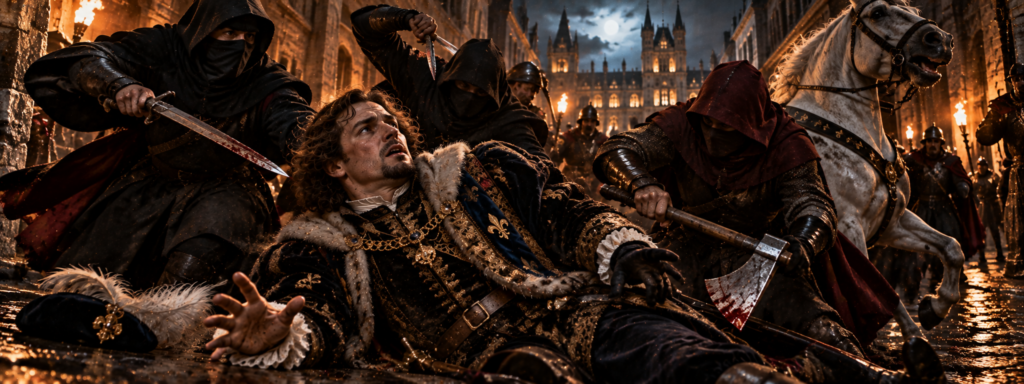
Louis of Orléans: The King’s Brother Hacked to Death in the Streets of Paris
Louis I, Duke of Orléans (1372–1407) | Younger brother of King Charles VI of France | Son of Charles V and Jeanne de Bourbon | Husband of Valentina Visconti of Milan | One of the most powerful princes governing France during the recurring mental illness of Charles VI | Rival of Philip the Bold and later John the Fearless, dukes of Burgundy | Accused by enemies of corruption, excessive taxation, sexual misconduct, sorcery, and manipulating the incapacitated king, although many allegations originated in partisan propaganda | Competed with the Burgundians for control of the royal council, treasury, foreign policy, and access to the king | Reconciled publicly with his cousin John the Fearless shortly before his death | Ambushed in Paris on November 23, 1407, by armed men acting on John’s orders | Struck from his horse and killed with swords, axes, and other weapons | His mutilated body was left in the street | John initially participated in public mourning before admitting responsibility and fleeing Paris | The murder helped ignite the Armagnac-Burgundian conflict and contributed to the political collapse that allowed Henry V of England to invade France.
Murder in the Rue Vieille du Temple
Paris was dark on the evening of November 23, 1407, when Louis, Duke of Orléans, left the residence of Queen Isabeau of Bavaria and began the short journey through the city streets. He was thirty-five years old, brother to the king, one of the richest and most controversial princes in France, and a man surrounded by enough enemies that political hatred had become an ordinary part of his existence. Yet Louis was not riding at the head of an army or moving through hostile territory. He was traveling through the capital of his own brother’s kingdom.
Waiting for him in the Rue Vieille du Temple was a group of armed men. Their presence was no spontaneous street robbery, drunken quarrel, or accidental confrontation between rival retainers. They had been positioned there deliberately, and the attack had been organized on behalf of Louis’s first cousin and bitter political rival, John the Fearless, Duke of Burgundy. The assassination was not merely suspected afterward; John would ultimately acknowledge responsibility.
Louis traveled with only a relatively small escort, apparently believing himself safe enough within Paris. The assassins emerged as his party passed through the narrow street and fell upon him with terrifying speed. Louis was dragged or knocked from his mount and attacked with bladed weapons while his attendants were overwhelmed. One of the most powerful men in France suddenly found himself fighting for his life in the mud and darkness.
The killers did not simply stab him once and flee. Contemporary descriptions emphasize the ferocity of the assault, portraying Louis as repeatedly struck with swords, axes, or similar weapons until his body was terribly mutilated. His hand or arm was badly damaged as he apparently attempted to defend himself, and blows to his head proved catastrophic. The exact sequence varies among accounts, but there is no serious doubt that the killing was exceptionally brutal.
When the attackers withdrew, the king’s brother lay dead in a Paris street. Blood that had belonged to the royal house of Valois ran between ordinary houses while frightened witnesses and surviving attendants confronted what had just happened. Louis had spent years fighting for influence over the government of France. His rivals had finally ended that struggle with steel.
The assassination did not solve the political crisis that had produced it. Instead, it transformed rivalry into something far more dangerous. Louis’s supporters demanded justice, John the Fearless justified the murder as tyrannicide, and France began sliding toward a civil war whose consequences would prove catastrophic. A killing intended to remove one rival helped tear apart an entire kingdom.
The Younger Son of Charles V
Louis was born on March 13, 1372, into the ruling Valois dynasty. His father was Charles V, remembered as Charles the Wise, a king whose reign had restored much of the authority and territory France had lost during the earlier disasters of the Hundred Years’ War. His mother, Jeanne de Bourbon, came from another powerful branch of the French royal family. Louis therefore entered the world surrounded by the privileges, expectations, and dangers of the highest aristocracy.
His elder brother Charles had been born in 1368 and stood first in line for the throne. Louis was never expected to become king while his brother lived and produced heirs, but younger royal sons were hardly politically irrelevant. They received lands, titles, marriages, military responsibilities, and places within the networks surrounding the crown. A king’s brother could become one of the strongest men in the kingdom without wearing the crown himself.
Charles V died in 1380, leaving the twelve-year-old Charles VI as king. The minority created opportunities for the young king’s powerful uncles, particularly Louis I, Duke of Anjou; John, Duke of Berry; and Philip the Bold, Duke of Burgundy. These princes dominated the government during the early years of Charles VI’s reign. Louis of Orléans was still a child and initially stood outside this struggle among older men.
The political education he received could hardly have been more revealing. He watched royal uncles use proximity to a young king to increase their own influence and wealth. He saw that government depended upon access to the monarch, control of offices, alliances with great nobles, and command of financial resources. He also learned that royal kinship could unite a dynasty publicly while concealing intense competition privately.
In 1388, Charles VI asserted greater personal control and dismissed many of the dominant royal uncles from government. A group of experienced advisers sometimes called the Marmousets gained influence instead. For a time, the monarchy appeared to be moving toward stronger personal government under the young king. Louis benefited from his brother’s favor and increasingly emerged as an important royal prince in his own right.
Then, in 1392, everything changed. Charles VI suffered the first major episode of the mental illness that would haunt the remainder of his reign. The political system suddenly faced a question it had never satisfactorily answered: who governed France when the king was alive but incapable of governing himself?
The Madness of Charles VI
Charles VI’s breakdown in 1392 became one of the defining catastrophes of late medieval France. While traveling with an army toward Brittany, the king suddenly attacked members of his own entourage, apparently believing himself threatened or betrayed. Several men were killed before Charles could be restrained. The episode was followed by periods of severe mental disturbance that returned unpredictably for the rest of his life.
Modern attempts to diagnose Charles precisely are speculative because medieval descriptions do not provide the evidence necessary for a secure clinical diagnosis. Contemporary accounts describe episodes in which he failed to recognize people around him, rejected his own identity, behaved erratically, and at times believed extraordinary things about his body. Between episodes, however, he could recover sufficiently to participate in government. The alternation between incapacity and apparent recovery made the political situation exceptionally difficult.
If Charles had died, succession would have provided an answer. If he had permanently abdicated, a new governmental structure might have emerged. Instead, he remained the anointed king for decades. Whoever controlled access to Charles during his periods of illness could claim to govern in the name of legitimate monarchy.
Louis’s position as the king’s only surviving brother gave him an obvious claim to influence. Yet he was not alone. Philip the Bold of Burgundy was Charles’s uncle, one of the wealthiest princes in Europe, and head of a rapidly expanding Burgundian political network. Queen Isabeau also possessed an important role as the king’s wife and mother of the royal children.
The government consequently became a struggle among people who could all claim legitimate reasons for exercising authority. Councils were formed, powers shifted, alliances changed, and control over the king’s person became intensely political. France did not simply have an incapacitated monarch. It had multiple factions competing to define what government in the monarch’s name actually meant.
Louis became increasingly central to this struggle. His closeness in blood to Charles gave him extraordinary status, while his ambition ensured that he would not remain a passive observer. The king’s illness created the political space in which Louis of Orléans became one of the most powerful and hated men in France.
Valentina Visconti and the Marriage of Ambition
In 1389, Louis married Valentina Visconti, daughter of Gian Galeazzo Visconti, ruler of Milan. The marriage connected the French royal family to one of the wealthiest and most ambitious dynasties in Italy. Valentina brought a substantial dowry and important dynastic claims. She also became a conspicuous foreign presence within a court increasingly poisoned by factional suspicion.
Louis and Valentina had several children, though many died young. Their surviving sons included Charles of Orléans, who would later become famous both as a prince and as a poet during his long captivity in England. Another son, Jean of Angoulême, would continue an important branch of the family. Their descendants would eventually return the Orléans line to the French throne through Louis XII and, through another branch, Francis I.
Valentina herself became closely associated with Charles VI during some periods of his illness. According to accounts, the disturbed king sometimes responded favorably to her when he rejected or failed to recognize others. This intimacy appears to have encouraged ugly rumors. Political enemies accused her of sorcery and suggested that she had somehow contributed to the king’s madness.
There is no credible evidence that Valentina caused Charles VI’s illness through poison, magic, or any other deliberate means. The accusations belong to a medieval culture in which foreign women, political outsiders, and powerful court figures could easily become targets of supernatural suspicion. Her Italian origins made the allegations especially convenient. Milan and the Visconti already possessed a reputation among enemies for sinister intrigue.
The hostility became sufficiently intense that Valentina spent considerable time away from court. Her treatment illustrates how factional politics increasingly relied upon character assassination as well as formal political maneuvering. Louis could be attacked through his wife, just as his opponents could be accused of betraying the kingdom through foreign alliances. Personal reputation became another battlefield.
The marriage nevertheless gave Louis important interests in Italy. He developed ambitions connected with Milan and other Italian territories, complicating his already extensive political commitments. His enemies would later portray these ambitions as evidence that he consumed French resources for personal schemes. As with many charges against Louis, genuine political ambition became mixed with partisan exaggeration.
The King’s Brother Becomes a Prince of Enormous Power
Louis accumulated titles, territories, and wealth as his political importance grew. He became Duke of Touraine in 1386 and later Duke of Orléans in 1392. He also acquired extensive lands and lordships, creating a territorial power base worthy of the king’s brother. His household became one of the great aristocratic centers of France.
Possession of wealth was essential because medieval political power required patronage. Princes needed to reward servants, maintain military retainers, support allies, arrange marriages, and display magnificence appropriate to their rank. Louis spent lavishly, as did other princes of his generation. His expenditures nevertheless became a major source of criticism when the royal government faced severe financial pressure.
His enemies accused him of greed and of exploiting taxation for personal benefit. Some criticism reflected genuine resentment against the fiscal demands imposed upon the population. France had endured war, taxation, plague, rebellion, and economic disruption throughout the fourteenth century. Ordinary people had good reason to resent princely extravagance.
Yet Burgundian propaganda turned Louis into a particularly convenient symbol of corrupt government. The Duke of Orléans could be depicted as the prince draining the kingdom while manipulating his sick brother. Such accusations were politically powerful because they connected elite rivalry to popular frustration. John the Fearless would later exploit this image masterfully.
Louis was undoubtedly ambitious. He sought offices, lands, influence, and strategic advantage, and there is little reason to romanticize him as a selfless defender of constitutional government. But ambition was not unusual among princes of his rank. Philip the Bold and John the Fearless were no less committed to expanding Burgundian power.
The real struggle was not between an ambitious Louis and disinterested opponents. It was between competing aristocratic power systems, each claiming to defend the crown while pursuing its own interests. Charles VI’s illness prevented the king from consistently controlling either side. France increasingly became the arena in which those rival systems collided.
Philip the Bold and the First Burgundian Rivalry
Louis’s first great Burgundian rival was Philip the Bold, Duke of Burgundy. Philip was a son of King John II of France and therefore uncle to both Charles VI and Louis. Through marriage to Margaret of Flanders, he acquired access to the wealthy territories of Flanders and the Low Countries. His Burgundian state was becoming one of the richest political powers in western Europe.
Philip’s interests did not always align with those of the French crown. Flanders depended heavily upon trade with England, particularly the wool trade. A prolonged Anglo-French war could therefore damage territories central to Burgundian prosperity. Louis, by contrast, often favored a more aggressive policy toward England.
This disagreement over foreign policy became intertwined with competition for control of the royal government. When Charles VI was incapable of ruling, Philip and Louis each sought influence over councils, appointments, finance, and diplomacy. Queen Isabeau could become an ally of one faction and then another depending upon circumstances. The government developed an unstable balance rather than a clear regency.
Louis’s relationship with the queen would later become one of the most scandalous elements of anti-Orléans propaganda. Their political cooperation was undeniable, and Louis spent considerable time around Isabeau. Rumors claimed they were lovers. No reliable evidence proves a sexual relationship between them.
The allegation nevertheless proved devastating because it allowed enemies to portray Louis as betraying his own brother in the most intimate way imaginable. The image was politically irresistible: the king had lost his reason, while his brother supposedly took his power, his money, and perhaps even his wife. Whether true or not, the story transformed political rivalry into moral outrage.
Philip the Bold was an experienced politician capable of exploiting such weaknesses without necessarily relying upon assassination. His death in 1404 changed the character of the conflict. Burgundy passed to his son John, a man whose rivalry with Louis would end not in compromise but in murder.
John the Fearless
John of Burgundy had earned the epithet “the Fearless” during the disastrous crusade of Nicopolis in 1396. The crusading army suffered a catastrophic defeat against the Ottoman forces of Sultan Bayezid I, and John was captured. His reputation for courage survived the disaster. When Philip the Bold died in 1404, John inherited Burgundy and much of his father’s political rivalry with Louis.
The two men were first cousins. They shared royal blood, moved within the same political world, and were bound through networks of kinship that should theoretically have encouraged cooperation. Instead, family intimacy sharpened competition. Each knew exactly how dangerous the other could become.
John inherited substantial territories but also major financial obligations. He needed access to royal resources and influence within France to strengthen his position. Louis already occupied much of the political space John wanted. The king’s illness meant there was no consistently authoritative monarch capable of forcing them into lasting submission.
Their rivalry extended across taxation, appointments, foreign policy, control of the royal council, and access to Charles VI. Both men claimed to defend good government. Both accused the other of abusing power. Their supporters increasingly organized into recognizable political factions.
John proved especially skilled at cultivating a populist image in Paris. He criticized taxation and presented himself as an opponent of financial abuses associated with Louis’s faction. This did not mean Burgundy had suddenly become a democratic reform movement. John was an immensely powerful feudal prince pursuing his own dynastic interests.
Nevertheless, political messaging mattered. Louis could be portrayed as extravagant, corrupt, immoral, and oppressive. John could portray himself as the defender of reform and the public good. By 1407, the rivalry had acquired a moral language capable of making murder sound like justice.
Queen Isabeau and the Politics of Scandal
Isabeau of Bavaria has suffered one of the darkest reputations of any medieval French queen. Later chroniclers and nationalist historians often portrayed her as greedy, promiscuous, treacherous, and indifferent to France. Much of that image grew from partisan propaganda generated during the civil conflicts surrounding Charles VI’s illness. Modern historical analysis has treated many of the traditional accusations with greater caution.
As queen, Isabeau occupied an almost impossible position. Her husband periodically became incapable of government, her children were young, and powerful male relatives competed for control of the kingdom. She could not withdraw from politics without leaving the field to others. Yet any alliance she formed could be interpreted as evidence of corruption or sexual manipulation.
Louis became one of her most important political partners during periods of the struggle. Their cooperation provided fertile ground for rumors of adultery. Medieval and later writers sometimes treated those rumors as fact, but documentary evidence does not establish that Louis and Isabeau were lovers. Political proximity alone is insufficient proof of a sexual relationship.
The rumor was nevertheless extraordinarily damaging. It transformed Louis from an ambitious royal prince into a supposed betrayer of his mentally ill brother. It also turned Isabeau into the archetype of the faithless queen. Their enemies could condemn political decisions by sexualizing them.
Some later stories went even further, suggesting that Louis fathered one or more of Isabeau’s children. These claims are unsupported. They belong to the broader tradition of defamatory narratives surrounding the queen and the Orléans faction. Repeating them as established history would reproduce the propaganda of their enemies.
The importance of the scandal lies not in proving it true but in understanding its political power. John the Fearless needed to convince people that Louis was more than a rival. He needed Louis to appear dangerous, corrupt, and morally illegitimate. Rumors surrounding Isabeau helped create the image of a man whose removal could be presented as an act of public salvation.
Money, Taxes, and Hatred in Paris
Political rivalry became particularly dangerous when it connected with popular anger over taxation. France’s monarchy required enormous sums to maintain government, royal households, military operations, diplomacy, and princely patronage. Charles VI’s illness did not reduce these expenses. Instead, factional competition often increased them.
Louis was associated with fiscal policies that generated intense resentment. His expanding territorial ambitions and magnificent household made him an easy target. Burgundian propaganda accused him of enriching himself while ordinary people suffered. Whether every charge was fair mattered less than the public perception they helped create.
Paris was especially important. The capital contained merchants, artisans, university scholars, clergy, officials, and politically active urban groups capable of influencing events. Whoever could claim the support of Paris possessed a powerful weapon in the struggle for royal government. John the Fearless understood this exceptionally well.
John presented himself as an advocate of financial reform and lower taxation. His supporters emphasized Louis’s extravagance and alleged abuses. This allowed a dynastic struggle between two immensely wealthy princes to acquire the appearance of a conflict between corruption and reform. Political propaganda rarely needs to be entirely false to be effective; it needs enough truth to make exaggeration believable.
Louis did little to make himself universally loved. He displayed wealth openly and pursued ambitious projects while the kingdom suffered. His personal reputation for charm and aristocratic magnificence could impress courtiers while alienating people who paid the taxes supporting princely politics. He was not an obvious candidate for popular sainthood.
Yet John’s later decision to murder him cannot be explained simply as the spontaneous expression of public anger. The assassination was planned by the Burgundian side. Popular hostility made the killing easier to justify afterward, but it did not transform an organized ambush into an act of communal justice. The distinction between grievance and murder would become central to the propaganda war following Louis’s death.
War With England and the Struggle for Policy
The Hundred Years’ War remained an essential background to the conflict. England and France had fought intermittently for generations, and questions of truce, war, territorial recovery, and diplomacy divided French political leaders. Louis often favored a more confrontational approach toward England. Burgundian interests, particularly in Flanders, encouraged greater caution.
Trade made this more than an abstract strategic disagreement. Flemish towns depended heavily upon commercial connections with England. A duke whose power rested partly upon Flanders could not ignore the economic consequences of war. Louis’s priorities were different.
The rivalry therefore involved competing visions of French foreign policy as well as personal ambition. Control of the royal council meant control over decisions affecting England, the empire, Italy, and the Low Countries. Charles VI’s incapacity allowed factional interests to become national policy whenever one side gained temporary dominance. Government changed direction as access to the king shifted.
Louis also cultivated ambitions in Italy, partly through Valentina Visconti’s inheritance and family connections. These interests exposed him to accusations that he diverted attention and resources away from France. His supporters could argue that Italian influence strengthened the Valois position. His enemies could portray it as another example of selfish ambition.
John’s political position was no less shaped by his own territorial interests. Burgundy was becoming a composite state whose rulers possessed lands both within and beyond the traditional French political sphere. The dukes of Burgundy were French princes, but they were also building a power structure capable of acting independently. Their policies could not simply be equated with the interests of the French crown.
This is one of the central ironies of the conflict. Both Louis and John accused the other of subordinating France to private ambition. Both had substantial private ambitions of their own. Charles VI’s illness left the kingdom vulnerable to precisely this kind of competition.
The Struggle for the King’s Body
In a monarchy, access to the king is power. When the king suffers recurring incapacity, controlling access becomes even more important. Charles VI’s illness therefore transformed his physical presence into a political prize. Whoever could speak around him, obtain approval during lucid periods, influence household officers, and claim to interpret royal wishes possessed an enormous advantage.
Louis had the strongest possible blood relationship short of being the king’s son. As Charles’s brother, he could present himself as the natural protector of royal authority. Burgundy countered with its own status, wealth, and network of supporters. Queen Isabeau occupied a crucial position between them.
At different times, arrangements attempted to distribute governmental authority among members of the royal family. None produced lasting stability. Charles could recover sufficiently to reassert himself and then relapse, disrupting whatever political balance had developed. Factions therefore lived with constant uncertainty.
The king’s illness also made accusations of manipulation extremely powerful. If Charles approved a policy while apparently lucid, opponents could claim he had been pressured or deceived. If he favored one prince, rivals could question his capacity. The monarch remained the source of legitimacy while simultaneously becoming incapable of reliably settling disputes.
Louis’s enemies accused him of exploiting his brother’s condition. Whether he did so more aggressively than other princes is difficult to establish. Every faction attempted to gain advantage from the governmental vacuum. The moral accusation concealed a structural problem.
France desperately needed an uncontested mechanism for governing during the king’s incapacity. It never found one. Instead, the royal family competed around Charles’s living body until rivalry escalated into assassination.
From Political Rivalry to Personal Hatred
By 1405, relations between Louis and John had deteriorated dangerously. Both sides mobilized armed followers and attempted to control the royal family. At one point, Louis and Queen Isabeau were accused by Burgundian supporters of attempting to remove the dauphin from Paris. John intervened and presented himself as protecting the heir.
The crisis demonstrated how close factional politics had come to armed conflict. Princes no longer merely argued within council chambers. They brought troops toward Paris, occupied strategic positions, and competed for custody of royal children. The possibility of civil war was becoming real.
Negotiations repeatedly produced apparent reconciliations. Medieval aristocratic politics placed enormous importance upon public gestures of peace. Rivals attended ceremonies, exchanged assurances, swore oaths, and appeared together before observers. Such rituals could temporarily contain violence.
Yet reconciliation could conceal continuing fear. John had reason to believe that Louis might eventually exclude him from power. Louis had equal reason to fear Burgundian dominance. Neither trusted the other’s promises enough to surrender political leverage.
By 1407, John had apparently concluded that ordinary political competition was no longer sufficient. Removing Louis physically offered a permanent solution to the rivalry. The decision was extraordinary because Louis was not merely another nobleman. He was the king’s brother.
Killing him risked charges of treason, blood feud, and political chaos. John nevertheless proceeded. The assassination would reveal just how far princely rivalry had escaped the restraining authority of the crown.
A Reconciliation Before Murder
One of the darkest elements of Louis’s assassination is that he and John publicly reconciled shortly before the killing. The two cousins participated in ceremonies intended to demonstrate peace. Contemporary political culture treated such reconciliations seriously because sworn agreements between princes were supposed to restore order. Louis therefore had reason to believe that immediate danger had diminished.
This apparent peace makes John’s decision look particularly treacherous. An open feud at least warns both sides to maintain heavy protection. A reconciliation encourages guards to relax and routines to return. The language of kinship becomes a weapon when one party has already decided that the peace is false.
John’s precise internal reasoning cannot be reconstructed with certainty. He may have feared Louis’s growing political advantage, believed his own position threatened, or concluded that eliminating his cousin was necessary to preserve Burgundian power. Later justification would frame the killing as an act against a tyrant. Planning beforehand reveals that it was not a spontaneous moral reaction.
The assassination required organization. Men had to be recruited, positioned, armed, and informed about Louis’s movements. Someone had to know where the duke would travel and when he would be vulnerable. The killers needed confidence that their patron could protect them afterward.
John’s involvement is not one of the disputed elements of the story. Unlike many medieval assassinations surrounded by uncertain attribution, responsibility became openly acknowledged. The mystery lies less in who ordered the murder than in how John expected to survive politically after admitting it. His answer would be propaganda.
First, however, Louis had to be placed within reach. On November 23, he visited Queen Isabeau. When he left her residence that evening, the trap was ready.
November 23, 1407
Louis had been visiting Queen Isabeau at the Hôtel Barbette in Paris. The queen had recently given birth, and Louis’s presence was consistent with his position within the royal family and his close political relationship with her. Later scandalous accounts naturally interpreted the visit through rumors about their alleged affair. There is no need to accept those rumors to explain why the king’s brother would visit the queen.
A message reportedly reached Louis that King Charles VI required or wished to see him. Whether the message itself formed part of the assassination plot has been discussed, but the surviving evidence does not justify embellishing the scene beyond what the sources support. Louis left the Hôtel Barbette and began traveling through the streets. His escort was relatively modest for a prince with so many enemies.
Parisian streets after dark could be narrow, poorly illuminated, and ideal for ambush. Houses pressed close around winding routes, and visibility was limited compared with an open road. Armed men familiar with the duke’s expected path could conceal themselves until his party was almost upon them. Escape routes were plentiful.
The assassins waited near the Rue Vieille du Temple. Their leader is generally identified as Raoul d’Anquetonville, a man connected with John the Fearless. The group may have numbered around fifteen or more, although exact numbers vary among accounts. They were not masked phantoms appearing from nowhere but organized retainers carrying out a planned political killing.
As Louis approached, the attackers rushed him. Some accounts describe a man shouting that the duke was being attacked, while others preserve different details of the first moments. The confusion of a sudden nighttime assault makes precise reconstruction difficult. What followed was clear enough: Louis was surrounded and violently struck down.
Hacked Down in the Street
Louis appears to have been knocked from his mule or horse as the attack began. He attempted to defend himself, but the number and preparation of the assassins made resistance almost hopeless. His attendants were unable to protect him effectively. One servant, traditionally identified as a Flemish or German attendant named Jacob, attempted to defend his master and was also killed.
The weapons used included swords and axes or similar heavy blades. Chroniclers described Louis receiving devastating injuries to his head and limbs. His hand was severed or badly mutilated in the attack, and his skull was split by repeated blows. The violence was excessive even by the brutal standards of medieval political murder.
This savagery may have served a practical purpose. The assassins had been sent to ensure Louis did not survive. A wounded royal prince could identify attackers, rally supporters, and demand vengeance. Leaving no possibility of recovery eliminated that risk.
The mutilation also gave the killing a symbolic quality whether intended or not. Louis had been one of the most magnificent princes in France, surrounded by servants, jewels, titles, estates, and royal privilege. In the street, all of that vanished. His body could be broken as easily as that of any ordinary victim.
Accounts describe his corpse lying amid blood and scattered remains until help arrived. The image shocked Paris because the victim’s identity made the crime an assault upon the royal family itself. Violence between aristocratic factions was familiar, but the deliberate butchering of the king’s brother inside the capital crossed a terrifying threshold. If Louis of Orléans could be killed this way, princely rank no longer guaranteed even the appearance of safety.
The killers escaped the immediate scene. Their patron remained close enough to participate in the political reaction. John the Fearless had ordered a murder, but he had not yet decided—or had not yet been forced to decide—how openly he would claim it.
The Duke of Burgundy Mourns the Man He Had Killed
News of Louis’s assassination spread rapidly through Paris. Members of the royal family gathered amid shock and uncertainty. John the Fearless initially joined other princes in public expressions of grief. The spectacle was extraordinary because the man lamenting the murdered duke had arranged his death.
Public mourning was politically necessary while the circumstances remained uncertain. John could not instantly announce himself as the architect of the killing without knowing how the royal court would react. He participated in the rituals expected of a cousin and prince. Behind those rituals lay the knowledge that his own men had carried out the attack.
The deception did not last long. Suspicion quickly moved toward the Burgundian household, and investigators began closing in on individuals connected with John. Faced with the possibility of exposure, the duke admitted responsibility to senior royal princes. His confession transformed the case from mysterious assassination into an acknowledged act of political murder.
John then left Paris and withdrew toward his own territories. Flight was prudent because Louis’s supporters could demand immediate punishment. Yet John did not behave like a criminal intending to disappear permanently. He possessed armies, territories, wealth, supporters, and enough political strength to return.
Most importantly, he developed a justification. Louis had not been murdered, John would argue, in the sense of an innocent man treacherously killed for private gain. He had supposedly been destroyed as a tyrant whose actions threatened the king and kingdom. The language of tyrannicide would become the duke’s defense.
This was a remarkable strategy. John did not deny the killing once denial became untenable. He attempted to redefine it. If Louis could be transformed from victim into tyrant, assassination could become public service.
Jean Petit and the Defense of Tyrannicide
John’s most famous intellectual weapon was the theologian Jean Petit. In 1408, Petit delivered an elaborate justification of the assassination before a royal audience. His argument presented Louis as a tyrant and traitor whose removal had been lawful or morally defensible. The speech became one of the most notorious political defenses of tyrannicide in medieval France.
Petit assembled accusations against the dead duke. Louis was portrayed as someone who had sought to dominate or destroy the king, corrupt government, misuse taxation, practice sorcery, pursue immoral relationships, and threaten the proper order of the realm. Some charges drew upon existing political grievances. Others belonged to the realm of propaganda, rumor, or hostile interpretation.
The dead man could not answer. This gave John an enormous advantage. Every unpopular tax, every court rumor, every foreign ambition, and every scandal associated with Louis could be assembled into a single indictment. Murder had removed not only the rival but also his ability to defend his reputation.
The concept of tyrannicide had deep roots in political thought, but applying it to Louis required extraordinary manipulation. Louis was not king and did not possess sovereign authority in his own right over France. He was a prince competing for influence within a dysfunctional royal government. Calling him a tyrant allowed John to turn factional rivalry into a moral emergency.
The argument was also dangerous for monarchy itself. If a prince could privately decide that another royal prince was tyrannical and therefore kill him without trial, political order became vulnerable to self-authorized violence. John’s justification threatened to make assassination an acceptable instrument whenever powerful men could manufacture sufficient moral accusations. Critics recognized this danger.
The debate over Petit’s justification continued for years. The University of Paris, theologians, church authorities, and political factions became involved in arguments over the doctrine. Louis’s murder therefore generated not only civil conflict but an intellectual battle over whether political violence could be sanctified after the fact.
Valentina Visconti Demands Justice
For Valentina Visconti, the assassination was not an abstract constitutional problem. Her husband had been butchered in a Paris street, and the man responsible openly admitted ordering the attack. She demanded justice from the crown. The weakness of the royal government made obtaining it extraordinarily difficult.
Valentina appeared before Charles VI and other royal authorities seeking punishment for John the Fearless. Her position was morally powerful but politically vulnerable. The king’s recurring illness prevented consistent royal action. Burgundy possessed enough military and political strength that arresting John risked open war.
The contrast must have been bitter. Louis had been accused of crimes without receiving anything resembling the process his killer later claimed he deserved to bypass. John had commissioned an ambush, admitted it, and then defended himself publicly. Power determined how far justice could reach.
Valentina’s grief became part of Orléans family memory. Later traditions associated her with the phrase that nothing remained for her but death, though memorable quotations attached to medieval figures should be treated cautiously unless securely sourced. What is beyond dispute is that she pursued vindication for her husband. She did not live long enough to see it achieved.
Valentina died in December 1408, little more than a year after Louis. Her children inherited both the Orléans patrimony and the obligation of vengeance. The eldest surviving son, Charles of Orléans, was still young. Older political allies would therefore become crucial to the family’s struggle.
Among them was Bernard VII, Count of Armagnac, whose connection to the Orléans family would eventually give a name to an entire faction. The murder of one duke was becoming the foundation of a civil war. Valentina’s demand for justice would be pursued by armies.
From Orléans to Armagnac
Louis’s supporters did not disappear with him. His family retained extensive lands, wealth, clients, and allies. In 1410, his son Charles married Bonne of Armagnac, daughter of Bernard VII, Count of Armagnac. The alliance strengthened the anti-Burgundian coalition. Louis’s political faction gradually became known as the Armagnacs.
The term therefore emerged after Louis’s death rather than describing a faction he had personally led under that name. This distinction matters because later histories sometimes project the Armagnac-Burgundian labels backward too neatly. Before 1407, the struggle centered on Orléans and Burgundy. After the murder, new alliances reshaped the conflict.
Bernard VII became one of the most forceful leaders of the anti-Burgundian cause. He brought military resources and a willingness to use violence equal to that of his opponents. The resulting struggle became increasingly brutal. Both factions claimed to defend the king while effectively waging war for control of his government.
Paris repeatedly changed hands or political alignment. Armed retainers, urban factions, royal officers, and university interests became entangled in the conflict. The monarchy’s institutions could no longer contain princely competition. Assassination had replaced negotiation, and civil war replaced assassination.
The tragedy was magnified by the continuing illness of Charles VI. The king remained alive as rival factions committed violence in his name. Each side sought royal legitimacy. Neither could create lasting stability.
Louis’s murder therefore did not remove the political problem John had hoped to solve. It multiplied it. Instead of one powerful rival, Burgundy faced a coalition bound together by blood vengeance and fear. The corpse in the Rue Vieille du Temple became a rallying point.
Paris Divides
John the Fearless maintained substantial popularity in Paris, especially among groups hostile to taxation and the Orléans-Armagnac faction. His reformist rhetoric resonated with people who believed royal finances had been abused. Burgundian political organization cultivated urban support. The struggle therefore penetrated deeply into the social fabric of the capital.
One of the most violent manifestations came with the Cabochien uprising of 1413. Radical Parisian supporters associated with the Burgundian cause seized control of the city and committed acts of intimidation and violence. The movement took its name from Simon Caboche, associated with the butchers’ guild. Reform demands became intertwined with factional terror.
The Cabochiens forced political concessions and targeted people associated with the Armagnac faction. Yet their extremism eventually frightened many Parisians. Support for Burgundy weakened sufficiently for the Armagnacs to regain control. The cycle of retaliation continued.
Neither faction possessed clean hands. Armagnac control of Paris could be harsh, and Burgundian propaganda drew upon genuine grievances. Political violence became normalized because each side could point to atrocities committed by the other. Louis’s assassination had provided an early and spectacular example of this logic.
The capital increasingly became a prize rather than a secure center of royal authority. Whoever controlled Paris could claim access to the king and government. Losing the city meant losing enormous political legitimacy. Urban politics and princely warfare became inseparable.
Meanwhile, England watched. France’s internal division created precisely the opportunity an ambitious English king could exploit. The consequences of Louis’s murder were about to expand beyond civil war.
Henry V Sees His Opportunity
Henry V became king of England in 1413. He inherited the long-standing English claim to the French crown and possessed both military ambition and political skill. France’s internal division made renewed invasion far more promising than it would have been against a united monarchy. Armagnacs and Burgundians were too consumed by their own struggle to coordinate effectively.
Henry invaded Normandy in 1415. His campaign culminated in the Battle of Agincourt on October 25, where the English army won a devastating victory over a much larger French force. The battle became legendary, but its strategic context cannot be separated from French political fragmentation. Many leading French nobles were killed or captured.
Charles of Orléans, Louis’s son, was among the prisoners. He would spend roughly twenty-five years in English captivity. The son of the murdered duke therefore lost much of his adult life partly within a conflict made possible by the civil division following his father’s death. His poetry would later become one of the remarkable cultural legacies of that captivity.
John the Fearless did not fight at Agincourt. Burgundian forces were largely absent as a unified contingent, although individual Burgundian-affiliated nobles participated. John’s political calculations remained focused upon the factional struggle. The absence of unified French leadership benefited Henry enormously.
It would be too simplistic to claim that Louis’s assassination “caused” Agincourt. The Hundred Years’ War had much deeper origins, and Henry V pursued his own dynastic ambitions. Yet the murder significantly intensified the civil conflict that weakened France at precisely the moment England renewed the war. Political assassination had strategic consequences.
John had killed Louis to strengthen Burgundy. Instead, the resulting division helped expose France to foreign conquest. The supposedly patriotic justification for the assassination became increasingly difficult to reconcile with its effects.
The Murderer Becomes the Murdered
History eventually produced a grim symmetry. John the Fearless, who had arranged Louis’s assassination in 1407, would himself die in an act of political murder twelve years later. By 1419, France’s situation had become desperate enough that Armagnac and Burgundian leaders attempted negotiations. Henry V was conquering territory while the French factions continued fighting.
John met the dauphin Charles, future Charles VII, on the bridge at Montereau on September 10, 1419. The meeting was intended to advance reconciliation. Instead, violence erupted. Men associated with the dauphin’s party killed John with swords and axes.
The parallels with Louis’s death were impossible to ignore. John had ordered his cousin ambushed after political reconciliation; he himself died during a meeting intended to produce political reconciliation. Louis had been hacked to death by armed men; John suffered a similarly violent end. Blood vengeance had completed another turn.
Whether the dauphin personally ordered John’s murder remains debated. His responsibility is less direct and certain than John’s responsibility for Louis’s assassination. What mattered politically was that Burgundy blamed the dauphin’s faction. John’s son Philip the Good inherited both the duchy and the grievance.
Philip responded by aligning Burgundy more closely with England. This decision contributed to the Treaty of Troyes in 1420, under which Charles VI recognized Henry V as his heir and arranged Henry’s marriage to Catherine of Valois. The dauphin was excluded from the succession. France’s dynastic crisis had reached an extraordinary depth.
The murder of Louis in 1407 and the murder of John in 1419 thus formed two bloody pillars of the civil conflict. Each killing created a demand for revenge that made reconciliation harder. Political assassination did not remove rivalry. It inherited rivalry to the next generation.
The Road to the Treaty of Troyes
The Treaty of Troyes represented one of the most astonishing moments in French royal history. Henry V of England married Catherine, daughter of Charles VI, and was recognized as heir to the French throne. The dauphin Charles was disinherited by the treaty’s terms. Burgundian cooperation was crucial to the political arrangement.
Queen Isabeau’s role in the treaty later became another source of accusations against her. Nationalist histories portrayed her as betraying her own son and country. The reality emerged from a kingdom shattered by civil war, military defeat, factional violence, and the murder of John the Fearless. Her choices were made within circumstances created over years of political collapse.
Louis of Orléans had been dead for thirteen years by the time Troyes was signed. Yet the chain connecting his assassination to the crisis was visible. His murder intensified factional hatred; factional hatred weakened resistance to England; John’s murder deepened Burgundian hostility toward the dauphin; Burgundy then cooperated with Henry V. No single event explains the treaty, but Louis’s death belongs near the beginning of the sequence.
The consequences nearly destroyed the Valois monarchy. When Charles VI and Henry V both died in 1422, the infant Henry VI of England was proclaimed king of France by the Anglo-Burgundian side. The dauphin maintained his own claim as Charles VII. France effectively possessed rival kings.
The political geography of the kingdom fractured. English forces controlled large territories, Burgundy remained enormously powerful, and Charles VII struggled to maintain his position. The monarchy Louis had once fought to dominate seemed close to collapse. A factional assassination had contributed to a national catastrophe.
Recovery would eventually come through military, political, and symbolic developments including the intervention of Joan of Arc and the eventual reconciliation between Charles VII and Philip the Good of Burgundy. But that belonged to another generation. Louis never saw how far the conflict surrounding his death would travel.
Was Louis Really a Tyrant?
John the Fearless’s justification requires serious examination because it influenced Louis’s reputation for centuries. Louis was unquestionably ambitious, wealthy, politically aggressive, and involved in heavy fiscal demands. He competed fiercely for control of government during his brother’s illness. His policies could be unpopular.
None of these facts automatically made him a tyrant in the sense required to justify private assassination. Louis was operating within a political system in which great princes routinely pursued family interests through royal government. Burgundy did the same. John’s accusation depended upon presenting ordinary princely competition as uniquely criminal when practiced by his rival.
Charges of sorcery are especially suspect. Medieval political propaganda frequently weaponized accusations of magic when illness, unexplained events, or foreign influence could be connected to a target. Louis and Valentina’s association with Italy made such claims easier to circulate. There is no sound evidence that Louis caused Charles VI’s illness through occult practices.
The alleged affair with Isabeau is similarly unproven. Their political closeness was real. Sexual accusations provided a way to convert political intimacy into moral treason. Later repetition made the rumor seem more factual than the evidence warrants.
Financial criticism has firmer foundations because Louis did seek resources for his political and territorial ambitions. Yet John himself was an aristocratic ruler requiring enormous revenues. The conflict was not between a corrupt spender and an ascetic reformer. It was between rival systems of princely power competing over limited royal resources.
Louis was therefore neither the innocent saint his supporters sometimes needed nor the monstrous tyrant John needed him to be. He was a late medieval prince behaving aggressively within a political culture that rewarded aggressive princely behavior. His flaws explain why he had enemies. They do not transform his ambush into lawful justice.
The Strange Power of a Murdered Reputation
Death changed Louis’s political identity. Before November 1407, he could be criticized as an ambitious prince manipulating royal government. Afterward, he became the murdered father of a faction. His mutilated body gave his supporters a grievance more emotionally powerful than any argument about taxation or council appointments.
John understood this danger, which is why justification became essential. If Louis remained simply the king’s brother murdered by his cousin, Burgundy would occupy an indefensible moral position. John therefore needed to kill Louis a second time politically by destroying his reputation. Jean Petit’s speech performed that task.
The Orléans side responded with its own propaganda. Louis could be presented as a loyal prince treacherously murdered after reconciliation. His faults could fade behind the brutality of his death. Political memory divided as sharply as the living factions.
This struggle over reputation demonstrates that assassination does not end politics surrounding a person. It changes the arena. The dead cannot act, but their image can mobilize others. Martyrdom may create more durable political power than the victim possessed while alive.
Louis’s son Charles carried that inherited identity even during his decades in English captivity. The Orléans family remained one of the great dynastic forces of France. The murdered duke’s descendants would eventually reach the throne. His political lineage survived the men sent to destroy him.
John succeeded in eliminating Louis physically. He failed to eliminate Orléans as a political force. In that sense, the assassination achieved its narrowest objective while undermining its broader purpose.
Louis’s Children and the Dynasty That Survived Him
Louis and Valentina’s children ensured that the family did not disappear with the murdered duke. Charles of Orléans inherited the duchy and eventually became famous for his poetry. His long English captivity after Agincourt prevented him from dominating French politics during much of his adult life. Yet his cultural legacy became extraordinary.
Charles’s son would eventually become King Louis XII of France in 1498. The crown therefore passed to the descendants of the man hacked to death in 1407. Louis of Orléans had never become king, but his direct line eventually did. Dynastic history has a way of making political murder look short-sighted.
Another descendant would connect the Orléans-Angoulême branch to Francis I, who became king in 1515. The family therefore remained central to French monarchy long after John the Fearless’s own political world had vanished. The assassination failed utterly as an attempt to erase Louis’s dynasty.
Valentina’s Visconti inheritance also continued to matter. French claims in Italy during the later Italian Wars drew partly upon dynastic connections involving the Orléans family. Louis XII would press claims to Milan based upon his grandmother Valentina’s lineage. Political ambitions that had once been used against Louis returned as royal policy under his descendants.
The irony is substantial. Louis’s Italian interests helped enemies portray him as selfish and dangerously ambitious. A century later, French kings pursued Italian claims on a vastly greater scale. What had looked like private princely ambition became part of royal strategy.
Louis’s family therefore outlived the political narrative created by his murderer. John could control the explanation of the assassination for a time. He could not control what Louis’s descendants would become. Dynastic survival offered its own form of revenge.
The Hôtel de Bourgogne and the Memory of the Crime
The physical landscape of medieval Paris preserved traces of the conflict long after the immediate political crisis passed. Noble residences were not merely homes; they were fortified centers of patronage and political organization. The Burgundian and Orléans factions maintained urban bases from which retainers and clients operated. Paris itself became mapped by aristocratic rivalry.
The site of Louis’s assassination acquired its own historical memory. Later generations could identify the Rue Vieille du Temple with the night the king’s brother was cut down. Urban space became a witness to political violence. Streets that ordinarily carried merchants, servants, clergy, and residents could suddenly become theaters of dynastic murder.
This mattered because Louis’s assassination was deliberately public in its consequences even if performed under cover of darkness. His corpse could not be hidden. The death had to become known, and John’s political strategy required explaining it. Unlike a secret poisoning, the murder announced that someone possessed enough power to kill a royal prince in Paris.
The brutality therefore communicated strength as well as hatred. John demonstrated that Louis’s rank could not protect him. His agents could reach the duke within the capital and escape. The message would have been obvious to every other prince involved in the struggle.
Yet demonstrations of strength can expose weakness. If John had possessed unquestioned authority, he would not have needed assassins. Murder was a confession that ordinary political mechanisms had failed to eliminate his rival. The duke’s power was enormous but insecure.
The street killing thus became an image of the wider French crisis. Royal government still existed, but it could no longer prevent princes from settling disputes through private violence. The monarchy remained magnificent in ceremony while becoming frighteningly fragile in practice.
A Kingdom Without an Arbiter
The deepest cause of the disaster was not simply that Louis and John hated each other. Political systems can survive personal hatred when institutions possess enough authority to restrain rivals. France’s tragedy was that Charles VI could not consistently serve as the final arbiter. His illness created a vacuum without formally vacating the throne.
No prince could simply replace him without challenging legitimate monarchy. No council could permanently govern because the king sometimes recovered. No faction could accept permanent exclusion because each possessed enough power to resist. The result was recurring instability.
Louis attempted to fill part of that vacuum through his position as royal brother. Burgundy attempted to fill it through princely power and influence. Isabeau attempted to navigate it as queen and mother. Every solution created another rival.
The murder of 1407 represented the moment when one faction abandoned the hope that political competition alone could settle the issue. John decided that eliminating Louis’s body could eliminate Louis’s influence. He misunderstood how aristocratic politics worked. A dead prince leaves heirs, clients, relatives, debts, loyalties, and demands for vengeance.
France therefore moved from a contest over government into a feud over blood. The distinction was devastating. Political compromises can redistribute offices and revenues. Blood vengeance demands punishment.
Charles VI remained alive throughout much of what followed, periodically lucid enough to witness fragments of the catastrophe surrounding his throne. His illness was personal tragedy transformed into constitutional disaster. Louis’s body in the Paris street was one of its most terrible consequences.
Why John Chose Murder
John’s decision can be understood without being excused. Louis appeared to be gaining influence, possessed a uniquely close relationship to the king, and threatened Burgundian access to royal government. Political reconciliation had repeatedly failed. John may have believed that waiting would leave him permanently marginalized.
Assassination offered speed and certainty. Louis could not negotiate his way back from death. He could not outbid Burgundy for allies, influence Isabeau, gain access to Charles, or redirect royal finance. A few armed retainers could accomplish in minutes what years of political maneuvering had failed to achieve.
John also had reason to believe his own power could protect him from consequences. He possessed territories, troops, wealth, urban support, and important allies. The royal government was too divided to punish him easily. His calculation was therefore not irrational in the narrow sense of personal survival.
Indeed, John survived the murder politically for twelve years. He returned to power, maintained substantial support, and continued shaping French politics. The assassination did not destroy him immediately. From a brutally pragmatic perspective, it worked better than moral outrage might suggest.
Its larger consequences were disastrous. The Armagnac faction emerged, civil war intensified, English invasion succeeded, and John’s own eventual murder deepened the crisis. A tactic that strengthened Burgundy temporarily weakened the kingdom upon which Burgundian prosperity partly depended. Short-term political success became long-term catastrophe.
John’s mistake was not believing murder could remove Louis. It did remove Louis. His mistake was believing Louis was the problem rather than one participant in a much larger structural conflict.
Assassination as Political Government
Louis’s murder belongs to a broader medieval tradition in which assassination sometimes became an instrument of elite politics. Kings, princes, ministers, favorites, and rivals could be removed when formal institutions failed to resolve competition. Yet such killings were dangerous because they threatened the moral and religious principles upon which aristocratic authority itself depended. A world where any prince could kill another threatened everyone.
This explains the elaborate justification following the assassination. John needed more than military power. He needed a moral theory explaining why ordinary prohibitions against murder did not apply. Tyrannicide provided that theory. Louis had to become an enemy of legitimate order so that killing him could be presented as restoring legitimate order.
The argument resembles many later justifications for political assassination. The victim is first transformed into an existential threat. Ordinary legal remedies are then declared inadequate. Violence becomes exceptional but supposedly necessary.
The problem lies in who decides when the exception exists. John appointed himself judge of Louis’s alleged tyranny, authorized the punishment, and employed the executioners. Louis received no trial capable of testing the accusations. The killer created both verdict and sentence.
That is why the assassination horrified even people who disliked Louis. Accepting John’s logic could legitimize private war at the highest level of government. Any prince powerful enough to kill a rival might later produce scholars willing to explain why the victim deserved it. Political theology could become an accessory after the fact.
Louis’s murder therefore belongs not only to the history of assassination but to the history of attempts to legitimize assassination. The blades in the Rue Vieille du Temple killed the man. Jean Petit’s arguments attempted to make the blades lawful.
The Long Shadow of November 1407
The effects of Louis’s murder lasted far beyond the night itself. Armagnac-Burgundian hostility shaped French politics for more than two decades. Paris experienced uprisings, factional killings, and changes of control. English armies exploited the division.
John’s own assassination in 1419 renewed the blood feud. Philip the Good’s alliance with England helped sustain the Anglo-Burgundian political order established through the Treaty of Troyes. Charles VII struggled for survival before eventually rebuilding royal authority. The road toward recovery was long.
The reconciliation between Charles VII and Philip the Good at the Treaty of Arras in 1435 finally ended the major political alliance between Burgundy and England. By then, nearly three decades had passed since Louis’s assassination. Most of the original protagonists were dead. A new generation had inherited their consequences.
France eventually recovered and expelled most English forces from its territory. The monarchy emerged stronger in the later fifteenth century. Yet this later success should not obscure how close factional conflict had brought the kingdom to disaster. The years after 1407 were among the darkest of the Valois monarchy.
Louis’s murder therefore matters far beyond the biography of one prince. It illustrates how elite violence can destabilize institutions already weakened by uncertainty. The assassination did not create Charles VI’s illness, the Hundred Years’ War, aristocratic rivalry, or fiscal tension. It connected those problems through vengeance.
One corpse became a political dividing line. Men who had never known Louis personally would eventually fight under a faction descended from his supporters. That is the strange afterlife of assassination: the victim stops acting, but the death continues to act through others.
Louis of Orléans: Victim, Villain, or Both?
Louis resists simple characterization. He was certainly a victim of assassination. John the Fearless ordered armed men to ambush him, and Louis was brutally killed without trial. Nothing about his political flaws changes that basic fact.
At the same time, victimhood does not require us to idealize him. Louis was ambitious, acquisitive, and deeply involved in the factional exploitation of royal government. His financial demands contributed to resentment. His territorial ambitions extended well beyond disinterested service to France.
Many accusations against him, however, were amplified by enemies. Claims of sorcery, sexual betrayal, and tyrannical conspiracy served obvious political purposes. The absence of reliable proof requires caution. A man can be politically aggressive without being guilty of every crime attributed to him by the person who ordered his murder.
The most accurate portrait is therefore uncomfortable. Louis was neither saint nor monster. He was an exceptionally powerful medieval prince operating within a broken political system, pursuing his interests aggressively while believing that his royal blood entitled him to enormous influence.
John behaved similarly until rivalry convinced him that ordinary competition was insufficient. The difference on November 23, 1407, was that John crossed from political maneuvering into premeditated killing. Whatever Louis’s faults, his cousin chose assassination as the solution. That choice belongs to John.
The brutality of the murder should not erase the complexity that preceded it. Complexity, however, should not blur responsibility. Louis’s political career was complicated; his assassination was deliberate.
Why Louis Belongs Among the Assassinated Rulers and Regicides
Louis was not king, but his position placed him near the center of sovereign government. As the king’s brother during Charles VI’s recurring incapacity, he exercised enormous political influence and competed to direct the monarchy. His death therefore belongs naturally within a broader category examining rulers, royal governors, regents, princes exercising governmental power, and victims of politically motivated dynastic assassination. The murder altered the direction of the French state.
Unlike disputed deaths where historians must weigh rumors of poison against natural causes, Louis’s case offers unusual certainty about responsibility. He was murdered. John the Fearless ordered the killing and subsequently acknowledged his role. The controversy concerns justification rather than identity.
The assassination is also exceptional because the murderer attempted to transform the crime into a legitimate act of tyrannicide. John did not merely escape prosecution through secrecy. He publicly defended what he had done. This turned a street murder into a constitutional and theological controversy.
The consequences make the case even more significant. Louis’s death helped produce the Armagnac-Burgundian civil war. That conflict weakened France during Henry V’s invasion and contributed to the conditions surrounding Agincourt, the Burgundian alliance with England, and the Treaty of Troyes. Few assassinations demonstrate more clearly how removing one political figure can magnify rather than resolve instability.
There is also a terrible narrative symmetry. Louis was murdered after reconciliation with John. John was later murdered during attempted reconciliation with Louis’s political heirs. Both men discovered that once political trust has been destroyed, gestures of peace can become opportunities for ambush.
Their deaths form a dark pair in French history. Louis’s assassination opened the wound. John’s assassination ensured that it would remain open.
The Blood in the Paris Street
Louis of Orléans spent his life close enough to the French throne to feel its power without ever possessing the crown. He was born the younger son of Charles V, brother to Charles VI, husband to Valentina Visconti, and member of a dynasty that had already survived some of the worst disasters of the Hundred Years’ War. His position should have guaranteed wealth, influence, and protection. Instead, it placed him directly inside the struggle that would kill him.
His brother’s illness transformed Louis’s political world. Charles VI remained king but could not consistently govern. Every period of incapacity created uncertainty, and every recovery rearranged the balance again. The monarchy possessed a sovereign whose authority remained sacred while his ability to exercise that authority repeatedly disappeared.
Louis stepped into that vacuum because almost any prince of his rank would have done the same. He sought influence over councils, finances, diplomacy, appointments, and access to the king. He accumulated lands and wealth. He pursued foreign ambitions and cultivated alliances.
His enemies watched and accused. Some accusations had foundations in real political grievances, particularly resentment over taxation and expenditure. Others drifted into the familiar darkness of court propaganda: adultery, sorcery, betrayal, and secret schemes against the king. Louis became not merely a rival but a story about everything supposedly wrong with France.
John the Fearless inherited that rivalry from his father and sharpened it. The cousins competed over royal government, foreign policy, money, Paris, and the king himself. Each possessed supporters capable of turning private ambition into public ideology. Neither could permanently defeat the other through ordinary politics.
They reconciled because princes were expected to reconcile. They shared ceremonies, exchanged assurances, and displayed peace before the court. Louis had reason to believe that whatever rivalry remained would continue within the familiar boundaries of aristocratic politics. John had already begun imagining another solution.
On November 23, 1407, Louis left Queen Isabeau’s residence and entered the Paris streets. He was not marching toward battle. He did not wear armor for a duel with Burgundy. His escort was not prepared to fight an organized assassination squad.
Men waited in the darkness. They knew where he was expected to pass. They carried weapons capable of doing far more than frightening him. Their orders required a permanent result.
The ambush erupted quickly. Louis was knocked or dragged from his mount and surrounded. His attendants could not save him. One servant who attempted to defend him died as well.
Then came the blades. Swords and axes struck the king’s brother repeatedly. His limbs were mutilated, his head shattered, and his body left ruined in a street belonging to the capital of his own dynasty.
There is no need to embellish the scene with invented dialogue. The documented violence is powerful enough. A prince who had spent years competing over who governed France ended his life unable to govern even the few seconds between ambush and death. Political power vanished the moment steel reached flesh.
John initially joined the mourning. That detail gives the story one of its coldest moments. The duke responsible for the assassination stood among men grieving the victim and performed the expected rituals of shock. Political theater continued even after murder.
Then suspicion tightened around Burgundy. John admitted what he had done and fled. Yet he did not disappear into exile as a disgraced criminal. He prepared to return as a prince defending an argument.
Louis, he claimed, had been a tyrant. The murder could therefore be reframed as tyrannicide. Jean Petit supplied theology and rhetoric to transform an ambush into supposed public service.
The dead duke became the defendant in the trial his killer had invented after killing him. Every rumor could now become evidence because Louis could no longer answer. His political ambition became tyranny, his fiscal policies became plunder, his relationship with the queen became sexual betrayal, and hostile stories about magic became part of an indictment. Murder acquired an intellectual costume.
But France did not become peaceful once the supposed tyrant was gone. Louis’s children survived. His allies survived. His wealth, territories, servants, political relationships, and family honor survived.
So did vengeance. Valentina demanded justice and died without seeing it. Charles of Orléans inherited a murdered father’s name before he was old enough to dominate the struggle himself.
Bernard of Armagnac and other allies converted that grievance into political organization. France divided between Armagnacs and Burgundians. The dispute Louis and John had once conducted through court politics became a civil war fought by thousands.
Paris suffered. Factions seized the capital, opponents were imprisoned or killed, and urban anger became entangled with aristocratic ambition. Each side claimed legitimacy. Each side accumulated its own atrocities.
Across the Channel, England found opportunity. Henry V invaded a France weakened by division. Agincourt demonstrated with horrifying clarity what internal collapse could cost.
Louis’s son Charles was captured on that battlefield and carried into English captivity. The murdered father’s political inheritance had become the imprisoned son’s personal fate. Charles would spend decades away from France while the kingdom continued bleeding.
John the Fearless eventually discovered that assassination establishes precedents its authors cannot control. In 1419, he met the dauphin Charles at Montereau under the shadow of attempted reconciliation. Armed men attacked him there. The murderer of Louis became another murdered prince.
John’s death did not end the cycle any more than Louis’s had. Philip the Good inherited Burgundy and his father’s grievance. He moved toward alliance with England, helping produce the Treaty of Troyes and one of the greatest crises the Valois monarchy ever faced.
Thus the assassination of 1407 continued killing people who had never stood in the Rue Vieille du Temple. That is perhaps its most important historical meaning. Political murder rarely ends with the victim. It rearranges loyalties, creates martyrs, produces heirs to vengeance, and teaches enemies that violence is an acceptable language of government.
John wanted Louis removed because Louis represented an obstacle. In the narrowest possible sense, the plan succeeded perfectly. Louis never attended another council, never influenced Queen Isabeau again, never competed for another appointment, and never challenged Burgundian policy. The rival was gone.
But the rivalry remained. Indeed, it became stronger because it acquired a corpse around which memory could organize itself. Louis alive had supporters; Louis murdered had avengers. John exchanged one dangerous cousin for an entire political movement defined partly by hatred of Burgundy.
This is the fatal weakness in the logic of assassination. Human beings can be killed far more easily than political conflicts can be killed. A blade can stop a heart. It cannot guarantee what surviving people will believe about the death.
Louis’s descendants ultimately survived the Burgundian world that killed him. Charles of Orléans returned from captivity. The family remained one of the great princely houses of France.
Eventually Louis XII, grandson of the murdered duke, became king. The bloodline John had tried to weaken reached the throne after all. Later Valois rulers would also descend through branches connected to Louis’s family.
John the Fearless left an extraordinary Burgundian inheritance of his own, but the independent power of the Valois dukes of Burgundy would eventually collapse. Charles the Bold died in 1477, and the political map shifted again. Dynasties that once seemed unstoppable proved mortal.
The street where Louis died therefore witnessed something larger than a successful assassination. It witnessed the failure of assassination as a permanent political solution. John could choose the time, place, killers, and victim. He could not choose the future.
Louis of Orléans was not an innocent outsider destroyed by a corrupt political world. He was one of the men who helped create that world. He participated enthusiastically in the competition for power surrounding his incapacitated brother, accumulated wealth and offices, pursued personal ambitions, and contributed to the factional atmosphere poisoning royal government. His story becomes less truthful, not more, if those facts are hidden.
But political guilt is not the same as guilt worthy of private execution. Louis was never convicted of the monstrous collection of offenses John later assembled against him. He was given no opportunity to defend himself against the sentence imposed in the Rue Vieille du Temple. His cousin appointed himself accuser, judge, and executioner.
That distinction is why the murder remains so important. John the Fearless did not simply order the killing of a rival. He claimed the right of a powerful prince to decide that another member of the royal family deserved death. The precedent struck at the political order both men claimed to defend.
France paid for that decision for years. The Armagnac-Burgundian conflict weakened the kingdom at one of the worst possible moments. English armies returned. French princes slaughtered one another while foreign conquest advanced.
None of this means Louis’s murder alone caused France’s disasters. Charles VI’s illness had already destabilized government, the Hundred Years’ War long predated the assassination, and aristocratic rivalry had deep structural roots. Henry V made his own decisions for English reasons. History rarely offers a single cause for catastrophe.
But November 23, 1407, was a decisive escalation. Before that night, Louis and John were rivals who could still theoretically reconcile. After it, one was dead and the other had made blood vengeance part of French politics. The possibility of ordinary compromise narrowed dramatically.
That is why the image of Louis’s body in the Paris street matters more than the lurid details alone. The shattered skull and mutilated hand belonged to one man, but the political violence they represented would spread far beyond him. France itself was beginning to resemble the victim—divided, wounded, and attacked by men who insisted their violence was necessary for its salvation.
Louis had spent years reaching toward the machinery of government. He wanted influence over his brother, the council, the treasury, diplomacy, and the direction of the kingdom. His cousin decided that the only reliable way to stop him was to make sure he never reached another council chamber.
So armed men waited in a dark street. They attacked a royal prince under cover of night, knocked him down, and kept striking until there was no possibility he could rise again. Then they disappeared, leaving others to explain the blood.
John the Fearless supplied that explanation. Louis had been a tyrant, he said through his defenders, and killing him had protected France. The years that followed delivered a darker verdict on the wisdom of that claim.
France did not become safer. It became more divided. The king did not become more secure. His government became even more vulnerable to faction.
Burgundy did not obtain permanent control. It inherited a feud. The Orléans faction did not disappear. It returned under another name and with new allies.
And Louis himself, supposedly erased in a few minutes of extraordinary violence, became impossible to remove from the story. His death outlived his political career. His blood became one of the dividing lines of fifteenth-century France.
On that November night in 1407, Louis of Orléans rode through Paris believing that the latest reconciliation with his cousin meant political rivalry would remain political. Somewhere ahead, men employed by John the Fearless were waiting with axes and swords. Between those two realities lay only a few dark streets.
When Louis entered them, he was one of the most powerful princes in Europe. When his killers left, he was a mutilated corpse lying in the capital of his brother’s kingdom. The struggle for France did not die beside him.
It became a war.