
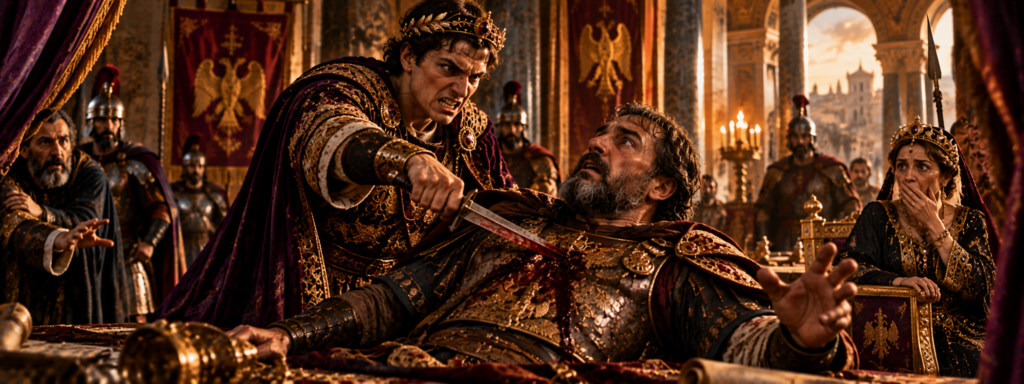
Valentinian III: The Emperor Who Murdered Rome’s Last Great General and Helped Destroy the Western Empire
For thirty years, Valentinian III wore the imperial purple while the Western Roman Empire struggled against invasion, rebellion, political betrayal, and the steady disappearance of its provinces. He inherited the throne as a child, grew up surrounded by powerful generals and ambitious courtiers, and eventually became an emperor whose authority was increasingly overshadowed by the men commanding his armies. Among them stood Flavius Aetius, the formidable general who helped defeat Attila the Hun and preserve what remained of Roman power in the West. Yet in September 454, Valentinian personally attacked and killed the very commander on whom his empire had depended. Six months later, the emperor himself lay dead, murdered by men connected to the general he had destroyed. Within weeks, another political assassination plunged the government into chaos, and a Vandal fleet approached Rome. The events of 454 and 455 became one of the most devastating sequences of betrayal in late Roman history, exposing an imperial government whose greatest enemies were no longer always waiting beyond its frontiers.
The Murder That Shook an Empire
On September 21, 454, one of the most powerful men in the Western Roman Empire entered the imperial presence to conduct government business. Flavius Aetius had spent decades commanding armies, negotiating with foreign rulers, suppressing rebellions, and holding together a state that had been slowly losing control of its territories. He had survived civil wars, political intrigues, and military disasters that would have destroyed the careers of lesser commanders. His position was so influential that the emperor himself increasingly depended on him to preserve the remaining structures of Roman authority.
Aetius had every reason to believe that his importance offered some protection. He held the prestigious rank of patrician, had repeatedly served as consul, and maintained extensive connections within the military establishment. His forces had played a decisive role in confronting Attila the Hun during the invasion of Gaul in 451. Although the victory was achieved by a coalition of Roman and allied armies rather than Aetius alone, his leadership had made him one of the most celebrated military figures of his generation.
Yet the greatest danger to Aetius was not another invading army. It was the emperor whose interests he had spent years defending.
According to surviving accounts, Valentinian III suddenly attacked Aetius during an imperial audience. The emperor used a weapon against the general, while an accomplice assisted in the killing. The precise sequence differs among the sources, but the essential event is beyond serious dispute: Valentinian personally participated in the murder of his most important military commander.
The killing was extraordinary even by the violent standards of late Roman politics. Emperors had ordered the executions of generals before, and military commanders had repeatedly removed emperors from power. But the spectacle of a reigning emperor personally striking down the man responsible for much of his military security revealed the intensity of the struggle at the center of government.
Later writers connected the murder to the influence of Petronius Maximus, an ambitious aristocrat who allegedly encouraged Valentinian to believe that Aetius intended to seize the throne. These accounts describe manipulation, jealousy, and fear, although their explanations of individual motives cannot be independently confirmed. Aetius had indeed accumulated enormous power, and his family was becoming closely connected to the imperial dynasty through marriage arrangements. The political tensions were real, even if the private conversations that supposedly caused the murder remain uncertain.
The consequences were immediate. The emperor had eliminated a commander whose influence extended throughout the western military establishment, but he had not created an equally capable replacement. Aetius’s supporters were alienated, powerful officers had reason to fear for their own safety, and the government lost a central figure in its fragile system of military alliances.
A famous anecdote, preserved by later historians, claims that someone compared Valentinian’s decision to cutting off his right hand with his left. The precise wording and identity of the speaker vary in the historical tradition, so the exchange cannot be treated as a securely recorded conversation. Nevertheless, the image captures how subsequent generations understood the killing.
Valentinian believed, or was persuaded to believe, that removing Aetius would strengthen his authority. Instead, the murder helped destroy the political arrangements that had kept him on the throne.
To understand how an emperor could become so dependent on a general that he ultimately regarded him as a threat, it is necessary to return to Valentinian’s childhood and the dangerous world into which he was born.
Born Into a Dynasty Already Surrounded by Enemies
Valentinian III was born on July 2, 419, into the Theodosian imperial dynasty. His father was Constantius III, a successful military commander who briefly became co-emperor of the West in 421. His mother, Galla Placidia, was the daughter of Emperor Theodosius I and the half-sister of the western emperor Honorius. Through both parents, Valentinian possessed connections to the highest levels of Roman imperial power.
His ancestry offered prestige, but it did not guarantee security. By the time of his birth, the Western Roman Empire had endured decades of political upheaval, military invasion, and territorial fragmentation. The Visigoths had sacked Rome in 410, an event that shocked the Roman world even though the city was no longer the normal residence of the western emperor. Imperial authority in Britain had effectively collapsed, while large areas of Gaul and Spain were contested by competing military and political powers.
The western government operated primarily from Ravenna, a fortified city surrounded by marshland and protected by its proximity to the Adriatic. Its defensive position made it difficult to attack, but the imperial court’s relative security contrasted with the vulnerability of many provinces. Emperors could remain protected within their residences while soldiers, landowners, and provincial communities faced the consequences of declining military control.
Valentinian’s father had helped preserve the empire during this period. Constantius had fought against usurpers and rival powers, negotiated with the Visigoths, and restored some measure of stability after the crises of Honorius’s reign. His marriage to Galla Placidia strengthened his connection to the imperial dynasty. When he became co-emperor in 421, it appeared possible that his family might establish a more secure succession.
Constantius died later that same year, leaving Galla Placidia with two young children: Valentinian and his older sister, Honoria. His death removed the family’s most important military protector. It also created political difficulties because Honorius remained emperor and relations within the imperial household deteriorated.
Galla Placidia eventually came into conflict with Honorius, and she departed the western court with her children. They sought refuge in Constantinople, where the eastern emperor Theodosius II ruled. The eastern and western halves of the Roman Empire remained formally connected, but they possessed separate courts, military structures, and administrative priorities.
Valentinian therefore spent part of his childhood away from the western territories he would eventually govern. His future depended on decisions made by relatives, generals, and court officials rather than on any authority he personally exercised. Before reaching adolescence, he would become the centerpiece of a struggle over the western throne.
A Child Emperor and the Mother Who Ruled in His Name
Honorius died in August 423 without a direct heir. His death created a succession crisis in the Western Roman Empire, where political authority depended on a complicated mixture of dynastic legitimacy, military support, and recognition from the eastern court. Rather than immediately accepting Valentinian, influential officials in the West supported another candidate. A senior official named Joannes emerged as emperor.
Joannes controlled the western government for approximately eighteen months, but his legitimacy was contested. Theodosius II refused to recognize him and instead supported the claims of Galla Placidia’s son. Valentinian was elevated to the rank of Caesar in 424, and preparations began to restore the Theodosian dynasty in the West.
The eastern government organized a military expedition against Joannes. Its commanders included Ardabur and his son Aspar, both prominent figures in eastern Roman military affairs. The campaign ultimately succeeded, and Joannes was captured and executed in 425. Valentinian was then proclaimed Augustus at Rome on October 23, 425.
He was only six years old.
The imperial title gave Valentinian immense symbolic authority, but the realities of government remained beyond his control. His mother, Galla Placidia, became the central political figure during his minority. She possessed extensive experience of imperial politics and had survived extraordinary personal upheavals, including captivity among the Visigoths and a marriage to their king Athaulf.
Placidia’s position was unusual but not unprecedented. Imperial women had exercised considerable influence during earlier reigns, particularly when emperors were children or politically dependent. Her authority rested on her dynastic status, her relationship with the eastern court, and her ability to manage powerful military commanders.
Yet the western government was already deeply divided. Rival generals controlled armies and competed for appointments, resources, and political influence. The emperor’s youth made these rivalries more dangerous because no adult ruler possessed sufficient independent authority to dominate them.
Among the most important commanders were Flavius Felix, Bonifatius, and Aetius. Their struggles would shape the political environment in which Valentinian grew up. The young emperor inherited not a unified military establishment but a collection of competing power centers whose loyalty could change rapidly.
The imperial court continued presenting Valentinian as the legitimate ruler of the West. His image appeared on coins, official documents were issued in his name, and ceremonial honors reinforced his status. Behind those symbols, however, the government depended on individuals whose personal ambitions could determine the fate of entire provinces.
Valentinian’s childhood was therefore defined by a contradiction that would persist throughout his reign. He possessed the highest title in the western world, yet the power needed to enforce his commands belonged largely to other men.
Three Generals and an Empire Divided Against Itself
The rivalry among Felix, Bonifatius, and Aetius exposed the instability of western Roman government during Valentinian’s minority. Each commander possessed military resources and political connections that made him difficult to remove. Their competing interests complicated efforts to defend the empire against external threats. The western court needed their armies, but their struggles consumed resources that could otherwise have protected vulnerable provinces.
Aetius was particularly formidable because of his connections with the Huns. During his earlier career, he had spent time among them and developed relationships that later allowed him to obtain military assistance. These connections were politically valuable in an empire increasingly dependent on alliances with groups beyond its traditional military establishment.
Bonifatius commanded important forces in North Africa, one of the most valuable regions remaining under western imperial authority. Africa supplied agricultural products and substantial tax revenues, making it essential to the government’s finances. Whoever controlled the province possessed resources that could influence politics throughout the western empire.
Relations between Bonifatius and the imperial court deteriorated during the 420s. Later accounts accused Aetius of manipulating the conflict through deceptive messages, supposedly persuading Placidia and Bonifatius to distrust one another. The famous story of deliberate deception survives in sources written after the events and cannot be accepted without qualification. Nevertheless, the political hostility between the commanders was real.
Felix initially held a dominant position within the western military hierarchy, but his authority did not last. In 430, Aetius arranged or participated in his removal, and Felix was killed. The precise circumstances are difficult to reconstruct, but the outcome strengthened Aetius’s position. A struggle that should have concerned military defense became a contest over control of the imperial government.
The rivalry culminated in 432 when Aetius and Bonifatius confronted one another militarily. Bonifatius won the engagement but died shortly afterward, reportedly from wounds sustained in the fighting. Aetius temporarily lost his position and withdrew, eventually obtaining support from the Huns.
He returned with sufficient military strength to compel the government to restore his authority. By 433, Aetius had emerged as the dominant western commander. His position would remain central to imperial politics for the next two decades.
Valentinian was still a child when this struggle concluded. He had watched the empire’s most powerful generals fight one another, with victory determined by military force rather than imperial judgment. The lesson was unmistakable: the emperor might possess the crown, but commanders with loyal armies could dictate political outcomes.
That imbalance would become one of the defining tensions of his adult reign.
The Vandals Take Africa: The Disaster That Weakened Rome
While western generals competed for power, a new threat was developing in North Africa. The Vandals, led by their king Geiseric, crossed from Spain into Africa in 429. Their movement brought a substantial military and political force into one of the empire’s richest territories. The invasion would have consequences far beyond the immediate fighting.
The traditional explanation that Bonifatius invited the Vandals into Africa to support his political struggle is disputed. Later historians repeated versions of this story, but the evidence does not securely establish such an invitation. Geiseric had strategic reasons to seek territory in Africa, including access to agricultural wealth and a more defensible political base. The invasion should not be reduced to a single alleged act of betrayal.
The Vandals advanced through the province, defeating or bypassing Roman resistance. Cities faced sieges, and imperial authority became increasingly fragmented. Hippo Regius endured a prolonged siege during which Augustine, the influential Christian bishop and theologian, died in 430. The episode became symbolic of the wider crisis confronting Roman Africa.
A settlement in 435 recognized Vandal control over substantial territories while attempting to preserve a relationship with the imperial government. The arrangement proved temporary. In 439, Geiseric captured Carthage, one of the most important cities in the western Mediterranean.
The loss was devastating.
Carthage had been a major center of Roman power for centuries. Its port supported trade and military operations, while the surrounding agricultural regions contributed heavily to imperial revenue. Losing the city meant more than surrendering a prestigious possession. It deprived the western government of resources needed to pay soldiers, maintain defenses, and support administration.
The Vandals also developed significant naval capabilities, allowing them to threaten Mediterranean shipping and coastal territories. Their control of Carthage transformed them into a major regional power. Rome’s enemies were no longer confined to land frontiers; they could now operate across the sea.
Valentinian’s government attempted to respond, including cooperation with the eastern empire, but military operations failed to restore Roman control. In 442, a new agreement recognized the Vandal kingdom’s possession of valuable African territories. The settlement represented a painful acknowledgment of military reality.
By this point, Valentinian was an adult emperor, yet his government had lost one of its greatest sources of wealth. The consequences would weaken western military power for the remainder of his reign. Even Aetius, whose reputation rested on preserving imperial authority, could not reverse the loss.
The western empire was becoming poorer, more vulnerable, and increasingly dependent on alliances with powerful military groups.
Valentinian Grows Up in the Shadow of Aetius
As Valentinian reached adulthood, his relationship with Aetius became increasingly important. The general commanded much of the effective military power available to the western government. He negotiated with neighboring peoples, conducted campaigns in Gaul, and maintained relationships with groups whose cooperation was essential to Roman defense. His influence extended well beyond ordinary military command.
Valentinian married Licinia Eudoxia in 437, strengthening his connection to the eastern imperial dynasty. She was the daughter of Theodosius II, and the marriage reinforced the political relationship between the eastern and western courts. The couple had two daughters, Eudocia and Placidia, but no surviving son. The absence of a male heir would eventually become a serious dynastic problem.
The marriage also marked Valentinian’s emergence into adult imperial life. He possessed the ceremonial authority of an emperor, a prestigious dynastic wife, and a court that continued presenting him as the legitimate ruler of the West. Yet Aetius remained the dominant military figure. The emperor could not easily govern independently of the general’s support.
The surviving evidence provides limited direct insight into Valentinian’s personality. Some later writers portray him as weak, indulgent, impulsive, or morally compromised, but these judgments must be treated cautiously. Much of the narrative material was shaped by hostility toward his government or by efforts to explain the empire’s decline through the failings of individual rulers. There is insufficient evidence to diagnose him with a mental disorder or establish that he habitually suffered uncontrollable fits of rage.
What can be established is that Valentinian lived within a political system that restricted his independence. His authority depended on powerful commanders, while his family connections gave him legitimacy without guaranteeing military control. The imbalance could produce resentment, but the sources do not allow us to reconstruct his emotional reactions with certainty.
Aetius, meanwhile, continued strengthening his position. He received repeated honors, maintained influential military relationships, and became indispensable to the defense of Gaul. His achievements gave him considerable prestige among soldiers and aristocrats. The longer he dominated military affairs, the harder it became for Valentinian to remove him without risking instability.
Their relationship was therefore inherently dangerous. The emperor needed Aetius to preserve his throne, but the general’s power could appear to threaten imperial sovereignty. Aetius needed Valentinian’s legitimacy, but he also possessed the military resources to influence the government’s decisions.
For years, the arrangement survived because both men benefited from it. Then Attila the Hun entered the western empire’s political calculations, and the balance became even more precarious.
Attila the Hun and the Princess Who Asked for Help
One of the strangest episodes of Valentinian’s reign involved his sister, Justa Grata Honoria. Like Valentinian, Honoria belonged to the Theodosian dynasty, giving her considerable political importance. Her position at court was constrained by the expectations surrounding imperial women, particularly the need to prevent marriages that might create rival claims to power. Her personal choices could have consequences for the entire government.
Around 449 or 450, Honoria became involved in a scandal connected with a court official named Eugenius. The surviving accounts differ in their details, but the relationship provoked an imperial response. Honoria faced restrictions and was apparently expected to enter a marriage arranged by her family. The situation threatened her independence and political position.
According to the historian Priscus, whose account survives in fragments, Honoria sent a message and a ring to Attila, the powerful ruler of the Huns. She sought assistance in escaping her circumstances. Attila interpreted the communication as a marriage proposal or used it as the basis for demanding her hand and a share of western imperial territory.
The episode was extraordinary because Attila already commanded a formidable political and military confederation. His forces had threatened the eastern empire and extracted substantial payments through warfare and diplomacy. A connection to the Theodosian dynasty could provide him with a claim to influence western imperial politics. Honoria’s message therefore created a dangerous diplomatic opportunity.
Valentinian rejected Attila’s demands. The emperor could not easily accept a marriage that might give the Hunnic ruler a claim to imperial territory or authority. The dispute became one of several justifications Attila used during his confrontation with the West. It should not be treated as the sole cause of his invasion, since strategic ambition and existing political conflicts also shaped his decisions.
Later accounts describe Valentinian reacting furiously to Honoria’s conduct and seeking severe punishment. His mother, Galla Placidia, is said to have intervened on Honoria’s behalf. The precise details of the emperor’s response are uncertain, but the political consequences of the affair were substantial.
The scandal exposed the vulnerability of the imperial dynasty. A princess’s attempt to secure assistance from a foreign ruler became a potential threat to the empire itself. It also demonstrated how marriage, inheritance, and military diplomacy were inseparable in late Roman politics.
Attila would soon bring his armies into Gaul, forcing Valentinian’s government to confront one of the most dangerous invasions of the century.
The Battle Against Attila: Rome’s Last Great Coalition
In 451, Attila invaded Gaul with a substantial army drawn from the Hunnic confederation and its allied peoples. His forces advanced through territories containing Roman cities, military positions, and communities already affected by decades of political instability. The invasion threatened to destroy the fragile balance that Aetius had maintained through diplomacy and military force. The western government faced a danger it could not overcome through Roman troops alone.
Aetius responded by assembling a coalition that included Roman forces and important allied groups, most notably the Visigoths under King Theodoric I. The alliance was remarkable because Rome and the Visigoths had frequently been enemies. Their cooperation reflected the seriousness of Attila’s threat and the ability of Aetius to negotiate among competing powers.
The armies confronted one another at the Battle of the Catalaunian Plains, also known as the Battle of Châlons, although the precise location remains debated. The engagement was one of the most famous battles of late antiquity. Medieval and modern accounts have sometimes exaggerated its scale and presented it as a simple confrontation between civilization and barbarism. In reality, both armies contained diverse peoples, and the political relationships among them were complex.
The fighting was intense, and Theodoric I was killed during the battle. The allied forces prevented Attila from achieving a decisive victory, and his army eventually withdrew. The battle checked the Hunnic advance into Gaul, although it did not destroy Attila’s military power. The outcome represented an important strategic success for Aetius and his allies.
Aetius’s reputation grew considerably. He had organized a coalition capable of resisting one of the most feared rulers of the age. His diplomatic relationships, military experience, and ability to coordinate different forces proved essential. Later generations celebrated him as one of the last great defenders of western Roman power.
The title “Last of the Romans” became closely associated with Aetius in later historical memory, although it should not be understood as an official contemporary designation. The phrase reflects the perception that he represented an older tradition of Roman military leadership during an era of decline. It also risks obscuring the contributions of other commanders and allied peoples who participated in the defense of the empire.
Valentinian remained emperor throughout the crisis, but Aetius occupied the central position in the military narrative. The victory increased the general’s prestige without necessarily strengthening the emperor’s personal authority. Indeed, the more indispensable Aetius became, the more difficult it was for Valentinian to imagine governing without him.
The empire had survived Attila’s invasion of Gaul. Yet the confrontation was not over.
When Attila Invaded Italy
In 452, Attila turned his attention toward Italy. His forces crossed the Alps and attacked cities in the northeastern part of the peninsula. Aquileia suffered particularly severe destruction, becoming one of the most notorious casualties of the invasion. Other communities faced devastation or the threat of attack as the Hunnic army advanced.
The invasion exposed the vulnerability of Italy itself. Although Ravenna possessed formidable natural defenses, the wider peninsula could not be protected by fortifications around the imperial court alone. Attila’s army threatened important cities and agricultural regions, placing enormous pressure on the government. Valentinian’s authority appeared increasingly fragile.
Aetius faced serious difficulties because his available forces were insufficient for an easy confrontation. The coalition that had resisted Attila in Gaul could not simply be recreated under identical conditions. The Visigoths had their own political interests, while the western government lacked the resources needed to maintain a large permanent field army. The military situation required caution.
A diplomatic mission eventually approached Attila, including Pope Leo I and senior Roman officials. Later Christian traditions emphasized Leo’s role in persuading Attila to withdraw, sometimes adding miraculous elements. The historical explanation was probably more complicated. Supply difficulties, disease, strategic concerns, and developments elsewhere may all have influenced Attila’s decision.
Attila withdrew from Italy, and the immediate danger passed. His death in 453 subsequently destabilized the Hunnic political system. Rivalries among his successors and subject peoples weakened the confederation that had threatened both halves of the Roman Empire. The collapse of Hunnic power altered the military balance across Europe.
For Aetius, these developments created both opportunities and dangers. His career had depended partly on relationships with the Huns, whose military assistance had supported his rise. Their weakening changed the network of alliances that sustained his position. At the same time, his prestige as the defender of Gaul remained considerable.
Valentinian now faced a powerful general whose influence had survived the greatest external threat of the decade. The emperor’s dependence on Aetius had become a central feature of his reign. With Attila dead, the political relationship between the two men entered a new and increasingly dangerous phase.
A Marriage Alliance That Threatened the Throne
One of the most important sources of tension between Valentinian and Aetius concerned a proposed marriage between their families. Aetius sought to marry his son Gaudentius to one of Valentinian’s daughters, generally identified as Placidia. The arrangement would connect the general’s family directly to the imperial dynasty. Such marriages were common instruments of political alliance, but this one carried exceptional significance.
Valentinian had no surviving son. His daughters therefore represented important dynastic assets, and their marriages could influence future claims to imperial authority. If Gaudentius married into the imperial family, Aetius’s descendants might acquire a stronger position in succession politics. The general would become not merely the empire’s leading commander but also the father of a potential imperial son-in-law.
The marriage arrangement may have been intended to stabilize relations between the emperor and Aetius. By linking their families, both sides could strengthen cooperation and reduce the risk of open conflict. Yet the same arrangement could also intensify suspicion. A ruler concerned about his independence might regard the general’s dynastic ambitions as evidence of a future challenge.
The surviving sources do not establish that Aetius planned to overthrow Valentinian. His political influence was enormous, but he had repeatedly exercised power through the existing imperial government rather than replacing it. His career suggests that maintaining a legitimate emperor could serve his interests. Nevertheless, his family’s growing connection to the dynasty created an obvious potential source of anxiety.
Petronius Maximus, a wealthy and ambitious aristocrat, emerged as an important figure in later accounts of the conspiracy against Aetius. He had held prestigious offices and possessed connections within the senatorial elite. His ambitions placed him in competition with other powerful men at court. The exact extent of his involvement in the events of 454 remains uncertain.
Later writers describe Maximus encouraging Valentinian to believe that Aetius intended to seize power. These accounts portray the emperor as susceptible to manipulation and motivated by fear. Yet they were written with knowledge of the disastrous events that followed, and their explanations may simplify a complicated political struggle. The historical record supports the existence of rivalry and suspicion more securely than it supports any particular private conversation.
By 454, the relationship between Valentinian and Aetius had become dangerously unstable. The emperor possessed the legal authority to command, while the general controlled much of the military power needed to enforce those commands. Their proposed family alliance did not eliminate the imbalance. Instead, it may have made the question of succession even more threatening.
The crisis would culminate in an act of violence that neither man could reverse.
September 454: The Emperor Draws His Weapon
The murder of Aetius occurred on September 21, 454, during an imperial audience. The surviving accounts differ in their descriptions of the setting and immediate circumstances, but they agree that Valentinian personally participated in the attack. Aetius had entered the emperor’s presence expecting to conduct official business. Instead, he encountered a ruler prepared to use violence against him.
According to the historical tradition, Valentinian struck Aetius with a weapon while an associate assisted. The general was killed before he could organize resistance. The suddenness of the attack suggests that the emperor and his accomplice had prepared for the confrontation, although the precise planning cannot be reconstructed. The murder eliminated the most powerful military figure in the western government.
Aetius’s death was followed by further violence against individuals associated with his position. The government sought to prevent his supporters from organizing an immediate response. Yet removing a commander did not automatically transfer his relationships, influence, or military loyalty to the emperor. The western army was not a single institution whose allegiance could be redirected through one palace decision.
Valentinian’s motives remain debated. Later sources emphasize fear that Aetius intended to seize the throne or establish his son as an imperial successor. The general’s extensive military influence and proposed marriage alliance provide a plausible political context for such concerns. But there is no secure evidence that Aetius had begun an actual coup.
The emperor may have believed that eliminating Aetius would allow him to govern independently. He may also have been influenced by courtiers who hoped to replace the general’s political dominance with their own. These possibilities are not mutually exclusive, but they remain interpretations rather than established facts. The surviving evidence cannot reveal Valentinian’s private reasoning with certainty.
What is clear is that the murder destroyed an important source of stability. Aetius had spent decades managing relationships among Roman commanders, allied peoples, and provincial authorities. His death created uncertainty throughout that network. The government needed an experienced military leader, but it had just killed the man best positioned to provide continuity.
The act also damaged the emperor’s standing among soldiers loyal to Aetius. Military allegiance in late antiquity frequently involved personal relationships with commanders, particularly those who distributed rewards and led campaigns. Valentinian could not assume that these soldiers would accept the killing without resentment. The murder therefore created immediate dangers to his own security.
Aetius had survived the Huns, civil wars, and repeated political crises. He died at the hands of the emperor whose throne he had helped preserve.
The Fatal Miscalculation
Valentinian’s murder of Aetius has often been described as one of the most destructive political decisions of the fifth century. The judgment reflects the general’s importance to the western government and the instability that followed his death. Yet the consequences should be understood within the empire’s broader problems rather than attributed entirely to one act. The West had already lost major territories, suffered severe financial damage, and become dependent on unstable military alliances.
Aetius had not solved those structural difficulties. He had failed to recover Africa from the Vandals, and his authority depended partly on negotiated relationships with powerful groups outside direct imperial control. His military achievements were substantial, but they did not restore the centralized power of earlier centuries. The empire remained vulnerable even while he lived.
Nevertheless, his death removed a figure with exceptional experience in managing those vulnerabilities. Aetius understood the political geography of Gaul, the military importance of alliances, and the complicated loyalties of western commanders. His influence provided continuity during a period when imperial institutions were increasingly fragile. Replacing him would have required both military credibility and political skill.
Valentinian did not possess an obvious successor capable of assuming the same role. The emperor could appoint officials, but appointments alone could not recreate Aetius’s relationships. Military power was distributed among commanders and allied groups whose cooperation depended on personal arrangements. The killing therefore disrupted a system that had developed over decades.
The emperor also faced a crisis of trust. If Aetius could be murdered during an audience, other powerful men might question their own safety. Courtiers could interpret the event as evidence that political disagreements might end in sudden violence. Soldiers connected to the dead general had reason to fear that they would be targeted next.
Petronius Maximus, who appears prominently in later accounts of the conspiracy, did not receive all the rewards he supposedly expected. Some traditions suggest that Valentinian refused to grant him the offices or influence he desired. Whether this disappointment directly caused Maximus to organize revenge remains uncertain. The later narratives nevertheless connect his ambitions to the emperor’s assassination.
Valentinian had removed the general who overshadowed him, but he had not secured the loyalty of the men who remained. The balance of power shifted without producing stability. The emperor’s attempt to assert personal authority instead exposed him to a new conspiracy.
Within six months, he would suffer the same fate as Aetius.
The Soldiers Who Remembered Their General
Among the men associated with Aetius were two soldiers named Optila and Thraustila. Their names appear in accounts of Valentinian’s assassination, and they are generally described as having connections to the murdered general. Their loyalty to Aetius became central to later explanations of the emperor’s death. The surviving narratives portray them as instruments of revenge, although their precise motives and relationships with other conspirators remain uncertain.
Petronius Maximus is frequently identified as the political organizer behind the assassination. He possessed considerable wealth, status, and ambition, making him a plausible beneficiary of Valentinian’s removal. Later accounts describe him cultivating the soldiers’ resentment and encouraging them to act. Yet the evidence is not sufficient to reconstruct every stage of the conspiracy.
The emperor’s security depended on guards and military personnel whose loyalties were not always straightforward. Late Roman rulers faced recurring difficulties controlling armed men who maintained personal attachments to commanders. Aetius’s murder had intensified those tensions. Soldiers who regarded the general as their patron might view Valentinian as an enemy rather than a legitimate ruler deserving protection.
The conspiracy developed during the months following Aetius’s death. Valentinian continued exercising imperial authority, but his political position had become precarious. The government lacked the military stability that Aetius had provided, while ambitious aristocrats maneuvered for influence. The emperor’s apparent victory over his general had not eliminated the dangers surrounding the throne.
On March 16, 455, Valentinian left the security of his residence to participate in activities on the Campus Martius in Rome. Accounts describe him practicing archery or engaging in military exercises, although details vary. He was accompanied by attendants and guards, creating an opportunity for conspirators who could approach him without immediately arousing suspicion.
Optila and Thraustila attacked. One struck the emperor, while the other participated in the killing of those attempting to protect him. Valentinian died at approximately thirty-five years of age, ending a reign that had lasted almost three decades.
The assassination was a remarkable reversal. The emperor who had personally killed Aetius was himself murdered by men associated with the dead general. The surviving sources present the event as revenge, political conspiracy, or a combination of both. Whatever the precise motivations, the sequence revealed how completely imperial authority had become entangled with personal military loyalties.
Valentinian’s death ended the western branch of the Theodosian dynasty in the male line. It also opened a succession crisis at one of the most dangerous moments in the empire’s history.
March 455: The Emperor Dies in Rome
Valentinian’s assassination took place in Rome rather than Ravenna, making the event especially significant for the ancient capital. Although emperors had long governed from other residences, Rome remained a powerful symbol of imperial legitimacy. Its aristocratic families, religious institutions, and ceremonial traditions continued influencing western politics. The murder of a reigning emperor within the city exposed the vulnerability of the government at its symbolic center.
The circumstances of the attack suggest that Valentinian’s killers possessed access to his immediate surroundings. The emperor was not defeated in battle or captured by an invading army. He was killed during an ordinary activity by men who could approach him closely enough to strike. The danger came from within the military and political establishment.
The assassination also eliminated the last adult male representative of the western Theodosian line. Valentinian’s daughters remained politically important, but neither could simply inherit the imperial title under established practice. Their marriages and dynastic connections would become crucial to the ambitions of rival claimants. The absence of a clear successor created immediate uncertainty.
Petronius Maximus moved rapidly to secure the throne. His wealth, senatorial connections, and political influence helped him gain recognition as emperor. Yet his accession lacked the stable dynastic legitimacy that Valentinian had possessed. He needed to consolidate support while confronting the consequences of the assassination.
Maximus’s position was weakened by the speed of events. The army remained divided, the imperial household was vulnerable, and the Vandal kingdom in Africa possessed the naval strength to threaten Italy. Geiseric had already established himself as a major Mediterranean power. The collapse of the western government created an opportunity he could exploit.
The relationship between Valentinian’s death and the subsequent Vandal attack has sometimes been presented as a simple chain of cause and effect. The assassination certainly destabilized the government, but the Vandals had independent strategic interests and longstanding conflicts with Rome. The invasion cannot be explained solely as revenge for Valentinian or Aetius. It emerged from a wider political and military situation.
Nevertheless, the timing was catastrophic. Within weeks of the emperor’s death, Rome faced another invasion. The government that had survived Attila’s armies was now struggling to defend its own capital against an enemy approaching by sea.
Petronius Maximus and the Throne Bought With Blood
Petronius Maximus became emperor in March 455, shortly after Valentinian’s assassination. His accession fulfilled the ambitions attributed to him by later historians, although the precise extent of his responsibility for the murder remains disputed. He possessed aristocratic prestige and political experience, but he lacked the military authority necessary to secure the empire. His reign would last only a few months.
Maximus attempted to strengthen his position through marriage alliances with the Theodosian family. He married Valentinian’s widow, Licinia Eudoxia, and arranged a marriage involving his own son and one of Valentinian’s daughters. These arrangements were intended to connect his regime to the previous dynasty. Yet they also disrupted existing diplomatic commitments.
One of Valentinian’s daughters, Eudocia, had been associated with a marriage agreement involving Huneric, the son of the Vandal king Geiseric. Such arrangements were politically important because they could establish alliances between ruling families. Maximus’s intervention threatened the relationship between the western court and the Vandals. The broken or challenged marriage agreement became one of the issues surrounding the Vandal expedition against Italy.
Later accounts claim that Licinia Eudoxia appealed to Geiseric for assistance after being forced into marriage with Maximus. The story is famous, but its historical reliability remains uncertain. It may reflect later efforts to explain the invasion through a dramatic personal betrayal. The Vandal king already possessed strategic reasons to exploit Roman instability.
Maximus struggled to organize effective resistance. His authority was contested, and the military resources available in Italy were limited. The government had lost Aetius, Valentinian, and the political continuity they represented. The emperor faced a powerful enemy without sufficient time to consolidate his position.
When news arrived that the Vandal fleet was approaching Rome, panic spread. Maximus attempted to leave the city, but he was killed by a hostile crowd or soldiers on May 31, 455. The exact circumstances of his death vary among the sources. His body was reportedly subjected to indignities after the killing.
The emperor who had gained power through the violent collapse of Valentinian’s government had survived for approximately seventy days. His death left Rome without effective imperial leadership as Geiseric’s forces approached. The political crisis had become a military catastrophe.
The Vandals Enter Rome
In June 455, Geiseric’s Vandal forces entered Rome and subjected the city to a prolonged sack. The invasion occurred only months after Valentinian’s assassination and weeks after the death of Petronius Maximus. The ancient capital had already experienced the trauma of the Visigothic sack in 410, but the events of 455 created another powerful symbol of western imperial decline. Rome’s political institutions had survived many crises, yet they could no longer guarantee the city’s security.
Pope Leo I reportedly negotiated with Geiseric in an effort to limit the violence. Later Christian traditions credited the pope with preventing wholesale slaughter and destruction. The precise terms of any agreement remain uncertain, but the sack appears to have involved extensive removal of wealth and captives rather than the complete destruction of the city. The traditional account describes the plundering lasting approximately two weeks.
The Vandals seized valuable objects, including treasures associated with the imperial palace and religious institutions. Ancient sources describe the removal of precious metals and ceremonial possessions, some of which had long histories within the Roman world. The material losses were substantial, but the human consequences were equally important. Many inhabitants were taken captive and transported to Vandal-controlled territory.
Among the captives were Licinia Eudoxia and her daughters. Their removal demonstrated the complete collapse of the political arrangements that had governed the western imperial family. The widow and children of Valentinian III became bargaining assets within the Vandal kingdom. Their fate was now tied to the diplomatic interests of Geiseric.
The sack of 455 has sometimes been portrayed as the direct result of Valentinian’s murder of Aetius. The connection is important but should not be overstated. The western empire had already lost Africa, suffered severe financial decline, and become dependent on unstable alliances. Aetius’s death weakened military leadership, while Valentinian’s assassination and Maximus’s short reign created immediate political chaos. The Vandal attack exploited these conditions rather than emerging from a single cause.
The consequences were devastating for western imperial prestige. Rome had once commanded territories across the Mediterranean, but now its imperial family was captive and its wealth carried away by a kingdom established on former Roman land. The city survived, and western emperors continued ruling afterward, but the symbolism was unmistakable.
The empire had not yet formally ended. Its final western emperor would not be deposed until 476. Yet the events of 455 demonstrated how far Roman power had declined.
Was Valentinian III Truly an Unstable Emperor?
Valentinian III has often been portrayed as an immature, impulsive, and emotionally unstable ruler whose personal failings contributed to the destruction of the Western Roman Empire. His murder of Aetius provides an obvious foundation for that reputation. The decision was violent, politically dangerous, and followed by consequences that weakened the government. Yet a careful historical assessment must distinguish the emperor’s documented actions from later judgments about his personality.
The surviving sources do not provide reliable evidence for diagnosing Valentinian with a mental disorder. Descriptions of sudden rage, jealousy, or paranoia appear in hostile or retrospective narratives and may reflect moral interpretations rather than direct observation. Late antique historians frequently explained political disasters through the character defects of rulers. Such explanations could simplify complicated events into stories of personal weakness and punishment.
Valentinian’s decision to kill Aetius was undoubtedly extraordinary. The emperor personally participated in the murder of a commander who had served his government for decades. The act demonstrated his willingness to use lethal violence against a powerful political rival. It also revealed the dangers created when military authority became concentrated in the hands of a general whose influence overshadowed the throne.
Yet the political tensions were not imaginary. Aetius possessed substantial military power, maintained relationships with foreign groups, and sought a marriage alliance connecting his family to the imperial dynasty. Valentinian had legitimate reasons to recognize the imbalance between imperial authority and military command. The problem was not necessarily that he feared a threat without any basis, but that he responded through a killing that destabilized the government.
Later historians also criticized Valentinian’s personal conduct. Some accounts accuse him of sexual misconduct, excessive indulgence, and neglect of imperial responsibilities. These allegations require caution because they appear within literary traditions that often used moral scandal to explain political decline. The available evidence does not allow every accusation to be verified.
Valentinian’s reign also included policies and developments that complicate the image of complete inactivity. His government issued legislation, maintained diplomatic relationships, and supported religious institutions. In 445, he issued a law strengthening the authority of the bishop of Rome in ecclesiastical disputes, reflecting the continuing interaction between imperial government and church politics. Such measures demonstrate that the administration remained active even when military affairs were dominated by Aetius.
The emperor’s limitations were nevertheless significant. He lacked the military experience and independent power needed to control the generals on whom his government depended. His accession as a child had placed him within a system dominated by regents and commanders. By adulthood, the structures of dependence were deeply established.
His final decision against Aetius therefore emerged from a political environment shaped over decades. It was a personal act of violence, but it occurred within a broader struggle over who actually controlled the Western Roman Empire.
The Empire That Was Already Dying
The Western Roman Empire’s decline cannot be explained through Valentinian III alone. By the time he became emperor in 425, western authority had already weakened across several major regions. Britain was effectively outside imperial control, much of Gaul was contested, and Spain contained powerful non-Roman political groups. The government’s ability to collect taxes and maintain armies had been seriously damaged.
The loss of Africa in 439 was especially important. The province’s agricultural wealth and revenue had supported the western government for generations. Without those resources, the empire struggled to finance military operations and maintain administrative structures. The Vandal kingdom also threatened Mediterranean communications, further weakening imperial power.
Military dependence on allied peoples created additional complications. Roman commanders increasingly negotiated with groups whose leaders possessed their own political objectives. Such arrangements could provide essential military support, but they also limited the government’s freedom of action. Aetius’s career demonstrated both the usefulness and the dangers of this system.
The eastern empire remained more resilient, possessing stronger financial resources and a more defensible territorial base. Constantinople continued exercising substantial military and diplomatic power, while the western government faced increasingly severe constraints. The two halves of the empire shared dynastic and cultural traditions, but their political circumstances diverged significantly.
Valentinian’s government attempted to preserve western authority within these limitations. Aetius maintained influence in Gaul, imperial officials continued administering surviving territories, and diplomatic agreements sought to manage relationships with powerful neighboring states. Yet these measures often preserved temporary stability rather than restoring earlier levels of control.
The murder of Aetius removed one of the individuals most experienced in managing this fragile system. Valentinian’s subsequent assassination destroyed dynastic continuity, while the rapid rise and fall of Petronius Maximus intensified political instability. The Vandal sack of Rome followed at a moment when the government lacked effective leadership.
These events accelerated a process already underway. They did not single-handedly cause the empire’s collapse, but they exposed the vulnerability of its institutions. The western government had become so dependent on particular individuals that their deaths could destabilize entire regions.
The tragedy of Valentinian’s reign lies partly in this dependence. He inherited an empire whose institutions were weakening, relied on powerful commanders to preserve it, and ultimately destroyed the relationship that had sustained his own authority.
The Last Years of the Theodosian Dynasty
Valentinian III’s death marked the end of an important chapter in Roman imperial history. The Theodosian dynasty had governed the empire since the late fourth century, producing rulers whose reigns shaped the transition from classical Rome to the Christian empire of late antiquity. Its western branch had survived civil wars, invasions, and repeated succession crises. Valentinian’s assassination ended its direct male succession in the West.
The dynasty’s legitimacy had helped preserve political continuity even when emperors possessed limited personal power. Galla Placidia had used her ancestry to secure Valentinian’s accession, while his marriage to Licinia Eudoxia reinforced connections with the eastern court. His daughters represented potential links to future ruling families. Dynastic relationships remained central to political authority.
Yet legitimacy alone could not defend territory or maintain armies. The western government needed military commanders capable of controlling soldiers and negotiating with powerful neighboring peoples. Aetius had fulfilled much of that role, but his dominance created tension with the emperor. The resulting conflict exposed the limits of a political system that separated ceremonial authority from effective military power.
After Valentinian’s death, western emperors continued ruling, but their positions became increasingly unstable. Avitus, Majorian, Libius Severus, Anthemius, Olybrius, Glycerius, Julius Nepos, and Romulus Augustulus occupied the throne during the remaining decades of western imperial government. Several were elevated or removed through the influence of powerful military commanders. Their reigns reflected the continuing struggle to preserve authority within a shrinking political structure.
The deposition of Romulus Augustulus in 476 became the traditional date for the fall of the Western Roman Empire. Yet Roman political authority did not disappear everywhere at once, and the eastern empire continued for nearly another millennium. The transformation was gradual, uneven, and shaped by developments extending far beyond any single reign.
Valentinian’s assassination in 455 nevertheless stands out because it destroyed a long-established dynastic line at a moment of exceptional vulnerability. The emperor’s murder of Aetius had already weakened the military establishment. His own death removed the political continuity that might have helped manage the consequences.
Within three months, Rome had been sacked and members of the imperial family carried into captivity. The sequence became a powerful illustration of how rapidly political violence could accelerate imperial decline.
The Emperor Who Destroyed His Own Protection
Valentinian III’s reign began with the promise of dynastic restoration. He was a child of the Theodosian family, elevated through eastern Roman military intervention and supported by his formidable mother, Galla Placidia. His accession ended a contested succession and preserved the appearance of imperial continuity. Yet the government he inherited was already weakened by decades of invasion, rebellion, and territorial loss.
As he grew older, Valentinian remained dependent on powerful military commanders. Aetius emerged as the dominant figure, using his experience, alliances, and military resources to preserve western authority. His campaigns in Gaul and his leadership against Attila demonstrated the importance of effective military coordination. Yet his influence also exposed the emperor’s limited independence.
The relationship between the two men became increasingly dangerous because each possessed something the other needed. Valentinian held the legitimate imperial title, while Aetius controlled much of the military power required to defend it. Their proposed marriage alliance might have strengthened cooperation, but it also raised questions about succession and political influence. By 454, the balance had become unstable.
Valentinian’s decision to murder Aetius was the defining act of his final year. He personally participated in killing the general who had served his government for decades. The act eliminated a powerful rival but failed to secure the emperor’s position. Instead, it alienated soldiers, disrupted military relationships, and created opportunities for ambitious courtiers.
Six months later, Valentinian was assassinated by men connected to Aetius. The emperor’s death ended the western Theodosian male line and triggered another succession crisis. Petronius Maximus briefly seized power but failed to establish stability. His death preceded the Vandal sack of Rome in June 455.
The empire’s collapse cannot be attributed entirely to Valentinian’s decisions. The loss of Africa, financial decline, military fragmentation, and the growing independence of regional powers had already undermined western authority. Nevertheless, the murders of Aetius and Valentinian removed two figures whose positions had provided continuity within an increasingly fragile system. Their deaths accelerated political instability at a moment when the government could scarcely afford it.
Valentinian’s reputation has often been shaped by hostile descriptions of weakness, jealousy, and uncontrolled emotion. The surviving evidence does not justify a clinical judgment about his mental state. His actions, however, reveal the dangers of a ruler attempting to recover authority through sudden violence rather than through a stable political settlement.
In the end, Valentinian III did not lose his throne to Attila the Hun, the Vandals, or an invading army. He lost it within the political world he had inherited, among the soldiers and courtiers whose loyalty was essential to his survival. For nearly thirty years, he had worn the imperial purple while other men commanded the armies that protected him. When he finally struck against the most powerful of those men, he destroyed more than a rival. He shattered a fragile arrangement that had helped sustain the Western Roman Empire through decades of crisis. His own assassination followed, and Rome soon endured another devastating sack. The emperor who had sought freedom from the shadow of his greatest general left behind a government even less capable of defending itself. Valentinian III’s story is therefore not simply one of personal betrayal, but of an empire whose institutions had become so fragile that the murder of one man could help unravel the political order surrounding another.