
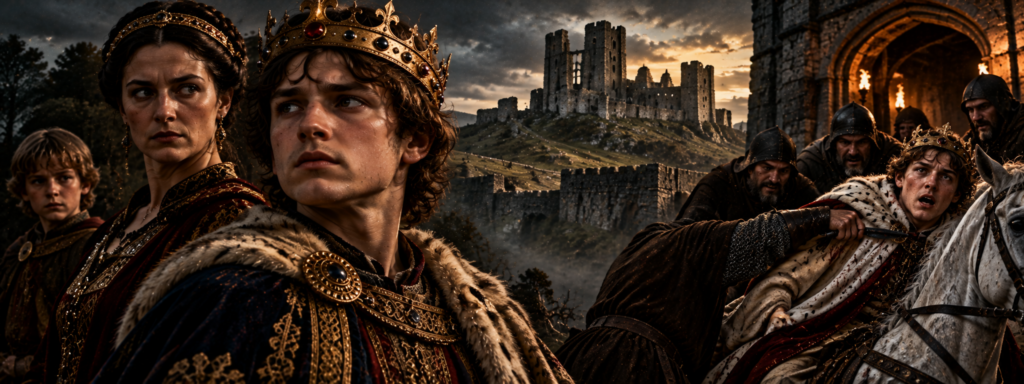
Edward the Martyr: The Teenage King Murdered at Corfe and the Stepmother Accused of Betrayal
Edward the Martyr (c. 962–978) | King of England, 975–978 | Murdered at Corfe, Dorset, on March 18, 978, amid a bitter struggle over the English succession
The Young King Who Rode Into a Deadly Trap
On March 18, 978, a teenage king arrived at Corfe in Dorset and encountered the men who would end his life. Edward had ruled England for less than three years, and his kingdom was already divided by rival aristocratic factions, disputes over church property, and a succession that had never been universally accepted. According to the most familiar version of his murder, he had come to visit his stepmother, Queen Ælfthryth, and his younger half-brother, Æthelred. What should have been an ordinary royal visit became one of the most notorious killings in Anglo-Saxon history.
The later accounts describe a betrayal as intimate as it was brutal. Edward supposedly approached the royal residence on horseback, unaware that men waiting nearby intended to kill him. As he accepted hospitality, or paused to drink, attackers seized their opportunity and stabbed him before he could escape. Some versions claim that the wounded king’s horse bolted, dragging him across the ground and leaving his body terribly mutilated.
For centuries, the woman most closely associated with this murder was Edward’s stepmother, Ælfthryth. Medieval chroniclers accused her of arranging the killing so that her own son, Æthelred, could inherit the English throne. The accusation gave the story a particularly sinister character because it transformed a royal household into a place of calculated betrayal. A queen who should have protected her husband’s son became, in popular memory, the woman who ordered his destruction.
Yet the evidence is far less straightforward than the legend suggests. The earliest surviving accounts establish that Edward was murdered, but they do not identify Ælfthryth as the person responsible. The detailed accusations against her developed in later narratives, written after Edward had become venerated as a martyr. The murder itself is beyond serious doubt, while the identity of the person who ordered it remains one of the great unresolved questions of Anglo-Saxon history.
The political consequences were immediate. Edward’s younger half-brother succeeded him as Æthelred II, a king whose long reign would become associated with Viking invasions, political disasters, and the eventual collapse of English resistance to Danish conquest. The boy who benefited from Edward’s death would spend much of his life ruling beneath the shadow of a murder committed before he was old enough to govern independently. Although there is no credible reason to believe the young Æthelred personally arranged the killing, his accession was inseparable from the violence that removed his brother.
Edward’s death also transformed his reputation. A king whose brief reign had been troubled by factional conflict became remembered as an innocent royal martyr, murdered by treacherous men and denied the dignity owed to his crown. Stories of miracles developed around his remains, his body was eventually transferred to Shaftesbury Abbey, and his cult attracted royal and aristocratic attention. The teenager who had struggled to maintain authority while alive became a powerful religious symbol after death.
Behind the familiar story of the wicked stepmother lies something more complicated and arguably more disturbing. Edward’s murder occurred within a political system where royal succession depended upon powerful families, influential churchmen, and aristocrats whose loyalties could shift with alarming speed. His death may have been the work of men who believed that removing him would settle a dangerous dispute over the throne. Instead, it left England with a legacy of suspicion, contested legitimacy, and a royal crime whose true architects were never conclusively identified.
England Under Edgar the Peaceful
Edward’s story begins during the reign of his father, King Edgar, one of the most successful rulers of tenth-century England. Edgar became king of the Mercians and Northumbrians in 957 and ruler of the whole English kingdom in 959, following the death of his elder brother Eadwig. His reign brought a period of relative political stability after generations of warfare, dynastic rivalry, and struggles to consolidate English kingship. Later generations remembered him as Edgar the Peaceful, although the title should not obscure the considerable political authority required to maintain his position.
Edgar inherited a kingdom transformed by the achievements of earlier West Saxon rulers. Alfred the Great had resisted Viking conquest in the ninth century, while his descendants gradually extended their authority over territories previously controlled by Scandinavian armies. By Edgar’s lifetime, the English monarchy governed a kingdom considerably larger and more integrated than the old kingdom of Wessex. Royal authority nevertheless depended upon cooperation with powerful regional nobles, bishops, abbots, and members of the extended royal family.
The king’s household stood at the center of this political world. Royal marriages created alliances, children represented possible successors, and the status of a queen could affect the standing of her sons. A king might have children from more than one relationship, and the legitimacy of those relationships could become politically contentious after his death. Such uncertainties were especially dangerous when rival heirs were still young.
Edgar’s reign was also closely associated with the English Benedictine Reform, a movement that sought to strengthen monastic discipline and replace some communities of secular clerics with monks living under a stricter religious rule. Leading churchmen such as Dunstan, Archbishop of Canterbury, Æthelwold, Bishop of Winchester, and Oswald, Archbishop of York, played important roles in the movement. Royal patronage allowed monasteries to acquire land, privileges, and influence. These developments would later become central to the political conflicts surrounding Edward’s accession.
Edgar’s ceremonial coronation at Bath in 973 became one of the most famous events of his reign. Although he had already ruled for many years, the ceremony presented English kingship in an especially elaborate religious and political form. It emphasized the sacred character of royal authority and the king’s responsibility to uphold justice and protect the church. The image of a divinely sanctioned monarchy would become painfully relevant when Edgar’s own son was murdered only five years later.
The stability of Edgar’s reign depended heavily upon his personal authority. Powerful aristocrats could cooperate under a successful adult ruler while harboring disagreements over property, religious policy, and future succession. Those disputes did not disappear simply because the king maintained control. When Edgar died in 975, the political balance he had preserved began to fracture almost immediately.
Two Sons, One Throne, and a Dangerous Succession
Edward was one of Edgar’s sons, but his precise maternal background remains uncertain. Later sources identify his mother in different ways, and the status of Edgar’s relationship with her has been debated. Some accounts name a woman called Æthelflæd, while others introduce details that cannot be securely verified. These uncertainties mattered because questions surrounding royal marriage and legitimacy could influence arguments over succession.
Edgar’s later wife, Ælfthryth, occupied a more clearly established position as queen. She was the daughter of Ordgar, a powerful nobleman associated with Devon, and became one of the most prominent royal women of the period. Her marriage to Edgar strengthened connections between the monarchy and important aristocratic families. She also became the mother of Æthelred, whose birth created another potential claimant to the throne.
Edward was older than Æthelred, but seniority did not automatically settle the succession. Anglo-Saxon kingship was hereditary in the sense that rulers were generally drawn from the royal dynasty, yet succession was not governed by an inflexible rule of primogeniture. Powerful nobles and churchmen played important roles in recognizing and supporting a new king. A younger son could therefore become a serious contender if influential men preferred him.
The existence of two royal sons created a problem that Edgar’s authority had prevented from becoming an open crisis. Edward possessed the advantage of age and an established claim as the king’s son. Æthelred possessed the support that could arise from his mother’s recognized status as queen and from aristocratic connections associated with her household. The relative strength of these claims depended upon political loyalties as much as family relationships.
When Edgar died on July 8, 975, Edward was still very young. His exact birth year is uncertain, but he was probably in his early teens. Æthelred was younger still, making either succession likely to involve substantial influence from adult advisers. The question was therefore not simply which boy would wear the crown, but which group of powerful men would exercise influence over the government.
The struggle quickly divided the political elite. Archbishop Dunstan supported Edward, and other leading figures also favored his succession. Supporters of Æthelred appear to have included members of the aristocracy who opposed the political direction associated with Edward’s allies. The surviving sources do not provide a complete list of supporters on either side, but they make clear that the succession was contested.
Edward ultimately became king, but his accession did not resolve the underlying divisions. Æthelred remained alive, legitimate in the eyes of his supporters, and connected to a powerful royal household through his mother. The defeated faction had not disappeared. England now possessed a young king whose authority rested upon a political settlement that important people had never fully accepted.
The Stepmother Who Became the Prime Suspect
Ælfthryth entered Edward’s reign in an unusual and potentially uncomfortable position. She had been Edgar’s queen, but the new king was not her son. Her own child, Æthelred, had been passed over for the crown despite possessing a claim that some powerful men considered preferable. The change threatened to reduce her direct influence over the monarchy.
The queen’s earlier life had already become surrounded by dramatic stories. Later writers described Edgar’s courtship of Ælfthryth through a tale involving her first husband, Æthelwald, and the king’s supposed determination to possess a woman whose beauty had been concealed from him. In some versions, Edgar killed Æthelwald after discovering the deception. These accounts are late, highly romanticized, and cannot be treated as reliable descriptions of the circumstances of Ælfthryth’s marriage.
Nevertheless, the stories influenced her reputation. Medieval writers increasingly portrayed Ælfthryth as a woman whose beauty, ambition, and political influence had dangerous consequences for the men around her. By the time accounts of Edward’s murder were being elaborated, she had become an ideal figure upon whom to place responsibility for a royal crime. The wicked stepmother was already a familiar character in medieval storytelling.
The historical Ælfthryth was considerably more complex. She held an important position at Edgar’s court and appears prominently in surviving evidence of royal patronage and ecclesiastical affairs. Her status as queen was not merely ceremonial, and she possessed connections that could help protect her son’s interests. Such influence made her politically significant without proving that she was willing to arrange a murder.
After Edward’s accession, Ælfthryth’s position was tied to the future of Æthelred. A young prince whose claim had been rejected could still become king if his elder brother died or was displaced. That possibility gave the queen an obvious political interest in the succession. It did not, however, establish that she actively plotted Edward’s death.
The distinction between motive and guilt is essential. Ælfthryth benefited from the political outcome of the murder because her son inherited the throne. Yet many aristocrats and royal advisers also benefited from the change. The fact that a person gained from a crime does not demonstrate that the person ordered it.
Later chroniclers often treated the queen’s supposed motive as sufficient explanation. A mother wanted her son to become king, so the stepmother must have arranged the murder of the son who stood in his way. The reasoning created a compelling story, but it bypassed the difficult question of evidence. No surviving contemporary document identifies Ælfthryth as the person who gave the fatal order.
A Kingdom Divided by Land, Religion, and Power
The struggle surrounding Edward’s accession cannot be understood solely as a family quarrel. During the final decades of the tenth century, disputes over monasteries and church property became entangled with aristocratic politics. Edgar’s support for monastic reform had transferred resources and influence toward religious communities favored by reforming bishops. Not everyone welcomed those changes.
Some aristocrats believed that lands granted to monasteries had previously belonged to their families or had been transferred under questionable circumstances. Others opposed the replacement of secular clerics by monks in important religious institutions. The conflict involved property, local influence, patronage, and competing ideas about the proper organization of the church. Religious language could therefore conceal very practical struggles over wealth and authority.
Following Edgar’s death, opponents of the reform movement attempted to reverse some of its achievements. Monks were reportedly expelled from certain religious communities, and lands associated with monastic institutions became subjects of dispute. The resulting upheaval was sometimes described as an anti-monastic reaction. It reflected the weakening of the political settlement that Edgar had maintained.
Edward became associated with supporters of the reform movement, particularly Archbishop Dunstan and Bishop Æthelwold. This association gave his reign a religious dimension that later writers would emphasize. Yet it would be misleading to imagine that the teenage king personally directed every aspect of ecclesiastical policy. Much of the conflict involved powerful adults whose interests predated his accession.
The aristocratic struggle was equally important. Men who had prospered under Edgar competed to maintain or expand their influence during the minority of his successor. Regional power, royal favor, and control over estates could all depend upon which faction prevailed. Supporting Edward or Æthelred therefore meant more than choosing between two boys.
One of the most important figures was Ælfhere, ealdorman of Mercia, who became associated with opposition to aspects of the monastic reform. His position gave him considerable influence over the political balance within the kingdom. Other leading nobles supported the reforming church and the interests of Edward’s government. Their rivalries made the succession dispute part of a much wider contest.
The young king stood at the center of these competing pressures. He had inherited a monarchy whose apparent stability depended upon agreements that were rapidly breaking down. His supporters expected him to defend their position, while his opponents had reason to seek a different political settlement. The existence of Æthelred offered an alternative around whom dissatisfied men could gather.
The Brief and Troubled Reign of Edward
Edward ruled from 975 until his murder in 978, a period too short to establish a detailed record of personal government. His reign is remembered primarily through the political disturbances that followed Edgar’s death and the violence that ended his own life. The surviving evidence gives only limited insight into his personality, ambitions, or relationship with his advisers. Much of what later generations believed about him developed after he became a saint.
The young king nevertheless exercised royal authority in a recognizable political system. Charters and other documents associated with his reign demonstrate the continuing operation of government, ecclesiastical patronage, and the relationships between the crown and leading aristocrats. The kingdom did not simply collapse into anarchy after Edgar’s death. Yet the political environment was clearly less stable than it had been under the previous ruler.
Later writers sometimes portrayed Edward as hot-tempered or difficult. Such descriptions have been used to suggest that he alienated powerful men through his behavior. The problem is that these character judgments survive within narratives shaped by later political and religious concerns. They cannot provide a secure psychological portrait of a teenager who died more than a thousand years ago.
Other accounts emphasize his piety and innocence. These qualities became central to the cult that developed after his murder. A saintly king needed to appear morally superior to those responsible for his death. The historical Edward may have possessed genuine religious devotion, but the surviving evidence does not allow us to separate his personality completely from later idealization.
The tensions surrounding his reign were therefore more important than any supposed personal flaw. Aristocratic factions disagreed over property and influence, while religious communities struggled to defend privileges granted under Edgar. The unresolved succession created an additional source of instability. Edward’s youth made him particularly dependent upon advisers whose interests were not always identical.
By early 978, the political situation remained dangerous. Edward’s half-brother was still a possible alternative king, and the factions that had opposed his accession had not necessarily abandoned their ambitions. A sudden death could change the entire balance of power. On March 18, that possibility became reality.
Corfe: The Place Where a King Was Murdered
Corfe lies in the Isle of Purbeck in Dorset, a region of hills, valleys, and routes connecting inland settlements with the southern coast. The dramatic ruins of Corfe Castle now dominate the landscape, making the location immediately recognizable to modern visitors. Those ruins, however, belong primarily to the great stone castle developed after the Norman Conquest. Edward’s murder took place long before that fortress existed in its familiar form.
In 978, the area was associated with a royal residence or estate rather than the later Norman castle. The exact appearance and location of the buildings connected with Edward’s death cannot be reconstructed with certainty. Archaeological evidence demonstrates the importance of the wider area in the Anglo-Saxon period, but it does not reveal the precise room or courtyard in which the king was attacked. Modern depictions that place the murder inside the surviving medieval castle are therefore anachronistic.
The tradition that Edward came to visit his stepmother and half-brother is widely repeated. It fits the political geography of the royal household and provides a plausible reason for his presence. Nevertheless, the earliest sources do not preserve all the details found in later accounts. The exact purpose of the visit remains uncertain.
Edward may have been traveling through the region as part of the normal movements of the royal court. Anglo-Saxon kings did not govern from a single permanent capital but moved between estates and residences where they received hospitality and conducted business. Such journeys allowed rulers to maintain contact with important regions and local elites. They also exposed them to the risks of travel and dependence upon hosts.
If Edward arrived at Corfe expecting a peaceful reception, the situation was especially dangerous. A king traveling with a limited retinue could become vulnerable when separated from loyal attendants. Men who controlled the immediate surroundings might possess a decisive advantage. A sudden attack could succeed before the victim understood what was happening.
The later tradition places Edward on horseback at the moment of the assault. He supposedly approached the residence and paused to receive hospitality before being attacked. The image is powerful because it presents the king as unsuspecting and exposed. Yet the precise circumstances belong to later accounts rather than securely established contemporary testimony.
What cannot reasonably be disputed is the outcome. Edward was murdered at Corfe on March 18, 978. His reign ended abruptly, and his younger half-brother became king. The place would remain associated with the killing for more than a thousand years.
March 18, 978: The Murder of Edward
The Anglo-Saxon Chronicle records Edward’s death in language that makes clear the shock and seriousness of the event. Its account states that the young king was murdered and associates the killing with Corfe. The chronicle does not provide a detailed reconstruction of the attack. It also does not identify Ælfthryth as the person who ordered it.
That silence is important because the Chronicle is among the closest surviving narrative sources to the event. Its compilers were writing within a tradition that preserved political information from the Anglo-Saxon period. Although the surviving manuscripts were copied and developed over time, their testimony remains considerably earlier than many elaborate accounts of the murder. The difference between the early record and later storytelling must remain central to any responsible reconstruction.
Later writers described Edward being attacked while still mounted. Some accounts claim that he was offered a drink, creating the impression of hospitality immediately before the assault. As he accepted it, armed men supposedly seized or stabbed him. The scene became one of the defining images of the murder tradition.
Other versions describe Edward attempting to escape after being wounded. His horse supposedly bolted, and the king became entangled in the stirrup or other riding equipment. The animal then dragged him across the ground, leaving his body badly injured. This detail intensified the horror of the story and emphasized the indignity inflicted upon a consecrated ruler.
These descriptions may preserve elements of an older tradition, but their accuracy cannot be established. The surviving early evidence does not provide enough detail to confirm the offered drink, the exact sequence of stabbing, or the dragging of the body. They should therefore be presented as later accounts rather than certain facts. The murder itself remains the historical foundation beneath the changing descriptions.
The identity of the attackers is equally uncertain. Some later sources refer to servants or retainers associated with Ælfthryth’s household. Others describe men acting in the interests of Æthelred or the faction that supported him. The available evidence does not allow the individual killers to be identified with confidence.
The attack was nevertheless politically consequential in a way that ordinary violence could never have been. Edward was not merely a young nobleman killed during a quarrel. He was the reigning king of England, and his death immediately opened the throne to another claimant. Whoever carried out the murder altered the succession by force.
The Stepmother Accused of Ordering the Killing
The accusation against Ælfthryth developed into the most enduring explanation for Edward’s murder. Later medieval chroniclers, including William of Malmesbury and Henry of Huntingdon, connected the killing with the interests of the queen and her son. Their narratives portrayed the murder as an act designed to remove the obstacle standing between Æthelred and the crown. The resulting story became deeply embedded in English historical memory.
William of Malmesbury wrote in the twelfth century, more than a century after Edward’s death. His historical works preserve valuable information, but they also reflect the literary methods and moral assumptions of his period. He was not an eyewitness to the events at Corfe. His account must therefore be evaluated alongside earlier evidence rather than treated as a direct record of the murder.
Henry of Huntingdon likewise wrote long after the event. His narrative contributed to the development of a tradition in which the queen’s ambition explained the king’s death. Such an explanation was appealing because it supplied a clear motive and a recognizable villain. It also connected the murder directly with the accession of Æthelred.
The accusation was not confined to a single late writer. Different medieval traditions associated Ælfthryth with the killing, although their details and emphases varied. Some portrayed her as personally arranging the attack, while others suggested that men acting on her behalf committed the murder. The repetition of the accusation made it influential, but repetition alone does not establish its truth.
The central weakness remains the absence of an explicit accusation in the earliest surviving accounts. If Ælfthryth had been publicly known as the person who ordered the murder, one might expect clearer contemporary testimony. Yet political caution, incomplete survival of records, and the influence of powerful royal factions could also explain silence. The absence of an accusation does not prove innocence, but it prevents certainty.
Ælfthryth’s position gave her a plausible motive. Her son had been passed over in 975, and Edward’s death removed the obstacle to his succession. As a politically connected queen, she may also have possessed access to men capable of carrying out violence. Those circumstances make suspicion understandable without converting it into proof.
There is another difficulty with the traditional accusation. Æthelred was still a child when Edward died, and his accession required support from powerful adult figures. A conspiracy could have involved aristocrats whose interests extended beyond the queen’s personal ambitions. Blaming Ælfthryth alone may obscure the wider political forces that made the murder possible.
The Possibility of an Aristocratic Conspiracy
Some modern historians have suggested that Edward’s murder may have been organized by members of the political faction supporting Æthelred. This interpretation places the killing within the broader struggle over royal succession and aristocratic influence. The conspirators might have believed that replacing Edward would protect their interests or reverse policies associated with his supporters. Such a motive would not require Ælfthryth to have personally ordered the attack.
The possibility is especially significant because Edward’s accession had been contested from the beginning. Men who favored Æthelred in 975 may have remained dissatisfied under Edward’s government. The anti-monastic reaction and disputes over land demonstrate that the political elite was divided by more than family loyalty. A change of king could affect property rights, appointments, and access to royal patronage.
An aristocratic conspiracy would also help explain how the murder could be carried out successfully. Killing a reigning monarch required opportunity, local support, or access to the royal household. Men connected with important families might possess the resources and influence necessary to arrange an attack. Their involvement could also help ensure that the younger prince succeeded without immediate civil war.
Yet this theory remains an interpretation rather than a proven reconstruction. No surviving contemporary document identifies a group of conspirators and records their plan. The names of the men who carried out the killing are not securely known. The possibility of factional involvement is historically plausible because of the political circumstances, not because a complete conspiracy has been documented.
The distinction between planning and benefiting is also important. Some nobles may have welcomed Edward’s death without participating in it. Others may have supported Æthelred’s accession only after the murder had already occurred. Political events often produce beneficiaries who were not responsible for causing them.
The queen’s relationship with such a faction is equally uncertain. She may have encouraged opposition to Edward, cooperated with influential nobles, or remained unaware of any plan to kill him. The surviving evidence does not permit a confident choice among these possibilities. Her reputation as the central conspirator may reflect the later tendency to reduce a complex political crime to the ambitions of one woman.
The aristocratic explanation therefore broadens the investigation without solving it. Edward’s murder took place in a kingdom divided by powerful interests, and those divisions provide a credible setting for conspiracy. The identity of the conspirators remains unknown. The political consequences, however, are unmistakable.
Was Æthelred Innocent of His Brother’s Murder?
Æthelred’s role in the story requires particular care because he was the person who inherited the throne. His accession followed immediately upon Edward’s death, creating an obvious connection between the murder and the succession. Yet Æthelred was still a child in 978. There is no reliable evidence that he personally ordered or participated in the killing.
The later reputation of Æthelred has sometimes encouraged unfair interpretations of his childhood. He became known to history as Æthelred the Unready, a nickname derived from an Old English word meaning poorly advised rather than simply unprepared. His reign was marked by repeated Viking attacks, political instability, heavy payments to invading forces, and eventual conquest. Those later disasters have often colored accounts of his accession.
It is tempting to imagine that a reign beginning with murder was destined to end in catastrophe. Medieval writers sometimes encouraged that interpretation by presenting Edward’s death as a sin whose consequences haunted the kingdom. Yet history does not operate through such simple moral patterns. Æthelred’s later difficulties had complex military, political, and economic causes.
The young prince may have known little about the circumstances of his brother’s death. Even if members of his household were involved, a child could inherit the benefits of their actions without understanding or approving them. His succession depended upon adult advisers and aristocrats who controlled the machinery of government. The responsibility for Edward’s murder should not be transferred automatically to the boy who became king.
Nevertheless, the circumstances of his accession created a lasting problem of legitimacy. Edward had been the recognized king, and his removal through violence could be interpreted as a violation of the sacred character of monarchy. Æthelred inherited a throne made available by an unresolved royal crime. That fact could be exploited by political opponents or interpreted by religious writers as a sign of divine displeasure.
Æthelred’s government later participated in the recognition and commemoration of Edward’s sanctity. This complicates any simplistic picture of a dynasty attempting to erase the murdered king. Royal support for Edward’s cult could demonstrate piety, acknowledge the injustice of the murder, and help reconcile the monarchy with those who had supported the previous ruler. It could also strengthen the legitimacy of a king whose accession remained morally troubling.
The relationship between the brothers is therefore one of the story’s most poignant uncertainties. They shared a father but stood on opposite sides of a succession dispute shaped largely by adults. One died before reaching maturity, while the other inherited a kingdom that would face decades of crisis. Neither boy had created the political system that placed them in competition.
The Body of the Murdered King
The treatment of Edward’s body became an important part of the later martyrdom tradition. Accounts describe his remains being buried without the honors normally owed to a king. Some versions associate the initial burial with Wareham, while others introduce details about the concealment or discovery of the corpse. The precise sequence is difficult to reconstruct because the surviving narratives differ.
The indignity of an improper burial carried considerable symbolic weight. Anglo-Saxon kingship was closely associated with Christian ritual, royal ceremony, and the public recognition of authority. A murdered king denied an honorable funeral could be portrayed as the victim of an injustice extending beyond death. The treatment of his body became evidence of the moral corruption of those responsible.
Later traditions describe miraculous signs surrounding Edward’s remains. These included lights, healings, and other events interpreted as demonstrations of divine favor. Such stories became central to his recognition as a martyr. They also helped explain why his body deserved removal to a more prestigious religious setting.
The historical development of Edward’s cult can be traced more securely than the miraculous details themselves. His remains were eventually transferred to Shaftesbury Abbey, an important religious institution with strong royal connections. The translation of his body became a major event in the preservation of his memory. It transformed a murdered ruler into the focus of organized religious devotion.
The accounts of his remains also reveal the importance of controlling a royal corpse. A living king exercised authority through government, military leadership, and patronage. A dead king could still possess political significance through burial, commemoration, and the religious institutions associated with his memory. Edward’s body became a powerful symbol around which competing interpretations of his death could develop.
The transformation was especially striking because the murder had apparently been intended to remove him from political life. His death ended his ability to rule, but the treatment of his remains created a new form of influence. Religious communities could invoke his name, preserve his story, and present him as a victim of injustice. The king who had been unable to defend himself at Corfe became a figure whose memory commanded reverence.
Shaftesbury Abbey and the Making of a Royal Martyr
Shaftesbury Abbey became the principal center of Edward’s cult. The abbey had been founded in the ninth century under royal patronage and possessed strong connections with the West Saxon dynasty. Its religious prestige made it an appropriate setting for the remains of a murdered king. The transfer of Edward’s body strengthened the abbey’s importance and ensured that his memory would be preserved within an influential institution.
The translation of Edward’s remains is commonly associated with the year 979 or 980, although the chronology of the early cult is not entirely straightforward. Later accounts describe the event with elaborate ceremonial and miraculous details. The movement of the body represented a public recognition that Edward deserved honor rather than obscurity. It also gave his supporters a place where devotion could be organized.
The abbey’s association with the royal family made the cult politically significant. A murdered king whose brother occupied the throne presented a potentially uncomfortable problem for the reigning dynasty. Honoring Edward could help reconcile competing loyalties and demonstrate that the monarchy did not endorse the violence that had brought about the succession. Religious commemoration offered a way to acknowledge the victim without necessarily reopening the political struggle.
The cult also benefited Shaftesbury itself. A shrine associated with a royal martyr could attract pilgrims, gifts, and aristocratic patronage. Stories of miracles strengthened the reputation of the saint and the institution responsible for preserving his remains. The abbey became closely identified with Edward’s memory.
The development of his cult did not occur independently of political circumstances. The late tenth and early eleventh centuries were periods of considerable anxiety about royal authority, ecclesiastical reform, and the moral responsibilities of rulers. Edward’s death provided a powerful example of the consequences of political treachery. His memory could be used to condemn unlawful violence and emphasize the sacred character of kingship.
The cult also shaped the surviving narratives. Religious writers had reasons to portray Edward as innocent, devout, and unjustly killed. Their accounts emphasized the wickedness of his murderers and the miraculous signs that supposedly confirmed his sanctity. These traditions preserved the emotional significance of the event while making it harder to reconstruct the historical king as a complex individual.
The Miracles and the Growth of the Legend
Edward’s reputation as a martyr encouraged the development of miracle stories. Later accounts described healings associated with his remains and extraordinary signs surrounding the places where his body had rested. Such narratives were familiar features of medieval hagiography. They presented the saint as an active source of divine assistance even after death.
The miracles also served to distinguish Edward from ordinary victims of political violence. Many rulers had been killed during succession struggles, but not all became saints. The stories surrounding Edward emphasized that his death possessed a religious meaning beyond the immediate political consequences. His innocence and divine favor were presented as the reasons his memory deserved special honor.
The narrative of his murder became increasingly elaborate as the cult developed. The offered drink, the sudden stabbing, the runaway horse, and the concealment of the body all contributed to a story designed to evoke sympathy and outrage. Each detail strengthened the contrast between the unsuspecting king and those who betrayed him. The resulting account became memorable precisely because it combined domestic intimacy with political violence.
The accusation against Ælfthryth also grew within this environment. A martyrdom narrative required persecutors whose actions could be condemned. The queen’s relationship to Edward and her son’s succession supplied a convenient explanation for the crime. Over time, the accusation became so familiar that it was often repeated without reference to the uncertainty of the earliest evidence.
The growth of the legend should not be dismissed as meaningless invention. Medieval communities used such stories to explore moral questions about power, kinship, betrayal, and legitimate authority. The narratives reveal what later generations found most disturbing about Edward’s death. They also demonstrate how historical memory could transform a political event into a religious lesson.
Yet the distinction between devotion and evidence remains essential. A miracle story may illuminate medieval belief without establishing the physical circumstances of a murder. A chronicler’s accusation may reveal a tradition of blame without proving the accused person’s guilt. Edward’s historical significance becomes clearer when those different kinds of testimony are examined separately.
The Political Uses of a Murdered King
Edward’s cult developed during the reign of the brother who had benefited from his death. This created an unusual relationship between the living monarchy and the memory of the murdered ruler. Æthelred’s government could not easily ignore Edward without appearing indifferent to a royal crime. At the same time, excessive emphasis on the injustice of the murder might raise uncomfortable questions about the legitimacy of the succession.
Supporting Edward’s commemoration offered a possible solution. The reigning king could honor his brother as a saint while distancing himself from the violence that had removed him. Such recognition might reassure supporters of the previous reign and strengthen relations with influential religious communities. It could also present Æthelred as a ruler committed to justice and Christian kingship.
The cult became increasingly important as England faced renewed Viking attacks. Religious writers interpreted political disasters through moral frameworks that emphasized sin, repentance, and divine judgment. The murder of a consecrated king could be understood as a national offense whose consequences extended beyond the immediate participants. Edward’s death therefore acquired meanings that were not necessarily present in 978.
These interpretations became especially influential during the troubled later years of Æthelred’s reign. England experienced repeated Scandinavian raids, large payments to invading armies, internal political tensions, and eventually the conquest associated with Sweyn Forkbeard and Cnut. Writers seeking explanations for these disasters could look backward to earlier failures of justice. The murder of Edward offered a powerful symbol of a kingdom whose political order had been corrupted.
Such moral explanations should not replace historical analysis. Viking expansion, military organization, political rivalries, and the resources of competing kingdoms all shaped England’s difficulties. The murder of Edward did not mechanically cause the disasters of Æthelred’s reign. Yet the belief that it had damaged the moral foundations of kingship influenced how later generations understood those events.
The dead king therefore became part of the political language of the living. His memory could be invoked to defend legitimate authority, condemn treachery, and encourage repentance. The murder had ended his reign, but it had not ended his usefulness as a symbol. Edward’s posthumous reputation became more powerful than anything securely documented from his short period of government.
The Queen’s Later Life and the Silence of the Evidence
Ælfthryth did not disappear from public life after Edward’s murder. She remained an important figure during the early years of Æthelred’s reign and continued to possess religious and political connections. Her later activities complicate the image of a universally condemned murderer. The surviving evidence does not show that she was publicly tried or punished for ordering Edward’s death.
This absence of punishment has sometimes been interpreted in different ways. Those convinced of her guilt may argue that her son’s accession protected her from prosecution. Others regard the lack of contemporary accusation as evidence that the later murder tradition was exaggerated or invented. Neither conclusion can be established with certainty.
Ælfthryth was associated with religious patronage, including connections with Wherwell Abbey in Hampshire. Her role in the religious life of the kingdom is historically important because it demonstrates that she remained more than a shadowy figure in a murder legend. She possessed an identity as a royal woman and patron independent of the accusations against her. Later writers sometimes interpreted religious activity as repentance for the killing, but that interpretation is not securely established.
The tendency to explain her later religious associations as penance reveals the strength of the murder tradition. Once a woman had been cast as the villain of a saint’s life, subsequent actions could be reinterpreted as evidence of guilt. Religious patronage became repentance, political influence became ambition, and maternal concern became conspiracy. The narrative could absorb almost any detail of her life.
A more cautious approach recognizes that Ælfthryth was a politically influential queen whose son benefited from Edward’s death. Those facts justify examining her possible involvement. They do not justify declaring her guilty without stronger evidence. Her actual role in the murder remains unknown.
The uncertainty is not a minor qualification to an otherwise settled story. It is central to the historical problem. Ælfthryth may have been involved, but the surviving sources cannot demonstrate that she ordered the killing. The familiar image of the murderous stepmother belongs more securely to medieval tradition than to established historical fact.
The Men Who May Have Had More to Gain
Focusing exclusively on Ælfthryth risks overlooking the powerful men whose interests were involved in Edward’s reign. The succession dispute of 975 had divided important aristocratic and ecclesiastical factions. Some nobles opposed the policies associated with Edward’s supporters, while others stood to gain from a change in government. These interests provide a broader context for the murder.
A young king could be particularly vulnerable to aristocratic manipulation. Edward depended upon experienced advisers, and his authority was exercised through networks of regional power. Men who controlled estates, military forces, and local loyalties could influence political outcomes far beyond their formal positions. Removing the king might therefore have been attractive to a faction seeking to reshape the balance of power.
The question is whether such men needed Ælfthryth’s direct involvement. A group of nobles loyal to Æthelred could conceivably have arranged the killing independently, expecting the queen and her son to benefit afterward. Alternatively, members of the royal household might have acted with encouragement from political allies. The evidence does not permit these possibilities to be distinguished.
The absence of identified conspirators is especially frustrating because the murder required practical action. Someone knew where Edward would be, possessed access to the location, and carried out the attack. Others may have helped conceal the crime or secure Æthelred’s succession. The surviving record preserves the outcome but not the operational details.
It is also possible that the killing was less carefully planned than later accounts suggest. A confrontation involving hostile retainers could have escalated into violence, after which political leaders accepted the resulting change of king. Such an explanation would differ considerably from the image of a prearranged assassination ordered by the queen. Yet it remains speculative because the evidence is insufficient.
The political environment nevertheless makes one conclusion difficult to avoid. Edward’s death was not an isolated domestic tragedy without wider significance. It occurred amid a struggle over royal authority, religious patronage, and aristocratic influence. The murder changed the succession in a way that benefited one political grouping and ended the hopes of another.
Why the Murder Was Never Solved
Edward’s murder took place in a society without modern investigative institutions. There was no independent police force capable of examining a royal death outside the influence of powerful families. The king himself was normally a central source of justice, and his sudden removal created a political crisis. The people who might have investigated the killing were also those whose positions depended upon the outcome.
The accession of Æthelred complicated matters further. The new king was a child whose government depended upon adult advisers. If some of those advisers had been involved in the murder, they would have possessed strong reasons to discourage scrutiny. Even if they were innocent, a public investigation might have reopened dangerous disputes over the succession.
The available records also reflect the interests of the people who produced them. Monastic chroniclers preserved events they considered important, but they did not necessarily possess access to confidential political decisions. Later historians relied upon earlier writings, oral traditions, and institutional memories that could be incomplete or biased. The resulting evidence is uneven and sometimes contradictory.
The passage of time made the problem worse. By the twelfth century, when writers such as William of Malmesbury and Henry of Huntingdon described the murder, the political world of 978 had long disappeared. The individuals involved were dead, and the details of the original investigation, if one occurred, were no longer available. Religious tradition had become intertwined with political memory.
The story of Ælfthryth’s guilt may preserve an authentic accusation that circulated soon after the murder. It may also represent a later attempt to explain a politically convenient death by blaming the person whose son benefited most directly. Both possibilities must be considered. Neither can be established conclusively.
The murder remains unresolved because the surviving evidence does not identify the killers or the person who directed them. Historians can reconstruct the political circumstances and examine the traditions that developed afterward. They cannot produce a verdict supported by the kind of evidence required to settle the accusation. Edward’s death therefore remains a historical murder mystery rather than a solved case of royal conspiracy.
Edward and the Sacred Nature of Kingship
The murder of Edward was particularly shocking because Anglo-Saxon kingship carried a powerful religious dimension. Kings were expected to defend the church, uphold justice, and protect the peace of their kingdoms. Royal ceremonies emphasized the connection between political authority and Christian responsibility. Violence against a reigning king could therefore be interpreted as an offense against the moral order of society.
Edward’s youth intensified the sense of injustice. He was a teenager who had inherited a dangerous political situation created largely by older and more powerful figures. Whether he was personally devout, difficult, capable, or inexperienced, he was still the recognized ruler of England. His murder represented the destruction of royal authority through private violence.
The later cult emphasized this religious dimension. Edward became known as a martyr, although his death did not occur during a conventional persecution for Christian belief. His sanctity developed from the idea that he had been an innocent king murdered unjustly. The category of royal martyrdom allowed political violence to acquire religious significance.
This interpretation also reinforced the legitimacy of kingship. By condemning Edward’s murder, religious writers could warn against treachery and unlawful attacks upon rulers. The saint became an example of what happened when ambition overcame loyalty and justice. His death could therefore serve as a lesson to later kings and aristocrats.
Yet the sacred image of kingship also created difficulties for historical understanding. A martyr needed to appear innocent, while the murderers needed to embody wickedness. The complexities of Edward’s reign could disappear beneath that moral contrast. Political disagreements over land, church reform, and succession became secondary to the story of an innocent victim betrayed by evil conspirators.
The historical Edward deserves to be understood within both contexts. He was a young king struggling to rule a divided kingdom, and he became a religious figure whose murder acquired enduring significance. The first identity explains the political circumstances of his death. The second explains why his story survived.
The Long Shadow Over Æthelred’s Reign
Æthelred inherited the English throne immediately after Edward’s murder, but his reign would prove exceptionally troubled. During his early years, government was conducted under the influence of powerful advisers and royal relatives. As he matured, he faced increasing challenges from Scandinavian raiders and the political difficulties of maintaining a united kingdom. His reign eventually became one of the most controversial in English history.
The renewed Viking attacks of the late tenth century placed enormous pressure upon the monarchy. Raiding armies targeted wealthy settlements, religious communities, and coastal regions. English rulers attempted military resistance, diplomacy, and payments intended to persuade invaders to withdraw. These strategies produced mixed results and became increasingly expensive.
Æthelred’s government also struggled with internal distrust. The dismissal or punishment of advisers, changes in political alliances, and the influence of competing aristocratic families contributed to instability. The murder of Edward remained part of the remembered background to the reign. Later writers could interpret subsequent disasters as consequences of the injustice that had accompanied Æthelred’s accession.
One particularly notorious event was the St Brice’s Day massacre of 1002, when Æthelred ordered the killing of Danes within his kingdom. The extent and implementation of the order remain debated, but the event demonstrates the severity of the political anxieties surrounding his rule. It also illustrates how royal violence could become part of attempts to defend a threatened monarchy. Æthelred’s reign was shaped by decisions far removed from the circumstances of his childhood accession.
In 1013, Sweyn Forkbeard of Denmark conquered England, forcing Æthelred into exile. Although Æthelred returned after Sweyn’s death, the struggle for control of the kingdom continued. Æthelred died in 1016, and England soon passed under the rule of Cnut. The political order established by Edgar and inherited by his sons had been profoundly transformed.
It would be historically irresponsible to claim that Edward’s murder directly caused these events. The Viking conquests resulted from military and political developments extending across northern Europe. Yet the killing remained an important symbol of the instability that could emerge when royal succession became entangled with violence. It marked the beginning of Æthelred’s reign with a question that could never be fully answered.
Corfe Castle and the Survival of a Dark Reputation
The association between Edward’s murder and Corfe endured through centuries of English history. The later Norman castle became one of the most dramatic fortifications in southern England, and its ruins eventually provided a powerful visual setting for the story. Visitors could imagine the young king approaching a fortress where betrayal awaited him. The surviving stone walls, however, belong to a period long after his death.
This distinction matters because the physical landscape can create misleading impressions of historical continuity. The site associated with Edward’s murder existed in the Anglo-Saxon period, but the familiar castle was constructed and developed under later rulers. The murder should not be imagined automatically within its surviving towers and curtain walls. The original setting was a royal residence whose precise form remains uncertain.
Corfe’s later history added further layers of violence and political conflict. The castle became an important royal stronghold and eventually played a role in the English Civil War. Its dramatic ruins encouraged romantic and historical interest in the location. Edward’s murder became one of the earliest and most memorable events associated with the site.
The landscape therefore preserves a story whose details remain uncertain. The location of the killing is accepted, but the exact scene cannot be reconstructed. The famous image of Edward receiving a drink before being stabbed belongs to later narrative tradition. The castle ruins provide atmosphere rather than direct evidence.
For modern visitors, the story remains compelling because it combines a recognizable place with an unresolved crime. A teenage king was murdered, his younger brother inherited the throne, and a queen became the subject of accusations that endured for centuries. The setting gives the mystery a physical presence. Yet the ruins cannot answer the question that matters most: who ordered Edward’s death?
The Wicked Stepmother and the Power of a Convenient Villain
Ælfthryth’s reputation demonstrates how historical women could become central figures in stories of political violence. Her position as stepmother made her an especially convenient suspect because medieval audiences were familiar with narratives of rivalry between children from different marriages. The accession of her own son supplied a clear motive. Her political influence made the accusation plausible enough to endure.
The image of the wicked stepmother also simplified a complicated political struggle. Instead of examining aristocratic factions, disputes over church property, and competing claims to the throne, the story could blame one ambitious woman. The murder became a domestic crime driven by maternal ambition. That explanation was emotionally satisfying but historically incomplete.
Medieval writers did not invent suspicion of powerful women, but they often expressed it through familiar literary patterns. Queens who exercised political influence could be portrayed as manipulative, jealous, or dangerous. Their actions were interpreted through assumptions about female ambition and the proper boundaries of authority. Ælfthryth’s later reputation belongs partly within that tradition.
This does not mean that women were incapable of organizing political violence. Royal women could possess considerable influence, command loyal households, and participate in dynastic struggles. Ælfthryth’s position gave her potential access to the resources necessary for conspiracy. The question is whether surviving evidence demonstrates that she used those resources to arrange Edward’s murder.
It does not. The accusation remains possible but unproven. A responsible account must acknowledge the political motive while refusing to treat it as a substitute for evidence. The historical Ælfthryth should not be reduced to the villain of a story whose details were written long after her death.
The same caution applies to the men who supported Æthelred. Their political interests make involvement plausible, but no complete list of conspirators survives. The murder may have resulted from a factional plan, a household conspiracy, or circumstances that the surviving record no longer reveals. The enduring mystery lies precisely in the gap between what later generations believed and what can actually be demonstrated.
A Martyr Made From a Murdered Monarch
Edward’s transformation into a saint changed the meaning of his life. During his reign, he had been a young king whose authority was contested and whose government depended upon powerful advisers. After his death, he became a symbol of innocence, legitimate kingship, and betrayal. The complexities of his political position were increasingly overshadowed by the circumstances of his murder.
His cult at Shaftesbury preserved that reputation through religious devotion and institutional memory. Pilgrims honored his remains, miracle stories circulated, and later writers presented him as a victim whose death revealed the wickedness of political ambition. The cult ensured that his name survived when many other Anglo-Saxon rulers faded into obscurity. It also encouraged the development of a narrative in which moral certainty replaced historical ambiguity.
The title Edward the Martyr reflects that transformation. It does not mean that every detail of his later hagiography is historically reliable. Rather, it demonstrates how medieval communities interpreted his death within a religious framework. His murder became a lesson about the violation of sacred kingship.
The distinction between historical king and religious martyr is not a reason to dismiss either identity. Edward genuinely ruled England and genuinely died through violence. His posthumous veneration was also a real historical development with consequences for religious institutions and royal memory. The difficulty lies in separating those established facts from the dramatic details added by later writers.
His story therefore reveals how political violence could create enduring religious significance. The murderers, whoever they were, ended Edward’s ability to govern. They could not prevent his supporters from preserving his memory or interpreting his death as an act of injustice. The result was a reputation far larger than his brief reign might otherwise have produced.
Edward’s murder also became part of a wider English tradition of royal martyrdom. Later generations remembered other rulers who died violently and whose deaths were interpreted through religious ideas about innocence and legitimate authority. The cult of a murdered king could survive changes of dynasty, conquest, and political transformation. Edward became one of the most important examples of that phenomenon.
The Mystery That History Cannot Resolve
More than a thousand years after Edward’s death, the essential question remains unanswered. Who ordered the murder at Corfe on March 18, 978? The traditional answer names Ælfthryth, but the earliest surviving evidence does not support a definitive accusation against her. Later chroniclers supplied motives and details that cannot be independently verified.
The political circumstances suggest several possibilities. Ælfthryth may have participated in a conspiracy intended to place her son on the throne. Aristocrats supporting Æthelred may have arranged the killing independently. Men within the royal household may have acted for reasons now lost to history.
The murder may also have involved a combination of personal and political motives. Rivalry between royal households could overlap with disputes over property, religious patronage, and regional influence. A conspiracy need not have been directed by one person or motivated by one objective. The surviving evidence is too limited to reconstruct such relationships confidently.
What is certain is that Edward’s death benefited the faction that supported Æthelred. The younger prince became king, and the political settlement established after Edgar’s death was overturned. The murder removed a reigning monarch without a recorded public trial or lawful deposition. It was a decisive act of political violence.
The absence of a secure explanation has allowed the legend to flourish. The queen, the offered drink, the sudden stabbing, and the runaway horse create a memorable sequence that seems to answer every question. Yet the most dramatic details come from later accounts. The historical record remains far less complete.
The unresolved nature of the case should not weaken its importance. Edward’s murder exposes the fragility of kingship in a society where powerful factions could influence succession and where political violence might determine who wore the crown. It also demonstrates how later generations transformed uncertain events into stories of moral certainty. The mystery survives because the consequences are clear while the responsibility remains disputed.
The Crown, the Stepmother, and the Murder That Haunted England
Edward the Martyr’s reign lasted less than three years, but his death became one of the most enduring royal murder stories in English history. He inherited a kingdom divided by competing aristocratic interests, religious disputes, and uncertainty over the succession. His younger half-brother possessed a rival claim, while powerful adults struggled to determine which royal household would dominate the future. On March 18, 978, the conflict ended in violence when Edward was murdered at Corfe.
The familiar story presents his stepmother as the architect of the crime. Ælfthryth supposedly arranged the killing so that her own son could inherit the throne, turning a royal visit into a carefully prepared betrayal. Later chroniclers described the attack with details that made the murder especially shocking, including the offer of hospitality, the sudden stabbing, and the wounded king dragged by his horse. Those details became inseparable from popular memory, even though they cannot all be established from the earliest surviving evidence.
The accusation against Ælfthryth remains one of the most difficult questions surrounding the murder. She possessed a plausible motive because Æthelred’s accession followed Edward’s death. She also occupied a position of influence within the royal household. Yet no surviving contemporary account explicitly identifies her as the person who ordered the killing.
The possibility of an aristocratic conspiracy offers a broader explanation. Edward’s accession had been contested, and powerful men had reasons to prefer the succession of Æthelred. Disputes over monastic reform, property, and political influence had already weakened the unity of the kingdom. A faction determined to change the government might have regarded Edward’s removal as the quickest way to achieve its objectives.
The young Æthelred inherited the consequences of the crime. He became king while still a child, and there is no reliable evidence that he personally participated in the murder. Nevertheless, his reign began under circumstances that later generations found deeply troubling. The unresolved killing of his brother remained part of the moral and political history of his kingship.
Edward himself became something far more enduring than a defeated ruler. His body was honored, his memory was preserved at Shaftesbury, and his reputation developed into that of a royal martyr. Religious communities interpreted his death as an act of injustice against a consecrated king. The teenager whose authority had been contested during life became a symbol of legitimate kingship after death.
The transformation also obscured the historical individual. We know relatively little about Edward’s personality, his ambitions, or the decisions he made during his brief reign. Later writers emphasized innocence and sanctity because those qualities served the religious meaning of his death. The real young king remains partly hidden beneath the legend created around his murder.
Ælfthryth experienced the opposite transformation. A politically important queen became remembered primarily as a murderous stepmother. Her alleged guilt was repeated so frequently that it came to seem inseparable from the story. Yet the evidence does not permit the certainty that popular tradition has often claimed.
The contrast between the two reputations reveals the power of medieval historical storytelling. Edward became the innocent victim, while Ælfthryth became the ambitious woman whose desire for her son’s advancement supposedly destroyed him. The narrative offered a clear moral explanation for a complicated political crime. Its emotional force helped it survive long after the original circumstances had become impossible to reconstruct.
The murder also exposed the vulnerability of the English monarchy. Edgar had ruled a powerful and relatively stable kingdom, but his death reopened disputes that his authority had contained. Edward inherited those conflicts without possessing his father’s experience or political strength. His murder demonstrated how quickly a royal succession could become a struggle in which violence replaced negotiation.
The later disasters of Æthelred’s reign gave Edward’s death an even darker significance. Viking invasions, political instability, and eventual conquest encouraged writers to search for moral explanations in the kingdom’s past. The murder of a young king became a symbol of injustice at the heart of English political life. Although it cannot be treated as the direct cause of later events, it remained an unsettling beginning to a troubled reign.
Corfe itself became a place where the mystery acquired a lasting physical presence. The later castle ruins provided a dramatic setting for retellings of the murder, even though the surviving fortress did not exist in Edward’s lifetime. Visitors could stand among the stones and imagine the young king approaching a household where enemies awaited him. The landscape preserved the memory of the crime without revealing the identities of those responsible.
The historical record leaves us with a series of questions that may never be answered. Did Ælfthryth know that an attack was planned, or was she blamed because her son inherited the throne? Did powerful nobles organize the killing to overturn Edward’s government, or did violence erupt from a confrontation whose details were never preserved? Were the later stories of hospitality and betrayal based upon authentic memories, or were they created to give the murder a more recognizable moral shape?
The uncertainty does not make the crime less disturbing. A reigning king was killed while still in his teens, and the succession changed immediately afterward. The people responsible were never securely identified in the surviving record. The political order continued, but the question of legitimacy remained entangled with the memory of bloodshed.
Edward’s story endures because it combines the intimacy of family rivalry with the brutality of political power. A brother inherited the crown, a stepmother became the principal suspect, and a young king was transformed into a saint. The murder reveals how easily the ambitions of powerful adults could overwhelm a ruler who had barely reached maturity. It also demonstrates how history can preserve the consequences of a crime while losing the evidence needed to identify its authors.
Edward the Martyr died at Corfe on March 18, 978, but the mystery surrounding his death never truly ended. His murder removed a teenage king, placed his younger half-brother upon the throne, and left his stepmother accused of a betrayal that no surviving contemporary source conclusively proves. Over the centuries, the victim became a saint, the queen became a villain, and the political struggle that surrounded them was transformed into a story of innocence destroyed by ambition. Yet beneath the legend remains a darker and more troubling truth: someone decided that the future of England would be better served by the death of its young king, and history has never been able to say with certainty who made that decision.