
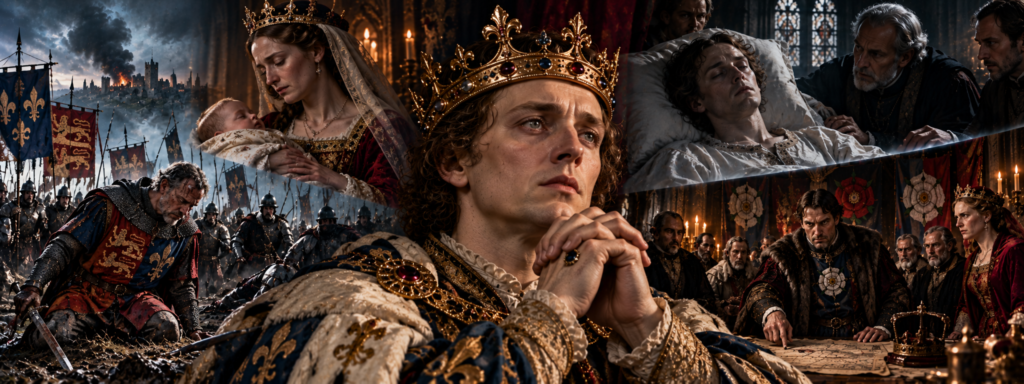
Henry VI: England’s Silent King, the Madness That Paralyzed a Throne, and the Bloody Wars of the Roses
He inherited the English crown before his first birthday and was proclaimed king of France while still an infant. He was the son of one of England’s greatest warrior kings, yet he grew into a gentle, deeply religious man who seemed far more comfortable with prayer and charitable works than warfare or political confrontation. Then, in the summer of 1453, something extraordinary happened. At thirty-one years old, Henry VI suffered a devastating episode of mental incapacity that left him almost entirely unresponsive to the world around him. He reportedly failed to acknowledge the birth of his only son, could not participate meaningfully in government, and remained incapacitated for more than a year. As England’s king sat silent, his ambitious relatives and powerful nobles fought over who should rule in his name. His eventual recovery did little to restore stability. Instead, the kingdom descended into the Wars of the Roses, a dynastic struggle marked by battlefield slaughter, political executions, betrayal, and the destruction of royal families. Henry would lose his crown, regain it briefly, and finally die as a prisoner in the Tower of London, almost certainly killed after his enemies returned to power.
The King Who Fell Silent
In the summer of 1453, England faced a crisis unlike anything its government had experienced in generations. King Henry VI, the thirty-one-year-old monarch who had ruled since infancy, suddenly became incapable of performing the duties of kingship. He withdrew from ordinary communication, appeared largely unaware of his surroundings, and could no longer participate meaningfully in the decisions upon which the kingdom depended. His condition was so severe that those around him struggled to obtain even the simplest responses.
The timing could hardly have been worse. England’s long war against France was approaching a humiliating conclusion, the royal treasury was under immense strain, and rival factions were competing for influence over a monarch already criticized for his political judgment. The loss of the king’s active participation created an extraordinary constitutional problem. Henry remained England’s legitimate, anointed sovereign, but the government could no longer depend upon him to exercise royal authority.
For months, the king’s condition showed little obvious improvement. His attendants continued caring for him, while councillors attempted to manage affairs in his name. Those seeking royal approval encountered a ruler who apparently could not understand or respond to their requests. In a political system where the monarch’s personal authority was central to government, the consequences were immediate and potentially disastrous.
Then came an event that should have transformed Henry’s personal and dynastic future. On October 13, 1453, his wife, Margaret of Anjou, gave birth to their only son, Edward of Westminster. The arrival of a male heir was momentous for the Lancastrian dynasty, which had previously faced uncertainty over the succession. Yet when the infant was presented to Henry, contemporary reports indicate that the king gave no meaningful acknowledgment.
The episode became one of the most disturbing details of his illness. Medieval kings were expected to celebrate the birth of legitimate heirs because succession secured the continuity of the dynasty. Henry’s apparent inability to recognize his own son revealed the severity of his incapacity. It also encouraged political speculation about the future of the monarchy.
Unlike rulers whose supposed madness consisted primarily of cruelty, eccentricity, or accusations made by political enemies, Henry VI experienced a prolonged and well-attested period of serious mental or neurological incapacity. The historical evidence demonstrates that he became unable to govern and was largely unresponsive for an extended period. What caused the episode remains uncertain.
Some historians have suggested a severe depressive illness, while others have considered conditions involving catatonia, psychosis, or neurological dysfunction. Henry’s maternal grandfather, Charles VI of France, experienced recurrent episodes of severe mental disturbance, raising questions about a possible hereditary vulnerability. Nevertheless, the surviving evidence is insufficient to establish a definitive diagnosis or prove that Henry inherited a particular disorder.
The illness itself was only the beginning of the catastrophe. While Henry remained incapacitated, England’s leading nobles struggled to determine who should exercise authority in his absence. His wife sought to protect the interests of their infant son, while Richard, Duke of York, possessed both a powerful dynastic claim and substantial political support.
The kingdom was approaching a confrontation from which the Plantagenet dynasty would never fully recover.
A Crown Placed Upon a Baby’s Head
Henry VI was born on December 6, 1421, at Windsor Castle. His father was Henry V, the celebrated English warrior king whose victories during the Hundred Years’ War had transformed England’s position in France. His mother was Catherine of Valois, daughter of Charles VI of France. Their marriage formed part of the Treaty of Troyes, an extraordinary agreement intended to unite the English and French crowns under Henry V and his descendants.
Henry V had achieved international fame through his victory at Agincourt in 1415. His subsequent campaigns brought substantial French territories under English control, while political divisions within France strengthened his position. The Treaty of Troyes, concluded in 1420, recognized Henry V as heir to Charles VI, displacing the French dauphin from the succession. The arrangement represented the apparent triumph of English ambitions on the continent.
Yet the settlement depended upon military power and political cooperation that remained fragile. Many French subjects rejected the treaty, while supporters of the dauphin continued resisting English authority. The kingdom was divided between competing governments and loyalties. The infant Henry entered the world as the intended beneficiary of an ambitious settlement that had not yet been secured.
On August 31, 1422, Henry V died unexpectedly at Vincennes, probably from an illness contracted during his military campaigns. His son was not yet nine months old. The death deprived England of an experienced military leader at a critical moment in the war. It also placed the monarchy in the hands of a child incapable of exercising authority.
Henry VI immediately became king of England. Less than two months later, Charles VI of France died, allowing the English government to proclaim the infant Henry king of France under the Treaty of Troyes. The French dauphin, however, continued claiming the French crown and would eventually reign as Charles VII. Henry’s supposed inheritance of France therefore remained fiercely contested.
The English government faced the difficult task of ruling in the name of a baby. Henry’s uncles and other senior nobles assumed responsibility for administration and military affairs. John, Duke of Bedford, became the principal English commander and regent in France, while Humphrey, Duke of Gloucester, exercised important responsibilities in England. Their relationship was complicated by political rivalry and competing ambitions.
Henry’s minority government achieved significant successes during its early years. English armies continued campaigning in France, and the victory at Verneuil in 1424 strengthened their position. Bedford demonstrated considerable administrative and military ability, preserving much of the inheritance created by Henry V. Nevertheless, the government depended heavily upon experienced individuals whose deaths or political failures could destabilize the entire system.
Henry himself grew up surrounded by the ceremonial expectations of kingship. He was crowned king of England at Westminster Abbey in November 1429 and crowned king of France at Notre-Dame Cathedral in Paris in December 1431. The ceremonies emphasized his claim to both kingdoms, but they could not eliminate the military and political challenges facing English rule in France.
The child king possessed extraordinary titles before he had developed the experience necessary to understand their responsibilities. His father had built a reputation through warfare and conquest, while his grandfather Henry IV had seized the English throne from Richard II. Henry VI inherited the consequences of both achievements without having chosen either path.
The contrast between his inheritance and his personality would become increasingly important as he reached adulthood.
The Son Who Was Nothing Like His Father
Henry VI grew into a ruler whose character differed markedly from that of Henry V. Contemporary accounts describe him as devout, charitable, modest, and personally reluctant to engage in violence. He took religious observance seriously and displayed considerable interest in education and ecclesiastical patronage. His reputation for personal piety became one of the most consistent features of descriptions written during and after his lifetime.
These qualities were admirable within medieval Christian culture, but kingship demanded more than personal virtue. A monarch was expected to dispense justice, defend territory, manage powerful nobles, and make difficult decisions during political conflict. Henry’s reluctance to confront opponents directly created difficulties in a kingdom already divided by competing aristocratic interests. His generosity also exposed him to accusations that he rewarded favorites without sufficient regard for financial consequences.
Henry’s religious commitments were substantial. He founded Eton College in 1440 and King’s College, Cambridge, in 1441, intending to create institutions that combined education with religious observance. Both foundations became enduring parts of his legacy. They demonstrate that Henry possessed serious interests and long-term ambitions beyond the immediate struggles of government.
His personal conduct also attracted favorable attention. Chroniclers praised his chastity, modesty, and reluctance to use coarse language. Later traditions emphasized his discomfort with public violence and his preference for peaceful resolution of disputes. These accounts sometimes became idealized, particularly among those who later regarded him as a saintly figure, but they reflect an important aspect of his historical reputation.
Henry’s political weaknesses were nevertheless increasingly apparent. He often depended upon advisers to manage complex affairs and struggled to impose lasting settlements upon rival factions. His government became associated with financial difficulties, the loss of French territories, and accusations of corruption. Powerful nobles competed for access to royal favor, creating opportunities for factional conflict.
The king’s personal generosity could become politically dangerous. Grants of lands, offices, and revenues reduced the resources available to the crown while strengthening favored individuals. Those excluded from patronage resented the advantages enjoyed by their rivals. Henry’s inability to manage these competing expectations contributed to the deterioration of royal authority.
It would be misleading to suggest that his gentle temperament inevitably caused the Wars of the Roses. England’s problems were rooted in dynastic uncertainty, the costs of warfare, aristocratic rivalries, and structural weaknesses in government. Nevertheless, Henry’s difficulty in managing political conflict became increasingly significant as those pressures intensified.
The king who preferred religious devotion to military glory would eventually inherit a crisis that demanded precisely the qualities he found hardest to exercise.
Margaret of Anjou: The Queen Who Would Fight for Her Husband’s Crown
In April 1445, Henry VI married Margaret of Anjou, daughter of René of Anjou and Isabella of Lorraine. Margaret was approximately fifteen years old, while Henry was twenty-three. The marriage formed part of diplomatic efforts to secure peace between England and France. It was intended to strengthen negotiations that might reduce the financial and military burdens of the Hundred Years’ War.
Margaret arrived in England as a young foreign princess entering a politically divided court. Her marriage carried substantial expectations because the Lancastrian dynasty needed an heir. Henry had no children, and uncertainty over the succession encouraged speculation among powerful relatives. Margaret’s position would therefore become increasingly important.
The marriage was associated with the controversial surrender of Maine to France, an agreement that provoked resentment among English nobles who believed the government was abandoning territories won through costly campaigns. The precise relationship between the marriage negotiations and territorial concessions was complicated, but the political consequences were damaging. Critics accused the king’s advisers of sacrificing English interests.
Margaret gradually became an influential figure within the royal household. Her position strengthened as Henry’s political difficulties increased. Later Yorkist propaganda portrayed her as domineering, ambitious, and responsible for manipulating her husband. Such descriptions must be treated cautiously because they emerged from political enemies seeking to undermine the Lancastrian government.
The queen nevertheless demonstrated considerable determination. She defended the interests of her husband and, after 1453, their son. Her actions were shaped by the extraordinary vulnerability of the dynasty. If Henry lost his crown, Margaret and Edward of Westminster could lose their political position, inheritance, and potentially their lives.
Her relationship with Henry remains difficult to reconstruct in personal terms. The surviving evidence does not justify a simple portrayal of a weak husband controlled by an ambitious wife. Margaret operated within a political system in which queens possessed influence but faced significant restrictions upon formal authority. Her efforts to protect the Lancastrian succession often brought her into conflict with powerful nobles.
The birth of their son in October 1453 transformed the political situation. Until then, Richard, Duke of York, had been among the most prominent potential successors to the throne. Edward’s arrival created a direct Lancastrian heir. The child became central to the struggle between the queen’s supporters and Yorkist interests.
Yet Henry’s illness prevented him from participating meaningfully in the celebration of his son’s birth. Margaret now faced the challenge of protecting an infant heir while her husband remained incapable of governing. The queen’s political role would expand dramatically during the crisis.
Her determination would eventually make her one of the most formidable figures of the Wars of the Roses.
The Hundred Years’ War: The Empire Henry Could Not Save
Henry VI inherited an extraordinary position in France, but English control was already vulnerable. The victories of Henry V had depended upon military leadership, alliances with French factions, and the political divisions surrounding Charles VI. After Henry V’s death, the English government struggled to maintain these advantages. The French resistance gradually recovered strength.
Joan of Arc’s intervention in 1429 became a turning point. Her participation in the relief of Orléans and the campaign leading to Charles VII’s coronation at Reims strengthened French morale and legitimacy. Although Joan was captured and executed in 1431, the political and military recovery she helped inspire continued. English authority faced increasingly determined opposition.
The death of Bedford in 1435 deprived the English government of one of its most experienced commanders. The same year, the Treaty of Arras reconciled Philip the Good, Duke of Burgundy, with Charles VII. Burgundy had previously been a crucial English ally, and its change of allegiance weakened the English position. The diplomatic foundations of Henry V’s continental achievements were collapsing.
During the 1440s, English policy became divided between those favoring negotiation and those demanding continued military resistance. Henry’s government pursued peace, but concessions provoked resentment among nobles who had invested heavily in warfare. The loss of territories also threatened the financial interests of English landholders in France. Political opposition increasingly connected military failure with accusations of corrupt government.
In 1450, Normandy was effectively lost after a series of French victories, including the Battle of Formigny. The defeat was devastating because Normandy had been central to English continental ambitions since the Norman Conquest. Its loss undermined confidence in Henry’s government and intensified demands for political reform. The king’s advisers became targets of public anger.
The situation deteriorated further in Gascony, where English rule had deep historical roots. Aquitaine had entered the Plantagenet inheritance through the marriage of Henry II and Eleanor of Aquitaine in 1152, with Henry becoming king of England in 1154. The region had remained a central element of English continental interests for centuries. Its loss carried enormous symbolic and political significance.
English forces temporarily recovered Bordeaux in 1452 under John Talbot, Earl of Shrewsbury. Talbot was an experienced commander whose reputation had been established through decades of warfare. His return offered hope that English fortunes might be revived. Yet the recovery proved temporary.
In July 1453, French forces defeated Talbot’s army at Castillon. The battle effectively ended England’s major territorial position in Gascony. Talbot and his son were killed, and French artillery played an important role in the victory. The defeat marked the final collapse of English ambitions to retain Aquitaine.
The loss was a profound humiliation for the Lancastrian monarchy. Henry V had once appeared capable of uniting the English and French crowns, but his son now presided over the disappearance of almost all English possessions in France. Calais remained under English control, but the broader continental inheritance had been lost.
Within weeks, Henry VI suffered his devastating mental collapse.
Castillon and the Collapse of 1453: Did Defeat Break the King?
The Battle of Castillon took place on July 17, 1453, and news of the defeat reached England during the following weeks. Henry’s illness became apparent in August, creating an apparent chronological connection between the military disaster and his sudden incapacity. The timing has encouraged historians to consider whether the loss of Gascony contributed to his breakdown. Yet the surviving evidence does not establish a direct causal relationship.
Castillon was undeniably significant. John Talbot, one of England’s most experienced military commanders, had been killed, and the remaining English position in Gascony was collapsing. The defeat represented the failure of policies pursued throughout Henry’s reign. It also intensified criticism of his government and the advisers responsible for military affairs.
Henry may have experienced considerable distress upon learning of the disaster, but his private reaction is not documented in sufficient detail to establish the sequence of events. Some accounts suggest that he became ill after receiving the news, while others provide less precise chronology. The assumption that Castillon triggered his condition remains a historical hypothesis rather than a proven explanation. His illness may have involved medical factors unrelated to the military defeat.
The possibility of severe psychological stress is nevertheless understandable. Henry had inherited immense expectations from his father and faced repeated political criticism as those expectations collapsed. The loss of Normandy and Gascony represented not merely military setbacks but the destruction of a dynastic project. Such circumstances could have created substantial emotional pressure.
However, historical events cannot be used to diagnose an individual retrospectively. A severe mental or neurological episode may occur in association with stressful circumstances without being caused by them. The surviving descriptions of Henry’s incapacity are too limited to determine whether his illness resulted from psychological distress, an underlying psychiatric condition, a neurological disorder, or another medical cause.
The timing remains striking because the king’s collapse occurred at precisely the moment when decisive leadership was most urgently needed. England required political stability after the loss of its French territories. Instead, the government confronted a monarch who could no longer participate in its decisions. The crisis transformed military defeat into a struggle over the exercise of royal authority.
Henry’s illness therefore became a turning point regardless of its cause. The king’s incapacity created opportunities for ambitious nobles, intensified existing rivalries, and complicated the succession. His condition would soon place the government under the control of a protector whose own dynastic interests threatened the Lancastrian monarchy.
The consequences would be far more destructive than the immediate loss of territory in France.
A King Without Awareness: Inside Henry’s Long Illness
Henry’s illness lasted from the summer of 1453 until approximately Christmas 1454, when he began showing signs of recovery. During much of this period, he was described as largely unresponsive and incapable of performing ordinary royal functions. Contemporary evidence indicates that he could not meaningfully participate in government. His condition was sufficiently severe to require extraordinary political arrangements.
The surviving descriptions suggest a profound disturbance of awareness, responsiveness, or communication. Some accounts indicate that he failed to recognize people around him or respond appropriately to events. Others emphasize his inability to understand or participate in political business. These observations are historically important, but they do not provide the detailed clinical information necessary for a modern diagnosis.
One of the most famous episodes concerns the birth of Edward of Westminster in October 1453. The infant was presented to his father, but Henry reportedly gave no meaningful acknowledgment. The scene became central to later accounts because it illustrated the depth of the king’s withdrawal. His failure to respond to the arrival of an heir was particularly alarming in a monarchy dependent upon dynastic continuity.
Henry’s condition also affected the practical administration of government. Royal authority remained legally vested in him, but his incapacity prevented normal decision-making. Councillors had to determine how to manage appointments, legal matters, finances, and military affairs without effective participation from the sovereign. The resulting uncertainty intensified factional competition.
Medical treatment in fifteenth-century England was limited by contemporary understandings of illness. Physicians worked within traditions influenced by humoral theory, religious interpretation, and inherited medical knowledge. They could attempt various remedies, but they lacked the diagnostic tools and treatments available to modern medicine. The failure of treatment does not identify the underlying condition.
Later accounts sometimes describe Henry’s illness as a state of complete stupor or catatonia. Such terminology may capture aspects of the reported behavior, particularly prolonged unresponsiveness, but it remains retrospective. Catatonia can occur in several psychiatric and medical conditions, and the historical evidence does not establish that Henry experienced a particular syndrome. The term should therefore be used cautiously.
The duration of the episode is also significant. Henry remained incapacitated for more than a year, an extraordinary period for a reigning monarch. Some modern interpretations have suggested that he experienced repeated episodes rather than one continuous illness, but the evidence cannot establish that pattern. The available sources describe prolonged incapacity without providing a reliable day-by-day medical history.
Henry’s recovery was eventually reported in late 1454 and early 1455. He regained sufficient awareness to recognize people and resume aspects of royal life. His improvement was politically important because it challenged the arrangements established during his incapacity. Yet recovery did not eliminate the rivalries that had developed while he was unable to govern.
The king had returned to awareness, but the political world around him had changed.
The Shadow of Charles VI: Was Henry’s Illness Hereditary?
Henry VI’s maternal grandfather was Charles VI of France, whose reign had been marked by recurrent episodes of severe mental disturbance. Charles experienced periods of confusion, altered beliefs, and inability to govern effectively. His condition contributed to political instability in France and intensified conflict among powerful aristocratic factions. The similarities between the political consequences of their illnesses have attracted considerable historical attention.
Charles VI’s first major episode occurred in 1392 during a military expedition. Contemporary accounts describe him attacking members of his entourage after becoming severely disturbed. Later episodes involved unusual beliefs and behavior, including reports that he believed his body was made of glass. These descriptions became central to his reputation as Charles the Mad.
The French king’s condition fluctuated over many years. Periods of apparent recovery alternated with episodes of serious incapacity. His illness created opportunities for rival factions, particularly those associated with the dukes of Orléans and Burgundy. The resulting political conflicts weakened the French monarchy during the Hundred Years’ War.
Henry VI’s illness differed in important respects. The English king’s best-documented episode involved prolonged withdrawal and unresponsiveness rather than the dramatic disturbances reported during some of Charles’s episodes. The available evidence does not establish that the two men experienced the same medical condition. Similarities in family history cannot substitute for clinical information.
Some historians have suggested a hereditary vulnerability to psychiatric illness. Such a possibility cannot be dismissed, because certain psychiatric and neurological conditions can have genetic components. Nevertheless, the surviving records do not permit identification of a specific inherited disorder. The claim that Henry suffered from hereditary catatonic schizophrenia is therefore much more definite than the evidence supports.
The diagnosis of schizophrenia itself presents difficulties when applied retrospectively. Modern diagnostic criteria require patterns of symptoms and duration that cannot be reliably reconstructed from medieval chronicles. Catatonia is not exclusive to schizophrenia and may occur in mood disorders, neurological conditions, and other medical circumstances. Henry’s apparent recovery also complicates attempts to fit his illness into a single modern category.
Other hypotheses have included severe depressive illness, bipolar-spectrum conditions, and neurological disorders. Each attempts to explain aspects of the historical record, but none can be established conclusively. The evidence supports the existence of serious incapacity rather than a precise medical explanation. Responsible historical interpretation must preserve that distinction.
The family connection remains fascinating because both kings experienced illnesses that created political crises. Charles VI’s incapacity contributed to factional conflict in France, while Henry VI’s collapse intensified rivalry between Lancaster and York. In both kingdoms, the personal condition of the monarch exposed weaknesses in systems dependent upon royal authority. Their illnesses became inseparable from broader struggles over government and succession.
Henry’s maternal ancestry therefore provides context for medical speculation, but it does not solve the mystery of his illness. The historical record leaves the precise cause unresolved.
Richard, Duke of York: The Protector Who Became a Rival
Richard, Duke of York, was one of the most powerful nobles in England and possessed a significant dynastic claim through his descent from Edward III. His family connections placed him within the Plantagenet royal line, while his extensive estates provided considerable political resources. He had served in important military and administrative positions, including responsibilities in France and Ireland. His relationship with Henry’s government became increasingly strained during the 1440s and early 1450s.
York criticized the influence of certain royal advisers and expressed concern about the conduct of government. His opposition reflected both political grievances and personal interests. The loss of French territories, financial difficulties, and disputes over patronage created opportunities for him to challenge the ruling faction. His supporters presented him as a figure capable of restoring effective government.
Henry’s illness transformed York’s position. The government needed a mechanism for exercising royal authority while the king remained incapacitated. Powerful nobles disagreed over who should control appointments, finances, and political decisions. The queen’s position was especially important because she had recently given birth to the heir.
In March 1454, York was appointed Protector of the Realm. The office gave him substantial authority during Henry’s incapacity, although it did not make him king. His appointment reflected the need for stable government and the political strength of his supporters. It also threatened individuals associated with the existing Lancastrian administration.
One of York’s principal opponents was Edmund Beaufort, Duke of Somerset. Somerset had been closely associated with royal policy in France and became a target of criticism following military failures. York’s supporters accused him of misgovernment, while Somerset’s allies defended his position. Their rivalry intensified the factional divisions surrounding the crown.
During York’s protectorate, Somerset was imprisoned in the Tower of London. The action demonstrated how control of government could be used to weaken political opponents. York also pursued administrative measures intended to restore order. Yet his position depended upon Henry’s continued incapacity.
When Henry recovered around Christmas 1454, the political balance changed. The king resumed authority, and Somerset regained influence. York’s position became increasingly vulnerable. The rival factions now faced the possibility that disputes previously managed through councils would become armed confrontations.
The protectorate had provided a temporary solution to the constitutional crisis, but it had not resolved the underlying struggle for power. Henry’s recovery restored the appearance of normal kingship without restoring political trust.
The kingdom was approaching civil war.
The First Battle of St Albans: The Wars of the Roses Begin
In May 1455, the rivalry between York and the Lancastrian court erupted into open violence. Richard, Duke of York, and his allies gathered forces to confront the king’s government. Henry VI and his supporters moved toward St Albans, a town north of London. Negotiations failed to prevent a military confrontation.
The First Battle of St Albans took place on May 22, 1455. Yorkist forces attacked the town, where Lancastrian troops had established defensive positions. Fighting occurred in streets and around buildings, making the engagement unusually concentrated. The battle was relatively small compared with later conflicts but politically devastating.
The Lancastrian army was defeated, and several prominent nobles were killed. Among them was Edmund Beaufort, Duke of Somerset, York’s principal rival. Henry VI was wounded, reportedly by an arrow, and fell into Yorkist custody. The king’s capture demonstrated the extent to which royal authority had become entangled in aristocratic warfare.
The battle is commonly regarded as the opening engagement of the Wars of the Roses. The name itself became established much later and can obscure the complexity of the conflict. The opposing factions were not initially organized around a simple struggle between two clearly defined royal houses. Their rivalries involved personal grievances, regional networks, political patronage, and competing interpretations of legitimate government.
York’s victory restored his influence, and he eventually resumed the protectorate during another period of Henry’s reduced capacity or limited political effectiveness. The precise medical circumstances of Henry’s later difficulties remain less clearly documented than the episode of 1453–1454. Nevertheless, his ability to exercise independent authority remained a central political concern. The king’s condition complicated every attempt to establish a stable settlement.
Margaret of Anjou increasingly defended the interests of her husband and son. She regarded York’s growing power as a threat to the Lancastrian succession. Her political activity intensified as the factions became more entrenched. The conflict gradually transformed from a dispute over government into a struggle over the crown itself.
The first battle had not settled anything. It had demonstrated that powerful nobles were willing to use armed force in the presence of the king. The monarchy’s authority was now vulnerable to military outcomes beyond Henry’s control.
The wars that followed would destroy much of the political generation that had inherited England from Henry V.
Margaret of Anjou and the Fight for the Lancastrian Dynasty
Margaret of Anjou became increasingly central to Lancastrian resistance as Henry’s political authority weakened. Her position was shaped by the need to protect her son’s inheritance and preserve her husband’s crown. The queen developed alliances with nobles who opposed York and sought to strengthen support for the Lancastrian government. Her activities challenged expectations that queens should remain outside direct military and factional politics.
Yorkist propaganda portrayed Margaret as manipulative and excessively ambitious. Such accusations reflected the political interests of her enemies and the discomfort created by a queen exercising visible authority. Nevertheless, Margaret’s involvement in factional politics was substantial. She helped organize resistance and became associated with efforts to counter Yorkist influence.
The conflict intensified during the late 1450s. Attempts at reconciliation failed to overcome deep distrust among the factions. The Loveday ceremony of 1458, intended to demonstrate peace between rival nobles, produced an impressive public display but did not resolve their grievances. Beneath the ceremonial gestures, political hostility remained.
In 1459, renewed fighting broke out. Yorkist forces initially suffered setbacks, and York himself fled to Ireland. His principal allies, including the Earl of Warwick and the Earl of Salisbury, regrouped abroad. The Lancastrian government appeared temporarily successful, but the conflict was far from over.
The Yorkists returned in 1460 and achieved a major victory at Northampton. Henry VI was captured again, while several Lancastrian leaders were killed. The king’s repeated capture demonstrated the collapse of effective royal independence. He remained the symbolic center of government, but military factions increasingly determined his circumstances.
York then advanced a claim to the throne based upon his descent from Edward III. The resulting negotiations produced the Act of Accord in October 1460. Under its terms, Henry would remain king for life, but York and his heirs would succeed him, displacing Prince Edward. The agreement represented an extraordinary attempt to resolve the dynastic conflict through parliamentary settlement.
Margaret refused to accept the disinheritance of her son. Her opposition was unsurprising because the agreement threatened the future of the Lancastrian line. She continued organizing resistance with supporters in northern England and elsewhere. The political conflict now involved competing claims to hereditary legitimacy.
The attempt at compromise therefore failed. York had secured recognition as heir, but he had not eliminated opposition to his claim. His enemies remained determined to preserve Prince Edward’s rights.
The struggle would soon claim York’s own life.
Wakefield and Towton: The Crown Passes Through Blood
On December 30, 1460, Richard, Duke of York, was killed at the Battle of Wakefield. His forces had confronted Lancastrian opponents near Sandal Castle in Yorkshire. The precise circumstances of the battle remain debated, but the outcome was decisive. York and several important supporters died, including his son Edmund, Earl of Rutland.
The deaths transformed the dynastic struggle. York’s claim passed to his eldest surviving son, Edward, Earl of March. The younger Edward possessed military ability, aristocratic connections, and the support of powerful allies. He would soon emerge as the principal Yorkist claimant to the throne.
In February 1461, Lancastrian forces defeated the Earl of Warwick at the Second Battle of St Albans. Henry VI, who had been held by the Yorkists, was recovered by his supporters. The victory appeared to offer Margaret an opportunity to restore Lancastrian control. Yet the political situation remained unstable, and the Yorkists continued gathering strength.
Edward of March advanced toward London, where he received substantial support. In March 1461, he was proclaimed King Edward IV. His claim rested upon his Plantagenet descent and the argument that Henry VI’s government had failed to maintain lawful authority. The proclamation created a direct contest between two crowned monarchs.
The decisive confrontation occurred at the Battle of Towton on March 29, 1461. Fought during severe weather in Yorkshire, Towton became one of the largest and bloodiest battles of the Wars of the Roses. Contemporary casualty figures are difficult to verify and may be exaggerated, but the scale of the fighting was extraordinary. The Yorkists achieved a decisive victory.
Henry VI and Margaret fled north and eventually sought refuge in Scotland. Their supporters continued resisting, but the Lancastrian government had lost control of most of England. Edward IV established himself as king, beginning a new phase of Yorkist rule. Henry’s first reign had effectively ended.
The contrast with his childhood was devastating. Henry had inherited the English crown as an infant and been proclaimed king of France. He now possessed neither effective control of England nor any meaningful claim to govern France. His dynasty had been driven from power by a rival branch of the Plantagenet family.
The king whose illness had helped create a political vacuum was now a fugitive. His supporters would spend years attempting to restore him, but the chances of success depended upon military and diplomatic developments largely beyond his control.
The Fugitive King: Henry’s Years in Hiding
After the Yorkist victory, Henry VI spent several years moving between areas of Lancastrian support. Scotland provided refuge for a time, while Margaret sought assistance from foreign rulers. The Lancastrian cause remained active, but its resources were limited. Edward IV’s government gradually strengthened its position through military victories and political settlements.
Henry’s movements during these years are imperfectly documented. He depended upon loyal supporters who sheltered him despite the risks of assisting a deposed monarch. His position was precarious because capture could provide the Yorkists with a powerful political advantage. As long as he remained free, Lancastrian resistance could continue claiming legitimacy in his name.
The former king’s personal circumstances were a striking reversal from royal life. He had once been surrounded by ceremonial attendants and governed through an elaborate household. Now he relied upon the hospitality and secrecy of individuals willing to protect him. His survival depended upon networks of loyalty that were increasingly vulnerable to pressure.
In 1465, Henry was captured in Lancashire, probably near Clitheroe, after his whereabouts became known to Yorkist authorities. Accounts differ concerning the precise circumstances of his arrest. He was taken to London and imprisoned in the Tower. His capture removed an important symbol of Lancastrian resistance.
Edward IV’s government treated Henry as a political prisoner rather than immediately executing him. The former king’s survival carried both advantages and dangers. Killing an anointed monarch could damage Edward’s reputation, while keeping Henry confined reduced his ability to participate in rebellion. The Yorkist government therefore maintained him under guard.
Henry remained imprisoned for several years. His condition during captivity is difficult to reconstruct, and later accounts sometimes emphasize his resignation and religious devotion. The surviving evidence does not provide a reliable continuous record of his mental health. It would be misleading to assume that he remained permanently incapacitated simply because he had experienced a severe episode in 1453.
Meanwhile, political tensions developed within the Yorkist regime. Edward IV’s relationship with Richard Neville, Earl of Warwick, deteriorated over questions of marriage, patronage, and foreign policy. Warwick had played a major role in Edward’s rise to power, but their alliance became increasingly unstable. The resulting conflict would unexpectedly create an opportunity for the Lancastrian dynasty.
Henry, still confined in the Tower, was about to become king again.
The Readeption of 1470: A Prisoner Returns to the Throne
In 1470, Warwick broke decisively with Edward IV and formed an alliance with Margaret of Anjou. The arrangement was extraordinary because Warwick had previously been one of the principal architects of Yorkist victory. Political necessity brought together former enemies who shared an interest in removing Edward. Their alliance demonstrated the fluidity of aristocratic loyalties during the Wars of the Roses.
Warwick invaded England in the autumn of 1470, forcing Edward IV to flee abroad. The Yorkist king sought refuge in the Burgundian Netherlands, leaving his government temporarily unable to resist the rebellion. Warwick entered London and restored Henry VI to the throne. The event became known as the Readeption, meaning the recovery or resumption of kingship.
Henry’s restoration was largely symbolic. He had spent years in captivity and lacked the independent political resources necessary to govern effectively. Warwick and his allies exercised substantial authority in his name. The restored king provided legitimacy for a government controlled by powerful nobles.
The situation resembled earlier periods of Henry’s reign, when rival factions had competed to exercise authority through the monarch. His personal wishes played a limited role in determining policy. The political settlement depended upon Warwick’s ability to maintain alliances and prevent Edward IV from returning. It was therefore vulnerable from the beginning.
Margaret remained abroad during much of the early restoration, preparing to return with her son. Her cooperation with Warwick had been difficult because of their history of conflict. Nevertheless, she recognized the opportunity to recover her husband’s crown and secure Prince Edward’s inheritance. The Lancastrian dynasty appeared to have regained a chance of survival.
Edward IV returned to England in March 1471. He gathered supporters and advanced toward London, exploiting divisions among his opponents. His campaign culminated in the Battle of Barnet on April 14, 1471. Warwick was killed, destroying the principal military foundation of Henry’s restored government.
The Lancastrian position deteriorated further at the Battle of Tewkesbury on May 4, 1471. Edward IV defeated forces associated with Margaret and Prince Edward. The young prince was killed, although accounts differ concerning the circumstances of his death. Margaret was captured, and the Lancastrian succession suffered a devastating blow.
Henry’s second reign had lasted only a few months. He was again placed under Yorkist control. With his son dead and his principal supporters defeated, the dynasty’s prospects were effectively destroyed.
The former king’s survival now presented a final political problem for Edward IV.
The Tower of London: The Death of Henry VI
Henry VI died in the Tower of London during the night of May 21–22, 1471, shortly after Edward IV returned to London following his victory at Tewkesbury. The official Yorkist explanation suggested that Henry died from grief or melancholy after learning of his son’s death and the destruction of the Lancastrian cause. The timing immediately raised suspicion. His death removed the most important surviving figure around whom Lancastrian opposition could organize.
Most modern historians regard murder as the probable explanation. Edward IV’s government had strong political reasons to eliminate Henry after the final defeat of Lancastrian forces. The former king had already been restored once, demonstrating that imprisonment alone could not permanently prevent his use as a rival claimant. His continued existence therefore threatened the security of the Yorkist monarchy.
The precise circumstances of his death remain uncertain. Later traditions accused Richard, Duke of Gloucester, the future Richard III, of personally killing Henry. These allegations became prominent in historical and literary accounts, but they are not established by reliable contemporary evidence. The identity of any individual directly responsible remains unknown.
Henry’s body was displayed publicly, apparently to demonstrate that he was dead. The government sought to prevent rumors of survival and further rebellion. He was initially buried at Chertsey Abbey in Surrey. His remains were later transferred to St George’s Chapel, Windsor, during the reign of Richard III.
The death ended the political career of a monarch who had never been able to escape the consequences of his inheritance. Henry had become king before his first birthday and spent much of his life surrounded by advisers, rivals, and military commanders who exercised power in his name. His severe illness intensified those struggles, but it did not create every underlying cause. The monarchy had already been weakened by financial difficulties, territorial losses, and aristocratic competition.
His wife survived him. Margaret of Anjou remained in English custody for several years before returning to France, where she died in 1482. Their only son had been killed at Tewkesbury, leaving no direct Lancastrian heir through Henry VI. The family line that had occupied the English throne since Henry IV’s accession in 1399 had effectively ended.
Henry’s death also transformed his reputation. Supporters increasingly remembered him as a pious and innocent sufferer rather than an unsuccessful ruler. Reports of miracles associated with his tomb contributed to efforts to promote his sanctity. His political failures became less prominent in accounts emphasizing his religious devotion.
The king who had been unable to govern during his illness was eventually remembered by some as a holy man wronged by a violent political world.
Was Henry VI Really Mad? The Medical Mystery Behind His Incapacity
Henry VI presents a different historical problem from monarchs whose reputations for madness developed primarily from cruelty, eccentricity, or political hostility. His prolonged incapacity in 1453–1454 is supported by substantial historical evidence. He became unable to participate meaningfully in government and reportedly failed to respond to important personal events. The severity of his condition is not seriously in doubt.
What remains uncertain is the medical explanation. The surviving sources describe behavior rather than providing clinical examinations. They were written by individuals whose understanding of illness differed fundamentally from modern medicine. Their accounts also contain gaps, making it impossible to reconstruct the full sequence of symptoms.
One hypothesis is that Henry experienced a severe depressive episode involving profound withdrawal or catatonic features. Such a condition might explain prolonged unresponsiveness and reduced communication. However, the surviving evidence does not establish the mood symptoms or other clinical characteristics necessary to confirm this interpretation. The diagnosis remains speculative.
Another possibility involves a psychiatric condition associated with catatonia. Catatonia is a syndrome characterized by disturbances in movement, responsiveness, and behavior. It can occur in several psychiatric and medical conditions rather than belonging exclusively to schizophrenia. Historical descriptions of Henry’s apparent stupor have encouraged this comparison, but they do not provide enough information to establish it.
The suggestion that Henry suffered from hereditary schizophrenia has appeared in some historical writing. His maternal grandfather Charles VI experienced severe recurrent mental disturbances, making family history relevant to medical speculation. Yet the two kings’ symptoms were not identical, and neither can be diagnosed confidently from the surviving records. The evidence does not justify presenting hereditary catatonic schizophrenia as the most probable or established explanation.
Neurological conditions also deserve consideration. Severe disturbances of awareness and responsiveness can arise from illnesses affecting the brain, metabolic disorders, infections, and other medical causes. The absence of detailed physical observations makes it difficult to evaluate these possibilities. Henry’s eventual recovery does not eliminate them.
The proposed connection with the Battle of Castillon is similarly uncertain. The defeat occurred shortly before Henry’s illness became apparent, and the loss of Gascony was politically devastating. Nevertheless, no surviving evidence proves that the news caused his collapse. Psychological stress may have been relevant, but the precise relationship cannot be established.
Henry’s later medical history is also difficult to interpret. He experienced periods of reduced political effectiveness, but not every episode of weak government should be attributed to psychiatric illness. His dependence upon advisers, personal reluctance to confront opponents, and political circumstances may explain some behavior independently of medical incapacity. Distinguishing illness from political weakness is essential.
The most responsible conclusion is that Henry experienced a severe and prolonged episode of mental or neurological incapacity whose precise cause remains unknown. His condition had extraordinary political consequences because medieval government depended heavily upon the personal authority of the monarch. The illness created opportunities for rival factions and complicated the succession at a moment of national crisis.
Henry’s case demonstrates the limitations of retrospective diagnosis. Historical evidence can establish that a person became seriously ill without revealing the modern medical category to which the illness belonged. The mystery is not solved by assigning a dramatic label. It remains one of the most significant unresolved medical questions in English royal history.
The King Who Became a Saintly Figure
After Henry’s death, his reputation underwent a remarkable transformation. During his reign, critics had accused his government of weakness, financial mismanagement, and failure in France. His inability to control powerful nobles contributed to political instability, while his illness exposed the monarchy’s vulnerability. Yet later religious traditions increasingly emphasized his personal piety and suffering.
Reports of miracles associated with Henry’s tomb began circulating after his death. Pilgrims visited places connected with his burial, and accounts described healings attributed to his intercession. Such traditions reflected medieval beliefs about sanctity and the spiritual power of holy individuals. They also provided an alternative interpretation of a king whose political career had ended in humiliation.
Henry VII, the first Tudor monarch, encouraged interest in Henry VI’s potential canonization. The Tudor dynasty claimed connections to the Lancastrian inheritance and benefited from presenting Henry as a pious predecessor. Efforts to secure formal recognition of his sanctity continued, although he was never canonized. His religious reputation nevertheless became an important part of his historical memory.
The transformation was striking because it separated personal virtue from political success. Henry had failed to preserve his father’s continental inheritance and had been unable to prevent civil war. Yet his charitable conduct, religious devotion, and suffering in captivity encouraged admiration among those who valued spiritual qualities. His life could be interpreted as the tragedy of a good man overwhelmed by a violent political world.
Such interpretations should not obscure the consequences of his reign. The loss of French territories, financial difficulties, factional conflict, and civil war caused enormous suffering. Henry’s personal intentions did not eliminate his responsibility as monarch, although his capacity to exercise authority varied dramatically during his life. His reputation requires consideration of both personal character and political outcomes.
His educational foundations provide a more tangible legacy. Eton College and King’s College, Cambridge, survived the political destruction of the Lancastrian dynasty. They remain among the most enduring institutions associated with his reign. Their existence demonstrates that Henry’s interests extended beyond the immediate conflicts that dominated his government.
The contrast between his religious reputation and political failure remains central to understanding him. Henry was not a conventional medieval warrior king, nor was he a ruler whose authority rested upon personal intimidation. His strengths lay in devotion, generosity, and patronage. Those qualities could inspire admiration but were insufficient to resolve the political crises he inherited.
His story therefore challenges simple assumptions about the relationship between personal goodness and effective kingship.
The Wars of the Roses: How a King’s Illness Helped Destroy a Dynasty
Henry VI’s illness did not single-handedly cause the Wars of the Roses. England already faced serious problems before his collapse in 1453. The loss of French territories damaged royal prestige, financial difficulties weakened government, and aristocratic rivalries created competing networks of influence. The Lancastrian dynasty also faced questions about succession and legitimacy rooted in Henry IV’s deposition of Richard II.
Nevertheless, the illness intensified those pressures dramatically. Henry’s incapacity created uncertainty over who should exercise royal authority. The appointment of Richard, Duke of York, as protector strengthened one political faction while threatening another. The birth of Edward of Westminster simultaneously transformed the succession and increased Margaret of Anjou’s determination to protect her son’s rights.
The resulting struggle became increasingly difficult to resolve through ordinary political negotiation. York and his supporters believed that government required reform, while Lancastrian loyalists feared that York intended to displace the royal family. Henry’s recovery restored the formal authority of the crown but did not eliminate the grievances created during his incapacity. The conflict continued escalating until armed confrontation became unavoidable.
The First Battle of St Albans in 1455 marked the beginning of sustained dynastic warfare. Subsequent battles destroyed powerful aristocratic families and repeatedly transformed the political balance. Henry was captured, restored, displaced, and eventually imprisoned. His personal authority became increasingly irrelevant to the military struggle conducted in his name.
The wars also demonstrated the importance of hereditary legitimacy. Both Lancastrian and Yorkist factions traced their claims through the descendants of Edward III. Their competing interpretations of succession provided legal and dynastic arguments for political conflict. Yet military power frequently determined which claim could be enforced.
Henry’s illness made the monarchy vulnerable at a critical moment, but the broader conflict reflected structural weaknesses in late medieval English politics. Powerful nobles possessed private affinities, regional influence, and military resources. Royal authority depended upon their cooperation. When that cooperation collapsed, the kingdom lacked effective mechanisms for preventing armed competition.
The consequences extended beyond Henry’s lifetime. Edward IV’s reign remained marked by political instability, while Richard III’s accession in 1483 created further controversy. The conflict eventually culminated in Henry Tudor’s victory at Bosworth in 1485 and the establishment of the Tudor dynasty. The political struggles that began during Henry VI’s reign therefore reshaped the English monarchy for generations.
Henry’s personal tragedy became inseparable from a national catastrophe. His illness exposed the fragility of a political system that depended upon the monarch’s ability to command loyalty. His inability to govern during the crisis allowed rival factions to compete for authority. Once that competition turned violent, the crown itself became the prize.
The Legacy of Henry VI: A Gentle King in a Violent Age
Henry VI remains one of the most unusual figures in English royal history. He inherited the throne as an infant, was proclaimed king of France, and grew into a ruler remembered for personal piety rather than military ambition. His foundations at Eton and King’s College demonstrate serious religious and educational commitments. Yet his reign became associated with territorial collapse, financial difficulties, political factionalism, and civil war.
His documented illness distinguishes him from many monarchs whose supposed madness rests upon hostile descriptions or later speculation. Henry experienced a prolonged period of profound incapacity that prevented him from governing. The episode was severe enough to require extraordinary political arrangements and contributed to the struggle between Lancaster and York. Its precise medical cause remains unknown.
The possibility of hereditary vulnerability through Charles VI of France remains intriguing but unproven. Modern psychiatric labels cannot be assigned confidently from medieval descriptions of behavior. The evidence establishes serious illness without identifying a definitive diagnosis. That uncertainty should be preserved rather than concealed beneath dramatic terminology.
Henry’s political failures also require context. He inherited an ambitious and unstable continental settlement created by his father, faced the recovery of French military power, and governed within a political system dominated by powerful aristocratic interests. His personal temperament made some challenges more difficult, but he did not create every problem that destroyed his reign. The loss of France and the Wars of the Roses emerged from multiple interacting causes.
Margaret of Anjou’s role further complicates the story. She became a determined defender of the Lancastrian succession while her husband struggled with illness and political weakness. Her actions were shaped by the need to protect their son and preserve the dynasty. Later hostile portrayals of her ambition should not obscure the extraordinary circumstances in which she operated.
Richard, Duke of York, likewise cannot be understood simply as an opportunist exploiting a helpless king. His grievances reflected genuine political disputes, although his dynastic ambitions eventually became central to the conflict. The struggle between York and Lancaster developed through years of rivalry, failed reconciliation, and military confrontation. Henry’s incapacity intensified the crisis but did not determine every subsequent decision.
The king’s final years were particularly tragic. He lost his throne, spent years in hiding, endured imprisonment, briefly recovered the crown, and then watched the Lancastrian cause collapse. His only son was killed at Tewkesbury, and Henry himself died in the Tower shortly afterward. The circumstances strongly suggest political murder, although the precise details remain uncertain.
His death ended the direct Lancastrian royal line established by Henry IV. Yet his reputation survived through religious devotion, educational foundations, and accounts of his suffering. The same ruler criticized for political weakness became an object of reverence among those who remembered his personal piety. His legacy therefore contains a striking contradiction between private virtue and public catastrophe.
Henry VI’s story is unsettling not because he was cruel or consumed by extravagant delusions of power, but because his illness exposed the vulnerability of a monarchy built around one individual. When the king could no longer speak for himself, powerful nobles began speaking in his name. When he could no longer govern, rivals competed to exercise his authority. And when he recovered, the divisions created during his absence had become too deep to repair. His reign demonstrates how a personal medical crisis could become a national political disaster in a world where the stability of government depended upon the health of an anointed monarch. Henry inherited two crowns, lost the territories his father had conquered, endured the destruction of his dynasty, and died a prisoner of the family that replaced him. His tragedy was not simply that he became ill. It was that, when England’s king fell silent, the struggle to control his crown eventually drowned the kingdom in blood.