
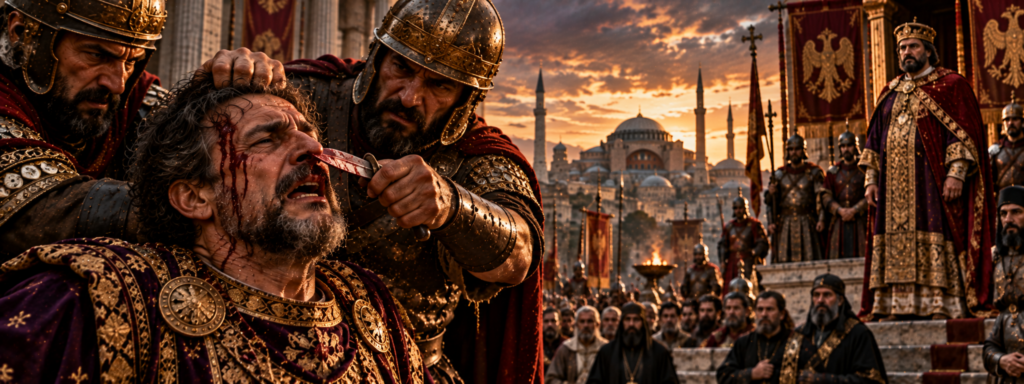
Leontius: The Mutilated Emperor Who Lost His Throne and Died for His Betrayal
The Bloody Overthrow of Justinian II, the Catastrophic Loss of Carthage, and the Terrifying Revenge That Ended a Byzantine Emperor’s Life
Leontius (died 705 CE) was Byzantine emperor from 695 to 698, a military commander who seized the throne after overthrowing the increasingly unpopular Justinian II. His rebellion began with a dramatic uprising in Constantinople, where Justinian was deposed, mutilated, and sent into exile. Yet Leontius’s own reign ended in disaster when the Byzantine Empire lost Carthage to the expanding Umayyad Caliphate, provoking a military revolt that replaced him with the emperor Tiberius III. Leontius suffered the same humiliating punishment he had inflicted upon his predecessor: his nose was cut off, and he was confined to a monastery. He remained a prisoner until 705, when Justinian II unexpectedly returned to power and ordered the execution of both men who had occupied his throne during his exile. Leontius was publicly humiliated and killed in Constantinople, completing one of the most vicious cycles of revenge in Byzantine imperial history.
The Emperor Who Thought His Enemy Was Finished
The man who would eventually order Leontius’s death should never have been able to return to the throne. Justinian II had been dragged from power, mutilated before his subjects, and banished to a distant imperial outpost on the Black Sea. His enemies believed they had destroyed his political future without needing to kill him. In the brutal world of Byzantine imperial politics, cutting off a ruler’s nose was intended to make him visibly unfit to govern, and exile was supposed to ensure that he could never again threaten the men who had replaced him.
For almost ten years, that calculation appeared to have worked. Justinian remained outside Constantinople, while the empire passed through the hands of two successive usurpers. Leontius, the first of them, briefly enjoyed the power he had seized, only to be overthrown and mutilated himself. His successor, Tiberius III, ruled for several years while the empire struggled against foreign enemies and internal instability. The emperor who had once seemed permanently defeated was reduced to a distant and dangerous memory.
Then, in 705, Justinian returned.
His restoration was one of the most extraordinary reversals in Byzantine history. The mutilated emperor had escaped exile, gathered foreign allies, and found a way back into the capital that had rejected him. He returned not as a supplicant seeking forgiveness but as a ruler determined to punish those responsible for his humiliation. His enemies had once believed that a missing nose could keep a man from wearing the imperial crown, and Justinian intended to demonstrate how catastrophically wrong they had been.
Leontius had spent the intervening years imprisoned in a monastery. The general who had once commanded armies and ruled from the imperial palace had become a captive whose future depended entirely upon the mercy of others. He had already endured deposition, mutilation, and the loss of everything he had gained through rebellion. Yet the worst punishment remained ahead of him.
When Justinian regained Constantinople, he ordered Leontius and Tiberius III brought before him. Later Byzantine accounts describe a carefully staged public humiliation in which the two former emperors were displayed before the crowd and subjected to the restored ruler’s contempt. The precise details of the spectacle vary across the surviving narrative traditions, but the central outcome is beyond serious doubt. Both men were executed, and the emperor they had believed permanently removed from power had finally taken his revenge.
The story of Leontius is therefore much more than the biography of a short-lived usurper. It is a story of imperial ambition, military disaster, religious politics, public mutilation, betrayal, and the terrifying uncertainty of power in medieval Constantinople. It also reveals a fundamental weakness within the Byzantine political system: an emperor could possess the throne, the army, and the ceremonial authority of the Roman state, yet still lose everything when the soldiers and people who had elevated him turned against him. Leontius discovered that weakness twice, first as the man who exploited it and then as its victim.
The Empire of Gold, Blood, and Dangerous Ambition
To understand Leontius, it is necessary to understand the world into which he rose. The Byzantine Empire of the late seventh century was still the Roman Empire, although its political and cultural center had long since shifted eastward to Constantinople. Its emperors considered themselves Roman rulers, its institutions descended from those of the ancient imperial state, and its subjects inherited a political tradition stretching back many centuries. Yet the empire had changed dramatically since the days when Roman armies dominated the Mediterranean.
The greatest transformation had come through the rise of Islam and the astonishing expansion of the early Muslim caliphates. During the seventh century, Byzantine armies lost Syria, Palestine, Egypt, and other territories that had supplied wealth, manpower, and prestige to the empire. The loss of Egypt was especially devastating because the province had been one of the most productive regions of the Roman world. The empire’s southern and eastern frontiers had been pushed back, and Constantinople faced enemies whose military power continued to grow.
The Byzantine state nevertheless remained formidable. Its capital possessed extraordinary fortifications, sophisticated administrative institutions, and access to maritime routes that connected Europe and Asia. Its emperors commanded armies organized through a changing military system that increasingly relied upon provincial forces. The empire could still conduct ambitious campaigns, negotiate complex diplomatic arrangements, and survive crises that would have destroyed weaker governments.
Yet survival came at a price. Military defeats created pressure upon the treasury, while taxation and administrative demands could provoke resentment among provincial populations. Emperors depended upon commanders whose loyalty could never be taken for granted. The same armies that defended the frontiers could become instruments of rebellion when soldiers believed their rulers had failed them.
The imperial succession was particularly dangerous. Byzantine emperors possessed immense authority, but there was no universally accepted mechanism that guaranteed peaceful transfers of power in every circumstance. Dynastic inheritance mattered, especially when a reigning emperor could associate his son with the throne, but military acclamation, political support, and control of Constantinople could prove equally decisive. A commander with sufficient backing might overthrow an emperor and then seek legitimacy through public ceremony and recognition.
The consequences for defeated rulers could be appalling. Execution was always a possibility, but mutilation became an especially significant political punishment. Blinding, cutting off the nose, and other forms of bodily injury could be used to mark a rival as unfit for imperial office. These punishments combined physical violence with public humiliation, turning the defeated ruler’s body into a visible warning against rebellion.
Leontius would both administer and endure that punishment. His career unfolded during a period when the empire was struggling to defend its territories while powerful commanders competed for the throne. He possessed the military experience necessary to rise within the imperial establishment, but that same experience placed him in the dangerous world of political rivalry. In Constantinople, a successful general could become an emperor, a prisoner, or a corpse, sometimes within the span of only a few years.
Leontius Before the Crown: A Soldier in an Empire at War
The early life of Leontius is poorly documented. His exact date of birth, family background, and childhood circumstances are not securely established by the surviving sources. He appears in the historical record primarily as a military commander, and it is through his service to the empire that his political importance becomes visible. The lack of detailed personal information is a reminder that Byzantine chroniclers often concentrated upon rulers’ public actions rather than preserving the private histories of men before they gained power.
Leontius rose during the reign of Constantine IV, who ruled from 668 to 685. This was a period of continuing conflict between Byzantium and the Umayyad Caliphate, whose armies and fleets threatened imperial territories across the eastern Mediterranean. The empire had successfully resisted major attacks upon Constantinople, but the struggle remained intense. Military commanders who could defend the frontiers were therefore essential to imperial survival.
Leontius became associated with the Anatolic military command, one of the most important provincial military establishments in Asia Minor. The Anatolic forces occupied a strategically vital position because they defended territory exposed to Muslim incursions. Commanding such troops brought prestige and influence, but it also created opportunities for political ambition. Soldiers who respected their commander might follow him into rebellion if they became dissatisfied with the emperor.
The surviving accounts connect Leontius with campaigns against the Arabs and with the eastern military frontier. His military career appears to have been substantial enough to earn imperial confidence. He was not an obscure court official who suddenly emerged from nowhere to seize the throne. He belonged to the class of experienced commanders upon whom the empire depended for its defense.
His reputation, however, cannot be reconstructed in detail. Later accounts written after his rebellion naturally viewed him through the consequences of his seizure of power. Some portray him as a capable soldier wronged by Justinian II, while others emphasize the instability created by his usurpation. The surviving evidence does not allow us to determine precisely how popular he was among his troops before his fall from imperial favor.
What is clear is that his military position made him dangerous once relations with the emperor deteriorated. A general commanding important provincial forces possessed more than ceremonial influence. He could gather supporters, communicate with officers, and potentially challenge the government in Constantinople. The empire needed men like Leontius, but its rulers also had reason to fear them.
This tension was not unique to his career. Throughout Roman history, emperors had relied upon generals whose victories could make them politically threatening. A successful commander might become indispensable in war and intolerable in peace. Leontius would eventually cross that boundary, transforming from a servant of the imperial state into a contender for its highest office.
Justinian II: The Young Emperor Who Made Powerful Enemies
Justinian II became emperor in 685 after the death of his father, Constantine IV. He was still young, but he inherited a dynasty with established imperial legitimacy. His reign began during a period when Byzantium had achieved some diplomatic and military successes against its enemies. These advantages gave the new emperor opportunities to strengthen the state, but they also encouraged an ambitious style of government.
Justinian was determined to exercise imperial authority vigorously. He pursued military campaigns, administrative measures, and policies intended to reinforce the power of Constantinople. His government sought to increase revenues and manage populations across the empire. Such policies could serve legitimate state interests, but they also created resentment among groups who bore their costs.
The emperor’s reputation for harshness became an important feature of later Byzantine historical writing. Chroniclers accused him and his officials of oppressive taxation, cruelty, and excessive punishment. Some of these accounts were shaped by hostility toward a ruler who had been overthrown and later restored through violence. They cannot all be accepted uncritically, but they reflect the genuine political tensions surrounding his government.
Two officials became especially associated with resentment against Justinian. Stephen, often identified by the title sakellarios, and Theodotus, a powerful fiscal official, appear in the narrative tradition as instruments of harsh imperial policy. Accounts accuse them of brutal treatment of prominent citizens and aggressive financial demands. Their exact responsibility for individual abuses is difficult to verify, but their prominence in the stories of Justinian’s downfall indicates how closely the emperor’s government became associated with unpopular administration.
Justinian also pursued an assertive military policy. His campaigns against the Arabs initially benefited from favorable circumstances, including arrangements involving tribute and frontier populations. Yet the balance of power remained unstable. Diplomatic agreements could break down, and military setbacks could rapidly undermine imperial prestige.
The emperor’s relationship with military commanders became increasingly strained. Leontius was among the men whose fortunes suffered during this period. His military experience did not protect him from imperial suspicion. Instead, the general who had served the state found himself imprisoned.
The reasons for Leontius’s imprisonment are not entirely clear. Later accounts connect it with military failures and Justinian’s distrust, but the precise charges and political circumstances remain uncertain. What matters is that a powerful commander was removed from active service and placed under restraint. The decision created an enemy who possessed both military connections and personal reasons to resent the emperor.
Justinian’s government was therefore accumulating dangers on several fronts. Provincial military setbacks threatened confidence in his leadership, while fiscal policies alienated sections of the population. Powerful officials became targets of hatred, and experienced commanders could find themselves disgraced. Leontius’s eventual rebellion would exploit these grievances, but it would also reveal how little stability remained beneath the ceremonial grandeur of the imperial court.
From Imperial Prisoner to Imperial Rebel
Leontius spent a period in confinement under Justinian II, with the surviving sources commonly placing his imprisonment at approximately three years. The details of his treatment are uncertain, and there is no reliable account of his daily life as a prisoner. Yet imprisonment by the emperor was a serious political humiliation for a man who had previously held military command. It removed him from public authority while leaving him dependent upon the ruler who had disgraced him.
In 695, Justinian unexpectedly restored Leontius to military responsibility. The emperor appointed him to command forces associated with the theme of Hellas, a region in the southern Balkans and Greece. The decision may have reflected a need for experienced officers, an attempt at reconciliation, or confidence that Leontius no longer posed a threat. The surviving evidence does not establish Justinian’s motives with certainty.
The appointment proved disastrous for the emperor. Leontius returned to public life with renewed access to military and political networks. Instead of quietly accepting his restoration, he became involved in a conspiracy against Justinian. His personal resentment combined with broader dissatisfaction in Constantinople.
The rebellion developed in a political atmosphere already charged with hostility toward the imperial government. Justinian’s officials had become unpopular, and influential members of the capital’s society were willing to support change. Religious figures also played a role in the events surrounding the uprising. The emperor’s authority, once apparently secure through dynastic succession, began to unravel.
Leontius’s supporters included men who could help mobilize opposition inside Constantinople. The sources identify prominent individuals involved in the conspiracy, although their precise roles differ across accounts. The rebellion was not simply a military invasion from the provinces. It was an uprising that exploited divisions within the capital itself.
The decisive moment came when Leontius and his allies moved openly against the government. According to later narrative accounts, they freed prisoners and gathered supporters while presenting their action as liberation from oppression. Such details may have been shaped by the political language used to justify the coup. Nevertheless, the rebellion clearly gained enough momentum to overwhelm Justinian’s remaining support.
The emperor who had imprisoned Leontius now faced the general he had released. The reversal was extraordinary but entirely consistent with the instability of Byzantine politics. Justinian had restored a dangerous commander to authority at a moment when his own government was deeply unpopular. Leontius used that opportunity to seize the throne.
Constantinople Erupts: The Fall of Justinian II
The overthrow of Justinian II in 695 was a violent political revolution. Leontius and his supporters mobilized opposition within Constantinople, and the emperor’s authority collapsed. The rebellion drew strength from resentment against Justinian’s officials and from the willingness of influential figures to abandon the reigning dynasty. Once the movement gained control of the capital, Justinian was left exposed.
Theodotus and Stephen, two officials closely associated with the emperor’s unpopular administration, became particular targets. Later accounts describe their brutal execution by the crowd, including the use of fire. The precise details of these killings come from narrative sources written after the events, but they reflect the intensity of hatred directed against the imperial government. Their deaths served as a public demonstration that the old regime had fallen.
Justinian himself was captured. The young emperor who had inherited the throne from Constantine IV now stood at the mercy of a commander he had previously imprisoned. Leontius faced a choice familiar to Roman usurpers: whether to kill the defeated ruler or preserve his life under conditions intended to prevent his return. The decision would shape the rest of both men’s lives.
The sources generally agree that Justinian was subjected to rhinotomy, the cutting off of his nose. This was not an arbitrary act of cruelty, although it was undeniably brutal. Within Byzantine political culture, severe facial mutilation could be used to render a rival visibly unsuitable for the imperial office. The punishment was intended to destroy Justinian’s legitimacy without requiring his execution.
The emperor was then exiled to Cherson, a Byzantine outpost in the Crimean region of the Black Sea. The distance from Constantinople was important because it placed him far from the capital’s political networks and military institutions. Leontius and his supporters expected the combination of mutilation and exile to prevent any future challenge. Justinian had lost his throne, his freedom, and part of his face.
The rebellion elevated Leontius to the imperial office. He assumed the crown as the man who had delivered Constantinople from an unpopular ruler. His accession was supported by the political forces that had overthrown Justinian, but those forces were not necessarily united by lasting loyalty. They had agreed upon the removal of one emperor, not necessarily upon a stable future under another.
The treatment of Justinian would later become one of the most consequential decisions of Leontius’s life. By sparing the former emperor, he avoided an immediate execution that might have provoked opposition among supporters of the Heraclian dynasty. Yet he also left alive a man whose claim to the throne had not disappeared. The mutilation was intended to make restoration impossible, but the assumption would eventually prove fatal.
Leontius had seized the throne through the very mechanism that made Byzantine imperial politics so dangerous. He exploited public resentment, military influence, and the collapse of confidence in the reigning emperor. His success demonstrated that imperial legitimacy could be overturned by force. Within three years, another commander would use the same principle against him.
The Mutilation of Justinian II: A Punishment That Failed
The cutting off of Justinian II’s nose was one of the defining acts of Leontius’s rebellion. It combined physical punishment with a calculated attempt to prevent the defeated emperor from returning to power. The mutilation was intended to mark Justinian permanently as a man whose body no longer met the expectations associated with imperial dignity. In a political culture that attached symbolic importance to the ruler’s appearance, such an injury could carry enormous consequences.
The punishment also reflected a broader Byzantine practice of disabling political rivals. Blinding and other forms of mutilation were used because they could remove a claimant from active political competition without necessarily requiring execution. The practice was cruel, but it could be presented as an alternative to killing. In reality, it often condemned victims to permanent suffering, confinement, and political humiliation.
Justinian’s treatment was particularly significant because he belonged to an established imperial dynasty. His father and grandfather had occupied the throne, and his claim rested upon hereditary legitimacy as well as his previous reign. Removing his nose did not erase that history. It merely attempted to make his return unacceptable within the political expectations of the time.
Leontius may have believed that the punishment was sufficient. Justinian had been publicly defeated, mutilated, and exiled far from the capital. His enemies controlled Constantinople, and the military forces necessary for restoration appeared beyond his reach. The decision to spare his life may therefore have seemed politically prudent.
Yet mutilation could not eliminate ambition, resentment, or dynastic identity. Justinian remained a former emperor whose supporters could still regard him as legitimate. His exile placed him beyond immediate imperial supervision in a frontier region where political loyalties were complicated. Over time, the very circumstances intended to isolate him created opportunities for escape and foreign alliances.
The punishment also ensured that any future confrontation would be deeply personal. Justinian had not merely been removed from office; he had been permanently disfigured before being sent away. His later conduct suggests that he remembered the humiliation with extraordinary bitterness. Although the surviving sources may exaggerate aspects of his vengeance, the connection between his mutilation and subsequent retaliation is unmistakable.
Leontius’s decision therefore created a dangerous surviving enemy. The general who had once been imprisoned by Justinian now occupied the throne, while the former emperor endured exile. Their positions appeared permanently reversed. Yet the man who had ordered the mutilation would eventually suffer the same punishment.
The episode demonstrates the limitations of political violence as a method of securing legitimacy. Mutilation could remove a rival from immediate power, but it could also deepen the desire for revenge. It could terrify potential opponents while simultaneously revealing the insecurity of the ruler who ordered it. In Leontius’s case, the punishment that appeared to secure his reign became part of the chain of events leading to his execution.
Leontius Takes the Purple
Leontius became emperor in 695 under circumstances that initially offered considerable political advantages. He had overthrown an unpopular ruler, gained support within Constantinople, and removed the most immediate dynastic rival from the capital. His accession could be presented as the restoration of justice after years of oppressive government. Yet the legitimacy of a successful rebellion was always vulnerable to the next successful rebellion.
The new emperor inherited the same strategic problems that had confronted Justinian II. The Byzantine Empire remained engaged in a difficult struggle against the Umayyad Caliphate, and its military resources were stretched across several fronts. The loss of territory during previous decades had weakened imperial revenues. Constantinople still possessed enormous defensive advantages, but the empire could not afford repeated disasters.
Leontius also faced the challenge of consolidating his authority among competing political groups. The people who supported his rebellion may have expected rewards, offices, or changes in government. Military commanders wanted confidence that the emperor would protect their interests. Religious and administrative elites had their own concerns.
The surviving evidence does not provide a detailed account of Leontius’s domestic policies. His reign was short, and later chroniclers concentrated heavily upon the military disaster that brought him down. It would therefore be misleading to construct an elaborate program of reform or repression without reliable documentation. His government must be understood primarily through the events that the sources preserve.
One of the most important issues confronting him was North Africa. The Byzantine territories around Carthage represented the remnants of a once-vast imperial presence in the western Mediterranean. Although the empire had lost Egypt and much of the eastern Mediterranean’s southern coastline, it continued to maintain authority in parts of North Africa. These territories were strategically valuable because they connected the empire to the western Mediterranean and served as a barrier against further Muslim expansion.
The Umayyad Caliphate had been extending its power westward across North Africa. Its commanders faced resistance from Byzantine forces and local populations, including Berber groups whose political relationships were complex and changing. Control of the region was contested through campaigns, alliances, and repeated shifts in military fortune. The struggle was not a simple uninterrupted advance but a prolonged conflict involving several powerful actors.
Leontius inherited this dangerous frontier at a moment when Byzantine resources were limited. The defense of Carthage required naval power, experienced commanders, and the ability to reinforce distant positions. A major defeat could threaten not only the remaining African territories but also the emperor’s reputation. For a ruler whose legitimacy rested upon a recent coup, military failure was especially dangerous.
The crisis in North Africa would soon destroy his reign. Leontius had taken the throne by exploiting Justinian’s unpopularity, but he had not escaped the fundamental problems that made emperors vulnerable. He still depended upon soldiers whose loyalty could collapse after defeat. When the African campaign ended in disaster, those soldiers would turn against him.
Carthage: The Prize Byzantium Could Not Afford to Lose
Carthage was one of the great cities of the ancient Mediterranean. Founded centuries before Rome’s imperial expansion, it had become the center of Roman North Africa after the destruction of the original Punic city and its subsequent reconstruction. Under Roman rule, the region developed into an extraordinarily productive agricultural and commercial center. Its wealth had helped sustain the western imperial government for generations.
The city had passed through several major political transformations before Leontius’s reign. The Vandals captured Carthage in 439, making it the capital of their North African kingdom. In 533, the armies of the Eastern emperor Justinian I reconquered the region, restoring Roman authority after nearly a century of Vandal rule. Carthage then became a major center of Byzantine administration and military power in Africa.
By the late seventh century, however, the position of Byzantine North Africa was increasingly precarious. Muslim armies had conquered Egypt and advanced westward, while Byzantine forces struggled to maintain control over distant territories. Local resistance to Muslim expansion sometimes created opportunities for imperial intervention, but the balance of power was changing. Carthage remained a valuable possession, yet defending it required resources the empire could not easily spare.
The city also carried enormous symbolic importance. Its reconquest under Justinian I had been celebrated as one of the great achievements of Byzantine imperial restoration. Losing it would represent the reversal of a major victory from the previous century. For an emperor attempting to establish his legitimacy, such a defeat could be politically devastating.
The struggle for Carthage intensified during Leontius’s reign. Umayyad forces under the general Hasan ibn al-Nu’man advanced against the remaining Byzantine positions in North Africa. The chronology of individual campaigns is complicated, and the surviving Byzantine and Arabic traditions do not always align perfectly. Nevertheless, the broad sequence is clear: Carthage fell to Muslim forces, Byzantine troops mounted a temporary recovery, and the city was ultimately lost.
Leontius responded to the crisis by sending a naval expedition to Africa. The fleet was intended to recover Carthage and restore imperial authority. The operation initially achieved success, demonstrating that Byzantine naval power remained capable of projecting force across the Mediterranean. Yet the recovery proved temporary.
The Umayyad forces returned with sufficient strength to defeat the Byzantine position. The imperial expedition ultimately failed to retain Carthage, and the surviving troops withdrew. The final loss of the city, generally dated to 698, marked a decisive stage in the collapse of Byzantine rule in North Africa. Although imperial influence in the region had already been weakened, the destruction of the Carthaginian position removed its principal remaining center.
The political consequences for Leontius were immediate. A major expedition had failed, and the empire had lost one of its most important remaining western possessions. The soldiers who returned from the campaign feared the emperor’s reaction and were dissatisfied with the outcome. Their resentment would soon become rebellion.
The African Expedition and the Seeds of Mutiny
Leontius’s decision to send an expedition to Carthage was understandable. The city represented a vital strategic position, and its loss threatened to eliminate Byzantine influence across much of North Africa. A successful recovery could have strengthened the emperor’s reputation and demonstrated that his government possessed the military energy necessary to defend imperial territory. Instead, the campaign became the disaster that destroyed him.
The Byzantine expedition was led by commanders whose names and precise responsibilities are not always consistently presented in the surviving accounts. The fleet crossed the Mediterranean and initially succeeded in recovering Carthage. This achievement suggests that the imperial forces retained considerable operational capability. The problem was not simply an inability to reach the city but the difficulty of holding it against renewed Umayyad pressure.
The Muslim response was decisive. Hasan ibn al-Nu’man returned with forces capable of overcoming the Byzantine position, and the imperial troops were compelled to withdraw. The surviving sources differ in their details of the fighting, but they agree upon the ultimate failure of the expedition. Carthage passed permanently out of effective Byzantine control.
For the soldiers, the retreat was dangerous in more than one sense. They had suffered defeat in a campaign of enormous importance, and they faced the possibility of imperial punishment upon returning to Constantinople. Byzantine emperors could be harsh toward commanders blamed for military failures. The troops therefore had reason to fear that Leontius would seek scapegoats for the disaster.
The surviving tradition emphasizes this fear as a major cause of the mutiny. The soldiers reportedly decided that replacing the emperor offered a safer future than returning to face his anger. Such explanations may simplify a more complicated mixture of resentment, ambition, and political calculation. Nevertheless, they reflect the dangerous relationship between imperial authority and military accountability.
The mutineers selected a naval officer named Apsimar as their leader. He would become known as Tiberius III after taking the throne. His rise illustrates how military rebellion could transform a relatively obscure officer into an emperor. The troops needed a figure around whom they could organize their opposition, and Apsimar became that figure.
The rebellion gathered momentum as the returning forces moved toward Constantinople. The soldiers were no longer simply survivors of a failed expedition. They had become an army challenging the ruler who had sent them to Africa. Leontius now faced the same danger that had destroyed Justinian II only three years earlier.
The irony was devastating. Leontius had overthrown Justinian by exploiting public resentment and the weakness of imperial authority. Now his own soldiers were using military failure as justification for rebellion. The man who had seized the throne through force was about to discover that force could remove him just as easily.
Apsimar Becomes Tiberius III: The Second Betrayal
The mutiny that elevated Apsimar developed into a direct challenge against Leontius. The returning Byzantine forces, angered by the failure in North Africa and fearful of punishment, refused to accept the emperor’s authority. They chose Apsimar as their leader and advanced toward Constantinople. The rebellion placed the capital at the center of another imperial crisis.
Apsimar was a naval officer rather than a member of the reigning dynasty. His claim to power rested upon military support and the willingness of political factions to accept him. Like Leontius before him, he needed more than soldiers to establish lasting authority. Control of Constantinople and recognition by influential groups were essential.
The capital’s defenses were formidable, but political divisions could undermine even the strongest walls. The sources describe the involvement of forces associated with the Green faction, one of the major circus factions whose political influence could extend beyond the Hippodrome. Their role in the events is difficult to reconstruct precisely, but the rebellion clearly benefited from support inside the city. Leontius’s government was unable to maintain control.
Apsimar entered Constantinople and was proclaimed emperor under the name Tiberius III. The choice of an imperial name helped present his accession as legitimate rather than merely military. He now occupied the same throne that Leontius had seized from Justinian. The cycle of rebellion had completed another turn.
Leontius was captured. His position was almost identical to that of Justinian II in 695, when the reigning emperor had fallen into the hands of a successful usurper. Tiberius faced the familiar question of how to dispose of a defeated predecessor. He chose a punishment that Leontius knew intimately.
The former emperor’s nose was cut off. The mutilation mirrored the punishment Leontius had inflicted upon Justinian, transforming the earlier act of political violence into a grim precedent. Leontius had once used facial disfigurement to destroy a rival’s claim to the throne. Now the same method was used to remove him from political competition.
He was then confined to a monastery. Such confinement could serve as a form of political imprisonment, placing a defeated ruler within a religious institution while keeping him away from military and administrative power. The arrangement did not necessarily mean that Leontius had voluntarily embraced monastic life. It was a means of removing him from public affairs without immediately killing him.
Tiberius III had secured the throne, but he had also repeated the dangerous decision made by Leontius. He left a defeated emperor alive. Leontius was mutilated and imprisoned, while Justinian remained in exile. The empire now possessed two former rulers whose grievances had not been extinguished by their removal from power.
The Nose Cut from an Emperor’s Face
The mutilation of Leontius was more than a personal humiliation. It was a deliberate political act intended to strip him of the physical dignity associated with imperial rule. The punishment publicly marked him as a defeated claimant and reinforced the authority of the man who had replaced him. Its cruelty was inseparable from its political purpose.
In Byzantine political culture, the emperor’s body carried symbolic meaning. Imperial ceremonies emphasized majesty, order, and the ruler’s special position within the Christian Roman state. A visibly mutilated man could be portrayed as unsuitable for such a role. The removal of the nose therefore served as an attempt to make political exclusion permanent.
The punishment was not based upon a universally applied written rule that automatically disqualified every injured person from office. Byzantine political practice was more flexible and contested than that. Nevertheless, bodily integrity carried enough symbolic importance for mutilation to be used repeatedly against rivals. Its effectiveness depended upon social expectations and the willingness of political elites to treat disfigurement as disqualification.
Leontius had already demonstrated his belief in that logic when he ordered Justinian’s nose cut off. The punishment had allowed him to spare the former emperor’s life while attempting to eliminate his political future. When Tiberius III imposed the same injury upon Leontius, the act carried an obvious element of retribution. The usurper had become the victim of the method he had previously employed.
The surviving accounts do not provide a reliable medical description of Leontius’s injuries. They do not establish how the wound was treated, whether complications followed, or how his appearance changed over time. Such details would be important to understanding his suffering, but inventing them would be irresponsible. The historical record establishes the mutilation and its political purpose without preserving a complete account of its physical consequences.
The psychological effects are likewise impossible to reconstruct with certainty. Leontius had lost his throne, his freedom, and part of his face, but his private reactions are not recorded in a reliable form. He may have experienced humiliation, anger, fear, or resignation, but those emotions cannot be presented as documented facts. What can be said is that his circumstances had changed catastrophically.
The former emperor’s confinement completed the process of removal. He was no longer a general commanding armies or a ruler receiving officials in the imperial palace. He had become a captive whose continued survival depended upon the government that had overthrown him. The man who once decided the fate of Justinian II now had no authority over his own future.
Yet the mutilation did not end the cycle of violence. Justinian remained alive, and his eventual restoration would expose the weakness of the belief that bodily disfigurement could permanently prevent a ruler from returning. Leontius had suffered the punishment he once considered sufficient to neutralize an enemy. In 705, he would discover that his own survival had merely postponed the final act.
The Monastery Prison: Years of Silence and Uncertainty
After his deposition in 698, Leontius disappeared from active political life. He was confined to a monastery, where he remained during the reign of Tiberius III. The surviving sources provide little information about his conditions of imprisonment. They do not preserve a detailed account of his daily routine, his relationships with monks, or his private reflections upon the loss of power.
Monasteries could serve several purposes in Byzantine political life. They were religious communities devoted to prayer and ascetic discipline, but they could also become places of confinement for defeated rulers and political opponents. Removing a man from public office and placing him under monastic supervision could prevent him from gathering supporters. The arrangement offered a form of controlled survival that avoided the immediate consequences of execution.
For Leontius, confinement meant the end of his political career. He had risen from military command to the imperial throne and then fallen into captivity within three years. His former supporters had either abandoned him, been removed from power, or adapted to the new government. The empire continued without him.
Tiberius III ruled from 698 to 705 and devoted considerable attention to military affairs. His government faced the continuing expansion of the Umayyad Caliphate and the need to defend Byzantine territory in Asia Minor. The empire remained under pressure, but the new emperor achieved some military successes and attempted to stabilize the state. Leontius had no visible role in these developments.
The former emperor’s imprisonment also protected Tiberius from one immediate rival. A mutilated captive under religious supervision was less dangerous than a free commander with access to troops. Yet the arrangement depended upon the assumption that the political system would remain stable. If another rebellion succeeded, the fate of former emperors could change overnight.
Leontius’s situation was particularly precarious because Justinian II remained alive in exile. The two men were linked by the events of 695, when Leontius had overthrown and mutilated the reigning emperor. If Justinian ever returned, Leontius would have reason to fear retaliation. His confinement under Tiberius offered no guarantee of safety against a restored predecessor.
The surviving evidence does not establish whether Leontius maintained contact with political supporters during these years. It is possible that his captors restricted his communications, but the details are unknown. Nor do we know whether he learned of Justinian’s movements before the final crisis of 705. The historical record leaves his years of captivity largely silent.
That silence is itself significant. Leontius had briefly occupied the highest office in the Roman world, yet after his deposition he became almost invisible to the chroniclers. His story reappears only when Justinian returned and ordered his death. The emperor who had once dominated Constantinople’s political life had been reduced to a prisoner awaiting the decisions of others.
Justinian II in Exile: The Emperor Who Refused to Disappear
While Leontius remained imprisoned, Justinian II pursued a very different course. His exile to Cherson had been intended to remove him permanently from imperial politics. Yet the former emperor continued to seek opportunities for restoration. His survival and determination would eventually transform the political situation across the Black Sea and the Balkans.
Cherson was a strategically important settlement in the Crimean region, connected to Byzantine trade and diplomacy. Its distance from Constantinople made it a suitable place for political exile, but it was not entirely isolated from surrounding powers. The region maintained relationships with the Khazars and other groups whose interests extended across the northern Black Sea. These connections created opportunities that Justinian could exploit.
The surviving narratives describe Justinian becoming involved in dangerous political circumstances at Cherson. Local authorities reportedly grew concerned about his activities and considered measures against him. The precise details differ across sources, but the accounts agree that he eventually escaped the confinement intended to keep him away from imperial politics. His flight began a remarkable journey toward restoration.
Justinian sought protection among the Khazars, a powerful people whose political influence extended across the steppe regions north of the Black Sea. He entered into a marriage alliance with a woman associated with the Khazar ruling family, traditionally identified as Theodora after her adoption of a Byzantine imperial name. The marriage strengthened his connections to a foreign power. It also demonstrated that his imperial ambitions had survived years of exile.
His position among the Khazars eventually became dangerous. Later accounts describe diplomatic pressure from Constantinople and threats to Justinian’s safety. The exact sequence is difficult to establish, but he was compelled to seek another refuge. He then turned toward the Bulgars, whose ruler Tervel possessed military resources that could support an expedition against Constantinople.
Tervel’s assistance proved decisive. Justinian secured Bulgar support for an attempt to recover the throne, offering rewards and political recognition in return. The alliance brought together a mutilated Roman emperor and a foreign ruler whose interests could be advanced through intervention in Byzantine politics. It was an extraordinary reversal for a man whom Leontius had once sent into exile.
The expedition moved toward Constantinople in 705. Justinian arrived with forces capable of threatening the capital, but the city’s fortifications made a straightforward assault difficult. The surviving accounts describe his eventual entry through a water conduit or passage associated with the city’s defenses. The details have been retold with dramatic embellishment, but the central fact remains that he succeeded in entering the capital and regaining power.
The restoration shocked the political world. A man who had been mutilated specifically to prevent his return now occupied the imperial throne again. His success exposed the limitations of the punishment imposed in 695. It also placed Leontius and Tiberius III in mortal danger.
The Return of the Emperor with the Severed Nose
Justinian’s restoration in 705 was an event almost designed to terrify his enemies. He had survived mutilation, exile, political betrayal, and years of uncertainty. He had secured foreign allies and overcome the defenses of the capital. Now he returned to the imperial palace as the ruler whose removal had once seemed permanent.
The restored emperor was no longer the young man who had been overthrown in 695. He had experienced years of exile and humiliation, and his return was accompanied by a determination to punish those responsible for his downfall. Byzantine chroniclers emphasize the severity of his vengeance. Although some details may reflect hostile portrayals of his character, the executions that followed are firmly rooted in the historical record.
Tiberius III was captured after losing control of Constantinople. The ruler who had replaced Leontius now faced the same fate as his predecessor. His military achievements and years on the throne offered no protection against the restored emperor. The political system that had elevated him through rebellion now abandoned him.
Leontius was also brought out of confinement. He had spent years as a mutilated prisoner, apparently removed from political competition. Yet Justinian had not forgotten the man who had ordered his own mutilation and exile. The former emperor’s continued survival now placed him within reach of the ruler he had once overthrown.
The restoration transformed the meaning of their earlier actions. In 695, Leontius had treated Justinian’s mutilation as a permanent solution to a political problem. In 698, Tiberius had treated Leontius’s mutilation in the same way. By 705, both assumptions had been exposed as dangerously mistaken.
Justinian’s return also carried a symbolic message. His mutilated appearance had not prevented him from reclaiming imperial authority. The visible injury intended to disqualify him had become evidence of his survival and determination. The man whose body had been marked as unfit for rule now possessed the power to condemn his former enemies.
The restored emperor did not choose reconciliation. He ordered the punishment of those who had occupied his throne during his absence. The resulting executions became among the most memorable acts of his second reign. For Leontius, the long period of imprisonment ended not with release but with a final journey toward public humiliation and death.
Two Fallen Emperors Before One Restored Tyrant
The execution of Leontius and Tiberius III was remembered as a particularly brutal demonstration of imperial revenge. Later Byzantine chroniclers describe the two former emperors being brought before Justinian and publicly humiliated. The scene is associated with the Hippodrome of Constantinople, the great arena where imperial ceremonies and public spectacles could become expressions of political authority. The precise sequence of events varies across the surviving accounts, but the central act of punishment is clear.
The Hippodrome was more than a place for chariot racing. It was one of the most important public spaces in Constantinople, where emperors appeared before their subjects and political tensions could erupt into demonstrations. Ceremonies held there could reinforce the ruler’s authority through spectacle and public participation. Humiliating defeated rivals in such a setting transformed personal revenge into a political performance.
According to the later narrative tradition, Justinian ordered Leontius and Tiberius brought before him while he occupied a position of imperial authority. The two men were forced to endure public degradation before their execution. Some accounts describe the restored emperor placing his feet upon their necks, an act intended to symbolize their complete submission. The detail is famous, although it should be understood as part of the chroniclers’ narrative tradition rather than treated as independently verified by multiple contemporary eyewitnesses.
The symbolism was unmistakable. Leontius had once ordered Justinian’s nose cut off and sent him into exile. Tiberius had then mutilated Leontius and taken the throne. Now both former emperors were displayed as defeated enemies beneath the authority of the man they had believed permanently removed.
The crowd’s role is described in hostile accounts that emphasize the spectacle of imperial vengeance. Public ceremonies could involve acclamations, religious language, and expressions of loyalty to the reigning emperor. The chroniclers’ descriptions should not be taken as a precise record of every individual’s reaction. Nevertheless, the executions were clearly intended to demonstrate the restored ruler’s triumph.
Leontius and Tiberius were then executed, with beheading commonly reported in the surviving tradition. Their deaths ended the sequence of usurpations that had begun in 695. The former emperors were not allowed to retire quietly into religious life or political obscurity. Justinian chose to eliminate them permanently.
The execution of Leontius was especially bitter because it completed the reversal begun a decade earlier. He had once possessed the power to decide whether Justinian would live or die. He had chosen mutilation and exile, believing that these punishments would secure his own reign. Now Justinian stood restored, while Leontius faced death as a captive.
The event demonstrated the extraordinary instability of Byzantine imperial power. Three men had occupied the throne within ten years, and each had been overthrown through rebellion. Two were mutilated, two were executed, and one returned from exile to reclaim the crown. The imperial office remained magnificent, but the men who occupied it lived under the constant threat of violent reversal.
The Execution of Leontius in 705
Leontius’s death in 705 ended a political career that had moved through nearly every possible condition of imperial fortune. He had been a military commander, a prisoner, a rebel, an emperor, a mutilated captive, and finally a condemned man. His execution was ordered by the same ruler he had overthrown a decade earlier. The circumstances gave the killing an unmistakable character of revenge.
The surviving sources generally agree that Leontius was executed alongside Tiberius III after Justinian’s restoration. Beheading is the method most commonly reported. The precise location and ceremonial sequence are described with varying levels of detail in later accounts. It is therefore safer to distinguish the well-established execution from the more elaborate descriptions of public humiliation that accompany it.
The killing was political rather than judicial in any modern sense. Leontius had committed an act of usurpation against Justinian in 695, and the restored emperor possessed the power to punish him. Yet the execution occurred after years of confinement, when Leontius no longer posed an obvious immediate military threat. Its significance lay in eliminating a former rival and demonstrating the consequences of opposing the restored dynasty.
The decision also reflected the personal history between the two men. Justinian had imprisoned Leontius before 695, then restored him to military responsibility. Leontius had responded by leading a rebellion, seizing the throne, and ordering Justinian’s mutilation. Their relationship had already passed through several reversals before the final act.
Leontius had subsequently suffered the same mutilation at the hands of Tiberius III. By the time Justinian returned, the former emperor had been stripped of the visible symbols of power and confined to religious custody. His execution therefore went beyond the immediate necessity of removing a reigning rival. It was the destruction of a man whose past actions remained intolerable to the restored ruler.
The sources do not preserve reliable final words from Leontius. They do not establish whether he pleaded for mercy, accepted his fate, or attempted to defend his actions. Inventing such a scene would create a false sense of intimacy with an event documented only in broad outline. The historical facts are sufficiently powerful without imagined dialogue.
His death also ended the possibility that he might again be used as a political claimant. Even a mutilated former emperor could possess symbolic value if factions wished to challenge the reigning ruler. Execution eliminated that possibility permanently. Justinian had learned, through his own survival, that mutilation and exile did not always prevent restoration.
Leontius therefore died as the victim of a lesson he had helped teach. He had demonstrated that emperors could be overthrown, disfigured, and removed from the throne. Justinian demonstrated that a mutilated emperor could return and exact revenge. The cycle ended with Leontius’s execution, but the violence that sustained it would continue to haunt the empire.
Was Justinian II a Monster or a Victim of His Age?
Justinian II’s reputation has long been dominated by accounts of cruelty, revenge, and political instability. His second reign, from 705 to 711, was marked by severe punishment of opponents and continuing conflict. Later Byzantine writers often portrayed him as a ruler whose brutality contributed to his eventual downfall. Yet the surviving narratives were shaped by political and religious perspectives that require careful interpretation.
There is no serious reason to deny that Justinian ordered executions after his restoration. Leontius and Tiberius III were killed, and other opponents also suffered punishment. His government pursued harsh measures against communities and individuals regarded as disloyal. These actions contributed to the atmosphere of fear associated with his second reign.
Nevertheless, describing him simply as insane or monstrous would flatten a complicated historical figure into a caricature. His policies reflected genuine imperial concerns, including military defense, administrative authority, and the preservation of dynastic legitimacy. His cruelty was extreme, but political violence was deeply embedded in the struggles of the period. Other rulers also used mutilation, imprisonment, and execution to secure their positions.
Justinian’s personal experiences provide important context. He had been overthrown, mutilated, and exiled while still relatively young. His return required years of political maneuvering and dangerous alliances. Such experiences could plausibly have intensified his determination to eliminate rivals, although the precise psychological effects cannot be established from the sources.
His enemies also had reasons to portray him negatively. A ruler who had been overthrown twice could become the subject of hostile narratives intended to justify his removal. Chroniclers writing under later governments might emphasize his brutality while minimizing the political circumstances surrounding particular actions. Historical accuracy requires recognizing these possibilities without excusing documented violence.
Leontius’s execution demonstrates both the personal and political dimensions of Justinian’s vengeance. The former emperor had directly participated in his overthrow and mutilation. Killing him eliminated a surviving rival and satisfied a long-standing grievance. The act was therefore understandable within the logic of imperial power struggles, even though it was brutal.
The distinction between explanation and justification matters. Understanding why Justinian sought revenge does not make the executions less violent. Recognizing that his enemies had also committed acts of mutilation does not transform his retaliation into justice. The history of these events is a record of rulers repeatedly using cruelty to solve political problems.
The result was a system in which violence reproduced itself. Leontius mutilated Justinian, Tiberius mutilated Leontius, and Justinian executed both men. Each ruler attempted to secure power through punishment, yet none achieved lasting stability. The empire survived, but its political leadership remained trapped in cycles of rebellion and revenge.
The Bloody Logic of Byzantine Imperial Mutilation
The punishment inflicted upon Leontius belongs to a broader history of bodily mutilation in Byzantine politics. Rulers and powerful officials sometimes used physical injury to prevent rivals from exercising authority. The practice reflected beliefs about imperial dignity, political legitimacy, and the visible body of the sovereign. It also provided an alternative to immediate execution, although the suffering it caused could be severe.
Blinding eventually became especially prominent as a means of disabling political opponents. Cutting off the nose was another recognized punishment, particularly in the seventh and eighth centuries. These injuries were intended to make a claimant visibly unsuitable for imperial office. The logic depended upon the assumption that a ruler’s physical condition affected his political acceptability.
The cases of Justinian II and Leontius reveal the weakness of that assumption. Justinian returned to power despite the mutilation intended to prevent his restoration. Leontius, meanwhile, was mutilated and confined but remained alive long enough to become the target of later vengeance. Neither punishment produced the permanent political security its perpetrators sought.
Mutilation also had a public dimension. The injured body of a defeated ruler served as evidence that he had been stripped of authority. It could discourage supporters from rallying around him and remind the population of the reigning emperor’s power. The punishment was therefore both practical and theatrical.
The use of monasteries as places of confinement reinforced this system. A defeated ruler could be removed from political life and placed under religious supervision, sometimes after receiving a monastic identity. The arrangement could be presented as a peaceful alternative to execution. Yet it also depended upon the willingness of successive governments to respect the prisoner’s continued survival.
Leontius’s experience demonstrates how unreliable that protection could be. Tiberius III spared his life after mutilating him, but Justinian later ordered his execution. The monastery had preserved him for several years without guaranteeing his future. His fate remained subject to the political fortunes of men outside its walls.
The repeated use of mutilation also undermined the image of imperial stability. A system in which rulers could be visibly disfigured by their successors exposed the fragility of political legitimacy. The emperor might be presented as God’s chosen representative on earth, yet he could be dragged from power and subjected to brutal punishment. The contrast between ceremonial majesty and physical vulnerability was profound.
Leontius’s story therefore reveals the dark underside of Byzantine imperial grandeur. Behind the gold, silk, religious ceremony, and magnificent architecture stood a political world in which the ruler’s body could become an instrument of public humiliation. The emperor who commanded armies and issued laws could eventually be reduced to a mutilated prisoner. His fate depended less upon the dignity of his office than upon the loyalty of those who controlled the soldiers.
The Fall of Carthage and the End of Byzantine North Africa
Although Leontius is remembered primarily for his rebellion and execution, the loss of Carthage during his reign was historically more consequential than his personal downfall. The city had served as a major center of Roman power for centuries. Its final loss marked a decisive stage in the transformation of the Mediterranean world. The consequences extended far beyond the political fate of one emperor.
The Byzantine reconquest of North Africa under Justinian I had been one of the great military achievements of the sixth century. It restored imperial authority over territories that had been ruled by the Vandals for nearly a hundred years. Carthage became the center of a renewed Roman administration, supported by military forces and provincial institutions. The region remained strategically important despite the challenges of governing it.
The expansion of the Muslim caliphates transformed that position. After the conquest of Egypt, Muslim armies advanced westward across North Africa. Their progress involved repeated campaigns, local resistance, alliances, and political changes among regional populations. The struggle lasted for decades rather than unfolding as a single uninterrupted conquest.
By the time Leontius became emperor, Byzantine control had contracted significantly. Carthage remained an important stronghold, but the empire could no longer rely upon the resources that had sustained earlier Roman rule. The city was vulnerable to renewed attacks, and its defense required naval reinforcement from distant imperial centers. Leontius’s expedition represented an attempt to preserve a position that was becoming increasingly difficult to hold.
The final loss of Carthage in 698 had enormous strategic implications. It removed the principal Byzantine base in the western North African region and helped consolidate Umayyad expansion. The Mediterranean was becoming a more contested political and military space, with Muslim naval and land power challenging Byzantine dominance. The empire’s western reach was further reduced.
The consequences also affected local populations. Political authority shifted, military structures changed, and communities adapted to new rulers. These transformations unfolded over time and involved complex processes of religious, linguistic, and social change. It would be inaccurate to imagine that the fall of Carthage immediately erased every Roman institution or Christian community in the region.
For Leontius, however, the political consequences were immediate and devastating. The returning expedition’s failure undermined confidence in his leadership. Soldiers who feared punishment rebelled and elevated Apsimar. The loss of a major imperial city therefore became the catalyst for another coup.
The episode demonstrates the close relationship between military success and imperial survival. A ruler might possess ceremonial legitimacy and control the capital, but a major defeat could destroy his authority. Leontius had seized power through rebellion and was removed by another rebellion triggered by military disaster. His personal fate became inseparable from the empire’s struggle to defend its remaining territories.
The Three Emperors Who Destroyed One Another
The decade from 695 to 705 produced an extraordinary sequence of imperial reversals. Justinian II began as the reigning emperor, was overthrown by Leontius, and suffered mutilation and exile. Leontius then ruled for three years before being overthrown by Tiberius III, who inflicted the same punishment upon him. Tiberius governed until Justinian returned and ordered the execution of both former usurpers.
The sequence illustrates the absence of a stable mechanism for resolving political conflict at the highest level. Each ruler gained power through military or popular support, but none could guarantee that support would endure. The imperial title remained prestigious, yet its possession offered little protection against betrayal. The same political forces that elevated an emperor could turn against him when circumstances changed.
Justinian’s first downfall reflected resentment against his government and the ability of Leontius to mobilize opposition. Leontius’s fall resulted from military disaster and mutiny among forces returning from Africa. Tiberius’s removal came through the extraordinary restoration of a former emperor supported by foreign allies. Each transition followed a different immediate cause, but all depended upon the vulnerability of imperial authority.
The personal relationships among the three men intensified the violence. Leontius had been imprisoned by Justinian before rebelling against him. Tiberius had replaced Leontius after the African catastrophe. Justinian’s restoration brought all three careers into a final confrontation. The political struggle became a sequence of punishments inflicted by men who had previously suffered at one another’s hands.
The use of mutilation created a particularly grim symmetry. Leontius ordered Justinian’s nose cut off in 695. Tiberius ordered Leontius’s nose cut off in 698. Justinian returned in 705 and executed both men. The punishment intended to secure each succession failed to prevent further upheaval.
The consequences extended beyond the imperial household. Repeated rebellions distracted the government from external threats and disrupted military command. The empire was fighting powerful enemies while its leaders struggled to survive internal conspiracies. The loss of Carthage demonstrated the danger of such instability.
Yet the Byzantine Empire did not collapse. Its institutions proved capable of surviving repeated changes of ruler, military defeats, and violent political struggles. Constantinople remained a formidable center of power, and the imperial state continued to defend its territories. The resilience of the empire makes the instability of its rulers even more striking.
Leontius’s career stands at the center of this sequence. He initiated the cycle by overthrowing Justinian, suffered the same punishment he had imposed, and eventually died when his former victim returned. His story reveals how the pursuit of imperial security through violence could create new dangers rather than eliminate old ones. The throne he seized became the source of his destruction.
Justinian’s Final Downfall: Revenge Could Not Save Him
Justinian II’s restoration did not bring lasting stability. His second reign continued until 711, when another rebellion ended his rule and his life. The emperor who had returned from exile to execute Leontius and Tiberius III eventually suffered the fate he had inflicted upon others. His violent career therefore completed another grim circle.
The final crisis developed through conflict involving Cherson and the wider Black Sea region. Justinian’s policies toward the area where he had once been exiled contributed to renewed hostility. The surviving sources describe punitive expeditions and harsh measures, although their details require careful interpretation. The emperor’s relationship with the region became increasingly dangerous.
A rebellion eventually emerged under a commander who took the imperial name Philippicus Bardanes. The movement gained support among forces dissatisfied with Justinian’s government. As in the earlier coups, military loyalty proved decisive. The emperor’s authority collapsed when his opponents gained sufficient support.
Justinian was captured and killed in 711. His young son Tiberius was also murdered, ending the direct male line of the Heraclian dynasty. The killings eliminated potential dynastic claimants and demonstrated that the political violence of the previous decades had not ended with the executions of 705. The restored emperor’s own family now suffered the consequences of another successful rebellion.
The contrast with Leontius’s fate is striking. Justinian had survived mutilation and exile, returned to power, and executed the men who replaced him. Yet his restoration did not secure his dynasty or protect him from another overthrow. The same system that allowed his extraordinary comeback also permitted his final destruction.
His death complicates any interpretation of the events of 705 as a triumphant restoration of justice. Justinian’s vengeance eliminated personal enemies but did not resolve the structural instability of imperial politics. Military commanders remained capable of rebellion, provincial grievances continued, and the empire still faced external threats. The executions demonstrated his power without guaranteeing its survival.
Leontius did not live to witness Justinian’s final downfall. He had been executed six years earlier, after spending much of the intervening decade in confinement. Yet the later events reveal the broader pattern that shaped his own career. None of the three emperors who occupied the throne between 695 and 705 ultimately escaped violent political destruction.
The Byzantine state survived their deaths, but their reigns exposed the human cost of its political struggles. Imperial power could bring wealth, prestige, and extraordinary authority. It could also bring mutilation, imprisonment, and execution. Leontius’s life and death remain among the clearest examples of that terrible contradiction.
Was Leontius a Tyrant, a Liberator, or an Opportunist?
Leontius’s reputation is difficult to assess because his reign was brief and the surviving evidence is uneven. He overthrew Justinian II during a period of genuine political dissatisfaction, and his rebellion appears to have attracted significant support in Constantinople. His supporters could plausibly present him as a liberator from oppressive government. Yet he also seized power through force and ordered the mutilation of the ruler he replaced.
The decision to spare Justinian’s life complicates the picture. Leontius could have ordered his immediate execution, as many usurpers had done to defeated rivals. Instead, he chose mutilation and exile. The decision may have reflected political caution rather than mercy, but it demonstrates that he did not initially pursue the complete physical elimination of his predecessor.
His military career also suggests that he possessed experience and ability. He had served in important commands and remained significant enough for Justinian to restore him to office after imprisonment. His rise was not merely the product of palace intrigue. He belonged to the military establishment responsible for defending the empire during a difficult period.
Nevertheless, his reign ended in catastrophic failure. The loss of Carthage was a major strategic defeat, and the mutiny that followed destroyed his government. Whether he could have prevented the disaster is uncertain, because the Byzantine position in North Africa had been weakening for decades. Blaming the entire loss upon his personal incompetence would oversimplify a much larger military and political transformation.
His handling of military loyalty also raises questions. The soldiers returning from Africa reportedly feared imperial punishment, suggesting that Leontius had not established sufficient trust within the forces serving him. Yet the sources may emphasize this fear because it provides a convenient explanation for rebellion. We cannot reconstruct every grievance or determine precisely how Leontius intended to respond to the failed expedition.
The most revealing aspect of his career may be his dependence upon the same methods used by his enemies. He seized the throne through rebellion, mutilated a rival, and attempted to secure power through political exclusion. When his own position weakened, another commander repeated those actions against him. His downfall was therefore not an inexplicable betrayal but a consequence of the unstable political system he had helped perpetuate.
Leontius was neither a simple hero nor a uniquely monstrous villain. He was a military commander who exploited genuine discontent, seized imperial authority, and failed to retain it. His actions included calculated brutality, but he also became the victim of similar brutality. The surviving evidence supports a portrait of an ambitious and vulnerable ruler rather than a one-dimensional tyrant.
His execution in 705 completed the transformation of his reputation from successful rebel to defeated usurper. Justinian’s restoration allowed the surviving narrative to present Leontius as a man punished for his betrayal. Yet the historical reality is more complicated. He had been both the instrument and the victim of imperial violence, and his fate illustrates the dangers of a political order in which legitimacy could be repeatedly overturned by force.
The Forgotten Emperor Between Two Monsters of History
Leontius is often overshadowed by Justinian II, whose mutilation, exile, restoration, and eventual death provide one of the most dramatic biographies in Byzantine history. Tiberius III also receives attention because of his military policies and the circumstances of his overthrow. Leontius, by contrast, is frequently reduced to the man who removed Justinian and then lost Carthage. His own experiences of imprisonment, mutilation, and execution are sometimes treated as secondary episodes in another emperor’s story.
Yet Leontius deserves closer examination. His career connects several major developments in the late seventh-century empire, including military command in Asia Minor, resentment against Justinian’s government, the political role of Constantinople’s factions, and the collapse of Byzantine authority in North Africa. His accession demonstrates the vulnerability of dynastic rule. His downfall reveals the political consequences of military disaster.
His life also provides an unusually clear example of the relationship between personal violence and imperial legitimacy. Leontius believed that mutilating Justinian would prevent his return. Tiberius believed that mutilating Leontius would remove him from political competition. Both assumptions were ultimately defeated by the extraordinary restoration of Justinian in 705.
The monastery years add another dimension to his story. Leontius spent much longer as a prisoner after his deposition than he had spent as emperor. The surviving sources reveal little about that period, but its duration demonstrates the fragility of political fortune. A man who had commanded armies and ruled Constantinople could be reduced to years of enforced obscurity.
His execution also illustrates the limits of mercy in Byzantine power struggles. Leontius had spared Justinian’s life, and Tiberius had spared Leontius’s life. Yet those decisions did not produce reconciliation or stability. The surviving rivals remained dangerous symbols, and Justinian eventually chose execution as the final solution.
The historical consequences of his reign were substantial despite its brevity. The final loss of Carthage helped transform the political map of the Mediterranean. The mutiny that followed demonstrated how military defeat could destroy imperial authority. His deposition contributed to the sequence of coups that destabilized Byzantine government during the period.
Leontius’s story therefore belongs within the broader history of assassinated rulers, regicides, and executed emperors. He was not murdered in a secret palace conspiracy or killed on a battlefield. He was deliberately executed after years of captivity by a restored ruler seeking revenge. His death was the final act in a struggle over imperial legitimacy that had begun a decade earlier.
The tragedy of Leontius lies partly in the fact that he understood the dangers of imperial power and still could not escape them. He had seen how easily a reigning emperor could be overthrown, because he had personally overthrown one. He had used mutilation to neutralize a rival, only to suffer the same punishment himself. In the end, he discovered that even years of confinement could not protect a defeated emperor from the vengeance of a man who returned to power.
The Emperor Who Cut Off a Nose and Lost His Head
Leontius rose from military command to the Byzantine throne during one of the most dangerous periods in the empire’s history. He had served the state, suffered imprisonment under Justinian II, and then seized the opportunity to overthrow the ruler who had disgraced him. His rebellion in 695 succeeded because imperial authority had been weakened by political resentment and the willingness of influential groups to abandon the reigning emperor. Yet his victory rested upon the same unstable foundations that would eventually destroy him.
The mutilation of Justinian II was intended to secure Leontius’s position permanently. By cutting off the former emperor’s nose and sending him into exile, Leontius attempted to eliminate a rival without ordering his death. The punishment reflected the brutal political logic of the age, in which bodily injury could be used to disqualify a claimant from imperial office. Yet the decision preserved the life of a man whose ambition and dynastic identity remained intact.
Leontius’s own reign lasted only three years. The struggle for North Africa culminated in the loss of Carthage, one of the most important remaining Byzantine possessions in the western Mediterranean. The returning expedition’s failure provoked a mutiny, and the soldiers elevated Apsimar as Tiberius III. Leontius was captured, mutilated, and confined to a monastery, suffering the same humiliation he had imposed upon Justinian.
For years, the former emperor remained a prisoner while the empire continued without him. He had lost his throne, his military authority, and his freedom. His political career appeared finished, and the surviving sources reveal little about his life during confinement. Yet the man he had overthrown was still alive, gathering allies and waiting for an opportunity to return.
In 705, Justinian II achieved the impossible. He returned to Constantinople despite the mutilation intended to prevent his restoration, overthrew Tiberius III, and reclaimed the imperial crown. His vengeance fell upon both men who had occupied his throne during his exile. Leontius was brought from captivity, publicly humiliated, and executed alongside Tiberius.
The execution completed a cycle of violence that had consumed three emperors. Leontius had mutilated Justinian, Tiberius had mutilated Leontius, and Justinian had returned to kill them both. Each ruler had attempted to secure power by destroying the political future of his predecessor. None succeeded in establishing lasting stability through those methods.
Leontius’s death also reveals the terrifying uncertainty of imperial power. The man who once commanded armies and decided the fate of a reigning emperor eventually became a mutilated prisoner awaiting execution. His former authority could not protect him, and his years of confinement did not erase the hatred of his enemies. The imperial crown had elevated him above ordinary men, but it had also made his downfall extraordinarily dangerous.
His story remains a warning about the destructive logic of revenge. Political violence can remove an immediate rival, but it can also create grievances that survive for years. Mutilation can humiliate an opponent without eliminating his ambition, while imprisonment can preserve an enemy who may later become the focus of renewed conflict. Leontius experienced every stage of that process, first as the ruler inflicting punishment and then as the captive enduring it.
Leontius had believed that cutting off Justinian II’s nose would end the former emperor’s claim forever. Three years later, he suffered the same mutilation, and for seven more years he lived as a prisoner while the man he had overthrown slowly made his way back toward Constantinople. When Justinian finally returned in 705, the emperor who had once ordered his humiliation was dragged from confinement and executed. The punishment intended to prevent one man’s restoration had failed, and the ruler who imposed it paid with his life. In the end, Leontius’s greatest mistake was not simply that he seized a throne he could not keep, but that he believed a defeated emperor could be made harmless without being forgotten.