
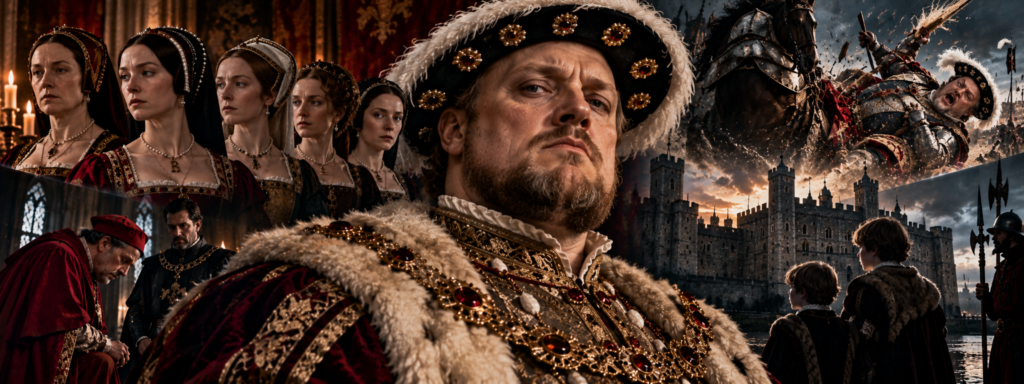
Henry VIII: England’s Most Feared King, His Six Wives, and the Bloody Descent Into Tyranny
He began his reign as the golden prince of the Tudor dynasty: handsome, athletic, intelligent, charming, and seemingly destined for greatness. He ended it as an aging, increasingly incapacitated monarch whose court lived under the shadow of suspicion, whose religious policies had sent people to the scaffold and the stake, and whose determination to secure his dynasty had destroyed marriages, friendships, and lives. Two of his wives were executed, trusted ministers fell from power, monasteries were dismantled, and even members of the royal family discovered that their bloodlines could make them targets. Between the brilliant young king of 1509 and the formidable ruler who died in 1547 lay nearly four decades of ambition, religious upheaval, marital catastrophe, and extraordinary political violence. But what transformed Henry VIII? Did years of jousting injuries and deteriorating health contribute to his increasingly severe behavior, or was the capacity for cruelty present long before his physical decline? The answer is more complicated, and perhaps more unsettling, than the familiar story of a once-beloved king driven mad by injury, illness, and an obsession with producing a son.
The Golden Prince Who Became England’s Most Feared Monarch
When Henry VIII inherited the English throne in April 1509, he seemed to embody everything a Renaissance monarch was expected to be. He was seventeen years old, physically impressive, highly educated, and enthusiastic about music, hunting, dancing, and martial competition. Foreign ambassadors admired his appearance and accomplishments, while his subjects welcomed the beginning of a reign that appeared to promise a departure from the financial severity associated with his father, Henry VII. England had a young king whose energy and confidence suggested that the Tudor dynasty was entering a glorious new chapter.
Almost four decades later, the atmosphere surrounding the English crown had changed dramatically. Henry had broken with papal authority, declared himself Supreme Head of the Church of England, dissolved hundreds of religious houses, and authorized punishments against people who challenged his policies. Two queens had been executed for alleged treasonous sexual misconduct, a third had died shortly after childbirth, and several of the king’s most important ministers had fallen from favor. His government had also pursued costly wars, imposed religious changes, and expanded the reach of royal authority through Parliament and the courts.
Henry’s physical appearance had changed just as dramatically. The energetic young sportsman became an increasingly heavy and physically restricted ruler who suffered from painful, recurring leg ulcers. By the final years of his life, his mobility was seriously impaired, and elaborate arrangements were sometimes necessary to move him. The contrast between the athletic prince and the suffering older king has encouraged generations of historians and medical commentators to search for a medical explanation for his political behavior.
Jousting accidents, possible head injuries, chronic infection, endocrine disorders, and rare genetic conditions have all been proposed. Some theories suggest that neurological damage contributed to changes in his temperament. Others emphasize the effects of persistent pain, frustration, and reduced physical independence. Still others argue that the most important explanations lie in the political pressures of Tudor kingship, the pursuit of a male heir, and Henry’s determination to defend his understanding of royal authority.
The temptation to identify a single turning point is understandable. Henry’s reign offers a dramatic before-and-after narrative, particularly around the serious jousting accident of January 1536. Yet the historical evidence does not establish that Henry developed a particular psychiatric disorder, suffered permanent frontal-lobe damage, or underwent a medically demonstrable personality transformation. Some of his most consequential acts of coercion occurred before his later physical deterioration, while important administrative achievements continued afterward.
Henry was not simply a healthy young man who became cruel because of an accident. His character, political circumstances, religious convictions, and health changed over time, and those developments interacted in complicated ways. Understanding his reign requires looking beyond the familiar image of an increasingly furious king and examining the world in which his decisions were made.
The result is a portrait of a ruler who could be intellectually sophisticated and politically ruthless, generous toward favored individuals and merciless toward those he considered disloyal. His story is not merely about illness or temperament. It is about what happened when personal desires, dynastic fears, religious conviction, and immense political power converged in the hands of one monarch.
The Tudor Inheritance: A Dynasty Haunted by Civil War
Henry was born on June 28, 1491, at Greenwich Palace, the third child and second son of Henry VII and Elizabeth of York. His father had won the crown at the Battle of Bosworth in 1485, defeating Richard III and bringing the Wars of the Roses toward their conclusion. Henry VII’s claim to the throne was not especially strong by hereditary standards, but military victory, parliamentary recognition, and marriage to Elizabeth of York helped establish his authority. The Tudor dynasty was nevertheless comparatively young and remained vulnerable to challenges.
The memory of dynastic warfare shaped the political environment in which Henry VIII grew up. His father had faced pretenders, rebellions, and threats from individuals claiming connections to the defeated House of York. Royal legitimacy was not merely a ceremonial concern. Rival claimants could become centers of rebellion, particularly when supported by powerful nobles or foreign rulers.
Henry VIII was not originally expected to inherit the throne. His elder brother, Arthur, Prince of Wales, occupied the position of heir and received an education designed for future kingship. Henry, by contrast, grew up with somewhat different expectations, although he still received an extensive education appropriate to a royal prince. He studied languages, theology, literature, and music, developing interests that remained important throughout his life.
In November 1501, Arthur married Catherine of Aragon, daughter of Ferdinand II of Aragon and Isabella I of Castile. The marriage strengthened diplomatic ties between England and Spain and represented an important achievement for Henry VII. Yet the arrangement was soon disrupted by tragedy. Arthur died in April 1502, leaving Catherine a young widow and transforming Henry into the heir to the English throne.
Arthur’s death would influence Henry’s life in ways no one could have anticipated. It altered the succession, created uncertainty over Catherine’s future, and eventually became central to the argument Henry used when seeking to end his first marriage. The question of whether Catherine’s marriage to Arthur had been consummated would become a major issue in the religious and political crisis of the 1520s and 1530s.
Henry’s mother, Elizabeth of York, died in February 1503 following childbirth. Her death deprived the young prince of an important family relationship and left Henry VII a widower. The surviving evidence does not permit confident conclusions about the psychological consequences for Henry VIII, but the losses formed part of his early experience. By the time he became king, he had witnessed the deaths of his elder brother and mother and inherited a dynasty whose security remained a central concern.
Henry VII died on April 21, 1509. His seventeen-year-old son succeeded him without serious immediate opposition. The transition appeared smooth, but the new king inherited the responsibilities of preserving a dynasty established through conquest and still conscious of the dangers posed by rival bloodlines.
The young Henry would spend much of his reign attempting to secure the Tudor succession. His methods would eventually become among the most controversial aspects of his government.
A Renaissance King: Intelligence, Charm, and the Love of Spectacle
Henry VIII’s early reputation was built upon qualities that made him unusually attractive to Renaissance observers. He was tall by the standards of his time, physically active, and accomplished in pursuits associated with aristocratic masculinity. Hunting, jousting, wrestling, dancing, and elaborate court entertainments occupied an important place in his life. These activities were not simply recreational; they displayed royal vitality, courage, and magnificence.
Henry was also intellectually engaged. He possessed a strong interest in theology and participated in religious debate, particularly during the early years of the Protestant Reformation. In 1521, a work published under his name defended traditional Catholic teaching against Martin Luther. Pope Leo X rewarded him with the title Defender of the Faith, an irony given Henry’s later break with papal authority.
Music formed another important part of his identity. Henry played instruments, supported musicians, and participated in courtly musical culture. Several compositions are associated with him, although popular tradition has incorrectly credited him with writing the song Greensleeves. His court became a center of artistic display, ceremony, and intellectual activity.
The young king also enjoyed competition and admiration. Royal tournaments allowed him to demonstrate physical ability before nobles, ambassadors, and members of the court. His participation carried risks, but it reinforced the image of a vigorous warrior prince. Henry’s desire for military glory reflected the example of earlier English kings, particularly Henry V.
His early government was not free from harshness. Shortly after his accession, the former financial officials Edmund Dudley and Richard Empson were arrested and eventually executed. They had become unpopular because of their roles in Henry VII’s financial administration. Their deaths helped distance the new reign from aspects of his father’s government, but they also demonstrated that political expediency could produce severe consequences.
This episode matters when considering claims that Henry’s cruelty began only after his later injuries. The young king was already willing to authorize executions when political circumstances encouraged them. Tudor monarchy operated within a legal and political culture in which treason could be punished severely, and rulers were expected to defend their authority.
Henry’s early charm and accomplishments were genuine, but they did not guarantee a gentle style of government. His personality contained qualities that could serve him well in courtly competition while becoming dangerous when combined with the power to determine the fate of political opponents.
The golden prince was not yet the formidable ruler remembered from his final years, but the foundations of his political outlook were already taking shape.
Catherine of Aragon: The Queen Who Could Not Give Him a Surviving Son
Henry married Catherine of Aragon on June 11, 1509, shortly before their joint coronation. Catherine was approximately six years older than Henry and had previously been married to his brother Arthur. Their marriage required a papal dispensation because of the relationship created by Catherine’s earlier marriage. The union initially appeared politically advantageous and personally successful.
Catherine possessed considerable experience of European dynastic politics. She was the daughter of powerful Spanish monarchs and had spent years navigating uncertainty after Arthur’s death. As queen, she developed a reputation for religious devotion, dignity, and political competence. In 1513, while Henry campaigned in France, she served as regent during the Scottish invasion that ended in England’s victory at Flodden.
The central difficulty in their marriage became the succession. Catherine experienced several pregnancies, but only one child, Mary, born in February 1516, survived infancy. Other pregnancies ended in miscarriage, stillbirth, or the early deaths of infants. The losses were personally painful and politically significant because Henry wanted a legitimate male heir.
The pressure surrounding the succession was intensified by the Tudor dynasty’s recent origins. Henry knew that disputes over hereditary claims had contributed to decades of civil conflict. A surviving son appeared to offer greater certainty, although the belief that a female ruler could not govern successfully was shaped by political assumptions rather than an absolute legal impossibility. England had experienced disputed female claims to the throne, most notably during the twelfth-century conflict involving Empress Matilda.
By the 1520s, Catherine was approaching the end of her reproductive years. Henry increasingly feared that the marriage would not produce a surviving son. His attention also turned toward Anne Boleyn, a young woman associated with the royal court. The combination of dynastic anxiety, personal attraction, and religious argument transformed a private marital problem into a national crisis.
Henry began questioning whether his marriage to Catherine had violated biblical prohibitions concerning marriage to a brother’s widow. He argued that the absence of surviving sons demonstrated divine displeasure. Catherine maintained that her marriage to Arthur had never been consummated and that her union with Henry was lawful. The dispute would occupy much of the following decade.
The king’s determination to secure an annulment revealed the extent to which he was prepared to challenge established institutions when they obstructed his objectives. His marriage had once strengthened England’s international position. Now its dissolution threatened relations with powerful European rulers and the authority of the papacy.
Catherine refused to surrender her status as Henry’s lawful wife. Her resistance transformed her into a powerful symbol of opposition to the king’s marital policies, while Henry’s determination increasingly shaped the future of English religion.
Cardinal Wolsey: The Minister Who Could Not Deliver the King’s Divorce
Thomas Wolsey became one of the most powerful figures of Henry’s early reign. Rising from relatively modest origins, he achieved extraordinary influence through administrative ability, diplomatic skill, and royal favor. He became Archbishop of York, a cardinal, and Lord Chancellor, combining major ecclesiastical and political responsibilities. For years, he managed much of the kingdom’s business while Henry pursued warfare, diplomacy, and courtly interests.
Wolsey’s position depended upon his ability to satisfy the king’s expectations. He negotiated with European rulers, organized government business, and helped finance royal ambitions. His wealth and magnificence attracted criticism, but his administrative talents were substantial. He became an indispensable figure in the early Tudor government.
The divorce crisis exposed the limits of his influence. Henry expected Wolsey to secure a papal annulment of his marriage to Catherine. Yet Pope Clement VII faced immense political pressure from Emperor Charles V, Catherine’s nephew. The sack of Rome in 1527 and the wider European political situation made the pope reluctant to authorize a decision that would humiliate the emperor’s family.
Wolsey attempted to manage the legal and diplomatic difficulties, but the process stalled. The legatine court convened at Blackfriars in 1529 failed to provide the resolution Henry demanded. Catherine challenged the proceedings and appealed to Rome. The king’s frustration intensified as the prospect of a straightforward annulment disappeared.
Wolsey fell from favor in 1529 and lost the great seal of office. He was accused of violating the statutes of praemunire, which restricted certain appeals to foreign ecclesiastical authority. His possessions were confiscated, although he initially retained some ecclesiastical responsibilities. The fall demonstrated how quickly royal favor could disappear when a minister failed to deliver a politically essential result.
In 1530, Wolsey was arrested on a charge of treason and ordered to travel south. He became seriously ill during the journey and died at Leicester Abbey in November. His death spared him the possibility of trial and execution. It also removed one of the most important political figures of Henry’s early reign.
Later accounts have often portrayed Wolsey as a minister who carefully managed Henry’s volatile temperament. Such interpretations capture aspects of the relationship between a powerful ruler and an experienced adviser, but they should not be exaggerated into a psychological diagnosis. Wolsey’s fall can be explained through political failure, changing court alliances, and the king’s determination to secure an annulment.
The episode established a pattern that would recur during Henry’s later reign. Ministers could accumulate immense power through royal favor, but their position remained vulnerable when their policies conflicted with the king’s wishes.
Wolsey had served Henry for years, yet his failure over one issue destroyed his career.
Anne Boleyn and the Break With Rome: When Marriage Changed a Kingdom
Anne Boleyn became central to Henry’s determination to end his marriage to Catherine. She had spent time at European courts and developed a reputation for intelligence, sophistication, and strong personal convictions. Henry’s pursuit of Anne began during the 1520s, although the precise development of their relationship remains partly uncertain. Anne resisted becoming merely another royal mistress and eventually became the focus of Henry’s plans for remarriage.
The king’s determination to marry Anne intensified his conflict with papal authority. When conventional ecclesiastical procedures failed to provide an annulment, Henry’s government pursued a more radical solution. Parliamentary legislation gradually transferred authority over English ecclesiastical affairs away from Rome. The changes created the legal foundation for the English Reformation.
In 1533, Thomas Cranmer, Archbishop of Canterbury, declared Henry’s marriage to Catherine invalid. Henry had already married Anne, and she was crowned queen in June. Their daughter Elizabeth was born in September 1533. Although Henry had hoped for a son, Elizabeth’s birth initially appeared to secure the possibility of further legitimate children.
The break with Rome continued through legislation enacted during the following years. The Act of Supremacy of 1534 recognized Henry as Supreme Head of the Church of England. This development fundamentally altered the relationship between monarchy and religion. The king now claimed authority over an institution previously connected to the papacy.
The religious changes were not simply expressions of personal vanity. They involved complex legal, theological, and political arguments about sovereignty, ecclesiastical jurisdiction, and the relationship between crown and church. Nevertheless, Henry’s marital objectives provided the immediate impetus for the crisis. His determination to obtain a male heir helped produce one of the most consequential transformations in English history.
Opposition could be dangerous. Thomas More, the former Lord Chancellor, refused to accept the religious settlement in the terms demanded by the government. Bishop John Fisher likewise resisted the changes. Both were executed in 1535 after convictions for treason. Their deaths demonstrated that the king’s religious policies would be enforced through the criminal law.
The executions also complicate attempts to explain Henry’s severity through the jousting accident of January 1536. More and Fisher died before that event. Their cases reveal that Henry’s willingness to use capital punishment against respected opponents had already become a defining feature of his government.
Anne Boleyn’s position appeared secure in 1533, but the absence of a surviving son gradually weakened her standing. Her marriage had helped transform English religion, yet she remained vulnerable to the same dynastic expectations that had destroyed Catherine’s position.
Within three years, Anne would be dead.
The Jousting Accidents: Did Henry Suffer Brain Injuries?
Henry VIII’s enthusiasm for jousting exposed him to repeated physical danger. The sport involved heavily armored riders charging toward one another with lances, and serious injuries were not uncommon. Henry’s participation reflected his desire to display martial skill and royal courage. It also created opportunities for accidents that have attracted considerable modern medical speculation.
One incident occurred in 1524, when Henry was struck during a joust and suffered an injury associated with his helmet. Accounts differ in detail, but the event demonstrates that his sporting activities involved substantial physical risk. The surviving evidence does not establish that he suffered a severe concussion or permanent neurological damage on that occasion. Later claims about chronic headaches and lasting brain injury are not securely documented.
The most famous accident occurred on January 24, 1536, at Greenwich. Henry fell from his horse during a joust, and contemporary reports indicate that the animal fell upon him. The incident caused considerable concern because the king’s death would have created another succession crisis. The exact nature and duration of his injuries remain uncertain.
Some later accounts have claimed that Henry remained unconscious for approximately two hours. That detail is frequently repeated in popular histories and medical discussions, but it is not securely established by the strongest contemporary evidence. Reports that he temporarily lost the ability to speak are likewise difficult to verify. The accident was serious, but its precise neurological consequences cannot be reconstructed confidently.
The possibility of traumatic brain injury has attracted modern attention because some brain injuries can affect emotional regulation, judgment, and behavior. Researchers have proposed that repeated head trauma might explain aspects of Henry’s later temperament. Such hypotheses are medically conceivable, but they remain retrospective interpretations based upon incomplete historical records. No surviving examination establishes frontal-lobe damage.
The timing of the accident has encouraged the idea that it marked a decisive transformation in Henry’s personality. Anne Boleyn’s downfall occurred only months later, and the king’s later reign became associated with increasingly severe political punishments. Yet chronological proximity does not prove causation. Henry had already authorized executions, pursued coercive religious policies, and demonstrated an uncompromising approach to political opposition before January 1536.
The accident may have affected his health and physical confidence. It may also have aggravated existing injuries or contributed to later mobility problems. However, the evidence does not permit a confident conclusion that it caused a permanent psychiatric or neurological change. The image of a king whose brain was suddenly damaged and whose cruelty began immediately afterward is too simple.
Henry’s behavior must be understood through a broader combination of political circumstances, personal priorities, health problems, and the structures of Tudor monarchy. The jousting accident remains an important event, but it cannot bear the full explanatory weight often placed upon it.
The Fall of Anne Boleyn: A Queen Accused, Condemned, and Executed
Anne Boleyn’s position deteriorated rapidly during the spring of 1536. She had failed to produce a surviving male heir, and Henry’s attention had turned toward Jane Seymour. The queen also faced hostility from political and religious opponents who resented her influence. Court factions maneuvered around the possibility that her marriage might be ended.
In late April and early May, a series of arrests transformed the situation. Anne was accused of adultery with several men, including members of the royal household. Her brother, George Boleyn, Viscount Rochford, was accused of incest with her. The allegations were extraordinarily serious because sexual misconduct by a queen could be treated as a threat to the succession.
The charges also included conspiracy against the king’s life. The evidence presented against Anne has been heavily questioned by historians, and the alleged offenses cannot be established as historical fact. Several accusations appear chronologically implausible, while the political circumstances surrounding the investigation raise serious concerns about its reliability. The proceedings were conducted in an atmosphere where the outcome was heavily influenced by royal power.
Anne was imprisoned in the Tower of London. Her marriage to Henry was declared invalid, and their daughter Elizabeth was consequently excluded from the succession under the new legal settlement. The queen who had once helped transform England’s religious institutions now faced execution. Her fall was astonishingly rapid.
On May 19, 1536, Anne Boleyn was executed within the Tower. She was beheaded by a swordsman brought from Calais, an arrangement often described as intended to provide a relatively swift death. Her execution was one of the most dramatic events of Henry’s reign. A reigning queen had been condemned for alleged sexual crimes and treason, while the king prepared to marry another woman.
Henry married Jane Seymour on May 30, eleven days after Anne’s death. The speed of the marriage reinforced contemporary and later suspicions that Anne’s removal had been politically convenient. Nevertheless, the surviving evidence does not reveal every stage of the decision-making process. Historians continue debating the roles played by Henry, Thomas Cromwell, and rival court factions.
The coincidence between Anne’s execution and Henry’s recent jousting accident has encouraged speculation that neurological injury contributed to his conduct. Yet the political motives surrounding the succession were substantial, and the accusations emerged within an established culture of factional rivalry. The evidence does not establish that the king’s decisions resulted from brain damage.
Anne’s death revealed the danger of occupying a position dependent upon royal favor. She had been elevated through Henry’s determination to marry her, but that same determination could turn against her when dynastic expectations remained unfulfilled.
The king had destroyed one marriage through religious revolution and ended another through execution. His pursuit of a surviving son continued.
Jane Seymour and the Son Henry Had Wanted for Decades
Jane Seymour became Henry’s third wife in May 1536. Unlike Catherine of Aragon and Anne Boleyn, she entered marriage with the king after two previous unions had ended in extraordinary political controversy. Her position was therefore both promising and dangerous. Henry expected her to provide the male heir he had pursued for so many years.
Jane’s family benefited from the marriage, gaining influence within the royal court. Her brothers Edward and Thomas Seymour would later become important political figures. Jane herself has often been portrayed as modest and conciliatory, although much of her personal character remains difficult to reconstruct from surviving evidence. Her role was shaped by the expectations imposed upon a Tudor queen.
In October 1537, Jane gave birth to a son, Edward, at Hampton Court Palace. The event fulfilled Henry’s central dynastic objective. After years of failed pregnancies, marital conflict, and religious upheaval, the king finally possessed a legitimate male heir. Celebrations marked the birth, and the infant was recognized as the future Edward VI.
The triumph was followed almost immediately by tragedy. Jane developed complications after childbirth and died on October 24, 1537. The precise medical cause remains uncertain, although puerperal infection has often been suggested. Her death deprived Henry of the queen who had given him the son he wanted.
Henry’s grief has been emphasized in later accounts, and his decision to be buried beside Jane at Windsor suggests that he regarded her as particularly important. Yet the surviving evidence does not permit a complete reconstruction of his emotional life. The marriage had produced a surviving son, making Jane’s position within Tudor dynastic memory distinctive. Her death also meant that Henry would eventually consider another marriage.
Edward’s birth reduced one immediate source of dynastic anxiety, but it did not eliminate the king’s concerns. A single male heir remained vulnerable to illness or death. Henry’s own childhood had demonstrated how quickly succession plans could collapse when an heir died unexpectedly.
The king’s desire for additional security therefore continued. His fourth marriage would become one of the most politically embarrassing episodes of his reign, and the minister who arranged it would pay a devastating price.
Anne of Cleves and the Destruction of Thomas Cromwell
Thomas Cromwell rose to prominence after Wolsey’s fall and became one of the principal architects of Henry’s religious and administrative reforms. He possessed considerable legal and financial ability and helped develop the parliamentary legislation that supported royal supremacy. His influence expanded during the 1530s, particularly as the government pursued the dissolution of monasteries. Yet his position depended upon maintaining Henry’s confidence.
Following Jane Seymour’s death, Cromwell supported a marriage alliance with Anne of Cleves, whose family had connections to Protestant interests in the Holy Roman Empire. The proposed union offered diplomatic advantages at a time of uncertainty in European politics. Henry agreed to the marriage, but the relationship proved unsuccessful almost immediately.
Henry married Anne in January 1540. He subsequently complained that he found her unattractive and that the marriage had not been consummated. His objections were shaped by personal preference, political circumstances, and changing diplomatic priorities. The marriage was annulled in July 1540.
Anne accepted the settlement and received substantial financial provision. She remained in England and enjoyed a relatively secure position as the king’s honored former wife. Her survival contrasts sharply with the fate of Anne Boleyn and Catherine Howard. Cooperation with the annulment allowed her to avoid a prolonged confrontation with royal authority.
Cromwell was less fortunate. His enemies exploited the failure of the marriage and the changing political atmosphere to undermine his position. He was arrested in June 1540 and accused of treason and heresy. Parliament passed an act of attainder against him, allowing punishment without an ordinary criminal trial.
Cromwell was executed on July 28, 1540. His death eliminated one of the most influential ministers of Henry’s reign. The king later expressed regret over aspects of Cromwell’s destruction, according to contemporary diplomatic reporting. Nevertheless, the execution demonstrated the vulnerability of even the most powerful royal servants.
The fall of Cromwell is sometimes interpreted as evidence of Henry’s increasingly unpredictable temperament. Yet it also reflected factional rivalry, religious disagreement, and the political consequences of a failed diplomatic marriage. Cromwell had accumulated enemies through his policies and influence. His removal was therefore part of a broader struggle over the direction of government.
The episode nevertheless reinforced a dangerous reality at the Tudor court. Service to the king could bring extraordinary rewards, but it offered no guarantee of personal safety. Wolsey had died after losing favor, More had been executed for resisting royal supremacy, and Cromwell now followed him to the scaffold.
Henry’s government had become a place where political failure could carry fatal consequences.
Catherine Howard: Youth, Scandal, and Another Queen on the Scaffold
Henry married Catherine Howard in July 1540, shortly after the annulment of his marriage to Anne of Cleves. Catherine was considerably younger than the king, although her exact birth date remains uncertain. She belonged to the influential Howard family and was related to Anne Boleyn through the extended family network. Her marriage appeared to strengthen conservative religious interests at court.
Henry was approaching fifty and suffering from increasingly serious physical limitations. Catherine’s youth and position attracted considerable attention, and the king reportedly showed her affection and generosity. Yet the marriage became entangled in allegations concerning her sexual history and conduct. These accusations would prove fatal.
In 1541, information emerged about Catherine’s relationships before her marriage, including connections with Henry Manox and Francis Dereham. Investigations also uncovered allegations concerning Thomas Culpeper, a member of the royal household. The precise nature of Catherine’s relationship with Culpeper remains debated, but secret meetings and correspondence became central to the accusations. The government treated the matter as a serious threat to royal honor and the succession.
Catherine was removed from court and subjected to investigation. The proceedings involved interrogations and the collection of testimony from individuals associated with her household. The legal and political environment was heavily unfavorable to her. As queen, her conduct was judged through expectations that carried consequences far beyond those imposed upon most subjects.
Parliament passed legislation addressing the concealment of premarital sexual conduct by a woman marrying the king, and Catherine was condemned through an act of attainder. She was executed at the Tower of London on February 13, 1542. Her attendant Jane Boleyn, Lady Rochford, was executed the same day. Catherine became the second of Henry’s wives to die by execution.
The scandal has frequently been used to illustrate Henry’s supposed paranoia or emotional instability. Yet the political significance of a queen’s alleged sexual conduct was substantial within Tudor dynastic culture. Questions about legitimacy and succession could threaten the monarchy. This context does not diminish the severity of Catherine’s punishment, but it helps explain why the accusations were treated as matters of state.
The historical evidence does not establish that Henry’s response resulted from a psychiatric disorder. His conduct can be examined through dynastic expectations, personal humiliation, political influence, and the harsh legal framework surrounding treason. The outcome was nevertheless devastating for Catherine and those associated with her.
By 1542, Henry had executed two queens. The spectacle of royal marriage had become inseparable from the possibility of political destruction.
The Dissolution of the Monasteries: Religion, Wealth, and Royal Power
One of the most consequential developments of Henry’s reign was the dissolution of the monasteries. Between 1536 and 1540, the government suppressed hundreds of religious houses across England and Wales. Their lands, buildings, and revenues were transferred to the crown, although substantial portions were later granted or sold to private individuals. The process transformed the religious and economic landscape of the kingdom.
The dissolution followed Henry’s break with Rome and the establishment of royal supremacy over the English church. Cromwell played a central administrative role, overseeing investigations and the implementation of legislation. Government officials examined religious houses and reported alleged abuses, financial conditions, and institutional practices. The resulting evidence was shaped by the political purposes of the campaign and cannot always be treated as impartial.
The suppression of smaller monasteries began under legislation enacted in 1536. Larger institutions were subsequently dissolved through surrender, pressure, and further legal measures. Monastic communities were dispersed, and many religious buildings were stripped of valuable materials. Some structures survived through conversion to parish churches or private use, while others fell into ruin.
The economic consequences were enormous. Monasteries had provided religious services, charity, hospitality, education, and employment in many communities. Their dissolution disrupted established networks of support and altered local relationships. The redistribution of monastic property also created new groups with financial interests in maintaining the religious settlement.
Opposition emerged, most dramatically during the Pilgrimage of Grace in 1536. The uprising began in northern England and involved grievances concerning religious change, taxation, and government policies. Thousands participated, making it one of the largest rebellions of Henry’s reign. The movement demonstrated that royal supremacy and monastic dissolution were deeply controversial.
Henry initially pursued negotiations, and promises of pardon and consideration of grievances helped secure the dispersal of rebel forces. Further unrest in 1537 led to severe punishment. Prominent participants, including Robert Aske, were executed. The government’s response reinforced the authority of the crown while leaving lasting resentment.
The repression of the Pilgrimage of Grace occurred after Henry’s jousting accident, but it also reflected established Tudor practices for responding to rebellion. The king regarded challenges to royal authority as threats to political order. His government used execution, confiscation, and legal punishment to deter further resistance. Such measures were harsh, but they cannot be attributed confidently to neurological injury.
The dissolution therefore illustrates the intersection of religious conviction, political control, and financial opportunity. Henry’s policies reshaped English society while demonstrating the extraordinary reach of royal authority. The king’s personal decisions mattered enormously, but they operated through administrative institutions capable of enforcing his will across the kingdom.
The Leg Ulcers: Chronic Pain and the Decline of a Warrior King
Henry’s later physical deterioration is among the best-documented changes of his reign. He developed persistent problems with his legs, including ulcers that became increasingly troublesome. The wounds caused pain, swelling, and difficulty moving. Their treatment required repeated attention from physicians and attendants.
The precise origins of the ulcers remain uncertain. They may have been associated with earlier injuries, circulatory problems, infection, or several interacting conditions. The jousting accident of 1536 has often been connected to their deterioration, but the evidence does not establish that it created every subsequent problem. Some indications of leg difficulties predate the accident.
The ulcers were reportedly prone to reopening and required treatment according to contemporary medical practices. Tudor medicine lacked antibiotics and modern wound-care techniques. Physicians relied upon methods derived from humoral theory, surgical experience, and traditional remedies. Some treatments may have been painful or ineffective, particularly when wounds became chronically infected.
Modern commentators have suggested that Henry may have suffered from osteomyelitis, a serious infection of bone. Such a condition could potentially explain persistent pain and recurrent inflammation. However, the surviving descriptions do not establish that infection reached the bone. The diagnosis remains hypothetical.
Chronic pain can affect sleep, mood, patience, and physical activity. It is therefore reasonable to consider whether Henry’s leg problems influenced his daily life and behavior. Yet the historical record does not allow a direct causal link between particular political decisions and episodes of pain. The relationship between illness and temperament cannot be reconstructed with clinical precision.
Henry’s reduced mobility also changed his relationship with the activities that had once defined his public identity. Hunting and jousting became increasingly difficult, while the ceremonial demands of kingship required physical assistance. The contrast between his earlier athleticism and later limitations was substantial. Such changes may have been personally frustrating, although his private emotional responses remain uncertain.
His court adapted to his needs through specialized furniture, transport arrangements, and assistance from attendants. The king continued participating in government, but his physical condition increasingly shaped the practical organization of royal life. His health became a matter of concern because the stability of the monarchy depended upon his survival.
The suffering of Henry’s final years was real. What remains uncertain is how far it contributed to the severity of his government. Chronic pain may have influenced his temperament, but it cannot explain every political decision or transform speculation into medical certainty.
Obesity, Possible Diabetes, and the Limits of Tudor Medicine
Henry’s weight increased substantially during the later decades of his reign. Surviving armor measurements demonstrate a marked expansion in his body size, particularly around the waist. His later ceremonial armor has been associated with a waist measurement of approximately fifty-one to fifty-four inches, depending upon the object and method of measurement. These measurements support the conclusion that he became considerably heavier than he had been in youth.
Popular accounts frequently estimate that Henry weighed nearly four hundred pounds. Such figures are speculative because no reliable contemporary measurement of his body weight survives. His actual weight cannot be established with precision. The surviving evidence demonstrates substantial obesity without providing an exact figure.
Reduced physical activity probably contributed to his weight gain. Henry had previously maintained an active lifestyle involving hunting, riding, and martial competition. His leg problems increasingly restricted those pursuits. Continued access to rich food and the ceremonial dining culture of the royal court may also have played a role.
Modern writers have suggested that Henry suffered from type 2 diabetes. The condition could potentially contribute to poor wound healing, circulatory problems, and other complications. However, the historical evidence does not establish that he experienced the symptoms necessary for a confident diagnosis. Diabetes remains one possible explanation among several.
Other medical theories have included endocrine disorders, cardiovascular disease, and complications associated with chronic infection. These suggestions attempt to account for his obesity, reduced mobility, and persistent wounds. Yet the absence of modern laboratory evidence makes definitive diagnosis impossible. His physical deterioration was probably influenced by multiple factors rather than a single identifiable condition.
The medical limitations of Tudor England compounded the problem. Physicians possessed considerable practical experience, but they lacked knowledge of bacteria, modern endocrinology, and effective treatment for many chronic diseases. Bloodletting, purging, topical applications, and dietary regulation formed part of contemporary medical practice. Some interventions may have provided limited relief, while others could have worsened symptoms.
Henry’s declining health also had political consequences. His advisers had to manage government business around a monarch whose mobility was increasingly restricted. The king’s physical presence remained symbolically important, but administrative institutions could carry out much of the daily work of government. The Tudor state continued functioning even as Henry’s body deteriorated.
The relationship between obesity and psychological behavior should not be overstated. Physical illness can influence well-being, but it does not establish cruelty, paranoia, or impaired judgment. Henry’s later policies must be examined through political and religious evidence rather than explained solely through his appearance or weight.
The Kell Blood Group and McLeod Syndrome: A Genetic Explanation?
Among the more unusual medical theories concerning Henry VIII is the suggestion that he possessed a particular Kell blood group profile associated with reproductive complications. The hypothesis attempts to explain why several of his wives experienced pregnancy losses. It has also been linked to speculation about McLeod syndrome, a rare genetic condition that can involve neurological and psychiatric symptoms. The theory has attracted public attention because it appears to connect Henry’s reproductive history with his later physical and behavioral changes.
The Kell blood group system involves antigens present on red blood cells. In certain circumstances, incompatibility between maternal and fetal blood groups can cause hemolytic disease of the fetus and newborn. If a father carries a relevant antigen and the mother lacks it, some pregnancies may be affected after maternal sensitization. This biological mechanism is well established in modern medicine.
Applying the theory to Henry’s marriages is much more difficult. The blood groups of Henry and his wives are unknown. Their reproductive histories are incompletely documented, and the causes of individual miscarriages, stillbirths, and infant deaths cannot be established. Pregnancy loss was common in early modern Europe for numerous reasons, including infection, maternal illness, obstetric complications, and factors that remain unidentified.
The suggestion that Henry was Kell-positive therefore remains speculative. It cannot be demonstrated from the available historical evidence. Nor does the pattern of pregnancies across his marriages provide a straightforward confirmation of the hypothesis. The theory offers a possible mechanism but lacks the genetic data necessary to test it.
McLeod syndrome is a rare X-linked disorder associated with abnormalities involving the XK gene and the Kell blood group system. It can produce neurological symptoms, movement abnormalities, and psychiatric manifestations in some affected individuals. However, it is not equivalent to simply possessing a Kell antigen, and the proposed connection with Henry requires additional assumptions. No genetic evidence establishes that he had the disorder.
Some advocates of the theory have suggested that McLeod syndrome could explain Henry’s later temperament and physical deterioration. Yet the surviving accounts do not document the characteristic neurological findings necessary to support the diagnosis. His obesity, leg ulcers, and political behavior are not sufficient to identify a rare genetic condition. The hypothesis remains an interesting but unproven attempt to explain a complex historical case.
The danger of such theories lies in their apparent completeness. A single medical explanation can seem attractive because it connects reproductive losses, personality changes, and physical decline. Yet historical lives rarely provide the detailed evidence required for retrospective diagnosis. A theory that explains several events is not necessarily correct if its central assumptions cannot be verified.
Henry’s reproductive history remains important, but its political consequences are much more securely documented than its medical causes. His desire for a male heir contributed directly to the breakdown of marriages, religious change, and succession legislation. Those developments can be studied without assigning him an unproven genetic disorder.
The Executions: How Many People Died Under Henry VIII?
Henry VIII’s reign is frequently associated with the claim that approximately seventy thousand people were executed under his authority. The figure appears in popular histories and discussions of Tudor tyranny. However, it is not supported by reliable surviving execution records and should not be presented as an established total. The true number of people executed during his reign cannot be calculated precisely.
The seventy-two-thousand figure is commonly traced to later historical writing, particularly William Harrison’s sixteenth-century Description of England. Harrison attributed an extraordinarily large number of executions to Henry’s reign, but his estimate was not based upon a comprehensive surviving national register. Historians have questioned its reliability. The figure may reflect exaggeration, uncertain calculation, or the rhetorical purposes of the writer.
What is beyond doubt is that Henry’s government authorized numerous executions for treason, religious offenses, rebellion, and other crimes. Some victims were prominent members of the aristocracy or clergy, while others were ordinary subjects caught in political and religious conflict. The scale of punishment varied according to circumstances. The surviving evidence supports serious criticism of the government’s coercive methods without requiring an inflated numerical claim.
Among the most famous victims were Thomas More, John Fisher, Anne Boleyn, Catherine Howard, Thomas Cromwell, and Margaret Pole. Their cases differed substantially, but all demonstrate the dangers associated with royal displeasure and accusations of disloyalty. The king’s authority was reinforced through legal procedures that could be manipulated or shaped by political necessity. Acts of attainder were particularly important because they allowed Parliament to condemn individuals without ordinary judicial trials.
Religious persecution also contributed to the death toll. Catholics who rejected royal supremacy could face treason charges, while some Protestants were executed for heresy under laws defending traditional doctrines. Henry’s religious policies were therefore not consistently Protestant in the later sense. He rejected papal authority while retaining many traditional Catholic beliefs and practices.
The execution of Margaret Pole, Countess of Salisbury, in 1541 became one of the most notorious episodes of the reign. She was an elderly noblewoman with Plantagenet ancestry and connections to the family of Cardinal Reginald Pole, an outspoken opponent of Henry’s religious policies. Her execution followed an act of attainder and reflected the government’s suspicion of dynastic and religious opposition. Later accounts describe a particularly gruesome execution, but the details vary and should be treated cautiously.
The government’s use of execution served several purposes. It punished alleged offenses, intimidated opponents, demonstrated royal authority, and removed individuals considered politically dangerous. Such practices were not unique to Henry, but the prominence of his victims and the religious transformations of his reign made them especially consequential. The king’s willingness to authorize severe punishment became central to his reputation.
The historical question is therefore not whether Henry ordered large numbers of executions; he did. The uncertainty concerns the total and the circumstances of individual cases. Responsible historical analysis should distinguish documented executions from unsupported numerical estimates.
Margaret Pole: Royal Blood as a Death Sentence
Margaret Pole, Countess of Salisbury, belonged to the surviving Plantagenet aristocracy. She was the daughter of George, Duke of Clarence, brother of Edward IV and Richard III. Her ancestry connected her directly to the royal family that had ruled England before the Tudors. Such connections could provide prestige, but they also carried political danger.
Margaret had experienced the instability of dynastic politics throughout her life. Her brother Edward, Earl of Warwick, was executed during Henry VII’s reign in 1499. The Tudor monarchy remained sensitive to individuals whose hereditary claims might attract opposition. Margaret nevertheless regained influence under Henry VIII and served in the household of Princess Mary.
Her position deteriorated as religious conflict intensified. Her son Reginald Pole became a prominent critic of Henry’s break with Rome and refused to support royal supremacy. His opposition angered the king and placed the wider Pole family under suspicion. Other relatives became involved in investigations and prosecutions.
Margaret was arrested in 1538 and imprisoned. She was subsequently condemned through an act of attainder rather than an ordinary criminal trial. The evidence used against her was controversial, and the political context suggests that her family connections and her son’s activities were central to the government’s actions. Her personal involvement in a treasonous conspiracy was not established through a conventional trial.
She was executed at the Tower of London on May 27, 1541, when she was approximately sixty-seven years old. Accounts of the execution differ, with later narratives emphasizing disorder and brutality. The precise details cannot be established confidently. Her death nevertheless became a powerful example of the danger faced by individuals associated with rival dynastic claims.
The execution is often interpreted as evidence of Henry’s paranoia. Yet that label risks oversimplifying the political circumstances. Tudor rulers had genuine reasons to fear rebellion and foreign intervention, while the Pole family’s connections to opposition abroad created serious political concerns. Those circumstances do not justify Margaret’s execution, but they help explain the government’s reasoning.
Her case illustrates the severity of Henry’s approach to dynastic security. Royal blood, which had once provided status and influence, could become a liability. The king’s determination to protect the Tudor succession contributed to the destruction of individuals whose ancestry made them politically inconvenient.
Catherine Parr: The Sixth Wife Who Survived
Henry married Catherine Parr in July 1543. She was an educated widow with substantial experience managing households and navigating aristocratic society. Unlike some of Henry’s earlier wives, Catherine entered marriage during the king’s final years, when his health was increasingly poor. Her position required considerable political caution.
Catherine developed a close relationship with Henry’s children and played an important role in the royal household. She supported educational interests and participated in religious discussion. Her theological sympathies leaned toward reform, although the precise development of her beliefs must be understood within the changing religious environment of the 1540s. She also served as regent during Henry’s campaign in France in 1544.
Religious disagreements created danger for Catherine. Conservative opponents at court sought to exploit her interest in theological debate. An attempt was made to move against her, and later accounts describe how she avoided the threat by emphasizing her submission to the king’s authority. The details are preserved in sources that require caution, but the episode reflects the political risks surrounding religious disagreement.
Catherine survived Henry’s reign and became his widow when he died in January 1547. Her survival was not simply a matter of luck. She possessed political skill, established relationships, and an understanding of the dangers associated with royal marriage. Her position also differed from that of wives whose marriages had become entangled in disputes over legitimacy or alleged sexual misconduct.
The familiar rhyme summarizing Henry’s wives as divorced, beheaded, died, divorced, beheaded, survived simplifies a much more complicated history. Catherine of Aragon and Anne of Cleves experienced annulments rather than modern divorces. Anne Boleyn and Catherine Howard were executed under accusations whose historical circumstances remain contested. Jane Seymour died following childbirth, while Catherine Parr outlived the king.
The six marriages reveal the extraordinary extent to which Henry’s personal life shaped national politics. They affected diplomacy, religion, succession, aristocratic alliances, and the lives of countless individuals. Yet they also demonstrate the limitations of explaining his conduct through a single medical condition. Each marriage unfolded within distinct political circumstances.
The Final Years: A King Imprisoned by His Own Body
During the final years of his reign, Henry VIII became increasingly restricted by physical illness. His leg ulcers remained troublesome, his mobility declined, and his substantial weight complicated movement. The king who had once displayed his athletic ability at tournaments now required assistance with activities that had previously been routine. His physical deterioration was visible to those around him.
Yet Henry continued exercising royal authority. His government pursued military campaigns, managed religious policy, and prepared for the succession. The king remained capable of participating in major decisions, although the extent of his daily involvement varied. His physical limitations did not mean that he had become incapable of governing.
The war with France in the 1540s imposed substantial financial burdens. Henry personally participated in the campaign of 1544, during which English forces captured Boulogne. The expedition demonstrated that he continued identifying himself with military kingship despite his declining health. However, the costs contributed to financial difficulties that would affect his successors.
Religious policy also remained contentious. Henry’s government alternated between measures associated with reform and efforts to preserve traditional doctrine. The Six Articles of 1539 had reaffirmed several conservative religious positions, while later developments continued producing conflict among competing factions. The king’s religious outlook was more complicated than a straightforward conversion to Protestantism.
Political executions continued during his final years. Henry Howard, Earl of Surrey, was executed in January 1547 after accusations involving treasonous ambition and the misuse of royal heraldic symbols. His father, Thomas Howard, Duke of Norfolk, narrowly escaped execution because Henry died before the sentence could be carried out. The episode demonstrates that dynastic suspicion remained significant until the end of the reign.
Henry’s physical condition undoubtedly made daily life difficult. Chronic wounds, restricted movement, and the limitations of Tudor medicine created circumstances that could produce suffering and frustration. Yet the surviving evidence does not establish that he experienced dementia, psychosis, or a specific psychiatric syndrome. His political behavior remained severe, but severity alone is not a medical diagnosis.
The final image of Henry as an enormous, angry monarch has become deeply embedded in popular culture. It captures aspects of his physical deterioration and political reputation but can obscure the complexity of his government. He remained intellectually engaged in religious and political matters, even as his body weakened. His ministers continued implementing policies that reflected both royal priorities and factional interests.
By early 1547, Henry’s health was failing. The question was no longer whether he would recover his former vitality, but how the kingdom would manage the succession after his death.
The Death of Henry VIII: The End of a Dangerous Reign
Henry VIII died at Whitehall Palace on January 28, 1547, at the age of fifty-five. His death ended a reign of nearly thirty-eight years. The young king who had inherited the throne in 1509 had transformed the relationship between crown and church, altered the succession repeatedly, and left England facing substantial financial and religious challenges. His death also brought to an end one of the most consequential personal reigns in English history.
The precise medical cause of death remains uncertain. His obesity, chronic leg ulcers, and possible cardiovascular or metabolic problems may have contributed to his decline. However, no surviving medical examination permits a definitive diagnosis. The evidence establishes serious physical deterioration without identifying a single cause.
Henry was succeeded by his nine-year-old son, Edward VI. The new king’s minority required government by councillors and a protector, creating opportunities for political rivalry. Edward’s reign would bring further religious reform, while his early death in 1553 reopened the succession question. The dynastic security Henry had pursued so relentlessly remained fragile.
Henry’s daughters Mary and Elizabeth would eventually rule England in their own right. Mary I attempted to restore Catholicism, while Elizabeth I established a durable Protestant religious settlement. Their reigns demonstrated that female monarchy was possible despite Henry’s anxiety about succession through daughters. The political consequences of his marriages therefore continued long after his death.
Henry was buried at St George’s Chapel, Windsor, beside Jane Seymour. His burial reflected his status as a monarch who had reshaped the kingdom, but it also symbolized the personal importance of the wife who had given him a surviving son. The king who had married six times rested beside his third queen. The arrangement became one of the enduring details of his posthumous reputation.
His death did not resolve the religious divisions created during his reign. England continued experiencing conflict over doctrine, worship, and the authority of the monarchy. The institutions established through the break with Rome remained central to the political struggles of the following decades. Henry’s decisions had transformed the kingdom in ways that could not easily be reversed.
The man was gone, but the consequences of his rule remained.
Was Henry VIII Really Mad? The Medical Evidence and the Historical Reality
Henry VIII is frequently described as a ruler whose personality deteriorated dramatically during middle age. The familiar narrative presents an intelligent, charming young prince transformed into a suspicious and violent tyrant by repeated head injuries, chronic pain, and psychological instability. The contrast between his early and later reputation is striking. Yet the medical explanation remains far less certain than popular accounts often suggest.
There is no reliable evidence that Henry was diagnosed with a psychiatric illness during his lifetime. Contemporary observers criticized his severity, ambition, religious policies, and treatment of opponents, but their descriptions do not establish a modern clinical condition. His actions were often deliberate, legally organized, and politically motivated. Cruelty and authoritarian government are not themselves proof of mental illness.
The traumatic brain injury hypothesis remains possible but unproven. Henry experienced jousting accidents, including the serious incident of January 1536. However, the surviving records do not establish the precise neurological consequences of those injuries. Claims of permanent frontal-lobe damage, severe memory loss, or a medically demonstrated personality change exceed the available evidence.
The chronic pain hypothesis is more securely grounded in the fact that Henry suffered from serious leg problems. Persistent ulcers and reduced mobility could have affected his comfort, sleep, and temperament. Nevertheless, historians cannot determine how particular political decisions were influenced by physical suffering. The existence of pain does not provide a complete explanation for executions, religious policy, or marital conflict.
Genetic theories involving Kell blood group incompatibility and McLeod syndrome are even more speculative. They depend upon unknown genetic characteristics and retrospective interpretations of reproductive and behavioral history. No surviving genetic evidence establishes that Henry possessed the relevant conditions. Such theories should be presented as hypotheses rather than accepted medical conclusions.
Psychological labels such as narcissism, paranoia, and megalomania also require caution. Henry displayed intense concern for dynastic security, demanded obedience, and punished individuals he considered disloyal. Those characteristics can be analyzed historically without assigning a personality disorder. His political environment encouraged suspicion because rival claims, rebellion, and foreign intervention were genuine threats to Tudor rule.
The most persuasive historical explanation is therefore multifactorial rather than diagnostic. Henry’s personality, dynastic priorities, religious convictions, political institutions, physical deterioration, and changing circumstances all influenced his reign. His increasingly severe government emerged from decisions made within a system that concentrated enormous authority in the monarchy. Medical conditions may have contributed to his behavior, but the evidence does not establish that they caused it.
The distinction is important because assigning responsibility to an unproven illness can obscure the political nature of Henry’s actions. His ministers, councillors, judges, and Parliament participated in implementing policies that punished opponents and transformed English institutions. The violence of the reign cannot be explained solely through the supposed mental deterioration of one individual. It involved a government capable of converting royal decisions into law and punishment.
Henry VIII belongs within a discussion of controversial monarchs not because he can be confidently diagnosed as mentally ill, but because his reign reveals the dangerous relationship between personal authority, dynastic anxiety, and political coercion. His reputation for tyranny is grounded in documented actions, while medical explanations for his temperament remain uncertain.
The Legacy of Henry VIII: Power, Fear, and the Destruction of Trust
Henry VIII’s reign transformed England more profoundly than that of many monarchs who ruled for far longer. He inherited a Catholic kingdom connected to the authority of the papacy and left behind a monarchy that claimed supremacy over the English church. He dissolved monasteries, redistributed enormous quantities of property, reshaped the succession, and expanded the role of Parliament in establishing royal policy. His decisions influenced English politics, religion, and society for generations.
His personal life became inseparable from those transformations. The desire to end his marriage to Catherine of Aragon helped produce the break with Rome. His marriage to Anne Boleyn contributed to the religious and political upheaval of the 1530s, while her execution demonstrated the vulnerability of even the most prominent individuals at court. Jane Seymour provided the male heir he desired, but her death left him searching for further dynastic security. The failures and tragedies of subsequent marriages continued shaping political alliances and ministerial fortunes.
Henry’s treatment of advisers reveals another central feature of his reign. Wolsey, Cromwell, More, and others occupied positions of extraordinary influence before losing royal favor or opposing royal policy. Their falls demonstrate how political service could become dangerous when the monarch’s expectations changed. The concentration of authority around the king created opportunities for advancement but also exposed individuals to severe punishment.
His religious policies produced lasting institutional change alongside coercion and persecution. Supporters of royal supremacy regarded the break with Rome as a necessary assertion of national sovereignty, while opponents viewed it as an unlawful rejection of ecclesiastical authority. The resulting conflicts affected clergy, religious communities, nobles, and ordinary subjects. Their consequences continued under Henry’s children.
The physical deterioration of Henry’s later years has become one of the most recognizable aspects of his historical image. His obesity, painful ulcers, and reduced mobility provide evidence of substantial suffering. Yet they do not establish a psychiatric diagnosis or explain every decision of his government. The search for a medical cause of tyranny risks simplifying a reign shaped by political ambition, religious conviction, and the exercise of power.
The familiar claim that Henry ordered seventy thousand executions likewise illustrates the importance of separating historical evidence from dramatic tradition. His government undeniably used capital punishment against political and religious opponents, but the precise total remains unknown. The documented cases are sufficiently serious without relying upon unsupported figures. The deaths of Anne Boleyn, Catherine Howard, Thomas More, Thomas Cromwell, and Margaret Pole reveal the human consequences of his rule.
Henry’s educational, cultural, and administrative interests also remain part of his legacy. He supported music, scholarship, architecture, and naval development. His government helped establish institutions and practices that influenced the later Tudor state. These achievements do not erase the violence of his reign, but they complicate the image of a ruler defined solely by anger and execution.
The question of whether Henry became mentally ill remains unresolved because the evidence does not permit a definitive diagnosis. His documented physical problems may have affected his daily life, and neurological injury remains a possibility. Yet the political record reveals continuity as well as change. Henry pursued dynastic security and demanded obedience long before his final years.
Henry VIII’s story is disturbing precisely because it does not require madness to explain its darkest chapters. He was capable of intelligence, charm, religious conviction, artistic accomplishment, and political calculation, yet he also presided over executions, persecution, and the destruction of people who had once enjoyed his confidence. His body deteriorated, his marriages collapsed, and his government became increasingly severe, but the surviving evidence does not establish that illness transformed an innocent prince into a tyrant. The deeper tragedy lies in the combination of personal ambition and extraordinary power. Henry believed that the survival of his dynasty and the authority of his crown justified decisions with devastating consequences for others. By the time he died, the golden prince of 1509 had become one of the most formidable and controversial rulers in English history. His reign remains a warning about the dangers of power exercised without effective restraint, and about the temptation to explain deliberate acts of cruelty through an illness that history cannot prove.