
Michael III: The Emperor Murdered in His Bed by the Friend Who Took His Throne
Michael III (840–867 CE) | Eastern Roman Emperor, 842–867 CE | Murdered at the palace of St. Mamas on the night of September 23–24, 867
Murder in the Emperor’s Bedroom
Late on a September night in 867, Emperor Michael III went to bed inside the imperial residence at St. Mamas, outside the central palace complex of Constantinople. He had spent the evening drinking and entertaining companions, according to the accounts that survive, and he apparently felt secure enough to retire without expecting immediate danger. Among the men closest to him was Basil the Macedonian, a former outsider of obscure origins whom Michael had elevated with astonishing speed. Basil had risen from relative poverty to become the emperor’s trusted favorite, chamberlain, political partner, and eventually co-emperor.
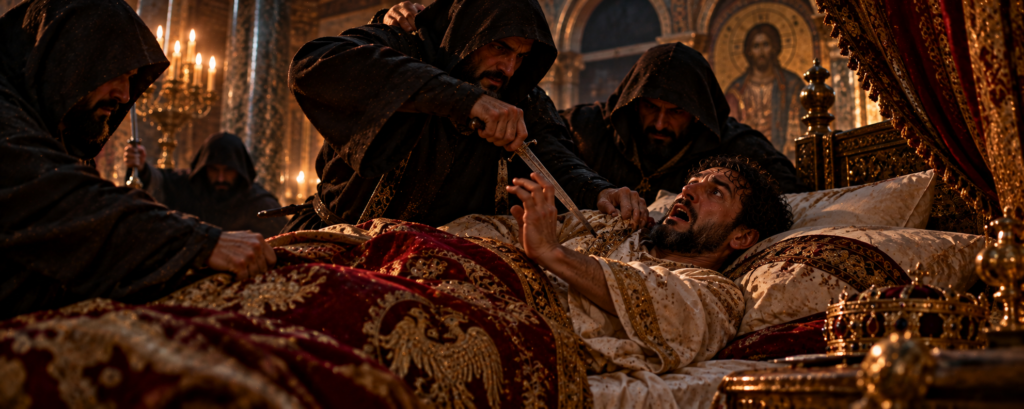
That night, trust became fatal. A group of conspirators associated with Basil entered the palace after Michael had gone to sleep. According to later Byzantine narratives, the conspirators had arranged for the emperor’s bedroom door or its locking mechanism to be tampered with so that his guards could not easily protect him. Michael awoke to armed men inside the room where he should have been safest.
The assassination was brutal. The emperor attempted to resist or call for help, but he had little chance against several armed attackers. Later accounts describe one of the conspirators cutting off or disabling Michael’s hands before the killers finished him with sword blows. The precise sequence differs among the sources, but there is no serious doubt that Michael III was murdered in his sleeping quarters during a conspiracy that placed Basil upon the throne.
Michael was twenty-seven years old. He had technically been emperor for twenty-five years, having inherited the throne as a toddler after the death of his father, Theophilos. His reign had witnessed the permanent restoration of icon veneration, important military campaigns against the Abbasid Caliphate, the rise of Byzantine missionary activity among the Slavs, and the emergence of men whose intellectual and religious influence would shape Eastern Europe for centuries. Yet the ruler who presided over this period would become better known to posterity by an insulting nickname: Michael the Drunkard.
That reputation presents a historical problem. Much of the surviving narrative about Michael was written under the Macedonian dynasty founded by Basil, the man who benefited most directly from his assassination. Portraying Michael as a drunken, irresponsible, immoral ruler helped justify Basil’s seizure of power and made the murdered emperor appear almost deserving of replacement. Some accusations may preserve genuine aspects of Michael’s behavior, particularly his fondness for entertainment and drinking, but the hostile political context cannot be ignored.
The irony becomes darker the closer one looks at Michael’s relationship with Basil. Michael did not merely know the man who replaced him. He created him politically. The emperor rewarded Basil, promoted him, arranged his marriage, entrusted him with extraordinary influence, and ultimately crowned him co-emperor.
Basil repaid that confidence by becoming involved in the destruction of Michael’s most powerful uncle, Bardas. Once Bardas was dead, Basil stood beside Michael as the most important man in the empire. Within little more than a year, Michael himself was dead as well. The beneficiary of both killings became sole emperor before the blood in Michael’s bedroom had faded from memory.
The murder of Michael III is therefore more than another Byzantine palace assassination. It is a story about political intimacy, propaganda, ambition, and the terrible danger of elevating a favorite beyond every rival. It is also a story whose most famous version was largely written by the descendants of the man who won.
A Child Inherits the Roman Empire
Michael was born in Constantinople on January 19, 840, the youngest child and only surviving son of Emperor Theophilos and Empress Theodora. His father belonged to the dynasty established by Michael II, the soldier-emperor who had taken power after the Christmas Day assassination of Leo V the Armenian in 820. Political murder therefore already formed part of the history that brought Michael’s family to the throne. The dynasty itself had been born from conspiracy.
Theophilos was a committed Iconoclast. The controversy over religious images had divided Byzantine Christianity for generations, with emperors, bishops, monks, and ordinary believers arguing over whether icons of Christ, the Virgin Mary, and the saints could legitimately be venerated. Theophilos defended the Iconoclast position and punished some prominent supporters of icons. His religious policy would become one of the defining issues inherited by his young son.
Michael was still a small child when Theophilos died in January 842. The throne passed to the boy, who was approximately two years old. A toddler could carry the title of emperor, but he obviously could not govern an empire threatened by powerful enemies and divided by religious controversy. Real authority therefore passed into the hands of a regency.
The most important figure in that government was Michael’s mother, Theodora. She was joined by senior officials and relatives, including the powerful logothete Theoktistos and members of her own family. The arrangement created a court in which personal relationships and political factions mattered enormously. Michael grew up surrounded by adults who governed in his name while competing for influence over his future.
Theodora would later be remembered as one of the most important empresses in Byzantine religious history. Unlike her late husband, she supported the restoration of icons. Her position required political caution because openly condemning Theophilos could damage the legitimacy of the dynasty. The settlement therefore had to preserve the memory of the dead emperor while reversing one of his central religious policies.
In 843, the regency restored the veneration of icons. The event became celebrated in the Eastern Church as the Triumph of Orthodoxy, commemorated on the first Sunday of Lent. The restoration ended the official period of Byzantine Iconoclasm that had shaped imperial politics for more than a century. Michael was still far too young to have directed the decision himself.
Nevertheless, the restoration occurred during his reign and became one of its most important legacies. Later Macedonian propaganda would often minimize Michael’s accomplishments by emphasizing his supposed personal failings. Yet the empire over which he eventually assumed direct control had undergone a profound religious transformation while he was still a child. His reign began at a turning point in Byzantine history.
Theodora, Theoktistos, and the Court Around a Young Emperor
Theodora’s regency was not merely a temporary arrangement designed to preserve the throne until Michael reached adulthood. It became a functioning government with its own alliances, policies, and rivalries. Theoktistos emerged as one of the most powerful officials within that administration. His influence would eventually bring him into conflict with Michael and with the emperor’s uncle Bardas.
The regency faced serious military challenges. Arab forces remained the empire’s principal external enemy in the east and the Mediterranean. Muslim powers controlled Crete, threatened Byzantine shipping, and launched raids into imperial territory. Sicily was also becoming an increasingly difficult battlefield as Muslim forces expanded their control over the island.
The government launched military expeditions with mixed results. Some operations failed badly, while others helped stabilize frontier regions. Byzantine warfare during this period involved raids, counter-raids, fortified cities, prisoner exchanges, and campaigns that could devastate border populations without producing permanent conquest. The empire remained powerful, but it was far from secure.
Theodora’s government also confronted the Paulicians, a Christian religious community regarded as heretical by the Byzantine establishment. Later sources accuse the regency of conducting severe persecution that caused large numbers of deaths. The figures preserved by chroniclers are almost certainly exaggerated, but the repression was real enough to drive some Paulicians toward alliance with the empire’s Muslim enemies. The consequences would later become a serious military problem.
Michael grew up inside this political environment while others exercised authority in his name. As he approached adolescence, the arrangement inevitably became unstable. An emperor raised beneath a regency eventually had to decide whether to accept the officials who had governed during his childhood or remove them. Michael chose the latter course.
The key figure in that transition was his maternal uncle Bardas. Bardas possessed political ambition, intelligence, and connections within the imperial family. He had been pushed aside during the dominance of Theoktistos but remained capable of rebuilding his influence. Michael’s desire for independence gave him the opportunity.
The struggle that followed would transform the government. Theodora would lose political authority, Theoktistos would die violently, and Bardas would emerge as the dominant figure beside the young emperor. Michael’s personal rule therefore began not through a peaceful coming of age but through another palace power struggle.
The Murder of Theoktistos
By the middle of the 850s, Michael was old enough to resent the restrictions imposed by the regency. Theoktistos in particular represented a political system in which the emperor possessed the title while others controlled government. Bardas encouraged Michael’s dissatisfaction and positioned himself as an alternative adviser. Their alliance became increasingly dangerous for the minister.
In 855, Theoktistos was arrested inside the palace. The exact circumstances are described differently by later sources, but he was ultimately killed by men acting within the emperor’s political circle. Michael was still only about fifteen years old. Whether he personally ordered every detail of the murder or was heavily influenced by Bardas remains debated.
The killing removed the most powerful supporter of Theodora’s regency. It also demonstrated that the young emperor was willing to participate in violent political change. Byzantine court politics could turn deadly with extraordinary speed once an official lost access to imperial protection. Theoktistos went from governing the empire to being killed within the palace system he had helped control.
Theodora’s authority collapsed soon afterward. She was gradually removed from government and eventually compelled to enter a convent along with several of Michael’s sisters. The transition was not necessarily an act of personal hatred toward his mother, but it ended her ability to dominate imperial politics. Michael was now moving toward direct rule.
Bardas benefited enormously. He became the emperor’s principal adviser and eventually received the title of Caesar, one of the highest honors in the Byzantine political system. His rise created a partnership in which Michael remained emperor while Bardas exercised substantial influence over administration, military policy, and cultural affairs. Later hostile accounts would use this arrangement to portray Michael as an irresponsible ruler who left government to his uncle.
That interpretation is too simple. Byzantine emperors routinely relied upon powerful ministers, relatives, and military commanders. Delegating authority did not necessarily mean abandoning government. The more important question is how effectively the imperial partnership functioned.
Under Michael and Bardas, the empire entered a period of notable military and cultural activity. The government supported education, missionary efforts, and campaigns against Arab forces. Constantinople remained politically dangerous, but the state itself was not collapsing. The stereotype of a drunken emperor presiding over complete chaos does not fit the broader evidence.
Bardas: The Uncle Behind the Throne
Bardas became one of the most important political figures of Michael’s reign. His influence extended across administration, military affairs, education, and ecclesiastical politics. Later writers hostile to Michael sometimes portrayed Bardas as the true ruler of the empire. That judgment reflects both his genuine importance and the desire to diminish Michael’s role.
One of the major developments associated with Bardas was the promotion of higher learning in Constantinople. The government supported intellectual activity connected with the Magnaura palace complex, where scholars taught subjects including philosophy, mathematics, astronomy, and grammar. The famous scholar Leo the Mathematician was associated with this intellectual environment. The period helped lay foundations for the cultural revival that would flourish under later Byzantine rulers.
Bardas also became deeply involved in church politics. His conflict with Patriarch Ignatios contributed to one of the most complicated ecclesiastical disputes of the ninth century. Ignatios was removed from office in 858 under controversial circumstances. The scholar and lay official Photios was rapidly elevated through ecclesiastical ranks and became patriarch.
Photios was one of the most brilliant intellectuals of medieval Byzantium. His appointment, however, generated intense opposition among supporters of Ignatios. The dispute eventually drew in Pope Nicholas I and contributed to worsening tensions between Constantinople and Rome. The controversy became entangled with questions of jurisdiction, ecclesiastical authority, and missionary activity.
Michael supported the government associated with Bardas and Photios. Later Latin and Byzantine sources interpreted the dispute according to their own religious loyalties, making simple judgments difficult. What matters for Michael’s political story is that his reign was deeply involved in major institutional developments. He was not ruling an empire devoid of serious policy.
Bardas’s power nevertheless created potential danger. A Caesar who controlled extensive patronage and enjoyed military influence could become almost as threatening as a rival emperor. Michael trusted his uncle for years, but the political balance around the throne was always vulnerable to new favorites. The arrival of Basil the Macedonian would eventually destroy it.
Before that happened, Michael and Bardas presided over significant developments beyond Constantinople. Their reign witnessed important military recovery in the east and missionary expansion among Slavic peoples. These achievements would later become part of the foundations upon which the Macedonian dynasty built its own reputation. Ironically, the dynasty that blackened Michael’s memory inherited many of the advantages created during his government.
War Against the Arabs
The eastern frontier remained one of the greatest tests of Michael’s reign. The Byzantine Empire and the Abbasid Caliphate had fought for generations, with both sides launching raids across the frontier zones of Anatolia and northern Syria. Cities could be captured, populations enslaved, and entire regions devastated. Victory rarely produced permanent security.
One of the most traumatic events of Michael’s childhood had been the sack of Amorion in 838 during his father’s reign. Amorion was associated with the ruling dynasty and possessed enormous symbolic importance. Its fall to Caliph al-Mu’tasim became a major humiliation for Byzantium. The memory of that disaster remained part of the political landscape Michael inherited.
During the 850s and 860s, Byzantine military fortunes began improving. Commanders such as Petronas, another of Michael’s maternal uncles, played important roles in campaigns against Muslim forces. Petronas possessed considerable military ability and eventually became one of the most successful generals of the reign. His victories strengthened the empire’s position in Anatolia.
The most celebrated success came at the Battle of Lalakaon in 863. A Muslim army led by Umar al-Aqta, emir of Melitene, had penetrated deeply into Byzantine territory. Roman forces converged upon the invaders from several directions. The resulting battle ended in a major Byzantine victory and the death of Umar.
Lalakaon had consequences beyond the destruction of a single raiding army. The victory weakened one of the most dangerous Muslim frontier powers and signaled that Byzantium was recovering the strategic initiative in Anatolia. Later generations would continue pushing eastward. The long Byzantine military revival of the ninth and tenth centuries had important roots in this period.
Michael’s personal role in these campaigns has been debated. Hostile sources attempted to credit successful generals while depicting the emperor as distracted by entertainment. Yet emperors did not need to personally command every battle to deserve political responsibility for military policy. Appointing effective commanders and supporting successful campaigns were themselves essential functions of government.
Michael also participated in campaigns and military preparations during his reign. The image of an emperor completely uninterested in warfare does not withstand scrutiny. His government faced serious threats and achieved meaningful successes. The contrast between those achievements and the later caricature of Michael as nothing more than a drunken fool should immediately raise questions about the sources.
The Rus’ Appear Before Constantinople
In 860, Constantinople faced an unexpected attack from the Rus’, whose raiders descended upon the region around the imperial capital. The appearance of their fleet shocked the Byzantines. Michael was reportedly away on campaign when the attack began, leaving the capital vulnerable to sudden maritime assault. The Rus’ devastated surrounding areas and threatened the city’s security.
Patriarch Photios preached sermons describing the terror caused by the attack. His surviving words provide a vivid contemporary perspective on the crisis. Constantinople’s inhabitants turned toward religious processions and prayers as they confronted an enemy whose arrival had seemed almost unimaginable. The attack eventually ended without the city being captured.
Later Byzantine traditions embellished the episode with miraculous stories involving the robe of the Virgin Mary and a sudden storm destroying the enemy fleet. These accounts reflect the religious memory of Constantinople as a city protected by the Mother of God. The exact circumstances of the Rus’ withdrawal remain uncertain. It is important not to present the later miracle traditions as straightforward military reporting.
The attack nevertheless marked the beginning of an increasingly important relationship between Byzantium and the Rus’. Over the following generations, warfare, diplomacy, trade, and conversion would connect Constantinople with the emerging political world of eastern Europe. Michael’s reign therefore witnessed one of the earliest dramatic encounters in that relationship. The consequences would extend far beyond his lifetime.
The episode also complicates the traditional portrayal of Michael’s government as entirely incompetent. Constantinople survived the attack, and the empire continued developing diplomatic connections in the region. The crisis was frightening but not catastrophic. The state possessed enough resilience to absorb the shock.
Religious diplomacy would soon become even more important. The reign of Michael III became associated with missionary activity that helped reshape the Christian map of Europe. Two brothers from Thessalonica would become central to that story. Their names were Constantine, later known as Cyril, and Methodios.
Cyril, Methodius, and a Legacy Far Beyond Constantinople
The missionary work of Cyril and Methodius became one of the most consequential developments associated with Michael’s reign. The brothers came from Thessalonica, a city surrounded by Slavic-speaking populations. Both were highly educated and possessed the linguistic abilities necessary for missionary work. Their careers were supported by the imperial and ecclesiastical establishment of Constantinople.
In 863, Prince Rastislav of Great Moravia requested missionaries capable of teaching Christianity in a language his people could understand. Constantinople responded by sending Constantine and Methodius. Their mission was religious, but it also possessed diplomatic significance. Successful missionary activity could expand Byzantine cultural influence beyond the empire’s political borders.
Constantine developed the Glagolitic alphabet for rendering Slavic speech in written form, and the brothers translated religious texts into the language now known as Old Church Slavonic. Their work allowed Christian teaching and liturgy to become accessible to Slavic-speaking populations without requiring exclusive dependence upon Greek or Latin. The cultural consequences were enormous. Their disciples would later help spread Slavic literacy across southeastern and eastern Europe.
The mission did not unfold without controversy. Latin clergy operating in central Europe challenged aspects of the brothers’ work, and questions arose over which languages could properly be used in worship. Cyril and Methodius eventually traveled to Rome, where their mission received important recognition. The wider struggle reflected competition between ecclesiastical jurisdictions as well as genuine theological concerns.
Michael did not personally invent the Slavic mission, but it occurred under his government and with imperial support. Bardas and Photios were deeply involved in the broader missionary strategy. The reign therefore contributed to a transformation whose effects would outlive the emperor by centuries. The later Christian cultures of Bulgaria, Serbia, Rus’, and other Slavic regions were profoundly influenced by developments that began during this period.
Bulgaria itself also moved toward Christianity during Michael’s reign. Khan Boris I eventually accepted baptism, taking the Christian name Michael, apparently in honor of the Byzantine emperor. The conversion of Bulgaria was a major geopolitical achievement because it brought a powerful neighboring state into the Christian world. It also intensified competition between Rome and Constantinople over ecclesiastical jurisdiction.
These achievements make the later image of Michael as a ruler interested only in drunken entertainment particularly misleading. His reign stood at the center of military recovery, intellectual revival, and missionary expansion. Other men undoubtedly carried out much of the practical work, but that is true of almost every imperial government. Michael’s historical reputation was shaped less by the full record of his reign than by the dynasty that replaced him.
Michael the Drunkard: History or Macedonian Propaganda?
Later Byzantine chronicles associated with the Macedonian dynasty depict Michael III as a drunken, irresponsible, and sometimes grotesque ruler. He is accused of excessive drinking, vulgar entertainment, mock religious ceremonies, reckless spending, and humiliating members of the clergy. The nickname Methystes, usually translated as “the Drunkard,” became inseparable from his historical identity. Yet historians have increasingly questioned how much confidence should be placed in this portrait.
There is little reason to assume that every criticism was invented. Michael appears to have enjoyed drinking, horse racing, hunting, and the company of entertainers and athletes. He may well have behaved in ways that conservative court writers considered undignified. Byzantine emperors were expected to embody ceremonial restraint, and a ruler who preferred informal companions could easily scandalize aristocratic observers.
The problem lies in the intensity and political usefulness of the accusations. Basil I founded a dynasty after Michael’s murder, and Basil’s descendants needed to explain why their founder had replaced a legitimate emperor. Presenting Michael as morally corrupt made the assassination appear less like betrayal and more like rescue. The worse Michael looked, the better Basil’s seizure of power could appear.
Some stories are especially suspicious because they resemble moralizing anecdotes rather than reliable administrative history. Accounts describe Michael organizing mock religious processions, parodying sacred ceremonies, and wasting enormous sums on chariot racing. Such episodes may preserve genuine memories of court entertainment, but their presentation was designed to ridicule him. The distinction between behavior and propaganda is difficult to recover.
The emperor’s accomplishments further complicate the caricature. A government supposedly dominated by constant drunkenness nevertheless achieved major military victories, supported important intellectual figures, expanded missionary activity, and navigated difficult relations with Bulgaria, Rome, and the Arab frontier. Michael benefited from capable advisers, but successful rulers frequently did. Delegation is not evidence of incapacity.
The hostile portrait also served a dynastic narrative in which Basil appeared as the disciplined, hardworking outsider who rescued the empire from decadence. That contrast was politically convenient. Basil’s own involvement in the murders of Bardas and Michael could be softened if both victims were portrayed as corrupt obstacles to good government. Historical memory became part of dynastic legitimacy.
Michael should therefore neither be romanticized nor accepted uncritically as the drunken monster of Macedonian propaganda. He was a young emperor who enjoyed pleasures that may have offended elite sensibilities and who participated in violent court politics. He was also the ruler of an empire experiencing significant recovery. The tension between those realities makes his story far more interesting than the nickname imposed upon him.
Enter Basil the Macedonian
Basil’s origins were dramatically different from Michael’s. He was born into a family of modest status, probably in the region of Macedonia or Thrace, although later dynastic propaganda attempted to construct more prestigious ancestry for him. His ethnic background remains debated, with Armenian connections frequently suggested. What is certain is that he did not begin life anywhere near the imperial throne.
Later accounts turned Basil’s rise into an almost legendary story. He was described as exceptionally strong, physically impressive, skilled with horses, and capable of attracting powerful patrons. Stories of wrestling victories and the taming of difficult animals became part of his biography. Some of these episodes may contain historical kernels, but they were also shaped by later efforts to portray the dynasty’s founder as destined for greatness.
Basil eventually entered the orbit of wealthy and influential men before reaching Michael’s court. His physical abilities and personal charisma appear to have helped him gain attention. The emperor developed a strong attachment to him. That relationship changed Basil’s life.
Michael promoted Basil rapidly. He received court offices and increasing access to the emperor’s private world. The precise nature of their relationship has been the subject of considerable speculation, both in medieval sources and modern discussions. Claims about sexual relationships or specific private arrangements cannot be established securely and should not be presented as fact.
What is undeniable is the extraordinary degree of Michael’s favor. Basil moved from obscurity into the highest circles of imperial government. The emperor trusted him enough to alter his personal circumstances and reward him with offices that brought wealth and influence. Few men in Byzantine history rose so far so quickly.
The relationship also involved marriage. Michael arranged for Basil to marry Eudokia Ingerina, a woman closely associated with the emperor and traditionally described as Michael’s mistress. Basil was required or persuaded to separate from his existing wife, Maria, who was compensated and sent away. The arrangement would later create one of the most enduring mysteries surrounding the Macedonian dynasty.
Eudokia gave birth to children while remaining closely connected with Michael. This led later observers to question the biological paternity of some of Basil’s supposed sons, particularly the future emperor Leo VI. The possibility that Michael III rather than Basil fathered Leo has been debated for centuries. The evidence does not allow certainty, and any claim must remain explicitly speculative.
Whatever the private truth, the marriage bound Basil more closely to the emperor. Michael had transformed the ambitious newcomer into a court insider. Basil’s fortunes now depended upon imperial favor. That favor would eventually become powerful enough to threaten Bardas.
Two Favorites Cannot Share One Emperor
By the early 860s, Bardas remained the dominant political figure beside Michael. He possessed the title of Caesar and years of experience governing the empire. Basil, meanwhile, had become increasingly important within the emperor’s personal circle. The two men represented competing sources of influence.
Basil had every reason to regard Bardas as an obstacle. As long as the Caesar remained alive, Basil could never become the most powerful man beneath the emperor. Bardas also had reasons to distrust Michael’s rapidly rising favorite. Byzantine courts were dangerous places for officials who allowed rivals to monopolize imperial affection.
The surviving sources describe growing hostility between the two men. Basil reportedly encouraged Michael to suspect that Bardas intended to seize the throne. Whether Bardas actually planned such a coup is uncertain. Accusations of treason were among the most effective weapons in Byzantine court politics.
Michael eventually turned against his uncle. The decision was remarkable because Bardas had helped him escape his mother’s regency and had served as his principal adviser for years. Their partnership had shaped much of the reign. Yet imperial favor could disappear with terrifying speed.
A military expedition against Crete in 866 provided the setting for the final confrontation. The emperor, Bardas, Basil, and other officials traveled with the army. Away from Constantinople, Bardas was surrounded by men whose loyalty increasingly belonged to Michael or Basil. The Caesar’s position had become dangerously exposed.
On April 21, 866, Bardas was murdered. Basil was directly associated with the conspiracy, although accounts differ concerning who struck the fatal blows and exactly how the killing unfolded. Michael either authorized the murder or permitted it. The uncle who had helped place real power in Michael’s hands died because the emperor now trusted another favorite more.
The elimination of Bardas transformed Basil’s position. There was no longer a powerful Caesar standing between him and the throne. Michael had allowed the destruction of the man who had dominated his government. Within weeks, Basil would receive an even greater reward.
Basil Becomes Co-Emperor
On May 26, 866, little more than a month after Bardas’s murder, Michael crowned Basil co-emperor. The promotion was extraordinary. Basil had no dynastic claim comparable to Michael’s and had risen from relative obscurity through personal favor. Now he stood beside the legitimate emperor as an officially crowned ruler.
The coronation altered the political structure of the empire. Basil was no longer merely a favorite who depended upon Michael’s goodwill. He possessed imperial rank, ceremonial legitimacy, and a recognized position within government. If Michael died without an acknowledged son, Basil was ideally positioned to succeed him.
Michael may have viewed the arrangement as a reward for loyalty. He may also have wanted a trusted partner after the death of Bardas. The emperor had spent much of his life surrounded by powerful older figures who attempted to control government. Basil appeared to offer a different kind of relationship.
The decision was extraordinarily risky. A favorite can be dismissed, exiled, or stripped of office. A crowned co-emperor possesses a political identity independent of the man who elevated him. Michael had transformed a dependent servant into a potential successor.
Basil understood the significance of the promotion. He now possessed something that years earlier would have seemed impossible: a legitimate place upon the imperial throne. His rise had depended entirely upon Michael’s patronage. Yet the closer he came to supreme power, the less secure his dependence upon Michael became.
The emperor’s continued ability to change favorites created the greatest danger. Michael had abandoned Theoktistos for Bardas and then Bardas for Basil. There was no guarantee that Basil would remain indispensable forever. Another ambitious courtier could replace him just as easily.
That possibility soon became real. Michael developed a strong attachment to a man named Basiliskianos. The newcomer began receiving the kind of attention that Basil himself had once enjoyed. For a co-emperor whose entire rise depended upon personal favor, the development was alarming.
Basiliskianos and the Fear of Replacement
Basiliskianos was a courtier whose precise background is less well documented than that of Basil. During the final period of Michael’s reign, he became increasingly prominent in the emperor’s personal circle. Michael reportedly showered him with affection and honors. The pattern would have been painfully familiar to Basil.
Later accounts describe Michael dressing Basiliskianos in imperial clothing or discussing the possibility of elevating him. Some sources claim that the emperor jokingly or seriously suggested that Basiliskianos was more worthy of imperial rank than Basil. These stories come through hostile or dynastically interested traditions and cannot be accepted without caution. Nevertheless, Basil appears to have had genuine reason to fear the erosion of his position.
The danger was not merely emotional jealousy. Basil’s survival depended upon remaining close to the emperor. He had participated in Bardas’s murder and accumulated enemies during his rapid ascent. If Michael withdrew protection, Basil could face prosecution, exile, mutilation, or death.
Michael’s unpredictable patronage therefore became a political threat. The emperor had demonstrated repeatedly that he could elevate one favorite and destroy another. Basil knew better than anyone what had happened to Bardas after losing Michael’s trust. He had helped make it happen.
The relationship between emperor and co-emperor deteriorated. Later narratives emphasize quarrels, drunken insults, and public humiliations. Some of these details may have been exaggerated, but the political tension is unmistakable. Basil could no longer assume that Michael intended him to remain successor.
The possibility that Basiliskianos might replace him created urgency. Basil had already reached the highest position available beneath sole emperor. There was nowhere further to rise while Michael remained alive. There was, however, a very long way to fall.
The logic that had destroyed Bardas now pointed toward Michael. Basil had learned that proximity to the emperor could create extraordinary opportunity, but it could also disappear overnight. If Michael could make him co-emperor, Michael could also remove him. Basil’s safest route to permanent power was becoming increasingly obvious.
The Palace of St. Mamas
Michael frequently spent time at the palace of St. Mamas, located outside the main Great Palace complex near Constantinople. Imperial residences beyond the central palace offered rulers opportunities for recreation, hunting, racing, and more informal entertainment. St. Mamas became closely associated with the final years of Michael’s life. It would also become the scene of his murder.
The emperor’s interest in horse racing was well known. Later hostile sources mocked his enthusiasm and accused him of participating personally in races or spending excessive amounts upon charioteers and horses. Some details were almost certainly exaggerated for moral effect. Nevertheless, racing appears to have been a genuine passion.
Michael’s enjoyment of informal entertainment may have made St. Mamas particularly attractive. The residence offered a setting where he could relax away from some of the ceremonial restrictions of the Great Palace. He could drink, dine, and socialize with companions in a more private environment. That informality also created security risks.
Imperial protection depended upon controlling access to the ruler. The Great Palace possessed elaborate layers of guards, eunuchs, officials, gates, and ceremonial procedures. A secondary residence could be less secure, particularly when the emperor surrounded himself with personal favorites. Men admitted as friends could move closer than ordinary petitioners or soldiers.
Basil knew Michael’s habits intimately. He understood where the emperor slept, who attended him, and how palace security functioned. The knowledge came from years of privileged access. Few assassins in history have possessed a more detailed understanding of their intended victim’s private life.
The location therefore favored conspiracy. Michael trusted Basil enough that his presence did not automatically provoke suspicion. Basil’s associates could exploit connections within the household. The emperor had effectively provided his future killer with access to the most private spaces of his life.
By September 867, the political relationship had deteriorated beyond repair. Michael remained emperor, but Basil possessed the title of co-emperor and supporters willing to act on his behalf. The question was no longer whether their partnership could survive. It was which man would survive the partnership.
September 23, 867
The final evening began with entertainment rather than open political crisis. Michael dined and drank at St. Mamas in the company of associates. Basil was present during at least part of the evening according to the narrative tradition. Basiliskianos was also closely associated with the emperor during this period.
Later sources emphasize Michael’s drunkenness on the night of his death. It is entirely plausible that he consumed substantial alcohol, given both the setting and his known reputation. Yet the accounts were written within a tradition eager to portray him as intoxicated and irresponsible. The exact degree of drunkenness cannot be established.
What matters is that Michael eventually retired to his bedroom. He apparently did not expect an attack that night. Whatever suspicions existed between him and Basil had not caused him to exclude the co-emperor completely from his private environment. The relationship retained enough outward normality for the conspiracy to proceed.
According to several accounts, one of Basil’s associates tampered with the emperor’s bedroom door before the attack. The locking mechanism was altered so that the conspirators could enter or prevent the door from being secured properly. This detail appears repeatedly in the narrative tradition, although its exact mechanics remain uncertain. The plot clearly required control over access to Michael’s sleeping quarters.
The conspirators waited until the emperor had gone to bed. Their number varies among the sources, but several men were involved. Basil’s precise physical role during the killing is described differently, and later Macedonian writers had obvious reasons to distance the dynasty’s founder from personally striking the fatal blows. His political responsibility for the conspiracy is much harder to escape.
The killers entered during the night of September 23–24. Michael was asleep or had only recently awakened when the attack began. The emperor who had survived court conspiracies since childhood was finally caught without the protection of his army or imperial ceremony. His bedroom became an execution chamber.
The Emperor Awakens to His Killers
The attack appears to have been sudden. Michael awoke to armed men inside his room and attempted to react. Some accounts suggest that he tried to defend himself, while others emphasize his helplessness after drinking heavily. The precise sequence cannot be reconstructed with certainty.
A conspirator traditionally identified as John Chaldos or another member of Basil’s circle struck at Michael’s hands or arms. Later sources describe the emperor’s hands being severed or badly wounded to prevent resistance. The image became one of the most gruesome details of the assassination. Whether both hands were literally cut off before the fatal blow is less certain than the broader fact that Michael suffered severe sword wounds.
The attackers then killed him. Byzantine narratives describe a final sword stroke across the body or abdomen. Michael died in his bedroom at approximately twenty-seven years old. There was no formal deposition, trial, or opportunity for exile.
Basiliskianos was also attacked. Some accounts indicate that he was wounded rather than immediately killed, although his subsequent fate is obscure. His presence reinforced the political motive behind the assassination. Basil’s feared rival was neutralized alongside the emperor who favored him.
Michael’s body reportedly remained exposed or poorly attended for a period after the murder. Later narratives describe it being wrapped in a horse blanket or otherwise treated without imperial dignity. Such details may have been intended to emphasize either the brutality of the conspirators or the fallen emperor’s degraded reputation. The precise handling of the corpse is difficult to verify.
The murder itself required only minutes. The political transformation it produced was enormous. Michael had entered the night as senior emperor of the Romans, descendant of the Amorian dynasty and ruler since infancy. By morning, Basil stood alone.
The assassination completed an astonishing rise. A man who had entered Michael’s service as an obscure outsider had become co-emperor through imperial favor. He had participated in the removal of Bardas, watched Michael alienate other powerful figures, and finally eliminated the ruler who created him. Basil the Macedonian was now Basil I.
Was Basil Personally in the Bedroom?
The question of Basil’s precise role in Michael’s murder has attracted considerable attention. The sources agree that the assassination benefited him and was carried out by men associated with him. They differ, however, over whether Basil personally struck Michael or remained outside while others performed the killing. The distinction mattered greatly to the dynasty he founded.
Macedonian-era historians had powerful reasons to minimize Basil’s direct involvement. A dynasty claiming divine favor and legitimate imperial authority did not benefit from emphasizing that its founder murdered his patron in bed. Writers could therefore shift the physical violence onto subordinate conspirators while presenting Basil as less directly responsible. Political responsibility, however, cannot be reduced to the identity of the man holding the sword.
Basil had become co-emperor through Michael’s favor and immediately succeeded him after the assassination. The killers belonged to his circle, and there was no competing faction that unexpectedly placed him upon the throne afterward. The conspiracy removed precisely the man whose continued life prevented Basil from becoming sole ruler. The outcome was too perfectly aligned with Basil’s interests to treat him as an innocent beneficiary.
That does not mean every later accusation should be accepted uncritically. Medieval historians often constructed dramatic assassination narratives with carefully arranged villains and symbolic details. The surviving accounts were shaped by religious, political, and dynastic agendas. Responsible history requires distinguishing probability from certainty.
It is therefore safest to describe Michael as murdered by conspirators associated with and acting for Basil, with Basil himself centrally involved in the plot. Whether he personally delivered a blow cannot be established beyond dispute. His accession was nevertheless inseparable from the killing. The murder created his sole emperorship.
The question also reveals the power of historical memory. Basil’s descendants controlled the court culture within which official narratives were produced. They could not erase Michael’s assassination because it was too well known. They could, however, influence how responsibility was distributed.
The dynasty’s historians would eventually transform Basil into a heroic founder and Michael into a drunken failure. The victim became morally degraded while the beneficiary became the architect of imperial renewal. That transformation may have been almost as politically important as the assassination itself.
The Morning After the Murder
Once Michael was dead, Basil needed to secure Constantinople quickly. Palace coups were dangerous because killing the emperor did not automatically guarantee control of the empire. Guards, senators, commanders, or members of the imperial family could resist. Speed was essential.
Basil already possessed the enormous advantage of being crowned co-emperor. Michael himself had given him a legitimate imperial title. The conspirators therefore did not need to invent a new claim or stage an immediate coronation of an unknown usurper. Basil could present himself as the surviving emperor.
This may have been one of Michael’s most consequential mistakes. By elevating Basil in 866, he had created a man who could replace him without leaving an obvious constitutional vacuum. The murder removed the senior emperor while leaving the junior emperor in place. Political continuity could therefore be claimed despite the violence.
There was also no adult legitimate son of Michael ready to challenge Basil. The emperor’s marriage to Eudokia Dekapolitissa had produced no recognized heir. His relationship with Eudokia Ingerina complicated the question of paternity surrounding her children, but legally those children belonged to Basil’s household. The ambiguity worked in Basil’s favor.
Michael’s mother Theodora still lived, but her political power had been dismantled years earlier. His sisters had been pushed into religious life. The family that might have organized resistance lacked the immediate military position necessary to overturn the coup. Basil’s planning had therefore removed a ruler without leaving a strong dynastic successor.
The transition succeeded. Basil became sole emperor and founded the dynasty later known as the Macedonian dynasty. His descendants would rule, with interruptions and complicated successions, during one of the most celebrated periods of Byzantine history. Military expansion, cultural flourishing, legal compilation, and artistic achievement would become associated with their name.
The brilliance of that later dynasty cast a long shadow backward over Michael’s death. Basil’s success made his seizure of power easier to rationalize. Victorious dynasties often write the histories through which defeated rulers are remembered. Michael III became one of the clearest Byzantine examples of that process.
The Strange Question of Leo VI
One of the most intriguing consequences of Michael’s relationship with Eudokia Ingerina concerns the future emperor Leo VI. Officially, Leo was the son of Basil I and Eudokia. Yet longstanding suspicions held that Michael III may actually have been his biological father. The possibility has fascinated historians because of its implications for dynastic history.
Michael’s close relationship with Eudokia is well attested, although the exact nature and chronology remain debated. Basil’s marriage to her occurred under circumstances arranged by Michael. If Michael continued a sexual relationship with Eudokia after the marriage, then the paternity of children born during that period could reasonably become uncertain. Later tensions between Basil and Leo have sometimes been interpreted through this possibility.
No surviving evidence can prove Michael’s paternity of Leo VI. Medieval genealogical questions rarely provide the kind of documentation necessary for certainty, and later gossip can easily become historical tradition. Genetic evidence is unavailable. The claim must therefore remain speculation.
If the theory were true, the irony would be extraordinary. Basil would have murdered Michael and founded a dynasty whose most important early successor was biologically the murdered emperor’s son. The Amorian bloodline would have continued within the Macedonian dynasty that replaced it. Such a possibility is irresistible to storytellers but cannot be presented as established fact.
Even without biological certainty, the relationship between the households was unusually tangled. Michael had elevated Basil, arranged his marriage, remained closely connected to Eudokia, and then died in a conspiracy that made Basil sole emperor. Personal and political relationships were almost impossible to separate. The imperial bedroom and the imperial throne belonged to the same world of patronage.
The paternity controversy also demonstrates how Michael’s private life became a weapon in later historical writing. Stories about sexual relationships, drunkenness, and scandal helped construct an image of moral disorder. Some may preserve genuine court gossip. Others served the needs of a dynasty eager to contrast itself with its predecessor.
The historian is left with uncertainty rather than a satisfying revelation. Leo VI may have been Basil’s biological son, Michael’s biological son, or the truth may simply be unrecoverable. What can be said confidently is that Michael’s relationship with Basil’s household was intimate enough to make the question plausible. That intimacy makes the eventual assassination even darker.
A Murder Followed by Character Assassination
Killing Michael removed him from the throne. Controlling his reputation helped secure the legitimacy of the men who replaced him. The Macedonian dynasty had every reason to portray its founder’s victim as unworthy of imperial power. The historical image of “Michael the Drunkard” developed within that political environment.
Later chronicles describe an emperor who squandered money, mocked religion, drank excessively, raced horses, and surrounded himself with disreputable companions. Basil, by contrast, appears as disciplined, energetic, pious, and capable. The contrast is almost too perfect. It reads like dynastic propaganda because in important respects it was.
This does not require rejecting every negative story about Michael. He probably did drink heavily at times, enjoyed racing, and preferred forms of entertainment that scandalized conservative observers. He participated in violent political decisions, including the murder of Theoktistos and the elimination of Bardas. His reign was not an innocent golden age destroyed by an inexplicable villain.
The issue is proportionality. Personal indulgence does not erase military victories at Lalakaon, the Christianization of Bulgaria, missionary activity among the Slavs, or the intellectual developments associated with Bardas and Photios. Michael’s government achieved things of lasting historical importance. A serious assessment must hold those realities alongside his weaknesses.
The assassination itself also shaped the propaganda. Basil had betrayed a man who had raised him from obscurity to imperial rank. Such an act violated powerful expectations surrounding loyalty and gratitude. Portraying Michael as monstrous reduced the moral burden of that betrayal.
The dynasty could not claim that Basil inherited the throne naturally. He needed a narrative in which extraordinary circumstances justified extraordinary action. Michael’s alleged degeneracy supplied that narrative. The murder could be recast as the removal of a disastrous ruler rather than the elimination of a patron.
Historical memory therefore became the final stage of the coup. Michael lost his life in 867, but he continued losing his reputation for generations. Basil’s descendants possessed the political power to ensure that the victim would be remembered through the eyes of the victor. Modern historians have spent considerable effort trying to separate the emperor from the caricature.
Was Michael III Actually a Bad Emperor?
Judging medieval rulers through simple labels can be misleading, particularly when the surviving evidence comes from hostile successors. Michael’s reign contained both serious political violence and substantial imperial achievement. He depended heavily upon powerful relatives and advisers, but Byzantine government was inherently collaborative. No emperor ruled a complex state entirely alone.
His treatment of Theoktistos demonstrates that Michael could participate in ruthless palace politics. The minister’s killing helped end the regency and strengthened Bardas. Years later, Michael allowed Bardas himself to be murdered when Basil convinced him that his uncle had become dangerous. The emperor repeatedly solved political problems through violent removal.
That pattern eventually turned against him. Michael elevated favorites quickly and discarded them when relationships changed. Such behavior could create intense competition among courtiers whose fortunes depended upon imperial affection. Basil’s fear of replacement was therefore not irrational. He had watched Michael destroy powerful men before.
Michael’s personal habits may also have undermined respect among sections of the elite. Heavy drinking and extravagant entertainment, if the hostile accounts contain a substantial core of truth, could damage the ceremonial dignity expected of an emperor. Public mockery of religious figures would have been especially provocative. Yet such behavior does not automatically translate into administrative incompetence.
The empire’s broader condition during the 860s suggests meaningful recovery. Arab frontier powers suffered important defeats, Bulgaria moved toward Christianity, Byzantine missionary influence expanded, and intellectual activity flourished. These developments cannot all be attributed to Michael personally. They also cannot reasonably be detached entirely from the government over which he presided.
His greatest political failure may have been his management of personal power. Michael repeatedly allowed one individual to accumulate extraordinary influence, only to shift favor toward another. The pattern destroyed Theoktistos, elevated Bardas, destroyed Bardas, elevated Basil, and finally frightened Basil. The emperor created a court where proximity to him could mean everything and losing that proximity could mean death.
Basil ultimately understood the system better than Michael did. He recognized that being favorite was temporary but being emperor could be permanent. Once Michael began showing enthusiasm for Basiliskianos, Basil faced a choice between waiting for his position to collapse and acting first. He chose murder.
Michael’s reign was therefore neither the farce described by Macedonian propaganda nor an uncomplicated success. He was a young ruler shaped by a violent court, capable of supporting effective government but dangerously dependent upon personal favorites. His political instincts helped create the circumstances of his own death. The tragedy lies in how completely he trusted the man who would exploit them.
Basil I and the Dynasty Born From Blood
Basil I’s reign would eventually acquire a reputation for administrative energy and dynastic importance. He pursued legal reforms, military campaigns, church policies, and building projects that strengthened the image of a renewed empire. Later generations celebrated him as the founder of the Macedonian dynasty. His descendants presided over a period often regarded as one of Byzantium’s great ages.
That later success can make the violence of his accession easy to overlook. Basil did not simply succeed a ruler who died naturally. Michael III was murdered in his bedroom by conspirators acting in Basil’s interest. The new dynasty began with bloodshed.
Basil’s career before the assassination was already tied to another political killing. He had played a central role in the elimination of Bardas in 866. That murder removed the principal obstacle to his elevation as co-emperor. Michael’s murder the following year removed the final obstacle to sole rule.
The sequence is difficult to dismiss as coincidence. Basil benefited directly from both deaths and rose immediately after each. His ascent followed a clear pattern in which men standing above him disappeared violently. The political effectiveness of that strategy cannot erase its brutality.
Yet Byzantine history rarely offered clean moral divisions. Michael himself had benefited from the murder of Theoktistos and approved the killing of Bardas. Basil operated within a court where violent removal had already become an accepted political tool. He did not invent that culture.
What distinguished Basil was the extraordinary completeness of his success. He began outside the hereditary imperial elite and ended as founder of a dynasty. Michael’s patronage made that rise possible. Basil’s conspiracy ensured that Michael would not live to regret it.
The dynasty then shaped the historical record. Basil became the heroic founder, while Michael became the drunken predecessor. Political victory was followed by narrative victory. The murdered emperor could no longer defend either his throne or his reputation.
The Bedroom as a Place of Political Vulnerability
Royal and imperial assassinations often occurred in places where rulers felt safest. Bedrooms, baths, private chambers, and chapels removed the ceremonial distance that normally separated sovereigns from potential attackers. Guards could protect palace gates while failing to protect the intimate spaces behind them. Michael’s death belongs to this long tradition of rulers killed when ordinary defenses were relaxed.
The bedroom at St. Mamas was particularly vulnerable because Michael’s killers understood his household. They were not foreign infiltrators attempting to penetrate an unfamiliar palace. They belonged to the political world the emperor himself had created. Their access came from trust.
This distinguishes the assassination from a battlefield death or public uprising. Michael was not overwhelmed by an enemy army. Constantinople had not revolted against him in the streets. A small number of men entered his private quarters and ended a twenty-five-year reign.
The attack also demonstrates how imperial security could fail from within. A palace might contain hundreds of guards and servants, but their effectiveness depended upon information and loyalty. If insiders controlled doors, schedules, and access, physical defenses could become almost irrelevant. The emperor’s own routines provided the conspirators with what they needed.
Michael’s alleged intoxication may have made him more vulnerable, but it was not the fundamental cause of his death. The conspiracy had been organized by men with intimate knowledge of the palace. Even a completely sober ruler would have been in grave danger once armed assassins entered his sleeping chamber. Focusing exclusively on alcohol risks repeating the moralizing explanation favored by hostile sources.
The true danger was political intimacy. Michael had brought Basil close enough to understand every weakness in his security. He had given him rank, legitimacy, wealth, and access. The emperor’s generosity created the man most capable of replacing him.
That is what makes the murder especially unsettling. Michael was not killed because he failed to recognize Basil’s abilities. He was killed because he recognized them, rewarded them, and allowed them to grow. The assassin’s path to the bedroom had been opened by the victim himself.
The Empire After Michael
Michael’s death did not reverse the broader developments of his reign. The military recovery that had begun in the ninth century continued under Basil and his successors. Byzantine forces gradually expanded their offensive capabilities against Muslim frontier states. The empire entered a period of renewed strength.
The missionary legacy also endured. The work associated with Cyril and Methodius continued through their disciples, especially in Bulgaria. Slavic literary culture developed using alphabets and translations rooted in their mission. Byzantine Christianity expanded across regions that would become central to the religious history of eastern Europe.
Bulgaria’s conversion had lasting geopolitical consequences. The new Christian state became both a rival and cultural partner of Byzantium. Conflicts over ecclesiastical authority continued, but the religious transformation could not be reversed. Michael’s reign had helped reshape the political landscape surrounding Constantinople.
Photios remained one of the most important intellectual and ecclesiastical figures of the century, although Basil initially removed him from the patriarchate before later restoring him. The disputes between Constantinople and Rome continued evolving. Michael’s reign therefore remained deeply connected to controversies that outlived him.
Basil inherited many of these developments and benefited from them. His dynasty’s later achievements were built partly upon foundations established before Michael’s murder. The transition between the Amorian and Macedonian periods was therefore less complete than dynastic propaganda suggested. Institutions, commanders, intellectual networks, and strategic trends continued across the assassination.
Michael’s reputation did not enjoy the same continuity. His personal image was transformed by the new political order. The young emperor became a warning about drunkenness and irresponsible rule. Basil became the founder who restored dignity.
Modern reassessment has complicated that story. Michael now appears less as a useless drunk and more as a ruler whose reign contained significant achievements alongside serious political flaws. The assassination remains central to understanding why the darker caricature became so powerful. The men who killed him inherited not only his empire but also the ability to tell his story.
A Murder Without a Trial
Michael’s assassination possessed none of the formal procedures that sometimes accompanied the removal of Byzantine emperors. He was not publicly accused before the senate, compelled to abdicate, or sent into monastic exile. There was no attempt to create a legal process. Armed men simply entered his bedroom and killed him.
That directness reveals the urgency of Basil’s position. A formal deposition might have given Michael time to rally supporters. Imprisonment would have left open the possibility of escape or restoration. Mutilation could disqualify an emperor symbolically, but Byzantine history had already demonstrated that mutilated rulers sometimes returned.
Death provided certainty. Once Michael was dead, Basil could present himself as the surviving crowned emperor. The conspirators did not need to defend the assassination in the moment. They needed only to control the palace.
The lack of a trial also meant that later propaganda had to perform the moral work that legal proceedings had not. Michael’s character became the prosecution case after his death. Stories of drunkenness, extravagance, and impiety explained why he supposedly deserved to lose the throne. History became the courtroom in which the victim was condemned retrospectively.
That process should make modern readers cautious. Negative stories about rulers are not automatically false simply because their enemies preserved them. Yet the political interests behind those stories matter. A dynasty founded through assassination had unusually strong reasons to blacken the reputation of the murdered predecessor.
Michael never received an opportunity to answer the charges. His government had flaws, and his personal behavior may genuinely have been scandalous. He also presided over a period of significant imperial achievement. Both realities belong in his history.
The murder ended the argument through force. Basil’s swordsmen did what political debate could not. They removed Michael from the throne and allowed the new regime to decide what kind of man he had been.
The Young Emperor Who Never Grew Old
Michael’s age at death is easy to overlook because of the extraordinary length of his nominal reign. He had been emperor since infancy and therefore ruled for approximately twenty-five years. Yet he was only twenty-seven when he was murdered. Most of his adult political life had lasted barely more than a decade.
His youth helps explain some of the volatility of his court. Michael grew up surrounded by adults competing to control him and the government. Theodora and Theoktistos dominated his childhood, Bardas dominated much of his adolescence and early adulthood, and Basil became increasingly important during his final years. Personal independence was something he repeatedly asserted by replacing one powerful figure with another.
That pattern may have reflected both political strategy and personal habit. Michael removed the people who appeared to restrict him, then elevated new favorites who eventually became powerful enough to pose similar problems. The cycle repeated itself. His inability to escape it proved fatal.
The emperor’s early accession also distorted later perceptions of his experience. A ruler who had technically worn the crown since age two could appear unusually established by his twenties. In reality, Michael had spent much of that time under regency. His period of genuine personal authority was considerably shorter.
He therefore died at an age when many rulers were only beginning to consolidate their governments. Basil, by contrast, was older and possessed years of experience navigating military and court politics. The relationship between them combined Michael’s hereditary authority with Basil’s ambition and survival instincts. The older favorite ultimately outmaneuvered the younger emperor.
Michael’s death froze his reputation at twenty-seven. He never had the opportunity to mature into a different kind of ruler, repair political mistakes, or reshape his legacy. Basil’s long reign and successful dynasty instead defined what came afterward. The victim remained forever the reckless young emperor of hostile historical memory.
Betrayal at the Heart of the Empire
Assassinated rulers often die because enemies breach the defenses surrounding them. Michael III’s case is darker because his killer did not need to breach those defenses from outside. Basil had been invited through them years earlier. Every promotion brought him closer.
Michael gave Basil status when he possessed little. He arranged his marriage into the intimate world of the imperial court. He elevated him above established aristocrats and eventually placed a crown upon his head. The emperor created his own potential successor.
Basil’s rise also depended upon Michael’s willingness to destroy earlier allies. Bardas had once been indispensable, yet Michael allowed Basil and others to murder him. That event taught everyone at court a dangerous lesson. Even the emperor’s closest relationships could end violently when his favor changed.
Basil had every reason to assume the same could happen to him. When Michael began favoring Basiliskianos, the co-emperor confronted the possibility that his extraordinary rise might reverse just as quickly. The man who had helped kill Bardas understood exactly what losing imperial favor could mean. He chose to strike before Michael could do to him what Michael had done to others.
This does not excuse the assassination. It explains the political logic behind it. Byzantine court politics rewarded preemptive violence when rulers and favorites believed their survival was at stake.
Michael’s bedroom became the final stage of a pattern he had helped create. The emperor had used violent removal to reshape his government. His favorite used violent removal to inherit it. The victim and beneficiary belonged to the same political culture.
The deepest betrayal was therefore not simply personal. It was structural. A court governed through unstable favor and fear eventually produced men who believed murder was safer than waiting. Michael’s generosity made Basil powerful, while Michael’s previous betrayals taught Basil what powerful favorites should fear.
The Emperor Who Raised His Own Killer
Michael III entered the world already destined for the throne. He was the son of Emperor Theophilos and Empress Theodora, born into a dynasty that had seized power through the violent politics of ninth-century Constantinople. Before he was old enough to understand imperial ceremony, he had been crowned emperor. Before he reached adulthood, others were governing an empire in his name.
His childhood reign witnessed one of the great religious turning points of Byzantine history. Theodora restored the veneration of icons in 843, ending the official Iconoclast controversy that had divided the empire for generations. Michael could claim little personal responsibility for the decision, but it shaped the religious world he inherited. His reign began with restoration rather than collapse.
As he grew older, Michael struggled to free himself from the people who had governed his childhood. Theoktistos was murdered, Theodora was removed from power, and Bardas emerged as the emperor’s dominant adviser. The transition revealed a political instinct that would follow Michael throughout his adult life. He escaped one powerful guardian by empowering another.
Under Michael and Bardas, the empire achieved substantial successes. Byzantine armies defeated important Muslim frontier forces, most dramatically at Lalakaon in 863. Intellectual life flourished around Constantinople, while Photios became one of the century’s most influential scholars and churchmen. Missionary activity carried Byzantine religious and cultural influence far beyond imperial territory.
The conversion of Bulgaria and the mission of Cyril and Methodius would have consequences lasting more than a thousand years. Slavic Christianity, literacy, and literature developed through processes closely connected with Michael’s government. These achievements do not fit comfortably beside the traditional image of a ruler who did nothing but drink and race horses. That contradiction is one reason his reputation deserves careful reassessment.
Michael undoubtedly had weaknesses. He enjoyed entertainment and apparently drank heavily enough for the habit to become notorious. He participated in violent palace politics and showed dangerous instability in his personal relationships. Men could rise extraordinarily quickly through his favor and fall just as suddenly.
Bardas experienced that danger most dramatically. He had helped Michael escape the regency and became Caesar, effectively standing beside the emperor as the most powerful official in the empire. Then Basil entered Michael’s life. Within a few years, Bardas was dead.
Basil’s rise was astonishing. He began far from the throne, advanced through physical ability, patronage, and imperial favor, and eventually became one of Michael’s closest companions. The emperor arranged his marriage to Eudokia Ingerina and gave him positions that would once have seemed unimaginable. Michael trusted him enough to place his future in his hands.
In 866, Basil participated in the conspiracy that killed Bardas. Michael accepted or authorized his uncle’s destruction and then crowned Basil co-emperor. The decision appeared to confirm the favorite’s triumph. Basil had moved from obscurity to within a single step of supreme power.
Yet Michael’s favor was never permanent. Basiliskianos began attracting the emperor’s attention, and Basil faced the possibility that he might be replaced just as Bardas had been replaced before him. For a man whose enemies were numerous and whose security depended upon imperial protection, the danger was existential. Basil had learned too much from Michael’s court to wait passively.
On the night of September 23–24, 867, conspirators entered Michael’s bedroom at St. Mamas. The emperor had been drinking and had gone to sleep believing himself secure among men he knew. The attackers reached him because they belonged to his own political world. There was no foreign army outside the palace and no popular uprising in the streets.
Michael awoke to armed men. Later sources describe his hands being struck or severed as he attempted to resist. The assassins then killed him with swords. The emperor who had worn the crown since infancy died before reaching his twenty-eighth birthday.
Basil immediately became sole emperor. He did not need to invent a claim because Michael himself had crowned him. The victim had already given his future killer the legitimacy necessary to succeed him. Few political mistakes could have been more complete.
The murder was followed by something almost as important: the reshaping of memory. Basil’s dynasty prospered, and its historians portrayed Michael as a drunken disgrace whose removal opened the way for better government. The murdered emperor became “Michael the Drunkard.” The man who benefited from his death became the founder of a celebrated dynasty.
Reality was more complicated. Michael was neither an innocent victim nor the useless caricature created by hostile tradition. He participated in murders, discarded allies, indulged favorites, and created a political environment in which proximity to the emperor could become a matter of life and death. His mistakes were real.
So were the achievements of his reign. The empire was militarily stronger in the late 860s than it had been during much of Michael’s childhood. Byzantine cultural and religious influence was expanding among Slavic peoples. Intellectual life was flourishing, and the government contained men of extraordinary ability.
Michael’s greatest weakness may not have been drunkenness at all. It may have been his inability to understand the danger created by his own style of personal politics. He believed he could make and unmake powerful men through favor. Eventually he created one he could no longer control.
Basil understood that imperial affection was temporary. He had watched Bardas fall after years of power and knew that Michael could turn against a favorite without warning. When Basiliskianos began rising, Basil faced the possibility that his own extraordinary career was approaching the same violent end. Instead of waiting, he reversed the danger.
That calculation transformed the bedroom at St. Mamas into one of the most consequential murder scenes in Byzantine history. Michael had trusted Basil enough to bring him closer than almost anyone else in the empire. Basil used that intimacy to destroy him. The assassination was not the work of a distant enemy but the final act of a relationship created by the victim himself.
The irony continued after Michael’s death. The Macedonian dynasty inherited military recovery, intellectual momentum, missionary networks, and political institutions developed during the reign it later disparaged. Basil’s descendants built upon foundations laid under the man their histories mocked. Their greatness did not emerge from an empty ruin.
Even the bloodline may contain one final mystery. If the longstanding speculation that Michael fathered Leo VI were ever true, then the murdered emperor’s biological son would have inherited the dynasty founded by his killer. There is no way to establish that claim with certainty, and it must remain speculation. Yet its very plausibility demonstrates how deeply entangled Michael and Basil had become.
Michael III’s story therefore resists the simple moral created by his successors. He was not merely a drunk whose murder rescued Byzantium, nor was he simply a promising ruler destroyed by an ungrateful servant. He was a young emperor shaped by palace violence who repeatedly used personal favor and political elimination to control the people around him. Eventually one of those people learned the system better than he did.
His death also offers a warning about historical reputation. Assassination silences a ruler physically, but victorious successors can silence him a second time by controlling the story. Michael lost both battles. Basil took his throne, and Basil’s dynasty took possession of his memory.
Yet the historical record still allows the murdered emperor to emerge from beneath the propaganda. Behind “Michael the Drunkard” stands a ruler whose reign witnessed military revival, religious transformation, missionary expansion, intellectual achievement, and extraordinary political intrigue. His government was flawed, violent, and unstable, but it was far from empty.
The last scene remains the most haunting. Michael III had spent his life inside the imperial world, surrounded by guards, relatives, ministers, generals, clergy, entertainers, and favorites. He had survived childhood regency, religious controversy, foreign attacks, military campaigns, and repeated struggles for control of his own court. None of those dangers killed him.
What killed Michael III was trust. He raised Basil from obscurity, enriched him, brought him into his private circle, helped arrange his marriage, allowed him to participate in the murder of Bardas, and finally placed an imperial crown upon his head. In September 867, the man Michael had lifted almost to the summit of Roman power took the final step without him. The emperor went to sleep at St. Mamas believing the throne was still his, and before morning the friend he had made a co-emperor had become the founder of a new dynasty.