
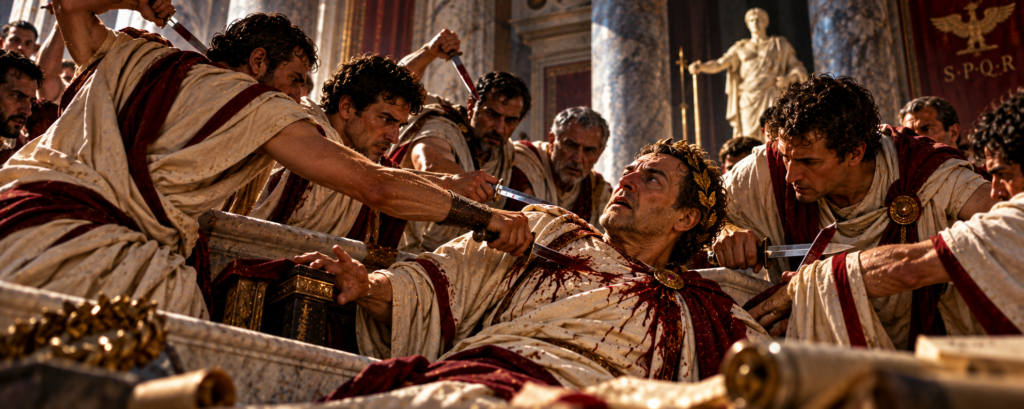
Julius Caesar: The Ides of March, the Betrayal of Brutus, and the Murder That Destroyed the Roman Republic
Gaius Julius Caesar (100–44 BCE) | Roman General, Statesman, and Dictator in Perpetuity | Assassinated March 15, 44 BCE
The Day Rome Turned Its Daggers Against Caesar
On the morning of March 15, 44 BCE, Julius Caesar left his home in Rome and walked toward a meeting from which he would never return. He was fifty-five years old, the most powerful man in the Roman world, and the undisputed master of a republic that had spent centuries insisting it would never again submit to a king. He had defeated his enemies, conquered enormous territories, accumulated unprecedented honors, and accepted a dictatorship that would last for the remainder of his life. Yet among the senators waiting for him that morning were men who had decided that the only way to save Rome was to murder the man who ruled it.
The assassination had been planned by members of Rome’s political elite, including men Caesar had defeated in civil war and others he had rewarded with offices, honors, and personal favor. Among them were Marcus Junius Brutus, whose family name was inseparable from the legendary overthrow of Rome’s ancient monarchy, and Gaius Cassius Longinus, an experienced politician and soldier with reasons of his own to resent Caesar’s supremacy. Another crucial participant was Decimus Junius Brutus Albinus, a trusted associate of Caesar whose role would prove especially important. Together with their fellow conspirators, they intended to strike during a meeting of the Senate, where Caesar would be surrounded by the very men who were supposed to advise him.
The location carried an irony that later generations would find almost impossible to resist. The Senate was meeting in a chamber attached to the magnificent theater complex built by Pompey the Great, Caesar’s former ally, son-in-law, political rival, and eventual enemy. Pompey had been defeated by Caesar during the civil war and murdered in Egypt in 48 BCE. Now Caesar was about to die within a building associated with the man whose destruction had helped make his dictatorship possible.
When Caesar entered the chamber, the conspirators moved into position. Lucius Tillius Cimber approached with a petition concerning his exiled brother, providing a reason for several senators to crowd around the dictator. Caesar attempted to dismiss the request, but Cimber seized his toga, creating the signal for the attack. One of the conspirators, traditionally identified as Publius Servilius Casca, drew his dagger and struck.
The first wound did not immediately incapacitate Caesar. Ancient accounts describe him struggling against his attackers, attempting to defend himself, and reacting with anger or astonishment as the senators closed around him. Daggers flashed beneath their togas, and the chamber descended into chaos. Men who had greeted Caesar as colleagues and benefactors moments earlier now competed to drive their weapons into his body.
According to the most familiar ancient tradition, Caesar received twenty-three stab wounds. His attackers struck so wildly that some wounded one another, and the senators who were not involved fled in terror. The dictator eventually collapsed near the base of Pompey’s statue, where his blood stained the floor of the chamber. The man who had survived decades of political intrigue, dangerous campaigns, and civil war was dead at the hands of Roman senators.
The conspirators believed they had saved the Republic. They expected the removal of Caesar to restore the political order that had existed before his dictatorship, when magistrates held temporary authority and the Senate exercised enormous influence over public affairs. Instead, their assassination unleashed another round of civil wars, political purges, and personal betrayals. Within a generation, the Roman Republic would give way to the imperial system established by Caesar’s adopted heir.
The murder of Julius Caesar became the most famous political assassination in Western history because it contained almost every element of a tragedy: extraordinary ambition, ancient rivalries, personal loyalty, public humiliation, secret conspiracy, ignored warnings, and a final betrayal that seemed to come from within the victim’s own circle. Yet the familiar story is only part of the truth. Behind the twenty-three wounds lay decades of political violence, institutional collapse, and competition among men who claimed to defend Rome while repeatedly bringing it closer to destruction.
The Republic That Feared Kings More Than Anything
Rome’s hatred of kingship was deeply rooted in its political identity. According to Roman tradition, the monarchy had been overthrown in 509 BCE after the crimes of the royal family provoked rebellion. Lucius Junius Brutus, an ancestor claimed by the later assassin Marcus Junius Brutus, became associated with the expulsion of the final king, Tarquinius Superbus. The story was a foundational legend of Roman liberty, although its details cannot be verified as straightforward historical fact.
For centuries, Romans celebrated the Republic as a system designed to prevent any individual from exercising permanent royal authority. Its most prestigious magistrates, the consuls, normally served for a single year, and two held office simultaneously. Political competition, annual elections, religious traditions, and the authority of the Senate were supposed to prevent the concentration of power. In practice, however, the system favored wealthy aristocratic families whose members competed fiercely for offices, military commands, and public recognition.
The Republic was never a modern democracy, nor was it a peaceful society governed entirely by constitutional restraint. Roman expansion created enormous wealth, intensified competition among elites, and placed powerful armies under the command of ambitious generals. Successful commanders could reward soldiers, enrich supporters, and acquire personal prestige that ordinary magistrates could scarcely rival. By the first century BCE, the Republic’s institutions were increasingly unable to control the men who possessed military power.
Political violence had already become a familiar feature of Roman life long before Caesar crossed the Rubicon. The reforming tribunes Tiberius and Gaius Gracchus had been killed during conflicts over land, citizenship, and political authority. The general Marius and his rival Sulla fought bitter struggles that brought armed forces into Roman politics. Sulla eventually established a dictatorship and used proscriptions to eliminate enemies, demonstrating how thoroughly republican institutions could be subordinated to personal military power.
These precedents mattered enormously to Caesar’s generation. Roman politicians understood that constitutional arguments could be backed by soldiers, intimidation, and murder. They also knew that victory in political conflict might determine whether they retained their fortunes, their careers, or their lives. The Republic’s ideals remained powerful, but its political practices had become increasingly brutal.
Caesar did not create this crisis, although he would intensify it dramatically. He emerged from a political culture in which aristocratic ambition had repeatedly overwhelmed constitutional restraint. His enemies were products of the same system, and many had benefited from its inequalities. Their eventual decision to kill him would be presented as a defense of liberty, but the Republic they hoped to restore had already been damaged by generations of internal conflict.
The Young Aristocrat Who Refused to Disappear
Gaius Julius Caesar was born in 100 BCE into the ancient patrician family of the Julii. His family possessed prestigious ancestry but did not enjoy the overwhelming political dominance associated with some other Roman houses. Caesar inherited a distinguished name rather than an assured path to supreme power. He would spend much of his early career turning that name into an instrument of political advancement.
His family connections placed him near the dangerous struggles between Marius and Sulla. Caesar’s aunt Julia had married Marius, while Caesar himself married Cornelia, daughter of Lucius Cornelius Cinna, another prominent opponent of Sulla. These relationships became dangerous when Sulla emerged victorious. The dictator reportedly demanded that Caesar divorce Cornelia, but Caesar refused.
Ancient biographers describe Caesar losing property, religious privileges, and political security during this confrontation. He was forced to keep out of sight and relied upon influential supporters to secure his safety. Some details of these episodes may have been shaped by later admiration for his courage, but the broader political danger was real. Caesar learned early that survival in Roman politics depended upon alliances, reputation, and an unwillingness to surrender easily.
His military service in Asia Minor provided another route to advancement. During this period, he acquired experience outside Rome and began establishing a reputation for personal courage. Ancient sources also preserve hostile gossip about his relationship with King Nicomedes IV of Bithynia, allegations that political enemies later used to ridicule him. The truth of those rumors cannot be established, but their persistence demonstrates how aggressively Roman aristocrats exploited sexual scandal.
One famous story concerns Caesar’s capture by pirates. According to later accounts, he behaved with extraordinary confidence during captivity, treated his captors almost as inferiors, and eventually returned to punish them after securing his release. The story is highly theatrical and may contain embellishment, but it became an important part of his legend. It portrayed a young man who regarded even captivity as a temporary inconvenience.
Caesar’s early career revealed traits that would define his later life. He cultivated popularity, accepted considerable financial risks, and pursued offices that brought prestige and influence. He understood the importance of public spectacle and personal generosity. Above all, he possessed an ambition that repeatedly carried him into conflicts with men who considered themselves entitled to dominate Roman politics.
Debt, Ambition, and the Road to Supreme Power
Caesar’s rise depended upon a combination of political skill, aristocratic connections, and extraordinary spending. Roman electoral competition was expensive, and ambitious politicians invested heavily in public games, gifts, and displays of generosity. Caesar accumulated substantial debts while cultivating popular support. His financial risks reflected the expectation that successful officeholding and military command could eventually produce enormous rewards.
He aligned himself with political interests often associated with the populares, politicians who sought support through popular assemblies and reform proposals. This did not make him a modern champion of ordinary people, nor did it mean that his opponents formed a unified conservative party. Roman political factions were fluid, personal, and frequently opportunistic. Caesar used popular causes because they offered both political leverage and genuine opportunities for reform.
His election as pontifex maximus in 63 BCE was a major achievement. The office made him Rome’s chief priest and provided enormous prestige. His success against more established candidates demonstrated his ability to mobilize support beyond traditional expectations. It also increased the resentment of aristocrats who regarded him as dangerously ambitious.
The Catilinarian conspiracy of the same year placed Caesar within another bitter political controversy. During the debate over the punishment of conspirators arrested in Rome, Caesar opposed their immediate execution without trial and advocated imprisonment and confiscation of property. His position brought him into conflict with Cato the Younger, one of the Republic’s most uncompromising defenders of senatorial authority. The episode revealed the ideological and personal divisions that would shape the coming civil war.
Caesar’s later partnership with Pompey and Marcus Licinius Crassus transformed his prospects. The informal political arrangement commonly called the First Triumvirate allowed three powerful men to coordinate their interests. Pompey possessed military prestige, Crassus enormous wealth, and Caesar exceptional political energy. Their cooperation weakened opponents who relied upon traditional senatorial procedures.
The alliance was reinforced when Pompey married Caesar’s daughter Julia. The marriage created a personal bond between two men whose ambitions might otherwise have brought them into immediate conflict. For a time, their interests remained compatible. Caesar gained the consulship in 59 BCE and then secured the provincial command that would make him one of the most powerful generals in Roman history.
The arrangement contained the seeds of future disaster. Caesar, Pompey, and Crassus were not united by a shared constitutional vision. Their cooperation depended upon personal advantage and mutual restraint. When those conditions disappeared, the Republic would become the battlefield upon which their rival ambitions were settled.
Gaul: The Conquest That Made Caesar Untouchable
Caesar’s campaigns in Gaul transformed him from an ambitious Roman politician into a military commander of extraordinary power. Beginning in 58 BCE, he conducted years of warfare across territories corresponding broadly to modern France, Belgium, and neighboring regions. His campaigns involved battles, sieges, diplomatic manipulation, and the subjugation of numerous communities. They also produced immense wealth and an army whose loyalty became increasingly personal.
Caesar presented his campaigns as necessary responses to threats against Roman interests. His own account, Commentaries on the Gallic War, portrayed him as a decisive commander protecting allies and responding to dangerous enemies. The work remains an invaluable source, but it was also a carefully constructed political narrative. Caesar had strong reasons to justify his actions to readers in Rome.
The conquest involved enormous suffering. Ancient sources describe mass killings, enslavement, forced submissions, and the destruction of communities. Modern historians debate the scale of casualties reported by Caesar and later writers, but the violence of the campaigns is beyond serious dispute. His military glory rested partly upon the devastation of conquered peoples.
His victory over Vercingetorix at Alesia in 52 BCE became one of his greatest achievements. The Gallic leader had organized a formidable resistance, forcing Caesar into a desperate siege in which Roman troops faced enemies both inside and outside their fortifications. Caesar’s eventual victory demonstrated his skill in engineering, logistics, and battlefield command. It also helped break organized resistance to Roman domination.
The campaigns made Caesar extraordinarily wealthy and politically dangerous. His soldiers had endured hardship under his leadership and received rewards from his victories. Many regarded their commander as the source of their fortunes and future security. Their loyalty could become more powerful than their attachment to Rome’s constitutional institutions.
Meanwhile, the political alliance that had supported Caesar began to disintegrate. Julia died in 54 BCE, weakening the personal bond between Caesar and Pompey. Crassus was killed during the disastrous Roman campaign against Parthia at Carrhae in 53 BCE. The partnership that had balanced Roman politics was reduced to two ambitious commanders increasingly suspicious of one another.
Pompey gradually moved closer to Caesar’s senatorial opponents. They feared that Caesar would return from Gaul with his army, wealth, and prestige intact. Caesar feared that surrendering his command would expose him to prosecution and political destruction. Each side claimed to defend legitimate rights, but neither trusted the other to accept defeat peacefully.
By the beginning of 49 BCE, compromise had become extraordinarily difficult. Caesar possessed an army capable of threatening Italy, while his enemies controlled important institutions of the Republic. The conflict was no longer merely about political office. It had become a struggle over who would control Rome.
Crossing the Rubicon: The Republic’s Point of No Return
In January 49 BCE, Caesar crossed the Rubicon River with troops under his command, entering Italy in defiance of the political settlement demanded by his opponents. The river marked a boundary beyond which a provincial commander could not lawfully bring his army without proper authority. Caesar’s action was therefore an extraordinary challenge to the Roman state. It transformed political confrontation into civil war.
Later tradition associated the crossing with a declaration that the die had been cast. Ancient accounts differ in wording and context, and the famous phrase should not be treated as a perfectly preserved transcript. Its enduring significance lies in the decision it represents. Caesar knowingly accepted a conflict that could destroy his career, his enemies, and the Republic itself.
Pompey and many senators withdrew from Italy rather than immediately confront Caesar’s advancing forces. Their departure allowed Caesar to occupy Rome and consolidate his position. The war then spread across the Mediterranean world, involving campaigns in Spain, Greece, Egypt, Africa, and eventually Spain again. Roman soldiers fought Roman soldiers in battles that devastated the political elite.
The decisive confrontation between Caesar and Pompey occurred at Pharsalus in 48 BCE. Caesar defeated the larger army commanded by his former ally, forcing Pompey to flee. Pompey sought refuge in Egypt, where advisers to the young king Ptolemy XIII decided that killing him would please the victorious Caesar. Their calculation proved politically disastrous.
Pompey was murdered as he approached the Egyptian shore. Ancient accounts describe his death as a betrayal committed while he expected protection. His severed head was presented to Caesar, who reportedly reacted with grief or revulsion. The details of Caesar’s response come from later narratives, but the political significance of Pompey’s death is clear.
The murder eliminated Caesar’s most formidable rival without ending the civil war. Other Pompeian commanders continued resisting, and Caesar spent additional years defeating them. His victories at Thapsus in 46 BCE and Munda in 45 BCE destroyed major centers of organized opposition. By the time he returned to Rome, few men remained capable of challenging him militarily.
Yet victory created a new problem. Caesar had defeated his enemies in the name of defending his political rights, but he now possessed authority greater than any Roman magistrate was supposed to hold. The Republic had survived previous dictatorships, but Caesar’s position appeared increasingly permanent. His enemies began to wonder whether the civil war had ended only because Rome had acquired a king without the title.
Pompey’s Ghost and the Men Caesar Forgave
Caesar’s treatment of defeated opponents became one of the most distinctive features of his dictatorship. Rather than ordering a comprehensive massacre of former enemies, he frequently offered pardons and allowed prominent men to resume public careers. This policy of clemency enhanced his reputation for generosity. It also allowed him to rebuild political institutions without eliminating much of Rome’s governing class.
Marcus Junius Brutus was among those who benefited. Although he had supported Pompey during the civil war, Caesar pardoned him and later entrusted him with important responsibilities. Cassius also survived the conflict and continued his political career. Several future conspirators owed their positions, and in some cases their lives, to Caesar’s willingness to reconcile with former enemies.
This generosity was politically useful but psychologically complicated. A pardon could restore a defeated aristocrat’s life and career while reminding him that he now depended upon the victor’s mercy. Men accustomed to competing as equals might resent being treated as recipients of personal favor. Caesar’s clemency could therefore produce gratitude and humiliation simultaneously.
The policy also strengthened Caesar’s control. By pardoning opponents, he could claim moral superiority while depriving them of an easy justification for renewed rebellion. Their acceptance of his favors made later resistance appear ungrateful. Yet the same arrangement left politically experienced enemies inside the institutions of government.
Caesar seems to have believed that reconciliation would make his position more secure. His surviving actions suggest a preference for incorporating former opponents rather than permanently excluding them. He also appears to have underestimated the extent to which aristocratic honor and republican ideology could override personal obligation. His enemies did not necessarily interpret forgiveness as a reason to abandon their political principles.
The relationship with Brutus became especially important. Caesar had shown him considerable favor, and ancient writers later emphasized the apparent intimacy between them. Some traditions speculated that Caesar might even have been Brutus’s biological father because of his earlier relationship with Brutus’s mother, Servilia. The chronology makes that speculation implausible, and there is no reliable evidence supporting it.
Nevertheless, Caesar’s affection or political regard for Brutus was real enough to become central to the assassination’s later memory. The idea that a favored young aristocrat participated in the murder intensified its emotional force. Caesar had defeated enemies who openly opposed him, but he would be killed by men who had accepted his forgiveness. His policy of clemency had preserved the lives of some of his eventual assassins.
Cleopatra, Egypt, and the Scandal of a Roman Dictator
Caesar’s involvement in Egypt introduced another element of scandal into his public life. After Pompey’s murder, Caesar became entangled in the dynastic conflict between Cleopatra VII and her brother Ptolemy XIII. The struggle involved political intrigue, military confrontation, and competing claims to the Egyptian throne. Caesar’s intervention helped Cleopatra secure her position.
The relationship between Caesar and Cleopatra became both political and personal. Ancient sources describe their intimacy, and Cleopatra later gave birth to a son known as Caesarion. She maintained that Caesar was the child’s father, although the precise legal and political implications remained controversial. Caesar did not make Caesarion his Roman heir.
Cleopatra’s presence in Rome during Caesar’s final years attracted attention. As a reigning foreign monarch, she represented a political world in which hereditary kingship was normal and rulers cultivated elaborate court ceremony. Her relationship with Caesar therefore became vulnerable to hostile interpretation. Opponents could connect his personal life with their fears that he intended to establish a monarchy.
The scandal was particularly potent because Roman political culture celebrated the rejection of kings. A Roman commander involved with an Egyptian queen offered critics a powerful symbol of supposedly eastern luxury and royal ambition. Such accusations drew upon longstanding Roman prejudices about foreign courts. They could exaggerate the political significance of Caesar’s private relationships.
Caesar also remained married to Calpurnia, whose role in the events preceding his assassination would later become famous. Roman aristocratic marriage often involved political alliances, and extramarital relationships among powerful men were hardly unusual. Nevertheless, Caesar’s connection with Cleopatra possessed extraordinary diplomatic implications. It linked Rome’s dominant politician to one of the wealthiest monarchies in the Mediterranean.
The relationship should not be reduced to a simple romance or treated as proof that Caesar intended to make Cleopatra queen of Rome. No reliable evidence establishes such a plan. Yet the association contributed to the atmosphere of suspicion surrounding his final months. Every royal symbol, extraordinary honor, and personal connection could be interpreted as another sign that the Republic was approaching monarchy.
For Caesar’s enemies, appearances mattered almost as much as intentions. They feared that he was transforming the Roman state into an instrument of personal power. Cleopatra’s presence provided a vivid image through which those fears could be expressed. The relationship became part of the larger political story that culminated in the Ides of March.
Dictator for Life: The Honor That Made Murder Seem Necessary
By early 44 BCE, Caesar’s authority had reached an unprecedented level. He had accumulated offices, privileges, and honors that placed him above ordinary republican competition. The Senate granted him the dictatorship in perpetuity, removing the temporary character traditionally associated with the office. His power no longer appeared to have a defined endpoint.
The title dictator perpetuo was especially alarming to opponents. Earlier Roman dictatorships had been associated with extraordinary circumstances and limited terms, although Sulla had already demonstrated how the institution could be transformed. Caesar’s lifetime appointment suggested that the normal republican system would never fully resume while he lived. For aristocrats who valued competition for office, this was an intolerable prospect.
Caesar also received honors that seemed to elevate him above ordinary citizens. His statues appeared in prominent locations, and he accepted ceremonial distinctions associated with exceptional authority. His image was placed on Roman coinage during his lifetime, a striking departure from earlier conventions. Such developments reinforced the impression that public institutions increasingly revolved around one individual.
Some honors may have been proposed by senators eager to flatter Caesar or expose him to criticism. Ancient accounts describe a political atmosphere in which excessive praise could become dangerous. A ruler who accepted extraordinary honors risked appearing arrogant, while one who rejected them might offend supporters. The distinction between genuine admiration and deliberate provocation is often impossible to establish.
Caesar’s control over appointments intensified resentment. He could influence magistracies, provincial commands, and the composition of the Senate. Men whose families had competed for generations found that their careers increasingly depended upon his decisions. Political life continued, but the central mechanism of aristocratic competition had changed.
The dictator also pursued substantial reforms. He reorganized aspects of administration, addressed debt and settlement questions, and introduced the calendar reform that became the foundation of the Julian calendar. These achievements were significant and should not be dismissed as mere decoration. Yet administrative effectiveness did not resolve the constitutional question of whether one man should possess permanent supremacy.
For the conspirators, the dictatorship in perpetuity made the danger immediate. Caesar was not merely exercising temporary emergency powers while promising to restore the old order. He had accepted an office that would last until his death. If the Republic could not recover while he lived, some senators concluded that his death was the necessary first step.
The Crown at the Lupercalia: Did Caesar Want to Be King?
On February 15, 44 BCE, Rome celebrated the festival of Lupercalia, an ancient religious observance associated with purification and fertility. During the festivities, Mark Antony publicly offered Caesar a diadem, a symbol closely associated with monarchy. Caesar refused it, and the episode became one of the most controversial events of his final weeks. Ancient writers differed over what the performance was intended to accomplish.
Some accounts describe the crowd responding favorably when Caesar rejected the diadem. The refusal could therefore be interpreted as a demonstration that he did not want the title of king. Yet critics suspected that the episode had been staged to test public opinion. They believed Caesar might have accepted the crown if the reaction had been sufficiently enthusiastic.
The incident was politically explosive because Roman hostility toward kingship remained intense. The title rex evoked the monarchy supposedly expelled centuries earlier. Caesar already possessed powers exceeding those of many kings, but the formal title carried extraordinary symbolic weight. Accepting it would have represented an unmistakable break with republican tradition.
Other incidents heightened suspicion. A diadem had reportedly been placed upon a statue of Caesar, provoking intervention by tribunes of the plebs. Caesar’s response to the tribunes contributed to accusations that he was suppressing officials traditionally associated with defending the people. His enemies interpreted such behavior as evidence that he would not tolerate constitutional limits.
The exact meaning of Caesar’s conduct remains disputed. He may have genuinely rejected the title while accepting equivalent power under republican terminology. He may have been considering some form of monarchy, particularly in connection with his planned eastern campaign. Alternatively, the rumors may have been amplified by opponents seeking justification for assassination.
What matters is that the fear was politically real. Senators who already resented Caesar’s permanent dictatorship could interpret the Lupercalia as confirmation of their suspicions. His public rejection of the diadem did not reassure them. Instead, it became another episode in an escalating struggle over his intentions.
The question of kingship therefore remained unresolved when the conspiracy developed. Caesar never publicly established himself as king of Rome. Yet his authority had become so concentrated that the distinction between dictatorship and monarchy appeared increasingly artificial. His enemies would claim that they were killing a tyrant before he could complete the destruction of the Republic.
Marcus Junius Brutus: The Name That Carried a Republic’s Memory
Marcus Junius Brutus became the most famous participant in Caesar’s assassination because his name carried extraordinary historical symbolism. Roman tradition associated his family with Lucius Junius Brutus, the legendary founder of the Republic. Another ancestor, Gaius Servilius Ahala, was celebrated in stories involving the killing of a man accused of seeking tyranny. These traditions placed enormous ideological expectations upon the younger Brutus.
Brutus was a serious, educated aristocrat with interests in philosophy and political morality. He cultivated a reputation for integrity, although his financial and political activities reveal a more complicated figure than the idealized hero of later literature. He had supported Pompey during the civil war despite his family’s earlier hostility toward Pompey. His decisions reflected a combination of principle, personal relationships, and aristocratic ambition.
Caesar pardoned Brutus after Pharsalus and treated him with notable favor. He appointed him to important positions and supported his advancement. By 44 BCE, Brutus held the praetorship, one of Rome’s prestigious magistracies. His participation in the conspiracy therefore involved a dramatic rejection of the man who had helped restore his career.
Ancient accounts describe pressure upon Brutus to act against Caesar. Anonymous messages reportedly appeared encouraging him to remember his ancestors and defend Roman liberty. Such stories may reflect genuine political agitation, but their precise details are difficult to verify. They demonstrate the importance later writers attached to his family name.
Brutus’s relationship with Cassius was also significant. Cassius was married to Brutus’s half-sister Junia Tertia, connecting the men through family ties. Their political relationship was not always harmonious, and they differed in temperament and judgment. Yet both came to regard Caesar’s supremacy as intolerable.
The involvement of Brutus gave the conspiracy a powerful moral identity. A plot led only by disgruntled politicians might appear to be a struggle for lost privileges. The participation of a man associated with republican virtue allowed the assassins to present themselves as defenders of an ancient constitutional tradition. His name became an instrument of political legitimacy.
Whether Brutus acted from pure principle remains impossible to establish. His opposition to Caesar may have been sincere, but he also belonged to an aristocracy whose influence had been diminished by the dictatorship. Personal honor and political ideology were closely intertwined. The assassination would become famous partly because later generations preferred to see Brutus as either a noble liberator or the ultimate traitor.
Cassius: The Conspirator Who Understood That Caesar Had to Die
Gaius Cassius Longinus was another central figure in the conspiracy. He possessed substantial military and political experience, including service in the eastern provinces and involvement in the civil war. Unlike the more philosophically celebrated Brutus, Cassius acquired a reputation in ancient literature for practical intelligence and determined hostility toward Caesar. His role was crucial to organizing the assassination.
Cassius had served under Crassus during the disastrous Parthian campaign of 53 BCE and helped preserve Roman forces after the defeat at Carrhae. His military experience gave him a realistic understanding of power and command. He later supported Pompey against Caesar but survived the civil war. Caesar’s clemency allowed him to continue his political career.
Personal resentment may have contributed to his hostility. Ancient accounts mention disputes over offices and honors, including competition for prestigious positions. Cassius could regard Caesar’s control over appointments as an insult to aristocratic independence. Yet reducing his motives entirely to wounded ambition would oversimplify the political crisis.
Cassius appears to have played a leading role in bringing conspirators together. He understood that Caesar’s power could not easily be challenged through ordinary political methods. The dictator controlled military resources and enjoyed substantial popular support. An assassination offered the possibility of eliminating him before opposition could be crushed.
His relationship with Brutus was essential. Brutus possessed the moral prestige that Cassius lacked in later tradition, while Cassius brought organizational determination. Their cooperation helped transform scattered resentment into a coordinated conspiracy. Together, they represented different strands of elite opposition to Caesar.
The conspirators also needed men close enough to Caesar to exploit his trust. Cassius and Brutus alone could not guarantee access or prevent intervention by loyal associates. Their success depended upon recruiting senators with positions inside the dictator’s political circle. The resulting conspiracy became a coalition of former enemies and apparent friends.
Cassius’s judgment would continue to shape events after the assassination. He understood the military dangers facing the conspirators, but he could not prevent the political mistakes that followed. His eventual death at Philippi would become part of the tragic aftermath of the Ides. The man who helped organize Caesar’s murder would discover that removing the dictator did not remove the forces supporting his supremacy.
Decimus Brutus: The Betrayal History Often Forgets
Decimus Junius Brutus Albinus was among the most important conspirators, yet popular memory frequently confuses him with Marcus Junius Brutus. The two men were distinct individuals with different careers and relationships to Caesar. Decimus had served Caesar loyally during military campaigns and belonged to his trusted circle. His participation in the assassination was therefore an especially significant betrayal.
Caesar had rewarded Decimus with important responsibilities and included him among those who would benefit from his political arrangements. Decimus had commanded forces for Caesar and enjoyed the confidence of the dictator. His position gave him access that more openly hostile senators might not possess. This made him invaluable to the conspiracy.
Ancient accounts assign Decimus a decisive role on the morning of March 15. Caesar reportedly hesitated to attend the Senate meeting because of troubling omens, poor health, or warnings from his wife. Decimus persuaded him to go, arguing that remaining home would damage his dignity and disappoint the assembled senators. The precise conversation is reconstructed by later writers, but the tradition consistently emphasizes Decimus’s influence.
The significance is extraordinary. Caesar may have been willing to postpone the meeting, and a delay could have disrupted the assassination plan. Decimus, a man he trusted, allegedly convinced him to continue. The conspiracy depended not only upon daggers but upon the dictator’s confidence in a supposed friend.
Decimus’s participation also undermines any simple division between Caesar’s former enemies and loyal supporters. Some conspirators had fought against him during the civil war, while others had served him. Their motives may have differed, but they shared the conclusion that his continued rule was unacceptable. The plot emerged from within the political system Caesar had constructed.
After the assassination, Decimus would become involved in the struggle against Mark Antony. His military position initially made him an important figure in the renewed conflict. Yet he eventually lost his forces and was killed while attempting to escape. His career ended in the same violent instability he had helped unleash.
The popular focus upon Marcus Brutus has often obscured Decimus’s role. Yet without a trusted insider capable of influencing Caesar’s movements, the conspiracy might have faced greater difficulties. Decimus demonstrates that the assassination was not merely an attack by defeated enemies. It was also a betrayal by men who had benefited from Caesar’s trust.
The Secret Conspiracy Inside the Roman Senate
The conspiracy against Caesar developed among senators who feared that his dictatorship had destroyed the Republic. Ancient sources differ over the number of participants, but Suetonius reports that more than sixty men joined the plot. Not all were necessarily present during the actual stabbing. The group included former Pompeians, Caesarian supporters, and politicians with varying personal grievances.
Their secrecy was essential. Caesar possessed substantial political authority, and discovery could have brought execution or other severe punishment. The conspirators therefore needed to coordinate without attracting attention. Their shared social world made communication possible, but it also increased the danger of rumors.
The plotters reportedly considered several methods of assassination. Ancient accounts mention possibilities involving public roads, elections, or other occasions when Caesar would appear before crowds. Each option carried risks involving guards, witnesses, and the difficulty of controlling the aftermath. A Senate meeting eventually appeared to offer the most favorable circumstances.
The choice was symbolically powerful. Caesar would be killed by senators within a chamber associated with the government of Rome. The conspirators could present the act as a collective judgment against tyranny rather than a private murder. Their location would help support their claim that they were acting for the Republic.
The plan also depended upon Caesar’s willingness to attend without overwhelming protection. He had dismissed or reduced some personal security arrangements, according to ancient accounts, and relied partly upon his reputation and political relationships. His clemency toward former enemies may have encouraged confidence that serious opposition had been neutralized. The conspirators exploited that assumption.
Their objective was to kill Caesar, but they did not agree upon every question concerning the aftermath. One major disagreement involved Mark Antony, Caesar’s close associate and fellow consul. Some conspirators believed Antony should also be killed to prevent retaliation. Brutus reportedly opposed extending the assassination beyond Caesar.
That decision would prove consequential. Antony survived and quickly became one of the most important figures in the struggle for Caesar’s political inheritance. The conspirators had removed the dictator but left powerful supporters capable of organizing resistance. Their attempt to preserve the moral purity of tyrannicide contributed to their strategic vulnerability.
Why Mark Antony Was Allowed to Live
Mark Antony occupied a dangerous position in the conspirators’ calculations. He was Caesar’s close associate, an experienced soldier, and consul in 44 BCE. His political influence and military connections made him a potential leader of resistance after Caesar’s death. Killing him alongside Caesar might have weakened the Caesarian faction.
Cassius and others reportedly favored eliminating Antony. Their reasoning was practical: a successful assassination would accomplish little if Caesar’s supporters immediately organized retaliation. Antony possessed the resources and ambition to become a formidable opponent. Leaving him alive created an obvious risk.
Brutus opposed the additional murder, according to the ancient tradition. He wanted the assassination to appear as a principled act against tyranny rather than a massacre of political enemies. Killing Caesar alone could be presented as the removal of a dangerous individual. Killing Antony as well might make the conspirators resemble the violent factions they condemned.
The distinction reflected an important moral problem. The conspirators claimed to defend republican liberty, but they were preparing to murder a political leader. They needed to justify the act as exceptional and necessary. Expanding the killing could undermine that justification.
Yet the decision also exposed the limits of their planning. They assumed that Caesar’s death would create an opportunity for constitutional restoration. They did not adequately prepare for the possibility that his supporters would retain substantial political strength. Antony’s survival would soon demonstrate the weakness of that assumption.
During the assassination, Antony was prevented from entering the chamber. Ancient sources commonly associate Gaius Trebonius with the task of detaining him outside, apparently through conversation. The maneuver kept a powerful Caesarian ally away from the immediate violence. It also ensured that Antony survived.
When news of the murder spread, Antony initially acted cautiously. He understood that the political situation was uncertain and that the conspirators might possess broader support. Yet he quickly began positioning himself within the struggle for control. The decision to spare him would become one of the most consequential choices made by Caesar’s assassins.
Calpurnia’s Dream and the Warnings Caesar Ignored
The night before the assassination became surrounded by stories of ominous dreams and supernatural warnings. Ancient writers describe Caesar’s wife Calpurnia experiencing disturbing visions that suggested her husband was in danger. Some accounts portray her dreaming that Caesar was wounded or that part of their house collapsed. The details vary, and the stories were recorded by authors writing after the event.
Calpurnia reportedly urged Caesar not to attend the Senate meeting. Her concern may have reflected genuine anxiety about political danger, although the surviving accounts emphasize prophetic dreams rather than ordinary intelligence. Caesar was said to have hesitated, partly because of his health and the unfavorable signs surrounding the day. The tradition presents him as a man briefly willing to avoid danger.
The soothsayer Spurinna also became central to the legend. According to ancient accounts, he had warned Caesar that danger threatened him around the Ides of March. On the fatal day, Caesar supposedly reminded Spurinna that the date had arrived without disaster. The seer responded that the day had not yet ended.
The exchange is famous because of its dramatic irony. Readers know what Caesar does not: the warning will soon appear fulfilled. Yet the precise words cannot be independently verified. Ancient historians frequently included memorable dialogue to give events moral and literary significance.
Other omens accumulated in later accounts. Animals behaved strangely, birds appeared in threatening circumstances, and sacrifices reportedly produced unfavorable signs. Such details reflected Roman religious culture, in which political decisions were often interpreted through divine approval or disapproval. They also allowed later writers to portray Caesar’s death as something the universe itself had anticipated.
The stories should not be treated as proof that supernatural warnings accurately predicted the assassination. They reveal how Romans and later authors understood extraordinary political events. Caesar’s murder seemed so consequential that ordinary explanations could appear insufficient. The accumulation of omens transformed a planned political killing into a tragedy of destiny.
What remains historically significant is that Caesar may have considered postponing the meeting. His hesitation created a moment when the conspiracy could have failed. The reported intervention of Decimus Brutus helped overcome that reluctance. If the tradition is broadly accurate, Caesar’s trust in a conspirator played a decisive role in bringing him to the Senate.
Artemidorus and the Warning That Was Never Read
Another famous episode concerns Artemidorus, a man who allegedly learned of the conspiracy and attempted to warn Caesar. Plutarch describes him preparing a written message identifying the danger. He approached Caesar as the dictator traveled toward the Senate meeting. The note was intended to reveal the plot before the assassins could act.
According to the tradition, Caesar received the message but did not read it in time. He was surrounded by people presenting petitions and other documents, making it difficult to give attention to any single communication. The warning remained among his papers as he entered the chamber. The opportunity to prevent the assassination was lost.
The story is extraordinarily effective as historical drama. A ruler approaches death while holding the information that might save him. The danger is no longer hidden from everyone, but the warning fails to reach the person who needs it. The audience is left contemplating how easily catastrophe might have been avoided.
Yet the details come from later narratives and cannot be confirmed independently. The existence of a warning may be plausible, particularly given the number of conspirators involved. Large conspiracies are difficult to conceal completely. Nevertheless, the precise circumstances of Artemidorus’s intervention remain uncertain.
The episode also raises questions about Caesar’s political environment. He was a ruler surrounded by petitioners, officials, and supporters seeking access to his authority. Such attention demonstrated his importance but also created confusion. A critical warning could be lost among routine requests.
The conspirators depended upon this crowded political world. They intended to approach Caesar under the appearance of ordinary senatorial business. The distinction between legitimate petition and deadly deception would become central to the attack. Artemidorus’s alleged warning anticipated the danger concealed within those familiar rituals.
Whether the episode occurred exactly as described or was embellished afterward, it became one of the most memorable elements of the Ides. Caesar’s death appeared not merely inevitable but tragically preventable. The warning existed within the story, yet the ruler failed to act upon it. The effect was to intensify the sense that every circumstance had conspired to bring him to the daggers.
The Curia of Pompey: A Murder Scene Chosen by History
The Senate meeting took place in the Curia of Pompey, a chamber associated with the theater complex constructed by Pompey the Great. The building stood in the Campus Martius, outside the traditional political center of the Roman Forum. It provided a suitable meeting place while other senatorial facilities were unavailable or undergoing reconstruction. Its connection to Pompey gave the assassination an extraordinary symbolic setting.
Pompey had once been Caesar’s ally and son-in-law. Their partnership had dominated Roman politics before rivalry and civil war destroyed it. Caesar defeated Pompey at Pharsalus, and Pompey was subsequently murdered in Egypt. The theater complex remained as a monument to his prestige.
Ancient writers later emphasized that Caesar fell near a statue of Pompey. The image was irresistible: the victorious dictator dying beneath the likeness of the rival he had defeated. Some accounts describe his blood reaching the statue’s base. The scene became a powerful symbol of political revenge, although the exact placement of Caesar’s body is reconstructed through literary sources.
The conspirators did not necessarily choose the chamber primarily because of its association with Pompey. The scheduled Senate meeting offered practical advantages, including predictable attendance and opportunities for close access. Yet the location strengthened the dramatic meaning later attached to the event. It connected Caesar’s death with the civil war that had brought him supreme power.
The chamber also offered a controlled environment. Senators could approach Caesar without appearing suspicious, and the conspirators could surround him under the pretense of ordinary business. Armed guards were less likely to intervene before the attack began. The arrangement allowed a small group of men to overcome a ruler who commanded armies across the Roman world.
The choice of a senatorial setting was politically deliberate. The conspirators wanted the assassination to appear as an act performed on behalf of the Republic. Killing Caesar in the presence of senators reinforced their claim to collective authority. The chamber became both a murder scene and a stage for political symbolism.
Yet the symbolism could not control the public response. The assassination horrified many Romans and created immediate uncertainty. The Senate chamber did not automatically transform the killing into a legitimate act. The conspirators would discover that location and rhetoric were insufficient substitutes for popular support.
March 15, 44 BCE: The Final Walk
Caesar eventually left his residence and proceeded toward the Senate meeting. Ancient accounts describe him traveling through Rome while receiving greetings, petitions, and warnings. The precise route and sequence of encounters remain uncertain. What is clear is that he arrived at the Curia of Pompey despite the reported hesitation of the morning.
The conspirators were waiting. Their plan required Caesar to enter the chamber and take his place before they could act. They also needed to ensure that Antony remained outside and that no loyal supporter interfered. The success of the operation depended upon timing and coordination.
Caesar’s appearance must have carried enormous political significance. He was not simply another senator attending routine business. He held permanent dictatorial authority and controlled the future of Roman government. The men surrounding him knew that his decisions could determine their careers and fortunes.
Some conspirators had accepted his favors, while others had been defeated by his armies. Their presence together demonstrated the strange political settlement Caesar had created. Former enemies and apparent friends occupied the same chamber. Beneath the formal rituals of senatorial government lay a conspiracy capable of destroying the ruler.
The atmosphere described by later writers is heavy with suspense. Caesar approaches the meeting despite warnings, while the conspirators struggle to conceal their intentions. Their success depends upon appearing ordinary until the final moment. Every delay threatens discovery.
Yet the historical record does not allow us to reconstruct every expression, gesture, or private thought. Ancient authors wrote dramatic narratives shaped by knowledge of the outcome. Their descriptions are valuable but not equivalent to modern eyewitness recordings. The central events remain clear even when individual details are uncertain.
Caesar entered the chamber and took his place. The conspirators moved toward him with a petition. The assassination was about to begin.
Tillius Cimber and the Petition That Became a Death Sentence
Lucius Tillius Cimber played a crucial role in initiating the attack. He approached Caesar with a request concerning the recall of his exiled brother. The petition provided a plausible reason to seek the dictator’s attention. It also allowed other conspirators to gather around him without immediately appearing threatening.
Caesar reportedly refused or postponed the request. The surrounding senators continued pressing him, creating a crowd that limited his freedom of movement. The situation resembled an ordinary political petition becoming increasingly insistent. The dictator was accustomed to receiving such appeals.
Then Cimber seized Caesar’s toga. Ancient accounts differ slightly in their descriptions, but the gesture is consistently presented as the signal for violence. Pulling at the garment disrupted Caesar’s dignity and restricted his movement. It also announced to the conspirators that the moment had arrived.
The first dagger appeared almost immediately. Casca struck at Caesar, reportedly near the neck or shoulder. The blow did not immediately kill him, and Caesar reacted violently. Some accounts describe him grabbing Casca’s arm or using a writing instrument to resist.
The struggle rapidly expanded. Other conspirators drew their weapons and attacked from different directions. Caesar was surrounded by men who had entered the chamber as senators and now behaved as executioners. The formal setting of republican government dissolved into a scene of personal violence.
The use of a petition was particularly revealing. Caesar’s authority required him to receive requests and make decisions, and the conspirators exploited that responsibility. They transformed the ordinary business of government into a mechanism for assassination. The very rituals that demonstrated his power made him vulnerable.
Cimber’s role also shows that the murder was carefully coordinated. The conspirators did not simply rush forward at random. They needed a signal that would allow several men to strike before guards or supporters could respond. The petition created the necessary opportunity.
Within moments, the dictator’s fate was sealed. The men surrounding him were no longer seeking mercy for an exile. They had come to kill him.
Twenty-Three Wounds: The Murder of Julius Caesar
The attack upon Caesar was brutal, confused, and intensely personal. Ancient accounts describe the conspirators striking from multiple directions while the dictator attempted to defend himself. The confined space and number of attackers made coordinated movement difficult. Some conspirators reportedly wounded one another during the assault.
Caesar initially resisted. Plutarch and Appian portray him struggling against his attackers, turning toward different threats and attempting to escape the circle closing around him. Suetonius offers a somewhat different emphasis, suggesting that Caesar eventually ceased resistance and covered his head with his toga. The accounts agree upon the essential fact that he was overwhelmed.
The traditional number of wounds is twenty-three. Suetonius reports that a physician named Antistius examined the body and concluded that only one wound, in the chest, was individually fatal. This account is sometimes described as an early recorded medical examination of a murder victim. Its details cannot be independently verified, but it demonstrates the interest ancient writers took in the physical circumstances of Caesar’s death.
The number of wounds became symbolic. Twenty-three injuries inflicted by a group of senators suggested not merely murder but collective participation. The conspirators wanted responsibility for the act to be shared. Their violence was intended to represent a political judgment rather than the private revenge of one man.
Yet the scene was far from orderly. The attackers were crowded together, and Caesar struggled as long as he could. Their daggers struck flesh, clothing, and sometimes one another. The Senate chamber became a place of panic rather than solemn republican justice.
The dictator eventually collapsed near Pompey’s statue. Ancient writers emphasized the location because it connected his death with the rival he had defeated. Caesar’s body lay in the chamber while senators fled and the conspirators attempted to establish control. The most powerful man in Rome had been reduced to a corpse surrounded by political enemies.
The assassination lasted only a short time, but its consequences would dominate Roman history. Caesar had survived battles, conspiracies, and the destruction of rival armies. He had believed himself secure enough to move among senators without overwhelming protection. The men who killed him proved that military supremacy could not guarantee personal safety.
Did Caesar Really Say “Et Tu, Brute?”
Few phrases are more closely associated with political betrayal than “Et tu, Brute?” The words are familiar from William Shakespeare’s tragedy Julius Caesar, in which the dictator recognizes Brutus among his attackers. The phrase has become shorthand for betrayal by a trusted friend. Yet there is no reliable evidence that Caesar spoke those exact words.
The ancient sources offer different traditions concerning his final moments. Suetonius reports that some believed Caesar addressed Brutus in Greek with words commonly rendered as “You too, child?” He also records a tradition that Caesar died without speaking after his initial reaction to the attack. The accounts do not establish a definitive final statement.
Plutarch emphasizes Caesar’s response to seeing Brutus among the attackers, suggesting that recognition contributed to his decision to stop resisting. Other authors describe continued struggle until he was overwhelmed. These variations reflect the difficulty of reconstructing a chaotic event from accounts written later. They also reveal the desire to give the murder an emotionally satisfying climax.
The relationship between Caesar and Brutus made the story especially powerful. Caesar had pardoned Brutus after the civil war and supported his political advancement. Brutus’s participation therefore appeared to transform political assassination into personal betrayal. Later writers naturally focused upon the moment when Caesar supposedly recognized him.
Yet the historical Caesar may have had little opportunity for a dramatic farewell. He was surrounded by armed men striking rapidly, and the attack produced severe injuries. The physical circumstances make elaborate dialogue unlikely. The ancient traditions should be understood as attempts to interpret the emotional meaning of the event rather than reliable transcripts.
The famous Latin phrase belongs primarily to Shakespeare’s literary legacy. It captures the tragedy of betrayal with extraordinary effectiveness, but it should not be presented as a documented quotation from Caesar. The historical record is less certain and perhaps more disturbing. We do not know exactly what he said when he realized that men he trusted were killing him.
What is certain is that Brutus participated in the conspiracy. Whether Caesar saw him, addressed him, or reacted with particular despair cannot be established conclusively. The uncertainty has not diminished the story’s power. Instead, it has allowed generations to imagine the final moment in different ways.
Brutus Raises His Dagger, but Rome Does Not Celebrate
After Caesar’s death, the conspirators expected their deed to be recognized as an act of liberation. They had killed the dictator in a Senate chamber and could claim to have restored the authority of republican institutions. Some ancient accounts describe them invoking liberty and attempting to rally support. Their confidence rested upon the assumption that Rome would welcome the removal of a tyrant.
The immediate reaction was far less encouraging. Senators fled, confusion spread, and ordinary citizens struggled to understand what had happened. The conspirators did not possess a clear plan for controlling the city. Their political victory existed largely in their own expectations.
Brutus and Cassius attempted to present the assassination as a necessary defense of the Republic. They emphasized Caesar’s permanent dictatorship and the danger of monarchy. Their arguments drew upon deeply rooted Roman traditions. Yet many Romans had benefited from Caesar’s policies, military victories, and generosity.
Caesar’s popularity among soldiers and sections of the urban population created a serious problem. His veterans had received rewards and expected continued protection of their interests. Ordinary citizens remembered his public games, distributions, and political reforms. The conspirators could not assume that these groups would celebrate his death.
The assassination also lacked a clear constitutional settlement. Caesar had accumulated extraordinary offices, but his removal did not automatically restore the earlier balance of power. Magistrates, armies, provincial commands, and political appointments remained contested. The conspirators had destroyed the individual who coordinated much of the system without establishing an alternative authority.
Their uncertainty allowed Antony to maneuver. As consul, he possessed an important constitutional position and connections with Caesar’s supporters. He could negotiate with the conspirators while preserving his own political options. The immediate aftermath became a struggle over legitimacy rather than a straightforward republican restoration.
The conspirators eventually withdrew to the Capitoline Hill, seeking security and political support. Their position revealed the weakness of their victory. They had succeeded in killing Caesar but could not safely control the streets of Rome. The city they claimed to have liberated did not immediately place itself under their leadership.
Mark Antony and the Funeral That Changed Everything
Mark Antony’s role after Caesar’s assassination became one of the decisive factors in the collapse of the conspirators’ plans. He survived because the assassins had chosen not to kill him. As consul and close associate of Caesar, he possessed political authority and access to important resources. He moved carefully in the uncertain days following the murder.
A temporary compromise emerged between Caesar’s supporters and the conspirators. The assassins received a form of amnesty, while Caesar’s official acts were allowed to remain valid. This arrangement reflected the practical difficulties facing both sides. Neither possessed sufficient control to impose a complete settlement immediately.
Caesar’s funeral transformed the political atmosphere. Ancient accounts describe Antony playing a prominent role in the ceremonies and the display of the dead dictator’s body or bloodstained clothing. The exact details vary among sources, and Shakespeare’s famous funeral speech is a literary creation rather than a historical transcript. Nevertheless, the funeral became a powerful demonstration of popular emotion.
The crowd’s response was intense. Caesar’s death could be presented not as the liberation of Rome but as the murder of a benefactor. His wounds became evidence of betrayal, and the conspirators’ claims to republican virtue faced the anger of citizens who admired him. Public mourning developed into political unrest.
Caesar’s will added another element to the reaction. It provided benefits for Roman citizens and revealed that his principal heir was his great-nephew Gaius Octavius, whom he adopted by testament. The bequests strengthened the image of Caesar as a generous leader. They also created a new political figure whose ambitions would soon become decisive.
Violence followed the funeral. Crowds attacked symbols associated with the conspirators, and public anger made their position increasingly dangerous. Brutus and Cassius could no longer rely upon the city as a secure base. Their attempt to restore the Republic was losing the struggle for popular legitimacy.
Antony had not simply inherited Caesar’s power, but he had demonstrated his ability to mobilize Caesar’s memory. The dead dictator remained politically influential because his supporters could act in his name. The assassination had removed Caesar’s body without destroying his reputation. That reputation would become a weapon in the civil wars that followed.
Caesar’s Will and the Young Heir Nobody Expected
Caesar’s will introduced a new figure into the struggle for Rome. Gaius Octavius, later known as Augustus, was only eighteen years old when Caesar was murdered. He belonged to Caesar’s extended family and had attracted the dictator’s interest. The will named him principal heir and adopted son, giving him a powerful political identity.
The young Octavian faced enormous obstacles. Antony possessed experience, office, and military connections, while the conspirators claimed to defend the Republic. Octavian lacked comparable standing and had not yet demonstrated his abilities. Yet Caesar’s name gave him a resource that no rival could easily ignore.
He moved to claim his inheritance and cultivate the loyalty of Caesar’s supporters. The adoption allowed him to present himself as the continuation of the dead dictator’s political legacy. Veterans and citizens who admired Caesar could transfer their loyalty to his heir. The assassination had therefore created an opportunity for another ambitious individual.
The rivalry between Antony and Octavian quickly became dangerous. Both sought influence over Caesar’s former supporters and military resources. Their competition initially produced conflict, but changing circumstances eventually encouraged cooperation. The struggle was shaped by the need to confront the conspirators and control the Roman state.
Octavian’s rise demonstrates one of the assassination’s greatest ironies. The conspirators killed Caesar because they feared permanent personal rule. His death elevated a young heir who would eventually establish a far more durable system of individual supremacy. The Republic’s defenders unintentionally helped create the circumstances for monarchy under another name.
The political importance of Caesar’s will also reveals the limitations of the conspiracy. The assassins had focused upon removing the dictator but underestimated the continuing power of his family, supporters, and reputation. They did not anticipate how effectively an heir could mobilize his memory. Their victory was therefore vulnerable from the beginning.
Octavian would eventually become Rome’s first emperor, although he avoided presenting himself simply as a king. His authority developed through military victory, political compromise, and the careful preservation of republican forms. The imperial system he established would outlast the Republic by centuries. Caesar’s assassination had not prevented personal supremacy; it had helped reshape the form that supremacy would take.
The Second Triumvirate and the Return of Political Terror
The struggle following Caesar’s death eventually produced an alliance between Octavian, Antony, and Marcus Aemilius Lepidus. In 43 BCE, they formed the Second Triumvirate, a legally established arrangement granting extraordinary powers. Their stated objectives included restoring order and punishing Caesar’s assassins. In practice, the alliance concentrated authority in the hands of three powerful men.
The triumvirs initiated proscriptions against political enemies. These lists identified individuals whose property could be confiscated and whose deaths were sanctioned. The policy recalled the violence of Sulla’s dictatorship decades earlier. Rome once again witnessed political murder justified as necessary for stability.
Among the most famous victims was Cicero, the great orator and defender of republican political traditions. He had attacked Antony in speeches known as the Philippics and supported Octavian during earlier stages of the conflict. His position became untenable when Antony and Octavian reached an accommodation. He was killed in December 43 BCE.
Ancient accounts describe the mutilation and public display of Cicero’s remains, emphasizing the brutality of the proscriptions. The details reflect a tradition that condemned Antony’s vengeance, but Cicero’s execution itself is beyond dispute. His death symbolized the destruction of a political generation. A man who had spent decades defending republican institutions was eliminated during the struggle supposedly intended to restore order.
The proscriptions also financed the triumvirs’ military campaigns. Confiscated wealth could support armies and reward followers. Political terror therefore served practical purposes as well as revenge. The alliance used violence to strengthen its control over the Roman world.
The contrast with the conspirators’ original intentions was devastating. Brutus and Cassius had claimed that killing Caesar would restore liberty. Instead, Rome experienced renewed dictatorship, confiscations, and executions. The assassination had intensified the very concentration of power its organizers opposed.
The triumvirs then turned their attention toward the armies commanded by Brutus and Cassius in the eastern provinces. The struggle would culminate in one of the most consequential battles of the Roman civil wars. The assassins who had once stood over Caesar’s body would now face the military consequences of their decision. Their political ideals would be tested against the armies raised in the dead dictator’s name.
Philippi: The Destruction of Brutus and Cassius
In 42 BCE, the armies of Brutus and Cassius confronted the forces of Antony and Octavian near Philippi in Macedonia. The campaign represented the decisive military struggle between Caesar’s assassins and the men claiming to avenge him. Both sides possessed substantial armies and political ambitions. The outcome would determine whether the republican opposition could survive.
The fighting occurred in two major battles. During the first, Cassius suffered defeat in his sector and mistakenly believed that the wider situation was hopeless. Ancient accounts describe him taking his own life. His death deprived the republican forces of an experienced commander.
Brutus continued the struggle, but the second battle ended in defeat. His forces were overwhelmed, and he eventually took his own life rather than surrender. The deaths of Brutus and Cassius destroyed the principal leadership of the conspiracy. Their military defeat ended the most serious organized attempt to restore the Republic through opposition to Caesar’s heirs.
The irony was profound. Brutus had killed Caesar because he believed that personal domination threatened Roman liberty. His assassination helped unleash the civil war in which he died. The man celebrated by some as a defender of freedom became one of the victims of the political catastrophe that followed his deed.
Ancient writers later treated Philippi as an act of vengeance or historical justice. Some emphasized the apparent punishment of Caesar’s killers, while others mourned the defeat of republican ideals. Such interpretations reflected the political and moral concerns of later generations. The battle itself was a military victory for the triumvirs rather than proof of divine judgment.
The surviving conspirators met varied fates. Some were killed in battle, others died by suicide, and others were captured or eliminated during subsequent conflicts. Suetonius presents a sweeping picture of the assassins suffering punishment, but his account is shaped by retrospective moral interpretation. Individual careers were more complicated than a simple story of universal retribution.
The defeat at Philippi ensured that Caesar’s assassination would not produce the restoration its organizers had promised. The military forces supporting the triumvirs remained dominant. The Republic’s institutions continued to exist formally, but their independence was increasingly limited. The path toward imperial government became clearer.
From Caesar’s Blood to Augustus’s Empire
The victory at Philippi did not end Rome’s civil wars. Antony and Octavian eventually became rivals, dividing influence across the Roman world and competing for military and political supremacy. Their conflict was complicated by Antony’s relationship with Cleopatra VII, whose earlier connection with Caesar had already made her a controversial figure in Roman politics. The struggle culminated in another decisive war.
In 31 BCE, Octavian’s forces defeated Antony and Cleopatra at the Battle of Actium. The following year, Antony and Cleopatra died as Octavian consolidated control over Egypt and the wider Roman world. Their deaths removed the last major rivals capable of challenging his supremacy. The long sequence of civil wars was approaching its conclusion.
Octavian carefully avoided some of the mistakes associated with Caesar’s final years. He did not simply declare himself king, nor did he openly abolish every republican institution. Instead, he accumulated authority through offices, powers, and honors that preserved the appearance of constitutional continuity. His political system became known as the Principate.
In 27 BCE, Octavian received the honorific name Augustus. The settlement associated with that year is commonly treated as a major stage in the establishment of the Roman Empire. Republican offices and the Senate continued functioning, but ultimate military and political authority increasingly rested with Augustus. The system provided a more durable form of personal supremacy than Caesar had achieved.
The contrast with the Ides of March is striking. Caesar’s assassins feared that permanent dictatorship would destroy the Republic. Their murder helped produce civil wars that made the concentration of authority appear necessary for peace. Augustus then established a system that preserved republican language while limiting genuine political competition.
The Republic did not disappear in a single moment. Its transformation resulted from decades of institutional weakness, military conflict, and political adaptation. Caesar’s assassination was one of the decisive events in that process, but it was not the sole cause. The Republic had already been severely damaged before the conspirators drew their daggers.
Nevertheless, the murder accelerated the final transformation. It removed the ruler who had concentrated power without providing a stable alternative. The resulting struggle allowed Caesar’s heir to establish a new political order. The men who claimed to save the Republic had helped create the conditions for its replacement.
Was Caesar a Tyrant or the Victim of Aristocratic Fear?
The moral meaning of Caesar’s assassination remains contested because both Caesar and his enemies possessed complicated political records. Caesar had concentrated extraordinary authority, undermined republican competition, and accepted a dictatorship without a fixed endpoint. His opponents therefore had substantial grounds for fearing the destruction of constitutional government. Yet many conspirators also belonged to an aristocratic elite whose privileges had been threatened by his supremacy.
Caesar’s reforms complicate the picture. He addressed administrative problems, reorganized aspects of government, expanded political participation in certain ways, and pursued policies that benefited sections of the population. His military victories brought enormous wealth and prestige to Rome, although they also involved conquest and mass suffering. He was neither a simple liberator nor merely a caricature of tyranny.
His enemies were equally complex. Brutus and Cassius could sincerely believe that personal dictatorship violated Roman liberty while also resenting their reduced influence. Their conception of freedom was rooted in an aristocratic political system that excluded many people from meaningful power. They did not necessarily seek the broad political equality associated with modern democratic ideals.
The assassination itself raises difficult ethical questions. Killing a ruler who has destroyed constitutional limits may appear justified to those who believe no peaceful remedy remains. Yet political murder can also unleash instability, encourage further violence, and create opportunities for new forms of domination. The consequences cannot be ignored when evaluating the act.
The conspirators failed to prepare a viable political settlement. They assumed that Caesar’s death would allow republican institutions to resume functioning, but those institutions had already been weakened by decades of conflict. Armies remained loyal to commanders, political factions remained hostile, and popular opinion was divided. The assassination removed the central figure without resolving the underlying crisis.
Caesar’s own choices contributed to that crisis. His willingness to retain permanent authority made reconciliation with republican opponents increasingly difficult. His acceptance of extraordinary honors encouraged fears of monarchy. His reliance upon personal prestige and military loyalty weakened the possibility of restoring ordinary constitutional government.
The result was a tragedy without a simple division between heroes and villains. Caesar’s ambition threatened the Republic, but his murder did not save it. Brutus and Cassius claimed to defend liberty, but their methods helped unleash another cycle of civil war. The assassination became a symbol of republican resistance and a warning about the dangers of political violence.
The Murder That Became Immortal
The assassination of Julius Caesar acquired extraordinary cultural significance because it combined political conflict with personal betrayal. Ancient historians reconstructed the events through accounts of omens, secret meetings, desperate warnings, and sudden violence. Their narratives emphasized the contrast between Caesar’s power and his vulnerability. The dictator who commanded armies could not defend himself against senators standing within arm’s reach.
Later literature transformed the story even further. Shakespeare’s Julius Caesar gave the assassination a dramatic structure that shaped popular memory for centuries. The play emphasized Brutus’s moral conflict, Cassius’s determination, Caesar’s apparent arrogance, and the political consequences of the murder. Its famous speeches and final words became inseparable from the historical event.
Yet the literary tradition also obscured important distinctions. The exact words spoken during the assassination are uncertain, and many famous scenes derive from later interpretation rather than contemporary testimony. The conspirators’ motives were varied and remain partly unknowable. The political crisis that produced the murder was far more complex than a simple struggle between liberty and tyranny.
The physical setting has also continued to fascinate historians and archaeologists. The remains associated with Pompey’s theater complex provide a tangible connection to the place where Caesar died. The Curia of Pompey was not the familiar Senate house in the Roman Forum, but a chamber within a larger architectural complex. Its association with Pompey gives the assassination an enduring symbolic power.
Caesar’s body became the center of political struggle almost immediately after his death. His funeral, will, and memory helped mobilize supporters who opposed the conspirators. His adopted heir transformed that memory into a foundation for political legitimacy. The dead dictator remained a force in Roman politics long after his assassins believed they had ended his power.
The Ides of March therefore became more than the anniversary of a murder. It symbolized the fragility of political institutions, the dangers of concentrated authority, and the unpredictable consequences of assassination. It also became a story about the limits of personal loyalty in a world dominated by ambition. Caesar’s death continues to fascinate because it raises questions that history has never fully resolved.
The conspirators succeeded in killing the most powerful man in Rome. They failed to restore the Republic they claimed to defend. Their deed became immortal because its consequences were so different from their intentions. The murder that was supposed to prevent monarchy helped clear the path toward empire.
Twenty-Three Wounds and the Death of a Republic
Julius Caesar entered the Curia of Pompey on March 15, 44 BCE, believing that he remained master of the Roman world. He had defeated Pompey, crushed the armies of his opponents, conquered Gaul, and accumulated authority greater than that of any ordinary republican magistrate. His enemies had been pardoned, rewarded, or politically marginalized, and his military supremacy appeared secure. Yet among the senators waiting to greet him were men who had decided that his death was necessary for Rome’s survival.
The conspiracy was born from fear, resentment, ideology, and political calculation. Brutus carried the prestige of a family associated with the overthrow of kings, while Cassius brought experience and determination. Decimus Brutus contributed the access and trust of a former loyal associate. Together with their fellow conspirators, they planned a murder intended to appear as an act of republican liberation.
Their opportunity came during an ordinary Senate meeting. A petition brought the conspirators close to Caesar, and a sudden gesture signaled the attack. The dictator resisted as daggers struck from multiple directions. He eventually collapsed near the statue of Pompey, the rival whose defeat had helped make his supremacy possible.
The traditional account records twenty-three wounds. That number became one of the most recognizable details of the assassination, symbolizing the collective violence of the conspirators. Yet the physical brutality was only the beginning of the tragedy. The men who had killed Caesar were about to discover that murder was easier than political restoration.
Brutus and Cassius believed that the Republic could recover once its dictator was removed. They underestimated Caesar’s popularity, the loyalty of his soldiers, and the ambitions of the men who survived him. Antony used Caesar’s funeral and memory to mobilize support, while the young Octavian claimed the political inheritance created by the dictator’s will. The assassination unleashed a struggle that the conspirators were not prepared to control.
The civil wars that followed destroyed the principal leaders of the conspiracy. Cassius and Brutus died after defeat at Philippi, while other participants were killed, captured, or driven from political life. The Second Triumvirate imposed proscriptions and renewed political terror. Rome experienced precisely the kind of concentrated power and violence that the assassins claimed to oppose.
The final outcome was the establishment of imperial government under Augustus. Caesar’s adopted heir achieved a more durable form of personal supremacy by preserving republican institutions while concentrating effective authority. The Senate survived, elections continued in altered form, and traditional offices remained visible. Yet the Republic’s old system of aristocratic competition had been fundamentally transformed.
This outcome does not mean Caesar’s dictatorship was harmless or that the conspirators’ fears were imaginary. Caesar had accepted permanent authority and undermined constitutional limits that many Romans regarded as essential to liberty. His enemies possessed genuine reasons for alarm. Their failure lay partly in believing that removing one man could reverse a political transformation already decades in the making.
Nor does the aftermath prove that Caesar’s murder was inevitable or that the Republic could never have survived. History offers no reliable way to determine what would have happened had Caesar lived. He might have pursued further conquest, altered his political arrangements, or intensified his personal rule. The assassination eliminated those possibilities before they could be tested.
What remains is the extraordinary contrast between the conspirators’ intentions and their achievement. They claimed to defend the Republic by killing the man they regarded as its greatest threat. Yet they possessed no effective plan for restoring stable government afterward. Their act destroyed Caesar without destroying the forces that had made his supremacy possible.
The murder also exposed the limits of Caesar’s own political judgment. He had defeated armies and manipulated the most powerful men in Rome, but he underestimated the resentment created by permanent personal authority. His clemency preserved opponents who remained committed to republican ideals. His confidence in familiar associates allowed conspirators to approach him at the moment of greatest vulnerability.
The final betrayal became the defining image of his death. Whether Caesar spoke to Brutus or died without a memorable farewell, the participation of trusted men transformed the assassination into a story of personal treachery. The dictator’s enemies did not need to defeat his legions. They needed only to stand beside him with concealed daggers.
Caesar’s death changed Rome, but not in the way his assassins intended. His name became a symbol of supreme authority, his memory helped elevate his heir, and the Republic entered its final transformation. The men who believed they were restoring liberty helped create the political conditions for empire. Their victory was immediate, spectacular, and ultimately self-defeating.
The Ides of March remains one of history’s most haunting reminders that political assassination can destroy a ruler without resolving the crisis that produced him. Caesar’s enemies killed the man they feared would become king, but they could not restore the world that had existed before his rise. The Republic had been weakened by generations of violence, ambition, and institutional failure, and twenty-three dagger wounds could not repair it.
Julius Caesar died beneath the blades of men who claimed they were saving Rome from tyranny, but the Republic they hoped to rescue was already slipping beyond their grasp. They killed the dictator, unleashed another generation of civil war, and cleared the way for his adopted son to become Rome’s first emperor. On the Ides of March, the conspirators believed they had struck a blow for liberty, but history would remember a darker irony: they murdered Caesar to prevent the rise of a monarch, and in doing so helped bury the Roman Republic.