
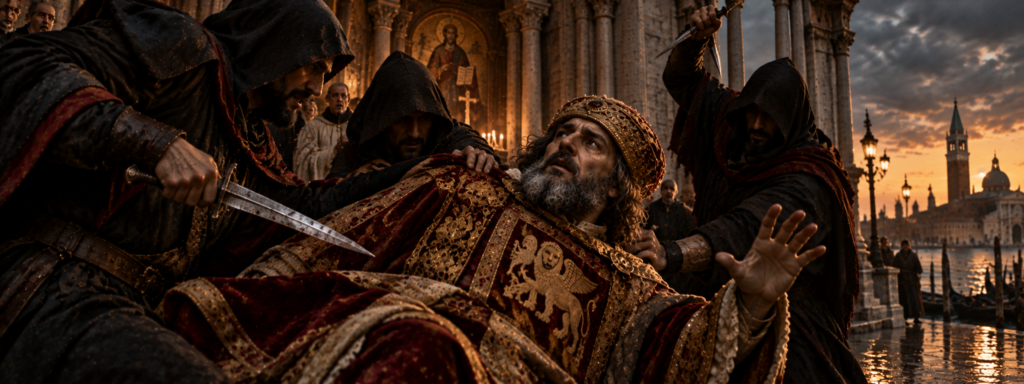
Pietro Tradonico: The Venetian Doge Murdered After Prayers
Twenty-Eight Years of War, Dynastic Ambition, and Political Intrigue Before a Deadly Ambush Outside a Venetian Church
Pietro Tradonico (c. 800–864) was Doge of Venice from approximately 836 until his assassination in 864. A military-minded ruler who strengthened Venetian maritime power, fought against Adriatic raiders, and negotiated with the Byzantine and Frankish empires, he also attempted to secure his family’s political position by elevating his son Giovanni as co-doge. After nearly three decades in power, Tradonico was murdered by a group of conspirators while returning from a religious service at the Church of San Zaccaria. His assassination plunged Venice into political turmoil and exposed the violent rivalries beneath the emerging republic’s government.
Murder After Mass: The Day Venice Turned Against Its Doge
On an ordinary religious occasion in September 864, the ruler of Venice entered a church to worship and emerged into a conspiracy that would end his life. Pietro Tradonico had survived nearly three decades of political intrigue, dangerous diplomacy, maritime warfare, and repeated threats to the security of the Venetian lagoon. He had commanded fleets against pirates, negotiated with emperors, and attempted to establish a political dynasty through his own son. Yet the danger that finally destroyed him came not from a foreign army or an enemy fleet, but from men within the community he governed.
The assassination took place near the Church of San Zaccaria, an important religious foundation closely connected with Venice’s ruling elite. Tradonico had attended a religious service, apparently without anticipating that his movements had become part of a carefully prepared attack. As he left the church, conspirators struck, killing the doge before he could escape. The surviving accounts do not preserve every detail of the assault, but they agree on its essential horror: Venice’s ruler was murdered in a public setting associated with worship, ceremony, and political respectability.
The killing was especially shocking because Tradonico was no inexperienced ruler whose authority had barely taken hold. He had occupied the dogeship since 836, making his government one of the longest of the early Venetian period. During those years, he had helped strengthen the lagoon’s military and diplomatic position in an increasingly dangerous Adriatic world. His death revealed that success against foreign enemies offered little protection against enemies at home.
The conspirators did not simply remove a ruler. They attacked the political order surrounding him, including the powerful interests that had supported his government and the dynastic ambitions of his family. The assassination raised an immediate question about who would control Venice once the doge was dead. It also threatened to unleash retaliatory violence between those responsible for the murder and those determined to avenge him.
Tradonico’s assassination belongs to a particularly brutal period of Venetian history. The later republic would become famous for its elaborate constitutional restraints, carefully managed elections, and suspicion of hereditary monarchy. In the ninth century, however, political authority remained deeply personal, and powerful families frequently attempted to secure the dogeship for their descendants. When those ambitions collided with rival interests, the consequences could be fatal.
The murder outside San Zaccaria therefore represented more than a sudden act of violence. It exposed the unresolved struggle between personal rule and collective government that shaped the earliest centuries of Venetian political life. Tradonico had attempted to strengthen his family’s position while defending the lagoon against external threats. In the end, his government collapsed because the greatest danger lay within Venice itself.
Venice Before Tradonico: A Republic Still Learning How to Survive
The Venice of Pietro Tradonico’s lifetime was very different from the magnificent maritime republic that would later dominate Mediterranean commerce. Its inhabitants lived among islands, marshes, tidal channels, and coastal settlements along the northern Adriatic. Political authority was concentrated increasingly around Rialto, but the institutions associated with the mature Venetian Republic were still developing. The doge remained a powerful ruler whose personal alliances and family connections could determine the stability of government.
The lagoon’s geography provided important advantages. Shallow waterways and shifting channels complicated the movements of invading armies, while local sailors possessed knowledge that outsiders often lacked. Communities could defend themselves through fleets of smaller vessels and exploit the surrounding marshes as natural barriers. Yet the same environment also created challenges for communication, food supply, and political unity.
Venice remained connected to the Byzantine Empire, whose rulers continued to claim authority over territories in the Adriatic. Constantinople offered diplomatic recognition, commercial opportunities, and access to eastern Mediterranean networks. At the same time, the Frankish Empire controlled much of the neighboring mainland, creating another powerful influence upon Venetian affairs. The lagoon’s leaders had to negotiate with both powers while preserving as much local autonomy as possible.
The early ninth century had already witnessed serious political upheaval. Obelerio Antenoreo, a former doge associated with the Frankish faction, had been deposed during the crisis surrounding the Frankish expedition against the lagoon in 809–810. His later attempt to reclaim power ended in defeat and execution. The violence surrounding his career demonstrated how dangerous the struggle for the dogeship could become.
The Participazio family subsequently established itself as a dominant force in Venetian government. Its members helped consolidate the political center at Rialto and continued the practice of involving relatives in ducal authority. Yet their rule did not eliminate factional conflict. Rival families remained capable of challenging established leaders, and the succession to the dogeship was far from secure.
The political instability of this period created opportunities for ambitious men. A successful ruler needed support from leading families, control over military resources, and sufficient diplomatic skill to manage relations with powerful neighbors. Personal reputation mattered, but so did the ability to reward allies and prevent opponents from organizing resistance. The dogeship offered extraordinary authority without guaranteeing personal safety.
Tradonico would emerge from this environment as a ruler whose career reflected both the strengths and weaknesses of early Venetian government. His long reign would demonstrate the lagoon’s growing capacity to defend its interests beyond its own waters. His assassination would demonstrate that the struggle for internal political stability remained unresolved. Venice was learning to survive as a maritime power, but it had not yet learned how to protect its rulers from their own political rivals.
The Rise of Pietro Tradonico
The early life of Pietro Tradonico is imperfectly documented, and the surviving accounts provide little reliable information about his childhood or personal character. His family is traditionally associated with Istrian origins, particularly the region around Pula, although the details of that connection remain uncertain. By the time he entered the historical record as doge, he belonged to the political elite of the Venetian lagoon. His rise reflected the ability of influential families to compete for authority during a period of institutional change.
Tradonico came to power in 836, following the removal of Doge Giovanni I Participazio. The preceding government had faced political opposition, and its collapse created an opportunity for a new ruling household. Tradonico’s election represented another transfer of authority between competing factions. It also demonstrated that the dogeship remained vulnerable to the political pressures that had destroyed earlier rulers.
The circumstances of his accession are significant because they reveal the unstable foundations of his government. Tradonico did not inherit an uncontested hereditary throne. He gained authority within a political community where powerful families possessed the means to challenge the ruling doge. Maintaining office required constant attention to alliances, military strength, and the distribution of influence.
The new doge also inherited a dangerous international situation. The Adriatic was increasingly threatened by maritime raiders, while the Byzantine Empire and the Frankish world continued to influence regional politics. Venetian merchants depended upon safe passage through waters that were becoming contested. A ruler who failed to protect commerce risked weakening the economic foundations of the lagoon.
Tradonico appears to have recognized the importance of military power. His government became associated with naval campaigns and efforts to defend Venetian shipping. These policies would contribute to the development of Venice as an increasingly independent maritime force. They also exposed the doge to the political consequences of military success and failure.
The length of his reign suggests that he possessed considerable political skill. Nearly three decades in office would have required the maintenance of influential alliances and the management of recurring threats. Yet longevity did not necessarily mean universal popularity. A ruler could remain in power for years while resentment accumulated among rivals.
Tradonico’s government would eventually confront the same problem that had troubled his predecessors: the relationship between personal authority and family ambition. Like earlier doges, he sought to involve his son in government. The decision promised continuity but also threatened to strengthen one household at the expense of others. Such arrangements could provoke hostility among elites who feared the emergence of hereditary rule.
His rise therefore contained the seeds of his eventual downfall. He entered office through a political system capable of removing established rulers, and he would attempt to secure his family’s position within that same unstable system. The challenge was to build a government strong enough to survive external threats without provoking fatal opposition at home. Tradonico would succeed in the first task more convincingly than the second.
A Dangerous Sea: Venice and the Pirates of the Adriatic
One of the greatest threats facing Venice during Tradonico’s reign came from the eastern Adriatic. Maritime raiders operating from the Dalmatian coast threatened merchant vessels and disrupted trade routes. The region’s complex coastline, with its islands, inlets, and sheltered harbors, offered opportunities for communities that relied upon raiding as well as commerce. Venetian ships traveling toward the Mediterranean could become vulnerable to attacks.
The Narentines, associated with the region around the Neretva River, became particularly prominent in Venetian accounts of Adriatic piracy. Their maritime activities challenged the security of routes that Venetian merchants increasingly depended upon. The conflict was not simply a struggle between peaceful traders and criminals, because coastal communities possessed their own political and economic interests. Nevertheless, Venetian sources regarded the raiders as a serious threat.
Tradonico’s government attempted to respond through military expeditions. The doge recognized that control over the lagoon alone could not guarantee the security of Venetian commerce. Ships needed protection along the wider Adriatic, where hostile forces could intercept them. Naval strength therefore became increasingly important to the survival of the Venetian economy.
The campaigns were not uniformly successful. Venetian forces encountered resistance from coastal communities familiar with local waters and capable of exploiting difficult geography. The eastern Adriatic contained numerous islands and channels that complicated military operations. A fleet that possessed numerical strength could still struggle against opponents who knew the coastline intimately.
The conflict also demonstrated the limits of Venetian power during the ninth century. The republic had not yet developed the extensive naval resources that would characterize its later history. Its fleets were capable of significant operations but remained vulnerable to defeat. The doge’s military ambitions therefore carried considerable risks.
Tradonico’s campaigns against the Narentines are remembered as part of the early struggle for Venetian maritime security. Some accounts describe expeditions that achieved temporary agreements, while others emphasize the persistence of raiding. The precise sequence of operations is difficult to reconstruct because later chronicles provide much of the narrative. The broader pattern of conflict, however, is well established.
The threat from Adriatic raiders affected more than the merchants whose ships were attacked. Maritime insecurity could disrupt supplies, reduce commercial profits, and weaken confidence in the government. Leading families whose wealth depended upon trade had strong reasons to demand protection. A doge who failed to respond risked losing political support.
Tradonico’s efforts therefore reflected both public necessity and personal political calculation. Successful naval campaigns could strengthen his reputation and demonstrate his ability to defend Venetian interests. Military setbacks could provide ammunition for rivals. The Adriatic became a theater in which the doge’s authority was repeatedly tested.
The Narentines: Enemies Along the Dalmatian Coast
The Narentines occupied a strategically important region of the eastern Adriatic. Their communities operated among coastal waterways and islands that offered excellent opportunities for maritime activity. Venetian merchants passing through the area faced the possibility of attack, particularly when traveling without sufficient protection. The resulting conflict became a recurring feature of early Venetian history.
The Narentines were not a unified pirate organization in the modern sense. They belonged to a broader political and cultural landscape of Slavic communities along the Dalmatian coast. Their maritime activities included trade, local warfare, and raiding. Venetian chroniclers often emphasized the danger they posed while providing less information about their internal political structures.
Tradonico’s government sought to confront this threat through naval expeditions. One campaign traditionally dated to 839 involved operations along the Dalmatian coast and attempts to secure agreements with local rulers. Such diplomacy suggests that military force was not the only instrument available to Venice. Negotiation could offer temporary security when direct conquest was impractical.
Agreements with coastal leaders did not necessarily end maritime raiding. Local political authority could be fragmented, and not every group operating in the region would obey a single ruler. The geography also made enforcement difficult. Venetian ships could not permanently occupy every island and inlet from which attacks might originate.
The persistence of raiding created a cycle of military expeditions and renewed conflict. A Venetian victory might secure temporary concessions, only for attacks to resume when circumstances changed. The doge therefore faced an enemy that could not easily be defeated in a single campaign. Maritime security required continuing attention.
The struggle also contributed to the development of Venetian naval experience. Expeditions beyond the lagoon demanded organization, supplies, and coordination among ships. Commanders had to navigate unfamiliar waters and negotiate with coastal communities. These activities helped establish traditions of maritime warfare that would become central to Venice’s later power.
The Narentine threat remained important long after Tradonico’s death. Later doges continued to confront raiders and rival powers along the Dalmatian coast. The conflict eventually became part of Venice’s broader ambition to dominate the Adriatic. Tradonico’s campaigns therefore belonged to the early stages of a much longer struggle.
His inability to eliminate the threat completely should not obscure the significance of his efforts. Venice was still a developing maritime state, and the resources available to its rulers were limited. The campaigns demonstrated a willingness to project military power beyond the lagoon. They also revealed how difficult it would be to transform commercial influence into lasting control over the sea.
The Disaster Against the Saracens
While the Narentines threatened Venetian commerce along the eastern Adriatic, another danger emerged from the expanding military activities of Muslim forces in the Mediterranean. The ninth century witnessed intense conflict between the Byzantine Empire and Muslim powers, particularly in southern Italy and Sicily. Raiding fleets operated across the central Mediterranean, threatening coastal settlements and shipping. Venice could not remain entirely separate from these struggles.
Tradonico’s government became involved in operations against Muslim forces often described in contemporary and later Christian sources as Saracens. The terminology reflected the language of the period and did not identify a single unified political organization. The forces involved in Adriatic and southern Italian warfare could have different origins and objectives. Their activities nevertheless posed a serious challenge to Byzantine and Venetian interests.
One of the most important episodes occurred in connection with the fighting around Taranto. Venetian forces participated in a naval campaign against Muslim opponents, but the expedition ended in defeat. The traditional chronology places the disaster around 840, although details of the engagement vary among historical accounts. The defeat became one of the major military setbacks associated with Tradonico’s reign.
The loss exposed the limitations of Venetian naval power. The lagoon communities possessed maritime experience, but they were confronting opponents capable of operating substantial fleets. A failed expedition could result in the destruction of ships and the loss of experienced sailors. Such losses were especially serious for a developing maritime state.
The defeat also carried political consequences. A doge who had presented himself as a defender of Venetian commerce could face criticism when military operations ended disastrously. Families whose relatives served in the fleet might suffer personal losses. Merchants could become concerned about the government’s ability to protect trade.
The surviving accounts do not provide a complete list of casualties or a detailed reconstruction of the battle. Later narratives sometimes emphasize the scale of the disaster, but their figures and descriptions require caution. The essential historical point is that Venetian forces suffered a significant defeat during Tradonico’s government. The setback demonstrated that the republic’s growing maritime ambitions exceeded its military capabilities in some circumstances.
The conflict with Muslim fleets also revealed the importance of Venice’s relationship with Byzantium. The empire remained a major naval power, and its struggle to defend territories in Italy influenced Venetian security. Cooperation with Constantinople could provide strategic advantages. Yet involvement in imperial warfare also exposed Venice to dangers beyond its immediate interests.
Tradonico therefore faced a difficult balance. Refusing to participate in wider maritime conflicts might weaken diplomatic relationships and leave trade routes vulnerable. Joining military expeditions could produce costly defeats. The doge had to make decisions whose consequences affected both Venice’s security and his own political standing.
The disaster against the Saracens became part of the darker side of his long reign. It reminded the lagoon communities that naval warfare could bring catastrophe as well as prestige. Tradonico’s government survived the defeat, but the episode contributed to the complicated reputation of a ruler whose ambitions were repeatedly tested at sea. His military policies strengthened Venice’s experience while exposing its vulnerabilities.
The Slavic Coast and the Limits of Venetian Power
The eastern Adriatic remained a persistent source of instability throughout Tradonico’s government. Venetian merchants depended upon routes passing near communities that possessed their own political ambitions and maritime traditions. The lagoon’s rulers could not simply impose authority over the entire coastline. They had to combine military expeditions with diplomacy and commercial negotiation.
The complexity of the region made lasting peace difficult. Coastal settlements were separated by mountains, islands, and waterways, creating political fragmentation. Local leaders could negotiate agreements without necessarily controlling every group engaged in raiding. A treaty that appeared promising might therefore fail to prevent renewed attacks.
Tradonico’s campaigns illustrate the challenges of projecting power across this environment. Venetian fleets could reach distant coastal settlements, but maintaining permanent control required resources that the early republic did not possess. Ships needed crews, provisions, and safe harbors. Military success also depended upon reliable information about local conditions.
The doge’s efforts nevertheless helped establish the Adriatic as a central concern of Venetian government. The security of maritime commerce became inseparable from political authority. Leading families whose wealth depended upon shipping expected the doge to protect their interests. Naval policy therefore influenced domestic legitimacy.
The conflict also encouraged the development of a more organized maritime outlook. Venice increasingly regarded threats beyond the lagoon as matters requiring collective action. The doge’s role expanded beyond managing local disputes to directing operations across the Adriatic. This transformation would eventually become one of the defining features of the republic.
Yet the expansion of military responsibilities could create resentment. Campaigns required ships, sailors, and resources that might otherwise support commerce. Families could disagree about the costs and benefits of particular expeditions. Military setbacks provided opportunities for political criticism.
Tradonico’s long reign therefore unfolded amid constant pressure to demonstrate strength. Success against raiders could enhance his reputation, while defeat could weaken confidence in his leadership. The same maritime policies that helped establish Venice’s future power also exposed the government to recurring controversy. The doge’s authority depended upon balancing ambition with the resources available to the lagoon.
The Frankish Empire and the Politics of Recognition
Venice’s relationship with the Frankish world remained important during Tradonico’s reign. The empire founded by Charlemagne had undergone political changes after his death in 814, but its rulers continued to influence northern Italy. The Venetian lagoon bordered territories connected to the Frankish political system. Commercial and diplomatic relations with those territories were essential.
Tradonico’s government sought to maintain workable relations with the western imperial authorities. Agreements concerning trade, boundaries, and political recognition helped define the lagoon’s position. Venice needed access to mainland markets and routes while preserving control over its own affairs. Diplomacy therefore became as important as naval warfare.
The Pactum Lotharii of 840 is particularly significant. Concluded during the reign of Emperor Lothair I, the agreement regulated relations between the Venetian communities and the neighboring imperial territories. It addressed practical matters involving trade, legal relationships, and boundaries. The document provides valuable evidence for Venice’s developing political identity.
The pact did not create Venetian independence in a single dramatic act. The lagoon’s autonomy emerged gradually through changing relationships with Byzantium and the western empire. Nevertheless, the agreement demonstrated that Venice possessed a distinct political organization capable of negotiating important arrangements. Tradonico’s government participated in this process.
The treaty also reveals the practical concerns of early Venetian society. Commerce depended upon predictable rules governing merchants and property. Disputes involving neighboring territories required mechanisms for resolution. Political stability therefore depended partly upon agreements that reduced the risk of conflict.
Tradonico’s diplomatic success contrasted with some of his military difficulties. While naval campaigns could end in defeat, negotiation offered opportunities to strengthen Venice’s position without direct confrontation. The doge’s government demonstrated an ability to operate within the complex political world of ninth-century Italy. Such achievements contributed to the long-term development of Venetian autonomy.
The agreement with Lothair also illustrates the importance of personal leadership. The doge represented the lagoon communities in negotiations with powerful rulers. His reputation and political authority influenced the credibility of the government. A successful diplomatic arrangement could strengthen his position among Venetian elites.
Yet diplomacy did not eliminate domestic rivalry. A ruler might secure favorable agreements abroad while provoking resentment at home. The interests of leading families were not always identical, and political success could intensify competition for influence. Tradonico’s government would eventually discover that external recognition offered little protection against internal conspiracy.
Byzantium: The Empire Venice Could Not Escape
The Byzantine Empire remained a central influence upon Venetian politics during Tradonico’s lifetime. Although Constantinople’s direct control over the lagoon had weakened, the empire continued to possess maritime power and historical claims to authority. Venetian merchants benefited from connections with eastern Mediterranean markets. The doge therefore had strong reasons to preserve relations with the Byzantine government.
The relationship was complicated by the empire’s conflicts with Muslim powers and its continuing interest in Italy. Byzantine fleets operated in the Adriatic and central Mediterranean, sometimes seeking assistance from local allies. Venice could benefit from cooperation but also risk becoming involved in costly military campaigns. The defeat associated with the fighting near Taranto illustrated those dangers.
Byzantine recognition could also strengthen a doge’s prestige. Imperial titles and diplomatic honors carried political significance in early medieval society. A ruler acknowledged by Constantinople might claim enhanced legitimacy. Such recognition did not necessarily imply complete obedience to imperial commands.
Tradonico’s government operated within this ambiguous relationship. Venice remained formally connected to the Byzantine world while developing greater practical autonomy. The lagoon’s rulers increasingly made decisions based upon local interests. Their ability to negotiate with western emperors demonstrated the complexity of their political position.
The relationship with Byzantium also influenced domestic factions. Some leading families valued eastern connections because of commercial interests or traditional loyalties. Others favored closer relations with the mainland powers. The doge had to manage these competing preferences without provoking a political crisis.
The long-term result was the development of a distinctive Venetian identity. The lagoon retained elements of Byzantine culture and political tradition while gradually establishing institutions suited to its own circumstances. Its leaders were neither ordinary provincial governors nor fully independent monarchs. They occupied an intermediate position shaped by geography, commerce, and diplomacy.
Tradonico’s reign contributed to this evolution. His government negotiated with western rulers, participated in wider maritime conflicts, and defended local interests. These activities strengthened the lagoon’s capacity to act as a political community. Yet the process remained vulnerable to internal disputes over who should exercise authority.
The doge’s assassination would expose the limits of external legitimacy. Recognition from powerful emperors could enhance prestige, but it could not guarantee loyalty among Venetian elites. The ruler who negotiated with distant courts remained dependent upon the political relationships surrounding him at home. When those relationships collapsed, imperial diplomacy could not save his life.
Giovanni Tradonico: The Son Who Was Supposed to Inherit Power
One of the most important political decisions of Tradonico’s reign was the elevation of his son Giovanni as co-doge. The arrangement reflected a recurring pattern in early Venetian government, where ruling families attempted to preserve authority through their descendants. By associating Giovanni with the dogeship, Pietro sought to strengthen his family’s position. The decision also raised questions about the future succession.
The mature Venetian Republic would eventually develop elaborate procedures intended to prevent hereditary monarchy. In Tradonico’s lifetime, however, those restrictions were not yet established. Earlier doges had involved sons and brothers in government, sometimes with the approval of influential political groups. The practice offered continuity but also threatened the interests of rival families.
Giovanni’s elevation therefore had both practical and political consequences. A co-doge could assist with government and provide a recognized successor. The arrangement might reassure supporters who favored stability. It could also alarm opponents who feared that the Tradonico family intended to monopolize the office.
The surviving evidence provides limited information about Giovanni’s personal character and independent political activities. His association with the dogeship is better documented than his individual achievements. Later accounts generally treat him as part of his father’s government rather than as a fully separate ruler. This makes it difficult to assess his influence upon particular decisions.
The dynastic arrangement became especially important because Giovanni died before his father. His death removed the intended successor and weakened the family’s prospects for maintaining control of the dogeship. The precise circumstances of his death are not clearly established in the surviving narratives. There is no reliable basis for portraying it as an assassination or deliberate political murder.
The loss of Giovanni may have altered the balance of power around Pietro. Without an established heir, the future of the dogeship became more uncertain. Rival families could anticipate opportunities once the aging ruler died or lost authority. The absence of a clear successor could intensify political competition.
It would be tempting to connect Giovanni’s death directly to the conspiracy against his father, but the evidence does not establish such a causal relationship. The surviving accounts do not reveal the private calculations of the assassins. They do not prove that the murder was planned specifically to prevent a Tradonico succession. The broader political context nevertheless makes the issue of dynastic authority relevant.
Pietro’s attempt to secure his family’s future ultimately failed. His son died before him, and the doge himself was murdered in 864. The government passed to another ruling household rather than continuing under the Tradonico family. The outcome demonstrated the fragility of hereditary ambition in a political system where rival elites retained the power to challenge established rulers.
A Long Reign and the Resentments It Could Create
Tradonico’s government lasted approximately twenty-eight years, an extraordinary period of continuity in the unstable political environment of early Venice. His longevity suggests that he possessed substantial support and the ability to manage competing interests. Yet a long reign could also create resentment among families excluded from the highest office. Political stability for one household might mean prolonged frustration for its rivals.
The doge’s military policies required resources and imposed burdens upon the community. Naval campaigns demanded ships, sailors, supplies, and financial support. Victories could strengthen the government, but defeats could provoke criticism. Families whose interests suffered from unsuccessful expeditions might become increasingly dissatisfied.
The attempt to establish a family succession created another potential source of tension. By elevating Giovanni, Tradonico signaled that he hoped to preserve authority within his household. Rival elites could interpret the arrangement as a threat to their own political ambitions. The death of the co-doge did not necessarily erase those concerns.
The surviving sources do not provide a complete account of the opposition that developed against Tradonico. They identify the existence of a conspiracy but offer limited reliable information about the personal grievances of its participants. Later narratives sometimes portray the doge as unpopular or authoritarian, but such judgments must be evaluated carefully. The murder itself does not prove that the ruler was universally hated.
Political opposition could arise from several overlapping causes. Disputes over appointments, military policy, family influence, and succession might all contribute to dissatisfaction. Personal rivalries could become entangled with broader disagreements about government. A conspiracy might unite men whose motives were not identical.
Tradonico’s long tenure may also have made his removal difficult through ordinary political means. A ruler who controlled important offices and possessed loyal supporters could resist attempts to replace him. Assassination offered a violent alternative to prolonged political struggle. The decision to murder the doge suggests that at least some opponents believed ordinary methods would not achieve their objectives.
Yet the conspirators faced serious risks. Killing a ruler could provoke retaliation from his supporters and create instability that threatened the entire community. The success of an assassination depended partly upon the ability to control its aftermath. A group capable of murdering the doge might still fail to establish a stable replacement government.
The events of 864 would demonstrate precisely that danger. Tradonico’s death did not produce an orderly transfer of authority controlled entirely by the assassins. Instead, the killing unleashed political turmoil and retaliation. The conspirators had removed the ruler, but they had not eliminated the forces that supported him.
San Zaccaria: A Church at the Heart of Venetian Power
The Church of San Zaccaria occupied an important place in the religious and political life of early Venice. Located near the developing center of government at Rialto, the foundation was closely associated with the ruling elite. Its religious community enjoyed prestigious connections, and the church became a setting for ceremonies involving leading Venetian families. The association between religious institutions and political authority was particularly strong in the early medieval world.
The monastery of San Zaccaria is traditionally connected with the patronage of the Participazio family during the ninth century. Its development reflected the growing importance of Rialto as a political and religious center. Religious foundations could reinforce the prestige of ruling households while providing spaces for worship and commemoration. They also became places where members of the political elite gathered.
The church’s importance makes Tradonico’s assassination especially striking. He was not attacked in an isolated military camp or during a dangerous expedition. He was murdered in connection with a religious service at a prominent Venetian institution. The setting offered an opportunity for conspirators who knew that the doge would be present.
The surviving accounts do not establish every detail of the service he attended. They do not reliably describe his prayers, the precise liturgy, or his conversations before leaving the church. Such details would create a vivid scene but cannot be presented as historical fact. The essential circumstances are sufficiently dramatic without invention.
The attack also reveals the vulnerability of rulers during public ceremonies. Religious observances brought leaders into contact with members of the community and required movement through spaces that could be difficult to secure. A ruler surrounded by supporters might still be exposed to sudden violence. The assassins appear to have exploited such an opportunity.
The location near San Zaccaria carried symbolic significance. The church represented religious authority and the prestige of the emerging Venetian political center. Murdering the doge there transformed a setting associated with worship into the scene of a political crime. The contrast would have made the killing especially memorable.
The assassination did not necessarily indicate hostility toward the church itself. The available evidence points to a political attack against the ruler rather than a religiously motivated assault upon the institution. The conspirators may have chosen the location because it offered a predictable opportunity. Their motives should not be confused with the religious setting of the crime.
San Zaccaria would continue to occupy an important place in Venetian history long after Tradonico’s death. The present church reflects later architectural development and should not be imagined as identical to the ninth-century building. Nevertheless, the association with the assassination preserves a connection to the violent politics of early Venice. A religious foundation became the setting for one of the most notorious murders in the republic’s early history.
The Conspiracy: Men Who Wanted the Doge Dead
The assassination of Pietro Tradonico required the participation of men willing to attack the reigning doge in a public setting. Later Venetian chronicles describe a conspiracy involving members of the political community who opposed his government. The surviving accounts do not provide a complete and consistent list of participants. Their precise relationships, grievances, and individual responsibilities remain difficult to reconstruct.
The existence of a conspiracy suggests that opposition had moved beyond ordinary political disagreement. The participants were prepared to remove the ruler through lethal violence. Such a decision carried enormous risks because the doge possessed supporters capable of retaliation. The conspirators therefore had to consider both the attack itself and the consequences of success.
The choice of San Zaccaria indicates that the assassins knew something about the doge’s movements. Religious ceremonies provided opportunities to anticipate where a ruler would appear. The attack could be organized around a predictable moment when the doge moved between the church and surrounding streets. The available evidence does not reveal the exact preparations, but the circumstances are consistent with a planned ambush.
The conspirators’ motives remain uncertain. Political resentment, opposition to dynastic ambition, personal grievances, and dissatisfaction with the government’s policies are all plausible possibilities. Yet the surviving narratives do not establish a single definitive explanation. It would be misleading to assign private motives to individual assassins without evidence.
Later historians have sometimes interpreted the murder as a reaction against authoritarian government. Such an explanation fits the broader pattern of early Venetian resistance to powerful ruling families. Nevertheless, it risks imposing the constitutional ideals of later centuries upon an earlier political system. The ninth-century dogeship remained a personal office embedded in family rivalries.
The conspirators may also have expected support from factions dissatisfied with Tradonico’s long rule. A ruler who had occupied office for nearly three decades inevitably affected the fortunes of numerous families. Some benefited from his patronage, while others may have felt excluded. The assassination could have offered an opportunity to alter that balance.
Yet the attack’s aftermath suggests that the conspirators did not command universal support. Tradonico’s loyalists remained capable of organizing resistance and demanding punishment. The murder therefore exposed deep divisions within the political community. It did not represent a unanimous decision by Venice to remove its ruler.
The conspiracy remains one of the most intriguing aspects of the case because the surviving evidence leaves so much unexplained. We know that men organized to kill the doge and succeeded in carrying out the attack. We know that the murder provoked a political crisis. What we cannot know with confidence is the full network of relationships and grievances that brought the conspirators together.
September 864: The Assassination Outside San Zaccaria
The traditional date of Pietro Tradonico’s assassination is 13 September 864. On that day, the doge attended a religious service at San Zaccaria, a foundation closely connected with the Venetian ruling elite. As he left the church, conspirators attacked him. The assault ended his life and brought his long government to a sudden, violent conclusion.
The surviving narratives describe the killing as a coordinated attack rather than an accidental confrontation. Several men were involved, and the location suggests that they had anticipated the doge’s presence. The attack occurred in the vicinity of a religious institution, where public ceremony and political authority intersected. The contrast between the setting and the violence became central to the historical memory of the event.
The precise sequence of blows cannot be reconstructed securely. Later chronicles describe the doge being attacked and killed, but they do not provide a contemporary forensic account. Claims about the exact number of wounds, the identities of every assailant, or the final words of the victim would go beyond the reliable evidence. The essential fact is that the conspirators succeeded in murdering the reigning doge.
Tradonico’s death was a remarkable reversal for a ruler who had survived so many external threats. He had faced maritime raiders, military defeats, and the pressures of imperial diplomacy. He had maintained office for nearly three decades despite the political instability of early Venice. Yet his life ended during a religious occasion within the political center of his own community.
The attack also revealed the limitations of personal security in the ninth century. A doge could command armed forces and exercise considerable authority, but he could not necessarily prevent a sudden assault by determined opponents. Public ceremonies required movement through spaces where enemies might approach. Political power did not provide immunity from physical vulnerability.
The assassination was particularly destabilizing because Giovanni Tradonico, the doge’s intended successor, had already died. There was no surviving co-doge ready to assume authority through the arrangement Pietro had established. The government therefore faced an immediate succession problem. Rival factions had an opportunity to compete for control.
The conspirators had achieved their immediate objective, but the consequences were far from settled. Tradonico’s supporters remained influential, and the killing created demands for retaliation. The assassination threatened to produce a cycle of violence that could destabilize the lagoon. Removing the doge proved easier than controlling the political aftermath.
The murder at San Zaccaria became one of the defining examples of early Venetian regicide. Although the doge was not a king in the conventional sense, he occupied the highest political office in the lagoon and exercised authority comparable to that of other early medieval rulers. His assassination therefore belongs within the broader history of rulers deliberately eliminated by political conspiracies. The killing demonstrated that the dogeship could be as dangerous as any throne.
The Body of the Doge and the Shock of His Death
The death of a ruler created immediate practical and symbolic problems for an early medieval government. The body had to be recovered and buried, while supporters and opponents struggled to determine the political consequences. Tradonico’s assassination occurred in a public setting, making it difficult to conceal the event. News of the killing would have spread through the political community.
The surviving accounts associate Tradonico’s burial with San Zaccaria. The connection is significant because the church was also the setting of his assassination. A place associated with religious ceremony became linked to both his violent death and his commemoration. The details of the original burial arrangements, however, are not preserved with sufficient clarity to reconstruct every stage.
The treatment of a murdered ruler’s remains could carry political meaning. Honorable burial might affirm his former status, while public humiliation could express hostility toward his government. In Tradonico’s case, the historical tradition emphasizes the assassination and its aftermath rather than a spectacular degradation of his body. His death nevertheless exposed the fragility of the dignity attached to the dogeship.
The killing also created uncertainty among the people who depended upon the government. Merchants, sailors, religious institutions, and leading families all had interests affected by political stability. A sudden change of ruler could disrupt agreements and alter the distribution of influence. The assassination therefore had consequences extending beyond the immediate circle of conspirators.
The absence of Giovanni Tradonico made the situation more complicated. Had the co-doge survived, he might have provided an established successor capable of claiming authority. His earlier death removed that possibility. The political community had to determine who would replace Pietro without the dynastic continuity he had attempted to create.
The conspirators could not assume that the murder would be accepted. Tradonico had governed for nearly twenty-eight years and possessed supporters whose fortunes were connected to his rule. Those supporters had reasons to seek revenge. The assassination therefore risked provoking further bloodshed.
The immediate aftermath became a struggle over legitimacy. Were the killers liberators who had removed an oppressive ruler, or criminals who had murdered the lawful doge? The answer depended upon political allegiance and the ability of rival groups to impose their interpretation. Later Venetian narratives would preserve the event as a conspiracy rather than a legitimate transfer of office.
Tradonico’s body became the final physical reminder of a government that had ended without warning. The ruler who had negotiated treaties and directed naval campaigns could no longer defend his authority. His supporters were left to respond to the killing, while his enemies confronted the consequences of their success. Venice had lost its doge, but the struggle over his legacy had only begun.
The Aftermath: Venice Turns on the Assassins
The assassination did not bring immediate peace to Venice. Tradonico’s supporters remained powerful, and the conspirators faced retaliation. Later accounts describe violent measures against those responsible for the murder. The political community was forced to confront the consequences of an attack that had destroyed the reigning government.
The reaction demonstrates that Tradonico had not lost all support before his death. His long reign had created relationships and loyalties that survived the assassination. Families associated with his government had reasons to oppose the conspirators. The murder therefore produced a struggle between rival groups rather than a universally accepted change of leadership.
The surviving chronicles describe punishment and political upheaval following the killing. Some accounts emphasize the pursuit of the conspirators and the destruction of their position. The precise sequence of reprisals is difficult to establish because later narratives differ in detail. Nevertheless, the broad pattern of retaliation is consistent with the violent character of early Venetian politics.
The conspirators’ failure to secure uncontested authority is particularly revealing. They had succeeded in killing the doge, but they could not necessarily control the political institutions that survived him. Other families possessed influence, and the community needed a new ruler capable of restoring order. The assassination created an opportunity for political change without guaranteeing victory for its organizers.
The crisis also exposed the weakness of dynastic succession. Tradonico had attempted to secure continuity through his son, but Giovanni’s earlier death left the family without an established successor. The murder therefore ended the family’s direct control of the dogeship. The government passed to another political household.
The aftermath became part of the longer struggle to develop institutions capable of managing political transitions. A state whose rulers could be murdered by conspirators needed mechanisms for selecting successors and limiting personal power. The later Venetian Republic would become famous for precisely such arrangements. Their development, however, was gradual and emerged from repeated experiences of instability.
The violence following Tradonico’s death also illustrates the dangers faced by political assassins. Removing a ruler could provoke revenge from those who had benefited from his government. The conspirators might become targets of the same violence they had employed. A successful assassination did not guarantee personal survival.
The murder at San Zaccaria therefore produced consequences beyond the death of one man. It destabilized the government, intensified factional hostility, and demonstrated the continuing importance of powerful families. Venice survived the crisis, but the event revealed how fragile its political order remained. The dogeship had endured, yet its occupant had been destroyed by the community he ruled.
Orso Participazio and the Restoration of Political Order
Following Tradonico’s assassination, Orso I Participazio emerged as the next doge. His accession returned the office to a family that had previously exercised considerable influence in Venetian government. The transition reflected the continuing importance of established political households. It also demonstrated the community’s need for leadership after the violence of 864.
Orso’s government became associated with efforts to restore stability and continue the development of Venetian maritime power. The new doge inherited the challenges that had confronted Tradonico, including threats from Adriatic raiders and the need to manage relations with neighboring powers. The assassination had changed the ruler but not the strategic circumstances of the lagoon. Venice still depended upon commerce, diplomacy, and naval defense.
The return of the Participazio family is significant because it illustrates the limited number of households capable of competing for the dogeship. Political authority remained concentrated among influential elites. A change of ruler could alter the balance between families without transforming the underlying system. The republic’s later constitutional arrangements had not yet emerged.
Orso’s accession also suggests that the conspirators against Tradonico did not establish a durable government of their own. The political community selected a ruler associated with an established family rather than allowing the assassination to produce a wholly new order. The transition therefore helped restore continuity. It also reduced the immediate danger of prolonged political fragmentation.
The new government faced the task of managing the memory of the assassination. Tradonico had been murdered by members of the political community, and the event could continue to divide families. Punishment of conspirators might satisfy some supporters while provoking resentment among others. Restoring stability required more than appointing a new doge.
The Participazio family had its own history of dynastic ambition. Earlier members had attempted to secure succession through relatives, and the same tendency would continue in later governments. The return of the family therefore did not represent a decisive rejection of hereditary politics. It reflected the persistence of a system in which powerful households competed for authority.
Nevertheless, the succession marked the survival of the Venetian state. The assassination had destroyed a ruler but had not destroyed the institutions surrounding the dogeship. A new government emerged, and the lagoon continued to develop its maritime interests. The political community demonstrated a capacity to recover from violent upheaval.
Tradonico’s death therefore became one episode in a longer process of institutional development. The republic survived because authority could pass to another ruler despite the collapse of an established government. Yet the violence revealed the need for more reliable methods of succession and political restraint. Venice would spend centuries addressing those problems.
Was Pietro Tradonico a Tyrant?
The assassination of Pietro Tradonico raises an unavoidable question about his government. Why would members of the Venetian political community organize to murder a ruler who had occupied office for nearly three decades? The surviving evidence does not provide a single definitive answer. Later narratives offer interpretations shaped by the political concerns of their own periods.
Some historians have suggested that opposition to Tradonico’s personal authority contributed to the conspiracy. His long reign and attempt to establish a family succession could have alarmed rival elites. A government dominated by one household might be perceived as threatening the interests of other powerful families. Such tensions were common in early Venetian politics.
Yet the existence of an assassination does not prove that Tradonico was a tyrant. Political murder could result from personal rivalry, disputes over succession, or resentment among excluded factions. A ruler might be targeted because he was powerful rather than because he was exceptionally cruel. The motives of the conspirators remain insufficiently documented.
Tradonico’s military record also complicates any simple judgment. His government undertook campaigns intended to defend Venetian commerce and strengthen maritime security. Some operations ended in defeat, while others demonstrated growing naval ambition. Military setbacks could provoke criticism without establishing deliberate oppression.
His diplomatic achievements provide another perspective. The Pactum Lotharii of 840 helped regulate relations with neighboring imperial territories and contributed to Venice’s developing political position. Such agreements required negotiation and administrative capacity. Tradonico’s government was therefore capable of constructive political action as well as military confrontation.
The attempt to elevate Giovanni as co-doge remains one of the clearest examples of dynastic ambition. Yet earlier and later doges pursued similar arrangements. The practice reflected the political culture of the period rather than a uniquely oppressive policy. It could nevertheless provoke serious opposition among rival families.
The surviving sources also lack detailed evidence concerning Tradonico’s personal conduct. They do not provide a reliable catalogue of private cruelties, scandals, or abuses comparable to those associated with some later rulers. Inventing such details would distort the historical record. His assassination is dramatic enough without attributing unsupported crimes to him.
Tradonico should therefore be understood as a powerful early medieval ruler whose government generated dangerous opposition. He pursued military and diplomatic policies that helped shape Venice’s future, while his dynastic ambitions reflected the unstable political system of his age. His murder reveals the intensity of factional conflict rather than providing a simple moral verdict upon his character. The doge was a victim of political assassination, but the reasons behind the conspiracy remain partly obscured.
The Doge, the Church, and the Violence of Sacred Space
The assassination at San Zaccaria possesses a disturbing symbolic quality because it occurred in connection with religious worship. Churches were central institutions in early medieval society, providing spaces for ceremony, community gatherings, and the commemoration of rulers. Their association with sacred authority made them important settings for political life. Yet their religious character did not always protect those who entered them from violence.
The murder of a ruler near a church could intensify the sense of outrage surrounding an assassination. The victim had participated in a religious observance before being attacked. The contrast between worship and murder made the event especially memorable. Later chroniclers had strong reasons to emphasize the setting.
Religious institutions were also closely connected with political families. Patronage of churches and monasteries could enhance the prestige of ruling households. Members of the elite attended ceremonies and maintained relationships with religious communities. These connections made churches important places of political visibility.
San Zaccaria’s association with the Venetian ruling elite therefore created both prestige and vulnerability. The doge’s attendance at a service was part of the public expression of his authority. It also placed him in a location where opponents could anticipate his movements. The assassins exploited the intersection of religious ceremony and political routine.
The surviving accounts do not establish that the conspirators intended to attack the church or its religious community. Their target was the doge, and the location appears to have provided an opportunity. The distinction matters because political violence near a sacred building was not necessarily motivated by religious hostility. The assassination should be understood primarily within the context of factional politics.
The event nevertheless illustrates the limits of sacred protection in early medieval society. Religious institutions possessed moral authority, but political conflicts could overwhelm respect for sacred spaces. Rulers and churchmen alike could become victims of violence when rival factions pursued power. The killing of Tradonico belongs to this broader history.
The church’s later architectural development adds another layer to the story. The San Zaccaria visible today reflects centuries of rebuilding and artistic transformation. It should not be imagined as an unchanged survival from the ninth century. The association with Tradonico’s death nevertheless connects the site with the earliest political history of Venice.
The murder remains unsettling because it occurred at a moment when the ruler might reasonably have expected ceremony rather than confrontation. The doge had survived military campaigns and diplomatic crises, but a religious occasion became the setting for his death. His assassination demonstrates how political violence could intrude into the most familiar rituals of public life. The sacred setting did not prevent the conspirators from carrying out their attack.
The Problem of Hereditary Power in Early Venice
Tradonico’s attempt to elevate his son Giovanni belongs to a recurring struggle over the nature of the dogeship. Early Venetian rulers frequently sought to involve relatives in government, hoping to preserve authority within their families. The practice reflected the importance of personal loyalty and dynastic continuity in medieval politics. It also created tension with the interests of other powerful households.
The doge was not a king in the conventional hereditary sense. His authority depended upon recognition within the political community, and the office could pass between rival families. Yet the distinction between elective leadership and dynastic rule remained unstable. A successful doge might attempt to transform temporary authority into a family possession.
The Galbaio family had pursued hereditary ambitions before Tradonico’s lifetime. The Participazio family also involved relatives in government, and Obelerio Antenoreo had elevated his brothers to positions of ducal authority. These precedents demonstrate that dynastic participation was not unusual. It was part of the political environment in which Tradonico operated.
The practice offered practical advantages. A co-doge could assist an aging ruler and provide continuity during military or diplomatic crises. Supporters might welcome a recognized successor because it reduced uncertainty. The arrangement could also strengthen the government’s ability to act over long periods.
Yet hereditary ambition threatened the political influence of rival families. If one household controlled the dogeship across generations, other elites might lose opportunities to participate in government. Resentment could accumulate, particularly when the ruling family dominated appointments and resources. The result could be factional conflict.
Tradonico’s elevation of Giovanni therefore carried political risks. The arrangement strengthened his family but may have alarmed opponents. Giovanni’s death removed the intended successor, yet it did not erase the broader issue of dynastic authority. The assassination of Pietro occurred within a political culture already shaped by these tensions.
The later Venetian Republic would develop elaborate restrictions intended to prevent the doge from becoming a hereditary monarch. Councils acquired authority, electoral procedures became increasingly complex, and the ruler’s personal freedom was carefully limited. These institutions emerged gradually rather than appearing fully formed in the ninth century. The violent experiences of early government helped reveal the dangers of concentrated personal power.
Tradonico’s fate therefore belongs to the history of Venice’s constitutional development. His long reign and family ambitions demonstrated the potential strength of personal government. His assassination demonstrated its vulnerability. The republic would eventually seek stability through institutions rather than dependence upon the fortunes of individual ruling households.
Assassination as a Political Weapon in Early Venice
The murder of Pietro Tradonico was not an isolated example of violence against Venetian rulers. The early history of the dogeship included deposition, exile, mutilation, rebellion, and execution. Political authority remained contested, and powerful families could resort to force when ordinary methods failed. The lagoon’s later reputation for stability emerged from a much more turbulent past.
Orso Ipato, an early doge traditionally associated with the eighth century, was reportedly killed during civil violence. Obelerio Antenoreo was executed after attempting to reclaim power following exile. Other rulers were removed through coups or forced into religious retirement. The dogeship offered prestige but little guarantee of personal security.
Tradonico’s assassination differed from some earlier cases because it occurred after a particularly long reign. He had maintained authority for nearly twenty-eight years and participated in major military and diplomatic developments. His murder demonstrated that longevity did not necessarily produce security. Political resentment could survive beneath the surface of an apparently stable government.
The method of attack also reflected the opportunities available to conspirators. A ruler who appeared publicly during religious ceremonies could be vulnerable to sudden violence. The assassins did not need to defeat the entire Venetian fleet or conquer the lagoon. They needed only to reach the doge at a moment when he could be attacked.
Such violence could be politically effective in the immediate sense. The death of a ruler created an opening for rival factions and prevented the victim from resisting further. Yet assassination also risked retaliation and instability. The aftermath of Tradonico’s murder demonstrated that killing the doge did not guarantee control of the government.
The event therefore illustrates both the attraction and danger of political assassination. Conspirators might regard murder as the fastest means of removing an entrenched ruler. They could underestimate the strength of his supporters or the difficulty of establishing a new political order. The resulting violence might continue long after the original target was dead.
Venice eventually developed institutions intended to reduce the likelihood of such conflicts. The doge’s authority became increasingly constrained, and political decisions were distributed among councils and magistracies. These changes did not eliminate conspiracy or political violence, but they reduced the dependence of government upon one ruler’s personal power. The mature republic emerged through a long process of institutional experimentation.
Tradonico’s death remains important because it reveals the world from which those institutions developed. The republic’s later stability was not an inherited condition. It was constructed over centuries in response to the dangers of dynastic ambition, factional rivalry, and violent succession. The murdered doge became part of the historical experience that shaped Venice’s political future.
A Maritime Legacy Overshadowed by Murder
Pietro Tradonico’s assassination is the most dramatic event associated with his name, but his government also contributed to the development of Venetian maritime power. His campaigns against Adriatic raiders demonstrated the importance of defending trade routes beyond the lagoon. His involvement in wider Mediterranean warfare revealed both the ambitions and limitations of the early Venetian fleet. His diplomacy helped define the lagoon’s relationship with neighboring empires.
The Pactum Lotharii of 840 stands among the most significant achievements of his reign. It provided a framework for relations with the western imperial territories and offers valuable evidence of Venice’s developing political organization. Such agreements were essential for commerce and legal stability. They contributed to the gradual emergence of a distinct Venetian political identity.
His naval campaigns were more ambiguous. Expeditions against the Narentines reflected the need to protect merchants, but the threat of raiding persisted. The defeat associated with the fighting near Taranto demonstrated the risks of confronting powerful maritime opponents. These setbacks revealed that Venice had not yet achieved the naval dominance of later centuries.
Tradonico’s government nevertheless helped establish a pattern of active maritime policy. The doge treated threats beyond the lagoon as matters requiring collective response. Naval operations became increasingly important to the defense of commercial interests. This approach would eventually become central to Venetian power.
His attempt to establish a family succession was less successful. Giovanni’s elevation as co-doge reflected the dynastic ambitions common among early rulers. The son’s death removed the intended heir, and Pietro’s assassination ended the family’s direct control of the dogeship. The political system remained resistant to permanent domination by a single household.
The murder also shaped his historical reputation. Later narratives remembered the violence at San Zaccaria as a defining moment. The circumstances of his death were dramatic and morally charged, making them attractive to chroniclers. His diplomatic achievements and military policies could be overshadowed by the image of the ruler attacked after worship.
This imbalance is common in the history of assassinated rulers. A violent death can become more memorable than decades of government. The final moments provide a dramatic conclusion that simplifies a complicated political career. Tradonico’s life, however, cannot be understood solely through the conspiracy that killed him.
He governed during a formative period when Venice was developing the military, diplomatic, and commercial foundations of its later greatness. His successes and failures belonged to that process. The assassination ended his personal authority but did not erase the changes that occurred during his reign. His legacy remains divided between the growth of Venetian maritime power and the brutality of his final day.
The Long Shadow of San Zaccaria
The assassination of Pietro Tradonico became part of Venice’s historical memory because it exposed the vulnerability of the dogeship. A ruler who had occupied office for nearly three decades was killed during a religious occasion within the political center of the lagoon. The event demonstrated that personal authority could collapse suddenly. It also revealed the capacity of rival factions to challenge government through violence.
San Zaccaria’s association with the murder gave the event a distinctive setting. The church was connected with the ruling elite and the religious life of the emerging city. Its proximity to political power made it a natural place for important ceremonies. The assassination transformed that association into a darker historical memory.
The later republic would become famous for ceremonies involving the doge and the religious institutions of Venice. Public ritual reinforced the dignity of the office and the continuity of the state. Tradonico’s death revealed the danger inherent in such visibility. The same ceremonies that displayed authority could expose the ruler to enemies.
The murder also demonstrated the limits of dynastic ambition. Tradonico had attempted to secure continuity through his son, but the arrangement failed to survive the family’s misfortunes. The dogeship passed to another household after his death. The political community continued to resist permanent hereditary control.
The violent aftermath reinforced the dangers of assassination as a political strategy. The conspirators removed the ruler but provoked retaliation and instability. Their success did not produce an uncontested new government. The event therefore became an example of how political murder could deepen rather than resolve factional conflict.
Venice’s later institutions developed in response to such experiences. The doge became increasingly constrained by councils and legal procedures, while the political elite sought methods of managing succession without open violence. The mature republic would never be entirely free from intrigue, but its constitutional system reduced the dangers associated with personal rule. Tradonico’s death belonged to the earlier world that those institutions sought to overcome.
The historical memory of the assassination also reminds us that Venice’s famous stability was achieved gradually. The republic did not emerge fully formed from the lagoon. It developed through conflict, experimentation, and the repeated failure of ruling families to establish permanent dynasties. The murder at San Zaccaria was one of the most dramatic examples of that process.
Tradonico’s story therefore remains relevant beyond the details of his death. It reveals how military ambition, diplomatic success, family politics, and factional resentment could coexist within a single government. It demonstrates the fragility of authority in a society where political institutions were still developing. Above all, it shows that the greatest danger to a ruler could come from the very community whose interests he had spent decades defending.
The Doge Who Survived His Enemies at Sea but Not His Enemies at Home
Pietro Tradonico ruled Venice during a period of extraordinary danger and transformation. The lagoon communities were developing their maritime capabilities while navigating the competing interests of Byzantium and the western imperial powers. Adriatic raiders threatened commerce, and wider Mediterranean conflicts exposed Venetian fleets to serious risks. The doge’s government responded through military expeditions, diplomacy, and efforts to strengthen political authority.
His reign lasted approximately twenty-eight years, making him one of the most enduring rulers of early Venice. He negotiated important agreements, including the Pactum Lotharii, and participated in the struggle to secure maritime routes. His military record included both determined campaigns and serious defeats. His government reflected the ambitions and limitations of a developing maritime state.
Tradonico also attempted to secure his family’s political future by elevating his son Giovanni as co-doge. The arrangement followed precedents established by earlier ruling households, but it also raised questions about hereditary authority. Giovanni’s death removed the intended successor and weakened the family’s prospects. The doge continued to rule, but the future of his government became increasingly uncertain.
The surviving evidence does not reveal the complete motives of the conspirators who eventually murdered him. Political resentment, factional rivalry, and opposition to dynastic ambition may have contributed to the attack. Yet the sources do not establish a single definitive explanation. The assassination should therefore be understood within the broader instability of early Venetian politics rather than reduced to an unsupported story of personal tyranny.
On 13 September 864, according to the traditional chronology, Tradonico attended a religious service at San Zaccaria. As he left the church, conspirators attacked and killed him. The murder ended a long reign in a moment of violence that shocked the political community. The ruler who had survived military crises and diplomatic struggles could not survive the hostility of his own opponents.
His death did not produce immediate stability. Supporters of the murdered doge demanded retaliation, and the political community struggled to restore order. The dogeship eventually passed to Orso I Participazio, returning authority to another influential family. Venice survived the assassination, but the event exposed the weakness of its political institutions.
The murder also demonstrated the dangers of concentrated personal power. A doge could command fleets, negotiate treaties, and govern for decades while remaining vulnerable to factional conspiracy. The later republic would develop elaborate restraints upon the office partly because early rulers had repeatedly attempted to establish dynastic authority. Political stability required institutions capable of surviving the death or removal of individual leaders.
Tradonico’s historical legacy therefore extends beyond the violence at San Zaccaria. His government contributed to the development of Venetian maritime policy and diplomatic autonomy. His assassination revealed the internal conflicts that threatened those achievements. The contrast between his public accomplishments and private vulnerability makes his story particularly compelling.
The final irony is that Tradonico’s enemies succeeded in killing him but could not destroy the political community he had helped strengthen. Venice continued to expand its maritime interests, develop its institutions, and negotiate with powerful neighbors. The dogeship survived, even as its occupants remained vulnerable to political violence. The republic would eventually become one of Europe’s most enduring states.
Pietro Tradonico had spent nearly three decades confronting the dangers that threatened Venice from beyond its waters, yet the conspiracy that ended his life was waiting beside a church in the heart of his own government. He had faced raiders, foreign powers, and the uncertainties of maritime warfare, only to discover that political loyalty could be more fragile than any naval defense. His assassination exposed the violence beneath the emerging republic’s authority and helped reveal why Venice would eventually place such elaborate restrictions upon its rulers. The doge who survived the storms of the Adriatic was destroyed not by an enemy fleet, but by the hands of men who waited for him to finish his prayers.