
Numerian: The Emperor Found Rotting in His Litter and the Murder Mystery That Brought Diocletian to Power
Marcus Aurelius Numerianus (died 284 CE) | Roman Emperor, 283–284 CE | Found Dead During the Army’s Return From Persia; Suspected Assassination
The Dead Emperor Behind the Curtains
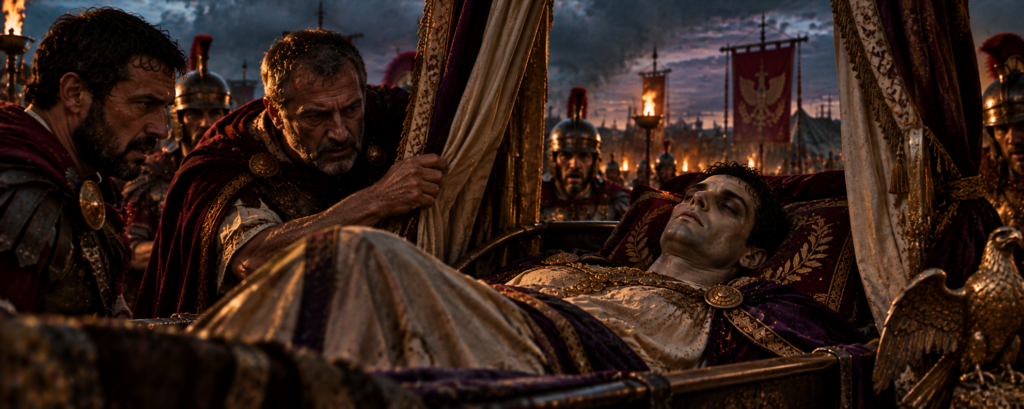
Somewhere along the Roman army’s long journey home from Persia, an emperor disappeared behind the curtains of his traveling litter and never emerged alive. His attendants explained that he was suffering from a painful condition affecting his eyes, making sunlight unbearable and forcing him to travel in darkness. The soldiers continued marching, the imperial procession maintained its familiar routine, and orders supposedly continued to emerge from the secluded ruler. Yet according to the ancient accounts, the man they believed was governing them had already become a corpse.
The truth was supposedly discovered when an increasingly foul odor began escaping from the enclosed litter. Soldiers who had grown suspicious of their emperor’s prolonged absence demanded to know what was happening. When the curtains were finally opened, they found Numerian dead, his body allegedly decomposing inside the very conveyance that had concealed him from the army. The discovery transformed an already uneasy military withdrawal into a political crisis.
The story was disturbing enough without what followed. Numerian’s father-in-law, the powerful Praetorian prefect Arrius Aper, was accused of murdering him and concealing the death while maneuvering to seize the imperial throne. Before the accusation could be subjected to anything resembling a proper investigation, another ambitious officer emerged from the confusion. His name was Diocles, and history would remember him as Diocletian.
At a military assembly near Nicomedia in November 284, Diocletian was proclaimed emperor. He publicly denied involvement in Numerian’s death, identified Aper as the murderer, and personally killed him before the assembled soldiers. The execution removed the principal suspect, eliminated a potentially dangerous political rival, and established Diocletian as the man who had supposedly avenged the murdered emperor.
It was an extraordinary beginning to one of the most consequential reigns in Roman history. Diocletian would eventually transform imperial administration, reorganize military authority, establish the Tetrarchy, and become one of the most influential rulers of the later Roman Empire. Yet his path to power began with a mysterious death, an accusation that was never independently proven, and an execution carried out by the man who benefited from the succession.
For Numerian, the consequences were devastating. He had inherited the imperial purple after his father’s sudden death during a victorious Persian campaign, only to vanish from public view while returning west. His brother Carinus remained emperor in the western provinces, but the eastern army refused to accept him as Numerian’s successor. Instead, it elevated Diocletian, setting the stage for another Roman civil war.
The mystery has never been solved. Numerian may have been murdered by Aper, as the traditional accounts insist, but the surviving evidence does not establish his guilt beyond doubt. The emperor might have died from illness, with his death concealed for political reasons, or he might have been eliminated by a conspiracy whose participants successfully directed suspicion elsewhere. Diocletian’s role has also attracted suspicion, although no surviving evidence proves that he arranged the killing.
What remains certain is that Numerian died under mysterious circumstances in 284, and his death changed the course of Roman history. The decomposing body inside the imperial litter became the centerpiece of a story about ambition, betrayal, and the violent transfer of power. Whether the familiar account preserves the truth or a carefully constructed justification for Diocletian’s accession, it remains one of the most unsettling mysteries surrounding a Roman emperor’s death.
Born Into an Empire That Devoured Its Rulers
The precise date and place of Numerian’s birth are unknown. He was the younger son of Marcus Aurelius Carus, a senior military commander who became emperor in 282, and the brother of Marcus Aurelius Carinus. His family belonged to the military world that had increasingly dominated Roman politics during the third century. Although later sources offer estimates of his age, the evidence is insufficient to establish a secure birth year.
Numerian grew up during a period when becoming emperor was almost as dangerous as fighting against one. The murder of Alexander Severus in 235 had opened an era of repeated military coups, civil wars, and violent successions. Roman armies frequently proclaimed their commanders emperor, while rival forces supported competing claimants. The imperial throne had become an extraordinarily unstable prize.
Foreign enemies exploited the disorder. Germanic groups repeatedly crossed the Rhine and Danube frontiers, while the Sasanian Persian Empire threatened Roman territories in the east. Internal rebellions drained military resources and weakened central authority. At several points, the empire appeared to be fragmenting into separate political states.
The capture of Emperor Valerian by the Persians in 260 was particularly humiliating. His son Gallienus struggled to preserve Roman authority while the western provinces broke away under Postumus and Palmyra expanded its influence in the east. Gallienus was eventually assassinated by officers during a military campaign in 268. His death demonstrated that even an experienced emperor could not rely upon the loyalty of his commanders.
Aurelian temporarily reversed the empire’s decline. Between 270 and 275, he defeated invading armies, recovered the eastern territories from Palmyra, and restored central control over the breakaway Gallic Empire. His achievements earned him the title Restorer of the World. Yet he was murdered by officers within his own entourage before he could consolidate his recovery.
Probus continued the restoration after becoming emperor in 276. His military victories strengthened the frontiers, suppressed rebellions, and helped restore security to devastated provinces. Nevertheless, his strict discipline and demanding use of military labor reportedly provoked resentment among his soldiers. In 282, he too was murdered during a mutiny near Sirmium.
Numerian’s family rose to power within this dangerous political environment. Military service offered extraordinary opportunities, but imperial authority could disappear without warning. His father would become emperor because another ruler had been killed by soldiers. Within two years, Numerian himself would be dead under circumstances that raised the possibility of another military conspiracy.
Carus: The Father Who Became Emperor
Marcus Aurelius Carus emerged as emperor following the murder of Probus in 282. He had held important military commands and possessed the experience necessary to attract support from Roman troops. Ancient accounts differ concerning the precise circumstances of his elevation. Although his accession benefited from Probus’s death, there is no secure evidence that Carus personally organized the assassination.
The new emperor inherited a state that had recovered much of its territorial integrity. Aurelian had reunited the empire, and Probus had strengthened its defenses. Nevertheless, foreign threats remained serious, and military loyalty continued to determine political survival. Carus needed to establish his authority quickly.
One of his first important decisions was to elevate his sons within the imperial hierarchy. Carinus and Numerian received the title Caesar, identifying them as junior rulers and intended successors. The decision was politically significant because recent history had demonstrated the dangers of uncertain succession. Carus apparently hoped that an established imperial family would provide greater stability.
The brothers were assigned different responsibilities. Carinus, the elder son, remained in the western provinces, where he would supervise administration and military affairs. Numerian accompanied his father eastward, joining the army preparing for operations against the Sasanian Persian Empire. The arrangement allowed the dynasty to maintain a presence in multiple regions.
For Numerian, the eastern assignment offered an opportunity to gain military and political experience. He would accompany an emperor on a major campaign against Rome’s most powerful eastern rival. Success could strengthen his legitimacy and establish his reputation among the soldiers. It also placed him in a dangerous environment where military officers exercised enormous influence.
Carus’s decision to divide responsibilities reflected the practical difficulties of governing the Roman Empire. Its territories extended across vast distances, and major threats could emerge simultaneously on different frontiers. A single emperor could not personally supervise every region. Delegating authority to trusted relatives offered a possible solution, but it also created opportunities for ambitious commanders when the ruling family suffered a crisis.
The Young Emperor With a Reputation for Learning
Numerian is remembered by several ancient writers as an educated young man with literary interests. The Historia Augusta describes him as a talented speaker and poet, claiming that his abilities attracted admiration. It presents him as cultured, intelligent, and personally appealing. Such qualities distinguished him from the conventional image of the hardened soldier-emperor.
The difficulty is that the Historia Augusta is notoriously unreliable. Its author frequently invented speeches, letters, official documents, and colorful anecdotes. The biography of Carus and his sons contains material intended to contrast the supposedly virtuous Numerian with his scandalous brother Carinus. Its praise therefore requires caution.
Nevertheless, the association between Numerian and literary culture may preserve a genuine tradition. Roman aristocratic education continued to emphasize rhetoric, poetry, and public speaking even during the military crises of the third century. A member of the imperial family could receive such training while preparing for political responsibilities. Literary accomplishments were considered signs of refinement and legitimate leadership.
Ancient writers sometimes described Numerian as a particularly promising ruler. His youth, education, and apparent lack of scandal made him a convenient contrast to Carinus, whose reputation became deeply hostile after Diocletian’s victory. The comparison may reflect genuine differences between the brothers. It may also have been exaggerated to create a moral narrative.
Little reliable information survives about Numerian’s private interests or personality. We do not know which poems he wrote, whether any circulated widely, or how he behaved within the imperial household. Claims about his literary achievements cannot be independently tested through surviving works. His reputation remains largely dependent upon later descriptions.
The portrait is nevertheless important because it shaped the way his death was remembered. Numerian became the promising young emperor destroyed by treachery, while Carinus became the corrupt ruler whose eventual defeat supposedly benefited Rome. Diocletian emerged as the avenger who punished the murderer. The contrast made an already dramatic succession crisis resemble a carefully constructed moral story.
The Marriage That Connected Numerian to Aper
One of the most important relationships in Numerian’s life was his marriage into the family of Arrius Aper. Aper served as Praetorian prefect, one of the highest-ranking military officials in the imperial government. The marriage made him Numerian’s father-in-law and connected the emperor directly to a powerful commander. This relationship would become central to the mystery surrounding Numerian’s death.
The name and personal history of Aper’s daughter are not securely preserved. Ancient sources focus upon her father’s political role rather than her own experiences. We do not know when the marriage took place or whether Numerian and his wife had children. The surviving evidence offers almost no insight into their domestic relationship.
The political significance of the marriage is easier to understand. Imperial families frequently formed alliances with influential military and administrative figures. Such connections could strengthen loyalty and provide access to experienced advisers. Aper’s position made him an especially valuable associate for a young emperor.
Yet the arrangement also created potential dangers. Aper possessed considerable authority within the army and enjoyed a personal relationship with Numerian. His access to the emperor could make him indispensable during a military campaign. If Numerian became ill or politically vulnerable, Aper might exercise substantial influence over decisions made in his name.
Ancient writers later used this relationship to explain the alleged murder. They claimed that Aper exploited his position as father-in-law and Praetorian prefect to gain access to Numerian and conceal his death. The combination of family intimacy and military authority made the accusation particularly sinister. The man expected to protect the emperor was portrayed as his killer.
Whether Aper actually betrayed his son-in-law remains uncertain. His relationship with Numerian made the accusation plausible, but it did not prove guilt. The marriage nevertheless placed him at the center of the succession crisis. When Numerian disappeared, Aper became the official most closely associated with the emperor’s seclusion.
The Persian War That Promised Glory
Carus’s campaign against Persia was one of the most ambitious Roman military operations of the late third century. The Sasanian Empire had inflicted serious defeats upon Rome, including the capture of Valerian in 260. Restoring Roman prestige in the east was therefore a major political objective. Carus intended to demonstrate that Roman armies could once again carry war deep into Persian territory.
The political situation in Persia offered an opportunity. The Sasanian ruler Bahram II faced internal difficulties, limiting his ability to organize an effective response. Roman forces advanced into Mesopotamia and achieved substantial success. Ancient accounts describe the capture of major cities, including Seleucia and Ctesiphon.
Ctesiphon held enormous symbolic importance. As a principal center of Sasanian royal power, its capture represented a major humiliation for Persia. Roman emperors had long sought victories in Mesopotamia, but campaigns in the region were difficult and dangerous. Carus appeared to have achieved a significant triumph.
Numerian accompanied his father during the campaign. His presence connected him with the army’s victories and strengthened his standing as a future ruler. Military success was particularly important for emperors whose legitimacy depended upon the support of soldiers. Participation in a victorious eastern expedition could help establish his authority.
The campaign also exposed Numerian to the hardships of military life. Roman forces operated far from their principal bases, relying upon complex supply arrangements and long lines of communication. Heat, disease, and exhaustion could be as dangerous as enemy resistance. The eastern expedition placed enormous demands upon everyone involved.
The victories appeared to promise a glorious future for the dynasty. Carus had demonstrated military competence, Numerian had participated in a successful campaign, and Carinus maintained authority in the west. The family seemed positioned to consolidate its rule. Then Carus died unexpectedly, and the entire political situation changed.
The Emperor Allegedly Killed by Lightning
Carus died in 283 while his army was operating in Persian territory. Ancient accounts famously claimed that he was struck by lightning during a violent storm. The story became one of the most memorable explanations for an emperor’s sudden death. Yet the surviving evidence does not establish that lightning was actually responsible.
Other traditions suggest that Carus died from illness. Some later interpretations have raised the possibility of political intrigue, although there is no secure evidence identifying a murderer. The uncertainty reflects the limited and often contradictory nature of third-century historical sources. Even the death of a reigning emperor could remain poorly documented.
The lightning story carried powerful symbolic meaning. Ancient writers frequently interpreted extraordinary natural events as expressions of divine approval or anger. An emperor dying during a storm in enemy territory could be portrayed as the victim of supernatural judgment. The narrative was especially dramatic because Carus had recently achieved major victories.
For Numerian, the consequences were immediate. His father had been the central authority holding the dynasty together. With Carus dead, Numerian became Augustus and assumed greater responsibility for the eastern army. His brother Carinus also held imperial authority in the west.
The succession was formally straightforward because both sons had already been elevated. Yet practical control depended upon military loyalty. Numerian needed the support of senior officers who had served under his father. Aper, as Praetorian prefect and father-in-law, occupied an especially influential position.
Carus’s death also changed the military situation. The eastern army had achieved important victories, but continuing deep into Persian territory without its experienced emperor posed serious risks. A withdrawal offered the possibility of preserving the campaign’s gains while avoiding unnecessary danger. Numerian’s government therefore began the long journey west.
The Retreat From Persia
The Roman army’s withdrawal from Persia was not necessarily a desperate flight. Carus had achieved significant military success, and the Sasanian government remained occupied with internal difficulties. The surviving evidence suggests that Roman forces withdrew in a relatively orderly manner. Later accounts sometimes dramatized the retreat, but there is no clear indication of a catastrophic battlefield defeat.
Numerian traveled with the army as it moved through the eastern provinces. The journey was lengthy, requiring the movement of soldiers, officers, equipment, supplies, and the imperial household. Maintaining discipline during such a withdrawal was essential. The army needed to preserve its organization while crossing enormous distances.
By early 284, Numerian had reached Syria. Evidence places him at Emesa, where an imperial legal decision was issued in his name. This provides an important indication that the government continued functioning during the withdrawal. It also establishes that the emperor’s movements can be traced at least partly through documentary evidence rather than relying entirely upon later narratives.
The journey continued westward through Asia Minor. Ancient accounts describe Numerian becoming increasingly ill, particularly with a condition affecting his eyes. The illness supposedly made exposure to sunlight painful or impossible. His attendants therefore arranged for him to travel in an enclosed litter.
Such an arrangement was not inherently suspicious. Roman elites and emperors could travel in covered conveyances, especially when ill. A ruler suffering from a serious eye condition might reasonably avoid bright sunlight and dust. The explanation offered by his attendants could therefore have appeared plausible to the soldiers.
The danger lay in the emperor’s growing isolation. Once Numerian was hidden behind curtains, ordinary soldiers could no longer confirm his condition. Senior officials controlled access to him and communicated information about his health. The arrangement created an opportunity for deception if someone wished to conceal his death.
The Illness That Hid an Emperor
The reported eye illness is one of the most important elements of Numerian’s death narrative. Ancient sources describe inflammation or weakness affecting his vision, making it necessary for him to avoid light. The precise medical condition cannot be diagnosed from the surviving descriptions. Suggestions that he suffered from a particular infection or disease remain speculative.
Eye problems were common in the ancient world. Dust, infection, injury, and environmental conditions could cause serious discomfort or impaired vision. Military campaigns exposed soldiers and officers to harsh conditions that might aggravate such problems. A painful eye disorder would not have been extraordinary.
The illness nevertheless became politically significant because it justified Numerian’s withdrawal from public view. An emperor normally appeared before his soldiers, received officials, and participated in ceremonial activities. His visible presence reinforced military loyalty and political authority. Prolonged absence could create uncertainty.
According to the traditional narrative, Aper and other attendants explained that Numerian needed darkness and rest. The emperor’s litter remained closed, and access was restricted. Orders supposedly continued to be communicated in his name. The soldiers therefore had reason to believe that he remained alive.
The arrangement also concentrated authority in the hands of those controlling access to the emperor. If Numerian was genuinely incapacitated, senior officials might need to manage government business temporarily. If he had already died, those same officials could potentially conceal the fact. The distinction was impossible for ordinary soldiers to determine from outside the litter.
The illness therefore became the perfect explanation for an absence that might otherwise have provoked immediate suspicion. Whether the concealment was planned before Numerian’s death or improvised afterward remains unknown. The surviving sources do not establish when the emperor actually died. That uncertainty lies at the heart of the mystery.
The Silent Imperial Procession
The image of Numerian’s army continuing westward while its emperor remained hidden became central to the ancient story. Soldiers marched through the provinces, officers supervised movements, and the imperial entourage maintained its routine. The ruler who should have been visible at the center of the procession remained behind closed curtains. His absence was explained as a medical necessity.
The practical details of the journey are difficult to reconstruct. We do not know precisely how often the army halted, which officials visited the litter, or how orders were transmitted. Later writers provide a dramatic outline rather than a complete record. Their accounts should not be expanded into invented scenes of whispered conversations or secret nighttime meetings.
Nevertheless, the political implications are clear. An emperor who could not appear publicly depended heavily upon trusted attendants. Those controlling access to him could influence what the army believed. If the emperor died, concealing the fact might allow officials to maintain authority temporarily.
The traditional accusation against Aper rests partly upon this opportunity. As Praetorian prefect and father-in-law, he was positioned close to Numerian. He possessed military authority and could plausibly communicate instructions in the emperor’s name. Ancient writers claimed that he exploited these advantages to conceal the murder.
Yet opportunity alone does not establish responsibility. Other officers and attendants also operated within the imperial entourage. The surviving sources do not identify everyone who had access to Numerian during his illness. Nor do they establish that Aper personally controlled every aspect of the concealment.
The silent procession therefore remains both vivid and frustratingly obscure. It suggests a government continuing to function while its ruler was increasingly invisible. It also raises questions about how much senior officers knew and when they learned the truth. The answers disappeared with the men who controlled the imperial household.
The Smell That Exposed the Secret
The most famous part of Numerian’s death story concerns the discovery of his decomposing body. According to several ancient accounts, soldiers eventually noticed a foul odor coming from the enclosed litter. Their suspicions grew until the curtains were opened. Inside, they allegedly found the emperor dead.
The detail is horrifying because it suggests that Numerian had been dead for some time before the army learned the truth. Decomposition would have made continued concealment increasingly difficult. The odor supposedly exposed what political deception had hidden. The emperor’s body became the evidence that his attendants could no longer control.
Yet the story requires caution. Ancient historians frequently used vivid physical details to dramatize political events. The smell of a decomposing corpse provided a memorable explanation for how the concealment was discovered. It also made the alleged conspiracy appear especially grotesque.
The precise duration of the concealment is unknown. Later accounts sometimes imply that the body remained hidden for several days, but the evidence does not establish an exact interval. Environmental conditions, the state of the body, and the circumstances of travel are not sufficiently documented. Attempts to reconstruct the decomposition scientifically would therefore rest upon speculation.
The location of the discovery is also uncertain. Ancient traditions place the final crisis in the region of Bithynia or nearby Thrace as the army approached the Bosporus. The broader geographical setting is reasonably clear, but the precise place where Numerian’s body was discovered cannot be established confidently. The subsequent military assembly occurred near Nicomedia.
Whatever the details, Numerian’s death had become undeniable. The army could no longer accept assurances that its emperor was merely ill. The discovery created an immediate question of responsibility. Someone had allowed the soldiers to believe that their ruler remained alive when he was dead.
Arrius Aper: The Father-in-Law Accused of Murder
Arrius Aper became the principal suspect in Numerian’s death. He was the emperor’s father-in-law and Praetorian prefect, combining personal access with substantial military authority. Ancient writers claimed that he murdered Numerian and concealed the body while preparing to seize the throne. The accusation became the official explanation for the crisis.
The motive attributed to Aper was ambition. According to the traditional narrative, he hoped to use his position to control the army and eventually become emperor. Numerian’s death would remove the legitimate ruler, while the concealment would give Aper time to strengthen his position. The story presents him as a calculating conspirator who exploited family trust for political advancement.
The accusation was plausible within the context of third-century Roman politics. Senior military commanders had repeatedly seized the throne after the deaths of emperors. A Praetorian prefect possessed influence, access to soldiers, and knowledge of imperial administration. Aper therefore had the means to become a dangerous political rival.
Yet the surviving evidence does not prove that he murdered Numerian. The accounts were written after Diocletian’s accession, and the accusation served an obvious political purpose. By identifying Aper as the murderer, Diocletian could justify his own elevation as an act of vengeance. The execution of the suspect then prevented further examination of the allegation.
The absence of a proper investigation is particularly troubling. Aper was killed before historians could preserve any reliable defense or explanation from him. We do not know whether he confessed, denied the accusation, or attempted to identify other suspects. The surviving narratives largely present his guilt as established.
Aper may indeed have been responsible. His position and relationship with Numerian made him a plausible conspirator, and the concealment of the emperor’s death would have required cooperation from influential members of the entourage. But the possibility that he was scapegoated cannot be dismissed. The man accused of murder was also a potential rival to the officer who became emperor.
The Problem With Aper’s Supposed Plan
The traditional explanation of Aper’s conspiracy contains a significant difficulty. If he intended to seize the throne, why would he conceal Numerian’s death while continuing to travel with an army that might become suspicious? The delay created opportunities for other commanders to organize opposition. It also exposed him to accusations once the deception was discovered.
One possibility is that Aper needed time to secure military support. A sudden announcement of Numerian’s death might have encouraged the soldiers to recognize Carinus, the surviving emperor in the west. Concealment could allow Aper to negotiate with officers or prepare his own claim. Such a strategy would have been dangerous but not impossible.
Another possibility is that Numerian died unexpectedly from illness, leaving Aper uncertain how to respond. If the prefect feared being blamed for the death, he might have concealed it temporarily. The deception could then have become increasingly difficult to maintain. This scenario would explain concealment without requiring Aper to have committed murder.
A third possibility is that the story was shaped after the event to justify Diocletian’s accession. The accusation against Aper provided a convenient explanation for Numerian’s death and a clear villain for the new emperor to punish. The details of the concealed corpse may have been exaggerated or reorganized to support that narrative. The surviving sources do not allow historians to determine how much was altered.
The alleged plan also raises questions about Aper’s political judgment. A Praetorian prefect might possess considerable authority, but becoming emperor required military recognition. Concealing the ruler’s death did not guarantee that the soldiers would support him. Indeed, the traditional narrative ends with the army selecting Diocletian instead.
These difficulties do not establish Aper’s innocence. Conspiracies can be poorly planned, and ambitious men sometimes make disastrous decisions. Nevertheless, the story should not be treated as a straightforward account of a proven murder plot. Its political usefulness and internal uncertainties demand careful examination.
Could Numerian Have Died Naturally?
One of the most important alternative explanations is that Numerian died from illness rather than assassination. Ancient accounts agree that he was reportedly suffering from a condition affecting his eyes. Although such an illness would not necessarily be fatal, it may have been part of a broader medical problem. The surviving evidence is too limited to determine his actual condition.
Military campaigns exposed Roman soldiers and officers to numerous health risks. Infectious diseases, contaminated water, exhaustion, and environmental conditions could all contribute to serious illness. An emperor returning from a long eastern campaign was not immune to these dangers. Sudden death from natural causes was entirely possible.
If Numerian died naturally, the concealment would still require explanation. Senior officials might have feared that announcing his death would destabilize the army. They may have wanted time to arrange a succession or secure their own positions. Such behavior could be politically criminal without involving murder.
The traditional accusation against Aper may therefore have confused concealment with homicide. If he controlled access to the emperor, he would naturally become the focus of suspicion. His failure to announce the death could appear incriminating. Yet concealment does not prove that he caused the death.
The possibility of natural death also complicates Diocletian’s public execution of Aper. If the prefect was innocent of murder, his killing removed a potential witness who might have challenged the official narrative. Diocletian’s action would then appear less like justice and more like political consolidation. This remains a hypothesis rather than an established conclusion.
No surviving medical evidence can resolve the question. Numerian’s body is unavailable for examination, and the ancient descriptions are too vague for diagnosis. Historians must therefore acknowledge that murder was alleged but not conclusively demonstrated. The emperor’s death remains genuinely mysterious.
Diocles: The Officer Who Emerged From the Crisis
Among the officers serving with the eastern army was Gaius Aurelius Valerius Diocles, the man later known as Diocletian. He had risen through the Roman military hierarchy and held an important command associated with the imperial household troops. His position placed him close to the political and military center of Numerian’s government. When the emperor died, Diocles was well positioned to influence the succession.
His background was relatively modest compared with traditional Roman aristocratic families. Ancient writers associated him with Dalmatia, a region that had produced numerous capable military officers. His career reflected the growing importance of Balkan commanders during the third century. Military experience offered opportunities for advancement that birth alone could no longer guarantee.
Diocles had served within an army accustomed to rapid political change. He would have understood that an emperor’s death could create both danger and opportunity. Senior officers needed to decide quickly whether to support the surviving ruler, recognize a new claimant, or compete for power themselves. Delay could be fatal.
Numerian’s death created precisely such a situation. Carinus remained emperor in the west, but the eastern army did not automatically accept his authority. Aper possessed significant influence but had become the principal suspect in the alleged murder. Other commanders could present themselves as more acceptable alternatives.
Diocles emerged as the successful candidate. The army’s officers selected him for imperial authority, and the soldiers acclaimed him emperor. His accession transformed him from a senior commander into the ruler of the eastern Roman forces. He would soon adopt the name Diocletian.
The speed of his rise has naturally attracted suspicion. He benefited directly from Numerian’s death and Aper’s removal. Yet political benefit does not prove involvement in murder. The surviving evidence establishes his accession but does not demonstrate that he arranged the events that made it possible.
The Military Assembly at Nicomedia
On November 20, 284, Diocletian was proclaimed emperor at a military assembly near Nicomedia in Bithynia. The gathering followed the discovery of Numerian’s death and the collapse of confidence in Aper. Senior officers and soldiers needed to determine who would command the eastern army. Their decision would challenge the authority of Carinus in the west.
The assembly became one of the most dramatic political scenes in late Roman history. Ancient accounts describe Diocletian addressing the troops and publicly denying responsibility for Numerian’s death. He reportedly invoked divine witness to support his declaration of innocence. The gesture was intended to establish his moral legitimacy before the army.
The oath mattered because Diocletian’s position was potentially suspicious. He had served within the imperial military entourage and benefited from the death of his ruler. His elevation could be interpreted as another military coup. Publicly denying involvement helped distinguish his accession from an act of treachery.
The soldiers also needed a convincing explanation for Numerian’s death. An emperor had disappeared under mysterious circumstances, and the army had discovered that its leaders had concealed the truth. Suspicion threatened the authority of the entire command structure. Identifying a murderer offered a way to restore order.
Diocletian supplied that explanation by accusing Aper. The Praetorian prefect was presented as the man responsible for Numerian’s death. His alleged guilt transformed Diocletian’s accession into an act of justice. The new emperor could claim to be punishing treachery rather than exploiting it.
The assembly therefore served several purposes at once. It selected a new ruler, established a public narrative of Numerian’s death, and removed a dangerous political rival. The soldiers witnessed the transition from uncertainty to apparently decisive leadership. Whether the explanation was true remains one of the central questions of the case.
The Execution That Silenced the Suspect
According to the ancient accounts, Diocletian personally killed Aper before the assembled army. After identifying the Praetorian prefect as Numerian’s murderer, he drew his weapon and struck him down. The act was presented as immediate punishment for treachery. It also demonstrated the new emperor’s willingness to exercise authority decisively.
The scene became famous because of its theatrical character. Diocletian had just been proclaimed emperor, and his first major public act was the killing of the man accused of murdering his predecessor. The execution provided a dramatic conclusion to the mystery. It also eliminated the person most capable of challenging the official accusation.
Ancient writers later embellished the episode with memorable dialogue. The Historia Augusta even connects the killing with a literary quotation and a story about Diocletian’s destiny. Such details should not be treated as reliable transcripts. They reflect the tendency of later historians to turn political events into dramatic scenes.
The essential act is better supported than the exact words spoken. Eutropius and other writers report that Diocletian killed Aper in the presence of the army. The execution became a central part of the accepted succession narrative. It helped establish Diocletian’s authority and remove suspicion from himself.
Yet the circumstances raise serious questions. Aper was accused and killed without any surviving record of a formal investigation. His guilt was declared by the man who had just benefited from Numerian’s death. The execution prevented the suspect from providing a defense or identifying other participants.
This does not prove that Diocletian was guilty of conspiracy. Aper may genuinely have murdered Numerian, and the army may have regarded his execution as justified. Nevertheless, the political convenience of the killing cannot be ignored. The principal suspect died before his account could be preserved, leaving Diocletian in control of the official story.
The Prophecy of the Boar
One of the strangest traditions surrounding Diocletian’s rise concerns a prophecy involving a boar. The Latin word aper means boar, and later writers connected this coincidence with a prediction that Diocletian would become emperor after killing a boar. The story transformed the execution of Arrius Aper into the fulfillment of destiny. It became part of the mythology surrounding Diocletian’s accession.
According to the tradition, Diocletian had once received a prediction that he would gain imperial power after killing a boar. He supposedly interpreted the prophecy literally and hunted wild boars without achieving the promised result. Only after killing Aper did the meaning become clear. The story offered a memorable explanation for the extraordinary events of 284.
The anecdote should not be accepted as established history. Ancient writers frequently invented or embellished prophecies to explain the rise of successful rulers. Such stories made political events appear predetermined by divine forces. They also provided entertaining connections between names, symbols, and historical outcomes.
The boar prophecy was particularly useful because it transformed a politically suspicious execution into a sign of destiny. Diocletian had killed the man accused of murdering Numerian, and the act supposedly fulfilled an earlier prediction. The narrative encouraged readers to see his accession as inevitable. It reduced the need to examine the political circumstances too closely.
The story also reveals how quickly historical events could acquire legendary details. A real military succession became surrounded by prophecies, dramatic speeches, and symbolic gestures. Later generations inherited these embellishments alongside more reliable information. Separating the two is essential to understanding Numerian’s death.
The prophecy therefore belongs to the history of Diocletian’s reputation rather than the proven circumstances of the murder. It illustrates how the new emperor’s supporters could interpret his rise as divinely sanctioned. Numerian’s death became part of a larger story about destiny and imperial renewal. The unresolved questions surrounding the corpse were overshadowed by the legend of the man who replaced him.
Did Diocletian Have Something to Hide?
Diocletian’s conduct has attracted suspicion because he benefited so directly from the succession crisis. Numerian’s death created a vacancy within the eastern command, and Aper’s execution removed a powerful rival. Diocletian emerged as emperor while the surviving legitimate ruler, Carinus, remained far away in the west. The sequence provided him with an extraordinary political opportunity.
His public denial of involvement is also noteworthy. Ancient accounts emphasize that he swore he had not participated in Numerian’s death. Such an oath may have been intended to address existing suspicions within the army. It also suggests that the question of responsibility was politically important from the beginning.
Yet suspicion is not evidence of guilt. Diocletian may have been an ambitious officer who reacted quickly to an unexpected crisis. He could have believed that Aper was genuinely responsible for the murder. His execution of the prefect might have been intended to secure justice and prevent further instability.
Alternatively, Diocletian may have exploited uncertainty to eliminate a rival. If Numerian died naturally or was killed by someone else, accusing Aper would have provided a convenient explanation. The execution would prevent further investigation while strengthening Diocletian’s authority. Such a scenario is plausible but unproven.
A more serious possibility is that Diocletian participated in a conspiracy against Numerian. His position within the imperial military household could have provided access and influence. Yet no surviving evidence directly establishes his involvement. The accusation remains speculative.
The central difficulty is that the official narrative emerged from the political environment created by Diocletian’s victory. Later writers had reasons to accept the explanation that Aper was guilty and Diocletian innocent. Alternative accounts, if they existed, have not survived in sufficient detail. The truth remains hidden behind the version of events that became politically dominant.
Why Did the Army Reject Carinus?
Numerian’s death did not leave the Roman Empire without an emperor. His elder brother Carinus remained Augustus in the western provinces and possessed a recognized dynastic claim. Under ordinary circumstances, the eastern army might have accepted his authority. Instead, its officers selected Diocletian.
The decision was politically significant. Carinus had been elevated by their father, Carus, and had governed the west for several years. His legitimacy did not depend upon a new military proclamation. By choosing Diocletian, the eastern army effectively rejected the surviving dynasty.
Ancient writers portrayed Carinus as deeply unpopular. They accused him of cruelty, sexual misconduct, extravagance, and abuse of imperial power. These allegations may have contributed to his reputation among soldiers and officers. Yet the sources were written after his defeat and should be treated cautiously.
Practical considerations may have been equally important. The eastern army was far from Carinus’s immediate control and possessed its own commanders. Recognizing a local military leader could provide greater opportunities for influence and reward. Soldiers might also fear punishment if they surrendered authority to a distant emperor.
Diocletian’s selection therefore reflected the political independence of military forces during the third century. The army had become accustomed to choosing emperors when succession crises occurred. Formal dynastic legitimacy was only one factor among many. Military support remained decisive.
The rejection of Carinus transformed Numerian’s death into a civil war. Diocletian could not become undisputed ruler while the western emperor remained in power. Carinus, in turn, could not accept the eastern army’s rebellion without surrendering his authority. The mystery of the corpse had become a struggle for the Roman throne.
Carinus Prepares for War
Carinus remained in control of the western provinces after learning of his brother’s death and Diocletian’s elevation. He possessed substantial military resources and the strongest surviving claim from the dynasty of Carus. His government had continued functioning despite the loss of his father and brother. He was not prepared to surrender the throne without resistance.
Before confronting Diocletian, Carinus faced another rival claimant named Julianus. The rebellion appears to have occurred in the western or central provinces, although its precise location and chronology remain disputed. Carinus defeated the challenge, demonstrating that he retained significant military authority. The victory allowed him to concentrate upon the eastern threat.
Diocletian advanced westward with the army that had proclaimed him emperor. His forces included experienced soldiers who had participated in the Persian campaign and subsequent withdrawal. Carinus gathered troops from the western provinces. The confrontation would determine which ruler controlled the Roman world.
The conflict also involved competing political narratives. Carinus could portray Diocletian as a usurper who had exploited Numerian’s mysterious death. Diocletian could present himself as the avenger of a murdered emperor and the opponent of a corrupt ruler. The outcome would determine which interpretation gained official authority.
The armies eventually confronted one another near the River Margus in 285. Ancient accounts differ concerning the details of the battle and Carinus’s death. Some suggest that Carinus’s forces initially held the advantage. Others emphasize betrayal within his army.
Carinus was killed during or immediately after the confrontation, and Diocletian emerged victorious. The precise circumstances remain disputed, including the famous allegation that an officer murdered Carinus because the emperor had seduced his wife. With his death, the dynasty of Carus came to an end. Numerian’s mysterious disappearance had helped set in motion the events that destroyed his entire ruling family.
The Dynasty That Disappeared in Three Years
The family of Carus rose to imperial power in 282 and lost it by 285. Its brief history contained major military victories, mysterious deaths, and a final civil war. Carus gained the throne after the murder of Probus and attempted to establish a dynasty through his sons. His sudden death during the Persian campaign left the brothers responsible for maintaining the government.
Numerian’s death created the next crisis. His disappearance during the army’s withdrawal allowed competing explanations of murder, illness, and concealment to emerge. Aper was accused and executed, while Diocletian gained the support of the eastern army. The surviving dynasty was immediately divided by rebellion.
Carinus attempted to preserve his position through military force. He defeated Julianus and advanced against Diocletian. His final confrontation at the Margus ended in his death. The family that had briefly controlled the empire was destroyed.
The sequence illustrates the fragility of imperial succession during the third century. Formal titles and family relationships could strengthen legitimacy, but they could not guarantee military loyalty. Armies remained capable of elevating new rulers when circumstances changed. The dynasty of Carus failed because it could not maintain control over the forces upon which its authority depended.
Numerian’s death was especially important because it created the opportunity for Diocletian’s accession. Had Numerian survived, the eastern army might have remained loyal to the established dynasty. His disappearance removed the ruler around whom that loyalty had been organized. The subsequent accusation against Aper provided a justification for choosing someone else.
The dynasty’s collapse also demonstrated the dangers of divided imperial command. Carinus and Numerian had governed separate regions, but the death of one allowed the eastern army to reject the other. Diocletian would later attempt to address similar problems through a more systematic arrangement of multiple emperors. His reforms emerged partly from the instability that had destroyed Numerian’s family.
The Emperor Who Became a Footnote to Diocletian
Numerian’s historical reputation has been overshadowed by the man who replaced him. Diocletian ruled for more than two decades and introduced reforms that transformed the Roman state. His achievements became central to the history of the later empire. Numerian, by contrast, is remembered primarily for the circumstances of his death.
The imbalance is understandable but unfortunate. Numerian participated in a major Persian campaign, inherited imperial authority, and governed during a critical period of Roman recovery. His reign was brief, but it occurred at an important moment. The empire had survived decades of fragmentation and was approaching a new political age.
The surviving sources provide little information about his independent policies. His father had directed the Persian campaign, and senior officers appear to have exercised substantial influence after Carus’s death. Numerian’s illness and mysterious disappearance further limited his visible role. Historians therefore struggle to assess his abilities as a ruler.
Later writers compensated for the lack of political detail by emphasizing his character. They portrayed him as educated, cultured, and personally admirable. The favorable image contrasted with the hostile descriptions of Carinus. It also made his alleged murder appear especially tragic.
Yet Numerian’s reputation should not be reduced to a moral contrast. The evidence does not establish that he was an exceptional statesman or that he would have become a successful long-term emperor. His reign was too brief and poorly documented for such conclusions. His historical importance lies partly in the circumstances that followed his death.
The mystery nevertheless deserves attention in its own right. Numerian was not merely an obstacle removed before Diocletian’s rise. He was a reigning emperor whose death triggered accusations, executions, and civil war. His fate illustrates the extraordinary vulnerability of Roman rulers during the third century.
The Problem With the Ancient Sources
The surviving accounts of Numerian’s death were written after the events and reflect different historical purposes. Eutropius, Aurelius Victor, the Historia Augusta, and later writers preserve versions of the story. They generally associate Aper with the alleged murder and Diocletian with the punishment of the suspect. Yet their agreement does not establish every detail as fact.
The Historia Augusta is particularly unreliable. Its author frequently invented documents, speeches, and sensational anecdotes. The work also contains elaborate stories about prophecies and imperial character. Its account of Numerian’s death must therefore be compared carefully with other evidence.
Eutropius provides a more concise narrative. He describes Numerian’s death through treachery and reports Diocletian’s public denial of involvement. His account is valuable because it preserves the accepted tradition of the fourth century. Nevertheless, he was writing decades after the events.
Aurelius Victor and other writers also reflect the political environment of the later empire. Diocletian had become a major historical figure, and his accession was generally treated as legitimate. The accusation against Aper helped explain how he gained power. Alternative interpretations may have been marginalized.
Modern historians therefore face a difficult task. The broad sequence of Numerian’s death, Diocletian’s proclamation, and Aper’s execution is reasonably secure. The precise cause of death, the duration of concealment, and the identity of any murderer remain uncertain. The sources preserve a narrative rather than a complete investigation.
The distinction between evidence and interpretation is essential. Numerian was found dead during the army’s return from Persia, and murder was alleged. Aper was publicly accused and killed by Diocletian. What cannot be established is whether the accusation was true or whether the official story concealed a different sequence of events.
A Murder Without a Trial
One of the most disturbing aspects of Numerian’s case is the absence of any meaningful investigation preserved in the historical record. The emperor was dead, his body had allegedly been concealed, and suspicion fell upon a powerful official. Yet the principal suspect was killed almost immediately after Diocletian’s elevation. No surviving account describes a careful examination of evidence.
The execution may have satisfied the soldiers. They had discovered that their emperor was dead and needed an explanation for the deception. Aper’s position made him a plausible suspect. Diocletian’s decisive action could appear to restore justice and order.
Nevertheless, the killing also prevented further inquiry. Aper could not provide a defense or identify other individuals who might have been involved. His death removed a potentially important witness. The official accusation became difficult to challenge.
The situation illustrates the difference between political justice and historical proof. Diocletian’s execution of Aper may have been accepted as legitimate by the army, but it did not establish the truth of the murder allegation. The act resolved an immediate political problem. It did not preserve evidence for later historians.
The absence of a trial is particularly significant because the accused was closely connected to the victim. Aper was Numerian’s father-in-law and Praetorian prefect. His position made him both a plausible conspirator and a potentially valuable source of information. Killing him eliminated the possibility of hearing his account.
The mystery therefore remained unresolved even as the political crisis moved forward. Diocletian became emperor, Carinus prepared for war, and the Roman state entered another succession struggle. Numerian’s death had been explained publicly, but not conclusively investigated. The difference would become increasingly important to later historical interpretation.
The Possibility of a Convenient Scapegoat
Aper’s execution raises the possibility that he became a scapegoat for a death whose true circumstances were uncertain. If Numerian died naturally, the prefect might have concealed the fact out of fear or political calculation. If another group arranged the murder, Aper’s position made him a convenient target. In either case, accusing him would provide an immediate explanation.
Diocletian had strong reasons to support a clear narrative. His accession challenged the surviving emperor Carinus, and he needed to justify the eastern army’s decision. Presenting himself as the avenger of Numerian transformed a military rebellion into an act of justice. The execution of Aper reinforced that claim.
The possibility of scapegoating does not prove that Diocletian acted dishonestly. He may genuinely have believed Aper was responsible. The evidence available to the soldiers might have seemed convincing. The problem is that those details have not survived.
The traditional narrative also contains an important imbalance. It describes Aper’s supposed ambition but offers little independent evidence of his preparations to seize the throne. It presents Diocletian’s innocence through his own public declaration. The account therefore depends heavily upon the statements and actions of the victorious ruler.
Historians must resist the temptation to replace one unproven accusation with another. Diocletian’s political benefit does not establish that he murdered Numerian. Aper’s access does not establish that he committed the crime. The surviving evidence permits suspicion but not certainty.
The possibility of a scapegoat nevertheless remains central to the case. Numerian’s death created a crisis in which someone needed to be blamed. Aper was accused, executed, and remembered as the murderer. Whether he deserved that reputation remains unknown.
The Political Value of a Dead Emperor
Numerian’s death was politically valuable because it created an opportunity for a new ruler. The eastern army could select a commander without directly confronting a living emperor within its own ranks. Diocletian’s elevation became easier once Numerian was gone. The accusation against Aper then supplied a moral justification for the transition.
The same pattern had appeared repeatedly during the third century. Emperors died, armies proclaimed successors, and new governments constructed explanations for the change. Military power often determined legitimacy before legal institutions could respond. The Roman state had become accustomed to violent succession.
Numerian’s case was distinctive because the death was allegedly concealed. The emperor’s body remained hidden while officials continued acting in his name. Such deception, if accurately reported, created a period in which authority was exercised without a living sovereign. The arrangement made the eventual discovery especially explosive.
The political consequences extended beyond the eastern army. Carinus remained emperor in the west and possessed a legitimate dynastic claim. Diocletian’s accession therefore divided the empire. Numerian’s death became the immediate cause of another civil war.
The outcome of that war would shape Roman history for generations. Diocletian defeated Carinus in 285 and eventually introduced major administrative and military reforms. His government helped end the instability associated with the third-century crisis. The mysterious death of Numerian thus became a turning point in the empire’s political development.
Yet the importance of the consequences should not obscure the victim. Numerian was a reigning emperor whose life ended under uncertain circumstances. His death was used to justify the rise of another ruler. The historical narrative that followed was shaped by the political interests of those who survived.
The Emperor Who Never Reached Home
Numerian’s final journey was supposed to bring the eastern army back from a successful Persian campaign. His father had died unexpectedly, but the dynasty still controlled the empire through its surviving sons. The withdrawal offered an opportunity to preserve military strength and consolidate authority. Instead, it became the setting for a mysterious death.
The journey carried the army through regions that had witnessed centuries of Roman military activity. Roads, cities, and military stations connected the eastern provinces with the Balkans and the wider empire. The soldiers were returning from a campaign that had demonstrated Roman power against Persia. Their emperor’s disappearance transformed the march into a political emergency.
Numerian never reached the western provinces where his brother governed. He died somewhere along the route, probably in the region of Bithynia or nearby territories. His body became the center of a scandal that destroyed confidence in his entourage. The army’s discovery of his death ended any possibility of a peaceful return under his command.
The contrast between the campaign’s success and the emperor’s fate is striking. Carus had captured major Persian cities, and Numerian had inherited the prestige of that victory. Yet the dynasty’s military achievements could not protect its rulers from sudden death. The danger came from within the imperial entourage rather than from a Persian army.
The story also reveals the vulnerability of rulers during long military journeys. An emperor could be surrounded by soldiers and still depend upon a small group of attendants for personal security. Illness increased that dependence. If those attendants became disloyal or concealed information, the wider army might remain unaware of the danger.
Numerian’s death therefore belongs to the history of imperial vulnerability as much as to the history of assassination. He was not killed in a great battle or publicly executed after defeat. He disappeared from view during an ordinary military movement. The discovery of his body exposed how little the soldiers actually knew about the man they were following.
The Mystery That Opened the Age of Diocletian
Diocletian’s accession in 284 marked the beginning of a major transformation in Roman government. His eventual reforms reorganized administration, taxation, and military authority. He established a system of multiple rulers intended to improve control over distant provinces. The political order that emerged differed substantially from the unstable system of the soldier-emperors.
The contrast with Numerian is enormous. One ruler disappeared after a brief reign, leaving behind a mystery that historians still debate. The other governed for more than two decades and became one of the most influential emperors in Roman history. Their reputations were shaped by radically different outcomes.
Yet the transition was not peaceful. Diocletian gained power through military acclamation and secured it through civil war against Carinus. His government emerged from the same political culture that had produced repeated assassinations and rebellions. The reforms of the later empire were therefore built upon the violent foundations of the third-century crisis.
Numerian’s death also illustrates why succession remained such a serious problem. The existence of a surviving emperor did not prevent the eastern army from choosing another ruler. Military commanders possessed enough authority to challenge dynastic legitimacy. The resulting conflict threatened to undo the recovery achieved by Aurelian and Probus.
Diocletian’s later system of shared imperial authority attempted to address these difficulties. By assigning responsibilities to multiple rulers and establishing recognized successors, he hoped to reduce the dangers of sudden vacancies. The system would eventually experience its own succession crises, but it represented a significant institutional response. Numerian’s mysterious death was one of the events that demonstrated the need for change.
The irony is that Diocletian’s own rise remained surrounded by unanswered questions. He became the reformer who sought to stabilize imperial government, yet his accession followed an unexplained death and a politically convenient execution. The mystery of Numerian was never conclusively resolved. It remained hidden beneath the achievements of the man who replaced him.
Assassination or Suspicious Death?
Numerian belongs within the broader history of assassinated rulers, but his classification requires an important qualification. Ancient sources alleged that he was murdered, usually identifying Aper as the killer. His death occurred under suspicious circumstances, and the concealment of his body strongly encouraged accusations of foul play. Nevertheless, the surviving evidence does not conclusively establish homicide.
The distinction matters because a suspicious death is not automatically an assassination. Numerian may have died from illness, with his death concealed for political reasons. He may have been deliberately murdered by Aper or another member of the imperial entourage. The possibility of a wider conspiracy also remains open.
The traditional narrative provides a clear culprit and motive. Aper supposedly murdered his son-in-law because he wanted the imperial throne. Diocletian then exposed and punished him. The story is coherent, dramatic, and politically satisfying.
Yet historical truth does not always follow the most satisfying narrative. The sources were shaped by the political order that emerged after Numerian’s death. The principal suspect was executed before his account could be preserved. The emperor’s medical condition and precise time of death remain unknown.
The most accurate classification is therefore suspected assassination or mysterious imperial death. Numerian was a reigning emperor whose death triggered allegations of murder and a violent succession crisis. His case belongs in the category because ancient contemporaries and later writers treated it as a political killing. The uncertainty should remain central to the account.
His story is especially valuable because it demonstrates how difficult it can be to distinguish assassination from illness, concealment, and political propaganda. The evidence establishes the death and its consequences more securely than the identity of any murderer. Numerian remains a victim of circumstances that cannot be fully reconstructed. His mystery is part of what makes the case historically significant.
The Emperor Whose Corpse Created a Dynasty’s Ruin
Numerian entered imperial history as the younger son of a successful military commander. His father, Carus, gained the throne after the murder of Probus and attempted to establish a dynasty through his sons. Numerian accompanied him on a major Persian campaign that achieved important victories and restored Roman prestige in the east. The family appeared positioned to consolidate the recovery begun by Aurelian and Probus.
Then Carus died unexpectedly, leaving Numerian and Carinus to govern the empire. Numerian inherited responsibility for the eastern army and began the long withdrawal from Persian territory. His journey should have strengthened his authority and brought him closer to the western provinces. Instead, it became the setting for one of the most mysterious deaths in Roman imperial history.
According to the ancient accounts, Numerian developed a painful eye condition and began traveling in a closed litter. His attendants explained that he needed darkness and rest, while the army continued marching. Eventually, soldiers became suspicious of his prolonged absence. When the litter was opened, they allegedly discovered his decomposing body.
The discovery immediately raised questions about responsibility. Aper, the emperor’s father-in-law and Praetorian prefect, was accused of murdering him and concealing the death. His position gave him access and influence, making the allegation plausible. Yet the surviving evidence does not establish his guilt conclusively.
Diocletian emerged from the crisis as the army’s chosen ruler. At a military assembly near Nicomedia, he denied involvement in Numerian’s death and personally killed Aper. The execution provided a dramatic resolution to the accusation while removing a powerful potential rival. It also ensured that the principal suspect would never offer a surviving defense.
The political consequences were enormous. The eastern army rejected the authority of Carinus, Numerian’s surviving brother, and supported Diocletian instead. Civil war followed, ending with Carinus’s death in 285. The dynasty of Carus disappeared after barely three years.
Diocletian went on to transform the Roman Empire. His reforms strengthened administration, reorganized military authority, and established a new system of shared imperial rule. His achievements became central to the history of the later Roman state. Numerian, meanwhile, became remembered primarily as the dead emperor whose mysterious disappearance had opened the way for Diocletian’s rise.
Yet the official explanation remains troubling. Aper was accused and executed by the man who benefited from the succession. The evidence against him was never preserved in a form that allows independent examination. The possibility that he was guilty remains real, but so does the possibility that the accusation concealed a different truth.
Numerian may have been murdered by an ambitious father-in-law. He may have died naturally, leaving frightened officials to conceal the death until they could secure their positions. He may have been eliminated by a conspiracy whose members successfully directed suspicion elsewhere. The surviving sources do not allow historians to choose confidently among these explanations.
The uncertainty makes the story more disturbing rather than less. A Roman emperor disappeared from public view while surrounded by soldiers and senior officials. His death was allegedly concealed until physical decay exposed the truth. The man accused of killing him was executed without a surviving record of proper investigation.
Numerian’s fate reveals the extraordinary vulnerability of imperial authority during the third century. A ruler could command armies, possess recognized titles, and belong to an established dynasty, yet remain dependent upon the loyalty of a small circle of attendants. Illness could isolate him from the soldiers who were supposed to protect him. Once that isolation became complete, even the emperor’s death could allegedly be hidden.
His story also demonstrates how quickly a murder accusation could become a political instrument. Diocletian’s execution of Aper transformed uncertainty into an official narrative of justice. The army accepted a new ruler, and the surviving dynasty was challenged. The truth of Numerian’s death became inseparable from the struggle for power.
The emperor himself remains frustratingly elusive. Ancient writers praised his education and literary talents, but little survives to reveal his personality or ambitions. His reign was too brief for a substantial independent political record. His historical identity was overwhelmed by the mystery of his death and the achievements of his successor.
More than seventeen centuries later, the essential questions remain unanswered. Who was responsible for Numerian’s death, and when did it occur? Was the emperor murdered, or did his attendants conceal a natural death? Did Diocletian uncover a genuine conspiracy, or did he use the accusation to secure his own accession?
The surviving evidence offers no definitive solution. It preserves a dead emperor, a concealed body, an accused father-in-law, and a military commander who emerged victorious from the crisis. The story is filled with political motives, suspicious behavior, and dramatic accusations, but certainty remains beyond reach. Numerian’s death belongs among the great unresolved mysteries of Roman imperial history.
Numerian never returned from Persia to enjoy the victories his family had won. Instead, his body became the center of a succession crisis that destroyed his dynasty and delivered the empire to Diocletian. Whether he was murdered or died from illness, the emperor who vanished behind the curtains of his litter left behind a mystery that helped change the course of Roman history—and a question that no surviving witness can answer.