
Henry IV of France: The King Who Survived a Kingdom at War Only to Die in a Paris Street
Henry IV of France (1553–1610) | King of Navarre, r. 1572–1610 | King of France, r. 1589–1610 | First king of the Bourbon dynasty | Son of Antoine de Bourbon and Jeanne d’Albret | Husband of Margaret of Valois and later Marie de’ Medici | Survivor of the St. Bartholomew’s Day Massacre | Protestant military leader who converted to Catholicism to secure the French throne | Victor of the battles of Arques and Ivry | Issued the Edict of Nantes in 1598 | Father of Louis XIII | Known as Henri le Grand and le Vert Galant | Survived numerous assassination threats and attempts | Stabbed to death in his carriage by François Ravaillac on May 14, 1610, in the Rue de la Ferronnerie, Paris | His assassination left the French crown to his eight-year-old son and plunged the monarchy into a dangerous regency
The King Who Never Reached His Destination
On the afternoon of May 14, 1610, King Henry IV of France climbed into his carriage and set out through the crowded streets of Paris. He was fifty-six years old, had survived decades of religious warfare, defeated armies, escaped conspiracies, and established the Bourbon dynasty on the French throne. His kingdom was preparing for a potentially dangerous military confrontation involving the Habsburg powers, and the king had been occupied with political and military arrangements. Yet the journey he was making that afternoon appeared ordinary enough, the sort of movement through his capital that a monarch accustomed to personal accessibility might undertake without imagining that it would become his last.
The carriage was traveling through the narrow Rue de la Ferronnerie, near the busy commercial district surrounding Les Halles, when its progress was obstructed. Accounts describe a traffic blockage involving carts, a circumstance that forced the vehicle to slow or stop. The king was seated inside with members of his entourage, and the carriage offered little protection against anyone who could approach its open side. Among the people in the street was François Ravaillac, a man who had become convinced that killing Henry was necessary for the defense of the Catholic faith.
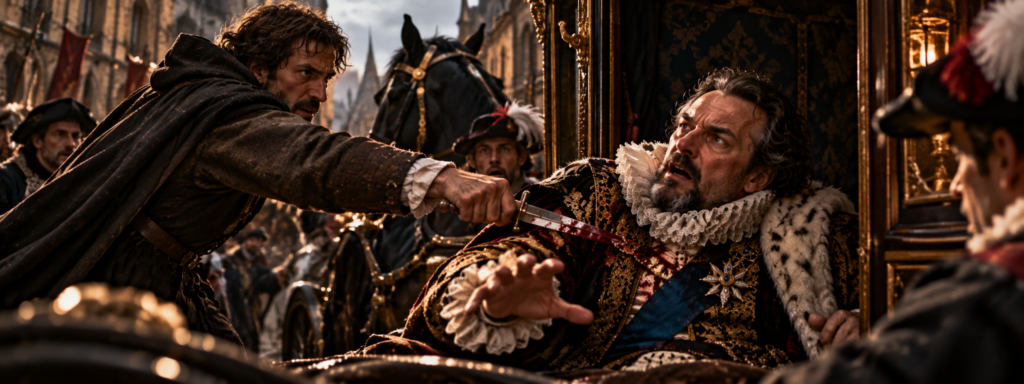
Ravaillac moved toward the carriage while the obstruction distracted the royal party. He climbed onto part of the vehicle and thrust a knife through the opening toward the king. Henry was stabbed twice, with the second wound proving fatal, although later representations and accounts sometimes differ over the precise number and sequence of blows. The attack unfolded so quickly that the king’s companions had almost no opportunity to intervene before the damage was done.
Within moments, Henry IV was mortally wounded. The carriage was hurried back toward the Louvre, but the king could not be saved. The man who had survived the St. Bartholomew’s Day Massacre, the Catholic League, the assassination of Henry III, and years of military campaigns had been killed in a Paris street by an attacker who required neither an army nor an elaborate siege. A knife had accomplished what generations of enemies had failed to achieve.
The consequences were immediate and enormous. Henry’s son Louis was only eight years old, and the succession would place effective government in the hands of the boy’s mother, Marie de’ Medici, as regent. The king’s military plans were disrupted, court factions began repositioning themselves, and France faced the uncertainty that always followed the sudden death of a powerful monarch. Ravaillac had killed a king who had spent much of his reign attempting to heal a kingdom devastated by religious conflict, but his act threatened to reopen the very divisions Henry had struggled to contain.
A Bourbon Prince Born Into a Divided World
Henry was born on December 13, 1553, at the Château de Pau in the southwestern French territory of Béarn. His father was Antoine de Bourbon, Duke of Vendôme, a prince descended from the Capetian royal line, while his mother was Jeanne d’Albret, the future queen of Navarre. Through his father’s ancestry, Henry possessed a distant but legitimate claim to the French throne under the principles of male-line succession. At his birth, however, the Valois dynasty still occupied the crown, and the prospect of a Bourbon prince becoming king of France appeared remote.
His childhood unfolded amid the expanding influence of the Protestant Reformation. Jeanne d’Albret became a committed supporter of Calvinist Protestantism and played an important role in establishing the reformed faith within her territories. Antoine’s religious and political commitments were less consistent, reflecting the pressures faced by noble families caught between confessional conviction and royal advancement. Their son inherited not only a dynastic claim but also a family deeply entangled in France’s religious divisions.
Henry’s upbringing later became surrounded by stories emphasizing his supposedly rugged, unpretentious character. Biographers celebrated his connection to Béarn, his familiarity with outdoor life, and his distance from the elaborate refinements of the French royal court. Some anecdotes were embellished by later writers eager to contrast the practical Bourbon king with the perceived decadence of the Valois monarchy. Nevertheless, Henry did develop a reputation for physical endurance, military courage, informality, and an ability to communicate with people beyond the narrowest circles of aristocratic ceremony.
Those qualities would become politically valuable, but they did not protect him from the dangers of his youth. France was moving toward religious civil war, and the Bourbon family occupied a precarious position within the conflict. Henry’s Protestant identity would repeatedly place him in mortal danger. Long before he became king, he learned that religion could determine whether a prince was welcomed at court, held prisoner, or marked for death.
The Religious Wars That Shaped His Life
The French Wars of Religion began in 1562, when tensions between Catholics and Huguenots erupted into sustained armed conflict. The struggle was not simply a disagreement over worship, although religious conviction was central to it. Powerful noble families used confessional loyalties to mobilize supporters, regional communities defended their own interests, and royal authority struggled to control armed factions. France became a kingdom in which private grievances, dynastic ambitions, theological disputes, and military violence reinforced one another.
Henry’s mother, Jeanne d’Albret, became one of the leading figures associated with the Huguenot cause. Her position gave the young prince political importance before he had the experience to exercise it independently. Protestant leaders regarded him as a valuable dynastic figure who might eventually help secure their position within France. Catholics who feared the growth of Protestant influence saw the Bourbon family’s religious alignment very differently.
The wars produced atrocities that shaped an entire generation’s understanding of politics. Towns were attacked, churches desecrated, prisoners executed, and civilians punished for the religion associated with their communities. Peace treaties repeatedly promised stability, only for renewed suspicion and violence to destroy the settlement. Henry grew up in a world where political compromise could be interpreted as weakness and where military defeat might lead to religious persecution.
His mother died in June 1572, leaving Henry to inherit the crown of Navarre. He was only eighteen years old and had already become a figure of considerable political significance. Within weeks, his marriage to a French royal princess would bring him to Paris for a celebration intended to symbolize reconciliation. Instead, he would witness one of the bloodiest episodes in French history.
A Wedding Followed by Massacre
On August 18, 1572, Henry married Margaret of Valois, the daughter of Henry II and Catherine de’ Medici and sister of the reigning King Charles IX. The marriage was intended partly to ease tensions between Catholics and Huguenots by linking the Bourbon and Valois families. Leading Protestant nobles traveled to Paris for the celebrations, creating a rare gathering of political and religious opponents within the same city. The occasion offered hope that dynastic marriage might succeed where repeated peace treaties had failed.
That hope collapsed almost immediately. On August 22, Admiral Gaspard de Coligny, one of the most influential Huguenot leaders, was wounded in an assassination attempt. Two days later, Coligny was murdered, and organized attacks against Protestant leaders developed into widespread killings throughout Paris. The violence spread to other French towns, producing the catastrophe remembered as the St. Bartholomew’s Day Massacre.
Henry survived, but survival came at a terrible political price. As a prominent Protestant prince present at the royal court, he was vulnerable to the same violence that destroyed many of his associates. He was pressured into abandoning Protestantism and remained under close royal supervision afterward. His position was closer to that of a politically valuable captive than a freely acting sovereign.
The massacre permanently shaped Henry’s political experience. He had seen how quickly apparent reconciliation could become slaughter and how little protection noble birth offered when religious hatred overwhelmed ordinary restraints. The royal family into which he had married was directly implicated in the violence, although responsibility for the massacre’s development remains historically complex. Henry’s later attempts to establish religious coexistence cannot be understood without remembering that he had personally survived the collapse of an earlier attempt at reconciliation.
His marriage to Margaret also became increasingly troubled. Their relationship was shaped by dynastic expectations, religious divisions, political suspicion, and the complicated sexual and social culture of the French court. Margaret would later become associated with scandals and hostile legends, some exaggerated by writers who preferred sensational stories to careful evidence. The marriage ultimately failed to produce an heir and would eventually be annulled.
Escape From the Valois Court
Henry remained under royal supervision for several years after the massacre. His outward religious conformity did not erase the suspicion surrounding him, and the French court remained a dangerous place for a Bourbon prince whose dynastic importance was steadily increasing. Political factions attempted to use him, while royal officials sought to prevent him from becoming an independent center of Protestant resistance. His freedom was constrained by circumstances that could shift suddenly with the death of a king or the failure of a conspiracy.
In 1576, Henry escaped from court and returned to the Protestant cause. His departure marked a decisive change in his political career because he was no longer merely a valuable prince being managed by others. He could now act as a military and political leader in his own right. The escape also confirmed the fears of Catholics who believed the Bourbon prince remained committed to Protestantism despite his earlier conversion under pressure.
Henry developed into an experienced commander through years of campaigning. His military career was marked by mobility, persistence, negotiation, and the ability to survive setbacks without surrendering his broader objectives. He was not invincible, and his forces sometimes suffered serious reverses. Nevertheless, he demonstrated an unusual capacity to continue fighting while maintaining political relationships that might later prove useful.
His personal style also became part of his reputation. Henry cultivated an image of courage and accessibility, sharing hardships with soldiers and appearing less distant than many royal figures. Such behavior could generate loyalty, although later accounts sometimes exaggerated his simplicity into a carefully polished legend of the soldier-king. His military followers came to know a man who could endure hardship and make decisions under pressure.
By the 1580s, Henry had become one of the most important figures in French politics. He was still a Protestant leader opposed by much of Catholic France, but his Bourbon ancestry gave him a claim that could not be dismissed as merely factional ambition. When the Valois succession began to collapse, that ancestry would become the central issue in the kingdom. The prince who had barely survived Paris in 1572 was moving toward the French crown.
The Protestant Heir Nobody Wanted
In June 1584, Francis, Duke of Anjou, the younger brother of King Henry III, died without legitimate children. Henry III himself had no surviving child, leaving the Valois dynasty without an obvious male successor. Under the principles governing French royal succession, Henry of Navarre became heir presumptive through his descent from the Capetian male line. The development transformed him from a dangerous Protestant prince into the man legally positioned to inherit the kingdom.
For militant Catholics, the prospect was intolerable. France’s monarchy had long identified itself with Catholicism, and the king traditionally bore the title of Most Christian King. The idea that a Protestant could inherit such a crown seemed to threaten the religious identity of the kingdom itself. Political opposition to Navarre therefore intensified into a struggle over whether dynastic law could be overridden in the name of religious necessity.
The Catholic League emerged as the most formidable organized force opposing a Protestant succession. Its aristocratic leadership was closely associated with Henry, Duke of Guise, while urban militants, clergy, and foreign supporters strengthened the movement. The League claimed to defend Catholic France against heresy, but its activities increasingly challenged the authority of Henry III himself. The French crown was trapped between hereditary legitimacy and confessional opposition.
Henry of Navarre understood that his claim would be difficult to enforce. Legal inheritance meant little if major cities, noble families, and military forces refused to recognize the heir. He therefore continued building alliances and fighting campaigns that might strengthen his eventual position. His survival depended upon military skill as much as genealogy.
The resulting struggle became known as the War of the Three Henrys. Henry III occupied the throne, Henry of Guise dominated militant Catholic politics, and Henry of Navarre represented the Protestant cause and the lawful succession. Each possessed a different form of legitimacy or power. France could not accommodate all three indefinitely.
The Assassination That Made Him King
The crisis reached a turning point in December 1588 when Henry III ordered the assassination of the Duke of Guise at Blois. The duke had become dangerously powerful, particularly after the Day of the Barricades forced the king to flee Paris earlier that year. Henry III believed that eliminating Guise would restore royal authority. Instead, the murder transformed Guise into a Catholic martyr and intensified League hostility toward the king.
Guise’s brother, Cardinal Louis of Guise, was also killed on the king’s orders. The deaths outraged militant Catholics and encouraged arguments that Henry III had forfeited legitimate authority through tyranny and violence against the Church. Paris became openly hostile to the king. The monarchy appeared increasingly isolated from the capital it was supposed to govern.
Henry III eventually allied with Henry of Navarre against the League. The arrangement was politically logical but religiously explosive because the Catholic king was now cooperating with the Protestant prince whom the League existed to exclude. Their combined forces threatened Paris during the summer of 1589. The king seemed close to recovering his capital when assassination intervened.
On August 1, 1589, the Dominican friar Jacques Clément stabbed Henry III at Saint-Cloud. The king died the following day, leaving no legitimate child or surviving brother to inherit the crown. Henry of Navarre became Henry IV by hereditary right, beginning the Bourbon dynasty. Yet the new king inherited a country in which much of the Catholic population refused to recognize him.
The circumstances of Henry IV’s accession carried an ominous warning. His predecessor had been murdered by a religious extremist who believed killing the king served the Catholic cause. Henry IV was Protestant, making him an even more obvious target for those who rejected a non-Catholic monarch. His reign began under the shadow of the same fanaticism that had ended Henry III’s.
A King Without a Kingdom
Henry IV’s accession did not give him immediate control of France. The Catholic League continued resisting him, Paris remained hostile, and many Catholic nobles refused to serve a Protestant sovereign. Even men who had supported Henry III could hesitate before transferring their allegiance to Navarre. The Bourbon king possessed a legal title that he still had to enforce through military and political struggle.
Henry responded with the persistence that had characterized his earlier career. He won important victories at Arques in 1589 and Ivry in 1590, demonstrating that he could defeat substantial opposing forces. His battlefield leadership strengthened his reputation and encouraged supporters who believed the monarchy could be restored under his command. Nevertheless, military victory did not automatically produce political acceptance.
Paris remained especially difficult to conquer. The capital contained a large population committed to Catholicism and strongly influenced by League leadership. Henry’s attempts to impose pressure through military operations and blockade caused severe suffering among civilians. The siege of Paris in 1590 became a particularly grim episode, reminding observers that even a king later celebrated for bringing peace could wage war with devastating consequences.
Henry also faced intervention from Spain, whose rulers had strategic and religious reasons to oppose a Protestant Bourbon monarchy. The French civil wars were part of a wider European struggle involving Catholic and Protestant powers, dynastic interests, and competition for influence. Henry could not simply defeat a domestic faction and declare the conflict finished. His enemies possessed resources and allies beyond France’s borders.
The longer the struggle continued, the clearer the central obstacle became. Henry could win battles, but he could not easily persuade a predominantly Catholic kingdom to accept a Protestant king. His dynastic right remained strong, yet religious opposition prevented that right from becoming secure political authority. Eventually, Henry chose a solution that would transform both his reign and his historical reputation.
The Conversion That Changed France
In 1593, Henry IV converted to Catholicism. The decision was politically decisive because it removed the strongest religious objection to his kingship. It also generated controversy among Protestants who had followed him through years of warfare and believed he had abandoned their cause. Henry’s conversion was therefore both an act of political calculation and a deeply consequential religious decision.
The famous phrase “Paris is worth a Mass” is traditionally attributed to Henry, but historians cannot establish it as an authentic statement made by the king. The sentiment nevertheless captures the practical problem he faced. Without Catholic acceptance, Henry could remain a successful military commander indefinitely without becoming the effective ruler of France. Conversion offered a path toward national reconciliation that continued warfare had failed to provide.
Henry was crowned at Chartres in February 1594 because Reims, the traditional coronation city, was not available to him. He entered Paris the following month, finally gaining control of the capital that had rejected him for years. The event represented an enormous political victory. The Bourbon king had succeeded where repeated military campaigns alone had failed.
His conversion did not instantly erase opposition or end every conflict. Some Catholics remained suspicious of his sincerity, while Protestants feared that their former champion might sacrifice their interests to secure the crown. Henry had to demonstrate that his government could protect the kingdom without allowing one confession to destroy the other. That task would dominate the next stage of his reign.
The conversion also created a permanent ambiguity surrounding his religious identity. Supporters praised his willingness to place the kingdom’s welfare above factional loyalty, while critics accused him of opportunism or betrayal. His enemies could point to his earlier Protestantism as evidence that he remained secretly dangerous to Catholicism. François Ravaillac would eventually become obsessed with precisely that suspicion.
The Edict of Nantes and the Price of Peace
By 1598, Henry had achieved major political settlements that helped end the principal phase of the French Wars of Religion. The Peace of Vervins concluded war with Spain, while the Edict of Nantes established a framework regulating the position of Protestants within France. The edict became one of the defining measures of Henry’s reign. It represented an attempt to prevent the kingdom from returning to the religious slaughter that had shaped his life.
The Edict of Nantes did not establish modern religious equality. Catholicism retained its privileged position, while Huguenots received specified rights to worship in certain places, legal protections, and important political and security guarantees. The settlement was complicated, uneven, and dependent upon royal enforcement. Its significance lay in acknowledging that religious division could not simply be eliminated through persecution.
For many Protestants, the edict provided relief after decades of uncertainty and violence. For many Catholics, however, tolerating Protestant worship remained deeply troubling. Militant opponents believed the king had permitted heresy to survive inside a kingdom that should have been uniformly Catholic. The edict therefore reduced open warfare without eliminating the religious hostility that had produced it.
Henry’s achievement was political rather than utopian. He understood that France could not prosper while its communities repeatedly destroyed one another. The edict sought to make coexistence possible under royal authority, not to persuade Catholics and Protestants that their theological disagreements no longer mattered. It was a practical settlement designed for a kingdom exhausted by war.
The distinction is important because Henry’s later reputation sometimes presents him as a modern champion of religious freedom. His policies were more limited and deeply rooted in the political realities of his time. Nevertheless, he demonstrated a willingness to accept religious coexistence that distinguished his government from the most uncompromising factions of the preceding decades. That willingness also ensured that some extremists would never regard him as a legitimate Catholic king.
Rebuilding a Kingdom Exhausted by War
Henry inherited a France weakened by decades of civil conflict. Agricultural production had been disrupted in many regions, commerce suffered from insecurity, and royal finances were strained by military expenditure and administrative disorder. Local communities had endured taxation, troop movements, sieges, plunder, and recurring uncertainty. Restoring peace required more than ending battles because the kingdom’s economic and administrative foundations also needed repair.
Henry relied upon capable ministers, most famously Maximilien de Béthune, Duke of Sully, who became closely associated with financial reform and royal administration. Sully worked to improve revenue collection, control expenditure, and strengthen the crown’s ability to manage its resources. His later memoirs helped shape the image of Henry’s reign, although they must be read with awareness of Sully’s own political interests and retrospective self-presentation. The reforms nevertheless contributed to a more stable royal government.
Henry’s administration also encouraged agricultural recovery, infrastructure improvements, and commercial activity. Roads, bridges, urban projects, and public works became associated with the restoration of royal authority. The king took an interest in Parisian development, including projects around the Pont Neuf and the Place Royale, later known as the Place des Vosges. Such improvements helped create a visible contrast between the destructive wars of the previous generation and the ambitions of the new Bourbon monarchy.
The image of Henry as a king concerned with ordinary people’s welfare became central to his later legend. Stories about his desire for peasants to enjoy a chicken in every pot captured an ideal of prosperity associated with his reign, although the famous wording and circumstances are difficult to establish securely. The legend reflected a genuine political theme: a monarchy that could deliver peace and material recovery would possess a stronger claim to loyalty. Henry’s reputation benefited enormously from the contrast between his government and the chaos preceding it.
Yet the recovery was neither complete nor equally experienced across France. Tax burdens remained substantial, local grievances persisted, and royal authority could still be coercive. The kingdom was not transformed into a peaceful paradise simply because Henry had defeated the League. His achievements were considerable, but the later image of an almost universally beloved king was shaped heavily by nostalgia after his assassination.
The King Who Loved Women and Scandal
Henry IV’s private life was almost as famous as his military career. He acquired the nickname le Vert Galant, often associated with his enduring appetite for romance and his reputation as an energetic lover. His relationships with numerous women became the subject of gossip, political maneuvering, and court scandal. The king’s romantic attachments were not merely private affairs because royal marriage, legitimate succession, and the distribution of favor were matters of state.
His marriage to Margaret of Valois had long since deteriorated. The couple had no children, and their relationship was complicated by political separation, religious conflict, and the interests of both dynasties. In 1599, the marriage was annulled with papal approval. Henry was then free to pursue a new marriage capable of securing the Bourbon succession.
Before that settlement, his relationship with Gabrielle d’Estrées had become particularly significant. Gabrielle was one of Henry’s most important mistresses and bore him several children. Henry’s affection for her was sufficiently strong that marriage appeared a possibility despite the political difficulties such a decision would have created. Her influence at court made her both admired and resented.
Gabrielle died suddenly in April 1599 while pregnant. Her death inspired rumors of poisoning, a familiar response in an era when unexpected deaths among politically important figures were often attributed to conspiracy. The evidence does not establish that she was murdered, and complications associated with pregnancy offer a plausible explanation. Nevertheless, her death became another episode in the mixture of romance, tragedy, and suspicion surrounding Henry’s court.
Henry’s later relationship with Henriette d’Entragues also generated scandal and political difficulty. He had made promises connected with marriage before his union with Marie de’ Medici, and Henriette’s family became entangled in dangerous political intrigues. The affair demonstrated how royal desire could create openings for ambitious courtiers and foreign interests. Henry’s personal weaknesses were capable of producing genuine political consequences.
Marie de’ Medici and the Bourbon Heir
In 1600, Henry married Marie de’ Medici, a member of the powerful Florentine Medici family. The marriage served important diplomatic and financial purposes while also addressing the urgent need for a legitimate heir. Henry was approaching fifty, and the Bourbon dynasty remained dangerously dependent upon his survival. A son would secure the succession in a way military victories and political treaties could not.
Marie gave birth to Louis in September 1601. The child became dauphin and future Louis XIII, providing the dynasty with the legitimate male heir it desperately needed. Additional children followed, strengthening the Bourbon family’s dynastic position. Henry could now contemplate his death without the immediate extinction of his royal line.
The marriage was not free from conflict. Henry continued relationships with mistresses, and Marie’s position at court was complicated by jealousy, competing households, and the influence of favorites. Their domestic disagreements sometimes intersected with larger political questions concerning patronage and access to the king. The royal marriage could secure succession without guaranteeing personal harmony.
Marie also possessed her own political ambitions and connections. Her household became associated with figures whose influence would grow after Henry’s death, particularly Concino Concini and Leonora Dori Galigaï. Such relationships later attracted intense hostility and accusations of manipulation. The court was already divided into networks of patronage that would become more important during a minority government.
By 1610, Henry had achieved something that had eluded the final Valois kings: a secure legitimate male heir. Yet the boy was still only eight years old. The king’s sudden death would therefore produce a regency rather than an adult succession. The dynasty could survive the assassination, but the political system surrounding the child would become vulnerable.
The King Who Could Not Escape Assassins
Henry IV had faced assassination threats long before François Ravaillac appeared. His religious history, dynastic position, military campaigns, and conversion made him a target for extremists who regarded him as an enemy of the faith. Even after becoming Catholic, he remained suspect to those who believed his conversion was insincere. The Edict of Nantes further strengthened the conviction among some militants that Henry had betrayed Catholic France.
One of the most serious earlier attempts occurred in December 1594, when a young man named Jean Châtel attacked Henry in Paris. Châtel attempted to stab the king but struck his face, injuring his lip and damaging a tooth rather than killing him. The attacker was captured and executed. The incident demonstrated how easily a determined individual could penetrate the physical space surrounding a monarch.
Châtel’s educational association with the Jesuits contributed to a major political controversy. The French authorities took action against the Society of Jesus, and the order was expelled from much of France before later being readmitted under Henry. The episode became part of a wider argument about religious education, obedience, and doctrines concerning tyrannicide. It also reinforced Henry’s awareness that ideological hostility could translate into sudden personal violence.
Other threats and alleged plots circulated during his reign, although not every accusation can be treated as a verified assassination conspiracy. Early modern courts were environments rich in rumor, and governments had reasons to publicize or exaggerate dangers. Henry nevertheless had genuine grounds for concern. The attack by Châtel had already shown that royal guards and political power could not guarantee safety.
His willingness to move through Paris with relatively accessible arrangements became part of his reputation. Henry cultivated personal contact and informality, qualities that helped distinguish him from more ceremonially distant rulers. Those habits also exposed him to risks that stricter security might have reduced. The same accessibility that contributed to his popularity helped make the attack of May 1610 possible.
François Ravaillac: The Man Behind the Knife
François Ravaillac was born around 1578 in Angoulême, in southwestern France. His family background was troubled, and he experienced financial difficulties and an unsettled early adulthood. He worked in occupations that included teaching and legal service, while also pursuing religious interests that became increasingly central to his life. His later actions would transform an otherwise obscure provincial man into one of the most notorious assassins in French history.
Ravaillac was intensely Catholic and sought a religious vocation. He attempted to enter religious communities but did not establish a lasting place within them. His spiritual life was marked by powerful convictions and experiences that he interpreted in religious terms. Historians must be cautious when discussing his psychological condition because surviving accounts were shaped by interrogation, polemic, and later efforts to explain an extraordinary crime.
He became increasingly preoccupied with Henry IV’s religious policies. Ravaillac believed the king had failed in his duty to defend Catholicism and feared that Henry intended to make war against the pope or the Catholic Church. These fears were not an accurate description of Henry’s declared policy, but they reflected the atmosphere of suspicion surrounding the king. His earlier Protestantism and continued toleration of Huguenots made him an obvious target for extremist interpretation.
Ravaillac reportedly attempted to communicate warnings or religious demands to the king before the assassination. Accounts of his movements and intentions vary, but he appears to have convinced himself that Henry must change course. When those efforts failed, he moved toward the belief that killing the king was necessary. The progression from warning to murder became central to later explanations of his crime.
Unlike an ordinary hired assassin, Ravaillac did not present himself as acting for money. He claimed a religious motivation and insisted that the king’s policies endangered Catholicism. Whether he was influenced by particular preachers, political agents, or conspirators remains disputed. His personal conviction is much clearer than the existence of any organized command behind him.
The Religious Fear That Consumed Ravaillac
Ravaillac’s beliefs developed within a society still haunted by the French Wars of Religion. The Edict of Nantes had reduced open conflict, but it had not eliminated the conviction among some Catholics that tolerating Protestantism was sinful. Henry’s conversion did not satisfy those who believed he remained secretly attached to his former faith. For such people, the king’s public Catholicism could be interpreted as a disguise.
The political climate of 1610 intensified these suspicions. Henry was preparing military action connected with the succession crisis in the duchies of Jülich and Cleves, a dispute involving major European powers. His plans threatened Habsburg interests and could be interpreted by extremists as a war against Catholic rulers. Ravaillac appears to have misunderstood or deliberately interpreted the situation as evidence that Henry intended to attack the Catholic Church itself.
That misunderstanding mattered because it transformed political strategy into an imagined religious emergency. Henry’s foreign policy was driven by dynastic and geopolitical concerns, not by a declared plan to destroy Catholicism. Ravaillac, however, believed the king’s actions endangered the faith. In his mind, ordinary political disagreement became a question of spiritual survival.
The assassin’s conviction illustrates the danger of religiously framed misinformation in an already polarized society. A ruler’s policy can be transformed through rumor into an existential threat, particularly when the ruler has a history that makes suspicion plausible to hostile audiences. Ravaillac did not need accurate intelligence to become dangerous. He needed only certainty that his interpretation was correct.
His eventual crime was therefore connected to the unresolved ideological conflicts of the previous generation. Henry had spent years attempting to establish a political order in which Catholics and Protestants could coexist under the crown. Ravaillac belonged to the minority for whom such coexistence remained unacceptable. The knife he carried was aimed not only at Henry’s body but at the religious settlement associated with his reign.
The European Crisis of 1610
The immediate political background to Henry’s assassination was the dispute over the succession to the duchies of Jülich and Cleves. The death of the ruling duke without a clear successor had created a contest involving rival claimants and major European powers. The territories occupied a strategically important position near the Spanish Netherlands and the western German lands. Their future could alter the balance of power between France and the Habsburg dynasties.
Henry’s government supported policies intended to prevent excessive Habsburg influence in the region. Military preparations were underway, and the king was considering action that could bring France into a dangerous international confrontation. His diplomacy involved Protestant as well as Catholic powers because European politics did not divide neatly along religious lines. Dynastic interests and strategic calculations frequently overrode confessional solidarity.
For militant Catholics suspicious of Henry, those alliances were deeply troubling. A king who had once been Protestant and now cooperated with Protestant princes could be portrayed as secretly hostile to Catholicism. Rumors exaggerated the nature and purpose of his military plans. Ravaillac’s fears emerged within that distorted political atmosphere.
The planned campaign also increased the importance of the royal succession and the queen’s position. Henry expected to be absent from Paris while military operations developed, making arrangements for government during his absence necessary. Marie de’ Medici was crowned queen at Saint-Denis on May 13, 1610, the day before Henry’s assassination. The timing would later become a source of suspicion because the ceremony placed her in a prominent political position immediately before the king’s death.
There is no sound basis for treating the coronation itself as proof that Marie knew of the assassination. Royal preparations for a campaign provided a legitimate reason to strengthen the queen’s ceremonial and political standing. Nevertheless, the coincidence was dramatic enough to encourage conspiracy theories. A queen crowned one day and widowed the next offered fertile material for those determined to find a hidden plot.
The Queen Crowned on the Eve of Murder
Marie de’ Medici’s coronation on May 13, 1610, was a magnificent royal ceremony intended to reinforce her position within the Bourbon monarchy. The king’s anticipated military absence made the queen’s status particularly important. Henry had secured a legitimate heir through their marriage, and Marie was the mother of the future king. Her ceremonial elevation therefore possessed clear dynastic and political meaning.
The marriage itself had been marked by tensions. Henry’s continued relationships with mistresses humiliated Marie, while disputes over household influence and political appointments contributed to conflict. Court observers were well aware that the royal couple did not enjoy uninterrupted harmony. Such tensions later encouraged accusations that Marie might have benefited from her husband’s death.
Yet political benefit does not establish responsibility for murder. Marie’s regency after Henry’s assassination was a consequence of their son’s minority, not proof that she arranged the killing. The surviving evidence does not substantiate claims that she commissioned Ravaillac. Historians must distinguish the obvious political opportunities created by Henry’s death from evidence of a deliberate conspiracy.
The coronation nevertheless gave the assassination an almost theatrical sequence. On May 13, France celebrated its queen in a ceremony of dynastic magnificence. On May 14, the king lay dead after being stabbed in a crowded street. The monarchy passed from public celebration to private catastrophe within a single day.
For later generations, the contrast was irresistible. Paintings, histories, pamphlets, and conspiracy narratives repeatedly returned to the queen’s coronation as though the timing demanded a sinister explanation. The actual political context was more complicated. Henry was preparing for military action, and the queen’s elevation was part of the arrangements surrounding that campaign.
May 14, 1610: The Fatal Journey
On May 14, Henry left the Louvre in a carriage to travel through Paris. Accounts commonly describe him intending to visit his minister Sully, who was unwell, although details of the king’s movements have been retold with variations. The journey took him into streets where traffic, carts, pedestrians, and commercial activity could easily obstruct a vehicle. Henry was accompanied by members of his entourage but did not travel within the kind of protective enclosure expected around a modern head of state.
The Rue de la Ferronnerie was narrow and busy. A blockage involving carts or wagons forced the royal carriage to slow or stop, creating the opportunity Ravaillac needed. The assassin approached while the vehicle was immobilized. He did not need to overpower an organized guard formation or force his way into a palace.
Ravaillac climbed onto part of the carriage and reached through its opening. He struck Henry with a knife, delivering two blows, one of which caused the fatal injury. The king’s companions were caught by surprise, and the attack was over before an effective defense could be mounted. The simplicity of the method was horrifying because it exposed how little protection separated the monarch from an attacker in an ordinary street.
Henry was gravely wounded and died very quickly. The carriage was taken back toward the Louvre, where the king’s death became undeniable. Ravaillac was seized alive, unlike Jacques Clément, who had been killed immediately after attacking Henry III. That difference would allow investigators to interrogate the assassin and pursue the question of possible accomplices.
The scene entered French historical memory almost immediately. A king associated with military courage and political survival had been killed while seated in a carriage. His enemies had failed to destroy him through years of war, yet one man in a crowded Paris street had succeeded. The assassination demonstrated the terrible vulnerability of even a powerful monarchy when its ruler could be reached at close quarters.
The Moment the Bourbon Dynasty Nearly Lost Everything
Henry’s death created a succession crisis of a different kind from the one that followed the assassination of Henry III. In 1589, the problem had been the absence of a Valois heir and the religious identity of the Bourbon successor. In 1610, the Bourbon succession was legally secure because Henry had a legitimate son. The danger lay in the new king’s age.
Louis XIII was only eight years old when his father was murdered. He could inherit the crown immediately, but he could not govern independently. A regency was therefore necessary, and Marie de’ Medici emerged as the central figure in the government. The transition was rapid because delay might have encouraged factional disorder.
The sudden death of an adult king often created opportunities for ambitious nobles and court factions. Henry had exercised strong personal authority, and his presence helped restrain competing interests. Without him, those interests could seek influence through the queen, ministers, and royal household. The political balance of the kingdom became more fragile.
The assassination also threatened the foreign policy Henry had been preparing. Military plans connected with the Jülich-Cleves crisis were disrupted, and the new government adopted different priorities. A regency had reasons to avoid the risks of a major international war. Ravaillac’s act therefore altered not only the domestic succession but also France’s position in European politics.
The Bourbon dynasty survived because Louis XIII inherited the crown. Yet the strength of the monarchy under Henry IV could not simply be transferred intact to a child. The regency would become a period of factional competition, resentment, and political instability. The king’s murder removed the individual who had held together much of the settlement created after the Wars of Religion.
The Arrest of François Ravaillac
Ravaillac was captured at the scene of the assassination. His survival allowed the authorities to investigate his motives and determine whether he had acted alone. The possibility of a wider conspiracy was politically explosive because many powerful individuals and foreign governments possessed reasons to oppose Henry’s policies. A confession naming accomplices could have transformed the murder into an international crisis.
The authorities subjected Ravaillac to interrogation. He maintained that his actions arose from religious conviction and insisted that he had not been commissioned by a wider conspiracy. His statements were examined under conditions that included torture, a practice accepted within the judicial procedures of the period. Such methods were intended to extract truth but could also produce unreliable testimony.
Investigators searched for evidence linking him to political factions, religious leaders, or foreign agents. Rumors implicated numerous possible conspirators, including enemies of Henry at court and abroad. The circumstances of the assassination encouraged suspicion because the king had been preparing for military action against interests associated with the Habsburg powers. Nevertheless, the inquiry did not establish a definitive organized conspiracy.
Ravaillac’s refusal to identify accomplices has been interpreted in different ways. Some historians regard it as evidence that he acted alone, while others have wondered whether he was protecting people who encouraged him. The problem is that silence cannot prove either conclusion. Without independent evidence, the existence of a mastermind remains speculation.
What can be stated with confidence is that Ravaillac physically murdered Henry IV and understood his act through a framework of religious extremism. He believed the king’s policies endangered Catholicism and that killing him was justified. Whether others deliberately manipulated those beliefs remains uncertain. The distinction between ideological influence and operational conspiracy is essential to understanding the case.
The Trial of a Regicide
Ravaillac’s trial unfolded under extraordinary public attention. The murder of an anointed king was regarded as one of the gravest offenses imaginable, combining political treason with an attack upon the sacred dignity of monarchy. The authorities needed not only to punish the killer but also to demonstrate that royal power remained intact. The trial therefore possessed a symbolic importance extending far beyond the fate of one prisoner.
Ravaillac was questioned about his motives, movements, contacts, and religious convictions. He continued to present himself as acting from personal belief rather than as an agent hired by powerful conspirators. His explanations reflected his conviction that Henry had failed to defend the Catholic faith properly. The court did not accept that religious motivation excused the murder.
The judicial process also exposed the difficulty of investigating ideological violence. Ravaillac’s beliefs had been shaped by a society filled with sermons, rumors, theological disputes, and political hostility. Identifying a single person responsible for those beliefs was much harder than identifying the hand that held the knife. The authorities could punish the assassin without resolving every question about the environment that produced him.
The sentence was deliberately terrifying. Ravaillac was condemned to public execution through a prolonged and brutal punishment traditionally associated with crimes against the sovereign. The spectacle was intended to express the enormity of regicide and discourage anyone tempted to imitate him. The monarchy would answer the assassination of its king with a display of judicial violence.
The Execution at the Place de Grève
François Ravaillac was executed in Paris on May 27, 1610. His punishment was designed to be public, prolonged, and exemplary, reflecting the early modern belief that extraordinary crimes demanded extraordinary suffering. The sentence included torture and dismemberment, carried out before a crowd. The brutality was intended to demonstrate that an attack upon the king was an attack upon the political order itself.
The execution followed the pattern used for particularly serious forms of treason. Ravaillac was subjected to painful punishments before horses were employed in the attempt to tear his body apart. Contemporary accounts describe the process as prolonged and difficult, although exact details vary among narratives. The spectacle became infamous for its cruelty.
The punishment did not merely seek to kill the murderer. It sought to destroy his body in a manner symbolically answering the destruction of the king’s body. Early modern justice frequently used public execution to communicate the authority of the state, and regicide occupied a special place within that system. The suffering of the condemned man was presented as a warning to anyone who might imagine that religious conviction justified killing a monarch.
Ravaillac’s family also suffered consequences. Relatives could be subjected to dishonor and restrictions intended to erase or stigmatize the assassin’s name. Such measures reflected the belief that regicide contaminated not merely the individual criminal but the wider social identity associated with him. The monarchy attempted to make the crime permanently shameful.
The execution could not restore Henry IV. It could not prove whether Ravaillac had accomplices, eliminate religious extremism, or prevent future attacks upon rulers. It did, however, reveal the violence through which early modern monarchy defended its sacred status. A king had been stabbed in a carriage, and the state answered by tearing apart the man who killed him.
Was Ravaillac Acting Alone?
The question of whether Ravaillac acted alone has haunted the assassination for centuries. Henry IV possessed enemies among militant Catholics, discontented nobles, foreign governments, and individuals whose political interests were threatened by his policies. His planned military intervention in the Jülich-Cleves dispute gave particular urgency to speculation about international involvement. The murder therefore seemed too politically consequential for many observers to accept as the work of a single fanatic.
Suspicion fell upon various figures associated with the French court, including individuals connected to Marie de’ Medici’s household. Other theories implicated Spanish interests or religious networks hostile to Henry’s policies. Some accusations arose almost immediately, while others developed through later political controversies. The number of theories reflects the magnitude of the event more than the strength of the evidence behind each claim.
The timing of Marie’s coronation became especially important in conspiracy narratives. She had been crowned on May 13 and became regent after Henry’s death the following day. The coincidence was dramatic, but it does not establish foreknowledge or participation. Political advantage is not proof of criminal responsibility.
Ravaillac’s religious beliefs also encouraged speculation about clerical influence. He had encountered religious teaching and lived within a Catholic culture still divided over the legitimacy of Henry’s policies. Some individuals may have reinforced his hostility toward the king without knowing he intended murder. Establishing that he was influenced by extremist ideas is not the same as proving that a religious institution organized the assassination.
The investigation did not produce conclusive evidence of a wider conspiracy. Ravaillac maintained that he acted from personal conviction, and historians remain divided over whether his account should be accepted completely. The safest conclusion is that he was the identified assassin and that his ideological motives are clear, while claims of specific powerful accomplices remain unproven. The mystery should not be solved by inventing certainty where the evidence does not provide it.
Marie de’ Medici Takes Control
Marie de’ Medici became regent for the young Louis XIII after Henry’s assassination. Her position was strengthened by her recent coronation and her status as the king’s widow and mother of the heir. The transition occurred quickly because the monarchy needed to prevent uncertainty from becoming rebellion. France had experienced enough dynastic crises to understand the danger of leaving authority undefined.
Marie inherited a political system shaped heavily by Henry’s personal leadership. His ministers, military commanders, noble allies, and diplomatic arrangements had depended upon his ability to balance competing interests. The regency lacked the same authority and experience. Court factions therefore gained opportunities to challenge established policies and seek influence.
The queen’s favorites became increasingly controversial. Concino Concini and Leonora Dori Galigaï acquired substantial influence, provoking resentment among nobles who believed foreigners and household dependents were dominating the government. Such accusations often contained xenophobic and misogynistic elements, but the political conflicts surrounding patronage were real. The regency became associated with factional struggles that Henry had worked to restrain.
Foreign policy also changed. The aggressive plans Henry had been preparing were not pursued in the same form, and the government moved toward arrangements intended to reduce immediate international danger. A regency responsible for an eight-year-old king had strong reasons to avoid a major war. The assassination therefore interrupted a potentially significant European confrontation.
Marie would eventually face increasing opposition from her son as he matured. Louis XIII’s assertion of personal authority in 1617 culminated in the killing of Concini and the removal of his mother’s dominant political position. The regency created by Henry’s assassination thus produced its own cycle of court conflict and political violence. The Bourbon monarchy survived, but the stability Henry had built proved more dependent upon him than his admirers wished to believe.
The Death That Created a Legend
Henry IV’s reputation changed dramatically after his assassination. During his lifetime, he had been controversial, frequently hated, and repeatedly accused of religious betrayal. Many Catholics distrusted his conversion, while some Protestants resented his abandonment of their confession. His reign had also involved sieges, taxation, military coercion, and political compromises that satisfied neither side completely.
Death transformed him into a symbol of lost stability. Funeral orations, commemorative images, political writings, and later histories emphasized his courage, generosity, accessibility, and concern for ordinary subjects. The contrast between the peaceful kingdom associated with his later reign and the uncertainty following his murder strengthened the image of a beloved monarch. His assassination helped create the legend of Henri le Grand, Henry the Great.
The transformation did not happen entirely through invention. Henry had genuinely helped end the principal phase of the Wars of Religion, strengthened royal authority, and encouraged economic recovery. His personal courage and political adaptability were widely recognized. Yet the later legend smoothed away many of the contradictions and failures that had complicated his life.
The image of the good king became especially powerful in later centuries. During periods of political crisis, Henry could be invoked as an example of practical monarchy, national reconciliation, or paternal concern for subjects. The Bourbon Restoration also made extensive use of his memory to strengthen dynastic legitimacy. The murdered king became a political symbol available to generations that had never known him.
His assassination was central to that process. A ruler who died naturally after decades of compromise might have been remembered as capable but controversial. A ruler murdered by a religious fanatic could be transformed into a martyr of peace. The knife that ended Henry’s life helped secure his place in French national mythology.
The Man Behind the Myth
The historical Henry IV was more complicated than the affectionate image that developed after his death. He was brave and politically adaptable, but he could also be ruthless, impatient, and willing to impose suffering when military necessity demanded it. His campaigns included sieges and operations that harmed civilian populations. His political survival required compromises that sometimes disappointed the people who had supported him most faithfully.
His conversion to Catholicism remains a particularly revealing example. Supporters regarded it as an act of statesmanship that made national reconciliation possible. Critics could interpret it as opportunism or betrayal. Both reactions reflected genuine tensions within his career, although neither captures the entire political situation he faced.
His private life also complicates the legend of the benevolent father of his people. Henry’s relationships with mistresses created scandals, humiliated his wives, and sometimes produced political difficulties. He could display warmth and affection while behaving with considerable selfishness. The qualities that made him personally charismatic did not always make him an exemplary husband.
His government likewise combined reconstruction with coercion. Financial reforms strengthened the crown but did not eliminate the burdens carried by ordinary subjects. Royal authority expanded partly because Henry had defeated or negotiated with rivals capable of challenging it. Peace depended upon the monarchy’s ability to enforce settlements, not merely upon goodwill.
Recognizing these contradictions does not diminish the significance of his achievements. It makes them more historically meaningful because they were accomplished by a flawed ruler operating within a deeply fractured society. Henry’s importance lies not in being a perfect king but in helping France escape a cycle of civil war that had consumed much of his lifetime. His murder showed how fragile that achievement remained.
The Assassin Who Mistook Compromise for Betrayal
Ravaillac’s crime emerged from a fundamental refusal to accept the political settlement Henry represented. The king had concluded that France could not survive if Catholics and Protestants continued attempting to destroy one another. Ravaillac believed that tolerating Protestantism endangered the Catholic faith. Their disagreement was not merely over administrative policy but over whether coexistence itself was legitimate.
For Henry, compromise had become necessary through experience. He had survived religious massacre, fought years of war, inherited a disputed throne, and watched civilians suffer through repeated campaigns. His conversion and the Edict of Nantes reflected a recognition that absolute confessional victory was either impossible or too destructive to pursue. He sought a political order in which royal authority could contain religious disagreement.
Ravaillac approached the same world from the opposite direction. He interpreted compromise as evidence of spiritual danger and believed the king’s foreign policy threatened Catholic interests. His certainty made him incapable of accepting the distinction between political alliances and religious betrayal. The king’s willingness to cooperate with Protestant powers became proof of guilt.
The assassination therefore illustrates how extremist conviction can turn the achievements of compromise into reasons for murder. Henry’s policies were intended to reduce religious violence, but they also provoked those who believed peace with heresy was itself a crime. Ravaillac did not need to defeat Henry’s arguments politically because he had convinced himself that the king’s continued existence was unacceptable. The knife replaced persuasion.
This makes the murder especially tragic within the history of the French Wars of Religion. Henry had spent much of his life trying to escape the logic that every religious disagreement required violent resolution. Ravaillac carried that logic directly into the king’s carriage. The assassination was a reminder that political settlements can reduce conflict without immediately transforming the beliefs of everyone who opposed them.
Two Kings, Two Friars, and the Same Religious Hatred
Henry IV’s assassination inevitably recalls the murder of his predecessor, Henry III. In 1589, Jacques Clément, a Dominican friar, stabbed Henry III because he believed the king had betrayed Catholic France through the murder of the Guise brothers and his alliance with Protestant Navarre. Twenty-one years later, François Ravaillac killed Henry IV because he believed the Bourbon king endangered Catholicism through his policies and political alliances. The two assassinations occurred under different circumstances but emerged from closely related ideological traditions.
Henry III had been a Catholic king who became the enemy of militant Catholics. Henry IV had been a Protestant prince who converted to Catholicism but never convinced every extremist of his sincerity. Both were murdered by men who believed religious duty justified killing a sovereign. The repetition revealed how deeply doctrines of resistance and tyrannicide had penetrated the political culture of the period.
The consequences differed dramatically. Henry III’s death ended the Valois dynasty and placed the Protestant Henry of Navarre on the throne. Henry IV’s death left the Bourbon dynasty intact because his legitimate son Louis XIII inherited immediately. One assassination produced a disputed adult succession, while the other produced a child king and regency.
Yet both exposed the vulnerability of monarchy to individual violence. Neither assassin commanded an army capable of defeating the king in battle. Clément gained access through his religious habit and apparent message, while Ravaillac exploited a traffic obstruction in a Paris street. Both demonstrated that political power could be destroyed at the moment a determined attacker reached the ruler’s body.
The parallel is particularly striking because Henry IV had inherited the crown through the consequences of Henry III’s assassination. He had personally witnessed the political transformation produced by Clément’s knife. He then spent two decades building a monarchy intended to move beyond the religious hatred that had killed his predecessor. In 1610, another assassin brought that hatred back to the center of French power.
The Fragility of Royal Security
Henry IV’s murder was not a military defeat. He was not captured in battle, betrayed by a rebellious general, or overwhelmed during a palace uprising. He was seated in a carriage moving through his own capital. The simplicity of the attack revealed the limitations of royal security in an age when kings remained physically accessible to subjects.
Early modern monarchs possessed guards, armed attendants, and elaborate ceremonial protections. Yet they also traveled through cities, attended religious services, received petitions, visited ministers, and interacted with people whose intentions could not always be known. Henry’s informal personal style increased the frequency of such encounters. The boundary between public accessibility and physical vulnerability was difficult to maintain.
Ravaillac exploited an ordinary feature of urban life. A narrow street became obstructed, the carriage slowed, and the assassin approached close enough to strike. The attack required timing and determination rather than complex military planning. It succeeded because the king’s body was momentarily exposed.
The incident also demonstrated how difficult it was to protect a ruler against someone prepared to die. Ordinary security assumptions depend partly upon attackers fearing capture or punishment. Ravaillac’s religious conviction appears to have outweighed concern for his own survival. The certainty that he would probably be executed did not prevent him from acting.
Henry had already survived Jean Châtel’s attack in 1594, making the danger of close-range assassination familiar. Yet the monarchy could not completely eliminate the risk without fundamentally changing how the king moved through society. The fatal carriage journey exposed the unresolved tension between royal accessibility and personal safety. A king who could command armies remained vulnerable to a knife carried by one man.
The Blood in the Carriage and the Future of France
Henry’s death interrupted a reign that had entered a relatively stable and ambitious phase. The king had restored much of the authority lost during the Wars of Religion, secured a legitimate heir, improved royal finances, and pursued an active foreign policy. His planned military intervention in 1610 suggested that France might soon play a more assertive role in European affairs. The assassination ended those plans before their consequences could become clear.
The regency of Marie de’ Medici changed the political direction of the kingdom. Court factions gained influence, foreign policy priorities shifted, and the government became increasingly vulnerable to disputes surrounding favorites and noble interests. The young Louis XIII inherited a monarchy strengthened by his father but deprived of the personal authority that had held much of it together. Henry’s death therefore created instability without destroying the Bourbon dynasty.
The long-term consequences are difficult to measure precisely because history does not reveal what Henry would have accomplished had he lived. His planned campaign might have altered the balance of power in Europe, but its outcome cannot be known. His continued rule might have restrained court factions, yet no king could permanently eliminate political rivalry. Counterfactual possibilities should remain possibilities rather than being presented as lost certainties.
What is certain is that the assassination changed the timing and leadership of French politics. An experienced adult monarch was replaced by a child whose government depended upon a regency. The immediate military initiative associated with Henry was interrupted. The court entered a new phase in which access to the queen and young king became increasingly important.
The murder also shaped the emotional memory of the Bourbon monarchy. Henry IV became the founder whose violent death symbolized the danger of religious extremism. His successors could invoke his achievements and martyrdom to strengthen their own legitimacy. The assassin intended to destroy an enemy of Catholicism but helped create one of the most enduring royal legends in French history.
Why Henry IV Belongs Among the Regicides
Henry IV’s assassination is one of the clearest examples of ideologically motivated regicide in early modern Europe. The killer’s identity is established, the date and location are known, and the political consequences were immediate. Unlike many medieval royal deaths surrounded by contradictory legends, there is no serious uncertainty that François Ravaillac deliberately stabbed the king. The unresolved questions concern the assassin’s possible accomplices and the precise influences that shaped his beliefs.
The case also demonstrates the difference between a religious motive and proof of an organized religious conspiracy. Ravaillac’s Catholic zeal and hostility toward Henry’s policies are central to understanding the murder. They do not establish that the Catholic Church, the Jesuits, the Spanish monarchy, or Marie de’ Medici formally ordered the assassination. Such accusations require evidence that the surviving record does not conclusively provide.
Henry’s death belongs to the wider history of tyrannicide and political violence because Ravaillac believed the king had forfeited legitimate authority. The assassin did not merely seek personal revenge or financial gain. He interpreted Henry’s policies through a religious framework that made killing appear justified. His crime therefore exposes the danger of ideological certainty when it overrides ordinary moral and legal restraints.
The assassination also transformed the monarchy’s future. It placed an eight-year-old king on the throne, created a regency, interrupted foreign policy, and reshaped the court’s balance of power. It strengthened Henry’s posthumous reputation and turned his death into a warning about fanaticism. Few individual acts of murder combined such immediate political consequences with such lasting symbolic power.
For a history of assassinated rulers, Henry IV represents the king who survived the great conflicts of his age only to be destroyed by their lingering hatred. His reign demonstrated that political compromise could restore a measure of peace after decades of religious war. His death demonstrated that peace could remain vulnerable to those who refused to accept it. The knife in the Rue de la Ferronnerie was the final weapon of a conflict Henry had spent his life trying to escape.
The King Who Survived Everything Except Peace
Henry IV had spent much of his life surrounded by death. As a young prince, he survived the St. Bartholomew’s Day Massacre while Protestant nobles were murdered around him. He escaped the constraints of the Valois court, returned to the Huguenot cause, fought through years of civil war, and inherited a throne that much of France refused to acknowledge. His enemies possessed armies, foreign allies, religious authority, and powerful aristocratic networks, yet none succeeded in destroying him.
He became king because another religious assassin had murdered Henry III. Jacques Clément’s knife ended the Valois dynasty and elevated the Bourbon heir whom militant Catholics feared. Henry IV then spent years fighting to establish the authority that dynastic law had granted him. His victories at Arques and Ivry strengthened his military position, but they could not persuade Catholic Paris to accept a Protestant sovereign.
His conversion in 1593 transformed the struggle. Henry accepted Catholicism, entered Paris, and gradually secured the kingdom that had rejected him. The Edict of Nantes later offered a political framework for coexistence between Catholics and Protestants, while the Peace of Vervins helped restore stability in France’s foreign relations. The king who had once been a Protestant military leader became the ruler associated with ending the most destructive phase of the religious wars.
Those achievements did not erase the hatred of everyone who opposed him. Some Protestants regarded his conversion as betrayal, while militant Catholics continued to question whether it had been sincere. The Edict of Nantes reduced religious violence without eliminating the conviction that Protestantism should be suppressed. Henry had created a settlement capable of governing a divided kingdom, but he had not transformed every conscience within it.
François Ravaillac belonged to the world that refused such compromise. He believed the king’s policies endangered Catholicism and interpreted political alliances through the language of religious treason. His convictions were shaped by an environment still haunted by the Wars of Religion, even though the worst of the fighting had ended years earlier. He came to regard Henry not as the lawful Catholic king of France but as an obstacle to the defense of the faith.
The assassin’s understanding of politics was dangerously absolute. Henry’s earlier Protestantism became evidence against him, his toleration of Huguenots appeared sinful, and his foreign policy seemed to confirm the threat. Ravaillac could not accept that a Catholic monarch might cooperate with Protestant powers for strategic reasons. The distinction between political necessity and religious betrayal disappeared from his interpretation of events.
His determination brought him to Paris in May 1610. Henry was preparing for military action connected with a European succession dispute, and the royal court was occupied with arrangements for the campaign. Marie de’ Medici had been crowned queen on May 13, strengthening her position while the king anticipated possible absence from the capital. The monarchy appeared to be preparing for another phase of political ambition rather than an unexpected change of sovereign.
The following afternoon, Henry entered his carriage. He was an experienced king, a veteran of battles and conspiracies, and the founder of a dynasty with a legitimate male heir. His personal authority had helped restore order to a kingdom that had spent decades tearing itself apart. Yet he traveled through streets where an ordinary obstruction could expose him to anyone determined enough to approach.
The Rue de la Ferronnerie provided the opportunity. Traffic slowed the carriage, Ravaillac moved close, and the knife struck before the royal entourage could prevent it. The attack required only moments. A reign that had survived twenty-one years of dynastic struggle and political reconstruction ended in the cramped interior of a carriage.
The king’s death was almost immediate, leaving little opportunity for final instructions or carefully staged royal farewell. His body was returned toward the Louvre while the machinery of succession began operating around the catastrophe. Louis XIII became king at eight years old. Marie de’ Medici assumed the central role in the regency.
The assassin was captured alive, but the investigation never produced a universally accepted explanation of every influence behind him. Ravaillac insisted that he acted from religious conviction, and the authorities subjected him to interrogation and torture in an attempt to uncover accomplices. Rumors implicated court figures, foreign powers, and religious networks. None of those suspicions has been established conclusively enough to replace the known fact of Ravaillac’s personal responsibility.
His execution was intended to answer the horror of regicide with an even more terrifying public spectacle. The state subjected him to a prolonged punishment designed to demonstrate the sacred authority of monarchy. His body was destroyed before a crowd, and his name became permanently associated with one of France’s most notorious murders. The violence of the punishment reflected the political order’s need to make an example of anyone who attacked the king.
Yet no execution could restore Henry IV. The monarchy could punish the assassin, dishonor his memory, and attempt to erase his influence, but it could not reverse the political consequences of the knife. France had lost an experienced ruler at a moment of significant foreign-policy preparation. The kingdom passed into a regency whose internal conflicts would reveal how much stability had depended upon Henry personally.
His death also transformed his reputation. The king who had been controversial in life became increasingly celebrated as a ruler who restored peace, strengthened the kingdom, and cared about the welfare of ordinary subjects. Funeral orations and commemorative images emphasized his virtues, while later generations repeated stories of his courage, simplicity, humor, and generosity. The assassination helped turn a complicated political figure into a national legend.
That legend should not obscure the real man. Henry had fought wars that caused suffering, made politically convenient religious choices, pursued numerous affairs, and used royal authority forcefully against opponents. His achievements were substantial, but they were not the work of a flawless ruler. They were the accomplishments of a pragmatic and often ruthless survivor who understood the destructive consequences of religious civil war because he had lived through them.
His greatest political achievement may have been recognizing that France could not continue treating religious disagreement as a permanent justification for slaughter. The Edict of Nantes was imperfect and limited, but it represented a practical attempt to contain conflict through law rather than endless military victory. Henry did not ask Catholics and Protestants to abandon their convictions. He sought to prevent those convictions from repeatedly destroying the kingdom.
Ravaillac’s act demonstrated the vulnerability of that achievement. The assassin believed that coexistence itself could be dangerous and that killing the king might serve a higher religious purpose. He was willing to destroy the individual who had become the central guarantor of the settlement. The murder therefore struck at the political logic of compromise as much as at Henry’s body.
The parallels with Henry III are impossible to ignore. Both kings were stabbed by men whose religious convictions had become entangled with political hatred. Both assassinations occurred after years of propaganda describing the monarch as an enemy of Catholic interests. Both demonstrated that sacred kingship could be challenged by individuals who believed religious duty outweighed obedience to the crown.
Yet Henry IV’s death carried a different dynastic consequence. The Valois dynasty had ended with Henry III because no legitimate male heir remained. Henry IV left a son, allowing the Bourbon monarchy to continue despite the assassination. The crown survived even as the experienced ruler who had secured it disappeared.
The tragedy lay partly in the timing. Henry had finally achieved the stability that had eluded much of his youth and early reign. He had secured a legitimate heir, restored royal authority, encouraged economic recovery, and pursued ambitious diplomacy. His kingdom remained imperfect and divided, but it was no longer consumed by the same level of religious civil war that had defined his formative years.
He was therefore killed not at the height of military defeat but during a period of renewed royal confidence. The assassin did not strike because Henry had lost his power. He struck because Henry’s policies and authority remained intolerable to him. The murder showed that political success could create its own enemies.
There is a bitter irony in the manner of Henry’s death. He had faced armies on battlefields, endured sieges, survived the massacre of political allies, and escaped a previous assassination attempt. He knew the dangers of war and the uncertainty of royal power better than most rulers of his age. Yet he died because his carriage slowed in a narrow street.
No elaborate military conspiracy was necessary. Ravaillac did not have to capture a fortress, bribe an army, or defeat the royal guard in open combat. He needed a knife, an opportunity, and the conviction that his victim deserved death. The vulnerability of monarchy was reduced to the distance between a man standing in the street and a king seated inside a carriage.
Henry’s death also exposes the limits of political assassination as an instrument of change. Ravaillac killed the king he believed endangered Catholicism, but the religious settlement did not immediately disappear. The Bourbon dynasty survived, and the crown passed to Henry’s son. The assassin removed a person without controlling the institutions and policies that person had helped create.
Nevertheless, the murder altered France profoundly. The regency changed the direction of government, court factions gained opportunities, and Henry’s planned foreign intervention was interrupted. The assassination also helped create a powerful memory of the dead king as a victim of fanaticism. The consequences extended far beyond the narrow street where the attack occurred.
Henry IV remains one of the most revealing figures in the history of regicide because his life and death embody the contradictions of religious politics. He had been a Protestant prince forced to convert under threat, a Huguenot commander who became a Catholic king, and a ruler who used compromise to restore order after decades of war. His enemies could never fully accept that transformation. To some, his earlier religion permanently disqualified him from trust.
Ravaillac carried that suspicion to its most violent conclusion. He convinced himself that the king’s religious and political choices made murder permissible. His knife became the physical expression of a belief that political disagreement could be resolved by eliminating the person responsible for it. The act was simple, but the ideology behind it had been cultivated through generations of conflict.
The king’s assassination therefore belongs not only to the history of the Bourbon dynasty but also to the wider history of religious violence. It demonstrates how long hatred can survive after formal peace has been declared. Treaties can end wars, laws can regulate worship, and rulers can negotiate settlements, but extremist convictions do not necessarily disappear when governments decide that fighting must stop.
Henry IV had spent his adult life learning that lesson. He understood the dangers of allowing religious certainty to become political extermination because he had nearly been one of its victims in 1572. He survived long enough to become king and attempt a different arrangement. In 1610, the old hatred finally reached him.
The assassination was made more haunting by its ordinary setting. There was no grand battlefield, no royal execution scaffold, and no solemn confrontation between rival armies. The king was traveling through Paris, surrounded by the everyday movement of a city whose streets he had fought for years to control. A traffic obstruction brought the carriage within reach of a man who had decided that murder was a religious duty.
The final scene contained none of the magnificence associated with monarchy. Henry did not die wearing a crown before an assembled court or issuing a memorable proclamation to his subjects. He was stabbed at close range and carried back toward the palace while his companions confronted the sudden loss of their sovereign. The violence stripped away the distance between royal majesty and human mortality.
In the years that followed, the French monarchy would remember him as Henry the Great. His portrait would become associated with courage, reconciliation, and the restoration of national order. His assassination would be represented in paintings, histories, and political arguments as a warning against fanaticism. The man who had once been rejected as a Protestant usurper would become one of the most celebrated kings in French memory.
Yet the most powerful truth about his death does not depend upon the legend. Henry IV survived the great religious conflicts of his generation and helped bring their most destructive phase to an end. He established a dynasty, secured an heir, and attempted to govern a kingdom divided by beliefs that had repeatedly produced massacre and civil war. He was killed because one man remained convinced that religious certainty justified the destruction of the king.
On May 14, 1610, François Ravaillac reached through the opening of a carriage and stabbed Henry IV in the heart of Paris. The king who had survived battles, rebellions, conspiracies, and the collapse of the Valois monarchy died before the day was over. His son inherited the crown, his widow inherited the regency, and France inherited another political trauma born from religious hatred.
Henry IV had spent his life proving that France could survive without one faith destroying the other. Ravaillac believed that the king’s willingness to tolerate such coexistence made him an enemy of God. Their conflict ended not in a council chamber, a battlefield, or a theological debate, but in the narrow space beside a halted carriage.
The first Bourbon king had survived a kingdom at war. He had fought his way through its bloodiest divisions, secured the throne, and begun rebuilding what decades of religious hatred had destroyed. In the end, he discovered that the most dangerous enemy was not necessarily the army waiting beyond the city walls, but the man standing close enough to strike while believing that murder was holy.
And in a crowded Paris street, the hatred Henry had spent his reign trying to contain finally killed him.