
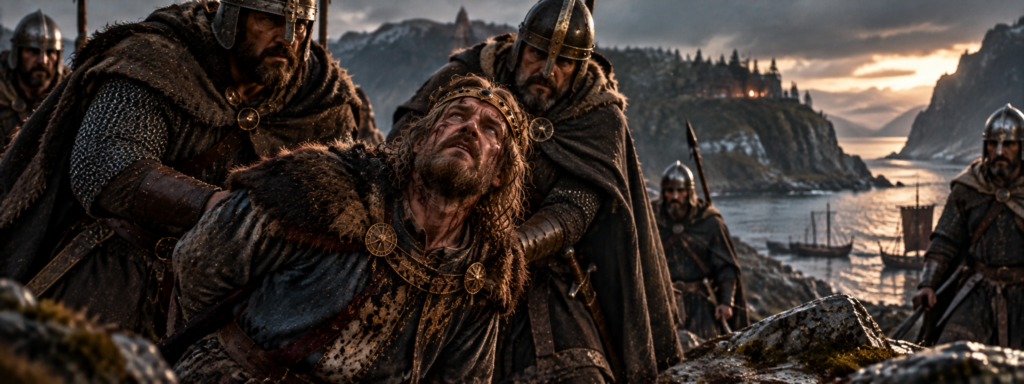
Eystein II of Norway: The Hunted King, the Betrayal at Bohuslän, and the Murder That Fueled a Civil War
Three Brothers, One Crown, and a Kingdom Divided by Blood: The Norwegian King Who Fled His Brother’s Forces, Was Abandoned by His Supporters, and Met a Violent Death in 1157
The King Who Ran Out of Places to Hide
In the summer of 1157, a Norwegian king was fleeing through the coastal borderlands between Norway and Sweden, desperately trying to escape the men who had destroyed his army. His name was Eystein Haraldsson, better known as Eystein II of Norway, and until recently he had been one of the country’s reigning monarchs. He had commanded warriors, collected royal revenues, negotiated with powerful aristocrats, and fought for control of a kingdom that had become dangerously divided among the sons of a murdered king. Now his political authority was collapsing around him, his supporters were deserting him, and the brother who had once shared the throne with him had become his enemy.
The king’s pursuers were not foreign invaders seeking to conquer Norway. They were Norwegians fighting in the name of his own half-brother, King Inge I Haraldsson, whose rivalry with Eystein had turned a fragile royal partnership into open civil war. The two men had inherited a monarchy already stained by assassination, blinding, mutilation, and betrayal, but the violence that had once united their family against common enemies had finally turned inward. Their supporters had chosen opposing sides, and the struggle for royal authority had become a contest in which defeat could mean far more than the loss of a battle.
Eystein’s last refuge lay in the region of Bohuslän, then part of Norway and known in medieval sources as Ranrike. He had retreated there after his position collapsed in Viken, the southeastern Norwegian region surrounding the Oslofjord. According to the medieval kings’ sagas, his remaining men abandoned him as his enemies approached, leaving him vulnerable to capture. He was eventually seized near the settlement of Fors and killed by men belonging to the opposing faction, although the precise circumstances of his final moments survive through accounts written decades after his death.
The killing was particularly significant because Eystein was not simply a warrior who fell in the confusion of battle. He was a reigning king who had been overtaken after his military position collapsed and was deliberately put to death. The saga tradition associates his killing with men serving Inge’s cause, but the surviving evidence does not establish that Inge personally issued an explicit order for his execution. That distinction matters because the murder of a captured monarch and the responsibility of a rival king are related questions, but they are not necessarily identical.
Eystein’s death did not end Norway’s civil wars. Instead, it removed one of the competing kings and intensified the struggle among the surviving members of the royal dynasty. Inge would soon face another rival, his nephew Haakon the Broad-shouldered, whose supporters included men determined to avenge Eystein and continue the fight against Inge’s faction. Within four years, Inge himself would be dead, and the country would remain trapped in the cycle of violence that had already consumed so many members of its ruling family.
The tragedy of Eystein II lies in the extraordinary distance between his beginnings and his end. He had been summoned to Norway as a royal son whose blood entitled him to share the throne, yet the system that elevated him also made him a threat to his brothers. His reign unfolded during a period when Norwegian kingship was being reshaped by aristocratic competition, ecclesiastical reform, foreign alliances, and increasingly sophisticated political institutions. His murder in 1157 exposed the deadly weakness of a monarchy in which several rulers could possess legitimate claims but no reliable mechanism existed to prevent those claims from becoming causes for war.
Eystein II: The King Who Shared Norway With His Brothers
Eystein II Haraldsson, known in Old Norse as Eysteinn Haraldsson, was born around 1125 and ruled as king of Norway from 1142 until his death in 1157. He was a son of King Harald IV Gille, who had been murdered in Bergen in 1136, and he belonged to a generation of royal heirs whose claims were shaped by Norway’s developing civil wars. Eystein was raised outside Norway, traditionally associated with Scotland or the western British Isles, before being brought into the kingdom and recognized as a king alongside his half-brothers Inge and Sigurd. Their arrangement initially offered a way to preserve dynastic unity, but the brothers’ competing ambitions and the rivalries of their advisers eventually transformed cooperation into hostility. After Sigurd was killed in Bergen in 1155, Eystein and Inge became the principal surviving royal rivals, and their relationship deteriorated into open warfare. In 1157, Eystein’s forces collapsed in southeastern Norway, and he fled toward Ranrike, where he was captured and killed near Fors. His death removed one claimant but did not restore lasting peace, because his supporters continued the struggle under other members of the dynasty. Eystein’s assassination remains an important episode in the Norwegian civil-war period, illustrating how shared kingship could collapse into fratricidal conflict and how even a recognized monarch could become defenseless once his military following disappeared.
Eystein’s reign is sometimes overshadowed by the more famous careers of his brothers. Inge I, known as Inge the Hunchback, became the principal beneficiary of Eystein’s defeat and is remembered for his close relationship with powerful churchmen and aristocrats. Sigurd II, nicknamed Sigurd Munn, became associated with the violence that preceded the brothers’ final confrontation. Eystein, meanwhile, appears in the sources as a politically active and ambitious ruler whose efforts to maintain his authority ultimately brought him into conflict with Inge.
The surviving narratives are not neutral biographies. Much of what is known about Eystein comes from Norwegian and Icelandic kings’ sagas, including Heimskringla, Fagrskinna, and related historical traditions compiled after the events. These works preserve valuable material about the civil wars, but they also reflect later political perspectives, literary conventions, and the reputations of the factions that survived. The main sequence of Eystein’s reign and death is well established, while particular speeches, motives, accusations, and dramatic details require caution.
His story is also inseparable from the unusual system of shared kingship practiced in medieval Norway. The recognition of multiple royal sons could prevent the immediate exclusion of potential claimants, but it also created overlapping authority and competition for followers. Each king needed resources, armed supporters, and influential advisers. When their interests diverged, the arrangement could become a mechanism for civil war rather than a safeguard against it.
Eystein’s death demonstrates how quickly royal legitimacy could become meaningless without military protection. He had been recognized as king for approximately fifteen years, yet once his followers deserted him, his status did not guarantee his safety. His captors belonged to a political world in which eliminating a rival monarch could appear more useful than keeping him alive. The murder near Fors was therefore both a personal tragedy and a symptom of a much larger crisis in Norwegian kingship.
Norway’s Royal Family Was Already a Battlefield
To understand Eystein’s murder, it is necessary to begin with the reign of his father, Harald IV Gille. Harald entered Norwegian politics as a claimant whose right to kingship rested upon his assertion that he was a son of Magnus III Barefoot. His claim was controversial because Norway already possessed a reigning king, Sigurd I the Crusader, who was also a son of Magnus. The question of whether Harald truly belonged to the royal dynasty would become one of the most consequential disputes in twelfth-century Norwegian history.
Harald reportedly arrived from the British Isles and sought recognition as a member of the royal family. The sagas describe an ordeal by fire through which he supposedly demonstrated the legitimacy of his claim, although the details belong to medieval narrative tradition and cannot be independently verified. Sigurd I eventually acknowledged Harald under conditions intended to protect the succession of his own son, Magnus. The arrangement did not survive Sigurd’s death in 1130.
After Sigurd I died, Harald challenged Magnus IV for the throne. The resulting conflict divided Norway and established patterns that would continue for decades. Both men claimed royal legitimacy, and both attracted followers prepared to fight for their preferred ruler. The dispute became particularly vicious because neither side could safely accept permanent subordination to the other.
Harald eventually defeated Magnus IV. The defeated king was blinded, mutilated, and imprisoned, earning the historical name Magnus the Blind. Such treatment was intended to remove him as a viable rival without necessarily killing him. Yet the violence demonstrated that royal blood offered little protection once a claimant had fallen into enemy hands.
Harald’s victory did not bring stability. In 1136, Sigurd Slembe, another man claiming descent from Magnus Barefoot, entered the struggle and arranged Harald’s assassination in Bergen. The king was killed while sleeping, according to the saga tradition, in an attack that transformed another dynastic dispute into a political murder. Harald’s death left several young sons whose supporters would soon be forced to defend their inheritance.
The assassination created an immediate crisis. Harald’s sons were too young to exercise effective independent government, but their claims could be used to organize resistance against Sigurd Slembe and Magnus the Blind. The boys became symbols around which powerful aristocrats could unite. Their royal ancestry provided legitimacy, while adult advisers supplied political and military leadership.
Inge and Sigurd were recognized as kings following their father’s murder. Their supporters eventually defeated the rival faction at the Battle of Holmengrå in 1139, where Magnus the Blind was killed and Sigurd Slembe was captured. The saga accounts describe Sigurd Slembe’s subsequent execution in especially brutal terms, reflecting the savage character of the conflict. The elimination of these rivals temporarily strengthened the position of Harald’s sons.
Yet the victory did not solve the underlying succession problem. Harald had fathered several sons, and each possessed a plausible claim to royal authority. Eystein, who had been raised outside Norway, would soon be brought into the kingdom and recognized alongside his brothers. The political system that had elevated Harald’s children after his murder would eventually turn them against one another.
A Prince Raised Beyond Norway’s Shores
Eystein’s early life is less clearly documented than the political events of his reign. He was a son of Harald Gille, but his mother is not securely identified in the surviving sources. His upbringing is traditionally associated with Scotland or the western British Isles, reflecting the close connections between Norwegian royalty and the Norse-Gaelic world. Those connections were especially important because the western seas linked Norway with the Hebrides, Orkney, the Isle of Man, and the coastal communities of Scotland and Ireland.
The political world of the British Isles was familiar territory for Norwegian royal claimants. Harald Gille himself had emerged from that environment before seeking recognition in Norway. Scandinavian settlement and maritime activity had created extensive networks of kinship, commerce, and military service across the region. A prince raised outside Norway could therefore still possess connections that made him politically valuable.
Eystein’s claim depended primarily upon his identification as Harald’s son. Medieval Norwegian succession practices allowed recognized royal sons to seek kingship, including sons born outside formal marriage. The crucial issue was often whether influential men accepted a claimant’s ancestry and were willing to support him. Eystein’s upbringing abroad did not automatically disqualify him.
The sagas describe his arrival in Norway in 1142. He was brought into the kingdom and recognized as king alongside Inge and Sigurd, who had already inherited authority after Harald’s murder. The arrangement expanded the number of reigning brothers. It also created a more complicated distribution of power.
Eystein’s recognition was not simply a ceremonial honor. A Norwegian king required followers, revenues, and access to the political institutions through which royal authority operated. He needed to participate in assemblies, maintain relationships with regional leaders, and support the military households that protected his position. The recognition of another king therefore affected the balance of influence within the kingdom.
The decision to accept Eystein may have appeared preferable to excluding him. A recognized royal son left outside the governing arrangement could become a focus for rebellion. Bringing him into shared kingship offered a means of acknowledging his claim while preserving the appearance of dynastic unity. The same solution, however, created additional opportunities for rivalry.
Eystein entered Norway as a young man with royal ancestry but without the same childhood political relationships as his brothers. He had to establish his position within a kingdom already governed by competing aristocratic networks. His success depended upon securing followers who believed that supporting him would bring advantage or stability. Over time, those relationships would become essential to his survival.
The circumstances of his arrival foreshadowed the central contradiction of his reign. Recognition as king gave Eystein legitimacy, but legitimacy alone could not guarantee lasting authority. He had been admitted into a partnership whose members possessed overlapping rights. The arrangement would endure only as long as the brothers and their supporters considered cooperation more useful than conflict.
Three Brothers, Three Kings, and a Fragile Peace
The joint reign of Inge, Sigurd, and Eystein represented an attempt to accommodate several royal heirs within one monarchy. Such arrangements were not entirely unusual in medieval Norway, where multiple sons of a king could receive recognition. Yet shared kingship required constant negotiation over authority, resources, and political influence. The system offered few reliable means of resolving disputes when the rulers disagreed.
Inge was the youngest of the brothers and had been recognized as king while still a child. He was known as Inge the Hunchback, a nickname associated with a physical disability that medieval sources describe in varying terms. The circumstances of his disability are not completely certain, and later accounts sometimes connect it with injuries sustained during childhood. His physical condition did not prevent him from becoming an important political figure.
Sigurd II, known as Sigurd Munn, was another son of Harald Gille. He had been recognized alongside Inge after their father’s assassination. His reputation in the saga tradition is often associated with personal ambition, sexual relationships, and a turbulent political temperament. Such descriptions must be read critically because they were shaped by later writers and the hostile perspectives of rival factions.
Eystein joined this arrangement in 1142. His recognition meant that Norway now had three kings belonging to the same paternal line. Their shared ancestry provided a basis for cooperation, but it also ensured that each could claim a legitimate share of authority. The brothers’ relationship was therefore both familial and political.
The practical administration of the kingdom required some distribution of responsibilities and revenues. Medieval Norway was geographically extensive, with important political centers spread across different regions. Royal authority depended upon personal presence, local alliances, and the ability to gather military support. A king who controlled a region could develop relationships that strengthened his independent position.
The brothers initially maintained a working relationship. Their government continued during a period of important ecclesiastical and political developments. They also participated in military activity beyond Norway. The absence of immediate civil war suggests that cooperation was possible when their interests remained sufficiently aligned.
Nevertheless, tensions gradually developed. Each king possessed advisers and followers whose ambitions did not necessarily coincide with those of the others. Competition for influence could transform minor disputes into questions of royal dignity. The brothers’ personal relationships became increasingly entangled with the interests of their political factions.
The arrangement also lacked a clear final destination. If all three kings remained alive, Norway might continue under divided authority for decades. If one died, his supporters might transfer allegiance to another claimant or promote his descendants. The uncertainty encouraged political calculation and made the monarchy vulnerable to sudden crises.
By the middle of the 1150s, the partnership was beginning to collapse. The brothers had survived the enemies who murdered their father, but they could not preserve unity among themselves. Their competing ambitions and the pressures of their supporters would soon produce violence within the royal family. The consequences would be fatal for two of the three kings.
The Making of a King: Power, Followers, and Royal Authority
Eystein’s political position depended upon more than his title. Medieval Norwegian kingship was sustained through relationships with aristocrats, military retainers, regional communities, and churchmen. A king needed to distribute rewards, maintain loyalty, and demonstrate that his authority could protect supporters. These obligations were particularly demanding when several kings competed within the same kingdom.
The royal household was an important center of power. Warriors and advisers attached themselves to kings because service offered prestige, protection, and opportunities for advancement. Their loyalty could be personal, but it was also influenced by political expectations. A ruler who appeared weak or unable to reward followers risked losing them.
Regional assemblies, known as things, also played important roles in political life. They provided settings for legal proceedings, public recognition, and the negotiation of authority. Kings sought acceptance from influential communities because recognition strengthened their legitimacy. Yet assemblies could also become arenas of rivalry when competing claimants sought support.
Eystein needed to cultivate these relationships after arriving from abroad. His brothers had already been recognized and possessed established networks of supporters. He therefore entered a political environment in which important loyalties had already formed. His ability to maintain a royal position depended upon attracting and retaining men willing to support him.
The distribution of royal revenues was another potential source of conflict. Kings required resources to maintain households, reward followers, and organize military expeditions. When several rulers shared authority, disputes could arise over taxation, estates, and regional income. Such disagreements were not merely financial because they affected the ability of each king to sustain political independence.
The brothers also faced the challenge of representing Norway abroad. Foreign rulers and neighboring territories might seek relationships with one king rather than another. Diplomatic alliances could strengthen individual positions within the shared monarchy. They could also create suspicion among the brothers.
Eystein’s career suggests that he was an active participant in these political struggles. He was not simply a ceremonial co-ruler whose name appeared beside those of Inge and Sigurd. The surviving accounts associate him with military activity and political decisions that affected the kingdom. His later conflict with Inge demonstrates that he possessed supporters and ambitions of his own.
The weakness of the system became apparent when those interests diverged. A king who lost the confidence of his followers could quickly lose the means of defending his title. Eystein would eventually discover that royal ancestry and formal recognition could not prevent abandonment. His final days would expose the dependence of medieval kingship upon the loyalty of armed men.
The Norwegian Church and the Struggle for Authority
The reign of Eystein II coincided with important changes in the organization of the Norwegian Church. Ecclesiastical institutions were becoming increasingly influential, and the relationship between bishops and kings was central to political stability. The establishment of a separate Norwegian archbishopric in the 1150s marked a major development. It also occurred during the period when relations among the royal brothers were deteriorating.
Before the middle of the twelfth century, Norway’s ecclesiastical organization was connected with the archbishopric of Lund. The creation of an archbishopric at Nidaros, modern Trondheim, strengthened the institutional independence of the Norwegian Church. The new province included important dioceses within Norway and territories associated with the wider Norse world. The development reflected broader movements of church reform and administrative consolidation.
Cardinal Nicholas Breakspear, the future Pope Adrian IV, visited Scandinavia as a papal legate during the early 1150s. His mission played a central role in the reorganization of the Church. The establishment of the archbishopric at Nidaros in 1152 or 1153 became one of the most significant achievements of the period. It gave Norway a more independent ecclesiastical hierarchy.
The royal brothers were involved in the political environment surrounding these reforms. Church leaders needed cooperation from secular rulers, while kings could benefit from ecclesiastical recognition. The relationship between monarchy and Church was therefore a source of both legitimacy and potential conflict. Different royal factions could seek support from different churchmen.
Inge’s later political position became closely associated with powerful ecclesiastical figures, including Archbishop Eystein Erlendsson, although the archbishop’s principal career belongs to the years after Eystein II’s death. The development of a stronger Church would eventually influence the wider civil-war period. Religious authority became increasingly important in disputes over legitimate kingship.
Eystein II’s own relationship with the Church is less clearly documented in detail. The sources do not provide sufficient evidence to reconstruct every aspect of his religious policy or personal beliefs. Nevertheless, he ruled during a period when ecclesiastical reform was transforming the political landscape. His position as one of several kings necessarily placed him within those developments.
The Church’s growing influence also complicated the politics of royal succession. Ecclesiastical leaders increasingly favored arrangements that could reduce instability and strengthen legitimate authority. Yet they could become associated with particular claimants, making religious institutions participants in political conflict. The relationship between sacred authority and dynastic ambition was therefore far from simple.
The murder of Eystein would occur within a kingdom where Christian kingship carried important moral expectations. Killing a recognized ruler was not merely a political act but one that could raise questions about legitimacy, justice, and the proper treatment of a defeated enemy. The saga tradition preserves the memory of his death within this broader moral world. His assassination exposed the distance between the ideals of Christian kingship and the realities of civil war.
War Across the Western Seas
Eystein’s reign included military activity beyond mainland Norway. The Norwegian kings maintained interests in the islands and coastal regions of the North Atlantic, where Norse political influence had developed over several centuries. These territories were connected through trade, settlement, and dynastic relationships. Control over them could enhance royal prestige and provide opportunities for military reward.
The Hebrides and other western islands occupied a complicated political position. Local rulers possessed their own interests and alliances, while Norwegian kings asserted varying degrees of overlordship. The region also connected Norway with Scotland, Ireland, and the Isle of Man. Military expeditions could therefore become entangled in several overlapping political struggles.
The saga tradition associates Eystein with a western expedition during his reign. Accounts describe activity in the British Isles, including attacks and the acquisition of plunder. The precise chronology and details require caution because the narratives were compiled later. Nevertheless, the tradition presents Eystein as a king willing to pursue military opportunities beyond Norway.
Such expeditions served several purposes. They could demonstrate a ruler’s strength, reward followers, and reinforce claims to influence in the western seas. A successful campaign might increase prestige among warriors who valued military leadership. It could also provide resources useful in domestic political competition.
The western expeditions also reveal the continuing importance of maritime warfare. Norwegian kings relied upon ships to move forces along the coast and across the North Atlantic. Naval mobility allowed rulers to respond to regional challenges and conduct campaigns far from their principal political centers. The ability to gather and command fleets was therefore an important measure of royal power.
Eystein’s involvement in such activity complicates any portrayal of him as an insignificant co-ruler. He possessed the authority and resources necessary to participate in military operations. His kingship had practical substance. He was a ruler whose political ambitions extended beyond ceremonial recognition.
Yet military prestige abroad did not guarantee security at home. A king might return from a successful expedition to find that rival factions had strengthened their positions. Followers could be attracted by plunder and victory, but their loyalty remained vulnerable to changing political circumstances. The same military networks that supported royal authority could become instruments of rebellion.
Eystein’s eventual downfall would occur not across the western seas but within Norway’s southeastern borderlands. His earlier campaigns demonstrated the possibilities of royal power, while his final flight revealed its fragility. The contrast between an active military king and a deserted fugitive is one of the most striking features of his story. It illustrates how quickly political fortune could change during the civil-war period.
The Brothers Begin to Turn Against One Another
The partnership among Eystein, Inge, and Sigurd gradually deteriorated during the 1150s. The surviving accounts describe increasing suspicion and competition among their supporters. The brothers’ advisers played important roles in shaping the conflict, and their interests did not always encourage reconciliation. The political arrangement that had once protected the dynasty was becoming unstable.
Inge’s faction included powerful aristocrats who sought to strengthen his position. Among the most important was Gregorius Dagsson, a leading supporter whose military and political influence became central to Inge’s cause. Gregorius was closely associated with the faction that opposed Sigurd and Eystein. His role demonstrates how aristocratic leadership could shape royal politics.
Sigurd’s faction possessed its own supporters. His personal reputation in the sagas is often presented unfavorably, but the political struggle cannot be explained solely through individual character. Competition over authority, resources, and influence created structural tensions among the brothers. Their followers had reasons to resist arrangements that reduced their preferred king’s power.
Eystein’s position became increasingly connected with Sigurd’s. The two brothers shared an interest in resisting the growing influence of Inge’s faction. Their cooperation did not necessarily eliminate all differences between them, but it created a political alignment against Inge. The resulting division threatened the survival of shared kingship.
The crisis intensified as accusations and counteraccusations circulated. Medieval narratives describe suspicions of plots and hostile intentions, although the precise truth of individual allegations is difficult to establish. Such rumors could become politically explosive because kings relied upon personal trust. Once that trust disappeared, even routine gatherings could appear dangerous.
The brothers also faced pressure from supporters who feared losing influence. An aristocrat attached to one king might view the success of another as a threat to his position. These calculations encouraged factional loyalty and made compromise more difficult. The kings were therefore not acting independently of the political networks surrounding them.
By 1155, the situation had become dangerous enough that open violence was increasingly likely. The brothers could no longer rely upon their shared ancestry to maintain peace. Their supporters were prepared to use force to determine the balance of power. The monarchy was approaching another dynastic catastrophe.
The killing of Sigurd II would transform the conflict. It would remove one of the three brothers and leave Eystein facing Inge without the same degree of support. The assassination would also deepen the hostility between their factions. Eystein’s final struggle began with the destruction of the partnership that had once sustained his kingship.
Bergen, 1155: The Murder of King Sigurd II
In 1155, the rivalry among the royal brothers erupted into violence in Bergen. The city was an important center of Norwegian kingship and a natural setting for royal gatherings. Yet the presence of competing kings and their armed followers created a dangerous atmosphere. The political tensions that had developed over several years could no longer be contained.
The surviving saga accounts describe a confrontation between the factions of Inge and Sigurd. Accusations of hostile intentions played a role in the escalation. The precise sequence of events is complicated by the literary character of the sources. Nevertheless, the outcome is clear: Sigurd II was killed by forces associated with Inge’s party.
The killing occurred in February 1155 and marked a decisive rupture within the royal family. Sigurd had been recognized as king since childhood and had shared authority with his brothers for years. His death removed one of the principal claimants. It also demonstrated that the surviving brothers were no longer protected by the expectation of dynastic cooperation.
The saga tradition places considerable emphasis upon the role of Gregorius Dagsson and other leading supporters of Inge. Their actions reveal the importance of aristocratic military leadership in the conflict. Inge’s physical disability did not prevent his faction from exercising force. His supporters possessed the organization and determination necessary to eliminate a rival king.
Eystein was not killed during the confrontation. He remained a recognized monarch, but his political position had changed dramatically. The death of Sigurd removed an ally and strengthened Inge’s faction. Eystein now faced the possibility that the same forces responsible for Sigurd’s death would eventually turn against him.
The killing also created new claims and loyalties. Sigurd had children whose supporters could later advance their rights to kingship. The death of a royal father did not necessarily extinguish his political line. Instead, it could produce another generation of claimants determined to avenge him.
The violence at Bergen was therefore not a final settlement. It was another stage in the fragmentation of the dynasty. Inge had gained an advantage, but Eystein remained a rival. The kingdom continued to face the possibility of civil war.
For Eystein, the murder of Sigurd was a warning. A brother who had shared the throne could be eliminated through political violence. The surviving relationship between Eystein and Inge was now burdened by suspicion and hostility. Their conflict would soon move from factional confrontation to open military struggle.
Eystein and Inge: From Royal Brothers to Mortal Enemies
After Sigurd’s death, Eystein and Inge became the principal surviving kings of Harald Gille’s generation. Their relationship was no longer a partnership sustained by shared interests. Each possessed supporters who viewed the other as a threat. The conflict between them increasingly became a struggle for exclusive authority.
Eystein had reasons to fear Inge’s faction. The men who had killed Sigurd were now associated with the strongest surviving rival to his own kingship. The possibility of reconciliation existed in theory, but the political circumstances made it difficult. Trust had been destroyed by the events at Bergen.
Inge’s supporters likewise regarded Eystein as dangerous. He remained a recognized king with his own military following and regional connections. His continued independence prevented Inge from exercising uncontested authority. The elimination of Sigurd had therefore not solved the succession problem.
The struggle involved competing aristocratic networks as much as personal hostility between the brothers. Gregorius Dagsson remained an important figure in Inge’s faction. Eystein relied upon his own supporters, whose loyalty was essential to maintaining his position. The balance of power depended upon which side could gather and sustain the stronger forces.
The conflict also reflected the geographic complexity of Norway. Different regions possessed political communities with their own interests and traditions. A king who enjoyed support in one area might face hostility in another. Control over important coastal routes and assembly districts was therefore crucial.
Eystein’s position in southeastern Norway became increasingly important during the final phase of the struggle. The region of Viken offered access to important communities and maritime routes. Yet it also exposed him to the forces of Inge’s supporters. The ability to hold the region would become a decisive test of his authority.
The surviving accounts describe military movements and political maneuvering that culminated in Eystein’s collapse in 1157. The precise chronology of every encounter is not equally clear. What matters is that Inge’s faction gained the advantage and Eystein’s support began to disintegrate. The king who had once shared Norway with two brothers was being driven toward the margins of the kingdom.
By the summer of 1157, Eystein faced a crisis from which he would not recover. His forces were unable to withstand the pressure of the opposing faction. His followers began to abandon him. The struggle that had begun as a dispute among royal brothers was approaching another assassination.
The Collapse in Viken
The final campaign against Eystein unfolded in southeastern Norway, where control of Viken was politically and militarily important. The region included communities around the Oslofjord and routes connecting Norway with neighboring territories. A king who maintained authority there could draw upon valuable resources and supporters. Losing it threatened both military security and political legitimacy.
Eystein’s position deteriorated as Inge’s faction advanced. The saga accounts describe a collapse of support rather than a single decisive battlefield death. Men who had previously followed Eystein began to leave him. The reasons for their desertion cannot be reconstructed individually, but the pattern suggests that many no longer believed he could win.
Desertion was especially dangerous for a medieval king. Royal authority depended upon the willingness of armed followers to remain loyal during crisis. A ruler without a military household could not easily defend himself, enforce commands, or negotiate from strength. Eystein’s title offered little practical protection once his supporters disappeared.
The collapse also had psychological consequences. A king who had commanded warriors and expected obedience was suddenly forced to rely upon a shrinking circle of companions. Each departure made the remaining men more vulnerable. The temptation to abandon a losing cause increased as defeat became more certain.
The sources suggest that Eystein attempted to escape rather than continue a hopeless confrontation. His movement toward Ranrike placed him in the borderlands between Norway and Sweden. The region offered possible routes away from the immediate reach of his enemies. Yet flight also exposed him to pursuit and betrayal.
Eystein’s decision to retreat was not necessarily evidence of cowardice. Medieval rulers frequently withdrew when military circumstances became unfavorable. Preserving the king’s life could allow supporters to regroup and continue the struggle. A surviving claimant remained politically dangerous even after defeat.
That possibility helps explain why his enemies had strong reasons to pursue him. If Eystein escaped, he might gather new forces, seek foreign assistance, or renew the war. His royal ancestry and established reputation would continue to provide legitimacy. Capturing him offered an opportunity to remove the threat permanently.
The collapse in Viken therefore transformed the conflict. Eystein was no longer defending a stable political position. He was fleeing from men who understood that his survival could prolong the civil war. His final journey would lead to the place where royal status ceased to offer protection.
The Flight Into Ranrike
Eystein’s last movements took him toward Ranrike, the medieval Norwegian region corresponding broadly to parts of modern Bohuslän in Sweden. At the time, this territory belonged to Norway and formed an important borderland. Its coastal routes and settlements connected the Norwegian kingdom with neighboring regions. For a fleeing king, it offered possible refuge but also the danger of isolation.
The sagas describe Eystein’s retreat after his supporters deserted him. The image is striking because it reverses the normal expectations of kingship. A monarch who had once traveled with an armed following was now dependent upon the loyalty of a few remaining companions. His enemies were approaching, and the political networks that had sustained him were collapsing.
The precise route of his flight is uncertain. Medieval accounts identify the region and the place associated with his death, but they do not provide a modern itinerary that can be reconstructed in every detail. Later traditions have attached particular locations to the story. Such identifications should be treated carefully when the surviving evidence is incomplete.
Eystein’s hope may have been to escape beyond the immediate reach of Inge’s forces. A successful withdrawal could have allowed him to seek new supporters or negotiate from a safer position. His previous political career demonstrated that he possessed the experience necessary to rebuild alliances. Yet those possibilities depended upon surviving the pursuit.
The desertion of his followers made that increasingly unlikely. Men who had once benefited from his kingship were no longer prepared to share his danger. Some may have feared capture or punishment, while others may have concluded that Inge’s victory was inevitable. The sources do not allow their individual motives to be established.
The situation also reveals the practical limits of medieval royal authority. A king could claim legitimacy through blood, recognition, and tradition, but he could not compel loyalty when his political position collapsed. The bonds connecting ruler and followers were powerful but not unbreakable. Eystein’s flight exposed their fragility.
His enemies had reasons to prevent his escape. As long as Eystein remained alive, his supporters could continue to recognize him as king. He could become the center of renewed rebellion. Capturing him would therefore remove a major obstacle to Inge’s dominance.
The final stage of the pursuit ended near Fors. The king was cornered and taken by men associated with the opposing faction. His remaining authority could not protect him from their decision. The conflict that had begun with shared kingship was about to end in another royal killing.
Fors, 1157: The Capture and Killing of a King
Eystein II was killed on 21 August 1157, according to the commonly accepted chronology, near Fors in Ranrike. The surviving saga tradition describes his capture after his followers had abandoned him. He was no longer leading an army in open battle. He had become a defeated king in the hands of men belonging to the victorious faction.
The distinction between battlefield death and execution is central to understanding the event. Eystein was not simply struck down while fighting among his warriors. The accounts indicate that he was overtaken after his military position had collapsed and deliberately killed. His death therefore belongs within the history of political assassination and regicide.
The precise circumstances remain uncertain. The sagas provide narrative details, but they were written after the event and reflect the perspectives of later historians. They cannot be treated as complete eyewitness testimony. The broad conclusion that Eystein was captured and killed is much firmer than every individual detail of the scene.
The responsibility of Inge I also requires careful distinction. Eystein was killed by men associated with Inge’s faction, and his death clearly benefited Inge politically. Yet the surviving evidence does not conclusively establish that Inge personally ordered the killing in advance. It is therefore more accurate to describe Eystein as slain by his captors during the conflict with Inge than to present an explicit royal execution order as proven fact.
The killing removed one of the principal surviving sons of Harald Gille. Eystein had ruled for approximately fifteen years and possessed a recognized claim to the throne. His death ended his ability to organize resistance or negotiate with his brother. It also deprived his supporters of the living king around whom they had gathered.
The murder was politically effective in the immediate sense. Inge no longer faced Eystein as a rival monarch. The surviving royal authority of Harald Gille’s generation was concentrated more firmly in Inge’s hands. Yet the elimination of one claimant did not remove the grievances of his followers.
Eystein’s death also carried a personal tragedy that the political narrative can easily obscure. He had entered Norway as a young prince and been recognized as a king alongside his brothers. He had participated in royal government, military campaigns, and the struggles of the dynasty. His life ended not with a negotiated retirement or peaceful succession but through violence at the hands of his enemies.
The place of his death became part of the historical memory of Norway’s civil wars. Fors represented the moment when Eystein’s kingship was reduced to the vulnerability of a captured man. His royal blood could no longer protect him. The same political system that had elevated him now allowed his enemies to destroy him.
Did Inge Order His Brother’s Death?
The question of Inge’s personal responsibility is one of the most important issues in interpreting Eystein’s killing. Inge was the principal political beneficiary of his brother’s death. His faction had pursued Eystein, and men associated with that faction carried out the killing. These circumstances establish a clear political connection between the conflict and the assassination.
They do not, however, prove every aspect of Inge’s involvement. Medieval kings could command followers whose actions were influenced by their own ambitions, fears, and calculations. A military leader might kill a captured rival because he believed it served his king’s interests. Such an act could occur with or without an explicit order from the monarch.
The surviving sagas do not provide a modern documentary record of the decision. They preserve accounts shaped by later political perspectives and narrative conventions. Claims about private instructions or conversations therefore require caution. A historian should not invent an execution order simply because the killing benefited Inge.
The political motive for eliminating Eystein was nevertheless obvious. As long as he lived, he remained a legitimate claimant with supporters who might rally around him. Captivity or exile could reduce his immediate danger, but neither necessarily removed his claim. Killing him offered a more permanent solution.
The moral implications were equally serious. Eystein was Inge’s half-brother and a recognized king. His deliberate killing violated the ideal of dynastic solidarity that had once justified their shared rule. The event continued the pattern of royal violence established by the assassination of their father.
Inge’s own position after the killing was not secure. He had removed Eystein but still faced opposition from supporters of the dead kings. The descendants of Sigurd II possessed claims that could be used to continue the struggle. The civil war therefore survived the elimination of Eystein.
The distinction between political responsibility and direct personal command remains important. Inge’s faction benefited from the killing, and the event strengthened his immediate position. Yet the surviving evidence does not permit a definitive reconstruction of his private intentions. The most responsible conclusion is that Eystein was deliberately killed by men serving the opposing side during a conflict in which Inge was the principal rival.
This uncertainty does not diminish the significance of the murder. A reigning king was captured and slain after his military support collapsed. The killing changed the balance of power and intensified the grievances of the defeated faction. Whether or not Inge personally ordered it, the assassination became another step in Norway’s destructive cycle of dynastic violence.
The Brothers Who Could Not Escape Their Father’s Fate
The deaths of Harald Gille’s sons reveal a grim pattern within the Norwegian royal dynasty. Harald had been assassinated in Bergen in 1136 by a rival claimant. His sons were elevated to kingship in response to that murder. Yet the political system that united them against their father’s enemies eventually turned them against one another.
Sigurd II was killed in Bergen in 1155 during a confrontation involving Inge’s faction. Eystein was captured and killed in 1157 after losing his military support. Inge would survive only four more years before dying in battle against another royal claimant. The generation that had inherited the throne after Harald’s murder was destroyed by the same struggle for kingship.
The violence was not simply the result of unusually cruel personalities. Norway’s succession practices allowed several royal sons to claim authority, while powerful aristocrats could support different candidates. The system created repeated opportunities for factional competition. Personal ambition intensified the conflicts, but the underlying political structure made them difficult to resolve.
The brothers’ childhood circumstances also contributed to instability. Inge and Sigurd were recognized as kings while still young, leaving adult supporters with considerable influence. Eystein arrived later from abroad and had to establish his own political following. Their authority developed within separate networks that did not necessarily share the same interests.
The memory of Harald’s assassination provided a common foundation for their kingship. Their supporters had united to defeat the men responsible for his death. The victory at Holmengrå in 1139 temporarily strengthened the dynasty. Yet the elimination of external rivals left the brothers competing among themselves.
The killing of Sigurd destroyed the possibility of maintaining the original partnership. Eystein and Inge became enemies, and the conflict ended with Eystein’s death. The surviving brother gained temporary dominance but inherited a kingdom filled with unresolved grievances. The supporters of the dead kings did not simply disappear.
The pattern continued because royal sons could become new claimants. The children of murdered or defeated kings inherited both dynastic legitimacy and the grievances of their fathers’ followers. A civil war could therefore reproduce itself across generations. Each assassination might eliminate one rival while creating reasons for another to seek revenge.
Eystein’s murder belongs within this larger tragedy. He was one of several royal men whose lives were destroyed by a system that offered multiple paths to kingship but few peaceful methods of resolving competition. His death was not an isolated crime. It was another consequence of a dynasty unable to prevent its own members from becoming mortal enemies.
Haakon the Broad-shouldered and the War That Followed
Eystein’s death did not end resistance to Inge. The defeated faction still possessed supporters, resources, and political grievances. They also had access to another royal claimant through the descendants of Sigurd II. The civil war therefore continued under a new leader.
Haakon Sigurdsson, known as Haakon the Broad-shouldered, was a son of Sigurd II. His claim to kingship rested upon the same principle that had elevated his father and uncles. As a royal son, he could attract supporters who opposed Inge. His youth did not prevent powerful men from using his claim as the foundation of a political movement.
After Eystein’s death, supporters of the defeated faction rallied around Haakon. The transition demonstrates how quickly opposition could reorganize after the loss of a king. Eystein’s death removed one claimant but did not eliminate the networks that had sustained him. Those networks could transfer their loyalty to another member of the dynasty.
Haakon’s supporters included men who had reasons to resent Inge’s faction. The deaths of Sigurd and Eystein had intensified their hostility. The struggle therefore combined dynastic claims with the desire to avenge earlier defeats. The political conflict acquired an increasingly personal character.
Inge remained a formidable opponent. His supporters included experienced military leaders and influential aristocrats. Yet the continuation of war placed constant demands upon his government. The monarchy remained divided despite the elimination of two of Harald Gille’s sons.
The fighting eventually culminated in the Battle of Oslo in 1161. Inge was killed during the battle, ending the life of the last surviving brother from the original shared kingship. His death demonstrated that the murder of Eystein had not secured lasting victory. The faction that had benefited from Eystein’s elimination was itself defeated.
Haakon’s success was temporary. He was killed in 1162 during the continuing struggle for royal authority. His death opened the way for another phase of the civil wars involving Magnus Erlingsson and other claimants. The kingdom remained trapped in a cycle of competing kings and military factions.
Eystein’s murder therefore had consequences extending far beyond 1157. It helped reshape the opposition to Inge and contributed to the political environment in which Haakon rose. The killing did not resolve the succession crisis. It transferred the conflict to another generation and ensured that Norway’s civil wars would continue.
The Men Who Made and Unmade Kings
The Norwegian civil wars were not fought by royal claimants alone. Powerful aristocrats, military leaders, and regional supporters played decisive roles in determining which kings could survive. Their influence was especially important when rulers were young or when several claimants possessed similar dynastic rights. Eystein’s rise and fall cannot be understood without recognizing the power of these men.
Gregorius Dagsson was among the most influential supporters of Inge. His military leadership helped strengthen Inge’s faction during the conflict with Sigurd and Eystein. The saga tradition presents him as a formidable political figure. His career demonstrates how an aristocrat could become essential to a king’s authority.
Other powerful men supported Eystein and Sigurd. Their loyalty provided the military resources necessary to resist Inge. Yet these relationships were vulnerable to changing circumstances. When Eystein’s position collapsed, many of his followers abandoned him.
The desertion was politically decisive. A king without supporters could not defend his claim effectively. His royal ancestry remained unchanged, but his practical authority disappeared. Eystein’s final flight therefore revealed the dependence of kingship upon aristocratic loyalty.
The same pattern appeared throughout the civil-war period. Young claimants could become kings because powerful men recognized and supported them. Defeated rulers could be replaced by their sons or nephews when factions sought new leaders. The monarchy was therefore shaped by the interaction between royal blood and aristocratic power.
This relationship also encouraged violence. A faction that feared losing influence might support the elimination of a rival king. Capturing or killing an opponent could protect political advantages. The assassination of Eystein occurred within this environment of ruthless calculation.
The surviving sources often emphasize the personalities of kings, but the actions of their supporters were equally important. Eystein’s death was carried out by men associated with the opposing faction. Their decision determined the fate of a recognized monarch. The event illustrates how royal authority could be destroyed by those who possessed the immediate power of life and death.
The civil wars therefore reveal a monarchy that was both prestigious and vulnerable. Kings possessed sacred and dynastic legitimacy, but they depended upon armed followers whose loyalty could change. Eystein’s assassination exposed that contradiction with brutal clarity. He remained a king in title until his death, but his enemies had already stripped him of the power necessary to survive.
What the Sagas Tell Us—and What They Cannot Prove
The principal narratives of Eystein’s reign were written after his death. The kings’ sagas preserve traditions about the political struggles of twelfth-century Norway, but they were composed within later historical and literary environments. Their authors sought to explain events, portray personalities, and create coherent narratives. They were not producing modern documentary histories.
Heimskringla, traditionally attributed to Snorri Sturluson, is one of the most influential sources. Its account of the Norwegian kings provides a detailed narrative of the civil wars. The work draws upon earlier material and traditions, some of which may preserve valuable historical information. Yet its speeches and dramatic scenes cannot automatically be treated as verbatim records.
Fagrskinna and other saga traditions provide additional perspectives. Agreements among these sources can strengthen confidence in the broad sequence of events. Differences may reveal uncertainty, alternative traditions, or the influence of later political interpretation. Comparing the narratives is therefore essential.
The chronology of Eystein’s reign is relatively secure. He was recognized as king in 1142 and killed in 1157. The deaths of Sigurd in 1155 and Inge in 1161 are also established elements of the civil-war sequence. These events provide the framework within which the detailed narratives must be interpreted.
The precise circumstances of Eystein’s capture and death are less certain. The sources associate his final flight with Ranrike and his killing with Fors. They describe the collapse of his support and the actions of his enemies. Yet they do not allow every movement, conversation, or decision to be reconstructed independently.
The question of Inge’s personal involvement is especially important. The sources connect Eystein’s death with the opposing faction, but they do not conclusively prove a direct execution order from Inge. Presenting such an order as fact would go beyond the available evidence. The political responsibility of the faction and the personal intentions of the king must therefore remain distinct.
The sagas also reflect the moral expectations of their authors. They often portray treachery, loyalty, courage, and kingship through recognizable narrative patterns. Such themes can illuminate medieval attitudes, but they may also shape the presentation of events. A dramatic account should not be mistaken for an unfiltered record.
Eystein’s story is therefore best understood through a combination of confidence and caution. His kingship, conflict with Inge, defeat, capture, and killing are central historical facts. The finer details of his final moments remain dependent upon later narrative traditions. Respecting those limits makes the tragedy more historically convincing rather than less compelling.
The Murder of a King Who Had Already Lost His Kingdom
Eystein’s death was unusual because his political defeat preceded his killing. He had not been struck down while commanding a successful army or defending a fortified royal residence. His support had collapsed, and he was attempting to escape. By the time his enemies overtook him, the practical foundations of his kingship had largely disappeared.
This distinction reveals the political purpose of the murder. A defeated king could remain dangerous because his claim survived military failure. Supporters might regroup around him, and foreign allies might offer assistance. Captivity or exile could reduce his immediate influence but did not necessarily eliminate his legitimacy.
Killing Eystein removed that possibility. His death prevented him from rebuilding his faction under his own name. It also demonstrated the determination of the victorious side to end his personal challenge. The assassination therefore served a political function beyond immediate revenge.
Yet the killing also created new grievances. Eystein’s supporters could interpret his death as an act of injustice requiring retaliation. Their opposition did not disappear with their king. Instead, they transferred support to another royal claimant.
The event therefore illustrates the limitations of assassination as a method of ending civil war. Eliminating one ruler could simplify the immediate political situation. It could also strengthen the determination of those who had supported him. The result might be another conflict rather than peace.
Eystein’s royal status made the killing particularly significant. He had been recognized as king for approximately fifteen years. His authority had been exercised through the institutions and political networks of the Norwegian monarchy. His captors were therefore not merely killing a defeated warrior but deliberately ending the life of a reigning monarch.
The murder also reflected the harsh realities of medieval succession politics. Royal blood created claims that could survive military defeat, imprisonment, and exile. A living claimant remained a potential threat. The temptation to eliminate such rivals was therefore powerful.
Eystein’s death at Fors became another example of that brutal calculation. His enemies had defeated his forces, but they also destroyed the man whose ancestry could justify renewed resistance. The killing achieved immediate political results while contributing to the continuing instability of the kingdom. It was both an act of regicide and a failed attempt to end a larger dynastic struggle.
Norway’s Civil Wars and the Curse of Shared Kingship
The Norwegian civil-war period is often dated from the succession struggle following Sigurd I’s death in 1130. It continued, with changing factions and claimants, into the thirteenth century. The conflicts involved royal inheritance, aristocratic competition, regional loyalties, and the growing influence of the Church. Eystein’s reign occupied an important stage in this prolonged transformation.
Shared kingship was one of the central problems. Recognizing multiple royal sons could reduce the immediate danger of excluding legitimate claimants. Yet it also created overlapping authority and competing political households. The arrangement depended upon cooperation that could be undermined by personal ambition and factional interests.
The reign of Harald Gille’s sons demonstrated both the possibilities and weaknesses of the system. Inge, Sigurd, and Eystein initially governed together. Their partnership survived for more than a decade after Eystein’s recognition. Yet the arrangement eventually collapsed into assassination and civil war.
The killings of Sigurd and Eystein did not produce lasting stability. Their supporters continued the struggle through Haakon the Broad-shouldered. Inge was killed in 1161, and Haakon followed him in 1162. The rapid succession of deaths demonstrates how difficult it was to eliminate the underlying causes of conflict.
The civil wars also encouraged changes in political institutions. Church leaders increasingly sought more orderly principles of succession and stronger royal government. Aristocratic factions continued to compete, but the experience of prolonged instability created pressure for reform. The eventual consolidation of monarchy required changes beyond the elimination of individual claimants.
Eystein’s story therefore belongs to a larger history of political development. His death exposed the dangers of a system in which royal legitimacy could be multiplied among several sons. The murder of one king did not resolve the competing claims of the dynasty. It simply changed the individuals through whom those claims were pursued.
The repeated violence also shaped the memory of Norwegian kingship. Later writers looked back upon the period as an era of rivalry, betrayal, and bloodshed. Individual kings became associated with dramatic deaths and shifting alliances. Eystein’s final flight and killing became part of that larger narrative.
The tragedy is that the brothers had originally been elevated to preserve their father’s dynasty. Their shared kingship was intended to protect the family against rival claimants. Instead, the arrangement ended with the brothers fighting one another. The political solution that had once promised unity became another cause of destruction.
Eystein II and the History of Regicide
Eystein II belongs within the history of assassinated rulers because he was deliberately killed after his military position collapsed. His death was not an ordinary battlefield casualty. He was a recognized king who had been pursued, captured, and slain by men associated with a rival faction. The circumstances place the event within the broader history of political murder.
His killing also demonstrates the close relationship between regicide and succession. Eystein’s continued existence threatened Inge’s claim to exclusive authority. Even after defeat, he possessed royal ancestry and the potential to gather supporters. His death removed that immediate danger.
The assassination was connected with fraternal conflict. Eystein and Inge were sons of the same father and had shared the throne for years. Their relationship deteriorated as their supporters competed for influence. The murder therefore emerged from a struggle within the ruling dynasty rather than a rebellion by unrelated outsiders.
The case differs from the murder of Harald Gille in 1136. Harald was assassinated while sleeping by a rival claimant seeking the throne. Eystein was killed after losing military support during an ongoing civil war. Both deaths involved political motives, but the immediate circumstances were different.
It also differs from the death of Sigurd II in 1155. Sigurd was killed during a confrontation in Bergen involving the rival royal factions. Eystein’s death followed a period of pursuit and flight. The sequence of defeat, abandonment, capture, and killing gives his case a distinctive character.
The event raises questions about the treatment of defeated rulers. Captivity could offer an alternative to execution, but it also created political risks. A living king might become a symbol for renewed rebellion. Eystein’s captors chose, or participated in, a course that ended those possibilities permanently.
Yet the consequences demonstrate that killing a claimant did not necessarily end his cause. Eystein’s supporters continued the struggle under Haakon the Broad-shouldered. The conflict eventually claimed Inge’s life as well. The assassination therefore failed to produce the lasting political settlement that its beneficiaries might have desired.
Eystein’s murder remains an important example of regicide during Norway’s civil wars. It reveals the vulnerability of kings whose authority depended upon unstable political alliances. It also shows how dynastic conflict could transform brothers into enemies and royal captives into victims. His death was one more act in a prolonged struggle that repeatedly consumed the men who claimed the Norwegian crown.
The Forgotten King of a Bloody Dynasty
Eystein II is less familiar to modern audiences than some of the other figures associated with Norway’s medieval monarchy. Harald Hardrada, Olaf II, and Sverre Sigurdsson occupy prominent places in popular historical memory. Eystein’s reign falls within a complicated period of shared kingship and civil war that can be difficult to summarize. His name is therefore often overshadowed by the broader conflict.
Yet his career deserves attention because it reveals the practical workings of twelfth-century Norwegian politics. He was recognized as king despite having been raised outside the kingdom. He shared authority with brothers whose political interests gradually diverged from his own. He participated in military activity and maintained supporters capable of sustaining his claim for many years.
His position was never simply that of a powerless younger brother. He possessed a legitimate royal title and exercised authority within the shared monarchy. His eventual conflict with Inge demonstrates that he remained a significant political figure. The opposing faction considered him dangerous enough to pursue after his military position collapsed.
The circumstances of his death have contributed to his relative obscurity. He did not die in a famous battle that could be celebrated through heroic tradition. He was abandoned, captured, and killed while attempting to escape. Such an ending offered little opportunity for the kind of triumphal narrative associated with victorious kings.
The saga tradition nevertheless preserves his place within the civil wars. His recognition in 1142, rivalry with Inge, and death in 1157 form an important sequence in the collapse of Harald Gille’s dynasty. His killing also helped create the conditions for the rise of Haakon the Broad-shouldered. The political consequences extended beyond his own life.
Eystein’s story also challenges romanticized images of medieval kingship. A royal crown did not guarantee personal security. A king could command armies one year and become a hunted fugitive the next. The loyalty of followers could disappear when defeat seemed inevitable.
His final journey through Ranrike therefore represents more than the downfall of an individual ruler. It exposes the instability of a political system in which several men could claim legitimate authority but none could rely upon permanent acceptance. Eystein’s death was the consequence of that uncertainty. He was a king whose title survived until the moment his enemies decided to end his life.
Remembering him restores attention to one of the less celebrated victims of Norway’s civil wars. His reign was not merely a prelude to Inge’s temporary dominance or Haakon’s later rebellion. It was a substantial political career that ended through deliberate violence. The murder at Fors deserves recognition as one of the defining acts of regicide in twelfth-century Scandinavia.
The King Who Was Abandoned Before He Was Killed
Eystein II of Norway entered kingship as a son of a murdered monarch whose dynasty was struggling to survive. His father, Harald Gille, had been assassinated in Bergen in 1136, leaving young heirs whose supporters were determined to preserve their claims. Eystein was raised outside Norway but brought into the kingdom and recognized as king in 1142. His accession appeared to strengthen the royal family by acknowledging another legitimate son of Harald.
For more than a decade, Eystein shared authority with his half-brothers Inge and Sigurd. Their arrangement offered a means of accommodating competing claims without immediately resorting to civil war. Yet the brothers’ political households developed separate interests, and their supporters increasingly viewed one another as rivals. The system that had been intended to preserve dynastic unity gradually became a source of conflict.
The murder of Sigurd II in Bergen in 1155 destroyed the fragile partnership. Eystein and Inge became the principal surviving royal rivals, and their factions moved toward open warfare. Eystein retained supporters and a legitimate claim, but Inge’s faction gained the advantage. The struggle eventually forced Eystein into retreat.
In the summer of 1157, Eystein’s military position collapsed in southeastern Norway. His followers abandoned him as his enemies advanced, leaving him with little protection. He fled toward Ranrike, hoping to escape the immediate danger and perhaps preserve the possibility of renewed resistance. Instead, he was overtaken near Fors.
The surviving saga tradition records that Eystein was captured and deliberately killed. His death was not an ordinary battlefield casualty but the elimination of a recognized king after his defeat. The men responsible belonged to the opposing faction, although the evidence does not conclusively establish that Inge personally ordered the killing. Eystein’s royal title could not save him once his military following had disappeared.
The assassination removed one claimant but did not end Norway’s civil wars. Eystein’s supporters continued the struggle under Haakon the Broad-shouldered, the son of Sigurd II. Inge himself was killed in battle in 1161, and Haakon died the following year. The dynasty continued to consume its own members through the same conflicts that had destroyed Eystein.
The tragedy of Eystein II is therefore inseparable from the political system that elevated him. He became king because royal blood gave him a legitimate claim, but that same claim made him a rival to his brothers. His authority depended upon followers whose loyalty could not be guaranteed. When those followers abandoned him, the crown became little more than a title carried by a hunted man.
Eystein Haraldsson had spent fifteen years as a king of Norway, sharing power with brothers whose blood gave them the same right to rule and whose ambitions eventually made them his enemies. He had survived the murder of his father, the political dangers of his accession, and the growing hostility that destroyed the partnership among Harald Gille’s sons. Yet when his final campaign collapsed, the men who had sustained his authority deserted him, and the king was left to flee through the borderlands of his own kingdom. His pursuers overtook him near Fors, where his life ended through deliberate violence rather than the uncertain fortunes of open battle. The killing removed him from the struggle, but it did not remove the hatred and competing claims that had made his death possible. Within a few years, Inge would also be dead, and Norway would remain divided among factions determined to raise new kings from the descendants of the old. Eystein’s fate revealed the cruel contradiction at the heart of medieval Norwegian kingship: royal blood could place a man upon the throne, but it could not protect him when the warriors who had once sworn to defend him decided that his cause was lost. He died not because he had ceased to be a king, but because his enemies understood that, as long as he remained alive, he could become one again.