
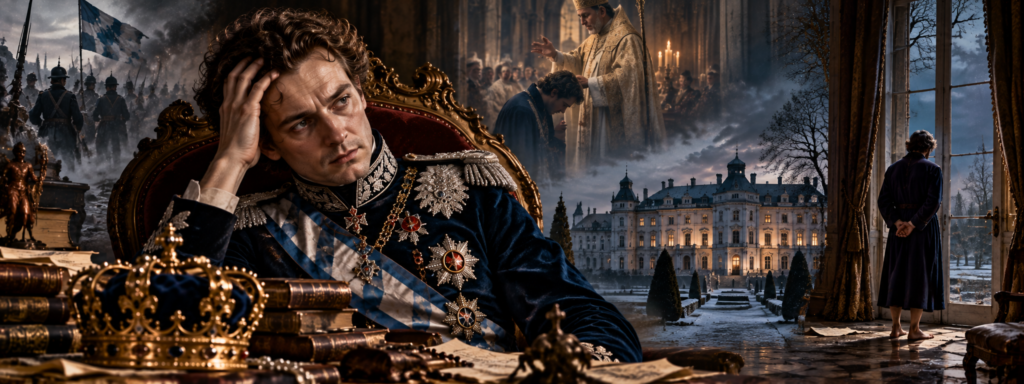
Otto of Bavaria: The Forgotten Mad King Who Reigned Behind Locked Doors
King of Bavaria, 1886–1913 | War, Mental Collapse, Religious Delusions, Fürstenried Palace, the Shadow of Ludwig II, Decades of Psychiatric Confinement, and a Crown Worn by a Man Who Could Never Rule
The King Who Never Knew His Kingdom
When Bavaria acquired a new king on 13 June 1886, there was no coronation, no triumphant procession through Munich, and no new sovereign stepping before cheering crowds. King Ludwig II had been found dead in Lake Starnberg beside the psychiatrist Bernhard von Gudden, only days after being declared mentally incapable of ruling. Under the normal laws of succession, the Bavarian crown passed immediately to Ludwig’s younger brother, Prince Otto. Yet the new king was already living under psychiatric supervision, increasingly separated from the outside world and considered incapable of understanding, much less exercising, the powers that had just become his.
It was one of the strangest successions in European royal history. Bavaria had replaced one king declared insane with another prince whose psychiatric illness was far less disputed and considerably more severe. Otto would remain king for more than twenty-seven years, longer than Ludwig II had reigned, yet he would never deliver a speech from the throne, appoint ministers on his own authority, preside meaningfully over government, or establish anything resembling a royal court. Government continued first under his uncle Prince Regent Luitpold and later under his cousin Ludwig, while Otto existed as the legal sovereign in a secluded palace outside Munich.
His tragedy was profoundly different from that of his famous brother. Ludwig II retreated into a world of castles, Wagnerian legends, artificial grottoes, nocturnal journeys, and fantasies of absolute monarchy, leaving behind enough ambiguity that historians still debate the nature and severity of his mental illness. Otto’s deterioration was more devastating. Contemporary observers described prolonged depression, withdrawal, periods of unresponsiveness, religious anguish, disturbed behavior, agitation, sleeplessness, and eventually a level of psychiatric incapacity that made serious political participation impossible.
Yet Otto has largely disappeared behind his brother’s legend. Ludwig became the Fairy-Tale King, his face reproduced beside Neuschwanstein and his death transformed into one of Europe’s great royal mysteries. Otto became almost invisible, spending decades at Fürstenried Palace while Bavaria continued to issue coins, laws, and official documents in the name of a king most Bavarians never saw. His reign was therefore built upon a haunting constitutional fiction: Otto remained king because blood and law said he was king, even though everyone understood that somebody else had to rule.
There are lurid stories about his illness, including claims that he barked like a dog, beat his head against walls, wandered barefoot through winter, attacked doors, smoked cigarettes almost continuously, and became terrified or enraged when objects around him were disturbed. Some such reports derive from contemporary or near-contemporary descriptions, while others became amplified as the image of the “mad Wittelsbachs” grew after the deaths of Ludwig and Otto. They should not all be repeated with equal confidence. What can be established without relying upon the most sensational anecdotes is dark enough: Otto was a young prince who deteriorated severely, spent most of his adult life confined, inherited a crown he could not use, and eventually lived long enough for Bavaria to change its constitution specifically so that someone else could take his throne.
The Other Son of Maximilian II
Otto Wilhelm Luitpold Adalbert Waldemar was born on 27 April 1848 in Munich, less than six weeks after his grandfather Ludwig I abdicated during the revolutionary crisis that had swept through Bavaria and much of Europe. His father, Maximilian II, had therefore only recently become king when his second son was born. Otto’s mother was Marie of Prussia, and his elder brother Ludwig, born in 1845, stood ahead of him in the succession. From birth, Otto belonged to a royal family already living beneath the weight of political upheaval, intense personalities, and an increasingly complicated relationship with modern constitutional government.
The brothers were close enough in age to share parts of their upbringing, but their temperaments were not identical. Ludwig was famously imaginative, private, artistically obsessed, and uncomfortable with many forms of social interaction. Otto, at least in youth, was often remembered as more sociable and accessible. Later descriptions of the completely withdrawn psychiatric patient can make it easy to imagine that he had always been detached from ordinary life, but that appears not to have been the case.
Their childhood was also shaped by the emotional reserve of their parents and the rigorous expectations placed upon royal children. Maximilian II was intellectually serious and conscientious, but he was not remembered as an especially warm father. The princes were educated for duty within a dynasty whose survival depended upon producing capable men prepared to serve the monarchy. Otto, as the second son, did not carry exactly the same burden as Ludwig, but he was still expected to become a useful royal prince and military officer.
No one looking at the young Otto could have known what his adulthood would become. He was not born into the role of hidden mad king, nor did his family initially behave as though severe psychiatric incapacity was inevitable. That later outcome has encouraged generations of writers to search backward through his childhood for warning signs, but retrospective narratives can make ordinary youthful traits appear ominous simply because the ending is already known.
Two Brothers and the Shadow of the Wittelsbachs
The psychiatric histories of Ludwig and Otto inevitably raise questions about heredity. The House of Wittelsbach, like other European dynasties, contained repeated marriages among aristocratic families, and various relatives displayed eccentricities or mental health difficulties. Nineteenth-century physicians were deeply interested in hereditary “degeneration,” a concept that often mixed legitimate observations about familial illness with speculative and sometimes prejudiced theories about bloodlines. After two royal brothers were declared mentally ill, hereditary explanations became almost irresistible.
There may indeed have been genetic vulnerability within the family. Modern psychiatry recognizes substantial hereditary components in disorders such as schizophrenia, bipolar disorder, and major depression, although genetics never operates as simply as the old dynastic idea of “bad blood.” Otto’s severe illness and Ludwig’s disputed condition have therefore encouraged retrospective theories involving inherited psychiatric susceptibility. Such theories remain plausible at a broad level but cannot identify a specific diagnosis or genetic cause in men who died before modern psychiatric and genetic medicine existed.
The popular language of “inbreeding” can also oversimplify the issue. European royal families frequently intermarried, but not every unusual royal personality can be traced directly to consanguinity, nor can a particular psychiatric disorder be reconstructed from a family tree alone. Otto’s illness must be understood primarily through his documented symptoms and functional decline rather than through a predetermined assumption that the Wittelsbach dynasty was genetically doomed.
What makes the family context especially haunting is that Otto and Ludwig followed radically different paths toward incapacity. Ludwig remained capable of sophisticated correspondence, architectural planning, financial maneuvering, and resistance to his deposition almost until his death. Otto deteriorated much earlier and much more profoundly. Whatever similarities existed between the brothers, their clinical histories were not interchangeable.
A Young Prince in Uniform
As a younger royal son, Otto entered military life. He served in the Bavarian army and participated in the Austro-Prussian War of 1866, when Bavaria fought on Austria’s side against Prussia. The conflict ended disastrously for Austria and its German allies, establishing Prussia as the dominant power in Germany. Otto was still a teenager, and the military experience placed him inside the violent political transformation that would eventually strip Bavaria of much of its independent importance.
Four years later came the Franco-Prussian War. Bavaria now fought alongside Prussia and the other German states against France, and Otto again served in the military. The war produced enormous casualties, devastated communities, and culminated in the creation of the German Empire under Prussian leadership. For Ludwig II, German unification contributed to disillusionment with practical politics; for Otto, later accounts associated the experience of war with the worsening of his mental condition.
It is tempting to describe Otto’s illness simply as psychological trauma caused by combat, but the evidence does not justify such certainty. Nineteenth-century soldiers could certainly develop what would now be recognized as trauma-related psychiatric symptoms, and warfare may have worsened an existing vulnerability. Otto’s later illness, however, included features that cannot safely be reduced to post-traumatic stress alone. His deterioration appears to have been broader, more persistent, and ultimately more disabling.
The Franco-Prussian War nevertheless forms an important dividing line in many accounts of his life. The prince who returned from military service was increasingly described as depressed, withdrawn, unstable, or otherwise changed. Whether war caused the transformation, accelerated an emerging psychiatric disorder, or merely coincided with its development remains impossible to establish conclusively.
The First Darkness
Signs of serious difficulty appeared while Otto was still young. Accounts describe depression, apathy, irritability, social withdrawal, and episodes in which he seemed mentally absent from what was happening around him. Later observers remembered periods during which he would stop responding, stare blankly, or appear lost inside himself. Such descriptions are suggestive but cannot be translated automatically into a modern diagnosis because similar outward behavior can arise from very different psychiatric and neurological conditions.
His family could not easily treat the problem as an ordinary private illness. A royal prince existed in public, represented the dynasty, performed military and ceremonial duties, and remained part of the succession. Every unusual incident therefore carried political implications. Admitting that the king’s only brother was seriously mentally ill also risked drawing uncomfortable attention toward the hereditary stability of the dynasty.
The situation was made more difficult by fluctuations in Otto’s condition. He could experience periods of relative calm and apparent lucidity amid episodes of profound disturbance. Intermittent improvement often complicates severe psychiatric illness because relatives can convince themselves that recovery has begun, only for another episode to destroy that hope. In Otto’s case, periods of better functioning seem to have delayed any simple conclusion about his future.
By the early 1870s, however, the family could no longer dismiss what was happening. His behavior was becoming sufficiently disturbing that physicians were increasingly involved. The young prince who should have been entering the confident public life of an adult royal was instead beginning a long descent into medical supervision.
The Church Incident
One of the most frequently repeated episodes from Otto’s deterioration occurred during a religious service, when he reportedly rushed into a church during Mass, fell before the officiating archbishop, and begged forgiveness for his sins. Versions differ in detail, and the incident acquired dramatic embellishments in later retellings. Nevertheless, episodes of intense religious anxiety and guilt appear in descriptions of Otto’s mental state.
Religious preoccupation was not inherently abnormal in nineteenth-century Catholic Bavaria. Otto belonged to a deeply Catholic dynasty and lived in a culture where confession, sin, absolution, ritual, and fear of damnation formed familiar parts of spiritual life. The distinction lies in intensity, context, and the extent to which religious ideas became disruptive or detached from ordinary behavior. When a prince interrupted public worship in a state of extreme anguish, observers naturally interpreted the episode as evidence that something was seriously wrong.
Later reports also describe delusional or obsessive concerns about his body, including supposed illnesses or eruptions on his skin. Such symptoms have been incorporated into theories that Otto experienced psychosis. Yet the exact content and reliability of every reported delusion cannot be reconstructed securely enough to diagnose him from individual anecdotes.
What matters is the cumulative pattern. Religious distress, withdrawal, disturbed behavior, impaired social functioning, and episodes of apparent disconnection were no longer isolated peculiarities. Otto’s capacity to live independently as a royal prince was beginning to collapse.
Depression, Silence, and the Blank Stare
Among the less theatrical but perhaps more revealing descriptions of Otto are accounts of profound withdrawal. He could become silent, disengaged, and apparently indifferent to people around him. Witnesses described states in which conversation seemed unable to reach him and his attention appeared fixed on something inaccessible to everyone else.
Modern readers may be tempted to label these episodes catatonia, dissociation, psychotic withdrawal, or depressive stupor. Each possibility has some superficial resemblance to the surviving descriptions, but none can be confidently established. Nineteenth-century observers did not record symptoms using modern diagnostic standards, and their vocabulary reflected the psychiatric concepts of their own time.
The change from his earlier personality made the symptoms particularly disturbing. A prince remembered as relatively sociable and personable became increasingly reluctant to engage with others. Invitations, court duties, conversation, and public appearances became more difficult. The outside world was gradually shrinking.
Unlike Ludwig, however, Otto did not replace society with an elaborate artistic universe of castles and historical fantasy. There is no Neuschwanstein in Otto’s story, no architectural masterpiece through which his withdrawal could be transformed into beauty. His retreat was darker and more empty, dominated increasingly by illness itself.
Screaming, Sleeplessness, and Violence
As Otto’s condition worsened, descriptions became more alarming. Accounts from those responsible for his care refer to episodes of agitation, shouting or screaming, insomnia, destructive behavior, and aggression. Some later narratives include head-banging and other forms of self-injurious behavior. These reports are more consistent with severe psychiatric disturbance than the harmless eccentricities often used against Ludwig II.
Stories that Otto barked like a dog have circulated widely and may derive from descriptions of strange vocalizations or disturbed episodes, but such sensational details deserve caution. Royal madness attracted exaggeration, and bizarre behavior became more memorable each time the story was retold. A symptom that began as an unusual cry could eventually become the image of a king crawling through a palace barking like an animal.
There is nevertheless little reason to romanticize Otto’s condition. Even if the most lurid anecdotes are removed, the surviving picture remains one of profound illness. His behavior frightened attendants, required supervision, and made ordinary independent life increasingly impossible.
Periods of sleeplessness may have worsened everything. Severe sleep disruption can intensify agitation, confusion, mood instability, and psychotic symptoms, regardless of the underlying diagnosis. Otto’s attendants were therefore dealing not with a harmless eccentric but with a patient whose condition could fluctuate unpredictably and sometimes violently.
Bernhard von Gudden Enters the Story
Among the physicians involved in Otto’s treatment was Bernhard von Gudden, the psychiatrist whose name would later become inseparable from Ludwig II’s deposition and mysterious death. Gudden was an important figure in nineteenth-century German psychiatry and neuroanatomy, not merely a court doctor willing to label inconvenient princes insane. His career included serious scientific work, and his methods were regarded in some respects as more humane than older traditions of brutal psychiatric restraint.
Gudden’s connection to Otto is important because it complicates the later accusation that he simply fabricated Ludwig II’s insanity for political reasons. He had observed and treated Otto, whose severe psychiatric illness was much harder to dispute. The doctor therefore had direct experience with one mentally ill Wittelsbach prince before becoming involved in the case of the other.
The contrast between the brothers is striking. Gudden could observe Otto over time and witness severe impairment directly. In Ludwig’s case, the 1886 medical commission relied heavily upon written reports and did not conduct a fresh direct examination before declaring the king incapable. That procedural difference is one reason Ludwig’s diagnosis remains controversial while Otto’s incapacity is generally accepted.
Gudden would not live to oversee Otto’s long-term care. On 13 June 1886, only days after helping certify Ludwig II as mentally incapable of ruling, he died beside Ludwig in Lake Starnberg. Otto therefore inherited the Bavarian crown on the same night that one of the doctors associated with his own psychiatric history died under circumstances that remain mysterious.
What Did Otto Actually Have?
Contemporary descriptions often used terms such as melancholia and insanity rather than diagnoses recognizable in modern psychiatry. As Otto’s illness progressed, physicians interpreted his symptoms within the categories available to them. Later historians and medical writers have attempted to translate those observations into modern diagnostic language, most frequently proposing schizophrenia or a related psychotic disorder.
The schizophrenia hypothesis has some plausibility because Otto reportedly experienced severe social withdrawal, impaired functioning, disturbed thought or behavior, possible delusions, periods of apparent unresponsiveness, and a chronic course beginning in youth or early adulthood. Yet the evidence is incomplete. We do not possess a modern psychiatric interview, standardized observations, neurological imaging, laboratory testing, or a sufficiently detailed longitudinal record to make a retrospective diagnosis secure.
Tertiary syphilis or neurosyphilis has also been suggested in discussions of the Wittelsbach brothers and other nineteenth-century royals. Syphilis could indeed cause devastating neurological and psychiatric symptoms, including personality changes, cognitive decline, delusions, and motor abnormalities. However, demonstrating that Otto specifically suffered from neurosyphilis requires evidence stronger than the fact that his symptoms could theoretically fit the disease.
Other possibilities include severe mood disorder with psychotic features, neurological disease, or a combination of psychiatric vulnerability and environmental stress. The most responsible conclusion is therefore broad rather than dramatic. Otto clearly suffered from a severe, chronic mental disorder that profoundly impaired his ability to function, but the exact modern diagnosis cannot be established with confidence.
The Prince Disappears
By the later 1870s, Otto’s public role had effectively ended. His family and physicians increasingly removed him from ordinary court life, and he lived under supervision in secluded royal residences. The official explanation emphasized illness and the need for treatment, while the practical effect was to make an embarrassing and unpredictable prince almost invisible.
Royal psychiatric confinement was very different from ordinary institutionalization. Otto was not placed in a public asylum ward among hundreds of patients. His rank allowed him private residences, servants, physicians, gardens, carefully controlled surroundings, and material comfort unimaginable to most mentally ill people of the nineteenth century.
Yet luxury did not equal freedom. His movements were restricted, visitors were controlled, attendants watched him, and decisions about his life were increasingly made by others. The palaces surrounding him remained royal, but they functioned in important respects as elegant psychiatric institutions.
Fürstenried Palace, southwest of Munich, eventually became the residence most closely associated with his confinement. Behind its walls, the prince who would unexpectedly become king spent years disappearing from Bavarian public consciousness.
Fürstenried: A Palace That Became a Prison
Fürstenried had originally been built as a hunting lodge and country palace, surrounded by grounds that provided distance from Munich. For Otto, its isolation was useful to both family and physicians. He could be cared for privately without becoming a daily spectacle, while the government avoided the political embarrassment that public incidents might create.
The residence was adapted around his needs. Staff members monitored him, medical supervision continued, and the household developed routines intended to manage his behavior. Otto had space to walk and live more comfortably than an ordinary asylum patient, but the boundaries of his existence were unmistakable.
Reports from these decades describe unusual habits that became part of his legend. He supposedly developed an aversion to footwear and sometimes walked barefoot even when the weather made doing so uncomfortable. He was also said to dislike closed doors and could become agitated when particular objects were moved or routines disrupted.
Such habits are plausible within the context of chronic psychiatric illness, but their evidentiary quality varies. They should be treated as observations reported about his confined life rather than as perfectly documented symptoms. The deeper truth requires no embellishment: Fürstenried became almost Otto’s entire world.
Cigarettes, Pacing, and the Long Years
Smoking became one of the habits most frequently associated with Otto’s later years. Accounts describe heavy cigarette consumption, sometimes portraying him smoking one cigarette after another while pacing or sitting through the repetitive routines of confinement. Tobacco use was common in nineteenth-century Europe, but chronic psychiatric patients often became particularly heavy smokers, a pattern still observed in later clinical populations.
The image of Otto pacing through Fürstenried with a cigarette is painfully different from Ludwig’s moonlit sleighs and illuminated castles. Ludwig’s isolation produced spectacle; Otto’s produced repetition. Days became years, and years became decades while Bavaria governed itself in his name.
His condition fluctuated. Reports of occasional calmer or more coherent periods continued, but none produced a sustained recovery sufficient to restore political responsibility. Whatever moments of lucidity occurred, they did not reverse the overall impairment.
This distinction is important because intermittent lucidity does not disprove severe mental illness. Many psychiatric disorders fluctuate, and patients can appear relatively organized at some times while being profoundly impaired at others. The constitutional question was not whether Otto could ever speak coherently; it was whether he could reliably perform the continuous responsibilities of kingship.
The Night the Crown Came to Fürstenried
On 13 June 1886, Ludwig II died at Lake Starnberg. The succession itself was automatic. Otto, as Ludwig’s younger brother, became King of Bavaria.
The legal transformation was enormous, but Otto’s daily existence changed remarkably little. He did not leave confinement to assume government because his incapacity had already been recognized. Prince Luitpold, uncle of both brothers, continued as regent, now ruling on behalf of Otto rather than Ludwig.
Later stories claim Otto did not understand that Ludwig had died or that he himself had become king. Some accounts portray him insisting that another relative remained the true sovereign or failing to comprehend explanations of his accession. The precise details are difficult to verify, but there is no serious doubt that Otto was incapable of meaningfully assuming the responsibilities that came with the crown.
Bavaria therefore entered an extraordinary constitutional arrangement. The country possessed a living king whose name represented royal legitimacy while another man exercised every meaningful function of monarchy.
King in Name, Patient in Reality
Officially, Otto was His Majesty the King of Bavaria. His portrait and name belonged to the monarchy, coins were issued bearing his image and title, and state acts continued within the legal framework of his reign. Yet Otto did not govern the kingdom whose crown he possessed.
Prince Regent Luitpold performed the functions of sovereign. He dealt with ministers, represented the monarchy publicly, handled political responsibilities, and became the face of the Bavarian state. Over time, Bavarians grew accustomed to the regency, and Luitpold developed considerable popularity.
The arrangement produced one of monarchy’s strangest paradoxes. Otto possessed the highest title in Bavaria but almost none of its practical meaning. Luitpold lacked the title of king but exercised nearly all of the authority and public functions associated with it.
The fiction remained because dynastic monarchy rested upon hereditary legitimacy. Otto’s illness did not automatically erase his rights. As long as the constitutional system could function through a regent, there was no immediate need to depose a sick man who posed no active political threat.
The Forgotten King and the Beloved Regent
Luitpold’s regency lasted from 1886 until his death in 1912, and the period acquired a reputation for relative stability and cultural flourishing. The aging prince regent was less theatrical than either Ludwig II or Ludwig I, and his public style suited a Bavaria increasingly comfortable with constitutional government. While Otto remained hidden, Luitpold became familiar.
This gradual normalization had an unintended consequence for Otto. The longer the regency worked, the less urgently anyone needed to think about the king himself. He became an almost abstract legal presence, a name behind which ordinary government continued.
Children could grow into adulthood without ever having seen their king except in images. Political careers began and ended while Otto remained at Fürstenried. Governments changed, technologies advanced, cities expanded, and the German Empire moved deeper into the modern age while Bavaria’s sovereign lived under psychiatric supervision.
The contrast with Ludwig II’s posthumous fame could hardly have been greater. Ludwig’s castles attracted curiosity almost immediately after his death, and his legend expanded. Otto was alive, but he was already disappearing from history.
Was Otto’s Madness Exaggerated for Political Reasons?
The political manipulation surrounding Ludwig II’s diagnosis naturally raises the question of whether Otto was similarly marginalized because his relatives wanted power. In Ludwig’s case, the government had clear political and financial motives for removal, and the lack of a direct contemporary psychiatric examination makes the process controversial. Otto’s case is substantially different.
Evidence of Otto’s serious illness appeared many years before he became king and long before anyone could have known Ludwig would die childless at forty. His psychiatric supervision therefore cannot plausibly be explained simply as a scheme devised in 1886 to place Luitpold in power. Otto had already been withdrawn from public life because of severe symptoms.
That does not mean every story told about him was accurate. Royal courts could conceal information, physicians could misunderstand symptoms, attendants could exaggerate, and the government had no incentive to publicize moments that complicated the official picture. Once Otto became king, maintaining the belief that he was permanently incapable also served the stability of the regency.
Nevertheless, the broad claim that Otto’s insanity was fabricated to steal his throne is poorly supported. Unlike Ludwig, whose level of incapacity remains legitimately debatable, Otto appears to have been genuinely and profoundly ill.
The Strange Mercy of Not Deposing Him
For decades, Bavaria allowed Otto to remain king despite his incapacity. In one sense, this arrangement preserved his dignity. He had done nothing morally wrong, led no rebellion, committed no crime, and possessed no control over the illness that had overtaken him.
Removing his title might have accomplished little while publicly humiliating a helpless patient. The regency already allowed government to function, so leaving Otto on the throne avoided an unnecessary dynastic rupture. His kingship became almost protective, preserving his formal place within the family even as it emptied the title of practical power.
Yet there was something cruel about the arrangement as well. Every official reference to “King Otto” maintained a public identity he could not meaningfully inhabit. Bavaria celebrated a monarch who remained behind palace walls, transforming his illness into a permanent constitutional arrangement.
The crown became both honor and reminder. Otto possessed it longer than Ludwig II ever had, but there is little evidence that it gave him anything resembling a king’s life.
Luitpold Dies and the Problem Returns
Prince Regent Luitpold died on 12 December 1912 at the age of ninety-one. Otto was still alive at Fürstenried, still king, and still considered incapable of ruling. The regency therefore passed to Luitpold’s eldest son, Ludwig.
By then the arrangement seemed increasingly absurd. Bavaria had maintained a regency for more than a quarter of a century, and there was no realistic expectation that Otto would recover. The new Prince Regent Ludwig was already an elderly man himself and had spent decades watching his father perform the duties of a king without possessing the title.
Pressure grew for a constitutional solution. The issue was no longer whether Otto deserved compassion but whether Bavaria should indefinitely maintain a monarchy in which the legal sovereign could never reign. The constitution had to reconcile hereditary right with political reality.
In 1913, amendments provided a mechanism by which a regency caused by permanent incapacity could be brought to an end under specified conditions. The change was transparently designed around Otto’s situation.
The Crown Is Finally Taken Away
On 5 November 1913, Prince Regent Ludwig declared the regency ended and assumed the throne as King Ludwig III. The Bavarian parliament recognized the change, and Otto’s twenty-seven-year nominal reign came to an end. Bavaria now possessed a king who could actually govern.
The transition was handled in a manner intended to preserve Otto’s personal dignity. He retained the title and honors of a king, even though he was no longer the reigning sovereign. There was no dramatic confrontation because Otto was in no position to resist the constitutional process.
For the second time in less than three decades, Bavaria had removed a mentally incapacitated Wittelsbach from the throne. The difference was striking. Ludwig II had been deposed through a rapid political and medical operation and died almost immediately afterward under mysterious circumstances. Otto’s removal came after twenty-seven years of regency and produced no comparable crisis.
The monarchy itself had only five years left. Ludwig III would be swept from power during the German Revolution of 1918, ending centuries of Wittelsbach rule in Bavaria. Otto, whose incapacity had once seemed like a great constitutional problem, had nearly outlived the institution that problem existed to protect.
The Barefoot King
Among the images associated with Otto’s final decades is that of the former king walking barefoot through Fürstenried. Reports claim he resisted shoes even in cold weather and preferred to move through his rooms or grounds without them. Whether this behavior was constant or became exaggerated through repetition is difficult to determine.
Such a habit could arise from sensory preference, psychiatric fixation, discomfort, or simple personal choice. In a royal patient already labeled insane, however, every eccentric behavior became part of a larger narrative. A healthy king walking barefoot might be called unconventional; a confined psychiatric patient doing the same thing was presented as further proof of madness.
The same problem applies to his supposed hostility toward closed doors. Reports that he became agitated by doors or demanded they remain open may reflect genuine repetitive or paranoid behavior. They could also reflect the understandable reactions of a man whose entire existence was controlled by barriers.
Context does not make the behavior normal, but it changes its emotional meaning. A locked or closed door means something different to a free person than it does to someone who has spent decades confined.
The Man Behind the Diagnosis
Otto’s story is difficult to tell because his illness consumed so much of the surviving narrative. Ludwig II left architectural projects, correspondence, political controversies, relationships, financial records, and an enormous cultural legacy through which historians can encounter different sides of his personality. Otto’s adult life produced far fewer independent expressions of self.
Once confined, almost everything known about him passed through observers. Doctors described symptoms, attendants recorded behavior, relatives discussed his condition, and officials managed the constitutional consequences. The patient himself gradually disappeared behind those descriptions.
This creates an ethical problem for modern storytelling. It is easy to turn Otto into a collection of grotesque symptoms: the barking prince, the barefoot king, the screaming patient, the chain-smoker pacing behind locked doors. Such an approach repeats the nineteenth-century habit of making psychiatric patients into spectacles.
Behind those symptoms was a man who had once been a young prince, a soldier, a brother, a son, and a recognizable participant in court society. Mental illness did not erase that person simply because history found the symptoms easier to remember.
Two Mad Kings, Two Very Different Cases
Comparing Otto with Ludwig II demonstrates why the phrase “mad monarch” must be handled carefully. Ludwig’s diagnosis was made during an immediate political crisis, without a fresh direct examination by the commission that certified him, and remains controversial. His unusual behavior coexisted with sophisticated artistic planning, correspondence, financial negotiation, and resistance to his removal.
Otto’s illness developed years before his accession and produced much more obvious functional impairment. He required psychiatric supervision long before anyone had reason to remove him from a throne. His incapacity therefore cannot easily be explained as a political invention.
The brothers may nevertheless have shared underlying vulnerabilities. Both became increasingly isolated, both struggled with conventional royal life, and both were treated by Gudden. Their very different clinical courses warn against forcing them into a single hereditary diagnosis.
History remembered one as the glamorous mad king and forgot the other almost entirely. Ironically, Otto may have been the brother whose illness more closely fits what later generations imagine when they use that label.
Medicine Behind Palace Walls
Psychiatric treatment during Otto’s lifetime occupied an uncomfortable transitional period. Nineteenth-century psychiatry was becoming increasingly medical and institutional, with physicians attempting to classify mental illnesses, study the brain, and replace some older forms of brutal restraint. Yet effective treatments for severe psychotic disorders remained extremely limited.
Doctors could regulate environment, sleep, diet, exercise, stimulation, and contact with other people. Sedative medications of various kinds existed, but nothing comparable to modern antipsychotic medication was available. For a chronically ill patient such as Otto, management often meant creating a controlled environment and waiting.
Gudden belonged to a generation of psychiatrists who advocated forms of treatment intended to reduce unnecessary physical restraint. That approach was progressive relative to harsher asylum traditions, but it did not mean patients possessed modern concepts of autonomy or informed consent. Otto remained under supervision because his physicians and family considered confinement necessary.
The luxurious setting should not obscure the medical helplessness surrounding him. Fürstenried could provide beautiful rooms, gardens, attendants, good food, warmth, and security. It could not provide a cure.
The Question of Syphilis
The suggestion that Otto suffered from syphilis appears periodically in discussions of his illness. Neurosyphilis can produce psychiatric and neurological symptoms years after infection, and before antibiotics it was a major cause of severe mental deterioration. Nineteenth- and early twentieth-century psychiatric institutions contained many patients suffering from what was then called general paralysis of the insane, a manifestation associated with syphilitic infection.
Some features attributed to Otto can be made to fit such a diagnosis, but that does not establish it. A retrospective diagnosis requires more than symptom resemblance, particularly when the historical record lacks decisive laboratory confirmation. Similar symptoms can occur in primary psychiatric disorders and other neurological diseases.
Schizophrenia-spectrum illness is another frequently proposed explanation, particularly given Otto’s age at onset, withdrawal, chronic impairment, unusual behavior, and possible delusional symptoms. Once again, the fit is suggestive rather than conclusive. Psychiatric diagnosis depends upon detailed patterns of symptoms, duration, exclusion of medical causes, and direct assessment that historians cannot reproduce.
Otto therefore remains diagnosable only at the broadest level. He suffered from severe chronic psychiatric illness. Anything more precise should be presented as hypothesis rather than fact.
War Trauma and the Search for a Cause
The Franco-Prussian War remains another tempting explanation. Otto’s symptoms reportedly worsened around the period of his military service, leading later writers to suggest that the horrors of war broke him psychologically. Modern awareness of post-traumatic stress makes the theory intuitively compelling.
Yet timing alone cannot prove causation. Severe psychiatric disorders commonly emerge in late adolescence and early adulthood, exactly the age Otto had reached during these wars. Stressful experiences can precipitate or worsen symptoms in vulnerable individuals without being the sole underlying cause.
It is entirely plausible that military service aggravated Otto’s mental state. Witnessing death, injury, suffering, and the pressures of military duty could have intensified depression, anxiety, insomnia, or an emerging psychotic illness. What cannot be justified is reducing his entire decades-long psychiatric history to battlefield trauma.
The most realistic explanation may involve multiple factors: inherited vulnerability, developmental age, psychological stress, military experience, and an underlying disorder whose exact nature remains unknown. History rarely provides the clean single cause that tragedy seems to demand.
Otto and the Brother He Lost
The relationship between Otto and Ludwig becomes increasingly difficult to reconstruct as Otto’s illness deepened. Ludwig showed concern for his brother, but his own emotional and political difficulties limited what he could do. Both men eventually lived largely apart from ordinary court society, though for very different reasons.
Ludwig’s death in 1886 created the cruelest possible intersection of their lives. Otto inherited everything his brother had possessed in law and almost nothing in practice. The crown passed from one isolated brother to another without either man participating in a normal succession.
Whether Otto fully understood Ludwig’s death is uncertain. Severe mental illness does not eliminate comprehension uniformly, and he may have understood some information at some times while failing to integrate it consistently. Later stories presenting him as completely oblivious should therefore be treated cautiously.
What cannot be doubted is that he was denied the ordinary rituals of grief as well as kingship. His brother died suddenly and mysteriously, and Otto remained inside the controlled world of psychiatric care.
A Reign Measured in Absence
Otto’s reign lasted from June 1886 until November 1913, making it one of the longest periods in which a European monarch remained sovereign while permanently incapable of exercising power. Yet almost none of the events normally associated with a reign can meaningfully be attributed to him. Bavaria changed enormously, but Otto did not direct those changes.
Industrialization accelerated, Munich expanded, science and technology transformed daily life, and German imperial politics moved through the age of Bismarck into that of Wilhelm II. Political parties developed, social movements grew, and modern mass politics increasingly challenged the old aristocratic order. Otto remained at Fürstenried.
This makes writing about his “reign” almost philosophically strange. A reign normally describes what a monarch did while occupying the throne. Otto’s reign is defined by what he could not do.
The constitutional system functioned precisely because Bavaria separated the person of the king from the exercise of royal power. Otto’s crown became proof that monarchy could survive even when the monarch effectively disappeared.
The End of the Wittelsbach World
When Ludwig III replaced Otto in 1913, the new king could reasonably expect the Bavarian monarchy to continue for generations. Europe still contained emperors, kings, grand dukes, princes, and hereditary rulers whose dynasties had survived revolutions, wars, and constitutional reforms. Few could have imagined how quickly that world would collapse.
The First World War began in 1914. Bavaria entered the conflict as part of the German Empire, and the enormous casualties, shortages, political tensions, and social upheavals of the war steadily weakened the monarchy. Otto remained secluded while the world beyond Fürstenried descended into industrialized slaughter on a scale far exceeding the wars of his youth.
He did not live to see the final revolution. Otto died at Fürstenried on 11 October 1916, aged sixty-eight. The former king had spent roughly four decades under psychiatric care and three years without the throne that had once legally belonged to him.
Two years later, the Bavarian monarchy collapsed. Ludwig III fled Munich during the revolution of November 1918, and the Wittelsbach dynasty ceased to rule. The institution that had spent decades preserving itself around Otto’s incapacity disappeared almost overnight.
Death at Fürstenried
Otto’s death lacked the Gothic mystery surrounding Ludwig II. There was no dark lake, no dead psychiatrist beside him, no unexplained footprints, and no enduring debate over assassination. He died within the palace that had contained most of his adult life.
His physical health had deteriorated substantially, and he had become increasingly frail. Contemporary accounts identify intestinal obstruction as the immediate cause of death. The end came after decades in which his psychiatric condition had already separated him from almost every function once expected of a prince.
The quietness of his death may help explain why his story faded. Ludwig’s death created a mystery that demanded retelling. Otto’s death simply closed a life that the public had largely stopped seeing.
Yet there is something more haunting about the silence. Ludwig’s tragedy unfolded over days in 1886. Otto’s unfolded over decades.
The Palace Without a King
Fürstenried represents the central image of Otto’s story more powerfully than any battlefield or throne room. It was a royal residence filled with attendants, physicians, furniture, gardens, and the material comforts appropriate to a prince. Yet it was also a controlled environment from which Otto could not simply walk away.
The contradiction mirrors his kingship. He possessed enormous rank without freedom and a crown without authority. He lived in a palace but experienced it partly as a place of confinement.
Stories about open doors, bare feet, repetitive pacing, cigarettes, and fixed objects become more unsettling when seen against that background. They describe not merely eccentricity but the routines through which a chronically ill person occupied an extraordinarily restricted world. Days had to be filled somehow.
By the time Otto died, Fürstenried had contained him for so long that the young prince who once served in uniform belonged to another age. His illness had outlasted governments, relatives, doctors, and almost the monarchy itself.
Was Otto a Victim?
Calling Otto a victim does not require believing his illness was invented. He appears to have been genuinely incapable of ruling, and some form of long-term care was almost certainly necessary. The tragedy lies in the limited possibilities available to him.
Modern psychiatric treatment might have offered medications, structured psychotherapy, neurological investigation, occupational programs, and more sophisticated assessment. None guarantees recovery from severe chronic mental illness, but Otto lived before most such tools existed. His doctors could observe, classify, supervise, calm, isolate, and protect far more easily than they could heal.
His royal status spared him many horrors endured by ordinary psychiatric patients. He was not thrown into an overcrowded pauper asylum or abandoned without care. Yet privilege could not restore his mind or return the decades lost behind palace walls.
Otto therefore occupied the strange position of being among the most privileged men in Europe and one of its least free. His title could command armies in theory, but he could not command the doors around him to open.
The Crown as an Empty Symbol
The twenty-seven years of Otto’s nominal reign expose something fundamental about monarchy. Royal authority often presents itself as intensely personal, embodied in a sovereign whose bloodline supposedly guarantees continuity. Otto demonstrated that the system could continue almost perfectly well without the sovereign exercising any authority at all.
Government operated under Luitpold, laws were administered, budgets were passed, officials were appointed, and Bavaria participated in the German Empire. The king’s incapacity did not cause the state to collapse. Instead, the machinery of constitutional government simply flowed around him.
That reality would have horrified believers in older forms of personal monarchy. The sovereign had become so institutionally replaceable that he could remain alive, legally king, and almost completely absent from politics for decades.
Otto’s reign therefore belongs not only to psychiatric history but to the history of monarchy’s transformation. The crown remained sacred in symbolism while becoming increasingly detachable from the person who wore it.
The Brother History Forgot
Ludwig II and Otto died only thirty years apart, yet their historical afterlives could hardly be more different. Ludwig became a global icon whose castles attract millions, whose portraits appear throughout Bavaria, and whose mysterious death continues generating books, documentaries, conspiracy theories, and arguments. Otto became a footnote to Ludwig’s story.
Part of that difference is architectural. Ludwig left physical objects of astonishing beauty that demand attention. Otto left no equivalent monuments through which visitors can imagine his inner life.
Part of it is narrative. Ludwig’s story contains glamour, art, Wagner, secret sexuality, castles, political intrigue, disputed psychiatry, deposition, and mysterious death. Otto’s story contains illness, confinement, regency, and waiting.
History naturally gravitates toward spectacle, but spectacle is not the only form of tragedy. Ludwig’s final days are dramatic because they happened so quickly. Otto’s tragedy lies precisely in how slowly it happened.
The Mad King Who Really Was Ill
Among the monarchs gathered under the broad label of “mad kings,” Otto occupies an unusual position because there is relatively little serious doubt that he suffered from profound mental illness. The uncertainty concerns the precise diagnosis, not the existence of severe impairment. His symptoms began before he became king, continued for decades, and repeatedly prevented normal functioning.
That makes him different from rulers branded insane primarily by enemies, political propaganda, eccentricity, cruelty, religious enthusiasm, or modern retrospective speculation. Otto did not acquire his reputation because he lost a political struggle after behaving strangely. His illness itself became the defining condition of his adult existence.
Even here, however, the word “mad” remains inadequate. It collapses depression, psychosis, agitation, withdrawal, possible delusions, periods of lucidity, disturbed sleep, repetitive behavior, and decades of institutional care into a crude historical label. It tells us that observers considered him abnormal without telling us what he actually experienced.
The human being disappears behind the adjective. Otto’s story becomes more meaningful when the label is removed and the long chronology of his illness is allowed to emerge.
A Life Between Two Locked Doors
Otto’s early life had contained possibilities that later vanished. He was a prince of Bavaria, a military officer, a young man with a place in one of Europe’s oldest dynasties, and the brother of a king. His future might have included marriage, military command, diplomacy, patronage, or a significant role supporting Ludwig’s monarchy.
Instead, illness narrowed that future year by year. Public duties disappeared, military life ended, social relationships contracted, medical supervision increased, and royal residences became places of confinement. The process did not happen in a single dramatic moment, which may have made it even more painful for those watching it.
There were apparently periods when Otto seemed calmer or more coherent, creating the possibility that improvement might last. Such moments can be especially cruel in chronic illness because they briefly restore the person relatives remember before symptoms return. Hope itself becomes unstable.
Eventually the family ceased planning for recovery and began planning around permanent incapacity. That psychological transition marked the real end of Otto’s independent life long before he acquired the crown.
The Cruel Irony of 1886
Nothing captures Otto’s tragedy more completely than the events of June 1886. Ludwig II was declared incapable of governing, and the regency under Luitpold began because the king was supposedly mentally unfit. Days later Ludwig died, automatically making Otto king.
The crown therefore moved from a brother whose insanity remains disputed to a brother whose severe incapacity was already well established. If the purpose of removing Ludwig had been simply to restore a mentally competent monarch, succession accomplished the opposite. The government had no choice but to continue the regency.
This strange sequence inevitably encouraged conspiracy theories. Critics of Ludwig’s deposition could point out that ministers had supposedly saved Bavaria from an insane king only to acknowledge another insane king immediately afterward. Supporters of the regency could respond that precisely because both brothers were incapacitated, Luitpold’s government was constitutionally necessary.
For Otto, the argument was irrelevant. He had no meaningful role in the struggle being conducted around his title. His name became part of a constitutional debate from which his own voice was absent.
The Longest Night
It is difficult to imagine the subjective experience of Otto’s decades at Fürstenried, and responsible history should resist inventing thoughts that he never recorded. We do not know how consistently he understood his circumstances, how much he remembered of his youth, or how he experienced the passage of time. Severe psychiatric illness can alter perception and memory in ways outsiders cannot reconstruct.
We know instead what others saw: withdrawal, agitation, repetitive habits, periods of calm, episodes of disturbed behavior, heavy supervision, and a life increasingly confined to one environment. Those observations provide an external chronology but not an internal biography.
This absence is perhaps the most haunting feature of his story. Ludwig II left thousands of words through which his passions, resentments, fantasies, and anxieties remain partially accessible. Otto’s illness progressively deprived history of his own perspective.
The king who spent twenty-seven years on the throne left almost no royal voice behind.
The Crown Behind the Locked Door
Otto of Bavaria’s life does not end with a mystery in a lake or a castle glowing above the mountains. It ends more quietly, after decades in which one of Europe’s highest titles belonged to a man who could not use it. His tragedy was not a sudden fall from power but the gradual disappearance of a person behind illness, physicians, attendants, palace walls, and constitutional arrangements created in his name.
He had once been a young Bavarian prince expected to live a recognizable royal life. He received a military education, served in two wars, appeared in court society, and stood beside an elder brother whose own eccentricities had not yet become legendary. Nothing about the ceremonial world surrounding the young princes suggested that one brother would die mysteriously after being declared insane while the other would spend decades confined as a psychiatric patient.
Otto’s deterioration began before political advantage could plausibly explain it. Depression, withdrawal, disturbed behavior, religious anguish, periods of apparent unresponsiveness, agitation, sleeplessness, and eventual profound incapacity emerged while Ludwig II was still young and apparently secure on the throne. Whatever political uses were later made of Otto’s condition, the illness itself was not invented in 1886 to create a regency.
The precise diagnosis remains another matter. Schizophrenia or a related psychotic disorder has often been suggested and fits portions of the surviving record, particularly the young-adult onset, withdrawal, possible delusions, chronic deterioration, and severe functional impairment. Neurosyphilis has also been proposed, as have mood and neurological disorders. None can be proved retrospectively, and historical responsibility requires leaving the uncertainty intact.
War may have contributed as well. Otto served during a period when Germany was being transformed through violence, and accounts often connect his worsening condition with the Franco-Prussian War. It is entirely plausible that military stress aggravated an existing vulnerability, but there is insufficient evidence to reduce four decades of psychiatric illness to battlefield trauma alone. The timing of severe psychiatric disorders commonly overlaps with precisely the age at which Otto went to war.
His case also reminds us how limited nineteenth-century psychiatry remained. Bernhard von Gudden and other physicians could observe Otto, provide controlled surroundings, regulate access to him, and attempt to reduce agitation. They could classify symptoms and debate whether his condition represented melancholia, psychosis, hereditary degeneration, or some other form of mental disease. What they could not do was offer the kind of effective modern treatment that might have changed the course of his life.
Fürstenried Palace therefore became both sanctuary and prison. Otto was protected from public ridicule and provided with comfort unavailable to ordinary asylum patients, but he also lost control over nearly every important part of his existence. Visitors could be restricted, attendants watched him, physicians shaped his routine, and the boundaries of his world were determined by other people.
The stories of barefoot walking, obsessive smoking, hostility toward closed doors, fixed routines, and agitation when objects were moved belong to this environment. Some are better documented than others, and sensational versions should be treated cautiously. They have survived because they give vivid form to a life otherwise hidden from view.
But those anecdotes can also become cruel. A mentally ill man reduced to barking, screaming, cigarettes, and bare feet ceases to appear human. The symptoms become entertainment, precisely as royal madness became entertainment for generations fascinated by the idea that immense privilege could coexist with profound psychological suffering.
Otto deserves to be seen beyond that spectacle. He was not merely a collection of symptoms but a person whose adult identity was steadily consumed by a disorder he could neither understand nor escape. His title made the tragedy politically unusual, but the fundamental experience of severe mental illness was painfully human.
Then came the crown.
When Ludwig II died on 13 June 1886, Otto became King of Bavaria automatically. No medical commission could stop hereditary succession from operating, and no question existed about which brother came next. The law gave Otto the throne at precisely the moment his condition made using it impossible.
There was something almost Gothic in the sequence. Ludwig had been declared insane, imprisoned, and found dead beside the psychiatrist who helped certify him. Otto, already confined because of a much more clearly established mental illness, inherited everything immediately. Bavaria acquired a king who could not come to Munich to become king.
Prince Regent Luitpold stepped into the gap, and what should have been an emergency arrangement became an era. Otto remained sovereign while Luitpold ruled. The distinction was legally important but increasingly invisible in daily life.
Years accumulated.
Governments changed.
Munich expanded.
Germany industrialized.
Bismarck fell from power.
Wilhelm II became emperor.
New political movements emerged.
Electricity, telephones, automobiles, and modern urban life transformed the world beyond Fürstenried.
Otto remained inside.
For twenty-seven years, Bavaria maintained the strange fiction that its king reigned even though another man performed every meaningful royal function. This was not necessarily cynical. Leaving Otto his crown spared a helpless man the additional humiliation of formal deposition while allowing constitutional government to continue through a regent.
Yet the arrangement revealed how little the individual monarch had become necessary to monarchy. Bavaria functioned without Otto’s participation. His signature, personality, opinions, and presence could disappear while the state continued under his name.
The supposedly personal institution of kingship had discovered how to survive an absent king.
When Luitpold died in 1912, the contradiction finally became difficult to justify. His son Ludwig inherited the regency, and Bavaria faced the prospect of continuing indefinitely with a permanently incapacitated sovereign whose recovery no one seriously expected. The constitution was changed to permit the situation to end.
In November 1913, Otto ceased to be the reigning king.
There was no revolution against him.
There were no barricades.
No ministers burst into his rooms demanding surrender.
No mysterious carriage carried him away in the night.
The throne simply moved on without him.
Ludwig III became king, while Otto retained royal rank and continued living at Fürstenried. The constitutional fiction that had lasted more than a quarter of a century was finally abandoned. Bavaria now had a monarch who could actually perform the role.
Otto lived three more years.
His death in October 1916 came while Europe was tearing itself apart in the First World War. Millions of men were experiencing horrors beyond anything Otto had encountered during the conflicts of his youth, and the political order into which he had been born was approaching destruction. He died before seeing the final collapse.
Two years later, Bavaria’s monarchy was gone.
That ending gives Otto’s story one final, melancholy irony. His family had spent decades constructing elaborate constitutional arrangements to preserve a crown he could not exercise. They had maintained a regency for twenty-seven years and eventually rewritten the constitution to transfer that crown to another Wittelsbach.
Then history abolished the crown altogether.
Ludwig II remains the more famous brother because Ludwig left behind dreams people can visit. Neuschwanstein rises above the Bavarian landscape as though his imagination hardened into stone, and the mystery of Lake Starnberg guarantees that his story ends with unanswered questions. Otto left no castle of fantasy and no dramatic death scene.
What he left was absence.
That absence is why he belongs so powerfully within the history of Europe’s troubled monarchs. Otto’s case demonstrates that genuine royal mental illness could look very different from the theatrical stereotypes attached to the word “mad.” It could mean decades rather than moments, withdrawal rather than spectacle, supervision rather than conspiracy, and a gradual erosion of ordinary life rather than one spectacular act of irrationality.
It also demonstrates why psychiatric history demands caution. Some of the strangest stories told about Otto may be true, others may contain kernels of truth distorted by repetition, and still others may belong to the mythology that accumulates around secluded royal patients. His illness does not need embellishment.
The documented reality is devastating enough.
A young prince became ill.
The illness deepened.
The world narrowed.
The palace doors closed.
His brother died.
A crown arrived.
And nothing changed.
Otto remained behind the same walls while other men ruled the kingdom that legally belonged to him. He possessed the title of king for twenty-seven years but experienced almost none of the power, ceremony, freedom, or public life associated with it.
For Ludwig II, the castle became an escape from kingship.
For Otto, the palace became the place where kingship could never reach him.
That may be the darkest distinction between Bavaria’s two tragic brothers. Ludwig tried desperately to escape reality by building another world. Otto’s illness took reality away from him without asking.
The forgotten king of Bavaria did not need a mysterious lake to become a tragedy. His tragedy lasted nearly forty years, unfolding slowly behind guarded doors while the kingdom outside continued to speak his name.
He was king.
He was alive.
And for most of his reign, he was almost completely absent from the world that called him sovereign.