
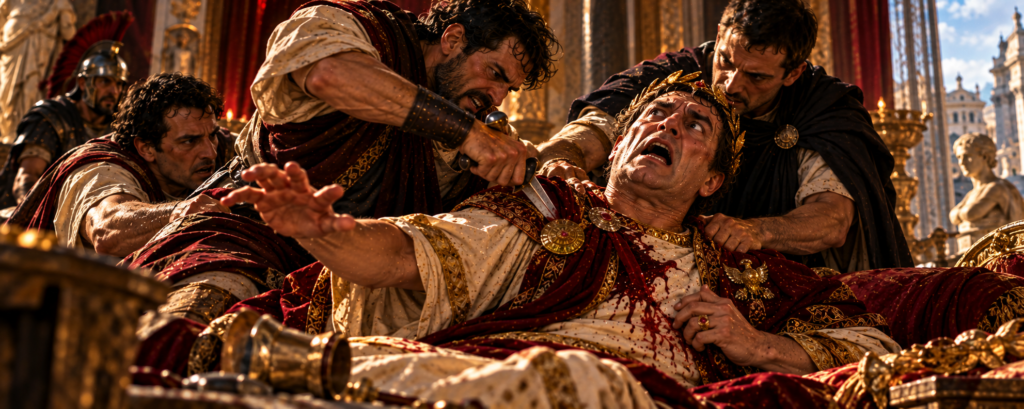
Domitian: The Emperor Murdered Inside His Own Palace
Domitian (51–96 CE) | Roman Emperor, 81–96 CE | Assassinated September 18, 96 CE
Murder in the Emperor’s Bedroom
On the morning of September 18, 96 CE, the emperor Domitian was inside the vast imperial palace on Rome’s Palatine Hill, surrounded by servants, guards, officials, and courtiers whose positions depended upon his favor. For fifteen years he had ruled the Roman Empire with an increasingly personal style of government, rewarding loyal administrators while terrifying senators who believed that accusation, exile, confiscation, or execution might follow a careless word. Domitian had survived military crises, aristocratic conspiracies, and years of political hostility, and ancient writers portray him as becoming deeply suspicious of those around him. Yet the conspiracy that finally killed him did not begin on a distant frontier or in the Senate house; it developed inside the household that was supposed to protect him.
The conspirators understood that reaching the emperor would be extraordinarily difficult. Domitian lived within a carefully controlled palace environment, and access to his person depended upon trusted members of his household. According to the surviving ancient accounts, the plot involved men close enough to manipulate his routine, remove potential protection, and place an assassin directly in his presence. The emperor who had spent years fearing betrayal was therefore destroyed by precisely the kind of intimate conspiracy that imperial security could never completely prevent.
At the center of the assassination was a palace official named Stephanus, who had served as a procurator or steward connected with Domitian’s niece Flavia Domitilla. Ancient accounts say that Stephanus pretended to have an injured arm for several days, wearing bandages that allowed him to conceal a weapon without immediately arousing suspicion. On September 18 he gained access to Domitian by claiming that he possessed information about a conspiracy against the emperor. It was a calculated deception perfectly designed for a ruler whose fear of conspiracy had become one of the defining features of his later reign.
Domitian reportedly dismissed or moved away those around him and examined the document Stephanus had brought. While the emperor was distracted, Stephanus produced the concealed dagger and struck him. The first wound was not immediately fatal, and what followed was not a clean execution but a desperate struggle inside the imperial residence. Domitian fought back, attempting to seize the weapon and calling for assistance while other conspirators rushed in to complete the attack.
Suetonius provides the most detailed surviving description of the murder, although his account was written years later and contains dramatic elements that cannot all be independently verified. According to him, Domitian tried to reach a weapon he expected to find beneath his pillow, only to discover that the sword had been removed. He grappled with Stephanus, cutting his fingers on the attacker’s blade and attempting to overpower him. Additional conspirators then entered and stabbed the emperor repeatedly until he collapsed.
Domitian was forty-four years old. He had ruled longer than any emperor since Tiberius, with the exception of Augustus, and there was no obvious successor waiting to inherit his position. Within hours, however, the Senate recognized the elderly senator Nerva as emperor. The speed of the transition has encouraged centuries of speculation about how extensive the conspiracy really was and whether Nerva knew anything about it beforehand, but no surviving evidence proves that he participated in the murder.
The assassination ended the Flavian dynasty that had restored stability after the catastrophic civil wars of 69 CE. Domitian’s father Vespasian had founded the dynasty, his brother Titus had succeeded him, and Domitian had inherited an empire that appeared far more secure than the one their father had seized. Yet the dynasty ended not on a battlefield but in a private chamber, with a ruler bleeding beneath the weapons of men who had passed through his own doors.
The Younger Son of Vespasian
Titus Flavius Domitianus was born in Rome on October 24, 51 CE, the younger son of the future emperor Vespasian and Flavia Domitilla the Elder. At the time of his birth, the Flavian family was respectable and increasingly successful but hardly comparable with the ancient aristocratic houses that had dominated Roman politics for generations. Vespasian had risen through military service, provincial administration, and the patronage networks of the imperial system. Domitian therefore grew up close enough to power to understand it, but without any certainty that his family would one day possess the throne.
His older brother Titus occupied a different position within the family. Titus was about eleven years older, received an education connected with the imperial court, and developed an impressive military career alongside their father. Domitian, by contrast, spent much of his youth away from the centers of military command that shaped the reputations of Vespasian and Titus. The imbalance between the brothers would later become important to ancient interpretations of Domitian’s personality.
Suetonius claimed that Domitian experienced financial difficulties during his youth and lived in circumstances below what might have been expected of a prominent senator’s son. Some of the biographer’s stories are clearly intended to foreshadow the emperor’s later character and should therefore be approached cautiously. What is clear is that Domitian did not possess the same early military record as Titus. His path toward imperial prominence began suddenly during the political catastrophe of 69 CE.
That year brought the Roman Empire close to disintegration. Nero had died in 68 CE, ending the Julio-Claudian dynasty, and the succession became a contest among powerful generals supported by provincial armies. Galba was murdered, Otho committed suicide after military defeat, and Vitellius seized Rome before Vespasian’s supporters launched another rebellion. Domitian, still only seventeen, found himself trapped in the capital while his father was being proclaimed emperor in the eastern provinces.
The struggle nearly killed him. When Vitellian forces attacked Vespasian’s brother Flavius Sabinus and his supporters on the Capitoline Hill, Domitian was among those caught in the fighting. The Temple of Jupiter Optimus Maximus burned during the violence, Sabinus was captured and killed, and Domitian escaped. Later traditions embellished the details of his disguise and flight, but the essential experience must have been terrifying.
Within days, the political world had been transformed. Vespasian’s forces captured Rome, Vitellius was dragged through the streets and killed, and the Flavian family became the new imperial dynasty. Domitian emerged from hiding as the son of the victorious emperor. The teenager who had recently been fleeing for his life suddenly stood near the center of Roman power.
The Brother Who Lived in Titus’s Shadow
Vespasian did not treat his sons equally in matters of imperial responsibility. Titus was clearly prepared for succession and became his father’s principal partner in government. He received tribunician power, shared important offices, commanded the Praetorian Guard, and accumulated honors that marked him as the future emperor. Domitian received prestigious titles but remained politically secondary.
The arrangement made practical sense. Titus was older, militarily experienced, and had commanded Roman forces during the Jewish War. He had demonstrated his abilities in the field and possessed the experience necessary to assist his father. Domitian was much younger and had not yet built a comparable career.
Ancient writers later claimed that Domitian resented his brother’s prominence. Suetonius accused him of plotting against Titus and attempting to undermine his authority, but such accusations are difficult to verify. The hostile tradition surrounding Domitian encouraged historians to interpret almost every family relationship through jealousy and suspicion. There is little reliable evidence that he actively attempted to overthrow Titus.
Vespasian died in 79 CE, and Titus succeeded peacefully. His reign was brief but eventful, marked by the eruption of Mount Vesuvius, a destructive fire in Rome, and continuing public works. Ancient writers remembered Titus favorably, particularly in contrast with Domitian. The sharp distinction may partly reflect genuine differences in political style, but it was also strengthened by Domitian’s later condemnation.
Titus died unexpectedly in September 81 CE after an illness. Rumors quickly developed that Domitian had somehow contributed to his brother’s death, and later writers repeated accusations that he had hastened the end or failed to help him. No convincing evidence supports the claim that Domitian murdered Titus. The emperor appears to have died from natural illness, although the precise cause remains unknown.
Domitian was proclaimed emperor shortly afterward. At twenty-nine, he had spent more than a decade near the imperial court without being entrusted with the same authority as his brother. He now possessed everything that had previously been withheld from him. The younger son of Vespasian had become master of the Roman world.
A Ruler Determined to Rule
Domitian approached imperial government differently from his father and brother. Vespasian had cultivated an image of practical simplicity, while Titus benefited from a reputation for generosity and accessibility. Domitian displayed a stronger preference for centralized personal authority. He expected officials and senators to recognize that the emperor stood at the center of government.
This did not automatically make his administration ineffective. Modern reassessments have emphasized that Domitian could be an energetic and capable ruler. He took provincial administration seriously, punished corruption, maintained the currency with considerable attention, strengthened frontier defenses, and supervised government business closely. His reign lasted fifteen years partly because the imperial machinery functioned effectively under him.
He also took Roman religion and public morality seriously, or at least presented himself as doing so. Domitian revived traditional offices and ceremonies, including the censorship, which gave him authority over senatorial membership and public morals. He attempted to regulate sexual behavior and enforce older moral legislation. These policies could be presented as traditional Roman conservatism, but they also gave the emperor additional means of scrutinizing elite behavior.
His building program transformed Rome. Domitian completed or restored numerous temples, public structures, and imperial residences damaged by earlier fires. The enormous palace complex on the Palatine, designed by the architect Rabirius, projected imperial magnificence on an unprecedented scale. Its ceremonial spaces reinforced the distance between the emperor and those who approached him.
Domitian also invested heavily in public entertainment. He sponsored games, athletic competitions, and spectacles designed to cultivate popular support. The Capitoline Games, modeled partly upon Greek festivals, became an important feature of his reign. He understood that imperial legitimacy was performed as well as administered.
His relationship with the army was equally important. Domitian increased soldiers’ pay, reportedly by roughly one-third, the first major increase since Augustus. The decision helped strengthen military loyalty but placed additional pressure on imperial finances. A ruler who understood the danger of discontented soldiers had good reason to keep the legions satisfied.
Yet Domitian’s style alienated many senators. He did not disguise his belief that imperial government depended upon the emperor rather than upon an illusion of senatorial partnership. Senators accustomed to ceremonial respect could interpret his behavior as arrogance. Over time, political disagreement became increasingly personal and dangerous.
Domitia Longina and the Imperial Marriage
Domitian’s private life became another source of scandal in the hostile historical tradition. His wife, Domitia Longina, was the daughter of the celebrated general Gnaeus Domitius Corbulo, who had been forced to commit suicide under Nero. She had previously been married to Lucius Aelius Lamia Plautius Aelianus when Domitian became involved with her. Domitian eventually married her, probably around 70 CE.
The marriage produced a son, but the child died young. Domitian later deified the boy, leaving the imperial couple without a surviving biological heir. The absence of a son became increasingly significant as the reign continued. Dynastic uncertainty always created political danger within the Roman imperial system.
Ancient writers describe a turbulent marriage. Suetonius claimed that Domitian divorced Domitia after discovering an affair with the actor Paris, only to restore her because he could not bear the separation. Other evidence confirms that Domitia temporarily disappeared from prominent public presentation, but the exact circumstances remain uncertain. The sensational details may preserve genuine court gossip without providing reliable proof of every accusation.
Paris was reportedly executed. If the traditional story is correct, Domitian’s jealousy had deadly consequences. Yet the sources that preserve the episode were hostile to the emperor, and their interpretation of private court events should not automatically be accepted. Imperial households generated rumors precisely because outsiders had limited access to what occurred within them.
Domitia eventually returned to her position and remained Augusta. Inscriptions and coinage show that she continued to possess public status. She survived Domitian’s assassination by many years. There is no firm evidence that she was punished by the new government for participating in the conspiracy.
Some later accounts nevertheless implicated her in her husband’s murder. Cassius Dio suggested that Domitia may have discovered her name on a list of people Domitian intended to execute and therefore joined the plot. The story is dramatic but difficult to verify, and modern historians generally treat her involvement as uncertain. No surviving contemporary evidence proves that the emperor’s wife helped arrange his death.
The possibility remains fascinating because the conspiracy clearly involved people within the palace environment. Domitia would have possessed access and knowledge unavailable to outsiders. Yet possibility is not evidence. Her role belongs among the unresolved questions surrounding September 96 CE rather than among the established facts.
Julia Flavia and the Darker Palace Rumors
Another woman central to the scandalous tradition surrounding Domitian was Julia Flavia, the daughter of his brother Titus. As the emperor’s niece, she belonged to the heart of the Flavian dynasty. Ancient sources accused Domitian of maintaining a sexual relationship with her. The allegation became one of the most notorious charges against his private life.
Suetonius claimed that Domitian had seduced Julia while Titus was still alive and later continued the relationship after becoming emperor. He further alleged that Julia became pregnant and died after being forced to undergo an abortion. Juvenal and later sources contributed to the broader tradition of sexual scandal. These accounts were written in a cultural environment where accusations of sexual immorality were common weapons against disliked rulers.
Julia did die during Domitian’s reign, probably around 90 or 91 CE, and she was deified after death. The circumstances of her death are not securely known. The claim that a forced abortion killed her cannot be verified independently. It should therefore be presented as an ancient allegation rather than established history.
The story nevertheless became politically useful because it attacked Domitian’s public moralism. An emperor who enforced sexual morality while secretly committing adultery and incest could be portrayed as a hypocrite of extraordinary proportions. Roman writers frequently used such contradictions to discredit rulers. The more severe Domitian’s public standards appeared, the more damaging accusations of private misconduct became.
Domitian’s relationship with the Flavian women also mattered because the dynasty lacked a clear male heir. Julia represented a direct connection to Titus, whose reputation after death became increasingly favorable. Her presence at court therefore carried dynastic significance beyond whatever personal relationship she had with her uncle. Her death narrowed the surviving family network further.
By the 90s, the imperial household had become a place where family relationships, succession anxieties, and political suspicion overlapped. Domitian had no surviving son. Potential heirs existed among relatives, but choosing one could create new centers of ambition. The emperor’s personal isolation therefore had political consequences.
This atmosphere would eventually matter to the assassination. A ruler without an obvious adult successor could be removed without automatically transferring power to a powerful son capable of revenge. Domitian’s household contained relatives, servants, freedmen, and officials whose futures depended upon his decisions. Some of those people would ultimately decide that killing him offered greater security than continuing to serve him.
War on the Rhine and Danube
Domitian’s reign was not confined to palace politics. He devoted considerable attention to the frontiers, particularly along the Rhine and Danube. Military campaigns helped reinforce his authority and allowed him to present himself as a victorious commander. They also exposed him to criticism from senators who mocked some of his triumphal claims.
Early in his reign, Domitian campaigned against the Chatti, a Germanic people beyond the Rhine. The operations resulted in territorial adjustments and the development of frontier defenses. Domitian adopted the title Germanicus and celebrated a triumph. Hostile writers later dismissed the campaign as exaggerated or even fraudulent.
Modern scholarship generally takes the military achievements more seriously than Domitian’s ancient critics did. The strengthening of the frontier and development of the limes represented important strategic work. Domitian was not merely staging imaginary victories. His government invested substantially in securing vulnerable regions.
The Danube presented even greater challenges. The Dacians under King Decebalus inflicted serious defeats upon Roman forces, including the destruction of an army commanded by the praetorian prefect Cornelius Fuscus. The setback was humiliating and dangerous. Domitian responded by reorganizing operations and committing additional resources.
Roman forces eventually achieved important successes, but circumstances elsewhere forced Domitian to negotiate with Decebalus. The resulting agreement provided subsidies and technical assistance to Dacia in exchange for political concessions. Ancient critics portrayed the settlement as shameful. Later Roman expansion under Trajan made Domitian’s compromise appear especially weak to writers celebrating subsequent conquest.
The situation was more complicated. Rome faced simultaneous pressures along multiple frontiers, and a negotiated settlement could be strategically sensible. Domitian’s decision bought time and reduced immediate threats. It should not simply be interpreted as cowardice.
Military pressures nevertheless affected domestic politics. Generals commanding large forces always represented potential dangers to an emperor. Domitian understood this better than most. In 89 CE, his fears became reality when a provincial commander attempted to overthrow him.
Saturninus: The Rebellion That Changed the Reign
Lucius Antonius Saturninus governed Upper Germany and commanded important military forces along the Rhine. In January 89 CE, he rebelled against Domitian and was proclaimed emperor by two legions at Mogontiacum, modern Mainz. The revolt represented the most serious direct military challenge of Domitian’s reign. For an emperor already inclined toward close supervision, the betrayal must have confirmed the danger of allowing powerful men too much independence.
Saturninus apparently expected assistance from Germanic allies across the Rhine. According to the ancient tradition, a sudden thaw disrupted the frozen river and prevented those allies from crossing. Whether this detail has been dramatized or not, the rebellion quickly lost momentum. Loyal forces moved against Saturninus before Domitian could arrive personally.
The revolt was crushed by troops under Lappius Maximus, governor of Lower Germany. Saturninus was killed, and his severed head was reportedly sent to Rome. The rebellion had lasted only a short time. Its political consequences, however, extended far beyond the battlefield.
Lappius Maximus allegedly burned Saturninus’s papers after defeating him. If true, the act may have protected people whose names appeared in correspondence with the rebel. Domitian could have interpreted such destruction as mercy, concealment, or both. The episode illustrates how conspiracy investigations could spread suspicion far beyond the original participants.
Punishments followed. Individuals suspected of involvement were executed or otherwise disciplined, and the rebellious legions were reorganized. Domitian also took measures intended to reduce the possibility of similar military conspiracies. The emperor had received a powerful reminder that provincial armies could still make emperors just as they had in his father’s time.
The revolt appears to have intensified the atmosphere of suspicion surrounding the later reign. It would be too simple to claim that Domitian suddenly became paranoid in 89 CE, but the rebellion provided concrete evidence that enemies existed. Fear of conspiracy was no longer merely theoretical. A Roman commander had actually attempted to replace him.
From that point onward, accusations of treason became increasingly prominent in the surviving sources. Senators and philosophers faced exile or execution, while informers gained influence. Some accounts may exaggerate the scale of repression, but there is little doubt that Domitian’s relationship with the senatorial elite deteriorated sharply. The emperor had survived Saturninus, but the victory did not make him feel secure.
The Senate and the Emperor Who Did Not Pretend
Roman emperors ruled through a political system filled with contradictions. In theory, the Senate remained an honored institution of the Republic, while in practice the emperor controlled the armies, finances, provincial appointments, and much of the administration. Successful rulers usually maintained the fiction that senators remained partners in government. Domitian showed less patience for that performance.
He accepted the censorship for life, allowing him extensive influence over the composition and conduct of the Senate. He presided closely over meetings and expected senators to recognize his authority. Ancient writers accused him of demanding excessive forms of address and cultivating divine honors. The famous claim that he required the title “lord and god” remains debated, particularly regarding whether it represented an official requirement or hostile exaggeration.
Domitian’s ceremonial style certainly emphasized imperial majesty. The palace architecture of the Palatine created spaces designed to impress visitors with the ruler’s elevated position. Court ritual became more elaborate. Senators accustomed to viewing themselves as Rome’s natural governing class could experience such displays as deliberate humiliation.
His relationship with aristocratic opposition became increasingly poisonous. Philosophers associated with Stoic traditions were expelled, and several prominent senators were prosecuted. Charges could involve conspiracy, treason, impiety, or other offenses. The exact political circumstances of individual cases varied considerably.
Helvidius Priscus the Younger was executed, reportedly after offending the emperor through writings or performances interpreted as attacks upon him. Junius Arulenus Rusticus was executed after praising Thrasea Paetus, a famous senatorial opponent of Nero. Herennius Senecio suffered a similar fate after writing about Helvidius Priscus the Elder. To later senatorial writers, these deaths demonstrated Domitian’s hatred of intellectual independence.
Yet the sources describing these events were themselves shaped by the senatorial tradition that emerged after Domitian’s death. Pliny the Younger and Tacitus had strong reasons to emphasize the terror of the previous regime while praising the political atmosphere under later emperors. Their testimony remains invaluable, but it is not neutral. Domitian’s reign must be reconstructed through writers who often regarded him with deep hostility.
The executions nevertheless created genuine fear. Even if the scale of Domitian’s terror was exaggerated afterward, prominent Romans were killed by his government. Confiscation of property could accompany conviction, creating suspicions that financial motives influenced prosecutions. Informers became symbols of the increasingly oppressive atmosphere.
The emperor who feared conspiracy was therefore creating the conditions in which conspiracy became more attractive. Senators might resent him, but senators alone could not easily reach him. The more dangerous threat would come from people inside the palace. Domitian’s efforts to control elite opposition could do little against servants who knew when he slept, where he kept his weapons, and how to approach him without raising alarm.
Fear Inside the Palace
Ancient accounts portray Domitian’s final years as dominated by suspicion. Suetonius famously claimed that the emperor had the walls of a palace walkway covered with a reflective stone so that he could see what was happening behind him. The image is almost too perfect: a ruler so fearful of assassination that even his walls became mirrors. Whether the detail is entirely accurate or partly literary, it became a lasting symbol of his reputation.
Domitian’s fears were not irrational in the strict sense. Roman emperors had repeatedly been assassinated by people close to them. Caligula had been killed by Praetorian officers, Claudius was widely believed in antiquity to have been poisoned, Galba had been murdered by soldiers, and Vitellius had been killed after civil war. Domitian himself had survived the violent struggle of 69 CE and the rebellion of Saturninus.
The palace was simultaneously the safest and most dangerous place in the empire. Guards controlled entrances, officials regulated access, and servants attended the emperor constantly. Yet those same people knew his habits better than anyone outside the household. An assassin who belonged within the palace did not need to break through its defenses.
Domitian increasingly depended upon freedmen and household officials to manage imperial business. Such men could possess extraordinary influence despite lacking senatorial status. Their access made them useful administrators. It also made them potentially dangerous enemies.
Among the most important was Parthenius, the emperor’s chamberlain. His position gave him intimate access to Domitian and knowledge of palace routines. Ancient sources place him among the principal organizers of the conspiracy. If those accounts are correct, Domitian’s assassination was made possible by the betrayal of one of the men responsible for managing access to him.
Other palace officials were also implicated. Suetonius names figures including Maximus, a freedman of Parthenius, and Satur, another member of the imperial household. The precise responsibilities and involvement of every participant are not completely clear. What matters is that the conspiracy extended beyond a single disgruntled attacker.
The emperor’s fear therefore became tragically self-confirming. Domitian suspected that people around him might want him dead. Eventually, some of them did. The security system designed to protect him could not function once trusted insiders became the organizers of the murder.
The Execution of Flavius Clemens
One of the most important events preceding Domitian’s assassination was the execution of his cousin Titus Flavius Clemens in 95 CE. Clemens belonged to the imperial family and had served as consul alongside Domitian. His wife, Flavia Domitilla, was also closely related to the dynasty. Their sons had apparently been designated for important dynastic roles.
Domitian had taken an interest in the boys and reportedly renamed them Vespasian and Domitian. The choice strongly suggests that they were being considered as potential heirs. With the emperor lacking a surviving son, these children offered a means of continuing the Flavian line. Their parents therefore occupied a politically sensitive position.
Shortly after Clemens completed his consulship, Domitian ordered his execution. Ancient sources describe the charge in terms of “atheism” or practices associated with Jewish customs, although the precise meaning remains debated. Later Christian traditions connected members of this family with Christianity. The evidence is insufficient to state confidently that Clemens was executed simply for being a Christian.
The speed and severity of the punishment shocked later writers. Cassius Dio portrayed Clemens as a man of little political ambition, making his execution appear especially arbitrary. Yet the exact political background remains obscure. Domitian may have suspected disloyalty or perceived a dynastic threat.
Flavia Domitilla was exiled. The fate of the couple demonstrated that even close family connections offered little protection when Domitian became suspicious. It also affected the succession because the parents of potential heirs had been removed. The imperial household became even more politically unstable.
The execution may have directly contributed to the conspiracy. Parthenius and other palace officials had reason to fear that the emperor’s suspicions were expanding. Stephanus, the eventual assassin, was associated with a Domitilla, although ancient sources create uncertainty about exactly which woman and household relationship was involved. The connection between the execution of Clemens and the murder of Domitian remains suggestive rather than fully documented.
What is clear is that Domitian entered the final year of his life increasingly isolated. Important aristocrats had been executed, family members had been punished, and palace officials may have feared that their own names would be next. An emperor who attempted to eliminate potential enemies could unintentionally convince uncertain men that they had no safe option except striking first.
The List of Names: History or Perfect Assassination Story?
One of the most dramatic traditions surrounding Domitian’s death concerns a list of people he supposedly intended to execute. According to Cassius Dio, the emperor had written the names of individuals marked for death on a tablet and placed it beneath his pillow. A young servant allegedly stole the document and brought it to Domitia Longina. She discovered her own name along with those of Parthenius and other officials.
The story provides an elegant explanation for the conspiracy. Men and women who might otherwise have remained loyal suddenly learned that their survival depended upon killing the emperor before he killed them. It transforms the assassination into an act of desperate self-preservation. For ancient historians, the narrative also offered a satisfying example of a tyrant destroyed by his own cruelty.
The problem is that the story cannot be independently verified. Cassius Dio wrote more than a century after Domitian’s death, drawing upon earlier sources that are now lost. Details involving secret execution lists appear elsewhere in ancient political literature. The episode may preserve genuine information, but its dramatic perfection should encourage caution.
Domitia’s supposed involvement depends heavily upon this tradition. If she discovered her own name on an execution list, participation in the conspiracy would become understandable. Without the list, the evidence linking her to the murder becomes much weaker. Her role therefore remains uncertain.
Parthenius had clearer reasons for fear. As chamberlain, he possessed both influence and vulnerability. Imperial freedmen could rise extraordinarily high but could also fall instantly if the emperor withdrew his favor. A suspicious ruler represented a constant danger to those closest to him.
The conspirators also had to consider what would happen if their plot failed. Attempted assassination of the emperor constituted treason and would almost certainly result in torture and death. Their willingness to proceed suggests either intense fear, intense hostility, confidence in broader support, or some combination of all three. The decision was not one they could safely reverse.
Whether or not an actual death list existed, the political atmosphere made such a story believable. Domitian had executed prominent men and punished members of his own family. Those around him knew that proximity to power offered no guarantee of survival. Fear had become capable of generating the very conspiracy the emperor feared.
Stephanus Begins to Prepare
Stephanus occupies a strange place in Roman history. He was not a celebrated senator, general, or philosopher, yet he became the man who struck the first blow against one of Rome’s longest-reigning emperors. His position within the household gave him something far more valuable than public prestige: access. The conspiracy depended upon turning that access into an opportunity for murder.
Suetonius describes Stephanus as the procurator of Domitilla. Precisely which Domitilla is meant has generated scholarly discussion because several women in the Flavian family bore the name. He had reportedly been accused of embezzlement or financial misconduct. If true, he may have feared punishment independently of the broader conspiracy.
For several days before the assassination, Stephanus wore his arm wrapped in bandages. The explanation was that he had suffered an injury. According to Suetonius, the bandaging concealed a dagger. The preparation suggests careful planning rather than a spontaneous attack.
The disguise was clever because an injured arm would attract little suspicion from palace personnel who saw him regularly. Repeating the appearance over several days allowed the bandage to become familiar. When the crucial morning arrived, the concealed weapon no longer looked unusual. The conspirators had turned routine into camouflage.
Other preparations were allegedly made inside Domitian’s chamber. Suetonius claims that the sword normally kept beneath the emperor’s pillow was removed. If accurate, this detail proves that Stephanus did not act alone. Someone with access to the private room had deliberately deprived Domitian of a weapon.
The palace conspirators also needed to control the emperor’s attendants. Domitian could not be attacked safely while surrounded by armed guards and loyal servants. The plot therefore required manipulation of access, timing, and information. Every stage depended upon insiders.
The chosen method exploited Domitian’s greatest fear. Stephanus would approach with a document supposedly revealing a conspiracy. An emperor worried about assassination could hardly ignore such information. The conspirators used Domitian’s suspicion as the means of isolating him.
The irony is almost brutal in its precision. Domitian had spent years trying to identify hidden enemies. On the day of his death, the promise of exposing those enemies persuaded him to admit the man carrying the knife.
September 18, 96 CE
Ancient traditions portray Domitian as unusually anxious on the day of his death. Suetonius claims that astrologers had predicted the year and even the approximate hour of his end. The emperor was famously interested in astrology and had reportedly taken predictions concerning his death seriously. Such stories may have been embellished after the event because prophetic warnings were common features of ancient biographies.
Domitian was said to have been particularly concerned about the fifth hour of the day. According to Suetonius, conspirators deliberately misled him about the time, convincing him that the dangerous hour had passed. Relieved, he prepared to attend to other business. Stephanus then arrived with his supposedly urgent information.
The chronology is dramatically satisfying but cannot be confirmed in every detail. Ancient writers frequently surrounded the deaths of rulers with omens, dreams, prophecies, and supernatural warnings. Domitian’s known interest in astrology made him especially suitable for this literary treatment. The safest conclusion is that the assassination occurred on September 18 and that later tradition remembered the emperor as anticipating danger.
Stephanus was admitted to Domitian’s private presence. He presented a document that allegedly contained information about a conspiracy. The emperor began reading it. The moment gave Stephanus the opening he needed.
The assassin drew the dagger concealed beneath his bandages and stabbed Domitian in the groin or lower abdomen. The wound shocked the emperor but did not immediately incapacitate him. Domitian reacted violently and attempted to defend himself. The assassination became a physical struggle rather than an effortless killing.
Suetonius reports that Domitian demanded his attendant bring the sword kept beneath his pillow. The servant found only the empty hilt or discovered that the weapon had been removed. The precise detail varies in interpretation, but the meaning is clear. The emperor’s defenses had been sabotaged before Stephanus entered.
Domitian then grappled with his attacker. He reportedly seized the blade with his bare hand, cutting his fingers severely while attempting to wrestle it away. The image is striking because it contradicts the portrait of a completely cowardly tyrant. Whatever his political failings, Domitian apparently fought desperately for his life.
Eight Wounds in the Palace
Stephanus alone may not have been able to kill Domitian. The emperor resisted, and the struggle created the possibility that guards or servants might intervene. At this point, other conspirators entered the room. The assassination became a coordinated attack.
Suetonius names several men who participated directly in the killing. They included Clodianus, a subordinate officer, Maximus, a freedman of Parthenius, Satur, a palace official, and a gladiator. The exact identities and functions of all participants remain somewhat uncertain. Their presence nevertheless demonstrates that the conspiracy reached across different levels of the imperial household.
The attackers stabbed Domitian repeatedly. Suetonius states that the emperor received seven additional wounds after Stephanus’s initial blow, producing the traditional total of eight. Ancient numerical details should always be approached with some caution, but there is no reason to doubt that multiple attackers struck him. The killing was violent and sustained.
Stephanus was himself wounded during the struggle and died shortly afterward. This detail reinforces the impression that Domitian resisted fiercely. The emperor was not simply surprised and immediately overwhelmed. His final moments involved close physical combat.
The assassination took place inside the residence from which Domitian had governed the Roman world. Beyond the chamber stood the enormous palace complex that projected his authority over senators, ambassadors, officials, and petitioners. Inside the room, however, imperial magnificence offered no protection. Political power had contracted to a struggle between one wounded man and the servants who wanted him dead.
No Praetorian rescue arrived in time. No loyal senator burst through the doors. No member of the Flavian family possessed the power to reverse what was happening. The carefully structured imperial household had been compromised from within.
Domitian finally collapsed under the repeated wounds. He died on September 18, 96 CE, ending a reign of approximately fifteen years. The Flavian dynasty that had emerged from the civil wars of 69 CE ended in a bedroom assassination twenty-seven years later.
Where Were the Praetorian Guards?
The failure of the Praetorian Guard to save Domitian raises important questions. The Guard existed specifically to protect the emperor and secure the capital. Domitian had generally maintained good relations with the military, including increasing soldiers’ pay. Yet his assassins reached him inside the palace and completed the killing without immediate interference.
One explanation is simply that palace security depended upon layers of trusted insiders. Praetorians could guard entrances and strategic points, but they could not stand directly beside the emperor every moment of the day. Chamberlains, freedmen, servants, and household officials controlled intimate access. Once those people joined a conspiracy, conventional security became much less effective.
The role of the Praetorian prefects is also uncertain. Later traditions sometimes suggest that senior officers may have known more about the conspiracy than the surviving evidence proves. Casperius Aelianus, who had previously served as prefect and later returned to the position under Nerva, eventually demanded punishment of Domitian’s assassins. That later crisis suggests that at least part of the Guard remained strongly attached to the murdered emperor.
The soldiers’ loyalty became apparent after Domitian’s death. Suetonius reports that the troops were angered and demanded that he be deified and that his killers be punished. The Senate reacted very differently. The contrast exposed a dangerous division between military and aristocratic attitudes toward the dead ruler.
If the entire Guard had been part of the conspiracy, such anger would be difficult to explain. It is more plausible that a relatively small palace network organized the murder while most soldiers remained uninformed. Surprise was essential to success. A conspiracy involving too many people would have been much easier to expose.
Domitian’s assassination therefore illustrates the limits of imperial protection. Guards could defeat external attackers, suppress riots, and intimidate political opponents. They could not easily protect a ruler from the officials responsible for deciding who was allowed into his private rooms. Security collapsed because trust collapsed.
The same vulnerability had killed earlier emperors. Caligula had been murdered by officers who understood his movements. Claudius was believed by many ancient writers to have been poisoned within his household, although the details remain disputed. Domitian joined a long list of rulers who discovered that the most dangerous distance in Roman politics was not between the emperor and his enemies, but between the emperor and those standing closest to him.
Did Domitia Help Kill Her Husband?
The possible involvement of Domitia Longina remains one of the most intriguing mysteries surrounding the assassination. Some ancient traditions connected her to the conspiracy, particularly through the story of the execution list. If Domitian intended to kill her, she would have possessed a powerful motive for joining the plot. Her position would also have made her an invaluable source of information about palace routines.
Yet the evidence is far from decisive. Suetonius, despite providing a detailed account of the assassination, does not clearly establish Domitia as one of its principal organizers. Cassius Dio’s later narrative provides the strongest basis for implicating her. The chronological distance between Dio and the events requires caution.
Domitia’s behavior after the assassination also complicates the accusation. Inscriptions indicate that she continued to identify herself in relation to Domitian after his death. This does not prove affection or innocence, but it makes the image of a wife eagerly celebrating her husband’s murder less straightforward. She appears to have preserved aspects of his memory privately even after the state condemned it.
Political survival may explain such contradictions. A Roman imperial woman could participate in a conspiracy and later maintain public respectability. She could also be falsely accused simply because later writers assumed that anyone close to Domitian must have feared him. The surviving evidence does not allow certainty.
The story of Domitia discovering her own name on a death list is particularly difficult to evaluate. It provides an almost theatrical motive for murder. The emperor prepares to destroy his household, the household discovers his plan, and the intended victims strike first. Ancient historians valued exactly this kind of moral reversal.
For a historically responsible account, Domitia should therefore remain a possible rather than proven conspirator. Her name belongs in discussions of the plot because ancient sources connect her to it. It should not be stated as fact that she arranged Domitian’s assassination.
The uncertainty itself reveals something important about palace politics. Domitian’s marriage existed within a world where personal relationships and political survival were inseparable. A wife could also be an Augusta, a dynastic figure, and a potential political threat. Even the emperor’s bedroom belonged partly to the state.
Was Nerva Waiting for the Murder?
Within hours of Domitian’s death, Marcus Cocceius Nerva was recognized as emperor. He was an elderly senator with a long public career and connections stretching back through previous regimes. His rapid elevation naturally generated suspicion. Had the conspirators already selected him before they killed Domitian?
The possibility is reasonable. Assassinating an emperor without considering the succession would have been extraordinarily dangerous. The conspirators needed someone acceptable to the Senate and at least tolerable to the military. Nerva’s age, experience, and lack of an obvious personal army made him an attractive compromise.
Cassius Dio and later traditions encouraged speculation that Nerva knew of the plot. Some modern historians have considered it likely that at least preliminary discussions occurred. Yet no surviving evidence proves that Nerva actively planned or authorized the assassination. His rapid accession alone is not enough to establish guilt.
Nerva had survived the reigns of Nero, Vespasian, Titus, and Domitian. He had held the consulship and belonged to the senatorial establishment without becoming a major military rival. His political experience made him suitable for a transition. The conspirators may simply have known that the Senate would accept him.
His age was also politically useful. Nerva was in his mid-sixties and had no son. He did not represent the beginning of an obvious hereditary dynasty. Senators who feared another dominant Flavian-style ruler may have viewed him as a safer choice.
The speed of his recognition nevertheless suggests that Domitian’s death did not leave the political elite entirely unprepared. Rome did not descend immediately into the kind of open succession struggle seen after Nero. Someone had thought about what would happen after the assassination. Whether that someone included Nerva remains unknown.
The uncertainty prevents the murder from being reduced to a simple household quarrel. Domitian’s killers may have acted partly from personal fear, but they were removing the head of the Roman state. A successful assassination required a political future as well as a weapon. Nerva became that future almost immediately.
The Senate Celebrates
If the soldiers mourned Domitian, many senators reacted with undisguised relief. Suetonius describes senators rushing to condemn the dead emperor’s memory. His statues and portraits were torn down, inscriptions were altered, and official honors were revoked. The political class that had feared him while he lived now attacked his memory when he could no longer retaliate.
The Senate decreed measures commonly associated with what modern historians call damnatio memoriae, although the Romans did not use that precise formal term as a standard legal label. Domitian’s name was erased from inscriptions in many places, and images were destroyed or reworked. The objective was not literally to make everyone forget him. It was to deny him the honors normally attached to an emperor.
The violence against his memory reflected genuine senatorial resentment. Men had been executed or exiled during his reign, and others had lived under the threat of accusation. Families had lost relatives and property. Domitian’s death offered an opportunity for revenge without physical danger.
It also encouraged exaggeration. Once the political climate changed, survivors had incentives to portray themselves as victims of tyranny. Cooperation with Domitian could be minimized, while resistance could be emphasized. The new regime benefited from contrasting its supposed moderation with the previous emperor’s oppression.
Pliny the Younger provides one of the clearest examples. His Panegyricus praised Trajan partly by contrasting him with Domitian, whose reign became a dark background against which the new emperor’s virtues shone. Tacitus similarly wrote within a post-Domitianic environment where condemnation of the previous ruler was politically acceptable. Their works remain indispensable, but their perspective was shaped by the world in which they wrote.
The Senate’s celebration therefore tells us both about Domitian and about his enemies. His government had unquestionably alienated powerful aristocrats. Yet the intensity of the posthumous attack also demonstrates how historical reputations could be constructed by survivors. Domitian lost not only his life but much of his ability to influence how his reign would be remembered.
His assassins had killed the man. The Senate helped kill the public image he had created.
The Army Remembers a Different Domitian
The military reaction to Domitian’s death was far less enthusiastic. Soldiers had benefited from his pay increase and generally experienced a ruler attentive to frontier defense. Many did not share the Senate’s hatred. The difference between military and senatorial memory quickly became politically dangerous.
The Praetorian Guard in particular demanded justice for the assassination. Nerva initially lacked the authority or military strength to ignore them indefinitely. The men who had killed Domitian remained vulnerable despite helping create the new government. Their victory inside the palace had not guaranteed their long-term survival.
In 97 CE, the crisis erupted. Casperius Aelianus, serving as Praetorian prefect, allowed or encouraged the Guard to seize Nerva and demand the surrender of Domitian’s assassins. The new emperor was humiliated and forced to comply. Several conspirators were killed.
Parthenius suffered an especially brutal fate according to Cassius Dio. The details preserved by later sources are gruesome and may contain exaggeration, but there is little doubt that he was killed in revenge for Domitian’s assassination. The palace chamberlain who had helped destroy one emperor could not rely upon the next emperor to protect him.
The episode demonstrated the weakness of Nerva’s position. He had the Senate’s support but lacked the military authority necessary to control the Guard. Domitian’s murder had solved one political problem while creating another. The men responsible for the assassination became symbols of the new regime’s vulnerability.
Nerva responded by adopting Trajan, a respected general with strong military support, as his heir. The decision stabilized the government and created the succession that later historians celebrated as the beginning of an era of capable adoptive emperors. Domitian’s assassination therefore indirectly contributed to one of the most important political transitions in Roman history.
The contrast remains striking. Senators remembered Domitian as a tyrant whose death brought liberation. Soldiers remembered an emperor who had rewarded them and demanded punishment for his killers. Both memories belonged to the same reign.
Tyrant, Administrator, or Both?
Domitian’s historical reputation has changed considerably over time. Ancient senatorial writers created an enduring portrait of a suspicious, cruel, arrogant ruler obsessed with power and terrified of conspiracy. For centuries, that image dominated popular accounts. Modern historians have approached the evidence with greater skepticism.
Administrative records reveal a ruler who paid close attention to provincial government. Domitian appointed capable officials and punished corruption. He managed finances more effectively than the caricature of uncontrolled extravagance would suggest. His coinage reforms and fiscal policies demonstrate serious engagement with economic administration.
His frontier policies have also been reassessed. The campaigns against the Chatti and Dacians were not simply theatrical performances. Domitian strengthened defensive systems and responded to genuine military threats. Some decisions criticized by ancient writers appear strategically defensible when considered in context.
His building program was extensive and influential. Rome’s monumental landscape changed dramatically during his reign. The imperial palace on the Palatine shaped the physical expression of monarchy for centuries. These achievements cannot be reconciled easily with the image of a ruler interested only in cruelty.
Yet reassessment should not become rehabilitation without limits. Domitian did execute senators and political opponents. Philosophers were expelled, treason accusations created fear, and members of his own extended family suffered severe punishment. His later government became increasingly coercive.
The crucial issue is perspective. Senators experienced Domitian’s centralized rule differently from soldiers, provincials, administrators, or urban crowds. An emperor could govern efficiently while terrifying part of the political elite. Administrative competence and authoritarian brutality are not mutually exclusive.
Domitian may therefore have been both more capable and more dangerous than the traditional caricature suggests. He was not simply a mad tyrant stumbling toward inevitable assassination. He was an effective ruler whose increasingly suspicious and autocratic style created enemies inside the very system he had strengthened.
That complexity makes his murder more historically interesting. The assassination was not the obvious removal of a universally hated monster. It was the violent solution chosen by a relatively small group of insiders who believed, for reasons that remain partly obscure, that they could no longer safely live under him.
Assassination or Tyrannicide?
To Domitian’s senatorial enemies, his death could be interpreted as liberation. The emperor had executed prominent aristocrats, punished critics, and concentrated authority in his own hands. Once he was dead, senators openly condemned him and praised the new political atmosphere. The language surrounding his memory resembles older Roman traditions of tyrannicide.
The Romans possessed a powerful cultural memory of men who killed supposed tyrants. Brutus and Cassius had claimed that Julius Caesar’s assassination restored liberty. Later generations continued debating whether murdering a ruler could be justified when ordinary political remedies failed. Domitian’s killers operated within a society familiar with those arguments.
Yet Stephanus was not Brutus. The conspiracy appears to have been organized primarily within the imperial household rather than presented publicly as a philosophical defense of republican liberty. Personal fear, threatened punishment, palace rivalry, and survival may have mattered more than abstract political ideals. The assassins left no surviving manifesto explaining their motives.
The Senate’s later celebration gave the murder a political meaning that the killers themselves may not have fully shared. Domitian could be transformed into a tyrant whose death allowed freedom to return. Nerva’s government benefited from that interpretation. The story became morally cleaner after the fact.
The military reaction exposed the weakness of the tyrannicide narrative. Many soldiers did not regard Domitian’s death as liberation. They viewed it as murder and demanded punishment. The same event could therefore appear as heroic resistance to one group and criminal betrayal to another.
Domitian’s assassination is best understood as both a palace conspiracy and a political killing. It removed an emperor whose policies had generated intense elite hostility. It also served the immediate interests of insiders who feared his continuing rule. Those motives need not have been mutually exclusive.
Calling the murder tyrannicide captures how some Romans interpreted it, but it should not be treated as an objective description. Whether Domitian was a tyrant depended partly upon who was judging him. The assassins killed a ruler; later writers decided what his death meant.
The Flavian Dynasty Ends Behind Closed Doors
The Flavian dynasty had begun in civil war. Vespasian’s armies defeated Vitellius in 69 CE, restoring political stability after a year in which emperors rose and fell with terrifying speed. Vespasian ruled for a decade and died naturally. Titus succeeded peacefully and also died without violence.
Domitian’s assassination shattered that pattern. The dynasty that had presented itself as the answer to military chaos ended through a conspiracy inside its own palace. No foreign enemy breached Rome’s defenses. No rebellious legion marched into the imperial bedroom.
The absence of a surviving son made the transition especially important. Domitian had failed to establish a secure hereditary succession. Potential heirs within the extended Flavian family had become entangled in suspicion and punishment. When he died, there was no adult Flavian prince capable of claiming the throne immediately.
Nerva’s accession therefore marked the end of the family that had ruled Rome for twenty-seven years. The Senate could celebrate a new beginning, but the transition remained dangerous. The Praetorian crisis of 97 demonstrated how easily the empire might have returned to violence. Stability required another solution.
The adoption of Trajan provided that solution. Nerva selected a successful general capable of commanding military loyalty. Trajan’s eventual succession in 98 CE occurred peacefully. The empire entered a period later remembered as one of its greatest.
This outcome can make Domitian’s assassination appear almost beneficial in retrospect. That interpretation should be resisted. The conspirators could not know that Trajan would eventually become emperor or that the succession would stabilize. They were taking an enormous risk.
Had the Praetorians rejected Nerva immediately or provincial armies proclaimed competing candidates, Rome might have experienced another civil war. The murder succeeded politically because events after it happened to remain manageable. Assassination removed Domitian, but it did not guarantee a better future.
The Palace Where Power Became a Trap
Domitian’s assassination possesses an almost architectural symbolism. He had built and occupied one of the most imposing imperial residences Rome had ever seen. The Palace of Domitian dominated the Palatine Hill, overlooking the city from which the empire was governed. Its scale communicated distance, majesty, and control.
The complex included enormous reception halls where visitors approached the emperor through carefully choreographed spaces. Marble, columns, fountains, and elevated platforms reinforced the ruler’s status. Architecture became a political language. Domitian’s palace told everyone who entered that the emperor occupied a world above ordinary men.
Yet ceremonial grandeur could not eliminate human vulnerability. The palace required hundreds of people to function. Servants opened doors, attendants carried messages, chamberlains controlled audiences, guards watched corridors, and freedmen managed private business. Every layer of protection created another relationship of trust.
Parthenius understood those relationships because he helped administer them. Stephanus understood how to appear harmless because he belonged within the wider household environment. Someone knew where Domitian’s sword was kept. Someone ensured that the assassin reached him.
The palace therefore became a trap. Domitian’s security depended upon men who had decided that he was the danger. Walls could keep enemies outside, but they could not identify enemies already inside. The greater the emperor’s isolation from ordinary political life, the more dependent he became upon a small circle of intimate attendants.
His death illustrates a recurring problem of autocratic government. Concentrating power in one person also concentrates enormous importance in access to that person. Household servants can become political actors because private space becomes government space. A bedroom can become the center of an empire.
Domitian had built a palace designed to make him appear untouchable. He died within it because the men who controlled its doors no longer wanted to protect him. Few endings better capture the paradox of absolute power.
What Happened to the Conspirators?
The assassins’ immediate success did not guarantee their survival. Stephanus died from wounds received during the struggle with Domitian. Other conspirators initially survived because Nerva’s accession protected the political transition. Yet military anger continued to threaten them.
Parthenius became the most prominent target. As Domitian’s chamberlain, he was widely regarded as one of the organizers of the murder. His betrayal carried particular emotional weight because his office had required personal loyalty to the emperor. The Praetorians eventually demanded revenge.
When Casperius Aelianus and the Guard challenged Nerva in 97 CE, the emperor was forced to surrender individuals connected with the assassination. Ancient sources describe their deaths as brutal. Parthenius was among those killed. The details vary, but the political meaning is clear.
Nerva reportedly found the humiliation unbearable. An emperor had been forced by his own guards to hand over men associated with the event that had placed him on the throne. His authority had been publicly exposed as fragile. The crisis demonstrated that senatorial approval alone could not secure imperial power.
The assassins therefore achieved only a temporary victory. They removed Domitian, but some soon died because of that act. Their fate resembled the broader pattern of political assassination in Roman history. Killing the ruler rarely ended the conflict surrounding him.
The Praetorian revenge also complicated the Senate’s celebration of Domitian’s death. If the assassination had universally represented liberation, its perpetrators should have been honored. Instead, armed soldiers demanded their blood. Rome remained divided over the dead emperor.
The surviving conspirators largely disappeared from history. They had changed the succession of the Roman Empire, yet their individual motives remain obscure. Their most enduring legacy was the empty throne they created.
Domitian’s Memory After Death
Official condemnation could damage Domitian’s public memory, but it could not erase him. Coins, inscriptions, buildings, and administrative decisions preserved evidence of his reign. His enormous palace remained physically present on the Palatine. Rome continued living among monuments created or restored under the emperor it had officially condemned.
Some inscriptions had his name removed. Statues were destroyed, recut, or replaced. Portraits could be transformed into images of later rulers. Such practices demonstrated the state’s rejection of the dead emperor while simultaneously revealing how difficult true erasure was.
Outside elite literary circles, attitudes may have been more complicated. Soldiers remembered his generosity. Provincial communities had experienced administrative policies rather than senatorial treason trials. People who benefited from public games or building projects may not have shared aristocratic hatred.
Later emperors also inherited institutions strengthened during Domitian’s reign. Frontier systems, administrative practices, and architectural projects did not disappear simply because the Senate condemned their creator. Trajan’s government built upon an empire that Domitian had helped organize. Political continuity survived official denunciation.
Christian tradition eventually added another layer to his reputation. Later writers portrayed Domitian as a persecutor of Christians, sometimes placing him alongside Nero. The evidence for a systematic empire-wide persecution under Domitian is weak and heavily debated. Individual Christians may have suffered, but the traditional picture of a coordinated general persecution is not securely established.
The emperor’s image therefore accumulated multiple layers of hostility. Senators remembered tyranny, Christian writers remembered persecution, and biographers remembered sexual scandal and paranoia. Each tradition reinforced the others. Domitian became one of Rome’s archetypal “bad emperors.”
Modern historical analysis has peeled away some of those layers without eliminating the darker evidence. The result is not an innocent Domitian but a more complicated one. His government could be efficient, his frontier policies rational, and his administration capable while his political methods remained harsh and increasingly frightening.
The Emperor Who Saw Enemies Everywhere
The most haunting element of Domitian’s death is the relationship between fear and reality. Ancient writers portrayed him as suspicious to the point of obsession. He feared conspiracies, monitored aristocrats, punished perceived enemies, and surrounded himself with elaborate security. Later historians used these habits as evidence that tyranny had made him paranoid.
Yet conspiracies against Roman emperors were real. Saturninus had actually rebelled. Senators really did hate Domitian. Members of his household really did eventually organize his murder. His fear was therefore not imaginary.
The tragedy lay in how he responded to danger. Executions and intimidation might eliminate individual enemies, but they could also create new ones. Punishing relatives and officials made everyone around the emperor wonder whether they might be next. Security based upon fear becomes increasingly unstable when those responsible for providing security become frightened themselves.
Parthenius may have feared for his life. Stephanus may have feared prosecution. Domitia may or may not have believed herself threatened. Whatever their individual motives, enough people inside the palace concluded that Domitian’s death was preferable to his continued rule.
The emperor’s suspicions therefore became self-reinforcing. The more enemies he perceived, the more aggressively he acted. The more aggressively he acted, the more people had reasons to become enemies. Eventually, fear crossed the boundary between imagined conspiracy and actual conspiracy.
There is a dark irony in the method chosen to kill him. Stephanus supposedly approached with evidence of a plot. Domitian’s desire to uncover conspirators allowed the real conspirator into the room. The emperor’s fear opened the door that his guards were meant to keep closed.
That irony may have appealed strongly to ancient storytellers, and some details may have been polished by later retelling. Yet the central fact remains. Domitian was assassinated by people close enough to understand his fears and use them against him.
The Last Flavian
Domitian died without a surviving son and without a secure succession plan capable of protecting his dynasty. His father’s line had risen from Italian municipal aristocracy to supreme imperial power within a generation. Vespasian had survived civil war, Titus had conquered Jerusalem, and Domitian had ruled for fifteen years. Then the dynasty ended in minutes.
The assassination demonstrates how fragile hereditary power remained in the early Roman Empire. The Flavians had established themselves through military victory, but they had not created an automatic law of succession. Each emperor still depended upon political recognition, military loyalty, and the absence of a successful rival. Bloodline alone was never enough.
Domitian’s long reign may actually have increased the shock of his death. By 96 CE, many Romans had known no other adult emperor for fifteen years. His administration had become embedded throughout the empire. His sudden disappearance created enormous uncertainty.
Nerva’s rapid elevation prevented immediate collapse. Yet the Praetorian crisis showed that the transition remained dangerous. The soldiers had not consented to Domitian’s removal. The Senate’s enthusiasm could not erase military resentment.
Trajan ultimately solved the problem by combining political legitimacy with military prestige. His adoption established a succession strong enough to survive Nerva’s death. The stability that followed made Domitian’s assassination appear like a gateway into a better age. History rarely offers such neat transitions in the moment they occur.
For the conspirators inside the palace, September 18 was not the beginning of the age of Trajan. It was simply the day they decided to gamble the empire on the death of one man. They could not know what would follow. They only knew that Domitian had to be reached before he discovered them.
The Emperor Who Could Not Protect Himself From His Own Household
Domitian spent fifteen years constructing one of the strongest personal governments Rome had seen since the early Julio-Claudian emperors. He supervised officials, strengthened frontiers, controlled finances, rebuilt the capital, rewarded soldiers, and demanded recognition of imperial authority. His government was far more competent than the caricature created by many of his enemies suggests. Yet competence did not prevent him from becoming increasingly isolated from the political elite whose cooperation remained essential.
His reign accumulated enemies slowly and then dangerously. Senators resented his treatment of their order, philosophers suffered exile and execution, relatives fell under suspicion, and palace officials lived close enough to imperial power to understand how quickly favor could become punishment. The rebellion of Saturninus demonstrated that threats to the throne were real. Domitian responded by tightening control, but tighter control could not manufacture genuine trust.
By 96 CE, fear had penetrated the imperial household. Parthenius, one of the officials responsible for managing the emperor’s private world, became associated with the conspiracy. Stephanus prepared the weapon and rehearsed the disguise that would allow him to carry it unnoticed. Other insiders allegedly removed Domitian’s sword and positioned themselves to join the attack.
The conspirators chose their bait carefully. They did not lure Domitian with money, pleasure, or political flattery. They offered him information about a conspiracy. The emperor who feared hidden enemies allowed an assassin close because he believed the assassin could reveal them.
When Stephanus struck, Domitian did not die immediately. He fought. He grabbed at the blade, injured his hands, struggled with his attacker, and tried to reach the weapon that should have been available to him. Only then did the other conspirators enter and overwhelm him with repeated blows.
Outside the chamber stood the enormous machinery of Roman imperial government. There were Praetorians, officials, senators, messengers, servants, and administrators governing territories from Britain to Syria. None of that power could help the emperor once the few men immediately around him had decided he should die. The Roman world continued functioning while its ruler bled inside his own palace.
The Senate responded with celebration. Statues were attacked, inscriptions altered, and the emperor’s memory condemned. Writers who had survived his government described the relief that followed his death. To them, September 18 could be remembered as the end of tyranny.
The soldiers remembered differently. Many had respected the emperor who increased their pay and defended the frontiers. The Praetorian Guard eventually demanded revenge, forcing Nerva to surrender men associated with the assassination. Some of Domitian’s killers therefore survived their victim by only a short time.
That division prevents any simple judgment. Domitian was neither merely the insane monster of hostile tradition nor an innocent administrator destroyed by ungrateful aristocrats. He could be effective and authoritarian, intelligent and suspicious, diligent and ruthless. The same ruler who strengthened the empire also created an atmosphere in which men closest to him believed murder was safer than loyalty.
His assassination also demonstrates the limitations of absolute power. Domitian could condemn senators, exile philosophers, command legions, appoint governors, and cover Rome with monuments bearing the authority of his dynasty. He could build an enormous palace designed to separate the emperor from ordinary men. What he could not do was force the people inside that palace to remain loyal.
The dynasty founded by Vespasian after the bloodshed of 69 CE therefore ended without a great battle, a foreign invasion, or a popular revolution. It ended because a palace official wrapped a dagger beneath a bandaged arm, entered the emperor’s private room with a warning about treason, and waited until Domitian began to read. Other conspirators stood ready nearby, the emperor’s weapon had allegedly been removed, and the guards who protected the ruler of the Roman world were too far away to save him.
Domitian had spent his later reign searching for enemies in the Senate, among philosophers, within aristocratic families, and across the armies of the empire. In the end, the men who killed him did not need to storm his gates or defeat his legions. They already knew the corridors, the servants, the routines, and the location of his bedchamber, because they belonged to the world he trusted enough to keep close.
The emperor who feared conspiracy was ultimately destroyed by a conspiracy. The ruler who had built one of Rome’s grandest palaces discovered that its walls could protect him only from enemies who remained outside them. And on September 18, 96 CE, the last emperor of the Flavian dynasty learned the darkest lesson of Roman power: the most dangerous assassin was not always the enemy approaching the palace, but the trusted servant already standing behind its doors.