
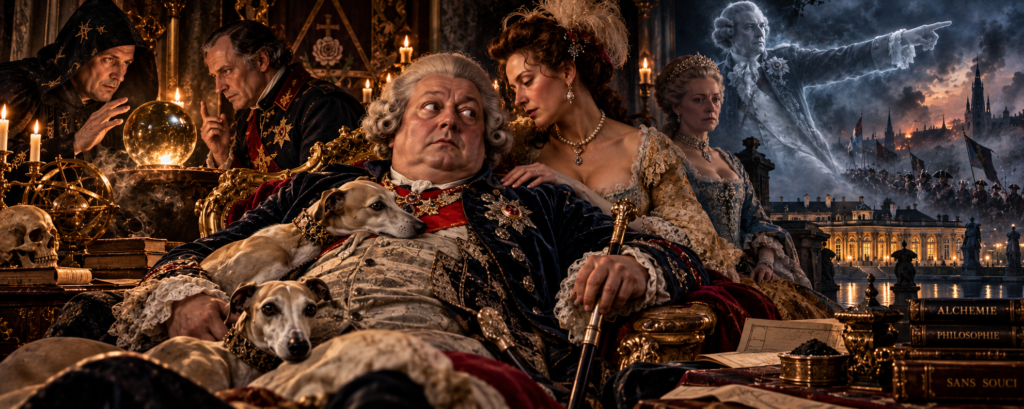
Frederick William II of Prussia: The Occult King, the Secret Wives, and the Court of Ghosts
King of Prussia, 1786–1797 | Rosicrucians, Séances, Religious Reaction, Royal Scandal, Wilhelmine Encke, Mozart, Beethoven, Revolutionary France, the Partitions of Poland, and the Strange Reign That Followed Frederick the Great
The King Who Lived in a Dead Man’s Shadow
When Frederick William II became King of Prussia in August 1786, the throne he inherited already seemed to belong to a ghost. His uncle, Frederick the Great, had ruled for forty-six years, survived wars that nearly destroyed Prussia, seized Silesia, corresponded with philosophers, humiliated larger enemies, and transformed a relatively small German monarchy into one of Europe’s great powers. The old king had become a legend before his death, and his habits of relentless work, military discipline, personal austerity, skepticism, and intellectual arrogance had become inseparable from the Prussian monarchy itself. Frederick William II could wear the same crown, command the same army, and occupy the same palaces, but he could never escape comparison with the man who had come before him. Almost everything about the new king made that comparison uncomfortable.
Frederick William was larger, warmer, more sensual, more conventionally religious, more interested in emotional intimacy, and far more susceptible to mystical ideas than his famously skeptical uncle. He loved music, played the cello, enjoyed architecture, surrounded himself with women and favorites, and became deeply involved with a secretive Rosicrucian order whose teachings mixed Christian mysticism with esoteric traditions. His private life was equally startling: while remaining married to his queen, he maintained a long relationship with Wilhelmine Encke and entered successive morganatic unions with two other women. The same ruler who supported stricter religious orthodoxy and censorship therefore presided over a court notorious for sexual scandal and complicated domestic arrangements. To critics who worshipped the memory of Frederick the Great, the transformation seemed almost incomprehensible.
Before long, stories spread that the king was not merely religious but credulous, not merely sensual but debauched, and not merely influenced by favorites but virtually controlled by mystics. Tales circulated of candlelit séances, manufactured ghosts, alchemical experiments, secret spiritual revelations, and Rosicrucian advisers who supposedly manipulated the monarch through his fascination with the supernatural. Some accounts eventually claimed that Frederick William communicated with spirits of famous dead figures or allowed supernatural warnings to affect political decisions. Later storytellers embellished these tales until his court resembled a Gothic theater populated by ghosts, charlatans, mistresses, ministers, and occult conspirators. The truth was less fantastical, but it was strange enough to explain why such legends flourished.
There is no convincing evidence that Frederick William II was clinically insane. Unlike monarchs whose periods of severe mental incapacity were unmistakably recorded, he continued to participate in government, diplomacy, military campaigns, artistic patronage, dynastic politics, and territorial expansion throughout his reign. His fascination with mysticism existed within an eighteenth-century culture in which Freemasonry, alchemy, Rosicrucianism, religious revival, occult speculation, and Enlightenment philosophy could exist side by side in ways that seem contradictory today. Yet his susceptibility to mystical advisers was politically significant because Frederick William was not a private gentleman indulging an eccentric hobby. He was an absolute monarch, and when an absolute monarch believed something, the consequences could reach far beyond the palace walls.
A Prince Frederick the Great Could Not Respect
Frederick William was born in Berlin on 25 September 1744, the eldest son of Prince Augustus William of Prussia and Duchess Luise Amalie of Brunswick-Wolfenbüttel. His uncle Frederick the Great had no children with his wife, Elisabeth Christine, making Augustus William’s family increasingly important to the succession. The relationship between Frederick and his younger brother deteriorated badly during the Seven Years’ War, particularly after Augustus William’s military performance disappointed the king. Augustus William died in 1758, leaving his fourteen-year-old son one step closer to a throne dominated by an uncle who was notoriously difficult to please. The young prince consequently grew up knowing that he would probably inherit Prussia while receiving little affection from the man whose achievements he would someday be expected to preserve.
Frederick the Great did not consider his nephew an ideal successor. The older king valued relentless labor, intellectual sharpness, military competence, personal self-control, and a degree of emotional detachment that Frederick William did not naturally possess. The younger man enjoyed pleasures his uncle regarded with contempt and displayed religious interests that clashed sharply with Frederick’s skepticism. Their differences were not merely political; they represented incompatible personalities and competing visions of kingship. Frederick William could never become the sort of monarch his uncle admired because he was fundamentally not the sort of man his uncle admired.
This did not mean Frederick William was stupid, as some hostile portraits later implied. He possessed genuine musical ability, became an accomplished cellist, understood artistic patronage, and showed serious interest in architecture and cultural life. He could be personable and generous, qualities not always associated with Frederick the Great’s increasingly bitter old age. His political weakness lay less in intellectual incapacity than in inconsistency, susceptibility to personal influence, and an unwillingness to devote himself to administration with his uncle’s almost obsessive intensity. These weaknesses would become especially dangerous once men who understood his spiritual anxieties gained intimate access to him.
The contrast between uncle and nephew became one of the defining forces of Frederick William’s reign. Frederick the Great had cultivated an image of rational monarchy in which the king presented himself as the state’s first servant, even while exercising enormous personal authority. Frederick William inherited that highly centralized structure without possessing the same appetite for personal supervision. More decisions consequently passed through advisers, favorites, intimate companions, and competing court networks. To contemporaries accustomed to the old king’s suffocating control, this looked less like delegation than the dissolution of royal authority.
Brother Ormesus and the Rosicrucians
Frederick William’s fascination with mystical religion developed before he became king. During the 1770s and early 1780s, he became increasingly involved with the Order of the Gold and Rosy Cross, a secretive organization combining Christian mysticism, hierarchical initiation, alchemical traditions, esoteric symbolism, and hostility toward some forms of Enlightenment rationalism. In 1781, the crown prince was formally initiated and received the order name “Ormesus.” For a future king of one of Europe’s major powers to become deeply involved with such a society was bound to attract attention, especially because the movement’s secrecy encouraged outsiders to imagine even more extraordinary practices than those that can actually be documented. The crown prince had entered a world in which spiritual truth was supposedly hidden behind symbols, initiations, secret knowledge, and privileged access to mysteries unavailable to ordinary believers.
Two men became particularly important within this environment: Johann Christoph von Wöllner and Johann Rudolf von Bischoffwerder. Wöllner was a clergyman, agricultural writer, estate administrator, and ambitious figure who moved through Rosicrucian circles before becoming increasingly influential with the crown prince. Bischoffwerder was a military officer and courtier whose access to Frederick William made him another important intermediary between the prince and the esoteric world. Both men understood that Frederick William wanted religious certainty and took mystical claims seriously. Their influence became far more consequential once the crown prince became king.
Frederick the Great regarded Wöllner with open contempt and disliked the religious tendencies represented by his nephew’s circle. The old king had little patience for clerical interference and even less for people he considered mystical charlatans. Frederick William, however, saw in these men something his uncle could not provide: a religious universe in which monarchy, Christianity, hidden wisdom, and personal salvation could be woven together into a coherent system. For a prince living beneath the judgment of an overpowering uncle, the attraction of belonging to an initiated elite may also have carried emotional appeal. He was no longer merely Frederick the Great’s disappointing nephew; within the secret order, he was Brother Ormesus, a participant in mysteries supposedly concealed from ordinary men.
It would be misleading to treat membership in a Rosicrucian order as proof of insanity. Eighteenth-century Europe contained numerous secret societies, Masonic lodges, mystical circles, alchemical enthusiasts, spiritual experimenters, and educated men who moved between rational inquiry and beliefs that modern readers would classify as occult. The boundaries between science, religion, pseudoscience, and esoteric philosophy had not yet hardened into their modern forms. What made Frederick William’s involvement unusual was not simply what he believed but the enormous power attached to the believer. When a future king became convinced that particular mystics possessed privileged spiritual knowledge, those mystics acquired a path toward the government of Prussia.
The Séances and the Manufactured Dead
Among the most sensational stories associated with Frederick William are accounts of supernatural apparitions staged for him by people within his mystical circle. Bischoffwerder in particular became connected with performances in which supposed spirits were produced through theatrical or optical methods, allowing participants to believe that beings from another world had appeared before them. Eighteenth-century illusionists possessed an impressive repertoire of techniques involving mirrors, projections, concealed lighting, smoke, hidden voices, and carefully controlled darkness. Such effects could be astonishing to audiences unfamiliar with their mechanisms. A man already predisposed to believe that secret knowledge allowed communication with the invisible world was especially vulnerable.
Later accounts expanded these episodes dramatically. Frederick William was said to have encountered apparitions of famous historical personalities and religious figures, while some stories presented his Rosicrucian advisers as deliberately manufacturing supernatural messages designed to control him. Names such as Aristotle and Cleopatra appear in popular retellings, although individual spirit encounters are not equally well documented and should not all be repeated as established fact. The broader claim that theatrical apparitions were used within his mystical environment has stronger historical grounding than every colorful detail attached to the story. As with many royal legends, a genuine kernel of strangeness attracted decades of embellishment.
The distinction between deception and hallucination is crucial when discussing Frederick William as a “mad monarch.” If a courtier uses optical machinery to create what appears to be a ghost, believing the illusion does not mean the observer is psychotic. Frederick William’s problem was credulity rather than demonstrable loss of contact with reality. He wanted to believe that hidden spiritual truths could be revealed, and men around him were willing to provide experiences that reinforced those expectations. His vulnerability was therefore psychological and political without necessarily being psychiatric.
For Enlightenment critics, however, the nuances scarcely mattered. Frederick the Great had corresponded with Voltaire, mocked superstition, and presented himself as a philosopher-king, while his successor seemed willing to sit in darkened rooms waiting for spirits to appear. The contrast became irresistible propaganda. Prussia had not merely changed kings; according to hostile observers, it had passed from the age of reason into a chamber of smoke, mirrors, and ghosts.
A New King and a Different Court
Frederick the Great died on 17 August 1786, and Frederick William II ascended the throne at the age of forty-one. His accession was not greeted entirely with dread, because many subjects had grown weary of his uncle’s severity. Frederick had become increasingly isolated, sarcastic, controlling, and parsimonious in old age, and the new monarch appeared more approachable and generous. Frederick William relaxed some burdens, showed greater warmth toward people around him, and brought renewed social life to a court that had become austere. For those who had suffered under the old king’s abrasive personality, the change initially felt like relief.
The new monarch inherited extraordinary advantages. Prussia possessed a formidable army, a respected bureaucracy, substantial territory, international prestige, and financial reserves accumulated under Frederick’s rigorous management. The kingdom was not collapsing when Frederick William took possession of it. He began his reign from a position of strength that most European monarchs would have envied. This makes the later criticism of his government particularly severe, because contemporaries believed he had been given an unusually strong inheritance.
His court quickly developed a different character. Music, architecture, personal relationships, religious concerns, and courtly patronage assumed greater importance, while Wöllner and Bischoffwerder rose dramatically in influence. Frederick William did not abandon government, but he did not attempt to read and control everything with his uncle’s exhausting thoroughness. Personal access consequently mattered more, and courtiers understood that winning the confidence of the king could translate into political power. The result was an atmosphere in which formal government and intimate influence often appeared dangerously intertwined.
This was the environment that produced Frederick William’s reputation as a ruler controlled by favorites. It is too simplistic to say that Wöllner, Bischoffwerder, or any mistress individually governed Prussia, because ministers, military officers, bureaucrats, and the king himself continued to make decisions. Yet Frederick William’s governing style gave trusted individuals opportunities they would not have enjoyed under Frederick the Great. In an absolute monarchy, access to the monarch could be almost as valuable as an official title. Frederick William’s court therefore became a place where private confidence and public power repeatedly collided.
The Religious Edict and the War Against Rationalism
The most important political consequence of Frederick William’s religious convictions came through Johann Christoph von Wöllner. In 1788, Wöllner became a senior minister responsible for ecclesiastical affairs, placing a Rosicrucian associate of the king in a position to influence Prussian religious policy. On 9 July 1788, the government issued the Religious Edict, intended to defend established Christian doctrine against theological rationalism and what conservatives regarded as corrosive unbelief. Protestant clergy and teachers were expected to remain within recognized confessional boundaries, while the state asserted greater authority over religious instruction. To rationalist theologians and Enlightenment intellectuals, the measure looked like a direct retreat from the relative intellectual latitude associated with Frederick the Great.
A censorship edict followed later that year, strengthening the impression that the new regime intended to police ideas as well as doctrine. Wöllner and the king did not simply oppose atheism; they were alarmed by theological interpretations that reduced miracles, revelation, and traditional dogma to rational moral teachings. Their concern reflected a broader conservative reaction occurring in parts of Europe as Enlightenment criticism challenged inherited religious authority. Frederick William believed monarchy had obligations to protect Christianity rather than remain indifferent to doctrinal erosion. His critics believed the state was arrogantly deciding what educated people were permitted to think.
The policies were sometimes denounced as a “Protestant Inquisition,” but that description is rhetorical rather than literal. Frederick William did not establish an institution equivalent to the historical Catholic Inquisition, nor did Prussia suddenly eliminate all religious toleration. Catholics, Jews, and other communities remained present under a complicated system of rights and restrictions inherited from earlier reigns. The central controversy concerned the regulation of Protestant teaching and the state’s attempt to restrain rationalist theology. Even without the exaggerated label, the shift was significant enough to alarm intellectuals.
The political damage was intensified by the identity of the men behind the policy. Had a conventional conservative minister promoted religious orthodoxy, critics might have attacked the policy without questioning the king’s sanity. Instead, the initiative was associated with Wöllner, Rosicrucianism, secret religious circles, and a monarch already rumored to participate in supernatural performances. The government therefore appeared to be suppressing rationalism while elevating mystical belief. For Enlightenment observers, the symbolism was devastating.
Kant and the Limits of Enlightenment
The conflict between Frederick William’s government and Enlightenment thought eventually touched Immanuel Kant, one of the most important philosophers of the age. Kant’s writings on reason, morality, autonomy, and religion challenged traditional assumptions about the relationship between revelation and philosophical inquiry. His work on religion attracted particular scrutiny from conservative Prussian authorities. The government objected to aspects of his theological writing and warned him against continuing to treat religious questions in ways judged incompatible with official doctrine. Kant responded cautiously and agreed, as the king’s subject, to refrain from certain public discussions while Frederick William lived.
The episode has often been transformed into an almost symbolic confrontation between reason and superstition. On one side stands Kant, the philosopher of Enlightenment autonomy; on the other stands a king associated with Rosicrucian mysteries and a minister determined to enforce orthodoxy. That image is powerful because it contains a genuine ideological conflict, although the historical reality was more complicated than a simple war between sanity and madness. Frederick William did not close the universities or destroy Prussian intellectual life, and important scholarship continued under his rule. Nevertheless, the government’s willingness to discipline theological thought marked a real departure from the atmosphere cultivated under his uncle.
The contradiction is especially revealing because Frederick William was not hostile to culture itself. He supported music, architecture, education, and artistic institutions, and he could recognize extraordinary talent. His objection was directed more specifically toward forms of intellectual freedom he believed threatened religion and social order. He could therefore patronize artistic genius while simultaneously restricting philosophical discussion. The apparent inconsistency made perfect sense within his own worldview, even when it looked absurd to his critics.
This pattern recurs throughout his reign. Frederick William was rarely irrational in the sense of acting without any comprehensible motive. Instead, he held values that collided with one another and used royal power to resolve those collisions in ways favorable to himself. His government could be generous and restrictive, cultivated and censorious, religious and scandalous at the same time. The contradictions were not symptoms of psychosis, but they helped create the enduring image of a monarch whose court seemed to have lost its intellectual compass.
Wilhelmine Encke: The Woman Who Outlasted Them All
Long before Frederick William became king, Wilhelmine Encke entered his life. Born in 1753 to a musician’s family, she became the crown prince’s mistress while still very young and remained connected to him for decades. Their relationship produced several children and survived other romantic attachments, political changes, and the king’s additional marriages. Frederick William spent heavily upon her education, residences, artistic surroundings, and social elevation. By the time he reached the throne, Wilhelmine had become one of the most important people in his private world.
Her position naturally generated accusations of political manipulation. Courtiers seeking favor understood that a woman with intimate access to the king could potentially influence appointments, recommendations, and royal moods. Enemies portrayed her as greedy, corrupt, sexually manipulative, and responsible for extravagant spending. Some accusations undoubtedly reflected genuine resentment at her influence, while others drew upon the familiar tradition of blaming royal mistresses for decisions made by kings. Her relatively modest origins made aristocratic hostility even sharper because she had crossed social boundaries that elite society guarded jealously.
Frederick William eventually elevated her as Countess Lichtenau in 1794, formalizing a social position she had already occupied in practice. Her houses and artistic projects became symbols of the luxury associated with the reign. She participated in a world of architecture, decoration, collecting, and court culture that contrasted dramatically with the austere mythology surrounding Frederick the Great. Critics saw every costly room and beautiful object as evidence that Prussian discipline was being exchanged for sensual indulgence. Wilhelmine became the human face of that accusation.
It would nevertheless be misleading to describe her as the secret ruler of Prussia. Frederick William listened to many people, and political decisions emerged from a complicated mixture of royal preference, ministerial advice, military interests, diplomatic circumstances, and factional competition. Wilhelmine’s importance lay in proximity rather than formal authority. She could reach the king in ways ordinary officials could not, and in a personal monarchy that alone made her formidable.
A Queen, a Mistress, and Two More Wives
Frederick William’s marital life was complicated even before he became king. His first marriage, to Elisabeth Christine of Brunswick-Wolfenbüttel, took place in 1765 and collapsed amid mutual infidelity and hostility. The marriage ended in divorce in 1769, after which Frederick William married Frederica Louisa of Hesse-Darmstadt. Frederica Louisa remained his official wife and eventually Queen of Prussia, but the marriage did not prevent her husband from continuing his relationship with Wilhelmine Encke. The king’s emotional and sexual life operated according to rules that bore little resemblance to the moral discipline his government expected from ordinary subjects.
The situation became considerably stranger in 1787 when Frederick William entered a morganatic union with Julie von Voss, one of the queen’s ladies-in-waiting. Because Frederica Louisa was still alive and married to him, the arrangement required theological and legal justification. Historical Protestant precedents were invoked to defend the possibility of an additional marriage under exceptional circumstances, although the union could not place Julie on the throne or give her children normal dynastic rights. The king was therefore not merely taking another mistress; he was attempting to provide a religiously sanctioned form to a relationship existing alongside his official marriage.
Julie died in 1789 after giving birth to a son, but Frederick William soon repeated the experiment. In 1790 he entered another morganatic union with Sophie von Dönhoff, again while Queen Frederica Louisa remained his lawful consort. Sophie bore him children and became entangled in court politics, eventually clashing with other members of the king’s intimate circle. Her relationship with Frederick William deteriorated, and she was separated from him within a few years. The court had by then become notorious for a domestic arrangement that looked astonishing even by the forgiving standards often applied to royal men.
The contradiction with Frederick William’s religious policy was impossible to miss. His government demanded doctrinal seriousness from clergy and teachers while the king used theological accommodations to legitimize relationships unavailable to ordinary subjects. He was not necessarily pretending to be religious; the effort to regularize his unions suggests that conscience may actually have mattered to him. Yet that made the situation more bizarre rather than less, because the king seemed determined to satisfy both desire and orthodoxy simultaneously. Critics saw hypocrisy, while Frederick William appears to have found ways of persuading himself that the rules could bend without breaking.
The Marble Palace and a World of Mystery
Frederick William’s tastes found magnificent expression in the Marmorpalais, or Marble Palace, begun in 1787 beside the Heiliger See in Potsdam’s New Garden. The building’s restrained Neoclassical appearance distinguished it from the Rococo elegance associated with Frederick the Great’s Sanssouci. Its setting, interiors, gardens, and decorative program reflected the new monarch’s preference for a more intimate and romantic royal environment. Frederick William wanted a world that was recognizably his rather than a continuation of his uncle’s. Architecture became one of the ways he escaped the dead king’s shadow.
The New Garden also became associated with Frederick William’s mystical reputation. Structures, decorative motifs, and secluded spaces could easily be interpreted through the lens of his Rosicrucian interests, and later storytellers populated the palace with secret laboratories and supernatural rituals. Some popular accounts describe the king watching alchemical experiments or searching for universal medicines within hidden rooms. The broad connection between his court and esoteric interests is real, but specific claims about elaborate laboratories, the Philosopher’s Stone, or an organized royal quest for immortality require more caution than sensational retellings usually provide.
The same is true of claims that Frederick William swallowed mysterious alchemical medicines in preference to conventional medical care. Eighteenth-century medicine itself contained treatments that now appear bizarre, and distinctions between chemical medicine, alchemy, experimental remedies, and occult healing were not always clear. His interest in hidden knowledge makes such stories plausible enough to spread, but plausibility is not documentation. A responsible account must resist turning every rumor into another symptom of royal madness. Frederick William’s verified mystical interests are already remarkable without adding unsupported details.
What the palace undeniably represented was a break with Frederick the Great’s emotional world. Frederick William preferred privacy, music, gardens, companionship, and beauty over the austere military persona cultivated by his uncle. His critics interpreted that preference as weakness and indulgence. Yet the Marble Palace remains one of the most elegant monuments of his reign, proof that the supposedly foolish king possessed genuine artistic taste.
Music in the Palace of Ghosts
Frederick William was a serious musician and an accomplished cellist, a fact that complicates every attempt to reduce him to a lazy sensualist. He maintained excellent musicians and took particular interest in compositions that gave prominence to his instrument. Jean-Pierre and Jean-Louis Duport, both celebrated cellists, were associated with the Prussian musical world, and the king’s enthusiasm encouraged composers to explore the cello in increasingly sophisticated ways. His patronage contributed to a flourishing chamber-music culture at court. Whatever his weaknesses as a statesman, his musical interests were neither superficial nor imaginary.
Joseph Haydn’s Opus 50 string quartets became known as the Prussian Quartets and were dedicated to Frederick William. Luigi Boccherini, himself one of the greatest cellist-composers of the eighteenth century, also benefited from the king’s patronage. These connections place Frederick William within a significant network of European musical culture. The same monarch mocked for secret societies and séances could recognize artistry of the highest order. His court was therefore simultaneously conservative in religion and adventurous in music.
Wolfgang Amadeus Mozart visited the Prussian court in 1789 during a journey undertaken partly in search of opportunities and financial support. Frederick William’s reputation as a cello-playing monarch made him an attractive potential patron. Mozart’s later string quartets commonly called the Prussian Quartets gave unusual prominence to the cello and became associated with the king, although the precise details of promised commissions and payments are more complicated than some popular accounts suggest. There is no need to invent a dramatic royal rescue that never happened, because the genuine musical connection is important enough. Frederick William’s tastes helped shape the environment in which Mozart conceived some of his late chamber music.
Ludwig van Beethoven arrived in Berlin and Potsdam in 1796, when he was still a young virtuoso whose greatest works lay ahead. He performed within the king’s musical circle and dedicated his two Opus 5 cello sonatas to Frederick William. The king reportedly rewarded him generously, and the visit helped produce works that became landmarks in the cello repertoire. It is one of the most striking contradictions of Frederick William’s life that a court remembered for mysticism also became connected with Mozart and Beethoven. The supposed palace of irrationality was filled with some of the most sophisticated music in Europe.
The Brandenburg Gate and the Price of Magnificence
Frederick William’s reign also left a major architectural mark on Berlin. The Brandenburg Gate was constructed between 1788 and 1791 according to designs by Carl Gotthard Langhans, becoming one of the most enduring monuments associated with the period. Its Neoclassical form reflected broader European artistic developments and the ambitions of a monarchy that wanted its capital to look worthy of great-power status. Frederick William supported other building projects and encouraged cultural institutions in ways that made his court more visually and socially vibrant than the increasingly austere court of his uncle’s final years. These achievements should not be dismissed merely because they cost money.
Yet money became an increasingly serious problem. Frederick the Great had accumulated significant reserves through relentless economy, while Frederick William was more generous and more willing to spend upon court life, architecture, artistic patronage, military operations, and favored individuals. His critics portrayed this as simple squandering, but court expenditure alone did not explain the deterioration of Prussian finances. Military interventions, foreign policy, territorial administration, and the enormous expense of maintaining great-power status consumed far larger sums than musical evenings or decorative projects. The financial problem was real, even if the morality tale built around it was exaggerated.
Frederick William’s physical appearance eventually became part of the same criticism. He grew increasingly corpulent, creating a dramatic visual contrast with the famously lean Frederick the Great. Hostile nicknames and caricatures portrayed him as a “fat” pleasure-loving king whose body symbolized the supposed bloating of the state itself. Translating every German insult attached to him as “the Fat Bastard” is too crude and often linguistically uncertain, but the tradition of mocking his weight was genuine. His enemies transformed his body into political commentary.
This comparison was powerful because Frederick the Great’s thinness had become symbolic. The old king’s gaunt face and worn uniform represented hardship, work, war, and self-denial in the Prussian imagination. Frederick William’s larger body could therefore be made to represent food, sex, luxury, laziness, and indulgence. The symbolism was unfair but politically effective. A monarch’s body had become an argument about the health of his kingdom.
The Dutch Campaign and an Early Success
Frederick William’s foreign policy did not begin with catastrophe. In 1787, conflict in the Dutch Republic created an opportunity for Prussian intervention when his sister Wilhelmine, wife of William V, Prince of Orange, was detained by Patriot forces while traveling. Frederick William demanded satisfaction and ultimately sent a Prussian army into the Netherlands. The intervention was rapid and effective, restoring the position of the House of Orange and demonstrating that the Prussian military machine remained formidable. For a new king living under his uncle’s military shadow, the operation was a valuable success.
The campaign also revealed that Frederick William was not simply a passive monarch hiding among mystics. He could pursue dynastic interests, authorize decisive military action, and use Prussian power effectively. His government understood the strategic implications of events beyond its borders. The success strengthened Prussian prestige and reassured those who feared that the army had immediately declined after Frederick the Great’s death. Whatever weaknesses later emerged, the state remained a major military power.
The problem was that Europe was approaching a crisis far greater than the Dutch dispute. In 1789, the French Revolution erupted, beginning a political transformation that would destroy assumptions upon which eighteenth-century monarchy had depended. Aristocratic privilege, royal authority, established religion, and hereditary hierarchy came under attack. Frederick William’s religious conservatism made the ideological challenge particularly alarming.
Within three years, Prussian soldiers would be marching toward revolutionary France. Frederick William himself would accompany them. The king associated with ghosts was about to encounter something much more dangerous than the supernatural: a political revolution capable of overturning the entire European order.
Revolutionary France and the Road to Valmy
Frederick William joined Emperor Leopold II at Pillnitz in August 1791, where the monarchs expressed concern over the situation of Louis XVI and the French monarchy. The Declaration of Pillnitz was more conditional than revolutionary propaganda portrayed it, but it nevertheless became part of the escalating confrontation between France and Europe’s monarchies. By 1792, diplomacy had given way to war. Prussia and Austria entered the conflict expecting that disciplined professional armies might restore order relatively quickly. The assumption proved disastrously optimistic.
Frederick William accompanied the campaign, while the Duke of Brunswick commanded the allied army advancing into France. The invasion initially appeared threatening, and the notorious Brunswick Manifesto warning Paris against harming the royal family intensified revolutionary fury. Rather than frightening the French into submission, the invasion helped radicalize resistance. The allied army then encountered logistical problems, disease, worsening weather, supply difficulties, and unexpectedly determined French opposition. The campaign was becoming far more complicated than its planners had imagined.
On 20 September 1792, French and allied forces confronted one another at Valmy. The engagement was not one of the largest battles of the era, but its psychological importance was enormous because the revolutionary army held its ground against forces expected to crush it. The allied advance stalled, and the strategic situation deteriorated. Disease ravaged the invaders, supplies failed, and the political assumptions behind the expedition collapsed. The Prussians ultimately withdrew.
That withdrawal later became fertile ground for one of the most spectacular legends surrounding Frederick William. A rational explanation involving dysentery, logistics, strategy, weather, political disagreement, and unexpected French resistance was apparently not dramatic enough. The occult king needed an occult explanation. History therefore gave him a ghost.
The Ghost That Did Not Stop the Prussian Army
According to later stories, Frederick William’s Rosicrucian advisers arranged a supernatural warning during the French campaign. Some versions claim that the spirit of Frederick the Great appeared and ordered his nephew to retreat, while others introduce the White Lady, a legendary Hohenzollern apparition believed to foretell death or disaster. Terrified by the warning, the king supposedly abandoned the advance and threw the coalition into confusion. The tale combines everything later generations wanted to believe about him: credulity, mystical manipulation, military weakness, and the inescapable shadow of his dead uncle. It is almost too perfectly constructed.
The problem is that the story is not a reliable explanation for the retreat. The allied army faced serious and well-documented practical difficulties, including disease, supply shortages, strategic disagreement, and French resistance. Frederick William did not need a supernatural warning to recognize that the campaign had become dangerous. The ghost story belongs to the legendary tradition that grew around his genuine interest in mystical practices. It should be told because it became part of his reputation, but it should not be presented as established military history.
The White Lady herself belonged to a much older body of dynastic folklore. Pale female apparitions were associated with several German noble houses, and sightings were often retrospectively connected with deaths, disasters, or moments of political crisis. Once Frederick William became known as a believer in supernatural phenomena, attaching the White Lady to him required very little imagination. Every reversal could become a prophecy, every hesitation a haunting, and every failure the result of mystical fear. His reputation effectively generated its own supernatural evidence.
There is an irony in the legend that makes it especially enduring. Frederick William genuinely did live under the shadow of Frederick the Great, even if his uncle never materialized as a ghost. Every military decision he made was compared with Frederick’s victories, every financial choice with Frederick’s economy, and every intellectual preference with Frederick’s skepticism. The dead king did not need Rosicrucian machinery to haunt his successor. Memory was more than sufficient.
From France to Poland
Prussia’s enthusiasm for war against revolutionary France declined as the conflict dragged on. Frederick William’s government faced mounting expenses and competing strategic opportunities in eastern Europe. Poland, undergoing significant political reform, became increasingly vulnerable to interference from Russia, Prussia, and Austria. Frederick William had earlier presented Prussia as a potential supporter of Polish independence against Russian dominance, but promises proved expendable when territorial opportunities appeared. The supposedly mystical king could become brutally pragmatic when land was at stake.
The Polish-Lithuanian Commonwealth had attempted sweeping reform through the Constitution of 3 May 1791. Reformers hoped to strengthen the state, reduce political paralysis, and preserve independence. Russia regarded the transformation as a threat to its influence, and Prussia abandoned Poland when intervention offered a chance for territorial gain. In the Second Partition of 1793, Prussia acquired substantial lands, including Danzig and Thorn. The transaction revealed a cold geopolitical opportunism difficult to reconcile with the caricature of Frederick William as a helpless dreamer controlled entirely by occult advisers.
Polish resistance erupted in the Kościuszko Uprising of 1794. Frederick William personally participated in military operations and was involved in the unsuccessful Prussian siege of Warsaw. His presence in the campaign again contradicts the image of a king incapable of serious action. The uprising was eventually crushed by the combined weight of the partitioning powers, although resistance demonstrated that Poland would not disappear quietly. In 1795, Russia, Prussia, and Austria completed the Third Partition, erasing the Polish-Lithuanian Commonwealth as an independent state.
Prussia acquired further territory, including Warsaw, and the kingdom Frederick William ruled became considerably larger. This territorial expansion came at the expense of a neighboring state whose attempts at reform had been exploited rather than protected. It was one of the darkest achievements of his reign, but it was not irrational. The king who supposedly listened to ghosts participated in one of the most calculated acts of eighteenth-century power politics.
Peace With the Revolution
By 1795, Frederick William’s government wanted to escape the increasingly expensive western war. Prussia negotiated the Treaty of Basel with revolutionary France, withdrawing from the First Coalition and effectively leaving former allies to continue the struggle. The decision angered monarchists who believed the Revolution represented a common existential threat. It also weakened Prussia’s relationships with other European powers. Yet from Berlin’s perspective, the agreement allowed the monarchy to concentrate upon its eastern interests and reduce the financial burden of war.
The policy illustrates why Frederick William cannot be understood simply through the language of irrationality. He was capable of abandoning ideological solidarity when practical interests changed. His government had entered the war partly to defend the European monarchical order, but it left when continued participation no longer seemed advantageous. That was cynical and arguably shortsighted, but it was conventional statecraft rather than madness. European monarchies repeatedly subordinated ideological principles to strategic interests throughout the revolutionary era.
The separate peace also contributed to Prussia’s increasing isolation. The monarchy would spend the following years attempting to remain outside the great conflicts consuming Europe. That policy survived Frederick William’s death and eventually proved disastrous when Napoleon’s dominance became impossible to ignore. The catastrophe at Jena and Auerstedt in 1806 would later encourage historians to search backward for the moment when Prussian strength began to decay. Frederick William II became an obvious target.
He deserves some responsibility, but not all of it. The army remained formidable during his reign, and the structural weaknesses exposed in 1806 developed across multiple decades. An aging officer corps, institutional rigidity, outdated tactical assumptions, financial constraints, and resistance to reform were larger problems than the king’s Rosicrucian interests. Ghosts did not destroy the Prussian army, and séances did not explain Napoleon.
A King of Appetite and Anxiety
Frederick William’s later years intensified the caricature of the pleasure-loving monarch. His weight increased significantly, his health deteriorated, and critics contrasted his physical condition with Frederick the Great’s austere appearance. He enjoyed food, intimate companionship, music, comfortable residences, and court life, all of which could be presented as evidence of self-indulgence. The fact that his government simultaneously demanded religious seriousness from others made the contrast especially damaging. Every pleasure became evidence for the prosecution.
It is difficult to reconstruct exactly how contemporaries interpreted his private anxieties because later accounts often exaggerate them. Some portray him as terrified of illness and death, desperately seeking occult medicines or supernatural reassurance. His religious and mystical interests certainly suggest a strong concern with salvation and hidden spiritual realities, but those concerns were not unusual in an age where death remained omnipresent. Claims that he relied upon magical elixirs or believed himself close to discovering immortality should be treated cautiously unless tied to reliable evidence. The king’s genuine credulity does not require us to accept every tale told about it.
His physical decline nevertheless altered the atmosphere of the court. By the mid-1790s, everyone understood that the reign might not last much longer. The heir, the future Frederick William III, possessed a different temperament and had little affection for many features of his father’s court. Wöllner’s position, Bischoffwerder’s influence, and Countess Lichtenau’s security all depended heavily upon the living king. Once Frederick William died, the network around him would become dangerously exposed.
Absolute monarchy made favorites powerful, but it also made their power fragile. They did not possess independent institutions capable of protecting them after a succession. Their authority rested upon access to one person, and one person’s death could turn courtiers into prisoners overnight. Wilhelmine Lichtenau would discover that reality with particular brutality.
Death of the Occult King
Frederick William II died in Potsdam on 16 November 1797 at the age of fifty-three. His reign had lasted only eleven years, a remarkably short period compared with his uncle’s forty-six. Yet those eleven years had carried Prussia through one of the most dramatic transformations in European history. When he became king, Louis XVI still ruled France, the old dynastic order seemed secure, and the Polish-Lithuanian Commonwealth remained on the map. By Frederick William’s death, Louis had been executed, revolutionary France had survived invasion, Poland had disappeared, and European warfare was entering an entirely new age.
The king left behind a Prussia larger in territory but burdened by serious problems. The finances had deteriorated, political factions had flourished around personal access, religious censorship had alienated important intellectual circles, and foreign policy had created diplomatic complications. Yet the state had not collapsed, and the army had not ceased to be formidable. His reign was neither the unbroken disaster described by hostile historians nor a misunderstood golden age. It was a period of contradictory achievements and accumulating weaknesses.
The reaction against his intimate circle began almost immediately. Wöllner’s political position deteriorated under the new regime, and the influence of the Rosicrucian network faded. The mystical atmosphere associated with Frederick William’s court no longer enjoyed royal protection. His successor wanted distance from the scandals and personalities that had surrounded his father. The transition became especially dangerous for the woman who had spent decades closest to the dead king.
Countess Lichtenau was arrested and investigated after Frederick William’s death, while property and wealth associated with royal favor came under scrutiny. The speed of her fall demonstrated how little permanent security even extraordinary intimacy with a monarch could provide. People who had bowed to her while Frederick William lived could condemn her once he was gone. Her humiliation also served a political purpose, allowing the new reign to repudiate aspects of the old court without directly placing a dead king on trial.
The Mistress Who Survived the Scandal
Wilhelmine Lichtenau did not disappear completely. Although she suffered arrest, confiscation, investigation, and public disgrace, she eventually recovered portions of her position and property. She lived until 1820, surviving Frederick William by more than two decades. During those years, she witnessed Prussia endure disasters far greater than anything that had happened under her royal lover. Napoleon’s armies shattered the kingdom’s military prestige in 1806, occupied Berlin, and forced the monarchy into humiliating concessions.
Her survival adds an almost cruel irony to the morality tale constructed around Frederick William’s reign. Critics had presented the king’s mistresses, mystics, and pleasures as symptoms of national decline, yet removing those people did not magically solve Prussia’s structural problems. The catastrophe of 1806 occurred under Frederick William III, a monarch whose personal habits were far more restrained. Prussia’s weakness could not be cured simply by replacing a sensual father with a sober son. Institutions mattered more than court gossip.
Lichtenau also remained an enduring symbol of the old king’s private world. Her relationship with Frederick William had begun before his accession and lasted through the complicated arrangements involving his queen and morganatic wives. She had known the man behind the public caricature in ways few others could claim. The fact that she outlived almost everyone who had attacked her ensured that the scandal continued to fascinate later generations. Royal mistresses often become historical shorthand for entire reigns, and Lichtenau became inseparable from Frederick William’s.
Yet reducing the king to his mistress repeats the same mistake as reducing him to Rosicrucianism. His reign included military interventions, territorial expansion, religious policy, censorship, music, architecture, diplomacy, family scandal, and participation in the destruction of Poland. The private and public worlds constantly overlapped, but neither entirely explains the other. Frederick William was more than the sum of the people around his bed and the mystics around his throne.
Was Frederick William II Actually Mad?
There is no compelling evidence that Frederick William II suffered from a severe psychiatric disorder that rendered him incapable of understanding reality or governing. No sustained episodes comparable to the unmistakable breakdowns of monarchs such as Charles VI of France are documented. He continued to make political decisions, participate in military affairs, maintain relationships, pursue cultural interests, and respond to changing international circumstances. His policies could be poor, contradictory, reactionary, or opportunistic without requiring a diagnosis of insanity. Historical incompetence and mental illness are not interchangeable categories.
His Rosicrucian beliefs are the strongest foundation for his popular reputation as an irrational king, but even these must be placed within their period. Secret societies and esoteric movements attracted educated, powerful, and socially prominent Europeans throughout the eighteenth century. Belief in spiritual manifestations or alchemical possibilities was not confined to people suffering from mental illness. Frederick William appears to have been unusually credulous and particularly susceptible to advisers who exploited those interests. Credulity can be dangerous in a monarch, but it is not the same thing as psychosis.
His sexual behavior likewise provides little evidence of mental illness. Maintaining mistresses was ordinary among European kings, although his attempt to enter successive morganatic marriages while his queen remained alive was unusually audacious. The arrangement demonstrated entitlement, desire, theological flexibility, and the extraordinary privileges available to a ruler. It also exposed him to justified accusations of hypocrisy because his government simultaneously promoted religious orthodoxy. None of that establishes madness.
The more interesting explanation for his reputation lies in comparison. Frederick William succeeded a king who had turned skepticism, discipline, military brilliance, and relentless administrative work into a personal mythology. Any successor who embraced mysticism, delegated authority, gained weight, spent more freely, and maintained a scandalous romantic life was likely to appear decadent. Frederick William did all of those things at once. His enemies barely needed to exaggerate before the caricature began writing itself.
The Madness of Contradiction
Frederick William II belongs naturally within the Mad Monarchs category precisely because the word “mad” has historically meant more than clinical insanity. Rulers were called mad because they were violent, eccentric, sexually scandalous, religiously extreme, politically reckless, emotionally unstable, or simply incomprehensible to the people judging them. Frederick William’s contemporaries and later critics could look at his court and see a king behaving in ways that seemed almost deliberately designed to offend Enlightenment expectations. He surrounded himself with mystics while governing a state famous for rational administration. He defended Protestant morality while constructing an extraordinary private marital life.
His contradictions went much deeper than sex and religion. He was mocked as lazy but accompanied armies in the field. He was portrayed as politically weak but participated in the calculated destruction of Poland. He restricted intellectual freedom while supporting some of Europe’s greatest musicians. He inherited a treasury built through austerity but spent more freely on a state that was simultaneously engaged in expensive military and territorial projects.
The temptation is to choose one version of Frederick William and treat it as the real man. He can become the gullible occultist, the gluttonous libertine, the reactionary censor, the generous patron, the weak successor, or the ruthless partitioner of Poland depending upon which episode receives attention. All of these identities contain elements of truth. None alone explains him.
That complexity is precisely why his reign is more unsettling when stripped of exaggerated legends. A clinically insane king could be treated as a tragic exception whose actions emerged from illness. Frederick William’s contradictions were recognizably human and politically understandable. The disturbing element was not madness but the enormous power available to a flawed human being whose personal convictions could become state policy.
The Ghosts History Gave Him
Frederick William’s supernatural reputation grew because it provided an irresistible explanation for everything people disliked about him. Once he became known as a Rosicrucian, every darkened chamber could become a séance room, every adviser a magician, every laboratory an alchemical workshop, and every unexpected political decision the result of a ghostly warning. Stories accumulated because they felt consistent with the character history had assigned him. The legend became self-reinforcing.
The famous tale of Frederick the Great’s spirit warning him during the French campaign is a perfect example. It places the dead uncle, the mystical nephew, military failure, and supernatural terror into a single unforgettable scene. Yet the actual retreat can be explained by ordinary military factors that are far better documented. The legend survives because ordinary logistics cannot compete with a ghost. Historical memory prefers images that can be seen.
The same process affected stories of the White Lady. Hohenzollern folklore already contained traditions of a female apparition whose appearance supposedly foretold death or disaster. Frederick William’s mystical interests made him the perfect royal figure upon whom to attach another sighting. Whether he ever encountered such an apparition matters less to the history of his reputation than the fact that generations believed he might have. A king’s legend can become historically important even when the events within it never happened.
The responsible approach is therefore neither to dismiss every supernatural story nor to repeat them uncritically. The séances and mystical environment deserve attention because they were part of the king’s world. The later ghost stories deserve attention because they shaped his memory. Separating those categories makes the history stronger rather than less dramatic.
The King Who Could Not Escape Frederick the Great
Of all the ghosts associated with Frederick William II, only one unquestionably haunted his reign. Frederick the Great remained present in the institutions, expectations, army, bureaucracy, finances, and political mythology of Prussia long after his death. His nephew inherited a kingdom designed around the habits of an extraordinary ruler. Every deviation from those habits looked like decline.
When Frederick William spent money, observers remembered Frederick’s thrift. When he trusted advisers, they remembered Frederick’s personal supervision. When he promoted religious orthodoxy, they remembered Frederick’s skepticism. When he failed to produce spectacular victories, they remembered Rossbach and Leuthen. The comparison was relentless and often unfair, but Frederick William’s own choices repeatedly made it worse.
He tried to create a different kind of court, one filled with music, architecture, gardens, companionship, religious meaning, and personal pleasure. Those preferences were not inherently destructive. The problem was that the Prussian monarchy had become identified with an almost monastic mythology of service and military discipline. Frederick William’s humanity therefore appeared as decadence.
The irony is that Frederick the Great himself had hardly been the simple rational hero later memory created. His wars had devastated Prussia, his government could be authoritarian, his personal relationships were complicated, and his philosophical tolerance had limits. Yet legends flatten complicated rulers into symbols. Frederick became the disciplined genius, leaving his nephew to become the indulgent fool.
A Court Between Reason and Revolution
Frederick William’s reign unfolded at the end of one political world and the beginning of another. He inherited an eighteenth-century monarchy based upon dynastic legitimacy, aristocratic hierarchy, professional armies, cabinet diplomacy, and the assumption that rulers could rearrange territories according to strategic convenience. The partitions of Poland demonstrated that old system at its most ruthless. The French Revolution simultaneously revealed that the subjects living beneath such governments might no longer accept those assumptions.
The king responded to this changing world inconsistently because Europe’s monarchies responded inconsistently. He opposed revolutionary France, then made peace with it. He supported religious conservatism at home while participating in opportunistic territorial expansion abroad. He worried about ideological disorder in the west while helping destroy an established state in the east. The contradictions belonged not only to Frederick William but to the political order he represented.
His reign therefore cannot be understood simply as the story of one eccentric monarch. It was part of a broader crisis in European kingship. Enlightened absolutism had promised that rational rulers could modernize states while preserving absolute authority. The French Revolution exposed the fragility of that bargain, while Poland demonstrated the vulnerability of weaker states to supposedly enlightened neighbors. Frederick William stood directly inside these contradictions.
His mystical interests make the story more colorful, but they were not the greatest threat facing Prussia. Revolution, military transformation, fiscal pressure, diplomatic isolation, and institutional stagnation mattered far more. The king could search for certainty in secret religious systems, but the political world outside his palaces was becoming impossible to control. Europe itself was entering an age in which old certainties would repeatedly collapse.
The Court After Midnight
It is easy to imagine Frederick William’s court through the imagery later generations attached to it. The Marble Palace stands beside the dark water at Potsdam, its rooms glowing with candlelight while musicians finish an evening performance. Somewhere nearby, courtiers whisper about Countess Lichtenau, ministers calculate military expenses, conservative churchmen worry about unbelief, and political messengers bring disturbing reports from France or Poland. In another chamber, perhaps members of the king’s mystical circle prepare an elaborate spiritual demonstration whose effects depend upon darkness, expectation, and carefully controlled illusion.
The image is not meant as a literal reconstruction of one documented evening, but it captures the strange combination of worlds that surrounded Frederick William. Music and mysticism, sensuality and piety, bureaucracy and favoritism, art and censorship all occupied the same court. The king could move among them without necessarily perceiving the contradictions that seemed so glaring to outsiders. Human beings are often capable of maintaining incompatible beliefs when each satisfies a different need.
That is also why the possibility of manufactured apparitions is more unsettling than the idea of genuine ghosts. If Frederick William had actually been visited by supernatural beings, he would have been confronting forces beyond human explanation. If men around him manufactured spiritual experiences because they understood what he wanted to believe, the danger becomes entirely human. Manipulation requires no supernatural power.
An absolute monarch does not have to be insane to be dangerous. He merely has to trust people who know how to exploit his convictions. Frederick William’s reign offers repeated examples of the political importance of access, confidence, and personal influence. The darkness around the throne was therefore not created by spirits but by the structure of power itself.
The King Behind the Smoke
Frederick William II died neither as a helpless lunatic nor as the puppet of an all-powerful occult conspiracy. He died as a deeply contradictory monarch whose beliefs, appetites, weaknesses, cultural passions, and political calculations had become magnified by absolute power. His kingdom was territorially larger than the one he inherited, yet its finances were strained and its diplomatic position uncertain. His reign produced cultural achievements that still endure, while his religious policies created a lasting reputation for reaction. He patronized extraordinary music while participating in the destruction of a neighboring state.
The easiest version of his story is also the least satisfying. It presents Frederick William as the foolish nephew of a genius, surrounded by mistresses and mystics while Prussia decayed around him. That caricature contains enough truth to remain seductive, but it removes the decisions that make him historically important. Frederick William was not absent from his reign; he made choices, pursued interests, rewarded favorites, supported policies, entered wars, withdrew from alliances, and accepted territorial gains.
His failures therefore cannot simply be blamed upon Rosicrucian manipulators. Wöllner and Bischoffwerder mattered because Frederick William chose to trust them. Lichtenau mattered because Frederick William chose to elevate her. Religious reaction mattered because the king shared enough of its assumptions to permit it.
The same principle applies to his achievements. Mozart and Beethoven did not pass through his court by accident, and the musical culture surrounding him reflected a genuine personal passion. The architectural monuments of his reign were not merely symptoms of extravagance. Frederick William’s taste could be sophisticated even when his judgment was poor.
Conclusion: The Occult King Who Was Probably Sane
Frederick William II deserves a place among history’s so-called mad monarchs, but not because the evidence supports a diagnosis of insanity. His reputation arose from something more complicated: a collision between mystical belief, personal scandal, political inconsistency, court favoritism, religious reaction, and the impossible legacy of Frederick the Great. To Enlightenment observers, the transformation of Prussia seemed almost grotesque. The philosopher-king was dead, and his successor appeared surrounded by Rosicrucians, secret marriages, mistresses, apparitions, and censors.
Yet the documented Frederick William was far more capable than the caricature suggests. He intervened successfully in the Netherlands, accompanied armies against revolutionary France, pursued hard strategic interests in Poland, expanded Prussian territory, supported major architectural projects, and created a musical court associated with Haydn, Mozart, Boccherini, and Beethoven. These were not the actions of a man permanently detached from reality. They were the actions of a ruler whose abilities existed beside serious weaknesses.
His greatest vulnerability was credulity. Frederick William wanted spiritual certainty, trusted men who claimed access to hidden truths, and allowed some of those men extraordinary proximity to power. That weakness became politically dangerous because Prussia’s system placed enormous authority in the person of the monarch. A private man’s fascination with mystical experiences might produce nothing more serious than embarrassment; a king’s fascination could influence appointments, religious policy, and the atmosphere of government.
His private life created another form of contradiction. Frederick William sincerely supported stronger Christian orthodoxy while maintaining a queen, a long-term mistress, and successive morganatic relationships sanctioned through extraordinary accommodations. He did not simply reject morality; he appears to have found ways to persuade himself that his desires could coexist with it. That combination of appetite and self-justification made him an easy target for critics and an enduring symbol of royal hypocrisy.
The supernatural legends surrounding him ultimately reveal the power of reputation. Once Frederick William became the occult king, later storytellers could place ghosts almost anywhere in his reign. Frederick the Great could materialize before him, the White Lady could warn of disaster, and secret laboratories could produce miraculous medicines or alchemical mysteries. Some stories grew from genuine features of his world, while others expanded far beyond what reliable evidence can support.
The real Frederick William does not need those embellishments. He genuinely belonged to a Rosicrucian order, genuinely trusted mystical advisers, genuinely presided over a scandalous private life, and genuinely supported religious policies that alarmed Enlightenment thinkers. At the same time, he loved music with enough seriousness to shape the artistic life of his court, expanded Prussia through ruthless geopolitical calculation, and remained capable of governing until his health declined. His contradictions were extraordinary because the power surrounding them was extraordinary.
That is the darker lesson of his reign. Madness is not required for a monarch to govern badly, trust dangerous advisers, rationalize hypocrisy, pursue ruthless foreign policy, or allow private obsessions to influence public life. Frederick William II may have been credulous, indulgent, inconsistent, and vulnerable to manipulation, but those characteristics belong comfortably within the ordinary range of human weakness. What transformed them into matters of European importance was the crown on his head.
When he died in 1797, the strange world around him began to dissolve. Wöllner’s influence faded, the Rosicrucian atmosphere lost its royal protection, and Countess Lichtenau discovered how quickly privilege could turn into imprisonment and investigation. A new king inherited the state and attempted to distance himself from the scandals of his father’s court, but Prussia’s deeper problems remained. Less than a decade later, Napoleon would expose weaknesses that no purge of mistresses or mystics could cure.
Frederick William’s reputation nevertheless remained trapped inside the candlelit rooms of legend. History remembered the séances because ghosts were more memorable than bureaucratic weakness, the mistresses because sex was more entertaining than fiscal policy, and the mystical advisers because secret societies made better villains than institutional stagnation. The image endured because it captured the unease produced by a ruler who seemed to reject the identity his predecessor had created for Prussia.
In the end, Frederick William II may have been haunted, but not in the way the legends claimed. He was haunted by comparison, by expectation, by the reputation of an uncle whose achievements had become almost impossible to equal. Frederick the Great remained present in every criticism of his nephew, an invisible standard against which every indulgence, hesitation, expenditure, and political reversal could be measured.
That ghost required no séance.
Frederick William could build the Marble Palace, surround himself with musicians, elevate new favorites, seek spiritual certainty, and create a court utterly unlike his uncle’s. He could expand Prussia, patronize genius, and attempt to define his own version of monarchy. What he could never do was escape the dead man whose throne he had inherited.
For Frederick William II, that was the haunting that lasted longest.