
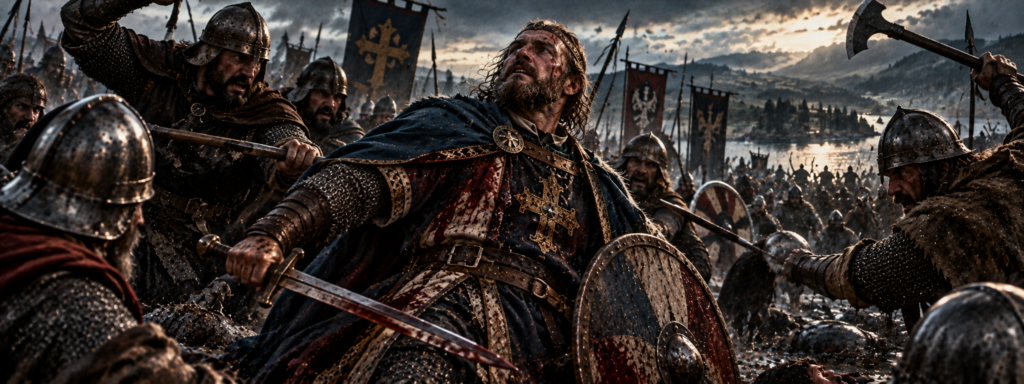
Olaf II of Norway: The Viking King Killed by His Own People and Reborn as a Saint
The Bloody Reign of Olaf Haraldsson, the Betrayal That Cost Him His Kingdom, and the Battle of Stiklestad That Transformed a Fallen King into Norway’s Eternal Martyr
On 29 July 1030, a deposed Norwegian king stood on a battlefield surrounded by men who had once been his subjects. Olaf Haraldsson had returned from exile determined to reclaim the kingdom he believed was rightfully his, but the army gathering against him was not simply a foreign invading force. Among his enemies were powerful Norwegian landowners, former supporters, and men whose families had suffered under his increasingly uncompromising rule. They had no intention of welcoming him home, and before the day was over, the king who had attempted to transform Norway into a Christian monarchy would be lying dead on the battlefield.
The confrontation at Stiklestad was the culmination of years of political bitterness, religious conflict, aristocratic resistance, and foreign interference. Olaf had made powerful enemies through his determination to strengthen royal authority, impose Christian practices, and punish those who defied him. His opponents accused him of tyranny, while his supporters regarded him as a legitimate king fighting against treachery and foreign domination. When the two sides finally met, the struggle was not merely about religion or royal succession, but about who possessed the right to rule Norway and how much power any king should be allowed to exercise.
According to later medieval accounts, Olaf’s final moments were brutally violent. The sagas describe him receiving several devastating wounds, including blows from an axe, spear, and sword, before collapsing among his enemies. The identities of the men credited with striking him vary in the surviving traditions, and the precise sequence cannot be established with certainty. What is clear is that Olaf died fighting an army composed substantially of Norwegians, including powerful men who had rejected his kingship and supported the political order that replaced him.
Within little more than a year, however, the meaning of his death began to change. Reports of miracles circulated, his remains became the focus of religious devotion, and the fallen ruler was recognized as a saint. The king whom many Norwegians had helped overthrow became the patron saint of their kingdom, and the battlefield where he died became one of the most important sites in Scandinavian religious memory. His reputation would eventually extend far beyond Norway, transforming a violent and controversial monarch into one of medieval northern Europe’s most celebrated Christian figures.
Yet the story behind Saint Olaf is considerably darker and more complicated than the familiar image of a holy king murdered by enemies of the faith. Olaf had begun his career as a Viking raider, participated in violent campaigns across northern Europe, and later used coercion as well as persuasion to establish his authority. His downfall involved political grievances that cannot be reduced to religious hostility, and his death occurred in open battle rather than in a conventional assassination. The extraordinary transformation of Olaf Haraldsson from feared ruler to revered martyr reveals how history, religion, and political necessity can reshape the memory of a man whose own subjects once considered him dangerous enough to kill.
Olaf Haraldsson: The Viking Who Became Norway’s Patron Saint
Olaf II Haraldsson, commonly known as Saint Olaf or Olaf the Holy, was born around 995 and ruled Norway from approximately 1015 to 1028. He belonged to a family with connections to the Norwegian royal tradition and claimed descent from Harald Fairhair, although the precise genealogy preserved in later sources remains uncertain. Before becoming king, Olaf participated in Viking expeditions around the Baltic and North Sea regions and spent time in England and continental Europe. He eventually embraced Christianity, traditionally receiving baptism in Normandy, although accounts of his conversion differ and the exact circumstances remain debated. After returning to Norway, he established himself as king and pursued a program of political consolidation closely associated with the strengthening of Christian institutions. His increasingly forceful rule alienated powerful regional leaders, and in 1028 he was driven from Norway as King Cnut of Denmark and England extended his authority over the country. Olaf fled eastward, eventually finding refuge among the rulers of Rus’, before returning in 1030 to recover his kingdom. On 29 July of that year, he was killed at the Battle of Stiklestad by forces composed largely of Norwegian opponents. His remains became the focus of a rapidly developing cult, and his recognition as a saint transformed him into one of the most influential figures in Norwegian religious and national history.
The dates of Olaf’s life are more secure than many details of his childhood, but substantial uncertainties remain. Much of the fullest narrative material comes from Icelandic and Norwegian histories composed generations after his death, particularly the kings’ sagas. These works preserve important traditions, some supported by earlier skaldic poetry, but they also contain reconstructed speeches, dramatic scenes, and interpretations shaped by later Christian attitudes. Their vivid descriptions should therefore not always be mistaken for contemporary eyewitness testimony.
Olaf’s reputation presents an unusual historical problem. His sanctity became central to Norwegian identity, yet the sources also preserve memories of a ruler who used violence against opponents and inspired significant resistance. These apparently conflicting images are not necessarily impossible to reconcile, because medieval ideals of kingship differed considerably from modern expectations. A ruler could be celebrated for defending Christianity while employing methods that later generations might regard as cruel.
The distinction between Olaf the historical king and Olaf the saint is essential to understanding his death. The king was a political actor struggling for authority in a fragmented Scandinavian kingdom. The saint became a symbol of religious legitimacy, national independence, and divine protection. The transformation from one identity to the other began almost immediately after his defeat.
Born Into a Kingdom of Rival Kings and Powerful Jarls
Norway at the end of the tenth century was not a centralized state governed through a uniform system of royal administration. It was a collection of regions with distinct political traditions, influential landowning families, and powerful local assemblies. Kings could claim authority over large territories, but their practical control depended upon the cooperation of regional leaders. The coast connected these communities through maritime trade and warfare, while inland districts retained considerable independence.
The legacy of Harald Fairhair, traditionally remembered as the first king to unite Norway, remained important to later royal claims. Yet the extent and nature of his supposed unification have been debated by historians. The kingdom that emerged from the Viking Age was shaped by successive struggles among royal descendants, powerful jarls, and foreign monarchs. Dynastic legitimacy mattered, but it rarely settled political disputes on its own.
Olaf’s father was Harald Grenske, a regional ruler associated with Vestfold, while his mother was Åsta Gudbrandsdatter. The later sagas describe Harald Grenske dying before Olaf’s birth or during his early childhood, leaving Åsta to raise her son within a politically influential family. Some details of these traditions are difficult to verify. Nevertheless, Olaf’s upbringing was associated with aristocratic connections that would later assist his political ambitions.
Åsta subsequently married Sigurd Syr, a wealthy landholder traditionally connected to the Norwegian royal line. The sagas portray Sigurd as a comparatively peaceful and practical figure whose interests centered upon managing his estates. Olaf’s relationship with his stepfather became an important element of later accounts of his return to Norway. The family network provided resources and connections useful to a young man seeking power.
Olaf’s early life unfolded during a period of extraordinary political upheaval. Norway had recently experienced the rule of Haakon Sigurdsson, the powerful jarl of Lade, followed by the rise of Olaf Tryggvason. The latter became famous for his efforts to promote Christianity and his dramatic death at the Battle of Svolder around 1000. His defeat allowed Danish and Swedish interests, together with Norwegian aristocratic leaders, to divide authority over much of the country.
The resulting political arrangement was dominated in important regions by the Lade jarls, particularly Erik Haakonsson and his family. These rulers exercised considerable independence while maintaining relationships with powerful Scandinavian monarchs. Their authority depended upon aristocratic support and maritime strength. The political landscape remained open to challengers who could assemble enough military resources and claim royal legitimacy.
For a young Olaf Haraldsson, the opportunity was obvious. The Norwegian crown was not securely held by a single uncontested dynasty. Powerful regional leaders possessed authority, but their alliances could change. A determined claimant with ships, warriors, and a credible royal ancestry might be able to transform himself from Viking adventurer into king.
The Young Viking Who Learned Power Through Violence
Before Olaf became associated with Christian kingship, he belonged to the world of Viking warfare. The later sagas describe him participating in expeditions across the Baltic region and along the coasts of northern Europe. These accounts include raids, battles, and encounters with other Scandinavian leaders. Their precise chronology and geographical details are not always reliable, but Olaf’s early career as a warrior is well established in the broader historical tradition.
Viking expeditions were not simply chaotic acts of plunder. They could involve organized fleets, political alliances, mercenary service, and attempts to secure territory or tribute. Successful leaders gained wealth, followers, and reputations that could later be converted into political authority. For a young man with royal ambitions, military experience was an important qualification.
Olaf’s activities brought him into contact with England during a period of intense Scandinavian intervention. Danish armies under Sweyn Forkbeard and later Cnut were struggling for control of the English kingdom. Scandinavian warriors could fight for different leaders according to political opportunity and personal advantage. Olaf’s presence within this environment exposed him to sophisticated forms of warfare and royal government.
Later narratives associate Olaf with campaigns in England and sometimes with fighting connected to the English king Æthelred II. The details of his allegiance at particular moments are disputed, and the surviving evidence does not support every episode described in the sagas. What matters is that Olaf operated within the wider Anglo-Scandinavian conflicts that transformed northern Europe during the early eleventh century. He gained experience in a world where kings could lose entire kingdoms through invasion and shifting alliances.
The famous account of an attack on London Bridge has sometimes been connected with Olaf. The story appears in later traditions and has become one of the most recognizable episodes associated with his Viking career. However, the historical circumstances and Olaf’s precise involvement remain debated. It should not be presented as an unquestionably documented exploit.
His years abroad also introduced him to Christian political culture. England and Normandy possessed established churches, royal administrations, and traditions of Christian kingship. A Scandinavian leader seeking a crown could observe how religious institutions supported political legitimacy. The relationship between Christianity and royal authority would become central to Olaf’s later ambitions.
By the time he returned to Norway, Olaf was no inexperienced prince. He had acquired military experience, developed relationships beyond Scandinavia, and learned how political opportunity could emerge from warfare. His earlier career had prepared him to seize power. It had not necessarily prepared him to govern a kingdom whose most influential inhabitants were deeply suspicious of royal interference.
Conversion, Christianity, and the Making of a Christian King
Olaf’s conversion to Christianity became one of the defining elements of his later reputation. Medieval tradition frequently places his baptism in Normandy, often associating it with Rouen and the Norman court. The precise date and circumstances remain uncertain, and some sources suggest that Olaf may already have encountered Christian practices earlier in life. The later narratives nevertheless treat his religious commitment as a major turning point.
Normandy offered a striking example of a society with Scandinavian origins that had become integrated into Latin Christian Europe. The descendants of Viking settlers had adopted Christianity and developed powerful political institutions. For a Norwegian prince, this transformation demonstrated that Scandinavian identity and Christian kingship could coexist. Religious conversion did not require abandoning royal ambition.
Christianity also offered political advantages. A Christian king could cultivate relationships with bishops, priests, and foreign rulers whose authority was supported by ecclesiastical institutions. The Church provided models of law, administration, and royal legitimacy that could strengthen a developing monarchy. Religious reform and political consolidation often reinforced one another.
Olaf’s personal sincerity cannot be measured directly. The surviving sources present him as a committed Christian, but they were shaped by the later cult of Saint Olaf. It is possible to recognize genuine religious conviction without assuming that his policies were motivated exclusively by devotion. Medieval rulers frequently understood political authority and religious responsibility as inseparable.
The conversion of Norway was already underway before Olaf’s reign. Earlier kings, including Haakon the Good and Olaf Tryggvason, had encouraged Christianity with varying degrees of success. Christian communities existed in several regions, especially those connected with trade and foreign contact. Traditional Norse religious practices nevertheless remained influential.
Olaf therefore did not introduce Christianity into a wholly pagan country. He inherited a religiously diverse society in which different communities had adopted Christian practices at different times. His achievement lay partly in strengthening the institutional position of Christianity and connecting it more firmly with royal authority. His methods, however, generated serious opposition.
Later accounts emphasize his destruction of pagan shrines, punishment of religious opponents, and enforcement of Christian observance. Some episodes may have been exaggerated to portray him as a heroic conqueror of paganism. Yet the broader association between his reign and coercive religious reform is difficult to dismiss. Olaf’s Christianity became inseparable from his determination to rule.
The Return to Norway and the Seizure of Power
Olaf returned to Norway around 1015, entering a political landscape shaped by Danish influence and the authority of the Lade jarls. His arrival coincided with circumstances that weakened the existing political arrangement. Erik Haakonsson had become involved in Cnut’s campaigns in England, leaving other members of his family to maintain their position in Norway. Olaf recognized an opportunity to challenge them.
The sagas describe his confrontation with Haakon Eriksson, a young member of the Lade family. According to the traditional account, Olaf captured Haakon and compelled him to surrender his position before allowing him to depart. The precise details cannot be independently verified. The episode nevertheless illustrates the political struggle between Olaf’s royal claim and the established authority of the jarls.
Olaf then sought recognition from regional assemblies and influential landowners. Kingship in Norway required more than military victory, because powerful communities retained traditions of political participation. A claimant needed supporters willing to acknowledge his authority and provide resources. Olaf’s family connections and military reputation helped him cultivate that support.
The decisive struggle came against Sweyn Haakonsson, another leading figure associated with the Lade dynasty. The Battle of Nesjar, generally dated to 1016, ended in Olaf’s victory. The battle was fought near the southeastern Norwegian coast and became an important milestone in his consolidation of power. Sweyn was defeated, and Olaf emerged as the dominant king.
Nesjar was significant because it weakened the principal aristocratic leadership opposing him. The Lade family had exercised authority over important regions for decades. Their defeat allowed Olaf to extend his influence and claim a more unified kingship. Yet the victory did not eliminate the political independence of every regional leader.
Olaf’s rule still depended upon negotiation and the maintenance of alliances. Powerful landowners possessed resources that the king needed, and their support could not always be compelled without consequences. The political challenge was to convert military victory into durable government. Olaf’s increasingly assertive approach would eventually undermine that process.
For the moment, however, his ambitions appeared successful. He had returned from abroad, defeated powerful opponents, and established himself as king. His reign offered the possibility of stronger central authority and a more firmly Christian political order. The same policies that advanced those goals would also create the enemies who later gathered at Stiklestad.
A King Determined to Rule Every Corner of Norway
Olaf’s reign was marked by efforts to strengthen royal authority across a politically fragmented kingdom. He sought to extend control over regions where local aristocrats had traditionally exercised substantial independence. His government relied upon royal representatives, alliances, legal authority, and military force. The exact administrative arrangements are difficult to reconstruct, but the general movement toward stronger kingship is clear.
Regional leaders could regard these developments as threats to their established privileges. A powerful landowner who had previously negotiated with kings from a position of considerable independence might resent demands for obedience, taxation, or military service. The crown’s expansion could affect local control over legal disputes and economic resources. Political resistance was therefore rooted in practical interests as well as personal rivalry.
Olaf’s Christian policies intensified these tensions. Religious reform could challenge traditional rituals that reinforced the authority of local communities and aristocratic families. A king who condemned certain practices might also undermine the prestige of leaders associated with them. Religious conflict and political centralization became closely intertwined.
The later sagas portray Olaf traveling through Norway to enforce Christian observance and punish resistance. Some accounts describe mutilation, execution, and the destruction of religious sites. The precise details of individual incidents cannot always be verified, and later Christian writers sometimes celebrated acts of coercion as demonstrations of saintly zeal. Nevertheless, the traditions preserve a consistent memory of a ruler willing to use severe methods.
Such policies could produce short-term obedience while creating long-term hostility. A landowner who submitted under pressure might remain loyal only while the king possessed overwhelming force. Families whose members were punished could preserve grievances for years. The growing resentment made Olaf vulnerable to rivals who promised a less intrusive political order.
His supporters, however, could interpret the same actions differently. They might regard the punishment of powerful opponents as necessary to establish justice and prevent aristocratic disorder. Christian reform could be presented as a sacred obligation rather than an arbitrary imposition. Olaf’s reign therefore generated competing understandings of legitimate kingship.
The difficulty of judging his policies lies partly in the nature of medieval political culture. Violence was an accepted instrument of authority, and rulers were often expected to punish defiance harshly. Olaf was not unique in employing coercion. Yet his particular combination of religious reform and centralization appears to have alienated enough powerful men to threaten his survival.
By the middle of his reign, the foundations of his authority were becoming increasingly fragile. He possessed the title of king and had achieved important military victories. He also faced aristocratic opposition, foreign ambitions, and grievances created by his own methods. The forces that would eventually overthrow him were beginning to take shape.
The Pagan Chieftains and the Price of Conversion
The religious conflicts associated with Olaf’s reign are among the most dramatic episodes in the saga tradition. Later accounts describe confrontations with chieftains who resisted Christianity and defended traditional practices. Olaf is portrayed as demanding conversion and punishing those who refused. These stories became important elements of his saintly reputation.
The historical situation was more complicated than a simple division between Christian king and pagan population. Christianity had already spread through coastal trade networks and aristocratic contacts with Europe. Some powerful Norwegians were Christian, while others maintained traditional beliefs or participated in mixed religious practices. Political loyalties did not always correspond neatly to religious identity.
Traditional Norse religion was deeply connected with social and political life. Feasts, sacrifices, and sacred sites could reinforce community relationships and the authority of influential families. A ruler who attempted to suppress these practices challenged more than private belief. He could disrupt established structures of prestige and obligation.
The sagas describe Olaf confronting local leaders at assemblies and religious gatherings. Some accounts include spectacular punishments or miraculous demonstrations of Christian power. Such episodes may reflect genuine memories of coercive reform, but their dramatic details often serve religious and literary purposes. They should not be treated as straightforward documentary evidence.
Olaf’s association with the destruction of pagan religious sites became central to later Christian interpretations of his reign. The king was celebrated for overcoming idolatry and establishing true worship. Yet the same actions could have appeared deeply threatening to communities whose traditions were being suppressed. Religious transformation was not experienced uniformly as liberation.
The king also relied upon clergy from abroad, particularly men connected with English Christian traditions. These priests and bishops contributed to the development of Norwegian ecclesiastical institutions. Their presence strengthened the connection between the monarchy and the wider Latin Church. It also helped establish forms of religious organization that would outlast Olaf himself.
The expansion of Christianity therefore involved both genuine institutional development and conflict. Churches and clerical networks became more firmly established, while traditional practices lost political protection. Olaf’s role in this transformation was significant. His methods, however, helped generate the opposition that eventually destroyed his reign.
The irony of his later sainthood is especially striking. The king remembered as a martyr for Christianity was killed by a coalition whose motives included political grievances rather than simply hostility to the faith. Many of his opponents were themselves operating within a society already influenced by Christianity. His death cannot be explained solely as a pagan reaction against conversion.
The Powerful Men Who Turned Against Their King
Olaf’s most dangerous enemies were not necessarily foreign monarchs. They included Norwegian aristocrats whose wealth, regional influence, and military resources made them essential to the functioning of the kingdom. A king could defeat individual opponents, but he could not easily govern without cooperation from powerful local families. Olaf’s increasingly forceful rule strained these relationships.
Among the most important figures was Erling Skjalgsson, a powerful aristocrat associated with Sola in southwestern Norway. Erling had established considerable influence before Olaf’s reign and maintained connections with the Norwegian royal tradition. His position made him an important political actor whose cooperation could strengthen a king. His independence also made him difficult to control.
The relationship between Olaf and Erling became increasingly tense. Later accounts describe disputes over authority, royal appointments, and the rights of local leaders. The exact sequence of confrontations is not always secure, but the broader conflict reflects the struggle between centralizing monarchy and regional aristocratic power. Erling was not merely a rebellious subject; he represented an established political order threatened by Olaf’s ambitions.
The sagas also describe opposition among other influential families. Some resented Olaf’s demands, while others possessed grievances arising from punishment or confiscation. The king’s enemies could communicate through kinship networks and regional alliances. Their combined influence made resistance more dangerous than isolated acts of defiance.
Olaf’s supporters remained important, but loyalty became increasingly costly. A nobleman who supported the king might find himself opposed by neighboring families or threatened by foreign intervention. The political situation became especially difficult as Cnut’s power expanded. Men who doubted Olaf’s ability to survive could begin considering alternatives.
The struggle was therefore shaped by fear as well as ambition. Aristocrats had to decide whether continued loyalty to Olaf would protect their interests or expose them to ruin. A powerful foreign king could offer rewards for changing allegiance. Olaf’s opponents did not need to defeat him immediately if they could gradually undermine his support.
The growing hostility revealed a fundamental weakness in his rule. He had attempted to create a stronger monarchy but had not secured the durable cooperation necessary to sustain it. His victories had removed particular opponents without eliminating the structures of aristocratic power. When a formidable external challenger appeared, those unresolved tensions became decisive.
Erling Skjalgsson and the Death That Poisoned a Kingdom
The killing of Erling Skjalgsson became one of the most important episodes in Olaf’s political downfall. Erling was a powerful regional aristocrat whose influence extended across parts of southwestern Norway. His relationship with Olaf had deteriorated as the king sought greater control over local affairs. Their confrontation became a symbol of the growing conflict between royal authority and aristocratic independence.
In 1028, Olaf and Erling clashed in a naval encounter, traditionally associated with Boknafjorden. The later sagas describe Erling being defeated and captured after fierce fighting. Some accounts portray Olaf as prepared to spare him. Erling was nevertheless killed, and the circumstances became a source of lasting controversy.
According to the saga tradition, a member of Olaf’s following named Aslak Fitjaskalle struck Erling with an axe after the defeated aristocrat had submitted. Olaf is then portrayed as condemning the killing because it destroyed the possibility of reconciliation. The dramatic exchange attributed to the king cannot be treated as a verbatim record. The broader tradition, however, associates Erling’s death with a severe political setback for Olaf.
The killing mattered because Erling possessed influential relatives and supporters. His death could not be dismissed as the elimination of an isolated rebel. It created grievances among families whose cooperation was important to royal government. Olaf’s position in southwestern Norway became increasingly difficult.
The circumstances also damaged the king’s reputation. Even if he had not personally ordered Erling’s death, responsibility could be attributed to his forces. A ruler was expected to control his followers and honor political settlements. The killing of a defeated aristocrat could make other opponents less willing to negotiate.
Erling’s death occurred at a moment when Cnut’s influence was expanding. Norwegian leaders dissatisfied with Olaf had an alternative source of royal authority. The death of such a prominent aristocrat strengthened the appeal of political change. Olaf’s enemies could present their opposition as resistance to a ruler who had become dangerous to established families.
The event therefore contributed to the collapse of Olaf’s support. His attempts to strengthen royal authority had already created resentment, and Erling’s killing intensified the hostility of important networks. The king’s military success produced political defeat. Within a short time, he would be forced to abandon Norway.
The episode also foreshadowed Stiklestad. Olaf’s downfall would be shaped by men who believed they had suffered under his rule or whose families had been harmed by his policies. The battlefield of 1030 would bring together grievances accumulated over years. Erling’s death was one of the events that helped turn political opposition into an armed movement.
Cnut the Great: The Foreign King Waiting to Take Norway
While Olaf struggled to maintain authority in Norway, Cnut the Great was building one of the most powerful political dominions in northern Europe. Cnut became king of England in 1016 and later succeeded to the Danish throne. His control of these kingdoms gave him substantial military, economic, and diplomatic resources. Norway represented both a strategic opportunity and a challenge to his regional supremacy.
Cnut’s ambitions were not simply those of a foreign conqueror seeking additional territory. Scandinavian kingship involved overlapping claims, family relationships, and established traditions of intervention. Danish rulers had exercised influence in Norway before Olaf’s rise. Cnut could therefore present his ambitions as the restoration or extension of existing political rights.
His resources were formidable. England provided wealth, administrative structures, and access to military forces, while Denmark offered a powerful Scandinavian base. Cnut could support Norwegian opponents of Olaf through diplomacy and financial rewards. He did not need to rely exclusively upon direct invasion.
The later sources describe Cnut cultivating relationships with Norwegian aristocrats dissatisfied with Olaf. Gifts and promises of advancement helped encourage defections. Such methods were common in medieval politics, where allegiance depended upon the ability of rulers to protect and reward supporters. Olaf’s increasingly strained relationships with powerful landowners made Cnut’s approach effective.
The contrast between the two kings was significant. Olaf sought to impose stronger authority within Norway but lacked the resources of Cnut’s wider dominion. Cnut could offer powerful families the prospect of security under an internationally dominant monarch. Some Norwegian leaders may have regarded his rule as preferable to Olaf’s increasingly confrontational policies.
Cnut’s intervention also complicated the religious interpretation of Olaf’s downfall. Cnut was himself a Christian king who supported churches and cultivated ecclesiastical legitimacy. The struggle between them was therefore not a simple war between Christianity and paganism. It was a contest between Christian rulers with competing political ambitions.
Olaf’s enemies could support Cnut without necessarily rejecting Christianity. Their opposition might arise from resentment of royal interference, personal grievances, or calculations about political survival. The religious identity of the competing rulers did not eliminate these motives. The later portrayal of Olaf as a martyr would simplify a conflict that was originally far more complex.
By 1028, Cnut’s influence had become overwhelming. Norwegian aristocratic support for Olaf was collapsing, and the king faced the prospect of confronting a superior political coalition. The ruler who had once returned triumphantly from abroad was now preparing to flee. His enemies had succeeded in making his own kingdom unsafe.
The Fall of Olaf’s Kingdom
In 1028, Olaf’s position deteriorated beyond recovery. Cnut’s political influence and the defection of powerful Norwegian leaders left the king increasingly isolated. His ability to summon reliable military support weakened, and the prospect of resisting a major Danish-backed challenge became dangerous. The kingdom he had spent more than a decade consolidating began to slip from his control.
The later sagas describe Olaf attempting to maintain authority while supporters abandoned him. Some men may have feared Cnut’s military strength, while others possessed grievances against Olaf’s government. The exact motives of individual aristocrats cannot always be reconstructed. The cumulative effect was decisive.
Olaf eventually fled Norway rather than confront an overwhelming coalition. His departure marked the collapse of his reign, although he did not abandon his claim to kingship. He traveled eastward through Sweden and eventually reached the lands of Rus’. The journey placed him within another network of royal and aristocratic relationships.
Cnut established his authority over Norway, although the practical arrangements involved Norwegian leaders and royal representatives. The powerful Lade lineage again became important to the political settlement. Håkon Eiriksson, a member of that family, exercised authority under Cnut. The arrangement demonstrated the continuing influence of regional aristocrats within Norwegian government.
For Olaf, exile was a profound reversal. He had returned to Norway as a warrior prince and established himself through military victory. Now he had been driven out by the same political forces he had attempted to control. His claim remained, but his ability to enforce it had disappeared.
The circumstances of his flight also reveal the limits of royal legitimacy. Olaf believed himself to be Norway’s rightful king, and his supporters continued to recognize his claim. Yet political authority depended upon military resources and aristocratic cooperation. Without them, a royal title offered little protection.
His enemies may have believed that exile had ended the problem. A deposed king living far away could appear less dangerous than one commanding troops within Norway. Yet Olaf had already demonstrated remarkable persistence in pursuing royal power. His departure would prove temporary.
The king’s return would transform political conflict into open battle. He had lost his kingdom through a combination of foreign intervention and domestic opposition. He intended to recover it by force. The decision would bring him to Stiklestad, where the struggle for Norway would end his life.
Exile in the East: The King Who Refused to Surrender
Olaf’s exile took him into the political world of Rus’, where Scandinavian connections remained important. The court of Yaroslav the Wise in Kyiv was linked to northern European dynastic networks through marriage and diplomacy. Olaf had family connections that made refuge there possible. The surviving traditions describe him receiving hospitality while considering his future.
Yaroslav’s wife, Ingegerd, was a Swedish princess whose earlier marriage negotiations had involved Olaf. The later sagas preserve a complicated account of Olaf’s relationship with her and his eventual marriage to Astrid, another daughter of the Swedish king Olof Skötkonung. The details of these relationships are shaped by literary traditions and cannot all be verified. Nevertheless, they illustrate the extensive dynastic connections linking Scandinavian rulers with eastern Europe.
Olaf’s wife Astrid remained an important figure in his family history, although the surviving sources provide limited information about her later life. His son Magnus, born to Alfhild according to the traditional accounts, would eventually become king of Norway. During Olaf’s exile, Magnus was still a child. His future political importance was not yet assured.
The sagas portray Olaf reflecting upon his defeat and considering whether to pursue a religious life. Such accounts fit the later image of a saintly king preparing for martyrdom. They may preserve genuine traditions of religious reflection, but their detailed descriptions of his private thoughts cannot be treated as historical certainty. Olaf’s eventual decision to return demonstrates that he had not abandoned his political ambitions.
Exile also provided an opportunity to seek support. Scandinavian rulers and aristocrats maintained connections across the Baltic region, and a displaced king could attempt to recruit followers abroad. Olaf had previously built his career through military expeditions and political alliances. He now needed to repeat that process under more difficult circumstances.
The political situation in Norway also changed during his absence. Håkon Eiriksson, who had exercised authority under Cnut, died around 1029, reportedly in a shipwreck. His death created uncertainty within the governing arrangement. Olaf could interpret the resulting instability as an opportunity to recover his throne.
The decision to return was therefore not simply a desperate act of religious conviction. It was a political calculation made by a deposed ruler who believed circumstances had become more favorable. His supporters could hope that discontent with Danish-backed government would encourage Norwegians to rally to him. The danger was that his enemies remained powerful and organized.
Olaf prepared to march westward. He gathered a force whose precise size and composition are uncertain, drawing upon supporters and foreign connections. The journey would take him through Sweden toward Norway. His destination was the kingdom he had lost, and the men waiting to resist him included those who had once acknowledged his authority.
The Road Back to Norway
Olaf’s return in 1030 was an attempt to reverse the political settlement established after his exile. He traveled westward with an armed following, seeking to regain support and confront the forces opposing his restoration. The later sagas describe his journey through Sweden and across the mountains toward Trøndelag. Their geographical details are not always secure, but the broad movement toward central Norway is well established.
His army was probably smaller than the forces that could be assembled by the Norwegian coalition opposing him. The exact numbers given in medieval accounts are unreliable because chroniclers frequently exaggerated army sizes. The composition of Olaf’s following is also debated. It likely included loyal Norwegians and men recruited through his connections abroad.
The presence of foreign warriors became an important element in later descriptions of the campaign. Olaf’s opponents could portray his return as an invasion supported by outsiders, even though he claimed to be Norway’s legitimate king. This complicated the political meaning of the conflict. A ruler seeking to recover his own kingdom could nevertheless appear as a threatening foreign-backed claimant.
Olaf’s supporters interpreted the situation differently. They regarded him as a dispossessed monarch whose enemies had betrayed him and submitted to Danish influence. His return could therefore be presented as an effort to restore legitimate kingship. The opposing sides disagreed not only about who should rule but about the meaning of loyalty itself.
The Norwegian aristocratic coalition prepared to resist him. Powerful leaders in Trøndelag and other regions had reasons to oppose his restoration. Some had benefited from the political order established under Cnut. Others feared that Olaf would punish those who had helped overthrow him.
The later sagas describe extensive preparations by both sides. Olaf’s army advanced toward the region of Stiklestad, while his opponents assembled a substantial force. The details of the march and individual encounters may contain literary embellishments. The essential situation was a confrontation between a returning claimant and a coalition determined to prevent his return to power.
The conflict was particularly bitter because the opposing armies were not separated by nationality alone. Norwegians fought on both sides, and personal relationships crossed the political divide. Men who had once served the same king could now confront one another as enemies. The struggle was therefore a civil war as much as a contest involving Danish influence.
As Olaf approached Stiklestad, his political options narrowed. Negotiation might have required concessions that neither side was willing to accept. Retreat would mean abandoning the attempt to recover his throne. The confrontation became increasingly difficult to avoid.
Stiklestad: The Battlefield That Would Change Norway
Stiklestad lies in the Verdal region of Trøndelag, an area associated with powerful communities and important political traditions. The battlefield became one of the most famous locations in Norwegian history because of Olaf’s death. The exact topography of the eleventh-century encounter cannot be reconstructed in every detail. Nevertheless, the region’s historical importance is beyond doubt.
The date traditionally assigned to the battle is 29 July 1030. This date became central to Olaf’s later religious commemoration, and his feast day continues to be associated with it. The chronological tradition is strong, although the precise reconstruction of all events surrounding the battle remains dependent upon later sources. The date itself became part of the transformation of a political defeat into a sacred anniversary.
Olaf’s opponents assembled a force composed largely of Norwegian landowners and their followers. The sagas identify several important leaders, including Tore Hund, Kalv Arnesson, and Hårek of Tjøtta. Their individual motives differed, but they shared an interest in preventing Olaf’s restoration. Some possessed personal grievances against him, while others had political reasons to support the existing order.
Tore Hund was a powerful northern Norwegian aristocrat whose family had suffered through conflict with Olaf’s regime. The sagas associate him with grievances arising from the killing of his nephew Asbjørn Selsbane. The details of that earlier episode are preserved through later narrative traditions, but the feud became an important explanation for Tore’s hostility. His participation at Stiklestad therefore carried a personal dimension.
Kalv Arnesson had once been associated with Olaf’s circle but later became one of his opponents. His change of allegiance reflected the complicated political choices facing Norwegian aristocrats. Loyalty to a king could be weakened by personal disputes, changing alliances, or the expectation of greater advantage elsewhere. Kalv’s presence among Olaf’s enemies illustrates the extent of the king’s political isolation.
Hårek of Tjøtta represented another influential regional power. His position in northern Norway gave him resources and followers independent of Olaf’s immediate control. The coalition against the returning king therefore brought together men whose authority rested upon established local networks. They were not simply soldiers obeying a foreign monarch.
The battlefield became the meeting point of these grievances. Olaf arrived seeking to recover the crown, while his opponents intended to prevent his return. The conflict combined questions of legitimacy, revenge, religion, and political independence. Its outcome would determine the immediate fate of the Norwegian monarchy.
Yet no one gathering at Stiklestad could have anticipated the full significance the battle would acquire. The men opposing Olaf expected to defeat a dangerous claimant. Instead, their victory would become the event that transformed him into a saint. The political meaning of the battle would change almost as dramatically as the fortunes of the king who died there.
The Men Who Wanted Olaf Dead
The coalition opposing Olaf was not united by a single ideology. Its leaders possessed different histories, grievances, and political interests. Some had suffered directly under Olaf’s rule, while others had benefited from the political arrangements established after his exile. Their common objective was to prevent him from regaining power.
Tore Hund became one of the most prominent figures in the later accounts of the battle. He was associated with Bjarkøy in northern Norway and belonged to an influential aristocratic network. The killing of his nephew Asbjørn Selsbane had created a bitter feud involving Olaf’s regime. Later narratives present Tore’s participation as partly motivated by revenge.
Asbjørn’s story illustrates the intersection of personal grievance and royal authority. According to the sagas, disputes over trade, supplies, and royal restrictions led to conflict involving members of Tore’s family. Asbjørn was eventually killed, and responsibility became entangled with Olaf’s political circle. The precise details are uncertain, but the tradition preserves the memory of a feud that contributed to hostility toward the king.
Kalv Arnesson’s position was equally complicated. He belonged to a powerful family whose members had connections with Olaf’s government. Some of his relatives remained loyal to the king, demonstrating that political divisions could run through individual families. His opposition at Stiklestad therefore reflected the fragmentation of aristocratic allegiance.
Hårek of Tjøtta had his own reasons to resist Olaf’s restoration. As a regional leader, he possessed interests that could be threatened by stronger royal control. His participation helped give the anti-Olaf coalition substantial northern support. The combined strength of such men made the opposition formidable.
The later saintly narratives sometimes portray Olaf’s enemies as morally corrupt or hostile to Christianity. That interpretation reflects the development of his cult after death. Their historical motives were more varied, and some were themselves Christians or operated within Christian political networks. Their opposition cannot be explained solely as resistance to religious conversion.
The coalition also benefited from the political authority of Cnut’s wider Scandinavian dominion. The existing arrangement offered powerful Norwegian leaders a framework within which they could exercise influence. Olaf’s return threatened to overturn that settlement. His enemies therefore had practical reasons to fight.
The personal dimension of the conflict made reconciliation difficult. Men whose relatives had been killed or whose authority had been challenged might fear revenge if Olaf regained power. The king, in turn, could regard their opposition as treachery. Stiklestad became the place where these unresolved grievances were settled through violence.
The Night Before the Battle
Later saga accounts devote considerable attention to Olaf’s conduct before the Battle of Stiklestad. They portray him as calm, prayerful, and increasingly aware that death might be approaching. These scenes became important to the religious interpretation of his final campaign. They should, however, be read with caution because their detailed conversations and private reflections were recorded long after the event.
The narratives describe Olaf arranging his forces and preparing for the confrontation. Some accounts emphasize his concern for Christian observance and his refusal to employ certain practices associated with traditional warfare. Others describe his interactions with followers who remained loyal despite the danger. These details help construct the image of a king approaching martyrdom.
The historical Olaf undoubtedly faced a difficult military situation. His opponents possessed substantial regional support, and his own army may have been smaller. The prospect of defeat was real. His decision to continue suggests either confidence in his claim, hope for victory, or an unwillingness to abandon his attempt at restoration.
The sagas also preserve accounts of dreams and supernatural signs associated with the approaching battle. Such stories belong to the religious and literary traditions surrounding Olaf’s death. They cannot be treated as evidence of actual prophetic experiences. Their importance lies in how later generations interpreted the event.
The portrayal of Olaf as a saintly figure before his death also contrasts with the harsher traditions concerning his reign. The king who had used coercion to enforce authority now appears in some narratives as a humble servant of God. This transformation was central to the development of his cult. His death was interpreted as the culmination of a sacred mission rather than the defeat of a controversial ruler.
His followers faced their own fears. They were preparing to fight a coalition of men who knew the country and possessed powerful local connections. Many of the opposing warriors were fellow Norwegians. The battle would therefore involve the possibility of killing neighbors, relatives, or former allies.
The emotional atmosphere can be understood without inventing specific conversations. Olaf had returned from exile to reclaim his kingdom, and his enemies had assembled to stop him. Neither side could easily retreat without surrendering its political objectives. The following day would decide whether the king recovered his throne or lost his life.
The Battle of Stiklestad: Norway Turns Its Weapons Against Its King
The Battle of Stiklestad was fought on 29 July 1030 between Olaf’s returning army and a coalition of Norwegian opponents. The later sagas describe a fierce engagement in which the forces eventually closed in brutal hand-to-hand combat. Their accounts contain vivid individual episodes, but the precise movements of the armies cannot be reconstructed with certainty. The broad outcome is undisputed: Olaf was defeated and killed.
The battle’s political character was unusually bitter. Olaf’s opponents were not merely foreign soldiers serving an invading monarch. They included powerful Norwegian leaders who had once lived under his authority and rejected his attempt to return. Their victory would prevent the restoration of a king they regarded as dangerous.
The sagas describe Olaf fighting among his men rather than remaining distant from the combat. This portrayal is consistent with the expectations of Viking-age and early medieval warrior kings, whose legitimacy often depended upon personal military leadership. A ruler who sought to recover his throne through battle could hardly avoid the dangers faced by his followers. His presence near the fighting made him vulnerable to direct attack.
As the battle developed, Olaf’s forces were overwhelmed. The exact sequence of the collapse is uncertain, but the king eventually became exposed to enemy warriors. The later accounts describe several men delivering wounds that contributed to his death. These descriptions became central to the memory of his martyrdom.
The traditional narrative identifies Tore Hund, Kalv Arnesson, and Torstein Knarresmed among those associated with the fatal blows. The precise distribution of wounds varies between accounts. Some describe a spear wound, an axe blow, and a sword strike, while others emphasize different details. Historians cannot establish the exact order or identify every attacker with confidence.
What matters is that Olaf died violently at the hands of men fighting against his restoration. His death ended the battle as a contest for his personal kingship. Without the returning claimant, his supporters could no longer achieve their immediate objective. The coalition opposing him had secured a decisive military victory.
The scene later became one of the most famous in Scandinavian historical memory. Artists, chroniclers, and religious writers repeatedly returned to the image of the king surrounded by enemies. The wounds described in the sagas acquired symbolic meaning as signs of suffering and sacrifice. The battlefield was transformed from the site of a political defeat into the setting of a sacred death.
Yet the historical event remained a battle. Olaf was armed, commanding forces, and attempting to regain political power. His opponents were fighting an organized military campaign rather than carrying out a clandestine murder. This distinction is essential when considering whether his death belongs within the history of assassination and regicide.
The Fatal Wounds: How Saint Olaf Was Killed
The most familiar account of Olaf’s death describes him receiving three principal wounds. In the version preserved by Snorri Sturluson, Torstein Knarresmed strikes him with an axe, Tore Hund wounds him with a spear, and Kalv Arnesson delivers another fatal blow. Other traditions differ in their emphasis and details. The sequence became an important part of the saintly narrative.
These descriptions should not be treated as a forensic reconstruction. The sources were written long after the battle, and the accounts reflect literary traditions that emphasized the participation of prominent enemies. The names may preserve authentic memories of the men involved. The precise identification of each wound remains uncertain.
The image of several enemies striking the king had powerful symbolic value. It presented Olaf as a ruler overwhelmed by collective hostility rather than defeated in an ordinary duel. His death could be interpreted as the culmination of betrayal by those who should have recognized his authority. The later cult of Saint Olaf transformed this suffering into evidence of martyrdom.
Tore Hund’s role became particularly memorable because of the feud involving his family. His presence among the king’s killers connected the final battle with earlier grievances. The tradition therefore offered a personal explanation for the violence. Olaf’s political decisions had created enemies who now stood over him with weapons.
Kalv Arnesson’s involvement carried a different significance. He had previously been associated with Olaf’s political circle, making his opposition a symbol of changing allegiance. The later accounts sometimes emphasize the moral consequences of such betrayal. His career after the battle would remain entangled with the politics of Olaf’s memory.
Torstein Knarresmed appears in the traditional account as another participant in the fatal attack. The sagas connect him with grievances against Olaf’s rule, reinforcing the theme that the king’s earlier actions had generated personal enemies. The details of these grievances are difficult to verify. Their inclusion demonstrates how later writers explained the king’s death through accumulated resentment.
The exact moment of Olaf’s death cannot be recovered. No reliable contemporary testimony preserves his final words, thoughts, or gestures. Later religious narratives supply dramatic details that serve devotional purposes. A historically responsible account must resist the temptation to present those scenes as certain.
Olaf’s death was nevertheless brutal and politically decisive. He had returned to reclaim his throne and was killed by the forces opposing him. His body remained on the battlefield while the victorious coalition controlled the immediate aftermath. The king’s military career had ended, but the struggle over the meaning of his life was only beginning.
Assassination, Regicide, or Death in Battle?
Olaf’s death occupies an unusual position within the history of murdered rulers. He was killed by men who had once been his subjects and who opposed his claim to kingship. His death was deliberate in the sense that enemy warriors sought to defeat and kill him during combat. Yet it occurred in an open battle rather than through a secret assassination plot.
The distinction is important. Assassination generally refers to the deliberate killing of a prominent person, often for political reasons, outside ordinary battlefield combat. Regicide refers more broadly to the killing of a king or ruler. Olaf’s death can be understood as a form of regicide within a civil conflict, but describing it as a conventional assassination risks obscuring the circumstances.
His position as a deposed king further complicates the terminology. Olaf had lost effective control of Norway in 1028 and returned in 1030 as a claimant seeking restoration. His supporters regarded him as the rightful monarch, while his opponents rejected his authority. The question of whether his killers murdered their king depended partly upon which political claim one accepted.
Later religious tradition resolved the issue differently. Olaf became a martyr whose death was interpreted as a sacrifice connected with Christian kingship. His enemies were portrayed as persecutors of a holy ruler. The political complexity of the battle was subordinated to its spiritual meaning.
The historical motives of the opposing coalition, however, were not exclusively religious. Aristocratic grievances, resistance to centralization, loyalty to Cnut’s political order, and personal feuds all contributed to the conflict. Some opponents may have objected to Olaf’s religious policies, but others were concerned primarily with political power. The battle cannot be reduced to an organized assassination of a Christian ruler by pagan enemies.
The classification of Olaf’s death should therefore remain precise. He was a former reigning king killed in battle by a coalition of his own countrymen and political opponents. His death became celebrated as martyrdom, and later tradition emphasized betrayal and sacred sacrifice. These interpretations are historically significant even where they differ from the immediate political circumstances.
Including Olaf among assassinated rulers and regicides is justified if the category encompasses politically motivated killings of rulers, including battlefield deaths at the hands of rebellious subjects. His case illustrates the boundary between assassination, civil war, and regicide. It also demonstrates how later religious memory can transform the meaning of a violent political death.
The Victors and the King They Had Destroyed
Olaf’s enemies won the Battle of Stiklestad, but their victory did not produce the stable political settlement they may have expected. The returning king was dead, and the immediate threat to the existing order had been eliminated. Yet the wider political circumstances of Norway remained unsettled. The authority of Cnut and his representatives continued to depend upon cooperation with regional leaders.
The men who had fought against Olaf could initially regard the battle as a success. Their coalition had prevented the restoration of a ruler whose policies they opposed. Powerful aristocrats retained influence, and the political arrangement established after Olaf’s exile remained in place. The death of the claimant appeared to resolve the immediate crisis.
The later sagas, however, describe growing dissatisfaction with the government that followed. Cnut’s son Sweyn and his mother Ælfgifu became associated with harsh rule and unpopular demands in Norway. The details of their administration are preserved through sources shaped by later hostility, but the tradition reflects a genuine political shift. The Danish-backed settlement lost support.
This deterioration changed how Olaf’s former opponents viewed the past. A king who had seemed intolerable while alive could appear more attractive when compared with an unpopular successor. Political memory is rarely fixed. The grievances that had justified rebellion could be overshadowed by new disappointments.
The development of Olaf’s religious cult accelerated this transformation. Reports of miracles and the recognition of his sanctity gave his supporters a powerful new argument for legitimacy. The king’s death could be interpreted as evidence of divine favor rather than political failure. His enemies faced the uncomfortable possibility that the man they had killed was becoming a sacred figure.
Some of the aristocrats associated with Stiklestad later participated in political arrangements involving Olaf’s son Magnus. Their changing allegiances illustrate the fluidity of Norwegian politics. Men who had opposed the father could support the son when circumstances changed. Dynastic legitimacy became useful once again.
The victory at Stiklestad therefore contained the seeds of its own reversal. Olaf’s death removed him from political competition but made possible a new form of authority through sainthood. His memory could unite supporters in ways his living government had failed to achieve. The king’s enemies had won the battle without controlling the story that followed.
The Body of Olaf and the First Reports of Miracles
The treatment of Olaf’s body after Stiklestad became central to the development of his cult. Later accounts describe his remains being recovered and buried near Nidaros, the settlement that would become Trondheim. The precise circumstances of the initial burial are uncertain. What matters is that his body soon became the focus of extraordinary religious attention.
Reports of miracles began circulating after his death. The traditions describe healings, unusual signs associated with his remains, and other events interpreted as evidence of holiness. These accounts were important to the process through which Olaf became recognized as a saint. They cannot be independently verified as supernatural occurrences, but their historical influence was profound.
One famous tradition concerns the condition of Olaf’s body when it was exhumed. Later sources describe his remains as remarkably preserved, with hair and nails apparently continuing to grow. Such details became powerful signs of sanctity in medieval religious culture. The historical reliability of the specific observations is uncertain.
The bishop Grimkell played an important role in the recognition of Olaf’s holiness. He had been associated with Olaf’s reign and participated in the development of the Norwegian Church. Around 1031, Olaf’s remains were examined and his sanctity was publicly recognized. This local ecclesiastical recognition became the foundation of his enduring cult.
The process occurred before the later medieval system of formal papal canonization had become standardized. Saints could be recognized through local ecclesiastical authority and popular devotion. Olaf’s cult developed within this earlier tradition. His status as a saint therefore emerged through a combination of religious belief, clerical support, and political circumstances.
The rapid development of the cult is remarkable. Only a short time earlier, powerful Norwegian leaders had considered Olaf dangerous enough to resist with armed force. Now his body was being honored as that of a holy man. The transformation reflected changing political conditions as well as religious devotion.
The miracles attributed to Olaf became increasingly numerous in later literature. Stories of healing, protection, and divine intervention spread through Norway and beyond. His reputation grew as pilgrims visited places associated with his life and death. The defeated king was becoming more powerful in memory than he had been during the final years of his reign.
The Making of Saint Olaf
Olaf’s recognition as a saint transformed the political meaning of his death. The Battle of Stiklestad ceased to be remembered merely as the defeat of a returning claimant. It became the scene of martyrdom, where a Christian ruler had suffered at the hands of enemies. The king’s military failure was reinterpreted as spiritual victory.
This transformation did not occur in isolation from politics. Norway was experiencing dissatisfaction with the Danish-backed government that followed Olaf’s death. The cult of a native royal saint offered an alternative source of legitimacy. Supporting Olaf’s memory could become a way of expressing opposition to foreign influence.
The Church also benefited from the development of the cult. A royal saint provided a powerful symbol around which Christian institutions could organize devotion and authority. Churches dedicated to Olaf appeared, and his feast day became an important part of the religious calendar. His memory helped strengthen the position of Christianity within Norwegian society.
The image of Olaf as a martyr also simplified his controversial reign. The harsh punishments and political conflicts associated with his government became secondary to the story of a king who had defended the faith. Later writers could portray his opponents as enemies of Christianity even when their historical motives were more complicated. The saintly narrative reshaped the moral balance of his life.
This did not necessarily require deliberate deception. Medieval communities interpreted events through religious assumptions that differed from modern historical analysis. Miracles, martyrdom, and divine judgment were meaningful categories through which people understood political change. Olaf’s death could genuinely appear to confirm his holiness.
The cult spread beyond Norway. Churches and communities in other Scandinavian regions, the British Isles, and parts of northern Europe honored Saint Olaf. His image became associated with royal sanctity, Christian identity, and protection. The geographical reach of his devotion was extraordinary for a ruler whose reign had ended in defeat.
The growth of the cult also influenced later historical writing. Authors composing accounts of Olaf’s life already knew him as a saint. They interpreted his earlier actions in light of that identity. The result was a body of literature in which political history and religious celebration became deeply intertwined.
The historical Olaf did not disappear entirely beneath the saintly image. Memories of his severity, political conflicts, and violent career survived in the sagas. Yet these elements were often incorporated into a narrative of righteous kingship. His harshness could be presented as necessary discipline rather than evidence of tyranny.
The transformation was complete in one essential respect. The king whom his own countrymen had killed became a symbol of the Norwegian kingdom itself. His enemies had prevented his return to power, but they could not prevent his memory from becoming central to the monarchy that followed.
Magnus the Good and the Return of Olaf’s Dynasty
Olaf’s son Magnus became one of the principal beneficiaries of his father’s growing reputation. Born around 1024, Magnus had been taken eastward during the period of Olaf’s exile and remained connected with the political world of Rus’. After Olaf’s death, his claim to the Norwegian throne acquired new significance. The cult of Saint Olaf provided a powerful foundation for dynastic legitimacy.
Dissatisfaction with the government associated with Cnut’s son Sweyn and Ælfgifu encouraged Norwegian leaders to seek an alternative. Magnus represented the bloodline of a king whose memory was rapidly becoming sacred. His youth also made him a potentially attractive candidate to aristocrats hoping for a more cooperative political arrangement. The political circumstances therefore favored his return.
In 1035, Magnus became king of Norway. His accession marked a dramatic reversal of the outcome at Stiklestad. The son of the defeated king now occupied the throne, supported by men whose interests had changed since 1030. The dynasty that had appeared destroyed was restored.
The relationship between Magnus and former opponents of Olaf was complicated. Some aristocrats associated with the battle became involved in the new political settlement. Later narratives describe tensions over revenge and reconciliation. The precise details are difficult to verify, but the broader problem was unavoidable: Magnus had to govern a kingdom containing men who had helped kill his father.
A policy of indiscriminate revenge would have threatened the alliances necessary for stable government. Magnus therefore faced the same structural problem that had contributed to Olaf’s downfall. He needed the cooperation of powerful regional families. His success depended upon balancing dynastic memory with political practicality.
The cult of Saint Olaf helped resolve this tension. The father’s sanctity strengthened the son’s legitimacy without requiring every former opponent to be punished. The monarchy could present itself as the heir to a sacred ruler while negotiating with aristocrats whose earlier loyalties had differed. Religious memory became a political resource.
Magnus’s reign also demonstrated the continuing importance of Scandinavian dynastic connections. He later became king of Denmark as well as Norway, extending his authority beyond his father’s kingdom. His career belonged to the same interconnected political world that had shaped Olaf’s rise and fall. The difference was that Magnus possessed the additional prestige of being the son of a saint.
Olaf’s death had therefore produced an outcome his enemies could scarcely have anticipated. The king they killed became the source of legitimacy for a restored dynasty. The political defeat of 1030 helped create the religious authority that supported the monarchy after 1035. Stiklestad became both the end of one reign and the beginning of a new form of royal power.
Nidaros: The City Built Around a Saint
The cult of Saint Olaf transformed Nidaros into one of the most important religious centers in medieval Scandinavia. The settlement, later known as Trondheim, became closely associated with his burial and the veneration of his remains. Pilgrims traveled there seeking spiritual benefits and honoring the king’s memory. The city acquired a religious significance far greater than its political position alone might have provided.
The shrine of Saint Olaf became a central feature of Norwegian Christian life. Religious communities preserved accounts of his miracles and promoted devotion to him. Churches dedicated to Olaf appeared across Scandinavia and beyond. His reputation connected Norway to wider networks of European pilgrimage and saintly veneration.
The establishment of the archbishopric of Nidaros in 1152 or 1153 further strengthened the city’s importance. Norway now possessed a major ecclesiastical center associated with its national saint. The development reflected the growing institutional maturity of the Norwegian Church. Olaf’s memory became deeply embedded within that structure.
Nidaros Cathedral eventually developed into one of the great medieval churches of northern Europe. Its history was closely connected with the shrine of Saint Olaf. The building became a monumental expression of the religious authority associated with the fallen king. The battlefield death of 1030 had helped create a center of pilgrimage that endured for centuries.
The cult also influenced royal ideology. Later Norwegian kings could associate their authority with Saint Olaf and present themselves as guardians of his legacy. The saint became a symbol of legitimate kingship that transcended the political controversies of his own reign. His image helped connect monarchy, Christianity, and national identity.
This transformation was especially remarkable because Olaf had failed to maintain the political alliances necessary for his own survival. As a living ruler, he had alienated powerful aristocrats and been driven into exile. As a saint, he became a figure around whom later rulers could organize legitimacy. His memory achieved a unity that his government had struggled to impose.
The importance of Nidaros also demonstrates how religious institutions can preserve and reshape political history. The city’s sacred identity depended upon the interpretation of Olaf’s death as martyrdom. Pilgrimage, liturgy, and architecture reinforced that interpretation. Over time, the saintly Olaf became more familiar than the controversial king.
Yet the historical contradictions remained. The man honored at Nidaros had been a Viking warrior, a forceful monarch, and a ruler whose subjects had taken up arms against him. His shrine did not erase those facts. It transformed their meaning within a religious narrative that endured long after the political struggles of the eleventh century had faded.
The Men Who Killed a Saint
The later reputations of Olaf’s opponents became inseparable from the development of his cult. Men who had fought against him at Stiklestad were increasingly remembered through the moral framework of martyrdom. Their political motives could be overshadowed by the accusation that they had participated in the killing of a holy king. The transformation created a lasting burden upon their historical memory.
Tore Hund remained one of the most recognizable figures associated with Olaf’s death. The sagas portray him as a powerful aristocrat whose family grievances contributed to his hostility. His participation in the fatal attack became central to later accounts. His subsequent fate is not securely documented in every detail, and traditions concerning his later travels should be treated cautiously.
Kalv Arnesson’s career continued after Stiklestad, reflecting the fluid political alliances of the period. He became involved in the political arrangements surrounding Magnus the Good. His position demonstrates that participation in Olaf’s defeat did not necessarily result in permanent exclusion from power. Political reconciliation could become necessary even when religious memory condemned earlier actions.
The later narratives sometimes portray Olaf’s killers as experiencing remorse or divine punishment. Such stories fit the conventions of hagiography, in which the enemies of saints often suffer consequences that confirm the holiness of their victims. They may preserve elements of historical memory, but their supernatural or moralized details cannot be independently verified. The historian must distinguish political careers from devotional storytelling.
The reputations of these men were shaped by the victory of Olaf’s memory. Had his cult not developed, Stiklestad might have been remembered primarily as the defeat of a failed claimant. Instead, the victors became associated with the death of Norway’s patron saint. Their military success was transformed into a moral defeat.
This reversal reveals the power of historical interpretation. The men who fought Olaf believed they possessed legitimate reasons to resist him. Their grievances included political independence, family feuds, and opposition to his government. Later generations increasingly understood their actions through the language of betrayal and sacrilege.
The transformation did not necessarily reflect a deliberate campaign to falsify history. Religious devotion and political legitimacy encouraged particular interpretations of the past. Stories emphasizing Olaf’s holiness became more influential than accounts explaining the grievances of his opponents. The victors at Stiklestad gradually lost control of their own historical image.
Olaf’s enemies therefore suffered an unusual defeat after death. They had killed the king and prevented his restoration, but his memory became more powerful than their victory. Their names survived largely because they were associated with his martyrdom. The battlefield that had secured their immediate political objectives became a place where their actions were remembered with condemnation.
Was Olaf Really a Martyr?
The question of Olaf’s martyrdom depends partly upon the distinction between medieval religious interpretation and modern historical analysis. In the Christian tradition, martyrdom involves suffering death in connection with faith or religious witness. Olaf’s supporters regarded his death as the culmination of his efforts to establish Christianity and legitimate kingship in Norway. His rapid recognition as a saint reflected that interpretation.
The immediate circumstances of Stiklestad, however, were political and military. Olaf had returned from exile with an armed force to reclaim his throne. His opponents assembled to prevent his restoration. The battle was therefore a struggle for power rather than a straightforward execution for refusing to renounce Christianity.
The religious identities of the participants also complicate the traditional narrative. Olaf’s enemies were not uniformly pagan, and the political order associated with Cnut was itself Christian. Opposition to Olaf did not necessarily mean opposition to Christianity. Many aristocrats had reasons to resist his government that were independent of religious belief.
This does not mean that religion was irrelevant. Olaf’s efforts to strengthen Christian institutions and suppress traditional practices had contributed to his political conflicts. His supporters could sincerely believe that his death was connected with his religious mission. Medieval ideas of sacred kingship often linked the defense of royal authority with the defense of Christian order.
The later cult transformed these connections into a powerful narrative of martyrdom. Miracles attributed to Olaf reinforced the belief that God had vindicated him. The Church’s recognition of his sanctity gave the interpretation institutional authority. His death became a religious event whose significance extended beyond the immediate battle.
Modern historians generally distinguish between Olaf’s political career and the devotional traditions that developed after his death. His sainthood is a historical fact in the sense that he was recognized and venerated as a saint. The supernatural claims associated with his cult belong to religious belief rather than independently verifiable historical evidence. His martyrdom is therefore best understood as a medieval religious interpretation of a violent political death.
The distinction makes his story more compelling rather than less. Olaf was not a passive victim seized and executed for his faith. He was a warrior king attempting to recover political authority through battle. His death became sacred because later communities interpreted it through the needs and beliefs of their own time.
The historical and religious identities of Olaf can therefore coexist without being confused. The king was defeated and killed by political opponents. The saint emerged through the devotion that followed. Understanding both reveals the extraordinary process by which a controversial ruler became a central figure in Scandinavian Christianity.
The Contradictions of a Holy Warrior
Olaf’s life contains contradictions that have fascinated historians for centuries. He began as a Viking warrior participating in a world of raiding and dynastic conflict. He later became a Christian king determined to strengthen religious institutions. His methods could be severe, yet his memory became associated with sanctity and divine protection.
These contradictions reflect the political culture of his age. Medieval rulers were expected to defend their authority through force, and religious reform could be pursued through coercive measures. The idea that a holy ruler should necessarily be peaceful did not dominate medieval understandings of kingship. A warrior king could be celebrated for using violence in the service of what contemporaries regarded as righteous goals.
Olaf’s opponents did not necessarily share that interpretation. Powerful landowners could experience his policies as attacks upon their rights and traditions. Families whose members were punished could regard his rule as oppressive. His determination to strengthen monarchy threatened established regional autonomy.
The later saintly narratives often reinterpret these conflicts as evidence of Olaf’s commitment to justice. Resistance becomes disobedience, and punishment becomes righteous discipline. Such interpretations reflect the political and religious values of the writers. They do not provide an impartial account of every dispute.
At the same time, dismissing Olaf as merely a tyrant would be equally simplistic. His reign contributed to the development of Christian institutions and stronger royal government. His supporters possessed reasons to regard him as a legitimate and capable ruler. The political transformation of Norway involved difficult conflicts that cannot be reduced to individual cruelty.
His death exposed the failure of his immediate political strategy. He had alienated enough powerful men to lose his kingdom, and his attempt at restoration ended in defeat. Yet his posthumous reputation transformed that failure into a source of legitimacy. The monarchy he could not preserve during his lifetime was strengthened by the memory of his sanctity.
The historical Olaf therefore remains a figure of unusual complexity. He was both a participant in Viking warfare and a promoter of Christianity, both a centralizing monarch and a ruler rejected by influential subjects. His death was both a battlefield defeat and the foundation of a major religious cult. These contradictions are essential to understanding his enduring significance.
The darker elements of his story should not be erased in the name of devotion. Nor should his religious legacy be dismissed because his political methods were harsh. Olaf belonged to a world in which kingship, warfare, and religion were closely connected. His life reveals the possibilities and dangers of that combination.
Stiklestad and the Birth of Norwegian Royal Memory
The Battle of Stiklestad became one of the defining events in Norway’s historical consciousness. Its significance extended far beyond the military defeat of a returning king. Through the cult of Saint Olaf, the battlefield became associated with the spiritual identity of the kingdom. Later generations interpreted the event as a turning point in Norway’s Christian history.
The transformation depended upon the relationship between memory and political legitimacy. Olaf’s son Magnus benefited from the saintly reputation of his father. Later kings could invoke Olaf as a model of legitimate Christian rulership. The cult provided continuity across periods of dynastic conflict.
Religious institutions played a central role in preserving this memory. Churches, liturgical celebrations, and pilgrimage traditions repeatedly presented Olaf’s death as martyrdom. The annual commemoration of his feast day reinforced the importance of 29 July. His image became familiar to communities far removed from the battlefield.
The development of the cult also influenced how Norwegian history was written. Saga authors interpreted earlier events through the knowledge that Olaf had become a saint. His military campaigns, political disputes, and religious policies were incorporated into a narrative leading toward martyrdom. The result was a powerful story whose structure could obscure the uncertainty of individual events.
The historical battle, however, remained a conflict among Norwegians over political authority. Olaf’s opponents were not simply foreign invaders or religious persecutors. They included men whose families had suffered under his rule and who feared his restoration. Their participation demonstrates that the creation of stronger monarchy was deeply contested.
The enduring significance of Stiklestad lies partly in this tension. The battlefield represents both the violent resistance to royal centralization and the later religious celebration of a king who pursued it. The same event could be remembered as liberation from an oppressive ruler or as the martyrdom of a holy monarch. Over time, the saintly interpretation became dominant.
Olaf’s death also helped establish a model of royal sanctity that influenced Scandinavian political culture. The idea of a king whose authority was confirmed through martyrdom offered a powerful form of legitimacy. His memory could transcend the weaknesses of his actual reign. The defeated ruler became an enduring symbol of kingship.
The transformation demonstrates how historical events acquire meanings that their participants could not anticipate. The men who gathered at Stiklestad fought over the immediate future of Norway. Their battle became a foundation of national religious memory. The death of one king helped shape the identity of a kingdom for centuries.
The King Who Became More Powerful After Death
Olaf’s political career ended in failure. He lost his throne in 1028, fled into exile, and returned with an army that was defeated at Stiklestad. His enemies killed him and prevented his restoration. Judged solely by the immediate outcome, his final campaign was a disaster.
Yet his posthumous influence exceeded anything he achieved during his lifetime. His recognition as a saint created a source of legitimacy that later rulers could invoke. His shrine became a center of pilgrimage, and his feast day entered the religious calendar. His memory helped connect the Norwegian monarchy with the Christian Church.
The contrast is extraordinary. A living Olaf had struggled to secure the loyalty of powerful aristocrats. A dead Olaf became a symbol capable of uniting religious and political institutions. The men who opposed him had defeated his army but could not prevent the development of his cult. His memory proved more durable than his government.
The cult also altered the political meaning of his harsh policies. Actions that had generated resentment could be reinterpreted as the necessary work of a Christian reformer. His enemies became figures in a story of martyrdom. The historical complexity of his reign was gradually absorbed into a narrative of sanctity.
This process was not unique to Olaf, but its scale was remarkable. Royal saints existed elsewhere in medieval Europe, yet few became so closely identified with the religious and political identity of an entire kingdom. Olaf’s reputation spread across Scandinavia and into other regions connected with northern European trade and pilgrimage. His name became familiar far beyond Norway.
The success of the cult also depended upon historical circumstances. Dissatisfaction with Danish-backed government encouraged renewed interest in Olaf’s dynasty. The accession of Magnus the Good gave the saintly memory direct political relevance. The Church’s developing institutions provided the means to preserve and promote devotion.
The result was a transformation that no battlefield victory could have guaranteed. Olaf became a ruler whose authority extended through memory, worship, and dynastic legitimacy. His death was no longer merely an event in the struggle for Norway. It became a foundation of the kingdom’s historical identity.
The irony remains central to his story. The king who had been killed by his own countrymen became their patron saint. His enemies had removed him from power, but their victory helped create the circumstances in which he would be remembered as holy. Stiklestad transformed political defeat into enduring symbolic authority.
The King His People Killed and the Saint They Chose to Remember
Olaf II Haraldsson lived during a period when Norway was still struggling to define the nature of kingship. He emerged from a world of Viking warfare, gained military experience abroad, and returned to establish himself as ruler. His reign contributed to the strengthening of Christian institutions and the expansion of royal authority. Yet the methods he used to achieve those goals created powerful enemies among the aristocratic families whose cooperation he needed.
His political downfall was not the result of a single betrayal. It developed through years of conflict involving regional autonomy, religious reform, personal grievances, and the ambitions of Cnut the Great. Powerful Norwegian leaders increasingly regarded Olaf as a threat to their interests. When Cnut offered an alternative political arrangement, many abandoned their king.
Olaf’s exile in 1028 appeared to mark the end of his reign, but he refused to surrender his claim. He sought refuge in the east, maintained important dynastic connections, and eventually returned with an armed following. His decision to reclaim Norway through battle brought him into direct conflict with men who had once lived under his authority. The confrontation at Stiklestad was the final consequence of those unresolved political struggles.
On 29 July 1030, Olaf was defeated and killed. The later sagas describe him receiving fatal wounds from several opponents, including Tore Hund, Kalv Arnesson, and Torstein Knarresmed, although the precise sequence remains uncertain. His death occurred during open combat rather than through a clandestine assassination. Nevertheless, it represented the deliberate killing of a former reigning king by a coalition that included his own subjects and political rivals.
The men who killed Olaf believed they had secured a political victory. They had prevented the restoration of a ruler whose policies had threatened their authority and whose return might have brought punishment. Yet the settlement that followed failed to produce lasting satisfaction. Within a short time, Olaf’s memory began to acquire a meaning that his enemies could not control.
Reports of miracles, the recognition of his sanctity, and the growth of devotion around his remains transformed the defeated king into Saint Olaf. His son Magnus eventually recovered the Norwegian throne, and the cult of his father became an important source of dynastic legitimacy. Nidaros developed into a major religious center, while Olaf’s reputation spread across northern Europe. The king who had failed to maintain political power became one of the most enduring symbols of Norwegian Christianity.
The historical Olaf remains more complicated than the saintly image suggests. He was a Viking warrior, a determined monarch, and a ruler whose coercive policies generated genuine resistance. His opponents were not simply enemies of Christianity, and his death cannot be understood solely as religious persecution. The battle was a political conflict whose religious meaning developed through the devotion and historical interpretation that followed.
Olaf Haraldsson returned to Norway in 1030 believing that the kingdom he had lost could still be recovered through force, but the men waiting at Stiklestad had already decided that his reign must not be restored. They were not strangers from a distant land, nor were they merely soldiers obeying a foreign conqueror; they included powerful Norwegians whose grievances had grown during the years of his rule and whose families had suffered in the struggle over royal authority. When the battle ended, the king lay dead, his followers were defeated, and his enemies possessed the victory they had sought. Yet the triumph proved far less permanent than they imagined, because the memory of the fallen ruler began to change almost as soon as his body was buried. Within a generation, the man whom his own countrymen had helped kill was honored as a saint, his son had recovered the throne, and his death had become a sacred event in the history of the kingdom. The violence of Stiklestad did not disappear beneath the language of martyrdom, nor did the harsh realities of Olaf’s reign cease to exist simply because later generations revered him. Instead, his story became an extraordinary example of how political defeat can be transformed into spiritual victory, and how a ruler rejected in life can acquire an authority after death that no army could have secured. The men at Stiklestad killed Olaf the king, but in doing so they helped create Saint Olaf, a figure whose memory would endure long after the names and ambitions of his conquerors had faded.