
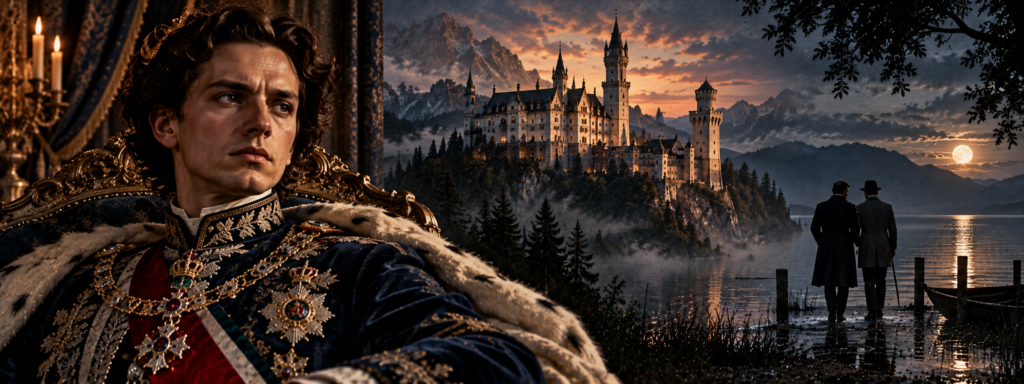
Ludwig II of Bavaria: The Mad King, the Stolen Throne, and the Mystery of the Deadly Lake
The Fairy-Tale King Who Built Palaces, Defied His Government, and Was Found Dead Beside His Psychiatrist Just Days After Being Declared Insane
Ludwig II of Bavaria (25 August 1845–13 June 1886) was King of Bavaria from 1864 until his deposition in June 1886, when his ministers declared him incapable of governing because of alleged mental illness. Born into the House of Wittelsbach, Ludwig inherited the throne at eighteen and became one of Europe’s most enigmatic monarchs, remembered for his devotion to composer Richard Wagner, his increasingly isolated lifestyle, and his extraordinary architectural projects, including Neuschwanstein, Linderhof, and Herrenchiemsee. His reign unfolded during the turbulent unification of Germany, a political transformation that diminished Bavaria’s independence and left its young king increasingly disillusioned with the realities of power. As Ludwig withdrew from public affairs, accumulated enormous personal debts, and pursued extravagant building schemes, his ministers began questioning his ability to rule. In June 1886, a medical commission led by psychiatrist Bernhard von Gudden declared him mentally incapacitated without personally examining him, providing the justification for a regency under his uncle, Prince Luitpold. Ludwig was removed from Neuschwanstein and confined at Berg Castle beside Lake Starnberg, where, on the evening of 13 June 1886, he and Gudden disappeared during a walk and were later found dead in the lake. The official conclusion was that Ludwig had drowned, possibly after attempting suicide, but the circumstances of both deaths have remained controversial. Whether the king intended to escape, attacked his psychiatrist, deliberately entered the water, or became the victim of a political killing has never been established beyond reasonable doubt, leaving his final hours among the most enduring mysteries of European royal history.
Two Bodies in the Water
On the evening of 13 June 1886, the servants and attendants at Berg Castle, on the eastern shore of Lake Starnberg, began to realize that something had gone terribly wrong. King Ludwig II of Bavaria had gone walking with his psychiatrist, Dr. Bernhard von Gudden, and neither man had returned at the expected time. Rain was falling, darkness was gathering, and the grounds surrounding the castle were becoming increasingly difficult to search. The king, who only days earlier had been stripped of his authority and placed under medical supervision, had vanished into the night.
The circumstances were alarming enough without the events that had preceded them. Ludwig had been declared mentally unfit to govern by physicians who had not personally examined him for the purpose of their diagnosis. His ministers had removed him from the throne, his uncle had assumed the regency, and the once-powerful monarch was now living under restrictions at Berg Castle. His disappearance therefore raised immediate fears that he had attempted to escape, taken his own life, or become involved in some desperate confrontation with the man responsible for supervising him.
Searchers eventually discovered the bodies of Ludwig and Gudden in the waters of Lake Starnberg. The king was thirty-nine years old, physically imposing, and an experienced swimmer in earlier life, while Gudden was a respected psychiatrist whose professional judgment had helped bring about Ludwig’s confinement. Both were dead, and the circumstances of their deaths were immediately troubling. The lake was relatively shallow where they were found, although descriptions of the precise depth and positions of the bodies vary between accounts.
There was no surviving witness who could explain what had happened between the moment the two men left the castle and the discovery of their bodies. No reliable account established whether Ludwig had entered the water voluntarily, whether Gudden had tried to restrain him, or whether some other confrontation had occurred. The psychiatrist’s injuries suggested that a physical struggle might have taken place, but they did not reveal its precise nature. The king’s death was officially treated as drowning, yet the available evidence was insufficient to reconstruct the final sequence of events with certainty.
Almost immediately, rumors began circulating that Ludwig had been murdered. His supporters had already questioned the legitimacy of his deposition, and the sudden death of the deposed king appeared suspiciously convenient for those who had removed him from power. Stories emerged of armed men, secret orders, hidden wounds, and political conspiracies designed to ensure that Ludwig would never reclaim his throne. None of these allegations has been conclusively demonstrated, but the unusual circumstances made them difficult to silence.
The official explanation was hardly free from problems. Ludwig had reportedly expressed opposition to suicide on religious grounds, although such statements cannot establish what he might have done during an acute crisis. His ability to swim raised questions about how he could have drowned in comparatively shallow water, but even strong swimmers can die through exhaustion, injury, cold, medical emergencies, or physical struggle. Gudden’s death was especially difficult to explain if the king had simply walked into the lake intending to kill himself.
The mystery was intensified by the political events surrounding Ludwig’s final days. His removal had been arranged by ministers who regarded his behavior and spending as intolerable, while the medical judgment used to justify the regency was based largely upon reports gathered from other people. The king had not been convicted of a crime, and there was no established judicial finding that he had committed an act warranting imprisonment. He had lost his authority through a constitutional and medical process whose fairness remains controversial.
The result was a death that could be interpreted in radically different ways. To some contemporaries, Ludwig was a disturbed and increasingly desperate monarch whose final actions reflected a tragic psychological crisis. To others, he was an eccentric but capable king who had been politically eliminated because he refused to conform to the expectations of his ministers. Still others believed that his death was the consequence of a failed escape attempt or a confrontation that ended in accidental drowning.
More than a century later, the central question remains unanswered. Ludwig II entered the final days of his life as a deposed monarch under psychiatric supervision, and he emerged from them as a corpse recovered from a lake. His psychiatrist died beside him, removing the only other person who might have explained the encounter. Whatever happened that rainy evening, it transformed Bavaria’s most unusual king into one of Europe’s most enduring royal mysteries.
The Prince Raised Between Duty and Dreams
Ludwig Otto Friedrich Wilhelm was born on 25 August 1845 at Nymphenburg Palace in Munich, the eldest son of Crown Prince Maximilian of Bavaria and Princess Marie of Prussia. His grandfather, King Ludwig I, still occupied the Bavarian throne, and the Wittelsbach dynasty remained one of the oldest ruling houses in Europe. The young prince entered a world of elaborate court ceremonies, aristocratic expectations, and carefully regulated behavior. From infancy, his future was defined by the possibility that he would one day inherit the crown.
His childhood unfolded during a period of profound political change. The revolutions of 1848 shook monarchies throughout Europe, including Bavaria, where Ludwig I abdicated amid political unrest and scandal. The throne passed to his son Maximilian II, making the young Ludwig heir apparent at an unusually early age. The upheaval demonstrated that royal authority was no longer beyond challenge, even within established dynasties.
Maximilian II was an intellectually serious monarch who emphasized education, administrative responsibility, and constitutional government. He wanted his son prepared for the practical demands of kingship and arranged a demanding program of instruction. Ludwig studied history, languages, religion, literature, and the institutions of government. Yet his education also placed considerable pressure upon a sensitive child who often preferred imagination to rigid discipline.
His mother, Marie, was more interested in outdoor pursuits and physical activity than the elaborate artistic world that increasingly attracted her son. Their relationship was not without affection, but Ludwig’s emotional needs and interests differed significantly from those of his parents. He developed a powerful attachment to poetry, medieval legends, romantic literature, and the theatrical representation of heroic history. These interests offered an imaginative refuge from the constraints of court life.
The young prince was especially captivated by stories of knights, sacred kingship, and legendary heroes. Medieval German literature and the operatic world of Richard Wagner would eventually become central to his understanding of monarchy. He imagined kingship not merely as administration but as a spiritual and aesthetic calling. This romantic conception would later collide disastrously with the realities of nineteenth-century politics.
Ludwig also developed a close relationship with his younger brother, Otto, born in 1848. The brothers shared the experience of growing up under the expectations imposed upon royal children, although their personalities and later circumstances differed. Otto would eventually suffer serious psychiatric difficulties and become unable to exercise royal authority. His illness later influenced the way Ludwig’s own behavior was interpreted.
The family’s residences contributed to Ludwig’s romantic imagination. Hohenschwangau Castle, rebuilt by his father in a medieval-inspired style, surrounded the young prince with murals depicting legendary German subjects. The castle’s decorative program transformed history and myth into an immersive visual environment. Ludwig absorbed these images long before he began creating his own architectural fantasies.
His childhood was therefore shaped by two competing visions of kingship. His father represented duty, constitutional responsibility, and practical government, while Ludwig increasingly associated monarchy with beauty, solitude, and the elevated world of legend. Neither influence disappeared when he became king. The conflict between them would define much of his reign.
A Beautiful Young King Takes the Throne
Maximilian II died unexpectedly on 10 March 1864, leaving his eighteen-year-old son to inherit the Bavarian crown. Ludwig had received extensive education but possessed little practical experience of government. He was suddenly responsible for a kingdom facing serious diplomatic and political challenges. The transition placed an unusually heavy burden upon a young man whose temperament was already markedly different from that of his father.
Ludwig’s appearance immediately attracted attention. He was tall, handsome, and possessed a strikingly romantic presence that seemed to embody the idealized monarchy celebrated in paintings and literature. Contemporary admirers described him in language more commonly associated with a legendary prince than a constitutional ruler. His youth and beauty encouraged hopes that Bavaria had entered a brilliant new era.
The new king initially approached his position with seriousness. He received ministers, studied state affairs, and attempted to understand the responsibilities of sovereignty. His later withdrawal from public life should not obscure the fact that he began his reign with genuine interest in certain aspects of government. Nevertheless, his strongest passions lay elsewhere.
One of his earliest major decisions was to invite Richard Wagner to Munich. The composer had become an object of Ludwig’s intense admiration through operas that combined Germanic legend, music, and profound emotional drama. Wagner’s artistic universe seemed to express everything the young king believed monarchy ought to represent. Ludwig wanted to support the composer and make Bavaria a center of extraordinary artistic achievement.
The invitation would transform both men’s lives. Wagner gained a powerful patron capable of rescuing him from financial difficulties and supporting ambitious productions. Ludwig gained access to an artist whose works appeared to give form to his private dreams. Their relationship became one of the most famous examples of royal artistic patronage in European history.
Yet the relationship also revealed the king’s vulnerability. Ludwig could become intensely attached to individuals who embodied his ideals, sometimes granting them extraordinary financial and emotional importance. Wagner’s political opinions, personal behavior, and financial demands soon created difficulties for the Bavarian government. The king’s devotion to the composer became an early source of tension with his ministers.
Ludwig’s accession had therefore begun with promise but also with warning signs. He possessed intelligence, cultural sophistication, and an unusually vivid imagination, yet he struggled with the compromises required by constitutional monarchy. His preference for an idealized world would become increasingly pronounced as political disappointments accumulated. The beautiful young king who inspired admiration in 1864 would eventually become the isolated ruler whom his government sought to remove.
Richard Wagner: The Composer Who Captured a King’s Imagination
Ludwig’s relationship with Richard Wagner was one of the defining attachments of his life. The king had encountered Wagner’s music as a teenager and became deeply moved by its themes of redemption, sacrifice, love, and legendary kingship. Operas such as Lohengrin offered a world in which noble figures pursued ideals beyond ordinary political calculation. For Ludwig, Wagner’s art was not merely entertainment but a vision of existence more meaningful than the everyday business of government.
When Ludwig summoned Wagner to Munich in 1864, the composer was burdened by debt and professional uncertainty. Royal patronage transformed his circumstances almost immediately. Ludwig provided financial assistance, supported performances, and encouraged Wagner’s ambitious artistic plans. The relationship made possible achievements that might otherwise have been delayed or abandoned.
Their correspondence reveals the intensity of Ludwig’s admiration. He frequently expressed emotional devotion to Wagner and described the composer’s music in exalted terms. The language can appear extraordinary to modern readers, but it reflected both Ludwig’s personal temperament and the conventions of romantic artistic expression. It should not automatically be interpreted as evidence of a sexual relationship.
Wagner was considerably older than Ludwig and possessed strong political opinions. His presence at court created resentment among officials who believed the composer exercised excessive influence over the inexperienced king. Wagner’s financial demands and personal controversies intensified the opposition. The situation became increasingly embarrassing for the government.
In 1865, Ludwig was pressured to require Wagner to leave Munich. The decision was deeply painful for the king, who regarded the composer as a uniquely important figure in his emotional and artistic life. Nevertheless, Ludwig continued supporting Wagner financially and maintained contact with him. Their relationship survived the composer’s departure from the Bavarian capital.
Wagner’s influence extended directly into Ludwig’s architectural imagination. Neuschwanstein would eventually incorporate themes and imagery associated with medieval legends celebrated in Wagner’s works. The king’s palaces became environments in which theatrical fantasy was translated into stone, painting, and elaborate decoration. His artistic patronage therefore shaped not only music but the physical landscape of Bavaria.
The relationship also illustrated Ludwig’s growing estrangement from conventional political priorities. His ministers worried about expenditure, public criticism, and the influence of individuals outside established government structures. Ludwig viewed their objections as interference with a higher artistic mission. The conflict strengthened his suspicion that ordinary politicians could never understand his conception of kingship.
Wagner’s later career benefited enormously from Ludwig’s support, including assistance associated with the development of the Bayreuth Festival. Yet the composer was not simply the king’s obedient servant, and their relationship contained tensions and disappointments. Ludwig’s idealization of Wagner sometimes exceeded the realities of the composer’s personality. The pattern would recur in other aspects of his life, where the imagined perfection of an ideal proved difficult to reconcile with human imperfection.
A King Who Wanted to Escape His Own Century
Ludwig’s political difficulties intensified during the struggle for German unification. Bavaria occupied an uncertain position between Austria and the rising power of Prussia, whose minister-president Otto von Bismarck sought to reshape the German states under Prussian leadership. The young king inherited a political environment in which traditional dynastic independence was increasingly threatened. His romantic understanding of sovereignty was poorly suited to the ruthless diplomacy of the period.
In 1866, Bavaria fought on Austria’s side during the Austro-Prussian War. Prussia achieved a decisive victory, forcing the German political order to change dramatically. Bavaria suffered defeat and became increasingly dependent upon arrangements shaped by Prussian power. Ludwig’s kingdom retained its monarchy, but its freedom of action was diminished.
The defeat was deeply disappointing. Ludwig had inherited a sovereign kingdom whose history and culture he cherished, yet he could not prevent the growing dominance of Prussia. The experience reinforced his dislike of political conflict and his sense that modern government was hostile to the ideals he valued. He increasingly preferred artistic projects and private retreats to the humiliations of diplomacy.
The crisis reached another stage during the Franco-Prussian War of 1870–1871. Bavaria joined the German states fighting alongside Prussia against France. The resulting victory created the conditions for the proclamation of the German Empire. Ludwig was drawn into negotiations that would permanently alter his kingdom’s position.
Bavaria entered the new German Empire while retaining certain reserved rights and its own royal dynasty. Ludwig remained King of Bavaria, but sovereignty was now constrained within a federal imperial structure dominated by Prussia. The transformation represented a major reduction in the independent political significance of his crown. For a monarch who cherished the symbolic grandeur of kingship, the arrangement was deeply uncomfortable.
Ludwig’s role in the imperial proclamation became associated with the so-called Kaiserbrief, the letter inviting King Wilhelm I of Prussia to accept the German imperial title. Bismarck played an important role in securing the letter, and the circumstances involved complicated negotiations and political pressure. Ludwig’s personal reluctance toward the new empire has been widely discussed. His participation was less a celebration of German unity than an accommodation to political realities he could not reverse.
The king’s financial relationship with Bismarck has also attracted controversy. Payments connected with funds under Bismarck’s control were made available to Ludwig, creating questions about the relationship between political concessions and financial inducements. Historians have debated the precise significance of these arrangements. They nevertheless illustrate the uncomfortable intersection of royal finance and high politics.
After 1871, Ludwig increasingly withdrew from the public responsibilities of monarchy. He remained king, but his interest in routine government declined while his architectural ambitions expanded. The new German Empire represented a political world in which he possessed less influence than he desired. His palaces offered a realm where his authority could remain absolute.
The King Who Refused to Marry
Ludwig’s private life became another source of tension between his personal desires and dynastic expectations. As a young monarch, he was expected to marry and produce heirs to secure the continuation of the Wittelsbach dynasty. Royal marriages were political institutions as much as personal relationships, and the choice of a consort could strengthen alliances and stabilize succession. Ludwig, however, found the prospect increasingly difficult.
In January 1867, his engagement to Duchess Sophie Charlotte in Bavaria was announced. Sophie was a member of a related branch of the Wittelsbach family and a younger sister of Empress Elisabeth of Austria, better known as Sisi. The engagement appeared suitable from a dynastic perspective. Both families had reasons to welcome the union.
Yet Ludwig repeatedly postponed the wedding. His hesitation created uncertainty and embarrassment, especially as preparations continued without a firm commitment from the king. The engagement was eventually broken off in October 1867. The collapse disappointed those who hoped marriage would encourage Ludwig to adopt a more conventional royal lifestyle.
The reasons for Ludwig’s reluctance were complex. His surviving diaries and private writings provide strong evidence that he experienced romantic and sexual attraction toward men. He also struggled with the conflict between those feelings and the religious teachings he had internalized. His private life was therefore marked by emotional distress, self-reproach, and attempts to reconcile desire with conscience.
Ludwig’s relationships with male attendants, aristocrats, and other companions have attracted considerable historical attention. Some were emotionally intense, while the precise nature of others remains uncertain. His diaries offer important evidence, but not every friendship or expression of affection should be treated as proof of a sexual relationship. The distinction matters because later writers have sometimes transformed ambiguous material into sensational claims.
His attraction to men was not itself evidence of mental illness, although nineteenth-century medical and social attitudes often treated same-sex desire as pathological or morally suspect. Ludwig lived in a society where openly acknowledging such feelings could carry serious personal and political consequences. His position as king intensified the pressure to maintain a respectable public image. The conflict between private identity and public expectation contributed to his isolation.
The broken engagement also had dynastic implications. Without a wife or legitimate children, Ludwig’s succession depended upon his younger brother Otto and other members of the royal family. Otto’s worsening psychiatric condition made the future of the monarchy increasingly uncertain. These circumstances later strengthened the political importance of Prince Luitpold, Ludwig’s uncle.
Ludwig never married. His unmarried status became part of the mythology surrounding him, sometimes portrayed as evidence of romantic purity and sometimes used to support accusations of abnormality. The reality was more human and more painful. He was a monarch expected to embody dynastic continuity while struggling with desires and emotional needs that could not easily be accommodated within the society in which he lived.
Neuschwanstein: A Castle Built Against Reality
In 1869, construction began on Neuschwanstein, the castle that would become Ludwig’s most famous architectural creation. Rising above the Bavarian landscape near Hohenschwangau, the project was conceived as an idealized medieval royal residence. Its towers, halls, and decorative schemes drew inspiration from German legend, romantic literature, and Wagnerian themes. It was not designed primarily as a military fortress but as an imaginative world made tangible.
Ludwig devoted enormous attention to the castle’s design. He worked with architects, artists, and theatrical designers to create interiors reflecting his personal ideals. The project incorporated modern construction techniques beneath its medieval appearance. This combination of technological sophistication and historical fantasy was characteristic of his architectural imagination.
Neuschwanstein was expensive, and construction continued for years. Ludwig demanded changes, refinements, and elaborate decorative features that increased costs and delayed completion. His ambitions exceeded the practical requirements of a royal residence. The castle became a symbol of his desire to inhabit a world shaped entirely by imagination.
The building also reflected his admiration for Wagner. Rooms were decorated with scenes associated with medieval legends such as Lohengrin and Tannhäuser. The imagery emphasized sacred kingship, heroic sacrifice, and spiritual longing. Ludwig was not simply constructing a beautiful residence; he was creating an environment that embodied his understanding of royal identity.
The castle’s isolation was equally significant. Perched above forests and mountains, it offered distance from Munich, ministers, parliamentary politics, and public expectations. Ludwig increasingly preferred such retreats to the ceremonial demands of the capital. The physical separation mirrored his growing emotional withdrawal from government.
Neuschwanstein was never completed during Ludwig’s lifetime. Its unfinished state became a fitting symbol of ambitions that continually expanded beyond practical limits. The king’s vision was extraordinary, but the financial demands were severe. His insistence upon perfection made completion increasingly difficult.
Later generations transformed Neuschwanstein into one of Germany’s most famous tourist attractions. Its romantic silhouette became associated with fairy-tale castles throughout the world. The building’s popularity has often softened the darker circumstances of its creation. Visitors admire the towers and interiors without necessarily confronting the political crisis and financial desperation that accompanied the final years of Ludwig’s reign.
For Ludwig, Neuschwanstein was both refuge and trap. It allowed him to escape the world of politics, but its costs contributed to the conflict that eventually destroyed his authority. The castle embodied his artistic genius and his inability to accept financial limitations. In June 1886, it would also become the setting for the confrontation that ended his reign.
Linderhof and Herrenchiemsee: The Kingdom of Impossible Palaces
Neuschwanstein was only one part of Ludwig’s architectural program. He also developed Linderhof Palace, a richly decorated residence inspired by French royal culture and the extravagance of eighteenth-century courts. Unlike Neuschwanstein, Linderhof was substantially completed during his lifetime. Its interiors reflected his fascination with ceremonial monarchy and the private luxury of rulers such as Louis XIV.
Linderhof became one of Ludwig’s preferred retreats. The palace and surrounding gardens offered an environment where every detail could be controlled according to his wishes. Elaborate decorative schemes, artificial landscapes, and theatrical effects created a world removed from ordinary political reality. The king could inhabit the role of an absolute monarch even as his actual constitutional authority was constrained.
One of the most extraordinary features of the Linderhof estate was the Venus Grotto, an artificial cave inspired partly by Wagner’s Tannhäuser. The grotto incorporated sophisticated lighting and theatrical effects that allowed Ludwig to immerse himself in a fantastical environment. It was an astonishing example of nineteenth-century engineering applied to private fantasy. The project also illustrated the extraordinary expense of his architectural ambitions.
Herrenchiemsee, begun in 1878 on an island in Chiemsee, represented an even grander undertaking. Ludwig intended it as an homage to Versailles and the monarchy of Louis XIV. Its ceremonial spaces and elaborate interiors reflected his admiration for the symbolic power of absolute kingship. Yet the project was never completed.
The king’s fascination with Louis XIV was revealing. The French monarch represented a form of sovereignty in which royal authority appeared almost limitless. Ludwig’s own position was very different, constrained by ministers, constitutional arrangements, and the political dominance of the German Empire. Herrenchiemsee allowed him to recreate the grandeur of a political system that no longer existed.
These projects were not financed simply by emptying the Bavarian state treasury. Ludwig’s building expenses were principally associated with his personal and royal household finances, including income available to him as monarch and substantial borrowing. Nevertheless, his debts became a serious political problem because creditors, court officials, and ministers feared the consequences of his continued expenditure. The distinction between personal royal finances and public funds is essential to understanding the controversy.
As the debts accumulated, Ludwig sought new sources of money. He pressed officials and advisers to obtain loans and explored increasingly unrealistic financial possibilities. His demands created alarm among those responsible for managing his affairs. The king appeared unwilling to accept that his architectural ambitions had exceeded available resources.
The palaces were extraordinary artistic achievements, but they also contributed directly to his political vulnerability. Ministers who had tolerated his withdrawal from government became increasingly concerned about the financial crisis. His refusal to reduce expenditure strengthened arguments that he was incapable of responsible decision-making. The magnificent buildings that would eventually preserve his fame helped bring about his downfall.
A Monarch Who Turned Night Into Day
As Ludwig grew older, his daily habits became increasingly unconventional. He preferred solitude, traveled at unusual hours, and often conducted activities during the night rather than the day. His nocturnal excursions through the Bavarian countryside became part of his legend. Servants and attendants adapted their schedules to accommodate a ruler whose private world increasingly operated apart from ordinary society.
The king’s preference for nighttime activity reflected several influences. Darkness offered privacy from curious observers, while artificial lighting transformed landscapes and buildings into theatrical settings. Ludwig could experience his palaces and surroundings without the interruptions of public life. His nocturnal habits were therefore connected to his artistic temperament as well as his desire for isolation.
He also became increasingly reluctant to appear at official ceremonies. Ministers sometimes struggled to obtain audiences or secure decisions on government matters. Ludwig’s absence created practical difficulties within a constitutional monarchy that still required royal participation in certain functions. His withdrawal became more than a personal eccentricity.
Stories circulated about elaborate private dinners, imaginary guests, and conversations with historical figures. Some accounts describe tables arranged for people who were not physically present, including figures associated with the French royal court. These stories have been repeated frequently, but their precise details and significance are not always securely documented. Even where unusual behavior occurred, it does not automatically establish psychosis or legal incapacity.
Ludwig’s relationship with servants also became a source of controversy. Reports collected by his opponents described episodes of anger, unreasonable demands, and humiliating treatment of attendants. Some incidents may reflect genuine difficulties in his behavior, while others were filtered through people whose testimony was gathered during a political campaign to remove him. The evidence must therefore be evaluated with attention to motive and context.
His physical health and appearance changed as well. Ludwig gained considerable weight during his later years and experienced dental problems and other discomforts. These changes contrasted with the image of the handsome young king who had ascended the throne in 1864. His increasing physical isolation may have been reinforced by embarrassment, discomfort, and emotional distress.
The king’s unusual habits became easier for critics to portray as signs of madness because they differed so sharply from conventional royal behavior. Yet eccentricity, nocturnal activity, artistic obsession, and social withdrawal are not sufficient grounds for a psychiatric diagnosis. They may reflect personality, distress, physical illness, or a range of other circumstances. The challenge for historians is to distinguish behavior that was genuinely disabling from conduct that merely offended contemporary expectations.
By the early 1880s, Ludwig’s lifestyle had become a political issue. His ministers were frustrated by his absence, creditors were alarmed by his debts, and members of the court feared the consequences of his increasingly unpredictable demands. The king’s private world was no longer simply an embarrassment. It was becoming the principal justification for removing him from power.
The Other Royal Patient: Ludwig’s Brother Otto
Ludwig’s younger brother Otto played an important role in the history of the king’s deposition. Otto had served in the Bavarian military and participated in the wars of German unification, but his health deteriorated during adulthood. He experienced serious psychiatric difficulties and eventually became unable to fulfill normal royal responsibilities. His condition required prolonged supervision and care.
The nature of Otto’s illness has been interpreted differently by later medical historians. Contemporary physicians used diagnostic categories that do not correspond neatly with modern psychiatric terminology. Some retrospective accounts have suggested schizophrenia or related disorders, but certainty is impossible. What matters historically is that Otto’s impairment was substantial and widely recognized.
Otto’s condition affected the succession. Because Ludwig had never married or produced legitimate children, Otto was the next heir to the throne. Yet his illness meant that he was unlikely to govern independently. The Wittelsbach dynasty therefore faced the possibility that both brothers would be unable to exercise royal authority.
This situation strengthened the importance of Prince Luitpold, their uncle. Luitpold was an experienced member of the royal family and a plausible candidate to assume a regency. His position offered a constitutional solution to the problem of royal incapacity. It also created a political alternative to Ludwig’s increasingly isolated rule.
The existence of Otto’s illness influenced contemporary perceptions of Ludwig. Physicians and officials sometimes considered the possibility of hereditary mental illness within the dynasty. Such reasoning reflected nineteenth-century medical theories that emphasized family history. It could also encourage assumptions about Ludwig’s condition before his behavior had been independently examined.
The distinction between the brothers remains important. Otto’s serious impairment does not prove that Ludwig suffered from the same condition. Psychiatric disorders can have familial components, but diagnosis requires evidence specific to the individual. The tendency to treat both brothers as examples of a single hereditary tragedy oversimplifies their very different histories.
After Ludwig’s death, Otto formally succeeded him as King Otto I of Bavaria. Because he was unable to govern, Luitpold continued exercising royal authority as regent. The arrangement demonstrated that Bavaria could maintain the monarchy without requiring the reigning king to perform governmental duties personally. It also showed why the succession crisis had been central to the events of 1886.
Otto remained king until his death in 1916, although he never exercised independent rule. His long reign under regency became another unusual chapter in Wittelsbach history. Ludwig’s deposition and death had not resolved the dynasty’s difficulties. They had merely transferred the crown to a brother whose incapacity was far more firmly established.
The Debts That Threatened the Throne
By the mid-1880s, Ludwig’s financial situation had become increasingly desperate. His palace projects required enormous sums, and he had accumulated debts that could not easily be repaid from his available income. Creditors demanded payment, while officials warned that further borrowing would worsen the crisis. The king nevertheless continued pursuing architectural schemes.
Ludwig’s spending was driven by more than ordinary luxury. His buildings represented an attempt to create environments in which he could exercise complete aesthetic and symbolic control. He regarded them as expressions of royal identity and artistic purpose. Abandoning the projects would have meant surrendering the world he had constructed around himself.
The government faced a difficult constitutional problem. Ludwig’s debts were not identical to the public debt of Bavaria, and his personal building expenditures did not automatically justify removing him from the throne. Nevertheless, the crisis threatened the royal household’s financial stability and created pressure upon officials to secure additional funds. Ministers feared that the king’s demands would eventually force the state into politically damaging arrangements.
Ludwig increasingly sought assistance from people who promised extraordinary financial solutions. He considered new loans and other schemes that officials regarded as unrealistic. His frustration grew when advisers refused to cooperate. The resulting conflicts deepened his distrust of the government.
Some accounts suggest that Ludwig contemplated dismissing ministers or taking drastic action against those who obstructed his financial plans. Reports of such threats were later used as evidence of his alleged incapacity. Yet the reliability of individual statements varies, and the political circumstances encouraged hostile interpretations. The king’s anger was real, but its significance remains open to debate.
The financial crisis also damaged relationships within the court. Servants and officials feared being blamed for failed schemes, while ministers became increasingly unwilling to accommodate the king’s demands. Communication deteriorated. Ludwig’s isolation made it harder to resolve disagreements through ordinary political negotiation.
By 1886, leading ministers had concluded that the situation could not continue. They believed Ludwig’s behavior threatened the functioning of government and the dignity of the monarchy. Rather than merely restricting his spending, they began considering whether he should be declared incapable of ruling. The financial crisis became the catalyst for a far more radical intervention.
The move from financial concern to psychiatric deposition was extraordinary. A king who spent recklessly might be criticized, restrained through constitutional mechanisms, or pressured to alter his policies. Declaring him mentally incapacitated required a different kind of justification. Ludwig’s opponents would therefore seek medical authority to support what was fundamentally a political decision.
The Conspiracy to Remove a King
During the spring of 1886, members of the Bavarian government moved toward removing Ludwig from effective power. Their concerns centered upon his debts, withdrawal from public duties, and increasingly difficult behavior. They also feared that the monarchy itself could be damaged if the crisis continued. The solution they pursued was the establishment of a regency.
Prince Luitpold emerged as the person who would assume royal authority. As Ludwig’s uncle and a senior member of the Wittelsbach family, he possessed the dynastic standing necessary for the role. His involvement gave the proposed regency an appearance of constitutional continuity. The monarchy could survive without the reigning king exercising power.
The ministers needed a medical judgment establishing that Ludwig was incapable of governing. They therefore turned to psychiatrists, including Dr. Bernhard von Gudden, a prominent physician with experience treating members of the royal family. Gudden’s professional standing gave the process considerable authority. His opinion would become central to the king’s removal.
Information was gathered from servants, court officials, and others familiar with Ludwig’s behavior. The reports described unusual habits, episodes of anger, extravagant spending, and conduct considered inappropriate for a monarch. Some testimony was undoubtedly based upon real observations. Yet the collection process was politically directed and relied heavily upon accounts from individuals connected to the court.
The resulting medical assessment concluded that Ludwig suffered from a severe mental disorder and was incapable of exercising royal authority. The most controversial feature of the process was that Gudden and the other physicians did not personally examine Ludwig for the purpose of preparing the report. Their conclusions rested upon documentary evidence and testimony. This omission has remained one of the principal reasons historians question the fairness of the deposition.
The diagnostic terminology used by the physicians reflected nineteenth-century psychiatry. Conditions were classified according to concepts that differ substantially from modern medical understanding. The report’s conclusions cannot simply be translated into a contemporary diagnosis. It is therefore misleading to claim that modern medicine has definitively confirmed the physicians’ judgment.
The political significance of the report was immediate. It provided the justification for declaring Ludwig incapable of governing and transferring authority to a regent. The ministers could present the action as a necessary constitutional response to illness rather than a direct political overthrow. Medical language gave the deposition an appearance of objective necessity.
Yet the distinction between medical judgment and political interest was difficult to maintain. The government had already decided that Ludwig’s behavior was intolerable and sought evidence to support his removal. The physicians operated within that political environment. Whether Ludwig suffered from a disabling psychiatric disorder remains uncertain, but the process used to establish his incapacity was deeply flawed by modern standards.
Declared Insane Without Being Examined
The medical report prepared in June 1886 became the decisive instrument in Ludwig’s deposition. It asserted that the king suffered from a serious and incurable mental disorder that made him incapable of governing. The conclusion carried enormous constitutional consequences. It effectively deprived Ludwig of the authority he had exercised for more than twenty-two years.
The physicians relied upon descriptions of Ludwig’s behavior rather than a direct contemporary examination. Reports of unusual routines, extravagant spending, social withdrawal, and anger toward servants formed part of the evidence. The assessment also drew upon assumptions about the king’s mental state that were difficult to verify independently. Its certainty exceeded what the method could securely establish.
The absence of a personal examination was especially troubling because Ludwig had not voluntarily sought psychiatric treatment. He was the subject of a political process initiated by his ministers. The doctors were therefore being asked to determine whether a reigning monarch should lose power. Their judgment was not simply a private medical opinion.
Modern commentators have proposed various explanations for Ludwig’s behavior. Some have suggested mood disorders, personality-related difficulties, neurological conditions, or other possibilities. Others argue that his conduct reflected eccentricity, emotional distress, and the pressures of a life he increasingly disliked. None of these interpretations can be established conclusively from the surviving evidence.
His sexuality has also been discussed in relation to the diagnosis. Nineteenth-century society often regarded same-sex attraction as evidence of moral or psychological abnormality. Modern understanding rejects that premise. Ludwig’s attraction to men cannot legitimately be used as proof that he was mentally incapable of ruling.
The report nevertheless achieved its political purpose. On 9 June 1886, the regency was proclaimed, and Prince Luitpold assumed authority. Ludwig’s ministers treated the king as no longer capable of exercising his constitutional functions. The monarchy continued, but the reigning sovereign had effectively been removed.
Ludwig rejected the action. He regarded the medical judgment as unjust and the regency as an illegitimate seizure of power. His supporters also questioned the evidence and the motives of those responsible. The deposition therefore created a crisis of legitimacy rather than a universally accepted transition.
The most disturbing feature of the affair was the speed with which a king could be transformed into a patient under coercive supervision. Ludwig had not been personally examined by the commission that declared him incapable, yet the report became the basis for removing him from his throne. The decision blurred the boundary between medical authority and political power. Within days, the consequences would become fatal.
The First Attempt to Seize Neuschwanstein
The government’s first attempt to take custody of Ludwig did not proceed smoothly. A commission was sent to Neuschwanstein to implement the regency and arrange the king’s removal. Officials expected to encounter a monarch whose authority had already been legally displaced. Instead, they found resistance and confusion.
Ludwig had received information about the plans against him. He rejected the accusation that he was mentally incapable and sought to defend his position. Loyal servants, local officials, and supporters helped frustrate the initial attempt to take control of the castle. The confrontation demonstrated that the king had not simply surrendered.
The commission’s arrival became an extraordinary scene. Members of the party were detained or obstructed, and the government’s authority was temporarily challenged. Ludwig still possessed enough personal loyalty to resist immediate removal. The episode embarrassed the ministers and forced them to organize a more effective operation.
The king considered appealing to the Bavarian people. He prepared a proclamation challenging the legitimacy of the regency and defending his right to rule. The document was intended to expose what he regarded as a conspiracy by his ministers. Its circulation was limited, however, and the government moved to prevent it from becoming the basis of organized resistance.
Ludwig’s situation was increasingly precarious. He had no reliable military force prepared to defend his throne, and the machinery of government was controlled by his opponents. Personal loyalty among servants and local supporters could delay his removal but not reverse the constitutional crisis. His isolation, once a source of comfort, had become a strategic weakness.
The failed operation also strengthened the government’s determination. Ministers feared that prolonged resistance might produce public disorder or undermine confidence in the regency. They therefore prepared a second attempt under more controlled conditions. This time, they intended to ensure that Ludwig could not evade custody.
The confrontation at Neuschwanstein has often been portrayed as the final stand of a romantic king against cold political officials. The image contains an element of truth, but it should not obscure the government’s genuine concerns about financial and administrative dysfunction. Nor should those concerns erase the serious questions surrounding the medical process. Both the king and his opponents were operating within a crisis that had become increasingly difficult to resolve peacefully.
By the time the second commission arrived, Ludwig’s options were narrowing. His ministers controlled the official institutions of government, and his uncle had assumed the regency. The king remained physically within his castle but had lost the authority necessary to defend his position. The fairy-tale refuge was about to become the scene of his final humiliation.
The Night the King Lost His Castle
During the night of 11–12 June 1886, the authorities succeeded in taking Ludwig into custody at Neuschwanstein. The operation was organized more carefully than the first attempt, and the king could no longer rely upon local resistance to protect him. He was informed that he would be transferred to Berg Castle under medical supervision. The removal marked the definitive end of his effective reign.
Ludwig’s departure from Neuschwanstein was deeply symbolic. The castle represented his artistic imagination, personal independence, and desire to escape the political world. He had invested enormous emotional and financial resources in its construction. Now he was being forced to leave it by officials acting under the authority of the government that had declared him insane.
Accounts of his behavior during the removal vary. Some describe resignation, while others emphasize distress and disbelief. The king reportedly questioned the legitimacy of the proceedings and the medical conclusions used against him. The surviving evidence does not permit every gesture or statement to be reconstructed with certainty.
The transfer to Berg Castle placed Ludwig in a very different environment. Unlike Neuschwanstein, Berg had been prepared for his confinement and supervision. The authorities intended to manage his movements and prevent any attempt to reclaim power. His status was no longer that of a reigning monarch exercising personal freedom.
The journey also marked a profound reversal of the relationship between king and government. Ludwig had once appointed ministers and exercised constitutional authority over the kingdom. Now those same institutions had arranged his removal and placed him under medical control. The transformation occurred with remarkable speed.
His supporters later portrayed the transfer as an abduction. From their perspective, Ludwig had been deprived of his throne and liberty through a politically motivated psychiatric judgment. The government, by contrast, presented the operation as necessary care for an incapacitated ruler. The opposing interpretations would shape the controversy surrounding his death.
The king arrived at Berg Castle on 12 June 1886. He had less than two days to live. The palace stood near Lake Starnberg, a place associated with royal leisure and the Bavarian landscape he loved. It would become the setting for his final and most mysterious tragedy.
The speed of events remains striking. Within a matter of days, Ludwig had been declared incapable, removed from his castle, and confined under psychiatric supervision. His ministers had achieved their immediate objective without a prolonged public struggle. Yet the apparent success would be overshadowed almost immediately by the discovery of two bodies in the lake.
Berg Castle: A Royal Residence Becomes a Prison
Berg Castle stood on the eastern shore of Lake Starnberg, south of Munich. The residence had long been associated with the Bavarian royal family and offered a setting that was both familiar and relatively secluded. For Ludwig, however, its meaning changed dramatically in June 1886. He arrived not as a monarch choosing a retreat but as a deposed king under supervision.
The authorities had made arrangements intended to ensure his security and prevent escape. Attendants and medical personnel were present, and the king’s movements were subject to restrictions. Dr. Bernhard von Gudden assumed a central role in his care. The psychiatrist was now responsible for supervising the very monarch whose incapacity he had helped certify.
This relationship was inherently difficult. Gudden was not simply an independent physician treating a patient who had voluntarily requested assistance. His medical judgment had been instrumental in Ludwig’s removal from power. The king therefore had reason to regard him as an agent of the political process that had destroyed his authority.
Accounts of Ludwig’s behavior at Berg suggest that he could appear calm and cooperative. Such observations have been used to challenge the claim that he was suffering from severe mental illness. Yet a person’s ability to converse rationally or behave politely during a particular period does not establish the absence of psychiatric difficulties. The evidence remains too limited for definitive conclusions.
The castle’s location near the lake was important. Ludwig had long been familiar with the Bavarian landscape and had enjoyed outdoor activities earlier in life. Walking near the water was not inherently unusual. Nevertheless, the circumstances of his confinement made any unsupervised movement potentially significant.
Gudden apparently believed that Ludwig could be allowed some freedom of movement under his personal supervision. This decision would later become a central question in the investigation. If the king was considered dangerously unstable or likely to escape, why was he permitted to walk with only the psychiatrist accompanying him? If he was not considered dangerous, the justification for such restrictive confinement appeared less convincing.
The arrangements at Berg therefore contained contradictions. Ludwig had been declared incapable of governing because of a severe mental disorder, yet he was not treated as someone requiring constant physical restraint. Gudden’s confidence in supervising him personally suggests that the psychiatrist did not anticipate an immediate violent confrontation. Whether that confidence was misplaced remains unknown.
On 13 June, the king and his psychiatrist would walk together beside the lake. The encounter would end with both men dead. Their final hours would become the central mystery of Ludwig’s life, overshadowing the palaces, political conflicts, and private struggles that had preceded them.
Bernhard von Gudden: The Doctor Who Helped Depose a King
Dr. Bernhard von Gudden was one of the most respected psychiatrists in nineteenth-century Bavaria. Born in 1824, he developed a distinguished medical career and became associated with important developments in psychiatric research and institutional care. His professional reputation made him a natural choice for officials seeking authoritative medical judgment. Yet his involvement in Ludwig’s deposition placed him at the center of a political controversy.
Gudden had experience treating members of the royal family, including Ludwig’s brother Otto. This familiarity gave him knowledge of the dynasty’s medical circumstances. It also meant that he operated within a network of court relationships and expectations. His professional independence has therefore been questioned by later commentators.
The report declaring Ludwig incapable of governing remains the most controversial act of Gudden’s career. He and the other physicians reached their conclusion without personally examining the king for the purpose of the assessment. They relied upon testimony and reports gathered by others. The decision has been criticized as medically inadequate and politically convenient.
Gudden’s defenders argue that nineteenth-century psychiatric practice differed from modern standards and that the physicians possessed substantial information about Ludwig’s behavior. They also note that the king’s withdrawal, financial demands, and reported conduct had created genuine concern. These arguments explain the historical context but do not eliminate the weaknesses of the assessment. A diagnosis with such enormous political consequences required especially careful scrutiny.
After Ludwig’s removal, Gudden became responsible for supervising him at Berg Castle. The relationship placed the psychiatrist in an uncomfortable position. He was both the medical authority who had helped justify confinement and the person expected to establish a working relationship with the confined king. Trust would have been difficult to achieve.
Gudden’s decision to accompany Ludwig on the final walk has attracted intense speculation. Some accounts suggest that he wished to demonstrate confidence in the king’s behavior or provide therapeutic freedom. Others interpret the walk as an opportunity Ludwig may have used to attempt escape. The surviving evidence does not establish Gudden’s precise intentions.
The psychiatrist’s death complicates every explanation of the tragedy. If Ludwig intended suicide, Gudden may have tried to prevent it. If the king attempted escape, the doctor may have intervened. If a violent confrontation occurred, Gudden may have been injured while restraining Ludwig or defending himself.
Gudden was therefore not merely a secondary victim in the story. His professional judgment helped remove Ludwig from the throne, and his death destroyed the possibility of obtaining a firsthand account of the final encounter. The man who had declared the king incapable of governing became inseparable from the mystery of the king’s death. Both were found in the same lake, and neither could explain what had happened.
The Final Walk Beside Lake Starnberg
Sunday, 13 June 1886, began as Ludwig’s second day at Berg Castle. The king remained under medical supervision, but accounts suggest that he was permitted to take walks in the grounds. Gudden accompanied him during an earlier outing, and the arrangements did not initially produce any obvious crisis. The afternoon and evening would prove very different.
Later that day, Ludwig and Gudden went walking again near Lake Starnberg. They departed without a larger escort immediately accompanying them. This decision has become one of the most debated aspects of the case. It placed the deposed monarch and his psychiatrist alone in a setting where neither could easily summon assistance.
The weather deteriorated during the evening. Rain fell, and the light faded as the expected time of their return passed. Attendants became concerned when neither man appeared. A search was eventually organized.
The precise route taken by Ludwig and Gudden is not known with certainty. Later reconstructions have attempted to identify the paths, shoreline, and possible movements of the two men. Such efforts depend upon incomplete testimony and physical evidence recorded under nineteenth-century investigative conditions. No reconstruction can be treated as definitive.
At some point, both men entered the water or were forced into it during an encounter near the shore. The circumstances remain unknown. The possibility of a struggle is supported by reports concerning Gudden’s injuries, but the nature and sequence of that struggle cannot be established. The absence of witnesses leaves several explanations possible.
Searchers eventually discovered the bodies in Lake Starnberg. Ludwig was found in the water, and Gudden’s body was recovered nearby. The discovery shocked those who had arranged the king’s confinement. The political crisis had suddenly become a double death.
The official response moved quickly toward an explanation involving Ludwig’s actions. Suicide, escape, and physical struggle were discussed as possible causes. Yet the investigation did not produce evidence sufficient to establish a single sequence beyond reasonable doubt. The mystery was therefore present from the beginning rather than invented entirely by later generations.
The setting contributed to the tragedy’s enduring power. Lake Starnberg was a place of natural beauty, surrounded by landscapes associated with Ludwig’s romantic imagination. The king who had built castles above mountains and forests died in water near a royal residence. His final scene seemed almost designed for legend, but the reality was more disturbing because the essential facts remained unresolved.
The Shallow Water That Raised a Thousand Questions
One of the most frequently repeated details about Ludwig’s death is that he was found in water too shallow to drown. Popular accounts sometimes describe the lake as waist-deep at the location where his body was recovered. The claim has become central to arguments that the official explanation was impossible. Yet the actual circumstances require more careful examination.
Water depth alone does not determine whether drowning can occur. People can drown in shallow water if they lose consciousness, become exhausted, suffer injury, experience a medical emergency, or are physically restrained. A strong swimmer can also drown under adverse conditions. The fact that Ludwig had been capable of swimming does not eliminate drowning as a possible cause.
The exact depth of the water at the relevant locations has been reported differently in historical accounts. Conditions near a shoreline can vary over short distances, and the positions in which bodies are discovered do not necessarily identify where death occurred. The lake’s physical characteristics therefore cannot establish the entire sequence of events. Claims that drowning was categorically impossible go beyond the evidence.
Ludwig’s physical condition is another consideration. By 1886, he was significantly heavier and less physically active than during his youth. His earlier swimming ability does not prove that he could have escaped every dangerous situation in the water. Cold, wet clothing, exhaustion, or a struggle might have affected his ability to survive.
Gudden’s presence makes the situation more complicated. If the king entered the water voluntarily, the psychiatrist may have followed to prevent him from drowning or escaping. A struggle between the two men could have exhausted or injured both. Such a scenario is plausible but remains unproven.
The absence of reliable eyewitness testimony is decisive. No one saw the exact moment when the men entered the water or observed the final struggle. Later accounts rely upon physical evidence, medical findings, and speculation about their intentions. Each explanation must therefore acknowledge uncertainty.
The shallow-water argument is important because it illustrates how a genuine mystery can become simplified into a dramatic claim. The circumstances were unusual and deserve scrutiny, but the depth of the lake does not prove murder. Nor does it establish suicide. It is one piece of incomplete evidence within a case that lacks a definitive reconstruction.
The mystery survives not because every official explanation is physically impossible, but because the available evidence permits several competing scenarios. Ludwig may have entered the water deliberately, attempted escape, struggled with Gudden, or experienced an accident. The deaths may have involved more than one of these possibilities. What cannot be justified is presenting any single theory as established fact.
The Psychiatrist’s Injuries and the Possibility of a Struggle
Reports concerning Gudden’s body have played an important role in attempts to reconstruct the deaths. The psychiatrist was said to have sustained injuries consistent with physical confrontation, including marks and damage that suggested he may have struggled before dying. These observations have encouraged the theory that he attempted to restrain Ludwig. They have also been used to support more sensational accounts of violence.
A struggle would help explain why both men died. If Ludwig attempted to escape or enter the lake, Gudden might have intervened. The king was physically larger than the psychiatrist, and a confrontation could have become dangerous. Both men might then have entered the water during the struggle.
Such a scenario does not require Ludwig to have intended murder. A desperate attempt to break free from confinement could have produced violence without a premeditated desire to kill. Gudden might have been injured while trying to prevent escape or suicide. The situation could then have escalated beyond either man’s control.
Alternatively, Ludwig may have attacked Gudden in anger or panic. The psychiatrist represented the medical authority that had helped deprive him of his throne. A confrontation between them is therefore psychologically plausible. Yet plausibility is not proof, and no witness established that Ludwig initiated violence.
The injuries have also been interpreted within theories of third-party involvement. Some writers suggest that Gudden encountered attackers or attempted to protect the king from assassins. These claims generally rely upon speculative reconstructions rather than verified evidence. The known injuries do not establish the presence of additional people.
The quality of the original medical investigation limits certainty. Nineteenth-century forensic methods were less developed than modern techniques, and surviving descriptions are incomplete. The bodies were examined within a politically sensitive environment where officials had strong reasons to seek a coherent explanation quickly. Later investigators cannot recover evidence that was never properly recorded.
The possibility of a struggle remains one of the most credible elements in the case. It offers a potential explanation for Gudden’s injuries and the deaths of both men. Yet it does not establish why the struggle began or what either man intended. The same physical evidence can support several different narratives.
This uncertainty is central to the tragedy. Gudden may have died trying to save Ludwig, prevent his escape, or defend himself. Ludwig may have died during an act of desperation, resistance, or self-destruction. Without witnesses or more reliable forensic evidence, the final confrontation remains beyond recovery.
Suicide: The Official Explanation Under Scrutiny
The theory that Ludwig intended to take his own life emerged quickly after the deaths. He had been stripped of his throne, confined under psychiatric supervision, and separated from the palaces and private world that had sustained him. The emotional consequences of these events could have been devastating. Suicide was therefore considered a possible explanation for his entry into the lake.
Supporters of the theory point to the extreme circumstances of his final days. Ludwig had experienced a sudden collapse of political authority and personal freedom. He faced the possibility of indefinite confinement and public humiliation. Such pressures could contribute to suicidal despair, although they cannot establish his intentions.
Opponents emphasize Ludwig’s religious beliefs. As a Catholic, he had expressed attitudes that conflicted with suicide, and some accounts describe him as rejecting the idea. These statements are relevant but not conclusive. People can act contrary to previously expressed convictions during periods of severe distress.
The presence of Gudden remains difficult to explain under a simple suicide scenario. If Ludwig deliberately entered the water, the psychiatrist may have attempted to save him. A physical struggle could then have resulted in both deaths. This possibility is consistent with some reported injuries but cannot be demonstrated.
Another difficulty concerns the absence of a clear farewell message or reliable statement of suicidal intent immediately before the walk. The surviving record does not establish that Ludwig planned to kill himself. His apparent cooperation at Berg Castle could be interpreted in different ways. Calm behavior does not rule out suicide, but neither does it support the theory conclusively.
The official explanation also developed within a politically charged environment. The government had just declared Ludwig mentally incapacitated and removed him from power. A death attributed to suicide could be presented as consistent with the diagnosis. This political convenience does not prove that the explanation was false, but it gives historians reason to examine it critically.
Modern discussions sometimes treat suicide as either certain or impossible. Both positions overstate the evidence. Ludwig’s psychological condition during his final hours cannot be reconstructed with confidence. The circumstances make suicide possible, but they do not establish it.
The theory remains part of the historical debate because it offers one coherent explanation for the king’s death. Yet it requires additional assumptions to account for Gudden’s injuries and drowning. Those assumptions may be reasonable, but they remain unverified. The lake has preserved the uncertainty that surrounded Ludwig’s final intentions.
Escape: Did Ludwig Try to Reclaim His Freedom?
Another major theory proposes that Ludwig attempted to escape from Berg Castle. He had been removed from his throne against his wishes and placed under restrictions he considered illegitimate. The lake and surrounding grounds offered possible routes away from confinement. A walk with only Gudden accompanying him may have appeared to provide an opportunity.
The escape theory has several variations. In one, Ludwig planned to reach supporters who would help him regain freedom. In another, he acted spontaneously after recognizing that the psychiatrist was the only person immediately preventing his departure. Some versions suggest that a boat or accomplices were waiting nearby. Such details are often unsupported by reliable evidence.
The king had demonstrated resistance during the initial attempt to remove him from Neuschwanstein. He had sought to challenge the regency and appeal to public opinion. These actions show that he did not willingly accept the loss of his authority. An attempt to escape confinement would therefore be consistent with his earlier behavior.
Gudden’s injuries could fit this scenario. If Ludwig attempted to flee, the psychiatrist might have tried to stop him. A struggle near the shoreline could have caused both men to enter the water. The resulting exhaustion or injury might explain their deaths.
Yet the theory also raises questions. Ludwig had been under supervision, and the grounds around Berg Castle were not necessarily an easy route to safety. Escape would have required some plan for avoiding capture and obtaining assistance. No conclusive evidence establishes that such arrangements existed.
The king’s physical condition may also have complicated an escape attempt. He was no longer the athletic young monarch of earlier years, and traveling through wet grounds at night would have been difficult. If he entered the lake to evade Gudden, the situation could have become dangerous very quickly. The attempt might have ended in accidental drowning.
The escape theory has remained attractive because it portrays Ludwig as resisting confinement rather than surrendering to despair. It also offers a plausible explanation for the deaths of both men without requiring an organized assassination. Nevertheless, the surviving evidence does not establish that escape was his intention. The scenario remains possible rather than proven.
The distinction matters because the final act would carry very different meanings depending upon Ludwig’s purpose. A suicide would suggest a king overwhelmed by the loss of his world. An escape attempt would suggest a monarch still determined to reclaim freedom. The physical evidence cannot tell us which impulse, if either, governed his final moments.
Murder: The Political Assassination Theory
The possibility that Ludwig was murdered has fascinated generations of historians, writers, and conspiracy theorists. His deposition had been politically controversial, and his sudden death removed the possibility that he might challenge the regency. The timing was extraordinary. A king was declared incapable, confined, and found dead within days.
Supporters of the murder theory argue that Ludwig’s opponents had powerful motives. His continued existence could complicate the legitimacy of Prince Luitpold’s regency, especially if public sympathy grew or evidence emerged challenging the psychiatric report. A living deposed monarch might become a focus for opposition. A dead king could no longer reclaim authority.
Stories of gunshot wounds have circulated for decades. Some accounts claim that Ludwig was shot while attempting to escape or that his clothing contained bullet holes. Others describe secret testimony from servants or officials who allegedly knew the truth. These stories have not been supported by conclusive, verifiable evidence establishing that he was shot.
The absence of a modern forensic examination has helped sustain such speculation. Ludwig’s remains have not been subjected to the kind of comprehensive investigation that might resolve certain physical questions. Historical accounts of the body and clothing are incomplete and sometimes contradictory. The resulting gaps leave room for theories that cannot be decisively tested.
The political murder theory also struggles to explain Gudden’s death. If assassins intended to kill Ludwig, why was the psychiatrist killed as well? Some versions suggest that Gudden witnessed the murder and was eliminated to prevent him from speaking. Others propose that he participated in the operation but became a victim of unforeseen circumstances. These explanations introduce additional assumptions without firm supporting evidence.
The alleged involvement of government officials remains unproven. No authenticated order to kill Ludwig has been established, and no reliable contemporary testimony conclusively identifies assassins. The ministers had already achieved their immediate political objective by establishing the regency. Murder would have created enormous risks if exposed.
Nevertheless, the theory cannot be dismissed merely because it is politically uncomfortable. The deposition process was deeply questionable, and the investigation into the deaths left significant uncertainties. Political violence was not unknown in nineteenth-century Europe. The possibility of deliberate killing therefore belongs within the range of historical discussion, although it lacks the evidence necessary for a confident conclusion.
The responsible distinction is between suspicion and proof. Ludwig’s death was convenient for those who had removed him, but convenience does not establish responsibility. Rumors of gunfire and secret assassins are dramatic, yet they remain unverified. The murder theory endures because the official narrative is incomplete, not because an alternative conspiracy has been demonstrated.
The Rumors of Gunshots and Hidden Evidence
Among the most persistent stories surrounding Ludwig’s death are claims that he was killed by gunfire rather than drowning. These accounts often describe witnesses who supposedly heard shots near the lake or later discovered evidence of bullets. Some versions suggest that the king was struck while attempting to escape. Others claim that guards were ordered to prevent him from reaching freedom at any cost.
The stories vary considerably in their details. Different accounts identify different alleged witnesses, locations, and circumstances. Some were recorded long after the event, when the mystery had already become part of Bavarian folklore. The passage of time makes it difficult to distinguish genuine recollection from rumor and embellishment.
Claims concerning Ludwig’s clothing have also attracted attention. Popular retellings sometimes refer to a coat allegedly marked by bullet holes. Yet the provenance and interpretation of such evidence are disputed. Without a secure chain of custody and reliable contemporary documentation, the claim cannot establish that Ludwig was shot.
The same caution applies to alleged secret testimony. Stories attributed to servants, fishermen, guards, or members of the royal household have circulated in different forms. Some may preserve fragments of genuine contemporary suspicion. Others appear to reflect the natural growth of legend around a mysterious royal death.
The official medical findings did not establish death by gunshot. This does not mean that every aspect of the examination was beyond criticism, but it places an important limit upon the evidence. A murder theory involving firearms requires more than the absence of certainty about drowning. It requires positive evidence of gunshot injury or armed intervention.
The political environment made rumors especially likely. Ludwig had supporters who regarded his deposition as a betrayal, and his death confirmed their worst fears about the regency. Stories of assassination offered a morally clear explanation for an event otherwise filled with ambiguity. They transformed the king from a controversial ruler into a victim of deliberate political violence.
The legends also benefited from Ludwig’s romantic reputation. A mysterious shooting beside a lake seemed consistent with the dramatic world of castles, secret passages, and royal conspiracies that surrounded his memory. The narrative was compelling enough to survive even when evidence remained weak. Popular imagination often prefers a hidden murderer to an unresolved accident.
Yet historical investigation must resist the temptation to turn uncertainty into certainty. There is no conclusive proof that Ludwig was shot, and the existence of rumors does not establish their truth. The unresolved circumstances deserve continued scrutiny, but the evidence does not justify presenting political assassination as fact. The most unsettling aspect of the case may be that no explanation can be established completely.
Was Ludwig II Really Mad?
The question of Ludwig’s mental health lies at the center of both his deposition and his death. His ministers justified removing him from power through a psychiatric judgment, and the official interpretation of his final actions was influenced by that diagnosis. Yet the evidence used to declare him incapable was gathered through a process that would be considered seriously inadequate today. The question therefore requires separating his actual behavior from the political uses made of it.
Ludwig was undeniably eccentric. He preferred solitude, maintained unusual schedules, spent enormous sums on architectural projects, and became increasingly unwilling to participate in routine government. He also displayed intense emotional attachments and sometimes treated servants in ways that contemporaries regarded as unreasonable. These characteristics created practical difficulties, but they do not automatically establish severe mental illness.
His withdrawal from public life may have reflected multiple causes. He disliked political conflict, experienced profound disappointment over Bavaria’s diminished sovereignty, and struggled with the constraints imposed upon his private relationships. Physical health problems and emotional distress may also have contributed. None of these factors can be reduced to a single retrospective diagnosis.
The medical report of 1886 used the diagnostic framework available to nineteenth-century psychiatrists. Its conclusions were based upon secondhand evidence and were not supported by a direct examination of the king for the purpose of determining incapacity. Modern psychiatric standards require far more careful assessment. The report’s authority should therefore not be confused with scientific certainty.
Some modern writers have proposed that Ludwig experienced a mood disorder or other psychiatric condition. Others have suggested that he suffered primarily from personality-related difficulties, social isolation, or psychological distress. Still others argue that his behavior was unusual but not sufficient to justify deposition. These interpretations remain hypotheses rather than established diagnoses.
The political dimension is impossible to ignore. Ludwig’s ministers were concerned about government administration and financial crisis, and they sought a mechanism to transfer authority. A declaration of mental incapacity provided that mechanism. The resulting medical judgment was therefore inseparable from the political interests surrounding it.
The label “Mad King Ludwig” has also distorted public understanding. It encourages the assumption that his behavior can be explained through a single dramatic condition. Yet Ludwig was capable of artistic judgment, sustained intellectual interests, and complex personal relationships. His eccentricity coexisted with abilities that do not fit neatly into the image of a completely irrational ruler.
The most defensible conclusion is that Ludwig’s mental state cannot be diagnosed with certainty from the surviving evidence. He may have experienced significant psychological difficulties, but the extent and nature of any disorder remain disputed. His deposition was based upon a flawed medical process, and his death cannot be explained simply by invoking madness. The label that made him famous has often obscured more than it reveals.
The Politics Behind the Diagnosis
Ludwig’s deposition illustrates the dangerous intersection of medical authority and political power. His ministers faced a genuine crisis involving royal finances, administrative dysfunction, and the king’s refusal to cooperate with ordinary government procedures. Yet the solution they chose depended upon declaring the monarch mentally incapable. This transformed political disagreement into a question of psychiatric judgment.
The government had reasons to prefer a regency over open confrontation. Bavaria remained a monarchy, and the legitimacy of the Wittelsbach dynasty was important to the political system. Removing Ludwig through a medical declaration allowed the institution to continue without admitting that ministers were overthrowing their sovereign. Prince Luitpold could govern as regent while preserving the formal continuity of the crown.
The medical report therefore served a constitutional function. It supplied the justification for transferring authority without requiring Ludwig’s consent. The king’s unusual behavior and financial decisions became evidence that he was incapable of exercising royal responsibilities. The process gave political action the appearance of medical necessity.
This does not prove that the physicians knowingly fabricated their conclusions. Gudden and his colleagues may genuinely have believed that Ludwig suffered from severe mental illness. Their professional assumptions reflected the medical knowledge and social expectations of their period. Nevertheless, sincerity does not eliminate the possibility of error or political influence.
The use of testimony from servants and officials was particularly problematic. Some witnesses may have described real incidents accurately, while others could have exaggerated behavior they found offensive or threatening. The king’s increasingly difficult relationships with his household created opportunities for resentment. The selection and interpretation of testimony were therefore crucial.
Ludwig’s refusal to submit to ordinary political expectations also shaped perceptions of his sanity. A constitutional monarch was expected to cooperate with ministers, appear at ceremonies, and manage his household responsibly. Ludwig increasingly rejected those expectations. His behavior was politically disruptive, but political disruption is not identical to psychiatric incapacity.
The deposition also reveals how vulnerable a monarch could become when isolated from the institutions of government. Ludwig possessed enormous symbolic authority but little practical support once his ministers and senior dynastic relatives turned against him. His castles provided privacy but not political protection. The very withdrawal that allowed him to escape government also made him easier to remove.
The tragedy lies in the speed with which the process became irreversible. Within days of the medical report, Ludwig had lost his throne and freedom. Before the legitimacy of the diagnosis could be meaningfully challenged, he was dead. The political decision and the mysterious death became permanently entangled.
Prince Luitpold and the Regency That Survived
Prince Luitpold assumed the regency after Ludwig was declared incapable of governing. He was a senior member of the Wittelsbach dynasty and possessed the standing necessary to preserve the monarchy during a constitutional crisis. His appointment offered continuity at a moment when the government feared instability. Yet the circumstances of his rise inevitably attracted suspicion.
Luitpold was not an outsider seeking to overthrow the dynasty. He belonged to the royal family and had long participated in Bavarian public life. His role was presented as a duty undertaken because the reigning king could no longer govern. The arrangement was intended to protect the monarchy rather than abolish it.
Nevertheless, Luitpold benefited politically from Ludwig’s removal. He acquired the authority to exercise royal functions and became the central figure in Bavarian government. Ludwig’s sudden death eliminated the possibility that the deposed king might challenge the regency. These facts have encouraged speculation about Luitpold’s motives.
There is no conclusive evidence that Luitpold ordered or participated in Ludwig’s death. Political benefit does not establish criminal responsibility. The regency had already been established before the king died, and the government possessed constitutional mechanisms for continuing it. An assassination would have introduced serious risks if discovered.
After Ludwig’s death, the crown passed to his younger brother Otto. Because Otto was unable to govern, Luitpold continued as regent. The arrangement lasted for decades and became an important period in Bavarian political history. Luitpold developed a reputation for comparatively stable and popular government.
The long duration of the regency reinforced the sense that Ludwig’s removal had permanently changed the monarchy. Bavaria continued functioning without the direct rule of either brother. The institutions that had struggled under Ludwig’s increasingly isolated kingship operated under a more conventional political arrangement. The contrast influenced later judgments about the deposition.
Yet administrative success cannot retroactively prove that the methods used against Ludwig were fair. A government may function effectively after an unjust removal of its ruler. Likewise, a flawed deposition does not establish that the deposed monarch was capable of governing responsibly. The questions must be considered separately.
Luitpold’s regency therefore remains part of the larger ambiguity surrounding Ludwig’s fate. It represented constitutional continuity and political stability, but it emerged from a process marked by serious doubts about medical evidence and royal consent. The death at Lake Starnberg removed the most immediate challenge to the arrangement. Whether that outcome was merely convenient or deliberately engineered has never been established.
The King Who Became More Powerful After Death
Ludwig’s death transformed his public reputation. During his final years, he had been criticized for extravagant spending, political withdrawal, and unusual behavior. His ministers regarded him as incapable of governing, and his debts threatened the royal household. Yet the circumstances of his death encouraged sympathy and fascination.
The image of a deposed king found dead beside his psychiatrist was almost impossible to separate from tragedy. Ludwig had lost his throne, freedom, and the private world he had constructed around himself. His death occurred before he could defend himself publicly against the medical judgment used to remove him. The absence of a definitive explanation allowed supporters to imagine him as a victim of political betrayal.
His architectural projects also acquired new meaning. Neuschwanstein, Linderhof, and Herrenchiemsee had contributed to the financial crisis that helped destroy his reign. After his death, they became extraordinary cultural attractions. The buildings that ministers had regarded as evidence of reckless expenditure eventually brought immense attention and economic benefit to Bavaria.
Neuschwanstein was opened to paying visitors shortly after Ludwig’s death. The castle’s romantic appearance attracted public interest, and its fame grew over subsequent generations. It became one of the most recognizable buildings in Europe. The transformation was deeply ironic.
Ludwig had created his palaces primarily as private refuges from the world. He disliked public intrusion and sought environments in which he could escape ordinary political and social demands. After his death, those same buildings became destinations for millions of visitors. The private fantasies of an isolated monarch were transformed into public cultural heritage.
His reputation as the “Fairy-Tale King” gradually overshadowed the more troubling aspects of his reign. Popular accounts emphasized his beauty, romantic imagination, and tragic death. His financial irresponsibility and the difficulties he created for government were often softened or omitted. The mystery at Lake Starnberg strengthened the romantic image.
The label “Mad King Ludwig” survived alongside the more affectionate title. Together, they created a figure who seemed to exist between genius and insanity, beauty and ruin, monarchy and fantasy. Yet the historical Ludwig was more complex than either legend. He was a constitutional ruler struggling with political change, private identity, emotional isolation, and the consequences of extraordinary artistic ambition.
Death accomplished what Ludwig could never achieve through government. It made him an enduring symbol of Bavaria, admired far beyond the political importance of his reign. His palaces became more famous than his policies, and his mysterious end became more compelling than the constitutional disputes that preceded it. The king who increasingly avoided public life became one of the most recognizable monarchs in European history.
The Memorial Cross and the Lake That Keeps Its Secret
A memorial cross stands in Lake Starnberg near the place associated with Ludwig’s death. The site has become a destination for visitors seeking to understand the final hours of Bavaria’s most enigmatic king. The surrounding landscape remains strikingly beautiful, with water, trees, and distant mountains creating an atmosphere of calm. That serenity contrasts sharply with the violence and uncertainty associated with the events of 13 June 1886.
The memorial has encouraged generations to imagine the final encounter between Ludwig and Gudden. Some picture a desperate king attempting to escape confinement, while others imagine a struggle to prevent suicide. Supporters of the murder theory see the shoreline as the scene of a political killing. The physical setting accommodates each interpretation without confirming any of them.
The lake itself offers little assistance. More than a century has passed, and the original physical evidence was never preserved according to modern forensic standards. Changes in the landscape and the limitations of contemporary records make precise reconstruction difficult. The absence of reliable eyewitness testimony remains insurmountable.
Ludwig’s burial took place in Munich, where his remains were placed in the crypt of St. Michael’s Church. His death prompted mourning and public fascination, even among people who had criticized his conduct. The funeral restored him to the ceremonial world of monarchy from which he had been removed. Yet it could not resolve the controversy surrounding his final days.
The memorial traditions surrounding Ludwig have sometimes encouraged a simplified story of innocence and betrayal. In that version, a misunderstood artistic genius was declared insane by corrupt politicians and murdered to prevent his return. The narrative is emotionally powerful, but its certainty exceeds the evidence. Historical sympathy should not replace critical examination.
The opposite simplification is equally problematic. Treating Ludwig as unquestionably insane and his death as an obvious suicide ignores the weaknesses of the medical report and the unresolved circumstances of the drowning. The official explanation was not supported by a complete reconstruction of events. Its acceptance should not be automatic merely because it came from the authorities.
The lake therefore remains a place where history and legend overlap. Its waters are associated with a genuine double death whose essential circumstances are known but whose final sequence is not. The uncertainty has allowed successive generations to project their own concerns onto Ludwig’s fate. He has become a symbol of artistic freedom, political oppression, psychiatric injustice, and the dangers of unchecked royal power.
The memorial cross does not identify a murderer or explain a suicide. It marks the place where two lives ended and a mystery began. The surrounding beauty makes the scene memorable, but the historical reality remains stubbornly incomplete. Lake Starnberg has become famous precisely because it refuses to surrender a final answer.
The King Who Escaped Into Legend
Ludwig II of Bavaria was born into a world that expected kings to govern, marry, produce heirs, and preserve the authority of their dynasties. He inherited the throne at eighteen, possessing intelligence, artistic sensitivity, and a romantic imagination that seemed extraordinary even among the cultivated courts of nineteenth-century Europe. His early reign inspired admiration, and his support for Richard Wagner demonstrated a genuine commitment to artistic achievement. Yet the responsibilities of constitutional monarchy increasingly conflicted with the private world he wanted to inhabit.
The political transformation of Germany deepened his disillusionment. Bavaria’s defeat in 1866 and its incorporation into the German Empire diminished the independent sovereignty Ludwig associated with kingship. He remained a monarch, but the authority he possessed was increasingly constrained by ministers, constitutional institutions, and the dominance of Prussia. His response was to retreat into architecture, music, and solitude.
Neuschwanstein, Linderhof, and Herrenchiemsee became expressions of his desire to escape the modern world. Their extraordinary beauty reflected his imagination, but their costs created a financial crisis that threatened his position. His increasingly isolated lifestyle made cooperation with government difficult, while his unconventional behavior encouraged suspicion. The king who sought freedom from political interference gradually surrendered the practical relationships necessary to defend his authority.
His private life added another layer of conflict. Ludwig struggled with romantic and sexual attraction to men in a society that expected him to marry and continue the dynasty. His broken engagement, emotional attachments, and religious self-reproach contributed to the distance between his public role and personal identity. These experiences help explain his isolation without proving that he suffered from a severe psychiatric disorder.
By 1886, his ministers had decided that the situation could not continue. They gathered testimony about his behavior and obtained a medical report declaring him incapable of governing. The physicians reached their conclusion without personally examining him for the purpose of the assessment, creating doubts that have never disappeared. The resulting regency deprived Ludwig of his throne and placed him under supervision.
His final days unfolded with astonishing speed. He resisted the first attempt to remove him from Neuschwanstein, but the authorities succeeded during the night of 11–12 June. He was transferred to Berg Castle, where Dr. Bernhard von Gudden became responsible for his care. On 13 June, the two men went walking beside Lake Starnberg and failed to return.
Their bodies were recovered from the lake that evening. The official explanation involved drowning, possibly connected with suicide, but the injuries reported on Gudden and the absence of witnesses left crucial questions unanswered. An attempted escape, a struggle, accidental drowning, and deliberate killing have all been proposed. None has been established conclusively.
The murder theory remains especially compelling because Ludwig’s death followed so closely upon his politically controversial deposition. His removal had benefited the ministers and dynastic figures who wanted a more manageable government, and his death eliminated the possibility of his return. Yet suspicion is not proof, and no reliable evidence conclusively establishes that assassins killed him. The case remains a mystery rather than a solved political murder.
The psychiatric judgment used against Ludwig is similarly uncertain. His behavior was unusual, and his financial decisions created genuine problems, but the medical process was deeply flawed. Modern historians cannot confidently diagnose him from surviving reports, and eccentricity alone does not establish incapacity. The title “Mad King” has endured because it is memorable, not because it provides a satisfactory explanation of his life.
After his death, the palaces that contributed to his downfall became his greatest legacy. Neuschwanstein emerged as one of the world’s most recognizable castles, while Linderhof and Herrenchiemsee preserved the extraordinary artistic world he had imagined. The king who built these residences to escape public attention became famous precisely because the public embraced them. His architectural dreams outlived the political system that had condemned them.
Ludwig II spent his life searching for a kingdom more beautiful than the one he had inherited, and in the end he lost the real throne while trying to preserve the imaginary one. He could command architects to raise castles above the mountains, summon music that seemed to transform legend into reality, and create private worlds where the compromises of modern government could not reach him. Yet he could not prevent his ministers from declaring him incapable, his uncle from assuming the regency, or his own removal from the palace that embodied his dreams. Within days, he was dead in a lake beside the psychiatrist whose judgment had helped destroy his authority, and the only other man who might have explained the final encounter had died with him. Whether Ludwig walked into the water seeking death, struggled desperately for freedom, or encountered violence arranged by others remains unknown. The uncertainty has made him immortal in a way that ordinary political achievement rarely could, transforming a troubled monarch into a figure suspended between tragedy, suspicion, and legend. His castles still rise above Bavaria, magnificent monuments to a man who believed beauty could offer refuge from the world, while the waters of Lake Starnberg remain silent about the final hours of his life. And perhaps that is the darkest irony of Ludwig’s story: the king who spent so much of his reign trying to escape reality ultimately became a mystery that reality itself has never been able to explain.