
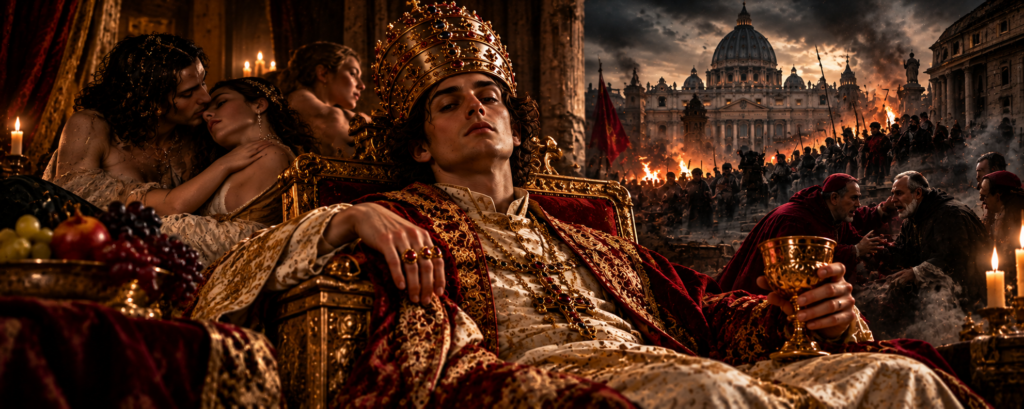
Benedict IX: The Pope Who Sold the Papacy and Came Back for More
Benedict IX — 1032–1044, 1045, 1047–1048
There have been popes accused of murder, popes remembered for sexual scandal, popes driven from Rome by angry mobs, and popes whose families treated the Church as another instrument of aristocratic power. Benedict IX managed to become associated with nearly every one of those darker themes, although the most sensational accusations against his private life must be approached with considerable caution. What cannot be dismissed as hostile gossip is the extraordinary public record of his career: he occupied the papal throne on three separate occasions, was expelled from Rome, returned by force, surrendered the papacy in connection with a substantial financial payment, tried to reclaim it, and eventually seized the office yet again. Even in an age when Roman politics could be astonishingly violent, Benedict’s relationship with the throne of Saint Peter was almost without parallel.
Later reforming writers transformed Benedict into one of the great monsters of papal history. They accused him of sexual excess, violence, corruption, sacrilege, and behavior so scandalous that his pontificate became a convenient symbol for everything they believed had gone wrong with the eleventh-century Church. Some of those writers lived relatively close to Benedict’s lifetime and cannot simply be ignored, but they were also participants in a reform movement that defined itself partly through opposition to the aristocratic and morally compromised ecclesiastical world Benedict represented. The safest historical approach is therefore neither to accept every accusation literally nor to dismiss the entire tradition as propaganda.
Benedict does not need the most lurid stories to qualify as one of the indispensable Wicked Popes. His family helped place him on the papal throne while he was remarkably young, although the famous claim that he was only twelve years old is almost certainly exaggerated. His relatives belonged to the powerful counts of Tusculum, a dynasty that had already supplied the previous two popes and had effectively dominated Roman papal politics for decades. Benedict inherited that world, exploited its advantages, became trapped in its rivalries, and eventually helped expose how badly the papacy could be compromised when sacred office became entangled with family property, money, and armed aristocratic power.
His career would culminate in a crisis so extraordinary that a German king crossed the Alps and confronted a Roman Church associated with three competing papal claimants. One had been driven from Rome, another had replaced him, and a third had acquired the office after paying money in connection with Benedict’s resignation. King Henry III and the reform-minded bishops around him attempted to clear the wreckage at the Synod of Sutri in 1046, after which a German bishop became Pope Clement II. Benedict nevertheless returned after Clement’s death and occupied the papal throne for a third time, proving that even an imperial intervention had not immediately destroyed the political system that had made him possible.
The scandal of Benedict IX therefore reaches beyond questions about whether every accusation concerning his bedroom or private conduct was true. His pontificate exposes an institution caught between Roman aristocratic dynasties, German kings, reforming clergy, rival noble factions, and an increasingly urgent conviction that the Church could no longer allow its highest office to be manipulated in this fashion. Benedict was both a product of that broken system and one of the men who pushed it toward crisis. By the time he finally disappeared from the papal throne, the movement to change that system had acquired one of its most powerful cautionary tales.
The Tusculans and the Family That Controlled the Papacy
Benedict IX was born Theophylact into the counts of Tusculum, one of the most formidable aristocratic families in the countryside around Rome. The family possessed estates, military resources, political connections, and enough influence within the city to shape papal elections. Their power had developed within a Roman political culture in which noble families frequently regarded control of the papacy as inseparable from control of Rome itself. The office of pope carried immense religious prestige, but it also provided access to wealth, patronage, diplomacy, and political authority that no ambitious Roman dynasty could afford to ignore.
Theophylact’s father was Alberic III, count of Tusculum, and his immediate family already possessed an extraordinary relationship with the papacy. Benedict VIII, who ruled from 1012 until 1024, belonged to the Tusculan dynasty and was Theophylact’s uncle. Benedict VIII was followed by his brother Romanus, who became Pope John XIX and ruled from 1024 until 1032. When John died, the family had therefore controlled the papal throne for approximately twenty years.
The earlier Tusculan popes were not simply interchangeable examples of corruption. Benedict VIII had been an energetic political ruler who worked closely with Emperor Henry II and became involved in military as well as ecclesiastical affairs. John XIX was more controversial, particularly because he rose extraordinarily quickly from lay status through the clerical ranks to become pope. Nevertheless, both men demonstrated that Tusculan domination could provide a degree of political continuity even while making the papacy look increasingly like the preserve of one aristocratic family.
When John XIX died in 1032, the Tusculans had no intention of surrendering their influence. Theophylact was elevated and took the name Benedict IX, continuing a remarkable sequence in which three members of the same dynasty occupied the throne of Saint Peter. Hostile sources naturally accused the family of using money and political pressure to secure his election, although the precise mechanics cannot be reconstructed with certainty. What is beyond serious dispute is that family power was fundamental to his accession.
This dynastic succession created a problem larger than Benedict’s personality. The papacy was theoretically an ecclesiastical office entrusted to a man chosen to lead the Roman Church and, increasingly, western Christendom. In practice, the Tusculans had made the succession appear almost hereditary. Benedict entered office carrying the burden of a political system in which bloodline could matter as much as ecclesiastical qualification.
That system had existed before Benedict and would not disappear immediately after him. Roman aristocratic families had influenced papal elections for generations, sometimes through persuasion and patronage and sometimes through intimidation or violence. Benedict’s family was therefore exploiting an established political culture rather than inventing something entirely new. What made his career exceptional was the extent to which that culture would eventually collapse around him.
How Young Was Benedict IX?
One of the most famous claims about Benedict IX is that he became pope at the age of twelve. The image is unforgettable: a child placed upon the throne of Saint Peter because his aristocratic family possessed enough money and influence to make it happen. It has consequently appeared in countless popular accounts of papal corruption. The difficulty is that the evidence for such an extraordinarily young age is weak, and the claim should not be presented as established fact.
Modern reconstructions generally make Benedict older, perhaps around eighteen or twenty when elected in 1032. His exact birth date remains uncertain, so no precise age can be stated confidently. Even an age around twenty would have made him remarkably young for a position requiring enormous ecclesiastical, diplomatic, administrative, and political experience. Correcting the twelve-year-old legend therefore does not remove the underlying problem of an unusually young aristocrat reaching the papacy primarily through family influence.
The question also affects how Benedict’s responsibility should be understood. A literal twelve-year-old pope would necessarily have been dominated by adult relatives and advisers, making his earliest government essentially a family regency. A man in his late teens or around twenty could still be heavily influenced by his family while making meaningful decisions of his own. The surviving evidence of Benedict’s later activity fits the latter interpretation much more comfortably.
Benedict was not merely a ceremonial figure carried through years of government by older Tusculans. Papal documents were issued under his authority, ecclesiastical business continued, and he became involved in disputes extending beyond Rome. He interacted with powerful secular rulers and participated in the ordinary institutional life of the medieval Church. His pontificate became notorious, but it was not an empty period during which nothing occurred except aristocratic partying and scandal.
The exaggeration of his youth nevertheless tells us something important about his later reputation. Writers who already regarded Benedict as grotesquely unfit had every incentive to make his election appear absurd from the beginning. Turning an unusually young pope into a child pope transformed a questionable aristocratic succession into a symbol of institutional degradation. The story survived because it perfectly matched the larger legend of Benedict IX.
The more historically responsible picture remains dark enough. A powerful family that had already supplied two successive popes placed another young relative on the throne. His preparation for the office appears to have mattered less than his bloodline. That reality is more important than whether he was twelve, eighteen, or twenty.
The First Pontificate
Benedict’s first period as pope lasted from 1032 until the revolt that drove him from Rome in 1044. That span of roughly twelve years is easy to overlook because the spectacular events at the end of his career dominate almost every retelling. Yet his ability to remain pope for so long demonstrates that Tusculan power was substantial and that Benedict’s government cannot have existed in a state of permanent collapse. Whatever his personal behavior, the machinery of the Roman Church continued to function.
Surviving records show Benedict performing ordinary papal responsibilities. He granted privileges, dealt with monasteries and churches, participated in synods, and became involved in wider ecclesiastical affairs. In 1037 he met Emperor Conrad II at Cremona and became involved in the conflict surrounding Archbishop Aribert of Milan. Benedict’s role in those affairs demonstrates that other rulers and bishops still treated the papacy as an institution capable of meaningful action.
This does not prove that Benedict was an effective or admirable pope. Medieval institutions could continue functioning under deeply flawed rulers because administrators, clergy, advisers, and local officials carried out much of the daily work. A notorious ruler could sign privileges and preside over ecclesiastical business while simultaneously behaving scandalously in private or pursuing reckless political policies. Institutional activity and personal misconduct can coexist without contradiction.
Benedict’s first reign also unfolded within the violent aristocratic politics of Rome. The Tusculans remained powerful, but rival families resented their long domination of the papacy. Political opposition could therefore attach itself easily to moral criticism of the pope. Every rumor of misconduct potentially became another weapon in the struggle to weaken his family.
The precise relationship between Benedict’s personal reputation and the later revolt against him is difficult to measure. Hostile writers emphasized Roman disgust at his immoral behavior, while political analysis points toward rivalry between aristocratic factions. Both explanations may contain truth because a ruler’s moral reputation and political vulnerability often reinforce each other. A scandalous pope gave rival nobles a more attractive justification for rebellion than simple competition for power.
By the early 1040s, Benedict’s position had become increasingly dangerous. His family could still protect him, but its enemies had not disappeared during the years of Tusculan domination. The pope’s reputation supplied those enemies with additional ammunition. Rome was moving toward another violent rupture in which control of the papacy would once again be decided partly in the streets.
The Dark Reputation of Benedict IX
Later writers described Benedict’s personal conduct in extraordinarily hostile language. Peter Damian, one of the fiercest reforming churchmen of the eleventh century, regarded the period surrounding Benedict as an example of the moral corruption afflicting ecclesiastical life. Other chroniclers accused the pope of sexual excess, violence, and behavior incompatible with even the most basic expectations of clerical discipline. Pope Victor III later described Benedict’s life in terms suggesting such profound wickedness that the chronicler professed reluctance to recount all of it.
These testimonies matter because Benedict’s terrible reputation was not invented by modern sensationalists. Medieval reformers genuinely regarded him as scandalous, and some wrote within living memory of his pontificate. The intensity and persistence of the condemnation suggest that there was more behind the tradition than a single political enemy inventing stories. Benedict was remembered badly by people who cared deeply about reforming the Church.
At the same time, those writers were not neutral investigators. The eleventh-century reform movement was increasingly attacking simony, clerical sexual misconduct, aristocratic domination of church offices, and the subordination of ecclesiastical authority to secular family interests. Benedict embodied almost everything reformers opposed. Describing him as extraordinarily wicked strengthened the argument that the entire system that had produced him needed to be dismantled.
Specific allegations must therefore be handled cautiously. Statements that Benedict maintained sexual relationships, lived scandalously, or behaved violently belong to the historical tradition surrounding him, but individual episodes are often impossible to verify independently. Some later descriptions sound more like moral denunciation than eyewitness reporting. Repetition across centuries does not automatically transform polemic into documented fact.
None of this requires rehabilitating Benedict. Historical caution should not become an automatic assumption that every controversial ruler was merely misunderstood. Benedict’s documented political conduct is sufficiently troubling, and his negative reputation among reformers was too persistent to dismiss entirely. The most reasonable conclusion is that serious misconduct probably underlay the tradition while the most extravagant details may have been amplified.
This distinction makes Benedict more interesting rather than less. A cartoon villain teaches us little about the actual Church of the eleventh century. A deeply compromised pope whose genuine failings were later magnified by reformers reveals both the corruption of his own political world and the ideological struggle that followed it. Benedict’s historical importance lies at the intersection of those two realities.
Rome Explodes
In 1044, the tension surrounding Benedict finally erupted into rebellion. A Roman faction hostile to the Tusculans rose against him, and the city descended into the kind of political violence that had repeatedly accompanied papal succession struggles. The exact chronology is complicated, with some events extending into the opening weeks of 1045. What is clear is that Benedict lost control of Rome and was forced to flee.
His opponents moved rapidly to establish an alternative government. John, bishop of Sabina, was elected and took the name Sylvester III in January 1045. His supporters were connected with aristocratic forces opposed to the Tusculans, making his elevation as political as Benedict’s own family-backed accession had been. Later tradition generally regarded Sylvester as an antipope, although the chaotic circumstances make the legal history more complicated than the label alone suggests.
Benedict had not voluntarily resigned when driven from Rome. From his perspective and that of his supporters, Sylvester had therefore seized an occupied throne. Sylvester’s faction could respond that Benedict’s expulsion and scandalous conduct had made replacement necessary. The competing arguments reveal how badly canonical legitimacy and physical control of the city had become disconnected.
The Tusculans refused to accept the defeat. They still possessed estates, armed supporters, and powerful alliances around Rome. Benedict regrouped outside the city while his relatives prepared to overturn the new regime. Sylvester’s possession of the papacy would prove extremely brief.
By March 1045, Benedict’s supporters had recovered enough strength to force Sylvester from Rome. Benedict returned and resumed control of the papacy. His restoration began what is generally counted as his second pontificate. The entire revolution had lasted only a matter of months.
The episode demonstrated both the strength and weakness of Benedict’s position. His family remained powerful enough to restore him, but the fact that he could be driven out at all showed that Tusculan domination was no longer secure. Benedict returned to the throne, yet he returned to a city in which his enemies remained active and his reputation had become dangerously damaged. His second reign would last only weeks.
Benedict Decides to Leave
Soon after recovering Rome, Benedict made the extraordinary decision to resign the papacy. Papal resignation itself was not impossible, and earlier popes had left office under unusual circumstances. Benedict’s departure became scandalous because it was connected with a financial arrangement involving the man who succeeded him. The transaction would eventually destabilize the papacy even further.
Benedict turned to John Gratian, the archpriest of San Giovanni a Porta Latina and a churchman with a far better reputation than Benedict possessed. Gratian was also traditionally described as Benedict’s godfather, suggesting a personal relationship beyond ordinary Roman ecclesiastical politics. He appears to have been genuinely disturbed by the condition of the papacy. If Benedict wanted to leave, Gratian may have believed facilitating that departure would rescue the Church from continuing scandal.
The reasons Benedict wanted to resign remain disputed. A persistent tradition claims that he wished to marry and could not do so while remaining pope. Some versions connect the plan with a particular aristocratic woman and suggest that marriage negotiations encouraged him to abandon ecclesiastical office. The story may preserve genuine information, but its details are not secure enough to be presented as unquestionable fact.
Political exhaustion provides another plausible explanation. Benedict had just been expelled from Rome and restored through factional struggle, leaving him dependent upon relatives and armed supporters. His position was unstable, his enemies remained powerful, and the papacy may have become more dangerous than attractive. A generous financial settlement could have offered a way to escape without surrendering the wealth and status to which he was accustomed.
Whatever combination of motives influenced him, Benedict agreed to relinquish the papacy. John Gratian provided a substantial payment or financial arrangement connected with the resignation. The exact amount and terms remain uncertain because surviving sources describe the transaction differently. The connection between money and Benedict’s surrender of office, however, became impossible to ignore.
In May 1045, Benedict stepped aside. John Gratian became Pope Gregory VI. The Roman Church had apparently escaped its scandalous pope, but the method used to remove him created a new problem almost immediately.
The Pope Who Sold His Throne
Popular histories often summarize the event by saying Benedict IX sold the papacy. The phrase is broadly understandable because he received financial compensation in connection with resigning, and the man who provided it became pope. Nevertheless, the transaction deserves more careful explanation than the image of two men simply negotiating a commercial price for Saint Peter’s throne. Gregory VI’s motives appear to have been substantially more honorable than those of an ordinary buyer.
John Gratian seems to have believed that paying Benedict to leave was the least harmful solution available. Rome had recently experienced rebellion, competing papal claims, and aristocratic violence. Benedict’s reputation had become disastrous, while Gratian himself was respected by reform-minded clergy. Removing Benedict peacefully may have appeared worth almost any financial cost.
This interpretation explains why important reformers initially welcomed Gregory VI. Peter Damian, despite his uncompromising hostility toward simony, spoke favorably of the new pope before the full implications of the transaction became unavoidable. Hildebrand, the future Pope Gregory VII, also became associated with Gregory VI. These men would hardly have rallied around him if they believed from the beginning that he was merely a cynical purchaser of ecclesiastical office.
The problem was that intention could not erase method. Simony—the buying or selling of spiritual offices or benefits—was becoming one of the central targets of ecclesiastical reform. If money had secured Benedict’s resignation and thereby enabled Gregory’s accession, critics could argue that the papacy itself had become part of a financial exchange. The scandal was devastating precisely because Gregory may have meant well.
Benedict’s position in the transaction is harder to defend. He held an office regarded as sacred and accepted compensation while surrendering it. Whether the payment was described as a pension, reimbursement, property arrangement, or direct price did not eliminate the appearance that papal authority had been converted into material value. His behavior reinforced the impression that he regarded the throne as something he personally possessed.
The transaction therefore became one of the defining moments in the history of papal scandal. Benedict’s family had helped turn the papacy into something resembling a dynastic inheritance. Benedict himself now made it appear transferable for money. The reform movement could hardly have asked for a more dramatic illustration of everything it opposed.
Gregory VI Inherits the Disaster
Gregory VI took office with considerable hope surrounding him. Unlike Benedict, he possessed a reputation for seriousness and moral integrity. Reformers who had watched the Roman Church deteriorate under aristocratic factionalism could imagine that his accession represented a genuine turning point. The papacy might finally escape the Tusculan dynasty and begin repairing its damaged authority.
The reality proved much more difficult. Sylvester III remained alive and apparently continued to assert some claim after being expelled from Rome. Benedict had resigned but retained family connections and political supporters. Gregory therefore inherited not a clean succession but the unresolved consequences of two earlier papal regimes.
The financial arrangement surrounding Gregory’s accession also became increasingly troublesome. Reformers could not convincingly denounce simony throughout Europe while ignoring a monetary transaction connected with the papacy itself. Gregory’s good intentions made the situation tragic rather than harmless. If the principle against simony mattered, it had to matter even when the beneficiary was personally respectable.
Benedict then complicated everything by reconsidering his resignation. The marriage he supposedly hoped to contract may not have occurred, or he may simply have regretted abandoning power. His family may also have encouraged him to reassert a claim that preserved Tusculan influence. Whatever the reason, Benedict once again presented himself as possessing rights to the papacy.
Rome now confronted a situation bordering on institutional absurdity. Gregory VI occupied the papal office, Sylvester III remained a rival claimant, and Benedict IX had revived his own pretensions after accepting compensation to resign. Different Roman factions supported different men, while none possessed enough authority to end the dispute permanently. The spiritual center of western Christianity had become trapped in a succession crisis of its own making.
The scandal reached far beyond Rome. Bishops, rulers, monasteries, and clergy throughout western Europe depended upon papal authority in disputes requiring Roman judgment. A papacy divided among competing claims could not easily provide that authority. The need for outside intervention became increasingly difficult to avoid.
Three Men and One Papal Throne
The traditional statement that there were three popes simultaneously in 1046 is somewhat simplified, because their legal and practical positions were not identical. Gregory VI actually occupied the office and enjoyed substantial recognition. Sylvester III had been expelled and was widely regarded by his enemies as a usurper. Benedict had formally resigned before attempting to renew his claim.
Yet the broader picture remains astonishing. Three living men possessed serious connections with the papal title, and each had supporters capable of keeping the controversy alive. Rome’s aristocratic factions had proven unable to produce a stable settlement. The papacy had become the center of an international ecclesiastical embarrassment.
The crisis also exposed the structural weakness behind Benedict’s entire career. There was no independent electoral mechanism powerful enough to prevent noble families from dominating papal succession. There was no permanent military force capable of protecting a pope from Roman factions. Canonical principles existed, but enforcing them depended heavily upon political power.
Reform-minded clergy increasingly concluded that the system itself had to change. The question was no longer simply whether Benedict was immoral or Gregory had made a questionable financial arrangement. The deeper problem was that the papacy could be captured by families and factions because the institutions surrounding papal elections were inadequate. Benedict’s scandal was becoming an argument for structural reform.
The immediate solution nevertheless came from secular power. Henry III, king of Germany, was preparing to travel to Italy. He wanted the imperial crown, but he also regarded himself as a protector and reformer of the Church. The Roman disaster provided an opportunity to fulfill both ambitions.
Henry crossed the Alps in 1046 accompanied by bishops and nobles. His arrival changed the political balance instantly because none of the Roman claimants possessed comparable military strength. The crisis that Rome had been unable to solve internally would now be examined under the shadow of royal power. Benedict’s extraordinary career was about to collide with the strongest ruler in western Europe.
Henry III Comes South
Henry III belonged to a tradition of German rulers who regarded intervention in Rome as part of imperial responsibility. His predecessors had influenced papal elections and repeatedly intervened in Italian politics. Henry nevertheless approached the crisis with an especially strong commitment to ecclesiastical reform. Simony and disorder within the Church offended both his religious ideals and his understanding of proper imperial government.
His journey to Italy also had an immediate personal objective. Henry wanted to be crowned emperor in Rome, and only a pope of unquestioned legitimacy could provide the ceremony with the authority he desired. Being crowned by a man whose own title was contaminated by simony or disputed succession would weaken the symbolism of the event. The papal crisis therefore had to be resolved before the imperial coronation.
Gregory VI went north to meet Henry, which is significant for understanding Gregory’s state of mind. A man who knew himself to be a cynical purchaser of the papacy might have avoided an investigation backed by the German king. Gregory instead appears to have believed that his intentions and circumstances could be defended. He had paid Benedict to rescue the Church, not because he regarded sacred office as merchandise.
Henry and his bishops were not satisfied with intention alone. The transaction had to be examined according to the reforming principles being applied elsewhere. If money could not legitimately secure an ordinary bishopric, the same principle had to apply even more strongly to the papacy. The resulting investigation would destroy Gregory despite his personal reputation.
Benedict was in a much weaker position. He had already resigned and then attempted to reclaim an office for which he had accepted compensation. His family still possessed political influence, but the arrival of Henry dramatically reduced its ability to dictate events. Benedict did not control the proceedings that followed.
The decisive assembly met at Sutri in December 1046. Its task was to untangle a succession crisis created over years of factional struggle. By the time it ended, the Roman papal order that had allowed Benedict to flourish would be severely damaged.
The Synod of Sutri
The Synod of Sutri has become one of the most famous ecclesiastical gatherings of the eleventh century. Bishops assembled under the political dominance of Henry III to examine the rival papal claims. The exact canonical mechanics remain debated, particularly because later reformers would become increasingly uncomfortable with the idea that a secular ruler could effectively determine the fate of popes. What is undeniable is that Henry’s presence made the settlement possible.
Sylvester III’s claim was dealt with harshly. He had obtained the papacy during the revolt that expelled Benedict and was regarded by the victorious party as an illegitimate usurper. Accounts describe him as deposed and subjected to ecclesiastical punishment, although his subsequent career suggests that the practical consequences may have been less straightforward than the official narrative implies. His claim nevertheless ceased to matter in the wider succession.
Gregory VI presented the more painful problem. He acknowledged the financial arrangement connected with Benedict’s resignation while apparently maintaining that his intention had been to free the Church from scandal. His defenders could point to his good reputation and reforming sympathies. His critics could point to the principle that spiritual office could not be obtained through money regardless of motive.
Gregory ultimately surrendered or was deprived of the papacy. The precise distinction between voluntary resignation and compelled deposition is difficult to recover from the sources, but the practical result was the same. He left office and later accompanied Henry north into Germany. Hildebrand went with him, carrying the experience of this extraordinary crisis into the emerging reform movement.
Benedict did not appear at Sutri to defend himself. His previous resignation and renewed claim left him particularly vulnerable, while Henry had no intention of allowing Tusculan control to return. A subsequent assembly at Rome completed the settlement and cleared the way for a new pope. Benedict appeared politically finished.
Henry supported Suidger, bishop of Bamberg, who became Pope Clement II. On Christmas Day 1046, Clement crowned Henry and his wife Agnes as emperor and empress. The ceremony proclaimed that order had finally returned to Rome after the chaos surrounding Benedict, Sylvester, and Gregory.
That appearance of finality lasted less than a year.
Clement II and the New Order
Clement II represented a striking break with the political culture that had produced Benedict IX. He was German, closely connected with Henry III, and sympathetic to ecclesiastical reform. His election demonstrated that Roman aristocratic families had temporarily lost their ability to determine who occupied the papal throne. The emperor had effectively imposed a new political order upon the city.
Clement quickly became associated with measures against simony. The reforming agenda that had helped remove Gregory VI despite his good intentions now became part of papal government. Benedict’s financial resignation had demonstrated how urgently the issue needed to be confronted. The new pope therefore stood in deliberate contrast to the world of Tusculan domination.
Yet Clement’s pontificate was extraordinarily brief. After accompanying Henry and participating in imperial affairs, he died on October 9, 1047, near Pesaro. His sudden death immediately reopened the question of who controlled Rome. The German-backed settlement had depended heavily upon the continued presence of a pope supported by imperial authority.
Later rumors naturally accused Benedict’s supporters of poisoning Clement. A controversial former pope with powerful relatives made an obvious villain whenever a successor died unexpectedly. Scientific examinations of remains attributed to Clement have sometimes been discussed in relation to elevated lead levels, but such evidence cannot establish deliberate poisoning, much less identify Benedict as responsible. Medieval people encountered lead through medicines, containers, water systems, pigments, and other ordinary sources.
Benedict should therefore not be accused of murdering Clement without evidence. The important documented fact is simpler and almost as dramatic. Clement’s death removed the man whose pontificate symbolized Benedict’s defeat. The Tusculans immediately recognized the opportunity.
Benedict returned to Rome in November 1047. Against everything the settlement at Sutri had attempted to accomplish, he occupied the papal throne for a third time. The pope who had been expelled, restored, paid to resign, condemned, and replaced had come back again.
The Third Pontificate
Benedict’s third return is what makes his career unique among legitimate popes. Restored pontiffs were not unknown in medieval Rome, where political fortunes could reverse quickly. Benedict, however, had already surrendered the office in a financial transaction and had then been excluded by the imperial reform settlement. His ability to return after all of that revealed the extraordinary resilience of aristocratic power.
The restoration depended upon political support rather than broad ecclesiastical acceptance. Benedict’s Tusculan relatives remained influential around Rome, and powerful Italian nobles could still frustrate German plans. Among the most important figures in the struggle was Boniface, marquis of Tuscany, whose territorial power made him crucial to anyone attempting to move through central Italy. Control of Rome still depended upon alliances extending far beyond the city walls.
Henry III refused to accept Benedict’s return. The emperor selected Poppo, bishop of Brixen, as the next pope. Poppo would take the name Damasus II, but he could not simply walk into Rome while Benedict remained in control. Henry needed Italian magnates to enforce his decision.
Boniface of Tuscany initially resisted or delayed assisting the imperial candidate. His behavior illustrates the practical limits of imperial authority in Italy. Henry could issue commands from north of the Alps, but local rulers controlled roads, armies, fortresses, and political networks. Benedict survived because enough of those networks still supported or tolerated him.
Henry eventually applied sufficient pressure to force cooperation. Boniface withdrew his support from Benedict and assisted the imperial candidate. Without the political protection that had enabled his restoration, Benedict’s position became untenable. By July 1048, his third occupation of the papacy had ended.
Damasus II entered Rome and was enthroned. Benedict never again successfully recovered the papal throne. After sixteen years of intermittent rule, rebellion, restoration, resignation, and renewed seizure, his extraordinary papal career had finally ended.
Damasus himself died only weeks later in August 1048. The timing might have offered Benedict yet another opportunity under earlier circumstances. This time the political environment had changed enough to prevent a fourth restoration. The Tusculan age was losing its grip on the papacy.
Three Pontificates and a Broken Institution
The chronology of Benedict’s three pontificates can make his career seem almost unreal. His first began in 1032 and lasted until the revolt of 1044–1045. His second began after the expulsion of Sylvester III in March 1045 and ended with Benedict’s resignation in May. His third began after Clement II’s death in late 1047 and ended when imperial pressure forced him from Rome in 1048.
Each period reveals a different weakness within papal government. The first demonstrates how thoroughly one aristocratic dynasty could dominate succession. The second reveals how military control of Rome could reverse an election within weeks. The third demonstrates that even a major imperial reform settlement could collapse when local political conditions changed.
Benedict’s resignation adds another dimension entirely. Papal authority had become so entangled with personal and family interests that surrendering the office could involve substantial financial compensation. Gregory VI may have intended to save the Church, but the transaction nevertheless created the appearance that the papacy could be bought and sold. The resulting scandal damaged both men.
The crisis also demonstrated the inadequacy of existing election procedures. No independent institution possessed enough authority to prevent Roman families, German kings, or armed factions from controlling the succession. The papacy could claim universal spiritual authority while remaining politically vulnerable within its own city. That contradiction became increasingly intolerable to reformers.
The election decree of 1059 would eventually give the cardinal bishops a central role in choosing popes. The reform did not eliminate political interference, and later medieval elections could still become violent or disputed. Nevertheless, it represented an attempt to move the papacy away from precisely the kind of aristocratic chaos associated with Benedict’s era.
Benedict therefore matters as more than a scandalous individual. His career exposed weaknesses that reformers would spend decades trying to correct. The pope who repeatedly returned became one of the strongest arguments for creating a system designed to make such returns more difficult.
The Sexual Scandals and What We Can Actually Say
Benedict’s sexual reputation has always attracted enormous attention. Medieval writers accused him of behavior ranging from clerical unchastity to almost unimaginable debauchery. Later popular histories frequently repeated these charges as though detailed records of his private life had survived. In reality, the evidence is far less precise than the legend suggests.
Peter Damian and other reformers regarded Benedict’s moral conduct with disgust, and that testimony should not simply be discarded. These men lived close enough to the period that their general picture of a scandalous reputation deserves serious consideration. Benedict was not first branded immoral hundreds of years after his death. Hostility toward his conduct belonged to the eleventh-century reform environment itself.
The difficulty arises when general condemnation becomes a catalogue of specific acts. Medieval polemic often used sweeping sexual accusations to demonstrate that an opponent was morally unfit. Chroniclers could repeat stories heard through partisan networks without possessing direct knowledge of the events. Later writers could then amplify those accounts until reputation hardened into biography.
The alleged plan to marry deserves similar caution. Several traditions connect Benedict’s resignation with a desire for marriage, making the story more substantial than some of the wilder accusations. Nevertheless, details concerning the woman involved and the precise negotiations vary. It is therefore reasonable to say that a desire to marry may have contributed to his resignation while avoiding claims that cannot be securely demonstrated.
The broader cultural context makes some degree of sexual misconduct plausible. Clerical marriage, concubinage, and sexual relationships were major targets of eleventh-century reform precisely because they were widespread enough to provoke sustained campaigns. Benedict was a young aristocratic pope formed within a political rather than monastic environment. He would not have been insulated from the customs reformers were attacking.
Plausibility, however, is not proof. Benedict’s place among the Wicked Popes should not depend upon repeating every accusation made by hostile writers. His documented treatment of the papacy already provides overwhelming material. The sexual stories belong in the article because they shaped his reputation, but they should remain clearly identified as accusations where evidence is uncertain.
Violence, Faction, and the Streets of Rome
Benedict’s Rome was a city in which political conflict could become physically dangerous with astonishing speed. Aristocratic families maintained armed supporters, controlled fortified residences, and competed for offices carrying both symbolic and material power. Papal elections were therefore rarely isolated ecclesiastical events. They were embedded in the wider struggle over who governed the city.
The revolt that expelled Benedict illustrates this environment. His enemies did not simply issue a theological objection and wait for a council to rule. They seized political control of Rome and installed Sylvester III. Benedict’s family responded in the same political language by gathering enough force to recover the city.
This violent background helps explain why Benedict’s resignation may have seemed attractive in 1045. He had already experienced the danger of losing Rome and knew another rebellion could occur. A financial settlement offered security that continued possession of the papacy could not guarantee. The throne was prestigious, but it could also become a trap.
It also explains why Gregory VI struggled to impose reform after succeeding him. A morally respected pope still needed enough political power to control Rome. Gregory inherited a city divided among families whose interests could not be erased through personal virtue. Reform required force as well as ideals.
Henry III’s intervention temporarily supplied that force. His army and political prestige allowed the synods of 1046 to accomplish what Roman factions could not. Yet Benedict’s third return after Clement II’s death demonstrated how quickly local power reasserted itself when imperial pressure weakened. The political disease survived the removal of individual claimants.
Benedict was therefore both a cause and symptom of Roman disorder. His willingness to reclaim the papacy intensified conflict, but the system already encouraged men to fight for the office. His career reveals what could happen when sacred authority existed inside a city where possession remained inseparable from armed aristocratic power.
Was Gregory VI Guilty of Simony?
Gregory VI’s involvement makes Benedict’s resignation morally complicated. If John Gratian had simply purchased the papacy because he wanted power, the episode would be straightforward corruption. The surviving picture instead suggests a respected churchman attempting to remove a scandalous pope by paying the price Benedict demanded. That intention made Gregory sympathetic to reformers even while creating a serious canonical problem.
Simony derived its name from Simon Magus, the biblical figure who attempted to purchase spiritual power. By the eleventh century, reformers were increasingly determined to eliminate the buying and selling of ecclesiastical offices. Bishops who obtained sees through payments could be condemned regardless of whether they later governed well. The spiritual office itself was not supposed to become merchandise.
Gregory could argue that he had purchased Benedict’s departure rather than the papacy. The distinction was morally meaningful because removing Benedict might genuinely have seemed like a service to the Church. Yet Gregory became pope immediately afterward, making the financial transaction impossible to separate completely from his accession. Critics could reasonably ask whether an office obtained through paying the previous holder to resign was truly free from simony.
The Synod of Sutri ultimately treated the problem as serious enough to end Gregory’s pontificate. His fate demonstrates how rapidly reforming standards were becoming more rigorous. Personal virtue could no longer compensate automatically for a compromised method of obtaining office. The papacy itself had to exemplify the principles reformers wanted enforced throughout the Church.
Benedict’s role in creating this dilemma is one of the most damaging aspects of his legacy. His willingness to accept money made even his respectable successor vulnerable. The transaction contaminated the very reform that was supposed to rescue Rome from him. Benedict managed to damage the papacy even while leaving it.
The episode also helped shape the generation that followed. Hildebrand witnessed Gregory’s downfall and accompanied him into exile. Decades later, as Gregory VII, Hildebrand would become one of the fiercest champions of ecclesiastical independence and reform in medieval history. The chaos surrounding Benedict formed part of the world from which that reforming papacy emerged.
The Shadow of Murder
Benedict’s reputation has sometimes encouraged later writers to connect him with deaths that occurred conveniently around his political returns. Clement II’s sudden death in 1047 is the most obvious example. Because Benedict regained Rome shortly afterward, suspicion naturally fell upon him and his supporters. The sequence makes a compelling mystery, but compelling timing is not evidence of murder.
No reliable contemporary evidence establishes that Benedict ordered Clement poisoned. Later scientific analysis associated with Clement’s remains has produced discussion of lead exposure, but lead was common in medieval environments and medicines. Even if poisoning could be demonstrated medically, identifying the person responsible would remain a separate historical problem. Benedict therefore should not be described as Clement’s murderer.
This caution is particularly important in a Wicked Popes article because Benedict’s established behavior already encourages readers to believe the worst. Once a historical figure acquires a monstrous reputation, every unexplained death around him begins to look like another crime. That is precisely how legend expands beyond evidence. Responsible history must resist the temptation even when the darker version makes a better thriller.
The same principle applies to other violent episodes attributed to Benedict’s period. Rome was full of factional conflict, and people undoubtedly died during struggles involving the papacy. Establishing that Benedict personally ordered a particular killing requires evidence beyond the existence of political violence. His general reputation cannot substitute for proof.
Benedict can be condemned for actions that are genuinely documented. He repeatedly asserted claims that destabilized the papacy, participated in factional struggles, and accepted financial compensation in connection with resignation. These facts are remarkable enough. Adding unsupported murder charges would weaken rather than strengthen the historical case against him.
The darkness of Benedict’s career therefore lies partly in refusing unnecessary embellishment. A pope does not need to be a secret poisoner to become one of the great scandals of church history. Benedict accomplished that through public actions visible to contemporaries. The documented story remains extraordinary on its own.
Benedict After His Final Expulsion
After 1048, Benedict’s life becomes considerably more obscure. He no longer successfully occupied the papal throne, but he did not immediately disappear from ecclesiastical controversy. His family remained influential, and some evidence suggests that he continued to maintain or revive claims connected with the office. Reforming popes therefore still had reason to treat him as a problem.
A synod under Leo IX in 1049 summoned Benedict to answer accusations connected with simony. Benedict failed to appear and was excommunicated. The action suggests that the Church wanted to close the door firmly on any lingering claim he might possess. His political defeat needed to be reinforced through ecclesiastical condemnation.
Later traditions connect Benedict with the Greek monastery of Grottaferrata outside Rome. According to monastic memory, he eventually came under the spiritual influence of Abbot Bartholomew and repented of his former life. Some accounts suggest that he abandoned his remaining claims and spent his final years in penitence. His burial was traditionally associated with the monastery.
The story cannot be verified in every detail. Medieval monasteries often preserved narratives in which notorious political figures found redemption through monastic repentance. Such traditions could contain genuine historical memory while also serving an edifying purpose. Benedict’s supposed conversion should therefore be presented as a meaningful tradition rather than unquestionable fact.
If substantially true, the ending would provide a striking contrast with his public career. The man who repeatedly fought for possession of the papal throne would have ended by abandoning worldly power altogether. The aristocrat accused of spectacular indulgence would have sought discipline within a monastery. The pope whose resignation involved money would have discovered a form of renunciation that required no payment.
Whether that transformation truly occurred remains uncertain. Benedict fades from reliable political history after the middle of the eleventh century. What remained visible was the damage his pontificate had already done.
The Reformers Needed a Villain
The movement transforming the eleventh-century Church did not begin with Benedict IX, but his career gave reformers an almost perfect symbol. They opposed simony, and Benedict’s resignation involved money. They opposed aristocratic domination of church offices, and Benedict had been placed on the papal throne by one of Rome’s most powerful families. They demanded clerical discipline, and Benedict carried a notorious reputation for sexual misconduct.
His story therefore acquired enormous rhetorical value. Reformers could point backward to the chaos of his pontificate and present their program as the only alternative to a return of that world. Benedict became evidence rather than merely biography. His name helped define what the reformed papacy claimed it would no longer tolerate.
Peter Damian’s hostility belongs within this context. Damian was not writing modern detached biography; he was fighting what he believed to be a spiritual crisis within the Church. His language could be savage because he regarded sexual misconduct and simony as diseases threatening Christian society. Benedict naturally became one of the figures upon whom that condemnation concentrated.
Later reformers had additional reasons to emphasize the contrast. The papacy of Leo IX promoted reform through councils and wider European engagement. Nicholas II changed the procedures surrounding papal elections. Gregory VII would eventually assert extraordinary claims concerning papal authority and independence from secular control.
Against those developments, Benedict looked like the embodiment of the corrupt old order. His family connections, financial resignation, and repeated restorations seemed to belong to a world reformers were determined to leave behind. The darker his memory became, the brighter the reforming contrast appeared. Historical memory and institutional identity reinforced one another.
Yet Benedict’s usefulness as a symbol should not cause us to reverse the verdict automatically. Reformers could exaggerate and still be responding to genuine scandal. His documented career confirms many of their broader concerns even when individual accusations remain uncertain. The man and the legend overlap enough that neither can be understood without the other.
From Benedict IX to a New Papal System
The papacy changed dramatically during the decades following Benedict’s final expulsion. German-backed reforming popes initially replaced the Roman aristocratic order that had dominated his era. Leo IX traveled widely and promoted ecclesiastical reform with unusual energy. The papacy increasingly imagined itself as the leader of a broader movement rather than merely the prize of Roman noble families.
In 1059, Pope Nicholas II issued a decree giving cardinal bishops a central role in papal elections. The exact system continued to evolve, but the principle represented a major attempt to insulate succession from the kind of direct aristocratic manipulation that had characterized Benedict’s accession. Roman clergy and people retained roles, and secular influence certainly did not disappear. Nevertheless, the direction of reform was unmistakable.
The irony is that the papacy would soon struggle against German imperial control as fiercely as reformers had struggled against Roman noble families. Henry III’s intervention had rescued the institution from one form of domination, but reformers eventually concluded that emperors should not control ecclesiastical appointments either. The Investiture Controversy would turn that principle into one of medieval Europe’s greatest political conflicts. The search for ecclesiastical independence therefore moved beyond the immediate problems of Benedict’s Rome.
Benedict stands near the beginning of that transformation because his career exposed the weaknesses reformers wanted to eliminate. His election showed the danger of dynastic control. His financial resignation showed the danger of treating spiritual office as material property. His repeated returns showed the inadequacy of existing mechanisms for resolving disputed succession.
He did not intentionally inspire reform, and he deserves no credit for the changes that followed. He benefited from the old system and repeatedly fought to preserve his place within it. Yet institutions often change most rapidly after their failures become impossible to conceal. Benedict made the failures of the aristocratic papacy spectacularly visible.
His pontificate therefore became part of the negative foundation upon which the reforming papacy built its identity. The Church wanted future generations to believe that the age of Benedict IX represented something it had escaped. Whether that escape was ever complete is another question. The determination to attempt it was real.
Was Benedict IX Really the Worst Pope?
Modern lists frequently rank Benedict IX among the worst popes in history. Such rankings are inevitably subjective because they compare men separated by centuries, political systems, and radically different kinds of evidence. Stephen VI is remembered for putting the corpse of Formosus on trial, John XII for extraordinary accusations of sexual and violent misconduct, and Boniface VII for a career associated with the imprisonment and deaths of rival popes. Benedict’s notoriety comes from a different combination of institutional and personal scandal.
Unlike Stephen VI, Benedict did not stage a grotesque posthumous trial that shocked even medieval Rome. Unlike Boniface VII, he is not primarily remembered as an antipope whose seizures of power were linked with the deaths of legitimate rivals. Unlike John XII, the surviving allegations against his private life are difficult to connect to a single dramatic judicial proceeding. Benedict’s scandal is cumulative rather than concentrated in one episode.
He was the beneficiary of dynastic papal politics, the target and participant in aristocratic coups, the recipient of money connected with papal resignation, a renewed claimant after that resignation, and the only legitimate pope generally counted as occupying the throne on three separate occasions. Each element would be notable by itself. Together they produced one of the strangest pontificates in the history of Christianity.
Calling him the single worst pope may therefore be less useful than asking what kind of failure he represents. Benedict represents the conversion of sacred office into something resembling aristocratic property. His scandal concerns not merely what a pope did while in office but how the office itself could be acquired, lost, transferred, and recovered. That makes his career especially important to the history of papal institutions.
The most sensational allegations can be removed without changing that conclusion. Even a heavily revised, evidence-conscious Benedict remains extraordinary. His reputation does not collapse when legends are stripped away. Instead, the structural scandal becomes easier to see.
That is why Benedict belongs at the center of Wicked Popes. He does not need to win an imaginary competition in depravity. His actual career is disturbing enough.
A Papacy Treated Like Property
Perhaps the deepest problem running through Benedict’s career is the impression that he treated the papacy as though it belonged to him. His family secured the office after two earlier Tusculan popes. When Roman opponents expelled him, his family helped recover it. When he wanted to leave, he accepted financial compensation connected with surrendering it.
After surrendering the office, Benedict reconsidered and renewed his claim. Following the death of Clement II, he returned and occupied the throne again. The pattern resembles the behavior of an aristocrat defending a disputed inheritance more than a churchman regarding office as a temporary spiritual responsibility. That perception became devastating to his historical reputation.
Benedict was not alone in thinking about ecclesiastical office through the language of family, property, and patronage. Medieval noble families routinely sought bishoprics and abbeys for relatives. Secular rulers expected influence over major appointments, while church lands and revenues made ecclesiastical positions politically valuable. The system surrounding Benedict encouraged precisely the attitudes reformers later condemned.
The papacy, however, magnified the problem enormously. A local abbacy manipulated by an aristocratic family could create scandal within a region. The throne of Saint Peter possessed significance throughout western Christianity. Treating that office as a family asset threatened the legitimacy of the entire ecclesiastical hierarchy.
Benedict’s financial resignation made the problem impossible to ignore. Even if Gregory VI’s motives were honorable and even if Benedict’s compensation could be described in ways more complicated than a direct purchase price, the appearance was disastrous. A sacred office seemed to have acquired monetary value. Reformers could point to the episode as proof that simony had reached the very top of the Church.
His later attempt to return made the transaction look even worse. Benedict had accepted the benefits of resignation without permanently accepting its consequences. He appeared to have surrendered the papacy as though making a bargain and then attempted to recover it when the bargain no longer suited him. Few episodes could have done more damage to the idea that ecclesiastical office was fundamentally a trust rather than a possession.
The Last Great Tusculan Pope
Benedict’s fall also marked the decline of the Tusculan family’s extraordinary papal dominance. The dynasty had shaped Roman politics for decades and produced a sequence of popes capable of working with emperors and controlling the city. Benedict initially appeared to be another continuation of that successful system. His first reign’s length demonstrates that Tusculan power remained formidable.
The revolts and restorations of the 1040s revealed that the system was beginning to fail. Rival Roman families had become strong enough to expel Benedict. German rulers possessed enough power to intervene directly. Reforming churchmen were increasingly unwilling to accept aristocratic manipulation as a normal feature of ecclesiastical government.
Each of Benedict’s returns therefore contained an element of desperation beneath the apparent triumph. His family could recover Rome, but it could not restore unquestioned legitimacy. The more often Benedict returned, the more obvious the institutional crisis became. Political victory no longer solved the deeper problem.
Henry III’s intervention finally broke the pattern sufficiently for reformers to build something different. German popes replaced Tusculan nominees, and the papacy began developing a more international reforming identity. Roman aristocrats would remain important, but open dynastic possession of the papacy became increasingly difficult to defend. The old system had not vanished overnight, yet its ideological foundations had been badly damaged.
Benedict therefore became both the beneficiary and destroyer of the world that produced him. His family power gave him the papacy, but his repeated scandals helped demonstrate why family power could no longer be allowed to operate so openly. The dynasty’s greatest prize became the evidence used against its political model.
By losing the papacy repeatedly, Benedict revealed how unstable Tusculan domination had become. By returning repeatedly, he revealed how dangerous it remained. The reform movement would attempt to solve both problems at once.
The Strange Possibility of Repentance
The tradition that Benedict eventually sought penitence at Grottaferrata gives his story an ending very different from the political chaos that defines most of his life. According to the monastery’s memory, Benedict came under the influence of Abbot Bartholomew and renounced the worldly ambitions that had driven his struggles for the papacy. He may have spent his final years in a religious setting and been buried there. The account cannot be established with the same confidence as his public pontificates, but it deserves mention.
Medieval Christianity placed enormous emphasis upon the possibility of repentance. A man could commit grave sins and still seek forgiveness if his conversion was genuine. Monastic writers naturally valued stories in which powerful sinners abandoned wealth and status for penitential life. Benedict’s biography offered an especially dramatic candidate for such a transformation.
The story also served the reputation of Grottaferrata. A monastery capable of receiving and reforming one of the most notorious popes of the century could present itself as a place of extraordinary spiritual power. That does not mean the tradition was fabricated, but it reminds us why monastic communities preserved such narratives. Historical memory and institutional identity frequently developed together.
If Benedict truly ended his life in penitence, the contrast is almost painfully appropriate. He had spent decades refusing to let go of the papal throne. He had returned after exile, reconsidered resignation, and reclaimed power after an imperial settlement supposedly ended his career. Genuine repentance would have required him finally to abandon the idea that the office belonged to him.
We cannot know what Benedict thought in his final years. We cannot reconstruct a confession or invent a moment in which he recognized the damage his career had caused. The sources do not give us that access to his inner life. The possibility of repentance should remain a possibility rather than a sentimental conclusion.
His public legacy remains unaffected by the uncertainty. A disastrous pope could repent and still have been a disastrous pope. Personal redemption, if it occurred, would not erase the institutional consequences of his reign.
The Legend and the Man
Benedict IX eventually became more than a historical pope. He became a symbol of papal corruption so powerful that later writers often used his name as shorthand for an entire era of ecclesiastical degradation. The child pope, the sexually depraved pope, the pope who sold his office, and the pope who returned three times gradually merged into one monstrous image. Some elements of that image are firmly historical, while others are much harder to prove.
Separating the two requires discipline because the legendary Benedict is enormously entertaining. A twelve-year-old aristocrat installed as pope, transforming the Lateran into a center of debauchery before selling the papacy to finance a marriage, sounds almost designed for dark historical storytelling. Yet several elements of that compressed version are uncertain or exaggerated. Repeating them without qualification sacrifices the very history that makes the real story valuable.
The historical Benedict was probably older than twelve when elected. His sexual reputation was terrible, but many specific allegations come from hostile reforming sources. His resignation did involve money, although Gregory VI’s role was more complicated than that of an ordinary buyer. His three separate occupations of the papacy, however, are not inventions.
Those secure facts create a story nearly as dramatic as the legend. A young aristocratic pope ruled for more than a decade, was expelled by a rival faction, returned, surrendered the office for compensation, revived his claim, survived an imperial intervention intended to remove him permanently, and returned yet again after his successor died. That sequence requires no sensational additions. It is already one of the most remarkable careers in papal history.
The legend matters because it reveals how later reformers and historians understood Benedict’s era. The man matters because the actual events expose the institutional weaknesses hidden beneath the moral condemnation. Studying both allows us to see how scandal becomes historical memory. Benedict’s reputation is therefore part of his history rather than merely an obstacle to recovering it.
He was almost certainly not everything later writers said he was. He did more than enough to become notorious without their help.
Why Benedict IX Is Indispensable to Wicked Popes
Benedict IX belongs in the Wicked Popes category not because every accusation against him can be proven, but because the documented structure of his career is itself scandalous. His family dominated the papacy and helped secure his election while he was unusually young. He survived for years through aristocratic power before Roman opposition drove him out. His relatives then helped him recover the city.
After returning, Benedict surrendered the papacy in connection with a substantial financial settlement. His successor, Gregory VI, was eventually forced from office because the transaction raised unavoidable questions of simony. Benedict then renewed his own claim and contributed to the chaos that brought Henry III into Italy. An emperor and a council were required to clear the competing papal claims.
Even that intervention did not end the story. Clement II died, and Benedict returned for a third pontificate. Henry had to exert renewed pressure before another pope could take possession of Rome. Benedict’s ability to survive so many defeats is almost as remarkable as the scandals themselves.
His career also helped expose the dangers of treating ecclesiastical office as an extension of aristocratic politics. The Tusculans were not uniquely evil for seeking influence; noble families throughout medieval Europe did the same. What made Benedict’s case extraordinary was the office involved and the repeated intensity of the manipulation. The pope was supposed to stand above ordinary family competition, yet Benedict appeared inseparable from it.
The later accusations of sexual depravity reinforce the dark reputation but should not become the foundation of the article. They are historically important because reformers believed and repeated them, and because they influenced how Benedict was remembered. Their precise details remain less secure than his public political actions. Keeping that distinction clear allows the story to remain dramatic without becoming careless.
Benedict’s greatest scandal was ultimately not what he may have done in private. It was what happened publicly to the papacy around him. Under Benedict IX, the throne of Saint Peter became something a family could seize, a mob could overturn, a rival could occupy, money could help transfer, an emperor could reorganize, and the original holder could still reclaim.
That alone makes him indispensable.
The Pope Who Would Not Stay Gone
Benedict IX began his career with the advantage that mattered most in the Rome of his youth: he belonged to the right family. The counts of Tusculum had already dominated the papacy for roughly two decades, and two of his uncles had occupied the throne immediately before him. When John XIX died in 1032, the family ensured that another Tusculan would succeed him. The young Theophylact became Benedict IX and inherited an office that his relatives had begun to make look almost hereditary.
The later claim that Benedict was only twelve years old sharpened the scandal until it became legendary. He was probably older, perhaps around eighteen or twenty, although his precise birth date remains uncertain. Even the more cautious estimate leaves an unusually young man occupying one of medieval Europe’s most demanding offices because his family possessed extraordinary political power. The corrected history remains disturbing without requiring the child-pope legend.
For roughly twelve years, Benedict remained in office. He performed normal papal functions, participated in ecclesiastical government, and dealt with rulers and bishops beyond Rome. Those facts prevent his first pontificate from being reduced to a continuous spectacle of depravity. They do not erase the increasingly terrible reputation that gathered around him.
Reforming writers accused Benedict of sexual misconduct and moral corruption in exceptionally harsh terms. Some of those accusations may reflect genuine behavior, while others were probably sharpened by polemical hostility. The reform movement needed examples of the ecclesiastical world it wanted to destroy, and Benedict offered an almost perfect target. His aristocratic background, notorious reputation, and later financial resignation made him uniquely useful.
By 1044, political opposition became open rebellion. Benedict was driven from Rome, and Sylvester III was installed in his place. The pope who had ruled for more than a decade suddenly became an exile. The Tusculans nevertheless retained enough power to reverse the result.
Within weeks, Benedict returned. Sylvester was forced out, and Benedict recovered the papacy. His restoration demonstrated that political possession of Rome could matter as much as ecclesiastical argument. The family that had originally secured his election could still fight to preserve it.
Then Benedict did something far stranger than simply surviving another Roman coup. He agreed to surrender the papacy in connection with a financial payment from John Gratian. Whatever his motives, the arrangement transformed his already controversial pontificate into one of the great scandals of medieval church history.
Gratian became Gregory VI and appears to have believed that removing Benedict was necessary to rescue the Church. Reform-minded clergy initially respected him because his personal reputation stood in dramatic contrast to Benedict’s. Yet the money involved in the resignation created a canonical problem that good intentions could not erase. A papal succession connected with payment looked dangerously like simony.
Benedict’s departure therefore damaged the papacy even while appearing to free it from him. Gregory inherited the consequences of the bargain. Sylvester remained a rival claimant, while Benedict eventually regretted his resignation and reasserted his own rights. The Roman Church moved from scandal into institutional paralysis.
By 1046, three living men possessed competing connections with the papal throne. Gregory VI actually governed, Sylvester maintained his disputed claim, and Benedict refused to accept that his own story was finished. Rome had become incapable of resolving the succession through its own political structures. The papacy that claimed spiritual authority across western Christianity could barely determine who its pope was.
Henry III crossed the Alps and imposed a settlement. At Sutri and Rome, the competing claims were examined and cleared away. Gregory’s honorable intentions could not save him from the implications of the financial transaction, while Sylvester’s claim was rejected and Benedict was excluded. Clement II became pope and crowned Henry emperor.
For Benedict, the settlement should have been final. He had been expelled, restored, resigned, returned as a claimant, and then swept aside by the most powerful ruler in western Europe. The papacy was now under German protection, and reformers were determined to prevent a return to the old Roman aristocratic order. Almost any other political career would have ended there.
Clement II died less than a year later. Benedict saw the opening and returned to Rome. The supposedly defeated pope began his third period in possession of the throne.
That final restoration is the detail that makes Benedict’s career almost impossible to match. His family and allies remained powerful enough to overturn an imperial ecclesiastical settlement as soon as circumstances became favorable. Benedict’s return demonstrated that decrees and synods meant little without political power capable of enforcing them. The old aristocratic Rome had not yet accepted its defeat.
Henry III responded by supporting Damasus II. Political pressure eventually forced Benedict’s allies to abandon him. In 1048, he lost Rome for the final time.
The end of his third pontificate did not immediately erase him from church politics. He remained troublesome enough to face later ecclesiastical condemnation, and traditions differ regarding his final years. The monastery of Grottaferrata eventually remembered him as a penitent who abandoned his claims and sought a different kind of life. Whether every detail of that tradition is historical cannot be established.
If Benedict did repent, the possibility adds complexity without erasing anything that came before. Medieval Christianity did not teach that notorious sinners were incapable of conversion. A man could damage an institution profoundly and still seek forgiveness later. Personal repentance and historical consequence belong to different questions.
The consequences of Benedict’s career were enormous because his scandals coincided with a wider transformation already beginning within the Church. Reformers were increasingly determined to eliminate simony, strengthen clerical discipline, and reduce secular control of ecclesiastical offices. Benedict gave them a spectacular example of what could happen when those principles were ignored. His pontificate became evidence for the prosecution of an entire political system.
The election reforms that followed did not arise solely because of Benedict, but his era helped demonstrate their necessity. Giving leading cardinals a stronger role in papal elections offered one way to weaken the ability of aristocratic families to impose candidates directly. The later struggle for ecclesiastical independence would extend far beyond Roman noble politics and eventually challenge emperors themselves. Benedict stood near the beginning of that enormous transformation.
This is why reducing him to lurid sexual stories misses the most important part of his history. The allegations matter because they shaped his reputation and may preserve genuine evidence of serious misconduct. Yet the most consequential scandal occurred in public rather than behind the walls of the Lateran. Benedict repeatedly treated the papacy as something that could be possessed.
His family secured it for him. His enemies took it away. His family helped him recover it.
He surrendered it for compensation. He regretted surrendering it. He attempted to reclaim it.
An emperor intervened to end the chaos. Benedict survived that intervention. When the opportunity came, he seized the throne again.
These events belong together in full paragraphs rather than as isolated dramatic fragments because their cumulative force is what makes Benedict’s story extraordinary. Each return weakened the idea that papal office existed independently of family and military power. Each reversal demonstrated how unstable Roman ecclesiastical government had become. Each scandal gave reformers another reason to insist that the system had to change.
Benedict was therefore more than a notoriously immoral pope. He became the embodiment of a papacy trapped inside an aristocratic political order that could no longer sustain its own legitimacy. The office had become too important to remain the possession of whichever Roman family controlled the streets. His career helped make that contradiction impossible to ignore.
There is a darker irony in the fact that Benedict’s first reign was relatively long. For more than a decade, the Tusculan system appeared capable of maintaining him. The spectacular collapse came only later, when political opposition, personal scandal, reforming ideals, and imperial power converged. A system that had looked durable suddenly began destroying itself.
Benedict’s repeated returns prolonged the collapse but could not prevent it. Every restoration demonstrated the remaining strength of the old order, while every new scandal made that order harder to defend. By 1048, the Tusculans could still create trouble but could no longer determine the future direction of the papacy. The center of gravity had shifted toward reform.
Later generations remembered Benedict accordingly. His enemies sharpened his reputation, chroniclers repeated the darkest stories, and popular history eventually turned him into one of the standard candidates for the worst pope who ever lived. Some details deserve skepticism, particularly the most extreme claims about his age and private sexual conduct. The underlying career, however, survives historical scrutiny remarkably well.
Benedict IX really did occupy the papacy three separate times. He really was driven from Rome and restored. His resignation really was connected with money provided by the man who succeeded him.
His attempt to return really did contribute to an extraordinary succession crisis. Henry III really did intervene in Italy and support a new papal settlement. Benedict really did come back after that settlement and seize Rome again.
Those facts are enough.
They reveal a pope whose relationship with his office became almost indistinguishable from aristocratic possession. They reveal a Roman political system in which sacred authority could be fought over through family alliances and armed power. They reveal a Church approaching the point where reform was no longer merely desirable but unavoidable.
Benedict’s private sins may never be reconstructed completely. Some accusations were probably true, some may have been exaggerated, and others cannot be verified. Historical accuracy requires preserving those distinctions rather than turning hostile medieval rhetoric into unquestioned biography. Nothing is gained by accusing him of crimes the evidence cannot support.
The public scandal requires no such uncertainty. Benedict’s three pontificates, financial resignation, renewed claims, and dependence upon family power are firmly embedded in the history of the period. They explain why his name survived as one of the darkest in papal history even before later storytellers embellished the picture. The institution itself appeared compromised whenever he returned.
That is ultimately what makes Benedict IX more disturbing than a simple tale of a wicked man in holy robes. Individual vice can die with the individual. Institutional corruption can reproduce itself, protect itself, and repeatedly restore the very people whose behavior reveals its failures. Benedict kept returning because the system around him remained capable of bringing him back.
His final defeat therefore mattered because it signaled that the system itself was beginning to change. The Church that emerged from the middle of the eleventh century was still political, still imperfect, and still vulnerable to powerful rulers. It would continue producing disputed elections, antipopes, scandals, and violent conflicts. Yet the assumption that a Roman dynasty could simply pass the papacy through its family and recover it whenever political circumstances permitted had become far harder to sustain.
Benedict IX did not intend to become the symbol of that transformation. He did not surrender power in order to reform the Church, and he repeatedly attempted to recover what reformers wanted him to relinquish. His contribution to change was therefore entirely unintended. He showed the Church what its existing system could produce when pushed to its most extreme conclusion.
A Tusculan aristocrat inherited extraordinary influence and reached Saint Peter’s throne while still young. He ruled, fell, returned, sold or financially surrendered his claim, regretted the bargain, survived an imperial purge, and returned again. His career reads like a dark satire of ecclesiastical government, yet the central events actually happened.
That is why Benedict IX belongs among the indispensable Wicked Popes. His reputation does not rest solely upon hostile gossip about sex, cruelty, or private vice. It rests upon a documented career in which the papal throne became entangled with dynasty, money, rebellion, rival claimants, and repeated seizures of power.
Other popes disgraced the office through what they did while sitting upon the throne. Benedict’s scandal went deeper because his entire career raised the question of what the throne itself had become. Under the Tusculans, it could resemble an inheritance; during rebellion, it could become a prize of factional warfare; during his resignation, it could acquire a financial value; after his supposed removal, it could still be reclaimed.
The reformers who came afterward understood the danger. They would fight bitterly over how popes should be chosen, who possessed authority over bishops, whether spiritual offices could be purchased, and how independent the Church should be from secular rulers. Those struggles would reshape medieval Europe. Behind them stood memories of crises like the one Benedict had helped create.
His final legacy is therefore larger than the lurid stories told about him. Benedict IX became a warning about what happens when sacred authority is treated as personal property. His three pontificates demonstrated how difficult it was to remove a ruler whose family possessed enough political power to keep restoring him, while his financial resignation demonstrated how easily an office could be corrupted once possession and spiritual vocation became confused.
The man eventually disappeared, and even the circumstances of his death remain uncertain. The scandal did not disappear with him. It became part of the historical memory that reformers used to define the kind of Church they claimed they were trying to build.
Benedict IX may have been younger or older than the legends say. He may have committed some of the sexual offenses attributed to him, while others may belong more to hostile polemic than recoverable biography. He may even have ended his life in genuine repentance.
None of those uncertainties alter the central verdict on his pontificate. Benedict inherited a papacy dominated by aristocratic power, helped drag it into one of its most humiliating succession crises, accepted money while relinquishing the office, attempted to recover what he had surrendered, and ultimately occupied the throne three separate times. His story is not merely about a wicked pope.
It is about a papacy that had become vulnerable enough to let him keep coming back.