
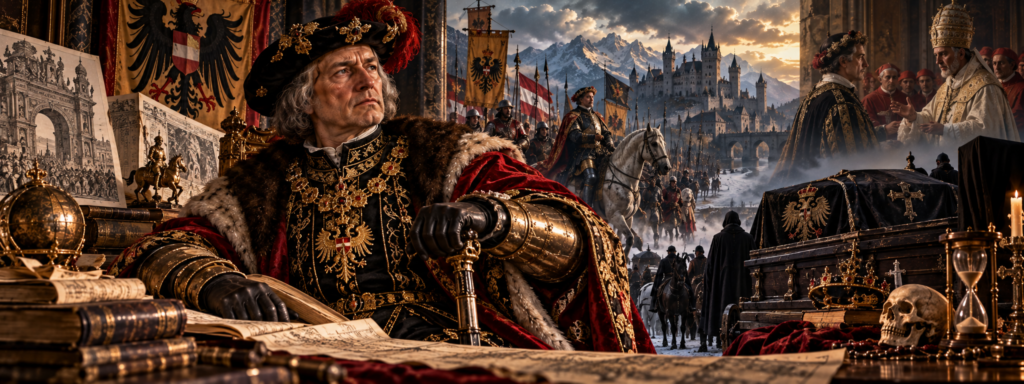
Maximilian I: The Last Knight, the Empty Purse, and the Emperor Who Tried to Manufacture Immortality
Holy Roman Emperor-Elect, 1508–1519 | Dynastic Ambition, Endless Wars, Financial Chaos, Chivalric Obsession, Imperial Propaganda, the Papal Scheme, a Traveling Coffin, and the Extraordinary Death Ritual of a Habsburg Emperor
The Emperor Who Refused to Be Forgotten
In the winter of 1518–1519, the aging Emperor Maximilian I moved through his Austrian lands accompanied by an object few rulers would have wanted anywhere near their traveling court: his own coffin. For years the emperor had carried it with him, a grim piece of luggage following the man who had spent most of his life chasing glory across Europe. Maximilian had commissioned monuments, heroic books, enormous woodcut projects, elaborate armor, genealogies, triumphal images, and an extraordinary tomb crowded with ancestral figures, all intended to make certain that the world remembered his name. Yet as death approached, the ruler who had devoted so much energy to manufacturing magnificence became increasingly preoccupied with humiliation, sin, mortality, and the fate of his soul.
His final instructions were startling. Maximilian wanted no embalming and no magnificent funeral display surrounding his actual body. His hair was to be cut away, his teeth removed, and his corpse subjected to scourging as an act of penitential humiliation before burial. The emperor whose artistic projects presented him as knight, warrior, ruler, dynastic patriarch, and almost mythological hero wanted his physical remains treated as those of a miserable sinner. His magnificent cenotaph at Innsbruck, surrounded eventually by imposing bronze ancestors and heroes, would remain empty, while Maximilian himself was buried beneath the high altar of St. George’s Chapel at Wiener Neustadt.
It is difficult to imagine a better introduction to Maximilian’s contradictions. He was extravagantly concerned with his reputation yet intensely preoccupied with Christian humility at the end of his life. He dreamed on a continental scale while frequently lacking the money to pay for his immediate plans. He presented himself as a triumphant warrior despite campaigns that repeatedly ended in frustration, compromise, or financial paralysis, and he cultivated the image of the medieval knight while becoming one of the most innovative political users of Renaissance art and the new technology of print. He could pursue schemes so ambitious that they bordered on fantasy, including the astonishing possibility of combining imperial and papal authority in his own person.
None of this means Maximilian was clinically insane. There is no persuasive evidence that he suffered from a persistent psychotic disorder or lost the ability to understand the political world around him. Indeed, some of the dynastic policies that appeared fantastically ambitious during his lifetime ultimately helped transform the Habsburgs into Europe’s dominant ruling family. His “madness,” insofar as contemporaries or later observers perceived one, belonged instead to his excesses: excessive ambition, excessive movement, excessive spending, excessive warfare, excessive self-mythologizing, and a restless refusal to accept the limits imposed by geography, money, institutions, or mortality.
Maximilian was a ruler caught between worlds. He looked backward toward medieval chivalry, universal Christian empire, crusading ideals, tournaments, knights, and heroic genealogy, while simultaneously looking forward toward printed propaganda, centralized administration, sophisticated dynastic marriage, professional artillery, and political image-making on a scale that feels strikingly modern. He wanted to conquer territory, arrange marriages, lead crusades, reform the empire, dominate Italy, preserve Burgundy, contain France, fight Venice, confront the Ottoman threat, secure the imperial succession, and ensure that unborn generations would know precisely how magnificent Maximilian I had been. His problem was not a shortage of dreams. It was that Europe, his subjects, his creditors, and his treasury were rarely capable of keeping pace with them.
A Habsburg Prince in a Dangerous World
Maximilian was born at Wiener Neustadt on 22 March 1459, the son of Emperor Frederick III and Eleanor of Portugal. The Habsburg family into which he was born possessed prestige that exceeded its immediately available power. Frederick carried the imperial title, but the Holy Roman Empire was not a centralized state that an emperor could command at will. It was an immense and complicated political structure composed of princes, bishops, cities, territories, and institutions whose cooperation had to be negotiated rather than simply ordered.
Maximilian’s childhood unfolded against a background of dynastic conflict and political insecurity. Vienna itself became a contested city, and the young prince experienced the instability created by warfare and opposition to his father. Later stories turned these experiences into dramatic explanations for his adult restlessness, including claims that childhood siege and deprivation helped produce unusual behavior. Some accounts even maintain that Maximilian remained virtually mute until around the age of eight, frightening Frederick III into believing that his heir might never develop normally, before suddenly becoming an energetic and linguistically gifted child.
The claim of a prolonged childhood refusal to speak should be treated cautiously. Stories about famous rulers often acquire prophetic childhood episodes that make their later personalities appear predetermined, and Maximilian’s own court-sponsored literature deliberately transformed his youth into legend. The adult emperor certainly became linguistically capable, intellectually curious, physically energetic, and extraordinarily communicative. Whatever difficulties he may have experienced as a young child did not prevent him from becoming one of the most socially and politically active rulers of his age.
What does seem clear is that Maximilian grew up with a powerful consciousness of dynasty. His father belonged to a family whose ambitions were immense even when its resources were comparatively modest, and the young prince learned that marriage, inheritance, genealogy, and titles could sometimes accomplish what armies could not. That lesson would eventually become one of the defining principles of Habsburg history. Maximilian would fight constantly, but some of his greatest victories would be won at wedding altars rather than on battlefields.
Mary of Burgundy and the Marriage That Changed Europe
The decisive transformation of Maximilian’s early life came through marriage. In 1477, at eighteen, he married Mary of Burgundy, the only child and heiress of Charles the Bold. Charles had been killed at the Battle of Nancy earlier that year, leaving behind a collection of wealthy territories stretching through the Low Countries and Burgundy that immediately became the object of intense competition.
Mary’s inheritance was enormously valuable, and King Louis XI of France moved quickly to seize portions of it. Maximilian therefore entered marriage not simply as a husband but as a military and political defender of Burgundian interests. The young Habsburg prince suddenly found himself at the center of one of Europe’s most important dynastic struggles.
The marriage appears to have developed into a genuinely close partnership, although later romantic storytelling has inevitably embellished it. Mary gave birth to Philip in 1478 and Margaret in 1480, securing the continuation of their dynastic line. Maximilian also began developing the knightly identity that would follow him throughout his life, presenting himself as the courageous defender of his wife’s inheritance against French aggression.
In 1479, Maximilian defeated French forces at the Battle of Guinegate, an important success that strengthened his military reputation. He fought alongside troops and demonstrated the physical courage that contemporaries valued in aristocratic warfare. Tournaments, hunting, riding, armor, and battlefield bravery were not decorative hobbies for the young Maximilian; they were central to his conception of what a prince should be.
Then, in 1482, catastrophe struck. Mary died after a riding accident, leaving Maximilian a widower with young children and a precarious political position in lands where much of his authority had rested upon being her husband. Her death was both a personal tragedy and a political disaster.
Maximilian spent years struggling to maintain influence over the Burgundian inheritance. The experience taught him several lessons he would never forget: dynastic marriage could transform the political map of Europe, inherited claims were worth fighting for, and a ruler’s personal family relationships could become matters of international importance. His later marriage policies would turn those lessons into a Habsburg strategy with consequences lasting centuries.
The Restless Prince Who Lived on the Road
Maximilian never became a ruler who governed comfortably from one permanent capital. His political world was geographically scattered, and the administrative realities of late medieval monarchy required constant personal movement. He traveled through Austria, the German lands, the Low Countries, Tyrol, and regions connected to his military and diplomatic campaigns, carrying court, officials, servants, soldiers, horses, baggage, documents, and financial problems behind him.
Contemporaries associated Maximilian so strongly with movement that the image of the emperor living almost “in the saddle” became part of his legend. He loved hunting, especially in mountainous terrain, and remained passionately involved in tournaments and martial exercises long after many rulers would have adopted a more sedentary court life. His physical energy could be extraordinary, and he expected people around him to tolerate journeys and exertions that suited his own restless temperament.
Calling this nomadic behavior pathological would be misleading. Medieval and early Renaissance kings frequently traveled because personal presence remained an important instrument of government. Maximilian’s territories were also too scattered for administration from a single center to be practical. Yet even by the standards of itinerant monarchy, his appetite for movement was remarkable.
The constant travel contributed to the disorder surrounding his finances and government. Officials sometimes struggled to keep pace with a ruler whose attention could shift quickly from one territory, military project, diplomatic scheme, or artistic commission to another. Maximilian’s court was not simply a household; it was a moving political organism that consumed money wherever it went.
This restless existence also shaped the emperor’s mythology. He appeared as a ruler perpetually in motion—riding, hunting, fighting, negotiating, marrying relatives, planning crusades, commissioning armor, dictating literary projects, and imagining the next campaign before the previous one had been paid for. Remaining still seems to have been one of the few things Maximilian never learned to enjoy.
Twenty-Five Campaigns and an Emperor Without Enough Money
Maximilian’s military career was astonishingly active. Over roughly four decades he participated in or directed approximately twenty-five campaigns, fighting in the Low Countries, against France, in Italy, against Venice, and in conflicts involving the complicated politics of the empire. Warfare was central to his identity, but it was also one of the greatest sources of frustration in his reign.
His ambitions routinely exceeded his financial resources. Raising armies required money, and Maximilian did not possess the centralized taxation system available to a modern state. He depended upon revenues from hereditary territories, negotiations with the imperial estates, loans, subsidies, bankers, allies, and whatever other financial mechanisms could be assembled for a particular project. Campaigns could therefore begin with tremendous enthusiasm and then falter because the emperor could no longer pay troops or sustain operations.
His enemies recognized the weakness. Italians mocked the emperor’s chronic poverty, and the derisive image of “Maximilian of little money” became attached to him. The insult was cruel because it struck at the central contradiction of his imperial identity: Maximilian thought on the scale of Charlemagne while frequently financing his ambitions from one loan to the next.
Stories circulated of imperial entourages accumulating unpaid bills and of creditors becoming increasingly reluctant to trust promises of future payment. Accounts that Maximilian or members of his entourage could find themselves embarrassed by unpaid lodging or provisions fit the broader reality of chronic financial difficulty, although colorful anecdotes about innkeepers literally preventing the emperor from leaving should be treated cautiously unless tied to specific contemporary documentation. What is indisputable is that unpaid craftsmen, suppliers, soldiers, and creditors were recurring features of Maximilian’s world.
His financial behavior was not simply the result of stupidity or ignorance of economics. The political structure in which he operated made raising reliable revenue extraordinarily difficult, while his responsibilities and ambitions extended across multiple territories. Nevertheless, Maximilian repeatedly chose projects that magnified those weaknesses. Instead of reducing his ambitions to match his income, he tried to stretch income until it matched his ambitions.
Usually, it did not.
The Emperor Who Could Win by Marriage
If Maximilian’s wars frequently disappointed him, his dynastic marriages produced results beyond anything his armies achieved. The famous later Habsburg saying that others should wage war while fortunate Austria married captures the strategy associated with his dynasty, although the phrase itself should not be treated as a literal policy statement written by Maximilian. Marriage became a form of territorial expansion requiring negotiation rather than conquest.
His son Philip the Handsome married Joanna of Castile, daughter of Ferdinand of Aragon and Isabella of Castile. At the time, the full consequences of the marriage could not have been predicted because Joanna was not initially expected to become the principal heir to her parents’ kingdoms. A sequence of deaths transformed the succession, eventually placing the inheritance of Spain and its expanding overseas empire within reach of Maximilian’s descendants.
Philip and Joanna’s son Charles would inherit an astonishing collection of territories. He became King of Spain and eventually succeeded Maximilian as Holy Roman Emperor Charles V, ruling lands scattered across Europe and an overseas empire expanding through the Americas. Maximilian’s dynastic strategy had helped create a monarchy far larger than anything he himself had directly governed.
The Habsburg marriage policy extended eastward as well. Agreements involving Hungary and Bohemia eventually positioned Maximilian’s grandson Ferdinand to inherit those crowns after the death of Louis II at Mohács in 1526. Again, the full outcome lay beyond Maximilian’s lifetime, but the groundwork had been laid.
This is one reason dismissing Maximilian as merely delusional is so misleading. Some of his ambitions genuinely were unrealistic, and many of his campaigns failed to achieve their intended objectives. Yet his dynastic imagination was extraordinarily successful. The emperor who often lacked enough money to sustain a war helped arrange a family network that would dominate European politics for generations.
King of the Romans, Emperor Without a Papal Crown
Maximilian had been elected King of the Romans in 1486 while his father Frederick III was still alive. When Frederick died in 1493, Maximilian became the effective head of the empire and inherited the Habsburg hereditary lands. Traditionally, however, becoming Holy Roman Emperor involved coronation by the pope, usually requiring a journey into Italy.
For Maximilian, that journey became politically impossible. France had expanded its influence in Italy, Venice opposed him, and northern Italian politics made a traditional expedition to Rome extremely difficult. The obstacle was more than ceremonial because Maximilian possessed a deeply elevated conception of imperial authority. He regarded the Holy Roman Empire as connected to the ancient Roman imperial tradition and imagined the emperor as a leader of Christian Europe.
In 1508, unable to reach Rome, Maximilian adopted the title of Elected Roman Emperor at Trent with papal consent. The compromise was historically important because it loosened the traditional connection between the imperial title and an actual papal coronation. His grandson Charles V would later receive a papal imperial coronation at Bologna in 1530, but the medieval expectation that an emperor had to journey to Rome was effectively dying.
Maximilian’s inability to secure the traditional coronation illustrates the gulf between his conception of the imperial office and political reality. He imagined a universal Christian emperorship whose theoretical dignity stretched back toward Rome and Charlemagne. In practice, he frequently had difficulty persuading German princes to provide enough money for his immediate military plans.
That gap did not discourage him.
It encouraged him to dream even larger.
Charlemagne, Crusade, and the Fantasy of Universal Empire
Maximilian’s political imagination remained deeply influenced by medieval ideals of Christian empire. The fall of Constantinople to the Ottomans in 1453 had occurred only six years before his birth, and the continuing Ottoman expansion into southeastern Europe gave crusading rhetoric enormous emotional and political power. Maximilian repeatedly entertained plans for campaigns against the Ottoman Empire and imagined himself as a defender of Christendom.
His imperial ambitions could extend into something approaching universal monarchy. He looked toward the legacy of Charlemagne and the Roman emperors, imagining the Holy Roman Emperor as more than simply one ruler among Europe’s competing princes. In the idealized political world Maximilian carried in his imagination, imperial authority possessed a sacred and historical superiority that contemporary kings were unlikely to acknowledge.
This did not mean he literally believed he possessed unlimited power. Maximilian could negotiate pragmatically when forced to do so, and much of his political career consisted precisely of compromise with princes, cities, estates, allies, and creditors. Yet his imagination continually returned to a grander conception of what his office ought to mean.
The tension between ideal and reality became one of the defining characteristics of his reign. Maximilian inhabited a Europe increasingly organized around powerful territorial monarchies while carrying an imperial worldview rooted partly in the medieval conception of universal Christian authority. His frustration arose repeatedly when the real world refused to conform to the symbolic world in which he believed an emperor should operate.
The most extraordinary example came in 1511, when Maximilian briefly contemplated solving the problem by becoming something no previous Holy Roman Emperor had successfully become: pope.
The Emperor Who Considered Becoming Pope
Pope Julius II was seriously ill in 1511, and Maximilian began entertaining an astonishing possibility. Correspondence associated with the scheme indicates that he considered pursuing election to the papacy if Julius died. The idea would have placed the imperial and papal dignities, the highest secular and spiritual offices in Latin Christendom, into the hands of one man.
It sounds so extraordinary that it is sometimes dismissed as a joke, misunderstanding, or proof that Maximilian had lost touch with reality. Yet the proposal was real enough to appear in contemporary correspondence, even if historians continue to debate exactly how seriously and practically he expected it to proceed. Maximilian was not an ordained priest, but medieval and Renaissance church politics could be extraordinarily flexible when power was involved, and rapid progression through clerical ranks was not unimaginable for elite candidates.
The scheme was nevertheless wildly unrealistic. A Habsburg emperor becoming pope would have terrified rival powers, disrupted the political balance of Italy, and required the cooperation of cardinals with little reason to hand Maximilian such unprecedented authority. Even the financial dimensions of influencing a papal election presented difficulties to a ruler already famous for lacking money.
What makes the episode revealing is not that Maximilian suffered a delusion that he already was pope. He did not. Instead, he possessed an imagination capable of treating possibilities that most rulers would have rejected immediately as impractical as subjects worthy of genuine political consideration.
For Maximilian, the boundary between audacious strategy and fantasy was unusually permeable.
Reforming an Empire That Would Not Obey
Maximilian’s reign coincided with important attempts to reform the Holy Roman Empire. At the Diet of Worms in 1495, imperial estates pressed for institutional changes intended to improve public peace, justice, taxation, and the functioning of the empire. The resulting reforms included the establishment of the Imperial Chamber Court and measures connected with the Perpetual Public Peace.
Maximilian’s relationship with reform was complicated. He wanted a stronger imperial structure capable of supporting his policies, but the princes wanted institutions that limited arbitrary royal power and gave them greater participation. The emperor therefore found himself negotiating reforms that could strengthen the empire while simultaneously constraining the emperor.
The conflict exposed another limitation upon Maximilian’s ambitions. He could imagine himself as the leader of Christendom, but within Germany he could not simply command the resources of the empire. Princes guarded their privileges, cities protected their autonomy, and representative institutions expected negotiation.
Maximilian occasionally responded to these frustrations with impatience and schemes for alternative sources of authority or money. Yet he also participated in institutional developments that helped shape the empire for centuries. His reign cannot therefore be reduced to romantic fantasy and failed wars.
He was simultaneously impractical and innovative.
That combination appears again and again.
The Last Knight
Maximilian’s enduring nickname, “the Last Knight,” captures both the romance and the artificiality surrounding his public image. He genuinely loved tournaments, armor, hunting, martial skill, and the chivalric traditions of aristocratic warfare. He participated personally in jousts and helped develop specialized tournament forms and equipment.
His interest went far beyond recreation. Maximilian understood that chivalry could be used politically. By presenting himself as the ideal knight, he created a recognizable public identity that connected courage, nobility, dynasty, and imperial authority.
Armor became part of this political language. Maximilian patronized some of Europe’s finest armorers and commissioned sophisticated equipment for himself, relatives, soldiers, and diplomatic gifts. Magnificent armor demonstrated wealth, technological skill, aristocratic identity, and personal courage simultaneously.
The irony is that Maximilian’s chivalric obsession flourished precisely when European warfare was changing dramatically. Infantry formations, artillery, firearms, professional soldiers, and expanding state finances were transforming the battlefield. The knight had not vanished, but the world in which mounted aristocratic warriors could dominate warfare was disappearing.
Maximilian therefore became the “Last Knight” not because he literally represented the final medieval warrior but because he deliberately cultivated an ideal already acquiring the glow of nostalgia.
The Emperor Who Turned Himself Into a Legend
Maximilian understood something about political power that feels strikingly modern: rulers exist partly in the stories people tell about them. He therefore invested extraordinary energy in controlling those stories. Printing had made it possible to reproduce words and images on a scale earlier medieval monarchs could scarcely have imagined, and Maximilian recognized the opportunity.
He commissioned an enormous collection of artistic and literary projects celebrating himself and the Habsburg dynasty. The monumental Triumphal Arch was not a physical stone structure but a gigantic composite woodcut designed to display his genealogy, achievements, titles, and imperial mythology. Created with contributions from leading artists including Albrecht Dürer and his circle, it could be printed in multiple copies and displayed across different locations.
The Triumphal Procession pursued a similarly ambitious vision. Hundreds of figures, horses, musicians, soldiers, hunters, courtiers, trophies, and allegorical elements were intended to parade across a vast sequence of images celebrating Maximilian’s achievements. It transformed the emperor’s life into an endless victory procession even though his actual military record contained plenty of reverses.
This was not simple vanity. It was sophisticated political communication. Maximilian understood that an image repeated across the empire could create a kind of presence in places the constantly traveling emperor could not personally occupy.
He was building an empire of memory.
Theuerdank: Maximilian as Hero of His Own Romance
Maximilian’s self-mythologizing extended into literature. Theuerdank, published in 1517, presented an allegorical and romanticized account connected to his courtship and marriage to Mary of Burgundy. The emperor appeared through the heroic figure Theuerdank, who overcomes a sequence of dangers and adventures before reaching his intended bride.
The work transformed political history into chivalric romance. Real experiences were reshaped into a world of heroic trials, enemies, providence, courage, and destiny. Maximilian was not simply recording his life; he was rewriting it into the form in which he wanted posterity to remember it.
This distinction matters when using his autobiographical works as evidence for his personality. They were not private diaries revealing an unfiltered mind. They were carefully constructed political and literary projects in which historical reality could be reorganized for symbolic purposes.
Maximilian knew perfectly well that stories could outlive armies. A campaign might fail, a treaty might be forgotten, and a territory might be lost, but a printed heroic image could survive indefinitely.
For a man increasingly obsessed with memory, that possibility was irresistible.
Weisskunig and the Perfect Prince
The unfinished Weisskunig, or “White King,” pushed Maximilian’s autobiographical mythology even further. It presented a fictionalized account of his life and education through allegorical royal figures. The young White King becomes accomplished in an astonishing range of arts, crafts, sciences, physical exercises, and princely skills.
The work portrays its hero as almost impossibly talented. He learns languages, military skills, hunting, artistic techniques, crafts, government, and intellectual disciplines, creating an image of the Renaissance prince as universal master. Some episodes are so extravagant that modern readers can easily mistake literary symbolism for evidence of personal delusion.
One particularly colorful story associated with Maximilian’s mythologized childhood describes the infant prince displaying extraordinary behavior while being bathed, an omen of his future greatness. Such episodes belong to the tradition of heroic biography in which remarkable childhood signs foreshadow adult destiny. They should not be treated as literal historical testimony that Maximilian believed he had consciously proclaimed his greatness as a newborn.
The important point is that Maximilian wanted such stories included in the mythology surrounding him. He was not satisfied with being remembered as a competent ruler. Posterity was to encounter an emperor whose greatness had been visible almost from infancy.
His autobiography became propaganda written against death.
The Emperor and the Printing Press
Maximilian’s use of print was revolutionary not because he invented political propaganda but because he exploited new reproductive technologies with unusual ambition. Medieval rulers had long commissioned chronicles, genealogies, monuments, manuscripts, and works of art. Printing allowed Maximilian to multiply and distribute such imagery far more widely.
He worked with major artists, including Albrecht Dürer, Hans Burgkmair the Elder, and others who helped create the visual language of his reign. The emperor could be shown as warrior, dynastic heir, Christian ruler, tournament champion, and successor to legendary ancestors.
Genealogy was particularly important because Maximilian understood dynastic legitimacy as a weapon. His ancestry could be extended through historical, legendary, and occasionally fanciful connections designed to make the Habsburgs appear rooted in the deepest layers of European history.
The distinction between accurate genealogy and politically useful genealogy was not always treated with modern scholarly caution. Maximilian wanted ancestors worthy of the dynasty he imagined his descendants would become.
In one sense, he was creating a brand centuries before the language of branding existed.
The brand was Maximilian.
The Tomb That Became a Dynasty in Bronze
Perhaps no project better illustrates Maximilian’s obsession with memory than the monumental tomb he planned at Innsbruck. The emperor envisioned an extraordinary memorial surrounded by large bronze figures representing ancestors, relatives, heroes, and dynastic connections. Some represented real historical people, while the broader genealogical program incorporated idealized and legendary elements.
The project was enormously ambitious and remained unfinished when Maximilian died. His descendants continued the work, and the magnificent monument visible today reflects decades of effort beyond his lifetime. The dark bronze figures surrounding the cenotaph create an almost theatrical assembly of dynastic memory.
Yet Maximilian’s body is not there.
That contradiction is wonderfully appropriate. The emperor constructed an enormous monument to his lineage and memory, then ordered himself buried elsewhere with extraordinary penitential humility. The empty cenotaph became a monument not simply to Maximilian’s corpse but to the Habsburg idea itself.
His body disappeared beneath a church altar.
His manufactured memory remained standing among bronze ancestors.
Genius, Art, and the Story of Veit Stoss
Maximilian’s admiration for artistic talent contributed to another collection of stories portraying him as willing to place genius above ordinary law. The sculptor Veit Stoss, one of the great German artists of the period, became embroiled in a serious legal case in Nuremberg involving a forged document connected to financial dealings. He was arrested, convicted, and punished, including being branded on the cheeks.
Later tradition emphasizes Maximilian’s intervention on Stoss’s behalf. The emperor did provide protection and support at points in the sculptor’s troubled career, illustrating his willingness to use imperial authority in favor of an artist he valued. However, the simplified story that Stoss was sentenced to have both hands chopped off and Maximilian canceled the punishment solely because artistic genius was a divine gift is too neat to repeat without qualification.
The legend nevertheless captures something genuine about Maximilian. He valued skilled craftsmen, armorers, printers, painters, sculptors, and writers because they could give physical form to the imperial image he wanted to leave behind. Art was not merely decoration at his court.
It was political technology.
An emperor who could not always afford an army could still commission an image showing himself triumphant.
War Without Money
Maximilian’s chronic financial problems followed him throughout his reign because his political imagination continuously generated new expenses. Armies required wages, horses required feed, artillery required transport, court travel required provisions, diplomatic missions required gifts, marriages required negotiations and ceremonies, and artistic projects required craftsmen who expected payment.
The emperor frequently depended upon wealthy financiers, including the Fugger family of Augsburg. The Fuggers’ expanding financial power became deeply connected with Habsburg politics, and the relationship would become even more important during the imperial election of Maximilian’s grandson Charles after Maximilian’s death.
Borrowing itself was not evidence of madness. Early modern rulers routinely depended upon credit because state revenues and military expenses rarely arrived on matching schedules. Maximilian’s problem was the relentless accumulation of commitments.
He could imagine new campaigns faster than he could create dependable revenue streams. Military opportunities encouraged him to borrow, while military setbacks made repayment harder. The emperor’s prestige helped him obtain credit, but prestige did not erase arithmetic.
The image of “Maximilian Empty-Pockets” therefore survived because it contained enough truth to wound. Here was a ruler dreaming of universal Christian empire while struggling with the ordinary question of who would pay the soldiers.
Italy: The Dream That Consumed Money
Italy repeatedly drew Maximilian into expensive political and military adventures. The peninsula contained wealthy cities, powerful dynasties, papal territories, French ambitions, Spanish interests, Venetian power, and imperial claims inherited from medieval political traditions. For an emperor who regarded northern Italy as part of the historical sphere of the empire, remaining outside these struggles was almost impossible.
The Italian Wars that began in 1494 created constantly shifting alliances. France, Spain, Venice, the papacy, Milan, Florence, and other powers repeatedly changed partners as immediate interests demanded. Maximilian entered this world with enormous ambitions but insufficient resources to dominate it.
His attempt to move toward Rome for an imperial coronation became entangled in Venetian resistance, contributing to the decision to assume the imperial title without the traditional Roman ceremony. Later, alliances against Venice produced victories and disappointments in rapid succession.
Maximilian could win territory and lose it, join coalitions and watch them rearrange, begin campaigns and run short of money. Italy became a perfect stage for his political personality because it rewarded audacity while punishing anyone unable to sustain long-term commitments.
The emperor repeatedly entered the game.
His treasury repeatedly paid the price.
Depression, Drinking, and the Problem of Retrospective Diagnosis
Some accounts describe Maximilian experiencing periods of deep melancholy or withdrawal, occasionally accompanied by heavy drinking. His life contained more than enough trauma to make periods of grief or depression plausible: Mary’s death, political defeats, financial humiliation, illness, family tensions, and the relentless pressures of warfare and government. Contemporary rulers also lived in a drinking culture very different from modern expectations, making claims about pathological alcohol use difficult to evaluate without precise evidence.
Stories that Maximilian sometimes drank continuously and became unreachable while his chancellor desperately attempted to keep government functioning should therefore be handled carefully. They may preserve memories of genuine episodes of withdrawal or excess, but turning them into a modern diagnosis of severe recurrent depression would go beyond what the evidence allows.
Maximilian was capable of intense emotional reactions. He could become discouraged after setbacks and then rapidly revive when a new plan appeared. His correspondence and political behavior reveal a man whose imagination repeatedly regenerated ambition even after disappointment.
That resilience may have looked erratic to officials forced to follow him from project to project. One campaign failed, another alliance appeared; one source of money disappeared, another loan was pursued; one dynastic plan collapsed, another marriage became possible.
Maximilian’s mind seems less like one periodically abandoning ambition than one almost incapable of abandoning it for long.
The Coffin Joins the Imperial Court
During the final years of his life, Maximilian’s preoccupation with death became increasingly visible. According to Habsburg historical accounts, for approximately the last four years of his life he traveled with his coffin. Wherever the imperial court moved, the object intended eventually to contain the emperor’s body traveled with it.
The practice sounds grotesque to modern ears, but late medieval Christianity possessed a rich tradition of memento mori, reminders that worldly glory ended in death. Skeletons, tomb imagery, death rituals, penitential practices, and meditations upon mortality were deeply embedded in the religious culture of Maximilian’s world. Carrying a coffin was extraordinary, but the underlying spiritual idea was not.
For Maximilian, however, the symbolism was particularly powerful. Few rulers had devoted more energy to controlling how future generations would remember them. His artistic commissions proclaimed triumph, genealogy, chivalry, authority, and heroic destiny, while the coffin silently proclaimed that every earthly title ended in the same physical reality.
The emperor could commission a triumphal procession longer than any real parade.
He could not commission immortality.
As illness accumulated, that contradiction seems to have occupied him increasingly.
The Final Journey
By late 1518, Maximilian’s health was deteriorating seriously. Decades of travel, campaigning, hunting, accidents, and illness had taken their toll. He was approaching sixty, not an extraordinary age by modern standards but substantial for a man who had spent much of his life under severe physical strain.
He traveled toward Upper Austria while increasingly conscious that death was approaching. His behavior during these final months has contributed significantly to the later image of an emperor becoming morbidly eccentric. Yet much of what he did fits within a deeply religious framework of preparation for death rather than evidence of mental collapse.
Maximilian had long contemplated his burial and memorialization. The magnificent Innsbruck tomb project represented one side of that preparation, but his personal instructions for his corpse represented another. He wanted the physical body stripped of the magnificence attached to the imperial office.
The contrast was deliberate.
The dynasty could keep the glory.
The sinner would go into the grave humbled.
Teeth, Hair, Scourging, and the Humiliation of an Emperor
Maximilian died at Wels on 12 January 1519. Before his death, he had given extraordinary instructions concerning the treatment of his remains. His hair was to be cut away, his teeth removed, and his body scourged. He did not want embalming or the elaborate physical glorification that might ordinarily accompany the death of an emperor.
The removal of the teeth is sometimes sensationally described as having them violently smashed from his mouth. The surviving tradition more securely supports the instruction that they be removed, and there is no need to embellish an already disturbing ritual. The scourging of the corpse similarly reflected penitential humiliation rather than random mutilation.
Maximilian wanted to appear before God not as Holy Roman Emperor, warrior, tournament champion, dynastic patriarch, or successor to Charlemagne, but as a sinful Christian stripped of earthly vanity. His final ritual therefore inverted the propaganda of his lifetime. The man who had spent decades surrounding himself with images of greatness ordered his own corpse degraded.
It would be easy to interpret this as evidence that Maximilian became mentally unstable at the end of his life. Yet within the religious culture of his age, extreme penitential practices were comprehensible even when unusual. Fear of judgment, concern for salvation, and contempt for the sinful body could produce behavior that appears shocking to modern readers.
His death ritual was eccentric.
It was not necessarily insane.
Did Maximilian Abdicate on His Deathbed?
Some popular retellings claim that Maximilian formally abdicated his titles shortly before death as part of his penitential rejection of worldly glory. The reality requires more caution. He prepared intensely for death and symbolically humbled himself, but describing the episode as a conventional legal abdication of all imperial titles risks imposing a cleaner political act upon what was fundamentally a religious ritual.
Maximilian remained the recognized emperor until his death. The succession immediately became one of the greatest political contests in Europe, with his grandson Charles eventually elected King of the Romans in June 1519. If Maximilian’s penitential behavior is described as renouncing earthly dignity, that should not automatically be treated as equivalent to a formal constitutional abdication in the later sense.
The distinction matters because the dramatic version can easily overwhelm the historical one. Maximilian did not suddenly decide that his entire reign had been meaningless and legally dissolve his authority. Rather, he approached death convinced that imperial dignity would have no value before divine judgment.
The emperor had spent his life thinking in symbols.
He died through symbols as well.
His last performance was not triumph but humiliation.
The Empty Tomb
Maximilian was buried at Wiener Neustadt beneath the high altar of St. George’s Chapel, while the enormous memorial he had planned at Innsbruck remained without his body. The Innsbruck monument continued to develop after his death and eventually became one of the most extraordinary dynastic memorials in Europe.
The empty cenotaph is perhaps a more appropriate monument to Maximilian than a conventional tomb could ever have been. It is filled with the architecture of memory: ancestors, heroes, dynastic claims, imperial symbolism, and the enormous effort of a family determined to make its past visible.
Maximilian understood that political legitimacy could be constructed backward as well as forward. A dynasty became more impressive if its ancestors appeared ancient, heroic, and connected to the great figures of European history. His memorial program therefore did more than mourn a dead emperor.
It manufactured ancestry.
The same man who tried to secure his grandchildren’s future through marriages tried to secure his family’s past through bronze and genealogy.
The Habsburg dynasty stretched in both directions because Maximilian was constantly building it.
The “Madness” of Maximilian’s Ambition
If Maximilian belongs within a category of “mad monarchs,” it should not be because he can reasonably be diagnosed with insanity. The surviving evidence instead presents a ruler whose ambitions repeatedly exceeded the practical resources available to him. He wanted more wars than he could finance, more authority than the imperial constitution allowed, more influence in Italy than his armies could sustain, and a grander place in Christian history than contemporary European politics could realistically grant him.
His 1511 papal scheme illustrates the extreme end of this mentality. Maximilian could seriously contemplate combining two offices whose rivalry had shaped centuries of European history. To many observers, such a plan must have looked fantastical.
Yet other ambitions that seemed equally audacious produced extraordinary results. His marriage policy helped place Habsburg descendants on the thrones of Spain, Bohemia, and Hungary and positioned his family at the center of European politics. His grandson Charles V would rule territories so extensive that Maximilian’s dreams of universal monarchy no longer seemed entirely absurd.
This complicates any easy judgment about grandiosity. A ruler who dreams impossibly and fails is called delusional; a ruler who dreams impossibly and succeeds becomes visionary. Maximilian did both often enough that the categories blur.
His greatest political talent may have been refusing to accept the scale at which circumstances seemed to confine him.
His greatest weakness was exactly the same.
Self-Promotion or Fear of Oblivion?
Maximilian’s artistic projects reveal a ruler unusually conscious of historical memory. He understood that physical life was temporary but representation could survive. Prints could be reproduced, books copied, monuments completed, genealogies preserved, and stories repeated long after eyewitnesses had died.
His concern with remembrance became explicit in the intellectual world surrounding his autobiographical projects. The underlying idea was stark: anyone who failed to create a memorial during life risked disappearing after death. For Maximilian, forgetting was a kind of second death.
This fear helps explain the apparent contradiction between his monumental self-promotion and his humiliating death ritual. They addressed different forms of mortality. The Christian sinner had to humble himself before God, but the Habsburg emperor had to survive in human memory.
His body could be scourged.
His image could remain triumphant.
The distinction allowed Maximilian to pursue extreme humility and extreme self-glorification almost simultaneously.
What appears psychologically contradictory becomes more understandable when viewed through the religious and dynastic assumptions of his age.
The Emperor Who Was Both Medieval and Modern
Maximilian is often portrayed as standing on the boundary between the Middle Ages and the Renaissance, and few rulers fit that description so well. He adored tournaments and chivalric romance but exploited printing technology with remarkable sophistication. He dreamed of crusades and universal Christian empire while developing dynastic strategies that shaped early modern European geopolitics.
He commissioned armor of extraordinary craftsmanship while understanding the increasing importance of artillery and infantry. He cultivated legendary ancestry while participating in administrative reforms. He presented himself as the ideal knight while using artists and printers to construct what looks remarkably like an early mass-media political campaign.
This mixture can make him appear inconsistent because modern categories encourage us to separate medieval and modern behavior. Maximilian did not experience such a clean division. To him, tournament armor, printed woodcuts, Roman imperial ideology, gunpowder warfare, genealogical legend, financial credit, crusading dreams, and Renaissance art could all belong to the same political universe.
His contradictions were therefore partly the contradictions of his age.
Europe itself was changing beneath him.
Maximilian did not choose between the old world and the new.
He attempted to command both.
What the Legends Get Wrong
The mythology surrounding Maximilian has accumulated precisely because his real personality was so colorful. Stories of childhood muteness, drunken depressive disappearances, unpaid inn bills, artists rescued from mutilation, prophetic bathwater episodes, and bizarre court behavior have been repeated until they sometimes appear as established facts. Some have historical foundations, while others have been simplified, embellished, or removed from their original context.
The safest approach is not to discard all of them but to separate documented patterns from dramatic anecdotes. Maximilian genuinely suffered chronic financial shortages, genuinely fought an extraordinary number of campaigns, genuinely cultivated a heroic autobiography, genuinely considered a papal scheme, genuinely used art as political propaganda, genuinely traveled with a coffin late in life, and genuinely ordered extraordinary treatment of his corpse.
Those facts already produce an extraordinary ruler.
The questionable details are unnecessary.
There is no need to invent a mentally deranged emperor when the historical Maximilian was a man capable of dreaming about becoming pope and emperor simultaneously while struggling to finance the campaigns he already had.
Reality provides enough darkness and absurdity.
The Dynasty That Won After Maximilian Died
Maximilian died before seeing the full consequences of his dynastic strategy. His son Philip had already died in 1506, leaving the next generation to carry the Habsburg inheritance forward. The struggle over the imperial succession after Maximilian’s death eventually resulted in the election of his grandson Charles.
Charles V inherited Spain, the Burgundian Netherlands, Habsburg territories, claims in Italy, and an expanding overseas empire, before adding the imperial title. The geographical scale of his inheritance dwarfed anything Maximilian had directly controlled.
Maximilian’s other grandson Ferdinand eventually became central to Habsburg power in Central Europe. After the death of Louis II of Hungary and Bohemia at Mohács in 1526, Ferdinand acquired claims that brought those kingdoms into the expanding Habsburg dynastic system.
The old emperor’s marriage diplomacy therefore succeeded on a scale his military campaigns rarely approached. Territories that could not be conquered permanently through Maximilian’s armies entered Habsburg history through inheritance.
The penniless campaigner had helped construct one of Europe’s greatest dynastic empires.
There is something almost absurdly appropriate about that outcome.
Maximilian repeatedly failed in the immediate objective and succeeded in the historical one.
The Last Knight’s Real Legacy
The romantic image of Maximilian as the “Last Knight” can obscure how innovative he actually was. His tournaments and chivalric imagery looked backward, but his manipulation of print looked forward. His universal imperial dreams belonged partly to medieval political theology, while his dynastic marriage strategy became one of the defining mechanisms of early modern European power.
He was neither simply a medieval relic nor straightforwardly a modern ruler. He was a transitional figure whose contradictions made sense precisely because he lived at a historical turning point.
His financial failures were genuine, but so were his political achievements. His military record contained repeated disappointments, but his dynastic strategy transformed Europe. His propaganda exaggerated his successes, yet the propaganda itself represented a sophisticated understanding of political communication.
Even his obsession with memory worked.
More than five centuries after his death, Maximilian remains recognizable through the very objects and stories he commissioned. Dürer’s portraits, tournament imagery, armor, Theuerdank, Weisskunig, the Triumphal Arch, the Triumphal Procession, and the Innsbruck cenotaph continue presenting the emperor to audiences he could never have imagined.
The campaign for immortality succeeded.
The Emperor Who Could Not Afford His Dreams
There is a temptation to laugh at Maximilian’s financial chaos because the contrast between his aspirations and resources can be genuinely comic. He imagined crusades, imperial restoration, Italian domination, European dynastic supremacy, monumental artistic projects, and even a possible papacy while creditors waited to be paid. The Venetian mockery of the emperor with too little money captured the contradiction perfectly.
Yet the humor conceals something darker. Maximilian’s wars consumed lives as well as money. Soldiers marched because of dynastic claims, towns suffered during campaigns, taxes and loans financed ambitions decided far above ordinary people, and shifting alliances could transform yesterday’s partner into tomorrow’s enemy.
His romantic chivalric imagery softened the reality of warfare. Woodcuts could show orderly triumphal processions, magnificent horses, banners, armor, and heroic knights. Actual campaigns involved disease, hunger, unpaid troops, devastated countryside, political betrayal, and men dying for objectives that might be abandoned when the money ran out.
Maximilian’s self-created mythology therefore deserves admiration and suspicion simultaneously. He was brilliant at making power beautiful.
Beauty could hide the bill.
A Mind Too Large for Its Treasury
Maximilian’s contemporaries did not need modern psychiatry to recognize that something about his ambitions seemed excessive. His plans expanded constantly, while practical obstacles accumulated beneath them. A failed campaign rarely convinced him to abandon grand strategy; it encouraged another coalition, another loan, another marriage, or another scheme.
This persistence could resemble irrationality, but it could also produce remarkable success. The Habsburg dynasty benefited enormously from Maximilian’s refusal to think modestly. His descendants inherited possibilities that would not have existed if he had limited himself to safe, affordable policies.
His reign therefore resists a simple judgment. Maximilian was neither the delusional fool of hostile caricature nor the flawless visionary of his own propaganda. He was capable of strategic brilliance and spectacular impracticality, sometimes within the same project.
His imagination consistently exceeded his resources.
His dynasty eventually grew large enough to catch up with some of that imagination.
That may be the most accurate way to understand the man.
Death Comes for the Self-Made Legend
By January 1519, Maximilian had spent decades trying to defeat political limits. He had fought France, Venice, and other enemies, negotiated with princes, borrowed from financiers, arranged marriages, commissioned monuments, rewritten his own biography, and constructed a genealogy worthy of the dynasty he intended to leave behind. He had failed often enough to become a target of ridicule and succeeded often enough to transform European history.
But mortality was a limit he could not negotiate.
The coffin traveling with his court had already acknowledged that fact. His increasingly penitential preparations stripped away the language of victory that had surrounded him for decades. The emperor who appeared in his artistic projects as the triumphant center of an ordered universe approached death concerned not with imperial precedence but divine judgment.
His instructions for the corpse were shocking precisely because they reversed his lifelong public image. Hair, teeth, bodily dignity, and ceremonial magnificence were deliberately rejected. The body beneath the armor was to be exposed as mortal.
Maximilian had spent a lifetime constructing himself.
At death, he ordered himself symbolically dismantled.
The Emperor Who Manufactured Eternity
Maximilian I was never simply the foolish emperor with an empty purse, although his financial troubles gave enemies ample material for ridicule. Nor was he merely the romantic “Last Knight” preserved in polished armor and heroic woodcuts. He was one of the strangest combinations of practicality and fantasy to occupy the imperial throne: a ruler who could negotiate brilliantly over marriage alliances while contemplating crusades beyond his means, who helped reform imperial institutions while dreaming of universal authority, and who understood the newest possibilities of printed communication while surrounding himself with the imagery of medieval chivalry.
His so-called madness lay primarily in scale. Maximilian rarely wanted anything modestly. If he fought, he imagined reshaping Italy or restoring imperial authority. If he married his children, he imagined dynastic transformations extending across kingdoms. If he commissioned a memorial, ordinary commemoration was insufficient; generations of ancestors and heroes had to stand around him in bronze. If he told his life story, he did not simply dictate memoirs but transformed himself into an allegorical hero mastering nearly every princely art.
Even the papacy briefly entered the orbit of his imagination. In 1511, while Julius II was ill, Maximilian could contemplate combining imperial and papal authority as though the accumulated political and religious divisions of medieval Europe might somehow be resolved through the person of Maximilian himself. The plan was wildly unrealistic, but it was perfectly characteristic. Where another ruler saw an impossible boundary, Maximilian saw a possibility worth investigating.
The same mentality repeatedly emptied his treasury. Twenty-five campaigns across roughly forty years imposed costs that neither imperial institutions nor Habsburg revenues could easily sustain. Maximilian borrowed, negotiated, demanded subsidies, accumulated debts, and frustrated allies who discovered that imperial promises did not necessarily produce imperial money. The emperor could conceive operations more quickly than administrators could finance them.
Yet dismissing him as financially incompetent misses the structural reality of his position. The Holy Roman Emperor did not possess an unlimited centralized treasury, and Maximilian’s scattered territories imposed enormous administrative challenges. His mistake was not failing to discover some simple source of money everyone else had overlooked. It was refusing to reduce his ambitions to the resources actually available.
Again and again, Maximilian behaved as though determination might somehow substitute for cash.
Sometimes it nearly did.
More often, creditors eventually reminded him otherwise.
His artistic propaganda solved a different problem. A failed military campaign could not be rewritten on the battlefield, but memory could be redesigned afterward. Maximilian understood that historical reputation was itself a form of power, and he mobilized some of Europe’s finest artists and the rapidly expanding technology of print to shape it.
The Triumphal Arch did not need to conquer a city.
It conquered walls.
The Triumphal Procession did not require Maximilian actually to return from every campaign victorious.
It required paper, artists, blocks, ink, and an audience.
Theuerdank transformed the dangerous politics surrounding Mary of Burgundy into heroic romance. Weisskunig transformed Maximilian’s development into the education of an almost impossibly accomplished prince. Genealogical projects surrounded the Habsburg dynasty with an ancestral grandeur that reality alone could not always supply.
This was propaganda, but calling it propaganda should not diminish its sophistication. Maximilian understood something fundamental about political authority: people do not experience power only through laws, armies, and taxes. They experience it through stories, symbols, images, ceremonies, memories, and expectations.
He wanted control over those things.
In that respect, the supposedly medieval knight was remarkably modern.
His dynastic policies were even more consequential. Maximilian’s battlefield achievements rarely matched the scale of his dreams, but his marriages created political possibilities that armies could not. Philip’s marriage to Joanna of Castile helped place Spain and its overseas possessions within the inheritance of Maximilian’s grandson Charles. Arrangements in Central Europe eventually strengthened Habsburg claims to Bohemia and Hungary.
The consequences transformed Europe.
Charles V eventually ruled a collection of territories so enormous that the grandfather’s fantasies of universal monarchy no longer seemed entirely ridiculous. Ferdinand established another great branch of Habsburg power in Central Europe. The dynasty Maximilian had struggled to finance became one of the dominant political forces of the sixteenth century.
The emperor who repeatedly lacked money had made his family extraordinarily rich in claims.
His greatest victories arrived after he was dead.
That fact complicates the entire question of whether Maximilian’s ambitions were irrational. Some certainly were unrealistic, and his papal scheme deserves a prominent place among the strangest serious ideas entertained by a European monarch. His crusading dreams repeatedly exceeded political reality, while his Italian campaigns demonstrated a persistent inability to align strategic objectives with dependable resources.
But Maximilian also imagined dynastic possibilities that became real.
He imagined Habsburg greatness before the Habsburgs fully possessed it.
Then he helped build the marriage network that made it possible.
Perhaps this is why his final years became so obsessed with memory. Maximilian understood that many of his projects would not be completed during his lifetime. His great tomb remained unfinished, artistic projects sprawled across years, political plans awaited future generations, and dynastic marriages contained possibilities whose final consequences he could never witness.
He was building for a future from which he knew he would be absent.
The coffin traveling behind him made that absence visible.
Every journey carried the reminder.
Every new plan existed beside the object that would eventually contain the planner.
There is something profoundly unsettling in that image: Maximilian riding through Europe still negotiating, commissioning, planning, dictating, hunting, and imagining while his coffin followed somewhere among the imperial baggage. The man who had spent decades refusing political limitations had accepted the one limitation no emperor could overcome.
But acceptance of death did not mean acceptance of oblivion.
That enemy he intended to fight.
His monuments would fight it.
His descendants would fight it.
His books would fight it.
His portraits would fight it.
His enormous printed triumph would continue marching after the real emperor could no longer move.
Then came the final reversal. The man who had spent his life constructing magnificence ordered his physical remains humiliated. His hair was to be removed, his teeth taken out, his corpse scourged, and his burial stripped of the bodily pomp expected of imperial death.
It was not necessarily madness.
It was a terrifyingly literal expression of Christian penitence.
Maximilian the emperor could commission bronze ancestors and printed triumphs. Maximilian the sinner would enter death without armor, without a tournament horse, without banners, without the imperial performance that had surrounded him for decades.
His body and his memory went in opposite directions.
The body was humbled.
The memory was glorified.
That contradiction may be the key to Maximilian I. He could believe intensely in worldly glory and its ultimate worthlessness at the same time. He could spend enormous sums constructing an immortal political image while carrying a coffin to remind himself that the flesh beneath that image was temporary.
The magnificent cenotaph at Innsbruck ultimately remained empty.
That emptiness feels almost deliberate even though history produced it through the circumstances of his burial. Around it stand the monumental figures of dynasty, ancestry, and historical memory that Maximilian wanted associated with his name. The emperor himself lies elsewhere, beneath the high altar at Wiener Neustadt.
The body is absent.
The performance remains.
Five centuries later, Maximilian’s campaign against forgetting has succeeded better than many of his military campaigns ever did. We still know the Last Knight through the armor he commissioned, the tournaments he celebrated, the marriages he arranged, the wars he could barely afford, the books in which he reinvented himself, the woodcuts that transformed his reign into triumph, the impossible schemes he entertained, and the coffin that accompanied him toward death.
He never became pope.
He never restored the universal empire of Charlemagne.
He never permanently mastered Italy.
He never found enough money for all the wars he wanted to fight.
But he transformed the Habsburg dynasty, helped reshape the imperial office, exploited print as an instrument of political image-making, and left descendants who would rule territories far beyond anything he personally controlled.
Maximilian spent much of his life trying to make reality as large as his imagination.
Reality frequently refused.
History, however, came surprisingly close.