
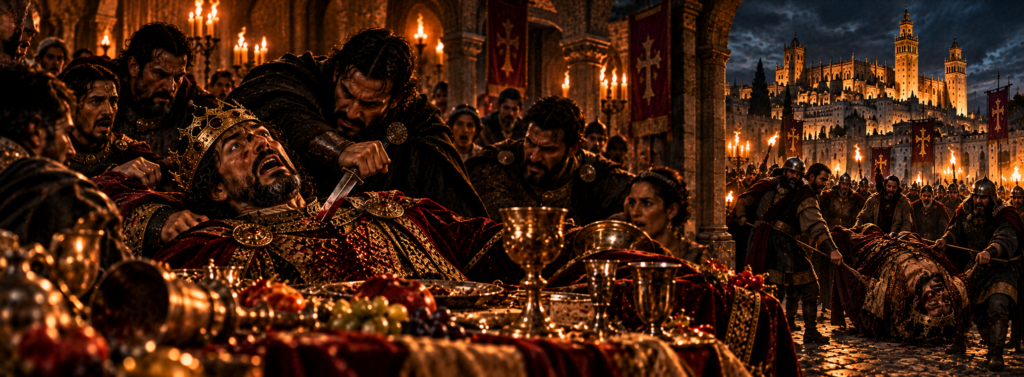
Witteric: The Visigothic King Murdered at a Banquet and Dragged Through the Streets
Witteric (d. 610) | King of the Visigoths, 603–610 | Also known as Viteric or Witéric | Former military commander who overthrew King Liuva II | Associated with an earlier conspiracy against Reccared I | Seized the throne after the mutilation and killing of his predecessor | Fought the Eastern Roman Empire and became entangled in Frankish dynastic politics | Assassinated in April 610, traditionally during a banquet | His corpse was reportedly dragged through the streets of Toledo | Succeeded by Gundemar.
The King They Would Not Even Bury with Honor
In April 610, the king of the Visigoths discovered that the throne he had stolen through violence offered no protection against men who had decided to kill him. Witteric had ruled for approximately seven years, having seized power after overthrowing a young monarch whose right hand was cut off before his death. He had survived military campaigns, religious divisions, and dangerous diplomatic entanglements with the Frankish kingdoms. Yet the greatest threat to his life came from within his own court, where the men surrounding him had apparently concluded that his reign should end as violently as it had begun.
According to the traditional account, the conspirators chose a banquet as the setting for the assassination. The king was supposedly killed during the gathering, his body subsequently dragged through the streets, and his remains denied the burial honors normally associated with royal dignity. The details evoke a scene of calculated humiliation, in which murder alone was not considered sufficient punishment. Witteric was to lose not only his life but also the public respect attached to his position.
The most important early witness, Isidore of Seville, confirms that Witteric was killed during a banquet and that his body was subjected to disgraceful treatment afterward. His account is openly hostile, portraying the dead king as a man whose crimes had finally returned upon him. The familiar description of the corpse being dragged through the streets belongs to this tradition of public dishonor. The precise identities of the assassins, however, are not securely preserved, and the description of the conspiracy as an exclusively Catholic aristocratic movement should be treated cautiously.
There was a particularly bitter irony in Witteric’s death. Seven years earlier, he had destroyed the reign of Liuva II, the young son of Reccared I and grandson of Leovigild. The deposed king had been mutilated and killed, ending the immediate succession of one of the most influential royal families in Visigothic history. Witteric had taken the crown through a betrayal that Catholic chroniclers would remember with undisguised contempt.
Now the same political system that had permitted his rise turned against him. His killers did not need a foreign invasion or a devastating battlefield defeat to remove him. They needed sufficient support among powerful men willing to violate the person of a reigning monarch. Once that support existed, the king’s authority could collapse with terrifying speed.
The aftermath made the message unmistakable. Witteric’s corpse was reportedly denied the dignity ordinarily afforded to a king, while Gundemar emerged as his successor. The man who had destroyed a royal dynasty was himself discarded by the aristocratic world that had allowed him to seize power. His assassination was both a political coup and a public repudiation of his reign.
Yet Witteric’s story is more complicated than a simple tale of a villain receiving his deserved punishment. His career unfolded during a period of extraordinary transformation, when the Visigothic monarchy was attempting to strengthen its authority, establish religious unity, and defend its remaining territories against the Eastern Roman Empire. His reign also became entangled in the murderous rivalries of the Frankish royal family. Understanding his downfall requires examining the unstable world in which he gained power, the enemies he accumulated, and the political calculations that may have made his removal attractive.
A Kingdom Where Kings Were Never Entirely Safe
The Visigothic kingdom had a long and bloody history of royal succession. Although kingship carried considerable prestige, it did not guarantee personal security or peaceful inheritance. Powerful aristocrats and military commanders could challenge rulers whose authority appeared weak or whose policies threatened established interests. The crown was an object of ambition, and the struggle to possess it had repeatedly ended in murder.
In 415, King Athaulf was assassinated at Barcelona, reportedly by a man associated with a rival Gothic faction. His successor Sigeric ruled only briefly before suffering a violent death of his own. Thorismund was murdered in 453 during a conspiracy involving his brothers, while Theodoric II was killed in 466 when another brother, Euric, seized power. These events established a grim precedent in which family connections offered little protection against political ambition.
The sixth century brought further examples. Theudis was assassinated in 548, and his successor Theudegisel was murdered the following year. Agila I, who became king after Theudegisel’s death, was killed by his own followers in 554 after a disastrous civil war. Each assassination demonstrated that royal authority depended heavily upon the willingness of powerful men to recognize and defend it.
The monarchy was not without institutions or traditions. Visigothic rulers governed substantial territories, issued legislation, commanded armies, and maintained relationships with influential bishops and aristocratic families. They inherited administrative practices from the Roman world and increasingly presented themselves as rulers of a unified kingdom. Nevertheless, the succession remained vulnerable whenever ambitious factions believed they could replace the reigning monarch.
The problem was partly structural. Hereditary succession possessed importance, but it was not consistently enforced as the exclusive means of choosing a king. Military prestige, aristocratic support, and political opportunity could become equally decisive. A successful commander might acquire the crown even without a direct hereditary claim.
Witteric belonged to this dangerous political world. He did not create the tradition of violent succession, but he exploited it with devastating effectiveness. His overthrow of Liuva II would become one of the most notorious examples of the monarchy’s vulnerability. His own assassination would demonstrate that a usurper remained exposed to the same dangers as the king he had displaced.
The Legacy of Leovigild
Before Witteric emerged as a serious political figure, the Visigothic kingdom had undergone a period of remarkable consolidation under Leovigild. Becoming sole king in 572, Leovigild pursued military campaigns intended to strengthen royal authority throughout Hispania. He confronted rebellious regions, expanded his control, and eventually conquered the Suevic kingdom in the northwest. His reign became one of the most important in the development of a more centralized Visigothic monarchy.
Leovigild also strengthened the outward dignity of kingship. He adopted more elaborate royal ceremonial practices and emphasized the distinction between the monarch and ordinary aristocrats. His government drew upon Roman traditions of political authority while preserving the military foundations of Gothic rule. The result was a monarchy that increasingly presented itself as a permanent institution rather than merely the personal command of a successful warrior.
Yet his achievements did not eliminate internal conflict. His son Hermenegild rebelled against him in a struggle associated with religious disagreement and political ambition. Hermenegild had converted to Catholic Christianity, while Leovigild remained committed to the Arian faith traditionally followed by the Gothic ruling elite. The rebellion became entangled with foreign alliances and regional opposition before ending in Hermenegild’s defeat.
Hermenegild was killed in 585, although the precise circumstances remain disputed. His death demonstrated that even the royal household could become a battlefield when questions of faith and authority collided. Leovigild preserved his throne, but the conflict revealed divisions that would continue influencing Visigothic politics. His surviving son Reccared inherited both the strengthened monarchy and its unresolved religious tensions.
When Leovigild died in 586, Reccared succeeded him without the kind of prolonged civil war that had accompanied many earlier transfers of power. The peaceful succession appeared to vindicate Leovigild’s efforts to establish a durable royal dynasty. Yet Reccared would make a decision that fundamentally transformed the kingdom. His conversion to Catholic Christianity created new opportunities for unity while provoking opposition among those attached to the old religious order.
Witteric’s later career cannot be understood without this background. He emerged in a kingdom where royal authority had recently become stronger, but where religious change had created powerful enemies. The monarchy was attempting to replace decades of instability with a more unified political structure. Witteric would become one of the men who demonstrated how fragile that achievement remained.
Reccared and the Religious Revolution
Reccared I inherited a kingdom divided between the Arian Christianity traditionally associated with the Visigothic elite and the Catholic Christianity followed by much of the Hispano-Roman population. These religious differences had political consequences because bishops, aristocrats, and royal officials often possessed overlapping interests. A king’s religious allegiance could influence his relationships with powerful institutions. Reccared recognized that conversion might provide a foundation for greater unity.
In 587, he abandoned Arian Christianity and embraced Catholicism. His decision was formally affirmed at the Third Council of Toledo in 589, an event that became central to the religious history of Visigothic Hispania. The monarchy publicly aligned itself with the Catholic church, bringing royal authority into closer cooperation with influential bishops. The transformation helped create a more unified religious identity for the kingdom.
Yet not everyone welcomed the change. Some Arian bishops and Gothic nobles regarded the conversion as a rejection of established traditions. Others may have feared that Catholic institutions would gain influence at the expense of aristocratic families accustomed to exercising power. Religious opposition could therefore overlap with personal ambition and resentment toward the ruling dynasty.
Several conspiracies emerged during Reccared’s reign. One of the most important involved Sunna, the Arian bishop of Mérida, and a group of opponents associated with resistance to the new religious settlement. The plot was exposed, and its participants faced punishment or exile. The episode demonstrated that religious disagreement could still threaten royal authority.
Witteric appears in the surviving tradition as a participant associated with this conspiracy. His precise role is difficult to reconstruct, but his involvement places him within a network of men opposed to Reccared’s political and religious policies. The connection became particularly significant when Witteric later overthrew Reccared’s son. It suggests a continuity of aristocratic opposition extending across two reigns.
Nevertheless, Witteric’s subsequent actions do not establish that he remained committed to restoring Arianism. His later kingship did not produce a documented reversal of Reccared’s Catholic settlement. The distinction matters because political ambition could survive long after the religious circumstances that initially encouraged opposition had changed. Witteric may have used existing resentments without intending to restore the old religious order.
The Conspiracy at Mérida
Mérida was one of the most important cities in western Hispania. Its Roman heritage, influential Christian institutions, and strategic position made it a significant center of political and religious authority. The city also possessed a powerful Catholic community associated with the cult of Saint Eulalia. Conflicts between religious leaders could therefore have consequences extending far beyond local theological disagreements.
During Reccared’s reign, Bishop Sunna became associated with a conspiracy against the Catholic settlement. The plot involved opposition to the religious changes supported by the monarchy and threatened influential Catholic figures in Mérida. The surviving account appears in the Lives of the Fathers of Mérida, a work concerned with the city’s ecclesiastical history. Its religious perspective is essential to understanding how the conspiracy was remembered.
Witteric’s name appears among those associated with the plot. The tradition presents him as a participant whose actions contributed to exposing the conspiracy rather than allowing it to succeed. His precise motives remain uncertain, and the surviving narrative does not permit a complete reconstruction of his relationship with the other conspirators. Nevertheless, the episode places him within the dangerous world of religious and aristocratic opposition.
The conspiracy failed, and Reccared’s religious policy survived. Catholic authority in Mérida remained intact, while the king continued consolidating the religious settlement established at Toledo. The failure demonstrated that the monarchy possessed sufficient support to defeat organized resistance. Yet it did not eliminate every individual who had been connected with opposition.
Witteric eventually recovered or retained enough political standing to pursue a military career. The surviving sources do not explain every stage of that development. We cannot identify all the patrons who supported him or determine precisely how he regained the confidence of the royal government. His later appointment to military command nevertheless demonstrates that he was not permanently excluded from power.
That survival would prove disastrous for Reccared’s family. A man associated with opposition to the king’s religious settlement eventually acquired the military resources necessary to challenge his successor. The conspiracy at Mérida did not destroy Reccared, but Witteric’s later ambitions would destroy Reccared’s son. The connection gave Catholic chroniclers a particularly compelling reason to condemn him.
The Young King Witteric Destroyed
When Reccared died in 601, his son Liuva II inherited the throne. The young monarch was approximately seventeen or eighteen years old, making him considerably less experienced than the powerful nobles and commanders surrounding him. He possessed the prestige of his father and grandfather, but he had not yet established a long record of personal military or political success. His position depended upon the continued loyalty of men who had served the dynasty.
Liuva represented the continuation of a royal family that had transformed the kingdom. Leovigild had expanded Visigothic authority through conquest, while Reccared had established Catholic Christianity as the monarchy’s official faith. Their achievements gave the dynasty considerable legitimacy. Yet hereditary prestige did not guarantee that every aristocratic faction would accept the young king indefinitely.
Witteric emerged as the central figure in the conspiracy that ended Liuva’s reign. He had acquired military authority, apparently connected with operations against the Eastern Roman Empire. Such a command placed soldiers and resources under his influence. The position offered opportunities to build relationships with men whose loyalty might become decisive in a struggle for the throne.
In 603, Witteric overthrew Liuva and seized power. The surviving sources do not preserve a detailed account of the coup, but they establish that the young king was removed from office. His right hand was cut off, and he was subsequently killed. The mutilation was particularly significant because bodily integrity was closely associated with a ruler’s fitness to exercise authority.
The exact sequence of Liuva’s mutilation and death remains uncertain. Isidore of Seville records both acts but does not provide a detailed chronology of imprisonment and execution. Later accounts sometimes present a more elaborate sequence, although the surviving early evidence is limited. What cannot be disputed is that Witteric’s seizure of power ended in the destruction of the legitimate young king.
The murder also ended the immediate ruling line of Leovigild. Liuva had inherited a dynasty whose authority rested upon decades of military and religious transformation. Witteric replaced that hereditary succession with a monarchy obtained through force. The crime would become central to the hostile judgment later passed upon his reign.
A Crown Taken Through Mutilation and Murder
The treatment of Liuva II reveals the ruthless political calculations behind Witteric’s rise. Deposing a king did not necessarily eliminate his claim to authority. A surviving monarch could attract supporters, receive assistance from foreign rulers, or become the center of a restoration movement. Witteric needed to prevent that possibility if he intended to retain the throne securely.
Mutilation offered one means of destroying a rival’s political future. In late antique and early medieval societies, physical impairment could be used to undermine a claimant’s suitability for kingship. Removing Liuva’s right hand attacked both his bodily integrity and the symbolic image of royal authority. The punishment marked him as a defeated ruler whose restoration would be difficult.
Yet Witteric did not stop at mutilation. The young king was killed, eliminating the immediate possibility that he could recover his throne. The surviving sources do not explain why the usurper considered both punishments necessary. The combination nevertheless demonstrates the determination with which Witteric destroyed his rival.
The act was particularly shocking because Liuva had inherited the throne through an established dynastic succession. He was not a foreign invader or a rival commander attempting to seize power from another ruler. He was the recognized son of Reccared and grandson of Leovigild. Witteric’s coup therefore represented a direct challenge to the dynasty that had shaped the kingdom’s recent history.
For Catholic chroniclers, the crime possessed an additional moral dimension. Liuva represented the family responsible for establishing Catholic royal authority, while Witteric had previously been associated with opposition to that settlement. The murder could therefore be interpreted as an attack upon a legitimate and religiously favored dynasty. Such interpretations contributed to the severity of Witteric’s later reputation.
His accession also established the precedent that would eventually destroy him. He had demonstrated that a powerful military figure could overthrow a reigning monarch and obtain the crown through violence. The same political logic could be applied against him if influential men concluded that his rule had become undesirable. Witteric gained the throne by proving that royal authority could be broken.
Witteric Becomes King
Witteric ruled the Visigothic kingdom from 603 until 610. His accession ended the immediate succession of Leovigild’s dynasty and placed the crown in the hands of a military usurper. Yet becoming king did not eliminate the political divisions that had helped him seize power. He inherited a kingdom that still required military defense, aristocratic cooperation, and effective relationships with Catholic institutions.
The Eastern Roman Empire remained one of the monarchy’s most important external enemies. Imperial forces controlled territories in southern and southeastern Hispania, remnants of Justinian’s sixth-century reconquest. Visigothic rulers had attempted to recover those lands for decades. Witteric inherited the continuing struggle against an empire whose military presence challenged the territorial unity of his kingdom.
His reign also unfolded amid complicated relations with the Frankish kingdoms. The Merovingian royal family was divided by rivalries involving powerful kings, queens, and aristocratic factions. Marriage alliances could create diplomatic opportunities, but they could also entangle foreign rulers in dangerous family conflicts. Witteric would discover how humiliating and politically costly such diplomacy could become.
The new king needed to establish legitimacy after the violent destruction of his predecessor. Military success offered one possible means of strengthening his position. Diplomatic marriages could also demonstrate that foreign rulers recognized his authority. Yet the surviving evidence suggests that neither military campaigning nor diplomacy produced the enduring prestige he may have sought.
Isidore of Seville provides a particularly hostile assessment of Witteric’s reign. He portrays the king as an unsuccessful military ruler whose achievements were limited. The judgment must be read in light of Isidore’s condemnation of Liuva’s murder. Nevertheless, the account suggests that Witteric did not acquire the kind of reputation that might have overshadowed the violence of his accession.
The monarchy therefore remained politically vulnerable. Witteric possessed the crown, but his legitimacy had been established through force rather than an accepted hereditary succession. His enemies could remember the killing of Liuva as evidence that he had obtained power unlawfully. The longer his reign continued without overwhelming success, the more opportunities opponents possessed to challenge him.
The War Against the Eastern Romans
The Eastern Roman presence in Hispania was a continuing reminder of the kingdom’s territorial losses during the civil wars of the previous century. Justinian’s forces had entered the peninsula in the 550s and established control over important southern and southeastern territories. Their possessions eventually formed the province commonly known as Spania. The imperial foothold survived long after the immediate circumstances of the intervention had disappeared.
Witteric attempted to challenge this presence through military campaigns. His government directed forces against imperial positions, continuing the efforts of earlier Visigothic kings. Such campaigns were important not only for territorial recovery but also for royal prestige. A king who defeated the Romans could strengthen his authority among military commanders and aristocratic supporters.
The surviving evidence, however, provides little detailed information about the campaigns. Isidore of Seville offers a dismissive account, suggesting that Witteric achieved few significant victories. He mentions the capture of Roman soldiers near Sagunto as one of the notable successes. The historian’s hostility may have influenced the tone of his assessment.
The reference to Sagunto is nevertheless important because it places military activity in eastern Hispania. The region lay near areas contested between Visigothic and imperial authority. Capturing enemy soldiers demonstrated that Witteric’s forces could conduct operations against Roman positions. It did not necessarily indicate a major territorial conquest.
The precise scale of the campaigns remains uncertain. We cannot reconstruct every movement of Witteric’s armies or identify all the commanders who served under him. Later accounts sometimes exaggerate the extent of his failures or victories. The surviving sources support a more cautious conclusion that he continued the war without achieving a decisive elimination of the imperial presence.
The lack of major recorded success may have weakened his political standing. Military achievement was an important foundation of Visigothic kingship, particularly for a ruler who had seized power through armed force. Witteric had obtained the throne as a commander capable of organizing a successful coup. His inability to achieve comparable success against foreign enemies may have encouraged doubts about his effectiveness.
The Empire That Refused to Leave Hispania
The imperial province of Spania represented one of the most enduring consequences of Visigothic political division. Its origins lay in the civil war between Agila I and Athanagild, when Justinian’s government exploited the struggle to establish a military presence. The empire subsequently retained territory despite attempts by Visigothic kings to recover it. By Witteric’s reign, the conflict had become a long-standing feature of the kingdom’s political landscape.
Imperial control was concentrated in parts of southern and southeastern Hispania. Coastal positions allowed communication with other Eastern Roman territories across the Mediterranean. These connections provided strategic advantages that made the province difficult to eliminate. Even when Visigothic armies controlled much of the interior, imperial garrisons could remain supplied through maritime routes.
The exact boundaries of Spania changed over time and remain difficult to reconstruct. Later maps sometimes present its territory with greater certainty than the surviving evidence permits. Nevertheless, its existence challenged the Visigothic claim to rule the whole peninsula. The province also provided a potential refuge or source of assistance for opponents of the monarchy.
Witteric’s campaigns should be understood within this broader struggle. He inherited an unresolved conflict that had frustrated several predecessors. Recovering the imperial territories required military resources, political unity, and effective command. The challenge was substantial even for a king whose legitimacy was secure.
For Witteric, the problem was particularly difficult because his own accession had involved internal violence. The murder of Liuva could alienate powerful families or religious figures whose support was necessary for sustained warfare. Military campaigns might strengthen his authority if successful, but failure could deepen existing resentment. The foreign enemy therefore interacted with the domestic weaknesses of his reign.
The Eastern Roman presence survived Witteric’s death. Later Visigothic rulers would continue fighting to recover the remaining imperial territories. The final elimination of the province occurred during the seventh century, after decades of conflict. Witteric’s inability to resolve the problem contributed to the impression that his reign had produced limited lasting achievements.
A Marriage Alliance with the Franks
Witteric’s foreign policy extended beyond the struggle against the Eastern Romans. He also sought to establish diplomatic relationships with the Frankish kingdoms, whose rulers controlled much of Gaul north of the Pyrenees. The Franks had long been important rivals and occasional partners of the Visigoths. Marriage alliances offered a way to strengthen political relationships without immediately resorting to war.
The Merovingian world was notoriously unstable. The descendants of Clovis I had divided the Frankish territories among competing royal branches, creating rivalries that frequently erupted into violence. Powerful queens and aristocratic factions influenced succession disputes and diplomatic decisions. Marriage could become a weapon in these struggles, linking dynasties while creating new grievances.
Witteric attempted to use his daughter Ermenberga to establish such an alliance. She was sent to the court of the Frankish king Theuderic II, who ruled Burgundy and later gained control of Austrasia. The proposed marriage offered an opportunity to strengthen relations between the Visigothic and Frankish monarchies. It also promised recognition of Witteric’s royal status by an established neighboring dynasty.
For a king who had seized power through violence, such recognition could be valuable. A successful marriage alliance would demonstrate that foreign rulers accepted his position. It might also provide diplomatic support against other enemies. The arrangement therefore carried significance beyond the personal fortunes of the young princess.
Yet the Frankish court was dominated by rivalries that made the marriage politically dangerous. Theuderic’s grandmother Brunhild remained a powerful figure in Merovingian politics. She had originally been a Visigothic princess, the daughter of Athanagild, and possessed extensive experience navigating royal conflict. Her influence over Theuderic’s court would become central to the failure of Witteric’s diplomatic plans.
The proposed marriage ultimately ended in humiliation. Ermenberga was rejected and returned to her father without becoming Theuderic’s wife. The episode damaged Witteric’s prestige and contributed to hostility between the kingdoms. What had begun as an attempt to strengthen his position became another source of political frustration.
Ermenberga: The Princess Sent Away
Ermenberga’s journey to the Frankish court was intended to secure a royal marriage. As Witteric’s daughter, she represented the interests of the Visigothic monarchy and the diplomatic ambitions of her father. Marriage to Theuderic II would have connected the two royal households and potentially reduced tensions between their kingdoms. Instead, she became entangled in the dangerous politics of the Merovingian court.
Theuderic’s grandmother Brunhild possessed considerable influence over his government. She had survived decades of dynastic conflict and understood how marriage alliances could alter the balance of power. The arrival of a Visigothic princess threatened to introduce another woman into the royal household with her own family connections and potential political influence. The surviving Frankish tradition associates Brunhild and other court figures with opposition to the marriage.
The precise motives behind Ermenberga’s rejection remain uncertain. The sources reflect the rivalries and prejudices of the courts that produced them. Some accounts emphasize the hostility of influential women surrounding Theuderic, while others suggest broader political considerations. The available evidence does not permit a complete reconstruction of the private negotiations.
What is clear is that the marriage did not take place. Ermenberga was sent back to her father after a humiliating failure of the diplomatic arrangement. The episode represented a public insult to Witteric’s family. A king who had hoped to strengthen his international standing instead faced the embarrassment of having his daughter rejected.
The consequences extended beyond wounded pride. Royal marriages were political agreements, and their failure could damage relationships between kingdoms. Witteric had reason to regard the rejection as a breach of diplomatic expectations. His subsequent actions suggest that the affair contributed to a more hostile policy toward Theuderic.
Ermenberga herself remains largely invisible in the surviving record. We do not know her personal feelings about the proposed marriage or the circumstances of her return. Her experience is preserved primarily because it affected the political relationships of powerful men. The episode nevertheless reveals how royal daughters could become vulnerable instruments of dynastic ambition.
Brunhild and the Dangerous Politics of the Frankish Court
Brunhild was one of the most formidable political figures of the Merovingian age. Born a Visigothic princess, she married the Frankish king Sigebert I and became deeply involved in the rivalries of the Frankish royal family. Her political career extended across decades of conflict, assassination, and shifting alliances. By Witteric’s reign, she remained a powerful influence at the court of her grandson Theuderic II.
Her history was closely connected to violence. Sigebert had been assassinated in 575, and Brunhild subsequently struggled to preserve the interests of her descendants. She faced powerful enemies, including Fredegund, whose rivalry with her became one of the most notorious conflicts of Merovingian history. The struggle involved accusations of murder, political manipulation, and repeated attempts to control royal succession.
Brunhild’s influence over Theuderic made her a significant obstacle to Witteric’s marriage plans. The rejection of Ermenberga has traditionally been associated with opposition from Brunhild and other influential women at court. The precise motives remain disputed, but the episode demonstrates how family politics could undermine formal diplomatic arrangements. A proposed marriage could fail because powerful figures feared the consequences of a new alliance.
For Witteric, the humiliation was particularly difficult because Brunhild herself came from a Visigothic royal family. She was the daughter of Athanagild, a king whose reign had preceded the dynasty of Leovigild. Her position at the Frankish court therefore connected two branches of the wider political world in which Witteric operated. The dispute was not simply between strangers but involved families with long histories of diplomatic contact.
The affair also exposed the limits of royal authority. Witteric could arrange for his daughter to travel to a foreign court, but he could not compel Theuderic to marry her. Nor could he easily overcome the influence of Brunhild and other Frankish political figures. His ambitions depended upon decisions made beyond his own kingdom.
The failed marriage became one of the most memorable diplomatic episodes of his reign. It damaged his prestige and encouraged hostility toward Theuderic. Yet it also revealed the broader instability of early medieval royal politics, where personal relationships could influence the fate of kingdoms. Witteric’s attempts to strengthen his position through marriage had instead drawn him into another dangerous political struggle.
The Alliance Against Theuderic
Following Ermenberga’s rejection, Witteric became involved in diplomatic efforts directed against Theuderic II. The Frankish kingdoms were already divided by rivalries among members of the Merovingian dynasty. Witteric could exploit those divisions by supporting rulers whose interests conflicted with Theuderic’s. The failed marriage provided an additional reason for hostility.
The political arrangements involved rulers such as Theudebert II of Austrasia and Chlothar II of Neustria. These kings possessed their own reasons to oppose Theuderic and his powerful grandmother Brunhild. Witteric’s participation in the diplomatic maneuvering connected Visigothic interests with the wider struggle for control of the Frankish kingdoms. The resulting alignments were complicated and subject to rapid change.
The surviving evidence does not establish that Witteric’s hostility was motivated solely by his daughter’s humiliation. Territorial interests, strategic calculations, and longstanding rivalries also influenced relations between the kingdoms. Nevertheless, the rejection of Ermenberga provided a personal grievance that could reinforce political opposition. The distinction between family honor and foreign policy was often difficult to maintain.
The alliances did not produce a decisive transformation of the political situation before Witteric’s death. The Frankish kingdoms continued their internal struggles, while the Visigothic monarchy remained concerned with its own security. Witteric’s diplomatic efforts demonstrated ambition but did not create a lasting settlement. His reign ended before the consequences of these arrangements could fully develop.
The episode also reveals the limitations of interpreting Witteric solely through the murder of Liuva. He was not an inactive usurper who simply occupied the throne until his assassination. He pursued military campaigns and attempted to influence the balance of power beyond Hispania. His policies reflected the strategic concerns of a kingdom situated between powerful neighbors.
Yet the available evidence does not suggest that these efforts transformed his reputation. The military struggle against the Eastern Romans remained unresolved, while the Frankish marriage alliance ended in embarrassment. His diplomatic activity did not erase the violence of his accession. The king continued ruling under the shadow of the young monarch he had destroyed.
The Catholic Nobles Who Turned Against Him
The conspiracy that ended Witteric’s reign is often described as the work of Catholic nobles. Such an interpretation is plausible within the religious and political circumstances of the kingdom, but the surviving evidence does not identify every conspirator or establish a complete account of their motives. Isidore of Seville, a Catholic bishop, portrays Witteric’s death as a fitting consequence of his earlier crimes. His account encourages a moral interpretation of the assassination.
Witteric had overthrown Liuva II, the son of the king who established Catholic Christianity as the official faith of the Visigothic monarchy. His earlier association with opposition to Reccared’s religious settlement may have intensified hostility toward him. Powerful Catholic aristocrats and bishops could therefore have regarded his reign with suspicion. Yet the evidence does not establish that the assassination was exclusively a religious uprising.
Political grievances may have been equally important. Witteric had ruled for approximately seven years without achieving decisive military success against the Eastern Romans. His diplomatic efforts with the Franks had produced humiliation rather than a secure alliance. Powerful nobles might have concluded that another ruler offered better prospects for the kingdom.
Personal ambition also cannot be excluded. Aristocratic conspiracies frequently involved men who expected to gain influence under a new monarch. Removing Witteric could create opportunities for offices, military commands, and royal favor. Such motives could coexist with genuine resentment over Liuva’s murder.
The surviving sources do not preserve the secret meetings through which the conspiracy developed. We cannot identify the precise moment when opposition became organized or determine whether Gundemar participated directly in planning the assassination. Later accounts sometimes present a coordinated movement of Catholic nobles, but the evidence remains incomplete. The certainty lies in the outcome rather than every stage of preparation.
By April 610, Witteric had lost enough support for his enemies to act. The king who had once used military influence to overthrow Liuva now faced opponents willing to employ the same method against him. His authority remained formidable in appearance, but the conspiracy demonstrated that it could be destroyed from within. The final act would take place in circumstances associated with royal hospitality and public ceremony.
April 610: The Fatal Banquet
The traditional account places Witteric’s assassination during a banquet in April 610. Such gatherings were important occasions within early medieval royal society, bringing together the king and influential members of his political circle. Feasting could reinforce relationships, demonstrate generosity, and provide opportunities for the distribution of favor. It could also place powerful men in close proximity to a ruler whose security depended upon their loyalty.
Isidore of Seville records that Witteric was killed during a banquet. His account does not provide a detailed reconstruction of the gathering or identify the precise location within the royal residence. Toledo is generally associated with the assassination because it had become the principal center of Visigothic government. The surviving evidence, however, does not permit every feature of the scene to be established.
The choice of a banquet carried particular significance. A royal feast was supposed to demonstrate the stability of the court and the bonds connecting the monarch with his followers. Killing the king during such an occasion transformed an expression of political unity into an act of betrayal. The setting made the assassination especially humiliating.
The surviving accounts do not reveal how the attackers approached Witteric. We do not know whether they concealed weapons, waited for a particular moment, or relied upon the assistance of guards. No reliable record preserves the king’s final words or describes a desperate struggle for survival. The historical event is sufficiently dramatic without adding details that the sources do not support.
What matters is that the conspirators succeeded in killing a reigning monarch during an occasion associated with royal authority. Witteric had survived years of political conflict and military responsibility, yet he could not protect himself among the men who surrounded him. The assassination demonstrated that the most dangerous enemies of a king could be those admitted into his own political circle. The banquet became the setting in which his authority ended.
The killing also recalled earlier Visigothic assassinations. Theudegisel had reportedly been murdered during a banquet in Seville in 549, when conspirators extinguished the lights and attacked him. Witteric’s death occurred more than sixty years later, but the resemblance was striking. Royal hospitality had again become the setting for regicide.
The Corpse Dragged Through the Streets
Witteric’s assassination did not end with the killing itself. According to Isidore’s hostile account, the dead king’s body was subjected to public disgrace and denied the honors normally associated with royal burial. The traditional description presents the corpse being dragged through the streets, transforming the fallen monarch into an object of humiliation. The treatment was intended to destroy the dignity that had surrounded him during life.
Such an act possessed powerful political symbolism. A king’s body represented more than an individual person because royal authority was expressed through ceremonial distinction and public recognition. Honorable burial could affirm the dignity of the monarchy even after a ruler’s death. Denying those honors suggested that the dead king was unworthy of the status he had claimed.
The reported dragging of the corpse also reversed the visual language of royal power. During life, Witteric would have appeared before his subjects as a ruler entitled to obedience and respect. After his assassination, his body was allegedly exposed to public contempt. The contrast was deliberate and devastating.
The precise route through the streets is unknown. The surviving sources do not identify particular buildings, squares, or gates associated with the procession. Nor do they preserve a reliable account of how ordinary inhabitants reacted. Later retellings sometimes imagine crowds celebrating the king’s humiliation, but such details cannot be established.
The absence of those details does not diminish the significance of the reported treatment. Public dishonor was a means of announcing that the fallen ruler had lost not only power but also legitimacy. His enemies could present the corpse as evidence that the old reign had ended and a new political order had begun. The body became part of the political message.
Witteric’s treatment was particularly striking because he had himself used mutilation and killing to destroy Liuva II. The usurper had attempted to eliminate the young king’s ability to reclaim the throne. Now Witteric’s own enemies sought to deny him the dignity of kingship after death. The violence of his accession had returned in a different but equally humiliating form.
The Burial Without Royal Honors
The denial of honorable burial formed another important element of Witteric’s posthumous humiliation. Royal funerals were opportunities to display continuity, legitimacy, and public respect for the monarchy. The burial of a king could reinforce the authority of his successor while preserving the dignity of the institution. Witteric’s enemies apparently chose a different message.
According to the traditional account, he was buried without the honors appropriate to his rank. The surviving evidence does not provide a detailed description of the burial ceremony or identify the precise location of his grave. It is therefore impossible to reconstruct the funeral with confidence. What matters is the reported denial of the ceremonial respect normally attached to kingship.
Such treatment suggested that Witteric’s reign was being condemned rather than merely concluded. A king who died naturally might receive honors even if his policies had been controversial. A ruler overthrown and publicly disgraced could be presented as someone who had never deserved the crown. The funeral became part of the struggle over historical memory.
The denial of honor also reinforced the moral interpretation preserved by Isidore. Witteric had seized power through the mutilation and killing of Liuva, and his own death was presented as a consequence of that crime. The humiliating treatment of his body appeared to confirm the judgment that he had ruled unlawfully. Political violence was transformed into a narrative of punishment.
Yet the historian must distinguish the actions of the conspirators from the moral conclusions later attached to them. The assassins may have sought to legitimize their own seizure of power by humiliating the previous king. Public disgrace could help discourage attempts to restore his supporters. The treatment of the corpse therefore served immediate political interests as well as symbolic purposes.
The burial without royal honors became one of the most memorable features of Witteric’s death. It ensured that his assassination would be remembered not simply as another violent succession but as an act of exceptional humiliation. The king who had once possessed the authority to command armies and determine the fate of rivals was denied the dignity of his own office. His enemies had made the corpse part of their victory.
Was Witteric Killed for Murdering Liuva II?
The murder of Liuva II provides an obvious explanation for the hostility directed toward Witteric. He had overthrown a young hereditary king, ordered the removal of his right hand, and caused his death. The act destroyed the immediate dynasty of Leovigild and Reccared. Catholic chroniclers remembered the crime with particular severity.
Isidore’s account encourages the interpretation that Witteric eventually received punishment for his earlier wrongdoing. The historian presents his assassination in moral terms, linking the violence of his death with the violence of his accession. The narrative resembles a familiar historical pattern in which a murderer ultimately becomes the victim of murder. Such symmetry made the episode especially memorable.
Yet the surviving evidence does not establish that the conspirators explicitly acted to avenge Liuva. Seven years had passed since the young king’s death, and Witteric’s reign had produced additional political grievances. Military frustration, diplomatic failure, and aristocratic ambition may have influenced the conspiracy. The murder of Liuva could have provided a moral justification without being the sole motive.
The distinction matters because political conspiracies rarely arise from a single cause. Powerful men may support the removal of a ruler for different reasons, even when they agree upon the immediate objective. Some might resent earlier crimes, while others seek advancement or fear future losses. The available evidence does not permit every participant’s intentions to be reconstructed.
Nevertheless, Liuva’s murder remained central to Witteric’s reputation. His accession had been achieved through a particularly brutal attack upon a young monarch whose hereditary claim was strong. That act created a lasting stain upon his legitimacy. Even if the assassins of 610 possessed additional motives, the memory of Liuva’s destruction could make Witteric easier to condemn.
The irony of the two deaths was unmistakable. Witteric had used violence to remove a king who stood between him and the throne. His own enemies later used violence to remove him. The political system that permitted his usurpation offered no guarantee that his successors would respect his life.
Gundemar: The Man Who Took His Place
After Witteric’s assassination, Gundemar became king of the Visigoths. He is associated with the aristocratic and military elite and is sometimes described as having held authority in Septimania, the Visigothic territory north of the Pyrenees. The precise details of his career before accession remain uncertain. His emergence nevertheless demonstrates that the conspirators possessed an alternative candidate capable of assuming royal authority.
The existence of such a candidate was politically important. Killing a king without an acceptable successor could plunge the kingdom into civil war. By recognizing Gundemar, the victorious faction could present the assassination as the beginning of a new government rather than a descent into disorder. The transfer of power therefore required more than the physical elimination of Witteric.
The surviving evidence does not establish whether Gundemar personally organized the assassination. His accession made him the principal beneficiary, but political advantage is not proof of direct involvement. He may have participated in the conspiracy, supported it after the fact, or been selected by powerful men seeking a replacement. The sources do not permit a definitive conclusion.
Gundemar ruled from 610 until 612. His reign was relatively brief, but it marked a transition away from Witteric’s violent government. He continued confronting the strategic problems inherited from earlier rulers, including relations with the Franks and the Eastern Roman Empire. The monarchy remained dependent upon military and aristocratic support.
His accession also demonstrated the continuing weakness of hereditary succession. Witteric had obtained the crown by overthrowing Liuva, and Gundemar gained power after Witteric’s assassination. The throne had passed through two violent political changes within seven years. The dynasty established by Leovigild had disappeared, while aristocratic factions continued influencing the choice of rulers.
Gundemar’s reign ended with his death in 612, after which Sisebut became king. The succession did not erase the memory of Witteric’s assassination. Instead, it formed another episode in the long history of Visigothic rulers whose authority depended upon the willingness of powerful men to accept them. The monarchy survived, but its political foundations remained vulnerable.
Isidore of Seville and the Condemnation of Witteric
Much of Witteric’s historical reputation depends upon Isidore of Seville, one of the most influential intellectual figures of the early medieval West. Isidore was a Catholic bishop who wrote about the history of the Goths and the development of the Visigothic kingdom. His account became central to later interpretations of the monarchy. It also reflects the religious and political values of the society in which he lived.
Isidore regarded Reccared’s conversion to Catholicism as a major achievement. The religious settlement established at Toledo helped define the kingdom’s identity and strengthened the relationship between monarchy and church. Liuva II, as Reccared’s son, represented the continuation of that transformation. Witteric’s overthrow of the young king therefore carried particular moral significance.
The historian’s treatment of Witteric is openly unfavorable. He emphasizes the violent seizure of power, offers a dismissive assessment of the king’s military achievements, and describes his death as a fitting consequence of his wrongdoing. The account presents a ruler whose crimes ultimately destroyed him. Such moral framing was common in early medieval historical writing.
This does not mean that Isidore’s account should simply be dismissed. He wrote relatively close to the events and possessed access to traditions circulating within the Visigothic kingdom. His testimony provides essential information about Witteric’s accession, reign, and assassination. The challenge is to distinguish the events he records from the judgments he attaches to them.
The account also leaves important questions unanswered. Isidore does not identify every conspirator involved in the assassination or provide a complete explanation of their motives. His description of Witteric’s military failures may reflect genuine limitations, but it is also shaped by hostility toward the king. The historian’s perspective influences which achievements and crimes receive emphasis.
Witteric therefore survives in the historical record through a narrative written largely by men who had reason to condemn him. His murder of Liuva remains a serious and well-attested act of political violence. Yet his broader career cannot be reconstructed solely through moral judgment. A balanced account must recognize both the brutality of his accession and the limitations of the evidence concerning his government.
The Banquet as a Weapon of Regicide
The assassination of Witteric belongs to a wider history of rulers murdered during gatherings intended to demonstrate loyalty and hospitality. Royal banquets brought powerful men together in circumstances where ceremonial respect could conceal political hostility. They offered opportunities for conversation, negotiation, and the display of generosity. They also created moments when conspirators could approach a ruler without the appearance of open warfare.
The Visigothic monarchy had already experienced a notorious banquet assassination. In 549, Theudegisel was murdered during a feast in Seville, reportedly after the lights were extinguished. The king had been accused of misconduct involving the wives of powerful nobles, and the conspiracy ended his reign after little more than a year. The episode demonstrated how quickly royal hospitality could become deadly.
Witteric’s death repeated the association between feasting and political murder. The surviving accounts do not establish that the conspirators used the same methods as those who killed Theudegisel. Nevertheless, the resemblance was striking enough to reinforce the dangerous reputation of royal gatherings. A banquet could provide the setting for a ruler’s destruction.
The symbolism was particularly powerful because feasting was connected to the distribution of royal favor. A king demonstrated generosity by entertaining followers and reinforcing relationships with influential men. The gathering represented an ideal of political harmony. Assassination during such an occasion exposed the possibility that outward loyalty concealed murderous resentment.
The method also avoided the uncertainties of open battle. A conspiracy could eliminate a king without requiring rival armies to fight for control of the kingdom. If the attackers possessed sufficient support, the transfer of power could occur rapidly. The danger was that unsuccessful conspirators might provoke retaliation or civil war.
Witteric’s assassination appears to have succeeded without producing a prolonged succession struggle. Gundemar emerged as king, and the monarchy continued. The banquet therefore became the setting for a decisive political transformation. A gathering associated with royal authority had been turned into an instrument for destroying it.
The Public Humiliation of a Dead Monarch
The treatment of Witteric’s corpse distinguishes his assassination from many other cases of Visigothic regicide. Killing the king removed him from power, but publicly dishonoring his body attacked his reputation and symbolic authority. The reported dragging of the corpse through the streets transformed the fallen ruler into an object of contempt. It was an act intended to communicate political rejection.
Public humiliation had a long history in the ancient and medieval worlds. Defeated enemies could be displayed, deprived of ceremonial dignity, or denied honorable burial. Such actions reinforced the power of the victors and demonstrated the destruction of the defeated person’s status. When directed against a former king, the symbolism became particularly severe.
Witteric’s enemies may have wanted to prevent his supporters from presenting him as a legitimate ruler unjustly murdered. By treating his body dishonorably, they could reinforce the claim that his reign had been criminal or illegitimate. The public nature of the humiliation made it more than a private act of revenge. It became part of the political transition.
The surviving evidence does not establish the reactions of the population. Some inhabitants may have welcomed the removal of a ruler associated with violence, while others may have feared the instability that followed another assassination. The sources do not preserve their voices. Later narratives tend to emphasize the moral meaning of the event rather than the complexity of public opinion.
The treatment of the corpse also reveals the relationship between royal dignity and political success. During life, Witteric had possessed the authority to command soldiers and determine the fate of rivals. After death, his enemies could deny him the honors attached to that office. The contrast demonstrated how quickly royal majesty could disappear when political support collapsed.
His humiliation became an enduring part of his historical memory. The king was remembered not merely for being assassinated but for the disgrace inflicted upon his remains. The violence of his death appeared to complete the moral narrative begun by his murder of Liuva. His enemies had ensured that the end of his reign would be remembered as a public condemnation.
The King Who Could Not Escape His Own Precedent
Witteric’s rise and fall reveal a fundamental contradiction in the political system that produced him. He obtained the throne by demonstrating that a reigning monarch could be overthrown through military conspiracy. Yet once he became king, he depended upon others accepting the authority he had established through violence. His success created a precedent that could later be used against him.
The murder of Liuva II had shown that hereditary legitimacy was insufficient without effective military support. Witteric possessed the resources and alliances necessary to destroy a young ruler whose family had governed for decades. His accession therefore strengthened the position of ambitious commanders who believed that political power could be seized. The monarchy became vulnerable to the same logic.
During his reign, Witteric attempted to establish authority through military campaigning and diplomacy. He confronted the Eastern Romans and pursued alliances with the Frankish kingdoms. These activities demonstrate that he sought to govern rather than merely occupy the throne. Yet his achievements were insufficient to erase the circumstances of his accession.
The failure of Ermenberga’s marriage alliance damaged his prestige, while the continuing imperial presence in Hispania limited his military reputation. Powerful nobles could compare his performance with their expectations and conclude that another ruler might serve their interests more effectively. The memory of Liuva’s murder provided an additional reason to condemn him. His position became increasingly vulnerable to organized opposition.
When the conspiracy finally succeeded in April 610, Witteric experienced the same fundamental loss of political protection that had destroyed Liuva. His enemies possessed enough support to kill him and establish a successor. The king’s authority collapsed because powerful men no longer regarded his survival as necessary. The throne passed to Gundemar.
The pattern was not unique to Witteric, but his career illustrates it with unusual clarity. He had risen through regicide and fallen through regicide. The violence that made him king also demonstrated how easily kingship could be destroyed. His reign became a warning about the insecurity of power obtained through the elimination of a predecessor.
Was Witteric a Tyrant or an Unsuccessful King?
Witteric is often remembered as a tyrant, particularly because of his treatment of Liuva II. The mutilation and killing of a young hereditary monarch provide strong grounds for condemning his accession. His assassination and posthumous humiliation further reinforce the image of a ruler despised by his contemporaries. Yet the surviving evidence does not provide a complete record of his domestic government.
Isidore’s account emphasizes Witteric’s crimes and limited military achievements. It offers relatively little information about legislation, administration, or relationships with regional communities. The absence of detailed evidence makes it difficult to assess the full character of his reign. A ruler could be politically ruthless without every aspect of his government being equally oppressive.
The label of tyrant also possessed a particular meaning in early medieval historical writing. It could describe a ruler who seized power unlawfully, regardless of whether his government involved systematic cruelty toward the population. Witteric’s overthrow of Liuva provided a clear basis for such condemnation. His illegitimate accession was central to the judgment.
Religious hostility may have intensified the portrayal. Witteric had been associated with an earlier conspiracy against Reccared’s Catholic settlement, while Liuva represented the dynasty responsible for that transformation. Catholic writers could therefore regard his usurpation as especially offensive. Yet his reign did not produce a documented restoration of Arian Christianity.
The evidence supports describing Witteric as a violent usurper whose seizure of power involved mutilation and killing. It also supports the conclusion that his military and diplomatic achievements were limited or at least poorly documented. More sweeping claims about systematic tyranny require caution. The surviving sources do not justify inventing atrocities or presenting every hostile accusation as established fact.
His assassination nevertheless demonstrates that significant opposition developed against him. The conspirators possessed sufficient support to kill the king and recognize Gundemar. Their actions suggest that Witteric had lost the confidence of influential men. Whether that loss resulted primarily from moral outrage, political ambition, military disappointment, or a combination of causes remains uncertain.
The Political Meaning of Gundemar’s Accession
Gundemar’s succession was the immediate political result of Witteric’s assassination. The conspirators removed the reigning king and established a replacement without a documented prolonged civil war. This suggests that the transfer of power had sufficient support among influential groups to succeed. The monarchy continued functioning despite the violence.
The identity of Gundemar is important because he represented an alternative source of authority. He belonged to the aristocratic and military world capable of producing kings. His association with Septimania placed him within a region of strategic importance to the Visigothic kingdom. The surviving evidence does not establish every detail of his earlier career, but his accession demonstrates that he possessed substantial political standing.
The transition also illustrates the relationship between assassination and legitimacy. Witteric had become king by destroying Liuva, while Gundemar became king after Witteric’s murder. In both cases, the successful claimant benefited from the removal of a predecessor. Political acceptance followed the outcome of violence.
Yet Gundemar’s accession did not necessarily represent a complete ideological revolution. The Catholic settlement established by Reccared had continued during Witteric’s reign and remained central to the kingdom afterward. The new king inherited many of the same military and diplomatic problems. The assassination changed the ruler without transforming every institution of government.
The episode therefore reveals the limits of interpreting the conspiracy as purely religious. Catholic nobles may have played important roles, and Witteric’s earlier crimes may have contributed to hostility. Nevertheless, the immediate objective was the transfer of royal power. Gundemar’s recognition gave the conspiracy a political outcome.
The monarchy survived because powerful men accepted the new king. Witteric’s corpse was dishonored, while Gundemar acquired the authority previously attached to him. The contrast demonstrated how royal dignity could be transferred from one person to another through violent political action. The institution endured even as individual kings were destroyed.
Why Witteric Belongs Among the Assassinated Rulers & Regicides
Witteric belongs firmly within the Assassinated Rulers & Regicides category because he was deliberately murdered while reigning as king of the Visigoths. His death occurred in April 610 during a conspiracy associated with powerful members of the kingdom’s political elite. The traditional account places the assassination at a banquet and describes the public humiliation of his corpse afterward. His removal allowed Gundemar to assume the throne.
The case is particularly significant because Witteric had himself obtained power through regicide. In 603, he overthrew Liuva II, ordered the mutilation of the young king’s right hand, and caused his death. The act destroyed the immediate dynasty of Leovigild and Reccared. Seven years later, Witteric became the victim of a similar political conspiracy.
His assassination also demonstrates the role of aristocratic factions in Visigothic succession. Powerful men could organize opposition to a reigning monarch and support an alternative candidate. The monarchy possessed substantial authority, but that authority depended upon political and military relationships. When those relationships collapsed, the king’s life could become vulnerable.
The religious background adds another layer of intrigue. Witteric had previously been associated with opposition to Reccared’s Catholic settlement, while his victim Liuva represented the dynasty responsible for that transformation. Catholic chroniclers remembered the usurper with hostility and interpreted his death as punishment for his crimes. Yet the surviving evidence does not establish that every assassin acted from religious motives.
The reported treatment of his corpse makes the case especially memorable. The dragging of the body through the streets and denial of royal burial honors transformed the assassination into a public act of humiliation. His enemies sought not merely to remove him but to condemn his reign. The corpse became a symbol of the collapse of his authority.
Witteric’s story combines dynastic murder, religious controversy, military ambition, failed diplomacy, aristocratic conspiracy, and public disgrace. It reveals how a king could obtain power through violence while remaining vulnerable to the same method of removal. His assassination ended a reign that had begun with the destruction of a young monarch. The symmetry made his death one of the most striking examples of regicide in Visigothic history.
The Crown That Could Not Protect Its Thief
Witteric’s life was shaped by a political world in which royal authority remained vulnerable to ambition and betrayal. The Visigothic monarchy had experienced repeated assassinations long before he emerged as a powerful commander. Kings possessed military resources, ceremonial dignity, and the authority to govern substantial territories. Yet none of those advantages guaranteed survival when influential men decided that another ruler should occupy the throne.
His early career unfolded during the religious transformation of the kingdom under Reccared I. The king’s conversion to Catholic Christianity had strengthened relationships between the monarchy and influential bishops while provoking opposition among some members of the Gothic elite. Witteric became associated with a conspiracy against that settlement. His survival and subsequent military prominence demonstrated that political opposition did not necessarily end a nobleman’s ambitions.
The decisive opportunity came after Reccared’s death. His son Liuva II inherited the throne at approximately seventeen or eighteen, possessing the prestige of a powerful dynasty but lacking the experience of his predecessors. Witteric acquired sufficient military support to overthrow him in 603. The young king’s right hand was cut off, and he was killed.
That act became the defining crime of Witteric’s career. It destroyed the immediate succession of Leovigild and Reccared, two rulers whose achievements had transformed the Visigothic kingdom. The mutilation attacked Liuva’s ability to reclaim the throne, while the killing eliminated him as a political rival. Witteric obtained the crown through an act of deliberate violence.
His accession demonstrated that military power could overcome hereditary legitimacy. Liuva possessed a recognized dynastic claim, but Witteric controlled the resources necessary to remove him. The monarchy’s institutional achievements could not prevent the usurpation. The throne passed from a young hereditary king to an ambitious commander.
Witteric then faced the difficult task of governing the kingdom he had seized. The Eastern Roman Empire continued occupying territory in southern and southeastern Hispania, requiring military campaigns that offered opportunities for prestige but also carried risks of failure. Frankish politics presented additional challenges. The king needed to demonstrate that his government could achieve more than the violent elimination of a predecessor.
His military record was limited. Isidore of Seville portrayed his campaigns against the Eastern Romans as largely unsuccessful, although the historian’s hostility must be considered. The capture of Roman soldiers near Sagunto provided one recorded achievement. The imperial province nevertheless survived his reign.
His diplomatic efforts also produced disappointment. Witteric attempted to arrange a marriage between his daughter Ermenberga and the Frankish king Theuderic II. The proposed alliance promised recognition and political advantage. Instead, the princess was rejected and returned to her father.
The humiliation drew Witteric into the dangerous rivalries of the Merovingian royal family. Brunhild and other influential figures at the Frankish court opposed the marriage, and the failure contributed to hostility between the kingdoms. Witteric sought alliances with rulers whose interests conflicted with Theuderic’s. The diplomatic maneuvering demonstrated ambition without producing a decisive improvement in his position.
Meanwhile, the memory of Liuva’s murder remained. Catholic chroniclers regarded Witteric as a usurper who had destroyed a legitimate young king. His earlier association with opposition to Reccared’s religious settlement reinforced their hostility. The violence of his accession became a lasting stain upon his reputation.
By April 610, opposition had developed sufficiently for a conspiracy to succeed. The surviving sources do not identify every participant or establish the complete motives behind the plot. Powerful nobles may have resented Witteric’s crimes, questioned his effectiveness, or sought greater influence under another ruler. Religious hostility and political ambition could have reinforced one another.
The assassins chose a setting associated with royal hospitality. According to Isidore, Witteric was killed during a banquet, transforming an occasion of political fellowship into an act of regicide. The surviving account does not preserve the precise method of attack. The king’s death nevertheless demonstrated that his enemies had gained access to the very environment in which he should have been most secure.
The violence did not end with the assassination. Witteric’s corpse was reportedly dragged through the streets and denied the honors ordinarily associated with royal burial. The treatment transformed his death into a public act of condemnation. His enemies sought to destroy the dignity attached to his kingship.
The humiliation carried a message that extended beyond the dead monarch. A ruler who had seized power through murder could be stripped of royal honor when another faction gained control. The corpse became evidence that the old reign had ended and a new political order had begun. Gundemar emerged as the successor.
Yet the assassination also demonstrated the continuing instability of the monarchy. Witteric had obtained the throne by overthrowing Liuva, and Gundemar acquired it after Witteric’s murder. The crown had passed through repeated acts of political violence. The kingdom survived, but its rulers remained vulnerable to powerful factions.
The moral symmetry was difficult for later writers to ignore. Witteric had destroyed a young king through mutilation and killing, only to suffer assassination himself seven years later. Isidore interpreted the outcome as fitting punishment for his earlier crimes. The narrative presented the usurper’s death as the return of violence upon the man who had employed it.
Historical caution requires separating that moral interpretation from the motives of the conspirators. The assassins may not have acted solely to avenge Liuva, and the surviving evidence does not establish that they regarded themselves as instruments of divine justice. Their interests may have included ambition, resentment, and dissatisfaction with Witteric’s government. The moral meaning attached to the death should not replace the political complexity of the event.
Nevertheless, Witteric’s own actions made the interpretation compelling. He had demonstrated that a reigning king could be eliminated when powerful men possessed the will and resources to act. His success weakened the principle that royal authority should protect the monarch from violent removal. When his enemies eventually turned against him, they used the same political logic.
The reported treatment of his body made the reversal especially severe. Liuva had been mutilated to destroy his ability to reclaim the crown, while Witteric’s corpse was humiliated to destroy the dignity of his memory. Both acts used physical violence to express political domination. The body of a king became the means through which his enemies announced victory.
Witteric’s reign also reveals the limitations of power obtained through force. He possessed the crown for approximately seven years and attempted to strengthen his position through war and diplomacy. Yet he never escaped the circumstances of his accession. The murder of Liuva remained central to how his government was judged.
His death did not solve every problem facing the Visigothic kingdom. The Eastern Roman presence continued, Frankish politics remained dangerous, and aristocratic factions retained substantial influence. Gundemar inherited the same political world that had produced Witteric’s rise. The assassination changed the ruler without eliminating the conditions that made regicide possible.
The episode therefore belongs to a larger history of violent succession. Visigothic kings repeatedly struggled to establish authority over powerful nobles and commanders. Hereditary legitimacy could strengthen a claim but did not guarantee obedience. Military success and aristocratic support remained essential to political survival.
Witteric had understood those realities well enough to seize the throne. He used military influence to destroy a young ruler whose family had governed for decades. Yet he failed to establish a position secure enough to prevent his own assassination. The skills that made him a successful usurper did not make him an invulnerable king.
The final humiliation transformed his death into a warning. A monarch could command armies, negotiate alliances, and exercise authority over cities and provinces, but his dignity depended upon political recognition. Once that recognition disappeared, even his corpse could be denied the honors of kingship. Witteric’s enemies made that loss visible.
His story is therefore more than an account of a banquet assassination. It is a study of ambition, legitimacy, religious division, and the violence that accompanied early medieval politics. Witteric destroyed a dynasty, gained a crown, pursued military and diplomatic ambitions, and ultimately fell to a conspiracy within his own kingdom. His reign began with the mutilation of a young king and ended with the public humiliation of a dead one.
There is a final irony in the fate of the man who believed that killing Liuva would secure his own future. By removing the legitimate heir, Witteric eliminated one rival but demonstrated that kingship could be obtained through murder. The precedent did not disappear when he placed the crown upon his own head. It remained available to anyone powerful enough to challenge him.
In April 610, that precedent returned to claim its creator. Witteric was murdered during a banquet, his body reportedly dragged through the streets, and his remains denied the dignity of a royal burial. Gundemar took the throne, while the dead usurper became an example of the insecurity of power gained through violence. The man who had once destroyed a king to obtain a crown discovered that the crown could not protect him from men willing to do exactly the same.