
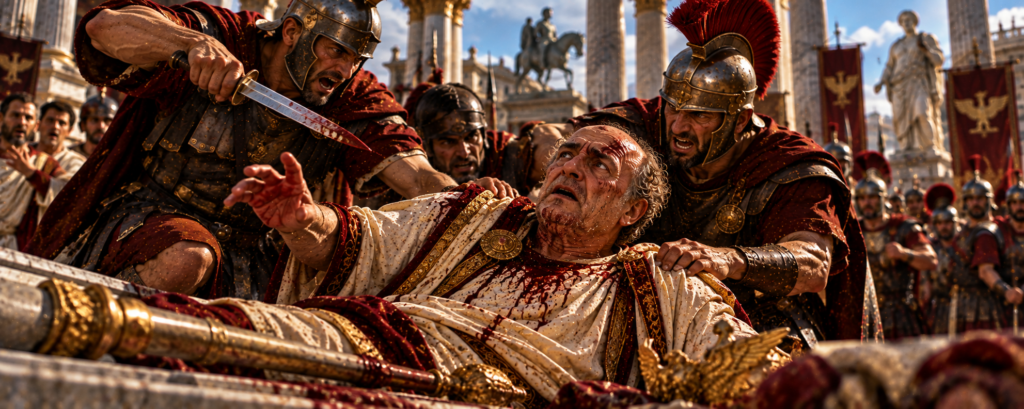
Galba: The Emperor Butchered in the Roman Forum and the Betrayal That Plunged Rome Into Civil War
Servius Sulpicius Galba (3 BCE–69 CE) | Roman Emperor, June 68–January 69 CE | Assassinated January 15, 69 CE
The Emperor Who Was Murdered in the Heart of Rome
On January 15, 69 CE, an elderly Roman emperor was carried through the streets of his capital toward a confrontation he did not fully understand. Servius Sulpicius Galba was seventy years old, had occupied the imperial throne for barely seven months, and was already losing control of the soldiers whose loyalty had made his reign possible. Rumors of rebellion were spreading through Rome, messengers brought contradictory reports, and the Praetorian Guard was abandoning the man it had sworn to protect. Somewhere inside the military camp, another emperor was being proclaimed, while Galba’s supporters desperately attempted to persuade themselves that the danger could still be contained.
The emperor had survived the murderous politics of Caligula, the intrigues of Claudius, and the increasingly violent reign of Nero. He had governed provinces, commanded armies, and accumulated a reputation for discipline and severity during a political career spanning decades. His distinguished ancestry and administrative experience had made him an attractive alternative when Nero’s government collapsed in 68 CE. Yet the qualities that had helped Galba survive earlier emperors were proving disastrous now that he occupied the throne himself.
Galba believed that Rome needed discipline after years of extravagance, corruption, and imperial excess. He intended to restore financial responsibility, punish abuses, and demonstrate that the emperor’s authority could not simply be purchased with promises of money. Unfortunately, the soldiers protecting him had been promised a substantial reward for supporting his accession, and they expected him to honor that promise. Galba refused, turning what might have been a manageable financial dispute into a crisis of military loyalty.
The final rupture came when Galba selected Lucius Calpurnius Piso Licinianus as his adopted son and intended successor. Marcus Salvius Otho, a former associate of Nero who had supported Galba’s rebellion, had expected the position for himself. Otho was ambitious, deeply indebted, and unwilling to watch another man inherit the empire he believed he had helped secure. Within days, he began turning the resentment of the Praetorian Guard into a conspiracy.
On the morning of January 15, Otho slipped away from Galba’s presence and made his way toward the Praetorian camp. Soldiers greeted him as emperor, and armed men began moving through Rome to eliminate Galba and his chosen heir. The reigning emperor received confused information about what was happening, including a false report that Otho had been killed. Instead of remaining securely inside the palace, Galba ventured toward the Roman Forum.
There, in the political and ceremonial heart of the empire, soldiers attacked him. Ancient accounts disagree about his final words and the precise sequence of blows, but they agree that the emperor was abandoned by most of those around him. His litter was overturned or brought to a halt, armed men closed in, and Galba was killed in public. His severed head was carried away as a trophy, while the soldiers who had sworn to defend him celebrated the arrival of another ruler.
The assassination was shocking not simply because an emperor had been murdered, but because of where and how it happened. Caligula had been killed inside the imperial palace complex, where conspirators could exploit secluded passages and familiar security arrangements. Galba was butchered in the Roman Forum, before witnesses, by soldiers whose loyalty had shifted to a rival claimant. The empire’s most powerful office had become something armed men could transfer through murder in the middle of the capital.
Galba’s death marked a decisive moment in the Year of the Four Emperors, the violent struggle that followed the collapse of Nero’s dynasty. His successor Otho would rule for only a few months before being defeated by Vitellius, who would himself be overthrown by Vespasian. The Roman world would discover that the emperor did not necessarily have to come from Augustus’s family, inherit the throne peacefully, or even possess the support of the Senate. He needed soldiers willing to fight for him, and Galba had learned that lesson too late.
An Aristocrat Born Into Rome’s Oldest Political Traditions
Servius Sulpicius Galba was born on December 24, 3 BCE, into one of Rome’s distinguished aristocratic families. The Sulpicii possessed a long history of republican officeholding, and Galba’s ancestry connected him to a political world older than the imperial system itself. His family name carried prestige, but prestige alone did not guarantee survival under the emperors. The early Roman Empire was filled with noble families whose distinguished ancestry made them valuable servants and potential threats to the ruling dynasty.
Galba grew up during the reign of Augustus, when Rome was adjusting to a political system that preserved republican institutions while concentrating real authority in the hands of one man. The Senate continued to meet, magistrates held traditional offices, and aristocratic families competed for honor and advancement. Yet the emperor controlled the military power upon which the entire arrangement depended. Successful senators needed to demonstrate loyalty while avoiding the appearance of excessive personal ambition.
Ancient writers portray Galba as a man whose character reflected traditional Roman aristocratic values. He was associated with seriousness, discipline, financial restraint, and respect for established customs. These qualities could be admired in a governor or military commander, particularly when contrasted with the extravagance of unpopular emperors. They could also become liabilities when applied without flexibility to the dangerous politics of imperial succession.
Suetonius preserves stories concerning Galba’s childhood and the attention he received from members of the imperial household. According to one tradition, Augustus noticed him while he was still young and made a prediction about his future importance. Another story associated Tiberius with an awareness that Galba might someday attain supreme power. Such anecdotes were recorded after Galba had become emperor and should be treated as retrospective stories rather than reliable prophecies.
His early career nevertheless demonstrated that he possessed the connections and abilities required for advancement. He held prestigious offices and developed relationships with influential figures. He also acquired experience in provincial administration and military command. Unlike Nero, who had inherited imperial authority while still a teenager, Galba spent decades learning how Roman government operated.
This experience helped create his reputation as a competent administrator. It also encouraged a belief that discipline and obedience could be maintained through firmness rather than popularity. As a provincial governor, Galba could rely upon established chains of command and the authority delegated by the emperor. As emperor himself, he would discover that those arrangements became far less reliable when soldiers began deciding who should occupy the throne.
The Man Who Survived Caligula, Claudius, and Nero
Galba’s political career unfolded under emperors whose reigns were marked by suspicion, intrigue, and sudden changes of fortune. He held the consulship in 33 CE during the reign of Tiberius, placing him among Rome’s highest-ranking aristocrats. He later served in military and provincial positions under Caligula and Claudius. His ability to survive successive administrations suggests political caution as well as competence.
Under Caligula, Galba commanded forces in Upper Germany. The emperor’s reign became associated with conflicts involving military officers and aristocrats, and several prominent figures lost their positions or their lives. Galba nevertheless retained his standing. His reputation for military discipline appears to have strengthened during this period.
Ancient accounts describe him enforcing strict standards among soldiers. He reportedly demanded rigorous training and punished breaches of discipline. Such measures were consistent with traditional Roman ideals of military command. A successful general was expected to maintain order, prevent indiscipline, and demonstrate personal authority.
Galba later governed Africa, where his administration acquired a reputation for severity. Suetonius preserves anecdotes illustrating his willingness to impose harsh punishments and investigate wrongdoing. Some stories may have been exaggerated to emphasize his character, but they reflect a consistent tradition. Galba was remembered as a man who believed authority should be exercised firmly.
His relationship with Claudius appears to have remained sufficiently favorable for continued advancement. Under Nero, however, the political environment became increasingly dangerous. Prominent senators and generals could be destroyed by accusations of conspiracy, while the emperor’s personal relationships influenced appointments and punishments. Galba survived by maintaining a careful distance from the most dangerous struggles at court.
In 60 CE, he became governor of Hispania Tarraconensis, a major province in northeastern and central Spain. The appointment placed him far from Rome and gave him authority over provincial administration and military resources. He remained there for approximately eight years. That distance eventually became crucial to his survival and rise.
By the later 60s, Galba was an elderly governor with a distinguished career behind him. He had served the imperial system for decades without openly challenging it. Yet Nero’s increasingly unstable government would transform him from a provincial official into a candidate for supreme power. The man who had survived by avoiding imperial suspicion would soon become the leader of a rebellion.
Nero’s Empire Begins to Collapse
Nero’s reign had begun in 54 CE under circumstances that initially encouraged optimism. Over time, however, his government became associated with political executions, court scandals, financial pressures, and growing tensions with the senatorial aristocracy. His artistic ambitions and public performances attracted criticism from elite writers who regarded such behavior as incompatible with imperial dignity. More importantly, his relationship with important military and political figures deteriorated.
The execution of prominent senators and the suppression of conspiracies created widespread fear. The Pisonian conspiracy of 65 CE had demonstrated that opposition existed within Rome’s ruling class. Nero responded with executions and forced suicides that included the philosopher Seneca and the poet Lucan. The atmosphere of suspicion made political survival increasingly uncertain.
Financial difficulties also complicated Nero’s position. His ambitious construction projects, public entertainments, and expenditures placed demands upon imperial resources. Ancient writers emphasized his extravagance, although their accounts were shaped by hostility toward his personal behavior. Nevertheless, fiscal pressure contributed to resentment in parts of the empire.
The decisive crisis began in Gaul in 68 CE. Gaius Julius Vindex, governor of Gallia Lugdunensis, organized a rebellion against Nero. Vindex lacked sufficient military strength to challenge the emperor alone and sought support from other provincial commanders. He approached Galba, whose reputation and position made him a plausible alternative.
Galba initially hesitated. Supporting rebellion against a reigning emperor was an extraordinarily dangerous decision, particularly for a man whose career had depended upon caution. If Nero survived, Galba could expect severe punishment. Yet refusing to act might also leave him exposed if the rebellion spread.
Ancient sources suggest that Galba became convinced Nero intended to destroy him. Whether this fear reflected accurate intelligence or the atmosphere of suspicion is difficult to establish. What matters is that Galba eventually abandoned his loyalty to Nero. In April 68 CE, he openly aligned himself with the movement against the emperor.
The rebellion did not immediately guarantee success. Vindex was defeated by forces associated with the Rhine armies, and he died during the conflict. Galba’s position became precarious, particularly because he did not possess overwhelming military strength. His survival depended upon developments in Rome and the willingness of other commanders to abandon Nero.
Those developments came rapidly. Nero’s support collapsed, and the Praetorian Guard withdrew its loyalty. The emperor fled and died by suicide in June 68 CE. Galba, who had begun as a provincial rebel facing enormous danger, suddenly found himself recognized as Rome’s new ruler.
The Praetorian Promise That Would Destroy Galba
The Praetorian Guard played a decisive role in Nero’s downfall. Its soldiers protected the emperor and possessed immediate military influence in Rome. When their loyalty shifted, Nero’s position became impossible to sustain. The same institution would soon determine Galba’s fate.
The Praetorian prefect Nymphidius Sabinus helped persuade the Guard to abandon Nero. Ancient accounts describe him promising substantial financial rewards in connection with Galba’s accession. The precise amount varied in the surviving tradition, but the soldiers clearly expected a generous payment. Their support was therefore tied partly to financial expectations.
Galba had not necessarily authorized every promise made on his behalf. This distinction became important because he later refused to provide the expected reward. From his perspective, he may have regarded the arrangement as an attempt to purchase military obedience. From the soldiers’ perspective, they had helped create a new emperor and expected compensation.
The disagreement reflected a fundamental weakness in the imperial system. Roman soldiers swore loyalty to the emperor, but their practical allegiance could depend upon rewards, promotions, and confidence in their commander. A ruler who ignored those expectations risked losing the armed support upon which his authority depended. Galba’s traditional insistence upon discipline did not eliminate the problem.
Nymphidius himself became a threat before Galba reached Rome. Encouraged by his influence over the Guard, he attempted to seize power. His effort failed, and he was killed by soldiers who refused to support his ambitions. The episode demonstrated how unstable the situation remained after Nero’s death.
Galba’s supporters eliminated Nymphidius and other individuals associated with the previous regime. These actions helped secure the new emperor’s position but also created resentment. Men who had expected rewards for abandoning Nero instead witnessed purges and uncertainty. The transition was already becoming violent.
Galba’s refusal to pay the promised donative became one of the most famous explanations for his downfall. Ancient writers attributed to him a statement that he selected soldiers rather than bought them. The exact wording may have been polished by later authors, but it captures the principle associated with his decision. Galba intended to govern through authority and discipline, while the soldiers expected money.
The conflict was more than a dispute over generosity. It exposed different understandings of the imperial relationship. Galba believed the army should obey the legitimate ruler because obedience was its duty. Many soldiers believed their loyalty deserved tangible recognition. The resulting resentment would provide Otho with the opportunity he needed.
A New Emperor Arrives in a City Already Afraid of Him
Galba’s journey toward Rome was marked by tension and violence. He approached the capital as the recognized successor to Nero, but his authority was not universally welcomed. Different military units had supported different political factions during the crisis. Some feared punishment for their previous loyalties.
One particularly notorious episode involved troops associated with Nero’s newly organized marine legion. Ancient sources describe a confrontation in which Galba’s forces attacked men seeking recognition or confirmation of their military status. The resulting deaths became an early stain upon his reign. The precise circumstances remain disputed, but the violence contributed to his reputation for severity.
The incident mattered because Galba needed to establish trust among soldiers who had recently experienced a dangerous change of government. Instead, his arrival became associated with bloodshed. Men who expected reconciliation could interpret the killings as evidence that the new emperor intended to rule through punishment. Fear began replacing the optimism that had accompanied Nero’s fall.
Galba also inherited a court filled with officials, freedmen, and political associates whose interests did not always align. His advanced age created uncertainty about the future. He had no direct surviving son prepared to succeed him. The question of succession therefore remained unresolved from the beginning.
Ancient writers describe Galba relying heavily upon a small circle of advisers. Three figures became particularly notorious: Titus Vinius, Cornelius Laco, and the freedman Icelus. Their influence attracted resentment and accusations of corruption. Some allegations may reflect hostile traditions developed after Galba’s death, but the perception of favoritism was politically damaging.
Vinius had held important military and administrative positions, while Laco became Praetorian prefect. Icelus enjoyed extraordinary access to the emperor as a trusted freedman. Their prominence encouraged the impression that Galba was difficult to approach without their assistance. Critics claimed that his advisers manipulated appointments and decisions.
The emperor’s personal severity combined badly with the alleged greed of his associates. Galba could refuse financial rewards to soldiers while men around him appeared to enrich themselves. Whether every accusation was justified mattered less than the resulting loss of confidence. The new regime began looking both harsh and hypocritical.
By the end of 68 CE, Galba had alienated important groups whose support he desperately needed. The Praetorians resented the unpaid donative, sections of the army questioned his leadership, and senators feared the influence of his advisers. The emperor remained legally supreme, but the foundations of his power were weakening. His greatest danger was that he did not fully recognize how quickly those foundations could collapse.
The Three Advisers Who Became Symbols of Corruption
Titus Vinius, Cornelius Laco, and Icelus became central figures in hostile accounts of Galba’s administration. Tacitus presents them as men whose influence damaged the emperor’s reputation and encouraged political instability. Their interests and personalities differed, but they were commonly blamed for decisions that alienated important supporters. Galba’s dependence upon them became one of the most persistent criticisms of his reign.
Titus Vinius possessed military experience and political ambition. He had supported Galba during the rebellion against Nero and expected influence under the new government. Ancient sources portray him as opportunistic and interested in personal advancement. His relationship with Otho would become especially important during the succession crisis.
Cornelius Laco served as Praetorian prefect. His responsibility was to command the very soldiers whose loyalty was becoming increasingly uncertain. Tacitus depicts him as ineffective and unable to recognize danger. Such judgments may reflect hindsight, but his failure to secure the Guard was undeniable.
Icelus occupied a different position as a freedman close to Galba. Imperial freedmen could exercise substantial influence because they controlled access to the emperor and managed important administrative responsibilities. Their prominence often provoked resentment among senators who regarded them as socially inferior. Icelus became a convenient target for criticism of the new regime.
The accusations against these advisers were not necessarily consistent. Some writers portrayed Galba as excessively severe, while others suggested that he allowed corrupt associates to exploit his authority. The combination was politically devastating. It implied that the emperor punished ordinary people while powerful favorites escaped restraint.
The problem was particularly serious because Galba had presented himself as an alternative to Nero’s extravagant and corrupt government. His legitimacy depended partly upon restoring responsible administration. If his advisers appeared greedy or incompetent, the moral contrast with Nero weakened. The new emperor risked losing the very reputation that had helped bring him to power.
These tensions also encouraged political intrigue. Men seeking office or influence could attempt to cultivate the advisers rather than Galba himself. Rival factions developed around expectations of succession. The emperor’s age made those calculations increasingly urgent.
The three advisers would not survive the political disaster they helped create. Their influence could not protect Galba once the soldiers abandoned him. In the aftermath of the assassination, members of his inner circle were killed or removed. Their fate demonstrated how quickly access to imperial power could become a liability.
The Emperor Who Tried to Save Money and Lost an Empire
Galba inherited financial difficulties after Nero’s reign. Ancient sources describe him attempting to recover gifts and expenditures made by his predecessor. The policy was intended to restore imperial resources and demonstrate fiscal responsibility. Yet recovering money from people who had already received it created immediate resentment.
Suetonius reports that Galba ordered the recovery of substantial portions of Nero’s gifts. Officials were sent to investigate recipients and reclaim funds. The process could become humiliating and financially damaging for individuals who had relied upon imperial generosity. It also provided opportunities for accusations of corruption and arbitrary enforcement.
Galba’s reputation for stinginess became increasingly prominent. Ancient writers preserved stories of small rewards and severe financial judgments. Some anecdotes may have been exaggerated to create a memorable portrait of an elderly miser. Nevertheless, the emperor’s unwillingness to spend freely was politically significant.
Roman emperors were expected to display generosity. Public distributions, military donatives, games, and rewards helped maintain relationships with soldiers and citizens. Such spending was not merely personal extravagance. It formed part of the political system through which imperial loyalty was cultivated.
Galba’s attempt to reverse that expectation was dangerous. He treated financial restraint as a virtue, while many supporters interpreted it as ingratitude. Soldiers who had abandoned Nero expected rewards for their risk. Instead, they encountered an emperor who insisted that obedience should not require payment.
The resulting resentment was especially strong among the Praetorians. Their proximity to Rome made them politically influential, and their loyalty had already helped determine the succession. Refusing their expected reward weakened the emperor’s immediate security. Galba could not compensate for that weakness simply by invoking traditional discipline.
His fiscal policies also alienated civilians. Recovering Nero’s gifts affected influential individuals and networks of patronage. People who might otherwise have accepted the new government became hostile. The emperor’s efforts to restore financial order therefore created additional political instability.
Galba’s mistake was not necessarily that he valued responsible government. The problem was that he failed to balance financial discipline with the realities of military and political loyalty. He attempted to impose austerity during a dangerous transition when his authority remained insecure. His refusal to purchase support became one of the conditions that allowed another man to purchase it instead.
The Rhine Legions Refuse to Obey
While Galba struggled to secure Rome, another crisis developed along the Rhine frontier. The legions stationed in Germany possessed substantial military strength and had played an important role in the events surrounding Nero’s fall. Their commanders and soldiers were sensitive to questions of honor, rewards, and political recognition. Galba’s treatment of them created additional resentment.
The Rhine armies had experienced tensions connected with the rebellion of Vindex. Some units had fought against Vindex while others supported the broader movement against Nero. Their actions did not fit neatly into the political settlement that brought Galba to power. Soldiers who believed they had served Rome faithfully could resent being treated with suspicion.
Galba replaced certain commanders and attempted to establish control over the frontier forces. These decisions may have been intended to prevent rebellion, but they also disrupted established loyalties. Military units could interpret changes in command as punishment or distrust. The emperor’s reputation for severity made such fears more powerful.
On January 1, 69 CE, troops in Upper Germany refused to renew their oath of loyalty to Galba. This was an extraordinary act because the annual oath represented a formal acknowledgment of imperial authority. Refusing it signaled that the soldiers no longer accepted the reigning emperor. The rebellion threatened the entire political settlement established after Nero’s death.
The armies in Lower Germany soon proclaimed Aulus Vitellius emperor. Vitellius had recently been appointed governor of the province and possessed a distinguished family background. He had not necessarily arrived intending to seize the throne, but the soldiers’ support transformed him into a rival claimant. The empire now faced the prospect of civil war.
Galba received news of the German rebellion while his own position in Rome remained insecure. The crisis demonstrated that his problems extended far beyond the Praetorian Guard. Powerful provincial armies were prepared to choose another emperor. His authority was collapsing on multiple fronts.
The rebellion also changed the political calculations of men around him. An elderly emperor facing hostile legions needed a secure successor and reliable supporters. Galba believed adoption could strengthen his position. Yet the choice he made would alienate the man most determined to inherit his power.
The Rhine revolt therefore became the immediate background to the assassination. Galba needed to restore confidence and demonstrate continuity. Instead, his response helped trigger a second rebellion inside Rome itself. The emperor was caught between provincial armies demanding a new ruler and Praetorians willing to support another claimant.
Otho: The Man Who Believed the Throne Belonged to Him
Marcus Salvius Otho had been closely associated with Nero during his younger years. Ancient writers portrayed him as extravagant, ambitious, and deeply involved in the social world of the imperial court. His relationship with Poppaea Sabina, who later became Nero’s wife, contributed to his eventual removal from Rome. The precise circumstances of their marriage and Nero’s involvement remain disputed.
Otho was sent to govern Lusitania, a province in western Iberia. Despite his earlier reputation, ancient sources suggest that he administered the province with considerable competence. His years away from Rome gave him political experience and a degree of independence. They also placed him near Galba when the rebellion against Nero began.
Otho supported Galba early in the uprising. His decision was politically significant because Galba needed allies and resources. Otho may have genuinely opposed Nero, but he also recognized the opportunity created by imperial instability. Supporting Galba could position him for future advancement.
His hopes centered upon succession. Galba was elderly and lacked a direct surviving heir. Otho believed that his loyalty and assistance made him an obvious candidate for adoption. Ancient accounts describe him cultivating soldiers and political supporters while anticipating the emperor’s decision.
Otho’s financial position added urgency to his ambition. Suetonius portrays him as burdened by substantial debts and convinced that imperial power offered his only escape. The account may exaggerate his desperation, but his financial difficulties appear to have been significant. The throne promised wealth, authority, and protection from creditors.
He also understood the resentment of the Praetorian Guard. Unlike Galba, Otho was willing to offer rewards and cultivate personal loyalty. Suetonius describes him giving money to soldiers and building relationships among the men responsible for imperial security. These efforts prepared the ground for rebellion.
Otho’s ambition became dangerous because it combined personal grievance with military opportunity. He had supported Galba, expected to inherit his position, and cultivated the soldiers who could determine the succession. If Galba chose another heir, Otho possessed both motive and means to retaliate. The emperor was about to make precisely that decision.
Piso: The Heir Who Was Chosen Instead
On January 10, 69 CE, Galba adopted Lucius Calpurnius Piso Licinianus as his son and intended successor. Piso belonged to a distinguished aristocratic family and possessed a reputation for seriousness and traditional virtue. His selection reflected Galba’s desire to establish a respectable succession rather than reward the ambitions of Otho. The decision was intended to strengthen the government during a period of military rebellion.
Piso had endured political danger under Nero. His family connections placed him within the aristocratic world that had suffered during earlier imperial purges. He was therefore an attractive candidate for those who valued noble ancestry and personal restraint. Galba apparently believed that Piso represented the qualities required for stable government.
The adoption was announced amid growing military uncertainty. Galba needed to reassure supporters that the empire would not collapse upon his death. Selecting a younger heir could provide continuity and discourage rival claimants. Yet the decision also required careful management of disappointed expectations.
Otho was devastated or enraged by the choice. Ancient sources describe him believing that Galba had betrayed the loyalty he had demonstrated during the rebellion against Nero. His financial difficulties and political ambitions made the disappointment especially severe. He now faced the possibility of permanent exclusion from imperial power.
The Praetorian Guard also reacted without enthusiasm. Piso had not cultivated the soldiers in the way Otho had, and Galba did not accompany the adoption with the generous payment many expected. The announcement therefore failed to resolve the military loyalty problem. It may even have intensified resentment.
Tacitus presents Galba’s choice as morally serious but politically disastrous. The emperor preferred a man he considered worthy rather than one who had made himself popular through gifts and promises. Yet the decision ignored the practical realities of the moment. A successor without military support could become a target rather than a source of stability.
Piso’s personal character offered little protection. He had not organized a conspiracy or attempted to seize power. His danger came from being chosen by Galba. Within five days of his adoption, he would be hunted down and murdered.
The adoption became the immediate trigger for Otho’s rebellion. Galba had attempted to secure the future of the empire through a traditional aristocratic arrangement. Instead, he gave his most ambitious supporter a reason to act before the opportunity disappeared. The decision transformed resentment into a deadly conspiracy.
Five Days Between Adoption and Murder
The five days following Piso’s adoption were filled with political maneuvering. Otho recognized that his hopes of peaceful succession had ended. He could either accept exclusion or attempt to seize the throne by force. His debts, ambitions, and connections with the Praetorian Guard made the second option increasingly attractive.
Ancient sources describe Otho organizing a conspiracy among soldiers. Suetonius reports that the initial group was relatively small, with participants recruiting additional supporters. Money and promises played an important role. The conspirators believed that wider military support would follow once the rebellion began.
The plan depended upon speed. Galba still occupied the palace and possessed formal imperial authority. If he discovered the conspiracy early, Otho could be arrested or executed. The conspirators therefore needed to secure the Praetorian camp before loyal officers could respond.
Otho’s personal access to Galba created an opportunity. He could appear at court without attracting suspicion because he remained a prominent supporter of the emperor. The conspiracy therefore resembled other Roman political murders in which apparent loyalty concealed deadly intentions. Galba’s confidence in familiar associates made him vulnerable.
The conspirators also understood the importance of the Praetorian Guard’s resentment. Soldiers who had been denied their expected reward were more likely to welcome a claimant promising generosity. Otho had already cultivated relationships among them. The financial dispute that Galba refused to resolve became the foundation of his rival’s support.
The rebellion was not guaranteed to succeed. Some soldiers remained loyal to Galba, and the wider political reaction was uncertain. Otho needed to create the impression that his accession was already inevitable. Once armed men proclaimed him emperor, hesitation among others might collapse.
The conspirators selected January 15 for their action. The date came only five days after Piso’s adoption and barely two weeks after the Rhine armies had rejected Galba. The empire was already facing rebellion in Germany. Otho intended to turn that crisis into an opportunity for himself.
January 15, 69 CE: Otho Walks Away From Galba
On the morning of January 15, Galba was engaged in religious observances and ordinary imperial business. Ancient accounts describe sacrifices and unfavorable omens, details that later writers used to heighten the tragedy. Otho was present with the emperor and behaved as though nothing unusual was happening. The conspiracy depended upon maintaining that appearance until the final moment.
Suetonius describes Otho receiving a prearranged message that served as the signal to depart. He excused himself under a plausible pretext and left Galba’s presence. Some accounts describe him moving through a rear entrance and traveling toward the appointed meeting place. The exact details vary, but his departure marked the beginning of the coup.
A small group of soldiers met Otho near the Forum. They greeted him as emperor and began escorting him toward the Praetorian camp. The number of initial supporters was limited, making the moment extraordinarily dangerous. If loyal forces intervened, the rebellion might have ended immediately.
Instead, the demonstration gathered momentum. Soldiers and supporters joined the procession, and Otho was carried toward the camp. The sight of armed men proclaiming a new emperor created the impression that the balance of power had already shifted. Political uncertainty began turning into military allegiance.
Inside the Praetorian camp, Otho received the support he needed. The soldiers acclaimed him emperor and prepared to defend his claim. Their decision represented a direct betrayal of Galba. The Guard that should have protected the reigning emperor had become the instrument of his overthrow.
Otho’s supporters then moved to eliminate Galba and Piso. The conspiracy was no longer merely a demonstration of military dissatisfaction. It had become a struggle in which the survival of the old emperor threatened the legitimacy of the new one. Murder offered the fastest solution.
The speed of events left Galba struggling to understand what was happening. Reports arrived from different directions, and his advisers disagreed about how to respond. Some urged caution, while others believed that a public appearance could restore confidence. The emperor faced the most dangerous decision of his reign.
The False Report That Lured Galba Toward Death
As news of Otho’s rebellion spread, Galba received conflicting reports about the situation. Ancient sources describe messengers bringing claims that the Praetorian Guard had defected, that Otho had been proclaimed emperor, and that the rebellion might already have failed. The confusion made it difficult to determine which forces remained loyal. Galba’s advisers offered competing recommendations.
One report claimed that Otho had been killed. According to Tacitus and other ancient writers, a soldier appeared with a bloodied sword and announced that he had eliminated the rival claimant. The story is dramatic and cannot be verified in every detail. Nevertheless, it reflects the misinformation surrounding the coup.
Galba reportedly questioned the soldier about who had ordered the killing. Ancient authors preserved different versions of his response, emphasizing either his concern for military discipline or his inability to grasp the danger. The precise words are uncertain. What matters is that the false report contributed to confusion about whether the rebellion had ended.
Some advisers urged Galba to remain within the palace. They believed that he should avoid exposing himself until loyal forces could be identified. Others argued that a public appearance would demonstrate confidence and rally support. The emperor had to choose between security and visible authority.
Galba eventually decided to move toward the Forum. He may have believed that Otho was dead or that the rebellion could still be contained. His presence in the city center could also allow him to communicate with senators and supporters. The decision proved fatal.
The emperor was carried in a litter because of his age and physical condition. His movement through the streets attracted attention, but the crowd did not necessarily represent reliable support. Soldiers were already changing allegiance. The imperial procession was moving into a city whose military control had become uncertain.
The tragedy lies partly in Galba’s misunderstanding of his position. He still possessed the titles and symbols of supreme authority. Yet those symbols could not protect him once the armed forces withdrew their loyalty. The emperor approached the Forum believing that his presence might restore order, while the soldiers sent to kill him were already moving toward their target.
The Roman Forum Becomes an Execution Ground
The Roman Forum was the ceremonial and political heart of the city. Its temples, monuments, and public spaces embodied centuries of Roman history. Triumphs, speeches, legal proceedings, and political gatherings had taken place there. On January 15, 69 CE, it became the scene of an emperor’s murder.
Galba entered the Forum in his litter, surrounded by a dwindling or uncertain escort. Ancient accounts describe soldiers approaching with weapons drawn. The emperor’s supporters began abandoning him as the danger became unmistakable. The procession that should have demonstrated imperial dignity turned into a scene of panic.
Tacitus places the attack near the Lacus Curtius, a landmark within the Forum. Suetonius and Plutarch preserve related accounts, although they differ over individual details. The soldiers moved toward Galba, and his litter was overturned or brought down. The elderly emperor was exposed to the attackers.
Galba’s final response became the subject of conflicting traditions. Some accounts portray him offering his neck to the soldiers and urging them to strike if his death served Rome. Others describe him pleading for a short delay or asking what wrong he had committed. These versions reflect different attempts to interpret his character after death.
The attackers did not spare him. Soldiers struck the emperor with swords and other weapons, killing him in public. The violence was not a formal execution ordered by a court or Senate. It was a military assassination carried out by men acting for a rival claimant.
The crowd’s behavior became part of the horror. Ancient writers describe bystanders fleeing, watching, or failing to intervene. The Forum was filled with people, but numbers did not translate into protection. Armed soldiers possessed the immediate power to determine events.
Galba’s death was especially humiliating because of his age and position. He had spent decades serving Rome and had occupied its highest offices. Yet he was killed in the open by men whose loyalty had shifted within hours. His distinguished ancestry and imperial titles offered no defense.
The murder demonstrated how completely military power had overtaken traditional political authority. The Senate had recognized Galba, and he remained the legitimate emperor until his death. Yet soldiers had already proclaimed Otho and were willing to kill the reigning ruler to secure the succession. The Forum witnessed the triumph of armed force over constitutional appearance.
Sempronius Densus: The Soldier Who Refused to Run
Amid the abandonment and confusion, ancient sources preserve the name of a soldier who attempted to resist the assassins. Sempronius Densus is remembered as a centurion who confronted the attackers rather than surrender his duty. His role is described differently by the surviving authors, including disagreement over whether he was specifically guarding Galba or Piso. Nevertheless, the tradition consistently presents him as an exceptional figure of loyalty.
Cassius Dio describes Densus defending Galba and dying in the attempt. Other accounts associate his resistance with the protection of Piso, who was also threatened by the coup. The differences prevent complete certainty about his precise assignment. They do not diminish the significance of the episode.
Densus reportedly confronted armed soldiers despite being heavily outnumbered. His resistance could not reverse the coup, but it delayed the attackers and demonstrated that not every member of the military had abandoned the old regime. The scene became a striking contrast with the behavior of soldiers who changed allegiance. One man attempted to fulfill his duty while others participated in murder.
Ancient historians were drawn to such examples because they illustrated moral choices within political catastrophe. The courage of an individual could be contrasted with the cowardice or treachery of a crowd. Densus became a symbol of professional loyalty in a world where military obedience had become negotiable. His actions were remembered precisely because they were unusual.
The episode also reveals the practical limits of personal bravery. A single centurion could not overcome a coordinated military coup. The assassins possessed numbers, weapons, and the momentum of rebellion. Densus’s resistance could delay violence but not prevent the transfer of power.
His death or defeat became part of the larger tragedy of Galba’s fall. The emperor had lost the loyalty of an institution, not merely a few individual soldiers. One courageous defender could not compensate for that collapse. The assassination succeeded because the military balance had already shifted.
The preservation of Densus’s name is significant. Many soldiers participated in the violence, but most remain anonymous in the historical record. Densus was remembered because he refused to join them. His story offers a rare example of loyalty amid the betrayals that defined January 69 CE.
Galba’s Final Words: Courage, Confusion, or Desperation?
Ancient historians disagreed about what Galba said when the assassins approached. Suetonius records traditions portraying him either as courageous or as pleading for time. Tacitus also preserves conflicting accounts of his final behavior. The variations reflect the difficulty of reconstructing a chaotic public murder.
One tradition depicts Galba offering his throat and inviting the soldiers to strike if they believed his death would benefit Rome. The scene presents him as a stern Roman aristocrat who accepted death with dignity. It fits the image of a man who valued discipline and public duty. Yet the precise wording cannot be established.
Another tradition describes him asking what wrong he had done or pleading for a brief delay. Such accounts portray a frightened elderly man suddenly confronted by armed soldiers. They may have been intended to undermine his reputation for courage. They also reflect the possibility that he did not fully understand why his own guards had turned against him.
The differences are important because Galba’s final words became part of the struggle over his memory. Admirers could present him as a principled ruler betrayed by corrupt soldiers. Critics could portray him as an incompetent emperor who failed to recognize danger until it was too late. Each interpretation found support in selected anecdotes.
The physical circumstances make certainty impossible. Galba was elderly, traveling in a litter, and surrounded by armed attackers. The assault occurred amid confusion and panic. Even witnesses might have heard different words or misunderstood what was said.
The ancient accounts nevertheless agree upon the central tragedy. Galba was abandoned by most of those who should have defended him. He was attacked by soldiers acting for another claimant. His death occurred in public, without the dignity or protection normally associated with imperial authority.
The uncertainty surrounding his final words should not obscure the significance of the event. Whether he met death bravely or desperately, Galba died because the soldiers had withdrawn their loyalty. His personal response could not alter that reality. The emperor’s fate had been decided before the first blow struck.
The Severed Head of an Emperor
The violence continued after Galba’s death. Ancient accounts describe his head being severed and carried away as proof that the emperor had been killed. The act transformed the body of Rome’s former ruler into a political trophy. It also demonstrated the brutality of the soldiers who had secured Otho’s accession.
Suetonius preserves particularly disturbing details about the treatment of the head. According to his account, soldiers carried it through the streets and eventually presented it to Otho. Some mocked the dead emperor, turning his physical appearance and reputation into objects of ridicule. The stories are shaped by the sensational interests of ancient biography, but the mutilation itself is well attested.
The display served a practical purpose. Otho needed confirmation that Galba could no longer challenge him. A dead emperor was less dangerous than a living rival whose supporters might regroup. The severed head provided unmistakable evidence that the transfer of power had been completed.
The treatment of Galba’s remains also reflected the collapse of political restraint. Roman culture placed importance upon funeral rites and the proper treatment of the dead. Yet civil conflict repeatedly produced mutilation and public displays of defeated enemies. Galba’s fate belonged to that tradition of political violence.
The emperor’s body was eventually recovered and buried. Ancient sources preserve details about the efforts of loyal associates or servants to provide funeral arrangements. The accounts differ, but they emphasize the contrast between his former dignity and the humiliation of his death. A man who had governed provinces and commanded armies required others to rescue his remains from the aftermath of murder.
The spectacle of the severed head became one of the most memorable images of the assassination. It demonstrated that imperial status offered no protection once military loyalty disappeared. The symbols of supreme authority could be stripped away within moments. Galba’s death reduced the emperor to a body that victorious soldiers could display and mock.
The incident also foreshadowed further violence during the Year of the Four Emperors. Rome would witness additional struggles in which defeated rulers were humiliated or killed. Galba’s murder was not an isolated eruption of brutality. It was the beginning of a wider demonstration that imperial power had become inseparable from civil war.
Piso’s Last Refuge and the Murder of the Chosen Heir
While Galba was being killed, his adopted heir Piso faced his own desperate struggle for survival. The young aristocrat had been selected only five days earlier to provide stability and continuity. His adoption had helped provoke Otho’s rebellion. Now the soldiers who supported Otho regarded him as a dangerous rival.
Ancient accounts describe Piso seeking refuge in the Temple of Vesta. The sanctuary was associated with one of Rome’s most sacred religious traditions and the maintenance of the city’s eternal flame. Seeking protection there reflected both desperation and the hope that religious sanctity might restrain the attackers. Yet the soldiers were determined to eliminate him.
Piso was discovered and dragged from his refuge. The details vary among Tacitus, Suetonius, and Plutarch, but the outcome is clear. He was killed by men acting for Otho. His brief position as heir to the empire ended in violence.
The murder was politically significant because Piso had not yet exercised imperial authority. He was killed for what he represented rather than for actions taken as ruler. His adoption made him a possible alternative to Otho. That possibility was enough to seal his fate.
Piso’s death also exposed the failure of Galba’s succession strategy. The emperor had chosen a man he believed worthy, hoping to secure the future. Instead, the adoption created a rival claimant who lacked sufficient military support. The attempt to stabilize the government helped destroy both ruler and heir.
The killing within or near a sacred sanctuary added another layer of horror. Roman religion traditionally recognized certain places as deserving special respect. Yet the soldiers’ determination overcame those restraints. Political necessity, as they understood it, outweighed religious scruple.
Piso’s death completed the immediate destruction of Galba’s regime. The emperor was dead, his heir eliminated, and his advisers scattered or killed. Otho could now claim that no legitimate rival remained in Rome. The coup had achieved its immediate objective through a series of murders.
Yet the removal of Galba and Piso did not resolve the larger crisis. Vitellius had already been proclaimed emperor by the Rhine armies. Otho’s victory in Rome therefore created another stage of civil war rather than lasting stability. The soldiers had killed one emperor only to discover that another claimant was approaching from the provinces.
Titus Vinius and the Destruction of Galba’s Inner Circle
Titus Vinius was among the prominent figures killed during the coup. As one of Galba’s closest advisers, he had been associated with the unpopular policies of the regime. Ancient sources also describe complicated relationships between Vinius and Otho. His position became increasingly dangerous as the conspiracy developed.
Some accounts suggest that Vinius had encouraged Galba to adopt Otho or had maintained friendly relations with him. Such connections did not protect him once the rebellion began. The soldiers involved in the coup were not necessarily interested in preserving every associate of the new emperor. Their immediate objective was to eliminate figures identified with Galba’s government.
Vinius was killed amid the violence surrounding the assassination. Ancient writers preserve conflicting details about his final moments and whether he attempted to invoke his relationship with Otho. The uncertainty reflects the confusion of the day. Political alliances that had seemed valuable only hours earlier became meaningless.
Cornelius Laco also fell from power. His failure to maintain Praetorian loyalty had been one of the decisive weaknesses of Galba’s government. Ancient accounts describe his removal and eventual death. The man responsible for protecting the emperor had been unable to prevent the Guard’s defection.
Icelus likewise lost the influence he had enjoyed under Galba. His position as a trusted freedman depended upon the emperor’s survival. Once Galba was dead, his access and authority vanished. The new regime had little reason to preserve a figure associated with the previous administration.
The destruction of Galba’s inner circle revealed the ruthless nature of imperial succession. Political office and personal favor could become liabilities when a ruler fell. Men who had exercised extraordinary influence were suddenly exposed to revenge. Their fate depended upon the decisions of soldiers and rivals rather than established legal procedures.
The killings also served Otho’s political interests. Eliminating prominent associates of Galba reduced the possibility of organized resistance. It allowed the new emperor to present the transfer of power as complete. Yet the violence created a dangerous precedent that would soon threaten Otho himself.
Galba’s government disappeared with remarkable speed. Within a single day, the emperor, his heir, and several leading supporters had been killed or removed. The administrative structure of the empire continued, but the individuals controlling it changed through murder. The coup demonstrated how fragile personal authority had become.
Otho Takes the Throne Over Galba’s Body
After Galba’s death, Otho moved quickly to secure recognition as emperor. The Praetorian Guard had already proclaimed him, giving him the military support necessary to control Rome. The Senate faced the reality that the reigning emperor had been murdered and his successor was backed by armed soldiers. Resistance would have required military resources it did not possess.
Otho appeared before the Senate and presented his accession in terms intended to legitimize the coup. Ancient sources describe him claiming that events had forced him into power. Such explanations were common among Roman rulers who had acquired authority through military intervention. They attempted to transform a violent seizure into an act of public necessity.
The Senate accepted Otho’s position. Its recognition gave constitutional form to a transfer of power already accomplished by soldiers. The process demonstrated the gap between republican institutions and imperial reality. The Senate could ratify events, but it had not controlled them.
Otho also sought popular support. Ancient writers describe him allowing the restoration of certain images and officials associated with Nero. His earlier connection with Nero may have helped him appeal to groups nostalgic for the previous emperor. He was willing to cultivate loyalties that Galba had alienated.
Yet Otho inherited a dangerous situation. The Rhine armies had already proclaimed Vitellius emperor. Their rebellion was not directed merely against Galba’s personal policies. They had committed themselves to another claimant and possessed the military strength to pursue his cause.
Otho therefore faced the same fundamental problem that had destroyed Galba. His authority depended upon military support, but powerful armies remained outside his control. The Praetorians could secure Rome, yet they could not guarantee victory against the Rhine legions. Civil war became increasingly likely.
The irony was immediate. Otho had murdered Galba because he believed the throne should belong to him. Within weeks, he would be fighting to defend that throne against another man whose soldiers had made the same calculation. The logic of military succession offered no stable endpoint.
Galba’s assassination therefore failed to create peace even for its principal beneficiary. Otho had secured the capital but not the empire. His reign began with bloodshed and moved rapidly toward battle. The Year of the Four Emperors was only beginning.
The Emperor Who Lasted Less Than Three Months
Otho’s reign lasted from January 15 to April 16, 69 CE. During those three months, he attempted to consolidate authority while preparing for war against Vitellius. The Rhine armies advanced toward Italy under experienced commanders. Their military strength posed a serious threat to the new emperor.
Otho possessed supporters among the Praetorian Guard and other forces, but his position remained uncertain. Some provincial armies were slow to declare allegiance, while others had already committed themselves to Vitellius. The conflict became a race to concentrate military strength. Political legitimacy mattered less than the outcome of battle.
The decisive confrontation occurred near Bedriacum in northern Italy. Otho’s forces suffered defeat in April 69 CE. The battle demonstrated the military superiority of the forces supporting Vitellius at that moment. Otho faced the prospect of continuing a destructive civil war.
Instead, he chose suicide. Ancient writers often contrasted his final decision with the violence of his accession. They portrayed him as willing to die rather than prolong Roman bloodshed. The sincerity and full motives of that decision remain uncertain, but his death ended his brief reign.
Otho’s suicide created another transfer of imperial authority. Vitellius became the dominant claimant, supported by the armies that had defeated Otho’s forces. Yet his victory would prove temporary. Another powerful commander was already emerging in the eastern provinces.
The speed of these events exposed the instability created by Nero’s death. Galba had ruled for approximately seven months, while Otho survived only three. Vitellius would also fail to establish a durable regime. The empire was being fought over by commanders whose claims depended upon military success.
Galba’s murder therefore became the first of several violent transfers of power during 69 CE. It demonstrated that an emperor could be removed by soldiers in the capital. Otho’s defeat showed that those soldiers could be overcome by provincial armies. The struggle would continue until one claimant secured overwhelming military superiority.
Vitellius and the Emperor Who Could Not Hold Rome
Aulus Vitellius had been proclaimed emperor by the Rhine armies before Galba was murdered. His supporters rejected Galba’s authority and expected their commander to replace him. The assassination in Rome therefore did not end their rebellion. It merely changed the identity of the rival they intended to defeat.
Vitellius’s forces entered Italy and defeated Otho’s army. Their victory brought him recognition as emperor, but his position depended upon military commanders and soldiers whose interests were not always aligned. Ancient writers portrayed his reign as extravagant and undisciplined. Some of those accounts were shaped by hostility from the regime that replaced him.
The soldiers supporting Vitellius expected rewards for their victories. Their demands placed pressure upon the government and created resentment among civilians. Military discipline deteriorated in some areas, and rival factions competed for influence. The problems that had undermined Galba continued under his successors.
Meanwhile, Vespasian emerged as another claimant. He commanded Roman forces involved in the Jewish War and possessed support among important eastern armies. His military experience and political connections made him a formidable rival. By the summer of 69 CE, the empire faced another struggle for supreme power.
Vespasian’s supporters advanced through the Balkans and northern Italy. Vitellius’s forces suffered defeat, and the conflict eventually reached Rome itself. Fighting broke out in the capital, causing destruction and panic. The political center of the empire again became a battlefield.
Vitellius was captured and killed in December 69 CE. Ancient accounts describe his final humiliation and death in terms that recall the treatment of Galba. Another emperor had fallen to soldiers in the streets of Rome. The cycle of military violence had reached its fourth ruler in a single year.
Vespasian eventually secured the throne and founded the Flavian dynasty. His victory brought greater stability after the chaos of 69 CE. Yet the events of the year had permanently demonstrated the military foundations of imperial power. Galba’s assassination had been an early and decisive revelation of that reality.
The Year Rome Learned That Armies Could Make Emperors
The Year of the Four Emperors marked a turning point in Roman imperial history. Nero’s death ended the Julio-Claudian dynasty, which had ruled since Augustus established the Principate. The absence of a clear dynastic successor created opportunities for provincial commanders. Military allegiance became the decisive factor in determining who would rule.
Galba’s accession had already demonstrated that an emperor could emerge from outside the ruling family. His rebellion began in Spain, far from Rome. He gained recognition because Nero’s support collapsed and important military forces accepted the change. The Senate followed the political reality created by soldiers.
His assassination revealed a second lesson. The emperor’s authority could be destroyed by the Praetorian Guard if its members transferred their loyalty. Galba possessed legal recognition and aristocratic prestige, but those advantages could not protect him. Armed men determined the succession through violence.
Otho’s brief reign demonstrated that control of Rome was insufficient. The Rhine armies had proclaimed Vitellius and were willing to fight for him. Their victory over Otho showed that provincial military strength could overcome the Praetorian Guard. The empire’s political center was no longer the only place where imperial power could be decided.
Vitellius’s defeat revealed the same principle again. Vespasian’s supporters controlled powerful armies in the east and along the Danube. Their victories allowed him to seize the throne despite Vitellius’s position in Rome. Military success created political legitimacy.
Tacitus famously emphasized the revelation that emperors could be made elsewhere than Rome. The phrase captures the central significance of 69 CE. Provincial armies had become kingmakers, and the Senate’s traditional authority was increasingly secondary. The empire’s stability depended upon managing military loyalties across vast territories.
The consequences would extend far beyond the first century. Later emperors would face rebellions, palace coups, and competing military proclamations. The Praetorian Guard would continue influencing succession, while frontier armies repeatedly elevated their commanders. Galba’s death belonged to the beginning of a recurring imperial problem.
The Year of the Four Emperors also demonstrated the human cost of military politics. Soldiers fought fellow Romans, cities suffered violence, and political rivals were murdered. The struggle for the throne consumed resources and lives across the empire. Galba’s assassination was not merely the death of one ruler but part of a wider collapse of political restraint.
Was Galba a Good Emperor Who Made Fatal Mistakes?
Galba’s historical reputation has often been shaped by the contrast between his personal character and political failure. Ancient writers acknowledged his administrative experience, seriousness, and traditional virtues. They also criticized his severity, financial restraint, and dependence upon advisers. The resulting portrait is of a man who possessed qualities suitable for government but lacked the flexibility required for imperial survival.
Tacitus offered one of the most influential judgments of Galba, suggesting that he appeared more capable of ruling before he actually became emperor. The observation captures the difference between reputation and performance. A provincial governor could be admired for discipline without facing the pressures of imperial succession. Galba discovered that governing the entire empire required different political skills.
His refusal to pay the Praetorian donative became the clearest example of that failure. From a moral perspective, refusing to purchase military loyalty could appear principled. From a practical perspective, it alienated the soldiers responsible for protecting him. The decision created an opportunity for a rival willing to offer money.
His choice of Piso was similarly complicated. Galba selected a man associated with traditional aristocratic virtue rather than rewarding Otho’s ambition. The decision may have reflected sincere concern for the empire’s future. Yet it ignored the immediate danger posed by a disappointed supporter with connections to the Praetorian Guard.
The emperor also failed to respond effectively to the Rhine rebellion. The refusal of German legions to renew their oath demonstrated that his authority was collapsing outside Rome. His adoption of Piso did not restore confidence. Instead, it intensified the succession crisis.
Galba’s advisers contributed to his difficulties. Whether they were as corrupt or incompetent as hostile writers claimed remains uncertain. Their influence nevertheless damaged the emperor’s reputation and encouraged resentment. A ruler who promised discipline appeared dependent upon men accused of exploiting their positions.
His age also mattered. Galba was seventy when he became emperor, making succession an immediate concern. He could not rely upon decades of future rule to establish a stable political settlement. Every ambitious associate understood that another transfer of power might occur soon. His vulnerability encouraged intrigue.
Galba’s failure therefore cannot be reduced to one mistake. His financial policies, military relationships, advisers, succession decision, and response to rebellion all contributed to the crisis. He inherited an unstable empire and made choices that deepened its instability. His assassination was the violent consequence of a political collapse already underway.
The Assassination as a Betrayal of Military Duty
Galba’s murder was especially disturbing because it was carried out by soldiers whose professional duty was to protect the emperor. The Praetorian Guard had helped secure his accession after Nero’s fall. Its members had sworn loyalty to him and received privileges associated with imperial service. Their decision to support Otho transformed the institution from protector into executioner.
The betrayal was not simply personal. It undermined the principle that military obedience should follow legitimate authority. Soldiers who could choose an emperor based upon promised rewards possessed enormous political power. Their decisions could determine the fate of the entire Roman world. Galba’s death demonstrated that the emperor’s position was vulnerable to collective military defection.
Otho exploited this weakness deliberately. He cultivated Praetorian support through gifts and promises, recognizing that financial expectations could outweigh formal loyalty. His conspiracy succeeded because the soldiers were already dissatisfied. The assassination was therefore both a political murder and a military transaction.
The killing of Piso extended the betrayal. The adopted heir represented Galba’s attempt to establish a legitimate succession. By murdering him, the soldiers eliminated the alternative around which loyalists might rally. Their violence ensured that Otho’s claim would face no immediate dynastic rival in Rome.
The treatment of Galba’s body revealed the depth of the collapse. Soldiers did not merely remove him from power. They mutilated his remains and displayed his head. The emperor’s dignity disappeared once his military support vanished.
The episode also exposed the weakness of senatorial authority. The Senate had recognized Galba and later accepted Otho. It did not control the armed men who determined the succession. Political legitimacy followed military victory rather than directing it.
Galba’s assassination became a warning to future emperors. They needed the loyalty of soldiers, particularly those closest to the palace. Financial rewards, promotions, personal relationships, and military prestige could all influence that loyalty. A ruler who ignored those realities risked sharing Galba’s fate.
Yet the lesson was dangerous because it encouraged emperors to compete for military favor. Generosity could secure loyalty temporarily, but it also raised expectations. Soldiers who helped make one emperor might believe they could replace him with another. Galba’s murder revealed a problem that no simple policy could permanently solve.
The Roman Forum and the Symbolism of a Public Murder
The location of Galba’s assassination gave it extraordinary symbolic power. The Roman Forum had been the center of republican political life for centuries. Its temples, monuments, and public spaces represented Rome’s collective history. Killing an emperor there transformed the city’s most prestigious political setting into a place of military violence.
The contrast with Caligula’s assassination was striking. Caligula had been killed in a palace passageway by officers who exploited his private movements. Galba was attacked openly in the Forum, where citizens could witness the collapse of imperial authority. The violence was public and unmistakable.
The Forum had seen political bloodshed before. The late Republic witnessed riots, assassinations, and struggles involving armed factions. The deaths of political leaders had repeatedly demonstrated the fragility of constitutional government. Galba’s murder continued that tradition under the imperial system.
Yet the imperial context made the event distinctive. Galba was not merely a senator or magistrate. He was the ruler of an empire extending across the Mediterranean world. His death in the Forum showed that supreme authority could be destroyed in the very place where Roman political legitimacy had traditionally been displayed.
The presence of bystanders intensified the humiliation. The emperor was not killed secretly and discovered later. He was attacked amid the ordinary life of the capital. Citizens witnessed soldiers exercising the power to determine who would rule them.
The location also revealed the failure of traditional symbols. Galba possessed imperial titles, official recognition, and the dignity of a distinguished aristocrat. None prevented the attack. The soldiers’ weapons carried more immediate authority than the institutions surrounding them.
The Forum therefore became a symbol of the political transformation occurring in 69 CE. Rome’s ancient center remained important, but the decisive power lay with armies. The emperor’s death made that reality visible to everyone present. The political order had been reduced to the question of who controlled the soldiers.
Galba’s assassination was remembered partly because it occurred in such a public setting. The image of an elderly emperor murdered in the Forum captured the brutality of the Year of the Four Emperors. It showed that the Roman state could continue functioning while its rulers were violently replaced. The empire survived, but the dignity of imperial authority had been shattered.
The Ancient Historians and the Problem of Galba’s Reputation
Much of what we know about Galba comes from Tacitus, Suetonius, Plutarch, and Cassius Dio. These authors provide valuable information about his career, reign, and assassination. They also wrote with different interests, political assumptions, and literary methods. Their accounts should not be treated as identical or completely impartial.
Tacitus offers one of the most detailed narratives of the crisis in his Histories. He was interested in the relationship between character, political power, and the collapse of military discipline. His account emphasizes the corruption of the imperial system and the weakness of rulers who depended upon unstable loyalties. Galba becomes an example of traditional virtue failing under extraordinary political pressure.
Suetonius approaches the emperor through biography. He preserves anecdotes about Galba’s ancestry, habits, severity, financial behavior, and death. His interest in memorable personal details makes his account vivid. It also requires caution because sensational stories could be selected for their entertainment value.
Plutarch provides another important perspective. His Life of Galba emphasizes moral character and the relationship between personal decisions and political catastrophe. He was particularly interested in how individuals responded to fortune, ambition, and danger. His narrative therefore gives substantial attention to the motives of Galba, Otho, and their associates.
Cassius Dio wrote much later and drew upon earlier historical traditions. His account preserves additional details about the assassination and the wider political crisis. The distance between his lifetime and the events means that he depended upon sources that are not always recoverable. His narrative remains valuable but cannot resolve every disagreement among earlier writers.
The sources differ over Galba’s final words, the behavior of his advisers, and the precise sequence of the assassination. They also disagree in emphasis when assessing his character. Some portray him as principled but inflexible, while others emphasize incompetence or greed. These variations reflect the complexity of the surviving tradition.
The historical Galba was probably neither the ideal ruler imagined by admirers nor the complete failure described by hostile critics. He possessed substantial administrative experience and a reputation for discipline. He also made political decisions that alienated crucial supporters. His assassination resulted from both his mistakes and the instability of the imperial system he inherited.
Understanding Galba requires resisting the temptation to turn his death into a simple moral lesson. His refusal to purchase military loyalty can be interpreted as principled or foolish, depending upon the perspective adopted. His choice of Piso can appear honorable or disastrously impractical. The tragedy lies partly in the possibility that qualities admired in an administrator contributed to his destruction as emperor.
The Emperor Who Could Not Buy Loyalty and Would Not Bend
Galba’s reign was defined by a conflict between traditional Roman ideals and the political realities of imperial power. He believed that discipline, authority, and financial restraint could restore order after Nero’s collapse. His reputation had been built upon those qualities during decades of service. Yet the empire he inherited required him to manage soldiers whose loyalty had already become entangled with rewards and personal ambition.
The Praetorian Guard expected money because its members had helped secure the succession. Galba refused to satisfy that expectation, apparently believing that obedience should not be purchased. His decision may have reflected genuine principle. It also ignored the danger posed by armed men who felt cheated.
Otho understood the problem more clearly. He cultivated soldiers, offered rewards, and exploited their resentment. His conspiracy succeeded because he recognized that military allegiance could be redirected through promises and personal relationships. Galba’s moral position offered no protection against that strategy.
The adoption of Piso exposed the same weakness. Galba selected a successor he considered worthy rather than one who had cultivated military support. The choice was intended to secure the future. Instead, it encouraged Otho to act immediately.
The Rhine rebellion demonstrated that the crisis extended beyond the capital. Provincial armies were already willing to proclaim another emperor. Galba faced threats from soldiers in Germany and from the Praetorians in Rome. His authority was collapsing because the military foundations of his government were no longer secure.
His final journey into the Forum revealed the consequences. The emperor still possessed the symbols of supreme power, but those symbols had become hollow. He could issue commands, receive reports, and appear before the public. He could not compel soldiers who had already chosen another ruler to defend him.
Galba’s death therefore represents more than the failure of an elderly emperor. It reveals a political system in which legitimacy depended upon military loyalty that could change rapidly. The Senate could recognize a ruler, but soldiers could destroy him. The empire had become vulnerable to the ambitions of men capable of commanding armed force.
The tragedy is that Galba understood discipline but underestimated loyalty. He had spent his life commanding soldiers and administering provinces. Yet he failed to recognize that the men protecting him no longer believed their interests were tied to his survival. By the time he entered the Forum, the decision had already been made.
The Emperor Who Lost His Throne in a Single Morning
Servius Sulpicius Galba had spent more than seventy years surviving the dangerous politics of Rome. He had served under Augustus’s successors, commanded armies, governed provinces, and outlived emperors whose reigns had destroyed countless prominent families. His experience and reputation made him an attractive alternative when Nero’s government collapsed. Yet the throne he inherited proved far more dangerous than any provincial command he had held.
Galba believed that Rome needed discipline after years of extravagance and political instability. He attempted to restore financial responsibility, punish abuses, and govern through traditional authority. His refusal to reward soldiers with the money they expected became a defining feature of his reign. What he regarded as principle, many of his protectors interpreted as betrayal.
His dependence upon unpopular advisers further weakened his position. Accusations of corruption and favoritism damaged the moral authority of his government. The Praetorian Guard grew resentful, while the Rhine legions openly rejected his rule. By January 69 CE, Galba faced a crisis that threatened the entire imperial settlement.
The adoption of Piso was intended to provide stability. Instead, it destroyed Otho’s hopes of succession and encouraged him to organize a conspiracy. Otho possessed the ambition, financial desperation, and military connections necessary to challenge the emperor. Within five days, he transformed Praetorian resentment into rebellion.
On January 15, Otho left Galba’s presence and secured recognition from soldiers in the Praetorian camp. Armed men moved through Rome to eliminate the reigning emperor and his chosen heir. Galba received contradictory reports and failed to recognize the full extent of the danger. His decision to enter the Forum exposed him to the attackers.
The murder was swift and brutal. Soldiers abandoned the emperor, his litter was brought down, and armed men killed him in public. Ancient accounts disagree over his final words, but none dispute the essential betrayal. The men responsible for imperial security had turned against the ruler they were supposed to protect.
The violence continued after his death. Galba’s head was severed and displayed, while Piso was dragged from sanctuary and murdered. Prominent members of the fallen government were killed or removed. The coup destroyed an entire political arrangement in a matter of hours.
Otho inherited the throne but not peace. The Rhine armies had already proclaimed Vitellius emperor, and civil war soon followed. Otho was defeated and died by suicide after ruling for only three months. Vitellius then seized power before being overthrown by Vespasian later that year.
The Year of the Four Emperors revealed that the Roman Empire could survive the destruction of individual rulers while its political institutions remained dangerously unstable. Provincial armies could proclaim emperors, the Praetorian Guard could murder them, and the Senate could do little more than recognize the outcome. The military foundations of imperial authority had become impossible to ignore. Galba’s assassination made that reality visible in the heart of Rome.
His death also exposed the limitations of personal virtue in a system dominated by armed power. Galba may have sincerely believed that soldiers should obey without demanding payment. He may have chosen Piso because he considered him more worthy than Otho. Yet those decisions could not succeed without the loyalty necessary to enforce them.
The emperor’s tragedy was not simply that he refused to buy his soldiers. It was that he failed to recognize how completely his survival depended upon their willingness to defend him. He had governed provinces through discipline and authority, but he could not govern an empire whose armies were prepared to choose their own rulers. His experience did not protect him from a political reality that had changed beneath his feet.
Galba’s assassination remains one of the most revealing murders in Roman history because it was both personal and institutional. Otho’s ambition and resentment helped trigger the conspiracy, but the murder succeeded because the Praetorian Guard abandoned its duty. The emperor was not defeated by a foreign enemy or a rival army on a distant battlefield. He was killed by Roman soldiers in the center of the city he ruled.
The image of Galba’s final moments captures the collapse of imperial dignity with extraordinary force. An elderly ruler who had survived decades of intrigue was carried into the Forum, believing that his authority might still command obedience. Around him stood the monuments of Rome’s political greatness, but those monuments could not save him. His titles, ancestry, and experience meant nothing to soldiers who had already accepted another emperor.
Galba had survived Caligula, Claudius, and Nero, only to be murdered by the soldiers who were supposed to protect him. He refused to purchase their loyalty, chose the wrong heir, and walked into the Roman Forum as his authority collapsed around him. His assassins gave Otho the throne, but they also helped unleash a civil war that would consume two more emperors before the year was over. On January 15, 69 CE, Rome learned that an emperor could command the world and still be butchered in its most famous public square when the men holding the swords decided he was no longer worth defending.