
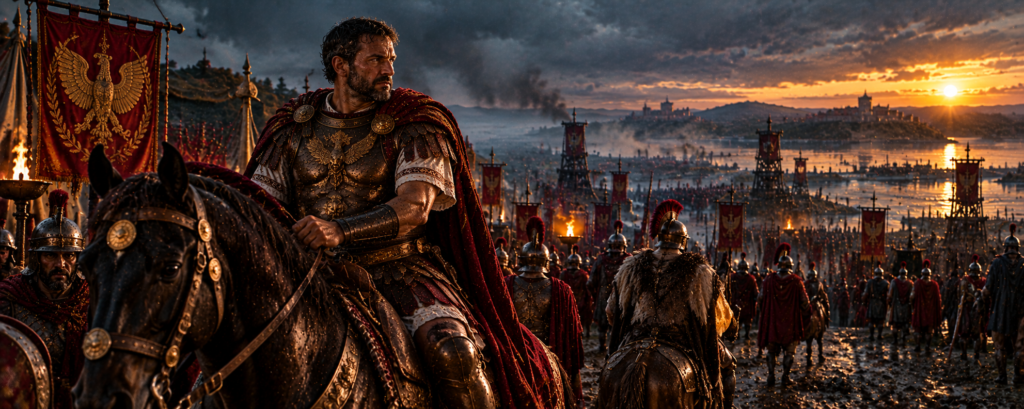
Carinus: The Scandal-Ridden Emperor Betrayed and Killed at the Battle of the Margus
Marcus Aurelius Carinus (died 285 CE) | Roman Emperor, 283–285 CE | Killed During or Immediately After the Battle of the Margus, 285 CE
The Emperor Who Was Winning the Battle When His Empire Collapsed
In the spring of 285 CE, two Roman emperors confronted one another near the River Margus, in the province of Moesia. Their armies had gathered for a battle that would determine who controlled the Roman Empire, and neither commander could afford to lose. On one side stood Diocletian, an ambitious military officer whose claim to the throne had emerged from the mysterious death of another emperor. Opposing him was Carinus, the surviving son of Emperor Carus, a ruler whose reputation had already been poisoned by stories of sexual misconduct, cruelty, extravagant entertainments, and reckless abuse of imperial power.
The battle should have been the moment when Carinus settled the question of his legitimacy. He possessed the stronger dynastic claim, controlled the western empire, and commanded substantial military forces. According to one ancient tradition, his soldiers were actually gaining the advantage when disaster struck. Yet before the victory could be secured, Carinus was dead, his army had abandoned his cause, and Diocletian had emerged as the undisputed ruler of the Roman world.
The circumstances of Carinus’s death became one of the more sensational stories of the late Roman Empire. Some ancient writers claimed that a military officer murdered him during the fighting because the emperor had seduced the officer’s wife. Others offered a less dramatic explanation, reporting that his own troops betrayed him as the battle turned against his authority. Still another account simply describes his defeat and death without providing a convincing explanation of who killed him or why.
The competing versions create an important historical problem. Carinus certainly died during the decisive struggle against Diocletian in 285, but it is impossible to establish whether he was deliberately assassinated by a subordinate, killed in the confusion of battle, or murdered after his military position collapsed. The famous story of the outraged husband may preserve a genuine act of revenge, but it also fits suspiciously well with the hostile portrait of Carinus as a sexually predatory ruler. The distinction matters because nearly everything written about his character comes from sources shaped by the political order that replaced him.
His death marked the end of more than one emperor’s ambitions. It extinguished the short-lived dynasty established by his father, Carus, and removed the last major obstacle to Diocletian’s consolidation of power. The victory would eventually lead to a profound reorganization of the Roman state, including the creation of the Tetrarchy and a new approach to imperial government. Carinus, meanwhile, became remembered largely as the dissolute tyrant whose downfall supposedly cleared the way for a better age.
But history is rarely as tidy as the stories written by victors. Behind the accusations of debauchery and cruelty stood a ruler who had successfully defended his position through military campaigns, survived the deaths of his father and brother, and confronted one of Rome’s most formidable future emperors. His reign was brief, his reputation deeply compromised, and his final moments uncertain. The story of Carinus is therefore not simply the downfall of a scandalous emperor, but the destruction of a dynasty during one of the last great succession struggles of Rome’s third-century crisis.
Born Into the Age of Murdered Emperors
The exact date and place of Carinus’s birth are unknown. He was the elder son of Marcus Aurelius Carus, a professional military commander who became emperor in 282, and the brother of Marcus Aurelius Numerianus, better known as Numerian. His family belonged to the military and administrative world that had become increasingly influential during the third century. Although the surviving sources provide little reliable information about his childhood, Carinus grew up in an empire where military authority could elevate a family to extraordinary power almost overnight.
By the time Carinus was born, Rome had entered a period of repeated political upheaval. The murder of Alexander Severus in 235 had opened an era in which soldiers frequently determined who occupied the imperial throne. Emperors were proclaimed by armies, challenged by rival commanders, and killed when their troops lost confidence in them. Even rulers who achieved significant victories could find themselves destroyed by the men responsible for protecting them.
The empire’s troubles extended far beyond palace conspiracies. Germanic and other groups repeatedly crossed the Rhine and Danube frontiers, while the Sasanian Persian Empire threatened Roman territory in the east. Internal rebellions disrupted administration and diverted military resources away from frontier defense. At several points, the Roman world appeared to be breaking into separate political states.
The capture of Emperor Valerian by the Persians in 260 was particularly humiliating. His son Gallienus struggled to maintain control while the western provinces developed a separate imperial government and Palmyra expanded its authority in the east. Gallienus himself was assassinated in 268, another victim of military conspiracy. His successors inherited an empire desperately in need of competent leadership.
Aurelian temporarily reversed the collapse. Between 270 and 275, he defeated invading armies, recovered the eastern territories from Palmyra, and brought the breakaway Gallic Empire back under central control. His achievements earned him the title Restorer of the World, but they did not solve Rome’s succession problems. He was murdered by officers within his own military entourage while preparing for another campaign.
Probus, who became emperor in 276, continued the recovery through aggressive military operations and reconstruction projects. His victories restored security to several threatened provinces, but his insistence upon strict discipline and productive military labor reportedly contributed to growing resentment among his soldiers. In 282, he too was murdered by mutinous troops near Sirmium. His death created the opportunity that would bring Carinus’s family to power.
The young Carinus therefore inherited a political world in which imperial authority offered extraordinary rewards but little security. His father would gain the throne through the army, just as numerous predecessors had done. The family would soon discover that military support could disappear as quickly as it had been obtained. Their rise and destruction would unfold within barely three years.
Carus: The Soldier Who Seized the Throne
Marcus Aurelius Carus emerged as emperor after the murder of Probus in 282. He had held senior military responsibilities, and his experience made him a plausible candidate for the throne. Ancient accounts differ concerning the precise circumstances of his elevation and his relationship with the mutiny that killed Probus. There is no secure evidence that Carus personally organized his predecessor’s assassination, although his accession clearly benefited from the collapse of Probus’s authority.
Carus inherited a more stable empire than many earlier third-century rulers. Aurelian had restored territorial unity, and Probus had strengthened frontier defenses while suppressing internal rebellions. Nevertheless, the state remained vulnerable to foreign threats and political challenges. The new emperor needed to establish his legitimacy quickly.
He did so partly by elevating his sons. Carinus and Numerian received the rank of Caesar, placing them within the imperial succession and presenting the family as a new ruling dynasty. The decision was significant because recent Roman history had demonstrated the dangers of leaving succession entirely to military competition. Carus apparently hoped that recognized heirs would provide continuity.
The two brothers were assigned different responsibilities. Carinus, as the elder son, was entrusted with authority in the western provinces. Numerian accompanied their father during preparations for a major eastern campaign against Persia. The arrangement divided military responsibilities while preserving the appearance of dynastic unity.
Carinus’s elevation was not merely ceremonial. The western empire contained important military frontiers, wealthy provinces, and the traditional capital at Rome. Maintaining control required administrative competence and military authority. A ruler who failed to defend those territories could quickly lose the support of the army.
Carus also needed to secure the Danubian frontier before concentrating upon Persia. Ancient sources credit him with victories against Sarmatian groups threatening Roman territory. The reported casualty figures are probably exaggerated, but the campaign appears to have strengthened his position. With the immediate threat reduced, the emperor turned eastward.
The dynasty appeared promising. Carus possessed military experience, his sons had been recognized as successors, and the empire had regained much of its former strength. Yet the family would soon experience a succession of deaths that transformed its future. Carinus would inherit far more responsibility than his father had originally intended.
Two Brothers, Two Halves of an Empire
The division of responsibilities between Carinus and Numerian reflected the practical difficulties of governing the Roman Empire. Its territories stretched from Britain and the Atlantic to Syria and Mesopotamia, with major military threats separated by enormous distances. A single emperor could not personally supervise every frontier. Delegating authority to trusted relatives offered a possible solution.
Carinus was assigned the western provinces, where the Rhine and Danube frontiers remained strategically important. His position also placed him closer to Rome and the traditional institutions of imperial government. Numerian traveled east with their father, joining the army assembled for operations against the Sasanians. Both brothers were therefore connected to significant military commands.
The arrangement carried obvious political advantages. By distributing responsibility among members of the ruling family, Carus could maintain a visible imperial presence in multiple regions. It also allowed his sons to gain experience and establish their own reputations. If the dynasty survived, the brothers might eventually govern together.
Yet divided authority could become dangerous when the central figure disappeared. Roman history contained numerous examples of relatives turning against one another or competing for military support. The army’s loyalty to one member of a dynasty did not automatically extend to another. A succession crisis could emerge even when the heirs had been formally recognized.
The surviving evidence provides little reliable information about the personal relationship between Carinus and Numerian. Later writers contrasted their characters sharply, presenting Numerian as cultured and admirable while portraying Carinus as vicious and corrupt. Such descriptions may reflect genuine differences, but they also serve a political narrative. The sources were written after the dynasty had been destroyed.
Carinus’s position in the west would eventually become decisive. When his father and brother died, he remained the surviving representative of the legitimate imperial household. He possessed armies, administrative authority, and a claim that had been publicly established before the crisis. Diocletian would therefore have to defeat him rather than simply inherit an uncontested throne.
The Persian Campaign That Changed Everything
Carus’s eastern campaign was among the most ambitious Roman military operations of the period. The Sasanian Persian Empire had inflicted severe defeats upon Rome, most famously capturing Emperor Valerian in 260. Restoring Roman prestige in the east was an important objective for any successful emperor. Carus intended to demonstrate that Rome could once again carry war deep into Persian territory.
The political situation in Persia offered an opportunity. The Sasanian monarchy faced internal difficulties, and Roman forces encountered less resistance than might otherwise have been expected. Carus advanced into Mesopotamia and achieved significant victories. Ancient accounts describe the capture of major cities, including Seleucia and Ctesiphon.
The campaign was an impressive demonstration of Roman military power. Ctesiphon was one of the principal centers of the Sasanian Empire, and its capture carried enormous symbolic importance. Roman emperors had long sought victories in Mesopotamia, but such campaigns were difficult and expensive. Carus appeared to have achieved a major success.
Then, in 283, the emperor died unexpectedly. Ancient writers famously claimed that he was struck by lightning during a violent storm. Other accounts suggested illness, and some later interpretations raised the possibility of political intrigue. The evidence does not allow a definitive conclusion.
The lightning story became especially popular because it provided a dramatic explanation for an emperor dying at the height of military success. It also fitted traditions about divine warnings against advancing too far into Persian territory. Such accounts should be treated cautiously. They reveal how later writers interpreted the event rather than establishing its exact cause.
Carus’s death interrupted the campaign and left his sons responsible for the empire. Numerian remained with the eastern army, while Carinus continued governing the west. The dynasty had lost its founder after barely a year. Its survival now depended upon the two young emperors.
Carinus Becomes Augustus
Carinus had already been elevated within the imperial hierarchy before his father’s death. During the dynasty’s brief existence, he received the title Augustus, marking his position as a full emperor. Numerian also became Augustus, and the brothers continued as joint rulers after Carus died. Their authority rested upon the legitimacy inherited from their father.
The arrangement was not unprecedented. Earlier Roman emperors had shared power with sons, brothers, or other relatives. Joint rule could provide administrative advantages, particularly when military threats required attention in distant provinces. Yet the system depended upon cooperation and the continued loyalty of separate armies.
Carinus remained in the west, where he was responsible for maintaining stability and defending Roman territory. The surviving evidence suggests that he exercised genuine authority rather than merely enjoying the privileges of imperial rank. His coinage proclaimed victories and emphasized traditional imperial virtues. Such propaganda was intended to reinforce his legitimacy.
Ancient writers later accused him of neglecting government while pursuing pleasure. The accusations are difficult to reconcile with the fact that he retained control over substantial western territories during a period of continuing military challenges. This does not prove that he was an exemplary administrator. It does suggest that the hostile literary portrait is incomplete.
His reign also included military activity against Germanic groups. Coins and later accounts associate him with victories that supported his claim to be an effective defender of the empire. The precise campaigns are difficult to reconstruct, but his government did not simply collapse through inactivity. He maintained a political and military position strong enough to challenge Diocletian in 285.
Carinus therefore deserves to be examined as a functioning emperor rather than merely a caricature of decadence. His enemies eventually succeeded in destroying his reputation, but they did not defeat him without serious military opposition. His authority was real, and his final campaign demonstrated that he remained a formidable political rival.
The Emperor Whose Reputation Became a Scandal
The surviving literary accounts of Carinus are extraordinarily hostile. He is portrayed as arrogant, sexually uncontrolled, cruel, extravagant, and contemptuous of traditional Roman morality. The Historia Augusta offers an especially lurid description of his behavior. It presents him as a ruler who devoted himself to pleasure while abusing the powers of his office.
According to these accounts, Carinus pursued numerous women, contracted repeated marriages, humiliated respectable families, and surrounded himself with disreputable companions. He allegedly rewarded entertainers and favorites while neglecting experienced officials. The stories were intended to demonstrate that he lacked the moral qualities expected of a Roman emperor. His private behavior became evidence of political unfitness.
The problem is that the most sensational source, the Historia Augusta, is notoriously unreliable. Its author frequently invented documents, speeches, letters, and anecdotes. The collection also contains obvious exaggerations and moralizing portraits designed to entertain readers. Its claims about Carinus cannot be accepted without independent support.
Other ancient writers also criticized his character, but their accounts were produced within a political tradition favorable to Diocletian and his successors. Carinus had been the defeated rival of the man who established a new imperial order. Portraying him as immoral helped justify his removal. The contrast between a corrupt predecessor and a capable successor was politically useful.
This does not mean every accusation was invented. Carinus may genuinely have behaved arrogantly or abused his authority. His personal relationships may have created resentment among officers and aristocratic families. The surviving evidence simply does not allow historians to determine how much of the hostile portrait reflects reality.
His reputation became especially important because it was used to explain his death. The story that an officer murdered him after the emperor seduced the officer’s wife fits the broader accusations of sexual misconduct. It turns his assassination into a punishment for private wrongdoing. That narrative may be true, but its convenience should make historians cautious.
The Alleged Marriages and Affairs
Ancient writers claimed that Carinus entered into numerous marriages during his short reign. The Historia Augusta offers extravagant accounts of his relationships, suggesting that he treated marriage and divorce with extraordinary recklessness. Such behavior was presented as evidence of his contempt for Roman social conventions. The accusations contributed to his reputation as one of the empire’s most dissolute rulers.
The precise number of marriages cannot be established reliably. Later literary sources may have exaggerated his relationships to create a sensational portrait. Roman emperors were frequently accused of sexual misconduct by hostile writers. Such allegations were particularly useful because they attacked both personal morality and political legitimacy.
One woman securely associated with Carinus was Magnia Urbica, who held the title Augusta. Her name appears on imperial coinage, providing independent evidence of her position. The coins present her through conventional images of imperial femininity and religious virtue. They reveal little about her private life or relationship with the emperor.
Magnia Urbica’s background remains uncertain. Historians cannot confidently reconstruct her family origins, the circumstances of her marriage, or her fate after Carinus’s death. Later narratives focus so heavily upon the emperor’s alleged misconduct that his legitimate household becomes almost invisible. The contrast between official coinage and hostile literary accounts is striking.
The allegations of affairs with married women are particularly difficult to assess. Ancient authors sometimes used such accusations to portray rulers as tyrants who violated the households of respectable men. Sexual misconduct became a symbol of political lawlessness. The stories could be true, exaggerated, or invented to fit a familiar pattern.
For Carinus, the distinction has enormous importance. One alleged affair supposedly provoked the officer who killed him at the Battle of the Margus. If the story is accurate, his private behavior directly contributed to his death. If it is propaganda, the accusation helped transform a military defeat into a moral tale about deserved punishment.
Magnia Urbica: The Empress Behind the Scandals
Magnia Urbica remains one of the more elusive women associated with the late third-century imperial court. Her title Augusta is established by surviving coins, which depict her with the dignified appearance expected of an imperial consort. The imagery emphasizes virtues associated with the Roman imperial household. It presents a public identity very different from the scandalous atmosphere described by hostile accounts of Carinus.
The existence of her coinage demonstrates that Carinus maintained the outward structures of dynastic government. His court promoted an empress whose image could symbolize continuity and legitimacy. Such representations were important because imperial families helped reinforce the stability of succession. The presence of an Augusta suggested that the dynasty intended to endure.
Yet the sources provide almost no reliable information about Magnia Urbica’s personal experiences. We do not know how she responded to the accusations against her husband. There is no secure evidence describing her influence over policy or her relationship with military officers. Inventing scenes of jealousy, humiliation, or court intrigue would go beyond the surviving record.
Her disappearance from history after Carinus’s defeat is equally frustrating. The political destruction of the dynasty removed the institutions that had supported her public position. Her coins survived, but the literary sources largely ignored her fate. She became another imperial woman whose historical identity was overshadowed by the political struggles of men.
The contrast is revealing. Carinus was remembered through stories of sexual excess, while his wife was preserved through conventional images of dignity and virtue. Neither representation provides a complete account of their marriage. Both were shaped by the purposes of the people who created them.
Magnia Urbica’s presence nevertheless complicates the image of Carinus as a ruler who cared only about pleasure. His government maintained the formal symbols of imperial legitimacy. It promoted a recognized empress and participated in the traditions of dynastic representation. The scandalous literary portrait captures only one side of a more complicated political reality.
The Palace of Pleasure Described by His Enemies
The Historia Augusta portrays Carinus as a ruler obsessed with luxurious surroundings and extravagant entertainment. It describes elaborate banquets, expensive decorations, and personal indulgences intended to demonstrate his lack of restraint. Some stories involve rooms scattered with flowers and elaborate bathing arrangements. The details resemble familiar literary attacks upon supposedly decadent emperors.
Such descriptions should immediately invite comparison with accounts of Nero, Caligula, and Elagabalus. Roman writers often used luxury as evidence of moral and political corruption. An emperor who spent lavishly on personal pleasure could be portrayed as neglecting the army, exploiting taxpayers, and abandoning traditional virtues. The accusations were especially powerful when directed against a defeated ruler.
Carinus may genuinely have enjoyed extravagant entertainments. Imperial courts possessed substantial resources, and rulers could spend lavishly upon public spectacles and private luxury. Yet the surviving descriptions are too sensational to accept without caution. They may reveal more about the author’s expectations than about Carinus’s actual behavior.
The same source accuses him of elevating unworthy companions and humiliating established officials. Such stories fit a familiar narrative in which a bad emperor surrounds himself with flatterers while excluding respectable men. They also provide a convenient explanation for why military officers and aristocrats might turn against him. The accusations therefore serve political as well as moral purposes.
There is little independent evidence that Carinus’s government was uniquely incompetent. He maintained control of the western provinces and possessed sufficient military strength to confront Diocletian. His coinage and official titles indicate that the normal machinery of imperial government continued functioning. These facts do not disprove personal misconduct, but they undermine the image of a ruler entirely detached from political reality.
The palace of pleasure described by later writers may therefore be partly a literary construction. Carinus became the villain required by the story of Diocletian’s rise. His supposed extravagance helped explain why his overthrow was desirable. The more scandalous the defeated emperor appeared, the more legitimate the victor could seem.
The Death of Numerian
While Carinus governed the western empire, his brother Numerian remained with the eastern army following their father’s death. The army eventually began withdrawing from Persian territory, and Numerian traveled westward with his military entourage. During the journey, he died under mysterious circumstances. His death would trigger the political crisis that destroyed the dynasty.
Ancient accounts describe Numerian suffering from an illness affecting his eyes. He was reportedly carried in a closed litter because exposure to light aggravated his condition. The arrangement allowed him to remain hidden from public view. His absence eventually became suspicious.
According to the traditional narrative, soldiers began questioning why their emperor had not appeared. Officials offered explanations for his continued seclusion, but suspicion grew. Eventually, the smell of decomposition allegedly revealed that Numerian had been dead for some time. The story is dramatic, although its precise details cannot be independently verified.
The Praetorian prefect Aper became the principal suspect. He was Numerian’s father-in-law and held an important position within the imperial administration. Ancient writers accused him of murdering the emperor in an attempt to seize power. The evidence supporting the accusation is uncertain.
Numerian’s death left Carinus as the surviving son of Carus and the only remaining emperor from the established dynasty. Yet the eastern army did not simply transfer its allegiance to him. Instead, its officers selected another commander. The decision transformed a mysterious death into a struggle for control of the empire.
The disappearance of Numerian therefore became the immediate cause of Carinus’s final crisis. His brother’s death created an opportunity for ambitious military officers. The eastern army would proclaim Diocletian emperor, forcing Carinus to defend his inherited authority through civil war. The dynasty was approaching its end.
The Corpse in the Imperial Litter
The story of Numerian’s concealed death became one of the most memorable episodes of late Roman imperial history. According to ancient accounts, the emperor’s body remained hidden inside his traveling litter while officials continued pretending that he was alive. The deception allegedly continued until the smell of the corpse exposed the truth. The episode provided a dramatic explanation for the army’s subsequent political decisions.
The narrative is unsettling because it transforms the imperial household into a scene of secrecy and decay. A Roman emperor was supposed to embody authority, dignity, and divine favor. Instead, the soldiers supposedly discovered that their ruler had been dead while those around him concealed the fact. The contrast made the story especially attractive to later historians.
Yet the account contains uncertainties. We do not know precisely when Numerian died or how long his death remained concealed. The circumstances of his illness are poorly documented. Nor can historians establish with confidence who was responsible for any deliberate deception.
Aper’s alleged role is particularly important. He possessed access to the emperor and held a powerful military office. Such circumstances made him a plausible suspect. They did not, however, prove that he committed murder.
The accusation against Aper also benefited Diocletian. By identifying a supposed murderer, the newly proclaimed emperor could present himself as the avenger of Numerian. The narrative transformed his accession from a military rebellion into an act of justice. It provided moral legitimacy for a man who was challenging the surviving member of the ruling dynasty.
Carinus had reason to reject that interpretation. He remained the legitimate surviving son of Carus, and his authority had been established before Numerian’s death. The eastern army’s decision to elevate Diocletian was therefore a direct challenge to his position. The mystery surrounding Numerian’s corpse became the beginning of another Roman civil war.
Diocletian: The Soldier Who Claimed to Avenge a Murder
Diocletian was born Diocles, probably in Dalmatia, and rose through the Roman military hierarchy. His background appears to have been relatively modest, although the precise details remain uncertain. By 284, he had acquired substantial military experience and held an important position within the imperial entourage. His career resembled that of several successful soldier-emperors who had emerged from the Balkan provinces.
After Numerian’s death became known, the eastern army proclaimed Diocletian emperor. The traditional date is November 20, 284, near Nicomedia. His accession immediately created a conflict with Carinus, who remained emperor in the west. The Roman world once again possessed rival rulers supported by separate armies.
Ancient accounts describe a dramatic assembly in which Diocletian accused Aper of murdering Numerian. He reportedly drew his sword and killed the prefect before the assembled soldiers. The act presented him as a decisive commander willing to punish treachery. It also removed a powerful official who might have challenged his authority.
The famous story includes elaborate dialogue and literary references that should not be treated as reliable transcripts. Later writers embellished the scene, and some versions connect Aper’s death with a prophecy about Diocletian’s destiny. Such details belong to the mythology surrounding his rise. The underlying event may have occurred, but its precise circumstances remain uncertain.
The political effect was enormous. Diocletian had been proclaimed emperor by the eastern army and had publicly associated himself with vengeance for Numerian. His claim did not depend upon descent from Carus. Instead, it rested upon military support and the argument that he was restoring justice.
Carinus now faced a dangerous rival. Diocletian possessed experienced troops, military prestige, and control over the eastern forces. He could also portray his accession as a response to murder rather than an act of rebellion. The struggle between them would determine whether the dynasty of Carus survived.
Two Emperors, One Throne
By the end of 284, the Roman Empire was divided between two rival imperial authorities. Carinus controlled the western provinces and possessed the stronger dynastic claim. Diocletian commanded the eastern army and had been proclaimed emperor following Numerian’s death. Neither could accept the other’s position without surrendering his own authority.
The confrontation reflected a recurring problem of third-century politics. Military commanders could acquire imperial power through the support of their troops, even when another emperor already occupied the throne. The Roman state lacked a universally accepted procedure for resolving such disputes. Civil war became the final means of determining legitimacy.
Carinus’s position was not hopeless. He had governed the west for several years and possessed established administrative structures. His army included experienced troops who had served under the dynasty. He also controlled important regions that provided manpower and resources.
Diocletian nevertheless represented a formidable threat. His soldiers had selected him in a moment of crisis, and his reputation as a capable commander helped sustain their loyalty. The eastern army possessed considerable military experience. Its movement toward the west threatened Carinus’s control over the central empire.
The two rulers also faced the problem of political propaganda. Carinus could portray Diocletian as a usurper who had betrayed the legitimate dynasty. Diocletian could present Carinus as a corrupt ruler whose removal was necessary for the welfare of the state. Later historical writing would overwhelmingly favor the second interpretation.
The conflict was therefore more than a contest between two generals. It was a struggle over legitimacy, military loyalty, and the future organization of imperial power. The outcome would determine which political narrative survived. Carinus’s defeat would ensure that his enemies controlled the story.
Julianus and the Rebellion in the West
Before Carinus could confront Diocletian directly, he faced another challenge within the western empire. A commander named Julianus, sometimes identified as Sabinus Julianus, emerged as a rival claimant. His rebellion appears to have occurred in the region of northern Italy or the Danubian provinces. The precise chronology and location remain disputed.
Julianus’s claim added another complication to an already dangerous situation. Carinus needed to preserve control over his own territories while preparing for war against Diocletian. A rival emperor operating within the west could undermine military loyalty and threaten important routes. Suppressing the rebellion became an urgent priority.
Ancient sources provide limited details about the conflict. Carinus appears to have defeated Julianus in battle, ending the challenge before confronting Diocletian. The victory demonstrated that he remained militarily capable. It also suggests that his authority had not collapsed despite the hostile accounts of his private behavior.
The rebellion illustrates how vulnerable imperial governments remained to ambitious commanders. Julianus apparently believed that the succession crisis offered an opportunity to claim power. Such calculations were common during the third century. The existence of multiple rival emperors encouraged further rebellion.
Carinus’s victory was politically important. By eliminating Julianus, he secured his immediate rear and preserved the forces needed for the approaching confrontation. He could now concentrate upon Diocletian. The struggle for the empire was moving toward a decisive battle.
The episode also complicates the image of Carinus as an incompetent pleasure-seeker. He had successfully defeated a rival claimant during a major political crisis. His military position remained strong enough to challenge the eastern emperor. Whatever his personal failings, he was not incapable of exercising power.
The March Toward the Margus
The decisive confrontation occurred in 285, traditionally near the River Margus, now associated with the Great Morava in modern Serbia. The region lay within the central Balkan military corridor, where armies could move between the eastern and western portions of the empire. Its strategic importance made it a natural setting for the struggle. Both emperors needed control of the routes connecting their territories.
Carinus advanced with substantial forces. His army included troops loyal to the established dynasty and experienced in the military campaigns of the preceding years. Diocletian approached with the eastern army that had proclaimed him emperor. The confrontation would determine which ruler possessed the stronger claim in practice.
The precise location of the battlefield remains uncertain. Ancient geographical references place the fighting in the region between Viminacium and Aureus Mons, near the Margus. Modern identifications vary, and the surviving descriptions do not permit a detailed reconstruction of the terrain. The battle’s political significance is much clearer than its tactical details.
The opposing armies represented different sources of legitimacy. Carinus relied upon dynastic succession and established authority in the west. Diocletian relied upon military acclamation and his claim to have avenged Numerian. Both possessed Roman soldiers who believed they were fighting for a legitimate emperor.
The conflict was especially tragic because it involved Roman forces fighting one another after decades of foreign invasions and internal instability. Aurelian and Probus had spent years restoring security to the empire. Now military resources were being consumed in another succession struggle. The same armies that defended Rome’s frontiers were preparing to kill fellow Romans.
For Carinus, the battle offered an opportunity to end the challenge decisively. Victory would remove Diocletian and preserve the dynasty of Carus. Defeat would almost certainly mean the loss of his throne and perhaps his life. The stakes could scarcely have been higher.
The Battle of the Margus
The Battle of the Margus took place in 285, although the exact date remains uncertain. Carinus and Diocletian confronted one another with armies whose loyalty would determine the outcome. The surviving sources provide only limited tactical information. Their accounts focus more heavily upon the political consequences and the circumstances of Carinus’s death.
One tradition suggests that Carinus’s forces were initially successful. His army may have possessed a numerical or tactical advantage, although the evidence is insufficient to establish the precise balance of forces. The possibility that he was winning makes his subsequent death especially dramatic. It suggests that the outcome may have been determined by events within his own command rather than straightforward battlefield defeat.
Other accounts provide a simpler narrative in which Carinus was defeated and killed. The Historia Augusta states that he perished after fighting Diocletian near the Margus. Its description does not establish whether he died directly in combat or through assassination. The source also has strong reasons to portray Diocletian’s victory favorably.
Eutropius offers a different emphasis, reporting that Carinus was betrayed by his own army. This version suggests that military loyalty collapsed during the confrontation. Such betrayal was entirely plausible within the political culture of the third century. Soldiers had repeatedly abandoned rulers when they believed another claimant offered better prospects.
The most sensational version identifies an officer who killed Carinus because the emperor had seduced his wife. This story transforms the battle into a scene of personal revenge. The officer’s alleged grievance supposedly overcame military loyalty at the decisive moment. Carinus’s private misconduct became the immediate cause of his political destruction.
The sources cannot be reconciled into a single certain narrative. Carinus may have been killed by an officer while his army was still fighting effectively. He may have been murdered after troops began deserting. He may also have died during the battle, with later writers inventing a personal motive to explain the outcome.
What is beyond serious doubt is that Carinus died and Diocletian emerged victorious. The surviving dynasty of Carus was destroyed. The Roman Empire passed into the hands of a ruler whose reforms would profoundly change its government. The Battle of the Margus became a turning point in imperial history.
The Officer Whose Wife Carinus Allegedly Seduced
The most notorious explanation for Carinus’s death appears in ancient accounts that connect his murder with sexual misconduct. According to this tradition, the emperor had seduced or violated the wife of a military officer. The offended husband eventually found an opportunity to take revenge during the struggle against Diocletian. Carinus was killed by a man who had served within his own military command.
The story is particularly striking because it makes the emperor’s private behavior responsible for the collapse of his government. A ruler who had survived military campaigns and defeated rival claimants was supposedly destroyed by an officer seeking personal vengeance. The alleged affair transformed a political assassination into a domestic scandal. It also reinforced the broader portrait of Carinus as a man whose sexual behavior endangered the state.
Yet the evidence is problematic. The officer’s identity is not securely established, and the circumstances of the alleged relationship remain obscure. The sources do not provide independent testimony from the woman involved. Nor can historians determine whether the accusation originated before or after Carinus’s defeat.
The story also resembles other Roman narratives in which sexual misconduct leads to political murder. Ancient writers frequently portrayed tyrants as men who violated the households of respectable citizens. Such accusations helped explain why supposedly loyal subjects turned against their rulers. The pattern was morally satisfying because it presented assassination as punishment for abuse.
Carinus’s reputation made the story especially convenient. Later writers had already described him as sexually uncontrolled and contemptuous of traditional morality. An assassination motivated by an offended husband fitted that image perfectly. The narrative therefore requires careful scrutiny.
It remains possible that an officer genuinely killed Carinus over a personal grievance. Military commanders were not immune to private disputes, and imperial abuse could provoke dangerous resentment. But possibility is not proof. The story should be presented as an ancient allegation rather than an established explanation for his death.
Betrayed by His Own Army
Eutropius’s account offers a broader explanation for Carinus’s downfall. Rather than focusing upon a single act of personal revenge, it states that the emperor was betrayed by his army. The wording suggests that the collapse of military loyalty was decisive. This interpretation fits the recurring pattern of third-century imperial politics.
Roman soldiers had repeatedly abandoned emperors when circumstances changed. Florianus lost his position when his troops turned against him in 276. Probus was murdered by mutinous soldiers in 282. Earlier rulers, including Aemilian and Trebonianus Gallus, had suffered similar betrayals. Carinus’s fate therefore belonged to a familiar political tradition.
The presence of Diocletian offered an alternative ruler. Soldiers who doubted Carinus’s prospects might have decided that continued resistance was dangerous. If they believed Diocletian would eventually prevail, changing allegiance could preserve their lives and careers. Such calculations often mattered more than formal legitimacy.
The hostile stories about Carinus’s character may reflect genuine dissatisfaction among his officers. A ruler who humiliated commanders or interfered with their families could undermine personal loyalty. Yet the evidence does not establish that sexual misconduct was the principal cause of military betrayal. Political calculation alone could explain the collapse.
It is also possible that Carinus’s death and the army’s defection were closely connected. If a senior officer killed the emperor during battle, his troops might have lost the will to continue fighting. Conversely, if the army began abandoning Carinus, an individual officer might have taken advantage of the confusion to murder him. The surviving accounts do not reveal the sequence.
The distinction matters because it changes how the assassination is understood. A personal revenge killing would make Carinus the victim of an individual grievance. A military betrayal would place his death within the larger struggle for imperial power. The evidence allows both possibilities but proves neither in detail.
Was Carinus Actually Winning?
One of the most intriguing elements of the ancient tradition is the suggestion that Carinus had the advantage before his death. If accurate, this would mean that Diocletian’s victory was not inevitable. The battle may have been decided by the sudden removal of the western emperor rather than superior military performance. Such an outcome would be entirely consistent with the instability of third-century warfare.
A Roman army could lose cohesion quickly when its commander died. Soldiers might assume that defeat was inevitable, even if their tactical position remained favorable. Officers could disagree over who should assume command. Rival political loyalties might emerge at the worst possible moment.
Carinus’s death would therefore have had immediate consequences regardless of how it occurred. The western army had been fighting to preserve his authority. Once he was dead, the political purpose of continued resistance became uncertain. Diocletian offered a surviving claimant who could reward submission.
The claim that Carinus was winning should nevertheless be treated cautiously. Ancient writers sometimes emphasized dramatic reversals to make political events more memorable. The story of a successful emperor suddenly murdered by an offended officer possesses obvious narrative appeal. It also helps explain how Diocletian could prevail without a clearly documented overwhelming battlefield victory.
The surviving evidence does not permit a detailed reconstruction of troop movements, casualties, or tactical decisions. We cannot confidently identify which army held the advantage at each stage. The battle’s outcome is secure, but the process remains obscure. Any description of Carinus standing on the verge of victory must therefore remain conditional.
The uncertainty makes his death especially fascinating. Carinus may have been only moments away from preserving his dynasty. He may instead have been losing control of an army already preparing to abandon him. The sources leave both possibilities open, ensuring that the Battle of the Margus remains one of the more mysterious imperial confrontations of the period.
A Death Without a Reliable Final Scene
Carinus’s final moments cannot be reconstructed with certainty. Ancient writers provide conflicting explanations for his death, and none offers a detailed account supported by independent evidence. We do not know whether he was mounted, fighting among his troops, directing operations from behind the lines, or attempting to escape. The familiar image of an emperor stabbed by an outraged officer is a possibility rather than a documented scene.
There is also no reliable record of his final words. Later historical traditions frequently invented speeches or dramatic statements for dying rulers. Such embellishments can make a narrative more vivid, but they create a false impression of certainty. Carinus’s death requires no invented dialogue to remain compelling.
The uncertainty extends to the immediate aftermath. We do not know exactly how his body was treated or whether his surviving officers attempted to organize further resistance. The sources focus primarily upon Diocletian’s victory and the political consequences. Carinus himself disappears almost immediately from the narrative.
His death nevertheless ended the dynasty established by Carus. Numerian had already died under mysterious circumstances, and Carus had perished during the Persian campaign. With Carinus gone, no surviving member of the family possessed a comparable claim to imperial authority. Diocletian could consolidate power without confronting another major dynastic rival.
The lack of a reliable final scene is particularly striking given the elaborate stories about Carinus’s private life. Ancient writers were eager to describe his alleged scandals but preserved little concrete information about his death. The imbalance reveals their priorities. His character mattered to their moral narrative more than the precise circumstances of the battle.
For modern readers, that absence should encourage caution rather than invention. Carinus was killed during the struggle for the Roman throne in 285. His death may have involved deliberate assassination by one of his own officers, but the evidence remains disputed. The uncertainty is an essential part of the historical story.
Diocletian Takes the Empire
Carinus’s death removed the last major obstacle to Diocletian’s control of the Roman Empire. The eastern commander who had been proclaimed emperor after Numerian’s death now possessed undisputed authority. His victory ended the short-lived dynasty of Carus. It also marked the beginning of a new phase in Roman political history.
Diocletian inherited an empire that had survived decades of crisis but remained vulnerable to instability. Aurelian and Probus had restored territorial unity and strengthened frontier defenses. Yet repeated assassinations and civil wars demonstrated that military success alone could not guarantee political continuity. Diocletian would attempt to address these problems through far-reaching reforms.
His government eventually reorganized imperial administration, taxation, and military responsibilities. He also established a system of multiple rulers known as the Tetrarchy. The arrangement was intended to provide effective leadership across distant regions and reduce the dangers associated with uncertain succession. Its development reflected the lessons of the third-century crisis.
The contrast between Diocletian and Carinus became central to later historical writing. Diocletian was portrayed as the disciplined reformer who restored order, while Carinus became the immoral predecessor whose removal made recovery possible. Such narratives simplified a complicated transition. They also helped legitimize the new political order.
Diocletian’s achievements were substantial, but they did not prove that every accusation against Carinus was true. A successful successor could benefit from the destruction of his predecessor’s reputation. The political usefulness of the hostile portrait should remain part of any historical assessment. Carinus’s defeat gave his enemies control over the story.
The Battle of the Margus therefore changed both the government of Rome and the memory of the man who lost. Diocletian became one of the most influential emperors in Roman history. Carinus became a cautionary example of imperial vice. The difference between their reputations was shaped partly by the outcome of a single battle.
The Dynasty That Lasted Barely Three Years
The family of Carus rose to power in 282 and disappeared from imperial politics by 285. Its brief history contained military victories, mysterious deaths, and a final civil war. Carus gained the throne after the murder of Probus, elevated his sons, and launched a successful campaign against Persia. His sudden death left the dynasty dependent upon Carinus and Numerian.
Numerian’s death during the eastern army’s withdrawal created the next crisis. The circumstances were suspicious, and the accusation against Aper became the foundation of Diocletian’s claim. Carinus remained emperor in the west, but the eastern army refused to accept his authority. The dynasty was divided by military rebellion.
Carinus attempted to preserve his position through force. He defeated Julianus and advanced against Diocletian. His actions demonstrated that he was not simply surrendering the throne to a rival. He possessed sufficient military support to make the final confrontation a serious contest.
The Battle of the Margus destroyed that possibility. Carinus died, his army ceased resisting, and Diocletian became the sole emperor. The dynasty’s political structure collapsed with extraordinary speed. Within three years of Carus’s accession, all three principal male rulers were dead.
The sequence illustrates the fragility of dynastic power during the third century. Formal titles and family relationships could strengthen legitimacy, but they could not guarantee military obedience. The army remained capable of elevating outsiders when circumstances changed. The dynasty of Carus failed because it could not control the forces upon which its authority depended.
Its destruction also demonstrated the dangers of divided imperial command. Carinus and Numerian had governed separate regions, but the death of one created an opportunity for another military leader. The surviving brother could not automatically inherit the loyalty of the eastern army. Diocletian would later attempt to organize shared rule through a more systematic political structure.
The Problem With Everything Written About Carinus
Carinus presents historians with an unusually difficult problem because the surviving literary evidence is heavily hostile. His reign was brief, and the political order that replaced him had strong reasons to portray him negatively. Later writers inherited traditions that emphasized his alleged cruelty, sexual misconduct, and extravagance. These stories became central to his historical identity.
The Historia Augusta is especially problematic. It contains numerous invented documents and sensational anecdotes, making it unreliable without corroboration. Its portrait of Carinus resembles familiar literary descriptions of bad emperors. The emphasis upon luxury, sexual excess, and contempt for respectable society should therefore be approached critically.
Eutropius and other writers provide additional information, but they were also writing after Diocletian’s victory. Their accounts reflect the political and moral assumptions of later Roman society. They may preserve genuine traditions, but they are not neutral witnesses. The passage of time further complicates their reliability.
Material evidence offers a different perspective. Coins issued under Carinus present him through conventional images of victory, legitimacy, and imperial authority. They demonstrate that his government maintained functioning institutions and promoted recognized political symbols. Such evidence cannot reveal his private character, but it confirms that he exercised real power.
The contrast between literary and material evidence is important. A ruler portrayed as hopelessly corrupt nevertheless governed substantial territories, maintained armies, and defeated at least one rival claimant. His final confrontation with Diocletian was serious enough to require a decisive battle. The historical Carinus was therefore more complicated than the caricature preserved by his enemies.
A responsible account must hold these conflicting realities together. Carinus may have committed abuses, and his conduct may have contributed to his downfall. Yet the most sensational accusations remain uncertain. His reputation cannot be separated from the political circumstances of his defeat.
Was Carinus a Tyrant or a Victim of Propaganda?
The question of Carinus’s character cannot be answered with complete confidence. Ancient writers consistently portray him negatively, which suggests that a hostile tradition developed relatively early. Yet agreement among later sources does not necessarily prove the accusations. Writers may have repeated the same political narrative rather than preserving independent testimony.
Some allegations are plausible within the context of Roman imperial power. Emperors possessed enormous authority, and abuses against aristocratic families or military officers could occur. A ruler who behaved arrogantly might create dangerous enemies. Carinus’s reputation may therefore preserve memories of genuine misconduct.
Other stories are more suspicious. The extravagant descriptions of his pleasures resemble standard attacks upon supposedly decadent rulers. Claims about numerous marriages and sexual adventures are difficult to verify. The absence of independent evidence makes precise judgments impossible.
The accusation that an offended husband killed him is particularly vulnerable to distortion. It provides a satisfying explanation for his death while reinforcing the claim that he was sexually immoral. The story may have been preserved because it was memorable and morally convenient. Its historical truth remains uncertain.
Carinus’s military record also complicates the charge of incompetence. He maintained western authority, defeated Julianus, and confronted Diocletian with substantial forces. These achievements do not establish that he was a good ruler, but they show that his government retained meaningful strength. A completely ineffective emperor would have struggled to accomplish them.
The most defensible conclusion is that Carinus was a capable political and military figure whose personal reputation became deeply hostile after his defeat. Some accusations may reflect genuine abuses, while others may have been exaggerated or invented. His death ensured that he could not defend his own record. The victors shaped the memory of his reign.
The Emperor Who Became the Villain of Diocletian’s Story
Diocletian’s rise required a narrative of legitimacy. He had been proclaimed emperor by an army while Carinus remained the surviving representative of an established dynasty. His claim therefore needed justification beyond military success. The accusation that he avenged Numerian helped provide that justification.
Carinus’s alleged misconduct served a similar purpose. If the western emperor was cruel, immoral, and incompetent, his removal could be presented as beneficial to the state. The struggle against him became more than a contest for power. It became a moral confrontation between corruption and restoration.
Later historical writing reinforced this contrast. Diocletian’s reforms were remembered as major achievements, while Carinus’s reign was reduced to scandal and defeat. The complexity of the civil war disappeared behind a simple narrative. The defeated ruler became the necessary villain.
This process was not unique to Carinus. Roman emperors frequently suffered hostile portrayals after their deaths, particularly when replaced by political enemies. Nero, Domitian, and other rulers became subjects of sensational traditions shaped by later attitudes. Carinus belonged to the same broader pattern.
The difference is that Carinus left relatively little independent evidence through which his reputation can be reassessed. His reign was short, and the surviving literary sources are limited. Historians therefore face substantial uncertainty. The most dramatic stories are often the least securely documented.
His case demonstrates how political victory can shape historical memory. Diocletian did not merely inherit the empire after Carinus’s death. His government and its successors also influenced how the defeated emperor would be remembered. Carinus lost both the throne and much of his historical identity.
Assassination, Battlefield Death, or Military Betrayal?
Carinus’s inclusion among assassinated rulers requires a clear distinction between established fact and disputed interpretation. He was certainly a reigning emperor who died during the struggle against Diocletian in 285. His death ended his government and allowed his rival to consolidate power. The precise manner of his killing, however, remains uncertain.
If the account of the offended officer is accurate, Carinus was deliberately assassinated by a subordinate during battle. The killing would have been motivated by personal revenge, although it carried enormous political consequences. It would qualify as an assassination of a reigning ruler. The battlefield setting would not change the deliberate nature of the act.
If Eutropius’s account of military betrayal is closer to the truth, the situation becomes more complicated. Carinus may have been abandoned by his troops and killed during the collapse of his army. He might have been murdered by soldiers who changed allegiance. Alternatively, he could have died in combat after losing their support.
The Historia Augusta provides an even less specific explanation, describing his defeat and death near the Margus. This version does not establish assassination. It leaves open the possibility that he was killed during ordinary fighting. The evidence therefore cannot support an unqualified claim that he was murdered by a particular officer.
The uncertainty is not a reason to exclude him entirely from the category. His death occurred amid military betrayal, and ancient traditions explicitly describe a deliberate killing by a subordinate. The case illustrates the blurred boundary between assassination and battlefield death during Roman civil wars. It is best classified as a disputed or possible assassination.
Carinus therefore belongs within the broader history of violent imperial deaths, provided the ambiguity remains clear. He should not be presented as a proven victim of personal revenge. Nor should the possibility of assassination be dismissed simply because it occurred during a battle. His death remains an unresolved episode in the history of Roman regicide.
The End of the Third-Century Crisis
Carinus’s death is often treated as one of the events marking the transition from the Crisis of the Third Century to the age of Diocletian. The crisis had begun with the murder of Alexander Severus in 235 and continued through decades of invasions, rebellions, and unstable succession. By 285, the empire had survived its most dangerous fragmentation. Yet the final struggle between Carinus and Diocletian demonstrated that political instability remained unresolved.
Aurelian and Probus had already achieved substantial military recovery. Their victories restored territorial unity and strengthened frontier defenses. Carus continued the tradition of active military leadership, while Carinus maintained authority in the west. The empire had not collapsed, but its government remained vulnerable to competing military claims.
Diocletian’s victory created an opportunity for more systematic reform. He eventually reorganized administration, taxation, and military command. His system of multiple emperors attempted to provide leadership across distant regions while reducing the dangers of uncertain succession. The reforms transformed the Roman state.
Yet the new order did not emerge without violence. Diocletian gained power through military acclamation and secured it through civil war. Carinus’s death removed the final obstacle to his authority. The transition therefore continued the same pattern that had defined the crisis.
The contrast between the two emperors became clearer only in hindsight. Diocletian would rule for more than two decades and voluntarily abdicate in 305. Carinus died after a short reign, leaving little opportunity to develop a lasting political program. Their historical reputations were shaped by these radically different outcomes.
Carinus’s death therefore stands at an important turning point. It ended one dynasty and opened the way for a new imperial system. Yet it also demonstrated that Rome’s recovery had been purchased through another violent succession. The empire entered a new age only after another emperor had fallen.
The Death That Changed Roman History
The consequences of Carinus’s death extended far beyond the battlefield. Diocletian’s victory allowed him to consolidate authority over the entire Roman Empire. His subsequent reforms would influence imperial government for generations. The political structure that emerged after 285 differed significantly from the system that had produced repeated soldier-emperors.
The Tetrarchy was among the most important developments. By dividing imperial responsibilities among multiple rulers, Diocletian attempted to address the difficulties of governing distant provinces. The arrangement also sought to establish a more orderly succession. Its eventual breakdown did not erase its significance.
Administrative reforms strengthened the machinery of government and increased the state’s ability to collect resources. Military organization evolved in response to continuing frontier threats. Imperial ceremony and ideology also changed, emphasizing the authority and separation of the emperor from ordinary society. These developments helped define the later Roman Empire.
Carinus’s defeat made this transformation possible by eliminating the principal rival to Diocletian. Had Carinus survived and won the Battle of the Margus, Roman history might have followed a different course. It is impossible to know what policies he would have pursued. The surviving evidence does not support elaborate speculation about an alternative empire.
Nevertheless, the importance of the battle is undeniable. A single succession struggle determined which ruler would control the state at a moment of profound transition. Carinus’s death ended the dynasty of Carus and allowed Diocletian to begin consolidating power. The consequences would be felt across the Roman world.
The uncertainty surrounding the killing makes the event even more striking. A personal grievance, a military betrayal, or a battlefield death may have determined the political future of millions. The sources do not reveal which explanation is correct. They preserve only fragments of the moment when one imperial order ended and another began.
The Emperor Whose Death Became a Moral Lesson
Carinus inherited an empire that had survived decades of political violence but remained vulnerable to military rebellion. His father, Carus, had gained the throne after the murder of Probus and attempted to establish a dynasty through his two sons. The arrangement initially appeared promising, with Carinus governing the west while Numerian accompanied their father in the east. Yet the family’s fortunes collapsed with extraordinary speed.
Carus died during a successful Persian campaign, leaving his sons to rule together. Numerian then died under mysterious circumstances while returning from the east. The army proclaimed Diocletian emperor, creating a rival claimant who challenged Carinus’s authority. The surviving son of Carus suddenly faced a struggle for the entire Roman world.
Carinus did not surrender without resistance. He maintained control of the western provinces, defeated the usurper Julianus, and advanced against Diocletian. His military position was substantial enough to make the final confrontation a serious contest. The hostile portrait of him as an incompetent pleasure-seeker cannot fully explain these achievements.
Yet his reputation had become deeply compromised. Ancient writers accused him of sexual misconduct, extravagant luxury, cruelty, and contempt for respectable society. Some allegations may have reflected genuine behavior, but the surviving accounts were shaped by hostility toward the defeated dynasty. Their most sensational details remain difficult to verify.
The accusations became inseparable from the story of his death. According to one tradition, an officer murdered Carinus because the emperor had seduced the officer’s wife. Another account describes betrayal by his own army, while a third simply records his defeat and death. The conflicting explanations prevent any definitive reconstruction.
The Battle of the Margus therefore remains one of the more intriguing episodes in the history of Roman imperial violence. Carinus may have been assassinated by a subordinate seeking personal revenge. He may have been murdered during a military defection or killed amid the confusion of battle. The surviving evidence cannot establish which version is correct.
What is certain is that his death ended the dynasty of Carus and gave Diocletian control of the Roman Empire. The consequences were enormous. Diocletian would eventually reorganize imperial government, establish the Tetrarchy, and transform the political structures of the Roman state. Carinus became the defeated predecessor whose removal supposedly made those achievements possible.
His historical reputation suffered accordingly. Later writers presented him as a corrupt ruler whose downfall was both deserved and inevitable. The story of an offended husband killing him offered a particularly satisfying moral conclusion. It transformed a complicated military struggle into a tale of personal wrongdoing punished by violence.
Yet the surviving evidence suggests a more complicated figure. Carinus exercised genuine imperial authority, maintained substantial military support, and confronted a formidable rival. His government was not merely a prolonged celebration of private pleasure. He was a functioning emperor whose political career ended in a violent succession struggle.
The tragedy of Carinus is that his death deprived him of any opportunity to shape the memory of his reign. His enemies controlled the empire and influenced the stories later generations would inherit. The accusations against him became more memorable than his military achievements. His final moments were transformed into a lesson about the supposed consequences of imperial vice.
Whether he deserved his reputation remains uncertain. Whether he was deliberately assassinated is equally unresolved. The evidence establishes his violent death during the struggle against Diocletian, but it does not reveal the full circumstances. The mystery has survived for more than seventeen centuries.
Carinus therefore occupies an unusual place among Rome’s assassinated rulers. He may have been murdered by an officer whose household he had violated, or he may have fallen because his army abandoned him at the decisive moment. Either possibility reveals the extraordinary vulnerability of Roman emperors during the third century. Even a ruler commanding substantial military forces could lose everything when personal loyalty and political allegiance collapsed.
His death also reminds us that history often preserves the version of events most useful to the victors. Diocletian became the reformer who rescued the empire, while Carinus became the scandalous tyrant whose removal supposedly cleared the way for recovery. The truth was almost certainly more complicated. The defeated emperor’s achievements, failures, and private conduct remain partly hidden behind the hostile accounts that survived him.
In the end, Carinus’s greatest historical significance lies in the moment when his life and dynasty came to an end. The Roman Empire stood at the threshold of a new political age, and the outcome of the Battle of the Margus determined who would lead it. Carinus entered that confrontation as the surviving heir of an established imperial family, commanding an army capable of challenging Diocletian. He emerged from it only as a dead emperor whose reputation would be shaped by the man who replaced him.
Carinus may have been murdered for an affair, betrayed by soldiers who no longer wanted him, or killed in the chaos of battle. What remains certain is that his death destroyed a dynasty, delivered the Roman Empire to Diocletian, and left behind a mystery in which scandal, political propaganda, and military betrayal have become almost impossible to separate.