
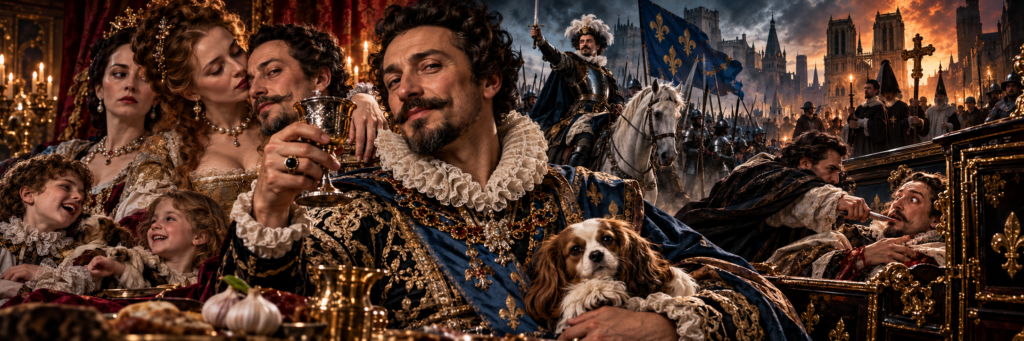
Henry IV of France: The Womanizing King, His Dangerous Obsessions, and the Assassin Who Ended His Reign
King of Navarre, 1572–1610 | King of France, 1589–1610
On the afternoon of May 14, 1610, a royal carriage became trapped in the narrow, congested streets of Paris. Inside sat Henry IV, the first Bourbon king of France, a man who had survived decades of religious warfare, political conspiracies, attempted assassinations, and bitter struggles for his crown. He had defeated powerful enemies, changed his religion to secure his throne, and helped restore a kingdom devastated by generations of civil war. Yet his enemies had never stopped watching him. To some Catholics, he remained a Protestant heretic masquerading as a faithful son of the Church. To some Protestants, he was a traitor who had abandoned the religion of his upbringing for political advantage. Even within his own court, where mistresses competed for influence and ambitious nobles plotted against one another, loyalty could be uncertain.
The king was traveling through the Rue de la Ferronnerie when his carriage was forced to slow almost to a standstill. A man emerged from the crowd, approached the exposed side of the vehicle, and struck with a knife. The attacker was François Ravaillac, a Catholic fanatic who had become convinced that Henry threatened the religious future of France. The first blow wounded the king, and another penetrated his chest, inflicting a fatal injury. Within moments, the monarch who had survived so many battlefields and conspiracies lay dying in his carriage. His assassination ended a reign that had brought France a measure of stability few would have thought possible twenty years earlier.
Henry IV was one of the most remarkable and contradictory rulers in French history. Remembered affectionately as Le Bon Roi Henri, or Good King Henry, he was also known as Le Vert Galant, the gallant lover whose appetite for romantic adventures became almost as famous as his political achievements. He could be charming, approachable, generous, and unexpectedly informal, but he could also be manipulative, unfaithful, politically ruthless, and dangerously impulsive when pursuing women. His court was a battlefield of jealous mistresses, competing families, illegitimate children, and aristocrats who understood that intimacy with the king could bring wealth and influence. His religious conversions infuriated believers who regarded faith as a matter of eternal salvation rather than political negotiation, while his willingness to compromise with former enemies seemed suspicious to those who had spent their lives fighting them.
His eccentricities added another dimension to his reputation. Henry preferred relatively informal clothing, enjoyed the company of soldiers and ordinary people, and displayed a physical familiarity that contrasted with the increasingly elaborate etiquette of European monarchy. Later anecdotes portrayed him as a king who rarely washed, consumed astonishing quantities of garlic, wandered through Paris without adequate protection, and sometimes preferred playing with his children to maintaining royal dignity. Some of these stories preserve recognizable elements of his personality, while others have been exaggerated through centuries of repetition. The distinction matters because Henry’s reputation became surrounded by colorful anecdotes that are often repeated more confidently than the evidence allows.
Unlike Charles VI of France, whose recurring episodes of severe mental disturbance were documented by contemporaries, Henry IV is not known to have suffered from a comparable psychiatric illness. His inclusion among supposedly mad monarchs rests instead upon the accusations of religious enemies, the apparent recklessness of certain political decisions, and a private life that repeatedly threatened to disrupt his public responsibilities. His romantic pursuits could become politically embarrassing, his willingness to change religious allegiance offended deeply held convictions, and his informal behavior sometimes appeared unsuitable for a sovereign. Yet these contradictions belonged to a ruler whose political judgment was frequently effective and whose achievements were substantial.
Henry IV’s story is therefore not that of a clinically insane king destroying his kingdom through delusion. It is the story of a shrewd survivor whose extraordinary appetites, dangerous relationships, and unconventional decisions existed alongside a remarkable talent for restoring political order. He helped end the French Wars of Religion, strengthened royal government, and laid foundations upon which the Bourbon monarchy would build. Nevertheless, he could never completely escape the hatred produced by France’s religious divisions. The same king who had learned to compromise in order to survive was ultimately murdered by a man who believed compromise itself was intolerable.
A Prince Raised Between Two Religions
Henry was born on December 13, 1553, at Pau, in the Kingdom of Navarre, to Antoine de Bourbon and Jeanne d’Albret. His family occupied a complicated position within European politics, possessing important connections to the French royal dynasty while ruling a kingdom whose territories had been greatly reduced by Spanish conquest. Jeanne became one of the most prominent Protestant rulers in Europe, and her religious convictions shaped Henry’s upbringing. His father, Antoine, moved between Catholic and Protestant interests before dying in 1562, leaving his son to grow up within a family already divided by the religious conflicts that would dominate France. Henry’s childhood therefore offered little opportunity to regard religion as a purely private matter. Faith determined political alliances, marriage prospects, military loyalties, and the legitimacy of rulers.
Later tradition portrays Henry’s upbringing in Béarn as unusually rugged for a prince. According to familiar stories, his grandfather encouraged a relatively hardy childhood, exposing him to country life and discouraging excessive luxury. Some accounts emphasize plain food, outdoor exercise, and the development of a practical temperament that distinguished Henry from more ceremonious French courtiers. Such anecdotes contributed to his later image as an approachable monarch who understood ordinary people, although their most picturesque details should not be accepted without qualification. What is clear is that Henry became an experienced horseman, soldier, and political survivor whose manner often contrasted with the rigid expectations of royal ceremony. He was capable of adapting his behavior to different social environments, a skill that would prove valuable during years of warfare and uncertain alliances.
Jeanne d’Albret’s Protestantism placed Henry within the growing Huguenot movement, whose supporters sought religious freedom and protection against Catholic persecution. France’s religious divisions became increasingly violent during his childhood, culminating in the outbreak of civil war in 1562. Powerful noble families competed for influence, while successive royal governments struggled to contain conflicts between Catholic and Protestant communities. Henry’s family connections made him politically important long before he possessed significant independent authority. As a Bourbon prince descended from the Capetian royal line, he also stood within the broader succession to the French crown. Few could have predicted how important that position would become, but the repeated deaths of Valois princes would eventually bring him within reach of the throne.
In June 1572, Jeanne died while preparing for Henry’s marriage to Marguerite de Valois, the sister of King Charles IX. Her death made Henry king of Navarre at the age of eighteen. The marriage, arranged partly to encourage reconciliation between Catholics and Protestants, was celebrated in Paris in August 1572. It brought prominent Protestant nobles into a predominantly Catholic capital at a moment of intense political suspicion. Within days, the wedding celebrations would be overshadowed by one of the most notorious massacres in European history. Henry’s survival would depend upon his willingness to make a religious concession that many Protestants regarded as a betrayal.
The Wedding That Became a Bloodbath
The marriage of Henry of Navarre and Marguerite de Valois was intended to symbolize the possibility of peace between France’s religious factions. Instead, it preceded the St. Bartholomew’s Day massacre, which began during the night of August 23–24, 1572. The violence followed an assassination attempt against Admiral Gaspard de Coligny, a leading Protestant commander whose influence at court alarmed powerful Catholic interests. Royal authorities moved against selected Huguenot leaders, but the killings expanded into a broader massacre involving armed groups and civilians. Thousands of Protestants died in Paris and in subsequent violence elsewhere in France, although historians continue to debate the total number of victims. The massacre shattered hopes of reconciliation and became a defining trauma in the history of French Protestantism.
Henry survived because his royal connections made his situation different from that of many Protestant nobles. He and his cousin Henry, Prince of Condé, were pressured into accepting Catholicism, allowing them to remain alive within a court that had become extraordinarily dangerous. The conversion was made under circumstances that raise obvious questions about religious freedom and sincerity. Henry remained under close supervision for several years, unable to act independently as a Protestant leader. His position was humiliating, but survival required accommodation with the forces controlling the French monarchy. The experience taught him a lesson that would become central to his political career: rigid declarations of principle could be fatal when powerful enemies controlled the circumstances in which those declarations were made.
Henry’s apparent willingness to change religious allegiance has often been reduced to a story of repeated conversions undertaken whenever political circumstances demanded them. The exact number depends upon how childhood religious arrangements, coerced declarations, and later public conversions are counted, so the familiar claim that he changed religion precisely five times should be treated cautiously. His religious identity was shaped by family circumstances, coercion, personal belief, and political calculation rather than by a simple sequence of voluntary changes. Nevertheless, contemporaries who regarded religious allegiance as sacred found his flexibility deeply troubling. Catholic extremists doubted the sincerity of his conversions, while some Protestants feared that he might abandon their cause whenever political advantage required it. These suspicions followed him throughout his life and eventually contributed to the hostility that made assassination a persistent danger.
In 1576, Henry escaped the restrictions of the French court and returned openly to Protestantism. He resumed a leading role among the Huguenots, building political and military alliances while attempting to preserve his position within the complicated world of French noble politics. His relationship with Marguerite became increasingly strained, reflecting both personal difficulties and the political tensions surrounding their marriage. The couple would spend long periods apart, and their union ultimately produced no children. Yet the marriage had served an important dynastic purpose, connecting Henry to the Valois family whose male line was approaching extinction. When the succession crisis finally arrived, those connections would become part of a struggle that threatened to tear France apart once again.
The Protestant Who Inherited a Catholic Kingdom
Henry’s path to the French throne opened dramatically in 1584, when Francis, Duke of Anjou, the younger brother of King Henry III, died without children. Under the traditional rules of succession, Henry of Navarre became the nearest legitimate male heir to the French crown. His Protestantism, however, made the prospect unacceptable to militant Catholics who feared that a Huguenot king would undermine the religious identity of France. The Catholic League, supported by powerful nobles and influential clergy, intensified its opposition to the succession. Henry, Duke of Guise, emerged as one of its most prominent leaders, challenging the authority of Henry III and presenting himself as a defender of Catholic interests. The resulting conflict became known as the War of the Three Henrys, a struggle involving the king, the Protestant heir, and the powerful Catholic duke.
The situation deteriorated further in December 1588, when Henry III ordered the assassination of the Duke of Guise at the Château de Blois. The killing provoked outrage among militant Catholics, who increasingly portrayed the king as a tyrant and betrayer of the faith. Paris became a center of resistance, and Henry III eventually formed an alliance with Henry of Navarre against the Catholic League. Their partnership was politically remarkable because it united a Catholic king with the Protestant prince whom many Catholics considered an unacceptable successor. Yet both men recognized that the League threatened the authority of the crown. The alliance represented a practical attempt to preserve monarchy against a faction whose ambitions had grown increasingly independent. Before the two could secure control of Paris, however, another assassination transformed the succession.
On August 1, 1589, the Dominican friar Jacques Clément stabbed Henry III at Saint-Cloud. The king died the following day, ending the male line of the Valois dynasty and leaving Henry of Navarre as his legitimate successor. The new Henry IV inherited the title of king, but he did not immediately possess the kingdom in any practical sense. Large portions of France rejected him, and Paris remained under the influence of the Catholic League. His Protestantism made his accession deeply controversial, while foreign powers, particularly Spain, had reasons to oppose his consolidation of authority. Henry therefore began his reign as a king forced to fight for recognition from many of the subjects he was legally entitled to govern. The crown had passed to him through hereditary succession, but military victory and political compromise would determine whether he could actually wear it.
A Crown Won Through War
Henry IV proved himself a capable military commander during the struggle to secure his throne. His victory at the Battle of Arques in September 1589 demonstrated that his smaller forces could resist larger Catholic League armies under favorable conditions. The following year, he achieved another important victory at Ivry, where his cavalry helped defeat the forces of the Duke of Mayenne. These successes strengthened his military reputation and weakened the League’s claim that he could be easily defeated. Yet victory in battle did not guarantee control of France, particularly when important cities remained hostile and foreign intervention continued. Henry faced the difficult task of converting military success into political acceptance. The challenge required patience, negotiation, and an understanding that religious allegiance could be more powerful than hereditary legitimacy.
Paris remained the greatest obstacle. The capital’s militant Catholic population rejected Henry’s Protestantism, and the city endured severe hardship during his siege in 1590. Hunger and disease devastated inhabitants as supplies dwindled, while the League maintained resistance and Spanish intervention helped prevent Henry from securing a decisive victory. The suffering exposed the human cost of the succession struggle, demonstrating that royal legitimacy could be defended or challenged through the starvation of civilians. Henry’s inability to take Paris by force encouraged him to consider a political solution that would remove the central objection to his rule. He had already survived one coerced conversion during the St. Bartholomew’s Day crisis, but the decision he faced in the early 1590s carried far greater consequences. He could remain Protestant and continue fighting for acceptance, or he could embrace Catholicism and potentially secure the allegiance of much of the kingdom.
In July 1593, Henry publicly converted to Catholicism at Saint-Denis. The decision transformed the political landscape because it deprived many moderate Catholics of their principal reason for rejecting him. His enemies did not immediately disappear, and some continued to question the sincerity of his faith, but the conversion made reconciliation more achievable. Henry entered Paris in March 1594, finally gaining control of the capital that had resisted him for years. His coronation had already taken place at Chartres in February, since Reims, the traditional coronation city, was not available to him. The sequence reflected the extraordinary circumstances of his accession, in which established ceremonies had to be adapted to political realities. Henry’s willingness to change religion proved decisive in securing his throne, but it also created a permanent vulnerability among those who believed that faith should never be subordinated to political necessity.
The phrase most famously associated with the conversion is “Paris is well worth a Mass.” It perfectly captures the image of Henry as a pragmatic ruler willing to make a religious concession in exchange for political stability. Unfortunately, the familiar wording is not securely documented as something he actually said, and historians generally treat it as a later attribution rather than an authenticated quotation. The sentiment nevertheless reflects the political logic of his decision. Henry understood that ruling France required more than military victory and that a Catholic majority would struggle to accept a Protestant sovereign. His conversion was therefore an act of statecraft, whether or not it also reflected sincere religious conviction. The distinction between political calculation and personal belief remains difficult to resolve because the surviving evidence cannot reveal his private faith with certainty.
The Edict of Nantes: Peace in a Kingdom That Had Forgotten It
By the late 1590s, Henry had made substantial progress toward restoring royal authority, but France remained exhausted by decades of warfare. Religious divisions continued to threaten stability, and Protestant communities feared renewed persecution despite the king’s former leadership of their cause. In April 1598, Henry issued the Edict of Nantes, establishing a framework for limited Protestant worship and civil rights within a predominantly Catholic kingdom. The edict did not create modern religious equality, nor did it establish unrestricted freedom of conscience in the contemporary sense. Catholicism retained its privileged position, while Protestant worship was permitted under specific conditions and in designated locations. Huguenots also received important legal protections and temporary security arrangements intended to reassure them against future violence. The settlement represented a pragmatic attempt to reduce conflict rather than a declaration that religious differences no longer mattered.
The edict angered extremists on both sides. Some Catholics regarded concessions to Protestants as an unacceptable compromise with heresy, while some Protestants remained suspicious of a king who had abandoned their religion to secure his throne. Henry understood that the settlement would satisfy neither faction completely, but he also recognized that continued warfare threatened the survival of the kingdom. His approach reflected a political philosophy shaped by experience rather than abstract tolerance alone. He had witnessed massacres, sieges, betrayals, and the destruction of communities, and he knew that France could not recover while religious conflict dominated government. The edict therefore became one of the most important achievements of his reign, even though its protections remained limited and vulnerable to future political changes. It helped create conditions in which economic recovery and administrative reform became possible.
The peace remained imperfect because the religious divisions of France could not be eliminated by royal decree. Catholic institutions continued to oppose aspects of the settlement, and Protestant communities remained conscious of their vulnerability. The king’s conversion also ensured that some opponents would always question his sincerity, regardless of his public religious observance. Henry’s position required him to defend Catholic monarchy while maintaining protections for a Protestant minority, a balance that demanded constant political attention. The very compromise that made his government successful also made him a target for those who believed that religious unity required coercion. His enemies could interpret moderation as weakness or betrayal, while supporters regarded it as necessary statecraft. The tension between these perspectives would remain unresolved throughout his life.
The Green Gallant: A King Ruled by Desire?
Henry’s romantic reputation became almost as famous as his military and political achievements. Known as Le Vert Galant, he cultivated relationships with numerous women, fathered several acknowledged illegitimate children, and repeatedly allowed personal attachments to intersect with court politics. His marriages were complicated by infidelity, competing family interests, and the ambitions of mistresses whose access to the king could produce extraordinary rewards. Contemporary observers recognized that royal mistresses were common within European courts, but Henry’s relationships attracted particular attention because of their frequency and political significance. His charm and informality made him attractive to some admirers, while his behavior could be deeply humiliating to the women expected to accommodate his affairs. The resulting scandals provided enemies with opportunities to portray him as morally undisciplined and incapable of controlling his desires. Yet the most serious consequences arose when romantic attachments began influencing questions of succession, diplomacy, and political patronage.
Henry’s relationship with Gabrielle d’Estrées became one of the most important romantic and political connections of his reign. Gabrielle entered his life during the struggle to secure the French crown and eventually became his principal mistress, enjoying considerable influence and receiving important titles and rewards. She bore him several children, including César, whom Henry acknowledged and later made Duke of Vendôme. Her position at court became increasingly prominent, and Henry’s attachment to her created speculation that he might attempt to marry her after obtaining an annulment of his marriage to Marguerite de Valois. Such a marriage would have been politically controversial because Gabrielle lacked the dynastic standing expected of a French queen, while the legitimacy of their children would have raised complicated succession questions. The king’s affection therefore became entangled with the future of the Bourbon dynasty. His private desires threatened to influence one of the most important decisions a monarch could make.
Gabrielle’s death in April 1599 transformed the situation. She died while pregnant, following a sudden illness that later generated rumors of poisoning and political intrigue. Contemporary uncertainty surrounding her death encouraged speculation, particularly because her possible marriage to Henry had become a matter of intense interest. Nevertheless, there is no reliable basis for presenting poisoning as established fact, and complications associated with pregnancy have long been considered a plausible explanation. Her death removed the immediate possibility of a controversial royal marriage, allowing Henry’s advisers to pursue a dynastically advantageous union. The episode illustrates how personal tragedy could alter the political future of a monarchy. Henry lost a woman to whom he was strongly attached, while the court gained an opportunity to secure a marriage more acceptable to European diplomatic interests.
The relationship also complicates the image of Henry as a ruler whose romantic attachments were entirely irrational. Gabrielle possessed political intelligence and became associated with networks of patronage that supported the king’s government. Her influence was not simply the result of physical attraction, although her privileged position depended upon Henry’s affection. Royal mistresses could act as intermediaries, distribute favors, and strengthen alliances, making their roles politically significant even when they lacked formal office. The danger arose when personal attachment threatened to override dynastic calculations or alienate influential families. Henry’s willingness to contemplate marriage to Gabrielle demonstrated the potential conflict between emotional desire and the expectations of monarchy. His eventual marriage to Marie de’ Medici would resolve some of these problems, but it would introduce new tensions into an already complicated household.
Marie de’ Medici: The Queen Who Had to Share Her Husband
Henry married Marie de’ Medici in 1600, establishing an alliance with the powerful Medici family of Florence and securing important financial and diplomatic advantages. The marriage offered the prospect of legitimate heirs, an urgent concern after years of dynastic uncertainty. Marie arrived in France as a young queen expected to produce children and occupy a position of dignity within a court already shaped by the influence of Henry’s mistresses. Their relationship soon became troubled by jealousy, competing expectations, and the king’s continued romantic pursuits. Marie was not simply a passive victim of court scandal, since she possessed political ambitions, family connections, and a strong sense of her royal position. Nevertheless, her marriage placed her in a difficult situation because Henry expected her to tolerate arrangements that repeatedly challenged her authority and dignity. The resulting domestic conflicts became a persistent feature of the Bourbon court.
The birth of their son Louis in September 1601 secured the immediate succession and strengthened the new dynasty. Additional children followed, including the future Henrietta Maria, who would become queen consort of England. The legitimate royal household now possessed the heirs necessary to establish Bourbon continuity, but Henry continued acknowledging and supporting children born to his mistresses. This created an unusually complicated family environment in which legitimate and illegitimate offspring occupied overlapping social worlds. The king’s affection for his children appears to have been genuine, and he sometimes encouraged relationships among them despite differences in legal status. Yet the arrangements also created opportunities for rivalry among mothers, relatives, and court factions seeking influence through royal offspring. Marie’s resentment was therefore connected not only to personal humiliation but also to the political implications of competing family networks.
Stories about Henry’s domestic life frequently emphasize the apparent chaos produced by his attempts to combine different branches of his family. Later writers sometimes describe a household in which legitimate and illegitimate children were raised together without distinction, while Marie was forced to accept the presence of her husband’s offspring from other relationships. The reality was more complicated because royal children possessed different legal statuses, households, attendants, and expectations. Some were brought into contact with one another, and Henry took an active interest in several of them, but the claim that all his children lived permanently under one roof as a single harmonious family exaggerates the evidence. The political significance of these relationships remained considerable because the mothers and relatives of acknowledged children could obtain favors and influence. Henry’s attempts to manage affection and patronage within an extended family did not eliminate the tensions created by his infidelity. Instead, they ensured that domestic relationships remained closely connected to the politics of the court.
Henriette d’Entragues: Promises, Jealousy, and a Dangerous Mistress
Among the women who complicated Henry’s marriage was Henriette d’Entragues, who became his mistress after Gabrielle d’Estrées died. Henry’s relationship with Henriette was marked by intense attraction, political ambition, and disputes over promises allegedly made before his marriage to Marie de’ Medici. He had provided Henriette with a written promise of marriage under specified conditions, an extraordinary concession that later created serious difficulties. When Henry married Marie, Henriette and her family retained grounds for resentment, and the relationship became entangled with court intrigue. Her relatives sought influence and advantages, while the king attempted to maintain control over a situation partly created by his own imprudence. The affair demonstrated how romantic promises could become political liabilities when made by a sovereign whose marriage affected international alliances and dynastic legitimacy. Henry’s willingness to place such commitments in writing revealed a dangerous disregard for their potential consequences.
Henriette’s family became associated with conspiratorial activity, including intrigues involving foreign interests and questions surrounding the succession. Her father, François de Balzac d’Entragues, and other relatives became implicated in plots that threatened royal authority. The exact extent of Henriette’s own involvement in every alleged conspiracy remains a matter requiring careful distinction, but the political danger surrounding her family was real. Henry’s relationship with her therefore became more than an embarrassing affair. It created opportunities for ambitious individuals to exploit personal access to the king and challenge the stability of his household. His attempts to preserve the relationship while controlling its consequences exposed the limitations of even a politically experienced monarch when personal desire interfered with judgment. The scandal also intensified the hostility between Marie de’ Medici and the women who competed for Henry’s attention.
Later anecdotes portray Henriette as openly insulting Henry’s appearance, habits, and personal hygiene. One familiar story claims that she compared his smell to carrion, contributing to his reputation as an exceptionally unwashed monarch. Such quotations are difficult to authenticate, and the precise wording should not be presented as securely documented speech. Nevertheless, the existence of hostile exchanges and tensions within Henry’s romantic relationships is consistent with the broader evidence of court conflict. Mistresses could possess considerable influence, but their positions remained vulnerable to changes in royal affection and political circumstance. Their families might gain wealth and status while also risking disgrace if the relationship deteriorated. Henriette’s career illustrates the dangerous mixture of intimacy, ambition, and uncertainty that surrounded Henry’s private life.
The King Who Supposedly Smelled Like a Corpse
Henry IV’s personal hygiene has become the subject of some of the most colorful anecdotes in French royal history. Popular accounts portray him as a monarch who rarely bathed, wore dirty clothing for extended periods, and possessed an overpowering body odor that offended even those closest to him. His preference for relatively informal dress and his experience as a soldier helped create an image of rugged masculinity that contrasted with the elaborate grooming of other European rulers. Later stories claim that his wives and mistresses complained about his smell, sometimes using extraordinarily vivid comparisons. These anecdotes have become so familiar that Henry is occasionally described as one of the dirtiest monarchs in European history. Yet such rankings are modern inventions rather than meaningful historical assessments, and the most sensational details often lack reliable contemporary documentation.
Early modern European hygiene differed significantly from modern expectations, but the common claim that people avoided all washing is misleading. Bathing practices varied according to region, social class, medical beliefs, and individual circumstances, while washing with water, changing linen, using perfumes, and maintaining personal cleanliness remained familiar activities. Some physicians warned against particular forms of immersion because they believed that opened pores could expose the body to disease, but this did not mean that everyone rejected hygiene. Henry’s military lifestyle may have made him less concerned with elaborate grooming than certain courtiers, yet the claim that he almost never washed cannot be established simply through later anecdotes. His reputation for strong odors may preserve genuine observations, but the precise frequency of bathing and changing clothes remains uncertain. Historical accuracy requires distinguishing an informal personal style from the exaggerated image of a king who deliberately cultivated filth.
The story that Marie de’ Medici nearly fainted from Henry’s smell on their wedding night belongs to this tradition of sensational domestic anecdotes. Similar accounts claim that she carried perfumed handkerchiefs to protect herself from his odor or that Marguerite de Valois complained about his feet and armpits. Such stories are memorable because they reduce royal grandeur to an intimate and embarrassing physical detail. Nevertheless, their specific wording and circumstances are not securely established by reliable evidence, and they should not be repeated as documented events without qualification. They may reflect later efforts to emphasize the contrast between Henry’s rough manner and the refined expectations of his wives. The image also suited his popular reputation as a king who preferred soldiers, hunting, and practical affairs to excessive courtly ceremony. What survives is a mixture of plausible personal habits, hostile commentary, and anecdotal embellishment.
Another frequently repeated claim concerns Henry’s supposed anger when a mistress washed herself before meeting him. According to the story, he preferred natural bodily odors and believed that bathing removed something essential to sexual attraction. Variations of this anecdote have circulated in connection with several historical figures, making its attribution to Henry particularly uncertain. It is therefore inappropriate to treat the incident as a verified expression of his personal preferences. The broader reputation for sensuality is well established, but individual stories about intimate behavior require stronger evidence than repetition in popular histories. Henry’s private life was sufficiently scandalous without relying upon every colorful anecdote attached to his name. His documented relationships, marriage promises, acknowledged children, and political complications provide a more reliable foundation for understanding his conduct.
Garlic, Wine, and the Appetite of a Soldier-King
Henry’s reputation for garlic consumption became another element of his earthy public image. Garlic was widely used in French regional cooking and possessed associations with health, vigor, and ordinary rural life. The king’s connection to Béarn and his relatively informal habits made stories about garlic particularly attractive to later writers seeking to contrast him with refined courtiers. Some anecdotes portray him eating large quantities of raw garlic and possessing breath strong enough to overwhelm those nearby. Others invent elaborate daily menus in which nearly every meal contains garlic in some form. These details are difficult to substantiate, and there is no reliable basis for reconstructing his daily diet as a continuous succession of garlic cloves, omelets, and heavily seasoned bread. The stories reveal how his reputation for physical vigor and sensuality became associated with food as well as romantic behavior.
Garlic also possessed a long history of medicinal and aphrodisiac associations, making it an appealing detail in accounts of a king famous for his sexual pursuits. Early modern medicine attributed numerous properties to foods and herbs, often interpreting diet through theories of bodily balance and temperament. Henry may well have enjoyed garlic, but claims that he consumed extraordinary quantities specifically to enhance sexual performance remain speculative. The familiar image of a king whose breath could supposedly defeat an ox is a humorous exaggeration rather than a measurable historical observation. Such stories became part of the affectionate and sometimes mocking folklore surrounding him. They helped create the image of a vigorous, approachable monarch whose appetites were unmistakably human. Yet the difference between cultural reputation and documented personal behavior remains important when assessing the eccentricities attributed to him.
Henry’s eating and drinking habits also contributed to a broader contrast between his public persona and the ceremonial expectations of monarchy. He could present himself as a soldier accustomed to hardship, an accessible ruler comfortable with ordinary conversation, and a sovereign who valued practical results over excessive formality. These qualities strengthened his popularity among certain groups, especially when compared with the perceived extravagance of earlier courts. Nevertheless, the image should not obscure the luxury and political complexity of his own household. Henry remained a Renaissance monarch who distributed patronage, maintained court ceremonies, and understood the importance of magnificence in royal representation. His informality was one aspect of his political identity rather than proof that he rejected the privileges of kingship. The garlic stories, like the hygiene anecdotes, exaggerate a recognizable characteristic into a theatrical symbol.
The King Who Walked Among His Subjects
Henry IV cultivated a reputation for accessibility that distinguished him from monarchs who maintained greater ceremonial distance. His experience during years of campaigning had accustomed him to soldiers, provincial communities, and the practical realities of travel. He could speak directly with people outside the highest aristocratic circles, and later tradition celebrated his willingness to engage with ordinary subjects. Such behavior contributed to the affectionate image of Good King Henry, a ruler who supposedly understood the hardships of the population. His political success depended partly upon rebuilding trust after decades of warfare, making personal accessibility a valuable asset. Yet the familiar stories of Henry wandering anonymously through Paris, drinking in taverns, gambling with commoners, and collecting unfiltered opinions require careful scrutiny. Some may reflect genuine habits, while others belong to the folklore that developed around his reign.
The idea of a monarch traveling incognito was not unique to Henry. European rulers sometimes used informal journeys, disguises, or reduced entourages for practical or political purposes, and such episodes could later become the subject of entertaining stories. Henry’s military background and approachable manner made him a particularly suitable figure for these narratives. Nevertheless, the claim that he routinely abandoned his guards and wandered through dangerous streets without protection is difficult to reconcile with the serious security concerns surrounding his reign. He faced genuine assassination threats, and royal movements were politically sensitive events. His final journey through Paris demonstrated that even a king traveling in a carriage with attendants could remain vulnerable. It would therefore be misleading to portray him as habitually reckless on the basis of stories whose frequency and details cannot be securely established.
The popularity of these anecdotes reflects the political importance of Henry’s relationship with his subjects. After decades of religious warfare, France needed a monarchy capable of presenting itself as a source of order rather than another faction in an endless conflict. Henry’s informal style helped support that image, especially when combined with policies intended to encourage economic recovery. His reputation for speaking plainly and showing personal interest in ordinary concerns became central to later celebrations of his reign. The stories may exaggerate individual incidents, but they preserve a broader perception of a king whose public identity differed from that of more distant or ceremonious rulers. Henry’s accessibility was not necessarily evidence of irrational behavior. It could also be understood as a political strength, allowing him to communicate authority through familiarity rather than intimidation alone.
The Father Who Became a Horse for His Children
Among the most affectionate stories about Henry IV is the account of an ambassador discovering the king on all fours while his children rode upon his back. The anecdote portrays Henry as an unusually playful father who refused to abandon domestic affection merely because he wore a crown. Versions of the story often emphasize the surprise of a foreign dignitary encountering a monarch behaving in a manner considered undignified by conventional court standards. The incident has become a symbol of Henry’s approachable personality and his willingness to cross the boundaries separating royal authority from ordinary family life. Yet the precise details, including the identity of the observer and the wording of any exchange, vary across retellings. It is therefore safer to treat the familiar scene as a traditional anecdote rather than a fully authenticated transcript of a specific encounter. Its enduring popularity reveals the qualities later generations wished to associate with Good King Henry.
Henry’s affection for his children is supported by the broader record of his family relationships, although the surviving evidence does not permit a complete reconstruction of his daily parenting. He acknowledged several illegitimate children and took an interest in their upbringing and advancement, while his legitimate offspring secured the future of the Bourbon dynasty. His willingness to maintain relationships with children from different mothers created complicated arrangements within the royal household. Such involvement could be interpreted as generosity and affection, but it also produced tensions because the children’s legal positions and political prospects differed considerably. Their mothers and relatives possessed competing interests, making family life inseparable from court politics. Henry’s desire to provide for his offspring therefore operated within a system where affection, inheritance, and patronage were closely connected. The resulting household was not simply a cheerful gathering of children, but a politically sensitive network of relationships.
The contrast between Henry’s playful reputation and the rigid expectations of monarchy became especially striking in later historical memory. A king who could crawl on the floor with his children appeared refreshingly human when compared with rulers remembered for cruelty, arrogance, or excessive ceremony. Yet the anecdote also served a political purpose by presenting Henry as the affectionate father of a restored nation. His paternal image complemented the broader legend of a monarch who wanted ordinary French families to enjoy peace and prosperity. This symbolism became particularly important after his assassination, when nostalgia for his reign encouraged idealized accounts of his character. The historical Henry was capable of tenderness, but he was also a ruler whose infidelities caused considerable suffering within his family. His domestic life contained affection and conflict in equal measure, making the sentimental image incomplete without the scandals that accompanied it.
The Betrayal of the Duke of Biron
Henry’s personal relationships were not limited to romantic entanglements, and some of the most dangerous betrayals of his reign involved men who had once served him loyally. Charles de Gontaut, Duke of Biron, was an experienced military commander whose career had been closely connected to Henry’s rise to power. He had fought in important campaigns and received substantial honors, becoming one of the most prominent figures within the royal military establishment. Yet his ambitions and grievances eventually drew him into conspiratorial activity involving foreign interests and opposition to the king. The circumstances revealed the continuing danger posed by powerful nobles whose personal loyalties could change when their expectations were frustrated. Henry’s success in restoring royal authority had not eliminated aristocratic ambition or the possibility of treason. The monarchy remained dependent upon men whose military resources and regional connections gave them considerable influence.
Biron was arrested in 1602 and brought to trial on charges of treason. Evidence of his involvement in conspiratorial dealings with foreign powers contributed to his conviction, and he was executed at the Bastille in July of that year. The decision demonstrated Henry’s willingness to punish a former associate whose conduct threatened the security of the state. It also revealed the limits of personal friendship within a monarchy struggling to consolidate authority after civil war. Henry had rewarded Biron generously, but those rewards had not guaranteed loyalty. The execution sent a warning to other nobles that military service and personal familiarity with the king would not necessarily protect them from punishment. It was a harsh decision, yet it reflected recognizable concerns about sovereignty rather than an irrational outburst. Henry understood that allowing powerful commanders to negotiate independently with foreign enemies could endanger the fragile peace he had worked to establish.
The Biron affair contributed to the atmosphere of suspicion surrounding the royal court. Henry had survived years of warfare and political intrigue, and the discovery that a prominent former supporter could become involved in conspiracy reinforced the dangers of misplaced trust. Yet the familiar claim that he developed severe paranoia should be approached cautiously. A ruler facing genuine conspiracies had practical reasons to investigate threats and monitor the loyalty of powerful nobles. Suspicion does not establish psychiatric illness when the dangers are real and documented. Henry’s political environment required vigilance, particularly because foreign powers remained interested in influencing French affairs. The betrayal of Biron therefore illustrates the precarious nature of royal authority rather than proving that the king suffered from a pathological fear of everyone around him.
A Kingdom Rebuilt: Sully, Money, and the Work of Recovery
Henry’s reputation as a successful ruler rests partly upon the economic and administrative recovery that followed the worst years of religious warfare. Decades of conflict had damaged agriculture, disrupted trade, burdened communities with taxation, and weakened the authority of central government. Restoring stability required more than military victory, because the kingdom needed functioning institutions capable of collecting revenue, maintaining infrastructure, and encouraging productive activity. Henry relied upon experienced advisers, particularly Maximilien de Béthune, Duke of Sully, whose financial and administrative work became closely associated with the reign. Sully sought to improve the management of royal revenue, reduce waste, and strengthen the resources available to the crown. Their collaboration contributed to a broader effort to restore order after years of destruction. The achievements were substantial, although later celebrations sometimes exaggerated the speed and completeness of the recovery.
Agriculture occupied an important place in the government’s priorities because the prosperity of rural communities underpinned much of the French economy. Henry’s reign became associated with the idea that ordinary families should enjoy sufficient food and security, a theme later expressed through the famous tradition of a chicken in every pot. The exact wording and circumstances of that supposed promise are uncertain, and the familiar quotation should not be treated as a securely documented royal declaration. Nevertheless, the sentiment reflects the image of Henry as a ruler concerned with material recovery rather than endless warfare. His government encouraged improvements in infrastructure, supported commercial activity, and attempted to stabilize royal finances. These efforts helped strengthen the monarchy and provided foundations for later Bourbon administration. The contrast between Henry’s practical achievements and his scandalous private life became one of the central contradictions of his reign.
The recovery remained uneven, and many French communities continued to experience poverty, taxation, and local tensions. Royal finances were not transformed overnight, and the government still faced the costs of maintaining military strength and managing powerful nobles. Nevertheless, the relative peace following the settlement of the religious wars created opportunities that had been unavailable during decades of conflict. Henry’s ability to work with capable ministers demonstrated administrative judgment that does not fit the caricature of a monarch governed entirely by impulse. His romantic pursuits could produce serious political complications, but they did not prevent him from recognizing the importance of economic stability. The achievements of the reign therefore require a balanced interpretation. Henry was neither an infallible national savior nor an irrational libertine, but a ruler capable of effective government despite significant personal weaknesses.
Charlotte de Montmorency: The Teenage Noblewoman Who Nearly Became an International Crisis
The most disturbing romantic scandal of Henry’s final years involved Charlotte-Marguerite de Montmorency, a young noblewoman whose beauty attracted the attention of the aging king. Born in 1594, Charlotte was still in her teens when Henry became interested in her, creating a striking imbalance between a powerful monarch in his mid-fifties and a girl whose marriage prospects were controlled by aristocratic and royal interests. Henry arranged for her marriage to Henri II de Bourbon, Prince of Condé, a young nobleman who was also a distant relative of the king. The marriage took place in 1609, but the king’s continued pursuit of Charlotte created immediate difficulties. Condé became increasingly concerned about Henry’s intentions and the humiliation that might follow if the king attempted to establish a sexual relationship with his wife. The situation was politically dangerous because the prince belonged to the Bourbon family and possessed dynastic significance. Henry’s personal attraction therefore threatened to create conflict within the very dynasty he had worked to establish.
Condé eventually removed Charlotte from the king’s immediate reach, and the couple fled to territories under Habsburg influence. Their departure transformed a court scandal into an international diplomatic problem because it involved a French prince seeking protection beyond the king’s authority. Henry demanded their return and became involved in negotiations and political pressure intended to resolve the situation. His conduct appeared humiliating for a sovereign whose government had otherwise demonstrated considerable diplomatic skill. The spectacle of an aging king pursuing a teenage noblewoman while her husband sought refuge abroad provided enemies with material for ridicule. Yet the affair cannot be understood solely as a romantic comedy or an amusing example of royal eccentricity. Charlotte’s position was constrained by the decisions of powerful men, while her marriage became entangled with the personal desires of a monarch capable of exercising enormous influence over her future.
The scandal coincided with growing tensions between France and the Habsburg powers, particularly over the succession dispute involving the duchies of Jülich and Cleves. Henry’s government was preparing military intervention in a conflict with significant implications for the European balance of power. Later accounts sometimes suggest that the king was willing to launch a continental war merely to recover Charlotte, presenting his romantic obsession as the principal cause of military preparations. That interpretation exaggerates the evidence because the Jülich-Cleves crisis involved longstanding strategic concerns about Habsburg influence and the security of France’s allies. Henry’s pursuit of Charlotte complicated diplomatic relations and created personal embarrassment, but it was not the sole explanation for his government’s military policy. The distinction is important because sensational stories can obscure the political circumstances in which personal scandals occurred. Henry’s behavior was reckless and potentially damaging, yet the international crisis had causes extending far beyond his romantic desires.
Charlotte’s experience also challenges the affectionate image of Henry as a charming womanizer whose pursuits were harmless expressions of vitality. His position as king gave him extraordinary power over the marriages and careers of aristocratic families, making refusal difficult and potentially dangerous. The young woman’s personal wishes are not fully recoverable from the surviving political correspondence, but the circumstances demonstrate the imbalance inherent in the relationship. Condé’s flight reflected genuine concern about the king’s conduct, and the resulting dispute threatened the dignity and independence of a prominent noble household. Henry’s actions therefore deserve criticism without resorting to unsupported psychiatric explanations. His pursuit of Charlotte revealed a failure to respect boundaries that had serious political consequences. It was an example of personal desire interfering with royal judgment, not evidence that he had lost contact with reality.
The Assassination Attempts That Haunted His Reign
Henry IV faced repeated threats from religious extremists, political conspirators, and individuals who regarded his accession as illegitimate. The danger was especially severe during the years when he remained a Protestant claimant to a predominantly Catholic kingdom, but it did not disappear after his conversion. Some militant Catholics continued to regard him as a secret heretic whose public profession of Catholicism concealed an unacceptable past. Others resented his protection of Protestant communities under the Edict of Nantes, interpreting religious compromise as betrayal. Conspiracies and threats circulated through a political environment already accustomed to assassination as a means of resolving conflict. Henry therefore had practical reasons to maintain security and investigate suspicious activity. The claim that he survived precisely twenty or more documented attempts should be treated cautiously because historical lists often combine confirmed attacks, alleged plots, rumors, and threats of uncertain credibility.
One of the most serious early attacks occurred in December 1594, when Jean Châtel attempted to assassinate Henry in Paris. Châtel struck the king in the face, injuring his mouth rather than killing him. The attack intensified concerns about militant religious influences and contributed to political action against the Jesuits, who were expelled from France in 1595 before eventually being readmitted. The relationship between individual assassins, religious education, and organized conspiracy was fiercely contested, and accusations against religious institutions were often shaped by political hostility. Nevertheless, the attack demonstrated that Henry remained vulnerable even after gaining control of Paris. His conversion had not convinced every opponent that he was a legitimate Catholic monarch. The incident also revealed how quickly an assassination attempt could become part of a wider struggle over religious authority and political responsibility.
The repeated threats contributed to an atmosphere in which predictions of Henry’s death and rumors of conspiracies acquired considerable influence. Early modern Europe possessed a rich culture of prophecy, astrology, religious visions, and apocalyptic interpretation, and political crises encouraged people to search for signs of approaching catastrophe. Stories circulated about warnings that the king would be murdered, some of which became more elaborate after his death. Such accounts should not be treated as evidence that particular individuals accurately foresaw the assassination. Retrospective narratives often transformed vague warnings into apparently precise predictions once the outcome was known. Henry’s actual security concerns were serious enough without relying upon supernatural explanations. His enemies had already demonstrated their willingness to use violence, and the ideological hostility surrounding his reign made assassination a persistent possibility.
The Final Days: A King Preparing for War
By the spring of 1610, Henry was preparing for military intervention connected with the Jülich-Cleves succession crisis. The dispute threatened to expand Habsburg influence in a strategically important region of Europe, raising concerns among powers opposed to Spanish and imperial dominance. Henry’s government had developed plans to support interests resisting Habsburg expansion, and military preparations were underway. The situation was complicated by the Charlotte de Montmorency affair, which had created additional tension with Habsburg-controlled territories. Nevertheless, the strategic dispute cannot be reduced to the king’s personal romantic frustration. France possessed broader diplomatic interests that made intervention plausible regardless of the scandal. Henry’s final political decisions therefore combined genuine concerns about European power with the personal complications that had become characteristic of his court.
On May 13, 1610, Marie de’ Medici was crowned queen at Saint-Denis, an event that acquired particular significance after the assassination the following day. The coronation strengthened her ceremonial position and helped prepare for the possibility that she might exercise authority during the king’s absence on campaign. Henry had legitimate heirs, but his eldest son Louis was still a child, making arrangements for government essential if the king departed. The ceremony was therefore connected to practical dynastic concerns rather than simply to domestic reconciliation. Later accounts sometimes portray Henry as unusually anxious during these final days, haunted by warnings or convinced that death was approaching. Such stories must be evaluated carefully because knowledge of the assassination encouraged later writers to interpret ordinary remarks as prophetic. The surviving record establishes the political preparations and the coronation, but not every dramatic premonition attributed to the king.
The atmosphere remained tense because Henry’s military plans, religious policies, and personal scandals had created numerous enemies. Radical Catholics continued to distrust him, while political opponents could interpret his preparations as a threat to the European religious balance. The king had survived previous attempts on his life, but familiarity with danger did not guarantee protection. His movements through Paris remained vulnerable to the practical limitations of early modern security, particularly in narrow streets crowded with people and vehicles. The final journey of May 14 would expose those weaknesses with devastating consequences. Henry’s assassination would later be surrounded by rumors of conspiracy, foreign involvement, and prophetic warnings, but the immediate event was brutally simple. A determined attacker gained access to a royal carriage and struck before the king could be protected.
François Ravaillac: The Man Who Believed Murder Was a Sacred Duty
François Ravaillac was born in Angoulême and developed intense religious convictions shaped by the militant Catholic environment of his time. His life included difficulties associated with religious aspirations, personal instability, and attempts to find a place within religious institutions. Later descriptions frequently characterize him as delusional or mentally disturbed, but retrospective psychiatric diagnosis is uncertain and should not be presented as established fact. What is clear is that Ravaillac believed Henry’s policies threatened the Catholic faith and that he came to regard violence against the king as justified. His motives were connected to the religious conflicts that had dominated France for decades, particularly hostility toward Protestantism and suspicion of the king’s intentions. The atmosphere of militant preaching and political denunciation helped create conditions in which such beliefs could become dangerous. Ravaillac’s actions demonstrated the lethal consequences of treating religious disagreement as a justification for murder.
On May 14, Ravaillac approached Henry’s carriage in the Rue de la Ferronnerie as traffic slowed its movement. The narrow street and congestion provided an opportunity for an attacker to reach the vehicle. Ravaillac climbed toward the carriage and stabbed the king, delivering the fatal wounds that ended his life. The attack occurred in public, and the assassin was immediately seized. Henry’s death shocked the court and created an urgent succession crisis, although the existence of a legitimate heir prevented the dynastic uncertainty that had accompanied the death of Henry III. The crown passed to the young Louis XIII, while Marie de’ Medici assumed the regency. The assassination therefore ended Henry’s personal rule but did not extinguish the Bourbon dynasty he had established. His political achievements would survive him, although the government faced new challenges under a child king.
Ravaillac was interrogated and subjected to torture as authorities attempted to determine whether he had acted alone or participated in a wider conspiracy. The investigation produced intense speculation, particularly because foreign powers and domestic opponents had reasons to resent Henry’s policies. Nevertheless, no definitive evidence established that a broader organized conspiracy directed the assassination. Ravaillac maintained responsibility for the act, and the surviving evidence does not justify treating every later allegation of foreign involvement as fact. His execution in Paris on May 27, 1610, was extraordinarily brutal, reflecting the punishment reserved for regicide under the French monarchy. He was publicly tortured and subjected to dismemberment, a spectacle intended to demonstrate the consequences of attacking the sacred person of the king. The violence of the punishment revealed the monarchy’s determination to defend its authority, even as the assassination had exposed the limits of royal protection.
The contrast between Henry and Ravaillac is one of the most disturbing elements of the story. Henry had spent much of his reign attempting to reduce religious conflict through compromise, while Ravaillac believed that compromise endangered the faith. The king’s policies were imperfect and did not establish complete religious equality, but they represented an effort to prevent the return of large-scale civil war. His assassin rejected that approach, interpreting the monarch’s tolerance of Protestant communities as a reason for violence. The murder therefore demonstrated the persistence of religious extremism despite years of political settlement. It also exposed the vulnerability of a ruler whose legitimacy remained contested by individuals unwilling to accept the compromises necessary for peace. Henry’s death became a symbol of the dangers that religious fanaticism continued to pose to the French monarchy.
The Making of Good King Henry
Henry IV’s reputation changed significantly after his assassination. During his lifetime, he had been criticized for religious conversions, infidelity, political compromises, and the privileges granted to his mistresses and illegitimate children. His enemies questioned his sincerity and legitimacy, while even supporters sometimes struggled to defend his private behavior. After his death, however, memories of the religious wars and the achievements of his reign encouraged a more affectionate interpretation. He became increasingly associated with peace, prosperity, accessibility, and concern for ordinary subjects. Stories about his informal manners, practical wisdom, and affection for children helped construct the image of a benevolent monarch whose personal weaknesses were overshadowed by his public accomplishments. The legend of Good King Henry gradually became one of the most enduring royal images in French history.
The process of idealization was not immediate or uniform, and later generations interpreted Henry according to their own political circumstances. Bourbon rulers could celebrate him as the founder of their dynasty, while writers interested in religious tolerance emphasized the Edict of Nantes. Popular tradition transformed his concern for economic recovery into memorable anecdotes about food, prosperity, and the welfare of peasants. His romantic scandals became part of a colorful personality rather than proof of moral corruption, while his informality was reinterpreted as evidence of genuine affection for the French people. The same characteristics that enemies had once used to ridicule him could now support an image of approachable kingship. His assassination intensified this transformation because a ruler killed by a fanatic could be remembered as a victim of the religious hatred he had attempted to contain. The resulting legend preserved important truths about his achievements while simplifying the contradictions of his life.
The affectionate reputation should not obscure the limitations of his reign. France remained a monarchy structured by privilege, inequality, and coercive authority, while the Edict of Nantes provided restricted rather than universal religious freedom. Henry’s military campaigns and political decisions imposed burdens upon communities, and his romantic pursuits could create serious difficulties for the women and families involved. His government strengthened royal power, a development that would have complicated consequences under later Bourbon rulers. Nevertheless, his achievements were substantial when measured against the devastation he inherited. He helped restore political stability, reduced the scale of religious warfare, and supported economic recovery after decades of conflict. His reign therefore deserves recognition without requiring the creation of an idealized monarch free from personal failings.
Was Henry IV Mad? Recklessness, Desire, and the Limits of Historical Diagnosis
Henry IV’s inclusion among supposedly mad monarchs requires a clear distinction between psychiatric illness and behavior that contemporaries considered scandalous, dangerous, or morally unacceptable. There is no convincing evidence that he suffered from the recurring psychosis associated with Charles VI, nor is there a reliable basis for diagnosing him with a modern psychiatric condition. His religious conversions were politically controversial, but they occurred within circumstances where survival and legitimacy depended upon religious allegiance. His romantic pursuits could be reckless and exploitative, particularly in the Charlotte de Montmorency affair, but they do not establish clinical delusion. His informal manners and affectionate parenting challenged expectations of royal dignity without demonstrating psychological instability. Even his reputation for poor hygiene and excessive garlic consumption rests partly upon anecdotes whose details cannot be securely verified. The historical record supports a complex personality, not a definitive medical diagnosis.
His enemies had powerful reasons to portray him as morally corrupted or dangerously unprincipled. Militant Catholics questioned his conversion and suspected that he remained secretly attached to Protestantism, while some Protestants resented his abandonment of their faith. Aristocratic rivals exploited his romantic scandals, and foreign powers watched his policies with concern. Accusations of madness or irrationality could serve political purposes by undermining confidence in his judgment and legitimacy. Yet Henry’s actual record demonstrates considerable political intelligence, particularly in his ability to survive civil war, secure the throne, negotiate religious settlement, and rebuild royal government. His successes do not excuse his personal misconduct, but they complicate any portrayal of him as incapable of rational decision-making. A ruler could be effective in public affairs while behaving irresponsibly in private relationships. Henry IV embodied that contradiction more vividly than many of his contemporaries.
The distinction between historical criticism and psychiatric speculation is especially important when examining his treatment of women. His pursuit of Charlotte de Montmorency was troubling because of her youth, the imbalance of power, and the political pressure surrounding her marriage. His promises to Henriette d’Entragues created opportunities for intrigue, while his infidelity repeatedly humiliated Marie de’ Medici and complicated the royal household. These actions deserve scrutiny as exercises of power and failures of judgment rather than as symptoms of an invented mental disorder. Similarly, his willingness to acknowledge illegitimate children can be understood through the social and political structures of early modern monarchy. The resulting family arrangements were unusual in some respects, but they were not evidence of insanity. Henry’s private life reveals the consequences of royal privilege when personal desire encountered few effective restraints. That explanation is historically more persuasive than the suggestion that he was driven by uncontrollable madness.
The King Who Survived Everything Except His Own Kingdom’s Hatred
Henry IV entered French history as a Protestant prince whose claim to the throne seemed almost impossible to enforce. He survived the St. Bartholomew’s Day massacre, escaped the restrictions of the Valois court, commanded armies through years of civil war, and inherited a crown rejected by many of the people he was supposed to govern. He changed his religion to secure political acceptance, negotiated a settlement that reduced religious violence, and worked with capable ministers to restore a kingdom exhausted by decades of destruction. His achievements were extraordinary, but his personal life remained a source of scandal and danger. He pursued women with a persistence that could humiliate families and complicate diplomacy, maintained a household shaped by competing mistresses and children, and sometimes allowed desire to interfere with judgment. His reputation for informality, physical vigor, and earthy habits made him memorable, while later anecdotes exaggerated those qualities into a portrait of almost theatrical eccentricity.
The most remarkable contradiction of his reign was that the king who had done so much to reduce religious warfare could never escape the hatred it had produced. His conversion to Catholicism made the monarchy more acceptable to many subjects, but it did not convince extremists who regarded him as permanently tainted by Protestantism. The Edict of Nantes helped create peace, yet its concessions became another reason for militant opponents to question his faith. Henry’s political flexibility, one of his greatest strengths, was precisely what made him intolerable to those who believed religious compromise was a betrayal of divine truth. He could defeat armies and negotiate with powerful nobles, but he could not eliminate the conviction that killing him might serve a sacred purpose. François Ravaillac’s attack exposed the terrifying vulnerability of a ruler whose legitimacy remained contested by fanatics. The assassination ended a reign of substantial achievement while demonstrating that political reconciliation could not immediately erase decades of religious hatred.
Henry’s death also transformed his reputation. The womanizer whose scandals had embarrassed the court became the beloved Good King Henry, remembered for his concern for ordinary subjects and his role in restoring peace. His eccentricities were softened into charming anecdotes, while his political achievements became symbols of national recovery. Yet the historical figure was more complicated than either the affectionate legend or the hostile caricature. He could be generous and ruthless, pragmatic and impulsive, affectionate and exploitative, politically disciplined and personally reckless. His private failings did not erase his accomplishments, just as his accomplishments did not excuse the consequences of his behavior. The most revealing aspect of his life is not that he can be reduced to a single psychological label, but that a ruler capable of extraordinary political judgment could still create serious problems through personal desire and privilege.
Henry IV was not demonstrably insane, and the evidence does not justify treating his religious flexibility, romantic scandals, or unconventional habits as symptoms of clinical madness. His story belongs in the history of controversial monarchy because it reveals how political enemies could transform compromise into accusations of heresy, how royal privilege could turn private desire into a matter of state, and how religious extremism could survive even after years of successful peace-making. He restored a measure of stability to France, but he could not make every subject accept the legitimacy of compromise. On May 14, 1610, that unresolved hatred reached into his carriage and killed him. The knife ended the life of the first Bourbon king, but it could not undo the political transformation he had helped accomplish.
Henry IV’s greatest achievement was not that he eliminated France’s divisions, but that he demonstrated the possibility of governing despite them. His greatest vulnerability was that some of his enemies believed those divisions could only be resolved through bloodshed. He had survived massacres, battles, betrayals, and conspiracies, yet he died because one man considered religious certainty more important than the life of a king. The monarch remembered for his mistresses, garlic, informal manners, and dangerous romantic pursuits ultimately left a far more consequential legacy: a kingdom that had begun to recover from civil war, and a warning that even the most successful political compromises remain vulnerable when hatred is treated as a sacred duty.