
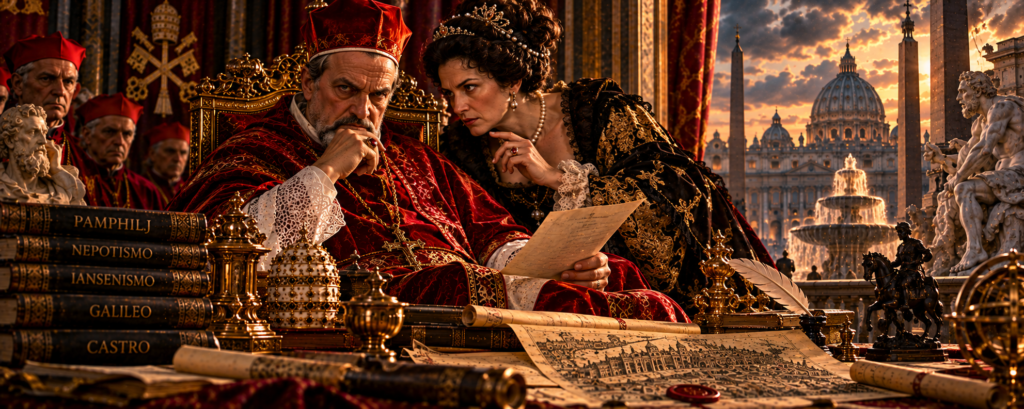
Innocent X: The Pope, the Widow, and the Woman Rome Said Ruled the Vatican
Pope Innocent X (1574–1655) | Reigned 1644–1655
When Rome Waited for a Pope to Be Buried
By the opening days of 1655, Pope Innocent X was dead, and Rome was already preparing to turn his final hours into scandal. The eighty-year-old pontiff had spent more than a decade ruling the Catholic Church, battling rival families, condemning theological propositions, commissioning magnificent works, and trying to establish the Pamphilj as one of Rome’s great dynasties. Yet the stories that spread after his death did not dwell first upon diplomacy or doctrine. They centered instead upon money, family, and the extraordinary woman whose name had become almost inseparable from his own.
That woman was Olimpia Maidalchini Pamphilj, Innocent’s widowed sister-in-law. During his pontificate she enjoyed access, influence, wealth, and political importance unusual even in a city accustomed to powerful papal relatives. Ambassadors watched her, petitioners sought her favor, enemies cursed her, and satirists transformed her into a symbol of greed and female domination. To admirers she could be an intelligent and formidable patron; to hostile contemporaries she became “La Papessa,” the woman supposedly ruling Rome from behind the papal throne.
The ugliest stories claimed that Olimpia stripped the dying pope’s rooms, refused to pay for his funeral, and abandoned his corpse because she cared only for his fortune. Some accounts went further, accusing her of corruption, sexual misconduct, sorcery, and virtually every vice available to seventeenth-century polemic. These stories are irresistible, which is precisely why they must be handled carefully. Much of the lurid portrait was constructed by enemies in a political culture where attacking a powerful woman as sexually corrupt, unnatural, avaricious, or secretly controlling men was an established weapon.
Even after those exaggerations are stripped away, however, there is no need to invent a scandal around Innocent X. Olimpia really did become one of the most influential people at his court, and her importance was recognized by diplomats who needed to understand how papal decisions were made. The Pamphilj really did use the pontificate to advance family interests, acquire wealth, commission palaces, and strengthen their place among Rome’s aristocracy. Innocent really did pursue the Barberini relatives of his predecessor, only to discover that the machinery of papal family politics could turn against one dynasty and then enrich another.
His reign also unfolded during one of the most important political transformations in European history. The Peace of Westphalia ended major phases of the Thirty Years’ War in 1648, but Innocent denounced parts of the settlement because they damaged Catholic ecclesiastical interests and ignored papal objections. In Italy, the long struggle over Castro reached a brutal conclusion when papal forces destroyed the Farnese city in 1649. Inside the Church, Innocent condemned five propositions associated with Jansenism, deepening a controversy that would trouble Catholic Europe for generations.
Then there was the pope himself. Diego Velázquez painted Innocent in a portrait so penetrating that later viewers often felt they were staring directly at a suspicious, hard, intelligent old man who had no interest in appearing gentle. The scarlet silk, white linen, tense hands, and penetrating eyes produced one of the most psychologically powerful images ever made of a pope. Whether or not it captures his private personality perfectly, it seems almost designed for the world Innocent inhabited: a court of relatives, ambassadors, cardinals, enemies, money, rumor, and fear.
The story of Innocent X is therefore not simply the story of a pope controlled by a domineering woman, as hostile tradition often claimed. It is the story of a papal monarchy in which family relationships were part of government, access could become political currency, and the absence of a conventional cardinal-nephew created an opening that Olimpia was unusually capable of filling. It is also a story about what happened when a pope tried to punish the nepotism of his predecessor while constructing a family regime of his own. By the time Innocent died, Rome had learned once again that changing the family on the papal throne did not necessarily change the system.
Giovanni Battista Pamphilj: The Man Behind the Portrait
Giovanni Battista Pamphilj was born in Rome on May 6, 1574, into a family that had established itself within the city’s aristocratic and ecclesiastical world. The Pamphilj traced their origins to Gubbio and had risen in Roman society through legal, administrative, and church service. They were respectable and increasingly prominent, but they did not yet possess the enormous prestige of houses such as the Colonna, Orsini, Farnese, or Barberini. Giovanni Battista’s eventual election would change the family’s position dramatically.
He received a strong education and studied law at the Collegio Romano and other Roman institutions, preparing for the kind of curial career in which legal expertise could be as valuable as theological brilliance. His training suited a man who would become known for caution, procedural seriousness, and an often severe concern with authority. He entered papal service and gradually accumulated experience within the complicated machinery of the Roman Curia. Unlike popes whose careers had been propelled primarily by military exploits or flamboyant court patronage, Pamphilj advanced through administration, diplomacy, and law.
His career took him beyond Rome. He served in connection with papal diplomatic missions, including work associated with Naples and Spain, and gained experience of the political rivalries shaping Catholic Europe. Spain remained enormously influential in Italy, while France increasingly challenged Habsburg power. A future pope needed to understand both courts without appearing to become the creature of either one.
Pamphilj was elevated to the cardinalate by Urban VIII in 1629, although the creation was initially reserved in pectore before being made public. As a cardinal, he participated in the politics of the Barberini papacy while maintaining his own network of relationships. He was not the most glamorous member of the Sacred College, but he was experienced and politically credible. By the time Urban died in 1644, Pamphilj had spent decades learning how papal government worked from the inside.
His personality is difficult to reconstruct without relying too heavily upon hostile or flattering descriptions. Contemporaries often regarded him as serious, cautious, suspicious, and capable of stubbornness. The later Velázquez portrait has reinforced the image of a severe and penetrating personality, although a painting cannot serve as a psychological diagnosis. What can be said with greater confidence is that Innocent was not a passive nonentity who simply surrendered government to his sister-in-law.
That distinction matters because the traditional legend of Olimpia depends upon making Innocent almost absurdly weak. The reality was more complicated. He could make independent decisions, dismiss favorites, reverse alliances, and pursue policies that reflected his own convictions. Olimpia’s influence was significant precisely because she operated beside a pope who possessed authority, not because she replaced an incapable man.
The Marriage That Created a Political Partnership
Olimpia Maidalchini was born in Viterbo in 1591 into a family of comfortable but not extraordinary status. Her father, Sforza Maidalchini, hoped to manage his daughters’ marriages and religious vocations in ways advantageous to the household. Later hostile biographies portrayed Olimpia’s youth as a sequence of manipulations and scandals, including lurid allegations involving a confessor. Those tales circulated widely, but their polemical character makes them poor foundations for confident biography.
What is certain is that Olimpia married twice. Her first husband, Paolo Nini, died relatively early, leaving her a widow with financial resources. She then married Pamphilio Pamphilj, the elder brother of Giovanni Battista. The marriage brought her directly into the family that would eventually provide a pope.
Pamphilio and Olimpia had children, including Camillo Pamphilj, who would become central to Innocent’s dynastic plans. Olimpia proved adept at managing family interests and property, and she developed a close working relationship with her clerical brother-in-law. When Pamphilio died in 1639, the widow remained deeply connected to Giovanni Battista and the wider Pamphilj household. Her importance did not disappear with her husband; it increased as the family approached the greatest political opportunity imaginable.
The relationship between Innocent and Olimpia later attracted sexual rumors. Hostile writers insinuated that their intimacy must have been improper, and the accusation became part of the mythology surrounding “La Papessa.” There is no reliable evidence establishing a sexual relationship between them, and repeating the allegation as fact would reproduce the methods of their seventeenth-century enemies rather than illuminate the history.
Their closeness can be explained without inventing an affair. Olimpia was his brother’s widow, the mother of the family’s principal male heir, an experienced manager of household interests, and a woman Innocent evidently trusted. In a papal court where relatives routinely handled sensitive business, that combination gave her enormous practical importance. Her gender made the arrangement unusual enough to attract attention, but family government itself was entirely familiar.
The future pope therefore entered the conclave of 1644 with a family network already in place. Olimpia understood its finances and relationships, while her son represented its dynastic future. If Giovanni Battista became pope, the Pamphilj would need people capable of converting temporary ecclesiastical power into lasting aristocratic status. Olimpia was exceptionally well positioned to do exactly that.
The Conclave of 1644: Eleven Years of Pamphilj Power Begin
Urban VIII died on July 29, 1644, after a pontificate dominated by the Barberini family. His nephews had accumulated offices, wealth, military responsibilities, and political enemies. The disastrous First War of Castro had damaged papal finances and left the Barberini vulnerable. The conclave that followed therefore involved not merely the election of a spiritual leader but a struggle over the future of an entire political regime.
French and Spanish interests competed intensely. Cardinal Jules Mazarin, chief minister of France, opposed candidates considered too sympathetic to Spain, while Spanish influence pushed in the opposite direction. Giovanni Battista Pamphilj was viewed with suspicion by the French because of his earlier connections and perceived Spanish sympathies. Yet conclaves rarely produced exactly the result foreign governments desired.
After weeks of maneuvering, Pamphilj was elected on September 15, 1644. He took the name Innocent X. He was seventy years old, an age that suggested experience but did not necessarily promise a long reign. His eleven-year pontificate would nevertheless be long enough to overturn Barberini dominance and establish the Pamphilj at the center of Roman politics.
The election immediately raised the question that confronted nearly every early modern pope: which relative would manage the family’s political interests? The institution of the cardinal-nephew had become deeply embedded in papal government. A pope needed trusted agents, and relatives were often considered safer than ambitious outsiders. Yet Urban VIII had demonstrated how spectacularly such arrangements could enrich a household and damage a pontificate.
Innocent initially possessed an obvious candidate in Camillo Pamphilj, Olimpia’s son and his own nephew. Camillo was elevated to the cardinalate soon after his uncle’s election and appeared destined to become the principal family representative. This followed the familiar pattern of papal nepotism. Had events continued normally, Olimpia might have remained influential but less conspicuous.
Instead, Camillo made a decision that threw the family government into confusion. He renounced the cardinalate in order to marry Olimpia Aldobrandini, the wealthy widow of Paolo Borghese and heiress of another powerful papal dynasty. The marriage offered immense dynastic advantages, but Innocent was furious at the abandonment of the ecclesiastical role he had assigned his nephew. The rupture deprived the pope of the conventional cardinal-nephew upon whom he had expected to rely.
That vacancy transformed Olimpia’s importance. She was already trusted, experienced, and intensely interested in family advancement. With Camillo temporarily out of favor, she became even more central to the management of access and patronage. Rome soon began talking about the widow who seemed to stand where a cardinal-nephew ordinarily would have stood.
La Papessa: How Much Power Did Olimpia Really Have?
Olimpia Maidalchini’s influence was not imaginary. Diplomatic correspondence, court behavior, patronage patterns, and contemporary observations all demonstrate that she possessed unusual access to Innocent and could affect appointments and petitions. Foreign representatives understood that cultivating her could be useful. Those seeking favors from the papal government often treated her as someone whose support mattered.
Yet influence is not the same thing as absolute control. The claim that Olimpia “ruled the Church” while Innocent merely obeyed her belongs more comfortably to satire than to careful history. Innocent could resist her wishes, exclude her from favor, and promote individuals she disliked. Their relationship experienced periods of tension as well as cooperation.
The problem for contemporaries was that Olimpia occupied no neat constitutional category. She was neither queen nor cardinal, neither official minister nor cloistered widow. Her power emerged from family intimacy and privileged access, making it difficult to measure through formal titles. That ambiguity made her both effective and vulnerable.
Male papal nephews had exercised comparable or greater influence without provoking exactly the same kind of language. They could certainly be accused of greed, corruption, or incompetence, but a powerful woman invited an additional repertoire of attacks. Critics described Olimpia as unnatural, sexually manipulative, domineering, and unfeminine. Her political activity itself became evidence against her.
This does not mean that every accusation can be dismissed as misogyny. Olimpia aggressively pursued wealth, family advantage, and patronage, and contemporaries had legitimate reasons to resent the sale or manipulation of access. Her financial interests were real, and her household benefited enormously from the pontificate. The challenge is to criticize what can be established without accepting every story created to demonize her.
The nickname “La Papessa,” or “the female pope,” captures the problem perfectly. It reflected the extraordinary visibility of her influence but also exaggerated it into a claim that she had usurped the papal office. Rome loved nicknames, satire, and political theater. A widowed woman apparently influencing the pope provided irresistible material.
Olimpia’s real power was more interesting than the legend. She did not need to secretly become pope in order to matter. By controlling access, recommending clients, managing family resources, and maintaining Innocent’s trust, she occupied a position from which decisions could be shaped before they ever reached formal institutions. That kind of influence was quieter than the legend of a female dictator, but it was also more plausible and politically sophisticated.
Money, Favors, and the Price of Access
The papal court operated through patronage. Offices, benefices, contracts, legal decisions, and introductions could all depend upon networks of recommendation. This did not mean that every appointment was literally sold to the highest bidder, but money and influence moved constantly through the system. A person close to the pope therefore occupied an extraordinarily valuable position.
Olimpia became associated with that economy of access. Petitioners sought her favor because they believed she could influence Innocent. Gifts and expressions of gratitude were common features of aristocratic patronage, but the boundary between accepted custom and corruption could be remarkably thin. Critics accused Olimpia of crossing it repeatedly.
Hostile accounts claimed that nothing could be obtained without paying her. Such sweeping statements are impossible to accept literally. They reflect the tendency of enemies to transform political influence into a universal conspiracy. Yet the persistence of complaints indicates that her role in patronage was highly visible and controversial.
Her financial acumen also strengthened the family’s position. The Pamphilj acquired property and invested in projects that advertised their new status. Olimpia herself controlled significant resources and became an important patron. She was not simply receiving pocket money from a generous brother-in-law; she was operating within the financial world of elite Roman society.
The perception that she profited from papal government mattered almost as much as the precise accounting. Early modern politics depended heavily upon reputation. If diplomats and petitioners believed that Olimpia’s favor had value, they behaved accordingly. Their behavior then reinforced her influence.
Innocent appears to have accepted much of this arrangement because he trusted her and needed reliable family agents. The papacy lacked the bureaucratic impersonality of a modern state. Government was conducted through households, kinship, patronage, and personal relationships. Olimpia’s activities therefore belonged to a broader political culture even when they attracted unusual criticism.
The scandal lay partly in visibility. Male cardinals could exercise influence behind institutional titles that made their authority appear normal. Olimpia’s power remained unmistakably personal. Every favor attributed to her reminded Rome that a woman without ecclesiastical office stood extraordinarily close to the center of government.
The Barberini Reckoning
Innocent X inherited a treasury damaged by Urban VIII’s military expenditures and the First War of Castro. He also inherited the Barberini nephews, whose wealth and political power made them obvious targets. The new pontificate quickly began investigating their conduct. What followed looked to many observers like justice, revenge, or both.
Cardinals Francesco and Antonio Barberini and their brother Taddeo had occupied commanding positions under Urban. They had participated in government, controlled patronage, and become associated with the disastrous war against the Farnese. Innocent’s administration scrutinized their handling of public money. The Barberini understood that their immunity had ended with their uncle’s death.
Facing the threat of prosecution and confiscation, leading Barberini fled into French protection. France under Mazarin was willing to defend them, partly because the dispute offered leverage against a pope considered too sympathetic to Spain. The affair therefore expanded beyond Roman family rivalry. A prosecution of papal nephews became an international diplomatic crisis.
Innocent ordered measures against Barberini property and challenged the assumption that cardinals could simply escape accountability by fleeing. The conflict raised serious questions about ecclesiastical privilege and papal authority. It also revealed how quickly the beneficiaries of one pontificate could become fugitives under the next. Rome’s wheel of fortune could turn with astonishing speed.
Olimpia’s position inevitably colored perceptions of the affair. Critics could point out that the Pamphilj were attacking Barberini enrichment while building their own family fortune. The charge of hypocrisy was difficult to avoid. Innocent could plausibly argue that he was investigating genuine abuses, but the replacement of one dominant clan by another weakened the moral force of the campaign.
The confrontation eventually softened under French pressure and changing political circumstances. Reconciliation allowed the Barberini to return and recover much of their position. Family marriages helped repair relationships that prosecution had failed to destroy. Rome’s aristocratic world was remarkably skilled at converting bitter political conflict into strategic alliance.
The episode established an important theme of Innocent’s reign. He opposed the excesses of Urban’s family government but did not dismantle nepotism itself. Instead, the beneficiaries changed. The Barberini bees receded while Pamphilj doves appeared across Rome.
Camillo Pamphilj Chooses Marriage Over the Cardinalate
Camillo Pamphilj had been elevated rapidly after his uncle’s election, but his ecclesiastical career did not last. He determined to marry Olimpia Aldobrandini, one of the most desirable widows in aristocratic Rome. She brought wealth, property, and connections linking the Pamphilj to the Aldobrandini and Borghese dynasties. From a family perspective, the marriage was extraordinarily attractive.
From Innocent’s perspective, however, Camillo’s decision was an act of disobedience. The pope had expected his nephew to serve as cardinal-nephew and help administer the family’s ecclesiastical interests. Renouncing the cardinalate disrupted that plan. Innocent reacted angrily and temporarily excluded the couple from Rome.
The marriage nevertheless strengthened the dynasty in the long term. Camillo became a secular prince capable of producing heirs, while his wife’s inheritance expanded the family’s property and status. The Pamphilj were no longer dependent solely upon ecclesiastical office for their future. They were becoming a hereditary aristocratic house.
The two Olimpias did not enjoy an easy relationship. Olimpia Maidalchini and Olimpia Aldobrandini represented different centers of family power, and tensions developed between them. The younger woman possessed wealth and noble connections of her own, reducing her dependence upon her mother-in-law. Their rivalry added another layer to the politics of the Pamphilj household.
Innocent eventually reconciled with Camillo. Dynastic logic was stronger than temporary anger, and the marriage’s advantages were obvious. Camillo and his descendants would help preserve the family’s status after the pope’s death. What had initially seemed like betrayal became an important part of the Pamphilj legacy.
The episode also increased Olimpia Maidalchini’s political importance during the years when her son could not perform the expected role of cardinal-nephew. The pope needed trusted family representatives, and his sister-in-law remained available. Her prominence therefore arose partly from a structural problem within papal government. The absence of the expected male nephew created space for an unconventional female power broker.
The arrangement scandalized observers because it violated expectations about gender more than expectations about nepotism. Nobody was surprised that a pope relied upon relatives. What seemed extraordinary was that the most conspicuous relative was a widow. Rome could accept family government more easily than it could accept the woman who had learned to master it.
The Peace of Westphalia: The Pope the Negotiators Ignored
While the Pamphilj consolidated their position in Rome, European diplomats were attempting to end the Thirty Years’ War. Negotiations at Münster and Osnabrück involved the Holy Roman Empire, France, Sweden, German princes, and numerous other interests. Papal representatives participated in aspects of the diplomatic process. Yet the settlement that emerged in 1648 contained provisions Rome found deeply objectionable.
The Peace of Westphalia redistributed political and religious rights across the empire. It confirmed arrangements that affected ecclesiastical property and recognized a confessional balance that the papacy considered unacceptable. Protestant powers gained formal protections, while Catholic institutions lost claims in some territories. The settlement reflected political realities that could no longer be reversed by papal decree.
Innocent responded with the bull Zelo Domus Dei, condemning provisions of the treaties that he believed injured the Catholic Church. He declared objectionable concessions null from the perspective of papal authority. The protest was uncompromising in language. Its practical effect was extremely limited.
European rulers proceeded with the settlement despite Rome’s objections. The treaties included protections designed to prevent outside challenges from undoing the agreement. The papal protest therefore demonstrated both the ideological firmness of Innocent and the declining ability of the papacy to dictate the structure of European interstate politics. Catholic rulers themselves were unwilling to reopen a devastating war merely because the pope rejected parts of the peace.
This did not mean the papacy had become politically irrelevant. Rome remained a major diplomatic center, and the pope retained enormous influence within Catholic institutions. What Westphalia revealed was a change in the relationship between spiritual authority and sovereign states. Governments increasingly negotiated political settlements according to dynastic and territorial interests even when papal approval was absent.
For Innocent, the outcome was deeply frustrating. A pope who believed strongly in ecclesiastical rights had watched European powers institutionalize compromises he considered illegitimate. His condemnation preserved Rome’s doctrinal and legal position but could not reverse the treaties. The episode exposed the limits of even the most forceful papal language.
The contrast with Olimpia’s influence at home is striking. Within the papal court, personal access could shape careers and fortunes. Beyond Italy, however, the pope himself could issue a solemn protest and discover that Europe continued without him. Innocent governed an institution of immense spiritual reach whose temporal leverage was no longer what medieval popes had once claimed.
Castro: The War Innocent Inherited and the City He Destroyed
The conflict over Castro had begun under Urban VIII, whose Barberini relatives became entangled in a bitter struggle with the Farnese dukes of Parma. The first war ended in 1644 without delivering the victory Urban desired. Castro was restored to the Farnese, and the Barberini emerged politically damaged. Innocent therefore inherited a dispute that already carried the memory of humiliation.
Relations with the Farnese remained unstable. The duchy of Castro was burdened by debt, and questions concerning creditors, papal authority, and Farnese obligations continued. Innocent initially approached the matter within the complicated legal and political framework left by his predecessor. The situation deteriorated dramatically in 1649.
Cristoforo Giarda, the bishop appointed to Castro, was murdered while traveling to take possession of his see. The killing provided the papal government with a powerful justification for intervention. Responsibility for the assassination became politically charged, and papal authorities blamed interests associated with the Farnese regime. The Duke of Parma denied involvement.
Innocent responded forcefully, and papal troops moved against Castro until the city surrendered. This time the government did not merely occupy the troublesome Farnese stronghold. Innocent ordered Castro destroyed, turning a decades-old political conflict into an act of deliberate urban annihilation. The pope intended to ensure that the city could not again become the center of resistance that had caused Rome so much difficulty.
The demolition was extensive enough to become one of the darkest episodes of his temporal rule. Buildings, fortifications, and important structures were torn down, leaving a community that had existed for centuries effectively erased as a political center. A commemorative inscription traditionally associated with the destruction proclaimed, in substance, that Castro had been there. The message was unmistakable: papal authority intended the ruin itself to serve as a warning.
The destruction went far beyond the punishment of an individual assassin. It was collective and symbolic, directed against the political existence of the Farnese stronghold. Innocent demonstrated that the Papal States could exercise territorial violence as ruthlessly as other early modern governments. The pope who protested European settlements on behalf of ecclesiastical rights showed little hesitation in annihilating a rebellious city within his own political sphere.
Later legend sometimes turns Castro into a simple story of Pamphilj greed. The reality involved debts, jurisdictional disputes, Farnese resistance, the bishop’s murder, and a conflict inherited from the previous pontificate. Yet complexity does not soften the final decision. Innocent chose destruction as the solution.
The ruins of Castro became a monument of absence. Urban VIII had failed to crush the Farnese permanently through war, but Innocent succeeded in eliminating their disputed city. The victory strengthened papal territorial authority while adding another unsettling episode to a reign already surrounded by stories of family power and vengeance. In the landscape where Castro had stood, papal authority was written not in marble but in emptiness.
Olimpia’s Viterbo Empire
Olimpia’s influence was not confined to palace corridors. She acquired substantial authority and property connected with San Martino al Cimino near Viterbo, where she developed a territorial base that reflected her growing status. Innocent granted her titles and privileges that elevated her far beyond the position into which she had been born. The widow had become a major aristocratic figure.
At San Martino al Cimino, Olimpia supported construction and urban development. The settlement was reshaped around the abbey, with planned streets and buildings that reflected seventeenth-century ideas about aristocratic lordship. Her patronage created employment and transformed the physical environment. This side of her career rarely fits comfortably within the caricature of a woman interested only in hoarding money.
She also exercised authority over local affairs. As a landholder and patron, she participated in the same structures of elite power used by male nobles throughout Italy. Her position demonstrates that her ambitions extended beyond extracting favors from the papal court. She was building a durable social and economic base.
Critics interpreted every acquisition as evidence of greed. Supporters could present the same activity as competent estate management and patronage. Both interpretations contain part of the truth. Olimpia wanted wealth and status, but she also knew how to use resources to establish institutions and reshape communities.
Her success was inseparable from Innocent’s pontificate. Without her relationship to the pope, she could not have risen so rapidly or acquired such extraordinary influence. The advantages were therefore products of nepotism even when she used them effectively. Competence does not erase privilege.
The San Martino story also complicates assumptions about early modern female power. Olimpia was not merely whispering into a man’s ear. She owned property, managed resources, commissioned projects, and cultivated clients. Her political importance rested upon activities that extended beyond personal persuasion.
That broader foundation helps explain why enemies feared her. A favorite dependent entirely upon the pope might disappear when access ended. Olimpia possessed money, property, family connections, and clients of her own. She was building a power structure capable of surviving fluctuations in court favor.
The Jubilee of 1650: Rome on Display
The Holy Year of 1650 brought enormous numbers of pilgrims to Rome and gave Innocent an opportunity to display the spiritual and physical magnificence of his capital. Jubilees combined devotion with logistics on a massive scale. Visitors required food, lodging, security, access to churches, and routes through the city. The papal government prepared extensively.
Urban VIII had left Rome filled with Barberini monuments. Innocent wanted the Pamphilj pontificate to possess its own visual identity. Construction and restoration projects accelerated as the Jubilee approached. Churches, streets, fountains, and ceremonial spaces became stages upon which papal authority could be displayed.
The event emphasized Innocent’s role as spiritual leader rather than merely Italian prince. Pilgrims came seeking indulgences and participating in rituals centered upon Rome’s great basilicas. The papacy presented itself as the heart of global Catholicism. Political rivalries did not disappear, but they existed beside sincere religious devotion.
Olimpia participated in the charitable and ceremonial world surrounding the court. Even hostile traditions that condemned her greed could not erase her role as a patron of religious institutions and public works. Wealth in early modern Rome was expected to produce visible charity as well as private luxury. Elite reputation depended upon both.
The Jubilee also benefited Rome economically. Pilgrims brought money into the city and supported inns, merchants, artisans, and religious institutions. Large gatherings created opportunities for profit as well as devotion. The sacred and commercial dimensions of urban life were never entirely separate.
Innocent’s government used the occasion to reinforce order. Managing crowds required policing and administrative coordination. Rome could be chaotic, violent, and socially divided, but the Jubilee demanded an image of disciplined sacred grandeur. The city became a carefully managed theater of Catholic power.
The successful celebration strengthened Innocent’s prestige. It reminded observers that his pontificate cannot be understood solely through Olimpia’s intrigues or family enrichment. He presided over a functioning international religious institution capable of organizing one of Europe’s largest recurring devotional events. The contrast between sacred spectacle and court politics was not a contradiction to contemporaries; both belonged to the papal monarchy.
Piazza Navona: The Pamphilj Family Builds Its Stage
No place expressed Pamphilj ambition more dramatically than Piazza Navona. The family possessed property along the square, and under Innocent it became an extraordinary theater of dynastic prestige. The Palazzo Pamphilj rose beside the church of Sant’Agnese in Agone, while the center of the piazza acquired one of Bernini’s greatest fountains. The urban landscape itself announced who now held power.
Olimpia was closely associated with the family palace and the development of the area. Her presence there contributed to the popular image of Piazza Navona as the center of her personal domain. Windows overlooking the square seemed to provide the perfect stage for the woman Rome imagined watching everything below. Architecture and rumor reinforced one another.
The Fountain of the Four Rivers, completed by Bernini in 1651, became the piazza’s most spectacular centerpiece. Its enormous sculptural figures represented great rivers associated with different parts of the known world, supporting an ancient obelisk beneath the Pamphilj dove. Water, stone, ancient monument, papal heraldry, and theatrical movement combined into a breathtaking assertion of universal reach. It was art serving family prestige and papal ideology simultaneously.
Bernini’s involvement was itself politically interesting. He had been closely associated with Urban VIII and therefore suffered some loss of favor after the Barberini pope’s death. His genius, however, was difficult to ignore. The commission helped restore his position under Innocent.
Stories later developed about supposed artistic rivalries encoded into the fountain and nearby church. One popular legend claims that a river figure raises his hand in fear that the façade of Sant’Agnese might collapse upon him, while another turns away in disgust. The chronology undermines the tale because the fountain preceded the relevant façade design. Rome’s appetite for theatrical stories was as powerful as its appetite for theatrical architecture.
The Pamphilj transformation of Piazza Navona demonstrates how nepotism could produce public beauty. Family ambition financed works that became part of Rome’s permanent cultural inheritance. This does not excuse the system that concentrated resources in papal households, but it explains why the legacy is difficult to classify simply as corruption. Private glory and public magnificence could emerge from the same expenditure.
For Innocent and Olimpia, the square was a triumph. The Pamphilj family had entered the ranks of Rome’s great dynasties and carved its symbols into one of the city’s most famous spaces. Long after their political power faded, the dove, palace, church, and fountain would continue telling visitors that this family had once possessed the pope. Rome had become their family album written in stone.
Velázquez Paints a Pope
In 1650, during the Jubilee period, Spanish painter Diego Velázquez produced his famous portrait of Innocent X. The work depicts the pope seated in scarlet and white, holding a paper while staring directly toward the viewer. The colors are sumptuous, but the face refuses easy idealization. Innocent appears alert, suspicious, intelligent, and almost confrontational.
A famous tradition claims that Innocent reacted to the finished portrait by calling it “too true.” The remark is widely repeated and may preserve a genuine contemporary impression, but such anecdotes should always be treated with caution when their transmission is uncertain. What requires no legend is the painting itself. Velázquez created an image of extraordinary psychological force.
The portrait matters because official papal imagery usually emphasized dignity and authority. Velázquez certainly provided both, but he also captured physical age and tension. Innocent’s eyes seem to assess the person standing before him. The effect is less like devotional iconography than an encounter with a formidable political personality.
Later generations have often used the portrait as evidence that Innocent was cruel or sinister. That goes beyond what a painting can establish. Artistic interpretation is not a court record. Yet the work fits remarkably well with documentary descriptions of a pope capable of suspicion, anger, and determined judgment.
The portrait also captures the material world of the papal court. Fine fabrics, ceremonial clothing, and controlled presentation communicate wealth and hierarchy. The pope’s body is surrounded by symbols of office. Even apparent psychological exposure occurs within an environment of power.
For the Pamphilj family, such an image contributed to dynastic prestige. Great rulers employed great artists because portraiture preserved authority beyond death. Velázquez gave Innocent something more complicated than flattery. He gave him immortality with an uncomfortable degree of humanity.
Centuries later, viewers who know nothing about Jansenism or Westphalia may still recognize Innocent through this portrait. His face has become one of the most famous papal images in Western art. The irony is striking: a pope surrounded by exaggerated rumors is remembered visually through a painting celebrated precisely for seeming brutally truthful. The man behind the legends still stares back at the world.
The Jansenist Controversy
Theological conflict remained a major responsibility of Innocent’s pontificate. One of the most important disputes concerned the movement associated with Cornelius Jansen, bishop of Ypres, whose posthumously published work Augustinus explored grace, free will, and the theology of St. Augustine. Supporters emphasized human dependence upon divine grace. Opponents accused them of approaching positions associated with Calvinism.
The controversy became especially intense in France. The community associated with Port-Royal attracted influential thinkers and religious figures. Jesuit theologians became major opponents of Jansenist positions. The dispute involved sophisticated questions about salvation but also reflected institutional rivalries and political tensions.
In 1653, Innocent issued the bull Cum occasione. It condemned five propositions said to be drawn from or associated with Jansen’s work. The judgment became a central reference point in subsequent debates. Jansenists disputed whether the condemned propositions accurately represented Jansen’s actual teaching and in what sense they appeared in his text.
The controversy therefore did not end with the papal bull. Instead, arguments shifted toward questions of fact, interpretation, and the scope of papal authority. Could the pope determine authoritatively that a particular author intended a condemned proposition? What precisely were Catholics required to accept? These questions would trouble the Church for decades.
Innocent’s intervention reflected the papacy’s role as doctrinal arbiter. Unlike his family politics, this was not simply a matter of nepotistic advantage. The dispute threatened ecclesiastical unity and required some form of response. Yet condemnation could suppress formulations without resolving the underlying theological disagreements.
The episode also demonstrates that Innocent was actively engaged in governing the Church. The caricature of a pope entirely controlled by Olimpia cannot explain major doctrinal decisions of this kind. He consulted theologians and used established institutional mechanisms. His pontificate possessed a serious ecclesiastical dimension alongside its court scandals.
For the Wicked Popes narrative, Jansenism is important precisely because it prevents simplification. Innocent was not merely a greedy prince surrounded by relatives. He was a pope confronting real theological disputes, international diplomacy, and administrative responsibilities. His failings become more historically meaningful when placed beside the legitimate duties he also performed.
The Cardinal-Nephew Problem Returns: Camillo Astalli
Camillo Pamphilj’s abandonment of the cardinalate left Innocent without the conventional nephew who normally served as a trusted minister. Olimpia’s prominence partly filled that vacuum, but the arrangement remained politically awkward. Eventually Innocent attempted another solution. He adopted Camillo Astalli into the Pamphilj family and elevated him into a position resembling that of a cardinal-nephew.
Astalli came from a noble but comparatively modest Roman background and had served within the curial environment. His sudden rise was spectacular. In 1650 he became a cardinal and was treated as an adopted member of the Pamphilj household. The pope appeared to have found a male favorite who could perform functions that family structure had left vacant.
Olimpia reportedly disliked Astalli and viewed his advancement as a threat to her influence. Hostile narratives naturally dramatized the rivalry, and the precise details of their personal conflict are difficult to establish. What is clear is that Astalli’s position created another center of patronage near the pope. Court politics became increasingly divided.
Astalli’s rise proved temporary. Innocent eventually accused him of betraying confidential information connected with papal affairs, particularly matters involving Spanish interests. In 1654 the pope stripped him of his privileged position and expelled him from the Pamphilj orbit. The favorite who had risen with astonishing speed fell almost as dramatically.
Olimpia returned to prominence after Astalli’s disgrace. The sequence encouraged contemporaries to believe she had engineered his destruction. She may well have benefited from and contributed to the political atmosphere against him, but claims of a perfectly orchestrated conspiracy should be treated cautiously. Innocent himself possessed reasons to distrust Astalli.
The episode reveals the instability of papal favoritism. A cardinal could become almost a nephew by adoption and then lose everything when confidence disappeared. Formal ecclesiastical rank offered less security than proximity to the pope. Court politics operated through relationships that could change suddenly.
It also demonstrates why Olimpia endured. Other favorites came and went, while she remained connected by blood, marriage, property, and decades of trust. Innocent could distance himself from her temporarily, but she belonged to the family structure upon which his dynasty depended. Her influence was therefore more resilient than that of an ordinary court favorite.
The Pamphilj Women and a Court at War With Itself
The Pamphilj court contained multiple powerful women, and their relationships were not always harmonious. Olimpia Maidalchini dominated the older generation, while her daughter-in-law Olimpia Aldobrandini brought enormous wealth and distinguished lineage into the family. These two women had different interests, clients, and expectations. Their rivalry complicated the internal politics of the dynasty.
Olimpia Aldobrandini had been born into a family already transformed by a previous papacy. She understood dynastic wealth and aristocratic status from childhood. Her marriage to Camillo Pamphilj joined two papal houses and concentrated substantial property. She therefore possessed an independent basis of power that Maidalchini could not simply control.
The tension between them was partly personal and partly structural. Both had reasons to influence Camillo and the future of the family. Both managed wealth and patronage. Both understood that Innocent’s pontificate offered opportunities that would not last forever.
Hostile chroniclers naturally enjoyed stories of female rivalry. They portrayed quarrels, jealousies, and intrigues with theatrical enthusiasm. Some conflict was real, but details should not automatically be accepted simply because they make good stories. Seventeenth-century Roman gossip was a political industry.
The family eventually had to accommodate competing interests. Camillo’s marriage ensured that the Pamphilj dynasty possessed heirs and connections after Innocent’s death. Maidalchini’s influence helped secure wealth and patronage during the pontificate. The two women contributed differently to the same broader project of family survival.
Their story also undermines the idea that Olimpia Maidalchini alone controlled everything. Power within the Pamphilj household was contested. Camillo made choices against his uncle’s wishes, Aldobrandini brought her own resources, Astalli briefly displaced Maidalchini, and Innocent himself could alter the balance. The court was a shifting coalition rather than a single woman’s dictatorship.
That complexity makes the history more compelling, not less. The Pamphilj were not puppets arranged around an all-powerful widow. They were ambitious individuals fighting over access to a temporary fountain of power. Every member of the household knew that the pope would eventually die and that whatever they had failed to secure before that moment might be lost forever.
Pasquino Speaks: Rome Turns Olimpia Into a Monster
Rome possessed a long tradition of anonymous political satire centered upon the talking statues, especially Pasquino. Writers attached verses and insults to these public monuments, mocking popes, cardinals, taxes, scandals, and aristocratic pretensions. No powerful family could entirely escape this culture. Olimpia became one of its favorite targets.
Her gender made the attacks particularly vicious. Satirists could portray a powerful male nephew as greedy, but a powerful woman could be accused of greed, lust, witchcraft, domination, and sexual corruption simultaneously. Olimpia was described as a female pope, a harpy, and worse. The attacks turned political criticism into character assassination.
Pamphlets circulated beyond Rome as well. One of the most influential hostile traditions was reinforced by sensational writers whose works about papal courts blended information, gossip, polemic, and invention. Such texts shaped later historical memory because they offered exactly what readers wanted: secret corruption behind sacred walls. Their popularity does not make every anecdote reliable.
Protestant writers also had obvious reasons to emphasize Catholic court corruption. A pope supposedly ruled by a greedy woman made excellent anti-papal propaganda. The story could be used to attack not only Innocent but the institution itself. Olimpia became a character in a larger confessional argument.
Catholic rivals were hardly more charitable. Roman aristocratic families competed fiercely for offices, marriages, property, and influence. Anyone excluded by Pamphilj patronage had reason to resent the woman believed to control access. Personal disappointment could become moral outrage remarkably quickly.
Modern historians therefore face a difficult task. Dismissing all hostile evidence would sanitize a genuinely controversial political figure. Accepting it all would reproduce centuries-old propaganda. The safest approach is to compare claims against diplomatic correspondence, financial evidence, official records, and the broader conventions of early modern polemic.
What survives that process is still remarkable. Olimpia possessed extraordinary influence, accumulated substantial wealth, participated in patronage, and became a political figure foreign diplomats took seriously. She does not need to have poisoned enemies, bewitched the pope, sold every office, or shared his bed to deserve a central place in the history of Innocent X. The documented woman is fascinating enough without the monster created around her.
The Legend of the Ghostly Carriage
Olimpia’s reputation became so dark that Roman folklore refused to let her remain dead. Later legends claimed that on certain nights her ghostly carriage raced from the Pamphilj palace across the city, carrying treasure toward the Tiber or fleeing from supernatural pursuers. Versions vary, as legends usually do. The common element is the image of a greedy woman eternally escaping with wealth taken from Rome.
The story tells us almost nothing reliable about what Olimpia actually did. It tells us a great deal about how completely her public image had been transformed into myth. Historical individuals become ghosts when communities use them to embody fears and moral judgments. Olimpia became the personification of avarice attached to female political power.
Her association with Piazza Navona made the legend especially vivid. The magnificent Pamphilj palace provided a physical setting for stories about hidden wealth and secret influence. The city itself became part of the narrative. Architecture preserved the dynasty while folklore punished it.
Similar legends accumulated around many notorious historical figures. They tend to simplify complicated lives into a single vice. For Olimpia, that vice was greed, reinforced by the belief that she had enriched herself through the papacy. The supernatural carriage transformed political criticism into popular entertainment.
The persistence of such stories can distort modern understanding. Readers encounter the legend first and the evidence later, if at all. A woman who managed estates, patronized building projects, cultivated diplomats, and navigated a dangerous court becomes merely a grasping witch. Historical complexity disappears beneath a satisfying morality tale.
Yet the legend belongs in her story precisely because reputation is part of history. Olimpia lived in a political culture where public perception could shape real influence. The attacks she endured reveal contemporary anxieties about women, money, and papal government. Her ghost became famous because the living woman had already become larger than life.
For Innocent, the legend created a strange afterlife as well. The pope became a supporting character in the mythology of his own sister-in-law. His name could hardly be mentioned without hers. Few examples better demonstrate how completely a ruler can lose control over the story later generations tell about his reign.
The Final Illness
By 1654, Innocent was approaching eighty and his health was failing. The political structure around him had become unstable. Camillo Astalli had fallen from favor, family rivalries remained unresolved, and Olimpia had again become highly influential. The aging pope increasingly depended upon a shrinking circle of trusted people.
His physical decline intensified during the final months of the year. Reports from the court described worsening illness and weakness. As often happened around dying popes, attention shifted immediately toward the coming conclave and the distribution of power. Cardinals, ambassadors, relatives, and clients all understood that the political world would change the moment he stopped breathing.
Olimpia’s position was especially precarious. Her influence depended heavily upon Innocent’s personal trust. A new pope could exclude her, investigate her finances, or support rival families. Whatever could be secured before the pontificate ended therefore carried enormous importance.
This context helps explain why stories about her conduct during Innocent’s final illness became so powerful. Enemies expected greed and therefore interpreted events through that expectation. Later writers embellished the scene. The dying pope and the allegedly grasping widow became perfect characters in a morality play about corruption.
Innocent died on January 7, 1655. His death ended more than ten years of Pamphilj dominance. The family still possessed wealth, property, and aristocratic status, but it no longer controlled the papal government. The transformation was immediate.
What happened to the pope’s body in the period surrounding his funeral became one of the most notorious stories of the reign. Accounts emphasized delay, inadequate arrangements, and the reluctance of relatives to bear expenses. Olimpia was accused of refusing financial responsibility for the funeral. The episode became the final proof, in hostile memory, that she cared more for money than for the man whose trust had made her powerful.
The Corpse, the Funeral, and the Story Rome Wanted to Believe
The posthumous scandal surrounding Innocent X has been repeated in dramatic terms for centuries. According to hostile accounts, his corpse was neglected while Olimpia removed valuables and refused to spend money on burial arrangements. Some versions describe the body remaining unattended or being treated with shocking indignity. The details differ from source to source, which should immediately encourage caution.
There appears to have been genuine confusion and unseemly delay surrounding funeral arrangements. Innocent’s household was undergoing the sudden collapse that accompanied every papal death, and responsibility for expenses became contested. Olimpia did not step forward as the generous guardian of his memory that later moral expectations might demand. Her behavior gave enemies material they could exploit.
Yet the most sensational versions emerged from sources already committed to depicting her as monstrous. Claims that she systematically looted the papal apartments or left the corpse entirely abandoned should not be repeated without qualification. The story grew in the telling. Each retelling made the contrast between sacred office and family greed more dramatic.
The episode was believable to contemporaries because it fit an established reputation. Olimpia had been accused for years of monetizing access and accumulating wealth. When the pope died, people were ready to believe she would squeeze profit from his final hours. Reputation prepared the audience before evidence was examined.
Innocent was eventually buried in the Pamphilj family church of Sant’Agnese in Agone at Piazza Navona. The setting was appropriate for a pope whose dynasty had transformed the square. His remains therefore entered the architectural landscape his family had created. The supposed abandonment was not the final chapter of his physical memorialization.
The funeral story nevertheless became almost impossible to dislodge. It provided a perfect ending to the legend of La Papessa: the powerful widow who allegedly ruled a pope, enriched herself through him, and abandoned him when he could no longer provide favors. Whether every detail was true mattered less to later storytellers than the moral shape of the narrative. History had become theater.
For a modern account, the episode should remain unsettling without becoming careless. There were real questions about family responsibility, money, and the treatment of the dead pope. There was also a hostile propaganda tradition eager to transform those questions into grotesque certainty. Innocent’s corpse became the final battlefield in the war over Olimpia’s reputation.
Olimpia After the Pope
The death of Innocent X destroyed Olimpia’s privileged access to the papal government almost overnight. The conclave elected Fabio Chigi as Alexander VII in April 1655. The new pope had no reason to preserve the extraordinary political position enjoyed by his predecessor’s sister-in-law. Olimpia withdrew from the center of Roman power.
She spent much of her remaining life away from the papal court, particularly in the territories associated with San Martino al Cimino. Her wealth and property meant that she did not become powerless in an ordinary sense. Yet the unique influence that had made ambassadors seek her favor was gone. Papal nepotism could create astonishing power and remove it just as quickly.
Olimpia died in 1657, only two years after Innocent. Her reputation had already escaped her control. Pamphlets, diplomatic gossip, Roman satire, and popular legend ensured that she would be remembered as one of the most notorious women in papal history. Later generations often repeated the darkest stories with little concern for their origins.
Her descendants and family connections preserved the Pamphilj legacy. The dynasty remained wealthy and culturally important, and its palaces and collections continued to shape Roman aristocratic life. The family eventually merged with other noble lines. The political moment of Innocent’s pontificate became hereditary prestige.
Olimpia’s historical significance should not be minimized simply because some accusations were exaggerated. She demonstrated how much power could be exercised through informal access in a supposedly male ecclesiastical government. Her position exposed the importance of households and kinship beneath formal institutions. That is a more consequential story than the claim that she was merely a greedy mistress or witch.
Her career also reveals the double standard surrounding female political power. Male cardinal-nephews could become ministers, generals, patrons, and millionaires without their gender itself becoming scandalous. Olimpia’s very visibility appeared to violate expectations. Her enemies attacked not only what she did but the fact that a woman was doing it.
The result was one of history’s most successful character assassinations, built around enough genuine power and acquisitiveness to remain plausible. The real Olimpia was ambitious, privileged, politically influential, and deeply involved in family advancement. She was also more complicated than the monster her enemies created. Separating those two women—the historical Olimpia and the legendary Papessa—is essential to understanding Innocent’s reign.
Was Innocent X a Wicked Pope?
Innocent X does not fit the Wicked Popes category in the same way as Alexander VI, John XII, or Urban VI. There are no credible tales of orgiastic court life, personal murderous rampages, or spectacular doctrinal madness. His reputation rests instead upon nepotism, harsh temporal politics, family patronage, and the extraordinary influence of Olimpia Maidalchini. The darkness lies in the political system rather than sensational private depravity.
His treatment of the Barberini illustrates the ambiguity. Investigating the financial conduct of Urban VIII’s nephews was not inherently wicked. Their administration deserved scrutiny after an expensive and disastrous war. Yet Innocent’s government attacked one nepotistic dynasty while promoting another.
The destruction of Castro provides a stronger case for condemnation. The murder of Bishop Giarda was a serious provocation, and the dispute with the Farnese had deep legal and political roots. Nevertheless, obliterating the city represented an extreme exercise of temporal power. The punishment extended far beyond the individuals responsible for the original violence.
His relationship with Olimpia is more difficult to judge morally. Relying upon a trusted sister-in-law was not itself a crime. The problem arose because private family access became intertwined with public appointments, finances, patronage, and political decision-making. Government became something that could be navigated through personal proximity to the papal household.
Innocent’s nepotism was less straightforward than Urban VIII’s because he struggled to construct a stable cardinal-nephew system. Camillo abandoned the cardinalate, Astalli rose and fell, and Olimpia occupied the resulting vacuum. The disorder itself is revealing. Papal government had become so accustomed to family management that the absence of a conventional nephew created a political crisis.
His international policies also show the limits of labeling him simply corrupt. Innocent opposed provisions of the Peace of Westphalia because he believed they violated Catholic ecclesiastical rights. He condemned propositions associated with Jansenism because he considered doctrinal unity his responsibility. These actions reflected serious convictions rather than family greed.
He also presided over significant artistic and urban development. Piazza Navona became one of the greatest public spaces of Baroque Rome. Bernini’s Fountain of the Four Rivers remains an extraordinary achievement. The Pamphilj pursuit of glory produced beauty that survived the political system that financed it.
Innocent belongs among the Wicked Popes, then, not because every accusation against him or Olimpia was true, but because his reign provides a powerful example of the papacy functioning simultaneously as Church government, territorial monarchy, and family opportunity. The institutions were intertwined so tightly that separating spiritual authority from dynastic interest became extraordinarily difficult. That system could create magnificent art, effective administration, doctrinal leadership, corruption, favoritism, and violence at the same time. Innocent’s pontificate exposes that contradiction with unusual clarity.
The Pope and the Woman History Refused to Separate
Innocent X spent his life within institutions designed and dominated by men. He studied law, served the Curia, became a diplomat, received the cardinalate, and eventually reached the papal throne. Yet the person most permanently associated with his reign was a woman who held no ecclesiastical office at all. That alone tells us something important about the realities beneath formal government.
Olimpia mattered because Innocent allowed her to matter. He trusted her judgment, relied upon her family loyalty, granted her opportunities, and tolerated a degree of political involvement that astonished observers. When he withdrew favor, her influence diminished; when he restored it, petitioners returned. Their relationship was therefore a partnership of unequal formal authority but considerable practical significance.
The legend later reversed that reality and portrayed Innocent as her helpless puppet. Doing so made for a better scandal. A pope controlled by a greedy widow was more entertaining than a pope who deliberately incorporated a capable female relative into an already nepotistic system. The sensational version also allowed critics to blame a woman for structures created and maintained by men.
Innocent cannot be absolved by blaming Olimpia. He was pope. The appointments, territorial policies, family advantages, and systems of access operated under his authority. Whatever influence she exercised existed because he permitted and often valued it.
Nor should Olimpia be absolved simply because enemies attacked her unfairly. She benefited enormously from nepotism and actively pursued family wealth and influence. She understood the value of access and used it. Her intelligence made the system more effective, not more innocent.
Their partnership therefore deserves to be studied without either caricature. Innocent was neither a powerless old fool nor an entirely independent ruler untouched by his sister-in-law. Olimpia was neither a supernatural villain nor a misunderstood bystander. Together they represented the way family and government could fuse at the highest level of seventeenth-century Rome.
The result fascinated contemporaries because it exposed something usually hidden behind cardinals’ robes and bureaucratic titles. Papal government depended upon trust, and trust often followed blood and marriage. Olimpia simply made that reality impossible to ignore. Rome’s outrage at the woman behind the throne inadvertently revealed how accustomed it had become to men performing much the same role.
The Pope, the Widow, and the Price of Family Power
When Innocent X died in January 1655, the Pamphilj pontificate ended as every papal family regime eventually did: suddenly. The rooms that had been filled with petitioners changed masters, ambassadors recalculated their alliances, cardinals prepared for a conclave, and relatives who had seemed untouchable discovered how temporary their influence could be. Papal monarchy offered families extraordinary opportunities, but it came with an unavoidable deadline. The pope would die, and the fountain of favors would stop.
Innocent had used his eleven years to transform the Pamphilj from a respected Roman house into one of the great families of Baroque Italy. Camillo’s marriage connected the dynasty to immense wealth, Piazza Navona became a theater of Pamphilj magnificence, and family properties preserved the prestige created by the pontificate. Olimpia Maidalchini emerged from that transformation as one of the most powerful women in seventeenth-century Rome. Her rise was remarkable precisely because she mastered a political culture that officially offered women so few formal avenues to power.
The price of that rise was a reputation saturated with hostility. Olimpia became La Papessa, the greedy widow, the alleged corrupter of offices, the supposed secret ruler of the Vatican, and eventually the ghost fleeing Rome with stolen treasure. Some accusations grew from genuine resentment of her wealth and influence. Others were shaped by misogyny, political rivalry, confessional propaganda, and the profitable appetite for scandal.
Innocent’s own responsibility was often obscured by the fascination with her. He pursued the Barberini, presided over the destruction of Castro, condemned the Westphalian settlement, intervened in the Jansenist controversy, managed family patronage, and repeatedly decided who would stand closest to his throne. He was not absent from his own pontificate. The myth of an all-powerful Olimpia can actually make him seem less responsible than the evidence warrants.
His reign also produced undeniable beauty. Bernini’s Fountain of the Four Rivers still explodes from the center of Piazza Navona in stone and water, while the Pamphilj palace and Sant’Agnese frame a space transformed by seventeenth-century ambition. Velázquez’s portrait still confronts viewers with the pope’s penetrating stare. These works survived because family glory and artistic genius happened to meet at the same historical moment.
That beauty should not obscure the system behind it. Wealth flowed toward relatives because proximity to the pope carried material value. Political access could be mediated through family relationships. Cities could be destroyed when territorial authority was challenged, while rival dynasties could be prosecuted when a new household inherited the papal throne.
Innocent X therefore represents a quieter form of papal darkness than the spectacular monsters of medieval legend. His court did not need poison banquets or secret orgies to become disturbing. Its central problem was more ordinary and therefore more revealing: public authority and private family interest had become almost impossible to separate. A pope could sincerely believe he was defending the Church while simultaneously ensuring that his relatives emerged richer and more powerful from his reign.
Olimpia makes the story unforgettable because she exposed that system in an unusual form. Had she been a male cardinal-nephew, many of her activities would have looked familiar. Because she was a widow operating without clerical office, every audience, recommendation, property acquisition, and political intervention became conspicuous. Rome stared at her because she made the hidden machinery of nepotism visible.
The final scandal of Innocent’s corpse, whether embellished or not, provided his enemies with an ending too perfect to resist. The pope who had elevated a family died, and the woman accused of profiting from his power was said to have refused even the cost of honoring his body. It was a morality tale designed for repetition. Its very perfection is one reason historians should approach it carefully.
The deeper truth is less theatrical but more unsettling. Innocent X did not need to be controlled by a wicked woman for his papacy to deserve scrutiny. He created and sustained a court in which family access, money, patronage, and spiritual authority overlapped every day. Olimpia did not corrupt an otherwise impersonal government; she flourished inside a system already built around personal trust and dynastic opportunity.
In the end, the most revealing monument to Innocent X may not be his tomb or even Velázquez’s portrait. It may be Piazza Navona, where the Pamphilj palace watches over Bernini’s fountain and the family dove still crowns the obelisk above the crowds. The square is magnificent, theatrical, excessive, and inseparable from the ambitions of the people who remade it. It is exactly the kind of legacy Innocent and Olimpia left behind: beauty created by power, power strengthened by family, and a family story so wrapped in scandal that four centuries later it remains difficult to tell where politics ends and legend begins.