
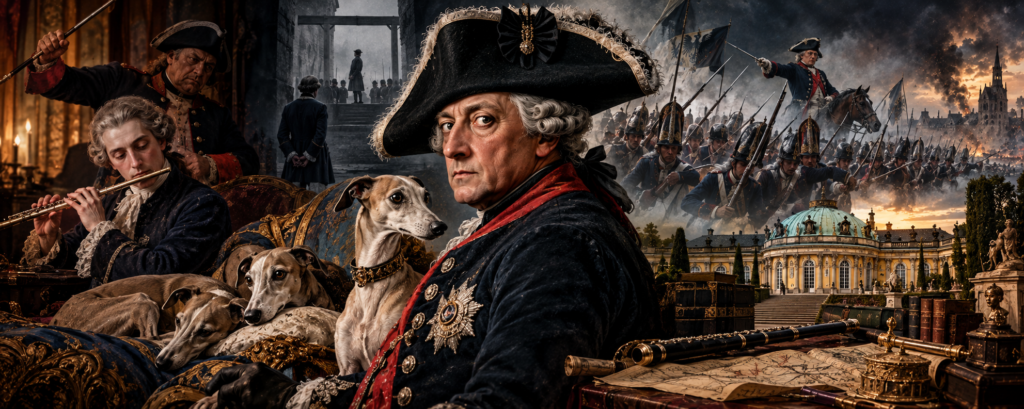
Frederick II of Prussia: The Broken Prince Who Became Frederick the Great
King of Prussia, 1740–1786 | Childhood Abuse, the Execution of Katte, the Seizure of Silesia, the Seven Years’ War, Kunersdorf, Enlightened Absolutism, Isolation, and the Dogs Who Became His Final Companions
The Prince at the Window
Long before Europe knew him as Frederick the Great, Frederick II of Prussia learned what absolute monarchy could look like from the wrong side of absolute power. He was not yet a conquering king, a celebrated military commander, or the philosopher of Sanssouci. He was a frightened crown prince trapped beneath the authority of his father, Frederick William I, the ferocious Soldier King who considered his son’s love of music, poetry, French literature, elegant clothing, and intellectual conversation signs of weakness. Their relationship deteriorated into a cycle of surveillance, humiliation, threats, beatings, and rebellion until, in 1730, the eighteen-year-old Frederick attempted to escape Prussia altogether. The attempt failed, Frederick was arrested, and his father devised a punishment that would haunt the prince long after he inherited the crown.
Frederick’s close companion Lieutenant Hans Hermann von Katte had helped with the escape scheme. A court-martial did not initially condemn Katte to death, but Frederick William intervened and demanded a harsher sentence. On 6 November 1730, Katte was brought out for execution at Küstrin while Frederick was confined nearby and compelled to witness, or at minimum be deliberately exposed to, the spectacle of his friend’s death. Accounts differ over the exact words exchanged between the two young men and over precisely how much Frederick could see from his window, but the central horror is not in serious dispute: Katte was beheaded on Frederick William’s orders, and the execution was deliberately incorporated into the punishment of his son. Frederick reportedly became overwhelmed and collapsed before or during the killing.
It would be tempting to make that morning the simple explanation for everything Frederick later became. The sensitive prince watched his friend die, something inside him broke, and the ruthless conqueror emerged from the wreckage. History is rarely that psychologically neat. Frederick retained his love of music, philosophy, literature, art, architecture, conversation, and animals throughout his life, while the calculating political ambition visible in his kingship cannot be reduced to a single traumatic event. Nevertheless, years of paternal violence followed by Katte’s execution undoubtedly formed part of the emotional landscape from which the adult Frederick emerged.
The resulting man was filled with contradictions. Frederick could write about reason while launching wars that killed tens of thousands, champion religious toleration while expressing vicious prejudices, compose flute sonatas between military campaigns, praise justice while personally interfering with courts, and cultivate the image of a philosophical monarch while ruling as an uncompromising autocrat. He could display extraordinary resilience during years when Prussia seemed close to destruction and then collapse into profound despair when catastrophe appeared unavoidable. He trusted animals more easily than many people, kept his wife at a distance for most of their marriage, surrounded himself largely with male companions, and grew increasingly solitary, sarcastic, suspicious, and physically neglected in old age.
None of this establishes that Frederick was clinically insane. There is no convincing evidence that he suffered the kind of sustained psychotic illness associated with Charles VI of France, nor should modern psychiatric diagnoses be imposed confidently upon a man who died in 1786. Yet Frederick belongs naturally in the darker margins of the Mad Monarchs category because contemporaries and later observers encountered a personality of startling extremes: wounded yet formidable, cultivated yet brutal, emotionally intense yet capable of chilling calculation. The boy who had once tried desperately to escape Prussia would eventually transform Prussia into a great power, but the price of that transformation would be paid in blood across Europe.
Born Between Two Worlds
Frederick was born in Berlin on 24 January 1712, the son of Frederick William I and Sophia Dorothea of Hanover. His parents represented two very different cultural worlds. Sophia Dorothea came from the Hanoverian dynasty that would occupy the British throne and possessed tastes closer to the refined aristocratic culture common among European courts. Frederick William preferred uniforms, military drill, bureaucratic efficiency, religious seriousness, frugality, and the rough masculine companionship of his Tobacco College.
The young Frederick gravitated toward precisely the interests his father disliked. He loved French language and literature, learned music, became particularly devoted to the flute, wrote poetry, and developed the intellectual curiosity that would later bring him into correspondence and friendship with some of Europe’s leading Enlightenment figures. These were not inherently unusual interests for an eighteenth-century prince. At many courts, they would have been considered signs of cultivation appropriate to a future monarch.
At Frederick William’s court, however, culture became a battlefield. The king wanted his heir hardened into the kind of disciplined military ruler he understood and respected. Frederick’s books, music, clothing, friendships, and mannerisms increasingly appeared to him as evidence that the prince was becoming something dangerously foreign to his ideal of Prussian kingship. The more Frederick resisted, the more aggressively his father attempted to control him.
The conflict eventually exceeded even the harsh standards of eighteenth-century royal parenting. Frederick William struck and humiliated his son, sometimes in front of others, and subjected him to relentless criticism. Frederick learned to conceal books and musical activities, creating a private intellectual life beyond his father’s approval. Every hidden book or secret flute lesson could become a small act of rebellion inside a household where the king expected obedience as complete as that of a soldier on parade.
The prince therefore grew up learning two contradictory lessons about power. From the philosophers he read, he encountered arguments about reason, civilization, justice, and human improvement. From his father, he learned that authority could also mean surveillance, humiliation, coercion, and physical force. Frederick would never entirely choose between those lessons. When he became king, he would carry both into his own conception of monarchy.
The Father Who Tried to Break Him
Frederick William’s treatment of his son cannot responsibly be diagnosed as the sole cause of Frederick’s adult personality, but neither should its severity be minimized. Frederick was not simply an artistic teenager arguing with a strict parent. His father was an absolute monarch with the ability to turn domestic anger into imprisonment, military prosecution, and potentially death. The crown prince therefore lived inside a family conflict in which the ordinary protections separating parental discipline from state violence barely existed.
Frederick’s relationship with his sister Wilhelmine became particularly important during these years. The siblings shared interests and confidences, and Wilhelmine later described the atmosphere of the royal household in memoirs filled with memories of their father’s anger and violence. Her account has to be read critically because memoirs are shaped by later memory and personal grievance, but the broader pattern of Frederick William’s brutality is independently supported. The children learned to maneuver around their father’s moods and to conceal intentions that might provoke him.
Frederick’s mother hoped to arrange prestigious British marriages for her children, while Frederick William became increasingly suspicious of the complicated diplomacy surrounding those plans. The dispute further poisoned the household. Frederick found himself caught between dynastic ambitions, his father’s authoritarian demands, and his own growing desire for personal freedom.
By 1730, escape began to look preferable to submission. Frederick planned to flee during a journey through southern Germany, hoping to escape his father’s jurisdiction and reach safety abroad. Katte became involved in the conspiracy, as did others within Frederick’s circle. The scheme was poorly protected, and the prince was caught before he could free himself.
Frederick William reacted as though his son had committed not merely filial disobedience but military treason. That distinction mattered enormously because Frederick was both crown prince and army officer. The king contemplated treating him as a deserter, and the possibility that Frederick himself might be executed was taken seriously enough to alarm those surrounding the monarchy. Frederick was imprisoned while the machinery of military justice moved against his associates.
Katte’s Death
Hans Hermann von Katte was twenty-six when the escape conspiracy destroyed him. He came from a military family and had become one of Frederick’s closest companions. The precise nature of their relationship has been debated extensively, with some historians allowing the possibility of a romantic or sexual attachment while others emphasize that the surviving evidence cannot establish its character with certainty. Whatever its private dimensions, the emotional importance of Katte to Frederick is beyond serious doubt.
The military court dealing with Katte did not initially produce the death sentence Frederick William wanted. The king intervened, increasing the punishment and ordering Katte’s execution. The decision transformed the case into something more than ordinary enforcement of military discipline because the monarch deliberately imposed a harsher outcome. Katte’s death became simultaneously punishment for the officer and a warning to the crown prince.
The execution at Küstrin on 6 November 1730 became one of the defining scenes of Frederick’s youth. Later retellings supplied dramatic dialogue and vivid details that cannot all be verified, but Frederick’s emotional devastation is well attested. The prince was placed where Katte’s execution would become part of his own ordeal, and Katte was beheaded after the two men had been brought into horrifying proximity for the last time. Frederick reportedly lost consciousness or became physically overwhelmed.
Calling this episode psychological torture is not an exaggeration. Frederick William understood that Katte mattered to his son and deliberately made the death part of Frederick’s punishment. The lesson was unmistakable: resistance to paternal and royal authority could destroy not only Frederick but those closest to him. It is impossible to measure precisely what such an experience did to an eighteen-year-old mind, but it would be equally unreasonable to pretend it left no mark.
Frederick survived by submitting. He studied administration at Küstrin, gradually regained his father’s confidence, and learned to display the outward behavior expected of him. Beneath that conformity, however, the musical and intellectual prince remained alive. The experience taught Frederick something he would use throughout his career: emotion could be concealed behind discipline, and survival sometimes required presenting the face other people expected to see.
A Marriage Without a Marriage
Reconciliation with Frederick William brought another demand. Frederick was expected to marry Elisabeth Christine of Brunswick-Wolfenbüttel-Bevern, a dynastic match favored by his father. The wedding took place in 1733, but it did not create the intimate royal partnership Elisabeth might reasonably have hoped for. Frederick remained emotionally distant, and once he became king their lives became increasingly separate.
It is easy to exaggerate this estrangement into the claim that Frederick literally banished his wife from his entire world. Elisabeth Christine retained royal status, maintained her own household, performed ceremonial duties, and appeared when dynastic protocol required her presence. What she did not possess was a meaningful place in Frederick’s private life at Sanssouci. He spent remarkably little time with her and showed no interest in creating a conventional marital household.
The marriage produced no children. Frederick’s sexuality has therefore generated centuries of speculation, especially because his closest emotional relationships were generally with men and because contemporary hostile commentary sometimes contained insinuations about same-sex desire. Modern historians continue to debate the evidence, and categorical declarations about his sexual life exceed what surviving documentation can securely prove. What can be said is that Frederick’s private world was overwhelmingly male and that his marriage remained distant and childless.
His treatment of Elisabeth Christine was cold rather than spectacularly violent. She was not subjected to anything resembling Katte’s fate, but she was denied the intimate role normally expected of a queen consort. Frederick could behave courteously toward her on formal occasions while keeping her outside the emotional center of his existence. The arrangement reflected both his personal preferences and the damage done by a marriage imposed upon him by the father he had once tried to escape.
There is a bleak symmetry in this part of Frederick’s life. Frederick William had attempted to dictate whom his son would become, what he would enjoy, how he would behave, and whom he would marry. Frederick eventually escaped his father’s physical authority by inheriting the throne, but he could not undo the decisions already embedded in his life. Elisabeth Christine became one of the quiet casualties of a family in which dynastic duty had long been more powerful than affection.
The Philosopher Becomes King
Frederick William I died on 31 May 1740. At twenty-eight, Frederick inherited a disciplined army, a strong treasury, an efficient administrative structure, and a kingdom far more powerful than its scattered territories might suggest. The son who had once contemplated fleeing Prussia now possessed absolute authority over it.
Observers who expected the new king to reverse his father’s policies were only partly correct. Frederick immediately demonstrated greater cultural sophistication and cultivated an image of enlightened rule. He relaxed certain restrictions, encouraged intellectual life, supported religious toleration by the standards of his age, and presented himself as a monarch who valued reason rather than crude authoritarianism. Music and philosophy returned openly to royal life.
Yet Frederick did not dismantle the military machine his father had created. He understood its value far too well. The army that had represented paternal oppression during his youth now became the instrument through which he would pursue his own ambitions.
Only months after taking the throne, Frederick invaded Silesia, a wealthy Habsburg province ruled by the young Maria Theresa. He justified his claim through complicated dynastic arguments, but the strategic reality was unmistakable. The Habsburg succession crisis had created an opportunity, Prussia possessed an excellent army, and Frederick chose to exploit the moment.
The philosopher-prince had become a conqueror with remarkable speed.
The Seizure of Silesia
Maria Theresa inherited the Habsburg lands after the death of her father, Emperor Charles VI, in October 1740. European powers had previously recognized the Pragmatic Sanction intended to secure her inheritance, but dynastic promises proved fragile once a young woman occupied the Habsburg throne and rival rulers saw opportunities for territorial gain. Frederick moved faster than most.
In December 1740, Prussian troops crossed into Silesia. Frederick’s decision began the First Silesian War and helped ignite the larger War of the Austrian Succession. It was a calculated act of aggression undertaken against a ruler struggling to secure her inheritance, and no amount of admiration for Frederick’s later military genius should obscure that reality.
The invasion revealed a side of Frederick very different from the persecuted prince of Küstrin. He could now treat international politics with the ruthless opportunism his father had applied to domestic authority. Strategic advantage mattered more than sentimental restraint, and Silesia offered population, industry, revenue, and geographic value that could transform Prussia’s position.
The gamble succeeded. Frederick’s army proved formidable, and after years of fighting he secured most of Silesia. The acquisition dramatically strengthened Prussia and established Frederick as a major European ruler. It also created a bitter rivalry with Maria Theresa that would shape the next two decades.
Frederick had learned an intoxicating lesson. Audacity could work.
The Enlightened Conqueror
Frederick’s reputation as an enlightened monarch did not disappear when he became a military aggressor because eighteenth-century political thought could accommodate contradictions modern readers often find uncomfortable. A ruler might promote legal reform, intellectual culture, religious toleration, agricultural development, and administrative efficiency while simultaneously waging wars of conquest. Frederick embraced the ideal of the monarch as the first servant of the state, but he also believed the state possessed interests that justified ruthless action.
He corresponded with intellectuals and wrote philosophical and political works. He played and composed music, admired French culture, maintained an extensive library, and cultivated a sophisticated court. His relationship with Voltaire became particularly famous, combining mutual admiration with vanity, quarrels, insults, and eventual estrangement.
Frederick’s religious policies were comparatively tolerant within the confessional politics of eighteenth-century Europe. He was personally skeptical about organized religion and generally willing to accept different Christian denominations when they served the state peacefully. Catholics continued to worship in conquered Silesia, and other groups could find room within his kingdom.
That tolerance nevertheless had limits. Frederick expressed harsh prejudices, including antisemitic views, and his policies toward Jews were frequently discriminatory and economically instrumental. He could defend broad principles of toleration while classifying populations according to whether he believed they were useful to the state. His Enlightenment was therefore genuine but incomplete, constrained by the authoritarian and hierarchical assumptions of his age and personality.
The contradiction was characteristic. Frederick wanted reason to govern society, but he assumed the person best qualified to determine what reason required was Frederick.
Sanssouci: Without Care
Beginning in the 1740s, Frederick created the retreat that became inseparable from his legend. Sanssouci rose above terraced vineyards near Potsdam, its very name promising a place “without care.” It was not designed primarily as a massive ceremonial palace comparable to Versailles but as a more intimate environment where Frederick could withdraw into music, literature, philosophy, conversation, and carefully chosen company.
The irony of the name is difficult to miss. Frederick spent much of his reign burdened by cares on a continental scale. Armies marched, alliances shifted, enemies surrounded him, provinces were invaded, and at several points the Prussian monarchy appeared close to destruction. Sanssouci offered an imagined alternative to that world.
Women had little place in its intimate social life. Frederick’s preferred companions were overwhelmingly male: officers, intellectuals, musicians, secretaries, visiting philosophers, and other men he found stimulating or useful. Elisabeth Christine remained largely outside this circle. Frederick had escaped his father’s barracks only to create a private world from which much of conventional family life was excluded.
His dogs, however, were welcome.
The Greyhounds of Sanssouci
Frederick’s affection for his Italian greyhounds was profound and unusually visible. Dogs accompanied him through his private life at Sanssouci, and surviving accounts leave little doubt that he formed strong emotional attachments to them. At a court where human relationships could become entangled in rank, ambition, betrayal, flattery, and political calculation, dogs offered companionship without intrigue.
One of the most famous was Biche, whom Frederick loved deeply. The dog’s death affected him intensely, reinforcing the image of a monarch capable of displaying toward animals a tenderness that he often concealed or withheld in human relationships. His greyhounds were permitted extraordinary freedom in his private surroundings and became part of the daily landscape of Sanssouci.
Stories about their behavior sometimes emphasize that they damaged expensive furnishings or were insufficiently house-trained while servants were forbidden to punish them. The broad picture of royal indulgence is credible, though the most comic details should not be treated as equally documented. Frederick’s attachment to the animals is far more important than whether every stained chair attributed to them can be historically verified.
He wanted his own burial place on the vineyard terrace at Sanssouci, near the environment he loved and the graves associated with his dogs. His wish was not immediately respected after his death; he was initially buried in the Garrison Church at Potsdam. Only in 1991 were his remains finally transferred to the terrace at Sanssouci.
The placement is deeply revealing. Frederick had been born into one of Europe’s most powerful dynastic families, yet the resting place he chose was not primarily a celebration of lineage. He wanted to remain at the retreat he had created for himself, in the landscape associated with the creatures whose companionship demanded nothing from him except affection.
War Returns
The peace Frederick won after the Silesian conflicts never truly settled the struggle with Austria. Maria Theresa did not forget the province taken from her, and Prussia’s dramatic rise alarmed other European powers. By the middle of the 1750s, the diplomatic system was shifting in ways that threatened Frederick with strategic encirclement.
In 1756, convinced that war was approaching, Frederick struck first by invading Saxony. He presented his action as preventive, but it involved the occupation of a neighboring territory and drew Prussia into the Seven Years’ War. Austria, France, Russia, Sweden, and various imperial forces would ultimately confront Prussia, while Britain became Frederick’s principal great-power ally.
The scale of the danger was enormous. Prussia was not simply fighting for another province. Frederick was attempting to preserve his monarchy against coalitions possessing vastly greater populations and resources.
His military reputation grew through astonishing victories. At Rossbach in 1757, Prussian forces crushed a larger Franco-Imperial army. Weeks later at Leuthen, Frederick defeated the Austrians in a battle that became one of the masterpieces of eighteenth-century warfare.
Victory reinforced the legend of the warrior-philosopher. Frederick seemed capable of moving armies with mathematical precision while still corresponding about literature and philosophy. Yet war would eventually reveal a different Frederick, one who could be driven toward psychological collapse when calculation failed.
The Price of the Great Captain
Frederick’s style of warfare demanded enormous effort from his soldiers. Prussian discipline was severe, maneuver exacting, and battlefield casualties could be appalling. The king shared danger more directly than many rulers, exposing himself during campaigns and enduring exhausting conditions, but personal courage did not make his wars less destructive for the men ordered into battle.
He could be ruthless toward officers whom he believed had failed him. Reputation, honor, and royal confidence mattered enormously within the Prussian military system. A commander who disappointed Frederick might discover that the king remembered the failure for years.
Stories of lifelong grudges against particular regiments or individuals should be evaluated case by case because Frederick’s reputation for sarcasm and vindictiveness attracted exaggeration. Nevertheless, his correspondence shows a man capable of savage judgments, bitter resentments, and extraordinarily cutting language. He did not forgive incompetence easily, particularly when he believed it had cost soldiers, territory, or strategic opportunity.
The king also placed punishing demands upon himself. Campaign seasons involved relentless movement, correspondence, planning, inspections, and decisions made under enormous pressure. Frederick’s famous capacity for work helped sustain Prussia, but it also meant that defeat could strike at a man who had invested his entire identity in remaining mentally superior to circumstances.
In 1759, circumstances finally overwhelmed him.
Kunersdorf: The Day Frederick Broke
The Battle of Kunersdorf on 12 August 1759 was one of the greatest disasters of Frederick’s reign. Prussian forces attacked a combined Russian and Austrian army east of the Oder. Early success encouraged Frederick to continue the battle rather than disengage, and repeated assaults gradually exhausted his troops.
The result was catastrophic. The Prussian army suffered devastating losses and disintegrated as an effective fighting force for the moment. Frederick, who had survived years of warfare by believing that speed, discipline, and his own judgment could overcome superior numbers, suddenly confronted the possibility that the entire system had failed.
His correspondence after the battle reveals genuine despair. He believed everything was lost and temporarily transferred or delegated command responsibilities while contemplating the destruction of his state. His emotional reaction was not the calm calculation later heroic portraits preferred to emphasize.
Accounts of Frederick sitting silently and drawing shapes or circles in the ground after defeats belong to the broader tradition describing his periods of withdrawal and despondency. Such picturesque details require caution because anecdotes about famous commanders often become more dramatic with repetition. The documentary evidence does not require them, however, to establish that Frederick experienced periods of severe emotional collapse under extreme military stress.
Kunersdorf therefore matters for understanding the king’s mental world. Frederick was not permanently detached from reality; indeed, his despair reflected a terrifyingly realistic understanding of how close Prussia was to catastrophe. Yet his response demonstrates how rapidly his extraordinary confidence could collapse into near hopelessness when events escaped his control.
Suicide in the King’s Pocket
During the Seven Years’ War, Frederick repeatedly contemplated the possibility of death and appears to have considered suicide preferable to capture or total humiliation. He carried poison during parts of the conflict and wrote letters reflecting an expectation that he might not survive the destruction of his monarchy. These were not merely theatrical gestures invented by later romantic biographers.
The temptation to diagnose such behavior must nevertheless be resisted. Frederick was living under extraordinary circumstances in which enemy armies repeatedly invaded his territories and the survival of Prussia genuinely hung in the balance. Eighteenth-century aristocratic concepts of honor also shaped attitudes toward capture, defeat, and self-inflicted death differently from modern clinical categories.
His despair could be profound. Frederick wrote about death with a familiarity that suggests more than abstract philosophical interest, especially during the darkest moments of the war. Yet he repeatedly returned to command, reorganized shattered forces, raised new armies, and continued fighting.
This oscillation between despair and extraordinary functionality is one reason later writers have been tempted to interpret Frederick through modern psychological frameworks. Trauma, depression, and stress responses offer plausible ways of thinking about aspects of his behavior, but the evidence does not permit a confident diagnosis of post-traumatic stress disorder or another specific condition. The safest conclusion is that Frederick suffered episodes of intense despair under pressure while retaining remarkable capacity to recover and act.
His greatest strength may not have been immunity to psychological collapse. It was his ability to continue after collapsing.
The Miracle That Saved Prussia
After Kunersdorf, Prussia seemed vulnerable to destruction, but its enemies failed to exploit their victory decisively. The coalition possessed enormous resources but also conflicting objectives, logistical problems, political rivalries, and strategic disagreements. Frederick survived the immediate crisis.
The war continued with terrible intensity. Prussian manpower and finances were strained almost beyond endurance, territories were devastated, and Frederick’s earlier confidence gave way to a harder form of persistence. Victory increasingly meant not triumph but survival.
Then, in January 1762, Empress Elizabeth of Russia died. Her successor, Peter III, admired Frederick and rapidly changed Russian policy, withdrawing from the anti-Prussian coalition and even moving toward alliance. The sudden reversal became famous in Prussian memory as the “Miracle of the House of Brandenburg.”
Frederick did not create this miracle through battlefield genius. Dynastic chance rescued him at a moment when Prussia was exhausted. The Treaty of Hubertusburg in 1763 restored the basic territorial situation in central Europe and confirmed Prussian possession of Silesia.
Frederick emerged with his reputation enormously enhanced. Prussia had survived a coalition of great powers, and its king became one of Europe’s most celebrated commanders. The victory, however, came after years of slaughter, financial desperation, devastation, and psychological strain that changed both monarch and kingdom.
Financing Survival with Bad Money
War required money on a scale Frederick’s normal revenues could not sustain. During the Seven Years’ War, the Prussian government therefore relied heavily upon currency debasement, reducing the precious-metal content of coins while continuing to issue them at higher nominal values. The operation became an important source of war finance and was associated with entrepreneurs such as Veitel Heine Ephraim and Daniel Itzig.
Polish and Saxon monetary systems became deeply entangled in these schemes. Prussia occupied Saxony and exploited its resources, while debased coins circulated through neighboring territories, including the Polish-Lithuanian Commonwealth. The economic consequences were damaging, and Frederick’s wartime monetary policies contributed to inflation and disruption beyond his own borders.
Popular retellings sometimes describe the operation as a personal revenge scheme in which Frederick stole Polish mint dies and deliberately destroyed neutral Poland’s currency out of spite. That simplifies a larger and more calculated system of wartime finance. Frederick was certainly willing to exploit Polish monetary vulnerability, but the primary motive was raising the enormous sums required to keep Prussia fighting.
The episode still reveals his ruthlessness. Frederick understood that economic manipulation could function as another weapon of war, and he was prepared to impose the resulting costs upon populations that had little influence over his strategic decisions. The philosopher-king who wrote about rational government was also perfectly capable of engineering monetary degradation when survival demanded it.
The contradiction was not accidental. Frederick’s philosophy of kingship placed the interests of the state above ordinary sentiment, and during the Seven Years’ War he increasingly identified Prussia’s survival with his own judgment. If debased money kept soldiers in the field, moral discomfort was unlikely to stop him.
The Dogs and the King
After the Seven Years’ War, Frederick increasingly withdrew into the private routines that made Sanssouci his refuge. Human relationships had repeatedly brought conflict, betrayal, competition, or disappointment. His dogs offered something simpler.
Italian greyhounds surrounded him in his private rooms and accompanied him through daily life. He named them, mourned them, tolerated behavior from them that servants would never have been permitted, and buried beloved animals near the palace. Visitors sometimes found the king’s indulgence toward them remarkable.
Biche occupies a special place in these stories. Frederick’s grief when she died became emblematic of the emotional tenderness he could display toward animals. A monarch capable of sending thousands of men into battle could mourn intensely for a small dog, a contrast that has fascinated biographers ever since.
There is no genuine contradiction in loving animals while being ruthless in politics, however uncomfortable the combination may appear. Human beings compartmentalize. Frederick could view soldiers through the abstractions of strategy while experiencing his dogs as immediate emotional companions.
The dogs also existed outside the hierarchical world that had damaged him. They could not conspire, negotiate alliances, betray military plans, demand dynastic marriages, criticize his policies, or remind him of his father. Their affection required none of the elaborate defenses Frederick had developed around human intimacy.
For the aging king, that may have mattered enormously.
Voltaire Comes to Prussia
Frederick’s relationship with Voltaire embodied both the brilliance and instability of his intellectual friendships. Long before Voltaire arrived in Prussia, the two men had exchanged letters filled with admiration. Frederick wanted the prestige and stimulation of Europe’s most famous philosopher, while Voltaire was fascinated by the idea of a philosophically minded king.
When Voltaire eventually settled at Frederick’s court, the friendship did not survive intimacy gracefully. Both men were proud, sarcastic, intelligent, sensitive to insult, and accustomed to dominating conversation. Arguments developed over money, publications, other intellectuals, and Voltaire’s conduct.
Frederick could be possessive and authoritarian even toward a philosopher whose independence he supposedly admired. Voltaire could be provocative, financially opportunistic, and devastatingly witty. Their quarrel eventually became poisonous, and Voltaire left Prussia under humiliating circumstances.
The episode exposed the limits of Frederick’s philosophical tolerance when philosophy became personal. He admired intellectual freedom in principle but found it more difficult when an intellectual friend refused to remain within boundaries Frederick considered acceptable. The king who wanted brilliant companions also wanted to remain king among them.
Their relationship later partially recovered through correspondence, but the dream of philosopher and philosopher-king living harmoniously at Sanssouci had collapsed. Frederick could create a palace “without care.” He could not create friendship without friction.
The All-Male World of Sanssouci
Frederick’s intimate court has often been described as overwhelmingly male, and this is broadly accurate. Officers, intellectuals, musicians, diplomats, secretaries, and male friends dominated his preferred private company. Women were not literally absent from the Prussian monarchy or broader court, but they were notably peripheral to Frederick’s personal circle at Sanssouci.
This has naturally influenced debates over his sexuality. Evidence of intimate male relationships, contemporary rumors, his estrangement from his wife, and his lack of known female mistresses have led many modern historians to consider it plausible that Frederick was primarily attracted to men. Others caution that the surviving evidence does not permit definitive reconstruction of his sexual behavior.
For the purposes of understanding his personality, certainty about labels is less important than recognizing the social structure he chose. Frederick created a private environment that sharply separated him from conventional married domestic life. He preferred selected male companionship and his dogs to the family-centered court expected of many dynastic monarchs.
That preference may have had many overlapping causes. Sexuality may have played a role, as may childhood trauma, resentment of his forced marriage, intellectual preference, military culture, and distrust of conventional court society. Reducing the arrangement to any single explanation would oversimplify a complicated man.
Whatever the cause, Elisabeth Christine remained outside the world Frederick considered truly his own. The marriage his father had imposed survived formally for more than half a century, but intimacy did not.
The King of Snuff and Stained Uniforms
The older Frederick became, the less interest he showed in conventional royal appearance. He was famous for wearing a relatively simple blue military coat rather than the glittering fashions associated with many European courts. Over time, his clothing could become worn, stained, and saturated with the evidence of daily habits.
Snuff was one of those habits. Frederick consumed it heavily, and descriptions of the aging king frequently emphasize clothing marked by tobacco. His increasingly careless appearance contrasted sharply with the elaborate interiors and cultivated artistic environment of Sanssouci.
Stories about his personal hygiene became progressively more extreme in later retellings. He is sometimes described as going months without washing, sleeping habitually in filthy boots, refusing to change underclothes, and raging at servants who attempted to clean him. Some degree of declining personal cleanliness in old age is credible and contemporary descriptions support an increasingly neglected appearance, but the most spectacular anecdotes should not automatically be accepted as literal routine.
By his final illness, however, the deterioration was unmistakable. Contemporary evidence surrounding his death indicates that he no longer possessed a clean shirt of his own suitable for burial and was dressed in one belonging to a servant. The detail is striking precisely because this was not an obscure recluse but Frederick the Great, one of the most celebrated monarchs in Europe.
The transformation from the elegant flute-playing prince into the physically deteriorating Old Fritz became part of his legend. His body aged, his clothes decayed, and the polished courtly world of his youth mattered less and less. What remained was work.
Coffee, Champagne, Mustard, and Royal Folklore
Frederick was a devoted coffee drinker, and his unusual habits surrounding the beverage have generated some of the most memorable anecdotes about his private life. He is associated with extraordinarily strong coffee and with experiments involving preparation methods that would have startled ordinary drinkers. One tradition claims he sometimes had coffee prepared with champagne rather than water.
The additional claim that he mixed mustard into this concoction appears frequently in modern collections of royal eccentricities, but it should be treated as anecdotal rather than as one of the securely documented pillars of his biography. Frederick accumulated odd stories because people expected odd behavior from him. The distinction between genuine personal habit and later embellishment becomes difficult when an eccentric monarch turns into folklore.
His attitude toward sleep was similarly severe. Frederick rose extremely early and maintained punishing work routines, particularly during military campaigns and periods of intense administration. He regarded excessive sleep as wasted time and expected attendants to ensure that he woke according to schedule.
Stories describe servants using increasingly forceful methods to wake him, including cold or damp cloths. Whether every version is accurate is less important than the well-established reality of his relentless schedule. Frederick treated his own body much as he treated the Prussian state: as something expected to continue functioning because duty required it.
That discipline could become self-punishing. The king who had spent childhood resisting his father’s brutal schedule eventually became a ruler famous for imposing harsh schedules upon himself.
Justice According to Frederick
Frederick liked to portray himself as a defender of justice and rational government. He worked to improve administration, supported legal reform, opposed certain abuses, and believed monarchs should actively supervise the machinery of the state. Yet his confidence in his own judgment sometimes led him to interfere dramatically with the very judicial independence enlightened government supposedly required.
The most famous example came in the Miller Arnold affair during the 1770s. A miller named Arnold became embroiled in a complicated dispute involving water rights, rents, creditors, and local courts. Frederick became convinced that the miller had been victimized by powerful interests and that judges had failed to deliver justice.
The king intervened aggressively. He ordered judicial officials punished and imprisoned, overruling legal judgments because he believed the courts had behaved corruptly. To Frederick, the action demonstrated that no judge was above justice and that the king would protect ordinary subjects against oppression.
To many legal observers, however, the episode demonstrated precisely the opposite. Frederick had substituted personal royal conviction for judicial procedure, punished judges whose interpretation differed from his own, and revealed how fragile legal independence remained under enlightened absolutism. A monarch who believed himself the guardian of justice could become a threat to justice whenever he was certain that only he understood it.
This was Frederick’s recurring problem. He genuinely believed in rational government. He also genuinely believed that his own reason should have the final word.
A King Who Remembered Failure
Frederick possessed a formidable memory for military performance, and officers who disappointed him could discover that royal displeasure endured. He demanded extraordinary standards because his armies frequently operated under conditions in which a single error could have strategic consequences. During the Seven Years’ War, this severity became especially pronounced.
His correspondence could be vicious. Frederick mocked generals, criticized soldiers, and expressed contempt for men he believed had failed through cowardice, incompetence, or stupidity. The celebrated philosopher-king possessed a tongue capable of cruelty almost as effectively as his father had wielded a cane.
Calling these grudges pathological would go beyond the evidence. Military command in eighteenth-century Europe depended heavily upon honor, patronage, reputation, and personal confidence, while Frederick had genuine reasons to remember costly mistakes. Yet the intensity of his resentment contributed to the impression of a monarch who had difficulty forgiving perceived betrayal.
This tendency extended beyond military affairs. Frederick’s relationships could move from intense admiration to bitterness when someone disappointed him. Voltaire discovered it, officers discovered it, relatives discovered it, and political allies discovered it.
The boy who had learned that intimacy could be dangerous became an old man who trusted selectively and forgave reluctantly.
Poland and the Ruthlessness of Reason
Frederick’s involvement in the First Partition of Poland in 1772 demonstrated the cold strategic logic of his later reign. Along with Russia and Austria, Prussia seized territory from the Polish-Lithuanian Commonwealth, exploiting its political weakness and the ambitions of surrounding powers. Frederick acquired West Prussia, though not initially the cities of Danzig and Thorn, connecting important parts of his monarchy and strengthening its geographic coherence.
The partition was not an irrational act. It was almost the opposite: a ruthlessly rational calculation of state advantage. Frederick understood what territory would improve Prussia’s strategic position and participated in dismantling a neighboring state to obtain it.
This is essential to the question of his supposed madness. Many of Frederick’s darkest political actions were not products of mental disorganization. They were calculated decisions made by a ruler capable of understanding consequences.
The disturbing element lies in the moral distance between his philosophical language and his geopolitical behavior. Frederick could discuss enlightened principles while participating in the dismemberment of another polity. He could criticize fanaticism and superstition while treating populations as strategic resources.
Reason without empathy can become its own form of brutality. Frederick’s reign repeatedly demonstrates that intellectual sophistication does not guarantee humane policy.
The Man Behind Old Fritz
As Frederick aged, the affectionate popular image of “Old Fritz” developed alongside the harsher reality of an authoritarian monarch. He cultivated direct involvement in government, read petitions, inspected provinces, and worked relentlessly. Subjects could imagine him as a stern but attentive father of the kingdom.
There was truth in that image. Frederick took kingship seriously and did not regard the state merely as a source of personal luxury. He believed a ruler owed labor to his subjects, and his administrative workload remained extraordinary.
Yet paternal monarchy could carry the same danger that paternal authority had carried in Frederick’s childhood. A father might claim to know what was best for children who had no right to refuse. Frederick similarly believed he could determine what was best for millions of subjects without granting them meaningful political participation.
He was enlightened because he wanted government to be rational, efficient, educated, and comparatively tolerant. He remained absolute because he had little interest in sharing sovereignty.
Frederick’s political philosophy therefore contained an unresolved contradiction. The state existed to serve society, but the king decided what service meant.
The Shadow of His Father
Frederick spent much of his youth resisting Frederick William I, yet aspects of the father survived unmistakably in the son. Both men worked obsessively, valued military strength, demanded competence, interfered personally in administration, and could respond savagely to perceived failure. Frederick rejected his father’s cultural austerity but inherited much of his authoritarian conception of kingship.
The resemblance becomes especially striking when considering control. Frederick William tried to control his son’s clothing, interests, friendships, marriage, and future. Frederick II would never reproduce the same domestic brutality because he had no children and kept his wife distant, but he exercised intense control over officers, bureaucrats, judges, and state policy.
The son refined the father’s methods. Where Frederick William might explode physically, Frederick often preferred sarcasm, administrative punishment, dismissal, or calculated political pressure. The cane became the memorandum.
Yet Frederick also consciously created spaces his father would have hated. Sanssouci was filled with art, music, French books, elegant architecture, intellectual conversation, and the greyhounds he adored. The palace represented the survival of the prince Frederick William had failed to destroy.
The old conflict therefore never completely ended. It was rebuilt in stone above the vineyards of Potsdam.
Was Frederick Traumatized?
It is entirely reasonable to describe Frederick’s childhood experiences as traumatic in the ordinary historical sense. He endured physical abuse, public humiliation, severe paternal control, imprisonment, fear for his own life, and the execution of a close companion deliberately incorporated into his punishment. Few modern psychologists would regard such experiences as emotionally trivial.
It is much more difficult to diagnose him retrospectively with post-traumatic stress disorder. Surviving documents can reveal behavior, language, mood, relationships, and reported experiences, but they cannot reproduce a clinical examination. Frederick’s emotional reserve, distrust, episodes of despair, intense need for control, and complicated relationships may be compatible with trauma-related adaptations without proving a particular diagnosis.
The same caution applies to claims of catatonia. Frederick experienced periods of withdrawal and severe despair, especially during military catastrophe, but describing them as clinical catatonia imposes a specific medical term that the evidence does not establish. His reaction after Kunersdorf was extreme but understandable given the apparent destruction of his army and imminent collapse of his kingdom.
Trauma nevertheless provides a valuable lens when used carefully rather than diagnostically. Frederick learned young that vulnerability could be punished and that emotional attachment could be weaponized against him. As an adult, he prized self-control, hid vulnerability, restricted intimacy, and sought environments where he controlled the terms of interaction.
His dogs may have been especially attractive precisely because they could not use affection as leverage.
The Wife Outside the Door
Elisabeth Christine survived Frederick by more than a decade, having spent much of their marriage occupying the strange position of queen without being a meaningful partner to the king. She performed public responsibilities and retained dignity despite the emotional distance between them. Frederick did not formally repudiate her, but neither did he create a shared domestic life.
Popular accounts sometimes say that she was absolutely forbidden from entering Potsdam or Sanssouci. The reality was more nuanced, shaped by separate households, court protocol, and Frederick’s determination to keep Sanssouci as his private refuge. Women could appear within the broader palace environment and royal ceremonial world, but Elisabeth was not part of the intimate circle around which Frederick organized his preferred life.
Their rare interactions became famous for their formality. Anecdotes portray Frederick greeting his wife with distant courtesy, sometimes merely inquiring after her health before turning away. Individual quotations may be polished by later storytellers, but the emotional distance is unmistakable.
Elisabeth’s experience complicates attempts to portray Frederick simply as a victim of his father’s marriage policy. He had been coerced into the marriage, but she had been caught within the same dynastic system. Frederick responded to his lack of choice by withdrawing from the relationship, leaving his wife to bear consequences she had not created.
The abused prince did not necessarily become an abusive husband in his father’s manner. He became something colder: largely absent.
The Physical Collapse of Old Fritz
By the 1780s, Frederick’s body was deteriorating badly. Decades of campaigning, relentless work, poor health, heavy snuff use, irregular habits, and age had transformed the once energetic king. He suffered from increasing physical weakness and eventually severe edema associated with his final illness.
His appearance could be startlingly neglected. The famous blue uniform became almost a second skin, worn with little concern for courtly elegance. Snuff stains and signs of physical decline contributed to the image of Old Fritz as a monarch who had ceased to care how he looked.
This should not be confused with complete withdrawal from government. Frederick continued working even as his health worsened. Administrative routine had become almost inseparable from identity, and he remained involved in state affairs when physical comfort might reasonably have justified retirement.
His final days were spent at Sanssouci, increasingly weak and drifting between sleep and consciousness. Contemporary accounts describe difficulty breathing, exhaustion, and periods of confusion as death approached. He died in the early hours of 17 August 1786, aged seventy-four.
The king who had spent his life trying to command events could no longer command his own body.
The Grave Beside the Dogs
Frederick had long intended to be buried on the terrace at Sanssouci. The site overlooked the landscape he had shaped and lay near the resting places associated with his beloved dogs. It was a remarkably personal choice for a monarch whose dynasty possessed more conventional royal burial places.
His immediate successor did not honor the request. Frederick was instead buried in the Garrison Church at Potsdam, placing him within a more traditional Prussian military setting. Wars and political upheavals later complicated the history of his remains still further.
Only on 17 August 1991, exactly 205 years after his death, was Frederick finally reburied at Sanssouci. His grave now lies on the upper terrace above the vineyard. Visitors often leave potatoes there, a modern tradition connected with Frederick’s famous association with encouraging potato cultivation in Prussia.
The location provides an unusually intimate ending to the life of a ruler remembered for enormous public events. He fought wars across central Europe, humiliated great powers, corresponded with philosophers, partitioned territory, transformed Prussia, and became a symbol of German military history. Yet the grave he wanted was not beneath a gigantic equestrian monument.
He wanted Sanssouci.
And he wanted his dogs nearby.
Was Frederick the Great Mad?
There is no convincing historical basis for describing Frederick II as clinically insane. He remained capable of sustained administration, sophisticated diplomacy, complex military planning, intellectual work, artistic creation, and long-term strategic thought throughout most of his reign. His failures could be catastrophic, but they were not evidence of psychosis.
Nor should every eccentricity be medicalized. Loving dogs intensely, preferring male companionship, living separately from one’s wife, wearing old uniforms, taking snuff, working extreme hours, or cultivating unusual dietary habits does not establish mental illness. Some behaviors became exaggerated precisely because Frederick was famous enough for every odd story about him to circulate.
His emotional collapses during the Seven Years’ War deserve greater attention. After catastrophic defeats, particularly Kunersdorf, Frederick could descend rapidly into despair and contemplate death. These episodes reveal psychological vulnerability beneath the celebrated image of relentless self-control.
Childhood trauma also cannot be ignored. Frederick endured treatment from his father that would have been devastating under almost any historical standard. The execution of Katte was an especially calculated act of psychological cruelty.
But trauma is not madness.
Frederick’s darker behavior is more disturbing precisely because so much of it was rational.
The Ruthlessness of a Rational King
Frederick seized Silesia because he calculated that he could. He invaded Saxony because he believed strategic circumstances required a preemptive strike. He debased currency because he needed money to continue fighting. He participated in the partition of Poland because territory was available and useful.
None of these decisions requires insanity to explain.
They require ambition.
The image of the mad king can sometimes become morally convenient because it separates cruelty from ordinary human calculation. If a ruler behaves monstrously because he is insane, his actions can be placed safely outside normal political behavior. Frederick resists that comforting interpretation.
He was extraordinarily intelligent. He understood diplomacy, finance, military logistics, administration, culture, and propaganda. He could anticipate consequences with remarkable sophistication.
And he still chose war.
His reign therefore raises a darker question than whether Frederick was mad. It asks what happens when a brilliant ruler possesses enormous power, a profound belief in his own judgment, and the willingness to sacrifice other people’s lives to strategic necessity.
The Philosopher Who Sent Men to Die
Frederick genuinely loved philosophy. His intellectual interests were not simply propaganda invented to disguise militarism. He read extensively, wrote seriously, corresponded with major thinkers, composed music, debated religion, and considered the nature of government.
He also spent enormous portions of his reign at war.
The contradiction has fascinated historians because it seems almost impossible to reconcile the flute player at Sanssouci with the commander surveying a battlefield covered in dead soldiers. Yet Frederick himself would not necessarily have considered the two identities incompatible. Enlightenment thought did not automatically reject warfare, monarchy, hierarchy, or conquest.
Frederick believed rulers had duties to their states. If war strengthened or preserved Prussia, he could regard it as a legitimate instrument of policy even while personally understanding its horrors. His letters from campaigns reveal that he was not emotionally blind to death.
Knowledge did not always produce restraint.
That may be one of the most important lessons of his reign.
The Sensitive Prince Never Entirely Died
It would be equally misleading to portray Frederick as emotionally dead after Katte. He remained capable of intense attachment, humor, artistic sensitivity, intellectual excitement, grief, and affection. His music alone contradicts the idea that the prince’s inner world simply disappeared beneath a soldier’s uniform.
His attachment to dogs reveals the same survival of tenderness. So does his devotion to Sanssouci, his correspondence, his friendships, and his continued passion for literature. The emotional man remained present even when the king concealed him.
What changed was the environment in which Frederick allowed vulnerability to appear. Battlefield command demanded hardness. Government demanded authority. Diplomacy demanded calculation.
Music was safer.
Dogs were safer.
Private letters could sometimes be safer.
The king could therefore appear cold not because he felt nothing but because he had learned very young that feeling openly could be dangerous.
From Victim to Absolute Monarch
Frederick’s life contains an uncomfortable transformation. As a young man, he was the victim of an absolute ruler who believed authority justified invading every part of his existence. As king, Frederick embraced absolute monarchy himself.
He changed its style. He preferred enlightened administration to his father’s rougher authoritarianism, cultivated philosophy rather than contempt for it, and replaced the Tobacco College with intellectual conversation. He did not routinely chase Berliners with a cane.
But the fundamental structure remained. Frederick believed the monarch possessed the right and duty to direct the state from above. Subjects did not receive political sovereignty because their king happened to read Voltaire.
The Miller Arnold affair exposed the contradiction dramatically. Frederick wanted to protect an ordinary man from injustice, an admirable goal, but he pursued it by overriding judges and punishing officials according to his own interpretation. Benevolent absolutism remained absolutism.
Perhaps the deepest inheritance from Frederick William was therefore not militarism.
It was certainty.
Both father and son believed that when they knew what was right, resistance became difficult to tolerate.
A Kingdom Built on Contradiction
Prussia at Frederick’s death was radically more powerful than it had been when he inherited it. Silesia remained Prussian, West Prussia connected important territories, the army enjoyed an enormous European reputation, and the monarchy had entered the first rank of continental powers. Frederick had achieved what generations of Hohenzollern rulers had sought.
The cost was immense. His wars killed and wounded enormous numbers of soldiers and devastated civilian communities. The Seven Years’ War placed Prussia under extraordinary strain and nearly destroyed the state Frederick was trying to strengthen.
Frederick nevertheless emerged from the conflict as a legend. Military theorists studied his campaigns, admirers celebrated his endurance, and Prussian identity increasingly became associated with the king who had survived seemingly impossible odds. “Old Fritz” became more than a person; he became a political myth.
That myth later proved dangerous because subsequent generations could select whichever Frederick they wanted. Liberals admired the enlightened ruler, nationalists admired the conqueror, military officers admired the commander, musicians admired the flutist, and authoritarian politicians admired the disciplined monarch. Each image contained some truth while concealing another part of the man.
The real Frederick was all of them at once.
The Last Night at Sanssouci
By August 1786, the king’s extraordinary capacity for work could no longer overcome physical collapse. His breathing worsened, exhaustion deepened, and periods of sleep became longer. The ruler who had survived Mollwitz, Leuthen, Kunersdorf, Russian invasion, Austrian armies, political betrayal, and decades of relentless administration was approaching an enemy no strategy could outmaneuver.
His final condition was far removed from royal magnificence. Frederick had become physically neglected enough that accounts surrounding his burial describe the need to use a servant’s clean shirt because an appropriate clean one of his own was unavailable. It is an extraordinary detail for a king whose reputation had filled Europe.
He died at Sanssouci on 17 August 1786. Elisabeth Christine, the wife who had spent so much of their marriage apart from him, survived until 1797. Frederick left no legitimate children, and the throne passed to his nephew Frederick William II.
The king’s requested burial on the vineyard terrace was ignored. The nephew whom Frederick had often treated contemptuously ordered him buried elsewhere, a small posthumous reversal of authority that the dead monarch could no longer prevent.
For once, Frederick gave an order and nobody had to obey.
The Boy at Küstrin and the Old Man at Sanssouci
Frederick’s life is often told as a triumph. A persecuted prince survives an abusive father, inherits the throne, becomes a military genius, defeats stronger enemies, transforms a vulnerable kingdom into a great power, and enters history as Frederick the Great. There is truth in every part of that story.
There is another story beneath it.
A young man learned that his father could kill someone he loved to enforce obedience. He learned to hide vulnerability, to distrust intimacy, to separate public duty from private feeling, and to survive through discipline. He then spent forty-six years wielding enormous power over armies and subjects of his own.
Sometimes he used that power with remarkable intelligence and restraint. Sometimes he used it to promote toleration, administration, agriculture, law, culture, and learning. Sometimes he used it to invade neighboring states.
The same mind produced flute sonatas and invasion plans.
The same hand wrote philosophy and military orders.
The contradiction cannot be solved by calling him mad.
Frederick the Great and the Mad Monarchs
Frederick II belongs in the Mad Monarchs collection precisely because his story challenges what the category means. He was not Charles VI of France, disappearing for periods into unmistakable psychotic illness. He was not incapable of governing, detached permanently from reality, or controlled by obvious delusions.
His darkness came from somewhere different.
He carried the scars of a brutal childhood into an adult life built around discipline, control, emotional concealment, ambition, and extraordinary endurance. Under extreme stress he could descend into profound despair, yet he repeatedly returned to command. He formed intense attachments but often preferred animals and selected male companions to conventional family intimacy. He championed reason while making decisions that brought devastation to entire regions.
Modern observers may see trauma in these patterns, and they may be right. What they cannot responsibly do is convert that possibility into a definitive psychiatric diagnosis. Frederick’s experiences provide context for his behavior, not a medical certificate explaining it.
Nor should trauma excuse what followed. The suffering of the prince does not erase the responsibility of the king. Frederick knew what power could do to a vulnerable person because he had experienced it himself, yet he still embraced a political system in which his judgment stood above almost everyone else’s.
That is part of his tragedy.
The King Who Could Not Live Without War or Music
Frederick’s flute has become almost as famous as his sword because the two objects seem to represent incompatible men. One belonged to the cultured prince who loved beauty, conversation, and artistic expression. The other belonged to the monarch who seized territory and repeatedly placed himself and his kingdom at the center of European war.
But perhaps they were never separate men.
Music gave Frederick structure without coercion. A composition demanded discipline, timing, precision, and control, yet transformed those qualities into beauty rather than punishment. Military command demanded many of the same things while transforming them into organized violence.
Frederick excelled at both.
His father had imagined music and soldiering as opposites. Frederick’s life demonstrated that they could coexist within the same personality. Sensitivity did not prevent ruthlessness, and ruthlessness did not eliminate sensitivity.
The lesson is uncomfortable because people often prefer historical monsters to be simple. Frederick was not.
The Philosopher’s Dogs
In the end, the greyhounds may tell us more about Frederick than many grand political monuments. He could relax around them in a way that appears to have been difficult for him with human beings. They slept near him, accompanied him, disrupted his carefully designed interiors, grew old, died, and were mourned.
There was no diplomacy in their affection.
No father could order them to betray him.
No officer could surrender a fortress.
No philosopher could publish a satire.
No wife could remind him of a marriage he had never wanted.
No enemy could turn them into bargaining pieces.
Frederick could simply love them.
That does not make the dogs a psychiatric clue proving trauma or emotional disorder. It makes them part of the private life of a man whose public existence had been shaped from childhood by dangerous human relationships.
His chosen grave beside Sanssouci makes the attachment even more poignant. The king who spent decades enlarging Prussia ultimately wanted his body placed not at the center of a military monument but above a vineyard near the animals he had loved.
The Man Behind “The Great”
Historical greatness is an uncomfortable word. Frederick earned the title because he transformed Prussia, demonstrated extraordinary military ability, survived overwhelming enemies, administered his kingdom tirelessly, and became one of the most influential monarchs of eighteenth-century Europe. None of those achievements requires admiration for everything he did.
His greatness was built partly upon aggression. Silesia was not offered to him voluntarily. Saxony did not invite occupation. Poland did not request partition. Soldiers did not choose every battlefield upon which Frederick’s strategic calculations placed them.
Yet reducing him to a warmonger would be equally inadequate. He was an intellectual of genuine ability, an accomplished musician, an energetic administrator, a religious skeptic who practiced significant toleration, a patron of culture, a legal reformer in important respects, and a monarch who genuinely believed kings existed to work rather than merely indulge themselves.
The contradictions are not flaws in the historical picture.
They are the picture.
The Crown and the Wound
Frederick II died one of Europe’s most famous rulers, but the frightened prince of 1730 never completely disappears from his story. He can still be glimpsed in the king’s distrust, his emotional reserve, his fierce attachment to selected companions, his contempt for vulnerability, his periods of despair, and perhaps most poignantly in his preference for animals whose affection carried no political danger. Those patterns do not prove a psychiatric diagnosis, but they remind us that kings do not become emotionally invulnerable when a crown is placed upon their heads.
The crown gave Frederick something the young prince had desperately lacked: control. No father could dictate his books anymore. No one could forbid his flute. No one could choose the architecture of his private refuge or decide which philosophers sat at his table. He could build Sanssouci according to his own imagination and surround himself with the company he preferred.
But absolute control has its own dangers. The man who had once been powerless became the man whose decisions could send entire armies across borders. The victim of royal authority became its master, and his understanding of power remained deeply shaped by discipline, hierarchy, obedience, and the conviction that superior judgment justified command.
Frederick did not become his father. That would be far too simple. He rejected Frederick William’s anti-intellectualism, cultivated everything his father had despised, and created a royal identity unmistakably his own. Yet the machinery Frederick William built—and something of the older king’s uncompromising certainty—survived within his son’s reign.
This is why Frederick the Great remains such a compelling figure for the darker history of monarchy. His story contains no convenient moment when sanity disappears and madness takes over. There is instead a long continuum between brilliance and obsession, resilience and despair, sensitivity and cruelty, philosophy and conquest.
The prince at Küstrin could weep for Katte.
The king at Sanssouci could mourn Biche.
The commander at Kunersdorf could believe everything was lost.
The strategist could recover and continue a war that consumed thousands more lives.
The philosopher could speak of reason.
The conqueror could invade.
All of these men were Frederick.
The King Who Survived Himself
By the time Frederick died in 1786, almost everyone who had shaped his youth was gone. Frederick William had been dead for forty-six years. Katte had lain in his grave for more than half a century. Wilhelmine, Frederick’s beloved sister and one of the strongest emotional connections of his early life, had died in 1758 while the Seven Years’ War was raging. Voltaire died in 1778. Favorite dogs came and went, officers aged, enemies disappeared, and the young flute-playing prince became the bent and increasingly solitary figure Europe called Old Fritz.
What remained was Prussia.
That may have been Frederick’s greatest triumph and his most terrible monument. The kingdom that had once seemed too small and fragmented to dominate European politics emerged from his reign as a great power. Its army commanded respect, its bureaucracy functioned with formidable discipline, and its rulers could no longer be treated as minor German princes.
But Prussia’s rise had been purchased through war, taxation, coercion, sacrifice, and the relentless concentration of state power. Frederick had inherited the machine from his father, refined it, intellectualized it, and then demonstrated what it could accomplish when directed by a ruler willing to gamble everything.
His father had tried to turn a sensitive child into a soldier.
He failed.
What emerged instead was far more complicated: a musician who became a conqueror, a philosopher who became an autocrat, a traumatized son who became one of Europe’s most formidable kings, and a man capable of extraordinary tenderness in private while making decisions of extraordinary ruthlessness in public.
That is why calling Frederick II simply “mad” tells us almost nothing. There is no secure evidence that insanity drove his wars or that mental illness explains the contradictions of his reign. His darkest decisions were often calculated, and his periods of despair frequently occurred when circumstances genuinely were desperate. Trauma may help us understand the emotional architecture of the man, but it cannot absolve the monarch who acted through it.
The more unsettling conclusion is that Frederick did not need to be mad to become the ruler he became. Intelligence did not protect him from cruelty. Philosophy did not prevent aggression. Personal suffering did not automatically create compassion for the suffering of others. Artistic sensitivity could coexist comfortably with military ruthlessness because human personalities are capable of containing contradictions that neat historical labels cannot resolve.
Frederick William I had tried to beat contradiction out of his son. He wanted a prince who was only one thing: soldier, heir, obedient instrument of the Prussian state. Frederick survived by refusing that simplification, and his entire life became an answer to it. He remained soldier and musician, skeptic and king, intellectual and conqueror, wounded son and absolute monarch.
In 1991, more than two centuries after his death, Frederick finally reached the grave he had chosen for himself on the terrace at Sanssouci. There was no battlefield beneath him, no gigantic military mausoleum, and no triumphant monument proclaiming the wars through which Prussia had risen. The old king came to rest above the vineyard, near the palace where he had played music, read philosophy, entertained chosen companions, escaped court ceremony, and lived among his beloved greyhounds.
It was perhaps the closest Frederick ever came to escaping the world his father had built for him.
The crown remained in history. The armies remained in history. Silesia, Kunersdorf, partition, conquest, enlightened absolutism, and the legend of Frederick the Great remained in history as well. But on the hill above Sanssouci lies something quieter: the final refuge of a man who spent almost his entire life mastering kingdoms, armies, officials, enemies, and himself, yet who had learned as a boy that there were some wounds no amount of power could completely command.