
Afonso IV of Portugal: The Brave King, the Murder of Inês de Castro, and the Family War That Drowned a Dynasty in Blood
King of Portugal, 1325–1357 | Afonso the Brave | The Murder of Inês de Castro
The King Who Chose the Crown Over His Son
On January 7, 1355, Inês de Castro died at Coimbra, and one of medieval Europe’s most enduring tragedies was born. She was a Galician noblewoman, the longtime companion of Pedro, heir to the Portuguese throne, and the mother of several of his children. King Afonso IV, Pedro’s father, had come to regard the relationship as politically dangerous. Inês’s powerful Castilian family alarmed the Portuguese court, her children complicated questions of succession, and Pedro’s attachment to her appeared capable of drawing the kingdom into dangerous aristocratic and dynastic struggles beyond its borders. Faced with those risks, Afonso and his advisers embraced a solution whose brutality would ultimately create precisely the catastrophe they feared.
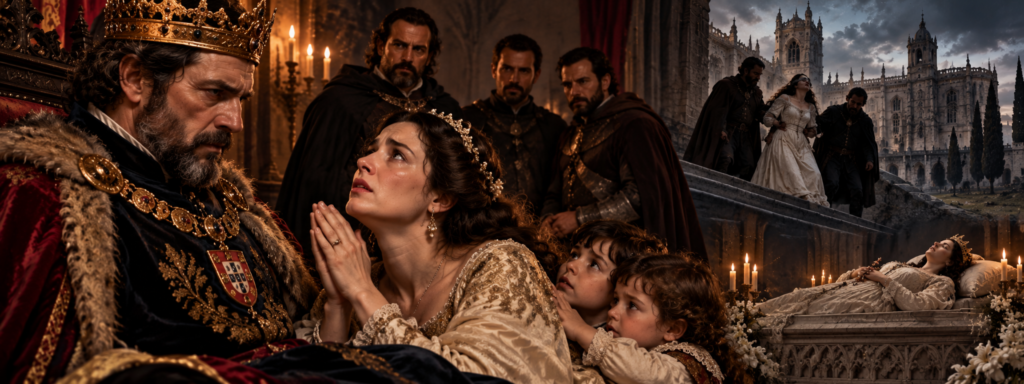
Inês was killed with royal approval while Pedro was absent. Later tradition transformed the killing into an intensely theatrical scene in which Inês threw herself before the king with her children and begged for mercy before assassins dragged her away to die. Some versions say she was beheaded, while others describe her as stabbed or killed by the sword. Medieval evidence establishes Afonso’s responsibility for her death far more securely than it establishes many of the dramatic details that accumulated around it. The distinction matters because the documented decision is disturbing enough without embellishment: the king authorized the elimination of the woman his son loved because he believed dynastic security required her removal.
The murder did not restore order. Pedro responded with fury, joined forces with members of the Castro family, and rebelled against his father, bringing violence into northern Portugal. The king who had acted in the name of stability now found himself fighting his own heir. Afonso eventually reached a reconciliation with Pedro, but the settlement could not undo what had happened, and when Afonso died in 1357 his son inherited both the throne and an unfinished desire for vengeance.
Pedro subsequently captured two of the men implicated in Inês’s death and had them executed with spectacular cruelty. The chronicler Fernão Lopes famously described their hearts being torn from their bodies, one through the chest and the other through the back, while the king watched. Around this documented core grew an even darker legend: that Pedro had Inês’s corpse exhumed, dressed as a queen, seated upon a throne, and presented to nobles who were forced to kiss her dead hand. The story has become inseparable from the mythology of Pedro and Inês, but the famous corpse-coronation scene is not securely supported by contemporary evidence and should be treated as legend rather than established history.
Afonso IV was not clinically insane. There is no persuasive evidence that he suffered psychosis, hallucinations, mania, dementia, or any other condition that would justify diagnosing him as mentally ill. His decisions instead reveal something arguably more unsettling: a ruler capable of subordinating intimate family relationships to dynastic calculation, using violence when he believed royal authority was threatened, and repeatedly entering destructive conflicts with his own relatives. Long before he ordered Inês killed, Afonso had already fought his father, persecuted his half-brother, and gone to war with the kingdom ruled by his son-in-law.
His place among the Mad Monarchs therefore rests not upon psychiatric illness but upon the destructive logic of power. Afonso could be rational in his objectives while choosing methods that produced catastrophically irrational consequences. He wanted to protect his inheritance and rebelled against his father; wanted to secure his throne and renewed conflict with his brother; wanted to defend his daughter and helped push Portugal toward war with Castile; wanted to protect the succession and authorized a murder that provoked his own heir into rebellion. Again and again, the pursuit of security generated instability.
The murder of Inês was not an inexplicable act committed by a previously calm ruler who suddenly lost control. It was the culmination of patterns that had shaped Afonso’s political life for decades. To understand why a king could decide that killing his son’s beloved was an acceptable act of state, it is necessary to return to another father and another son—and to the civil conflict that nearly tore the Portuguese royal family apart before Afonso ever wore the crown.
A Prince Who Feared His Own Father
Afonso was born in Lisbon on February 8, 1291, the legitimate son of King Denis of Portugal and Elizabeth of Aragon, the woman later revered as Saint Elizabeth of Portugal. Denis was one of medieval Portugal’s most significant rulers, remembered for administrative development, royal centralization, agricultural policies, diplomacy, and cultural patronage. Yet his family life contained the seeds of future conflict. Like many medieval kings, Denis fathered children outside his marriage, and one of them would become a particular source of anxiety to his legitimate heir.
Afonso Sanches, an illegitimate son of Denis, enjoyed substantial royal favor. He received lands, wealth, offices, and influence, and his prominence became increasingly threatening to Prince Afonso. Medieval succession did not make it easy for Denis simply to replace a legitimate son with an illegitimate one, and claims that Afonso Sanches was on the verge of being formally substituted as heir should therefore be treated cautiously. Nevertheless, political power was not determined by succession law alone, and a wealthy half-brother with the king’s confidence could remain dangerous even if he never wore the crown.
Prince Afonso came to believe that his father’s favoritism endangered his own position. Whether this amounted to “paranoia” in a modern psychological sense cannot be established, and the word should be used carefully because the prince had genuine reasons to resent Afonso Sanches’s prominence. Royal courts were dangerous environments in which brothers, uncles, cousins, and illegitimate children could become centers of opposition. Afonso’s fear was therefore not imaginary, but his response transformed dynastic suspicion into armed conflict.
Beginning around 1320, the dispute erupted into open confrontation between father and son. Prince Afonso gathered supporters and challenged Denis, while the king defended his authority and the position of his favored illegitimate son. What had begun as jealousy and political insecurity now threatened to become civil war. Afonso was willing to use force against the king whose throne he expected one day to inherit, establishing a pattern that would later return with grim symmetry when his own son rebelled against him.
The conflict continued intermittently through the final years of Denis’s reign. It is tempting to describe the prince’s behavior as an irrational obsession, but medieval dynastic politics rarely permit such simple judgments. Afonso’s fear of being politically marginalized was understandable; his willingness to destabilize the kingdom to prevent that possibility was far more consequential. He behaved as though preserving his future authority justified damaging the monarchy he hoped to inherit.
That contradiction would become one of the defining features of his life. Afonso repeatedly acted to prevent a feared political disaster while helping create a different disaster through the methods he chose. The young prince who fought his father because he feared losing his place in the dynasty would eventually become the father who killed his son’s beloved because he feared losing control of the dynasty. The names and circumstances changed, but the underlying struggle between family affection and royal power remained.
Saint Elizabeth Between Two Armies
Afonso’s mother became famous for attempting to mediate between her husband and son. Elizabeth of Aragon had already developed a reputation for piety, charity, and peacemaking, and the conflict within her own family placed those qualities under extraordinary pressure. Later tradition produced vivid images of her physically placing herself between hostile forces, sometimes described as riding a mule between the opposing armies to prevent battle. The broad tradition of her intervention as peacemaker is strong, although the most picturesque details have been embellished through centuries of devotional storytelling.
One celebrated episode is associated with the confrontation at Alvalade near Lisbon in 1323. Denis and his son appeared close to open battle, while Elizabeth intervened in an effort to prevent bloodshed. Her mediation became part of the saintly image later constructed around her, presenting the queen as the peaceful figure standing between two men consumed by dynastic hostility. Whether every later description of the scene is literally accurate is less important than the political reality it represents: the royal family had become divided badly enough that the queen repeatedly worked to keep husband and son from destroying one another.
The conflict also placed Elizabeth herself in a difficult position. Denis reportedly suspected her of favoring their son and at one point restricted or displaced her from court, although accounts of these events became intertwined with later hagiography. She nevertheless continued working toward reconciliation. The royal marriage, the succession, and the peace of the kingdom had become inseparable from the feud between Afonso and Afonso Sanches.
Peace was eventually restored sufficiently for the succession to proceed without a final catastrophe. Denis died on January 7, 1325, and his legitimate son became King Afonso IV. The prince who had feared being displaced had obtained exactly what succession law had always promised him. One might expect the new king’s anxieties to have ended with his coronation, but dynastic memory did not disappear merely because he now possessed the crown.
His half-brother remained alive, wealthy, connected, and potentially dangerous. Afonso IV had spent years interpreting him as a threat, and kingship gave him the power to act upon that hostility more decisively than he could as a prince. The family feud therefore survived Denis. The son who had rebelled against his father now inherited both the kingdom and the enemies created during that rebellion.
A Crown and an Old Grudge
Afonso IV moved against Afonso Sanches after becoming king, confiscating lands and possessions and forcing his half-brother from Portugal. Describing this simply as petty vengeance understates the political dimension of the decision. Afonso Sanches possessed extensive resources and had once enjoyed exceptional proximity to the previous king, making him a plausible rallying point for anyone dissatisfied with the new ruler. Neutralizing such a figure was a recognizable medieval strategy.
Yet political calculation and personal resentment were not mutually exclusive. Afonso IV had hated and feared his half-brother’s influence for years, and accession gave him an opportunity to settle the dispute from a position of overwhelming authority. Rather than absorbing Afonso Sanches peacefully into the new regime, the king chose dispossession and exile. The result was predictable: the exiled magnate did not simply disappear.
Afonso Sanches resisted from Castilian territory, and armed conflict followed. Once again, Portugal faced violence rooted in disputes within its ruling family. The new king had spent his youth fighting because he feared his brother’s power, and his attempt to eliminate that power after accession generated further fighting. The pattern of preventive aggression producing the danger it was intended to suppress had begun almost immediately.
Eventually, mediation helped produce reconciliation. Queen Elizabeth again played an important role in resolving the quarrel between the half-brothers. The settlement demonstrated that Afonso was capable of compromise when circumstances required it, an important corrective to any portrayal of him as a ruler driven by uncontrollable rage. He could negotiate, calculate, retreat, and reconcile.
That capacity makes his later decisions more significant rather than less. Afonso did not repeatedly resort to violence because he was incapable of rational thought. He resorted to violence because he regarded coercion as a legitimate instrument of dynastic government. When compromise appeared useful, he compromised; when elimination appeared safer, he could choose elimination.
The King Called “the Brave”
Afonso IV’s later reputation cannot be reduced to family bloodshed. He was known as Afonso o Bravo, Afonso the Brave, a title associated particularly with his military reputation. His reign included administrative activity, diplomatic maneuvering, conflict with Castile, and participation in one of the most celebrated Christian victories of the later Iberian Middle Ages. He was neither a helpless eccentric nor a king incapable of governing.
Portugal under Afonso remained deeply connected to the political world of the Iberian Peninsula. Royal marriages linked Portuguese rulers to Castile and Aragon, while noble families possessed connections that crossed political borders. The kingdoms were independent, but their dynasties were intertwined so closely that domestic family disputes could quickly become international problems. A marriage might create an alliance, but it could also give foreign relatives a reason to interfere in another kingdom’s politics.
Afonso understood these dangers because he had lived through them. His conflict with Afonso Sanches involved Castilian connections, and his own children would become instruments of diplomatic strategy. Yet the same king who understood the dangers of foreign aristocratic influence would later discover that royal marriages created emotional relationships he could not control as easily as treaties.
This tension between the personal and political is central to Afonso’s story. Medieval rulers were expected to treat marriage as an instrument of policy, but marriages still involved real human beings capable of love, resentment, jealousy, humiliation, and rebellion. Afonso repeatedly attempted to manage family relationships according to political logic. The consequences reveal how dangerous that assumption could become.
Maria of Portugal and a Marriage Gone Wrong
Afonso’s daughter Maria married Alfonso XI of Castile in 1328. The union promised to strengthen relations between the neighboring kingdoms and placed a Portuguese princess on the Castilian throne. In dynastic terms, it was precisely the kind of marriage a medieval king might consider a political success. The personal reality was much less satisfactory.
Alfonso XI maintained a long and highly visible relationship with Leonor de Guzmán, who became his influential mistress and bore him numerous children. Maria’s position was humiliating, and her father’s anger at her treatment contributed to deteriorating relations between Portugal and Castile. Some popular accounts claim that Alfonso XI effectively abandoned Maria to a convent while openly preferring Leonor, although the exact circumstances of Maria’s residence and treatment require more nuance than the most dramatic retellings provide.
Afonso IV’s response should not simply be described as a “tantrum.” The humiliation of a queen was a dynastic matter, and Leonor’s influence had implications beyond marital infidelity because her children created a powerful alternative branch of the Castilian royal family. Afonso’s concern for his daughter’s status therefore combined paternal anger with legitimate political calculation. Nevertheless, personal grievance helped intensify a dispute between two kingdoms.
War broke out between Portugal and Castile in 1336. Fighting continued intermittently until 1339, involving raids, frontier conflict, and maritime operations rather than one uninterrupted campaign of total war. The struggle imposed costs on both kingdoms while larger dangers were developing in the south. Afonso’s determination to defend Portuguese dynastic interests had again helped turn a family dispute into military confrontation.
Maria herself became involved in efforts toward peace, adding another striking reversal to Afonso’s family history. The daughter whose mistreatment helped fuel the conflict participated in the diplomacy that helped bring it to an end. Once again, members of the royal family were required to repair the consequences of dynastic hostility. The pattern would recur with far greater violence when Afonso’s son Pedro became the central figure in the darkest crisis of the reign.
From Family War to the Battlefield of Río Salado
The conflict between Portugal and Castile could not continue indefinitely because a much greater military threat emerged from North Africa and the Muslim kingdom of Granada. Marinid forces crossed into Iberia, creating a crisis that threatened Castile and potentially Portugal as well. Whatever their personal and dynastic grievances, the Christian monarchs now faced a common enemy.
Maria is traditionally credited with appealing to her father for assistance to Alfonso XI. Afonso IV responded, and Portuguese forces joined the Castilians in the campaign that culminated in the Battle of Río Salado on October 30, 1340. The combined Christian army won a major victory over the Marinid and Granadan forces. The battle became one of the great military achievements associated with Afonso’s reign and contributed significantly to his reputation for bravery.
Río Salado reveals a side of Afonso that disappears if he is portrayed merely as irrational and vindictive. He could distinguish immediate family resentment from larger strategic necessity. He was capable of cooperating with the son-in-law whose treatment of Maria had enraged him when the security of the peninsula required it. His political behavior could therefore be flexible and pragmatic.
That pragmatism is precisely what makes the Inês de Castro affair so important. Afonso’s decision to authorize her death did not emerge from an inability to calculate consequences in any ordinary sense. He had demonstrated repeatedly that he understood alliances, threats, military necessity, and dynastic strategy. The tragedy came because his calculations about Inês ultimately reduced a human relationship to a security problem.
Afonso would eventually decide that the woman loved by his heir represented a danger to Portugal. He would then apply the same hard logic of political necessity that medieval kings used against rebellious nobles or foreign enemies. The crucial difference was that Inês was not merely another political actor. She was the mother of Pedro’s children and the person around whom his emotional life had come to revolve.
Pedro, Constanza, and the Woman From Galicia
Pedro, Afonso’s surviving son and heir, was born in 1320. Like other royal children, his marriage was expected to serve dynastic policy. After earlier marriage arrangements proved complicated, Pedro eventually married Constanza Manuel, a Castilian noblewoman whose family connections made the union politically important. Among the women who accompanied Constanza to Portugal was Inês de Castro.
Inês belonged to the powerful Castro family of Galicia. She was not an obscure servant or socially insignificant mistress who happened to catch the prince’s eye. Her relatives belonged to the interconnected aristocratic world of Castile and Galicia, and members of her family possessed political ambitions and influence. That background would become central to Afonso’s fears.
Pedro and Inês formed an intimate relationship, apparently while Constanza was still alive. The affair created obvious humiliation for Pedro’s wife and political discomfort for the Portuguese court. Later romantic tradition transformed their relationship into an almost perfect medieval love story, but its beginnings were painful for Constanza and politically disruptive. Afonso had reasons to disapprove even before questions of succession became acute.
The king attempted to separate the lovers, and Inês was at one point sent away from court. Separation did not end the relationship. Pedro remained attached to her, and after Constanza died in 1345 the obstacles preventing him from living openly with Inês weakened considerably.
From Pedro’s perspective, the death of his wife may have made Inês his natural companion. From Afonso’s perspective, it made the situation more dangerous. The prince was no longer merely conducting an affair with a lady attached to his wife’s household. He was a widowed heir whose beloved belonged to a foreign-connected noble family and whose future marriage could reshape the politics of the succession.
Four Children and a Dangerous Question
Pedro and Inês had four known children, although one died young. Their surviving sons and daughter created a dynastic problem that grew more serious as the relationship continued. Pedro also had a legitimate son by Constanza, the future King Ferdinand I of Portugal. The existence of a recognized legitimate heir should have reduced some succession anxiety, but medieval dynastic politics could rarely be considered secure merely because one child stood first in line.
The Castro children possessed royal blood through Pedro and powerful aristocratic connections through Inês. If Pedro married Inês, or later claimed that he had already married her, their status could potentially change dramatically. Rival noble factions might rally around different branches of the royal family. Afonso had spent his own youth terrified of an illegitimate half-brother with political influence, so the possibility of competing sons around the future king may have struck him with particular force.
It is impossible to know exactly how much Afonso’s experience with Afonso Sanches shaped his thinking, but the parallel is difficult to ignore. As a prince, he had feared that a favored illegitimate son could threaten a legitimate heir. As king, he now watched his own heir produce children with a woman whose relatives possessed powerful connections outside Portugal. The old dynastic nightmare had returned in a different form.
This does not mean the Castro children were actively plotting to seize the Portuguese throne in the early 1350s. Nor does it prove that Inês intended to manipulate Pedro into displacing Ferdinand. Much of the case against her rested upon what might happen in the future rather than upon a proven conspiracy already underway. Preventive politics often operates in precisely this space between genuine risk and imagined catastrophe.
Afonso increasingly treated that risk as intolerable. The king and his advisers worried not merely about a love affair but about the possibility of a Castro political bloc forming around the future monarch. Once Inês became defined as a threat to the state rather than as Pedro’s companion, the range of solutions considered acceptable could become much darker.
The Castro Brothers and the Shadow of Castile
Inês’s brothers, particularly Álvaro Pérez de Castro and Fernando de Castro, were important figures in the turbulent politics of Castile. Their connections to Pedro inevitably drew Portuguese attention. Castile itself was becoming increasingly unstable, and aristocratic factions moved through a political environment filled with rivalry, rebellion, royal mistresses, illegitimate children, and competing dynastic interests.
The situation was especially sensitive because Alfonso XI died in 1350 and was succeeded by Pedro I of Castile, later remembered as either “the Cruel” or “the Just” depending upon the tradition describing him. Castilian politics descended into increasingly bitter conflict involving the king, noble factions, and his illegitimate half-brothers, the sons of Leonor de Guzmán. Portugal had every reason to avoid becoming trapped inside those struggles.
The Castro family reportedly encouraged Portuguese Pedro toward intervention in Castilian affairs, although the exact extent of their influence is difficult to reconstruct without accepting hostile royal interpretations at face value. Afonso IV feared that his son might become a vehicle for ambitions that would drag Portugal into foreign dynastic conflict. Given the volatility of Castile, this was not an absurd concern.
Where Afonso’s reasoning becomes more troubling is in the leap from recognizing political risk to deciding that Inês herself had to die. The king could have continued exile, restricted Castro access to Pedro, negotiated another marriage, or attempted other forms of political containment. None offered certainty, and Pedro’s stubborn attachment to Inês made ordinary separation difficult. Nevertheless, murder was not the only imaginable response.
The decision to kill her therefore reveals the severity of Afonso’s concept of kingship. He appears to have concluded that the security of the crown justified an irreversible act against a woman whose greatest political danger lay partly in the people surrounding her and the children she had borne. It was a medieval act of reason of the coldest kind: identify the perceived source of instability, remove it permanently, and trust that authority can contain the aftermath.
Did Pedro Secretly Marry Inês?
One of the most consequential mysteries surrounding the couple concerns whether Pedro and Inês actually married. After becoming king, Pedro asserted that he had married her secretly, an assertion that would make her his lawful wife and potentially alter the status of their children. The alleged marriage was said to have taken place before her death, but the circumstances remained uncertain even during Pedro’s own reign.
Pedro’s claim cannot simply be dismissed, yet historians have long debated its credibility. Evidence was produced in support of the marriage, but important uncertainties remained regarding the date, witnesses, and canonical circumstances. Pedro himself reportedly could not or would not provide a clear date when the marriage was publicly discussed. Political motives also existed for elevating Inês after her death.
For Afonso IV, however, even the possibility of marriage would have been alarming. If Pedro could legitimize the relationship, Inês would cease to be merely a mistress and become a potential future queen. Her sons would gain a stronger claim to legitimate dynastic status, increasing the possibility of future rivalry with Ferdinand.
This was the nightmare Afonso wanted to prevent. His fear was not simply that Pedro loved the wrong woman. It was that love might alter the structure of the Portuguese dynasty and connect the future monarchy too closely to a powerful Galician-Castilian family.
Whether the threat was as immediate as Afonso believed is another matter. Medieval rulers frequently acted upon possibilities because waiting for a conspiracy to become undeniable could mean waiting until it was impossible to stop. Afonso’s tragedy was that preventive logic allowed increasingly extreme measures to appear reasonable.
Coimbra and the Decision to Kill
By the beginning of 1355, Inês was living in Coimbra, traditionally associated with the palace at Santa Clara. Pedro remained openly attached to her, and the king’s advisers continued to regard the relationship with alarm. Among the men later identified with the decision were Pêro Coelho, Álvaro Gonçalves, and Diogo Lopes Pacheco, names that would become infamous when Pedro eventually sought revenge.
The precise deliberations leading to the killing cannot be reconstructed with perfect certainty. Later chronicles were written with knowledge of the tragedy’s outcome and of Pedro’s subsequent reign, while romantic literature added emotional scenes that became almost impossible to separate from popular memory. Afonso’s political concerns are clear, but the exact arguments exchanged within the royal council are not.
Tradition depicts the king arriving at Coimbra while Pedro was away, confronting Inês, and wavering after she begged for the lives of herself and her children. His councillors then supposedly persuaded him that state necessity required her death. This scene has enormous dramatic power, but its details should not be treated as a verbatim record of what occurred. Medieval chroniclers frequently shaped moral narratives around decisive moments.
What remains beyond the romantic embellishment is Afonso’s responsibility. Inês was killed with the approval of the king, and the men associated with her death acted within the political context created by his decision. Whether Afonso personally spoke the final command in precisely the form later writers imagined matters less than the fact that royal authority made the killing possible.
The king had finally attempted to solve the Castro problem permanently. Inês could no longer marry Pedro, could no longer become queen, and could no longer serve as the living center of a foreign-connected faction around the heir. On paper, the threat had been removed. In reality, Afonso had transformed a political problem into a blood feud with the man destined to inherit his throne.
The Death of Inês de Castro
Inês was killed on January 7, 1355. Popular tradition often states categorically that she was beheaded, while other accounts describe death by sword or stabbing. The precise mechanics of the killing are less securely established than the fact that she was deliberately put to death. Because later art and literature repeatedly dramatized the murder, specific details have acquired an authority they do not always possess in the medieval evidence.
Her children have an equally important place in the legend. Later retellings frequently place them around their mother during her final appeal, making the scene almost unbearable: a woman kneeling before the grandfather of her children while asking him not to make them motherless. Whether the confrontation unfolded exactly this way cannot be demonstrated. The story survived because it captures the moral horror later generations saw in Afonso’s choice.
For Pedro, however, no theatrical embellishment was required. The woman with whom he had shared years of his life and who had borne his children had been killed with his father’s approval. Whatever political arguments Afonso believed justified the act, Pedro experienced its consequences personally. The king had used the power of the crown against his own son’s household.
Afonso may have expected grief, anger, and resistance. There is no evidence that he naively assumed Pedro would simply “calm down” and cheerfully accept another marriage, a claim that would attribute a remarkably simplistic thought process to a ruler experienced in dynastic conflict. More likely, Afonso believed royal authority could survive Pedro’s rage and that removing the long-term political danger justified the short-term crisis.
If so, he miscalculated badly. Pedro did not merely grieve. He rebelled.
The Son Turns His Fury Against the Father
Pedro’s reaction transformed private bereavement into armed resistance. He allied himself with Castro interests and turned against his father, bringing war into Portugal. Northern regions, particularly between the Douro and Minho, suffered as the conflict developed, and attacks were directed against territories and interests associated with the king.
The civil violence represented the precise kind of internal instability Afonso had claimed to fear from the Castro connection. His solution to a hypothetical future dynastic conflict had generated an immediate rebellion by the heir himself. The king had eliminated Inês but could not eliminate Pedro, because Pedro remained essential to the continuation of the dynasty.
The conflict was serious but should not be exaggerated into a prolonged nationwide war that completely destroyed Portugal. Fighting was concentrated and relatively brief, although destructive enough to make reconciliation urgent. Both sides faced powerful reasons to avoid an irreparable rupture because Afonso could not easily discard his heir and Pedro could not destroy his father’s monarchy without damaging the kingdom he expected to inherit.
Once again, a woman of the royal family helped mediate between hostile men. Queen Beatrice of Castile, Afonso’s wife and Pedro’s mother, played an important role in bringing father and son toward settlement. The pattern echoed the earlier intervention of Saint Elizabeth between Denis and Afonso. Two generations of Portuguese royal women found themselves trying to stop fathers and sons from settling dynastic grievances through violence.
An agreement was reached in 1355, ending the immediate rebellion. Pedro formally reconciled with Afonso, but reconciliation on parchment could not erase Inês’s death. The king had preserved his throne for the moment, while the prince had preserved his right to inherit it. Beneath that political settlement remained a debt of blood that Pedro would remember after his father was no longer alive to restrain him.
The Terrible Symmetry of Father and Son
Afonso’s conflict with Pedro possessed an almost eerie resemblance to his own conflict with Denis. As a young prince, Afonso had taken up arms against his father because he believed the king’s favoritism toward another branch of the family threatened his future. Decades later, Pedro took up arms against Afonso because the king had intervened violently in his intimate and dynastic life. In both cases, the heir challenged the reigning monarch, and in both cases royal women participated in efforts to restore peace.
The motives were not identical. Afonso’s rebellion against Denis centered heavily upon Afonso Sanches and fears about royal favor, while Pedro’s rebellion followed the killing of Inês. Nevertheless, both conflicts emerged from the inability of the Portuguese royal family to keep dynastic anxiety from becoming armed confrontation. Afonso had experienced firsthand how violently a prince could react when he believed his father threatened his future, yet he later created a crisis in which his own son had even stronger reasons for fury.
This does not prove that Afonso suffered from some psychological compulsion to repeat his youth. Historical patterns are not psychiatric diagnoses. It does, however, reveal a striking failure to learn from experience. The king who had once been the dangerous son became the father unable to prevent another dangerous son from rebelling.
Power may have changed Afonso’s perspective. As heir, he regarded resistance as justified when royal policy threatened him. As king, he regarded resistance as a threat to order and believed the crown possessed the right to impose dynastic discipline. The transformation is common in politics, but in Afonso’s family it became lethal.
His life therefore offers a particularly dark study in the way authority alters moral perspective. Afonso could remember his own fears as a prince while still concluding that Pedro’s wishes must yield to state necessity. The man had changed positions within the dynasty, and with that change came a radically different understanding of whose suffering mattered.
Afonso’s Final Years
Afonso lived for only a little more than two years after Inês’s death. The reconciliation with Pedro prevented immediate continuation of the civil conflict, allowing the kingdom to avoid a final destructive confrontation between king and heir. Yet the relationship between father and son had been permanently altered.
The king died in Lisbon on May 28, 1357, at the age of sixty-six. His reign of more than three decades had included military success, royal administration, conflict with Castile, victory at Río Salado, dynastic disputes, and the continued development of Portuguese monarchy. Judging his entire kingship solely through the death of Inês would therefore produce a distorted picture.
Nevertheless, the murder became the event that overwhelmed almost everything else in popular memory. Afonso the Brave became the king who killed Inês, just as Pedro would become the king who avenged her. Their political achievements survived in chronicles, but the blood feud possessed an emotional power that ordinary administration could never match.
Afonso died having prevented Inês from becoming the living wife of Portugal’s next king. He had not prevented Pedro from becoming king, nor had he destroyed the Castro children. Most importantly, he had no control over what his son would do once royal authority passed into Pedro’s hands.
The restraints imposed by fatherhood, political compromise, and Afonso’s living presence disappeared with the old king. Pedro inherited the crown. The prince who had been forced to accept reconciliation could now decide what reconciliation had actually been worth.
Pedro Becomes King
Pedro I of Portugal succeeded his father in 1357. He would develop a reputation as a forceful administrator of justice, earning contrasting memories as Pedro the Just and Pedro the Cruel. His reign contained much more than revenge for Inês, but her death remained central to the mythology surrounding him.
The men involved in her killing had reason to fear the new king. Some fled beyond Pedro’s reach, and complicated negotiations eventually enabled him to obtain custody of two of them. Pêro Coelho and Álvaro Gonçalves were returned to Portugal, while Diogo Lopes Pacheco escaped the vengeance that befell his companions.
Pedro’s treatment of the captured men became one of the most gruesome episodes in Portuguese royal history. Fernão Lopes, writing later in the fourteenth and early fifteenth centuries, described the king overseeing their execution and ordering their hearts torn out, one through the chest and the other through the back. The brutality was deliberate and symbolic, transforming execution into vengeance.
The account has contributed enormously to Pedro’s terrifying romantic image. He was not merely punishing men for participation in an unlawful killing; their actions had been authorized under the previous king. Pedro was using his own royal authority to reverse the moral judgment of his father’s reign. Afonso had treated Inês’s death as an act of state security, while Pedro treated those responsible as criminals deserving spectacular destruction.
The dynasty had thus completed a grim circle. Afonso used royal power to kill Inês, and Pedro inherited that same royal power and used it to kill her killers. Each king could present violence as justice. The crown remained constant while the definition of the crime changed with the man wearing it.
Hearts Torn From Living Bodies
The executions of Pêro Coelho and Álvaro Gonçalves are often described with the phrase “their hearts were ripped out while they were alive.” Fernão Lopes’s account supports the tradition of extraordinarily cruel execution involving removal of their hearts, although later retellings sometimes add dialogue and gruesome details not necessary to the historical narrative. The chronicler’s description is already horrifying.
The symbolism of the hearts has invited obvious interpretation. The men who participated in taking Pedro’s beloved from him were themselves destroyed through the organs conventionally associated with love and feeling. Whether Pedro consciously designed the punishment according to that romantic symbolism cannot be known with certainty, but later generations inevitably read it that way.
The executions also demonstrate why the Inês affair cannot be reduced to a tragic love story. It was a political killing followed by rebellion, reconciliation, accession, extradition, and judicial vengeance. Royal authority shaped every stage. Love supplied the emotional force, but kingship supplied the machinery of death.
Afonso had feared the Castro family might gain excessive influence over the Portuguese crown. His decision to kill Inês instead ensured that her memory became permanently attached to that crown. Pedro’s vengeance elevated her from politically inconvenient mistress to martyr of royal love, and later generations transformed her into something even more powerful: Portugal’s murdered queen.
This was the final failure of Afonso’s strategy. He succeeded in destroying the living Inês but helped create the legendary Inês. The woman he wanted removed from the future of the dynasty became one of the most famous figures in the entire history of Portuguese monarchy.
The Queen After Death
Pedro later publicly maintained that he had married Inês, thereby claiming that she had been his lawful wife. If accepted, this would make her queen in a retrospective sense and strengthen the legitimacy of their children. The claim became central to the later romantic tradition.
Inês’s remains were transferred from Coimbra to the monastery of Alcobaça, where Pedro commissioned an extraordinary tomb for her. His own tomb was placed nearby, creating one of medieval Europe’s most powerful funerary monuments to royal love and death. The elaborate sculptures ensured that their story would survive in stone even if chronicles had forgotten it.
The tombs themselves became part of the mythology. They are often described as positioned so that Pedro and Inês will rise facing one another at the Last Judgment, although interpretations of their original placement and intended relationship have generated debate. What is certain is that Pedro deliberately monumentalized Inês in a manner completely at odds with his father’s attempt to eliminate her political significance.
Afonso’s killing had been intended to prevent Inês from occupying a place within Portuguese queenship. Pedro answered by giving her a monumental royal afterlife. She could not rule beside him in life, but he could ensure that memory placed them together.
The irony is almost perfect. Afonso used murder to erase a woman from the dynasty. His son used kingship, architecture, ceremony, and vengeance to inscribe her into the dynasty permanently.
The Corpse on the Throne
The most famous story associated with Pedro and Inês is also the one that demands the greatest caution. According to later legend, Pedro ordered Inês’s corpse exhumed after becoming king, dressed it in royal robes, placed a crown upon the dead woman’s head, seated her on a throne, and forced the nobility to approach and kiss her decomposed hand. The image is so grotesque and unforgettable that it has become almost impossible to separate from their story.
There is no secure contemporary evidence that this macabre coronation occurred. Fernão Lopes, whose chronicle preserves detailed information about Pedro and the executions of Inês’s killers, does not provide the famous corpse-throne scene in the form later legend made familiar. The story developed and expanded in subsequent tradition, literature, art, and national mythology.
There may have been ceremonies associated with the translation of Inês’s remains to Alcobaça, and Pedro’s declaration of their marriage contributed to her posthumous elevation. Over time, these genuine elements may have helped generate the much more dramatic image of the dead queen receiving homage. Romantic imagination then supplied what history could not confirm.
For the Mad Monarchs category, the distinction is particularly important. The corpse-coronation story is frequently used as evidence that Pedro had become literally deranged by grief, and by extension it makes Afonso’s murder appear to have unleashed psychological madness in his son. Without reliable evidence that the ceremony happened, it cannot responsibly support such a conclusion.
The legend remains worth telling because legends reveal what later generations wanted the story to mean. Portugal remembered Pedro’s grief as so enormous that ordinary mourning could not contain it. In the imagination of later storytellers, only a dead queen seated upon a throne was powerful enough to express the scale of what Afonso had destroyed.
Was Afonso IV Paranoid?
Afonso’s repeated family conflicts make it tempting to diagnose him retrospectively with pathological paranoia. He feared Afonso Sanches might threaten his succession, distrusted the political implications of the Castro family, worried that Pedro might become entangled in Castilian affairs, and repeatedly acted against relatives he perceived as threats. Seen in isolation, the pattern can appear obsessive.
The difficulty is that medieval rulers genuinely faced dynastic conspiracies. Half-brothers did become rivals, nobles did shift allegiance, foreign courts did exploit family divisions, and disputed succession could lead to decades of war. A king who ignored such possibilities was not necessarily sane and trusting; he might simply be politically incompetent.
Afonso’s fears therefore existed within a rational political framework. Afonso Sanches really possessed substantial influence. The Castros really were powerful and involved in Castilian politics. Pedro really was deeply attached to Inês and resistant to his father’s attempts to separate them. None of those concerns requires delusion.
What can be criticized is the proportionality of Afonso’s responses. He repeatedly treated potential threats as problems demanding coercive solutions, and those solutions sometimes intensified the dangers he hoped to suppress. Political suspicion may have been rational, but rational suspicion can still produce disastrous policy.
The distinction is essential to understanding his place among troubled rulers. Afonso was frightening not because he imagined enemies who did not exist. He was frightening because he identified real political risks and could convince himself that extreme violence was a reasonable way to manage them.
The Myth of the “Machiavellian” Medieval King
Calling Afonso “Machiavellian” is convenient shorthand for ruthless political calculation, although Niccolò Machiavelli would not be born until more than a century after Afonso’s death. The label can still describe a style of political reasoning, provided it is understood as retrospective rather than literal. Afonso repeatedly prioritized dynastic security, royal authority, and political calculation over personal relationships.
Yet even ruthless calculation should be judged by results. The decision to kill Inês was supposed to reduce the political influence surrounding Pedro and prevent future dynastic instability. Instead, it provoked rebellion, damaged the relationship between king and heir, and created a blood feud that continued after Afonso’s death.
This is where cold rationality begins to resemble madness from the outside. A decision can be logical within a narrow framework while becoming irrational when broader human consequences are ignored. If Inês is treated merely as a node connecting Pedro to the Castro family, eliminating her seems to remove a political connection. If she is understood as the woman Pedro loved and the mother of his children, killing her obviously risks creating an enemy more dangerous than the original political problem.
Afonso’s failure was therefore not necessarily an inability to think logically. It was the narrowing of logic until state security consumed every competing consideration. His reasoning became dangerous because the emotional reality of his own family was treated as something royal authority could simply overpower.
The king was not detached from reality. He was detached from the limits of coercion. That difference makes the tragedy far more historically plausible and far more unsettling.
Afonso and the Politics of Preventive Violence
Much of Afonso’s political life can be understood through preventive action. As a prince, he rebelled before his half-brother could supposedly threaten his succession. As king, he stripped that half-brother of power before he could become a rival. He fought Castile in part because dynastic humiliation and political developments there threatened Portuguese interests. He moved against Inês because her continued relationship with Pedro seemed capable of creating future instability.
Preventive politics is inherently vulnerable to escalation because it punishes people for dangers that have not yet fully materialized. The ruler can always imagine a worse future and justify harsher action as the price of avoiding it. Once that logic is accepted, restraint begins to look like weakness.
Afonso’s own life should have warned him about the dangers of this approach. His father had attempted to manage competing sons and factions, only to face rebellion from Afonso himself. Afonso then attempted to manage his half-brother through confiscation and exile, producing further conflict. Yet he continued to believe dynastic problems could be solved through decisive royal pressure.
Inês represented the most extreme application of that principle because death allowed no later compromise. Exile could be reversed, property could be restored, treaties could be renegotiated, and rebellious relatives could reconcile. Murder could not be undone.
Once Inês was dead, Afonso had no political concession capable of giving Pedro what he actually wanted. The king had eliminated every path back to the previous situation. His only remaining strategy was to survive his son’s fury.
The Cruel Arithmetic of Medieval Kingship
It would be easy to condemn Afonso according to modern expectations and stop there. Medieval monarchy, however, operated within a political culture in which dynastic survival could determine whether kingdoms remained independent, whether civil wars erupted, and whether foreign powers gained influence. Royal marriage and succession were matters of state security rather than private choice.
Afonso had witnessed enough dynastic conflict to understand the stakes. His own succession dispute had produced armed confrontation. Castile was filled with rival royal branches and aristocratic factions. Portugal’s independence remained something rulers had to defend actively rather than assume permanently secure.
From that perspective, the king’s concern about Pedro and the Castros becomes understandable. A future Portuguese monarch surrounded by powerful Galician relatives could create opportunities for foreign intervention, while multiple royal sons with disputed legitimacy might generate competing factions. Afonso did not invent these dangers out of nothing.
Understanding his reasoning does not excuse the killing. It instead exposes the moral machinery that made the killing possible. Inês ceased to be treated as a person and became a variable in dynastic arithmetic: remove her, weaken the Castro influence, protect Ferdinand’s succession, redirect Pedro toward a more acceptable political future.
The calculation failed because human beings do not behave like pieces on a genealogical chart. Pedro did not respond as a controllable heir whose political options had simply narrowed. He responded as a bereaved man whose father had authorized the killing of the woman he loved.
The King Who Created the Disaster He Feared
This contradiction is the heart of Afonso IV’s story. He repeatedly pursued stability through actions that generated instability. His youthful rebellion endangered the authority of the father whose throne he wanted to preserve for himself. His attack on Afonso Sanches prolonged the family conflict he hoped to end.
His war with Castile similarly shows how dynastic honor could escalate into broader political violence, although the conflict involved more than personal anger over Maria’s treatment. Afonso could eventually compromise when strategic necessity required cooperation against the Marinids. That flexibility demonstrates that he was not simply a man incapable of controlling rage.
With Inês, however, he chose an irreversible solution. He apparently believed the long-term threat outweighed the immediate consequences of Pedro’s anger. The rebellion that followed revealed how badly the king had underestimated those consequences.
The great irony is that the Castro threat Afonso feared became more powerful in memory because of the murder. Had Inês lived, she might have become Pedro’s wife, perhaps even queen, and eventually another figure in a complicated medieval dynasty. Because she was killed, she became immortal.
Afonso could control whether Inês remained alive. He could not control what her death would mean. In that distinction lies the ultimate failure of his ruthlessness.
Was the Murder of Inês an Act of Madness?
If madness means clinical mental illness, there is no reason to describe the murder that way. Afonso’s actions were deliberate, politically motivated, discussed within a council environment, and connected to recognizable concerns about succession and foreign influence. He understood what he was doing and appears to have believed it served the monarchy.
If madness is used more broadly to describe a form of political behavior in which the pursuit of security becomes so extreme that it destroys the security being pursued, the description becomes more compelling. Afonso’s decision demonstrates how rational statecraft can become grotesque when political calculation excludes empathy and underestimates emotional consequences.
The king did not kill Inês in a sudden uncontrolled outburst. That would almost make the episode easier to understand. Instead, the murder appears to have emerged from deliberation. Advisers considered the danger, royal authority evaluated the problem, and a decision was made.
That deliberateness is what gives the story its darkest quality. Afonso was not a man momentarily overcome by fury who regretted an impulsive blow. The Portuguese crown concluded that one woman’s death could solve a dynastic problem.
The resulting rebellion proved that the calculation was disastrously incomplete. Political intelligence without emotional intelligence can be a dangerous form of blindness, especially when possessed by someone with the power to order death. Afonso saw the dynasty clearly enough to fear what might happen decades later, yet failed to appreciate what his own son might do within weeks.
The Women Who Stood Between Violent Men
Another pattern runs quietly through Afonso’s life. Again and again, women were placed in the position of repairing conflicts created by royal men. His mother Elizabeth mediated between Afonso and Denis. His daughter Maria became involved in reconciliation between Portugal and her Castilian husband. His wife Beatrice helped mediate between Afonso and Pedro after the murder of Inês.
These women were not simply passive peacemakers existing outside politics. Medieval royal women exercised diplomatic influence through kinship, marriage, religious authority, and personal access. Their interventions demonstrate how family relationships could sometimes restrain the violent political logic of kingship.
Inês represents the horrifying inversion of that pattern. Instead of becoming a mediator, she became the object around which conflict crystallized. Her removal was intended to simplify dynastic politics, but her death made compromise more difficult because the central grievance could never be repaired.
Afonso’s story therefore contains an almost generational rhythm of men creating conflicts and women attempting to contain them. Elizabeth rode into the struggle between husband and son; Maria negotiated amid hostility between father and husband; Beatrice confronted the rupture between husband and son. Inês alone was denied the opportunity to survive the political conflict surrounding her.
The contrast contributes to the tragedy without requiring romantic invention. Afonso’s monarchy repeatedly depended upon family diplomacy to restore peace after dynastic quarrels became dangerous. In 1355, the king abandoned that tradition of mediation and chose elimination. The kingdom immediately paid the price.
The Brave King and the Murdered Woman
Afonso’s historical reputation is consequently divided between the public ruler and the private catastrophe. He was the king associated with Río Salado, the monarch who defended Portuguese interests, and a ruler whose long reign cannot be dismissed as a sequence of irrational episodes. He was also the king responsible for one of the most infamous political murders in Portuguese history.
The title “the Brave” reflects genuine elements of his reputation. Medieval kings were expected to demonstrate military courage, defend their kingdoms, and maintain dynastic authority. Afonso’s participation in Río Salado alone provided powerful material for an honorable royal memory.
Inês’s death produced a competing memory far more emotionally compelling. Battles become lists of commanders and troop movements; murdered lovers become legends. Afonso’s military achievements could never compete with the image of Pedro returning to discover that his father had ordered Inês killed.
The irony is that Afonso probably regarded the decision as an act of kingship rather than personal cruelty. He believed himself responsible for a dynasty and kingdom whose future extended beyond the desires of one prince. The crown demanded sacrifice, and Inês became the person sacrificed.
History has been less willing to accept his arithmetic. The woman treated as expendable became more famous than many queens who lived peacefully beside their kings. The ruler who tried to erase her instead ensured that his own name would forever be linked to hers.
A Dynasty Haunted by Inês
The political consequences of the Castro children did not disappear after Afonso’s death. Pedro’s son Ferdinand I succeeded him in 1367, but Ferdinand’s death in 1383 without a surviving legitimate son produced the succession crisis Afonso had spent much of his life trying to prevent in one form or another. The resulting crisis of 1383–1385 brought Portugal into another dangerous confrontation involving Castilian claims.
The sons of Pedro and Inês occupied complicated positions within the wider dynastic world, although the eventual solution to the crisis came through another of Pedro’s sons, João, born to Teresa Lourenço. João became King John I and founded the House of Aviz after the Portuguese victory at Aljubarrota in 1385. The dynasty therefore survived through a branch Afonso IV could scarcely have imagined becoming Portugal’s future royal house.
It would be misleading to claim that Afonso’s murder of Inês directly caused every later succession conflict. Medieval dynastic history contains too many intervening events for such a simple chain of causation. Nevertheless, his fears about rival branches, foreign influence, and disputed legitimacy were not imaginary concerns. They remained central to Portuguese politics long after his death.
The tragedy is that murder did not eliminate those structural problems. Inês died, but dynastic complexity survived. Pedro’s children survived, Castilian connections survived, succession uncertainty survived, and Portugal eventually faced the very kind of international dynastic crisis Afonso had tried to prevent.
Violence had solved only one thing permanently: Inês could never return. Everything else remained subject to politics.
Afonso IV Among the Mad Monarchs
Afonso IV belongs in the Mad Monarchs category only if the meaning of madness is handled carefully. He should not be portrayed as mentally ill merely because his decisions were violent, vindictive, or disastrous. Medieval kingship could be brutally rational, and Afonso’s behavior makes sense within a political culture obsessed with inheritance, loyalty, legitimacy, and dynastic survival.
His story nevertheless exposes a kind of political irrationality that can exist within otherwise rational rulers. Afonso repeatedly identified threats accurately enough to take them seriously but responded in ways that increased instability. His fear of losing his inheritance contributed to rebellion against his father. His hostility toward Afonso Sanches prolonged family conflict. His anxiety over the Castros culminated in a murder that provoked rebellion by his heir.
This was not insanity in a medical sense. It was the danger of allowing dynastic fear to narrow political judgment until coercion appeared safer than compromise. Afonso could calculate alliances across kingdoms while miscalculating the emotional consequences inside his own family.
The pattern makes him especially interesting because he does not fit the familiar image of the mad king. There were no documented hallucinations, no delusions of supernatural persecution, no progressive cognitive decline, and no evidence of psychotic episodes. He appears instead as a capable ruler whose most infamous decision was made precisely because he believed himself capable of placing state interest above ordinary human feeling.
That distinction should remain at the center of his story. Afonso did not lose his mind and order Inês killed. He kept his mind, weighed the political danger, and allowed himself to conclude that killing her was acceptable. For a history of destructive monarchy, that may be the more disturbing possibility.
The Crown, the Father, and the Fatal Miscalculation
Afonso spent much of his life trying to prevent other people from controlling his dynasty. As a prince, he feared that Denis and Afonso Sanches might diminish his future authority. As king, he fought to ensure that royal power remained secure against rivals, foreign influence, and aristocratic factions. As a father, he eventually concluded that Pedro’s love for Inês threatened the future political order of Portugal.
Each role demanded something different from him. The son wanted recognition, the king wanted stability, and the father should have understood the emotional world of his child. In the Inês crisis, kingship overwhelmed fatherhood almost completely.
That imbalance created the fatal miscalculation. Afonso treated Pedro primarily as an heir whose political environment could be managed. He underestimated Pedro as a man capable of grief, fury, rebellion, and eventual revenge. The prince’s love could not be removed by removing the beloved.
Once Inês was dead, Pedro’s attachment did not disappear; it hardened into memory. A living relationship that might have changed with time became a permanent grievance. Afonso had transformed something politically uncertain into something emotionally irreversible.
The king could command armies and issue judgments, but he could not command his son’s grief. Royal authority ended at precisely the point where Afonso believed it should have been strongest.
The Murder That Became Immortal
The story of Pedro and Inês eventually escaped the boundaries of medieval Portuguese politics. Poets, playwrights, painters, composers, historians, and novelists repeatedly returned to it, turning a fourteenth-century dynastic killing into one of Europe’s great legends of doomed love. Luís de Camões immortalized Inês in Os Lusíadas, while writers across Europe adapted the tragedy for new audiences.
Every retelling moved further from the narrow political objective Afonso had pursued. The Castro alliances, succession concerns, and Castilian factional struggles faded into the background. What remained was the king who ordered a woman killed and the prince who loved her beyond death.
Legend intensified the story because ordinary historical reality seemed insufficient for the emotion attached to it. Inês begged with her children at her feet. Pedro became insane with grief. Murderers lost their hearts. A corpse wore a crown. Nobles kissed the hand of the dead.
Not all of those details can be accepted as history, but their existence reveals the magnitude of Afonso’s reputational defeat. The king controlled Inês’s physical fate for one day in 1355. He lost control of her memory forever.
His decision became a warning about the arrogance of political power. A ruler can order a body destroyed and still fail completely to destroy what that person represents. Inês died because Afonso considered her too dangerous to the dynasty, yet the dynasty itself became one of the principal vehicles through which her memory survived.
The King Who Could Defeat Armies but Not His Own Family
Afonso IV earned his martial reputation in a world where courage on the battlefield mattered enormously. He survived dynastic conflict, defeated political rivals, defended Portuguese interests, and participated in the victory at Río Salado. Judged according to conventional medieval standards, there was much in his reign that contemporaries could admire.
Yet the greatest disasters of his life occurred not against foreign armies but within his family. He fought his father, fought his half-brother, fought the kingdom of his son-in-law, and finally faced rebellion from his own son. The recurring presence of family conflict is too striking to dismiss as coincidence, even though each confrontation had distinct political causes.
Afonso appears to have understood relationships most clearly when they could be translated into hierarchy. A king commanded subjects, a father expected obedience from a son, an heir defended his rights, and marriage served the dynasty. Problems emerged when human attachments refused to conform to those roles.
Pedro’s love for Inês was precisely such a problem. It persisted despite royal opposition, exile, political pressure, and the death of Pedro’s wife. Afonso eventually confronted something he could not successfully order away.
He chose the most absolute command available to a medieval king. Inês was killed. Instead of proving the extent of royal power, her death exposed its limits.
The Darkest Lesson of Afonso IV
There is an understandable temptation to make Afonso into a monster. The murder of Inês encourages moral clarity, and the later vengeance of Pedro gives the story the structure of a tragedy in which cruelty eventually returns to those who unleashed it. Yet reducing Afonso to a villain makes the history less disturbing.
Monsters are easy to separate from ordinary political reasoning. Afonso cannot be separated so comfortably. His concerns about Castilian influence, noble factions, succession, and dynastic legitimacy were recognizable concerns for a medieval king. His decision emerged from a political system in which rulers routinely placed dynasty above individual happiness.
The horror lies in how easily legitimate concerns could become justification for irreversible violence. Afonso did not need to hate Inês personally. He only needed to believe that Portugal would be safer without her.
That principle has appeared repeatedly throughout history. Once a ruler defines a person or group primarily as a security problem, ordinary moral restraints become easier to discard. Violence can then be presented not as cruelty but as necessity.
Afonso’s failure demonstrates why necessity deserves suspicion when the person declaring it also possesses the power to kill. His kingdom was not made safer by Inês’s death. It was thrown into rebellion, and his family entered a cycle of vengeance that permanently shaped the memory of his reign.
The Brave King and the Madness of Ruthless Reason
Afonso IV died as a respected medieval king with genuine achievements behind him. He had ruled Portugal for more than thirty years, defended royal authority, participated in a major military victory, navigated the dangerous politics of Iberia, and preserved a kingdom that remained independent. Nothing in the surviving record requires us to imagine a clinically unstable man sitting on the Portuguese throne.
Yet the same ruler spent much of his life locked in conflicts with his closest relatives. He rebelled against his father because he feared a favored half-brother, moved against that half-brother after obtaining the crown, became embroiled in war with the kingdom of his daughter’s husband, and eventually authorized the killing of the woman loved by his own heir. The pattern does not diagnose a disorder, but it does reveal how easily dynastic insecurity could turn family relationships into matters of state violence.
Inês de Castro became the point at which Afonso’s political logic reached its most terrible conclusion. He saw the Castro family, Pedro’s attachment, the children born from their relationship, and the instability of Castile and perceived a future danger to Portugal. Those concerns were not fantasies. The madness, if the word is used at all, lay in believing that the future could be controlled by cutting one woman permanently out of it.
The plan succeeded in the narrowest possible sense. Inês never became Pedro’s living queen. She could no longer influence him directly, marry him publicly, or participate personally in a Castro faction at the Portuguese court. Yet almost every larger objective behind the murder failed. Pedro rebelled, northern Portugal suffered violence, father and son became enemies, the killers were later hunted, and Inês acquired a dynastic importance in death that Afonso had tried to deny her in life.
Pedro’s later vengeance ensured that the murder would never remain merely a political footnote. Two of the men associated with the killing died horribly, their hearts torn from their bodies according to Fernão Lopes’s account. Inês received a magnificent tomb at Alcobaça, Pedro declared that she had been his wife, and later generations transformed her into Portugal’s posthumous queen of legend. The corpse seated upon a throne and the nobles kissing its hand almost certainly belong to later storytelling rather than secure medieval history, but the legend itself represents Afonso’s ultimate defeat.
He had attempted to erase Inês from the future. Instead, he made her unforgettable.
That is what makes Afonso IV such a compelling figure for the Mad Monarchs. His story does not show what happens when a king loses contact with reality. It shows what can happen when a king remains perfectly capable of reasoning but allows political reasoning to become so narrow that love, grief, loyalty, and human consequence are treated as inconveniences that authority can simply overpower.
Afonso had already learned, through his own rebellion against Denis, how violently sons could react against fathers. He had watched his mother intervene to prevent royal bloodshed. He had experienced the bitterness of dynastic suspicion personally, yet when faced with Pedro’s refusal to abandon Inês, he repeated the same destructive pattern from the opposite side of the throne. The rebellious prince had become the commanding father, and power had apparently convinced him that obedience would succeed where understanding had failed.
It did not. The crown could kill Inês, but it could not make Pedro stop loving her. It could compel political reconciliation, but it could not command forgiveness. It could punish a woman considered dangerous, but it could not dictate how history would remember her.
Afonso IV therefore leaves behind a darker lesson than the simple story of a cruel king. He demonstrates that intelligence and sanity do not protect rulers from catastrophic decisions. A man can understand politics, command armies, negotiate alliances, recognize genuine threats, and still make a choice so brutally short-sighted that it creates the very disorder he hoped to prevent.
Inês’s death became the monument to that failure. The king who feared she might become too powerful within the Portuguese dynasty ensured that her name would survive alongside his for nearly seven centuries. Afonso was remembered as the Brave, but bravery was never the quality history found most fascinating about him. His military victories became part of Portugal’s medieval record, while the woman he condemned became part of its cultural memory.
In the end, the most unsettling thing about Afonso IV is that there is no need to call him insane. He did not require hallucinations, delusions, or uncontrollable frenzy to destroy his son’s happiness and throw part of his kingdom into rebellion. He needed only fear, dynastic calculation, a belief in the supremacy of royal necessity, and enough power to turn that belief into a death sentence.
The murder of Inês de Castro was therefore not the act of a mad king in the clinical sense. It was something colder: the act of a ruler who convinced himself that political order justified an intimate atrocity, only to discover that human beings do not obey the clean logic of dynastic strategy. Afonso killed one woman to secure the future of his house, and in doing so unleashed rebellion, vengeance, legend, and a love story stronger than the royal command intended to destroy it.
The king had the power to decide that Inês would die. History gave him no power over what happened after.