
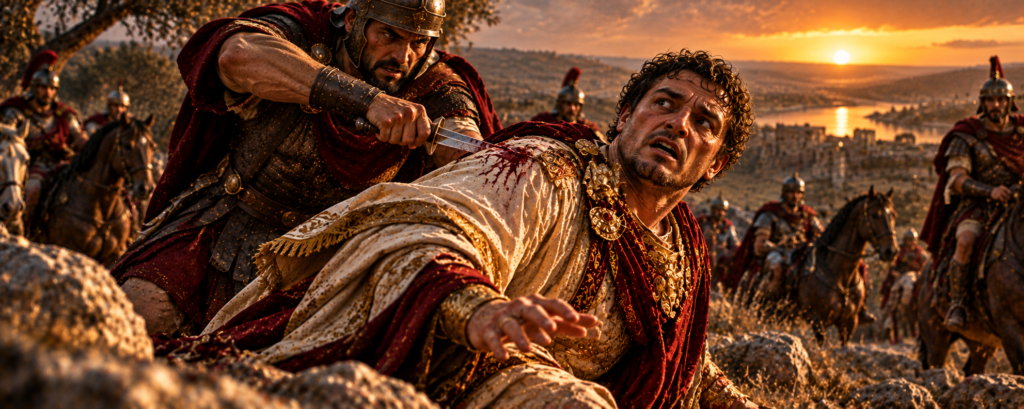
Caracalla: The Emperor Murdered on a Lonely Road to Carrhae
Marcus Aurelius Antoninus, known as Caracalla (188–217 CE) | Roman Emperor, 198–217 CE | Assassinated April 8, 217 CE
The Emperor Who Stopped Beside the Road and Never Returned
On April 8, 217 CE, the Roman emperor Caracalla was traveling through northern Mesopotamia when he made a decision so ordinary that nobody accompanying him could have imagined its consequences. The emperor, who had spent years surrounding himself with soldiers, eliminating suspected enemies, and ruling through a mixture of military generosity and political intimidation, needed to stop and relieve himself. His destination was a sanctuary associated with the moon god near Carrhae, a city whose name carried terrible memories for Rome. As his escort withdrew to give him privacy, one of the men trusted to accompany him saw the opportunity he had been waiting for.
The assassin was Julius Martialis, a soldier attached to the emperor’s entourage. Ancient accounts disagree about the precise nature of his grievance, but they agree that he had a personal reason to hate Caracalla. One tradition claims that the emperor had executed Martialis’s brother, while another says that Martialis resented being denied promotion to the rank of centurion. Whatever the original grievance, the soldier had apparently become willing to commit one of the most dangerous crimes imaginable in the Roman world.
Martialis approached while Caracalla was separated from most of his guards. According to the historian Herodian, he moved toward the emperor as though he had been summoned or wished to deliver information. Caracalla, distracted and momentarily vulnerable, did not recognize the danger until it was too late. Martialis drew a concealed dagger and struck him from behind, delivering a fatal wound beneath the shoulder.
The emperor collapsed. Martialis attempted to escape, but members of Caracalla’s mounted bodyguard pursued him and killed him before he could be questioned. Within moments, both the ruler of the Roman Empire and the man who had stabbed him were dead. The surviving soldiers were left staring at the consequences of an assassination that had occurred almost within their reach.
Caracalla was twenty-nine years old. He had ruled as sole emperor for a little more than five years, having previously shared imperial authority with his father and brother. His reign had been marked by the murder of his younger brother Geta, extensive political repression, costly military policies, ambitious building projects, and a major expansion of Roman citizenship. He was feared by many senators but admired by significant sections of the army, whose loyalty he had cultivated with extraordinary determination.
The assassination immediately raised an unsettling question. Had Martialis acted alone, driven by personal revenge, or had someone more powerful arranged the killing? Ancient historians pointed toward Marcus Opellius Macrinus, one of the emperor’s praetorian prefects, a man whose position placed him close to Caracalla and gave him considerable influence over military and administrative affairs.
According to the surviving narratives, Macrinus had discovered that his own life was in danger. A warning had allegedly reached him indicating that Caracalla intended to remove or execute him, and the prefect decided that the only way to survive was to strike first. Martialis provided the weapon, the personal grievance, and the opportunity. Macrinus, if the ancient accounts are correct, provided the political calculation behind the murder.
The evidence strongly associates Macrinus with the conspiracy, although the precise sequence of events remains uncertain. Both Cassius Dio and Herodian describe his involvement, but their accounts differ in important details, and neither provides a complete, independently verifiable reconstruction. What cannot be disputed is that Caracalla was murdered by a member of his own military entourage and that Macrinus became emperor shortly afterward.
The circumstances were almost grotesquely ironic. Caracalla had ordered executions, destroyed perceived rivals, and spent years attempting to ensure that nobody around him could threaten his position. He had survived political conspiracies, family hatred, military campaigns, and the consequences of murdering his own brother. Yet he died because a soldier approached him during a private moment on an ordinary road, when the vast machinery of imperial protection had briefly stepped aside.
Born Into a Dynasty Built by Civil War
Caracalla was born Lucius Septimius Bassianus on April 4, 188 CE, in Lugdunum, modern Lyon, where his father Septimius Severus was serving as governor of Gallia Lugdunensis. His mother, Julia Domna, came from an influential family associated with the priesthood of the sun god at Emesa in Roman Syria. His younger brother Geta was born the following year. The two boys entered a world of privilege, but their family had not yet secured the imperial throne.
The Roman Empire was then ruled by Commodus, the increasingly controversial son of Marcus Aurelius. Commodus’s reign ended with his assassination on December 31, 192 CE, unleashing a succession crisis that rapidly descended into civil war. Pertinax briefly became emperor before being murdered by the Praetorian Guard, whose members then supported Didius Julianus after a notorious competition involving enormous financial promises. Provincial commanders refused to accept the arrangement, and several powerful generals claimed imperial authority.
Septimius Severus emerged as the most successful contender. Supported by the Danubian legions, he marched on Rome, overthrew Julianus, and then defeated rival claimants Pescennius Niger and Clodius Albinus. By 197 CE, Severus had established himself as the undisputed ruler of the Roman world. His victory created the Severan dynasty, but it also demonstrated that imperial power ultimately depended upon soldiers.
Young Caracalla grew up watching his father’s rise through warfare, intimidation, political calculation, and military loyalty. The lessons were impossible to miss. Emperors could be murdered by their guards, senators could recognize one ruler and abandon him weeks later, and provincial armies could overturn decisions made in Rome. A successful emperor needed more than an impressive ancestry or the approval of the Senate.
Severus took particular care to strengthen his family’s claim to legitimacy. Caracalla was renamed Marcus Aurelius Antoninus, associating him with the revered emperor Marcus Aurelius and the Antonine dynasty. The name was politically valuable because Severus wanted his family to appear connected with Rome’s prestigious imperial past. The boy known to history as Caracalla was therefore publicly presented as an heir to a tradition much older than his father’s recent military victory.
The nickname Caracalla came from a type of hooded Gallic cloak that the emperor later favored. It was not his official imperial name, and contemporary formal documents generally identified him as Antoninus. Modern historians use Caracalla because it distinguishes him from other emperors bearing similar names. The familiar nickname has become inseparable from his reputation, even though it originally referred to an item of clothing rather than a personal characteristic.
Caracalla received the title Caesar in 196 CE and was elevated to Augustus in 198, while still a child. His younger brother Geta also received imperial honors, although Caracalla remained the senior heir. Severus intended to establish a lasting dynasty, and the public presentation of his sons formed an essential part of that plan. Unfortunately, the emperor could not manufacture affection between them.
Two Brothers Raised to Hate Each Other
The rivalry between Caracalla and Geta became one of the defining tragedies of the Severan dynasty. Ancient historians describe the brothers as bitter competitors from childhood, constantly quarreling and struggling for precedence. Some stories are probably exaggerated to foreshadow the violence that followed, but the political tension between them was real. Their father attempted to maintain a workable relationship while preparing both sons for imperial responsibility.
The problem was structural as well as personal. Roman imperial government had no reliable mechanism for dividing supreme authority between two ambitious adult brothers. Co-emperors could cooperate when one accepted the other’s seniority, but Caracalla and Geta increasingly appeared unwilling to do so. Every honor, appointment, military command, and ceremonial distinction could become evidence that one brother was being favored over the other.
Their mother Julia Domna tried to preserve family unity. She was an influential figure at court, closely involved in dynastic politics and respected for her intelligence and cultural interests. Yet even her position could not eliminate the rivalry. The brothers increasingly developed separate circles of supporters, making their personal hostility a matter of state.
Severus took both sons on his campaign in Britain beginning in 208 CE. The expedition was intended partly to address military problems on the northern frontier, but it also provided an opportunity to expose the young princes to command and responsibility. Caracalla participated in military operations, while Geta undertook administrative duties. Their father hoped that shared responsibility might prepare them for eventual cooperation.
Ancient sources claim that Caracalla became impatient for supreme power during the campaign. Herodian even alleges that he attempted to hasten his father’s death, although the accusation cannot be independently verified. Such stories reflect the hostile tradition surrounding Caracalla and should not be accepted automatically. Nevertheless, the tension within the imperial family was sufficiently serious to concern Severus.
Septimius Severus died at Eboracum, modern York, on February 4, 211 CE. His sons inherited the empire together. Later writers preserved a famous deathbed instruction urging them to remain united, enrich the soldiers, and disregard everyone else. The precise wording is uncertain, but the sentiment reflects the military foundations of Severan power.
The brothers returned to Rome with their father’s ashes. Their shared reign immediately became a contest over authority. The emperor who had conquered his rivals and built a dynasty had left behind two heirs who could barely tolerate one another.
The Murder of Geta
Caracalla and Geta’s joint government lasted less than a year. Ancient accounts describe the brothers occupying separate quarters, employing different attendants, and surrounding themselves with loyal supporters. They reportedly considered dividing the empire, although the details of such discussions remain uncertain. Julia Domna opposed any arrangement that would permanently separate her sons.
Their mutual suspicion became increasingly dangerous. Both feared assassination, and both understood that the other’s survival threatened exclusive control of the empire. Courtiers and officials were drawn into rival factions. The imperial palace became a place where family hatred could determine political survival.
On December 19, 211 CE, Geta was murdered. The most widely accepted reconstruction is that Caracalla arranged the killing during a meeting involving their mother. Ancient sources portray Geta seeking refuge with Julia Domna as armed men attacked him. The younger emperor died while his mother desperately attempted to protect him.
The scene became one of the most notorious episodes of Roman dynastic violence. Herodian and Cassius Dio describe Julia Domna being physically caught in the attack, with Geta’s blood staining her clothing. Although some dramatic details may have been embellished, there is little serious doubt that Caracalla was responsible for his brother’s murder. The political consequences were immediate and unmistakable.
Caracalla hurried to the Praetorian camp and claimed that he had survived a conspiracy against his life. He presented Geta’s death as necessary self-defense and sought the guards’ support through promises and payments. The soldiers accepted his position. The Senate, confronted with an emperor backed by armed men, had little opportunity to challenge him.
Geta’s supporters were then targeted. Ancient sources describe executions of senators, officials, servants, and others suspected of loyalty to the murdered brother. The precise number of victims is impossible to establish, and claims that tens of thousands were killed should be treated cautiously. Nevertheless, the purge was extensive enough to leave a lasting impression on Roman political memory.
Caracalla also attempted to erase Geta’s public existence. His brother’s name was removed from inscriptions, portraits were altered, and official images were destroyed or modified. Modern historians describe these measures as part of the practice commonly called damnatio memoriae. The intention was to deny Geta the honors and recognition associated with imperial legitimacy.
The effort could never erase what had happened. Julia Domna had lost one son to the ambition of the other, and Caracalla had established his sole rule through fratricide. Every future accusation of conspiracy would unfold against the memory of that murder. The emperor had demonstrated that even the closest family relationship offered no protection when power was at stake.
An Emperor Haunted by His Own Crime
Ancient writers portray Caracalla as becoming increasingly suspicious after Geta’s death. Cassius Dio, who lived during the period and later held high office, presents an emperor capable of extraordinary cruelty and intensely concerned with his personal security. Herodian similarly describes a ruler whose violence and mistrust shaped the atmosphere of government. Both accounts are important, but neither is free from bias.
Caracalla’s fear was understandable within the political system he inhabited. He had murdered his brother and eliminated numerous people associated with him. The families of those victims might seek revenge, while surviving officials had reason to conceal their true feelings. The emperor knew better than anyone that a ruler could be killed by someone standing nearby.
His government relied heavily upon military loyalty. Caracalla increased soldiers’ pay and cultivated the image of a commander who shared their hardships. He appeared among troops, participated in military exercises, and emphasized his connection with the army. These gestures helped secure support among soldiers who might otherwise have questioned his actions.
The Senate received very different treatment. Many senators resented Caracalla’s authoritarian behavior, financial demands, and executions. The emperor appears to have shown little interest in winning their affection. He understood that senatorial approval could not protect a ruler whose soldiers abandoned him.
This division between military popularity and aristocratic hostility became central to his reign. Soldiers could admire an emperor whom senators regarded as dangerous. Caracalla’s willingness to spend enormous sums on the army strengthened that relationship. It also increased the financial burdens carried by the wider empire.
Ancient writers accused him of paranoia, but the term should be used cautiously. His suspicion did not necessarily indicate a psychiatric disorder. Roman imperial politics genuinely involved conspiracies, assassinations, and betrayals. Caracalla’s responses were often brutal, but the threats he feared were not entirely imaginary.
His greatest vulnerability emerged from the methods he used to secure himself. By humiliating officials, threatening subordinates, and punishing perceived enemies, he created new reasons for people to want him dead. Fear could enforce obedience temporarily, but it could also encourage desperate action. The conspiracy of 217 would develop within precisely that atmosphere.
The Emperor Who Gave Citizenship to Millions
Despite his reputation for violence, Caracalla introduced one of the most consequential legal measures in Roman history. In 212 CE, he issued the Constitutio Antoniniana, an imperial decree extending Roman citizenship to nearly all free inhabitants of the empire. Certain categories, often discussed under the term dediticii, were excluded, although the exact meaning and scope of the exception remain debated. The decree fundamentally altered the legal relationship between Rome and its provincial populations.
Before the decree, Roman citizenship had been a valuable status acquired through birth, military service, individual grants, or the privileges of particular communities. Citizens enjoyed important legal protections and rights that distinguished them from many other free inhabitants. Caracalla’s measure dramatically expanded the number of people possessing that status. It accelerated a process of integration that had developed over centuries.
Ancient critics questioned the emperor’s motives. Cassius Dio argued that Caracalla wanted to increase tax revenue because certain taxes applied specifically to Roman citizens. The expansion of citizenship therefore enlarged the number of people liable for those obligations. Financial considerations may indeed have influenced the decree.
Yet reducing the measure entirely to taxation would be too simplistic. Roman citizenship had long served as an instrument of political integration. Extending it across the empire strengthened the idea of a common imperial community. The decree had legal, social, cultural, and administrative consequences far beyond immediate revenue.
The measure also complicates Caracalla’s historical reputation. A ruler responsible for fratricide and political repression could simultaneously introduce a reform of enormous long-term importance. Roman emperors were not required to be morally admirable to enact consequential policies. The same government could expand legal inclusion while employing violent methods against political opponents.
Caracalla’s reign therefore cannot be understood solely through the circumstances of his assassination. His actions affected millions of people who never entered the imperial court or witnessed his military campaigns. Many provincial inhabitants acquired a legal identity previously unavailable to them. The consequences continued long after his murder.
This contradiction is essential to understanding him. Caracalla could be destructive in his personal politics and transformative in his public legislation. His government was not simply a continuous sequence of atrocities. It combined administrative change, military ambition, monumental construction, financial pressure, and political violence.
The Baths, the Treasury, and the Cost of Imperial Ambition
Caracalla’s most famous architectural legacy is the enormous bathing complex in Rome that bears his name. The Baths of Caracalla were among the largest public bathing establishments ever constructed in the ancient world. Their vast halls, heated rooms, exercise areas, gardens, and decorative programs demonstrated the extraordinary resources available to imperial government. The complex remained one of Rome’s most impressive monuments long after the emperor’s death.
The baths were not merely luxurious facilities for the wealthy. Roman public baths served social, recreational, and cultural functions across different levels of society. Their construction helped associate the emperor with public generosity and urban improvement. Monumental building was a form of political communication as much as architecture.
Yet such projects required enormous expenditure. Caracalla also maintained costly military commitments and increased soldiers’ pay. The combination placed significant pressure on imperial finances. His government sought revenue through taxation, monetary policy, and other measures.
The emperor altered the silver currency and introduced the coin commonly called the antoninianus. The new denomination became increasingly important in later Roman monetary history. Its silver content and relationship to existing coinage reflected the financial challenges of the period. Monetary innovation offered temporary flexibility but did not eliminate underlying fiscal pressures.
Caracalla’s military spending was especially significant. His father had demonstrated that armies could determine the succession, and Caracalla had personally relied upon the Praetorians after murdering Geta. He understood that soldiers needed to see material benefits from his rule. Generosity toward the army was therefore both a policy and a form of insurance.
The strategy succeeded in creating considerable military affection. Herodian describes soldiers mourning Caracalla after his assassination because they regarded him almost as a fellow soldier. Such testimony should not be interpreted as universal popularity, but it reveals a genuine difference between military and senatorial attitudes. The emperor’s cultivated military identity had political consequences.
Ironically, that loyalty would complicate the position of the man who replaced him. Macrinus could arrange or benefit from Caracalla’s murder, but he could not automatically inherit the dead emperor’s relationship with the army. Soldiers might accept a new ruler out of necessity while continuing to admire his predecessor. The distinction would prove dangerous.
Alexandria and the Emperor’s Vengeance
One of the darkest episodes associated with Caracalla occurred during his visit to Alexandria in Egypt. Ancient sources describe the emperor becoming enraged by the city’s mockery of him, particularly jokes concerning his murder of Geta and his relationship with Julia Domna. Alexandria had a long tradition of sharp political satire. Its inhabitants were capable of ridiculing powerful rulers with extraordinary boldness.
Caracalla reportedly responded with violence. Cassius Dio describes a massacre in which soldiers attacked Alexandrians, while Herodian provides a different but similarly disturbing narrative. The sources disagree about the circumstances and scale of the killing. Their accounts nevertheless support the conclusion that substantial violence occurred during the emperor’s visit.
One tradition claims that Caracalla summoned young men under the pretext of recruitment before ordering an attack. Another emphasizes the killing of civilians and the disruption of city life. Such details cannot all be independently verified. The precise number of victims is unknown.
The massacre became a powerful symbol of Caracalla’s vindictiveness. Ancient writers portrayed him as a ruler willing to punish an entire population for insults directed at his person. The event reinforced his reputation for treating criticism as a form of political treason. It also demonstrated the danger of an emperor whose personal grievances could become military operations.
The Alexandrian episode matters to the assassination because it reveals the atmosphere surrounding Caracalla’s later years. He was accustomed to using overwhelming force against perceived disrespect. Officials who angered him could reasonably fear severe consequences. The distinction between personal offense and political danger had become increasingly uncertain.
Macrinus would eventually find himself in that position. His professional competence and high office did not guarantee safety. A ruler who could punish cities for mockery might also destroy an official because of suspicion or humiliation. The prefect’s fear therefore developed within a government where imperial anger could be fatal.
Alexander the Great and the Dream of Eastern Conquest
Caracalla cultivated an intense admiration for Alexander the Great. Ancient historians describe him imitating aspects of Alexander’s appearance, military style, and public image. Some stories may be exaggerated, but his fascination with the Macedonian conqueror is well attested. Alexander represented the kind of military glory Caracalla wanted for himself.
The emperor’s eastern ambitions grew increasingly important after his campaigns along the northern frontiers. He traveled through the Greek-speaking eastern provinces and visited places associated with Alexander’s memory. The legendary conqueror offered an appealing model for an emperor determined to surpass his predecessors. Military victory could strengthen Caracalla’s prestige and reinforce his relationship with the army.
The Parthian Empire provided the obvious eastern rival. Rome and Parthia had competed for influence in Armenia, Mesopotamia, and surrounding regions for generations. Their wars had produced victories, defeats, diplomatic settlements, and repeated frontier crises. A successful campaign against Parthia could bring enormous prestige.
Caracalla prepared for war with considerable ambition. Ancient sources describe him pursuing diplomatic initiatives and then launching military operations in Parthian territory. Herodian preserves a sensational story that the emperor sought marriage with a Parthian princess before attacking unsuspecting participants in a supposed wedding celebration. The details are disputed, and the narrative may reflect hostile literary embellishment.
What is clear is that Caracalla initiated aggressive operations against the Parthians. His forces moved through parts of the eastern frontier region, and the campaign contributed to renewed hostilities. The emperor appears to have expected further military action in 217. His assassination interrupted those plans.
The campaign also brought him into the geographical setting of his death. Northern Mesopotamia was a region of strategic importance and ancient religious traditions. Carrhae, one of its most famous cities, had already become a place of humiliation in Roman military memory. Caracalla’s journey toward its sanctuary would place him on the road where Martialis struck.
The emperor who dreamed of rivaling Alexander would never fight the decisive eastern war he anticipated. His ambitions ended before the campaign reached its intended conclusion. The Parthian conflict would instead become a problem inherited by Macrinus.
Carrhae: A Place Haunted by Roman Defeat
Carrhae occupied a grim place in Roman history. In 53 BCE, the Roman general Marcus Licinius Crassus had suffered a catastrophic defeat against Parthian forces near the city. Thousands of Roman soldiers were killed or captured, and Crassus himself died during the disastrous campaign. The defeat became a lasting symbol of Roman vulnerability in the east.
By Caracalla’s time, nearly three centuries had passed since that catastrophe. Rome had experienced periods of success against Parthia, including major campaigns under Trajan and Septimius Severus. Nevertheless, Carrhae retained its association with one of Rome’s most humiliating military disasters. The city’s name carried historical weight.
The region was also religiously significant. Carrhae, associated with modern Harran, possessed a celebrated sanctuary of the moon god Sin. Greek and Roman writers could identify the deity with their own lunar divinities, including Selene or Luna. The sanctuary attracted attention beyond the immediate region.
Caracalla intended to visit this religious site in April 217. The precise starting point and route differ among ancient accounts, with the emperor associated with Edessa and Carrhae during the journey. Herodian places particular emphasis upon the religious purpose of the visit. The emperor apparently traveled with a relatively limited mounted escort rather than moving the entire army.
The decision was not inherently reckless. Emperors regularly visited sanctuaries, made sacrifices, and traveled with selected attendants. Military escorts were expected to provide sufficient protection. Caracalla had no reason to assume that a trusted soldier would use such a journey to assassinate him.
Yet the journey created an opportunity unavailable within a heavily guarded camp. Movement between locations required changes in formation, moments of separation, and occasional stops. The emperor’s personal needs could temporarily interrupt normal security. Martialis needed only one such moment.
The irony of the setting is difficult to ignore. Carrhae had witnessed the destruction of a Roman army under Crassus. In 217, its surrounding region became the scene of another Roman catastrophe, although this time the fatal blow came from within the emperor’s own escort. Caracalla did not fall to Parthian arrows or a foreign general. He died because one of his soldiers turned against him.
Macrinus: The Man Who Had Everything to Lose
Marcus Opellius Macrinus was an unusual figure among the highest officials of the Roman Empire. Born around 164 CE in Caesarea in Mauretania, he came from an equestrian rather than senatorial background. He developed a career associated with law and imperial administration. His abilities eventually brought him into the circle of Caracalla’s most important officials.
Macrinus became praetorian prefect, one of the most powerful positions available to a man of equestrian rank. The prefecture involved command responsibilities and substantial influence over military and administrative affairs. Under the Severan emperors, the office could provide extraordinary access to the ruler. A successful prefect might exercise power rivaling that of leading senators.
Yet such proximity carried danger. Praetorian prefects depended heavily upon imperial favor. Their authority could disappear instantly if the emperor became suspicious. Previous prefects had been executed, disgraced, or destroyed during changes of regime. Macrinus understood that his position was powerful but insecure.
Herodian describes Caracalla repeatedly humiliating Macrinus. The emperor supposedly mocked his preference for comfortable living and contrasted it with the rough habits of soldiers. He accused the prefect of cowardice and effeminacy. The exact wording of these insults cannot be verified, but the tradition suggests that their relationship had deteriorated.
Macrinus was not a battlefield commander in the mold of Septimius Severus. His strengths lay in law, administration, and political management. Caracalla’s cultivated military identity made such differences particularly visible. A ruler who glorified soldierly toughness could easily despise an official he regarded as insufficiently martial.
Public humiliation mattered in Roman elite culture. Reputation and dignity were essential components of political standing. Repeated insults from the emperor could weaken an official’s authority over subordinates. Macrinus may have feared that ridicule was the prelude to dismissal or execution.
His concerns were intensified by Caracalla’s history. The emperor had murdered Geta, punished suspected opponents, and demonstrated little hesitation in ordering executions. A threatened prefect could not simply resign and retire safely. Once imperial suspicion attached itself to him, distance might offer little protection.
Macrinus therefore occupied a position of extraordinary tension. He stood close enough to the emperor to understand his movements and influence his security. He also had reason to believe that continued proximity might eventually kill him. The circumstances made conspiracy both possible and tempting.
The Warning That May Have Sealed Caracalla’s Fate
One of the most dramatic elements of the assassination narrative concerns a warning sent from Rome. According to Herodian, Caracalla had become increasingly interested in predictions concerning his future and the possibility of conspiracy. He consulted astrologers, diviners, and other specialists associated with foretelling events. His curiosity reflected a wider Roman elite fascination with prophecy, although ancient writers often used such interests to portray rulers as fearful or irrational.
Caracalla allegedly instructed a trusted official named Materianus to investigate whether anyone intended to seize imperial power. Materianus consulted specialists and eventually sent a message identifying Macrinus as a dangerous potential rival. The letter warned that the prefect might attempt to become emperor. It reportedly urged that he be removed.
The message reached Caracalla while he was occupied with other activities. Herodian claims that the emperor handed the incoming correspondence to Macrinus and instructed him to examine it for urgent matters. The prefect opened the dispatches and discovered the accusation against himself. He concealed the incriminating letter.
The story has the structure of a political nightmare. An emperor orders an investigation into conspiracy, the investigation identifies a powerful subordinate, and the warning is accidentally placed in that subordinate’s hands. The threatened official learns that his ruler may soon kill him. His only apparent escape is to become the conspirator he has been accused of being.
Cassius Dio preserves a related but different tradition involving predictions and warnings about Macrinus. His surviving account is fragmentary, and the details cannot be reconciled completely with Herodian. Both narratives nevertheless associate the prefect’s fear with information suggesting that Caracalla might destroy him. Their agreement on the broader issue strengthens the possibility that Macrinus believed himself in immediate danger.
The exact letter episode remains uncertain. Ancient historians frequently constructed dramatic chains of cause and effect around assassinations. A conveniently intercepted warning creates a compelling explanation for why a powerful official suddenly decided to kill his emperor. It may preserve genuine information, but its details should not be treated as independently established.
The underlying political logic is persuasive. Macrinus knew Caracalla’s capacity for violence. He had access to the emperor’s entourage and opportunities to communicate with soldiers. If he believed an execution order was approaching, arranging the emperor’s death could appear to be his only realistic means of survival.
That calculation would make Caracalla’s assassination a particularly dark example of preventive political murder. Macrinus may have killed because he feared being killed. Whether the emperor had truly decided to execute him remains unknown. Fear itself may have been enough.
Julius Martialis: A Soldier With a Personal Grudge
Macrinus needed someone capable of reaching Caracalla at close range. An open attack by a group of officers would risk immediate detection and resistance from the emperor’s loyal troops. Poisoning might require access to food or drink controlled by trusted attendants. A single soldier with a plausible reason to approach the emperor offered a more practical solution.
Julius Martialis appears in the ancient accounts as precisely such a man. He belonged to the emperor’s military entourage and could travel with the imperial escort. His position provided opportunities unavailable to outsiders. He also possessed a personal grievance that made him receptive to assassination.
Herodian identifies Martialis as a centurion and claims that Caracalla had executed his brother on an unproven accusation. He adds that the emperor repeatedly insulted Martialis, mocking his character and humiliating him. These injuries supposedly created an intense desire for revenge. Macrinus recognized the opportunity and approached him.
Cassius Dio gives a different explanation. In his account, Martialis belonged among the evocati, experienced soldiers who had returned to service after completing an earlier term. He resented Caracalla because the emperor had refused his request for promotion to centurion. Dio also associates Macrinus with other military officers involved in preparing the conspiracy.
The differences matter. Martialis cannot simultaneously be treated with certainty as an already serving centurion and as a man seeking that promotion. Nor can the execution of his brother be established beyond dispute. The surviving evidence confirms a tradition of personal resentment but does not securely identify its precise origin.
Both accounts nevertheless portray a soldier who hated Caracalla for reasons independent of Macrinus’s ambitions. That combination made him an effective recruit. The prefect could offer encouragement or promises while Martialis supplied the emotional motivation. The assassination would satisfy both political fear and personal revenge.
The arrangement also protected Macrinus to some degree. If Martialis acted alone and was killed immediately, investigators might attribute the murder to an individual grievance. The prefect could publicly express grief and deny involvement. A successful conspiracy would therefore leave its organizer less visibly exposed than its attacker.
That is almost exactly what happened. Martialis struck Caracalla and was killed while attempting to escape. Macrinus survived, mourned the emperor publicly, and eventually succeeded him. The soldier’s personal motives remained the visible explanation while the prefect’s suspected role became a matter for historians.
The Conspiracy Inside the Imperial Escort
Cassius Dio names additional officers associated with Macrinus’s preparations, including Nemesianus and Apollinaris, brothers connected with the Praetorian Guard. Their involvement suggests that the plot may have extended beyond a private agreement between Macrinus and Martialis. A successful assassination required knowledge of the emperor’s movements and confidence that the immediate aftermath could be managed. Even a small network of sympathetic officers would have been valuable.
The conspirators faced a serious obstacle in Caracalla’s popularity among soldiers. The emperor had deliberately cultivated military affection through pay, personal attention, and shared hardship. Many soldiers regarded him as a commander who understood their lives. An open military rebellion against him might therefore fail.
The solution was to exploit a moment when the emperor’s protection would be temporarily reduced. Martialis could approach as a member of the escort without attracting the suspicion directed toward an outsider. The attack could be completed before most soldiers understood what was happening. Speed and surprise were essential.
The religious journey to Carrhae provided that opportunity. Caracalla traveled with selected mounted guards and attendants. The escort was close enough to protect him from external threats but not necessarily from one of its own members. When the emperor stopped for privacy, the protective formation briefly loosened.
Whether Macrinus arranged the exact timing or simply encouraged Martialis to seize an opportunity remains unknown. The ancient narratives do not preserve a detailed operational plan. It would be misleading to invent secret meetings, coded messages, or elaborate instructions. The available evidence supports a conspiracy tradition without revealing every step.
The plot was nevertheless remarkably simple in its final form. One soldier needed a concealed blade. The emperor needed to be separated from most of his escort. The assassin needed only enough time to strike before the guards reacted.
The greatest danger came afterward. Martialis was unlikely to survive if loyal soldiers recognized him. Macrinus could also be exposed if the assassin was captured and questioned. The plan therefore depended partly upon confusion and the possibility that the killer would die before revealing his accomplices.
The conspirators were gambling with the Roman Empire. A successful attack would remove Caracalla but leave the succession unresolved. Macrinus could not be certain that the army would accept him. Yet the threat he believed he faced may have made the gamble seem preferable to waiting.
April 8, 217 CE: The Journey Toward the Moon God’s Sanctuary
Caracalla set out on his journey through northern Mesopotamia on April 8, 217 CE. Ancient accounts associate the movement with Edessa and Carrhae, although their geographical details are not entirely consistent. The emperor intended to visit a sanctuary connected with the moon deity worshipped in the region. He traveled with a relatively small escort rather than the full army.
The setting was far removed from the ceremonial grandeur of Rome. There were no marble halls filled with senators and ambassadors, no enormous public crowds, and no formal imperial procession through the capital. The emperor was moving through a frontier region during an active military campaign. His authority was represented by the soldiers accompanying him.
Martialis was among those soldiers. He knew that Caracalla’s movements could create an opportunity for attack. According to Herodian, he had already agreed to act when circumstances allowed. The journey offered the chance he needed.
At some point along the road, Caracalla stopped to relieve himself. The escort withdrew to provide privacy, leaving the emperor with minimal immediate protection. Such a pause was ordinary and would not necessarily have alarmed anyone. The soldiers had no obvious reason to suspect that one of their own was preparing to murder him.
Martialis approached. Herodian says he behaved as though the emperor had summoned him or as though he wished to communicate something important. The disguise was not elaborate. His uniform and position were enough to make his approach appear legitimate.
Caracalla was momentarily defenseless. He was not wearing the full protection appropriate to battle, and his attention was elsewhere. Martialis drew a dagger and struck from behind. The wound proved fatal.
The emperor fell before his guards could intervene. Martialis immediately attempted to escape on horseback. Members of the mounted bodyguard pursued him. The assassination had succeeded, but the assassin’s own survival was now in question.
The Death of Caracalla
Herodian describes the fatal blow as striking beneath Caracalla’s shoulder. Cassius Dio similarly places the attack during the emperor’s private stop along the road. The precise mechanics differ slightly between the surviving accounts, but the essential event is consistent. Julius Martialis stabbed Caracalla while the emperor was separated from most of his escort.
The attack was sudden enough to prevent effective resistance. Unlike Domitian, who reportedly struggled with his assassins inside the palace, Caracalla appears to have been incapacitated almost immediately. He had no opportunity to summon reinforcements or organize a defense. The emperor who had spent years preparing for military conflict was defeated by a single unexpected blow.
Martialis fled, but his escape failed. Herodian says that German cavalrymen serving as Caracalla’s bodyguards pursued and killed him. Cassius Dio describes the assassin being identified and struck down by a member of the emperor’s escort. Both accounts agree that he died shortly after the murder.
His death eliminated the most important potential witness. Martialis could not explain whether he had acted entirely from personal hatred or under instructions from Macrinus. He could not identify additional conspirators. The circumstances therefore left room for competing explanations.
Macrinus reportedly arrived and publicly mourned the emperor. Herodian describes him expressing grief before soldiers who were genuinely distressed by Caracalla’s death. The prefect’s behavior was politically necessary whether or not he had organized the murder. Any visible satisfaction would have been extraordinarily dangerous.
The soldiers’ reaction was not what an ambitious conspirator might have hoped. Many admired Caracalla and regarded his death as a personal loss. Their affection reflected years of deliberate military patronage. Macrinus inherited an army that did not automatically welcome its emperor’s removal.
Caracalla’s body was cremated, and his ashes were sent westward. His death ended his eastern campaign and created an immediate succession crisis. The emperor had left no acknowledged legitimate son ready to inherit the throne. The Severan dynasty suddenly appeared vulnerable.
The assassination had required only a moment. Its political consequences would unfold over the following year and help bring down the man accused of arranging it.
Macrinus Plays the Mourner
Macrinus’s position immediately after the murder was precarious. He was one of the highest-ranking officials present, but he was not a member of the imperial family. He possessed administrative experience and influence, yet he lacked the dynastic prestige that had helped sustain the Severans. The army’s affection for Caracalla made an immediate claim to power dangerous.
Herodian describes a period of uncertainty following the assassination. The soldiers reportedly considered another senior prefect, Marcus Oclatinius Adventus, as a possible successor. Adventus declined, citing his age or limitations. Macrinus then emerged as the preferred candidate.
On April 11, 217 CE, Macrinus was proclaimed emperor. The interval between Caracalla’s death and his accession is significant. It suggests that the succession was not entirely automatic or universally agreed upon. Even if Macrinus had arranged the assassination, he still needed the army to accept him.
His accession was historically unusual. Macrinus became the first Roman emperor to rise directly from the equestrian order without previously holding senatorial rank. The distinction reflected the increasing importance of imperial administrators and military officers. It also exposed him to aristocratic criticism.
Macrinus adopted imperial titles and attempted to establish legitimacy. He presented himself as a responsible ruler capable of restoring stability after Caracalla’s harsh government. The Senate, which had suffered under the previous emperor, generally welcomed the change. Yet senatorial approval could not solve his greatest problem.
The soldiers remained emotionally attached to Caracalla. Macrinus had to govern an army that admired the man he was suspected of murdering. He also inherited the Parthian war, a conflict requiring military resources and political authority. His position was therefore dangerous from the beginning.
If Macrinus had killed to save his own life, he had succeeded only temporarily. The assassination removed Caracalla but placed the prefect at the center of a succession crisis. The new emperor would soon discover that obtaining the throne and keeping it were very different challenges.
The Mother Who Lost Both Sons
Julia Domna’s position after Caracalla’s assassination was tragic. She had already witnessed the destruction of her younger son Geta and had continued serving within the government of the son responsible for his death. Her relationship with Caracalla was politically important and personally complicated. His murder left her without either son.
Julia had exercised substantial influence during the Severan dynasty. She was associated with imperial correspondence, court administration, and the intellectual circles surrounding the ruling family. Her position had been strengthened by her marriage to Septimius Severus and her role as mother of two emperors. The deaths of both sons destroyed the dynastic foundation of that authority.
Ancient sources differ over the circumstances of her death. Herodian reports that she died after Caracalla, suggesting suicide or another violent explanation. Cassius Dio describes her as suffering from serious illness and refusing food after learning of her son’s death and the political changes that followed. The precise cause remains uncertain.
The possibility of suicide cannot be established conclusively. Nor should her death be described simply as the result of grief without acknowledging the reported illness and political circumstances. Julia had lost her sons, her imperial position, and the dynasty she had spent decades helping sustain. Her final months unfolded amid extraordinary personal and political upheaval.
Macrinus initially treated her with some outward respect, but her continued presence posed a potential threat. Julia belonged to the Severan family and retained connections that the new emperor could not easily control. Even without a surviving son, she represented dynastic legitimacy. Her influence might become dangerous if soldiers turned against Macrinus.
Her death removed one immediate problem for the new ruler. It did not eliminate the wider Severan family. Julia’s sister Julia Maesa and her descendants remained alive. Their ambitions would soon transform Caracalla’s memory into a weapon against Macrinus.
The assassination therefore did not simply end one emperor’s life. It shattered the immediate family that had ruled Rome since Septimius Severus. The surviving relatives would respond by attempting to reclaim the throne. Macrinus’s victory was already beginning to unravel.
The Parthian War Caracalla Left Behind
Caracalla’s death occurred during an active eastern military crisis. His campaigns had intensified tensions with the Parthian Empire, and the Parthian king Artabanus IV was preparing a substantial response. Macrinus inherited the consequences without possessing Caracalla’s military prestige. The new emperor needed to secure peace or achieve victory quickly.
The confrontation developed into a major battle near Nisibis in 217 CE. Roman and Parthian forces fought a difficult engagement that exposed the challenges facing Macrinus. Ancient accounts differ over tactical details, but the conflict was costly and ultimately led to negotiations. Macrinus was unable to achieve the kind of spectacular victory that might have strengthened his legitimacy.
The resulting settlement required concessions, including a substantial financial payment according to the surviving sources. From a practical perspective, peace may have been necessary. The Roman army was exhausted, the succession remained unsettled, and prolonged war carried serious risks. Yet soldiers accustomed to Caracalla’s aggressive military posture could interpret compromise as weakness.
Macrinus also attempted to address military finances. Caracalla’s generosity had increased the cost of maintaining the army. The new emperor faced pressure to reduce expenditure while preserving loyalty. Such policies were politically dangerous because soldiers had come to regard higher pay and benefits as established rights.
His efforts generated resentment. Herodian portrays soldiers comparing Macrinus unfavorably with Caracalla, whose willingness to share hardships and reward troops had made him popular. The contrast may have been exaggerated, but it reflects a real political problem. Macrinus could not easily reproduce the military image of the emperor he replaced.
The army’s dissatisfaction created an opportunity for the surviving Severan family. Caracalla’s name still possessed considerable emotional power among soldiers. A claimant presented as his son could potentially attract support. Julia Maesa understood the opportunity.
Macrinus had inherited the throne through an assassination that eliminated the emperor but not his reputation. Caracalla remained politically useful after death. His memory would soon help destroy his successor.
Julia Maesa and the Revenge of the Severan Women
Julia Maesa was the sister of Julia Domna and a member of the influential family associated with Emesa in Syria. She possessed considerable wealth and important family connections. After Caracalla’s death and Julia Domna’s disappearance from power, Macrinus allowed Maesa to return to her homeland. The decision appeared reasonable but would prove politically disastrous.
Maesa had two daughters, Julia Soaemias and Julia Mamaea. Soaemias’s son, Varius Avitus Bassianus, served as a young priest of the sun god Elagabal at Emesa. The boy would later become emperor under the name Elagabalus. His family possessed both wealth and a connection to the Severan dynasty.
Maesa began promoting the claim that the boy was actually Caracalla’s illegitimate son. The allegation was politically useful but cannot be established as fact. Ancient sources describe the family exploiting physical resemblance, dynastic connections, and the soldiers’ affection for Caracalla. The claim transformed a provincial priest into a potential imperial heir.
Money played an important role. Maesa’s wealth allowed her to cultivate military support. Soldiers stationed in Syria were already dissatisfied with Macrinus. The prospect of restoring a supposed son of Caracalla offered both financial rewards and emotional legitimacy.
In May 218 CE, troops associated with Legio III Gallica proclaimed the young Bassianus emperor. The rebellion challenged Macrinus directly. He attempted to suppress it but failed to secure a decisive advantage. The political situation deteriorated rapidly.
The decisive confrontation occurred near Antioch in June 218. Macrinus’s forces were defeated, and the emperor fled. He was eventually captured and executed, while his young son Diadumenian was also killed. The man who had succeeded Caracalla survived on the throne for little more than a year.
The Severan family returned to power through Elagabalus. The new emperor’s claim depended heavily upon the memory of Caracalla, whether or not the alleged biological relationship was genuine. The assassination of 217 had therefore failed to remove the dynasty permanently. It had merely interrupted its rule.
Macrinus had allegedly killed Caracalla because he feared death. His victory brought him the throne, but it also placed him against a family whose surviving women proved formidable political opponents. Within fourteen months of Caracalla’s murder, Macrinus himself was dead.
Was Macrinus Really the Mastermind?
The question of Macrinus’s responsibility remains central to understanding Caracalla’s assassination. Cassius Dio and Herodian both connect the prefect with the killing. Their accounts describe motives involving fear, suspicion, and the recruitment of Martialis. The broad agreement is significant, particularly because the sources preserve different details.
Nevertheless, ancient historical agreement does not automatically establish every element of a conspiracy. Writers could draw upon shared rumors, political interpretations, or earlier accounts that are now lost. Macrinus’s rapid accession made him an obvious suspect. His enemies also had reasons to portray him as a murderer.
The evidence against him is circumstantial rather than forensic. He possessed access, influence, and a plausible motive. The assassin had a personal grievance and apparently belonged to a network that could include officers sympathetic to Macrinus. The prefect benefited directly from Caracalla’s death.
Yet benefiting from an assassination does not prove responsibility. Roman succession crises often elevated men who had not personally organized the previous ruler’s death. The possibility that Martialis acted independently cannot be eliminated completely. Nor can the exact extent of Macrinus’s involvement be reconstructed.
The ancient accounts also differ over Martialis’s grievance. Herodian emphasizes the execution of his brother and repeated humiliation. Dio emphasizes a denied promotion. Both explanations could conceivably reflect different aspects of the same resentment, but there is insufficient evidence to combine them confidently.
The warning allegedly identifying Macrinus as a future emperor is equally uncertain. It may preserve a genuine political development. It may also be a literary explanation constructed after Macrinus actually became emperor. Ancient historians frequently interpreted earlier omens and predictions through knowledge of later events.
The strongest historically responsible conclusion is that Macrinus was probably involved in arranging Caracalla’s murder. His motive was plausible, his opportunity considerable, and the ancient tradition consistently suspicious of him. The precise planning, however, remains uncertain. Martialis’s personal motives and Macrinus’s political fears should be distinguished rather than treated as a single proven narrative.
That uncertainty does not diminish the assassination’s significance. The emperor was unquestionably killed by a soldier attached to his escort. The murderer died almost immediately. A powerful prefect became emperor shortly afterward, and the circumstances generated a lasting suspicion that the killing had been planned from within the imperial command.
A Soldier’s Revenge or a Political Execution?
Martialis’s role raises another question about the nature of the assassination. If he killed Caracalla because the emperor had executed his brother, the attack contained an element of personal revenge. If he acted because he had been denied promotion, resentment over military status may have been decisive. If Macrinus recruited him, the killing also served a larger political purpose.
These motives are not mutually exclusive. Political conspiracies often depend upon people whose grievances differ. One participant may seek power, another survival, and another revenge. Their interests converge temporarily around the removal of a common enemy.
Martialis had reason to hate Caracalla independently of the prefect’s ambitions. Macrinus allegedly had reason to fear execution. Other officers may have worried about their positions or believed the emperor’s behavior threatened the army. The conspiracy could therefore have united personal and political hostility.
Unlike the assassins of Julius Caesar, Caracalla’s killer did not leave behind a public claim that he was restoring republican liberty. There is no evidence that Martialis intended to reform the empire or replace monarchy with another political system. His attack occurred privately, without an ideological declaration. The emperor’s death created a succession crisis rather than a proclaimed liberation.
The killing is therefore best understood as political assassination with a possible element of personal vengeance. It removed a ruler through deliberate violence. It was carried out by a soldier whose access derived from his service. Its suspected organizer stood to gain supreme power.
The method also reflects the changing character of Roman imperial politics. By the third century, the military establishment had become central to succession. Emperors relied upon soldiers for protection, but soldiers could also remove them. The boundary between loyal service and political violence was dangerously unstable.
Caracalla understood that reality because his own family had risen through civil war. His father had seized power through military victory, and Caracalla had secured sole rule through the murder of Geta and the support of the Praetorians. He knew that armed men could determine the fate of emperors. He nevertheless failed to prevent one of those men from killing him.
The Emperor Who Was Loved by Soldiers and Feared by Senators
The reaction to Caracalla’s death reveals the contradictions of his reign. Many senators regarded him as cruel, dangerous, and oppressive. His executions and humiliations had created deep resentment among the political elite. For them, his death offered the possibility of relief.
Soldiers often remembered him differently. He had increased their pay, emphasized military identity, and spent substantial time among the army. Herodian describes their grief after the assassination as sincere. They felt they had lost a commander who shared their way of life.
This division was not unique to Caracalla. Several Roman emperors enjoyed military support while alienating senators. The army and Senate had different priorities, interests, and experiences of imperial government. A ruler could be generous to soldiers while imposing harsh demands upon civilians and aristocrats.
Caracalla’s policies made the contrast especially pronounced. Military expenditure increased financial pressure throughout the empire. Senators and wealthy communities could experience the costs of policies that soldiers welcomed. The same decisions therefore generated loyalty in one group and hostility in another.
Macrinus underestimated the durability of that military attachment. He inherited Caracalla’s army but not its affection. Attempts to restrain expenditure and negotiate peace with Parthia damaged his standing. The soldiers who had mourned Caracalla became increasingly receptive to a supposed dynastic heir.
The assassination thus failed to erase the political foundations of the murdered emperor’s power. His reputation among soldiers survived him. Julia Maesa exploited that loyalty to elevate Elagabalus. Macrinus discovered that a dead emperor could remain more popular than a living one.
Caracalla’s murder demonstrates that removing a ruler does not necessarily remove the loyalties he created. Political authority can survive in memory, family claims, military expectations, and symbols. The assassin’s dagger ended Caracalla’s life. It did not immediately end his influence.
The Cruelty That Came Back to Him
Caracalla’s death invites an interpretation centered upon the consequences of his own behavior. He had murdered Geta, punished suspected enemies, and humiliated powerful officials. He had cultivated fear as an instrument of government. Eventually, one of the men around him decided that killing the emperor was preferable to enduring his rule.
The connection is compelling, but it should not become a simplistic claim that assassination was inevitable. Many violent Roman emperors survived for years, while some comparatively restrained rulers were murdered. Political outcomes depended upon circumstances, opportunity, military loyalty, and individual decisions. Caracalla’s conduct created dangers without making his death unavoidable.
Macrinus’s suspected fear is especially important. If the prefect genuinely believed that Caracalla intended to execute him, the assassination may have been an act of preemptive survival. The emperor’s reputation for sudden violence made such fear credible. A ruler who repeatedly destroyed perceived enemies could encourage others to strike before becoming victims.
Martialis’s grievance reinforces the pattern. Whether his anger arose from his brother’s execution or a denied promotion, the surviving tradition presents him as a soldier who felt personally wronged. Caracalla’s treatment of subordinates therefore became part of the explanation for his death. The emperor had created hostility within the very institution he depended upon most.
Yet the assassination also required a moment of vulnerability. Caracalla could not remain surrounded by armed guards every second of his life. Even the most heavily protected ruler had private needs and ordinary routines. Martialis exploited one of those unavoidable moments.
The contrast between imperial power and physical vulnerability is striking. Caracalla commanded legions, controlled enormous financial resources, issued laws affecting millions, and planned campaigns against foreign kingdoms. He could order executions across the empire. None of that authority protected him when a soldier approached from behind with a dagger.
His death therefore illustrates both the consequences of coercive government and the fragility of personal rule. Fear could make an emperor powerful, but it could also make his servants dangerous. Military loyalty could preserve his throne, but it could not guarantee that every soldier remained loyal. The ruler who trusted force ultimately died through force.
The Severan Dynasty After Caracalla
Caracalla’s assassination marked a turning point in the Severan dynasty. Septimius Severus had established the family through military victory and intended his sons to preserve its authority. Instead, Caracalla murdered Geta and then died without a recognized legitimate heir. The direct line of succession collapsed.
Macrinus briefly interrupted the dynasty, but Julia Maesa restored Severan power through Elagabalus. The young emperor’s reign became notorious for religious controversy, court politics, and conflict with Roman expectations. Ancient accounts of his behavior are frequently sensationalized, but his government undeniably generated substantial opposition. He was eventually murdered by the Praetorian Guard in 222 CE.
His cousin Severus Alexander then became emperor. Alexander ruled until 235 CE, when soldiers killed him during a military crisis. His death is traditionally associated with the beginning of the Crisis of the Third Century. The empire entered decades marked by rapid imperial turnover, civil wars, external invasions, and severe political instability.
Caracalla’s assassination did not single-handedly cause that crisis. The structural problems of Roman imperial government had developed over many generations. Military succession, financial pressure, frontier threats, and competing regional armies all contributed. Nevertheless, the events of 217 demonstrated how unstable the imperial system could become when personal loyalty replaced secure institutions.
The murder also helped establish Macrinus as an important historical precedent. He was the first emperor to rise directly from the equestrian order, showing that supreme power was no longer restricted to men who had already entered the Senate. His accession reflected the growing political importance of military and administrative officials. Future emperors would increasingly emerge from similar backgrounds.
Yet Macrinus’s failure also demonstrated the limitations of administrative competence without military legitimacy. He could manage government, but he could not command the same affection Caracalla had cultivated. His alleged role in the assassination made his position even more precarious. A ruler suspected of murdering a popular military emperor could never assume the army would forget.
The Severan family survived Caracalla’s death, but the dynasty never recovered the stability Septimius Severus had hoped to create. The murder of Geta, the assassination of Caracalla, the overthrow of Macrinus, and the later killings of Elagabalus and Severus Alexander formed a grim sequence. Family ambition and military violence repeatedly determined who occupied the throne. The dynasty that began with civil war ultimately ended in another military assassination.
A Death Without a Grand Conspiracy Scene
Many famous assassinations possess dramatic settings that seem designed for historical memory. Julius Caesar died during a Senate meeting, surrounded by men who claimed to defend republican liberty. Caligula was attacked within the imperial palace complex by officers of the Praetorian Guard. Domitian was stabbed inside his private rooms after a conspirator gained access through deception.
Caracalla’s murder was different. There was no Senate chamber, no public proclamation, and no elaborate ceremonial confrontation. The emperor was traveling between locations during a military campaign. His assassin struck during a private bodily necessity.
The circumstances made the killing both ordinary and horrifying. Caracalla was not defeated in battle by the Parthians he intended to fight. He was not overthrown by a rebellious provincial army. He did not die during a carefully staged public execution. A soldier simply approached him when his guards had stepped away.
That simplicity made the assassination effective. Martialis did not need to defeat the emperor’s entire escort. He needed only to reach the emperor before anyone recognized his intentions. The attack succeeded because the assassin already belonged to the protected circle. The greatest barrier to killing Caracalla had been removed by trust.
The location also complicated the aftermath. Martialis was killed before he could explain his motives. Macrinus could publicly mourn without immediately facing a surviving accuser. The soldiers knew who had struck the blow but could not easily determine whether others had arranged it. Suspicion filled the gap left by the assassin’s death.
Ancient historians later supplied explanations involving personal grievance, prophetic warnings, intercepted letters, and political fear. Some elements may preserve genuine information. Others may have been shaped by the desire to explain how an apparently secure emperor could be killed so suddenly. The surviving narratives are valuable precisely because they reveal both the event and the uncertainty surrounding it.
The historical truth is therefore more unsettling than a perfectly reconstructed conspiracy would be. We know the emperor died, we know who struck him, and we know who benefited. We cannot establish every conversation or motive that brought those facts together. The murder remains partly hidden behind the speed with which its participants disappeared or seized power.
The Assassination That Failed to Secure Its Winner
If Macrinus organized Caracalla’s murder to save his own life, the immediate outcome appeared successful. The emperor who allegedly threatened him was dead. The assassin had been killed. The prefect survived and became ruler of the Roman Empire.
Yet his triumph lasted little more than a year. The army remained attached to Caracalla’s memory, the Parthian war created new difficulties, and financial pressures made military generosity harder to sustain. Macrinus lacked a secure dynastic claim. His position depended upon the same soldiers whose loyalty had made Caracalla powerful.
Julia Maesa recognized his vulnerability. By promoting Elagabalus as Caracalla’s son, she transformed the dead emperor into a source of legitimacy. Soldiers who had admired Caracalla could imagine restoring his bloodline. The political advantage Macrinus gained through assassination was therefore undermined by the victim’s surviving reputation.
The rebellion succeeded. Macrinus was defeated, captured, and executed in 218 CE. His son was also killed. The man suspected of arranging Caracalla’s death became another casualty of the succession struggles that followed it.
The pattern resembles many other Roman assassinations. Killing an emperor could remove an immediate threat without resolving the political conditions that made the threat dangerous. The successor inherited armies, rivalries, financial obligations, and expectations shaped by the dead ruler. A successful murder could therefore produce an unsuccessful reign.
Caracalla’s assassination illustrates this problem with particular clarity. Macrinus may have believed that removing one man would secure his future. Instead, he inherited a government whose military foundations had been built around that man’s personality. The soldiers could accept a replacement temporarily while continuing to prefer the memory of their former emperor.
The conspiracy therefore destroyed both men in different ways. Caracalla died on the road to Carrhae. Macrinus died after losing the throne he had gained in the aftermath. The assassination produced no lasting settlement, only another violent transfer of power.
The Emperor Who Could Not Escape His Own Violence
Caracalla spent much of his adult life demonstrating that he would do almost anything to preserve imperial power. He inherited the throne alongside his brother, then arranged Geta’s murder when shared authority became intolerable. He rewarded soldiers, intimidated senators, punished perceived enemies, and cultivated the image of a ruler whose strength rested upon the army. His government could enact sweeping legal reforms and construct magnificent public buildings while simultaneously spreading fear through the imperial court.
The murder of Geta established the pattern that would haunt his reign. Caracalla had learned that a political rival could be eliminated through sudden violence, provided the soldiers accepted the result. He had also learned that the emperor’s personal survival mattered more than traditional expectations of family loyalty. Those lessons helped secure his sole rule, but they created a government in which others might eventually reach the same conclusion about him.
Macrinus, if the ancient accounts are substantially correct, faced precisely that calculation in 217 CE. He believed that Caracalla might execute him, and he possessed enough influence to arrange a preventive attack. Julius Martialis supplied the personal hatred and the weapon. Together, their motives created a conspiracy in which survival, revenge, and ambition became almost impossible to separate.
The final opportunity was astonishingly simple. Caracalla traveled toward a sanctuary associated with the moon god near Carrhae, accompanied by soldiers he believed would protect him. He stopped beside the road and withdrew briefly from the main escort. Martialis approached as though he belonged there, because he did belong there, and struck before the emperor understood what was happening.
There was no final battle and no heroic defense. The emperor who had dreamed of following Alexander the Great into eastern conquest died during an ordinary interruption to a journey. His attacker fled and was killed by the same military escort that had failed to prevent the murder. Within moments, the two men at the center of the attack were dead, and the empire was left without its ruler.
Macrinus survived and eventually became emperor, but he inherited a problem he could not solve. Caracalla had been feared by senators and admired by many soldiers. His death relieved one group while leaving another resentful. The new ruler could not simply replace the personal loyalty his predecessor had cultivated.
The Severan family exploited that weakness. Julia Maesa promoted a supposed son of Caracalla, military support shifted, and Macrinus was overthrown. Barely fourteen months after Caracalla’s assassination, the man suspected of organizing it had lost both his throne and his life. The murder had removed an emperor without creating a secure successor.
Caracalla’s legacy remains deeply contradictory. He extended Roman citizenship to nearly all free inhabitants of the empire, leaving a legal transformation of enormous historical importance. He built one of Rome’s greatest bathing complexes and maintained an energetic interest in military affairs. Yet he also murdered his brother, presided over political executions, and became associated with some of the most disturbing episodes of imperial violence.
His death should not be presented as inevitable punishment for those crimes. History does not operate through a reliable system of moral justice, and many violent rulers died peacefully. Caracalla was killed because particular men developed particular grievances and found an opportunity to act. His behavior helped create the danger, but the assassination still depended upon decisions made by individuals.
The most disturbing aspect of the story is how completely Caracalla’s methods returned to threaten him. He had secured power by eliminating someone close to him. Macrinus allegedly sought security by eliminating the emperor. Martialis, driven by resentment, carried out the killing through the access granted by military service. The logic of preventive violence had spread from the ruler to the men surrounding him.
On April 8, 217 CE, Caracalla possessed all the formal authority of a Roman emperor. He commanded armies, controlled vast territories, issued laws, and could determine the fate of powerful officials with a word. His enemies could be imprisoned or executed, and his soldiers had been rewarded generously for their loyalty. Yet none of that mattered when one trusted member of his escort approached with a concealed dagger.
Caracalla had murdered his brother to secure the throne, ruled through fear to protect it, and surrounded himself with soldiers to defend it. In the end, the threat came from a soldier who already stood within that protection, possibly acting for an official who believed the emperor intended to kill him first. The ruler who had made political survival a contest of suspicion and violence was destroyed by men who had learned to play the same game. On a lonely road near Carrhae, far from the marble palaces of Rome and the glory of the conquests he imagined, Caracalla discovered that even an emperor who trusted no one could not survive without trusting someone.