
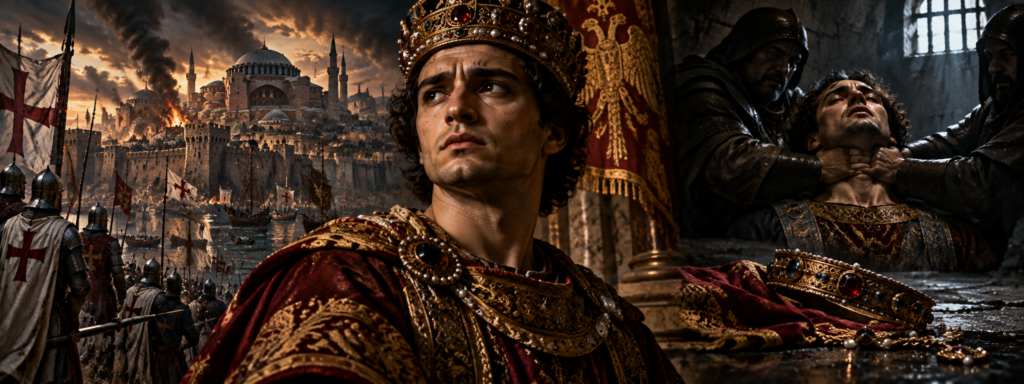
Alexios IV Angelos: The Emperor Strangled in Prison After Bringing the Fourth Crusade to Constantinople
Alexios IV Angelos (c. 1182–1204) | Byzantine Emperor, 1203–1204 | Deposed in January 1204 and strangled in prison in February 1204, following the seizure of power by Alexios V Doukas
The Emperor Who Could Hear His Empire Falling Apart
In the opening weeks of 1204, a young Byzantine emperor sat imprisoned inside the imperial palace of Constantinople, surrounded by the wreckage of a political gamble that had gone catastrophically wrong. Alexios IV Angelos had come to power only months earlier, carried toward the throne by an army of western crusaders whom he had promised extraordinary rewards in exchange for restoring his family. Now those same crusaders stood outside the walls of the capital demanding payment, while the people inside the city cursed his name and accused him of delivering the empire into foreign hands. His father was dead, his supporters had deserted him, and the man who had seized his throne had every reason to ensure that he would never emerge from captivity alive.
Alexios was still a young man, probably around twenty-one years old, when his reign ended in betrayal and murder. He had not inherited the throne through an orderly succession, nor had he conquered it through his own military ability. Instead, he had persuaded the leaders of the Fourth Crusade to abandon their intended campaign against Muslim-controlled territory and intervene in a Byzantine dynastic struggle. What he offered them in return was so extravagant that fulfilling the agreement would have placed enormous financial, religious, and military burdens upon an empire already weakened by decades of political instability.
The bargain brought Alexios the crown, but it also made him dependent upon men whose interests increasingly conflicted with those of his own subjects. To the crusaders, he was a legitimate prince who had promised money, supplies, troops, and ecclesiastical cooperation in exchange for their assistance. To many Constantinopolitans, he was a dangerous young ruler who had invited foreign soldiers to attack a Christian capital and then expected its inhabitants to pay the bill. As his promises became impossible to fulfill, Alexios found himself trapped between an impatient foreign army and a population growing more furious by the day.
His final enemy emerged from within the imperial government itself. Alexios Doukas, a powerful court figure known by the nickname Mourtzouphlos, exploited the mounting crisis and seized control of Constantinople in late January 1204. The young emperor was imprisoned, and his remaining political authority disappeared almost immediately. Within weeks, Alexios IV was strangled on the orders of the new ruler, who had taken the imperial name Alexios V.
The murder did not save Constantinople. Instead, it helped sever the last fragile relationship between the crusaders and the Byzantine government they had installed, leaving the city facing an army that now considered itself betrayed. In April 1204, the crusaders stormed Constantinople, subjected it to a devastating sack, and established a Latin empire upon the ruins of Byzantine authority. Alexios IV did not live to witness the catastrophe, but his desperate attempt to reclaim his father’s throne had helped bring it about.
His story is therefore more than the familiar tragedy of an emperor murdered by a usurper. It is the story of a young prince who believed foreign intervention could restore his family’s fortunes, only to discover that the price of that intervention was greater than his empire could bear. It is a story of dynastic betrayal, religious hostility, impossible promises, political desperation, and a murder committed while one of the greatest cities in the medieval world stood on the edge of destruction.
A Prince Born Into a Dangerous Dynasty
Alexios was born around 1182 into the Angelos family, which had risen to imperial power during one of the most unstable periods in Byzantine history. His father, Isaac II Angelos, became emperor in 1185 after the overthrow of Andronikos I Komnenos, whose reign had ended in an extraordinarily brutal public lynching. Isaac’s accession brought an end to direct Komnenian rule in Constantinople, but it did not restore the political stability that the empire desperately needed. The new emperor inherited a state burdened by aristocratic rivalries, financial pressures, military threats, and increasingly difficult relations with western Europe.
The Angeloi possessed distinguished aristocratic connections, but they lacked the established imperial prestige enjoyed by the Komnenian dynasty. Isaac II therefore needed to consolidate his position through military success, political alliances, and careful management of powerful families. His reign included victories and diplomatic achievements, yet it was also marked by serious setbacks and recurring rebellion. The empire’s ability to project power across the Balkans and Anatolia had weakened, while the costs of maintaining imperial authority continued to rise.
For the young Alexios, the palace offered privilege without security. He grew up surrounded by ceremonial magnificence, but the men who served his father understood that emperors could be overthrown with frightening speed. Andronikos I had been destroyed by a popular uprising, and Isaac himself had reached the throne through rebellion rather than inheritance. The lesson was unavoidable: imperial blood could provide a claim to power, but it could not guarantee survival.
The most dangerous threat eventually came from within the family. Isaac’s elder brother, Alexios Angelos, had his own ambitions and enjoyed connections among the aristocracy. In 1195, while Isaac was away on campaign, his brother seized the throne and became Emperor Alexios III Angelos. The coup transformed the young Alexios IV from an imperial prince into the son of a deposed ruler.
Isaac II was captured and blinded, a punishment commonly used in Byzantine politics to render a rival unsuitable for emperorship. Blinding was not necessarily intended to kill, but it could inflict permanent suffering and remove a defeated ruler from political life. Isaac was confined, and his son faced an uncertain future under the authority of the uncle who had betrayed them. The imperial family had become its own prison.
The Uncle Who Stole the Throne
Alexios III Angelos inherited the imperial position through his betrayal of Isaac II, but he did not solve the empire’s underlying problems. His government struggled with financial weakness, aristocratic pressures, and the continuing erosion of Byzantine authority. The imperial treasury was under strain, and the army was increasingly unable to guarantee security across the empire’s extensive territories. The contrast between Constantinople’s extraordinary wealth and the government’s financial difficulties became especially important in the years that followed.
Alexios IV remained a potential threat because he was the son of the deposed emperor. Although Byzantine succession was not governed by a rigid system of primogeniture, dynastic legitimacy still mattered enormously. A prince whose father had been overthrown could attract supporters dissatisfied with the usurper. His existence therefore represented a political problem for Alexios III.
The young prince eventually escaped Byzantine control and traveled westward, seeking assistance from rulers who might help restore his father. His flight carried him into a political world shaped by the Crusades, papal ambitions, German imperial politics, and the commercial power of Venice. He was not the first Byzantine claimant to seek foreign assistance, and he would not be the last. What made his decision exceptional was the army he eventually persuaded to intervene.
Alexios had connections to the German royal family through his sister Irene Angelina, who had married Philip of Swabia. Philip was a major figure in the struggle for power within the Holy Roman Empire, and his court offered Alexios access to influential western aristocrats. These connections helped place the young prince before men who were already preparing for a major crusading expedition. His personal struggle for the Byzantine throne was about to intersect with one of the most consequential military ventures of the Middle Ages.
The irony was that Alexios sought help from a western Christian movement whose relationship with Byzantium had long been troubled. Earlier crusading armies had passed through Byzantine territory amid suspicion, conflicting political objectives, and accusations of betrayal. Religious differences between the Latin and Greek churches intensified mistrust, while commercial competition added another layer of hostility. Alexios nevertheless believed that the crusaders could become the instrument of his restoration.
He was about to make promises that would change the course of history.
The Crusade That Was Supposed to Go Somewhere Else
The Fourth Crusade had been proclaimed under Pope Innocent III with the goal of advancing the Christian struggle in the eastern Mediterranean. Its leaders planned an expedition that would ultimately target Egypt, regarded by many western strategists as the key to weakening Muslim power in the region. The crusaders required a substantial fleet to transport soldiers, horses, weapons, and supplies across the Mediterranean. Venice possessed the maritime resources needed to make such an undertaking possible.
In 1201, crusading representatives negotiated an agreement with Venice for an enormous transport fleet. The Venetians committed themselves to constructing and supplying vessels for an expedition of exceptional scale. The agreement required a substantial payment, commonly given as 85,000 silver marks, based upon the anticipated size of the crusading army. The arrangement created a dangerous financial dependency before the expedition had even begun.
When the crusaders assembled in Venice in 1202, fewer men arrived than the organizers had expected. Many participants had traveled independently or failed to join the expedition, leaving the assembled army unable to meet its financial obligations. Venice had invested heavily in preparing the fleet and was unwilling simply to absorb the loss. The crusaders therefore found themselves dependent upon Venetian cooperation while lacking the money needed to secure it.
Doge Enrico Dandolo and the Venetian leadership offered a solution that immediately compromised the expedition’s religious purpose. The crusaders could assist Venice in attacking Zara, a Christian city on the Adriatic coast that had resisted Venetian domination. In exchange, the Venetians would defer part of the debt. The proposal provoked serious objections because crusaders had taken vows to fight in the Holy Land, not attack fellow Christians.
Despite opposition and papal condemnation, the expedition attacked Zara in November 1202. The city fell, and the crusaders became entangled in the political and commercial interests of Venice. The diversion demonstrated how financial necessity could redirect an army originally assembled for a religious campaign. It also established a precedent for using crusading forces against Christian opponents.
Alexios IV entered the story at precisely this vulnerable moment. The crusaders needed money, the Venetians wanted repayment, and the expedition’s leaders were searching for a way to recover their original purpose. The young Byzantine prince offered a bargain that appeared capable of solving nearly every problem at once. It was also a bargain whose consequences he had dangerously underestimated.
The Promise That Bought an Empire
Alexios proposed that the crusaders help restore Isaac II to the Byzantine throne and establish him as co-emperor. In exchange, he offered extraordinary financial and military assistance. The promised payment is generally given as 200,000 silver marks, a sum enormous enough to cover the crusaders’ Venetian obligations and provide additional resources for the expedition. He also promised provisions, military support, and assistance for the crusade’s eventual campaign in the eastern Mediterranean.
The religious terms were equally ambitious. Alexios offered to bring the Byzantine Church into obedience to Rome, effectively promising a settlement of the division between Greek and Latin Christianity. Such a commitment was politically explosive because ecclesiastical relations had been strained for generations. The Byzantine Church possessed its own traditions, hierarchy, theological convictions, and deep suspicion of papal claims. A young prince seeking restoration had no realistic authority to guarantee that an entire religious establishment would accept such a transformation.
Alexios also promised military assistance, including a contingent of Byzantine troops for the crusading expedition, and support for the maintenance of forces in the Holy Land. These offers made the proposed diversion attractive to leaders who feared that the expedition would otherwise collapse. If Alexios could deliver what he promised, the crusaders might repay their debts, strengthen their army, and continue toward their original objective. From their perspective, intervening in Byzantine politics could be presented as a temporary detour that would ultimately advance the crusade.
The problem was that Alexios did not control the Byzantine treasury, army, or church. He was a fugitive prince making commitments on behalf of a government that did not yet exist. He could not know precisely how much money remained available in Constantinople or how much resistance his religious proposals would encounter. His promises rested upon the assumption that once restored, he would possess enough authority to compel the empire to fulfill them.
The crusading leadership was divided over the proposal. Some participants regarded an attack upon Constantinople as a betrayal of their vows and refused to support it. Others believed the intervention was justified because Alexios had been wrongfully deprived of his inheritance and because the promised assistance could rescue the expedition. The financial attraction was impossible to ignore.
The decision to support Alexios was therefore not the product of a single motive. Dynastic legitimacy, religious ambition, military calculation, commercial interest, and financial desperation all contributed. The crusaders did not simply wake up one morning determined to conquer Constantinople, but neither were they innocent travelers accidentally drawn into Byzantine politics. Their leaders knowingly accepted a bargain that required military intervention against a Christian empire.
Alexios had found the army he needed. He had also placed his future reign under obligations that would prove almost impossible to satisfy.
The City That Did Not Welcome Its Prince
In June 1203, the crusading fleet reached Constantinople. The sight was extraordinary even by the standards of a city accustomed to receiving foreign armies and ambassadors. Ships crowded the waters near the imperial capital, carrying knights, soldiers, horses, siege equipment, and the military resources of Venice. The crusaders had arrived not as ordinary pilgrims but as an armed force prepared to impose a dynastic settlement.
Constantinople was one of the greatest cities in the medieval world. Its massive walls, monumental churches, imperial palaces, markets, harbors, and accumulated wealth impressed western visitors who had never encountered anything comparable. The city had survived centuries of attacks and possessed defenses that made a successful assault extraordinarily difficult. For many crusaders, the first sight of Constantinople was an encounter with a scale of urban magnificence beyond their experience.
Alexios expected that the population might welcome him once his identity and intentions became known. After all, his father had been overthrown and blinded by an ambitious brother, and Alexios could present himself as the legitimate heir returning to correct a dynastic injustice. The crusaders attempted to display him before the city’s inhabitants and encourage recognition of his claim. The response was deeply disappointing.
The population did not rise enthusiastically in his support. Many Constantinopolitans regarded the foreign army with suspicion or hostility, regardless of the prince accompanying it. Alexios III remained emperor, and the inhabitants had little reason to assume that replacing him through a western invasion would improve their lives. The presence of the crusaders made Alexios’s claim appear threatening rather than reassuring.
This rejection should have warned the young prince that his political assumptions were dangerously flawed. He had promised the crusaders money and religious concessions on the belief that restoration would give him control over the empire. Yet the people whose obedience he needed did not appear eager to accept him. His path to the throne would therefore require foreign military force rather than spontaneous popular support.
The crusaders prepared to attack.
The First Siege of Constantinople
The campaign against Constantinople in 1203 demonstrated both the strength of the city’s defenses and the effectiveness of the crusading army. The attackers needed to overcome formidable walls and secure positions that would allow them to penetrate the capital. Venetian naval expertise proved especially important because the city’s maritime defenses offered opportunities for assault. The fighting was difficult, and the outcome was far from inevitable.
The crusaders attacked across the Golden Horn and along the city’s defenses, while Venetian forces played a crucial role in operations against the sea walls. The defenders resisted, but Alexios III’s leadership proved inadequate. The emperor possessed substantial resources and could potentially have organized stronger resistance. His failure to do so became one of the decisive weaknesses of the defense.
During the fighting, fires broke out in parts of Constantinople, causing destruction and intensifying the population’s suffering. The crusaders were not yet attempting the complete conquest that would follow in 1204, but their intervention had already brought war directly into the imperial capital. The city’s inhabitants faced the terrifying prospect that a foreign army might breach walls long associated with Byzantine security. Their resentment toward the prince responsible for bringing the attackers grew accordingly.
Alexios III eventually abandoned Constantinople and fled. His departure created a sudden political vacuum because the reigning emperor had effectively deserted his capital. Rather than surrender immediately to the crusaders, Byzantine authorities restored Isaac II, the blinded father of Alexios IV. The old emperor was brought back to the throne after eight years of confinement.
The restoration appeared to fulfill the central purpose of Alexios’s expedition, but it also created new complications. Isaac had not personally negotiated the extraordinary promises made to the crusaders. The foreign army wanted guarantees that the restored government would honor those commitments. The young prince therefore remained essential to the settlement.
Alexios IV entered Constantinople as the apparent victor of a dynastic struggle. His father had been restored, his uncle had fled, and the crusaders expected payment for their assistance. Yet the city had suffered from the fighting, the population distrusted the foreigners, and the treasury was in no condition to satisfy the obligations made in exile. The new emperor’s triumph already contained the foundations of his destruction.
Two Emperors and an Empty Treasury
Alexios IV was crowned co-emperor alongside his father on 1 August 1203. The arrangement was intended to unite Isaac’s dynastic legitimacy with the young prince’s political role in securing restoration. In ceremonial terms, the Angelos family had recovered what Alexios III had stolen in 1195. In practical terms, the government now faced an enormous financial crisis.
The crusaders demanded fulfillment of the agreement. Alexios had promised 200,000 silver marks, and the western leaders expected the new regime to begin paying immediately. Some substantial payments were made, with western accounts indicating that approximately half the promised amount was initially delivered. The money helped relieve the crusaders’ immediate financial difficulties, but it did not satisfy the full obligation.
The problem was not simply that Alexios refused to pay. Byzantine finances had been weakened by years of misgovernment, military expenditure, political instability, and the diversion of resources into private hands. The imperial treasury did not contain unlimited reserves waiting to be distributed. Alexios had promised a sum far greater than he could readily produce.
The government therefore sought additional resources. Taxes were raised, valuables were collected, and precious objects associated with imperial and religious institutions became potential sources of revenue. The seizure or melting down of valuable objects for payment to the crusaders generated enormous resentment. To many Byzantines, the government appeared to be sacrificing the wealth and sacred possessions of Constantinople to satisfy foreign soldiers.
The religious dimension made the situation still more dangerous. Alexios had promised cooperation with Rome, but the Byzantine population and clergy had not agreed to abandon their traditions or accept papal supremacy. The idea that a young emperor could impose ecclesiastical submission as part of a bargain with an invading army was profoundly offensive to many of his subjects. The promise that had helped secure western support now undermined his legitimacy at home.
Isaac II could offer little practical assistance. His years of imprisonment, physical condition, and weakened authority limited his ability to control the crisis. Alexios IV increasingly became the public face of a government associated with foreign pressure and financial extraction. The restoration that should have strengthened the Angelos dynasty instead left father and son dependent upon an army camped outside their capital.
The Crusaders Who Would Not Leave
The crusaders had expected their intervention to produce money, supplies, and an opportunity to resume the expedition toward the eastern Mediterranean. Instead, they found themselves waiting outside Constantinople while the Byzantine government struggled to fulfill its promises. The delay created frustration among men who had already spent considerable time and resources on the expedition. Their leaders needed to maintain discipline while explaining why the army remained involved in Byzantine politics.
Alexios IV faced an equally dangerous problem. If the crusaders departed before he had consolidated his authority, his enemies might overthrow him. His government remained unpopular, and the population had not enthusiastically accepted his restoration. The foreign army was therefore both the source of his legitimacy and the greatest threat to it.
He persuaded the crusaders to remain for a longer period while he attempted to strengthen his position and raise additional money. The arrangement may have seemed reasonable in the short term because the crusaders needed payment and Alexios needed protection. Yet every additional week deepened Constantinopolitan resentment. The inhabitants saw foreign troops remaining near their city while their government extracted resources to support them.
Alexios also undertook military operations in Byzantine territory, seeking to secure areas still loyal to his uncle. Western forces assisted him in some of these campaigns, demonstrating the continuing military partnership between the young emperor and the crusaders. Such cooperation could strengthen his position outside the capital, but it did little to solve the political crisis within Constantinople. The more closely Alexios associated himself with western soldiers, the easier it became for opponents to portray him as their puppet.
The crusaders, meanwhile, increasingly doubted whether the remaining payments would ever arrive. Their expectations had been shaped by Alexios’s extraordinary promises, and many believed that the wealth of Constantinople should make fulfillment possible. They had little understanding of the practical limits of Byzantine taxation or the political consequences of extracting money from religious institutions and urban communities. Both sides therefore interpreted the growing delays through suspicion.
The relationship was becoming a trap from which neither party could easily withdraw. Alexios could not satisfy the crusaders without further alienating his subjects, but he could not dismiss the crusaders without risking his throne. The western army could not simply abandon its claims without accepting enormous financial losses. A settlement that had initially appeared mutually beneficial was becoming a source of mutual hostility.
Fire in the Greatest City of Christendom
The situation deteriorated further when violence erupted between Latins and Byzantines in Constantinople. Relations between the communities had been strained for decades, and the presence of a foreign army intensified every grievance. Religious differences, commercial rivalries, memories of earlier massacres, and resentment toward Alexios’s dependence upon the crusaders all contributed to the tension. The city became increasingly dangerous for anyone associated with the opposing side.
In August 1203, a group of westerners entered Constantinople and attacked a mosque used by the city’s Muslim community. The confrontation escalated, and a fire spread through densely populated districts. The resulting destruction was enormous, devastating homes, businesses, churches, and other buildings across a substantial area. The fire became one of the most destructive episodes in the city’s history before the final sack.
The disaster intensified popular hatred of the crusaders. Constantinopolitans who had already suffered from the siege now watched large sections of their city burn because of violence associated with the foreign presence. Families lost homes and possessions, while the government appeared unable to protect them. Alexios IV was blamed for the circumstances that had brought the western army to Constantinople.
The fire also damaged the relationship between the imperial government and its own population. A ruler could sometimes survive unpopular taxation if he delivered military security and political stability in return. Alexios was delivering neither. His reign had brought invasion, foreign troops, financial extraction, religious controversy, and now devastating urban destruction.
For the crusaders, the hostility of the population made remaining near Constantinople increasingly dangerous. They feared that the Byzantines might attack their camps or refuse further cooperation. Each side began preparing for the possibility of renewed war. The atmosphere that had briefly followed the restoration of Isaac II was disappearing.
Alexios’s political position became almost impossible. He had promised the crusaders rewards he could not fully deliver, while his subjects increasingly believed that he had betrayed the empire. Every attempt to appease one side made the other more hostile. The young emperor was losing control of the forces that had placed him on the throne.
The Emperor Who Could Please Nobody
By the closing months of 1203, Alexios IV had become trapped between incompatible demands. The crusaders wanted the money and assistance they had been promised, while the people of Constantinople wanted the foreigners gone. The emperor could not satisfy both demands because the crusaders were unwilling to depart without adequate compensation and the Byzantine government lacked the resources to pay them without provoking further resentment. His political survival depended upon resolving a contradiction that may no longer have had a peaceful solution.
The imperial court itself was divided. Some officials believed continued cooperation with the crusaders was necessary because the government owed its restoration to their military intervention. Others regarded the foreign army as an intolerable threat and believed that Alexios’s dependence upon it was destroying imperial authority. Powerful men began calculating whether the young emperor could survive the crisis.
Alexios’s relationship with the western leaders deteriorated as payments slowed. The crusaders increasingly suspected that the emperor was deliberately withholding resources or attempting to evade his obligations. Alexios, meanwhile, understood that further concessions might provoke rebellion within Constantinople. His promises had been made when he was a fugitive seeking power, but fulfilling them now threatened to destroy the power he had obtained.
The population’s anger became increasingly visible. Crowds denounced the government, and anti-Latin sentiment spread through the city. The presence of foreign soldiers outside the walls was humiliating enough, but the belief that the emperor was using Byzantine wealth to pay them made the situation intolerable to many inhabitants. Alexios was increasingly seen not as the legitimate heir of Isaac II but as the man responsible for the city’s suffering.
His youth and limited experience made the crisis even more difficult. Alexios had demonstrated enough political ability to secure western support and reclaim his father’s throne, but governing Constantinople required skills far beyond those needed to negotiate an intervention. He had to manage the aristocracy, clergy, military, treasury, urban population, and foreign army simultaneously. Each group possessed interests that increasingly conflicted with those of the others.
The young emperor’s authority weakened as the crisis deepened. Men who had supported him during the restoration began considering alternatives. The crusaders became less willing to trust him, and Constantinopolitans became less willing to obey him. The throne that had seemed worth almost any promise was becoming impossible to hold.
Alexios Doukas Waits in the Shadows
Among the men who benefited from the collapse of Alexios IV’s popularity was Alexios Doukas, known as Mourtzouphlos. His nickname is generally associated with his heavy or prominent eyebrows, a physical characteristic that became inseparable from his historical identity. He belonged to the Byzantine political elite and possessed the court connections necessary to operate close to the imperial government. Unlike the young emperor, he could present himself as a defender of Constantinople against foreign domination.
Mourtzouphlos was not merely an outsider exploiting a moment of chaos. He had held positions within the imperial administration and understood the workings of the palace. He knew the weaknesses of Alexios IV’s government and the depth of resentment surrounding its dependence upon the crusaders. His proximity to power made him especially dangerous because he could act from within the system rather than relying upon an external army.
The political atmosphere increasingly favored a leader willing to confront the westerners. Alexios IV had become associated with submission, financial humiliation, and religious concessions. Mourtzouphlos could offer the opposite image: a Byzantine ruler prepared to resist foreign demands and restore the dignity of the empire. Whether he possessed a realistic strategy for defeating the crusaders was another matter.
His ambitions were also personal. Byzantine imperial politics had long rewarded men capable of exploiting moments of crisis, and the Angelos dynasty itself had risen through rebellion and betrayal. Mourtzouphlos understood that an emperor who lost the confidence of the capital could fall very quickly. The same instability that had elevated Alexios IV now offered an opportunity to replace him.
The approaching confrontation was therefore both a political revolt and a palace conspiracy. Popular anger created the conditions, but ambitious men within the imperial government determined how that anger might be directed. Alexios IV had invited foreign soldiers to restore his family, only to find that the decisive threat to his life was developing inside his own palace. The enemy who would ultimately destroy him did not need to breach Constantinople’s walls.
January 1204: The City Turns Against Its Emperor
In January 1204, opposition to Alexios IV erupted into open political crisis. Constantinople’s population had endured months of foreign military pressure, financial demands, destructive fires, and uncertainty. The emperor’s inability to remove the crusaders made him appear both weak and compromised. Public demonstrations reflected a growing determination to replace the government.
The political situation became confused as competing groups searched for an alternative ruler. At one stage, a man named Nicholas Kanabos was proclaimed emperor by opponents of the existing regime, although he did not possess the military power necessary to secure the throne. His brief prominence demonstrated how completely Alexios IV’s authority had deteriorated. The capital was no longer merely criticizing its emperor; it was actively searching for someone else to rule.
Mourtzouphlos exploited the confusion. He moved against Alexios IV and seized control of the imperial government in late January 1204. The young emperor was arrested and imprisoned, while his father Isaac II was also removed from effective power. The Angelos restoration that had begun with such enormous promises only six months earlier had collapsed.
Isaac II died around this time, apparently from natural causes amid the turmoil, although medieval accounts differ in emphasis and chronology. His death should not be casually described as an execution ordered by Mourtzouphlos because the evidence does not establish that conclusion. The old emperor had already endured years of imprisonment and blinding, followed by a brief and disastrous restoration. He died as the political settlement that had returned him to power disintegrated.
Alexios IV remained alive in captivity. His continued existence presented an immediate danger to the new regime because the crusaders could still claim to be acting on behalf of the emperor they had installed. Mourtzouphlos therefore faced the same problem that had haunted Byzantine usurpers for generations. A deposed ruler could become the symbol around which enemies organized.
The young emperor’s fate was now in the hands of a man who had seized his throne and needed him permanently removed.
The Prisoner Who Had No One Left to Save Him
Alexios IV’s imprisonment was the final stage of a political collapse that had begun long before his arrest. The crusaders remained outside Constantinople, but their presence no longer guaranteed his safety. The population inside the walls despised his dependence upon them, while the new government had every reason to prevent his restoration. His father’s death removed the last immediate family connection capable of reinforcing his legitimacy.
The contrast with his arrival in 1203 was devastating. Then, Alexios had been accompanied by a powerful western army and had promised to transform its fortunes through Byzantine wealth. He had entered Constantinople as the son of a restored emperor and soon received the imperial crown himself. Now he was a prisoner whose former allies could do little without launching another attack upon the city.
Mourtzouphlos had powerful reasons to eliminate him. Alexios IV’s survival would provide the crusaders with a legitimate claimant whose restoration could justify renewed intervention. Even if the young emperor were forced into exile, he might seek foreign assistance again, just as he had done after his uncle’s coup. The history of Byzantine politics offered countless examples of deposed rulers becoming dangerous after escaping confinement.
Blinding might have been considered sufficient to render him unsuitable for rule, but it would not necessarily prevent his supporters from using his name. Imprisonment alone was even less secure because political conditions could change quickly. Mourtzouphlos had seized power amid rebellion and knew that his own position remained vulnerable. Killing Alexios offered the most permanent solution.
The young emperor had no realistic means of resisting. His supporters inside the palace had been neutralized, and the crusaders were separated from him by the defenses of Constantinople. The same walls that had once protected Byzantine emperors from foreign armies now helped imprison a ruler whose foreign allies could not reach him. Alexios had finally become completely dependent upon the mercy of his political enemy.
That mercy did not come.
Strangled in the Darkness
Alexios IV was strangled in prison in February 1204, following the seizure of power by Alexios V Doukas. The killing was carried out on the orders of the new emperor, who had every reason to regard his captive predecessor as a continuing political threat. Unlike the public lynching of Andronikos I in 1185, Alexios’s death was a controlled palace murder rather than an eruption of collective violence. The young ruler disappeared behind the walls of captivity and emerged only as a dead man.
The exact details of his final moments cannot be reconstructed with certainty. Medieval sources agree upon the essential fact of his deliberate killing, but they do not provide a neutral eyewitness account of everything that occurred inside the prison. Later retellings sometimes add dramatic elements to such deaths, including imagined pleas, final words, or conversations with executioners. None should be presented as historical fact without reliable evidence.
The method of strangulation was familiar within Byzantine political history. It could kill a prisoner without the public spectacle of beheading or the prolonged violence of a mob execution. For a ruler seeking to eliminate a rival quietly, it offered an efficient means of ensuring that the victim could never return. Alexios IV, who had once negotiated with princes, crusading leaders, and Venetian officials, was reduced to a captive whose death could be ordered by the man occupying his throne.
The murder also exposed the brutal continuity of Byzantine dynastic politics. Alexios’s father had been overthrown and blinded by his own brother in 1195. Alexios had then used a foreign army to restore his father and depose that uncle in 1203. Less than a year later, another ambitious court figure had overthrown Alexios and ordered his death.
Every attempt to settle the succession through force created another violent reversal. The Angelos family had helped normalize the idea that emperors could be removed through conspiracy and military pressure. Alexios IV became one of the most tragic victims of that political culture. He had succeeded in reclaiming the throne but failed to create a government capable of protecting him once he possessed it.
Did Alexios V Murder Him to Save Constantinople?
Mourtzouphlos’s decision to kill Alexios IV can be understood through the political circumstances of early 1204. The new emperor needed to establish his authority quickly while confronting a powerful foreign army outside the capital. Alexios IV remained the claimant whom that army had restored and whose promises it continued to invoke. Eliminating him removed the most obvious justification for another restoration campaign.
Yet the murder also made reconciliation with the crusaders more difficult. The western leaders had already become furious over unpaid obligations and the collapse of the government they had supported. Killing Alexios transformed a dispute over money and political authority into a confrontation involving the deliberate murder of their former ally. The crusaders could now present themselves as seeking justice for a deposed and murdered emperor, even as their own ambitions increasingly moved toward conquest.
Mourtzouphlos may have believed that decisive action would strengthen Byzantine resistance. By removing the unpopular Alexios IV, he could distance the government from the promises that had brought the crusaders to Constantinople. He could also appeal to the population’s desire for a ruler willing to confront foreign demands. In the short term, his seizure of power gave the capital a leader more openly committed to resistance.
The strategic problem was that the crusading army had not disappeared. Its leaders still possessed military forces, Venetian naval support, and powerful incentives to seek compensation. The murder of Alexios IV did not remove their financial demands or erase the conflict that had developed over the preceding months. Instead, it destroyed one of the remaining political relationships through which compromise might have been attempted.
Whether Mourtzouphlos believed he was acting primarily to defend the empire or to secure his own throne cannot be established with certainty. Both motives could have operated simultaneously. Byzantine rulers frequently justified political violence through claims of public necessity, and those claims were not always entirely insincere. Nevertheless, the immediate beneficiary of Alexios IV’s death was the man who had replaced him.
The murder was therefore both a political calculation and an act of regicide. It eliminated a rival while leaving Constantinople facing an enemy army whose determination was growing stronger. The young emperor’s death closed one chapter of the crisis but accelerated the approach of another.
The Crusaders Learn Their Emperor Is Dead
News of Alexios IV’s murder reached the crusading army outside Constantinople. The western leaders had already become deeply suspicious of the Byzantine government, and the overthrow of their ally confirmed that the political settlement of 1203 had failed. The man whose promises had justified the expedition’s diversion was dead, while the new emperor refused to accept the obligations made in his name. The crusaders now faced the question of what to do with an army that had invested enormous resources in an intervention producing neither the expected payment nor a stable ally.
Their response increasingly moved toward conquest. The possibility of replacing the Byzantine government with a Latin regime became more attractive to leaders who believed that Constantinople’s wealth could compensate them for the expedition’s failures. Religious arguments also entered the discussion, with some western participants portraying the Byzantines as unreliable or hostile Christians whose resistance justified military action. Such claims served political purposes and should not be mistaken for neutral assessments of Byzantine society.
The crusaders’ grievances were real in the sense that Alexios IV had made promises he could not fulfill. They had provided military assistance, incurred costs, and expected compensation. Yet those grievances did not automatically justify attacking and plundering a Christian capital. The decision to proceed toward conquest involved choices made by crusading and Venetian leaders, not merely consequences forced upon them by Alexios’s death.
The murder nevertheless became an important element in the justification for renewed war. The crusaders could point to the overthrow and killing of the ruler they had installed as evidence that the new Byzantine government was illegitimate and hostile. Mourtzouphlos’s resistance strengthened their determination to settle the conflict militarily. Both sides increasingly regarded compromise as either impossible or unacceptable.
Alexios IV had once believed that western intervention would solve his family’s problems. Now his death became another reason for western intervention to continue. The bargain that had restored him to the throne had outlived him, and its consequences were moving beyond anything he could have imagined.
Constantinople Prepares for the Final Assault
Alexios V attempted to organize the defense of Constantinople against the crusaders. He understood that the city faced a serious threat and that its survival depended upon effective resistance. The Byzantine capital possessed formidable walls, substantial resources, and a long history of defeating foreign attackers. Yet its military organization had been weakened by political instability, and the crusaders had already demonstrated their ability to exploit weaknesses in its defenses.
The new emperor adopted a more confrontational position than Alexios IV. He sought to strengthen fortifications, organize troops, and resist the western army rather than continue negotiating over unpaid promises. His efforts gained support among people who had come to regard the crusaders as enemies. For Constantinopolitans exhausted by foreign pressure, a ruler willing to fight could appear preferable to one who had tried unsuccessfully to appease them.
The crusaders and Venetians prepared their own assault. Their leaders discussed the division of territory and political authority that might follow a successful conquest. The planning revealed that the expedition had moved far beyond the original purpose of restoring Isaac II and Alexios IV. The possibility of establishing a new political order in Constantinople had become central to the campaign.
The city itself remained divided and frightened. Its inhabitants had endured one siege, destructive fires, financial extraction, political upheaval, and the murder of an emperor. The government now demanded that they prepare for another attack by the same army that had helped install the previous regime. The population faced the possibility that the consequences of Alexios IV’s bargain would culminate in the destruction of the capital.
The first major assault in April 1204 did not immediately succeed. Byzantine defenders resisted, and the crusaders suffered setbacks. The failure demonstrated that Constantinople was not an easy prize and that the outcome remained uncertain. Yet the attackers regrouped and prepared another attempt.
On 12 April 1204, the crusaders breached the city’s defenses. The resistance collapsed, and Alexios V eventually fled. Constantinople, the imperial capital of the eastern Roman world, fell into the hands of a western Christian army. The catastrophe that Alexios IV had helped set in motion reached its terrible conclusion.
The Sack That Changed Byzantium Forever
The sack of Constantinople in April 1204 became one of the most notorious episodes in medieval European history. Crusading soldiers and their allies plundered the city, seizing wealth, precious objects, religious treasures, and works of art accumulated over centuries. Churches, monasteries, palaces, and private homes were looted. The violence included killings, sexual assaults, destruction, and the humiliation of a population that had believed its capital protected by some of the strongest walls in the world.
The scale of the plunder was extraordinary. Constantinople possessed religious relics, gold and silver objects, classical sculptures, manuscripts, textiles, and ceremonial treasures that western visitors had admired for generations. Much of this wealth was seized and dispersed across Europe. Some objects eventually became famous possessions of western churches and cities, while countless others disappeared into private hands or were destroyed.
The city’s suffering extended beyond the loss of valuables. Fires destroyed neighborhoods, families were displaced, and the institutions that had supported Byzantine government were shattered. The imperial capital had not merely changed rulers. Its political and social order had been violently disrupted by an army that had originally assembled to fight in the eastern Mediterranean.
The conquest led to the establishment of the Latin Empire of Constantinople. Baldwin of Flanders became its first emperor, while Venetian and other western interests received extensive territorial and commercial advantages. The Byzantine Empire fragmented into successor states, including important centers of resistance at Nicaea, Epirus, and Trebizond. The eastern Roman political tradition survived, but it no longer possessed its ancient capital.
The sack also deepened the division between eastern and western Christianity. The memory of Latin soldiers plundering Orthodox churches and attacking a Christian city became a lasting source of bitterness. Relations between the churches had already been strained by centuries of theological and political disputes. The events of 1204 transformed those tensions into a historical wound that endured long after the immediate military crisis ended.
Alexios IV was dead before the final assault, but his role in bringing the crusaders to Constantinople remained central to the story. His promises had made the diversion attractive, his restoration had placed the foreign army outside the city, and his inability to fulfill the agreement had contributed to the breakdown of relations. Yet responsibility for the sack cannot be assigned to him alone. The crusading leaders, Venetian authorities, Byzantine factions, and successive imperial governments all made decisions that helped produce the catastrophe.
The Murderer Meets His Own Fate
Alexios V Doukas did not enjoy a long reign after ordering the death of Alexios IV. His efforts to defend Constantinople failed, and he fled as the crusaders captured the city. The man who had seized the throne by overthrowing his predecessor now became another fugitive emperor. His own survival depended upon finding protection beyond the capital.
He eventually encountered Alexios III Angelos, the uncle whose coup in 1195 had begun the chain of events leading to the Fourth Crusade’s intervention. The meeting brought together two men whose ambitions had contributed enormously to the empire’s political instability. Alexios III initially appeared willing to cooperate with Mourtzouphlos, but the relationship ended in betrayal. The former emperor had Alexios V blinded.
The punishment was a bitter reversal. Mourtzouphlos had ordered the strangling of Alexios IV to secure his own throne, only to become the victim of another imperial claimant’s treachery. Blinding deprived him of the physical integrity traditionally associated with eligibility for emperorship. Yet his suffering did not end there.
Alexios V eventually fell into the hands of the crusaders. They held him responsible for the murder of Alexios IV and subjected him to judgment. He was condemned and executed by being thrown from a high column in Constantinople later in 1204. His death was deliberately public and symbolically humiliating.
The sequence created an almost grotesque chain of imperial destruction. Isaac II had been blinded by his brother Alexios III. Alexios IV had used foreign soldiers to restore Isaac and overthrow that uncle. Alexios V had then overthrown and murdered Alexios IV, only to be blinded by Alexios III and executed by the crusaders.
The Angelos era had become a succession of betrayals in which every attempt to secure power produced another violent reversal. The men who fought over Constantinople’s throne repeatedly destroyed one another while the empire itself weakened around them. By the end of 1204, the imperial capital had fallen, the old political order had been shattered, and several of the principal figures in the struggle were dead, mutilated, or in exile. The pursuit of the throne had consumed both rulers and state.
Was Alexios IV a Traitor?
Alexios IV has often been portrayed as the prince who betrayed Constantinople to the crusaders. The accusation is understandable because he deliberately invited a foreign army to intervene in Byzantine politics and promised that army enormous rewards. His agreement placed financial and religious obligations upon the empire without securing the consent of the people who would bear them. His restoration also depended upon military violence directed against his own capital.
Yet calling him a traitor without qualification risks imposing a simplicity that the historical circumstances do not support. Alexios believed his father had been unlawfully deposed and blinded by a usurping brother. Seeking foreign assistance to restore a legitimate ruler was not unprecedented in Byzantine politics. He could plausibly regard his actions as an attempt to correct a dynastic injustice rather than destroy the empire.
The distinction matters because Alexios did not set out to arrange the sack of Constantinople in 1204. His apparent goal was to regain the throne, reward his allies, and restore Byzantine authority under his family. He seems to have believed that the empire possessed enough wealth and resources to fulfill his promises. His failure lay partly in misunderstanding the political and financial realities he would face once restored.
That misunderstanding had catastrophic consequences. He underestimated the hostility of the Constantinopolitan population toward the crusaders and overestimated his ability to command the Byzantine treasury and church. He also failed to recognize that foreign soldiers who had been promised enormous rewards might become dangerous enemies if those rewards were not delivered. His bargain created a dependency from which he could not escape.
Alexios was therefore neither an innocent victim of circumstances nor the sole architect of Byzantium’s destruction. He made decisions that contributed directly to the crisis, but those decisions interacted with the ambitions of many other powerful actors. The crusading leaders chose to divert their expedition, the Venetians pursued their interests, Byzantine aristocrats competed for power, and Mourtzouphlos chose murder. The catastrophe emerged from the collision of those choices.
His tragedy is that he achieved the immediate objective that had driven him into exile. He restored his father and became emperor. Yet the means by which he accomplished that victory made the position almost impossible to sustain. He won the throne by accepting obligations that helped destroy his legitimacy once he occupied it.
The Prince Who Promised More Than an Empire Could Give
The financial promises made by Alexios IV were central to his downfall. Two hundred thousand silver marks represented an enormous obligation, especially for a government whose revenues and reserves had been weakened by years of political instability. The sum was attractive to the crusaders precisely because it appeared capable of transforming their financial position. For Alexios, it was the price of military assistance.
The problem was that promises made in exile can appear easier than obligations enforced from a throne. Alexios did not have to raise the money when he negotiated with the crusaders. He needed only to persuade them that the Byzantine Empire was wealthy enough to provide it. Once restored, he discovered that imperial wealth was not a single treasure chest waiting to be opened.
Constantinople certainly contained immense private, ecclesiastical, and ceremonial wealth. Yet extracting that wealth for foreign soldiers required political authority and public cooperation that Alexios did not possess. The treasury’s limitations forced the government to seek resources from institutions and communities already resentful of the crusaders. Every additional payment threatened to deepen opposition.
The religious promises were even more difficult. Bringing the Byzantine Church under Roman obedience was not something a young emperor could accomplish through personal agreement with western leaders. Greek ecclesiastical identity rested upon centuries of tradition, and resistance to Latin claims was deeply rooted. Alexios had offered a religious settlement without possessing the authority necessary to impose it.
His military promises likewise depended upon resources and loyalty that could not be guaranteed. Byzantine forces were needed to defend the empire’s own territories, while foreign threats and internal instability limited the government’s freedom of action. Supplying large numbers of troops to a crusading expedition would have required substantial coordination and political support. Alexios’s agreement treated these complicated realities as though they were simple matters of imperial command.
The tragedy was therefore built into the bargain itself. The crusaders expected fulfillment because they had provided the assistance requested. Alexios expected cooperation because he had restored his family’s legitimate claim. The Byzantine population expected relief from foreign pressure because the dynastic dispute had supposedly been settled.
All three expectations were incompatible.
A Young Emperor Without a Political Foundation
Alexios IV’s reign was extraordinarily brief, lasting from his coronation in August 1203 until his overthrow in January 1204. Those few months were dominated by problems that would have challenged even an experienced ruler. He needed to consolidate authority after a foreign-assisted restoration, satisfy enormous financial obligations, negotiate religious controversy, control an angry capital, and prevent his military allies from becoming enemies. He attempted all of this while sharing the throne with a father whose ability to govern had been severely diminished.
His youth mattered, but it should not become an excuse for every failure. Young rulers could succeed when supported by capable advisers, stable institutions, and loyal military forces. Alexios lacked those advantages. His restoration had depended upon outsiders whose interests were not identical to those of the empire.
The political foundation of his government was therefore weak from the beginning. He had not been acclaimed through a broad popular movement, nor had he defeated his uncle through an army personally loyal to him. The crusaders supplied the decisive military force. Once their demands became unpopular, the emperor’s dependence upon them turned into a liability.
His father could not compensate for that weakness. Isaac II possessed dynastic legitimacy but lacked the political strength necessary to rebuild the government. The aristocracy remained divided, the treasury was strained, and the population increasingly associated the restored dynasty with foreign interference. Alexios’s court became a place where every political decision threatened to alienate someone essential.
The young emperor also struggled to control the narrative surrounding his rule. To the crusaders, he increasingly appeared unreliable because he failed to deliver promised rewards. To Constantinopolitans, he appeared submissive because he continued accommodating the foreign army. To ambitious court figures, he appeared vulnerable because neither side trusted him.
Mourtzouphlos exploited precisely that vulnerability. He did not need to invent popular anger because the city was already furious. He did not need to create financial crisis because the treasury was already under pressure. He needed only to present himself as the man capable of ending the humiliation associated with Alexios IV.
The emperor’s greatest weakness was not simply that he had enemies. It was that he no longer possessed a political constituency strong enough to defend him. The crusaders could threaten the city, but they could not prevent a palace coup from reaching him. His subjects could recognize his imperial title, but they no longer trusted the government behind it.
The Sources and the Problem of Blame
The history of Alexios IV and the Fourth Crusade survives through several important narrative traditions, each shaped by the perspective of its authors. Geoffrey of Villehardouin, a prominent participant in the crusade, described the expedition from the viewpoint of its leadership. Robert de Clari, a lesser-ranking crusader, offered a different western perspective that preserves details of ordinary participants’ experiences and expectations. Niketas Choniates, a Byzantine official and historian, recorded the crisis from within the society devastated by the conquest.
These accounts are invaluable because they preserve events witnessed or closely experienced by their authors. They also disagree in emphasis and interpretation. Western crusading writers often sought to explain or justify the expedition’s diversion and the conduct of its leaders. Byzantine writers naturally emphasized the suffering of Constantinople and the failures of the rulers who had exposed the empire to disaster.
The differences are especially important when assigning responsibility. Crusading narratives could portray Alexios IV as a ruler who failed to honor legitimate promises after receiving military assistance. Byzantine accounts could emphasize his dependence upon foreigners and the destructive consequences of inviting them into imperial politics. Both perspectives contain important evidence, but neither should be accepted without considering the author’s interests.
The murder of Alexios IV is more straightforward than many other aspects of the crisis. His overthrow, imprisonment, and deliberate killing under Alexios V are firmly established. The exact details of his final hours are less certain, and no responsible account should invent conversations or emotional scenes inside the prison. His death was a political murder, but the precise experience of the victim remains beyond recovery.
The larger question of whether the Fourth Crusade’s conquest was inevitable is much more difficult. Some historians emphasize the expedition’s financial dependency upon Venice, while others stress the ambitions of crusading leaders, Byzantine instability, or the escalating breakdown of relations after 1203. The evidence supports a complicated process rather than a single secret plan controlling every stage. Alexios IV’s decisions were important, but they operated within a crisis shaped by many actors.
Historical accuracy therefore requires resisting two attractive but misleading stories. Alexios was not simply an innocent prince betrayed by greedy foreigners, because he knowingly invited their intervention and made extravagant promises. Nor was he a calculating villain who deliberately arranged the destruction of Constantinople, because the final conquest occurred after his death and was not the outcome he had sought. He was a desperate claimant whose successful restoration created a crisis he could not control.
A Murder That Failed to Save the Empire
Alexios V’s decision to strangle his predecessor was intended to secure the new regime. Removing Alexios IV deprived the crusaders of the living claimant whose restoration had justified their original intervention. It also allowed Mourtzouphlos to present himself as a decisive ruler who had broken with the unpopular policies of the previous government. In the immediate political circumstances, the murder may have appeared brutally practical.
Yet it solved almost nothing. The crusaders remained outside Constantinople, the financial dispute persisted, and the city was still threatened by an army possessing substantial military and naval resources. Killing Alexios did not restore the treasury or repair the damage caused by months of political instability. It also did not erase the promises that had brought the crusaders to the capital.
Instead, the murder deepened the rupture. The western leaders could now argue that their ally had been unlawfully overthrown and killed. Mourtzouphlos could insist that the previous emperor’s commitments no longer bound the government, but the crusaders had little incentive to accept that position. Both sides increasingly viewed war as the only remaining solution.
The final assault in April demonstrated the limits of political murder as a strategy. Alexios V had eliminated a rival but failed to secure the capital. The crusaders breached the walls, and the new emperor fled. The regime created through the strangling of Alexios IV survived only a few months.
The aftermath was devastating for Byzantium. The Latin conquest fragmented imperial authority and removed Constantinople from Byzantine control for more than half a century. Byzantine successor states preserved the eastern Roman political tradition, and Constantinople would eventually be recovered in 1261. Yet the empire that emerged from restoration was profoundly changed.
Alexios IV’s murder therefore stands at the intersection of personal tragedy and imperial catastrophe. A young ruler was killed because his successor feared he might regain power through foreign support. The killing was intended to protect the new government from precisely the intervention that had brought Alexios to the throne. Instead, it became one more step toward the destruction of the political order both men had struggled to control.
The Angelos Family and the Cost of Betrayal
The Angelos dynasty’s history during these years is remarkable for the frequency with which family members and political associates destroyed one another. Isaac II gained the throne after the fall of Andronikos I in 1185, only to be overthrown and blinded by his brother Alexios III in 1195. Isaac’s son then sought foreign assistance to reverse that betrayal, bringing the Fourth Crusade to Constantinople. The restoration succeeded, but it produced a government too weak to survive the demands of its own allies.
Alexios IV’s overthrow repeated the pattern of palace conspiracy. Mourtzouphlos exploited dissatisfaction, removed the reigning emperor, and claimed the throne for himself. His decision to kill Alexios reflected the familiar Byzantine fear that a living rival could become the center of another restoration attempt. The murder was therefore part of a political culture in which defeated rulers were rarely safe.
The consequences of these repeated coups extended far beyond the individuals involved. Every violent succession weakened confidence in imperial institutions and encouraged powerful families to treat the throne as something that could be seized through opportunity. Military commanders and aristocrats became accustomed to calculating which claimant offered the best prospects for advancement. Foreign rulers learned that Byzantine dynastic disputes could provide opportunities for intervention.
The empire’s enemies did not create all of these weaknesses. Byzantine political leaders repeatedly undermined their own institutions through rivalry, corruption, and personal ambition. Alexios IV’s bargain with the crusaders was one particularly destructive expression of a broader pattern. He sought to solve an internal political dispute by importing overwhelming external force.
The result was an empire whose fate became entangled with the financial and military interests of outsiders. Alexios had intended to use the crusaders as instruments of restoration. Once they arrived, however, they became independent political actors with demands he could not satisfy. The distinction between ally and occupier grew increasingly difficult to maintain.
The dynasty’s struggle for power therefore helped expose Constantinople to conquest. The men involved did not all intend that outcome, and their motives differed considerably. Yet the cumulative effect of their decisions was catastrophic. By the time the crusaders entered the city in April 1204, the imperial government had been weakened by years of internal betrayal and months of foreign intervention.
The Emperor Who Never Saw the Sack
There is something particularly tragic about the timing of Alexios IV’s death. He was murdered only weeks before the crusaders captured Constantinople. He therefore did not witness the final destruction that later generations would associate with his name. His life ended while the outcome remained uncertain, with the city still defended and the possibility of a negotiated settlement not yet completely extinguished.
Had Alexios survived, the political situation might have developed differently, although any alternative remains speculative. The crusaders could have attempted to restore him again, or the new Byzantine government might have used him as a bargaining instrument. His survival could also have complicated the crusaders’ plans for establishing a Latin regime. None of these possibilities can be established as likely outcomes.
What is certain is that his death removed one of the few remaining figures capable of connecting the rival political positions. Alexios had negotiated with the crusaders and understood the commitments made to them. He also possessed dynastic legitimacy through his father and had been crowned emperor in Constantinople. His removal left the two sides confronting one another without the person whose bargain had originally brought them together.
That did not make him an effective mediator. By January 1204, both the crusaders and the Byzantine population had lost confidence in him. His inability to satisfy either side had contributed directly to his overthrow. Nevertheless, his murder eliminated a political option at a moment when alternatives were rapidly disappearing.
The tragedy lies partly in the contrast between his intentions and his legacy. Alexios wanted to restore his father, reclaim the throne, and secure his family’s position. He succeeded in the first two objectives for a brief period. The third proved impossible, and the means by which he achieved restoration helped destroy the very political order he hoped to inherit.
His final months therefore reveal the difference between winning power and possessing the capacity to govern. Foreign soldiers could place a crown upon his head, but they could not make Constantinople trust him. The imperial title gave him authority in ceremony, but it did not create the money needed to satisfy his promises. The throne became a position of extraordinary danger rather than security.
Why Alexios IV Belongs Among the Regicides
Alexios IV was not killed in battle, nor did he die from illness or accident. He was deliberately murdered after being deposed, with the killing ordered by the man who had seized his throne. His death therefore fits the category of regicide in its most direct political form. A former emperor was eliminated because his continued existence threatened the legitimacy and security of a new ruler.
The circumstances distinguish his murder from the more spectacular deaths of other Byzantine emperors. Andronikos I Komnenos had been publicly tortured and killed by a crowd in 1185, while Alexios IV disappeared into prison and was strangled away from public view. The contrast illustrates the different forms political violence could take in Byzantium. One ruler was destroyed through collective vengeance, while the other was eliminated through a calculated palace killing.
The motive was also different from an ordinary personal assassination. Alexios V did not need to hate his predecessor privately in order to regard him as dangerous. Alexios IV possessed a claim to the throne and connections to a powerful foreign army. Those political realities made him a threat even after he had lost control of the government.
His murder also demonstrates the instability created when succession depends upon force rather than durable legitimacy. Alexios III had overthrown Isaac II, Alexios IV had restored Isaac through crusading intervention, and Alexios V had then overthrown Alexios IV. Each transfer of power created a defeated claimant whose survival threatened the victor. Violence became the means of closing one succession crisis while opening another.
The strangling of Alexios IV did not produce lasting security. Mourtzouphlos soon lost Constantinople and eventually suffered a violent execution himself. The political murder that was supposed to stabilize the new regime became another episode in the chain of destruction surrounding the Fourth Crusade. In that sense, Alexios’s death was both a regicide and a warning about the futility of using murder to solve a collapsing political order.
The Crown That Cost Constantinople
Alexios IV Angelos began his political career as the son of a betrayed emperor. His father had been overthrown and blinded by his own brother, leaving the young prince with a powerful grievance and a legitimate claim to restoration. In the violent world of Byzantine dynastic politics, seeking assistance against a usurper was not inherently extraordinary. What made Alexios’s decision so consequential was the foreign army he persuaded to intervene and the promises he made to secure its support.
The Fourth Crusade was already in trouble when Alexios offered his bargain. Its leaders had contracted for an enormous Venetian fleet but lacked the money necessary to pay for it. The expedition had already attacked the Christian city of Zara, demonstrating how financial pressure could divert crusading armies from their declared purpose. Alexios arrived with an offer that appeared capable of rescuing the entire venture.
He promised money, troops, supplies, and religious concessions on a scale that would have challenged even a strong Byzantine government. The crusaders saw an opportunity to recover their investment and continue their expedition. Alexios saw an opportunity to restore his father and reclaim the throne. Both sides believed they could use the other to achieve their objectives.
The bargain succeeded just long enough to become disastrous. The crusaders reached Constantinople, attacked its defenses, and helped force Alexios III to flee. Isaac II was restored, and Alexios IV received the imperial crown. The young prince had achieved what had once seemed almost impossible.
Yet the victory exposed the weakness of everything he had promised. The treasury could not easily produce the required money, the Byzantine Church could not simply be ordered into obedience to Rome, and the population had little affection for the foreign soldiers occupying positions outside the capital. Alexios had won the throne through military assistance that made him politically dependent upon outsiders. His restoration was therefore both his greatest success and the beginning of his destruction.
The people of Constantinople watched their city suffer through siege, fire, financial extraction, and mounting religious hostility. They saw an emperor who had invited foreigners into Byzantine politics and now seemed unable to make them leave. The crusaders, meanwhile, watched the promised payments slow and began to suspect that the government was betraying its obligations. Alexios found himself caught between two groups whose demands had become impossible to reconcile.
His father could not rescue him. Isaac II had endured years of captivity and blinding, and his brief restoration provided little practical stability. The imperial court became divided, while powerful figures began searching for alternatives to the unpopular young ruler. The emperor who had relied upon foreign force to gain power discovered that the same force could not protect him from betrayal inside his own palace.
Alexios Doukas Mourtzouphlos understood the opportunity. He presented himself as a defender of Constantinople against the crusaders and exploited the hatred surrounding Alexios IV’s government. In late January 1204, he seized power and imprisoned the young emperor. The restoration that had begun with such extravagant hopes ended in another Byzantine palace coup.
Alexios IV’s death followed soon afterward. He was strangled in prison on the orders of the new emperor, eliminating the claimant whose existence threatened the regime. There was no great public execution and no final military struggle in which the young ruler could attempt to recover his position. The man who had negotiated with crusading leaders and entered Constantinople as an emperor died as a helpless prisoner.
His murder did not save the city. The crusaders remained outside the walls, their demands unresolved and their hostility intensified by the overthrow of their former ally. Alexios V attempted to organize resistance, but the political and military situation had deteriorated too far. In April 1204, the crusaders breached Constantinople’s defenses and subjected the city to a devastating sack.
The consequences reached far beyond the death of one emperor. The Latin conquest shattered Byzantine control over its ancient capital, dispersed enormous quantities of wealth, and deepened the division between eastern and western Christianity. The empire fragmented into successor states, and the political order that had governed Constantinople for centuries was violently interrupted. The catastrophe became one of the defining events of medieval history.
Alexios IV did not intend that outcome. He wanted to restore his father and secure his own position within the imperial dynasty. Yet intention cannot erase responsibility for decisions that helped make catastrophe possible. His promises drew the crusaders toward Constantinople, and his inability to fulfill them contributed to the crisis that followed.
The crusaders also bore responsibility for their choices. They decided to divert their expedition, attack a Christian capital, and eventually conquer and plunder it. Venetian interests, crusading ambitions, Byzantine rivalries, and the decisions of successive emperors all contributed to the disaster. No single individual can adequately explain the fall of Constantinople in 1204.
Alexios IV nevertheless remains one of its most tragic central figures. He was young enough to believe that reclaiming a throne would solve his family’s problems, but experienced enough to negotiate a bargain that placed enormous obligations upon an empire he did not yet control. He understood the power of foreign military assistance but underestimated the danger of becoming dependent upon it. His political imagination reached as far as restoration but failed to account for what governing afterward would require.
His death also revealed the brutality of the political world he had inherited. His father had been blinded by a brother, his uncle had been driven from the throne by foreign soldiers, and Alexios himself was strangled by a new usurper. The struggle for imperial authority became a succession of betrayals in which every victor feared the survival of the defeated. The throne offered extraordinary prestige but little security to anyone unable to hold it through force and loyalty.
Alexios V believed that murdering his predecessor would strengthen his own position. Instead, he inherited a confrontation that could no longer be resolved through another palace coup. He soon lost the capital, fled, was blinded, and eventually suffered a public execution. The man who had ordered Alexios IV’s death became another victim of the political violence consuming the empire.
The final irony is that Alexios IV succeeded in the very ambition that destroyed him. He restored his father, reclaimed the imperial crown, and entered Constantinople as a ruler rather than a fugitive. For a few months, the young prince possessed the throne he had sought so desperately. Yet every day of his reign made clearer that the price of restoration was greater than he could pay.
His story is therefore not simply one of betrayal by a murderous successor. It is the tragedy of a ruler who mistook the ability to obtain power for the ability to sustain it. He had persuaded a foreign army to make him emperor, but he could not persuade his subjects to trust him or his allies to accept what the empire could realistically provide. Once those relationships collapsed, the crown offered no protection.
Alexios IV Angelos had crossed Europe seeking the soldiers who could restore his father’s throne, and he found them among crusaders desperate for money and opportunity. Their intervention gave him the imperial crown, but the promises that purchased it turned Constantinople against him and left his government trapped between foreign demands and domestic fury. When a rival seized the palace, the young emperor was strangled in captivity, his brief reign ending before the catastrophe it had helped unleash reached its terrible conclusion. He had brought an army to Constantinople to recover an empire, only to die in prison while that army prepared to take the city for itself.