
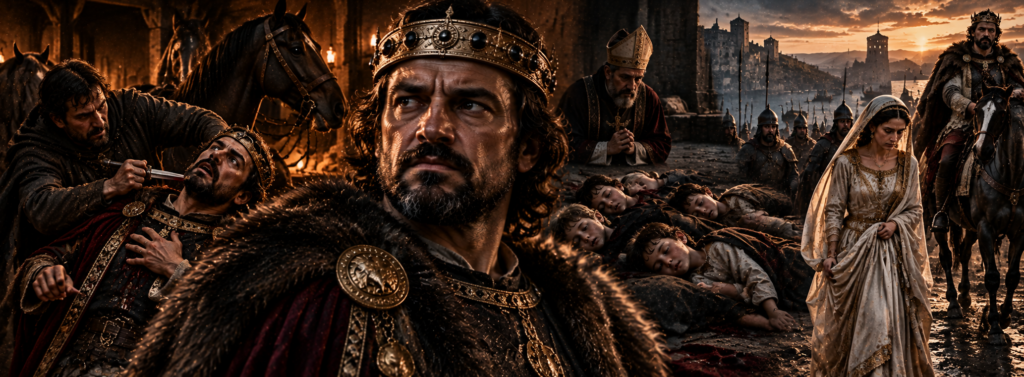
Sigeric: The Visigothic King Who Ruled for Seven Bloody Days
Sigeric (d. 415) | King of the Visigoths for approximately seven days in 415 | Brother of the powerful Gothic commander Sarus | Member of a faction bitterly hostile to King Athaulf | Rose to power immediately after Athaulf was assassinated at Barcelona | Often associated with the conspiracy that killed Athaulf, although surviving evidence does not conclusively prove that Sigeric personally ordered the assassination | Seized the throne despite indications that Athaulf favored another succession | Ordered the killing of Athaulf’s six sons from an earlier relationship | Subjected Athaulf’s widow, the Roman imperial princess Galla Placidia, to deliberate public humiliation | Represented a violent repudiation of Athaulf’s household and political legacy | Failed to secure sufficient support among the Visigothic elite | Assassinated after a reign traditionally given as only seven days | Replaced by Wallia, who ultimately negotiated a new accommodation with the Western Roman Empire | His astonishingly brief reign became one of the most violent episodes in early Visigothic royal history.
Seven Days Between Two Murders
For seven days in the year 415, Sigeric was king of the Visigoths. He reached the throne through the political chaos created by the assassination of his predecessor, Athaulf, and almost immediately unleashed violence against the dead king’s family. Before his first week wearing the crown had ended, Sigeric himself was dead. His entire reign unfolded between one assassination and another, compressed into a savage interval of vengeance, dynastic murder, humiliation, and political failure.
There are rulers remembered for decades of conquest and rulers remembered for the institutions they built, the wars they won, or the civilizations they transformed. Sigeric belongs to another category entirely. His reign was so brief that there was scarcely time for anything resembling conventional government, yet the few actions securely associated with him were extraordinarily brutal. He seized power, murdered potential dynastic rivals, degraded an imperial princess, and was assassinated before he could establish himself.
The temptation to describe Sigeric as the mastermind behind Athaulf’s murder is understandable, especially because the assassin was connected to Sigeric’s dead brother Sarus and Sigeric immediately benefited from the killing. The political circumstances strongly suggest that Athaulf’s enemies were prepared to exploit his death, and Sigeric’s subsequent actions reveal intense hostility toward Athaulf’s family and policies. However, the surviving evidence does not conclusively prove that Sigeric personally commissioned the assassin or directed every stage of a coordinated conspiracy. It is safer to describe him as the principal beneficiary and leader of the hostile faction that seized power after the murder while recognizing that direct orchestration remains probable or possible rather than definitively documented.
That distinction does not make Sigeric’s story less sinister. If anything, it makes the political atmosphere surrounding the assassination more revealing. Personal vengeance for Sarus, aristocratic rivalry, resentment of Athaulf, opposition to his relationship with Rome, and ambition for the Gothic kingship all converged at precisely the same moment. A servant’s attack inside a Barcelona stable became the opening through which Sigeric reached the throne.
Then the violence accelerated. Athaulf’s sons were killed because their blood made them dangerous. Galla Placidia, daughter of one Roman emperor and sister of another, was forced into a degrading public display intended to demonstrate that the world Athaulf had tried to create had been destroyed with him. Sigeric appeared determined to erase his predecessor’s dynasty before it could organize resistance.
Seven days later, the eraser was erased. Sigeric was assassinated by men among the Visigoths who rejected his rule, and Wallia emerged as king. The astonishing speed of the reversal exposes one of the central realities of early Visigothic kingship: killing a ruler could create a vacancy, but only political support could turn that vacancy into a durable reign.
Before Sigeric: A People Without a Permanent Kingdom
The Visigoths of the early fifth century were not yet the rulers of the mature territorial kingdom later centered first at Toulouse and eventually in Hispania. They were an armed political community moving through the collapsing structures of the Western Roman Empire, searching for security, territory, food, and recognition. Their leaders negotiated with Roman emperors while simultaneously fighting Roman armies. Cooperation and warfare were not opposites so much as alternating strategies.
The Roman Empire itself was experiencing profound internal instability. Emperors struggled against usurpers, generals accumulated extraordinary personal power, provinces slipped from effective central control, and groups including Vandals, Alans, Suebi, Burgundians, and Goths established themselves within imperial territory. The Roman state remained culturally prestigious and administratively sophisticated, but its western government increasingly lacked the military strength to impose its will everywhere it claimed sovereignty. This weakness created opportunities for ambitious commanders on every side.
Alaric I had spent years attempting to obtain a durable settlement for his followers. His negotiations with the government of Emperor Honorius repeatedly failed, leading to escalating confrontation and ultimately the sack of Rome in August 410. The event horrified contemporaries, but it did not destroy the empire or solve the Goths’ underlying problem. They still needed somewhere to live.
Alaric died only months after the sack. His brother-in-law Athaulf succeeded him and gradually moved the Goths away from Italy toward Gaul. Athaulf inherited military power and prestige, but he also inherited unresolved conflicts with Rome and divisions among Gothic leaders. One of the most dangerous of those rivalries involved a warrior named Sarus.
Sarus was Sigeric’s brother. His feud with Alaric’s circle would eventually shape the fate of two Visigothic kings. Long before Sigeric briefly wore the crown, the path toward his seven-day reign was being paved by the blood feud surrounding Sarus.
Sarus and the Family Feud
Sarus was a Gothic commander who spent important periods serving Roman interests rather than following Alaric. The surviving sources do not reveal every stage in the origins of his hostility toward Alaric and Athaulf, but the feud was clearly serious. Sarus possessed his own following of warriors and enough reputation to matter in the confused military politics of the Western Empire. He represented an alternative center of Gothic loyalty.
This mattered because early Visigothic leadership was not governed by an automatic hereditary succession resembling later European primogeniture. Military prestige, aristocratic backing, family connections, and personal followings all influenced who could lead. A powerful Gothic commander therefore represented more than a battlefield rival. He could become a political alternative to the reigning king.
Sarus’s relationship with Roman authorities further complicated matters. Gothic leaders frequently served within Roman military structures, and identities that modern readers might imagine as rigidly opposed were often intertwined. A man could be ethnically Gothic, command Gothic warriors, serve a Roman emperor, and fight another Gothic commander without perceiving those roles as contradictory. Late Roman politics rewarded flexible allegiance.
Athaulf had strong reasons to distrust Sarus. Around 412, Sarus became entangled in another Roman political struggle and was intercepted by Athaulf. The surviving tradition portrays Sarus as possessing only a small following when confronted by a much larger Gothic force. He fought but was overwhelmed and killed.
For Athaulf, the elimination of Sarus removed a dangerous rival. For Sigeric and Sarus’s surviving followers, it created a blood debt. In a political culture built around personal loyalty and kinship, the death of a commander did not automatically dissolve the network that had surrounded him. Sarus’s enemies had killed the man but not the memory.
One of the men connected to Sarus would later enter Athaulf’s domestic environment. In 415, that connection became lethal. The king who had destroyed Sigeric’s brother would die at the hands of someone associated with the dead commander’s household.
Athaulf Turns Toward Rome
Athaulf’s reign moved increasingly toward accommodation with the Roman world. This did not mean that he became a submissive servant of Emperor Honorius or abandoned Gothic interests. He continued using military pressure, occupied Roman cities, and bargained aggressively. Yet his political direction suggested that he believed Gothic power could flourish inside the Roman order rather than only through its destruction.
The Christian historian Orosius preserves the famous tradition that Athaulf had once imagined replacing the Roman Empire with a Gothic one. According to the account, he later concluded that the Goths lacked the established legal discipline necessary to govern an empire on Rome’s scale and therefore sought glory by restoring Roman civilization through Gothic strength. The exact words cannot be treated as a verbatim transcript, because Orosius was reporting them indirectly and for his own literary purposes. The broader sentiment nevertheless fits Athaulf’s policies surprisingly well.
Nothing represented that direction more dramatically than Galla Placidia. She was the daughter of Emperor Theodosius I and half-sister of Honorius. Captured when the Goths controlled Rome, she became one of the most politically valuable people in Athaulf’s entourage. In 414, Athaulf married her.
The wedding at Narbonne was filled with Roman symbolism. Athaulf reportedly dressed in Roman fashion, while the ceremony took place within an aristocratic Roman setting. Gifts included treasures connected with the earlier Gothic plunder of Rome. The spectacle transformed the memory of conquest into a display of dynastic union.
Athaulf and Placidia then had a son whom they named Theodosius after Placidia’s father. The name advertised the political significance of the child. He possessed both Gothic royal ancestry and the blood of the Theodosian imperial house.
The infant died, destroying whatever future might have emerged from that extraordinary union. Yet Athaulf’s marriage remained a powerful symbol of his political orientation. To his enemies, especially those associated with Sarus, the king’s relationship with Rome could provide another reason to oppose him.
The Roman Princess at the Center of the Crisis
Galla Placidia was far more than Athaulf’s wife. Her identity connected the Visigothic court directly to the Western imperial dynasty. Emperor Honorius had no surviving children, making the future of the Theodosian house politically sensitive. Placidia’s marriage to a Gothic king therefore had implications far beyond the personal relationship between two individuals.
The Roman government did not simply accept the union. Honorius wanted his sister returned, while the powerful general Constantius had his own political and possibly personal interest in marrying her. Constantius became the dominant military figure in the Western Empire and applied pressure against Athaulf. Rather than recognizing the Gothic king as a permanent imperial brother-in-law, the Roman government sought to recover Placidia.
The marriage nevertheless strengthened Athaulf’s prestige. He could present himself not merely as successor to Alaric but as a ruler connected by marriage to the dynasty governing the Western Empire. If his son Theodosius had survived, that connection would have become even more significant. The infant’s death removed one potential dynastic bridge but did not eliminate the symbolic importance of Placidia herself.
For Sigeric’s faction, she represented almost everything objectionable about Athaulf’s direction. She embodied the imperial relationship, the possibility of Romano-Gothic dynastic integration, and the prestige Athaulf had gained through marriage. Her treatment immediately after his death therefore appears deliberately political. Sigeric did not merely inherit his predecessor’s widow.
He humiliated her.
The brutality of that humiliation becomes more comprehensible when Placidia is understood as a symbol as well as a person. Degrading her publicly attacked Athaulf’s legacy and proclaimed the triumph of his enemies. The new king was demonstrating that the murdered ruler’s Roman connection no longer protected his household.
Yet Placidia was too valuable simply to kill. Her blood made her useful even to men who despised what she represented. Sigeric would discover that destroying Athaulf’s children was easier than destroying the imperial world attached to his widow.
Barcelona and the End of Athaulf
Roman pressure eventually forced Athaulf and his followers from Gaul into Hispania. Constantius had used control of supplies and military pressure to make the Gothic position increasingly difficult. Athaulf crossed the Pyrenees and established himself at Barcelona. The city would become the setting for both personal tragedy and political catastrophe.
His infant son Theodosius died there. The child’s burial, reportedly in a silver coffin, marked the collapse of Athaulf’s most obvious dynastic connection to the Theodosian house. The king nevertheless retained Placidia and continued attempting to navigate the deteriorating relationship with Rome. His political situation remained precarious.
Inside the Gothic community, old enemies had not disappeared. Sarus’s followers retained their grievance, while Sigeric survived as the dead commander’s brother. Opposition to Athaulf therefore had both personal and political foundations. The king had killed a powerful rival and pursued policies that could alienate those who preferred a more independent or hostile stance toward Rome.
In 415, Athaulf entered or visited his stables to inspect his horses. A household retainer associated with Sarus approached him and attacked. Later tradition commonly names the assassin as Dubius, although the fragmentary state of the ancient evidence requires caution about some details. The essential point is secure: Athaulf was murdered by a man linked to the rival whose death he had caused.
The assassination instantly created a succession crisis. Sigeric was positioned to exploit it. Whether he had arranged the killing beforehand cannot be established conclusively, but his subsequent actions demonstrate that he was not a reluctant beneficiary unexpectedly thrust into power.
He seized the kingship.
The brother of Sarus had outlived the man who killed Sarus. A blood feud that had already consumed one Gothic commander had now consumed a king. Sigeric’s next task was ensuring that Athaulf’s family could never take revenge in return.
Did Sigeric Orchestrate Athaulf’s Murder?
Sigeric is frequently described in modern summaries as the man who orchestrated Athaulf’s assassination. The conclusion is understandable because the circumstantial case is powerful. Athaulf’s killer was associated with Sarus, Sigeric was Sarus’s brother, Sigeric benefited immediately from the assassination, and he launched a savage attack upon Athaulf’s family as soon as he became king. If historians possessed a fuller narrative source, it might well confirm direct planning.
The problem is that the surviving sources do not provide that confirmation with sufficient clarity. Olympiodorus of Thebes, one of the most important historians for these events, survives only in fragments and later summaries. The tradition clearly associates Athaulf’s killer with Sarus and presents revenge as a motive. It does not preserve a detailed conspiracy narrative proving that Sigeric issued the order.
This distinction is important because historical accuracy requires separating probability from documentation. Sigeric may have known of the plot, encouraged it, or directed it. He may instead have moved instantly once a Sarus loyalist acted from personal vengeance. Both scenarios fit the surviving evidence, but neither can be reconstructed in detail.
What can be stated confidently is that the assassination empowered Sigeric’s faction. The new king’s actions were openly hostile to Athaulf’s household. He killed the former ruler’s children and humiliated his widow, behavior entirely consistent with a violent political overthrow rather than an ordinary succession. Whatever Sigeric knew beforehand, he embraced the result completely.
The difference between “ordered the assassination” and “seized power through the assassination” may appear small in a dramatic narrative, but historically it matters. The second is securely supported. The first remains an inference.
Sigeric does not need an invented conspiracy to qualify as a sinister usurper. The actions we know he committed after Athaulf’s death are already extraordinary. His seven-day reign would be defined not by uncertainty over what he might have done, but by the brutality of what he unquestionably did next.
The Crown Taken in Blood
Athaulf’s death did not automatically make Sigeric king. Someone still had to claim leadership and persuade or compel enough of the Gothic elite to accept the new reality. Sigeric moved rapidly. His accession suggests that a faction was ready to support him immediately, even if that faction proved much too narrow to sustain his reign.
There are indications that Athaulf had preferred another succession arrangement. Some traditions connect his final wishes with the return of Placidia to Roman authority and the selection of a more acceptable successor. The details are difficult to reconstruct because the sources are fragmentary. What is clear is that Sigeric represented a violent break rather than a smooth continuation.
His claim likely rested partly upon his position within the Gothic aristocracy and his relationship to Sarus. Sarus had possessed enough status and followers to challenge Athaulf’s circle. Sigeric could inherit those loyalties. The assassination created the moment in which they could be converted into kingship.
The new ruler immediately faced a fundamental problem. Athaulf had left behind children from an earlier relationship. As sons of a recently murdered king, they could become rallying points for anyone seeking to overthrow the usurper.
Sigeric chose the most brutal solution possible.
He ordered the boys killed.
The act transformed his accession from a disputed succession into a deliberate purge of a royal household. Whatever justification Sigeric or his supporters may have offered has not survived. The political purpose is painfully obvious: dead princes cannot grow into rival kings.
Six Sons Marked for Death
Ancient tradition reports that Athaulf had six sons from an earlier marriage or relationship. They were not the children of Galla Placidia, whose only known son by Athaulf had already died in infancy. After Sigeric seized power, these boys became dangerous simply because they existed. Their father’s blood gave them claims that the new ruler could not comfortably ignore.
The children had reportedly sought or received protection associated with Bishop Sigesar. The presence of a bishop in the story is significant because late Roman and early medieval churches could function as places of refuge and bishops frequently acted as political intermediaries. Religious status, however, could not guarantee protection when a throne was at stake. Sigeric’s men seized the boys.
All six were killed.
The sources do not require embellishment about the exact method. Their deaths are horrifying precisely because the political logic is so transparent. Sigeric was eliminating the male offspring of the king whose throne he had taken.
Dynastic murder of children appears repeatedly across monarchical history because legitimacy can survive inside a child long before that child possesses any personal power. A ten-year-old or five-year-old cannot command an army, but an ambitious general can command one in his name. A prince can become the banner beneath which dissatisfied nobles gather. Sigeric apparently understood that danger.
The killings also revealed the weakness of his own legitimacy. A ruler confident that the political community overwhelmingly accepted him might have had less reason to slaughter children immediately. Sigeric behaved like a man who believed rival claims had to be physically extinguished. His insecurity was written in the blood of Athaulf’s sons.
The purge did not save him. The children died, but opposition survived among adult warriors who did not need an Athaulf prince to reject Sigeric. Within days, they would turn their weapons against the king himself.
A Dynasty Destroyed in a Week
The murder of Athaulf’s sons had consequences beyond immediate succession politics. It effectively destroyed the most obvious male continuation of his household. The son he had fathered with Placidia was already dead. Now his earlier sons were eliminated as well.
For Sigeric, this may have seemed like decisive political housekeeping. The dead king’s bloodline had been stripped of potential male claimants. The new ruler could theoretically govern without fearing that one of Athaulf’s children would return years later seeking revenge. Such calculations were common in dynastic politics across many cultures.
Yet killing royal children could also provoke revulsion and opposition. Even in a violent political environment, there were limits to what factions would tolerate from a ruler they had not fully accepted. Sigeric had been king only briefly and lacked the accumulated loyalty of a long reign. Beginning his rule with a massacre of children could hardly have broadened his support.
The involvement of Bishop Sigesar, if accurately preserved, adds another layer. Removing children from ecclesiastical protection risked antagonizing religious authorities as well as Athaulf loyalists. The Goths themselves were predominantly Arian Christians at this stage, while most Roman subjects followed Nicene Christianity, but bishops of either confession could possess substantial social authority. Royal violence against protected dependents was politically dangerous.
Sigeric nevertheless acted with extraordinary speed. Perhaps he believed hesitation would be fatal. A usurper often faces the greatest danger immediately after taking power, before supporters have been rewarded and opponents disarmed.
If so, his reasoning produced exactly the opposite result. The killings demonstrated ruthlessness without establishing control. Sigeric had destroyed children who might one day threaten him while failing to neutralize the men capable of killing him immediately.
The crown remained on his head for only a few more days.
Galla Placidia Before the Horse
Sigeric’s treatment of Galla Placidia became one of the most memorable episodes of his seven-day reign. According to the surviving tradition, he forced the imperial princess to walk on foot for miles before his horse along with other captives. The exact distance varies in retellings, and numerical precision should be treated cautiously. The humiliation itself is well attested.
For Placidia, the reversal was extraordinary. She was the daughter of Theodosius I, sister of Honorius, widow of Athaulf, and a woman who had been publicly presented as queen beside the Gothic king. Within days of her husband’s assassination, she was reduced to walking as a captive before the man who had seized his throne. Her imperial ancestry did not protect her from degradation.
The display almost certainly carried political meaning. Placidia embodied Athaulf’s relationship with Rome. By humiliating her, Sigeric was symbolically trampling upon the dead king’s most visible political alliance. The procession turned a Roman princess into evidence of the new ruler’s victory.
Yet Sigeric stopped short of killing her. This restraint was probably practical rather than merciful. Placidia remained an immensely valuable hostage, and murdering the emperor’s sister would have created a permanent obstacle to any future negotiation with Honorius. Even a ruler hostile to Athaulf’s Roman policy had reason to keep her alive.
The episode also demonstrates the limits of Sigeric’s supposed anti-Romanism. He could insult Roman prestige, but he could not escape Rome’s continuing political value. Placidia’s life was worth more than the satisfaction of killing her. The empire remained weak enough to be defied and important enough to be bargained with.
Placidia survived the humiliation and Sigeric himself. That survival would ultimately make the seven-day king look even more transient. The captive he degraded went on to become Augusta and mother of a Roman emperor, while Sigeric became a brief and bloody footnote in the history through which she moved.
Was Sigeric an Anti-Roman King?
Sigeric is often presented as the representative of an anti-Roman Gothic faction reacting against Athaulf’s policy of accommodation. There is considerable logic behind that interpretation. His brother Sarus had long opposed Athaulf’s circle, and Sigeric’s humiliation of Placidia certainly looks like a repudiation of the murdered king’s imperial connection. His accession therefore appears to mark a sharp political reaction.
The difficulty lies in determining how coherent that reaction really was. Early fifth-century Gothic politics were not organized into modern ideological parties with written platforms. Nobles could oppose Athaulf because of personal rivalries, competition for resources, military strategy, family loyalty, or dissatisfaction with Roman negotiations. Several motives could operate simultaneously.
Sigeric’s own reign was too short to reveal a sustained foreign policy. Seven days did not allow him to negotiate treaties, organize major campaigns, restructure relations with Rome, or establish an alternative territorial strategy. Almost everything known about his kingship concerns the destruction of Athaulf’s household. This makes broad ideological conclusions necessarily tentative.
His humiliation of Placidia remains the strongest evidence of hostility toward Athaulf’s Roman alignment. Even that act, however, did not result in her death. Sigeric preserved the empire’s princess as a political asset. Pragmatism survived alongside hostility.
The ruler who followed him makes the picture still more complicated. Wallia eventually negotiated extensively with Honorius’s government, returned Placidia, accepted Roman supplies, and fought Rome’s enemies in Hispania. If Sigeric represented a decisive rejection of accommodation, his policy vanished almost immediately with him.
It is therefore better to view his accession as the triumph of a hostile faction rather than the beginning of a coherent anti-Roman revolution. Sarus’s family had won its revenge. Sigeric had won the throne. Neither victory lasted long enough to remake Visigothic strategy.
A King Without Time
Seven days is barely enough time for a new government to announce itself, much less establish authority across a mobile and militarized political community. Sigeric inherited no peaceful administrative transition. He seized leadership amid the shock of assassination. Every decision he made occurred under the pressure of immediate survival.
The surviving record suggests that he devoted those days primarily to eliminating threats. Athaulf’s sons were killed. Placidia was humiliated and controlled. The previous royal household was dismantled.
What we do not see is equally revealing. There is no surviving record of major legislation, diplomatic achievements, territorial reorganization, or military campaigns undertaken during his reign. There was simply no time. Sigeric’s kingship was almost entirely an act of seizure and purge.
His short reign also makes it difficult to distinguish his personal policies from the demands of the faction that supported him. A ruler who comes to power through a narrow coalition may initially act on behalf of those who helped him. We cannot know how much freedom Sigeric possessed or whether his brutality reflected collective demands from Sarus’s followers. The sources do not take us inside those councils.
What they reveal is the outcome. Whatever coalition placed Sigeric on the throne was weaker than the opposition that formed against him. The new king could kill children but could not command enough adult warriors to protect himself.
By the end of the week, his enemies were ready.
The assassination of Athaulf had demonstrated that a king could be reached inside his own household. Sigeric apparently learned nothing from that warning, or perhaps he simply had no time to build a secure household of his own. His crown remained vulnerable from the moment he took it.
The Nobles Turn Against Him
The surviving accounts do not preserve a detailed list of every man involved in Sigeric’s overthrow. Later summaries often describe rival nobles or Gothic leaders rejecting him and favoring Wallia. This is broadly consistent with the outcome, but the exact mechanics of the assassination remain obscure. As with Athaulf’s death, historians must resist inventing a fully documented conspiracy where the evidence supplies only its result.
What can be inferred is that Sigeric failed to obtain sufficiently broad elite support. Visigothic kingship depended upon the acceptance of powerful warriors and aristocratic families. A ruler could not govern simply by announcing that he was king. He needed men willing to fight for him.
Sigeric’s brutal treatment of Athaulf’s family may have intensified opposition. Some nobles may have remained loyal to the dead king, while others may simply have regarded Sigeric as dangerous, illegitimate, or incapable of securing a stable settlement. His association with Sarus’s faction could also have alienated rivals from other Gothic networks. The political community was larger than one family feud.
Wallia emerged as the alternative. His exact role in the conspiracy against Sigeric is not securely documented in enough detail to claim that he personally ordered the assassination. He clearly benefited from Sigeric’s removal and became the next king. Whether his supporters acted explicitly on his instructions or elevated him after killing Sigeric remains uncertain.
The essential sequence is nevertheless unmistakable. Sigeric’s enemies moved against him before his first week had fully passed. The king was killed. The crown changed hands again.
For the second time in a matter of days, assassination determined Visigothic leadership. The faction that had celebrated Athaulf’s death now watched its own king fall to the same political method. Sigeric had entered the cycle of violence as a beneficiary and left it as a victim.
The Assassination of the Seven-Day King
No detailed description of Sigeric’s final moments survives. We do not know whether he was attacked in a residence, ambushed while moving through Barcelona, killed during a council, or struck down by men he believed loyal. The absence of detail is frustrating, but filling it with invented scenery would distort the evidence. His death is known principally through the succession it produced.
He was assassinated approximately seven days after becoming king. The killers came from within the Gothic political community rather than from a Roman army or foreign enemy. Wallia then succeeded him. The speed of the transition indicates that the opposition was prepared to replace Sigeric immediately.
The murder transformed Sigeric into an almost perfect mirror of Athaulf. He had profited from the killing of a king and then became a murdered king himself. His reign was bracketed by regicide. The same political instability that allowed him to rise ensured that he could fall just as quickly.
Unlike Athaulf, Sigeric left little opportunity for later admirers to construct a record of achievement around him. His legacy consisted primarily of violence. The murders of Athaulf’s sons and the humiliation of Placidia became the defining events attached to his name.
His death may have been greeted as the removal of a dangerous usurper by those who supported Wallia. We should nevertheless avoid inventing popular reactions that the sources do not preserve. The Gothic community was not a single voice, and different factions undoubtedly interpreted events differently. What mattered was that Sigeric’s opponents won.
The king who had attempted to secure himself by destroying a rival dynasty discovered that legitimacy could not be murdered into existence. Seven days after taking the crown, he joined the growing list of rulers whose reigns ended at the hands of the people closest to political power.
Wallia Takes the Crown
Wallia succeeded Sigeric and immediately faced the problems neither assassination had solved. The Goths still lacked a secure territorial settlement. They still needed food and resources. Roman pressure had not disappeared, and Galla Placidia remained a valuable hostage.
Wallia initially appears to have sought options beyond straightforward accommodation with Honorius. Gothic forces attempted to move toward North Africa, whose agricultural wealth made it enormously attractive. Difficulties crossing from Hispania prevented the plan from succeeding. Geography pushed the Goths back toward negotiation.
The Roman general Constantius remained prepared to bargain. Rome needed military forces against the Vandals, Alans, and Suebi who had established themselves in Hispania. The Goths needed supplies and a political settlement. Their interests once again overlapped.
An agreement followed. Wallia returned Galla Placidia to the Roman government. In return, the Goths received grain and recognition while entering Roman service against other groups in Hispania. Gothic armies subsequently inflicted severe defeats upon the Alans and Siling Vandals.
The arrangement ultimately led to the settlement of the Goths in southwestern Gaul around 418. This became the territorial foundation of the Visigothic Kingdom of Toulouse. What Alaric had sought through years of pressure and Athaulf had pursued through negotiation and dynastic alliance was finally achieved under Wallia and his successors.
The political irony is devastating for Sigeric’s legacy. His faction had violently overturned Athaulf’s household, yet the Goths returned almost immediately to accommodation with Rome. The seven-day king killed people. He did not change the strategic realities governing his people.
Placidia Returns to Rome
For Galla Placidia, Sigeric’s assassination opened the way out of Gothic captivity. Wallia eventually returned her to Honorius as part of the agreement with the imperial government. She had spent years moving with the Goths, married their king, borne his child, buried that child, watched her husband die, and endured deliberate humiliation under his successor. Her life now shifted again.
In 417, she married Constantius. The union joined her to the Roman general who had spent years applying pressure against Athaulf. The marriage produced two children, Justa Grata Honoria and Valentinian. The latter would become one of the final Western Roman emperors.
Constantius briefly became co-emperor as Constantius III in 421 before dying. Placidia later became Augusta and played a central political role during the minority of Valentinian III. The woman Sigeric had forced to walk before his horse eventually occupied one of the highest positions available in the Roman world.
Her later career offers a striking reversal of Sigeric’s attempt to degrade her. Public humiliation had not destroyed her dynastic identity. Roman imperial politics still valued her blood, experience, and connections. She survived nearly every man who attempted to control her during this phase of her life.
Placidia died in 450, roughly thirty-five years after Sigeric’s seven-day reign. By then the Western Empire was approaching another catastrophe as Attila the Hun prepared to invade Gaul. The political world continued changing, but Placidia had lived long enough to become one of its central figures.
Sigeric, by contrast, never escaped the week in which he seized power. His treatment of Placidia became part of her extraordinary biography, while she became part of the reason his brutality was remembered. The captive outlived the king who humiliated her by decades.
The Problem of Legitimacy
Sigeric’s failure illustrates a central problem of early Visigothic monarchy: possessing royal ambition was not the same as possessing legitimacy. The Goths had not developed a rigid succession system guaranteeing that a king’s eldest son automatically inherited. Leadership depended upon aristocratic acceptance, military reputation, family connections, and political circumstances. This flexibility created opportunities for capable rulers but also invited coups.
Sigeric had one obvious advantage. He belonged to the family of Sarus, a respected Gothic commander with his own following. That connection gave him supporters and probably helped him seize power immediately after Athaulf’s death. It did not give him universal acceptance.
Athaulf’s sons represented competing legitimacy through their father. Wallia represented another possible leadership choice. Other aristocrats possessed their own interests and alliances. The Gothic political community therefore contained multiple centers of power capable of challenging Sigeric.
His response was coercive rather than conciliatory. He eliminated Athaulf’s sons and humiliated Placidia. Those actions may have frightened some opponents, but fear is unstable when the frightened men themselves carry weapons.
The result was a classic usurper’s dilemma. Sigeric needed violence because his position was insecure, yet the violence itself may have made him more insecure. Every murdered rival created grieving relatives, offended allies, and frightened nobles wondering whether they would be next.
Seven days did not give him time to escape that trap. Before patronage, military success, or diplomacy could strengthen his authority, his opponents removed him. The crown he had seized never became securely his.
The Politics of Killing Children
The murder of Athaulf’s sons deserves particular attention because it reveals how dynastic politics could transform children into perceived political threats. Modern readers naturally see the boys primarily as victims, and morally that is unavoidable. Sigeric and his supporters would have viewed them through the brutal calculations of succession. Their existence meant that Athaulf’s faction possessed potential claimants.
History contains many examples of rulers killing the children of defeated dynasties for precisely this reason. A prince can be politically dangerous even before he understands politics. Nobles can act for him, armies can be rallied in his name, and foreign powers can present him as the legitimate alternative to a usurper. Blood can become a political weapon independent of the person who carries it.
Sigeric therefore attempted to solve the succession problem permanently. Killing all six boys would prevent any one of them from growing into an avenger. It would also make it more difficult for Athaulf’s surviving supporters to restore his direct line. The logic was ruthless but comprehensible within the politics of usurpation.
The problem was that Athaulf’s children were not Sigeric’s only opponents. Kingship depended upon adult aristocrats who could choose another ruler entirely. Eliminating one set of claimants did nothing to prevent Wallia from becoming the focus of opposition.
The murders may even have accelerated that process. A ruler willing to slaughter the children of his predecessor signaled how he might treat other political enemies. Nobles deciding whether to tolerate Sigeric had reason to consider their own safety.
Sigeric’s most brutal attempt to secure the future therefore failed almost immediately. The boys he killed would never challenge him, but neither would they need to. Other men killed him first.
Vengeance Devours Its Victors
There is a grim symmetry between Sarus, Athaulf, and Sigeric. Sarus opposed Athaulf and was killed by him. A man associated with Sarus later killed Athaulf. Sigeric, Sarus’s brother, seized the resulting throne and then was himself assassinated.
The cycle resembles a tragedy, but no supernatural curse is necessary to explain it. Each act of violence altered the political balance while creating new enemies. Sarus’s death produced grievances among his followers. Athaulf’s assassination provoked opposition to Sigeric. Sigeric’s purge intensified the crisis rather than ending it.
This is one reason blood feuds can become politically destructive. Violence rarely removes only an individual. The victim belongs to networks of kin, followers, dependents, and allies. Killing one rival can produce several new ones.
Athaulf appears to have learned that lesson too late, if at all. Killing Sarus eliminated an immediate competitor but left Sigeric and Sarus’s loyalists alive. Sigeric repeated the pattern in even more brutal form. He killed Athaulf’s children but could not kill every man who opposed his accession.
Wallia’s emergence ended the immediate cycle because his government eventually found a political settlement capable of providing the Goths with resources and direction. Stability required more than eliminating enemies. It required giving enough powerful people a reason to accept the existing ruler.
Sigeric never achieved that. His reign was vengeance without consolidation. The violence that brought his faction to power consumed it almost immediately.
How Certain Is the Seven-Day Reign?
Ancient chronology is not always precise, particularly when dealing with rapidly changing leadership in the early fifth century. Nevertheless, the tradition that Sigeric ruled for approximately seven days is well established in historical accounts. Whether modern readers should imagine exactly 168 hours is less important than the essential point that his kingship was extraordinarily brief. It lasted roughly a week.
The brevity itself shaped the surviving record. Chroniclers had little reason or opportunity to preserve administrative details from a reign that disappeared almost as soon as it began. Sigeric’s political identity therefore comes almost entirely from the violence surrounding his accession and death. There was no long reign to complicate the picture.
This can create a distortion. A man capable of winning enough support to become king presumably had a career before those seven days. He had relationships, allies, military experience, and a place within Gothic aristocratic politics. Most of that life has disappeared because the sources only illuminate him at the moment he reached supreme power.
We should therefore resist imagining that Sigeric suddenly appeared from nowhere after Athaulf’s murder. As Sarus’s brother, he belonged to an established political network. His ability to seize the kingship suggests that he already possessed influence. The silence before 415 reflects the limitations of our evidence rather than necessarily the insignificance of his earlier life.
Yet history often remembers rulers by the moment when documentation becomes brightest. For Sigeric, that light lasted a week. What it illuminates is horrifying.
His earlier ambitions remain obscure, and his future policies never had time to develop. The seven days swallowed everything else. Sigeric entered history as a usurper and left it as a murdered king.
The Visigoths After Sigeric
The political community that survived Sigeric’s death continued evolving rapidly. Wallia’s agreement with Rome allowed the Goths to fight in Hispania before receiving settlement in Gaul. By 418, the foundations of the Toulouse kingdom were taking shape. The wandering years following the sack of Rome were coming to an end.
Wallia himself died not long afterward, probably in 418. He was succeeded by Theodoric I, under whom the Visigothic kingdom became increasingly entrenched in southwestern Gaul. Theodoric would eventually die fighting alongside Roman forces against Attila at the Battle of the Catalaunian Plains in 451. Gothic and Roman military interests remained deeply intertwined.
The later kingdom would repeatedly challenge Rome while also preserving Roman institutions. Visigothic kings expanded into Hispania and across Gaul. Euric, ruling later in the century, would become one of the most powerful kings in the Western Mediterranean. By then, the Western Roman Empire itself was approaching extinction.
Sigeric contributed almost nothing directly to this institutional development because his reign was too brief. His historical importance lies instead in demonstrating the instability that preceded territorial consolidation. The Goths had military power before they possessed a settled political order. Their kingship remained vulnerable to factional violence.
Once a territorial kingdom emerged, succession did not become completely peaceful. Visigothic history continued to contain coups, assassinations, depositions, and aristocratic conspiracies. The problem of securing royal authority would haunt the monarchy for centuries. Sigeric’s seven days were an early and particularly extreme example.
His death therefore belongs to a longer pattern. Visigothic kings could become powerful enough to command provinces yet remain vulnerable to the nobles who elevated them. The crown was valuable precisely because powerful men believed it could be transferred.
In 415, it was transferred twice through murder.
Why Sigeric Belongs Among Assassinated Rulers and Regicides
Sigeric belongs in the Assassinated Rulers & Regicides category for an unusual reason: he was both a beneficiary of regicide and almost immediately a victim of it. His reign cannot be separated from Athaulf’s assassination. Nor can his legacy be separated from his own murder approximately seven days later.
His story illustrates how regicide can become contagious within an unstable political system. Once one faction demonstrates that killing the king can successfully transfer power, other factions may adopt the same method. The first assassination weakens the taboo surrounding the second. Violence becomes a mechanism of succession.
Sigeric also demonstrates the danger of assuming that ruthless action produces strong government. His purge was ferocious. Six sons of Athaulf were eliminated, and Galla Placidia was publicly humiliated. Yet none of that made his kingship secure.
A ruler needs more than frightened enemies. He needs allies willing to defend him. Sigeric apparently had enough supporters to take the crown and too few to keep it.
His death also exposes the limits of factional vengeance. Sarus’s supporters could avenge their fallen leader by destroying Athaulf, but vengeance did not answer the practical questions confronting the Goths. Where would they settle? How would they obtain grain? What relationship would they maintain with Rome? Who could command enough support to hold the people together?
Sigeric’s seven days offered no durable answers. Wallia’s subsequent diplomacy did. The contrast helps explain why one king disappeared almost immediately while the other guided the Goths toward settlement.
The Man Who Tried to Erase Athaulf
Sigeric’s actions suggest a determination to destroy not merely Athaulf but the political memory surrounding him. The dead king’s sons were killed. His widow was humiliated. His preferred succession was ignored. The faction associated with Sarus had apparently triumphed.
Yet Athaulf proved surprisingly difficult to erase. His marriage to Placidia remained one of the most remarkable political events of late antiquity. His reported reflections on Rome survived through Orosius. His policies anticipated the accommodation later Visigothic rulers would make with Roman society.
Placidia herself became the most dramatic failure of Sigeric’s attempted erasure. He reduced her publicly to the status of a captive, but she returned to Rome and eventually became Augusta. Her son Valentinian III occupied the imperial throne for thirty years.
Sigeric’s own family did not replace Athaulf’s with a lasting dynasty. His kingship vanished almost instantly. There was no long Sigericid line dominating Visigothic history. The political revolution associated with his accession collapsed before it could acquire institutions.
Even the strategic direction he may have opposed survived. Wallia negotiated with Rome. The Goths accepted settlement within Roman Gaul. Later Visigothic kings ruled populations whose culture remained deeply Roman.
The seven-day king succeeded at killing people. He failed at killing the political world they represented. Athaulf’s household was shattered, but the fusion of Gothic and Roman power continued.
The King History Barely Saw
Sigeric is one of those rulers whose reign raises a strange question: how long must someone rule before kingship becomes historically meaningful? Seven days seems almost absurdly short. Yet during those seven days, people died because he possessed royal power. Placidia suffered because he possessed royal power. The Visigothic succession changed because he possessed royal power.
His brevity therefore does not make him irrelevant. It concentrates the nature of rulership into its most violent elements. There was no time for pageantry, long campaigns, legislation, monumental building, or carefully cultivated royal image. There was only acquisition, elimination, and death.
This concentration also makes Sigeric useful for understanding the political environment around him. A stable monarchy could survive a controversial king because institutions would preserve continuity. The Visigoths of 415 did not yet possess that degree of institutional stability. Leadership depended heavily upon individuals and factions.
When Athaulf died, the entire political direction of the group could be contested immediately. When Sigeric died, it changed again. The crown did not sit above factional politics; it was the prize at their center.
Later Visigothic monarchs would govern larger territories and more developed institutions, but the problem never disappeared entirely. Aristocratic power remained formidable. Kings who lost elite support could face deposition or death.
Sigeric’s seven-day reign is therefore not merely an oddity. It is an extreme example of a structural weakness that would continue haunting Visigothic monarchy. A crown surrounded by armed nobles could become a death sentence almost as quickly as it became a prize.
A Crown That Lasted Seven Days
Sigeric entered the kingship through a doorway opened by murder. Athaulf, the man who had killed his brother Sarus, was struck down at Barcelona by an assassin associated with Sarus’s following. The grievance was personal, but the consequences were political. Before the dead king’s household could recover from the shock, Sigeric took the throne.
The circumstances invite suspicion that he had been involved from the beginning. He had motive, family grievance, political ambition, and immediate access to the benefits of Athaulf’s death. Yet responsible history cannot convert that suspicious pattern into documentary certainty. The surviving evidence does not allow us to say confidently that Sigeric personally handed the assassin his orders.
What it allows us to say is already damning. Sigeric embraced the assassination’s consequences without hesitation. He seized the crown and immediately turned against Athaulf’s surviving family.
The six sons of the murdered king were the most obvious danger. They carried Athaulf’s blood and could someday become claimants or symbols around whom opposition gathered. Sigeric decided that they would not be allowed to have that future.
They were killed.
Their deaths expose the brutal mathematics of insecure kingship. A child did not need to possess an army to frighten a usurper. He needed only a name that armed adults might someday follow.
Sigeric attempted to make his throne safer by extinguishing those names. If the boys were dead, no supporter of Athaulf could restore one of them years later. The new king was trying to murder the future before the future could organize against him.
Galla Placidia presented a different problem. She was Athaulf’s widow, but she was also the daughter of Theodosius I and sister of Honorius. Her blood connected her to an empire that remained weakened but politically indispensable. Killing her would have consequences far beyond Gothic succession.
Sigeric therefore chose humiliation instead of execution. He forced the imperial princess to walk before his horse, reducing a woman who had stood beside Athaulf as queen to the visible condition of a captive. The act was cruel, theatrical, and unmistakably political.
Placidia embodied everything about Athaulf’s reign that Sigeric’s faction had reason to resent. She represented the murdered king’s relationship with Rome. She represented his dynastic ambitions. She represented the possibility that Gothic power might become integrated with Roman imperial legitimacy.
Making her walk did not merely degrade a widow. It symbolically dragged Athaulf’s political project through the dust.
Yet even in that moment of apparent triumph, Sigeric’s weakness was visible. He could not kill Placidia because he might need Rome. He could not erase Athaulf’s influence because the practical circumstances that had produced Athaulf’s policies remained unchanged. He could not murder every aristocrat who questioned his right to rule.
The Goths still needed food. They still needed territory. They still faced Roman military pressure and the complicated politics of Hispania. Killing a king had solved none of those problems.
Sigeric’s response to insecurity was more violence. That approach can work temporarily when fear prevents opponents from coordinating. It can also convince every uncertain noble that his own survival depends upon removing the ruler first.
Somewhere within the Gothic elite, opposition hardened rapidly. We do not know every name involved or every conversation that preceded the decision. The sources do not preserve the room in which men agreed that Sigeric had to die.
What they preserve is the result.
Approximately seven days after he seized the throne, Sigeric was assassinated. The man who had profited from Athaulf’s murder now became the victim of another violent succession. The crown changed hands again.
There is an almost savage neatness to the sequence. Sarus was killed by Athaulf. Athaulf was killed by a man connected to Sarus. Sarus’s brother took Athaulf’s throne and then was killed himself.
But history was not enforcing justice. No supernatural force balanced the deaths. Each killing arose from the political conditions created by the one before it.
Violence had become self-replicating. Every murdered leader left behind followers, relatives, grievances, and opportunities. Every new ruler inherited enemies along with the crown.
Sigeric’s fundamental mistake may have been believing that destruction could substitute for legitimacy. He could remove Athaulf’s sons, but he could not force every Gothic noble to accept him. He could humiliate Placidia, but he could not erase the value of Roman negotiation.
He could frighten people. He could not make them loyal.
Wallia emerged from the reaction against him. Whether Wallia personally directed the assassination is uncertain, but he became the beneficiary just as Sigeric had benefited from Athaulf’s death. Once again, the man left standing inherited the crown.
Wallia then confronted the same realities his predecessors had faced. The Goths lacked a secure permanent homeland. Their supplies were precarious, and their relationship with Rome remained unresolved.
Unlike Sigeric, Wallia survived long enough to negotiate. Placidia was returned to Honorius. Roman grain reached the Goths. Gothic warriors entered imperial service against Vandals, Alans, and Suebi in Hispania.
The process eventually produced the settlement in southwestern Gaul from which the Visigothic Kingdom of Toulouse developed. In practical terms, the Goths returned to the kind of Roman accommodation associated with Athaulf. Sigeric’s bloody reaction had lasted even less time than his reign.
This outcome does not mean Athaulf’s policies simply won. Wallia pursued his own strategy under different circumstances. The relationship between Rome and the Goths remained competitive, unstable, and frequently violent.
It does mean that Sigeric failed to provide an alternative. He left no diplomatic settlement, no territorial reorganization, no legal program, and no durable dynasty. His political legacy consisted almost entirely of blood.
That is partly unfair to the historical individual because seven days cannot reveal an entire man’s abilities. Sigeric must have possessed enough influence before 415 to become a plausible king. His brother had been an important commander, and Sigeric likely had his own network among Gothic warriors.
Most of that life has vanished from the record. The surviving sources illuminate him only when he suddenly reaches the summit. Unfortunately for his reputation, what they show there is horrifying.
He appears as a brother seeking or benefiting from vengeance, a usurper exploiting assassination, a ruler killing children, and a king humiliating a captive woman. Then the light goes out. Sigeric is murdered.
His story therefore feels less like a reign than an explosion. The political tensions accumulated under Alaric and Athaulf suddenly detonated. Sarus’s feud, Roman diplomacy, Gothic aristocratic rivalry, dynastic anxiety, and the question of Placidia all erupted within the same few days.
The casualties included a king and six royal children. They included Sigeric himself. Placidia survived, but not without experiencing the brutality of the struggle firsthand.
Her survival gives the episode one of its most striking reversals. Sigeric attempted to reduce her publicly, yet her political career had barely begun. She would return to Rome, marry Constantius, and become the mother of Valentinian III.
Eventually she would exercise power as Augusta while her son was a child. Roman generals and aristocrats would compete around her. She would become one of the defining women of the final century of the Western Empire.
Sigeric would remain the man who made her walk.
That contrast reveals something about the instability of power in the fifth century. A king on horseback could appear absolute while a captive woman walked before him. A week later the king could be dead, while the captive continued toward decades of political influence.
Power could be theatrical without being durable.
Sigeric’s massacre of Athaulf’s sons provides the same lesson. At the moment he ordered their deaths, he possessed enough authority to decide who lived and who died. Their vulnerability demonstrated the terrifying reach of kingship.
His own assassination demonstrated its limits.
The men who killed him did not need to restore Athaulf’s children. Sigeric had already made that impossible. They simply selected another adult leader. The strategy designed to eliminate rival succession claims had misunderstood where the real danger lay.
The threat was not in the future. It was standing around him already.
Perhaps this is why Sigeric’s seven-day kingship remains so compelling despite its brevity. It strips monarchy of ceremony and exposes the raw machinery underneath. A ruler needs people willing to obey him, defend him, and believe that their interests are safer with him alive than dead.
Sigeric never achieved that balance.
His reign began with the murder of a predecessor whose policies had created enemies. It continued with the destruction of that predecessor’s family. It ended when another group of powerful men decided Sigeric himself was the obstacle.
The crown moved on.
Within a few years, the Visigoths obtained the territorial settlement that would allow their kingdom to take clearer shape. Toulouse became the center of a major power in Gaul. Later kings would negotiate with Rome, fight Rome, absorb Roman territory, and eventually outlive the Western imperial government itself.
Sigeric saw none of it.
He did not live long enough to discover whether he could have become a successful king. He did not have time to build institutions or establish a dynasty. He scarcely had time to become accustomed to possessing the throne.
Seven days separated triumph from death.
For the Assassinated Rulers & Regicides category, that brevity makes Sigeric unusually revealing. He was not merely another monarch killed by rivals. He was a ruler produced by assassination and destroyed by assassination before the first crime had even faded from memory.
His story demonstrates that regicide can create a political chain reaction. Once royal murder becomes a successful method of succession, the new king inherits not only the throne but the precedent used to obtain it. Every rival now knows that the crown can be reached through blood.
Sigeric benefited from that lesson when Athaulf died.
His enemies learned it just as quickly.
The result was one of the shortest and darkest reigns in Visigothic history. A murdered king lay behind him, murdered children surrounded his accession, a humiliated imperial princess walked before him, and another assassination waited only days ahead.
Sigeric had seized the crown as though killing Athaulf had settled the argument over who should rule. Instead, Athaulf’s death had merely demonstrated how vulnerable a Visigothic king could be.
Seven days later, Sigeric proved the lesson himself. The man who had climbed to the throne through the opening created by murder discovered that the same opening remained behind him. Before he could close it, his rivals came through.