
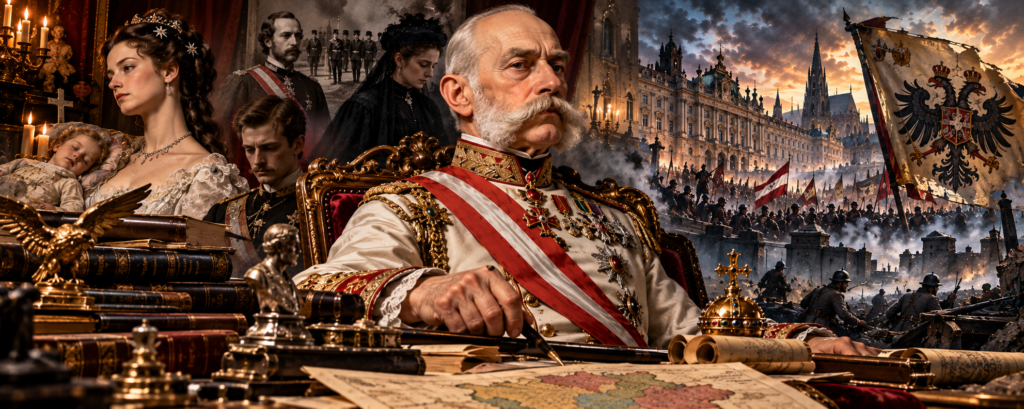
Franz Joseph I: The Emperor of Duty, the Dynasty of Death, and the Empire He Could Not Save
Emperor of Austria, 1848–1916 | Revolution, Repression, Military Defeat, Dynastic Tragedy, Mayerling, the Murder of Empress Elisabeth, Nationalist Crisis, Sarajevo, World War I, and the Relentless Routine of Europe’s Old Emperor
The Emperor Who Answered Catastrophe With Routine
Long before sunrise, while Vienna still lay beneath darkness, Emperor Franz Joseph I was already awake. By the final decades of his life, his morning frequently began around four o’clock, sometimes earlier, and within a short time he was dressed, breakfasted, and seated before another mountain of government papers. Reports from ministers, military memoranda, petitions, appointments, diplomatic correspondence, and documents requiring the imperial signature passed across his desk with relentless regularity. Franz Joseph had turned work into something larger than employment or even royal duty: it was the structure around which he had built his entire existence, a structure so rigid that revolution, military humiliation, political crisis, family catastrophe, old age, and even world war could barely disturb it.
There was no convincing evidence that Franz Joseph was clinically “mad.” He did not suffer the psychotic episodes associated with Charles VI of France, the profound psychiatric deterioration experienced by some other European rulers, or the neurological disabilities that had severely limited his predecessor and uncle Ferdinand I. Franz Joseph remained intellectually functional, administratively capable, and astonishingly disciplined across a reign lasting almost sixty-eight years. If there was something psychologically extraordinary about him, it was not a failure to control himself but an almost frightening degree of self-control, combined with a devotion to routine, military discipline, bureaucracy, hierarchy, and duty that sometimes seemed to leave little room for ordinary human weakness.
That rigidity became more remarkable because Franz Joseph’s private world repeatedly collapsed around him. His first daughter died before reaching her second birthday; his younger brother Maximilian was executed by firing squad in Mexico; his only son, Crown Prince Rudolf, died at Mayerling after killing his young lover and then himself; his wife, Empress Elisabeth, was stabbed to death by an anarchist; and his nephew and eventual heir Franz Ferdinand was assassinated at Sarajevo. Each catastrophe carried emotional consequences, but each also became an affair of state involving funerals, succession arrangements, political calculations, public ceremonies, or international repercussions. Franz Joseph could never simply be a grieving father, husband, brother, or uncle, because the emperor always remained present inside the grieving man.
His response to catastrophe became almost ritualistic. He mourned, attended to whatever dynastic consequences followed, and returned to work. The papers still needed signatures, the ministers still required audiences, the army still demanded attention, and the sprawling multinational monarchy still had to be held together. Work became the wall Franz Joseph built between himself and chaos, and as the chaos intensified, the wall became thicker.
That is where Franz Joseph belongs within the darker world of Mad Monarchs. His story is not one of insanity in the medical sense, and it would be irresponsible to diagnose him retrospectively with obsessive-compulsive disorder or another modern psychiatric condition merely because his habits were unusually rigid. His extremity was instead the almost total transformation of a human life into an imperial routine. He survived by becoming predictable in a world that repeatedly demonstrated how violently unpredictable it could be.
A Boy Raised to Become the State
Franz Joseph was born at Schönbrunn Palace on August 18, 1830, the eldest son of Archduke Franz Karl and Princess Sophie of Bavaria. His father was mild, politically unambitious, and unlikely to dominate the Habsburg court, but his mother was a formidable figure who understood the weaknesses surrounding the Austrian throne. Emperor Ferdinand I, Franz Joseph’s uncle, suffered from epilepsy and significant health difficulties that limited his ability to conduct government independently. Sophie therefore recognized that her eldest son might eventually be called upon to perform a role for which the existing emperor was poorly suited.
The young archduke’s education was consequently designed around service rather than self-discovery. He studied religion, languages, history, geography, law, military subjects, riding, fencing, and the elaborate ceremonial expectations of Habsburg dynastic life. His schedule became increasingly demanding as he grew older, and the habits of punctuality and relentless work later associated with the emperor were cultivated when he was still a boy. He was being trained not merely to possess a crown but to inhabit an institution.
Military culture became especially important. Franz Joseph was fascinated by the army, its uniforms, hierarchy, regulations, rituals, and clear distinctions between command and obedience. The military offered a world in which authority could be seen, rank could be identified instantly, and everyone theoretically knew where he belonged. For a future ruler of an empire filled with competing nationalities, historical privileges, languages, religions, and political demands, such clarity must have been deeply attractive.
His mother also instilled a strong sense of Catholic dynastic obligation. A Habsburg prince was not supposed to organize his life primarily around personal happiness; he belonged to the dynasty, and the dynasty belonged to history. Franz Joseph absorbed this conception of duty so thoroughly that it eventually became difficult to distinguish his personality from his office. The young man did not simply learn how to be emperor; he learned that being emperor would take precedence over almost everything else.
This upbringing helps explain behaviors later described as obsessive or emotionally rigid without requiring a psychiatric diagnosis. Franz Joseph had been rewarded since childhood for self-control, punctuality, obedience to duty, and suppression of personal preference. Those qualities would eventually help him survive one of the longest and most turbulent reigns in European history. They would also help trap him inside a political and emotional world from which he rarely seemed capable of escaping.
Revolution Puts an Eighteen-Year-Old on the Throne
The throne came sooner than expected. Europe erupted in revolution in 1848, and the Habsburg monarchy was shaken by liberal demands, nationalist movements, economic grievances, political unrest, and calls for constitutional government. Metternich, the great architect of conservative post-Napoleonic Europe, fled Vienna as the system he had helped construct began collapsing. Prague rebelled, Vienna became dangerous, Hungary asserted sweeping political rights, and Emperor Ferdinand’s government struggled to respond coherently.
The imperial family concluded that Ferdinand could no longer remain emperor. Franz Joseph’s father stood between him and the throne but renounced his rights, leaving the eighteen-year-old archduke as the dynasty’s chosen instrument of recovery. On December 2, 1848, at Olmütz, Ferdinand abdicated and Franz Joseph became Emperor of Austria. His reign therefore began not with the quiet death of an elderly predecessor but in the middle of a political emergency that seemed capable of destroying the monarchy itself.
The young emperor did not interpret the revolutions as a democratic awakening he should embrace. He had been raised to regard dynastic authority as legitimate and essential, and he inherited advisers and generals determined to restore imperial control. Hungary presented the greatest challenge, and when Austrian forces proved unable to suppress the Hungarian struggle quickly, Franz Joseph accepted military assistance from Tsar Nicholas I of Russia. Russian intervention helped overwhelm the Hungarian forces in 1849, allowing the Habsburg government to reassert control.
Victory brought repression. Lajos Batthyány, the first Hungarian prime minister under the revolutionary settlement, was executed, while thirteen Hungarian generals were put to death at Arad in October 1849. General Julius Jacob von Haynau became notorious for the harshness of the reprisals, and Franz Joseph did not personally devise every punitive action carried out under his government. Nevertheless, the eighteen-year-old emperor emerged from the revolutionary crisis as the sovereign of a restored authoritarian state whose victory had been secured through armies, executions, censorship, and coercion.
The contrast with the grandfatherly figure remembered from photographs of his later years could hardly be greater. The old emperor of popular nostalgia began as a young ruler determined to reverse revolution and recover monarchical authority. He learned his first great political lesson early: when the dynasty was threatened, force could save it. That lesson would never entirely disappear from his understanding of government.
The Emperor of Neo-Absolutism
During the 1850s Franz Joseph presided over the system generally known as neo-absolutism. Interior Minister Alexander Bach became closely associated with the centralized bureaucracy that attempted to modernize administration while keeping genuine political power away from representative institutions. Censorship, policing, centralization, and bureaucratic oversight helped create a state that was modernizing in some respects while remaining politically authoritarian. Franz Joseph found much about this system congenial because it translated monarchy into precisely the language he understood best: paperwork, hierarchy, officials, regulations, and obedience.
He worked remarkably hard from the beginning. Franz Joseph was no ornamental sovereign content to leave administration entirely to ministers, and he developed a reputation for reading documents carefully and involving himself in appointments, military affairs, petitions, and governmental business. The workload was immense, but rather than recoiling from it, he seemed to find reassurance in it. Administration provided a world in which problems arrived in folders and could, at least theoretically, be resolved with decisions and signatures.
Yet administrative diligence could not compensate for political inflexibility. Franz Joseph was intelligent and possessed considerable practical judgment, but he was not a visionary political thinker. Liberalism, nationalism, constitutionalism, and mass politics challenged assumptions he had absorbed since childhood, and his instinct was usually to preserve existing authority until circumstances made preservation impossible. Change was something he accepted under pressure rather than something he naturally welcomed.
This became a recurring pattern throughout his reign. Franz Joseph resisted reform, political circumstances worsened, military or constitutional crisis demonstrated that the existing arrangement could not survive, and only then did he compromise. Once a compromise had become necessary, however, he could accept it with considerable discipline and treat the revised system as another framework of duty. His flexibility was therefore real but reactive.
The distinction mattered enormously. Franz Joseph could adjust to history after history had forced his hand, but he rarely moved fast enough to prevent the crisis that made adjustment unavoidable. For decades this strategy somehow worked, allowing him to survive political disasters that would have ended other reigns. It also meant that unresolved problems repeatedly accumulated beneath the surface of the empire.
Elisabeth: The Woman Who Could Not Become Him
In 1853 Franz Joseph’s mother arranged a meeting at Bad Ischl intended to bring about an engagement between the emperor and her niece Helene in Bavaria. Instead, Franz Joseph became captivated by Helene’s younger sister Elisabeth. The arrangement changed, and on April 24, 1854, the twenty-three-year-old emperor married the sixteen-year-old Bavarian princess who would become famous as Empress Elisabeth, or “Sisi.” Their marriage began with genuine attraction, but it soon revealed a fundamental conflict between two people who responded to royal life in almost opposite ways.
Franz Joseph embraced structure; Elisabeth resisted it. He found security in ceremony, hierarchy, work, uniforms, and routine, while she increasingly experienced the Viennese court as suffocating. Elisabeth loved travel, riding, poetry, exercise, privacy, and personal freedom, and over time she spent increasingly long periods away from Vienna. The emperor had been trained to disappear into his position, while his wife spent much of her adult life trying to escape hers.
The marriage was further strained by Archduchess Sophie’s involvement in the upbringing of the couple’s children. Elisabeth was young and inexperienced when she entered the Habsburg court, and her mother-in-law exerted considerable authority over the imperial nursery. The resulting conflict contributed to Elisabeth’s unhappiness and deepened her sense that the palace had deprived her of control over her own life. Franz Joseph loved his mother and his wife, but he was poorly equipped to mediate between two strong women whose expectations of him were fundamentally incompatible.
Their first daughter, Sophie, was born in 1855, followed by Gisela the next year. During an imperial journey through Hungary in 1857, both girls became ill, and two-year-old Sophie died. Elisabeth was devastated, and the loss intensified the emotional strain already surrounding her life at court. Franz Joseph was twenty-six years old when he buried his first child, and the tragedy became the opening chapter in a family history increasingly dominated by premature and violent death.
The emperor did not collapse beneath the loss. He continued governing because that was what he had been trained to do, and because there was no imaginable version of his life in which duty could simply be suspended. It was a response that would become increasingly familiar. Grief might enter the palace, but the imperial schedule would survive it.
Rudolf: The Son Who Saw a Different Future
The birth of Crown Prince Rudolf in 1858 appeared to secure the dynasty’s future. Rudolf grew into an intelligent, curious, scientifically minded young man with political instincts very different from those of his father. He became interested in natural science, journalism, liberal politics, and intellectual currents that Franz Joseph often regarded with suspicion. The emperor loved the military world of hierarchy and obedience, while Rudolf increasingly questioned the conservative assumptions underlying the monarchy he was expected eventually to inherit.
Rudolf’s early education was initially severe. His military tutor, Major General Leopold Gondrecourt, subjected the young prince to harsh methods intended to harden him, until Elisabeth intervened and secured a change in his upbringing. Later accounts have sometimes treated this childhood experience as the key to Rudolf’s eventual psychological collapse, but such explanations are too simple. His adult difficulties developed within a complicated mixture of family tensions, political frustration, physical illness, marital unhappiness, substance use, sexual relationships, and severe emotional distress.
It is equally tempting to attribute Rudolf’s problems to a hereditary “Habsburg madness,” particularly because both the Habsburg and Wittelsbach dynasties contained relatives with significant psychiatric or neurological conditions. Genetics may have contributed to vulnerabilities within these closely intermarried royal families, but Rudolf cannot responsibly be reduced to a dynastic curse. Retrospective psychiatric diagnoses remain uncertain, and the surviving evidence reveals distress rather than a single easily identifiable modern disorder. What is beyond dispute is that his psychological condition deteriorated badly before his death.
Father and son increasingly failed to understand one another. Rudolf believed the monarchy needed liberalization and political reform, while Franz Joseph regarded some of his son’s views as irresponsible or dangerous. The crown prince also occupied a frustrating constitutional position: he was intelligent enough to develop strong opinions about the future of the empire but had little power to implement them while his father remained vigorous and firmly in command. Franz Joseph’s extraordinary longevity, which gave the monarchy stability, left his heir waiting indefinitely.
The conflict was therefore personal and political at once. Rudolf could not become the kind of prince his father wanted, while Franz Joseph could not understand why the values that had sustained his own life failed to satisfy his son. The distance between them widened until reconciliation became impossible. In 1889, the consequences would become horrifying.
Solferino and the First Great Humiliation
Before the family tragedies reached their darkest point, Franz Joseph’s confidence in authoritarian monarchy had already been battered by military defeat. In 1859 Austria fought France and Piedmont-Sardinia in a conflict central to the struggle for Italian unification. Franz Joseph became personally involved in military command during the campaign, but enthusiasm for the army did not make him an exceptional strategist. Austrian forces suffered defeats at Magenta and then at Solferino, where the scale of bloodshed shocked Europe.
The Battle of Solferino became infamous for the thousands of dead and wounded scattered across the battlefield with inadequate medical assistance. The suffering witnessed there inspired Henri Dunant to campaign for improved treatment of wounded soldiers, contributing eventually to the creation of the International Committee of the Red Cross. For Franz Joseph, however, the immediate consequences were territorial and political. Austria lost Lombardy and saw its dominance in northern Italy severely weakened.
Defeat exposed the limitations of the neo-absolutist system. The centralized authoritarian state had promised strength, but it had failed to deliver victory. Franz Joseph was forced toward constitutional experiments because military failure had demonstrated that the existing arrangement could not simply continue untouched. Once again, reform came not from ideological conversion but from necessity.
This pattern would repeat itself with remarkable consistency. Franz Joseph rarely abandoned a political structure because reformers persuaded him that it was unjust or obsolete. He changed when circumstances demonstrated that the old structure could no longer perform its essential function of preserving the monarchy. Defeat became one of his most effective political instructors.
The lesson of 1859 was painful, but an even greater humiliation was approaching. Austria still competed with Prussia for leadership within the German world, and Franz Joseph’s dynasty possessed centuries of historical prestige behind its claim. In 1866, that prestige collided with the military machine of Otto von Bismarck’s Prussia.
The Empire Defeated by Prussia
The Austro-Prussian War lasted only weeks, but it permanently transformed Central Europe. At Königgrätz in July 1866, Prussian forces inflicted a decisive defeat upon Austria. The Habsburg monarchy was effectively pushed out of German affairs, and Prussia emerged as the dominant power that would soon lead the creation of a unified German Empire. For a dynasty whose identity had been intertwined with the Holy Roman Empire and German politics for centuries, the symbolic blow was enormous.
Franz Joseph survived the defeat, but the political system around him had to change again. Austria’s weakened international position strengthened Hungarian demands for a constitutional settlement, and the emperor could no longer postpone the problem indefinitely. The result was the Austro-Hungarian Compromise of 1867, which transformed the Habsburg monarchy into the Dual Monarchy of Austria-Hungary. Franz Joseph remained Emperor of Austria while becoming constitutionally recognized and crowned as King of Hungary.
Hungary gained its own government and parliament for domestic affairs, while foreign policy, military affairs, and certain financial responsibilities remained shared. Franz Joseph had resisted many of the principles embodied in the settlement, but once the compromise became necessary he accepted his new role with characteristic seriousness. He could be remarkably disciplined about obeying a political arrangement he had previously opposed. Survival mattered more than ideological consistency.
The Compromise solved one major problem while aggravating others. Hungarian elites gained substantial autonomy, but Czechs, Croats, Romanians, Slovaks, South Slavs, and other peoples could reasonably ask why their historical or national aspirations deserved less recognition. Franz Joseph had stabilized the monarchy, but he had not solved the problem of how a multinational empire should distribute political power. That unresolved question would follow him for the rest of his life.
His method had succeeded again: resist, endure, compromise when unavoidable, and continue. The monarchy survived. Franz Joseph remained on the throne. Beneath the apparent stability, however, the number of problems requiring future compromises continued to grow.
Maximilian Before the Firing Squad
The same year Franz Joseph was crowned King of Hungary, his younger brother Maximilian died thousands of miles away in Mexico. Maximilian had accepted the Mexican imperial crown under circumstances created by French military intervention and support from Mexican conservatives. Napoleon III hoped to establish a friendly monarchy in Mexico, while Maximilian imagined that he could build a liberal empire possessing genuine popular legitimacy. The project was far more fragile than he understood.
Relations between Franz Joseph and Maximilian had long contained affection, rivalry, and political tension. Before Maximilian departed for Mexico, questions concerning his dynastic rights within the House of Habsburg created serious friction. Once he arrived, he discovered that a foreign-supported throne was extraordinarily difficult to sustain against the republican forces led by Benito Juárez. When Napoleon III eventually withdrew French military support, Maximilian’s position became desperate.
Maximilian refused or failed to escape in time, was captured at Querétaro, tried by a military court, and sentenced to death. On June 19, 1867, he was executed by firing squad alongside Generals Miguel Miramón and Tomás Mejía. The death of a Habsburg archduke who had become an emperor and ended before a firing squad was sensational enough to become one of the defining royal tragedies of the nineteenth century.
For Franz Joseph, it was also the death of his brother. Whatever tensions had existed between them, Maximilian’s execution inflicted a deeply personal wound and humiliated the dynasty. Franz Joseph had already lost a daughter and suffered military defeats; now his family had been struck by an international catastrophe that no amount of imperial ceremony could disguise.
Yet the machinery of government continued. Franz Joseph had recently reconstructed his monarchy through the Compromise with Hungary, and his responsibilities did not disappear because his brother was dead. He mourned and returned to work, reinforcing a pattern that would become almost unbearably familiar as the decades passed.
The Uniform Became His Armor
Franz Joseph’s attachment to military dress became one of the most recognizable features of his public identity. Portrait after portrait presents essentially the same figure: erect posture, carefully groomed whiskers, military tunic, decorations, and the controlled expression of a man conscious that he represented something larger than himself. He wore uniform habitually and strongly preferred military clothing to fashionable civilian dress. Over time, the image became so consistent that the emperor himself seemed almost frozen while the world around him changed.
Later anecdotes sometimes exaggerate this preference into caricature, claiming that Franz Joseph literally never wore civilian clothing or erupted into terrifying rages whenever he spotted an incorrect button on a subordinate’s uniform. He certainly cared deeply about military standards, etiquette, rank, and proper appearance, but colorful court stories should not automatically be accepted in their most dramatic form. The documented reality is striking enough without embellishment. Franz Joseph identified profoundly with the army and with the visual order represented by uniform.
Military clothing also matched his private austerity. Although he occupied magnificent palaces and presided over an elaborate imperial court, his own rooms could be remarkably functional. He did not require personal luxury on the scale associated with many monarchs, and he preferred familiar furniture, simple arrangements, and practical surroundings. His famous narrow iron bed at Schönbrunn became a particularly powerful symbol of this almost soldierly private life.
The simplicity should not be mistaken for egalitarianism. Franz Joseph remained intensely conscious of rank, hierarchy, dynastic privilege, and court etiquette. He could reject luxury for himself while continuing to inhabit a system built upon enormous social distinctions. His austerity was personal discipline rather than a rejection of monarchy.
Still, the uniform functioned almost like psychological armor. It eliminated uncertainty about who he was and what was expected of him. When Franz Joseph put it on, the grieving husband, disappointed father, bereaved brother, and aging man could disappear behind the emperor.
The Old-Fashioned Emperor in a Modernizing World
Franz Joseph lived through an astonishing technological transformation. When he was born in 1830, railways were only beginning to reshape transportation, photography had not yet entered ordinary life, and electrical communication remained experimental. By the time he died in 1916, Europe possessed automobiles, telephones, electric lighting, cinema, aircraft, submarines, machine guns, and industrialized warfare. The emperor witnessed the emergence of the modern world but never entirely became comfortable inside it.
His personal preferences remained distinctly conservative. Franz Joseph loved horses and carriages and showed little enthusiasm for automobiles, although claims that he absolutely refused ever to ride in a motorcar are false. In 1908 he rode in a car with King Edward VII at Bad Ischl and apparently remained unimpressed by the experience. His reluctance was therefore real, but it should not be transformed into a mythical lifelong prohibition.
Similar caution is necessary with stories about telephones, elevators, typewriters, and other modern conveniences. Franz Joseph could be suspicious of innovations and preferred established methods, while his private rooms retained old-fashioned features that surprised younger visitors. Yet the Austro-Hungarian state itself made extensive use of modern communications and technology, and the emperor did not somehow force a twentieth-century bureaucracy to function entirely with nineteenth-century tools. Personal conservatism and governmental technological paralysis were not the same thing.
What made Franz Joseph seem increasingly peculiar was the contrast between the changing world and the unchanging ruler. Vienna became a center of modern architecture, psychology, music, literature, medicine, and political thought. Electric trams crossed streets while the emperor continued preferring carriages; telephones spread while he remained more comfortable with written reports and personal audiences. The city around him seemed to accelerate while his private life retained the rhythm of another age.
There was something almost theatrical about the contrast. Modernity did not need Franz Joseph’s permission and continued advancing regardless of his preferences. He did not defeat it, nor did he truly attempt to stop all of it. He simply created a private world in which much of it remained at a distance.
The Emperor at Dinner
Meals offered another glimpse into Franz Joseph’s preference for efficiency and routine. He was associated with traditional Austrian dishes, particularly Tafelspitz, boiled beef served with accompaniments, and his personal tastes were comparatively straightforward for a man surrounded by the resources of an imperial court. Food appears to have been something he enjoyed without turning it into an elaborate personal obsession. He generally lacked the extravagant culinary appetites associated with some earlier monarchs.
Formal court dinners could nevertheless become uncomfortable because of ceremonial rules surrounding the sovereign. Franz Joseph was known to eat relatively quickly, and when the emperor finished a course the service moved forward. Guests who ate slowly could therefore find themselves struggling to finish before attendants removed the plates. Later retellings turned this into a comic nightmare in which starving diplomats watched untouched dinners vanish before them, but the underlying tension between court protocol and Franz Joseph’s rapid eating was genuine.
Claims that he would remain hungry or thirsty for hours rather than request anything outside the proper schedule are more difficult to establish and should be treated as anecdotes rather than firm facts. They fit so neatly with his reputation for rigid modesty that they have been repeated frequently. What is well documented is the broader pattern of a man who imposed discipline upon himself as readily as he expected it from others. Franz Joseph did not demand lavish indulgence simply because he possessed the power to obtain it.
This self-discipline helped explain why servants and subjects could view him with genuine respect even when his politics were unpopular. He did not ask others to endure a world of obligation while living entirely outside it. The emperor believed in duty because he practiced it personally, sometimes to an almost punishing degree. His rigidity could be frustrating, but it was rarely hypocritical in the simple sense.
Elisabeth Escapes the Imperial Cage
As Franz Joseph became increasingly inseparable from the routines of monarchy, Elisabeth moved further away from them. She traveled frequently, spent long periods outside Vienna, pursued strenuous exercise, became an exceptional horsewoman, and developed elaborate beauty and dietary regimens. Her famous appearance required enormous effort, and her relationship with food, weight, exercise, and her own body has attracted intense modern scrutiny. Some historians and biographers have suggested disorders that resemble anorexia, depression, anxiety, or compulsive behavior, but retrospective clinical diagnosis remains uncertain.
What can be said confidently is that Elisabeth experienced profound unhappiness and periods of emotional withdrawal. She increasingly disliked court life, disliked being constantly observed, and resented many of the expectations attached to her position. Travel became a means of escape, allowing her to create distance between herself and the Habsburg court. Franz Joseph remained in the world she fled.
Their marriage consequently became unconventional. Franz Joseph continued to express affection toward Elisabeth, while she spent substantial portions of her life elsewhere. Their emotional connection never vanished completely, but they increasingly lived separate daily lives. The emperor’s capacity to tolerate this arrangement suggests more emotional flexibility than the caricature of a purely controlling bureaucrat might imply.
During the 1880s, actress Katharina Schratt became one of Franz Joseph’s closest companions. Elisabeth appears to have accepted and perhaps encouraged the relationship, understanding that Schratt could provide companionship the empress herself no longer wished to provide regularly. Whether the relationship was sexual has long been debated, and the evidence does not justify absolute certainty. Its emotional significance, however, is beyond serious doubt.
Schratt offered Franz Joseph something increasingly rare: an environment in which he could relax some of the burdens of imperial ceremony. With her, he could converse and dine without every moment becoming an act of state. For a man whose identity had become almost completely fused with his office, even a small space of informality mattered enormously.
Then Mayerling shattered what remained of his immediate family.
Mayerling: The Son in the Hunting Lodge
On January 30, 1889, Crown Prince Rudolf was found dead at the imperial hunting lodge of Mayerling beside the body of seventeen-year-old Baroness Mary Vetsera. The deaths immediately presented the Habsburg court with a nightmare of scandal, religion, succession, and public relations. Initial official explanations were incomplete or misleading because suicide carried grave religious consequences and because the dynasty desperately wanted to control the story. Eventually the central reality became impossible to conceal: Rudolf had killed Mary and then himself.
The Mayerling deaths have generated conspiracy theories ever since. Political assassination, secret agents, pregnancy, blackmail, and elaborate murder plots have all been proposed, sometimes with enormous confidence. Surviving evidence, including farewell letters associated with Mary Vetsera, strongly supports the conclusion that the deaths resulted from a planned murder-suicide, although some details of the final hours remain uncertain. Rudolf’s psychological state had clearly deteriorated severely before his death.
For Franz Joseph, the catastrophe was both personal and dynastic. Rudolf was his only son and heir, the child upon whom the direct future of the monarchy had rested. The emperor now faced the knowledge that his son had died by suicide after killing a teenage girl, and that their own relationship had been strained by political disagreement and emotional distance. There would be no opportunity to repair it.
The court had to manage the religious consequences of Rudolf’s suicide while ensuring he received an imperial burial. His mental state was emphasized sufficiently to permit Catholic funeral rites, transforming psychological distress into part of the official dynastic solution. Even the dead prince’s suffering became entangled with protocol.
Franz Joseph was devastated, but he did not cease governing. Once again, private horror entered the bureaucratic machinery of monarchy and emerged as arrangements, ceremonies, documents, and succession questions. Work resumed because work always resumed.
For the emperor, that may have been the only way forward he knew.
Work as a Refuge From Grief
Franz Joseph’s legendary schedule became more understandable as the tragedies accumulated. He frequently rose extraordinarily early, particularly in later life, sometimes beginning his day around half past three or four in the morning. After a simple breakfast, he moved quickly into government work and could remain occupied with official business for long stretches. Meals might be arranged around work rather than work around meals.
His appetite for paperwork was immense. Reports, appointments, military questions, petitions, correspondence, and administrative decisions flowed constantly through the imperial office. Franz Joseph could not personally govern every aspect of Austria-Hungary, but he involved himself deeply in the machinery of state. He seemed to possess an almost inexhaustible willingness to perform the repetitive labor of monarchy.
This has encouraged modern descriptions of his behavior as obsessive-compulsive, but a clinical diagnosis would go beyond the evidence. Rigid routine does not automatically equal obsessive-compulsive disorder, particularly in a man trained from childhood to regard punctuality, discipline, and work as moral obligations. Franz Joseph’s habits were extreme, but they remained functional and generally strengthened rather than destroyed his capacity to perform his official role.
Psychologically, however, work clearly offered something more than efficiency. Government documents presented problems that could be categorized, reviewed, approved, rejected, forwarded, or filed. Grief did not behave so conveniently. There was no imperial decree capable of reversing Mayerling, restoring Maximilian, or bringing little Sophie back from the dead.
The desk therefore became more than furniture. It was the place where Franz Joseph could still exercise control when his private life repeatedly proved beyond control. Each signature reaffirmed that some part of his world remained orderly.
That refuge would become even more important after 1898.
The Murder of Elisabeth
On September 10, 1898, Elisabeth was in Geneva when an Italian anarchist named Luigi Lucheni approached her and stabbed her with a sharpened file. The attack happened quickly, and the wound was initially so inconspicuous that Elisabeth continued toward the steamer she intended to board. She soon collapsed, and despite attempts to save her, the empress died. Franz Joseph had now lost his wife not to illness or age but to assassination.
The randomness of the murder made it especially disturbing. Lucheni was an anarchist seeking a prominent aristocratic victim and had originally hoped to attack another royal figure. Elisabeth became his target because circumstances placed her within reach. The empress who had spent much of her life trying to escape the restrictions of royalty was murdered precisely because she possessed a royal title.
Franz Joseph’s grief was profound. A statement associated with his reaction is often translated as “Nothing has been spared me in this world,” though versions differ slightly in wording. Whether remembered with perfect verbal precision or not, the sentiment captures the extraordinary accumulation of loss he had experienced. His daughter, brother, son, and now wife were dead, three of them through violent or self-inflicted deaths.
Yet the emperor remained functional. There was no public mental collapse, no abandonment of government, and no prolonged withdrawal from official responsibility. He mourned Elisabeth deeply, but the routine resumed because routine had become the structure through which he survived everything else.
By then, the sight of Franz Joseph returning to work after catastrophe had become almost predictable. That predictability was both impressive and unsettling. The more death stripped away from his private world, the more firmly he seemed to attach himself to the machinery of the state.
The Empire of Too Many Nations
While Franz Joseph’s family disintegrated, his monarchy faced a different form of fragmentation. Austria-Hungary contained Germans, Hungarians, Czechs, Poles, Ruthenians, Romanians, Slovaks, Croats, Serbs, Slovenes, Italians, and other communities whose political aspirations could not easily be reconciled. Language, education, voting rights, local administration, historical privileges, and national identity became recurring sources of conflict. The empire was not merely diverse; it contained competing ideas about what political community itself should mean.
The Compromise of 1867 had given Hungary an exceptionally strong constitutional position within the monarchy. Magyar elites gained substantial control over the Hungarian half of the Dual Monarchy, while other national groups increasingly demanded recognition of their own political rights. Czechs sought greater status for the lands of the Bohemian Crown, South Slav movements developed different programs of autonomy or national unification, and Romanian and Slovak grievances complicated Hungarian politics. Every concession to one group threatened to provoke another.
Franz Joseph did not simply hate nationalism or refuse every national demand. He could cooperate pragmatically with different political groups and became personally popular among many subjects who disliked particular governments or policies. His role as a supranational monarch possessed genuine political value because he could symbolize an authority above competing ethnic parties. The extraordinary length of his reign strengthened this effect.
Yet Franz Joseph never found a constitutional formula capable of permanently reconciling the empire’s nationalities. His instincts remained dynastic rather than nationalist, and he believed loyalty to the crown could provide a common political identity. For many people it did, but nationalism was becoming an increasingly powerful alternative source of allegiance. Younger generations could imagine futures that did not require a Habsburg emperor.
The monarchy therefore became a system of constant management. Problems were negotiated, postponed, partially solved, or shifted elsewhere. Franz Joseph proved extraordinarily skilled at surviving crises without solving the deeper question beneath them: what would ultimately hold Austria-Hungary together if loyalty to the dynasty ceased to be enough?
The Emperor Who Became a Living Monument
By the beginning of the twentieth century, Franz Joseph had ruled for more than half a century. He had been emperor before Bismarck became the dominant figure in German politics, before Italy or Germany existed as unified nation-states, and before many technologies considered ordinary by 1900 had entered European life. Entire generations of his subjects had been born, grown old, and died without knowing another sovereign. Franz Joseph had become less like an ordinary political leader and more like a permanent feature of the landscape.
His portrait appeared throughout the monarchy in government buildings, barracks, schools, railway stations, offices, and public institutions. The familiar white whiskers and military uniform created a visual language of continuity. Governments could change, parliaments could erupt into chaos, national parties could fight bitterly, and ministers could rise and fall, but the emperor remained. For millions of subjects, he represented stability even when the political system beneath him was anything but stable.
This longevity encouraged a complicated loyalty. People could resent taxes, conscription, bureaucrats, Hungarian policies, Austrian ministries, local officials, or national inequalities while maintaining affection for Franz Joseph personally. The emperor stood above the everyday ugliness of politics because his reign had lasted long enough for him to become symbolic. His personality merged with the mythology of the monarchy.
The symbolism became even more powerful as his appearance aged. The young autocrat of 1848 disappeared beneath the image of the solemn old ruler who had suffered more family tragedies than most subjects could easily remember. His grief humanized him, while his endurance elevated him. He seemed almost indestructible.
That appearance was deceptive. Franz Joseph was aging, the political structure was becoming more difficult to manage, and the international system surrounding Austria-Hungary was becoming increasingly dangerous. The emperor looked permanent precisely when permanence was becoming impossible.
Franz Ferdinand and the Heir Who Wanted Change
After Rudolf’s death, succession eventually moved toward Franz Joseph’s nephew Archduke Franz Ferdinand, the son of Archduke Karl Ludwig. Franz Ferdinand possessed a forceful personality, strong political opinions, and a willingness to consider major changes to the structure of the monarchy. He was also irritable, difficult, and frequently at odds with the court. His relationship with Franz Joseph was never especially warm.
Their most famous conflict concerned Franz Ferdinand’s determination to marry Countess Sophie Chotek. Sophie belonged to the aristocracy but was not considered of equal dynastic rank under Habsburg house law. Franz Joseph eventually permitted the marriage only on the condition that it be morganatic, preventing Sophie from sharing her husband’s full dynastic status and excluding their children from succession rights. Franz Ferdinand accepted the humiliating arrangement because he refused to abandon the woman he loved.
The episode revealed Franz Joseph’s extraordinary devotion to dynastic rules. By then he had endured the death of a child, brother, son, and wife, experiences that might have made another man more sympathetic to personal happiness over protocol. Yet when individual desire collided with Habsburg law, Franz Joseph still instinctively defended the law. The institution remained larger than the individual.
Political disagreements compounded the personal tension. Franz Ferdinand believed the Dual Monarchy required restructuring and was particularly hostile toward the privileged position of the Magyar political elite. Various federal or trialist schemes have been associated with him, although precisely what he would have implemented after becoming emperor remains uncertain. What is clear is that he expected substantial change.
Once again Franz Joseph faced an heir who believed the empire needed reforms the reigning monarch approached with caution. Once again the heir would never reach the throne. In 1914, the conflict between continuity and change would be overtaken by murder.
Sarajevo and the Murder of Another Heir
On June 28, 1914, Franz Ferdinand and Sophie visited Sarajevo in Bosnia and Herzegovina. Members of the revolutionary movement Young Bosnia had prepared an assassination attempt, aided by connections to Serbian nationalist networks and individuals associated with the Black Hand. An initial bomb attack failed to kill the archduke, and astonishingly, the official program continued. Later that morning, a combination of altered plans, confusion, and chance brought Franz Ferdinand’s automobile within reach of Gavrilo Princip.
Princip fired at close range. Franz Ferdinand was mortally wounded, and Sophie was also struck. Both died, leaving three children who had already been excluded from the succession because of their parents’ morganatic marriage.
Franz Joseph had now lost another heir violently. His relationship with Franz Ferdinand had been strained, and later stories sometimes exaggerate the emperor’s supposed relief at his nephew’s death. Whatever his personal feelings, the assassination represented a direct attack upon the Habsburg dynasty and created an international crisis of enormous seriousness. Vienna immediately confronted the question of how to respond to Serbian nationalism and the networks connected to the assassins.
Austria-Hungary’s leadership increasingly favored a decisive confrontation with Serbia. Germany offered strong support, the famous “blank cheque,” encouraging Vienna to believe it could act even if Russia intervened. The Austro-Hungarian ultimatum to Serbia contained sweeping demands, and although Serbia accepted many of them, the response was judged insufficient. Franz Joseph approved the movement toward war.
It is inaccurate to portray the elderly emperor as the sole author of the First World War. The July Crisis involved calculations and decisions by Austria-Hungary, Germany, Russia, France, Serbia, Britain, and other actors within a dangerous alliance system. Yet Franz Joseph was not merely a helpless old man whose ministers acted entirely without him. His approval carried constitutional and symbolic importance.
After sixty-six years spent preserving the monarchy, he accepted a gamble intended to protect its authority.
The gamble would destroy it.
The Emperor Goes to War
Austria-Hungary declared war on Serbia on July 28, 1914. Franz Joseph issued a manifesto explaining the decision to his peoples as an unavoidable response to years of hostility and the assassination of his heir. The language of duty, honor, necessity, and defense of the monarchy matched the concepts that had governed his life since childhood. He appears to have believed that failing to respond decisively would expose Austria-Hungary to further nationalist attacks and accelerate its decline.
The conflict rapidly escaped Austro-Hungarian control. Russia mobilized in support of Serbia, Germany declared war on Russia and France, Germany invaded Belgium, and Britain entered the conflict. What had begun as a Balkan confrontation became a European war and then a global one. Franz Joseph had lived long enough to witness political crisis transformed by modern technology into industrial slaughter.
The emperor was eighty-three when the war began. His armies now fought with machine guns, heavy artillery, rail mobilization, telegraphs, aircraft, and weapons unimaginable when he had first taken the throne in 1848. Austria-Hungary suffered terrible losses in campaigns against Serbia and Russia, while the empire became increasingly dependent upon Germany. The military monarchy Franz Joseph had revered throughout his life discovered that modern warfare could consume men and resources faster than even a great empire could replace them.
The emperor continued working as his health permitted. Reports from the fronts joined the familiar flow of documents across his desk, except now the numbers represented dead, wounded, missing, prisoners, shortages, and collapsing units. The bureaucratic habits that had helped him manage decades of peacetime government were now applied to catastrophe on an industrial scale.
There is something profoundly bleak in the image. Franz Joseph had always believed that duty required persistence. Now persistence meant continuing a war whose cost expanded beyond anything his generation had previously experienced.
The old emperor kept reading the reports.
The Myth of Habsburg Madness
Franz Joseph’s life is often folded into popular stories about hereditary Habsburg “madness.” The dynasty’s history of intermarriage unquestionably produced genetic risks, and various Habsburg rulers suffered significant physical, neurological, or psychological difficulties. Franz Joseph’s uncle and predecessor Ferdinand I experienced severe epilepsy and other developmental and neurological problems. Earlier generations displayed the famous Habsburg jaw with varying severity, while related European dynasties contained their own patterns of illness.
But the idea of a single inherited curse marching inevitably through the family is far too simplistic. Franz Joseph himself remained cognitively capable and administratively functional into extreme old age. His wife Elisabeth came from the Wittelsbach dynasty rather than the Habsburg line, and her psychological difficulties cannot simply be attributed to Habsburg genetics. Rudolf’s severe distress similarly cannot be reduced to having inherited “mad blood” from one side of the family.
What the dynasty undeniably transmitted was an extraordinarily demanding environment. Royal children grew up knowing that marriage, reproduction, religion, political loyalty, and public behavior could have constitutional consequences. Personal relationships were rarely entirely personal. A romantic choice could become a dynastic crisis, while the birth or death of a child could alter the political future of millions.
Franz Joseph adapted to this environment exceptionally well because he internalized its values almost completely. Elisabeth resisted them and spent much of her life fleeing court. Rudolf struggled against them intellectually and emotionally. Franz Ferdinand challenged parts of them while preparing for a future reign.
Franz Joseph endured.
That endurance, rather than insanity, was his defining psychological characteristic.
The Emotional Price of Perfect Duty
Franz Joseph’s stoicism did not mean that he lacked emotion. His surviving correspondence reveals affection, concern, grief, irritation, and attachment. He loved Elisabeth even after their marriage became unconventional, cared deeply about his children, and valued his relationship with Katharina Schratt. He was capable of kindness and personal warmth, particularly away from the most formal settings of court.
The difference was that Franz Joseph believed emotion had to remain subordinate to responsibility. When personal relationships conflicted with dynastic rules, the rules usually prevailed. When ministers left office, he could detach from relationships that had once seemed close because their institutional purpose had ended. When relatives disappointed him, his response could become formal and cold.
This behavior could appear almost mechanical to people around him, but it followed a coherent internal logic. Franz Joseph’s world taught him that institutions survived while individuals disappeared. Ministers resigned, generals retired, relatives died, political movements rose and fell, and governments collapsed. The emperor remained.
By identifying himself with the office, Franz Joseph created a psychological structure capable of surviving repeated bereavement. His brother could be shot, his son could die at Mayerling, his wife could be assassinated, and his heir could be murdered in Sarajevo, but the imperial office would still exist the following morning. As long as Franz Joseph could rise, dress, and work, some portion of the universe remained intact.
It was an extraordinarily effective survival strategy.
It was also an extraordinarily lonely one.
The Emperor Who Could Not Retire
Franz Joseph’s predecessor Ferdinand had abdicated in 1848 and lived another twenty-six years in comfortable retirement. Franz Joseph never seriously followed that example, even as old age narrowed his world and the burdens of office increased. Abdication would have required him to imagine an identity separate from the throne, and after decades of rule such an identity may have seemed almost meaningless. He had become emperor at eighteen and knew no other adult existence.
Retirement also conflicted with his conception of duty. A ruler did not simply leave because he was tired, grieving, old, or frustrated. The office had been entrusted to him, and surrendering it voluntarily would have required a justification stronger than personal exhaustion. Franz Joseph had endured too much in the name of duty to abandon the principle when age made it inconvenient.
His longevity provided Austria-Hungary with remarkable continuity. Governments changed while the emperor remained, allowing him to function as a stabilizing symbol above political conflict. Yet the same longevity could also discourage deeper renewal because the monarchy remained emotionally centered on a man whose political instincts had been formed before 1848. Franz Joseph could adapt, but he did not naturally reinvent.
By 1914 he had become a bridge connecting two radically different Europes. The young emperor had confronted barricades and nationalist revolutionaries with nineteenth-century armies; the old emperor presided over machine guns, rail mobilization, mass conscription, modern propaganda, and industrial warfare. Almost everything surrounding him had changed.
Franz Joseph still wore the uniform.
The Final Illness
By November 1916 Franz Joseph was eighty-six years old and physically exhausted. Austria-Hungary had been at war for more than two years, suffering enormous casualties, food shortages, economic strain, and growing dependence upon Germany. The emperor had survived nearly every political figure associated with the beginning of his reign, and most of the people central to his private life were already dead. Only the routine remained remarkably familiar.
Franz Joseph developed pneumonia but continued attempting to work. The behavior was entirely consistent with a lifetime in which illness, grief, and fatigue were expected to yield to responsibility whenever possible. His body, however, could no longer obey the discipline he had imposed upon it for decades. On November 21, 1916, Franz Joseph died at Schönbrunn Palace.
His great-nephew succeeded him as Emperor Charles I. The young emperor inherited a monarchy trapped inside a devastating war, confronted by nationalist pressures, shortages, military exhaustion, and an international system increasingly hostile to the empire’s survival. Franz Joseph had spent sixty-eight years maintaining the Habsburg state; Charles would receive less than two years to save it.
The old emperor did not witness the collapse. He never saw Austria-Hungary disintegrate in 1918, never saw the dynasty lose political power, and never watched the empire divide into successor states. For a man who had devoted his entire existence to preserving the monarchy, death spared him the final catastrophe.
His iron bed remained behind.
The empire did not.
Was Franz Joseph Actually Mad?
There is no persuasive historical evidence that Franz Joseph I suffered from clinical insanity. He did not experience documented psychotic breaks, persistent delusions, severe manic episodes, or the kind of cognitive deterioration that would have made him incapable of distinguishing reality from fantasy. On the contrary, his extraordinary administrative functionality continued into advanced age. Whatever criticisms can be made of his politics, he understood what he was doing.
Modern observers can easily be tempted to diagnose his rigid routines. His early rising, relentless paperwork, preference for uniform, discomfort with novelty, attachment to schedules, austere private surroundings, and emotional compartmentalization can sound obsessive when listed together. Yet diagnosing obsessive-compulsive disorder or another psychiatric condition from historical anecdotes would be speculative. Discipline, habit, upbringing, personality, and occupational demands can all produce extreme routines without constituting mental illness.
The more interesting question is what those routines did for him psychologically. Franz Joseph’s world repeatedly confronted him with events he could not control: revolutions, battlefield defeats, nationalist movements, suicide, assassination, execution, bereavement, and finally world war. His response was to make the parts of life he could control almost perfectly predictable. The hour of waking, the uniform, the desk, the paperwork, and the audiences became fixed points within a universe that repeatedly broke apart.
His rigidity was therefore not madness in any defensible medical sense. It was a coping system, a political style, and an identity developed over decades. It made him extraordinarily resilient while simultaneously limiting his capacity to imagine radical alternatives to the system he served.
The more unpredictable history became, the more predictable Franz Joseph made himself.
The Dynasty of Coffins
Seen across nearly seven decades, Franz Joseph’s private life resembles a procession of funerals. His daughter Sophie died first, a toddler whose death devastated her young parents. Maximilian followed before a Mexican firing squad, turning dynastic adventure into international tragedy. Rudolf followed at Mayerling, surrounded by scandal, despair, and questions that would haunt the family for generations.
Then Elisabeth was murdered in Geneva. Franz Ferdinand and Sophie were shot in Sarajevo. Around these famous deaths were the ordinary losses of a very long life: parents, relatives, ministers, generals, friends, servants, and companions disappearing one after another while the emperor continued aging.
Every major death entered the machinery of monarchy. Funerals had to be organized, announcements issued, titles adjusted, inheritance considered, succession recalculated, and public mourning performed. Even the most intimate grief acquired an official form. Franz Joseph could never experience tragedy entirely outside the institution that governed his life.
There is something unsettling about the process. Death itself became bureaucratic, transformed into ceremonial schedules and dynastic consequences before the grieving emperor returned to his desk. The same system that helped Franz Joseph survive may also have prevented him from ever escaping his role long enough to experience grief as an ordinary man.
The emperor remained behind the uniform.
With every funeral, there was less of the private world left behind it.
The Empire He Could Hold but Never Heal
Franz Joseph’s greatest political achievement was undoubtedly survival. He inherited a monarchy shaken by revolution and kept it intact through military defeats, constitutional transformations, nationalist crises, political assassinations, economic changes, and international upheaval. Austria-Hungary was not simply a doomed relic waiting helplessly to collapse. It possessed functioning institutions, universities, railways, industries, courts, vibrant cities, cultural brilliance, and millions of subjects whose loyalties were far more complicated than later nationalist histories sometimes suggest.
Franz Joseph himself contributed significantly to that survival because his longevity provided a supranational symbol around which people could organize loyalty. He was Emperor of Austria and King of Hungary but also represented a dynasty whose territories contained many languages and identities. His portrait offered a shared political image where national symbols increasingly divided people. For decades, the formula worked surprisingly well.
Yet survival concealed structural weakness. The Compromise with Hungary solved the immediate Hungarian crisis while giving Magyar elites a privileged constitutional position that other national groups resented. Czech aspirations remained unresolved, South Slav nationalism grew increasingly important, and parliamentary conflict could become extraordinarily bitter. The monarchy developed methods of managing these tensions but never found a permanent answer to them.
Franz Joseph’s political temperament encouraged management rather than transformation. He preferred a difficult compromise that preserved the existing state to an ambitious redesign whose consequences could not be predicted. Given the dangers surrounding the empire, that caution was understandable. It also meant that necessary reforms could arrive too late or not at all.
The emperor became remarkably skilled at buying time.
What he could not do was make time stop.
The Madness of Perfect Order
Franz Joseph belongs within Mad Monarchs precisely because his story expands the category beyond rulers who experienced obvious psychiatric illness. There were no famous hallucinations, no glass delusions, no episodes of running through palace corridors in terror, and no documented loss of contact with reality. His extremity lay at the opposite end of the spectrum: order carried so far that it became almost a philosophy of existence.
He rose before dawn, dressed according to familiar patterns, processed papers, held audiences, followed protocol, hunted when circumstances allowed, and returned repeatedly to the same routines. He did this while governments changed, armies lost wars, political systems were rewritten, technologies transformed everyday life, and members of his family died violently. The consistency was astonishing.
There was genuine strength in such discipline. Franz Joseph’s capacity for work was formidable, his personal habits were comparatively modest, and his sense of responsibility was not theatrical. He believed the ruler should work because ruling was an obligation rather than merely a privilege. Many subjects respected him precisely because he imposed the ethic of duty upon himself.
But perfect order can become its own trap. A ruler who responds to every crisis by preserving routine may fail to recognize when the underlying structure itself requires radical reconstruction. Franz Joseph could compromise after disaster, but he struggled to anticipate transformations before disaster forced them upon him.
That was not insanity.
It was rigidity elevated into statecraft.
The Man Who Became the Monarchy
As Franz Joseph aged, he and Austria-Hungary increasingly seemed to resemble one another. Both were old, complicated, ceremonial, surprisingly resilient, and held together through an intricate combination of law, habit, bureaucracy, military power, compromise, and loyalty. Both survived crises that repeatedly convinced outsiders that collapse was imminent. Both were capable of adapting without ever becoming something fundamentally different.
The empire contained contradictions everywhere. It could be authoritarian and constitutional, modern and archaic, economically dynamic and administratively cumbersome, culturally brilliant and politically paralyzed. Franz Joseph embodied similar contradictions. He was personally austere while presiding over magnificent court ceremony, politically conservative while accepting major constitutional changes, emotionally restrained while capable of deep attachment, and suspicious of novelty while ruling an empire transformed by modern technology.
His personality therefore became an unusually effective symbol of the state. Subjects who could not agree about nationality, language, parliament, or political reform could recognize the old emperor. His longevity created a sense that he had always been there and perhaps always would be. That illusion became one of the monarchy’s quiet sources of stability.
When Franz Joseph died, the psychological effect was enormous. The empire had lost not simply its ruler but the human figure most closely associated with its continuity. Charles I inherited the crown but could not inherit sixty-eight years of familiarity.
Franz Joseph had become an institution.
Institutions are difficult to replace overnight.
The Signature That Helped Open the Door to War
The darkest political decision of Franz Joseph’s final years came after Sarajevo. Austria-Hungary had genuine reasons to fear Serbian-backed nationalist agitation, and the assassination of Franz Ferdinand demonstrated that the danger was not imaginary. Yet military action was not inevitable. Vienna chose confrontation because important officials believed the monarchy’s credibility and perhaps its survival required a decisive response.
Franz Joseph accepted that reasoning. He was not the most aggressive architect of the July Crisis, and responsibility for the escalation to world war cannot be placed upon him alone. Germany’s support encouraged Austria-Hungary, Russia’s mobilization expanded the crisis, French and British calculations mattered, Serbian nationalism formed part of the background, and rigid military planning accelerated events once mobilizations began.
Nevertheless, Franz Joseph’s approval mattered. The emperor who had spent his life preserving the monarchy consented to a strategy that risked a wider European war because the alternative appeared to him to threaten imperial authority. The logic was consistent with everything he had learned since 1848: when the dynasty faced an existential challenge, hesitation could be more dangerous than force.
The terrible irony is that war accomplished precisely what the Habsburg leadership hoped to prevent. Instead of restoring imperial prestige and neutralizing a regional threat, it placed Austria-Hungary inside a conflict whose scale exceeded its political, economic, and military capacity. The empire Franz Joseph had spent sixty-eight years preserving began bleeding itself to death.
He did not live long enough to see the final result.
The Emperor in the Iron Bed
The room in which Franz Joseph died provides an almost perfect final image of his life. The emperor of one of Europe’s great dynasties slept in a narrow iron bed rather than surrounding himself with the theatrical luxury available to him. The simplicity reflected genuine personal preference and decades of habits formed around military discipline and practical routine. He possessed immense privilege without requiring constant personal indulgence.
That austerity should not obscure the enormous power Franz Joseph wielded or the coercive dimensions of his early reign. He could sleep like a soldier while governing as an emperor. Personal modesty did not automatically produce political liberalism, just as hard work did not guarantee wise decisions. His virtues and limitations frequently existed side by side.
Yet the iron bed remains powerful because it represents the life Franz Joseph chose within monarchy. Elisabeth sought freedom through travel, Rudolf sought intellectual and emotional escape, Franz Ferdinand challenged dynastic rules, and Ferdinand I had eventually been released from government through abdication. Franz Joseph remained where duty placed him.
He stayed through revolution, defeat, bereavement, assassination, political transformation, old age, and war. He stayed when almost everyone from the beginning of his life had disappeared. He stayed until his body could no longer perform the routine.
That persistence was his greatness.
It was also his tragedy.
The Emperor Who Could Not Save What He Served
Franz Joseph died believing in the Habsburg monarchy he had devoted his life to preserving. He never saw the empire fragment into Austria, Hungary, Czechoslovakia, the new South Slav state, and territories transferred to neighboring countries. He never witnessed Charles I lose power or watched imperial insignia become relics of a vanished political order. The monarchy survived its old emperor by less than two years.
That fact casts a long shadow backward across his reign. Sixty-eight years of work, political compromises, military campaigns, constitutional experiments, ceremonial obligations, and personal sacrifices had kept the state alive through extraordinary adversity. Yet preservation during one lifetime was not the same thing as creating a structure capable of surviving indefinitely. Franz Joseph proved exceptionally good at maintaining the monarchy he inherited, but less successful at helping it become something fundamentally different.
It would be inaccurate to say that Austria-Hungary never modernized under him. Vienna became one of Europe’s great modern cities, industrialization advanced, railways expanded, constitutional politics developed, suffrage broadened in the Austrian half, scientific and cultural life flourished, and modern administrative institutions expanded. The empire of 1914 was not simply the empire of 1848 frozen in place.
The deeper problem was political identity. What ultimately bound together Czechs, Germans, Hungarians, Croats, Poles, Romanians, Slovenes, Slovaks, Serbs, Ruthenians, Italians, and others when dynastic loyalty weakened? Franz Joseph never found a durable answer that satisfied enough of them simultaneously.
He could keep the machine functioning.
He could not permanently answer why everyone inside it should want the machine to survive.
The Emperor Who Never Allowed Himself to Collapse
Perhaps the most remarkable thing about Franz Joseph is not what happened to him but what did not happen. He did not collapse after Sophie died. He did not collapse after Maximilian was executed. He did not collapse after Mayerling, Elisabeth’s assassination, or Sarajevo. He continued functioning through a sequence of losses that would have overwhelmed many people.
This endurance should not be mistaken for emotional emptiness. Franz Joseph grieved, formed attachments, experienced disappointment, and sometimes expressed deep sorrow. What distinguished him was his ability to compartmentalize emotion and return to the obligations of office. His upbringing had prepared him to regard self-command as one of the essential qualities of sovereignty.
The psychological cost cannot be measured precisely. We cannot know how much of his relentless work represented temperament, training, coping, avoidance, or some combination of all four. Historical evidence allows us to observe the pattern but not to enter his mind with clinical certainty. Any diagnosis claiming otherwise would exceed what the sources can support.
What we can say is that Franz Joseph created an existence in which almost everything had an appointed place. Work had its hours, audiences their procedures, uniforms their regulations, meals their schedules, and court life its hierarchy. Even mourning possessed ceremony.
The world could fall apart.
Franz Joseph would not.
The Old Emperor at the End of Europe
In photographs from his final years, Franz Joseph appears almost less like a living man than a monument already erected to himself. His white whiskers frame an aged face, the military uniform remains immaculate, and his expression carries the solemn restraint cultivated over a lifetime. The young ruler who had confronted revolution in 1848 had vanished beneath decades of responsibility. Europe itself had changed almost beyond recognition.
He had begun his reign in a world of dynastic monarchies and ended it amid mass nationalism, socialism, modern political parties, industrial economies, rapid communications, automobiles, aircraft, and total war. Italy had unified, Germany had unified, France had passed through another empire into another republic, and the Ottoman and Russian empires were approaching their own catastrophes. Franz Joseph had survived long enough to become a living connection to a political age already disappearing.
His extraordinary longevity encouraged the illusion that the Habsburg monarchy possessed the same durability. If Franz Joseph could survive everything, perhaps Austria-Hungary could as well. Revolution had not destroyed it, military defeat had not destroyed it, nationalist agitation had not destroyed it, and constitutional conflict had not destroyed it. Each time disaster approached, some compromise or adjustment had allowed the monarchy to continue.
World War I was different. Industrial warfare consumed resources and lives at a scale that exposed every structural weakness of the empire. Food shortages, military casualties, economic exhaustion, nationalist tensions, and dependence upon Germany intensified simultaneously. There would be no simple compromise capable of restoring the prewar world.
Franz Joseph died before the illusion finally broke.
The Emperor Who Became His Own Prison
The most compelling interpretation of Franz Joseph’s supposed “madness” lies not in diagnosis but in the degree to which duty consumed the rest of his identity. He had been taught from childhood that personal desires must yield to dynasty, and he spent almost seven decades proving that lesson. His schedule, uniform, work habits, austerity, emotional restraint, and resistance to unnecessary change all served the same fundamental purpose: keeping the emperor under control so that the empire might remain under control.
The system worked extraordinarily well for Franz Joseph himself. He did not disintegrate beneath grief, become incapacitated by age until very late, or abandon his responsibilities. He remained functional through pressures that would have overwhelmed many rulers. The discipline was real, and so was the strength required to maintain it.
Yet a survival mechanism can become a prison. Franz Joseph’s reliance upon routine narrowed the range of responses that came naturally to him. Problems that could be processed administratively received immense attention, while problems demanding radical imagination were more difficult. He could work harder than almost anyone around him, but some political crises could not be solved by increasing the number of hours spent at a desk.
That distinction defines much of his reign. Franz Joseph could manage an empire brilliantly in the procedural sense while still struggling with the deeper question of what the empire needed to become. His commitment to preserving inherited structures made him a stabilizing ruler and a cautious reformer at the same time.
He mastered endurance.
History eventually demanded transformation.
The Last Morning Never Came
On November 21, 1916, Franz Joseph’s routine ended for the first time in nearly sixty-eight years. There would be no next morning in which the old emperor rose before dawn, dressed according to familiar habit, and returned to the waiting documents. Ministers would continue meeting, armies would continue fighting, trains would continue carrying soldiers toward the fronts, and bureaucrats would continue processing the paperwork of a dying empire, but Franz Joseph would no longer sit at the center of it.
His successor inherited the office without inheriting the world that had made Franz Joseph possible. Charles I was younger, more open to change, and desperate to find a way out of the war, but by then the monarchy’s choices had narrowed drastically. Military dependence upon Germany, Allied war aims, nationalist movements, economic exhaustion, and the accelerating collapse of the old European order left little room for rescue.
Austria-Hungary disintegrated in 1918. The dynasty that Franz Joseph had served with almost religious devotion lost political power, and the territories over which he had ruled were divided among successor states. The monarchy that had survived revolution, defeat, constitutional crisis, assassination, and nationalism finally failed under the strain of total war.
Franz Joseph had spent his life behaving as though sufficient discipline could overcome chaos. For much of his reign, the strategy worked remarkably well. When the state faltered, he continued; when family members died, he continued; when political arrangements failed, he accepted new ones and continued.
Eventually there was nothing left to continue.
The Man Beneath the White Whiskers
Popular memory has often reduced Franz Joseph to one of two convenient characters. He becomes either the kindly old emperor presiding over a nostalgic world of waltzes, cafés, uniforms, and imperial Vienna, or the reactionary autocrat whose stubborn conservatism helped doom a multinational empire. Neither image is sufficient on its own.
The young Franz Joseph presided over repression after the revolutions of 1848 and remained deeply attached to hierarchy, military authority, Catholic monarchy, and dynastic legitimacy. Yet the older emperor accepted constitutional government, the Dual Monarchy, parliamentary institutions, and political compromises that would have been almost unimaginable to the eighteen-year-old who took the throne. He changed, but usually because circumstances made change necessary.
Personally, he combined austerity with privilege, affection with emotional distance, relentless work with political caution, and genuine devotion to family with an equally genuine willingness to place dynastic rules above individual happiness. He loved Elisabeth but could not give her the freedom from monarchy she desired. He cared for Rudolf but could not bridge the ideological and emotional gulf between them. He tolerated Franz Ferdinand’s marriage only under conditions that preserved Habsburg house law.
These contradictions make him more interesting than either legend. Franz Joseph was neither an emotionless machine nor a helpless victim of history. He was a ruler whose greatest strengths repeatedly shaded into weaknesses. Discipline became rigidity, loyalty became resistance to structural change, continuity became stagnation, and endurance sometimes became an excuse to postpone questions that would eventually return in more dangerous forms.
None of that requires madness.
It requires only a human being placed inside an almost impossibly demanding role for almost impossibly long.
The Emperor Who Outlived Almost Everyone
By the final years of Franz Joseph’s reign, the people who had defined his youth existed mostly in memory. Ferdinand I, whose abdication had made him emperor, was long dead. His mother Sophie, who had shaped his character and prepared him for the throne, had been gone since 1872. Maximilian, Elisabeth, Rudolf, and Franz Ferdinand had all disappeared through violent or tragic circumstances.
The emperor survived them and continued aging. His daughters Gisela and Marie Valerie remained, along with grandchildren and other relatives, but the intimate family world surrounding the young emperor had been transformed beyond recognition. Katharina Schratt remained an important source of companionship, yet even this private relationship existed beside the enormous weight of an office Franz Joseph never abandoned.
Longevity itself became a source of isolation. Franz Joseph remembered political figures, diplomatic crises, court customs, and military events that younger ministers knew only from history. He carried within him a version of Europe that had vanished. The longer he lived, the fewer people remained who could remember the world as he remembered it.
The court also became increasingly anachronistic. Its elaborate etiquette, dynastic hierarchies, and ceremonial traditions continued while mass political parties, nationalist organizations, newspapers, trade unions, and modern ideologies transformed society outside the palace. Franz Joseph could still command deference, but the cultural foundations beneath that deference were changing.
He was not unaware of the transformation.
He simply belonged to another world too completely to leave it.
The Emperor Who Survived Everything Except the Future
Franz Joseph’s life ultimately presents a strange paradox. He was one of the most durable rulers in European history, yet almost everything he represented proved temporary. He survived revolution, rebellion, assassination attempts, military defeat, constitutional upheaval, family catastrophe, and the deaths of multiple heirs. The monarchy itself repeatedly survived alongside him.
His persistence became so extraordinary that survival almost appeared to be a law of nature. Austria lost wars but remained. Nationalities rebelled but remained within the empire. Political structures failed but were replaced. Franz Joseph buried another relative, attended another funeral, signed another document, and continued.
This created the illusion that the Habsburg system could always find another compromise. Perhaps there would always be another constitutional adjustment, another ministerial solution, another diplomatic maneuver, or another administrative arrangement capable of buying time. Franz Joseph’s own longevity encouraged that belief because he seemed to embody the principle that endurance would eventually defeat crisis.
The First World War shattered the assumption. There was no administrative solution to millions of casualties, economic collapse, hunger, military exhaustion, nationalist radicalization, and the destruction of the old international order. The empire required resources and political unity that decades of careful balancing could no longer provide.
Franz Joseph had mastered the art of surviving yesterday’s catastrophe.
The future demanded something else.
The Emperor at His Desk
The most haunting image of Franz Joseph is therefore not a battlefield, a coronation, or a magnificent imperial ceremony. It is the old man seated at his desk before dawn, surrounded by papers. Somewhere beyond Schönbrunn, the modern world is moving faster than ever, armies are fighting, national movements are organizing, trains are carrying troops, and politicians are arguing about a future the emperor will never see.
He reads another report and makes another decision because that is what he has always done. The habit contains courage, stubbornness, avoidance, professionalism, discipline, and perhaps desperation all at once. Work has become the final language through which he understands his relationship with the world.
When Sophie died, he worked. When Austria lost Lombardy, he worked. When Prussia expelled Austria from German leadership, he worked. When Maximilian faced a firing squad, he worked. When Rudolf died at Mayerling and Elisabeth was murdered beside Lake Geneva, he returned to his desk.
When Franz Ferdinand was assassinated, Franz Joseph did something more consequential. He approved the decisions that moved Austria-Hungary toward war. The paperwork that had once represented stability became part of the machinery carrying Europe toward catastrophe.
The emperor continued performing his duty.
History no longer cared whether duty was enough.
The Mad Monarch of Absolute Self-Control
Franz Joseph was not a mad emperor in the conventional sense, and any attempt to portray him as clinically insane would distort the historical record. His mind remained functional, his work ethic extraordinary, and his behavior generally predictable. He did not lose reality; if anything, he confronted reality through an almost excessive commitment to order.
That is precisely what makes him such an unusual figure for the Mad Monarchs category. Royal “madness” has historically been a label applied not only to psychiatric illness but also to behavior contemporaries or later generations considered irrationally extreme. In Franz Joseph’s case, the extremity was discipline itself: the belief that routine, hierarchy, work, and endurance could preserve both the man and the monarchy through almost any crisis.
For decades, the belief seemed justified. Franz Joseph’s empire survived disasters that repeatedly appeared fatal. His personal life survived losses that might have destroyed another person’s capacity to function. The old emperor simply continued.
But endurance and wisdom are not identical. A political system can survive long after the conditions supporting its future have begun disappearing. A ruler can remain functional while the world around him requires forms of imagination that his habits do not encourage.
Franz Joseph’s tragedy was not that he went mad.
It was that he remained disciplined enough to keep an increasingly fragile system functioning without ever finding a way to make it secure.
The Dynasty of Death and the Discipline of Survival
Few rulers have endured a personal history so crowded with famous deaths. Sophie died in childhood, Maximilian before a firing squad, Rudolf at Mayerling, Elisabeth beneath an assassin’s weapon, and Franz Ferdinand in Sarajevo. Each death stripped another person from Franz Joseph’s private world while creating another public crisis for the emperor.
Yet he continued behaving according to the rules that had governed him since childhood. He rose early, wore the uniform, received reports, held audiences, reviewed military affairs, and signed papers. The ritual became almost defiant, as though repetition itself could prove that catastrophe had not won.
There is something admirable in that determination, but there is also something deeply melancholy about it. Franz Joseph had been trained so successfully to become emperor that he seemed to possess few ways of being merely Franz Joseph. His position protected him from emotional collapse by denying him the luxury of collapse.
His family responded differently to the pressures of dynasty. Elisabeth fled across Europe. Rudolf spiraled toward self-destruction. Franz Ferdinand fought for the right to marry Sophie and dreamed of restructuring the state. Maximilian sought another throne on another continent.
Franz Joseph stayed where he had been placed.
He stayed for sixty-eight years.
History Has Its Final Word
Franz Joseph I died without seeing the world that followed him, and perhaps that is why his story retains such extraordinary melancholy. He never witnessed Austria-Hungary disappear from the map. He never saw Vienna become the capital of a small republic or the Habsburg dynasty reduced from ruling house to historical memory. He never watched the nationalities over whom he had ruled construct states of their own.
The old emperor died while the imperial structure still formally existed, allowing him to leave the world believing that his life’s work remained unfinished rather than destroyed. His successor would experience the collapse instead. Charles I inherited the war, the shortages, the nationalist crises, and the impossible task of rescuing a monarchy whose political foundations were disintegrating.
Franz Joseph’s reign therefore ended just before the historical verdict arrived. For nearly seven decades, he had proven that extraordinary persistence could preserve a dynasty through almost anything. Revolution had failed to destroy it, military defeat had failed, constitutional conflict had failed, nationalist unrest had failed, and family catastrophe had failed.
World war succeeded.
The empire disappeared in 1918, but Franz Joseph’s image survived it. The white-whiskered emperor became the face of a lost Central European world, remembered with nostalgia by some and criticism by others. His extraordinary longevity transformed him from politician into symbol.
Behind that symbol was a man who had spent almost his entire adult life attempting to prevent change from becoming collapse.
Sometimes he succeeded brilliantly.
Sometimes he merely postponed the reckoning.
The Emperor Who Never Allowed Himself to Fall Apart
Franz Joseph’s life does not need invented insanity to become disturbing. The reality is more psychologically compelling. He was a man subjected to extraordinary pressures who responded by making discipline almost absolute, turning the routine of monarchy into both a political method and a means of emotional survival.
His family repeatedly demonstrated the limits of that world. Elisabeth could not tolerate the cage of court life and escaped whenever she could. Rudolf could not reconcile his personality and political beliefs with the role awaiting him. Franz Ferdinand challenged dynastic conventions and imagined structural reform. Franz Joseph alone seemed capable of surrendering himself almost completely to the institution.
That surrender made him formidable. It allowed him to survive bereavement without becoming incapacitated, perform exhausting administrative labor into old age, and remain a stabilizing symbol across generations. Yet it also made him resistant to forms of change that threatened the assumptions around which his identity had been constructed.
The tragedy of Franz Joseph was therefore not insanity but inflexibility. He could accept change when circumstances left him no alternative, but he rarely trusted transformation before catastrophe forced it upon him. He governed brilliantly within systems whose rules he understood and struggled whenever history began rewriting the rules themselves.
The desk could organize documents.
It could not organize nationalism.
The uniform could impose order upon the emperor.
It could not impose order upon Europe.
The Old Man and the Dying Empire
By 1916 Franz Joseph had become almost indistinguishable from the monarchy he ruled. Both were ancient by the standards of the new century, burdened by tradition, complicated by history, surprisingly resilient, and increasingly exhausted. Both had survived crises that should have destroyed them, and both remained functional partly because generations had become accustomed to their existence.
The war stripped away that illusion of permanence. Austria-Hungary suffered enormous military casualties and economic strain, while shortages and nationalist tensions worsened behind the front. Germany increasingly became the dominant partner in the alliance, reducing the freedom of action of the monarchy Franz Joseph had spent his life defending. The old emperor could still sign documents, but the forces determining his empire’s future were moving beyond his control.
He continued working because he had no alternative method of existence. The behavior that had once symbolized strength now carried a darker meaning. An eighty-six-year-old man sat before reports describing a catastrophe whose scale no amount of administrative diligence could master.
The empire needed peace, reform, resources, political cohesion, and perhaps a new constitutional identity. Franz Joseph could provide only the thing he had always provided: himself. For most of his reign, that had been enough to buy time.
Now time itself was running out.
The Emperor Who Tried to Defeat Chaos With Duty
Franz Joseph I was never the lunatic emperor of sensational legend. He did not howl through palace corridors, believe himself made of glass, or surrender government to hallucinations. He remained lucid enough to understand his responsibilities and disciplined enough to carry them out for nearly seven decades.
His story is darker because of that lucidity. Franz Joseph saw revolutions threaten his dynasty and answered with repression. He saw military defeat destroy Austrian dominance in Italy and Germany and reluctantly adapted. He saw nationalism grow throughout his empire and tried to contain it through compromise, bureaucracy, loyalty, and dynastic authority.
He also saw his private world destroyed piece by piece. He buried a daughter, a brother, a son, a wife, and an heir. The emotional blows arrived across decades, but they shared the same answer: the emperor returned to his responsibilities because the emperor was not permitted to stop.
Duty saved Franz Joseph from collapse.
It could not save everyone around him.
It could not save Rudolf from Mayerling, Elisabeth from Geneva, Franz Ferdinand from Sarajevo, or millions of soldiers from the war that followed.
And ultimately it could not save the empire.
The Emperor Who Became the Last Habit of a Vanishing World
When Franz Joseph finally died, Europe did not merely lose an elderly sovereign. It lost one of the last living embodiments of the nineteenth-century dynastic order. He had ruled so long that monarchy under Franz Joseph seemed less like a government than a fact of nature. The Habsburg state had existed before everyone alive could remember, and the old emperor appeared to guarantee that it would continue afterward.
That assumption was wrong.
Austria-Hungary survived him by less than two years. Its collapse revealed how much of its apparent permanence had depended upon habit, compromise, bureaucracy, military force, and the willingness of its peoples to continue participating in an inherited political structure. Once total war shattered those conditions, even centuries of dynastic legitimacy could not hold the monarchy together.
Franz Joseph had spent his life mastering habit. His days followed patterns, his clothing followed regulations, his government followed procedures, and his response to grief followed the same grim sequence of mourning and return to work. He transformed repetition into a defense against uncertainty.
For one human lifetime, it was remarkably successful.
For history, it was not enough.
The Emperor Who Remained Standing
There is a temptation to judge Franz Joseph by the fact that his empire collapsed, but doing so risks ignoring the astonishing length of time he kept it functioning. Austria-Hungary contained profound contradictions and faced powerful external rivals, yet it survived for decades under his rule. Franz Joseph’s patience, discipline, symbolic authority, and willingness to compromise when absolutely necessary contributed to that endurance.
At the same time, the length of his reign made his limitations consequential. Problems postponed for decades could become more dangerous, and a political culture centered on preserving the existing monarchy struggled to imagine alternatives before crisis made them unavoidable. Franz Joseph’s success at survival could therefore disguise the need for deeper transformation.
His family tragedies reveal the same contradiction on a personal level. Franz Joseph survived because he possessed extraordinary emotional discipline, but survival did not mean healing. There were losses no routine could repair and relationships no imperial authority could restore. He could continue after Mayerling without ever making Mayerling less tragic.
The emperor remained standing because he had been trained never to fall.
The empire learned the same habit.
Eventually both reached the point where endurance could go no further.
The Man Who Tried to Outwork History
Franz Joseph’s story ends where it began: with duty. The young archduke had been trained to believe that a ruler’s obligations outweighed his personal desires, and the elderly emperor died having lived that principle with extraordinary consistency. Few monarchs have surrendered so much of their identity to the office they occupied.
His work ethic was not a colorful eccentricity attached to an otherwise ordinary reign. It was the central organizing principle of his life. The early mornings, uniforms, paperwork, audiences, military discipline, simple private rooms, and resistance to unnecessary novelty all belonged to the same worldview. Order mattered because disorder threatened everything.
Yet history continually demonstrated that some forms of disorder could not be disciplined away. Nationalism could not be filed into submission, political representation could not be permanently postponed, technological change could not be ignored, and family grief could not be resolved by signing another memorandum. Franz Joseph could manage these forces, delay them, compromise with them, or survive them, but he could not eliminate them.
In the final years, even war became another administrative burden arriving at his desk. Casualty reports replaced ordinary memoranda, and the machinery of bureaucracy processed destruction with the same formal precision it had once processed appointments and petitions. Franz Joseph continued because continuation was the only answer he had ever trusted.
He tried, in effect, to outwork history.
History worked later than he did.
Franz Joseph and the Dark Side of Duty
For the Mad Monarchs category, Franz Joseph offers a particularly unsettling lesson because he demonstrates that destructive royal extremity does not always resemble madness. Sometimes it resembles discipline, punctuality, responsibility, and devotion carried beyond the point where flexibility becomes possible. Franz Joseph’s virtues were genuine, but virtues can become dangerous when they harden into absolutes.
Duty enabled him to govern for sixty-eight years, but duty also reinforced his attachment to dynastic preservation. Loyalty gave him extraordinary endurance, but loyalty made radical restructuring difficult. Self-control protected him from emotional collapse, but self-control also allowed him to continue functioning after tragedies that might have forced another person to reconsider the entire structure of his life.
His political failures should not be reduced to personality alone. Austria-Hungary confronted problems no individual ruler could easily solve, including nationalism, geopolitical rivalry, constitutional conflict, social transformation, and the destabilizing effects of modern mass politics. Franz Joseph operated within constraints created long before his birth.
Still, rulers matter because personality influences how they respond to those constraints. Franz Joseph consistently chose order over experimentation, continuity over radical reform, and duty over personal preference. Those choices helped preserve the empire for decades.
They also helped define the limits of what preservation could achieve.
The Last Emperor of Routine
Franz Joseph’s world ultimately disappeared, but the image of the old emperor remains strangely powerful. He sits at a desk or stands in uniform, his expression restrained, his white whiskers instantly recognizable. Behind the image lie nearly seven decades of revolution, repression, war, reform, nationalism, assassination, grief, and political survival.
He had watched the nineteenth century transform into the twentieth without ever allowing the transformation to alter the fundamental rhythm of his own existence. Other people changed, fled, rebelled, died, or reinvented themselves. Franz Joseph continued.
That persistence can look heroic from one angle and tragic from another. It gave millions of subjects a sense of continuity during an age of enormous upheaval. It also tied the symbolism of the monarchy to a political culture increasingly unable to imagine itself without the old emperor.
When he disappeared, the state discovered how little time remained.
Charles I attempted reforms and peace initiatives, but war had already accelerated the forces of dissolution. National councils formed, armies collapsed, shortages worsened, and the political map of Central Europe began changing. The empire that had survived almost everything under Franz Joseph could not survive the conditions created by the First World War.
The old emperor had not been the only thing holding it together.
But once he was gone, everyone could see the cracks.
The Emperor Who Could Endure Everything Except the Future
Franz Joseph’s life contained enough catastrophe to destroy several dynasties. He survived the revolutions of 1848, the loss of Lombardy, defeat by Prussia, the transformation of his monarchy, the execution of Maximilian, the suicide of Rudolf, the assassination of Elisabeth, the assassination of Franz Ferdinand, and the first two years of a world war. Each crisis left scars, yet none removed him from the throne.
His ability to endure became so extraordinary that it could resemble invulnerability. Franz Joseph seemed to embody the belief that if the emperor remained disciplined enough, the monarchy itself would somehow survive. The connection between man and state became almost mystical in the imagination of his subjects.
But endurance is always temporary because human beings are temporary. Franz Joseph eventually died, and the political system that had organized itself around his permanence suddenly faced a future without him. The empire was already weakened by war, but his death removed one of its most powerful symbols of continuity at precisely the worst possible moment.
There is no need to imagine Franz Joseph as insane to understand the tragedy. He was lucid enough to recognize danger, disciplined enough to respond, and experienced enough to understand that his empire was fragile. What he lacked was a solution capable of transforming fragility into lasting stability.
He could endure the present.
He could remember the past.
The future was the one thing his routines could not control.
The Emperor Who Never Broke
Franz Joseph I spent almost his entire adult life demonstrating that he could not easily be broken. Revolution did not break him, military defeat did not break him, political humiliation did not break him, and family catastrophe did not break him. Even old age and world war could not force him voluntarily away from his desk.
That strength deserves recognition. It is difficult to imagine the psychological weight of losing a child, a brother, a son, a wife, and an heir under such extraordinary circumstances while simultaneously carrying responsibility for a multinational empire. Franz Joseph remained functional through it all.
But there is another side to that strength. A man who refuses to break can also refuse to bend until circumstances become unbearable. Franz Joseph’s political history repeatedly demonstrates this tension, from neo-absolutism to the Hungarian settlement and the crises of the multinational empire.
His most important compromises came after pressure had become overwhelming. His willingness to adapt saved the monarchy repeatedly, but his reluctance to anticipate change ensured that adaptation often came through crisis. It was government by endurance rather than imagination.
For decades, endurance won.
In 1914, it met a catastrophe too large to outlast.
The Emperor at the Edge of Oblivion
Franz Joseph died before Austria-Hungary, but only barely. The empire that had seemed permanent throughout his lifetime vanished with astonishing speed once military defeat, economic exhaustion, nationalism, and political revolution converged. Maps were redrawn, crowns lost their authority, and the dynasty that had shaped Central European history for centuries became a family without an empire.
The contrast is almost cruel. Franz Joseph had devoted tens of thousands of mornings to government, processed mountains of paperwork, held innumerable audiences, endured political crises, and sacrificed much of his personal existence to the belief that maintaining the monarchy was his sacred responsibility. Yet history does not measure effort before deciding whether institutions survive.
The collapse does not render his life meaningless. His reign shaped Central Europe profoundly, and the relative stability achieved during much of it allowed economic, cultural, scientific, and social developments whose legacy survived the dynasty. Vienna’s extraordinary cultural flowering occurred beneath the political structure he represented.
Still, the ending cannot be escaped. Franz Joseph spent his life preserving a system that disappeared almost immediately after him. The knowledge gives his disciplined routines a haunting quality in retrospect.
Every morning he rose early.
Every morning he worked.
Every morning the empire lasted one day longer.
Eventually there were no more mornings.
The Emperor Who Turned Himself Into a Machine
The darkest interpretation of Franz Joseph is not that he was mentally ill but that he learned to suppress so much of himself that he began to resemble the bureaucracy he commanded. Problems arrived, were classified, considered, signed, and moved onward. People entered his official life through appointments and audiences and disappeared when their institutional role ended. Even enormous personal tragedies had to pass through the machinery of ceremony and government.
Yet he was never truly a machine. The grief was real, the affection was real, and the loneliness was real. His very dependence upon routine suggests how much emotional stability he may have derived from it. Machines do not need rituals to survive loss; people do.
Franz Joseph’s tragedy was that the emperor inside him always had priority over the man. The monarchy demanded consistency, and he supplied it. The dynasty demanded obedience to its traditions, and he generally obeyed. The state demanded work, and he gave it almost every waking hour.
By the end, there was remarkably little Franz Joseph outside those obligations.
His family had scattered or died.
His generation had vanished.
His political world was disappearing.
Only duty remained.
The Emperor Who Tried to Hold Back the Dark
Franz Joseph I did not descend into madness. He did something in some ways more remarkable: he endured. For nearly sixty-eight years he confronted revolution, war, political transformation, family catastrophe, nationalism, technological change, and old age without abandoning the fundamental habits upon which he had built his identity.
The same habits that preserved him also defined his limitations. He trusted hierarchy because hierarchy had organized his childhood. He trusted military discipline because it promised order. He trusted paperwork because documents could be controlled. He trusted duty because duty had carried him through every previous disaster.
History eventually presented him with disasters that those tools could not solve.
His daughter could not be brought back through discipline. Maximilian could not be rescued by protocol. Rudolf could not be healed by hierarchy. Elisabeth could not be protected by imperial dignity. Franz Ferdinand could not be restored by military retaliation.
And Austria-Hungary could not be saved simply because its emperor refused to stop working.
The Old Emperor and the Final Tragedy
When Franz Joseph’s life is viewed as a whole, the question of madness almost becomes secondary. He was not clinically insane, and the historical record gives no responsible basis for pretending otherwise. His significance lies in the extremity of his adaptation to monarchy.
He turned duty into identity, routine into refuge, and self-control into a shield against grief. The strategy allowed him to survive longer on the throne than almost anyone around him could have imagined. It also made him the perfect ruler for preserving an old system and a far less natural ruler for reinventing it.
That distinction became fatal only at the end. For decades, Austria-Hungary did not need complete reinvention to survive; compromise and administrative skill repeatedly proved sufficient. World War I changed the calculation by placing unprecedented strain upon every weakness simultaneously.
Franz Joseph could no longer buy enough time.
The old emperor died before the state did, leaving the final reckoning to his successor. Yet the ruins of 1918 inevitably became part of Franz Joseph’s legacy because so much of the political structure that collapsed had been shaped during his extraordinary reign.
He had preserved the empire.
He had not prepared it to exist without him.
The Emperor Who Became a Ghost Before He Died
By the final years, Franz Joseph already seemed to belong partly to history. Young soldiers going to war in 1914 had grandparents who had grown up beneath his rule. The emperor’s face had watched over classrooms, offices, barracks, and railway stations for generations. His reign had become the background against which ordinary life occurred.
That familiarity made him comforting. Even subjects who disliked particular policies could imagine the emperor as something separate from politics, a paternal figure standing above the conflicts of parties and nationalities. Franz Joseph’s age and personal tragedies strengthened the emotional power of this image.
But symbols can hide reality. The monarchy beneath the portrait was not timeless, and its political compromises were not permanent. The emperor’s apparent permanence encouraged people to forget that the system would eventually have to function without him.
When death finally came, Franz Joseph left behind an empire already fighting for survival. His successor inherited the crown, but he could not inherit the old emperor’s accumulated authority. Sixty-eight years of familiarity could not be transferred through succession law.
The man had become a symbol too large for the institution to replace.
In that sense, Franz Joseph had become a ghost before he died: the living memory of a political world whose future was already slipping away.
The Emperor Who Worked Until History Closed the Door
Franz Joseph’s story deserves to end not with a diagnosis but with the image of persistence. He is old, exhausted, and increasingly surrounded by memories. The people who defined his youth are gone, his wife and son are dead, his brother was executed decades earlier, his nephew has been assassinated, and Europe is at war.
Still the papers arrive.
Still the emperor reads them.
Still the machinery continues.
For almost sixty-eight years, Franz Joseph believed that monarchy meant remaining at one’s post regardless of the cost. He fulfilled that belief with extraordinary consistency. Whatever else can be said about his politics, he did not ask his subjects to respect a concept of duty he was unwilling to practice himself.
Yet history eventually exposed the limitation of his creed. Duty could preserve a man through grief, but it could not resurrect the dead. Discipline could keep a bureaucracy functioning, but it could not reconcile every nationality. Military loyalty could sustain an army, but it could not guarantee victory in an industrial war.
Franz Joseph had made himself extraordinarily difficult to destroy.
The empire was more fragile.
The Emperor Who Could Not Stop Time
Franz Joseph I remains one of the most haunting monarchs of modern European history because he spent his life fighting an enemy no emperor could defeat: change itself. He did not always oppose change outright, and his monarchy transformed enormously during his reign, but his instinct was to control change, regulate it, slow it, and ensure that whatever emerged remained compatible with Habsburg survival. For an astonishing length of time, he succeeded.
His tragedy was that the twentieth century demanded more than survival. National identities had become politically powerful, mass participation was reshaping government, technology was transforming warfare, and old dynastic assumptions were losing their authority. Austria-Hungary could not simply continue indefinitely because Franz Joseph wanted it to.
The emperor’s personal life mirrored the political problem. He tried to preserve stability through routine even as death repeatedly changed everything around him. He could continue the same schedule, wear the same uniforms, sleep in the same simple bed, and return to the same desk, but he could not make the people he loved return.
The rituals remained.
The world changed anyway.
Franz Joseph spent nearly seven decades demonstrating the extraordinary power of discipline.
His final years demonstrated its limits.
The Last Lesson of Franz Joseph
Franz Joseph was not the mad Habsburg emperor of popular mythology. He was something more complicated and perhaps more unsettling: a sane, intelligent, disciplined ruler whose greatest strength could become his greatest weakness. His devotion to order allowed him to survive chaos but made radical change deeply uncomfortable. His commitment to duty gave his life meaning but left little room for a self outside monarchy.
He endured the deaths of people he loved because he believed the emperor must continue. He endured political defeat because the dynasty must continue. He endured constitutional compromises because the empire must continue. Every crisis reinforced the same answer.
Continue.
For most of his life, that answer worked.
Then Sarajevo came, followed by war, and continuation itself became catastrophic. Austria-Hungary entered a struggle intended to preserve imperial authority and instead accelerated its own destruction. Franz Joseph died before he had to confront that final result.
There is a cruel symmetry to the ending. The emperor who spent his life refusing to collapse was spared the sight of his empire collapsing. The man who had buried so many relatives did not live to attend the funeral of the political system to which he had sacrificed almost everything.
The Emperor Who Never Went Mad
Franz Joseph I did not go mad after his daughter died, after his brother was executed, after his son killed himself, after his wife was assassinated, or after his heir was murdered. There was no spectacular breakdown, no retreat into fantasy, and no documented loss of contact with reality. He remained himself with almost unnerving consistency.
That consistency is precisely what makes his story so dark. Franz Joseph’s life suggests that a ruler does not need to be insane to become trapped by his own psychology. Habit can become confinement, discipline can become rigidity, loyalty can become blindness, and duty can become a way of avoiding questions that no amount of work can answer.
His mornings began in darkness because he believed there was always more work to do. The routine gave him purpose, structure, and perhaps protection against memories he could never entirely escape. Each day at the desk became another small victory over grief.
But Franz Joseph was trying to accomplish something no schedule could achieve.
He was trying to make permanence out of a world built on change.
The Emperor Who Could Endure Everything but the End
Franz Joseph’s final legacy therefore lies somewhere between admiration and tragedy. He was hardworking without being visionary, conservative without being completely incapable of compromise, emotionally restrained without being emotionless, and old-fashioned without being entirely hostile to modernity. He was not a caricature, and he should not be reduced to one.
His extraordinary discipline helped hold Austria-Hungary together through decades when collapse repeatedly appeared possible. His symbolic authority mattered, his willingness to work mattered, and his acceptance of painful compromises mattered. The empire might well have experienced even greater instability under a weaker ruler.
Yet the same man who could preserve could not always transform. Franz Joseph’s monarchy accumulated unresolved tensions beneath the appearance of continuity. The old emperor’s presence reassured people that the structure remained solid even when cracks were widening underneath.
When he died, the illusion of permanence weakened with him.
Two years later, the Habsburg monarchy was gone.
Franz Joseph had outlived his daughter, his brother, his son, his wife, his heir, countless ministers, generals, enemies, and friends. He had outlived political movements and watched new ones replace them. He had outlived the Europe of his childhood.
The only thing he could not outlive was history itself.
The Emperor at the Desk, One Last Time
Imagine Franz Joseph near the end, not as the majestic figure of imperial portraiture but as an elderly man in a familiar room at Schönbrunn. His body is failing, Europe is at war, and the empire whose preservation has defined his entire adult life is bleeding men and resources across multiple fronts. The faces that once surrounded him have mostly disappeared into photographs, portraits, graves, and memory.
There is still work on the desk.
For Franz Joseph, there was always work on the desk.
That simple fact may explain more about him than any theory of inherited madness or psychiatric diagnosis. He survived by believing that responsibility did not disappear simply because life had become unbearable. The answer to tragedy was not surrender but the next obligation.
It was a philosophy capable of carrying one man through almost everything.
It was not a philosophy capable of solving everything.
Franz Joseph’s life is therefore not the story of an emperor who lost his mind. It is the story of an emperor who held onto control so tightly, for so long, that control itself became the defining feature of his existence. He transformed grief into work, uncertainty into routine, personality into office, and monarchy into a daily discipline performed from before sunrise until exhaustion.
He held himself together.
He held his empire together.
And for almost sixty-eight years, both achievements looked permanent.
They were not.
Franz Joseph died in 1916, still emperor, still surrounded by the remnants of the world he had spent his life preserving. Two years later Austria-Hungary vanished, and the dynasty that had shaped Central Europe for centuries lost its throne.
The old emperor had survived nearly every tragedy history placed before him.
The final tragedy was that everything he had trained himself to endure had taught him how to keep going—but never how to let the old world become something new before it was too late.