
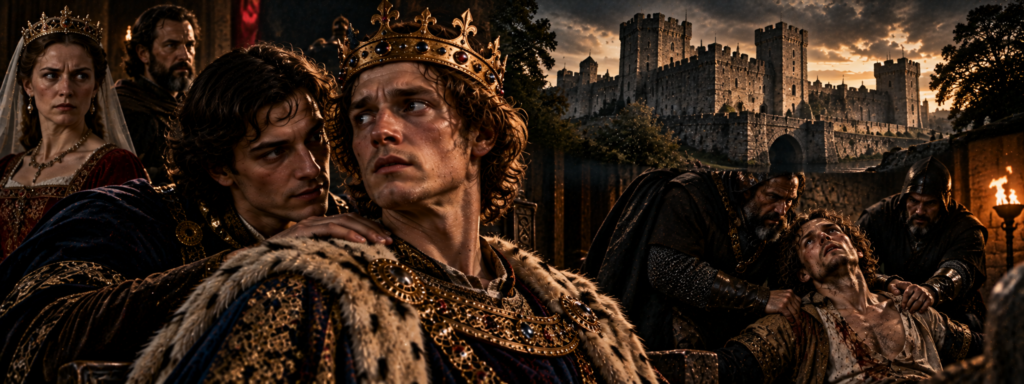
Edward II: The Deposed King, the Murder at Berkeley Castle, and the Terrible Legend of the Red-Hot Poker
Edward II (1284–1327, officially) | King of England, 1307–1327 | Deposed in January 1327 and officially reported dead at Berkeley Castle on September 21, 1327; murder is widely suspected, but the circumstances remain disputed
The King Who Disappeared Behind the Walls of Berkeley Castle
In September 1327, a prisoner held inside Berkeley Castle in Gloucestershire became the center of one of the darkest mysteries in English royal history. He was not an ordinary captive, nor was he a nobleman awaiting trial for rebellion or treason. He was Edward II, the former king of England, a man who had once commanded armies, distributed fortunes, condemned enemies to death, and exercised authority over millions of subjects. Now stripped of his crown, separated from his family, and confined under the authority of the government that had overthrown him, Edward was entirely dependent upon the people who controlled his imprisonment.
On or around September 21, 1327, Edward was officially reported dead. He was forty-three years old, had been deposed only months earlier, and remained a dangerous political figure simply because he was alive. His fourteen-year-old son had inherited the throne as Edward III, but the real power behind the new government belonged to Edward’s estranged wife, Isabella of France, and her close political ally Roger Mortimer. Their authority depended upon the successful removal of the former king, and his continued existence threatened to provide dissatisfied nobles with a rallying point for rebellion.
The announcement of Edward’s death solved an enormous political problem. A living former king could be restored, used by conspirators, or become the focus of competing claims to legitimate authority. A dead former king could no longer issue commands, receive secret messages, or personally challenge the government ruling in his son’s name. Yet the convenient timing of his disappearance immediately raised questions that have never been conclusively answered.
According to the most infamous version of the story, Edward was murdered in a particularly cruel and degrading manner. His assassins supposedly forced a heated iron instrument into his body, killing him while attempting to avoid leaving obvious external injuries. The allegation eventually became inseparable from his reputation, repeated in chronicles, histories, plays, and popular accounts of medieval cruelty. It is also one of the most sensational and least securely established details of his entire life.
The familiar red-hot poker story developed within a hostile and increasingly elaborate tradition surrounding Edward’s death. The earliest evidence does not establish that this method was used, and historians have serious reasons to question the tale. Its emphasis on sexual humiliation also reflects the way Edward’s relationships with male favorites were condemned and sensationalized by later writers. Whatever happened inside Berkeley Castle, the notorious story cannot be accepted as a straightforward description of a witnessed murder.
Even the apparently simple fact of Edward’s death has been challenged. A remarkable document known as the Fieschi Letter claims that the former king escaped captivity and survived for years after his supposed murder. Other evidence has been interpreted as suggesting that Edward III may have encountered someone claiming to be his father in continental Europe. Most historians continue to regard Edward’s death in 1327 as the more convincing explanation, but the survival theory has ensured that the mystery remains unusually complicated.
To understand why Edward might have been murdered, it is necessary to understand how he became a prisoner in the first place. His downfall involved a disastrous military defeat, the execution of a beloved companion, a bitter struggle with powerful nobles, the rise of an extraordinarily unpopular favorite, and the collapse of his marriage. It also involved a queen who eventually returned to England with an invading force and helped overthrow her own husband. By the time Edward reached Berkeley Castle, nearly every relationship that had once sustained his kingship had become a source of danger.
His story is therefore much more than the legend of a murdered king. It is a history of affection turned into political scandal, royal authority destroyed by favoritism, and a monarchy forced to confront the possibility that a crowned ruler could be removed by his own subjects. At its center stands a man whose greatest political weaknesses were inseparable from his personal loyalties. His final fate remains uncertain, but the forces that brought him to Berkeley Castle are among the most extraordinary in medieval English history.
Born Beneath the Shadow of a Formidable Father
Edward was born on April 25, 1284, at Caernarfon Castle in north Wales. His father was Edward I, one of the most formidable English monarchs of the Middle Ages, and his mother was Eleanor of Castile. The circumstances of his birth were politically significant because Edward I had recently conquered much of Wales and was consolidating English authority over the region. The young prince entered a world in which kingship was associated with military conquest, imposing castles, and the uncompromising exercise of royal power.
Edward I had already established a reputation as a determined soldier and an exceptionally forceful ruler. He had participated in crusading, defeated opposition within England, and pursued ambitious campaigns in Wales and Scotland. His government relied upon military organization, taxation, legal authority, and a willingness to confront powerful aristocrats. These qualities made him respected by some contemporaries and feared by others.
The younger Edward grew up under expectations that would prove difficult to satisfy. As the surviving male heir, he was expected to inherit not merely a crown but a program of conquest and political domination. His father wanted a successor capable of maintaining English authority in Wales and completing the struggle against Scotland. The prince’s personal interests and temperament, however, did not always resemble those of the older king.
Edward was physically capable and received the education appropriate to a royal heir. He learned the responsibilities of aristocratic life and was familiar with hunting, military activity, and the ceremonial world of kingship. Yet contemporary and later accounts also suggest that he enjoyed practical activities and the company of people outside the highest ranks of the nobility. Such preferences were not inherently scandalous, but they could appear inappropriate to aristocrats who expected a king to maintain a carefully controlled distance from ordinary society.
His father reportedly disapproved of aspects of his conduct and of certain companions. The precise details of their disagreements have been shaped by later narratives, but tensions between the two men are well established. Edward I was a demanding parent whose expectations were inseparable from his understanding of kingship. The prince’s willingness to form intense personal attachments would become a recurring source of conflict.
In 1301, Edward was created Prince of Wales, becoming the first English heir to receive that title in the form that later became customary. The appointment reinforced his position within the royal succession and associated him with his father’s conquest. It also placed him under increasing pressure to demonstrate political maturity. His future appeared secure, but the personal relationships that would define his reign were already beginning to develop.
Piers Gaveston: The Favorite Who Changed Everything
Among the young prince’s companions, none became more important than Piers Gaveston. Gaveston came from a Gascon noble family connected with the English crown’s continental possessions. He entered Edward’s household while both men were young, and their relationship developed into an unusually close attachment. The friendship would become one of the most controversial personal relationships in English royal history.
Gaveston possessed qualities that made him attractive within a princely household. He was associated with martial skill, confidence, wit, and a willingness to challenge established social hierarchies. His position, however, was far below that of the great English earls who expected to dominate royal politics. Edward’s extraordinary affection for him threatened to elevate a comparatively minor nobleman above men who considered themselves the natural advisers of the crown.
The relationship became politically dangerous because Edward repeatedly placed Gaveston’s interests ahead of those of powerful aristocrats. He rewarded him generously, defended him against criticism, and appeared unwilling to accept restrictions upon their association. The king’s affection was therefore not merely a private matter. It affected appointments, patronage, access to royal authority, and the distribution of wealth.
The nature of their intimacy has been debated for centuries. Some medieval writers used language suggesting an exceptionally intense emotional bond, while others condemned their relationship in terms associated with improper affection. Modern historians have considered the possibility that the two men were lovers, but the surviving evidence cannot establish the precise nature of their sexual relationship. It is important to distinguish the documented closeness between them from later claims that present every aspect of their private lives as certain.
Edward’s relationship with Gaveston also exposed a broader problem in medieval kingship. A ruler was expected to reward loyal servants, but excessive favoritism could threaten the political balance among powerful families. Nobles who believed themselves excluded from influence might interpret the favorite’s rise as an attack upon their status. The resentment became particularly intense when Gaveston appeared to mock or humiliate members of the aristocracy.
Edward I eventually ordered Gaveston into exile in 1307, shortly before his death. The circumstances reflected the older king’s determination to control his son’s political relationships. The separation did not last long. Once Edward inherited the throne, bringing Gaveston back became one of his earliest priorities.
A New King and an Old Scandal
Edward I died on July 7, 1307, leaving his son to inherit the English crown and the unfinished war against Scotland. The new king was twenty-three years old and possessed the authority to make decisions that his father had previously forbidden. Almost immediately, he recalled Piers Gaveston from exile. The decision announced that Edward intended to govern according to his own preferences.
Gaveston received the earldom of Cornwall, an exceptionally prestigious title normally associated with the royal family. The grant elevated him into the highest ranks of English aristocratic society. It also placed him above noblemen whose families had possessed great influence for generations. The resentment created by the appointment was immediate and profound.
Edward’s behavior suggested that he did not fully appreciate the political consequences. He trusted Gaveston and valued his companionship, but the English aristocracy viewed the relationship through the lens of power and privilege. A favorite who received wealth and authority could influence the king’s decisions. Those excluded from his circle feared that their interests would be ignored.
The situation became particularly awkward because Edward was preparing to marry Isabella of France. The marriage was intended to strengthen relations between England and France, two kingdoms whose political interests frequently collided. Isabella was the daughter of Philip IV of France and belonged to one of Europe’s most powerful royal families. Her marriage to Edward carried diplomatic importance far beyond the personal relationship between husband and wife.
Edward and Isabella married in January 1308, and their coronation followed in February. Isabella was still a young teenager, while Edward was an adult king already deeply attached to Gaveston. Later accounts emphasized the apparent contrast between the neglected queen and the favored companion. Some details of the alleged humiliations surrounding the wedding and coronation are difficult to verify, but the political tensions were genuine.
The marriage would eventually produce four children, including the future Edward III. It therefore cannot be reduced to a simple story of total personal estrangement from the beginning. Isabella participated in royal life and fulfilled important diplomatic responsibilities during the earlier years of the reign. Nevertheless, Gaveston’s position created resentment that would become increasingly difficult to contain.
The Nobles Who Refused to Accept a Second King
The opposition to Gaveston developed into a struggle over the nature of royal government. Powerful earls argued that Edward had allowed one man to dominate his decisions and distribute patronage unfairly. Their complaints combined personal resentment with broader concerns about military policy, taxation, and the administration of the kingdom. Gaveston became the most visible symbol of everything they believed was wrong with the new reign.
In 1308, pressure from the nobility forced Edward to accept Gaveston’s removal from England. The favorite was sent to Ireland, where he exercised authority as the king’s lieutenant. Edward nevertheless continued to seek ways to bring him back. The episode demonstrated that the king was willing to compromise temporarily but remained determined to preserve the relationship.
Gaveston returned in 1309, and the conflict soon intensified. His behavior toward leading nobles reportedly included insulting nicknames and displays of contempt. Such conduct was politically dangerous in a society where honor and status were central to aristocratic identity. Even powerful men prepared to tolerate royal authority could resent humiliation by someone they regarded as socially inferior.
In 1311, a group of reforming nobles known as the Lords Ordainers imposed restrictions upon royal government. Their ordinances sought to control appointments, financial administration, and the king’s ability to act without consultation. Gaveston was again ordered into exile. Edward regarded the measures as an unacceptable interference with his authority.
The struggle had now moved beyond the fate of one favorite. It concerned whether the king could govern according to his personal wishes or whether leading nobles possessed the right to restrain him. Edward’s refusal to abandon Gaveston made compromise increasingly difficult. The kingdom moved toward armed confrontation.
Gaveston returned once more, and his enemies decided that exile was no longer sufficient. The earls organized military action against him, forcing him into a series of increasingly desperate positions. Edward attempted to protect his companion but lacked the strength to prevent his capture. The confrontation ended in a killing that would haunt the remainder of his reign.
The Execution of Piers Gaveston
In 1312, Gaveston was besieged at Scarborough Castle and eventually surrendered under terms intended to protect his life. He was placed in the custody of Aymer de Valence, Earl of Pembroke, who sought to manage the crisis without provoking further violence. During a stop at Deddington, however, Gaveston was seized by men acting for the Earl of Warwick. The capture placed him in the hands of nobles determined to eliminate him.
Gaveston was taken to Warwick Castle, where his enemies treated him as a traitor. The leading figures involved included Thomas, Earl of Lancaster, one of the most powerful noblemen in England. Their decision to execute him was politically explosive because Gaveston remained a royal favorite under the king’s protection. The killing represented a direct challenge to Edward’s authority.
On June 19, 1312, Gaveston was taken to Blacklow Hill near Warwick and executed. Accounts describe him being killed by armed men acting under the authority of the hostile earls. His death removed the favorite but did not resolve the underlying conflict. Instead, it created a personal grievance that Edward would never forget.
The king’s reaction was one of profound anger and grief. Gaveston had been his closest companion, and the execution demonstrated that powerful nobles could destroy someone he loved despite his royal authority. Edward sought revenge against those responsible. His determination would contribute to years of political hostility.
The execution also exposed the limits of aristocratic opposition. The earls had eliminated Gaveston, but they had committed an act that could itself be regarded as unlawful violence. Their actions divided the political community and complicated efforts to establish stable government. The kingdom remained trapped between a king who resented restraint and nobles who feared unchecked favoritism.
For Edward, the loss was both personal and political. Gaveston’s death deprived him of a trusted companion while reinforcing his distrust of the aristocracy. The experience would influence his later relationship with the Despenser family. When another favorite rose to prominence, Edward would prove even less willing to surrender him.
Bannockburn: The Battle That Shattered a King’s Reputation
While Edward struggled with his nobles, the war against Scotland continued to deteriorate. Robert Bruce had established himself as king of Scots and was steadily recovering territory previously controlled by England. Edward’s government faced the difficult task of maintaining military pressure while dealing with internal political conflict. The divisions weakened England’s ability to respond effectively.
In 1314, Edward assembled a large army to relieve Stirling Castle, which was threatened by Scottish forces. The campaign offered an opportunity to restore English prestige and demonstrate that the king could match his father’s military achievements. The army included powerful nobles and substantial numbers of infantry and cavalry. Edward possessed considerable resources, but the campaign would end disastrously.
The Battle of Bannockburn took place on June 23 and 24, 1314. Robert Bruce’s forces used disciplined infantry formations and favorable terrain to resist the English attack. Edward’s army struggled to deploy effectively and became increasingly disorganized. The resulting defeat was one of the most humiliating military disasters in medieval English history.
Edward escaped the battlefield, but the consequences were devastating. English losses included important nobles and large numbers of soldiers. Scotland’s independence became more secure, while English prestige suffered a severe blow. The defeat also strengthened the position of Edward’s domestic opponents.
Thomas of Lancaster emerged as an increasingly powerful figure in the political struggle. He criticized the king’s government and sought greater control over royal policy. Edward resented the interference but lacked the political strength to defeat his opponents immediately. The kingdom entered another period of unstable government.
Bannockburn became central to Edward’s later reputation as an ineffective ruler. His father had spent years attempting to conquer Scotland, while Edward II had suffered a catastrophic defeat. The contrast was politically damaging and difficult to escape. It contributed to the belief that the king’s personal judgment was inadequate for the responsibilities of his office.
Famine, Disorder, and a Kingdom Losing Faith
Edward’s military problems were compounded by a severe economic and environmental crisis. Beginning in 1315, prolonged wet weather and poor harvests contributed to the Great Famine. Food shortages affected much of northern Europe, and England experienced widespread suffering. Prices rose, livestock diseases caused additional losses, and communities struggled to survive.
The famine placed enormous pressure upon royal government. A king was expected to maintain justice, defend the realm, and protect the stability of society. Edward could not control the weather, but his inability to resolve the wider political crisis made the suffering appear even more severe. His opponents used the disorder to criticize his leadership.
The Scottish war continued to drain resources. Raids devastated northern England, while attempts to restore English authority achieved limited success. Local communities faced insecurity, taxation, and the threat of violence. The king’s government appeared unable to provide the protection that subjects expected.
The period also witnessed growing conflict among powerful aristocrats. Private feuds, disputes over estates, and competing political factions undermined order. Edward struggled to maintain a consistent coalition of supporters. His reliance upon personal favorites became increasingly controversial.
These crises helped create the conditions for his eventual downfall. A king might survive an unpopular companion or a military defeat, but repeated failures weakened confidence in his judgment. The famine, Scottish war, and aristocratic conflict reinforced one another. By the early 1320s, Edward’s authority rested upon an increasingly unstable foundation.
The emergence of Hugh Despenser the Younger would make the situation far worse. Unlike Gaveston, Despenser possessed extensive aristocratic connections and ambitions that directly threatened other powerful families. His rise transformed royal favoritism into a struggle over land, wealth, and political survival. The resulting conflict would eventually destroy Edward’s reign.
Hugh Despenser: The Favorite Who Became England’s Most Hated Man
Hugh Despenser the Younger rose to prominence during the later years of Edward’s reign. He belonged to an ambitious noble family and was married to Eleanor de Clare, a niece of the king. The marriage connected him to the vast inheritance of the Clare family and gave him opportunities to expand his wealth. His political ambitions were considerable.
Despenser became increasingly close to Edward and gained extraordinary influence over royal decisions. His father, Hugh Despenser the Elder, also benefited from the family’s position. Together, they accumulated wealth, offices, and power. Their rise alarmed nobles who feared losing estates or influence to the favorites.
The younger Despenser’s expansion in the Welsh Marches was particularly controversial. He used his position to pursue territorial claims and pressure rivals. The dispute surrounding the lordship of Gower became one of the immediate causes of armed opposition. Powerful Marcher lords regarded his actions as a threat to their independence.
The relationship between Edward and Despenser has also attracted speculation about sexual intimacy. Contemporary and later sources demonstrate the king’s exceptional attachment to him, but the precise nature of their private relationship remains uncertain. Some writers have interpreted the closeness as romantic or sexual, while others emphasize political dependence and personal loyalty. The evidence does not justify presenting every allegation as established fact.
What is beyond doubt is that Despenser’s influence became politically disastrous. He alienated powerful nobles, helped intensify royal authoritarianism, and contributed to the exclusion of opponents from government. Edward repeatedly defended him despite mounting hostility. The pattern resembled the earlier Gaveston crisis, but the consequences would be even more destructive.
Despenser also became deeply unpopular with Queen Isabella. His influence over Edward restricted her access to political authority and eventually affected her lands and income. The queen increasingly viewed the favorite as a threat to her position. The conflict would help transform a troubled royal marriage into a revolutionary alliance against the king.
The Despenser War and the Road to Civil Conflict
By 1321, opposition to the Despensers had become an armed movement. Powerful Marcher lords, including Roger Mortimer, joined forces against the favorites. They attacked Despenser properties and demanded their removal from royal government. The conflict became known as the Despenser War.
Edward initially faced serious pressure. His opponents possessed military resources and influential allies, while the political community remained divided. Parliament forced the exile of the Despensers in 1321. The king accepted the decision temporarily, but he had no intention of allowing the arrangement to endure.
Edward soon regained the initiative. He exploited divisions among his opponents and assembled forces loyal to the crown. The campaign against the rebels was increasingly successful. The king demonstrated that he could act decisively when his personal authority and favorites were threatened.
Roger Mortimer surrendered in January 1322 and was imprisoned in the Tower of London. Other opponents continued resistance, but Edward’s military position improved. The decisive confrontation came at the Battle of Boroughbridge in March 1322. Royal forces defeated the army associated with Thomas of Lancaster.
Lancaster was captured and taken to Pontefract Castle. Edward had him condemned and executed, ending the career of the nobleman who had helped destroy Gaveston. The execution was a dramatic reversal of fortune. A king who had once been unable to protect his favorite now possessed the power to kill one of the most influential aristocrats in England.
The victory appeared to restore Edward’s authority. His enemies had been defeated, the Despensers returned, and the crown could impose its will with fewer immediate restraints. Yet the triumph concealed a dangerous problem. The king’s government had become increasingly dependent upon a narrow circle of supporters whose enemies were determined to seek revenge.
The Tyranny of the Despensers
After 1322, Edward and the Despensers exercised power with unusual severity. The defeat of their opponents allowed them to confiscate estates, reward supporters, and pursue political enemies. The younger Despenser expanded his wealth and influence dramatically. His conduct created resentment among nobles who feared becoming the next victims.
The period is sometimes described as the tyranny of the Despensers. Although the label reflects hostile political traditions, the government’s coercive treatment of opponents is well documented. Confiscations, imprisonments, and pressure upon aristocratic families became central features of the regime. The king’s willingness to support the favorites intensified the hostility directed against him.
Edward’s earlier experiences help explain his determination. Gaveston had been seized and executed by nobles who defied royal authority. Edward had spent years attempting to recover control over his government. The victory of 1322 offered an opportunity to prevent similar humiliation.
Yet the methods used to secure that control undermined his position. Powerful families could no longer trust that their estates and privileges would be protected. The king appeared increasingly unwilling to accept criticism or compromise. His personal loyalty to the Despensers became inseparable from a wider system of political intimidation.
Queen Isabella’s position also deteriorated. The Despensers influenced access to the king and interfered with her political interests. Her lands and income were eventually restricted, deepening the estrangement. The marriage that had once served as an important diplomatic alliance was becoming a source of danger to Edward’s government.
The king had defeated his domestic enemies, but he had not eliminated their grievances. Roger Mortimer remained alive, and many aristocrats resented the Despensers. The Scottish war continued to damage royal prestige. The apparent strength of the regime depended upon the continued obedience of men who increasingly despised it.
Roger Mortimer: The Prisoner Who Escaped to Become a King’s Enemy
Roger Mortimer was one of the most important aristocrats in the Welsh Marches. His family possessed extensive lands and military influence, making him a significant political figure. His opposition to the Despensers had brought him into direct conflict with Edward. After surrendering in 1322, he faced imprisonment and the possibility of severe punishment.
Mortimer was held in the Tower of London, where his prospects appeared bleak. The king had demonstrated his willingness to execute powerful opponents, and Mortimer had little reason to expect permanent security. Yet in August 1323, he escaped from the Tower in an episode that became one of the most remarkable prison escapes of medieval England. The precise details of the operation remain uncertain, but he successfully reached continental Europe.
His escape transformed the political situation. Mortimer was now beyond Edward’s immediate control and could seek support among the king’s foreign enemies. He retained connections with aristocrats who resented the Despensers. His survival provided the opposition with an experienced military and political leader.
Mortimer eventually became closely associated with Queen Isabella. Their relationship developed into an alliance that would destroy Edward’s government. Later accounts describe them as lovers, and their intimacy became an important part of the scandal surrounding the queen’s rebellion. The precise beginning and nature of the relationship cannot be reconstructed with complete certainty, but their political partnership is beyond doubt.
Both possessed powerful motives to oppose Edward. Mortimer had been imprisoned and threatened by the regime, while Isabella had been marginalized and increasingly deprived of influence. The Despensers represented a common enemy. Their cooperation united royal legitimacy with aristocratic military experience.
The alliance also created a dangerous alternative center of authority. Isabella was the queen of England and mother of the heir to the throne. Mortimer possessed political connections and knowledge of the kingdom’s military weaknesses. Together, they could challenge Edward in a way that isolated nobles had previously failed to achieve.
Isabella of France: From Queen to Rebel
Isabella of France entered English history as a young princess married to a powerful foreign king. Her marriage to Edward II was intended to strengthen relations between England and France. Over the years, she became an experienced political figure who participated in diplomacy and royal government. Her later rebellion was therefore not the action of a woman entirely unfamiliar with power.
The relationship between Isabella and Edward was complicated from the beginning. His attachment to Gaveston created political tensions, but the marriage produced children and periods of cooperation. Isabella fulfilled important ceremonial and diplomatic responsibilities. She also developed relationships with English nobles and foreign rulers that would later prove valuable.
The rise of Hugh Despenser the Younger transformed her position. The favorite’s influence increasingly restricted her access to the king and threatened her financial security. Edward’s willingness to support Despenser intensified the estrangement. Isabella eventually came to regard the royal government as hostile to her interests.
In 1325, Isabella traveled to France to negotiate matters connected with Edward’s continental possessions. The diplomatic mission provided an opportunity to leave England without openly declaring rebellion. Her son Edward, the future Edward III, later joined her in France to perform homage for the English crown’s French lands. The presence of the heir gave Isabella enormous political leverage.
Once abroad, Isabella refused to return while the Despensers remained in power. She publicly criticized their influence and presented herself as a queen seeking protection from oppressive favorites. Her position attracted sympathy among some English exiles and opponents of Edward’s government. The conflict was becoming an international political crisis.
Her alliance with Mortimer transformed protest into preparation for invasion. The queen possessed legitimacy through marriage and motherhood, while Mortimer contributed military experience and aristocratic connections. Their cause could be presented as an effort to rescue the kingdom from corrupt advisers. In practice, it threatened to remove Edward himself.
The Queen Who Returned With an Army
In September 1326, Isabella and Mortimer landed in England with an invading force. Their army was not enormous, but its political impact was extraordinary. Edward’s government had alienated so many powerful figures that support for the invaders spread rapidly. Nobles who might once have defended the king began abandoning him.
The invasion exposed the weakness beneath the apparent strength of the Despenser regime. Edward possessed castles, resources, and the formal authority of kingship, but he lacked dependable political support. The queen’s presence gave the rebellion a legitimacy that ordinary aristocratic opposition might not have possessed. Her supporters claimed to be acting against the favorites rather than against lawful monarchy.
Edward attempted to organize resistance, but his efforts collapsed. He and Hugh Despenser the Younger fled westward, hoping to find support in Wales. The movement reflected the importance of the Despensers’ regional interests and the possibility of escaping to a more defensible position. Yet the king’s authority was disintegrating faster than he could respond.
The elder Hugh Despenser was captured at Bristol. He was condemned and executed in October 1326, removing one of the principal figures of the regime. The execution demonstrated that Isabella and Mortimer intended to destroy the political structure that had sustained Edward. It also warned remaining supporters that resistance could be fatal.
Edward and the younger Despenser continued their desperate flight. Their attempt to escape by sea failed, and they were eventually captured in south Wales in November. The king who had defeated his opponents in 1322 was now a prisoner of the very political movement he had helped create through repression. His favorite faced an even more immediate fate.
The collapse was astonishingly rapid. Within weeks of Isabella’s landing, the royal government had disintegrated, the Despensers had been captured, and Edward had lost control of his kingdom. The invasion succeeded less through overwhelming military force than through the withdrawal of political loyalty. Edward’s reign was effectively over before the formal deposition occurred.
The Execution of Hugh Despenser the Younger
Hugh Despenser the Younger was taken to Hereford, where his enemies prepared a spectacular public execution. He had become one of the most hated men in England, blamed for confiscations, oppression, and the destruction of powerful families. His position as Edward’s favorite made him the central symbol of the defeated regime. The new authorities intended his death to demonstrate the complete reversal of political power.
Despenser was condemned for treason and other offenses. The punishment imposed upon him was exceptionally brutal, involving the forms of execution associated with the most serious crimes against royal authority. Contemporary accounts describe a public spectacle intended to humiliate him before death. The details vary between sources, but the violence of the execution is not in doubt.
The execution took place on November 24, 1326. Despenser was hanged, disemboweled, and dismembered in a punishment designed to display the destruction of his political identity as well as his body. The spectacle served as revenge for his enemies and a warning to supporters of the former government. It also demonstrated the ruthlessness of the new regime.
Edward was not present as a free ruler capable of intervening. He had lost the authority that once allowed him to protect Despenser against powerful opponents. The parallel with Gaveston’s death was unmistakable. Once again, a man to whom Edward was exceptionally attached had been seized and killed by his political enemies.
The emotional consequences for Edward cannot be known with certainty. His relationship with Despenser had been central to his government, and the favorite’s death marked the destruction of the political world he had created. The king had also lost his freedom and faced an uncertain future. The combination of personal and political catastrophe was complete.
Despenser’s execution did not resolve the problem of Edward himself. The king remained alive, and his continued existence threatened the legitimacy of the new government. Isabella and Mortimer had defeated him militarily, but they still needed a constitutional settlement. The next stage would involve something almost unprecedented in English royal history.
The Deposition of an Anointed King
Removing Edward from the throne presented a serious political problem. Medieval kingship was surrounded by religious authority, hereditary legitimacy, and expectations of obedience. A crowned king was not simply an official who could be dismissed after losing political support. His deposition required a justification that would persuade the political community to accept a new ruler.
Edward was held at Kenilworth Castle while his opponents prepared the transition. Parliament assembled in January 1327, and leading figures considered how to transfer authority to the king’s son. The charges against Edward emphasized failures of government, military defeat, poor counsel, and his inability to protect the kingdom. The proceedings were shaped by the political reality that the king had already lost effective power.
The deposition was presented as a necessary response to a ruler who had failed in his responsibilities. Edward’s opponents argued that the kingdom could not safely continue under his authority. The young prince offered a solution because he possessed hereditary legitimacy without carrying responsibility for his father’s policies. The transfer could therefore be portrayed as preserving the dynasty rather than destroying monarchy.
Edward’s formal renunciation of the crown occurred under intense pressure. The precise degree of coercion is difficult to measure, but he was a prisoner surrounded by opponents who controlled the political process. He had little realistic ability to refuse. His abdication was therefore not the voluntary retirement of a ruler who had freely chosen to surrender power.
The deposition was announced in January 1327, and Edward III was crowned on February 1. The new king was only fourteen years old, making him dependent upon adult advisers. Isabella and Mortimer quickly emerged as the dominant figures in the government. The arrangement gave them control over royal authority without requiring either to claim the crown personally.
The former king’s position was now exceptionally dangerous. He had been stripped of his title but remained the father of the reigning monarch. His existence could undermine the legitimacy of the deposition if supporters attempted to restore him. The government therefore faced a problem that imprisonment alone might not permanently solve.
A Living Former King Was a Dangerous Man
Edward’s deposition did not eliminate his political significance. He remained an anointed monarch in the eyes of those who questioned the legitimacy of the proceedings. His supporters could argue that the transfer of power had been forced and therefore invalid. Even without an army, he represented a potential alternative to the government of Isabella and Mortimer.
The danger was particularly serious because Edward III was a minor. The young king’s authority depended upon the advisers who controlled access to him and governed in his name. If dissatisfied nobles could restore Edward II, the political structure established in 1327 might collapse. The former king’s captivity therefore became a matter of national security.
Isabella and Mortimer had reasons to fear such a development. Their invasion had been justified partly as an effort to remove the Despensers and correct abuses. Once Edward had been deposed, they possessed authority that depended upon preventing his return. Their political survival was closely connected with the permanence of the new settlement.
Yet murdering a former king would also be dangerous. Edward remained the father of the reigning monarch, and responsibility for his death could provoke outrage. The religious significance of kingship made deliberate regicide a grave act. Any government contemplating such a measure would have strong reasons to conceal its involvement.
The situation created a terrible ambiguity. Keeping Edward alive allowed the possibility of restoration, but killing him risked destroying the legitimacy of those who had overthrown him. The problem was not unique to Edward’s reign, but it was especially acute because England had little established precedent for the permanent removal of an anointed king. His captivity therefore became increasingly politically sensitive.
The official announcement of his death later that year would remove the immediate danger. Whether that result was deliberately arranged remains disputed. The political motive for murder is clear, but motive does not establish responsibility. The distinction is essential when examining what happened at Berkeley Castle.
From Kenilworth to Berkeley Castle
Edward was initially held at Kenilworth Castle, a formidable fortress associated with important aristocratic families. His captivity was closely supervised, and his movements were controlled by the new government. The former king could no longer travel freely, summon supporters, or exercise political authority. His world had contracted from a kingdom to the walls of a fortress.
In April 1327, Edward was transferred to Berkeley Castle in Gloucestershire. The move placed him under the custody of Thomas Berkeley and John Maltravers, men connected with the political authorities. Berkeley Castle was a substantial fortified residence capable of holding an important prisoner. Its location also removed Edward from some of the political centers where supporters might attempt to reach him.
The precise conditions of his imprisonment are difficult to reconstruct. Later accounts describe humiliation, harsh treatment, and attempts to undermine his physical and emotional well-being. Some stories portray him as subjected to deliberate cruelty intended to weaken him. These details require caution because they often appear in narratives shaped by hostility toward Mortimer and the government responsible for his captivity.
The basic fact of confinement is not disputed. Edward was no longer free and depended upon his custodians for food, shelter, security, and communication. His captors controlled who could see him and what information reached the outside world. Such circumstances made it difficult for supporters to determine his condition.
The transfer also increased the significance of those responsible for his custody. Thomas Berkeley and John Maltravers became central figures in later investigations and accusations. Their involvement placed them close to the final known stage of Edward’s life. Yet proximity to the prisoner does not automatically establish responsibility for murder.
Berkeley Castle would become inseparable from Edward’s fate. Its walls provided the setting for the official account of his death and the later legends that surrounded it. The fortress became a symbol of royal humiliation and possible assassination. The uncertainty concerning what occurred inside has endured for centuries.
The Attempts to Rescue Edward
The former king’s imprisonment did not end efforts to restore him. In 1327, conspirators attempted to organize a rescue, demonstrating that Edward remained politically dangerous to the new regime. The most important early plot was associated with the Dominican friar Thomas Dunheved and his supporters. Their activities revealed that the deposition had not secured universal acceptance.
The conspirators sought to reach Edward and remove him from captivity. Their plans involved men who remained loyal to the former king or opposed the government of Isabella and Mortimer. The precise sequence of events is difficult to reconstruct, but the attempt appears to have created genuine concern among the authorities. It demonstrated that the prisoner could become the focus of active resistance.
The rescue efforts help explain why Edward’s continued existence was so troublesome. A deposed king who attracted supporters might destabilize the new government even without personally organizing rebellion. His mere presence could provide legitimacy to those dissatisfied with the political settlement. The authorities therefore had strong reasons to prevent further attempts.
The plots also complicate the interpretation of Edward’s death. If the government feared a successful rescue, eliminating the prisoner could appear politically advantageous. The timing of the official announcement after the rescue attempts has therefore attracted suspicion. Yet the surviving evidence does not establish a direct causal connection.
The possibility of escape also became central to later survival theories. If supporters were actively attempting to free Edward, it is conceivable that one effort succeeded or that the prisoner was moved secretly. The Fieschi Letter would later offer a narrative built around escape and concealment. Whether that account reflects actual events remains disputed.
What is certain is that Edward’s captivity was not politically quiet. His enemies feared restoration, while some supporters continued to regard him as their rightful king. The struggle over his fate continued after his formal deposition. Berkeley Castle was therefore not simply a place of detention but the center of an unresolved constitutional crisis.
September 1327: The Official Death of Edward II
The government announced that Edward II had died at Berkeley Castle on September 21, 1327. The date became the accepted endpoint of his life and reign in most historical accounts. The official explanation did not provide a clear and convincing medical cause. The absence of reliable detail helped create the uncertainty that continues to surround the event.
The death occurred approximately eight months after Edward’s deposition. During that period, Isabella and Mortimer had consolidated authority in the name of Edward III. The former king’s continued existence had remained a potential threat. His death removed the possibility of his personal restoration.
The political convenience was extraordinary. A living Edward could be used by rebels to challenge the new government. A dead Edward could be commemorated without posing the same immediate danger. The announcement therefore benefited those who controlled his captivity.
Yet convenience alone does not prove murder. Edward may have died from illness or other natural causes while imprisoned. Medieval captivity could be physically and psychologically damaging, particularly for a man accustomed to royal comfort and freedom. The surviving evidence does not establish a medical explanation, but natural death cannot be excluded solely because the timing was politically useful.
The official announcement was followed by preparations for burial. Edward’s body was taken to Gloucester, where he received a substantial funeral and was buried at the abbey that later became Gloucester Cathedral. The existence of a public burial has been used as evidence that he genuinely died in 1327. It also raises questions about the identity of the body if the survival theory is considered.
The fundamental mystery remains unresolved. The government reported Edward dead, and a body was buried as his. Later accusations claimed that he had been murdered. Other traditions suggested that the entire death announcement concealed an escape or substitution.
The Murder Accusations Begin
Suspicions of murder developed within a political environment that soon turned against Roger Mortimer. The government’s authority became increasingly unpopular as Mortimer accumulated power and wealth. Edward III eventually overthrew him in 1330, creating an opportunity to investigate or condemn the actions of the previous regime. Edward II’s death became one of the accusations associated with Mortimer’s fall.
The proceedings against Mortimer included allegations connected with the former king’s death. This is important because it demonstrates that murder was not merely a story invented centuries later. Serious accusations existed within a few years of the official announcement. Their presence gives the suspicion historical weight.
Yet the political circumstances of the proceedings require caution. Mortimer was being destroyed by a rival government determined to remove him from power. Charges against him served the interests of Edward III and those who supported the coup. The accusation of involvement in Edward II’s death therefore cannot be treated as the equivalent of an impartial modern investigation.
The available records do not provide a complete reconstruction of the alleged killing. They do not establish the exact method or identify every person involved. The later stories of a red-hot instrument are not demonstrated by the surviving evidence from 1330. The distinction between an early murder accusation and a later detailed murder narrative is crucial.
Mortimer’s enemies had strong reasons to portray him as responsible for the former king’s death. If he had arranged the killing, the accusation was extraordinarily serious. If the charge was exaggerated or politically manipulated, it could still serve to justify his destruction. The surviving evidence does not allow every possibility to be eliminated.
Nevertheless, the allegations remain a significant reason why many historians regard murder as likely. They emerged relatively close to the event and were connected with people who had participated in the political crisis. The official death occurred under the authority of a government that benefited from Edward’s disappearance. The evidence supports serious suspicion, even though the precise circumstances remain uncertain.
The Red-Hot Poker: Medieval History’s Most Infamous Murder Story
The most notorious account of Edward’s death describes an assassination designed to inflict extreme suffering while concealing visible evidence of violence. According to the familiar version, his captors inserted a heated iron instrument into his body, sometimes said to have been introduced through a horn or similar device. The method supposedly killed him without leaving obvious external wounds. The story became one of the most recognizable examples of alleged medieval cruelty.
The allegation is deeply disturbing, but its historical reliability is doubtful. The detailed narrative developed in chronicles written after the event, rather than in a secure eyewitness account from Berkeley Castle. The sources differ in their descriptions and do not provide verifiable medical evidence. The familiar image of a red-hot poker should therefore be treated as a later tradition, not an established fact.
The story also carries an unmistakable element of sexual humiliation. Edward’s relationships with Gaveston and Despenser had attracted hostility and speculation during his lifetime. Later writers could interpret a sexually degrading method of murder as a form of punishment connected with those relationships. The allegation therefore reveals the prejudices and moral assumptions of the tradition that preserved it.
It is also important to recognize that the story’s grotesque details made it exceptionally memorable. A former king quietly suffocated or poisoned in prison would have been disturbing enough. A king killed through a deliberately humiliating instrument created a narrative that audiences were unlikely to forget. The sensationalism helped ensure the story’s survival.
The alleged method is sometimes presented as if it were chosen specifically to avoid leaving visible marks. That explanation appears logical within the narrative, but it does not establish that the technique was actually used. The absence of a reliable medical examination prevents confirmation. Later repetition cannot transform an unsupported detail into evidence.
The red-hot poker legend remains central to Edward’s popular reputation because it combines political murder with personal degradation. Yet its prominence has often obscured the more important historical question of whether Edward was killed at all. The evidence for deliberate murder is stronger than the evidence for this particular method. Treating the two claims as identical distorts the history.
Why the Murder Legend Became So Popular
Edward’s reign offered later writers a story filled with recognizable moral themes. He had favored men whom powerful nobles despised, suffered military humiliation, and allowed unpopular advisers to dominate government. His wife had turned against him, and his enemies had stripped him of the crown. A violent and degrading death seemed to provide a dramatic conclusion to a reign already associated with scandal.
Medieval chroniclers frequently interpreted political disasters as evidence of moral failure. A ruler who neglected accepted standards of kingship might be portrayed as receiving punishment appropriate to his conduct. Edward’s relationships with male favorites made him particularly vulnerable to hostile sexual commentary. The red-hot poker story fitted that moral framework with disturbing precision.
The legend also appealed to later dramatists and historians. Christopher Marlowe’s play Edward II helped establish the king’s downfall as a tragic drama of love, power, and betrayal. The play drew upon earlier historical traditions while shaping them for theatrical effect. Its influence contributed to the enduring association between Edward and an especially cruel death.
The story’s popularity demonstrates how historical memory can become dominated by one vivid allegation. The actual political causes of Edward’s deposition were complicated, involving war, finance, aristocratic power, and constitutional conflict. The murder legend reduced the final stage of his life to a single shocking image. It was easier to remember than the intricate political struggles that brought him to captivity.
The sexualized nature of the story also influenced interpretations of Edward’s personal relationships. Rather than examining the evidence for his attachments with appropriate caution, some later accounts treated the alleged method of death as proof of his sexuality. That reasoning is circular because the murder story itself may have been shaped by hostile assumptions about those relationships. The legend cannot independently establish the nature of Edward’s private life.
Modern historical analysis therefore approaches the story with skepticism. Its details are not securely documented, and its narrative purpose is unusually obvious. It may preserve a distorted memory of an actual murder, but that possibility cannot be demonstrated. The historical Edward deserves to be separated from the sensationalism that later surrounded his death.
Who Would Have Wanted Edward Dead?
The most obvious political beneficiaries of Edward’s death were Isabella and Mortimer. They had overthrown him and established a government operating in the name of his young son. Their authority depended upon the permanence of the deposition. A living former king represented a continuing threat.
Mortimer had especially strong reasons to fear restoration. Edward had imprisoned him, and the conflict between them had become a struggle for political survival. If Edward returned to power, Mortimer could expect severe punishment. Eliminating the former king would remove the possibility of personal revenge.
Isabella’s position was more complicated. She had helped depose her husband and supported the government that controlled his imprisonment. Yet Edward remained the father of her children, including the reigning king. Ordering his murder would carry political and personal risks that cannot be dismissed.
The custodians at Berkeley Castle also became subjects of suspicion. Thomas Berkeley and John Maltravers possessed direct responsibility for the prisoner during the final stage of his captivity. Their proximity made them important figures in later accusations. Yet the surviving evidence does not establish that either personally carried out a killing.
Other agents were named in later traditions, including Sir Thomas Gurney and William Ockley. Their alleged involvement became part of the developing murder narrative. The precise roles attributed to them differ between accounts and are difficult to verify. The existence of named suspects does not mean that the entire story is securely documented.
The question of responsibility therefore remains distinct from the question of whether murder occurred. A government might benefit from a prisoner’s death without directly ordering it. Custodians might act on instructions, misunderstand political expectations, or pursue their own interests. The surviving record does not permit a definitive reconstruction of the chain of command.
Thomas Berkeley and John Maltravers: The Men Responsible for the Prisoner
Thomas Berkeley and John Maltravers were entrusted with the custody of Edward after his transfer from Kenilworth. Their responsibilities placed them in an exceptionally sensitive position. They had to prevent escape while ensuring that the former king remained under the control of the new government. Any failure could have serious political consequences.
Berkeley Castle belonged to a powerful aristocratic family with extensive regional influence. The fortress was capable of holding an important prisoner securely. Its association with Edward’s final months made the Berkeley name central to the mystery. Yet the castle’s role as the place of official death does not establish what happened inside.
After Mortimer’s downfall, questions were raised concerning Edward’s death and the conduct of those responsible for his custody. Berkeley’s defense included the claim that he had been ill or absent during the relevant period. The precise legal and political significance of these statements has been debated. They do not provide a complete account of the prisoner’s final moments.
Maltravers also became associated with the accusations surrounding the death. His political position placed him among those vulnerable after Edward III’s seizure of power. The change of government transformed former supporters of Mortimer into potential enemies of the crown. Allegations concerning Edward II became part of that broader reckoning.
The surviving proceedings are frustrating because they do not supply the clarity that a modern investigation would seek. They contain accusations, defenses, and political judgments rather than a comprehensive forensic record. The exact circumstances of the death remain obscure. The later murder stories filled that gap with details that cannot be securely verified.
The custodians therefore occupy an ambiguous position. They were responsible for Edward’s confinement and may have possessed direct knowledge of his fate. Yet the surviving evidence does not establish a complete sequence of events or a proven method of killing. Their involvement remains central to the mystery without resolving it.
The Funeral at Gloucester
Edward’s body was taken to Gloucester for burial after the official announcement of his death. The funeral was substantial, reflecting his status as a former king and the father of the reigning monarch. The burial took place at St Peter’s Abbey, the institution that later became Gloucester Cathedral. His tomb would eventually become one of the most important royal monuments in medieval England.
The existence of a funeral has often been used as evidence against the survival theory. A body was presented and buried as Edward II, and the ceremony involved important political and religious figures. The arrangements required resources and official coordination. Such evidence supports the conclusion that the government intended the death to be accepted as genuine.
Yet the funeral does not resolve every question. If Edward had been murdered, the burial could still have been conducted with full ceremony. If a substitution occurred, as the survival theory proposes, the funeral would have been part of an elaborate deception. The latter explanation requires additional assumptions for which the evidence remains disputed.
The tomb at Gloucester became an important focus of royal memory. Edward III later supported the commemoration of his father, and the monument acquired considerable prestige. The former king’s burial place attracted attention from pilgrims and visitors. His reputation gradually developed in ways that differed from the hostile political narratives of his reign.
The contrast between Edward’s humiliation in life and commemoration after death is striking. A man who had been stripped of authority and imprisoned became the subject of an elaborate royal monument. The tomb restored a degree of dignity that his deposition had denied him. It also allowed his son to honor him without challenging the political settlement that had established Edward III’s own kingship.
The burial remains one of the strongest pieces of evidence supporting the conventional account of Edward’s death. It does not prove the precise cause, but it demonstrates that the government publicly treated him as dead in 1327. Any alternative explanation must account for the body, the ceremony, and the later commemoration. That burden makes the survival theory difficult, although not entirely impossible, to sustain.
The Fieschi Letter: The King Who Supposedly Escaped
The most remarkable challenge to the conventional account comes from a document known as the Fieschi Letter. The letter was associated with Manuele Fieschi, a cleric from a prominent Italian family, and was addressed to Edward III. It claimed that Edward II had escaped from captivity and survived after the date of his supposed death. The narrative offered an alternative history of the former king’s final years.
According to the letter, Edward escaped from Berkeley Castle with assistance and eventually traveled through England and continental Europe. The account describes a complicated journey involving concealment, religious houses, and movement through different territories. It ultimately places him in Italy, living under circumstances far removed from his former royal position. The story is extraordinary because it directly contradicts the official account of his death.
The letter’s date and transmission have been debated, but it belongs to the fourteenth-century documentary tradition rather than a much later fictional invention. This makes it more historically interesting than the familiar red-hot poker legend. Its existence demonstrates that claims of Edward’s survival circulated relatively close to the events. Yet the letter’s authenticity as a document does not establish the truth of its contents.
The account contains details that some historians regard as potentially significant. Its author appears to have possessed knowledge of political and geographical circumstances relevant to Edward’s imprisonment. Supporters of the survival theory argue that such information is difficult to explain if the story was entirely invented. Critics respond that a well-informed writer could construct a plausible narrative without possessing direct knowledge of Edward’s fate.
The letter also raises difficult questions about motive. Why would someone tell Edward III that his father was alive if the claim were false? The answer might involve political manipulation, misinformation, or an attempt to obtain favor. Medieval courts were familiar with impostors and disputed claims of identity.
The Fieschi Letter therefore cannot be dismissed merely because its story is unusual. It is a genuine historical problem that deserves careful examination. Nevertheless, its claims remain uncorroborated in crucial respects. The conventional account of Edward’s death in 1327 continues to command broader acceptance.
Could Edward II Have Lived in Italy?
The survival theory proposes that Edward escaped from Berkeley Castle and spent years living in concealment. Some versions suggest that the government deliberately announced his death while allowing him to disappear. Others imagine a successful rescue followed by the substitution of another body. The theories differ in their details but share the central claim that Edward survived beyond September 1327.
The Fieschi Letter places the former king in continental Europe, eventually associating him with religious life in Italy. Such an existence would represent an extraordinary reversal for a man who had once ruled England. A former monarch living anonymously among religious communities would have little opportunity to reclaim political authority. The secrecy might also explain why his survival left so little documentary evidence.
Supporters of the theory point to the possibility that Edward’s survival could have been politically useful. A hidden former king might be less dangerous than a publicly imprisoned one if his identity remained concealed. The government could maintain the appearance of his death while avoiding the risks of actual regicide. Such an arrangement would require extraordinary secrecy and cooperation.
Critics emphasize the difficulties. A living Edward would remain a potential claimant, and the knowledge of his survival could threaten the legitimacy of Edward III’s government. Maintaining a deception involving custodians, funeral arrangements, and foreign travel would be complicated. The longer the supposed survival continued, the greater the danger of exposure.
The theory also depends upon the reliability of a narrative that cannot be independently verified in its most important details. The Fieschi Letter may preserve genuine information, but it may also contain invention or misinformation. The presence of plausible details does not prove that the central claim is true. Historical judgment must weigh the entire body of evidence rather than the attractiveness of an alternative explanation.
The possibility of survival remains one of the most intriguing aspects of Edward’s story. It challenges the assumption that the official announcement necessarily reflected reality. Yet it also requires substantial explanations for the funeral and the political silence surrounding the alleged escape. Most historians therefore continue to regard death in 1327 as the more probable conclusion.
The Mysterious Encounter in Germany
Another episode has attracted attention from historians interested in Edward’s possible survival. In the 1330s, Edward III traveled to the continent and encountered a man associated with claims concerning his father’s identity. The evidence comes from records and later interpretations that have been examined in connection with the Fieschi Letter. The episode is intriguing because it suggests that rumors of Edward II’s survival may have circulated beyond England.
The man has sometimes been identified in modern discussions as William le Galeys, a name associated with the possibility of an impostor or claimant. The precise circumstances of the encounter remain difficult to reconstruct. The surviving evidence does not establish that Edward III recognized the man as his father. It does show that questions surrounding the former king’s fate were not necessarily confined to later literary legend.
Supporters of the survival theory have interpreted the episode as possible evidence that Edward III knew his father was alive. They argue that the king’s conduct may have reflected private recognition or a desire to avoid public scandal. Such interpretations are speculative. The records do not provide a definitive statement confirming the identity of the man involved.
Alternative explanations are available. The individual may have been an impostor, a confused claimant, or someone whose association with Edward II was misunderstood. Medieval Europe contained many displaced nobles, exiles, and people who adopted prestigious identities. Claims of royal survival could attract attention even when unsupported.
The episode therefore adds another layer of uncertainty without resolving the central mystery. It demonstrates the persistence of questions concerning Edward’s fate. It does not prove that the former king escaped Berkeley Castle. The distinction between a reported claim and verified identity remains essential.
Together, the Fieschi Letter and the continental encounter have encouraged renewed historical debate. They prevent the conventional narrative from being treated as entirely beyond question. Yet neither supplies conclusive evidence that Edward survived. The mystery remains open to interpretation rather than definitive resolution.
Isabella and Mortimer Rule in the Name of Edward III
After Edward’s deposition, Isabella and Mortimer dominated the government of the young Edward III. Their position was unusual because neither possessed the crown personally. They exercised authority through the king’s minority and their control over political appointments. The arrangement initially enjoyed support from those who had opposed the Despensers.
The new government faced serious challenges. England remained at war with Scotland, financial pressures continued, and powerful nobles expected rewards for supporting the invasion. Isabella and Mortimer had promised to correct the abuses of Edward II’s government. Their ability to fulfill those promises would determine whether the new political settlement endured.
Mortimer increasingly accumulated wealth and influence. He received extensive lands and eventually the title Earl of March. His rise alarmed nobles who believed that the government had simply replaced one dominant favorite with another. The resemblance to the Despenser regime became politically damaging.
Isabella’s relationship with Mortimer also attracted hostility. Their intimacy was widely discussed, and later writers portrayed them as an ambitious couple ruling through the young king. The political significance of their partnership is clear, although some sensational details belong to hostile traditions. Their authority depended upon maintaining control over Edward III.
The settlement with Scotland in 1328 further damaged their popularity among some English nobles. The Treaty of Edinburgh-Northampton recognized Scottish independence and ended a long period of conflict. Supporters regarded peace as necessary, while opponents condemned the terms as humiliating. Mortimer became a particular target of criticism.
By 1330, the government faced growing resentment. Edward III was approaching adulthood and increasingly unwilling to remain under Mortimer’s domination. The political conditions resembled those that had helped destroy his father’s reign. A powerful favorite had accumulated influence while alienating the aristocracy.
Edward III Turns Against His Mother’s Lover
In October 1330, Edward III moved against Roger Mortimer. The young king organized a coup at Nottingham Castle with the assistance of trusted supporters. Mortimer was arrested, and the political dominance of Isabella and her ally came to an abrupt end. The operation marked Edward III’s emergence as an independent ruler.
Mortimer’s downfall was swift. He was taken into custody and brought before Parliament, where accusations concerning his conduct were presented. The charges included abuses of power and involvement in the death of Edward II. The proceedings were shaped by the new king’s determination to destroy the man who had dominated his government.
Mortimer was condemned and executed at Tyburn on November 29, 1330. His death ended the career of one of the most powerful political figures of the preceding decade. The man who had helped overthrow Edward II was himself destroyed by Edward’s son. The reversal was dramatic and deeply significant.
Isabella was removed from political control but was not executed. She lived for many years afterward, maintaining a position appropriate to a former queen while remaining outside the center of government. Edward III’s treatment of his mother was therefore different from his treatment of Mortimer. The distinction reflected both family considerations and political calculation.
The coup also transformed the interpretation of Edward II’s death. Mortimer could now be portrayed as the principal villain responsible for the former king’s fate. The accusation helped justify his execution and reinforced Edward III’s authority. Yet the proceedings did not establish the precise circumstances of the alleged murder.
Edward III’s actions demonstrated the instability of government through favorites. His father had been condemned for excessive dependence upon Gaveston and Despenser. Mortimer had then accumulated extraordinary influence under the new regime. The young king’s seizure of power ended that pattern, at least temporarily, and restored direct royal authority.
Did Edward III Know the Truth About His Father?
Edward III’s relationship with his father’s memory is one of the most intriguing aspects of the mystery. He became king through a deposition that he had not personally directed as an independent ruler. His mother and Mortimer controlled the government during his early reign. As he matured, he had to reconcile his legitimacy with the circumstances that had removed Edward II.
The accusation against Mortimer provided a politically useful explanation. If Mortimer had murdered the former king, Edward III could condemn the crime while preserving the legitimacy of his own accession. The young king could present himself as avenging his father rather than challenging the entire constitutional settlement. Such a position strengthened his authority.
Yet the survival theory raises a more complicated possibility. If Edward II remained alive after 1327, Edward III might have known or eventually discovered the truth. A living former king would create serious problems for the reigning monarch’s legitimacy. The possibility has encouraged speculation about secret communications and concealed meetings.
The surviving evidence does not establish that Edward III knowingly participated in a deception. His actions are compatible with the belief that his father had been murdered. They are also compatible with a political determination to punish Mortimer for abuses that extended beyond the alleged killing. The records do not reveal his private knowledge with certainty.
Edward III later supported the commemoration of his father at Gloucester. The tomb became an important monument, and the former king’s memory was treated with increasing respect. Such actions suggest that Edward III wished to honor his father publicly. They do not resolve whether he possessed information about the circumstances of the death.
The question remains fascinating because Edward III occupied a unique position. He was both the beneficiary of his father’s deposition and the son of the man allegedly murdered by the government that had placed him on the throne. His political survival required navigating that contradiction. The full extent of his knowledge may never be recovered.
Was Edward II Really a Weak King?
Edward II has often been portrayed as one of England’s most disastrous monarchs. His reign included military defeat, political rebellion, favoritism, and eventual deposition. The contrast with his formidable father and successful son has made his reputation particularly poor. Yet reducing him to a foolish ruler controlled by favorites overlooks important complexities.
Edward possessed genuine interests and abilities that did not always align with aristocratic expectations. His enjoyment of practical activities and personal companionship was not inherently evidence of incompetence. The problem arose when his loyalties affected political decisions and the distribution of power. His inability to manage those consequences became increasingly destructive.
His military record was certainly damaging. Bannockburn represented a catastrophic defeat, and his government struggled to contain Scottish resistance. Yet military failure resulted from multiple factors, including strategy, leadership, logistics, and political divisions. It cannot be explained solely through personal weakness.
Edward also demonstrated determination and political ruthlessness. His victory over the opposition in 1322 showed that he could organize military action and defeat powerful enemies. The subsequent dominance of the Despensers demonstrated his willingness to impose authority. These qualities complicate the image of a passive monarch incapable of independent decisions.
His downfall resulted partly from the way he exercised power. He repeatedly placed personal loyalty above political compromise and allowed favored individuals to accumulate influence that threatened other nobles. When challenged, he often responded with anger and coercion. The resulting cycle of resentment and retaliation undermined the foundations of his kingship.
Edward was therefore neither simply a helpless victim nor a ruler whose destruction was inevitable. He made decisions that contributed directly to his political isolation. His enemies also pursued their own ambitions and employed ruthless methods to remove him. Understanding his fate requires recognizing both his failures and the extraordinary violence of the political world in which he lived.
The Personal Relationships That Destroyed a Reign
Edward’s relationships with Gaveston, Despenser, and Isabella were central to his political history. Each relationship involved genuine personal attachment, but each also carried consequences for the distribution of power. The king’s inability to separate private loyalty from public authority repeatedly created conflict. His reign demonstrates how dangerous personal favoritism could become within medieval monarchy.
Gaveston’s rise alienated powerful earls who believed that their status entitled them to influence. His execution in 1312 humiliated Edward and created a lasting desire for revenge. The king’s determination to protect later favorites was shaped by that experience. The emotional consequences became inseparable from political decisions.
Despenser’s influence was even more destructive because it involved extensive territorial ambitions and coercive government. His accumulation of wealth threatened powerful families, while his control over access to the king marginalized opponents. Edward’s support allowed the favorite to pursue policies that generated widespread resentment. The resulting opposition eventually united around Isabella and Mortimer.
Isabella’s transformation from queen to rebel was equally significant. Her marriage had begun as a diplomatic alliance and produced the heir who would succeed Edward. Over time, the relationship deteriorated as the Despensers restricted her position. Her decision to join Mortimer turned domestic estrangement into a political revolution.
The question of Edward’s sexuality has often overshadowed these political realities. His intense attachments to male favorites were documented and controversial, but their precise sexual nature remains uncertain. Medieval accusations and later sensational stories cannot be treated as direct evidence of private conduct. The political consequences of favoritism are clearer than the intimate details of the relationships themselves.
The tragedy is that Edward repeatedly trusted individuals whose elevation endangered his authority. He sought loyalty and companionship in a political environment dominated by ambition and suspicion. His favorites became targets for enemies who could not easily attack the king directly. Eventually, the destruction of those relationships contributed to the destruction of the king himself.
Murder, Natural Death, or Escape?
Three broad explanations dominate the debate over Edward’s fate. The conventional interpretation holds that he died at Berkeley Castle in September 1327, probably through deliberate murder. A second possibility is that he died naturally while imprisoned and that later political accusations transformed the death into a murder. The third is that he escaped and survived for years after the official announcement.
The murder theory possesses substantial political plausibility. Edward’s continued existence threatened the government of Isabella and Mortimer, and attempts to rescue him demonstrated that the danger was real. Accusations of murder emerged relatively soon afterward. Many historians therefore regard deliberate killing as the most likely explanation.
Yet the precise method remains unknown. The red-hot poker story is not securely established and may reflect later hostile traditions. Other possible methods, including suffocation or poisoning, have been suggested without decisive evidence. The absence of reliable medical testimony prevents certainty.
Natural death cannot be completely excluded. Edward had experienced deposition, captivity, and severe political humiliation. The conditions of imprisonment may have affected his health. Yet the timing and subsequent accusations make the explanation less satisfying to many historians.
The survival theory offers an extraordinary alternative. The Fieschi Letter and related evidence demonstrate that claims of escape deserve examination. Nevertheless, the theory requires explaining the funeral, the apparent burial, and the prolonged secrecy surrounding a living former king. Those difficulties remain substantial.
The most responsible conclusion is that Edward was officially reported dead in September 1327 and was probably killed, but the circumstances cannot be established beyond dispute. The famous method of murder should not be presented as fact. The survival theory remains a serious historical controversy rather than a proven alternative. The mystery is compelling precisely because the evidence does not permit a completely secure verdict.
Gloucester Cathedral and the King Who Became a Legend
Edward’s tomb at Gloucester became one of the most important monuments associated with his memory. The elaborate structure presented him with the dignity appropriate to a king, despite the humiliation of his deposition. Its location within a major religious institution gave his memory a lasting physical presence. The monument also became associated with stories of sanctity and miraculous intervention.
The development of Edward’s reputation after death was remarkable. A ruler condemned during his lifetime for military failure and favoritism could be remembered as a victim of injustice. His suffering in captivity encouraged sympathy. The possibility of murder gave his story the qualities of martyrdom.
The religious significance of his tomb also helped preserve his memory. Visitors encountered a monument that emphasized royal dignity rather than political failure. The contrast between the tomb and the stories of imprisonment was striking. A man supposedly degraded and murdered in a castle was honored in death within a great church.
The tomb does not resolve the historical mystery. It commemorates the person officially buried as Edward II and reflects the political and religious memory that developed afterward. Its existence supports the conventional account but cannot independently establish the cause of death. The monument remains a place where history and legend meet.
Edward’s reputation also changed through literature and popular storytelling. The red-hot poker became the most famous detail of his supposed murder, while his relationships with Gaveston and Despenser attracted repeated attention. The political complexities of his reign were often reduced to a tragedy of personal attachment and betrayal. His story became more emotionally powerful even as some historical details became distorted.
The result is a king whose death has overshadowed much of his life. His failures, relationships, deposition, and possible murder are remembered as parts of one continuous tragedy. Yet the historical evidence requires separating those events rather than allowing the legend to determine their meaning. Edward’s final fate remains uncertain despite the confidence of many popular retellings.
The Legacy of England’s Most Mysterious Deposed King
Edward II’s deposition established an important precedent in English political history. It demonstrated that a king could be removed when powerful political groups concluded that his government had become intolerable. The process was presented as a transfer of authority within the royal dynasty rather than the abolition of monarchy. Nevertheless, it challenged traditional assumptions about the permanence of an anointed ruler’s position.
The precedent would matter during later crises. Richard II was deposed in 1399, and his subsequent death in captivity invited comparisons with Edward II. Henry VI was also removed and eventually died under circumstances associated with political violence. The problem of what to do with a living former king remained dangerous.
Edward’s fate therefore belongs to a broader history of royal vulnerability. Kings possessed enormous authority while ruling, but deposition could leave them almost defenseless. Their former status made them politically dangerous, while their captivity exposed them to the power of enemies. The transition from sovereign to prisoner could be fatal.
The events of 1327 also revealed the instability of government through a minor king. Isabella and Mortimer controlled authority in Edward III’s name but eventually became targets of resentment. Their dominance resembled the favoritism that had helped destroy Edward II. The young king’s coup in 1330 demonstrated that the political struggle had not ended with his father’s deposition.
Edward III’s subsequent reign transformed England’s international position. He became a powerful ruler whose military campaigns in France helped initiate the Hundred Years’ War. His achievements contrasted sharply with his father’s failures. Yet his accession remained inseparable from the overthrow and mysterious death of Edward II.
The historical significance of Edward’s downfall extends beyond the question of murder. It reveals how personal loyalty, aristocratic rivalry, military failure, and political ambition could combine to destroy a monarchy. The uncertain circumstances of his death added a final layer of darkness. The mystery remains compelling because it emerged from a crisis that had already transformed English kingship.
The Crown Was Taken, but the Truth Remained Hidden
Edward II entered the world as the son of one of England’s most formidable kings. He inherited a powerful monarchy, a continuing war against Scotland, and expectations that he would preserve his father’s achievements. Instead, his reign became dominated by bitter aristocratic conflict, disastrous military defeat, and increasingly controversial personal relationships. By the time his enemies invaded England in 1326, the foundations of his authority had been fatally weakened.
His attachment to Piers Gaveston created the first great crisis of his reign. The favorite’s execution demonstrated that powerful nobles could defy the king and destroy someone he loved. Edward’s subsequent determination to protect Hugh Despenser the Younger contributed to an even more destructive conflict. The resulting government alienated so many influential figures that resistance eventually became a movement to remove the king himself.
Isabella and Mortimer transformed that resistance into a successful invasion. Edward’s supporters abandoned him, the Despensers were captured and executed, and the king became a prisoner. His deposition in January 1327 stripped him of the authority he had inherited twenty years earlier. The crown passed to his young son while the former king remained confined.
The official announcement of his death at Berkeley Castle in September 1327 removed the most dangerous obstacle to the new government. A living Edward could have become the focus of restoration plots, and attempts to rescue him demonstrated that the threat was genuine. His disappearance therefore benefited those who controlled his captivity. The political circumstances make suspicion of murder entirely understandable.
Yet the famous red-hot poker story remains deeply unreliable. Its grotesque details developed within a tradition shaped by moral condemnation, political hostility, and sensational storytelling. The allegation should not be repeated as a proven account of Edward’s final moments. The evidence for possible murder does not establish the method by which he supposedly died.
The Fieschi Letter complicates the mystery further. Its claim that Edward escaped and survived in continental Europe challenges the conventional narrative of death at Berkeley Castle. The theory raises serious questions about the funeral, the body buried at Gloucester, and the political consequences of a surviving former king. It remains intriguing but unproven.
Roger Mortimer’s downfall in 1330 added another layer of accusation. Edward III overthrew the man who had dominated his government and condemned him for abuses that included alleged involvement in his father’s death. The proceedings demonstrate that suspicion of murder existed relatively close to the event. They do not provide a complete or impartial reconstruction of what happened.
Isabella survived the destruction of Mortimer’s regime and lived for many years afterward. Her role in Edward’s deposition is established, but her responsibility for his possible murder remains uncertain. The queen who had helped overthrow her husband became one of the most controversial women in English royal history. Her reputation was shaped by political reality and hostile storytelling alike.
The custodians of Berkeley Castle also remain difficult to judge. They controlled Edward’s imprisonment and may have possessed direct knowledge of his final fate. Yet the surviving evidence does not establish a definitive sequence of events or identify a proven killer. The absence of certainty has allowed suspicion to survive for centuries.
Edward’s tomb at Gloucester stands as a reminder of the strange reversal that followed his death. A king stripped of his crown and imprisoned by his enemies was eventually commemorated with royal dignity. His burial place became a focus of memory and reverence. The monument preserved his identity even as the circumstances of his death became increasingly obscured by legend.
The tragedy of Edward II lies partly in the way his personal relationships became inseparable from the destruction of his political authority. He repeatedly elevated companions whose influence provoked powerful enemies. His refusal to compromise contributed to rebellion, repression, and eventual deposition. Yet his failures as a ruler did not make the violence and humiliation inflicted upon him inevitable or justified.
His story also reveals the dangerous contradiction at the heart of medieval kingship. A king was expected to embody authority, justice, and the stability of the realm. Once removed from power, however, that same royal identity could make him an intolerable threat to his successors. Edward’s former status protected his dignity in theory while placing his life in danger in practice.
More than seven centuries later, the essential questions remain unanswered. Was Edward deliberately murdered inside Berkeley Castle, or did he die naturally while imprisoned? Did his captors conceal a killing, or did the government announce a death that had never occurred? The surviving evidence allows historians to assess probabilities but not to establish every fact.
The most likely explanation remains that Edward died in 1327, probably as the result of deliberate violence. The identity of those directly responsible, the precise method, and the degree of involvement of Isabella and Mortimer remain uncertain. The red-hot poker belongs to the realm of disputed tradition rather than established history. The survival theory remains an extraordinary possibility that has not displaced the conventional account.
Edward II lost his favorites, his wife, his political allies, his freedom, and finally his crown. By September 1327, the man who had once ruled England was a prisoner whose continued existence threatened the government established in his son’s name. Then came the announcement that he was dead, followed by accusations of murder, stories of unimaginable cruelty, and claims that the supposedly murdered king had escaped to live in secrecy. His enemies succeeded in removing him from power, but they left behind a mystery that neither the passage of centuries nor the accumulation of increasingly sensational stories has resolved.