
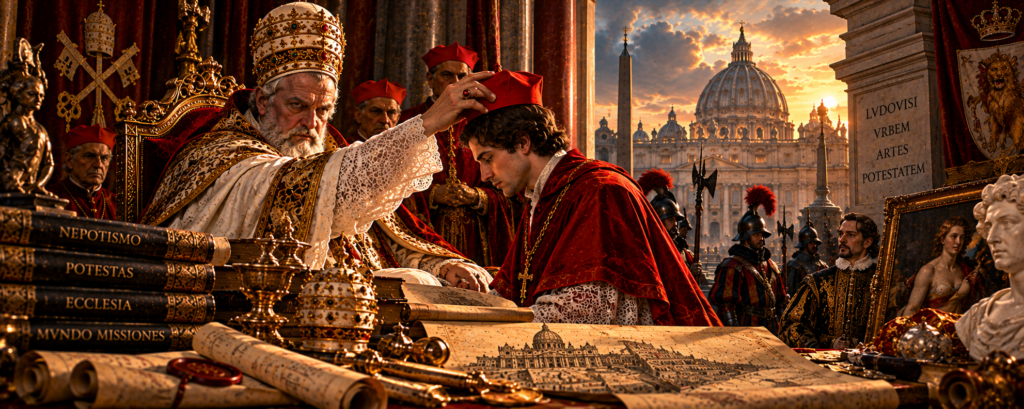
Gregory XV: The Frail Pope Who Handed His Nephew the Keys to the Vatican
Pope Gregory XV (1554–1623) | Reigned 1621–1623
The Young Cardinal Who Suddenly Held the Power of a Pope
In February 1621, a twenty-five-year-old Italian nobleman experienced the kind of transformation that most ambitious men could only dream of. Ludovico Ludovisi had not spent decades governing dioceses, negotiating with kings, or building a reputation as one of the Catholic Church’s greatest theologians. He was young, well-connected, and fortunate enough to possess something far more valuable than experience: his uncle had just become pope. Within days, Ludovico was elevated to the College of Cardinals, and within weeks, he was exercising influence over the government of one of Europe’s most powerful religious institutions.
His uncle, Pope Gregory XV, was sixty-seven years old and already suffering from poor health. He had inherited a papacy entangled in European warfare, diplomatic rivalries, religious persecution, and the endless struggle to preserve Catholic authority against Protestant expansion. The new pope needed capable assistants, but he chose to place extraordinary trust in a member of his own family. Ludovico became the central figure in a system of government where blood relationships could matter as much as theological learning, administrative experience, or personal merit.
The speed of his advancement was remarkable even by the standards of Renaissance and Baroque Rome. On February 15, 1621, only six days after Gregory’s election, Ludovico received the cardinal’s hat. He soon acquired responsibility for important administrative affairs, while his father and younger brother also received prestigious appointments. The Ludovisi family was being transformed from a respected Bolognese household into a papal dynasty, and the process had barely begun.
Over the next two years, Ludovico accumulated offices, ecclesiastical benefices, financial resources, and political influence on an extraordinary scale. He helped direct papal diplomacy during the Thirty Years’ War, participated in the administration of the Church, and became one of Rome’s most important patrons of art. His relatives pursued advantageous marriages and valuable territorial possessions that would preserve the family’s status long after Gregory’s death. The pope’s short reign became an extraordinary demonstration of how quickly ecclesiastical authority could be converted into hereditary wealth and aristocratic prestige.
Yet Gregory XV was not an obvious villain. He was generally regarded as personally respectable, serious about religion, and committed to the Catholic reforms inherited from the previous century. His pontificate produced significant achievements, including reforms to papal elections and the establishment of an institution that would coordinate Catholic missionary activity across the world. He also canonized several of the Counter-Reformation’s most celebrated religious figures and helped shape Catholic policy during a critical stage of the Thirty Years’ War.
That combination makes Gregory particularly revealing. His reputation was not built upon notorious sexual scandals, spectacular cruelty, or the personal extravagance associated with some earlier popes. Instead, the darker aspects of his reign emerged from a political system that treated the elevation of papal relatives as an ordinary function of government. The Church could proclaim religious reform while allowing its highest offices to enrich a single family, and Gregory saw no fundamental contradiction between those two activities.
His pontificate lasted only two years and five months, but the consequences extended far beyond his death. The Ludovisi family emerged with wealth, influence, and valuable connections that would shape its future for generations. Catholic institutions acquired reforms that endured for centuries, while the papacy continued participating in the violent struggle over Europe’s religious and political future. Gregory XV’s story is therefore not simply about an elderly pope and an ambitious nephew, but about the machinery of power operating behind the spiritual authority of the Vatican.
Alessandro Ludovisi: The Making of a Pope
The future Gregory XV was born Alessandro Ludovisi in Bologna on January 9, 1554. His family belonged to the city’s established patrician society, possessing the education and social connections that could open doors within the Church. Bologna was an important intellectual center, particularly renowned for its university and traditions of legal scholarship. It was also part of the Papal States, making ecclesiastical service a natural route toward political advancement.
Alessandro grew up during a period of profound religious transformation. The Council of Trent had recently concluded, and the Catholic Church was working to enforce new standards of clerical discipline, education, and religious administration. Protestant movements had already transformed much of northern Europe, while Catholic rulers and churchmen sought to strengthen institutions that had been shaken by decades of controversy. The young Ludovisi entered a world in which religious commitment and political authority were becoming increasingly intertwined.
He pursued legal studies and developed the expertise necessary for a career within the Roman Curia. His training emphasized canon law, administrative procedure, and the complicated relationship between ecclesiastical and secular jurisdictions. These subjects were essential to papal government, where disputes over property, appointments, and political authority frequently required sophisticated legal arguments. Alessandro’s abilities eventually attracted the attention of influential churchmen.
One of the most important figures in his early career was Ugo Boncompagni, the future Pope Gregory XIII. Like Ludovisi, Boncompagni came from Bologna and possessed a strong legal background. His patronage helped Alessandro enter circles of ecclesiastical influence. The connection would remain important enough that Ludovisi later chose his papal name partly in memory of his distinguished predecessor.
Alessandro’s advancement continued under subsequent pontificates. He held administrative responsibilities and gained experience in diplomatic affairs. His career was characterized more by careful service than by spectacular political ambition. He developed a reputation as a capable, educated, and relatively moderate churchman.
In 1612, Pope Paul V appointed him archbishop of Bologna. The position gave Ludovisi responsibility for an important diocese and allowed him to demonstrate his commitment to the reforms associated with the Council of Trent. He convened diocesan synods and undertook pastoral responsibilities intended to improve ecclesiastical discipline. His work contributed to his reputation as a conscientious bishop.
Ludovisi also participated in diplomatic negotiations involving conflicts among Italian rulers. His experience in mediation helped establish him as a figure capable of dealing with competing political interests. Such skills were valuable in a Europe where religious allegiance, territorial ambition, and dynastic rivalry frequently overlapped. His career suggested that he possessed the temperament of a negotiator rather than a confrontational political adventurer.
Paul V elevated Ludovisi to the College of Cardinals in 1616, although the formal ceremonies associated with his cardinalatial dignity followed later. The appointment placed him among the senior members of the Church and made him eligible for election to the papacy. By 1621, Alessandro had become a respected figure whose reputation was not dominated by scandal. His personal qualities would help make him an acceptable candidate when the next conclave began.
Rome After Paul V: A Papacy Already Ruled by Nephews
When Pope Paul V died on January 28, 1621, he left behind a Church whose government had been profoundly influenced by his own family. His nephew, Cardinal Scipione Borghese, had accumulated immense wealth and political authority during the previous pontificate. Scipione had controlled important administrative affairs, acquired valuable ecclesiastical benefices, and assembled one of Rome’s greatest art collections. His career demonstrated how the position of cardinal-nephew could transform a young relative into one of the most powerful men in Catholic Europe.
The Borghese family’s rise was hardly unprecedented. Earlier papal dynasties, including the Farnese and Aldobrandini, had used ecclesiastical office to secure lasting aristocratic status. The practice of advancing relatives was so deeply embedded in Roman government that many contemporaries considered it normal. A pope was expected to provide for his family, and relatives were often regarded as especially trustworthy assistants.
The system also served a practical political purpose. A reigning pope could not establish a hereditary succession to the papal throne, and his position depended upon the support of cardinals whose loyalties might change. Family members offered a more dependable source of personal allegiance. By placing relatives in powerful positions, a pope could create an administrative network that served his interests while he remained alive.
Yet the arrangement encouraged extraordinary abuses. Offices intended for religious administration could become sources of private income, while ecclesiastical appointments could reward family loyalty rather than ability. A cardinal-nephew might control access to the pope, influence diplomatic negotiations, and direct financial resources toward his household. The concentration of power created opportunities for favoritism that ordinary churchmen could scarcely challenge.
Scipione Borghese had demonstrated the possibilities of this system with remarkable success. He emerged from his uncle’s reign as a wealthy and influential aristocrat whose family possessed substantial estates and cultural prestige. His example was visible to every ambitious household in Rome. The next pope’s relatives could reasonably hope to enjoy similar advantages.
The election of a new pontiff therefore carried enormous consequences beyond the spiritual leadership of the Church. It could determine which family would dominate Roman politics, which cardinals would receive important offices, and which aristocratic alliances would flourish. The conclave was not merely a religious ceremony. It was also a struggle over the distribution of power and wealth.
Alessandro Ludovisi entered this environment as a respected cardinal from Bologna. He did not possess the enormous family resources of some established Roman dynasties. Nevertheless, his election would give the Ludovisi access to opportunities that could transform their social position almost overnight. The machinery of papal nepotism was already waiting for its next beneficiary.
The Conclave of 1621: An Elderly Compromise Candidate
The conclave following Paul V’s death opened on February 8, 1621. The College of Cardinals contained factions associated with powerful families and competing European interests. Spain and France both watched the election closely because the pope’s policies could influence the political balance of Catholic Europe. Cardinals connected to previous pontificates also sought to preserve their influence.
Scipione Borghese entered the conclave with considerable political experience and a network of supporters. As the nephew of the deceased pope, he remained an important figure within the College of Cardinals. He initially favored candidates who might protect Borghese interests. Yet the competing factions made agreement difficult.
Alessandro Ludovisi emerged as an acceptable alternative. He possessed administrative experience, a reputation for moderation, and connections that did not make him intolerable to either the French or Habsburg interests. His advanced age and fragile health may also have made him attractive to cardinals who expected a relatively short pontificate. A pope unlikely to reign for many years could appear less threatening to rival factions.
On February 9, only a day after the conclave opened, Ludovisi was elected pope. He chose the name Gregory XV, recalling his earlier connection with Gregory XIII. The speed of the election was striking in an institution often associated with prolonged political maneuvering. The cardinals had found a candidate capable of satisfying enough competing interests to secure agreement.
Gregory was sixty-seven years old and already suffering from physical weakness. His appearance and manner did not suggest the forceful personality of a warrior pope or an ambitious Renaissance prince. Contemporary descriptions generally portray him as reserved, quiet, and physically unimposing. Yet his position gave him authority over an institution with enormous religious, political, and financial influence.
His election also changed the fortunes of the Ludovisi family. Relatives who had previously occupied respectable but comparatively ordinary positions could now expect advancement. The new pope possessed the power to create cardinals, distribute offices, and influence the acquisition of property. The opportunities were immediate.
Gregory’s coronation took place on February 14, 1621. The ceremonies celebrated the beginning of a new pontificate and the continuity of Catholic authority. Behind the religious pageantry, however, important political decisions were already taking shape. The pope’s nephew was about to become the central figure in his government.
Six Days to a Cardinal’s Hat
Ludovico Ludovisi was born in 1595, making him only twenty-five when his uncle became pope. He belonged to the generation that had grown up after the Council of Trent, when Catholic reform and ecclesiastical bureaucracy had become defining features of Church government. His family connections provided opportunities for education and administrative service. Yet his experience remained limited compared with that of senior cardinals who had spent decades managing dioceses or negotiating with monarchs.
On February 15, 1621, Gregory XV elevated Ludovico to the College of Cardinals. The appointment came only six days after the pope’s election. Its speed revealed how urgently Gregory intended to establish a trusted family representative within the highest levels of government. The young man’s relationship to the pope was plainly central to his advancement.
Ludovico quickly received responsibilities connected with important administrative affairs. He became involved in the supervision of papal government and acquired influence over the handling of correspondence, appointments, and political business. His position placed him close to the center of decision-making. Experienced officials now had to deal with a young cardinal whose authority rested upon his uncle’s confidence.
The appointment followed an established pattern, but its implications were substantial. Gregory was already in poor health and could not personally manage every detail of government. A trusted relative offered practical assistance and political security. Yet the arrangement also concentrated extraordinary power in someone whose qualifications were inseparable from family loyalty.
Ludovico proved more capable than his youth might suggest. He possessed intelligence, energy, and an ability to navigate the complex relationships of the Roman Curia. He developed influence among diplomats and senior ecclesiastical officials. His career cannot fairly be dismissed as that of an incompetent favorite.
Nevertheless, competence did not erase the underlying favoritism. Ludovico received opportunities that countless experienced churchmen could never have obtained. His elevation was not the result of an open competition based upon merit. It was a decision made by a pope who placed extraordinary trust in his nephew.
The young cardinal’s position also created an important political reality. Anyone seeking influence at the papal court needed to understand Ludovico’s role. Diplomatic representatives, aristocratic families, and ecclesiastical officials recognized that access to the nephew could help secure access to the pope. The concentration of influence made him a central figure in Roman politics.
Gregory’s decision therefore shaped the entire pontificate. The pope remained the ultimate source of authority, but Ludovico became an indispensable intermediary. His advancement demonstrated how the cardinal-nephew system could operate almost automatically after a papal election. Within a week, the Ludovisi family had begun its transformation into a ruling dynasty.
The Cardinal-Nephew: A Government Within the Government
The position of cardinal-nephew was one of the most distinctive institutions of early modern papal government. It combined family loyalty, political administration, and access to ecclesiastical wealth. The cardinal-nephew often supervised correspondence, coordinated appointments, and represented the pope in important political affairs. His influence could rival that of officials who possessed far greater experience.
The arrangement emerged partly from the peculiar structure of the papacy. Unlike hereditary monarchs, popes could not simply pass their office to their descendants. Their governments were temporary, and each election could transform the political balance of Rome. A pope therefore needed trusted supporters capable of protecting his interests during his lifetime.
Family members offered a solution. A nephew was expected to remain loyal because his prosperity depended upon the reigning pope. His advancement could also strengthen the wider family, creating a network of relatives whose interests were tied to the pontificate. The system provided personal security within a government filled with rival factions.
Yet the same arrangement encouraged the diversion of resources into private hands. A cardinal-nephew might receive numerous ecclesiastical benefices, each producing income. He could influence appointments and acquire estates through opportunities unavailable to ordinary citizens. His position allowed him to transform temporary political authority into lasting wealth.
Under Gregory XV, Ludovico became the principal beneficiary of this system. He accumulated honors, offices, and financial advantages at a remarkable pace. Contemporary observers recognized the extraordinary scale of his advancement. His career became one of the clearest examples of the wealth available to a papal relative.
The young cardinal also participated in genuine administrative work. He was involved in diplomatic affairs and helped coordinate the government’s response to major European developments. His responsibilities were not purely ceremonial. The problem was not that he performed no useful service, but that useful service existed alongside exceptional private enrichment.
This distinction matters when evaluating Gregory’s reputation. The pope did not simply hand power to an incapable young man who spent his time indulging in pleasures. He elevated a talented relative who could assist with government. Nevertheless, the appointment reinforced a system in which blood relationships determined access to extraordinary authority.
The cardinal-nephew arrangement therefore reveals a deeper institutional problem. Nepotism could become so familiar that it no longer appeared scandalous to those benefiting from it. The Church could condemn corruption in principle while maintaining practices that concentrated wealth within powerful families. Gregory’s pontificate demonstrated how thoroughly those practices had become embedded in government.
The Rest of the Family Comes to Power
Ludovico was not the only relative whose fortunes improved after Gregory’s election. The pope’s brother Orazio Ludovisi received command of the papal military forces. The appointment placed another family member in a position of considerable prestige. Military authority was an important component of the papacy’s temporal government, particularly during a period of international instability.
The pope also advanced Orazio’s younger son Niccolò. Although still a child, Niccolò received appointments associated with important papal territories and fortifications. The offices carried status and financial implications that far exceeded anything an ordinary boy could expect. His youth made the favoritism especially visible.
Such appointments were not necessarily intended to place a child in personal command of military operations. The practical duties could be performed by experienced deputies or administrators. Nevertheless, the titles and associated advantages belonged to the favored relative. The arrangement allowed the family to benefit from offices whose responsibilities required adult expertise.
The practice illustrates the distinction between holding an office and performing its work. Early modern governments frequently distributed titles and benefices through patronage networks. Powerful families could receive the income and prestige associated with positions while delegating their practical responsibilities. The papal court was deeply involved in this political culture.
Gregory’s decisions strengthened the Ludovisi family’s position within Rome. The pope’s brother commanded military authority, his nephew became a cardinal and principal adviser, and younger relatives received valuable appointments. The family’s rise was coordinated across ecclesiastical and secular institutions. Each advancement reinforced the others.
The concentration of offices also created opportunities for future alliances. Aristocratic families recognized the advantages of marriage connections with relatives of the reigning pope. Such relationships could provide access to influence, property, and political protection. The Ludovisi quickly began exploring these possibilities.
The pope’s behavior was consistent with established precedent. Earlier pontiffs had similarly advanced relatives, sometimes with far more dramatic consequences. Gregory was therefore not introducing an entirely new form of corruption. He was participating in a system that had survived repeated attempts at ecclesiastical reform.
That continuity makes his case particularly important. The most revealing feature of Gregory’s nepotism is how ordinary it appeared within the political culture of the papacy. A young nephew became a cardinal, a brother received military command, and a child acquired prestigious offices. The machinery of family advancement operated almost as a routine extension of papal government.
Ludovico Ludovisi: Wealth Beyond Ordinary Imagination
As Gregory’s pontificate continued, Ludovico accumulated ecclesiastical benefices and financial resources on an extraordinary scale. His positions provided income, influence, and opportunities to acquire valuable property. The young cardinal became one of the wealthiest figures associated with the Roman Curia. His fortune grew through a combination of appointments, patronage, and the privileges attached to his office.
Ecclesiastical benefices were particularly important. A benefice could provide income derived from church property or institutions, and powerful clerics sometimes held several simultaneously. The system had long been criticized because it allowed individuals to collect revenues from offices whose pastoral responsibilities they might not personally perform. Catholic reform had attempted to address abuses, but powerful figures continued finding opportunities for accumulation.
Ludovico benefited from this environment. His uncle’s position made valuable appointments available, and the cardinal-nephew possessed considerable influence over their distribution. The resulting income supported his political activities and cultural patronage. It also strengthened the family’s financial position.
His wealth became even more remarkable because it accumulated during such a short pontificate. Gregory ruled for less than two and a half years. Nevertheless, the family secured advantages that would survive for decades. The speed of the transformation demonstrates how concentrated the opportunities of papal government could be.
Ludovico’s prosperity did not depend solely upon money received directly from the pope. His offices and connections gave him access to networks of influence that could produce further benefits. Political authority and financial opportunity reinforced one another. The cardinal’s position became a foundation for continuing wealth.
Contemporaries recognized the scale of his enrichment. Even writers sympathetic to Gregory acknowledged that the nephew received extraordinary honors and financial advantages. The accumulation was difficult to reconcile with the ideal of ecclesiastical service detached from worldly ambition. Ludovico had become both a prince of the Church and a wealthy aristocrat.
The cardinal’s defenders could point to his administrative abilities and support for religious institutions. He was not simply an idle beneficiary of family privilege. His work contributed to important developments during Gregory’s reign. Yet those achievements do not explain why so much wealth and influence should have been concentrated in one relative.
The distinction is central to Gregory’s place among the Wicked Popes. His nephew’s enrichment was not necessarily the product of criminal theft or secret conspiracy. Much of it occurred through accepted mechanisms of ecclesiastical patronage. The troubling reality is that the system itself allowed religious authority to become a source of extraordinary private advantage.
Marriage, Titles, and the Making of a Dynasty
The Ludovisi family understood that the pope’s reign would eventually end. Gregory was elderly and frequently ill, making the future of the household an urgent concern. Relatives needed to convert temporary access to papal power into lasting wealth and political security. Marriage alliances offered one of the most effective methods.
In April 1621, arrangements were made for the marriage of Ippolita Ludovisi to Giovanni Giorgio Aldobrandini, a member of another prominent papal family. The alliance connected the Ludovisi to the household associated with Pope Clement VIII. It brought together families whose fortunes had been shaped by ecclesiastical office. Such marriages helped preserve influence across successive pontificates.
The Aldobrandini connection was politically valuable. A new pope could not guarantee that his relatives would retain influence after his death. Alliances with established aristocratic families provided protection against that uncertainty. They also strengthened claims to property, status, and future appointments.
The Ludovisi pursued another important marriage arrangement involving Niccolò Ludovisi and Isabella Gesualdo. Isabella was heiress to the principality of Venosa and possessed connections to one of southern Italy’s great noble fortunes. The proposed union offered access to territorial wealth and hereditary prestige. Its significance extended far beyond the personal lives of the young couple.
The marriage agreement was concluded in 1622, during Gregory’s pontificate. It formed part of a wider strategy to secure the family’s future. The Ludovisi were not content to remain dependent upon ecclesiastical offices. They sought the titles and estates that would establish them permanently among Italy’s ruling aristocracy.
Niccolò’s later marriages, after Gregory’s death, further strengthened these connections. Through subsequent unions, the family became linked with other important dynasties, including the Pamphili. These developments occurred beyond Gregory’s lifetime but reflected the foundation laid during his reign. The pope’s relatives had entered a world of aristocratic alliances that would continue shaping their fortunes.
The strategy resembled that of earlier papal families. The Farnese had used papal influence to establish territorial power, while the Borghese had accumulated estates and princely status under Paul V. The Ludovisi followed the same pattern. Their rise demonstrates how papal government could function as a launching point for hereditary aristocracy.
The Church’s highest office therefore became an instrument of family advancement. Religious authority opened the door to titles, estates, and marriages that transformed the social position of the pope’s relatives. The process was not hidden or necessarily regarded as extraordinary by contemporaries. It was a recognized feature of Roman political life, which makes its moral implications all the more striking.
The Frail Pope and the Question of Who Really Ruled
Gregory XV’s declining health made Ludovico’s influence especially important. The pope suffered from physical weakness and recurring illnesses that limited his ability to manage the demands of government. Contemporary descriptions portray him as reserved and often physically exhausted. His condition created practical reasons to rely upon trusted advisers.
Ludovico became the most prominent of those advisers. His responsibilities extended across important areas of papal administration. Diplomatic representatives recognized his influence, and officials understood that he could help determine which matters reached the pope. His position gave him substantial control over the daily operation of government.
Yet it would be misleading to claim that Gregory simply surrendered all authority to his nephew. The pope remained involved in major decisions and possessed his own political and religious priorities. He also relied upon experienced officials outside the Ludovisi family. The government was not controlled by a single young cardinal acting without supervision.
Giovanni Battista Agucchi was among the important advisers associated with Gregory’s administration. A capable diplomat and intellectual, Agucchi possessed experience that complemented Ludovico’s political position. Other senior cardinals and officials also participated in government. Their presence demonstrates that the papal administration remained a complex institution.
Nevertheless, Ludovico’s family relationship gave him advantages unavailable to those officials. He enjoyed personal access and trust that could outweigh seniority or expertise. His influence depended upon the pope’s confidence as much as upon formal responsibilities. The arrangement made the distinction between public administration and private loyalty difficult to maintain.
Gregory appears to have understood the dangers facing his nephew after his own death. Accounts of his advice to Ludovico emphasize caution, modesty, and the need to avoid provoking hostility among rival cardinals. The pope recognized that the extraordinary power of a cardinal-nephew depended upon the survival of the reigning pontiff. Once that protection disappeared, resentment could become dangerous.
This awareness adds a revealing dimension to Gregory’s behavior. He understood that Ludovico’s position was politically precarious, yet he continued supporting his advancement. The pope wanted his nephew to benefit from the opportunities of the pontificate while avoiding the consequences that might follow. Family loyalty remained central to his decisions.
The question of who truly ruled during Gregory’s reign therefore has no simple answer. The pope retained ultimate authority, but his nephew exercised exceptional influence over its administration. Their relationship reflected both practical necessity and dynastic ambition. The result was a government in which family privilege became an essential component of institutional power.
Europe Was Already Burning
Gregory XV inherited the papacy during one of the most dangerous periods in early modern European history. The Thirty Years’ War had begun in 1618, and its early stages were transforming the political and religious balance of the Holy Roman Empire. Protestant and Catholic rulers competed over territory, constitutional rights, and religious authority. The conflict threatened to spread beyond its original centers.
The immediate crisis had developed in Bohemia, where Protestant nobles resisted the policies of the Catholic Habsburg dynasty. Their rebellion challenged the authority of Emperor Ferdinand II. The conflict became increasingly violent as armies entered the struggle. Religious identity intensified political rivalries and encouraged outside intervention.
In November 1620, Catholic forces defeated the Bohemian rebels at the Battle of White Mountain near Prague. The victory was decisive for the Habsburg position in Bohemia. It also created opportunities for the restoration of Catholic authority in territories where Protestant institutions had become influential. The consequences would be profound for the region’s religious and political future.
Gregory became pope only a few months after the battle. He inherited a situation in which Catholic rulers appeared to be gaining important victories. The papacy had already supported the Catholic cause under Paul V. Gregory continued that policy and regarded the conflict as an opportunity to strengthen Catholic interests.
The war was not simply a struggle between two unified religious camps. Dynastic rivalry, territorial ambition, and constitutional disputes played major roles. Catholic rulers could disagree with one another, while Protestant powers pursued different political objectives. Nevertheless, religious identity remained a powerful force shaping alliances and justifying military action.
Gregory’s government provided financial and diplomatic support to Catholic interests. The pope viewed the restoration of Catholic authority as an important responsibility. His advisers participated in efforts to coordinate policy with the Habsburg emperor and other Catholic rulers. Ludovico Ludovisi became involved in the diplomatic machinery surrounding these decisions.
The consequences for ordinary people were severe. Warfare brought destruction, displacement, taxation, and the disruption of agricultural life. Religious policies imposed after military victories could force communities to abandon established practices. The political ambitions of rulers were experienced by civilians as uncertainty, hardship, and coercion.
Gregory did not create the Thirty Years’ War, and he died long before its most devastating stages. Nevertheless, his pontificate belonged to a period when the papacy actively supported one side of a conflict that would eventually devastate central Europe. His policies reveal how religious leadership remained entangled with military and dynastic struggles. The pope’s commitment to Catholic restoration carried consequences far beyond Rome.
Bohemia After the Battle of White Mountain
The Catholic victory at White Mountain transformed Bohemia’s political future. Ferdinand II regained control over the rebellious kingdom and moved to strengthen Habsburg authority. Protestant nobles faced confiscations, exile, and the loss of political influence. The religious landscape began changing under pressure from the victorious Catholic government.
The process of recatholicization was not merely a matter of persuasion. Political authority and religious conformity were closely connected. Protestant institutions faced restrictions, and communities were increasingly expected to accept Catholic practices. The restoration of Catholic dominance involved measures that could disrupt families and local traditions.
Gregory supported the broader Catholic cause and regarded the defeat of Protestant rebellion as a significant development. His government maintained diplomatic relations with the Habsburg court and encouraged policies favorable to Catholic restoration. The papacy viewed religious unity as essential to political stability. Yet that understanding of unity often left little room for dissent.
The emperor’s policies also reflected dynastic objectives. Ferdinand sought to strengthen hereditary authority and reduce the independence of estates that had challenged his rule. Religious measures therefore supported political centralization. The struggle over faith was inseparable from the struggle over sovereignty.
The papacy’s involvement must be understood within this wider context. Gregory did not personally administer every confiscation or religious restriction imposed in Bohemia. Those measures were carried out by Habsburg authorities and their representatives. Nevertheless, papal support for the Catholic cause contributed to the political environment in which coercive restoration proceeded.
The distinction between direct responsibility and broader support is important. It would be inaccurate to attribute every act of repression in Bohemia personally to Gregory XV. At the same time, his government supported the political and religious objectives of the victorious Catholic powers. The pope was not a detached observer of the conflict.
The events illustrate the moral difficulties surrounding Counter-Reformation politics. Catholic authorities regarded the restoration of their religion as a legitimate and desirable objective. Protestant communities often experienced the same process as persecution and dispossession. The difference between religious reform and religious coercion depended heavily upon one’s position within the struggle.
Gregory’s pontificate therefore belongs to the darker history of Europe’s confessional conflicts. His support for Catholic victory reflected the priorities of his age. It also connected the papacy to a political system in which religious conformity could be enforced through state power. The consequences were particularly severe for communities that found themselves on the losing side.
Frederick V, Maximilian of Bavaria, and the Electoral Prize
One of the most important political questions during Gregory’s pontificate concerned Frederick V, the Protestant Elector Palatine. Frederick had accepted the crown of Bohemia during the rebellion against Ferdinand II. His brief reign ended after the Catholic victory at White Mountain. He became known as the Winter King, a nickname reflecting the short duration of his rule.
Frederick’s defeat created an opportunity to reshape the political structure of the Holy Roman Empire. His electoral dignity gave him a vote in the selection of the emperor. Removing that dignity from a Protestant ruler and transferring it to a Catholic prince would alter the balance within the imperial electoral college. The issue therefore possessed enormous religious and political significance.
Maximilian I of Bavaria emerged as the principal beneficiary of the proposed transfer. A powerful Catholic ruler and leader of the Catholic League, Maximilian had provided important military support to the emperor. He sought compensation for his efforts and hoped to secure the electoral dignity. The transfer would elevate his position within the empire.
Gregory supported the advancement of Maximilian. The pope regarded the strengthening of Catholic representation among the imperial electors as a major achievement. His government used diplomatic influence to encourage the transfer. Papal representatives participated in negotiations surrounding the issue.
In February 1623, Ferdinand II formally invested Maximilian with the electoral dignity previously held by Frederick V. The decision strengthened the Catholic position within the empire. It also deepened the grievances of Protestant rulers who regarded the transfer as a dangerous precedent. The political consequences would continue shaping the war.
Gregory’s involvement demonstrates the papacy’s active participation in European power politics. The pope was not merely encouraging private religious devotion. He supported a constitutional change that altered the balance of power within the Holy Roman Empire. Religious objectives and dynastic interests operated together.
The transfer also reveals the complexity of the Catholic cause. Maximilian sought personal and territorial advantage as well as religious victory. Ferdinand needed military support and political stability. Gregory wanted to strengthen Catholic influence. Their interests overlapped, but they were not identical.
The episode therefore belongs to the broader history of the papacy as a political institution. Gregory used diplomatic influence to support a Catholic ruler’s acquisition of power. The decision had consequences for the empire’s constitutional order and the continuation of religious conflict. It was a significant achievement for Catholic diplomacy, but hardly a neutral act of spiritual leadership.
The Heidelberg Library: A Prize of War
The defeat of Protestant power in the Palatinate produced another extraordinary episode during Gregory’s pontificate. Heidelberg possessed one of Europe’s most celebrated libraries, the Bibliotheca Palatina. Its collections included valuable manuscripts and printed books accumulated over generations. The library represented an important center of learning within the Protestant Palatinate.
After Catholic forces gained control of Heidelberg, the library became a prize of war. Maximilian of Bavaria arranged for its transfer to Pope Gregory XV. The gift was presented as an expression of gratitude for papal support. It also symbolized the triumph of Catholic power over a defeated Protestant territory.
The collection contained thousands of valuable works. Manuscripts of theology, history, literature, and other subjects had been preserved within the Palatine library. Their removal represented a substantial cultural loss for Heidelberg. The books were transported to Rome and incorporated into the Vatican Library.
The transfer required careful organization. Leo Allatius, a learned Greek scholar associated with the Vatican, was entrusted with overseeing the movement of the collection. The undertaking involved identifying, packing, and transporting valuable materials across considerable distances. It was a major operation involving one of Europe’s most important collections.
From the papal perspective, the acquisition enriched the Vatican Library and preserved valuable works within a major scholarly institution. The collection remained accessible to learned circles associated with Rome. Its arrival enhanced the prestige of the papacy. Gregory’s name became connected with a significant cultural acquisition.
From the perspective of Heidelberg, however, the event was a forced removal of cultural property following military defeat. The library had been assembled within a particular intellectual and political community. Its transfer deprived that community of an important part of its heritage. The episode demonstrates how warfare could redistribute cultural treasures.
The books were not destroyed, and their preservation within the Vatican was significant. Nevertheless, preservation does not erase the circumstances of their removal. The collection entered Rome as a consequence of conquest and political power. Its history therefore raises questions about ownership, cultural displacement, and the spoils of war.
The Heidelberg library episode adds another dimension to Gregory’s legacy. His pontificate supported the acquisition of valuable scholarship, but the opportunity arose from the defeat of a Protestant ruler. The Vatican benefited from the political consequences of religious warfare. The episode reveals how intellectual treasures could become instruments of victory and prestige.
Propaganda Fide: The Church Organizes Its Global Mission
One of Gregory XV’s most enduring achievements came in January 1622, when he established the Sacred Congregation for the Propagation of the Faith. The institution, commonly known by its Latin name Propaganda Fide, was intended to coordinate Catholic missionary activity. Its creation marked an important development in the administration of the global Church. The congregation would eventually become one of the most influential institutions of Catholic missionary history.
Before its establishment, missionary activity often depended heavily upon religious orders and the patronage systems of Catholic monarchies. Spain and Portugal possessed extensive overseas empires and exercised significant influence over ecclesiastical affairs within their territories. Missionaries frequently operated within political structures shaped by imperial expansion. The papacy sought greater coordination and more direct oversight.
Gregory’s new congregation provided an institutional framework for managing missionary affairs. It could gather information, supervise activities, and help direct resources toward regions considered important for Catholic expansion. The arrangement strengthened the Roman Curia’s ability to influence religious developments beyond Europe. It also reflected the Church’s growing awareness of its global responsibilities.
The institution’s creation was not simply an administrative reform. It represented an effort to centralize authority over the spread of Catholicism. Missionary activity became more closely connected with Roman government. The papacy sought to reduce dependence upon the priorities of individual monarchies and religious orders.
The congregation eventually became involved in missionary work across Asia, Africa, the Americas, and other regions. Its later history extended far beyond Gregory’s short pontificate. It supported educational initiatives, missionary training, and the development of ecclesiastical institutions. Its influence would become a defining feature of modern Catholic missionary organization.
The historical legacy of missionary expansion is complicated. Missionaries sometimes defended local communities against exploitation and contributed to education and scholarship. They also operated within systems of European imperial expansion that could involve coercion, cultural disruption, and unequal power relationships. The consequences varied greatly across regions and periods.
Gregory’s establishment of Propaganda Fide should therefore be evaluated within its historical context. The congregation was a major administrative achievement that strengthened the global organization of the Catholic Church. It also represented the centralization of religious authority in Rome. Its later activities would become entangled with the wider history of colonialism and cultural transformation.
For Gregory personally, the institution demonstrated genuine administrative vision. He was not simply an elderly pope whose nephew controlled everything. His pontificate produced reforms with consequences lasting centuries. The establishment of Propaganda Fide remains one of the strongest reasons to regard his reign as historically significant.
The Pope Who Changed How Popes Were Elected
Gregory XV also introduced important reforms to the process of electing future popes. The conclave system had long been vulnerable to factional bargaining, political pressure, and the influence of powerful Catholic monarchies. Cardinals frequently entered elections with loyalties shaped by family connections and international interests. The resulting negotiations could become prolonged and contentious.
Gregory understood these problems from personal experience. His own election had depended upon agreement among competing factions. The speed of the 1621 conclave did not eliminate the influence of political calculation. The pope recognized that the procedures governing elections required greater clarity.
On November 15, 1621, he issued the bull Aeterni Patris Filius. The document established important regulations concerning papal elections. It emphasized secret voting and defined recognized methods of choosing a pope. The reforms sought to reduce abuses associated with open factional pressure.
The ordinary method of election was to be voting by scrutiny. Cardinals would cast secret ballots, and the successful candidate would require the necessary supermajority. Other recognized methods involved agreement through compromise or election by a form of unanimous acclamation. The procedures were intended to create a more orderly and legitimate electoral process.
In March 1622, Gregory issued Decet Romanum Pontificem, which provided additional ceremonial regulations. Together, the measures established a framework that influenced papal elections for centuries. Later popes modified the rules, but Gregory’s reforms became an important foundation of the modern conclave system. His contribution was substantial.
The reforms also reveal an interesting contradiction. Gregory sought to limit the influence of political factions during papal elections while allowing his own relatives to accumulate extraordinary power. He recognized the dangers of patronage and factional pressure within the College of Cardinals. Yet he continued supporting the cardinal-nephew system that helped sustain those same political networks.
This contradiction does not make the electoral reforms meaningless. The new procedures improved the institutional framework for choosing future popes. They represented a genuine attempt to address problems within ecclesiastical government. Gregory’s administration was capable of important reform even while preserving entrenched privileges.
The episode demonstrates why his reputation requires careful treatment. He was neither a simple reforming hero nor an obviously corrupt tyrant. His government could strengthen institutional procedures while enriching his family. The same pontificate produced both lasting administrative improvements and extraordinary nepotism.
Five New Saints and a Celebration of Catholic Triumph
On March 12, 1622, Gregory XV presided over one of the most remarkable canonization ceremonies in Catholic history. Five figures were formally recognized as saints: Ignatius of Loyola, Francis Xavier, Teresa of Ávila, Philip Neri, and Isidore the Farmer. The event celebrated individuals whose lives represented different aspects of Catholic devotion and reform. It also carried considerable religious and political significance.
Ignatius of Loyola had founded the Society of Jesus, commonly known as the Jesuits. The order became one of the most influential institutions of the Counter-Reformation, emphasizing education, missionary work, and loyalty to the papacy. Its members played important roles in Catholic renewal across Europe and beyond. Canonizing Ignatius honored the founder of a movement closely associated with the Church’s response to Protestant expansion.
Francis Xavier was celebrated for his missionary activity in Asia. His work symbolized the global ambitions of Catholic evangelization. His canonization complemented Gregory’s establishment of Propaganda Fide. Together, the developments emphasized the Church’s commitment to extending its religious influence beyond Europe.
Teresa of Ávila represented another dimension of Catholic reform. Her writings and work within the Carmelite tradition emphasized spiritual discipline, prayer, and religious renewal. She had become one of the most influential figures of sixteenth-century Catholic spirituality. Her canonization recognized the importance of contemplative reform alongside missionary activity.
Philip Neri, founder of the Oratorian movement, was associated with religious renewal in Rome. His emphasis upon pastoral care and spiritual community offered a different model of Catholic reform. Isidore the Farmer represented the sanctity of ordinary labor and devotion. The group therefore included figures whose lives appealed to different aspects of Catholic society.
The canonizations also reflected political pressures. Catholic monarchies and religious orders had strong interests in promoting particular candidates. Spain possessed especially important connections to several of the new saints. The inclusion of Philip Neri helped broaden the ceremony beyond a predominantly Spanish celebration.
The event demonstrated the papacy’s ability to shape religious memory. Canonization elevated particular lives as models of sanctity and devotion. It also reinforced the institutional authority of Rome, which possessed the power to recognize saints formally. The ceremony was both a religious celebration and a statement of Catholic identity.
Gregory’s role in the canonizations was a genuine achievement of his pontificate. The event strengthened the symbolic legacy of the Catholic Reformation. Yet it also occurred within a Church whose government remained deeply influenced by family patronage and political calculation. The contrast between spiritual ideals and institutional privilege was impossible to ignore.
The Ludovisi Collection: Art, Wealth, and Political Prestige
Like the Borghese before them, the Ludovisi recognized the political value of artistic patronage. Wealthy Roman families used architecture, painting, and sculpture to display their status. A magnificent collection could establish cultural prestige that survived long after a particular pope’s death. Art became an important component of aristocratic identity.
Ludovico Ludovisi developed a substantial collection and supported important artists. His patronage reflected genuine artistic interest as well as the desire for family prestige. The Ludovisi became associated with works by major painters and sculptors of the period. Their cultural ambitions helped establish them among Rome’s leading households.
One of the most important properties associated with the family was the Villa Ludovisi. Its gardens and buildings became celebrated features of seventeenth-century Rome. The estate provided a setting for artistic display and aristocratic leisure. Its development reflected the wealth accumulated during Gregory’s pontificate.
The painter Guercino became closely associated with Ludovisi patronage. His celebrated ceiling fresco of Aurora, created for the Casino Ludovisi, became an important work of Baroque art. The painting demonstrated the family’s willingness to commission ambitious projects. It also helped establish the cultural reputation of their Roman residence.
Other artists, including Domenichino, received commissions associated with the papal court and Ludovisi circle. The family’s patronage contributed to the artistic development of Rome during a period of remarkable creativity. The resulting works became part of the city’s cultural heritage. Their survival continues to shape the reputation of the Ludovisi.
Yet the relationship between artistic achievement and political privilege remained complicated. The wealth supporting these commissions came partly from offices and opportunities associated with papal government. Ludovico’s position as cardinal-nephew provided resources unavailable to most patrons. The family’s artistic legacy therefore emerged from the same system that encouraged nepotism.
This does not diminish the artistic quality of the works themselves. Great art can emerge from political circumstances that deserve criticism. The achievements of painters and sculptors should be recognized independently of the conduct of their patrons. Nevertheless, the history of patronage reveals how cultural magnificence could depend upon concentrated power.
The Ludovisi collection therefore resembles the Borghese legacy in important respects. Both families used a papal pontificate to accumulate wealth and artistic prestige. Both supported major artists whose works remain celebrated. Both demonstrate how the papacy could function as an engine of aristocratic enrichment.
The Cardinal Who Became a Prince of the Church
Ludovico’s transformation from a young ecclesiastical official into a wealthy cardinal was extraordinary. He possessed political influence, valuable benefices, and the resources necessary to maintain an impressive household. His position placed him among the most important figures in Rome. The speed of his advancement remained inseparable from his uncle’s election.
The cardinal’s responsibilities also extended into international diplomacy. During the Thirty Years’ War, papal representatives communicated with Catholic rulers and sought to influence the course of events. Ludovico participated in the administration of these policies. His role required political judgment and familiarity with European affairs.
He was therefore more than a decorative relative occupying a ceremonial position. His abilities helped him exercise the authority entrusted to him. Contemporary assessments recognized his intelligence and administrative energy. The criticism of his advancement concerns the system that gave him power rather than an assumption that he possessed no talent.
Nevertheless, his wealth and offices raised serious questions about the purpose of ecclesiastical appointments. Church positions were intended to support religious administration and pastoral responsibilities. When they became instruments of family enrichment, their spiritual purpose could be overshadowed. Ludovico’s career demonstrated how easily that transformation could occur.
His financial position also allowed him to support religious institutions. He contributed to projects associated with Catholic education and devotion. Such patronage could be presented as evidence that his wealth served the Church. Yet charitable or religious expenditure did not eliminate the advantages created by nepotism.
The relationship between wealth and religious patronage was common in Baroque Rome. Powerful cardinals financed churches, colleges, and artistic commissions. These projects could provide genuine benefits while enhancing the donor’s prestige. The distinction between devotion and self-promotion was often difficult to establish.
Ludovico’s career therefore reveals the ambiguity of the cardinal-nephew system. He could be capable, religiously committed, and generous while still benefiting from extraordinary favoritism. His success was not necessarily evidence of personal depravity. It was evidence of an institution that allowed family relationships to determine access to wealth and power.
Gregory’s responsibility lies in his decision to sustain that arrangement. He chose to elevate his nephew rapidly and support his accumulation of influence. The pope may have believed that family loyalty was essential to effective government. Nevertheless, the resulting concentration of privilege remained difficult to reconcile with ideals of impartial ecclesiastical service.
Rome’s Financial Problems and the Cost of Government
The papacy’s financial responsibilities were substantial during Gregory’s reign. Rome required food supplies, public administration, and the maintenance of important religious institutions. The Papal States also faced military and diplomatic expenses. These obligations placed pressure upon the government’s resources.
Agricultural difficulties created additional problems. During the early 1620s, parts of Italy experienced shortages and rising concerns over grain supplies. The papal government attempted to secure food imports and stabilize the availability of bread. Such measures were essential because shortages could produce unrest among urban populations.
Gregory’s administration sought grain from several regions. Officials attempted to maintain supplies and regulate prices in order to protect consumers. These interventions could impose substantial costs upon public finances. The government faced difficult choices between fiscal stability and the immediate needs of the population.
Ludovico participated in the administration of these problems. His role was not limited to distributing favors or acquiring property. He helped manage a government confronting practical economic challenges. The episode demonstrates the genuine administrative responsibilities attached to his position.
Nevertheless, the contrast between public financial pressure and private family enrichment was striking. The papal government struggled with the costs of maintaining food supplies while relatives accumulated valuable offices and estates. The two developments were not necessarily financed through identical mechanisms. Yet they reveal the unequal distribution of opportunities within papal society.
Ordinary Romans experienced the consequences of shortages and economic uncertainty. Wealthy ecclesiastical families possessed resources that insulated them from many such difficulties. The political elite could continue commissioning art and acquiring property while the government confronted the basic problem of feeding the population. The contrast was a familiar feature of early modern urban life.
Gregory’s efforts to stabilize food supplies deserve recognition. They demonstrate that his administration did not simply neglect public responsibilities. The government undertook measures intended to protect the city from scarcity. Such policies formed part of the ordinary duties of a temporal ruler.
The financial pressures of the period nevertheless complicate the moral picture. A pope responsible for public welfare also permitted exceptional enrichment among his relatives. The arrangement reflected the broader political culture of the papacy. It also exposed the tension between government as public service and government as family opportunity.
The Pope’s Failing Health
Gregory’s physical condition remained a persistent concern throughout his pontificate. He had been elderly and relatively frail at the time of his election. The demands of papal government were substantial, requiring attention to religious administration, diplomatic correspondence, and political disputes. His health limited his ability to maintain the pace expected of a vigorous ruler.
Contemporary accounts describe recurring weakness and attacks of gout. The illness could cause severe pain and interfere with movement. During the later stages of his reign, Gregory experienced increasingly serious episodes. His condition made the assistance of trusted advisers especially important.
Ludovico’s influence therefore developed within a practical environment shaped by the pope’s limitations. The young cardinal possessed the energy necessary to handle demanding administrative responsibilities. His uncle relied upon him as a trusted intermediary. Their relationship combined family affection with political necessity.
The pope nevertheless remained concerned about the future. His death would remove the protection upon which Ludovico’s extraordinary position depended. Rival factions might seek revenge or attempt to reduce the family’s influence. The political dangers facing a former cardinal-nephew were well understood in Rome.
Gregory reportedly advised Ludovico to behave cautiously after the pontificate ended. He encouraged restraint in political affairs and warned against provoking unnecessary hostility. Such advice reflected the pope’s awareness of the temporary nature of family power. The same system that elevated a nephew could expose him to danger once his uncle died.
The warning also reveals the precarious foundations of papal nepotism. A family could accumulate enormous wealth during one pontificate but lose political influence after the next election. The survival of its fortunes depended upon property, marriages, and relationships established before the reigning pope’s death. The Ludovisi had worked rapidly to secure those advantages.
By 1623, Gregory’s health had deteriorated significantly. His final illness unfolded while the Church continued confronting the consequences of the Thirty Years’ War. The pope’s government remained active, but his physical strength was failing. The end of the pontificate was approaching.
The prospect of his death created uncertainty for Ludovico and the wider family. Their wealth was substantial, but their privileged access to government could not be guaranteed. A new pope would bring different relatives and advisers into prominence. The Ludovisi needed to preserve what they had acquired before the political landscape changed.
July 1623: The Death of Gregory XV
Gregory XV died on July 8, 1623, at the Quirinal Palace in Rome. He was sixty-nine years old and had occupied the papal throne for approximately two years and five months. His pontificate was short, but it had produced significant administrative and political developments. The Church he left behind was not identical to the institution he had inherited.
His electoral reforms had established procedures that would influence papal conclaves for centuries. Propaganda Fide had created a new institutional framework for Catholic missionary activity. The canonizations of 1622 had celebrated important figures of the Catholic Reformation. His government had also supported Catholic interests during the early stages of the Thirty Years’ War.
The Ludovisi family had benefited enormously. Ludovico possessed wealth, offices, and political connections that placed him among Rome’s leading figures. Other relatives had acquired appointments and valuable marriage alliances. The family’s transformation had occurred within an astonishingly brief period.
Gregory’s death ended the direct advantages of having a reigning pope in the household. Ludovico remained a cardinal, but he no longer possessed the same personal access to the supreme authority of the Church. His political future depended upon the outcome of the next conclave. Rival factions were already preparing to compete for influence.
The election of Urban VIII later that summer introduced a new papal dynasty. The Barberini family would eventually become another extraordinary example of nepotism and aristocratic enrichment. Gregory’s death therefore did not end the system that had benefited the Ludovisi. It merely transferred the opportunities of papal government to a new household.
Ludovico continued exercising influence after his uncle’s death, although his position changed. He remained involved in ecclesiastical affairs and retained considerable wealth. His later career demonstrated that the advantages accumulated during Gregory’s pontificate could survive the loss of direct papal protection. He died in 1632, less than a decade after his uncle.
The Ludovisi family’s fortunes continued beyond both men. Its aristocratic alliances and property holdings preserved the prestige established during the pontificate. The family became part of the wider network of Italian noble houses whose status had been shaped by papal patronage. Gregory’s brief reign had created consequences lasting generations.
His death therefore provides an important perspective on the nature of his achievement. He had governed for only a short time, yet his family emerged transformed. The papacy had served as an extraordinary instrument of social advancement. The process reveals how much wealth and influence could be concentrated through ecclesiastical office.
The Barberini Arrive: Nepotism Continues
The election of Urban VIII in 1623 demonstrated that Gregory’s nepotism was not an isolated phenomenon. Urban belonged to the Barberini family, another ambitious Italian household eager to establish lasting aristocratic prestige. His pontificate would become notorious for the advancement of relatives. The machinery of family government continued operating under a new name.
The transition reveals the structural nature of the problem. Gregory had inherited a papacy shaped by Borghese influence. He transformed it into a center of Ludovisi advancement. Urban VIII would then use the same institution to promote the Barberini.
Each family sought to convert temporary ecclesiastical authority into permanent social advantage. Cardinal-nephews became central figures in government, while relatives acquired titles, property, and valuable marriages. The pattern repeated because the incentives remained powerful. A papal election could transform the fortunes of an entire household.
The system also created competition among former papal families. The Borghese, Aldobrandini, Ludovisi, and Barberini all possessed resources accumulated during earlier pontificates. Their members continued participating in Roman politics after their respective popes died. The city became a landscape of competing dynastic legacies.
These families were also major patrons of art and architecture. Their wealth supported churches, palaces, fountains, and collections that remain celebrated. The cultural achievements of Baroque Rome cannot be separated entirely from the political structure that financed them. Nepotism helped produce both artistic magnificence and extraordinary concentrations of private wealth.
Gregory’s place within this sequence is particularly revealing because his pontificate was so short. He did not need decades to establish his family’s position. A little more than two years proved sufficient to distribute offices, secure alliances, and accumulate substantial resources. The speed of the process demonstrates how institutionalized the system had become.
The succession from Borghese to Ludovisi to Barberini also undermines any interpretation that treats nepotism solely as a matter of individual moral weakness. Personal ambition certainly mattered, but the political structure encouraged the practice. Popes inherited expectations that relatives would receive advancement. The system rewarded those who participated and offered few incentives for restraint.
Gregory therefore belongs to a broader history of papal family government. His actions were neither unprecedented nor uniquely extreme. Their significance lies in how clearly they demonstrate the persistence of nepotism after decades of Catholic reform. The institution had changed in many ways, but family privilege remained deeply embedded within its highest offices.
Was Gregory XV Really a Wicked Pope?
Gregory XV is a more complicated candidate for the Wicked Popes category than many of his predecessors. He was not associated with notorious sexual scandals, spectacular personal cruelty, or the deliberate murder of political opponents. His reputation was generally that of a serious and religiously committed churchman. His short pontificate produced several important reforms.
His achievements deserve recognition. The establishment of Propaganda Fide strengthened the organization of Catholic missionary activity. His reforms to papal elections helped create procedures that influenced conclaves for centuries. The canonizations of 1622 celebrated important figures of Catholic spirituality and religious reform.
His government also confronted genuine administrative challenges. Food shortages required practical intervention, while the Thirty Years’ War created serious diplomatic difficulties. Gregory relied upon experienced advisers and attempted to manage the responsibilities of a major European religious institution. His pontificate was not simply an exercise in family enrichment.
Nevertheless, the advancement of Ludovico Ludovisi raises serious questions. The young nephew received extraordinary authority within days of Gregory’s election. He accumulated offices, benefices, and wealth that transformed his position. Other relatives received military appointments, titles, and opportunities for advantageous marriages.
The scale of this favoritism cannot be explained entirely by administrative necessity. Ludovico possessed genuine ability, but countless capable churchmen lacked access to comparable opportunities. His relationship to the pope was the decisive factor in his advancement. The resulting concentration of wealth and influence reflected a system of government built upon family privilege.
Gregory’s support for Catholic interests during the Thirty Years’ War also complicates his reputation. His government participated in the political struggle surrounding the restoration of Catholic authority in central Europe. The transfer of the Palatine electoral dignity strengthened Catholic influence within the Holy Roman Empire. These policies were understood as religiously justified but carried consequences for defeated Protestant communities.
The Heidelberg library episode further illustrates the relationship between religion and political power. The Vatican acquired a magnificent collection of manuscripts and books after Catholic military victory. The transfer enriched an important scholarly institution while depriving Heidelberg of a major cultural treasure. The event reveals how religious warfare could produce cultural displacement.
Yet Gregory’s involvement in these developments should not be exaggerated. He did not personally direct every act of repression carried out by Catholic rulers. Nor did he create the conflicts that had already engulfed central Europe before his election. His responsibility lies in the policies and alliances pursued by his government.
The strongest argument for including Gregory among the Wicked Popes therefore concerns institutional corruption rather than personal depravity. His pontificate demonstrates how a respectable and reform-minded pope could participate enthusiastically in a system of extraordinary nepotism. The same government that strengthened Catholic institutions also enriched a privileged family. That contradiction makes Gregory historically important.
The Church That Reformed Everything Except Its Families
The Council of Trent had concluded in 1563, nearly six decades before Gregory became pope. Its reforms had addressed important problems involving clerical education, discipline, and religious administration. Bishops were expected to fulfill pastoral responsibilities, seminaries expanded, and Catholic institutions sought to improve standards of religious life. The Counter-Reformation transformed the Church in significant ways.
Yet nepotism remained remarkably resilient. Popes continued elevating relatives to positions of authority and allowing families to accumulate wealth through ecclesiastical office. The practice survived because it served political interests deeply embedded within the structure of papal government. Family loyalty provided security, while patronage helped maintain networks of influence.
Gregory’s pontificate illustrates the contradiction. He supported reforms intended to strengthen institutional order and religious discipline. He also elevated his nephew almost immediately after his election. The two activities occurred within the same government without appearing fundamentally incompatible to those responsible.
The cardinal-nephew system was especially difficult to reform because it benefited the men who possessed the authority to change it. A pope could condemn abuses associated with other offices while regarding his own relatives as necessary assistants. The distinction between legitimate family support and improper favoritism remained flexible. Powerful households had little incentive to surrender their advantages.
The accumulation of ecclesiastical benefices created additional problems. Offices intended to support religious institutions could provide substantial income to individuals whose responsibilities were primarily political. The system encouraged the concentration of wealth among senior clerics. It also created opportunities for appointments based upon influence rather than pastoral need.
Ludovico’s career demonstrates how these arrangements operated. His uncle’s election opened the door to extraordinary advancement. His administrative abilities helped him exercise the resulting authority, but family loyalty remained the foundation of his position. The Church’s highest offices became instruments of dynastic opportunity.
The contrast with ordinary religious life was striking. Priests and bishops were increasingly expected to observe standards of discipline and pastoral responsibility. Meanwhile, senior figures could accumulate wealth and political influence through relationships with the papal family. Reform had changed many aspects of the institution without eliminating privilege at its summit.
This is why Gregory’s story deserves attention even though his personal reputation was comparatively respectable. His pontificate exposes the limits of institutional reform when powerful interests remain protected. The Church could improve discipline, expand missions, and regulate elections while preserving a system that enriched the relatives of its supreme ruler. The contradiction was not accidental but deeply embedded within the political culture of the papacy.
The Wealth That Outlived the Pope
One of the most revealing features of Gregory’s reign is the durability of the Ludovisi family’s success. The pope died in 1623, but his relatives retained substantial wealth and aristocratic connections. Their position did not disappear when another family entered the Vatican. The advantages accumulated during the pontificate had been converted into assets capable of surviving political change.
This transformation was the central objective of papal dynastic strategy. A pope could not guarantee that his family would control the Church after his death. He could, however, help relatives acquire property, titles, and marriages that would preserve their social standing. The Ludovisi pursued precisely that approach.
Ludovico’s ecclesiastical wealth and political connections provided immediate advantages. The family’s marriage alliances created longer-term security. Niccolò’s aristocratic future reflected the opportunities established during Gregory’s reign. The household had become part of Italy’s network of powerful noble families.
The family’s cultural patronage also preserved its memory. Works associated with Ludovisi commissions continued attracting admiration after the pope’s death. The Villa Ludovisi and its artistic treasures became symbols of aristocratic prestige. The family’s name entered the cultural history of Rome.
Such achievements complicate the moral judgment. Artistic patronage and religious foundations could provide genuine public benefits. Wealth accumulated through privilege sometimes supported institutions that survived for centuries. Yet those benefits did not eliminate the unequal system through which the resources were obtained.
The distinction between private enrichment and public service remained blurred. A cardinal could finance a church while strengthening his family’s reputation. An aristocratic marriage could preserve wealth accumulated through ecclesiastical office. A magnificent collection could become a cultural treasure while originating in political favoritism.
Gregory’s pontificate therefore reveals the long-term consequences of nepotism. Its effects did not end when the pope died or when his nephew lost direct control over government. Wealth and status became embedded within the aristocratic structure of Italian society. The benefits could continue for generations.
The Ludovisi were not alone in achieving this transformation. Other papal families followed similar paths before and after Gregory’s reign. Their collective success shaped the political and cultural landscape of Rome. The city became a monument to the extraordinary opportunities created by papal office.
A Short Pontificate With a Long Shadow
Gregory XV ruled for only two years and five months, yet his pontificate left a surprisingly substantial legacy. His reforms to papal elections influenced the Church for centuries. Propaganda Fide became a major institution in Catholic missionary history. The canonizations of 1622 celebrated figures whose influence remains important within Catholic spirituality.
His government also participated in significant European political developments. The Thirty Years’ War was entering a dangerous phase, and Catholic rulers were consolidating victories in central Europe. The transfer of the Palatine electoral dignity strengthened Catholic representation within the Holy Roman Empire. The Vatican acquired the Heidelberg library as a consequence of military victory.
These achievements and controversies demonstrate that Gregory was not merely a passive figure overshadowed by his nephew. He possessed political and religious priorities and supported policies with lasting consequences. His frail health limited his activity, but it did not eliminate his authority. His administration remained capable of significant decisions.
Nevertheless, Ludovico Ludovisi became the most visible beneficiary of the pontificate. His extraordinary advancement illustrates the concentration of opportunity within the papal court. A young relative could acquire authority and wealth far beyond what ordinary ecclesiastical service might provide. The arrangement reflected the accepted political culture of the period.
The family’s success also reveals the importance of timing. Gregory’s age and illness made the pontificate uncertain from the beginning. His relatives therefore moved quickly to secure appointments, property, and alliances. Their strategy proved effective despite the brevity of his reign.
The story is not one of a helpless pope manipulated by an entirely unscrupulous nephew. Gregory deliberately supported his family’s advancement, and Ludovico possessed genuine administrative abilities. Their relationship combined trust, affection, political calculation, and ambition. The resulting system was more complicated than a simple tale of corruption.
That complexity makes Gregory an important figure in the history of papal nepotism. His personal respectability did not prevent extraordinary favoritism. His administrative achievements did not eliminate the private advantages enjoyed by his relatives. His religious commitments coexisted with a political system that treated family enrichment as an ordinary responsibility of government.
The legacy therefore extends beyond the Ludovisi themselves. Gregory’s pontificate reveals the structure of an institution that could pursue genuine reform while preserving deeply entrenched privilege. The contradiction was not unique to his reign. It was one of the defining characteristics of early modern papal government.
The Pope Who Left His Nephew a Fortune
Gregory XV did not leave behind the kind of scandalous reputation associated with Alexander VI or the violent notoriety of certain earlier pontiffs. He was not remembered as a libertine, a murderer, or a ruler consumed by personal luxury. His contemporaries generally regarded him as a serious churchman whose physical weakness contrasted with the importance of his office. His short reign produced reforms that strengthened the Catholic Church and influenced its future.
Yet within days of his election, he had placed his young nephew among the highest authorities of the Church. Ludovico Ludovisi became a cardinal, acquired extensive influence, and accumulated wealth on a scale that transformed his family’s fortunes. Other relatives received military appointments, valuable offices, and opportunities for aristocratic advancement. The Ludovisi used the papacy to establish a dynasty that would survive long after Gregory’s death.
The process was not a secret conspiracy. It occurred through recognized institutions and accepted practices of Roman government. Ecclesiastical offices provided income, family relationships opened political doors, and marriages converted temporary influence into hereditary status. The machinery of nepotism operated with remarkable efficiency.
Gregory’s achievements make the contradiction particularly striking. He reformed papal elections, established Propaganda Fide, and presided over important canonizations. His government participated in European diplomacy and supported Catholic interests during a period of religious warfare. He was capable of serious institutional leadership while simultaneously allowing his relatives to benefit from extraordinary favoritism.
The darker implications of his reign therefore emerge from the system rather than from spectacular personal wickedness. A pope could be respectable, religiously committed, and administratively capable while still presiding over a government that concentrated wealth within his family. The problem was not simply that an ambitious nephew took advantage of an elderly uncle. It was that the institution made such advancement possible, familiar, and politically useful.
The Ludovisi family’s rise also demonstrates how temporary power could produce permanent consequences. Gregory ruled for little more than two years, but his relatives emerged with wealth, property, and connections that lasted for generations. Their artistic patronage enriched Rome’s cultural heritage, while their political advancement reflected the privileges available to those closest to the papal throne. The family had converted a brief pontificate into a lasting aristocratic legacy.
That is what makes Gregory XV a revealing figure within the Wicked Popes category. He was not among the most personally scandalous pontiffs, and his achievements deserve serious recognition. Yet his reign exposes a system in which the highest spiritual office in Catholic Christianity could also function as an instrument of private family enrichment. The pope who sought to reform the Church’s institutions never seriously challenged the expectation that his own relatives should prosper through his authority.
When Gregory died in July 1623, the papacy passed to another man and another ambitious family. The Barberini would soon demonstrate that the opportunities enjoyed by the Ludovisi were far from exceptional. Rome’s political machinery continued operating, distributing influence, wealth, and prestige to those fortunate enough to stand close to the reigning pope. Gregory’s death ended his pontificate, but it did not end the system that had made his nephew powerful.
His story leaves behind a troubling question about the nature of corruption. Must a ruler be personally cruel, extravagant, or dishonest to preside over a deeply compromised institution, or can corruption become so familiar that respectable men participate in it without recognizing the contradiction? Gregory XV suggests that the second possibility may be more dangerous, precisely because it is easier to excuse. He helped reform the Church, strengthened its institutions, and left his family extraordinarily wealthy, all while operating within a system that regarded those achievements as compatible.
In the end, Gregory XV’s greatest historical significance may lie in that contradiction. His pontificate demonstrates that religious reform and political favoritism could flourish side by side, each supported by the authority of the same office. The pope was buried, his nephew retained his fortune, and the machinery of papal nepotism continued turning. Rome had acquired another dynasty, and the Church had acquired another reminder that institutional corruption does not always wear the face of an obviously wicked man.