
Odoacer: The King Who Ended the Western Roman Empire and Was Murdered at a Banquet
The Fall of Rome, the Rise of a Barbarian King, and the Deadly Betrayal of 15 March 493
A Banquet of Betrayal: The Murder of Italy’s First King
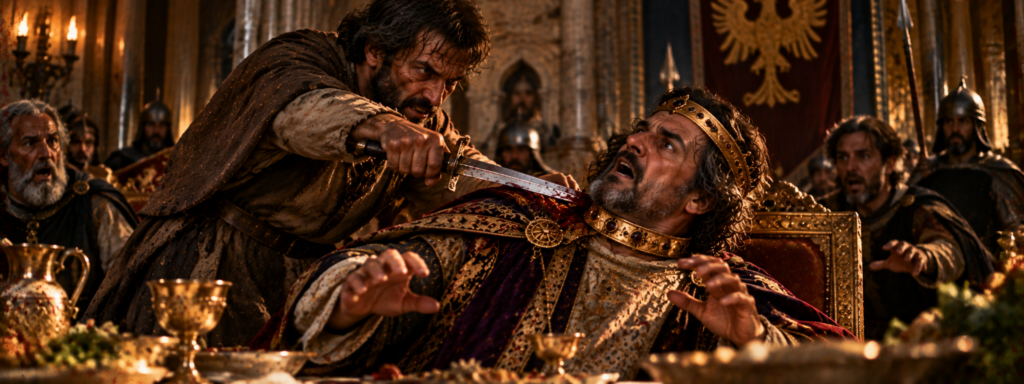
On 15 March 493, a banquet in the Italian city of Ravenna became the setting for one of the most infamous political murders of the early Middle Ages. The guest of honor was Odoacer, the warrior king who had deposed the last Western Roman emperor and ruled Italy for nearly seventeen years. His host was Theodoric, the formidable Ostrogothic commander who had spent the previous four years trying to destroy him. Only days earlier, the two enemies had reached an agreement that appeared to promise an end to their devastating struggle, but the celebration of peace concealed a deadly betrayal.
Odoacer had every reason to understand the dangers of trusting a rival who had repeatedly attempted to take his kingdom. He had survived civil war, military defeats, sieges, shifting alliances, and the collapse of the imperial government he had once served. His final refuge, Ravenna, had endured a prolonged siege, and his exhausted followers had little appetite for another round of fighting. The agreement with Theodoric offered something that had become increasingly difficult to obtain: a chance to preserve his position without condemning his remaining supporters to destruction.
The terms of the settlement reportedly provided for the two rulers to share power in Italy. It was an arrangement that promised an extraordinary reconciliation between men whose armies had fought across the peninsula for years. Odoacer would retain royal authority, while Theodoric would gain the position he had sought through invasion and conquest. Whether either man genuinely believed that such a partnership could survive is impossible to know, but the agreement temporarily ended the immediate military confrontation.
Ten days after Theodoric entered Ravenna, Odoacer attended a banquet associated with their supposed reconciliation. The occasion should have marked the beginning of a new political order, one in which two powerful warrior kings put aside their differences and governed together. Instead, Theodoric killed Odoacer, personally striking down the man whose kingdom he intended to possess. The circumstances were so shocking that the murder became one of the defining stories of Theodoric’s rise to power.
Later accounts supplied the killing with details that were as dramatic as they were gruesome. One tradition describes Theodoric drawing his sword and delivering a blow of such extraordinary force that it nearly divided Odoacer’s body. Another portrays the murder as part of a carefully arranged ambush in which armed men were positioned to eliminate the unsuspecting king. These descriptions come from sources written after the event, and their exact physical details cannot all be independently verified, but they preserve the central accusation that Theodoric deliberately murdered Odoacer during a meeting held under the appearance of peace.
The killing was followed by a wider elimination of Odoacer’s family and supporters. His brother Onoulphus was killed, his son Thela was eventually put to death, and his wife Sunigilda was reportedly imprisoned and later executed. Members of his military following were also targeted, removing men who might have organized resistance to Theodoric’s new regime. The assassination was therefore not merely a personal act of vengeance, but part of a violent transfer of power intended to prevent Odoacer’s dynasty from surviving its founder.
There was a particularly grim irony in the manner of his death. Odoacer had become famous for removing an emperor without killing him, allowing the young Romulus Augustulus to retire rather than ordering his execution. Nearly seventeen years later, the king who had spared the last Western Roman emperor was himself murdered by the rival who replaced him. The contrast revealed the brutal uncertainty of an age in which political authority could be won through military force, recognized through diplomacy, and destroyed during a meal.
Odoacer’s death marked the end of a remarkable career that had begun within the military world of the disintegrating Western Roman Empire. He had risen from the ranks of powerful non-Roman soldiers serving Rome to become the ruler of Italy, a position he maintained while preserving much of the Roman administrative system. His reign had demonstrated that the imperial title was no longer necessary for effective government in the western Mediterranean. His murder demonstrated something equally important: a king who controlled Italy could still lose everything when a stronger rival decided that sharing power was unacceptable.
To understand why Odoacer was invited to a banquet only to be killed by his supposed partner, it is necessary to return to the dying decades of the Western Roman Empire. His story begins not with the fall of Rome as a single dramatic catastrophe, but with a political world that had been slowly unraveling for generations. Armies increasingly determined who ruled, powerful commanders dominated weak emperors, and the distinction between Roman and barbarian military power had become dangerously blurred. Odoacer emerged from that world, mastered its opportunities, and ultimately became one of its most famous victims.
The World That Created Odoacer: An Empire Coming Apart
By the middle of the fifth century, the Western Roman Empire was a shadow of the political and military power that had once dominated much of Europe and the Mediterranean. Its rulers had lost control of extensive territories, including large parts of Gaul, Spain, and North Africa. The imperial government struggled to raise sufficient revenue, maintain armies, and defend its remaining possessions against ambitious rivals. Although the Roman state continued to function, its survival increasingly depended upon military commanders whose loyalty could not always be guaranteed.
The loss of North Africa to the Vandals was particularly damaging because the region had supplied enormous wealth and agricultural resources to the western government. Without those revenues, the empire faced worsening financial difficulties and a shrinking ability to support its military establishment. Political instability compounded the problem, as emperors were repeatedly elevated and removed through military intervention. The imperial throne became a prize contested by powerful generals rather than a secure institution capable of commanding their obedience.
The Roman army itself had undergone major changes. Soldiers from outside the traditional Roman population had served the empire for centuries, and by the fifth century many military formations included men whose families originated among Gothic, Hunnic, Scirian, Herulian, and other communities. Some served as individual recruits, while others belonged to groups settled under agreements with Roman authorities. Their commanders could become indispensable to imperial defense while retaining political interests of their own.
This changing military environment did not mean that Rome had simply been conquered by outsiders who knew nothing of its institutions. Many of the men labeled barbarians were deeply familiar with Roman military organization, political titles, diplomacy, and administrative practices. Some had spent much of their lives in imperial service. Their ambitions frequently involved controlling the Roman state rather than destroying everything associated with it.
Odoacer belonged to this complicated world of military integration and political fragmentation. His ancestry remains disputed, with ancient sources connecting him to peoples including the Sciri and other groups associated with the Danubian frontier. His father is commonly identified as Edeco, a prominent figure associated with the court of Attila the Hun, although the precise details of the family relationship and ethnic identification are debated. What matters is that Odoacer came from a military environment in which service to powerful rulers could provide opportunities for advancement.
His early life is poorly documented, and later stories about his youth should be approached cautiously. He appears in the historical record as a military leader operating within the western imperial system. His rise was made possible by the same conditions that had weakened imperial government: armies required commanders, commanders required rewards, and the emperor increasingly lacked the resources to satisfy everyone. Odoacer would eventually exploit that crisis more successfully than almost anyone before him.
A Warrior From the Empire’s Frontier
The precise date and place of Odoacer’s birth are unknown, although he was probably born during the early decades of the fifth century. His name appears in several forms in the surviving sources, reflecting the linguistic and cultural diversity of the period. Later historians have attempted to assign him a definite ethnic identity, but the evidence does not support a simple answer. He was a product of the military communities that moved between the Roman world and the regions beyond its frontiers.
His father, Edeco, is associated in ancient accounts with the world of Attila the Hun. One Edeco appears in the narrative of the diplomat Priscus as a figure connected to Attila’s court, where political negotiations and conspiracies involved both Roman and Hunnic officials. Scholars have debated whether every reference to Edeco concerns the same individual. The association nevertheless places Odoacer’s family within a world of ambitious military leaders operating across political boundaries.
The collapse of Attila’s power after his death in 453 created new opportunities and dangers for the peoples who had served or lived under Hunnic domination. Formerly subordinate groups struggled to establish independent positions, sometimes fighting one another and sometimes entering Roman service. Political loyalties were fluid, and successful commanders could move between courts and armies. Odoacer’s eventual emergence in Italy reflected this broader transformation of the post-Hunnic world.
Some later traditions connect Odoacer’s early travels with a meeting involving the holy man Severinus of Noricum. According to the account written by Eugippius, a young Odoacer encountered Severinus and received a prediction of future greatness. The story became famous because it appeared to foreshadow Odoacer’s eventual kingship. Its religious and literary purpose, however, means that it should not be treated as a straightforward transcript of a historical conversation.
Whether or not the encounter occurred exactly as described, Odoacer eventually entered the military environment of Italy. The western imperial government relied heavily upon soldiers from diverse backgrounds, and advancement could be rapid for men with ability and followers. Odoacer became associated with the military forces serving under the powerful commander Orestes. That relationship would ultimately place him at the center of the final crisis of the Western Roman imperial office.
The surviving sources do not provide a detailed account of Odoacer’s early military campaigns or personal relationships. Much of his life before 476 remains hidden behind the larger political events of the period. Yet his later actions suggest a commander who understood the demands of soldiers, the weaknesses of imperial government, and the importance of securing recognition for military power. Those skills would carry him from the ranks of an imperial army to the throne of Italy.
The Last Western Emperor: A Boy on a Crumbling Throne
In 475, the western imperial government entered another succession crisis. Julius Nepos, who had been recognized as Western Roman emperor, was driven from Italy by the military commander Orestes. Nepos withdrew to Dalmatia, where he continued to claim imperial authority. Orestes then placed his young son Romulus on the imperial throne, creating one of the most famous and short-lived reigns in Roman history.
Romulus became known to later generations as Romulus Augustulus, a diminutive nickname that emphasized his youth and perhaps the perceived insignificance of his position. His reign began in October 475 and lasted less than a year. Although he bore the imperial title, effective power rested largely with his father. The arrangement reflected the extent to which the western throne had become dependent upon military strongmen.
The young emperor’s name carried an almost theatrical symbolism. Romulus recalled the legendary founder of Rome, while Augustus evoked the first Roman emperor. A boy bearing those names occupied the western imperial throne at the moment when its political foundations were collapsing. Later historians found the coincidence irresistible, although contemporaries did not necessarily understand the events of 476 as the definitive end of Roman civilization.
Orestes faced a serious problem involving the soldiers upon whom his authority depended. Military groups serving in Italy demanded land, reportedly seeking a substantial share of Italian territory for settlement. Such demands were not unprecedented, but they threatened the interests of existing landowners and the political stability of the government. Orestes refused to satisfy the soldiers in the manner they demanded.
The refusal proved disastrous because the army possessed the power to replace the men who governed it. Soldiers dissatisfied with Orestes’s leadership rallied around Odoacer, who emerged as their chosen commander. The rebellion was not simply a conflict between Romans and barbarians, because the imperial military establishment already included men of many backgrounds. It was a struggle over power, land, military loyalty, and the future of government in Italy.
Odoacer was proclaimed king by his followers in 476, traditionally dated to 23 August. His new authority rested upon military support rather than appointment by the western emperor. He then moved against Orestes and the remaining forces loyal to the imperial government. Within weeks, the rebellion had become the event later remembered as the fall of the Western Roman Empire.
The Fall of the Western Roman Empire
Odoacer’s forces defeated those loyal to Orestes, and the commander was captured and executed at Placentia in August 476. His brother Paul was subsequently killed during the struggle for control of Ravenna. The military defeat destroyed the power behind Romulus Augustulus. The young emperor could no longer rely upon the army that had placed him on the throne.
In early September 476, Odoacer entered Ravenna and removed Romulus from power. The deposition was politically decisive because no new Western Roman emperor was installed in Italy to replace him. Instead, Odoacer governed as king while maintaining a formal relationship with the Eastern Roman emperor. The western imperial office, already weakened by decades of military domination, effectively ceased to function as an independent institution in Italy.
The fate of Romulus Augustulus was surprisingly merciful by the standards of the period. Odoacer did not order the young emperor’s execution, even though the boy represented the dynasty he had overthrown. Instead, he allowed Romulus to retire, reportedly granting him financial support and permitting him to live in Campania. The decision removed a political rival without creating the spectacle of a murdered child emperor.
The reasons for this restraint remain open to interpretation. Romulus was young, politically weak, and unlikely to command an independent military following. Killing him may have offered little practical advantage. Allowing him to survive also helped Odoacer present the transition as a change of government rather than an indiscriminate destruction of Roman society.
The famous date of 476 has become a conventional dividing line between antiquity and the Middle Ages. Yet the people living through the events did not necessarily experience an immediate civilizational collapse. Roman laws, officials, cities, landowners, and administrative practices continued to exist. Odoacer’s government preserved much of the institutional framework inherited from the empire.
There was also an important complication involving Julius Nepos. Although Romulus had been deposed, Nepos remained alive in Dalmatia and continued to be recognized by the Eastern Roman government as the legitimate Western Roman emperor. His death in 480 removed the most prominent surviving claimant to that office. Consequently, describing Romulus as the last Western Roman emperor is a useful convention, but it simplifies a more complicated constitutional situation.
Odoacer’s achievement was nevertheless extraordinary. He had removed the emperor who ruled in Italy, defeated the military establishment supporting him, and established a new form of government. His authority was based upon kingship rather than the western imperial title. The Roman world had not disappeared, but its political structure had changed in a way that would prove enduring.
A King Without an Imperial Crown
Odoacer did not attempt to restore the western imperial office in his own name. Instead, he ruled Italy as king, exercising authority over territory that had once formed the core of the Western Roman Empire. His position was unusual because it combined military kingship with the continued operation of Roman administrative institutions. The arrangement allowed him to govern a predominantly Roman population without presenting himself as a new Roman emperor.
The Eastern Roman emperor Zeno remained an important figure in the political calculations surrounding Italy. Odoacer sought recognition from Constantinople, and the eastern government had to decide how to respond to a powerful ruler who controlled the peninsula. Formal relations were complicated by the continuing claim of Julius Nepos. The resulting diplomacy involved ambiguity, compromise, and competing interpretations of legitimate authority.
Odoacer received or used the Roman title of patrician, which provided a means of expressing his position within the imperial political order. He also maintained the practical authority of a king over his military followers. These overlapping titles reflected the transitional character of the age. Political power no longer fit neatly into the older categories of emperor, general, and subordinate official.
His government relied upon Roman administrators and aristocrats who possessed experience in taxation, law, and civil administration. The Senate continued to exist, and the machinery of government remained recognizable. Odoacer did not attempt to replace every Roman institution with an entirely new system. He understood that the wealth and stability of Italy depended upon preserving administrative continuity.
The Roman aristocracy had reasons to cooperate with him. Many landowners preferred a stable government capable of protecting property and maintaining order to another cycle of imperial coups. Odoacer’s regime offered a degree of continuity after decades of instability. His military authority could be accepted as the price of political survival.
The arrangement also depended upon managing the interests of his soldiers. The forces that had elevated Odoacer expected rewards, and land settlement remained a central issue. Balancing those demands against the interests of established Roman landowners was politically delicate. His ability to maintain authority for nearly seventeen years suggests that he achieved a workable compromise, even if tensions remained.
Odoacer’s kingship therefore cannot be understood simply as the destruction of Roman government by a foreign conqueror. It represented an adaptation of Roman political institutions to a world in which military power had shifted. The king governed through a combination of Roman administration and the loyalty of non-Roman military groups. His reign was one of the earliest and most significant experiments in post-imperial government in western Europe.
The Kingdom of Italy: Power Built on Roman Foundations
Odoacer inherited a territory that had suffered decades of warfare, political instability, and economic disruption. Italy remained wealthy and strategically important, but its government faced serious challenges. Maintaining roads, cities, taxation, and military defense required resources that could not be created through victory alone. The new king had to demonstrate that his rule could provide more than the temporary triumph of an army.
The preservation of Roman administrative institutions was central to his strategy. Experienced officials continued to manage civil affairs, while the Senate retained a place within the political order. The king’s authority was supported by military force, but the practical work of government depended upon administrators who understood Roman law and fiscal systems. This continuity helped prevent the immediate collapse of public administration.
Odoacer also maintained relations with the Catholic Church, an increasingly influential institution in Italian society. Religious leaders possessed local authority, wealth, and networks of communication that could support stability. The king himself is generally associated with Arian Christianity, although the precise character of his religious identity and practice is not fully documented. His government nevertheless avoided a systematic campaign to impose Arian doctrine upon the Catholic population.
The distinction between Arian and Nicene Christianity was politically important in the fifth century. Many Gothic and other non-Roman military elites adhered to forms of Christianity that Catholic authorities regarded as heretical. Religious differences could become sources of conflict, particularly when rulers attempted to control church institutions. Odoacer’s relative restraint helped reduce the risk of widespread religious opposition.
His reign also involved military campaigns beyond the immediate defense of Italy. He sought to maintain control over territories associated with the former western imperial government and to protect the kingdom from neighboring powers. These efforts included operations in Dalmatia and conflicts along the northern frontier. His ambitions eventually brought him into confrontation with interests associated with the Eastern Roman Empire.
The stability of Odoacer’s kingdom was therefore conditional rather than permanent. His military success gave him authority, but that authority depended upon maintaining support among soldiers, Roman elites, and external powers. The balance was difficult to preserve. A rival with a strong army and imperial encouragement could threaten everything he had built.
The Shadow of Constantinople
The Eastern Roman Empire remained the most powerful surviving Roman state after the deposition of Romulus Augustulus. Its capital, Constantinople, possessed enormous wealth, sophisticated institutions, and a political culture that continued to claim universal Roman legitimacy. From the eastern perspective, Italy remained part of the Roman world even though it was governed by a king. The question was not whether Italy mattered, but who possessed the right to control it.
Emperor Zeno faced serious difficulties of his own. His reign was troubled by rebellions, court intrigues, religious controversies, and the presence of powerful Gothic military leaders within imperial territory. He had to manage threats from men who commanded substantial armed followings. Some could become useful allies, while others posed dangers to the throne.
Odoacer’s position in Italy initially offered a practical solution to the western problem. He governed the peninsula without requiring Constantinople to finance a major reconquest. His formal acknowledgment of eastern imperial authority helped preserve the appearance of Roman unity. Yet the arrangement depended upon mutual restraint and compatible political interests.
Relations deteriorated as Odoacer pursued an increasingly independent foreign policy. His activities in Dalmatia and the Danubian region raised concerns in Constantinople. His dealings with opponents of Zeno further complicated the relationship. The emperor began to regard the Italian king as a potential threat rather than a convenient subordinate.
The problem was especially serious because Zeno possessed another powerful military figure whose ambitions needed to be managed. Theodoric, leader of the Ostrogoths, commanded warriors who could challenge imperial authority in the Balkans. His relationship with the emperor alternated between cooperation and hostility. Finding a new political role for Theodoric became an attractive possibility.
The solution that emerged was both practical and dangerous. Zeno encouraged Theodoric to move into Italy and confront Odoacer. Such a campaign could remove an increasingly troublesome ruler while redirecting Gothic military power away from the eastern provinces. The emperor would benefit if the two rivals weakened one another, although the precise terms of his arrangement with Theodoric remain debated.
Odoacer had therefore become vulnerable to a political maneuver originating far beyond Italy. His kingdom was not threatened only by internal rebellion or local enemies. It had become part of a larger struggle involving the Eastern Roman emperor and one of the most formidable Gothic commanders of the age. The man chosen to destroy him would eventually become famous as Theodoric the Great.
Theodoric the Great: The Rival Who Wanted Italy
Theodoric was born around the middle of the fifth century into the Amal dynasty, a prominent Gothic ruling family. His early life was shaped by the political relationship between the Goths and the Eastern Roman Empire. As a young man, he spent time at Constantinople, where he became familiar with imperial institutions and court politics. The experience gave him an understanding of Roman government that would later influence his rule in Italy.
He emerged as a powerful leader among the Ostrogoths, commanding a substantial military following. His relationship with Emperor Zeno was unstable, alternating between alliance and confrontation. Theodoric could serve imperial interests, but he also possessed enough military power to threaten the emperor. His ambition made him both useful and dangerous.
Theodoric’s position differed from that of a simple foreign invader. He had held Roman titles and participated in imperial politics. He understood the value of legitimacy and the importance of presenting military conquest as compatible with Roman authority. His eventual invasion of Italy would therefore be accompanied by claims that he acted within a broader imperial political framework.
Zeno’s decision to encourage Theodoric’s expedition served several purposes. It offered a way to remove Gothic forces from the Balkans, where they threatened eastern security. It also created an opportunity to replace Odoacer with a ruler who might be more cooperative. The plan depended upon Theodoric’s ability to defeat an established king who controlled Italy’s resources and fortified cities.
Theodoric accepted the opportunity because Italy offered wealth, prestige, and a permanent territorial base for his people. His warriors required land and security, while his own ambitions demanded a kingdom worthy of his military reputation. The peninsula promised both. The campaign would be difficult, but the potential reward was enormous.
The invasion began in 488, when Theodoric led his forces toward Italy. The movement involved not only warriors but also families and followers who expected to establish new lives in the conquered territory. It was therefore more than a raid or temporary military expedition. Theodoric intended to replace Odoacer as the dominant ruler of Italy.
The conflict that followed would last several years and devastate parts of the peninsula. Odoacer proved a determined opponent, capable of recovering from defeats and maintaining resistance from fortified positions. Theodoric possessed military skill and powerful followers, but victory was far from immediate. Their struggle became one of the defining wars of the post-Roman west.
The Invasion of 488: Two Kings, One Kingdom
Theodoric’s forces crossed into Italy after a difficult journey from the Balkans. The movement required coordination of a large military following through contested territory. Supplies, transportation, and the protection of noncombatants complicated the expedition. Theodoric nevertheless brought his army into the peninsula and prepared to confront Odoacer.
Odoacer understood that the invasion threatened the survival of his kingdom. Theodoric was not seeking a temporary settlement or a minor territorial concession. He intended to establish himself as ruler of Italy. A compromise that preserved Odoacer’s authority would be difficult to achieve while both men commanded armies and claimed political supremacy.
The first major confrontation occurred near the Isonzo River in August 489. Theodoric defeated Odoacer’s forces, forcing the Italian king to withdraw. The victory gave the invaders momentum and demonstrated their military strength. It did not, however, end the war.
A second major battle followed near Verona in September 489. Odoacer again suffered defeat, and his forces retreated toward Ravenna. Theodoric appeared to be approaching decisive victory. Yet the political and military situation remained unstable, and the defeated king retained supporters capable of continuing the struggle.
Odoacer’s resistance was strengthened by the difficulties Theodoric faced in securing territory. Local commanders and military factions could shift allegiance, and control of a city did not necessarily guarantee control of the surrounding region. The invaders had to maintain supplies while confronting an enemy familiar with Italian defenses. The war became more complicated than a sequence of battlefield victories.
Theodoric’s early successes nevertheless weakened Odoacer’s position. The Italian king had lost major battles and faced the prospect of being confined to fortified strongholds. His ability to recover depended upon the loyalty of remaining forces and the possibility of exploiting his rival’s vulnerabilities. The struggle was entering a phase in which endurance mattered as much as battlefield skill.
The Battle of the Adda: Odoacer’s Last Great Defeat
The war did not proceed in a straight line toward Theodoric’s victory. Odoacer recovered sufficiently to launch counteroffensives and challenge the invaders. His forces remained dangerous, and the shifting loyalties of commanders created opportunities for renewed resistance. The conflict demonstrated that the king who had overthrown the Western Roman emperor was not easily removed.
In 490, Theodoric gained additional support, including assistance associated with the Visigothic kingdom. The balance of military power shifted again. Odoacer faced an increasingly difficult situation as his rival consolidated forces and prepared for another major confrontation. The decisive battle took place near the Adda River in August 490.
Odoacer suffered another serious defeat. His army was unable to prevent Theodoric from gaining the advantage, and the Italian king withdrew toward Ravenna. The battle substantially reduced his ability to contest control of the peninsula in open warfare. His remaining hopes increasingly depended upon the defensive strength of his capital.
Ravenna was an exceptionally difficult city to capture. Its surrounding marshes and waterways provided natural protection, while its defenses had long made it attractive to Roman emperors. The city had served as the western imperial capital during the final decades of the empire. Odoacer now relied upon the same strategic advantages that had protected earlier rulers.
Theodoric could defeat armies in the field, but capturing Ravenna required patience and sustained pressure. The city’s geography complicated direct assault, and its defenders possessed opportunities to maintain resistance. The war therefore entered a prolonged siege. Both sides faced exhaustion, uncertainty, and the possibility that outside developments could change the balance.
Odoacer had lost much of his kingdom, but he remained alive and politically significant. His continued resistance prevented Theodoric from claiming an uncontested victory. The invader could occupy territory and establish authority elsewhere, but the old king’s survival remained a challenge. The conflict would not truly end until Ravenna surrendered or Odoacer was removed.
Ravenna: The Fortress That Refused to Fall
Ravenna was one of the most formidable defensive positions in late Roman Italy. Its marshes, canals, and proximity to the Adriatic made conventional siege operations difficult. The city had served as an imperial capital precisely because it was relatively secure from attack. Odoacer’s decision to make it his final refuge reflected a sound understanding of its strategic value.
Theodoric’s forces surrounded Ravenna and attempted to isolate its defenders. The siege continued for years, imposing hardship upon the population and the soldiers trapped inside. Supplies became increasingly important, and control of routes into the city could determine whether resistance remained possible. The conflict became a contest of endurance rather than a single decisive battle.
Odoacer did not remain entirely passive. His forces attempted operations against the besiegers, and the struggle included efforts to break the encirclement. Theodoric had to maintain his army while preventing the defenders from escaping or receiving sufficient support. The prolonged confrontation placed pressure upon both sides.
The siege also affected civilians. Ravenna’s inhabitants faced the consequences of military isolation, including shortages and the disruption of ordinary economic life. The surviving sources do not provide a complete picture of daily suffering within the city, but prolonged sieges commonly imposed severe burdens upon urban populations. The war had become a struggle in which civilians paid for the ambitions of rival kings.
Theodoric gradually strengthened his position. His forces secured control over important routes and reduced the ability of Ravenna to sustain resistance. Odoacer’s options narrowed as the siege continued. The prospect of an indefinite struggle became increasingly unattractive.
By early 493, the conditions for negotiation had emerged. Odoacer remained a king, but his military position was severely weakened. Theodoric controlled much of Italy, yet the continued resistance of Ravenna prevented complete political consolidation. Both men had reasons to consider a settlement, even if their ambitions remained incompatible.
The negotiations that followed produced an agreement whose apparent generosity would soon become infamous. The two rulers reportedly consented to share authority over Italy. The arrangement promised to end years of warfare without requiring Odoacer’s immediate surrender of his royal status. It also placed two bitter enemies within the same political structure, creating a situation that was unstable from the beginning.
The Peace Agreement: Two Enemies Promise to Share a Throne
The settlement between Odoacer and Theodoric was reached in late February 493. Its precise terms are not preserved in a complete contemporary treaty, but the surviving accounts describe an agreement for shared rule. The arrangement allowed Theodoric to enter Ravenna while Odoacer retained a recognized position. It appeared to offer a peaceful conclusion to the conflict.
The agreement was remarkable because both men had fought for exclusive control of Italy. Their armies had inflicted defeats upon one another, and the struggle had lasted for years. The idea that they could suddenly govern together required a dramatic reversal of their political relationship. Yet the exhaustion of war sometimes produced settlements that would have seemed impossible earlier.
Odoacer had practical reasons to accept. His position in Ravenna had become increasingly difficult, and continued resistance threatened his remaining supporters. A settlement might preserve his life, status, and some measure of authority. It could also prevent further suffering within the city.
Theodoric likewise had reasons to negotiate. A peaceful entry into Ravenna would spare him the difficulties of a final assault. It would allow him to consolidate control over Italy and present himself as a ruler capable of ending destructive conflict. The agreement also created an opportunity to bring Odoacer into a setting where military defenses no longer separated them.
Whether Theodoric intended to honor the settlement is one of the central questions of the story. The murder that followed strongly suggests that he was unwilling to tolerate Odoacer as a lasting partner. Yet the surviving sources do not reveal his private intentions at the moment the agreement was concluded. It is possible that the decision to kill Odoacer was made before the settlement, during the days that followed, or as part of a developing political calculation.
The practical problem was obvious. Two kings with separate military followings could not easily share authority over the same territory. Each possessed supporters whose fortunes depended upon his continued power. The arrangement risked creating competing courts, rival chains of command, and renewed civil war.
The settlement therefore contained the seeds of its own destruction. It ended the immediate siege but did not resolve the question of ultimate sovereignty. Theodoric had invaded Italy to become its ruler, while Odoacer had fought to preserve the kingdom he had governed since 476. Their agreement postponed the conflict rather than eliminating its underlying cause.
Theodoric Enters Ravenna
Theodoric entered Ravenna on 5 March 493, bringing the long siege to an apparent conclusion. The city that had resisted his forces for years now opened its gates under the terms of the agreement. His arrival marked a major political victory. He had gained access to the capital of the king he had spent years attempting to defeat.
For Odoacer, the moment was far more ambiguous. He remained alive and had secured a settlement that reportedly preserved his royal position. Yet the military balance had shifted decisively in Theodoric’s favor. The invader’s presence within Ravenna meant that Odoacer could no longer rely upon the city’s defenses to protect him.
The two rulers now occupied the same political space. Their followers had to navigate an arrangement in which former enemies were supposedly partners. Questions of precedence, command, and access to resources would have been difficult to resolve. The agreement demanded cooperation from men whose relationship had been defined by war.
Theodoric’s supporters had strong reasons to resent any arrangement that preserved Odoacer’s authority. They had endured a long campaign and expected rewards from victory. Sharing power could limit the benefits of conquest. The same problem existed among Odoacer’s remaining followers, who faced the possibility of losing influence to the invaders.
The atmosphere in Ravenna was therefore unlikely to have been one of uncomplicated reconciliation. The city had just emerged from a prolonged siege, and the political future remained uncertain. Theodoric possessed the stronger military position, while Odoacer depended upon the terms of an agreement with his enemy. The balance of power was dangerously unequal.
Ten days after Theodoric’s entry, Odoacer was dead. The speed of the reversal transformed the peace settlement into one of the most notorious examples of political betrayal in the period. The banquet that accompanied the supposed reconciliation became the setting for a murder that eliminated the last major obstacle to Theodoric’s rule. Theodoric’s victory was complete, but its manner would remain controversial.
The Fatal Banquet of 15 March 493
The murder of Odoacer took place on 15 March 493, a date that later readers inevitably associate with the assassination of Julius Caesar. The coincidence is striking, although there is no evidence that Theodoric deliberately selected the date to evoke Caesar’s death. Both killings involved powerful rulers destroyed by political violence, but their circumstances were different. Odoacer was murdered by a rival who had recently agreed to share power with him.
The surviving accounts describe the killing as occurring during a banquet or meeting associated with the reconciliation between the two kings. Theodoric had gained access to Odoacer through the settlement that ended the siege. The occasion created an opportunity for the rival rulers to meet without the protections that had previously separated them. Odoacer entered a situation in which his safety depended upon the good faith of his enemy.
Theodoric killed Odoacer personally, according to the principal narrative tradition. The act was not presented as an accidental death during a confused battle. It was a deliberate killing that removed a political rival. The surrounding circumstances indicate that the murder formed part of a broader effort to eliminate Odoacer’s remaining power.
Later sources describe the scene with dramatic detail. Some accounts portray Theodoric drawing his sword and striking Odoacer with extraordinary force. Others suggest that the king’s attendants or armed men were involved in a planned ambush. The precise sequence cannot be reconstructed with complete confidence, but the central fact of Theodoric’s responsibility is well established.
One famous tradition claims that Theodoric’s blow was so powerful that it nearly cut Odoacer in two. The story emphasizes the physical strength and ferocity of the Ostrogothic king. It also serves a literary purpose by transforming the murder into a demonstration of almost superhuman violence. The detail should therefore be treated as a dramatic report rather than a medically verified description of the wound.
The assassination destroyed the agreement for shared rule almost immediately after it had been implemented. Odoacer had surrendered the security of Ravenna’s defenses in exchange for a promise of political survival. Theodoric then eliminated him. The betrayal was especially shocking because the victim had accepted a settlement that was supposed to end the war.
The killing also exposed the brutal logic of the struggle for Italy. Theodoric had not invaded the peninsula to become a subordinate partner. He intended to establish a kingdom under his own authority. Odoacer’s continued existence represented a threat to that ambition, regardless of the formal terms of the peace.
The banquet therefore became the final act of a war that had lasted nearly five years. Theodoric achieved through murder what he had been unable to accomplish through repeated battlefield victories and a prolonged siege. Odoacer’s kingdom ended not with a final battle, but with the sudden violence of a political meeting. The man who had once removed an emperor was himself removed by a rival who refused to share power.
The Sword Stroke: What the Sources Actually Say
The most dramatic descriptions of Odoacer’s death come from narrative sources written after the event. The Anonymus Valesianus, a valuable but complicated source for the period, preserves an account of Theodoric’s killing of Odoacer. Later writers added details that emphasized the violence and treachery of the act. These accounts are essential to reconstructing the murder, but they must be read with attention to their dates, purposes, and limitations.
The claim that Theodoric nearly divided Odoacer’s body with a single sword stroke became one of the most memorable features of the story. It presents Theodoric as a warrior of terrifying physical strength. Such descriptions were common in traditions celebrating or condemning powerful military figures. The image may preserve a memory of a particularly violent blow, but its literal accuracy cannot be demonstrated.
Another tradition suggests that Theodoric attempted to justify the killing by referring to the deaths of his own supporters during the war. This explanation presents the murder as vengeance rather than simple ambition. Yet the political circumstances make clear that eliminating Odoacer also served Theodoric’s immediate interests. The victim’s continued existence threatened the stability of the new regime.
The distinction between revenge and political calculation is not necessarily absolute. A ruler could possess personal grievances while also recognizing the strategic advantages of removing a rival. Theodoric had fought Odoacer for years, and the conflict had involved significant losses. The murder may have been motivated by several considerations that the surviving sources cannot fully disentangle.
What is not seriously in doubt is that Theodoric benefited directly from Odoacer’s death. The agreement for shared rule ended, and the Ostrogothic leader became the dominant ruler of Italy. Odoacer’s military following lost its central figure. The political transformation was immediate.
The sources also indicate that the killing was followed by a wider campaign against Odoacer’s family and supporters. This aftermath strengthens the interpretation that the murder was part of a deliberate effort to eliminate rival authority. Theodoric did not merely strike down an enemy in a moment of anger and then leave his household untouched. The destruction extended beyond the king himself.
The historian must therefore resist two temptations. One is to accept every dramatic detail of the sword stroke as literal fact. The other is to reduce the murder to an impersonal political necessity and overlook the betrayal involved. The evidence supports a deliberate killing during a supposed reconciliation, followed by the elimination of potential opponents.
The Destruction of Odoacer’s Family
The murder of Odoacer did not end with the death of the king. Theodoric’s victory was accompanied by violence against members of Odoacer’s family and military following. These killings were politically significant because they reduced the possibility that a surviving relative could become the focus of resistance. The destruction of a ruling household was a familiar method of securing power in an age of dynastic conflict.
Odoacer’s brother Onoulphus was among those killed in the aftermath. He had played a role in the king’s military and political affairs, making him a potential threat to the new regime. His survival could have provided a rallying point for Odoacer’s remaining supporters. Removing him helped prevent the reorganization of resistance.
Odoacer’s son Thela also became a victim of the political transition. Accounts indicate that he was initially sent away or placed under control before being killed. The precise chronology varies among sources, but his eventual death eliminated the most obvious dynastic successor. Theodoric’s kingdom would not have to contend with a surviving son of the former king claiming his father’s position.
Odoacer’s wife Sunigilda suffered a similarly grim fate. She was reportedly imprisoned and later executed, with some accounts describing death by starvation. The details are difficult to verify independently, but the tradition reflects the wider destruction of Odoacer’s household. The violence extended to family members whose political importance derived from their relationship to the fallen king.
The killings reveal the practical logic of dynastic elimination. A murdered ruler could become a martyr, and his relatives could preserve claims that threatened the victor. By removing the family, Theodoric reduced the likelihood of future challenges based upon Odoacer’s legitimacy. The policy was ruthless but consistent with the political calculations of the period.
The aftermath also complicates Theodoric’s later reputation as a ruler associated with stability and Roman administrative continuity. His government would eventually be remembered for legal order, public works, and cooperation with Roman elites. Yet its foundation included the murder of a defeated rival and the destruction of his family. The contrast is central to understanding the violence beneath the political achievements of early medieval kingship.
Was the Banquet a Trap From the Beginning?
The question of whether Theodoric planned Odoacer’s murder before the peace agreement remains unresolved. The surviving sources do not provide a complete record of the negotiations or the private discussions within Theodoric’s court. They do, however, establish that Odoacer was killed shortly after accepting a settlement that reportedly promised shared rule. The sequence strongly suggests that the agreement created an opportunity for Theodoric to eliminate his rival.
One interpretation is that Theodoric never intended to share power. Under this view, the settlement was a calculated deception designed to bring Odoacer out of his defensive position. Theodoric could not easily capture Ravenna by force, but he could enter the city through negotiation. Once inside, he possessed the opportunity to kill the king whose resistance had frustrated him for years.
Another possibility is that Theodoric initially accepted the arrangement but quickly concluded that it was unworkable. Two rival military leaders could not easily govern the same kingdom, especially after years of warfare. Their followers had competing interests, and disputes over authority could have renewed the conflict. Theodoric may have decided that Odoacer’s removal was necessary to prevent another war.
The distinction matters because it affects how the murder is understood. A premeditated trap would make the peace agreement an instrument of assassination from the beginning. A later decision would still constitute betrayal, but it would suggest that the political arrangement collapsed after the city had surrendered. The evidence does not allow the historian to choose between these possibilities with certainty.
Theodoric’s actions after the murder nevertheless indicate a clear intention to establish exclusive control. He eliminated Odoacer and moved against his family and supporters. The arrangement for shared rule disappeared almost immediately. The political result was precisely what Theodoric had sought through invasion.
The banquet therefore remains one of the most disturbing examples of the dangers of negotiated surrender. Odoacer accepted a settlement that appeared to preserve his life and status. Theodoric gained access to the city and the man he had been unable to defeat completely through siege. The promise of peace became the setting for a murder that completed the conquest.
Theodoric’s Kingdom: Stability Built Upon Murder
After Odoacer’s death, Theodoric established himself as ruler of Italy. His reign would last until 526 and become one of the most significant experiments in post-Roman government. Like Odoacer before him, he preserved many Roman institutions and relied upon experienced administrators. His kingdom combined Gothic military authority with the continuing traditions of Roman civil government.
Theodoric cultivated relationships with the Roman Senate and aristocracy. He employed officials who possessed expertise in law, taxation, and administration. His government sought to maintain public order and protect the economic resources of Italy. These policies contributed to a period of relative stability after decades of warfare.
The king also pursued diplomatic relationships with neighboring rulers. Marriage alliances connected his dynasty to other powerful families across western Europe. His political ambitions extended beyond Italy, and he attempted to influence developments among the Visigoths, Franks, Vandals, and Burgundians. Theodoric became one of the most important rulers of the early sixth century.
His religious policy was generally characterized by a degree of tolerance during much of his reign. Although Theodoric adhered to Arian Christianity, he governed a population in which Catholic Christianity was dominant. He usually avoided attempting to impose his religious beliefs upon Roman subjects. Tensions nevertheless emerged, particularly during the later years of his rule.
Theodoric’s reputation was also shaped by his relationship with prominent Roman intellectuals and officials. Figures such as Cassiodorus served within his administration, while Boethius became associated with the darker political developments of his later reign. The execution of Boethius and the death of his father-in-law Symmachus revealed the suspicion and violence that could exist beneath the appearance of orderly government. Theodoric’s final years were therefore marked by controversies that complicated his image as a benevolent ruler.
The murder of Odoacer remained an uncomfortable foundation for this political achievement. Theodoric’s kingdom did not emerge from a peaceful transfer of authority. It was established through invasion, prolonged warfare, negotiated surrender, and assassination. His later success as a ruler cannot erase the circumstances through which he obtained power.
The contrast between Theodoric’s reputation and his treatment of Odoacer illustrates a recurring pattern in history. Rulers remembered for stability and administrative competence may have reached power through acts of extraordinary violence. Political order and political brutality were not mutually exclusive. In Theodoric’s case, the kingdom that preserved Roman institutions was built upon the murder of the man who had first established royal rule in Italy.
The King Who Spared an Emperor but Was Given No Mercy
One of the most striking features of Odoacer’s career is the contrast between his treatment of Romulus Augustulus and Theodoric’s treatment of him. In 476, Odoacer removed the young emperor from power but allowed him to live. The decision demonstrated that political victory did not always require the execution of a defeated ruler. Nearly seventeen years later, Odoacer received no comparable mercy from the man who conquered his kingdom.
The circumstances were not identical. Romulus was a young emperor whose authority depended upon his father and whose political position collapsed when Orestes was defeated. Odoacer, by contrast, was an experienced military leader who had ruled Italy for years and retained supporters. Theodoric may have considered him a far more dangerous surviving rival. These differences help explain the contrasting outcomes without excusing the betrayal.
Odoacer’s decision to spare Romulus also served his own interests. The boy emperor was unlikely to organize effective resistance, and his survival reduced the appearance of unnecessary cruelty. Allowing him to retire could help reassure Roman elites that the new government would not destroy their society. Mercy was therefore compatible with political calculation.
Theodoric’s treatment of Odoacer reflected a different assessment of danger. The defeated king possessed a history of military leadership and a claim to authority grounded in nearly seventeen years of rule. His continued existence could divide loyalties within the new kingdom. Theodoric removed that danger through murder.
The comparison reveals the harsh pragmatism of the period. Political leaders could spare enemies when mercy appeared useful and kill them when survival seemed threatening. The moral language of legitimacy and justice often concealed calculations about military power. The fate of a defeated ruler depended heavily upon the victor’s perception of risk.
Odoacer’s death was therefore not simply an ironic reversal. It demonstrated the instability of political authority in a world where military strength remained the ultimate guarantee of survival. He had mastered that system in 476 and lost to it in 493. The king who had ended the western imperial office was himself destroyed by the same struggle for power.
The Ides of March: An Unsettling Historical Coincidence
The date of Odoacer’s murder carries an extraordinary historical resonance. He was killed on 15 March 493, the same calendar date traditionally associated with the assassination of Julius Caesar in 44 BCE. The coincidence invites comparison between two rulers whose deaths became symbols of political betrayal. Yet the historical circumstances were separated by more than five centuries and belonged to very different political worlds.
Caesar was murdered by a group of Roman senators who claimed to be defending the republic against tyranny. Odoacer was killed by a rival king who had recently agreed to share power with him. Both killings involved questions of legitimacy, authority, and the future of government. The motives and political structures, however, were not the same.
The date also creates a striking connection between the beginning and aftermath of imperial Rome. Caesar’s assassination occurred during the crisis that preceded the establishment of the Roman Empire. Odoacer’s death occurred after the western imperial office had disappeared from Italy. The two events therefore stand near opposite ends of a long transformation in Roman political history.
It would be tempting to imagine Theodoric deliberately selecting the Ides of March for symbolic reasons. The surviving evidence does not support that conclusion. The date may have been coincidental, and the sources do not establish that Theodoric intended to evoke Caesar’s murder. The historian should resist turning an intriguing parallel into an unsupported motive.
The coincidence nevertheless adds to the atmosphere surrounding Odoacer’s death. A ruler associated with the end of the Western Roman Empire was murdered on a date already infamous for the killing of a Roman leader. Both stories involve the sudden destruction of a powerful man in a setting where political trust had failed. The repetition is historically memorable even without evidence of deliberate imitation.
The comparison also highlights the continuity of political violence across Roman history. The forms of government changed, but the struggle for power remained capable of producing assassination. Senators, generals, emperors, and kings all faced the possibility that rivals would resort to murder. Odoacer’s death belonged to that long tradition of violent political transition.
The Problem With Calling Odoacer the First King of Italy
Odoacer is often described as the first King of Italy after the fall of the Western Roman Empire. The title is useful because it captures the political transformation of 476, when he replaced the western imperial office with royal government. Yet the description requires qualification. Italy had been ruled by earlier kings in different historical contexts, and Odoacer’s own titles and constitutional position were more complicated than a modern national monarchy.
The kingdom he governed was not Italy in the modern sense. It consisted of territories inherited from the late Roman political order, administered through institutions that continued to identify with Roman traditions. The population was diverse, and political authority rested upon a combination of military kingship and Roman administration. The concept of a unified Italian nation-state lay many centuries in the future.
Odoacer’s kingship also existed alongside the continuing claims of the Eastern Roman emperor. He did not present himself as an entirely independent sovereign in the modern sense. His use of Roman titles and diplomatic recognition reflected the importance of imperial legitimacy. The relationship was ambiguous, but it mattered to the political language of the period.
The title rex, or king, was central to his authority among the military groups that had elevated him. Yet his government also depended upon the cooperation of Roman elites who were accustomed to imperial institutions. Odoacer therefore occupied a position that combined different traditions of rulership. His authority cannot be reduced to a single constitutional category.
Theodoric inherited much of this arrangement after 493. He too ruled as king while preserving Roman administrative structures and maintaining a complicated relationship with Constantinople. The continuity between their governments is one of the most important features of the period. The murder changed the ruling dynasty more dramatically than it changed the basic machinery of government.
Odoacer’s historical importance lies in this transitional role. He was the ruler who established effective kingship in Italy after the removal of the western imperial government. His reign demonstrated that Roman institutions could survive without a Western Roman emperor. His death marked the replacement of one post-imperial monarchy by another.
The Legacy of a Murdered King
Odoacer’s reputation has long been shaped by his role in the fall of the Western Roman Empire. Popular histories often present him as the barbarian leader who ended Rome. The description is memorable but misleading if it suggests that Roman civilization vanished in 476. Odoacer preserved many of the institutions he inherited and governed through a political system that remained deeply Roman.
His reign lasted nearly seventeen years, a substantial period in an age of frequent political upheaval. He maintained authority over Italy, negotiated with Constantinople, and defended his kingdom against external threats. His government demonstrated administrative continuity after the disappearance of the western imperial office. These achievements deserve attention alongside the dramatic events of his rise and fall.
The murder of 493 has sometimes been overshadowed by the larger narrative of Theodoric’s successful reign. Theodoric became famous for his efforts to preserve Roman government and create stability in Italy. His reputation as a powerful and sophisticated ruler can obscure the violence through which he obtained the kingdom. Odoacer’s assassination is essential to understanding that transition.
The case also reveals the limits of political agreements made under extreme military pressure. Odoacer accepted a settlement because continued resistance had become increasingly difficult. Theodoric used the resulting access to eliminate him. The promise of shared rule failed almost immediately.
The destruction of Odoacer’s family deepened the significance of the murder. Theodoric did not simply replace one ruler with another. He removed potential dynastic rivals and weakened the networks that might have preserved Odoacer’s political legacy. The assassination was therefore part of a broader effort to secure exclusive authority.
Odoacer remains a complicated figure rather than a simple hero or villain. He was a military usurper who overthrew an emperor, a king who preserved Roman institutions, and a ruler who ultimately became the victim of betrayal. His career illustrates the fluidity of political identity in the late Roman world. His death reveals the violence that accompanied the emergence of new kingdoms from the remains of imperial authority.
The King Who Ended an Empire and Died at a Feast
Odoacer entered history as the man who removed the last Western Roman emperor from power in Italy. His victory in 476 marked a turning point that later generations would treat as the end of antiquity and the beginning of a new age. Yet his achievement was more complicated than the simple destruction of an empire. He preserved Roman institutions, governed through experienced administrators, and established a kingdom that maintained substantial continuity with the political world it replaced.
His rise had been made possible by the weakness of the western imperial government. Soldiers demanded rewards that the state struggled to provide, military commanders dominated emperors, and political authority increasingly depended upon armed force. Odoacer understood those conditions and used them to his advantage. He became king because the military system that had sustained the Western Roman Empire could no longer be controlled by its nominal rulers.
For nearly seventeen years, he maintained his position. He governed Italy, negotiated with Constantinople, and defended his kingdom against rivals. His reign demonstrated that the disappearance of the western imperial office did not require the immediate collapse of Roman society. The administrative structures of the empire survived under a king whose authority came from a different political tradition.
Yet the same world that elevated Odoacer eventually destroyed him. Emperor Zeno encouraged Theodoric to invade Italy, redirecting Gothic military power toward a ruler whose independence had become inconvenient. Theodoric accepted the opportunity because the peninsula offered wealth, territory, and the prospect of a lasting kingdom. The resulting war lasted for years and devastated parts of Italy.
Odoacer fought with determination. He suffered defeats at the Isonzo, Verona, and the Adda, but he continued resisting from Ravenna. The city’s defenses frustrated Theodoric and prevented an easy victory. The war became a prolonged contest in which military endurance and political calculation were equally important.
By early 493, Odoacer’s position had become increasingly difficult. Ravenna remained defensible, but the siege had exhausted resources and narrowed his options. A settlement offered the possibility of preserving his life and royal status. The agreement for shared rule appeared to end the conflict without requiring his complete destruction.
Theodoric entered Ravenna on 5 March 493. Ten days later, Odoacer was dead. The king who had accepted a promise of shared authority was murdered during a banquet associated with reconciliation. The settlement that had ended the siege became the means through which his rival gained access to him.
The precise physical details of the killing remain uncertain. Later accounts describe Theodoric delivering a sword stroke of extraordinary force, while other traditions emphasize the planning and treachery involved. The central fact is that Theodoric killed Odoacer and benefited directly from his death. The murder removed the last major obstacle to his control of Italy.
The violence continued after the king fell. Odoacer’s brother, son, and wife became victims of the new political order, and members of his military following were also targeted. The destruction of his family reduced the possibility of organized resistance. Theodoric’s kingdom was secured through a combination of military victory, negotiated surrender, and calculated elimination.
The contrast with Odoacer’s treatment of Romulus Augustulus remains striking. In 476, Odoacer had spared the young emperor whose throne he removed. He had recognized that a defeated ruler did not always need to die. In 493, Theodoric reached a different conclusion about the man whose kingdom he intended to possess.
The murder also exposes the instability of political agreements between rival rulers. Odoacer and Theodoric had fought for exclusive control of Italy, and their followers possessed competing interests. The promise of shared power could not easily resolve those ambitions. Theodoric chose murder rather than continued compromise.
His later reign would become famous for administrative stability and the preservation of Roman traditions. Yet the foundation of that achievement was stained by the killing of a defeated rival. Theodoric’s reputation as a capable ruler must be considered alongside the violence through which he obtained power. Political success did not erase the betrayal at Ravenna.
Odoacer’s death belongs among the most consequential royal assassinations of the early Middle Ages. It ended the career of the ruler who had transformed the political structure of Italy after the fall of the Western Roman Empire. It also marked the beginning of Theodoric’s uncontested rule. The assassination was therefore a decisive moment in the transition from late Roman government to the kingdoms of post-imperial Europe.
The date adds an unsettling final detail. Odoacer was murdered on 15 March, the Ides of March, centuries after Julius Caesar had been assassinated on the same day. There is no evidence that Theodoric deliberately chose the date for its symbolism. Nevertheless, the coincidence links two famous episodes of political violence across the long history of Rome.
Both killings reveal the dangers faced by rulers whose authority depended upon unstable political relationships. Caesar was murdered by senators who feared his domination of the republic. Odoacer was killed by a rival king who refused to share control of Italy. Their circumstances differed, but both deaths exposed the lethal consequences of struggles over sovereignty.
Odoacer’s legacy is therefore inseparable from contradiction. He was a military usurper who became a king, a ruler associated with the end of Rome who preserved Roman government, and a conqueror who spared an emperor but was himself murdered after accepting peace. His life illustrates the complexity of the age in which the Western Roman Empire gave way to new political structures. His death reveals the ruthless calculations that often determined who survived that transformation.
The banquet at Ravenna was supposed to celebrate reconciliation. Instead, it became the setting for a murder that destroyed a king and cleared the way for a new dynasty. Odoacer had survived the collapse of an empire, the ambitions of generals, and years of warfare against a formidable enemy. He could not survive the moment when that enemy invited him to share power.
Theodoric gained Italy, and Odoacer lost his life. The kingdom continued, Roman institutions endured, and the political world moved forward under a new ruler. Yet the manner of the transfer remains a reminder that the transition from antiquity to the Middle Ages was not a clean break between civilizations. It was a struggle fought through armies, diplomacy, betrayal, and blood.
Odoacer’s final tragedy was that he trusted a peace that could not protect him. The king who had removed the last Western Roman emperor without killing him was destroyed by a rival who considered his continued existence intolerable. His reign ended not beneath the walls of Ravenna, but at a banquet where the promise of reconciliation concealed a sword. In the ruins of the Western Roman Empire, power had passed from emperor to king, and then from one king to another through murder.