
Giuliano de’ Medici: Murder in Florence Cathedral and the Bloody Pazzi Conspiracy
The Beloved Brother of Lorenzo the Magnificent, the Conspiracy That Turned Easter Mass into a Bloodbath, and the Assassination That Changed Renaissance Florence Forever
Giuliano de’ Medici (28 October 1453 – 26 April 1478) was a prominent member of Florence’s powerful Medici family and the younger brother of Lorenzo de’ Medici, better known as Lorenzo the Magnificent. Born to Piero di Cosimo de’ Medici and Lucrezia Tornabuoni, Giuliano grew up surrounded by the wealth, political intrigue, and artistic brilliance of Renaissance Florence. Although he never held a sovereign title, his position within the family that effectively governed the Florentine Republic made him an important political figure. Celebrated for his charm, athletic ability, and striking appearance, he became a popular presence in Florentine society and was immortalized in the poetry and artistic traditions of his age.
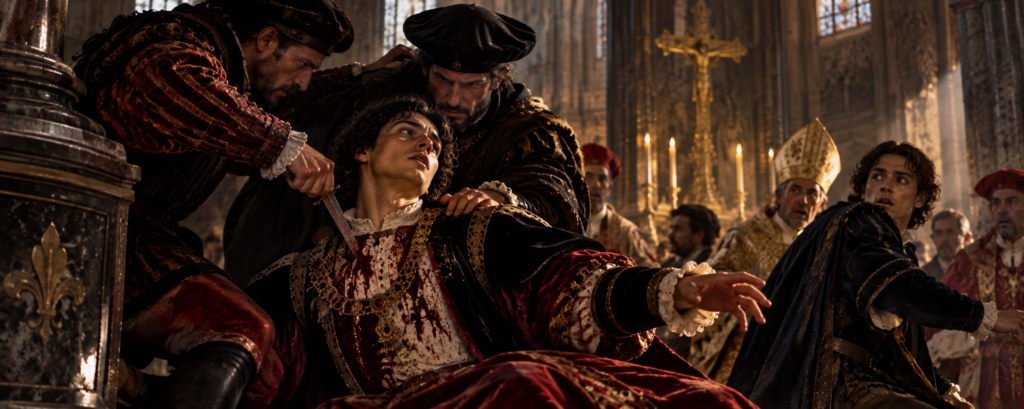
On 26 April 1478, Easter Sunday, Giuliano was brutally assassinated inside Florence Cathedral during the infamous Pazzi conspiracy, a coordinated attempt to murder both Medici brothers and overthrow their family’s political dominance. He was stabbed repeatedly by conspirators led in the attack by Francesco de’ Pazzi and Bernardo Bandini Baroncelli, while Lorenzo narrowly escaped a simultaneous attempt on his life. Giuliano was only twenty-four years old when he died, leaving behind an infant son, Giulio de’ Medici, who would later become Pope Clement VII. His murder unleashed a wave of executions, political reprisals, and international conflict, becoming one of the most notorious acts of political violence in Renaissance Italy.
Easter Sunday, 1478: Blood Beneath the Dome of Florence
On the morning of 26 April 1478, Florence gathered beneath the magnificent dome of Santa Maria del Fiore to celebrate Easter Sunday. The cathedral was filled with worshippers, noblemen, merchants, clergy, and members of the city’s most powerful families, all assembled for one of the most important religious observances of the Christian calendar. Among them were two brothers whose family had dominated Florentine politics for decades, Lorenzo and Giuliano de’ Medici. Neither man knew that a conspiracy involving prominent citizens, churchmen, and powerful political enemies had chosen the sacred setting for an act of extraordinary violence.
The conspirators intended to kill both brothers almost simultaneously, eliminating the two most important young men of the Medici family before their supporters could intervene. Their plan depended upon surprise, confusion, and the assumption that the murder of the brothers would trigger a political revolution. The cathedral offered an unusual opportunity because the intended victims could be approached during a public ceremony without the protective arrangements that might surround them elsewhere. The assassins were prepared to violate the sanctity of Easter Mass to accomplish what years of political rivalry had failed to achieve.
As the service reached a crucial moment, the attackers struck. Giuliano de’ Medici was overwhelmed by men who had positioned themselves close to him, and he was stabbed repeatedly in a savage assault that left him dying on the cathedral floor. His elder brother Lorenzo was also attacked, but he escaped with a wound to his neck and was hurried into the relative safety of the cathedral sacristy. Within moments, a ceremony intended to celebrate resurrection had become the scene of one of the most notorious political murders of the Italian Renaissance.
Giuliano was only twenty-four years old. He was admired for his appearance, athletic ability, charm, and participation in Florence’s brilliant cultural life, and his death would inspire poetry, mourning, political propaganda, and works of art. Yet his murder was not simply the destruction of a popular young nobleman. It was an attempt to decapitate the Medici political network and reshape the balance of power throughout central Italy.
The conspirators had expected Florence to rise against the Medici once the brothers were dead. Instead, Giuliano’s murder and Lorenzo’s survival produced a furious backlash that consumed the conspirators and strengthened the family they had hoped to destroy. Men were hanged from palace windows, bodies were dragged through the streets, and the failed coup provoked a diplomatic crisis involving Florence, the papacy, and the Kingdom of Naples. The blood spilled beneath Brunelleschi’s dome would continue to shape Italian politics long after the cathedral floor had been cleaned.
Giuliano’s assassination remains especially haunting because of the contrast between his public image and the political violence that destroyed him. He was celebrated in the poetry and festivities of Florence, associated with the beauty of the Renaissance, and remembered as the younger brother of one of its most famous statesmen. Yet his life ended amid knives, panic, and betrayal in a place where violence should have been unthinkable. To understand why he became a target, it is necessary to enter the dangerous world behind the splendor of Medici Florence.
A Golden Childhood in a City Ruled Without a Crown
Giuliano de’ Medici was born in Florence on 28 October 1453, the younger son of Piero di Cosimo de’ Medici and Lucrezia Tornabuoni. His family belonged to the immensely wealthy banking dynasty that had become the dominant political force in the Florentine Republic. The Medici were not hereditary monarchs, and Florence continued to maintain republican institutions, councils, and elected magistracies. Nevertheless, the family’s financial resources, alliances, patronage, and influence over public appointments allowed it to exercise a degree of control that often resembled princely government.
Giuliano’s grandfather, Cosimo de’ Medici, had established the foundations of this extraordinary position. Known to posterity as Cosimo the Elder, he had returned from exile in 1434 and gradually consolidated a system of political influence that operated through personal relationships rather than an openly declared monarchy. His wealth helped finance buildings, religious institutions, scholars, and artists, while his supporters occupied important positions within the republic. The arrangement allowed the Medici to dominate Florence while preserving the outward appearance of traditional civic government.
This distinction between public republicanism and private family power would become one of the most important causes of the Pazzi conspiracy. Florence possessed a proud history of resistance to tyranny, and its citizens were accustomed to speaking about liberty and civic participation. Yet the Medici had accumulated influence that made meaningful opposition increasingly difficult. Their supporters regarded them as guardians of stability, while their enemies accused them of undermining the freedom of the republic.
Giuliano grew up within the privileges and expectations of this unusual political system. The Medici household offered access to tutors, intellectuals, diplomats, artists, and visiting dignitaries, creating an environment in which cultural refinement was inseparable from political education. His mother, Lucrezia Tornabuoni, came from another prominent Florentine family and was herself a writer and influential figure within the household. She helped shape the upbringing of her children and maintained connections that strengthened the family’s standing.
The brothers were raised to understand that the Medici name carried obligations as well as advantages. Their public conduct mattered because personal reputation could influence political loyalty. A successful Medici heir needed to appear generous, cultured, accessible, and capable of maintaining relationships with powerful citizens. The family could not simply command obedience through royal decree, so it relied heavily upon prestige and personal influence.
Giuliano was younger than Lorenzo by nearly five years, and the two brothers developed different public roles. Lorenzo received the greater share of responsibility for political leadership, particularly as the family’s position became more demanding. Giuliano became associated with the social and ceremonial life of Florence, where his youth, athletic ability, and appearance attracted attention. Their contrasting personalities would later make the assassination particularly devastating, because the conspirators attempted to destroy both the political head and the popular face of the Medici family.
The world into which Giuliano was born was therefore brilliant but unstable. Wealth and culture flourished alongside factional rivalry, and the language of republican liberty coexisted with the realities of oligarchic power. The Medici appeared secure because their influence reached into nearly every important institution. Yet the family’s very success encouraged resentment among those who believed Florence had become the private possession of a banking dynasty.
Lorenzo and Giuliano: Two Brothers at the Center of Florence
Lorenzo de’ Medici and Giuliano occupied complementary positions within the family during the 1470s. Lorenzo was the more politically active brother, increasingly responsible for diplomacy, financial affairs, and the management of Medici alliances. Giuliano participated in the public life of Florence and represented the family’s prestige through ceremonies, friendships, and aristocratic display. Together they embodied the younger generation of a dynasty whose political dominance had survived several changes of leadership.
Their father, Piero de’ Medici, had inherited the family’s leadership after Cosimo’s death in 1464. Piero suffered from chronic illness and physical limitations, which contributed to his reputation as Piero the Gouty. Despite those difficulties, he defended the family’s political position against opponents who sought to weaken Medici influence. His death in December 1469 transferred responsibility to Lorenzo, who was only twenty years old.
The transition was potentially dangerous because the Medici had no formal hereditary title guaranteeing their position. Lorenzo needed the cooperation of influential Florentine citizens to maintain the political network created by his grandfather. He also needed to manage the family’s extensive financial and diplomatic commitments. Giuliano’s presence provided an additional adult male representative of the dynasty, even though Lorenzo remained its principal political leader.
Contemporary descriptions frequently emphasize Giuliano’s physical attractiveness and engaging manner. He was associated with athletic pursuits and the refined social culture of the Florentine elite. These qualities made him a suitable participant in the tournaments, celebrations, and ceremonial occasions through which the Medici displayed their wealth and status. His public popularity helped strengthen the family’s image beyond the formal institutions of government.
The brothers were not simply interchangeable members of a political household. Lorenzo’s responsibilities placed him at the center of contentious decisions involving taxation, appointments, diplomacy, and banking interests. Giuliano’s role was less directly administrative, although his family position inevitably made him politically significant. Their enemies understood that both brothers represented the continuation of Medici power.
The affection between the brothers is reflected in the grief and commemorative efforts that followed Giuliano’s death. Lorenzo’s later poetry and political actions reveal how deeply the assassination affected him, although the surviving evidence does not allow every private emotion to be reconstructed. The murder deprived him of a brother who had shared the extraordinary pressures of their family’s position. It also forced him to confront the possibility that the entire Medici political structure could be destroyed through a single act of violence.
Their relationship illustrates the importance of family solidarity in Renaissance government. The Medici depended upon relatives who could represent the dynasty, maintain alliances, and provide continuity across generations. Giuliano’s death therefore removed more than a beloved sibling. It eliminated a prominent figure whose existence helped stabilize the family’s position within Florence.
Florence the Magnificent: Beauty Built Over Political Rivalry
Florence during Giuliano’s lifetime was one of Europe’s most celebrated centers of commerce, art, architecture, and intellectual activity. Its merchants and bankers maintained connections across the continent, while its workshops produced textiles, metalwork, paintings, and luxury goods admired far beyond Tuscany. The city’s churches and public buildings reflected generations of artistic ambition. The cathedral itself, crowned by Filippo Brunelleschi’s extraordinary dome, had become a symbol of Florentine achievement.
The Medici played a major role in this cultural environment. Their patronage supported artists, architects, humanists, and religious institutions, helping to create the image of Florence as a city where wealth and learning flourished together. Lorenzo cultivated relationships with intellectuals and poets, while the family sponsored public celebrations that reinforced its prestige. Cultural magnificence served both genuine artistic interests and political purposes.
The beauty of Florence, however, should not obscure the conflicts beneath its surface. The republic was governed through a complicated system of councils and magistracies, and powerful families competed for influence within those institutions. Political disagreements could become personal feuds, particularly when financial interests or access to office were threatened. Exile, confiscation, and exclusion from government were familiar weapons in Florentine politics.
The Medici system relied upon maintaining a broad network of supporters while limiting the influence of hostile families. Such arrangements could produce stability, but they also generated resentment among citizens who believed the republic’s institutions had been manipulated. Opponents accused the Medici of turning public offices into instruments of private power. Supporters countered that the family’s leadership protected Florence from factional disorder.
Giuliano participated in the ceremonial culture that helped soften these political tensions. Tournaments, festivals, and public displays allowed elite families to present themselves as generous patrons of civic life. They also created opportunities for competition, as noblemen sought admiration through expensive clothing, elaborate processions, and displays of physical skill. The celebrations were beautiful, but they were never entirely separate from politics.
The city’s artistic brilliance therefore existed alongside a constant struggle over authority. A family could sponsor magnificent paintings while maneuvering to exclude rivals from office. A religious ceremony could bring together men who privately contemplated one another’s destruction. The Pazzi conspiracy would reveal how thin the boundary between cultural splendor and political violence could become.
For Giuliano, Florence offered a life of extraordinary privilege and public admiration. He moved among poets, courtiers, merchants, and statesmen in a city that celebrated beauty and refinement. Yet his family name made him a target for enemies whose grievances extended far beyond personal jealousy. The same prominence that made him admired also placed him in mortal danger.
The Tournament of 1475: Giuliano’s Moment of Glory
One of the most famous episodes of Giuliano’s life occurred during the tournament held in Florence in January 1475. The event was a lavish display of aristocratic ceremony, martial skill, and public celebration, staged in the Piazza Santa Croce. Giuliano participated as a prominent young nobleman, surrounded by the elaborate pageantry that characterized elite Florentine festivities. The tournament helped establish his reputation as one of the most admired young men in the city.
Such tournaments were not simply sporting competitions. They allowed wealthy families to demonstrate prestige, cultivate public loyalty, and celebrate alliances through carefully arranged spectacle. Participants wore elaborate armor and displayed heraldic devices, while poets and artists contributed to the ceremonial atmosphere. The events transformed political power into something visible and emotionally compelling.
Giuliano’s participation became especially famous because of its association with Simonetta Vespucci. Simonetta was a young noblewoman celebrated for her beauty, and later tradition connected her closely with Giuliano’s tournament performance. She became an important figure in the literary mythology surrounding the Medici court. The relationship between the two has often been described in romantic terms, although the surviving evidence does not establish that they were lovers.
The poet Angelo Poliziano immortalized the tournament in his unfinished work Stanze per la giostra. The poem transformed the event into an elaborate literary celebration of Giuliano, using classical imagery and idealized descriptions of love and beauty. Its purpose was not to provide a straightforward historical record of personal relationships. It belonged to a courtly tradition in which real individuals could become figures of poetic symbolism.
The tournament helped strengthen Giuliano’s public image. He appeared as a youthful representative of the Medici family’s magnificence, combining aristocratic display with the cultural sophistication of Florence. The event also demonstrated the family’s ability to command public attention through spectacle. Such celebrations reinforced the impression that the Medici were indispensable to the city’s identity.
Yet the tournament’s brilliance would later acquire a tragic quality. Within three years, Giuliano would be murdered in the cathedral, and Simonetta would also be dead. The artistic celebration of youth and beauty became inseparable from the knowledge of their early deaths. Later generations would interpret the tournament through the melancholy of what followed.
The contrast between the tournament and the assassination remains one of the most striking features of Giuliano’s story. In 1475, he appeared before Florence as a celebrated young nobleman surrounded by poetry, music, and admiration. In 1478, he lay dying beneath the cathedral dome after being attacked by political enemies. The distance between those two scenes reveals the extraordinary instability of Renaissance fortune.
Simonetta Vespucci: The Woman Behind the Renaissance Legend
Simonetta Vespucci became one of the most celebrated women associated with the artistic culture of Medici Florence. Born Simonetta Cattaneo, probably in 1453, she married Marco Vespucci, a member of a prominent Florentine family. Her beauty attracted attention in the literary and social circles surrounding the Medici. Over time, her image became entangled with the poetry, paintings, and romantic mythology of the Renaissance.
Giuliano’s association with Simonetta emerged most famously through the tournament of 1475 and the poetry written to commemorate it. Later accounts frequently describe her as his beloved or mistress, presenting their relationship as a tragic romance. The surviving evidence, however, is insufficient to establish a physical affair. Much of the tradition reflects the conventions of courtly love, in which admiration for a beautiful woman could serve as an artistic and ceremonial ideal.
The distinction matters because Renaissance literary culture often blurred the boundaries between personal experience and symbolic representation. Poets could describe love in elaborate terms without documenting an actual relationship. Artists could use idealized female figures without intending accurate portraits of specific individuals. Later generations sometimes transformed these conventions into biographical claims.
Simonetta died in April 1476, probably from an illness commonly identified as consumption, although the precise medical diagnosis cannot be established with certainty. She was still in her early twenties. Her death inspired expressions of mourning and contributed to the image of a beautiful young woman whose life had ended prematurely. The loss occurred almost exactly two years before Giuliano’s assassination.
The deaths of Simonetta and Giuliano encouraged later writers to construct a narrative of doomed Renaissance love. Both were young, admired, and associated with the cultural brilliance of Florence. Their stories seemed to invite comparison with classical myths about beauty and mortality. Yet the historical evidence supports admiration and literary association more securely than a documented romantic relationship.
Simonetta has also been connected with paintings by Sandro Botticelli, including famous idealized female figures. Such identifications are often repeated, but many remain speculative. Renaissance artists did not necessarily create literal portraits when painting mythological subjects, and the identification of Simonetta in particular works is frequently debated. The artistic tradition should therefore be distinguished from established biographical fact.
For Giuliano, the association with Simonetta contributed to his enduring reputation as a figure of youthful beauty and tragic promise. It placed him within the cultural mythology of the Medici court, where poetry and painting could preserve a person long after death. Yet his assassination was driven by political conflict rather than romantic tragedy. The knives that killed him were wielded by men who wanted to destroy his family’s power.
The Pazzi Family: Wealth, Pride, and a Dangerous Rivalry
The Pazzi family was one of Florence’s prominent banking and aristocratic dynasties. Its members possessed wealth, social standing, and a long history within the republic. Like the Medici, the Pazzi participated in the financial and political life of the city. Their rivalry with the ruling family developed within a system where access to public office and financial influence could determine a household’s fortunes.
The relationship between the two families was not always openly hostile. Elite Florentine society was interconnected through marriages, business dealings, and political associations. Members of competing households could attend the same ceremonies and maintain personal relationships despite underlying tensions. Such familiarity would later make the conspiracy especially dangerous because the assassins could approach their targets without immediately arousing suspicion.
During the 1470s, however, the rivalry intensified. The Medici were accused of using their influence to restrict the advancement of competing families. Disputes over financial matters and public appointments contributed to resentment. The Pazzi believed that Medici dominance threatened their interests and standing within the republic.
One important source of conflict involved papal finances. The Medici bank had long enjoyed a privileged relationship with the papacy, but that connection deteriorated during the pontificate of Sixtus IV. The Pazzi bank gained opportunities to serve papal interests, increasing its influence at Rome. Financial competition became intertwined with the pope’s political ambitions.
The acquisition of Imola for Girolamo Riario was particularly significant. The pope’s desire to establish his nephew as a territorial ruler required substantial financing and threatened the interests of other Italian powers. Lorenzo de’ Medici opposed aspects of the project, while the Pazzi became associated with the financial arrangements supporting it. The dispute deepened the hostility between the Medici and the papal faction.
The Pazzi conspiracy therefore emerged from more than a simple family quarrel. It involved competition over banking, political office, territorial influence, and the future government of Florence. The conspirators believed that removing the Medici would create opportunities for themselves and their allies. Their ambitions were encouraged by powerful figures who regarded Lorenzo’s government as an obstacle.
The family’s name would become permanently associated with the assassination attempt. Yet the conspiracy involved a wider network of participants whose motives were not identical. Some sought political power in Florence, others hoped to advance papal interests, and still others were driven by personal resentment. Giuliano’s murder was the point at which those ambitions converged in violence.
Pope Sixtus IV and the Politics Behind the Conspiracy
Pope Sixtus IV occupied a central position in the political environment that produced the Pazzi conspiracy. Elected in 1471, he pursued policies that strengthened the territorial and financial interests of his relatives. His pontificate combined important cultural patronage with aggressive intervention in Italian affairs. The resulting conflicts brought him into direct opposition with Lorenzo de’ Medici.
Sixtus’s support for Girolamo Riario was particularly important. The pope wanted to establish his nephew as a powerful ruler in Romagna, a region where papal authority competed with the interests of Florence, Milan, Venice, and other states. Girolamo’s acquisition of Imola became a major source of tension. Lorenzo viewed the expansion of papal influence near Florentine territory with suspicion.
The pope also resented Medici interference with appointments and political arrangements affecting the Church. Relations deteriorated as financial and territorial disputes accumulated. The Medici bank lost important papal business, while rival financiers gained influence. These developments encouraged cooperation between the Pazzi family and figures connected to the papal court.
The precise extent of Sixtus IV’s responsibility for the assassination plot remains one of the most contested questions in the history of the conspiracy. Evidence indicates that the pope supported efforts to overthrow Medici dominance, and individuals close to him participated in the planning. However, the degree to which he knew about or explicitly authorized the intended murders is disputed. It would be misleading to present every allegation against him as an established fact.
Some accounts suggest that the pope approved political action against Lorenzo while expressing opposition to bloodshed. Such statements, even when reported, require careful interpretation because they may reflect attempts to preserve plausible deniability. Renaissance diplomacy frequently employed ambiguous language, especially when discussing dangerous political objectives. The surviving evidence does not permit a simple reconstruction of every private conversation.
What is clear is that powerful papal interests were aligned against the Medici. Girolamo Riario stood to benefit from a change of government in Florence, while the Pazzi hoped to regain influence within the republic. Archbishop Francesco Salviati, whose ambitions had been frustrated by Medici opposition, became an important participant. Their shared hostility created the conditions for conspiracy.
The involvement of churchmen made the eventual assassination especially scandalous. The plot would unfold during Easter Mass, and one of its principal political organizers was an archbishop. The religious authority of the papacy became entangled with an attack that violated the sanctity of Florence’s cathedral. The consequences would extend far beyond the deaths and injuries of the intended victims.
Francesco de’ Pazzi and the Men Who Planned the Murders
Francesco de’ Pazzi was among the most important conspirators involved in the assassination attempt. He belonged to the powerful Pazzi banking family and had developed connections with figures hostile to Medici dominance. His personal ambitions intersected with those of papal officials and other opponents of Lorenzo. The conspiracy offered him the possibility of transforming his family’s political position through a decisive act of violence.
Archbishop Francesco Salviati was another central participant. His appointment to the archbishopric of Pisa had been opposed by Lorenzo, contributing to a bitter conflict between the Medici and the papal faction. Salviati’s resentment became part of the conspiracy’s political foundation. He would play a crucial role in the attempted seizure of Florence’s government.
Jacopo de’ Pazzi, the senior figure of the Pazzi family, was also implicated in the plot. His position gave the conspiracy additional prestige and access to resources. The involvement of such prominent men demonstrated that the attack was not an isolated act by a handful of desperate assassins. It was an organized attempt to change the government of Florence.
Bernardo Bandini Baroncelli became one of the principal attackers inside the cathedral. His role in the murder of Giuliano was remembered in contemporary and later accounts. He would eventually flee Florence, only to be captured and returned for execution. His fate became one of the most famous episodes in the aftermath of the conspiracy.
The conspirators also relied upon other associates who could help coordinate the attack and the attempted seizure of political institutions. Their plan required simultaneous action at different locations. Killing the Medici brothers would be insufficient if their supporters retained control of the government. The plot therefore combined assassination with an attempted coup.
The conspirators faced a practical problem: Lorenzo and Giuliano were not always together. Their original plans reportedly involved opportunities to attack the brothers during social gatherings, but circumstances forced changes. The cathedral eventually offered a moment when both could be reached during a public ceremony. The decision to strike during Mass reflected the conspirators’ determination to act despite the religious setting.
The men who planned the attack believed that the destruction of the brothers would weaken Medici authority beyond repair. They underestimated the strength of the family’s political network and the anger that the murder would provoke. Their plan depended upon a rapid collapse of loyalty to Lorenzo. The events of Easter Sunday would prove that assumption disastrously wrong.
The Failed Banquet Plan and the Decision to Strike at Mass
The Pazzi conspirators did not necessarily begin with the cathedral as their preferred setting. Accounts of the plot describe earlier opportunities involving social gatherings at which the Medici brothers might be present. Such occasions offered the possibility of approaching the intended victims without the obstacles created by guards or formal political ceremonies. The conspirators needed a setting in which both brothers could be attacked before either had time to escape.
One reported opportunity involved a banquet connected with the visit of Cardinal Raffaele Riario, a young relative of Pope Sixtus IV. The cardinal’s presence in Florence created occasions for elite gatherings that brought together members of rival political factions. His role in the conspiracy remains disputed, and he should not automatically be treated as a knowing participant. The fact that his visit provided a setting for the conspirators’ plans does not establish his complicity.
Giuliano’s movements complicated the arrangements. Some accounts indicate that he was absent from an earlier gathering, preventing the conspirators from carrying out a simultaneous attack. The plotters needed both brothers to be present because the survival of either could allow the Medici government to recover. Their determination to kill both men shaped the final decision to attack during Mass.
The cathedral offered an extraordinary opportunity. Easter Sunday attracted large crowds, and the presence of important visitors made the ceremony a major public occasion. The Medici brothers could be approached by acquaintances and political associates without immediately provoking alarm. The religious setting also created a degree of trust that the conspirators intended to exploit.
The decision was nevertheless risky. A crowded cathedral could produce confusion, and the attackers would need to act quickly before guards or supporters intervened. The conspirators also had to coordinate the attack with the attempted seizure of the Palazzo della Signoria, the center of Florentine government. Failure at either location could doom the entire operation.
The conspirators therefore divided their responsibilities. Some would attack the brothers during the service, while others would attempt to seize political control elsewhere in the city. The plan required timing, surprise, and the assumption that news of the murders would produce panic among Medici supporters. It also required men willing to commit murder in one of Florence’s holiest spaces.
By the morning of 26 April, the conspiracy had reached the point where hesitation could be fatal to its organizers. The attackers were committed to a plan that would either transform Florence or expose them to charges of treason and sacrilegious murder. The cathedral filled with worshippers who had no reason to expect violence. Among them stood Giuliano de’ Medici, unaware that men nearby had come to kill him.
The Last Walk to Florence Cathedral
The final hours of Giuliano de’ Medici’s life have attracted considerable attention because of the apparent familiarity between the victim and his attackers. Some accounts describe conspirators accompanying him toward the cathedral and behaving as though they were ordinary acquaintances. The details vary among sources, but the broader point is significant. The murderers relied upon the social access created by elite Florentine relationships.
Giuliano was a prominent young man whose presence at an important religious ceremony would not have been unusual. He belonged to the family that dominated the city’s political life and participated in its public celebrations. Easter Mass provided an opportunity for him to appear alongside Lorenzo before the citizens of Florence. The occasion should have reinforced the family’s prestige and religious respectability.
Instead, the conspirators used it to bring the brothers within reach. Some traditions describe the attackers embracing Giuliano before the assault, supposedly to determine whether he wore protective armor beneath his clothing. The story is plausible within the circumstances of the plot, but its precise details cannot be independently verified. It should be treated as a reported episode rather than an unquestionable fact.
The possibility of such an embrace illustrates the personal nature of Renaissance political violence. Assassins did not always approach their victims as strangers. They could be men who had attended the same gatherings, exchanged courtesies, and moved within overlapping social circles. Familiarity could become a weapon because it allowed an attacker to come close without provoking suspicion.
Giuliano had little reason to expect that Easter worship would become the occasion for his murder. The cathedral was a sacred space, and the ceremony brought together the city’s religious and political communities. Although Florence had experienced factional violence, the deliberate killing of prominent citizens during Mass represented an extraordinary violation of public expectations. The conspirators were prepared to exploit that very sense of security.
The final moments before the attack must have been marked by ordinary ceremonial activity. Clergy conducted the service, worshippers followed the ritual, and members of the elite occupied their places within the cathedral. The surviving sources do not allow the thoughts of Giuliano or the conspirators to be reconstructed. What is known is that the attackers waited for the moment they believed would provide the greatest advantage.
The contrast between the public solemnity of the occasion and the hidden intentions of the conspirators gives the assassination its enduring horror. Giuliano entered the cathedral as a celebrated member of Florence’s ruling family. He was surrounded by the symbols of Christian worship and civic magnificence. Before the service ended, he would be dead.
The Attack Begins: Knives Drawn During the Sacred Service
The conspirators chose a moment during the Mass when the attention of the congregation was directed toward the religious ceremony. Accounts commonly place the attack around the elevation of the Host, a solemn moment in the Eucharistic liturgy. The precise sequence of every movement is difficult to reconstruct, but the coordinated nature of the assault is clear. The attackers intended to strike both brothers before either could receive effective protection.
Giuliano was attacked by Francesco de’ Pazzi and Bernardo Bandini Baroncelli. The assault was ferocious, with the attackers using knives to inflict repeated wounds. Contemporary and later accounts describe Giuliano being stabbed many times, often giving the number as nineteen. That figure is widely repeated, although it should be understood as a traditional report rather than a modern forensic determination.
The attack overwhelmed Giuliano. He was unable to escape the men who had approached him at close range, and the wounds proved fatal. His body fell within the cathedral, turning the sacred floor into the scene of a political killing. The speed and violence of the assault left little opportunity for intervention.
Francesco de’ Pazzi reportedly wounded himself during the attack, an indication of the frenzy with which the stabbing was carried out. Such details appear in accounts of the conspiracy and contribute to the image of an assault conducted with extraordinary intensity. The attackers were not attempting to arrest Giuliano or force a political concession. Their objective was his death.
The murder occurred amid the panic of a congregation suddenly confronted with violence. Worshippers had gathered for Easter, not for a political confrontation. The sight of armed men attacking prominent citizens inside the cathedral must have shattered the solemnity of the ceremony. The surviving narratives emphasize the confusion and terror that followed.
Giuliano’s death was the first major success of the conspiracy. The attackers had eliminated one of the two brothers whose survival represented the continuation of Medici power. Yet the plot depended upon killing Lorenzo as well. At almost the same moment, another group of assassins attempted to complete that task.
The murder of Giuliano therefore cannot be separated from the failed attack upon his brother. The conspirators had planned a double assassination that would leave the Medici without their principal young leaders. They achieved only half of that objective. The survival of Lorenzo would transform their apparent success into catastrophe.
Lorenzo Escapes: The Brother Who Survived
While Giuliano was being murdered, Lorenzo de’ Medici faced his own attackers. The men assigned to kill him struck during the same moment of confusion, hoping to prevent him from escaping or organizing resistance. Lorenzo suffered a wound to his neck, but the injury was not fatal. His ability to escape became the decisive failure of the conspiracy.
Accounts of the attack describe Lorenzo defending himself and receiving assistance from supporters who helped him reach the cathedral sacristy. The precise sequence of movements differs among sources, but the essential event is clear. Lorenzo survived the assault and was sheltered behind a secured door. The conspirators were unable to reach him before his supporters organized protection.
The contrast between the brothers’ fates was immediate and devastating. Giuliano had been overwhelmed and killed, while Lorenzo escaped with a wound that allowed him to remain politically active. The conspirators had intended to remove both men from Florence’s government. Instead, they left alive the brother with the greatest political experience and strongest network of supporters.
Lorenzo’s survival also provided a rallying point for Medici loyalists. News that he was alive allowed supporters to organize around a recognizable leader. The family had suffered a terrible loss, but its political structure had not been destroyed. The conspirators’ expectation of a rapid collapse became increasingly unrealistic.
The attack inside the cathedral also created a powerful moral advantage for Lorenzo. His enemies had attempted to murder him during Easter Mass, an act that could be presented as sacrilegious and treacherous. The violence against Giuliano intensified public outrage. Lorenzo’s supporters could portray the conspiracy as an assault upon both the Medici family and the religious dignity of Florence.
The survival of one brother therefore changed the meaning of the entire operation. The assassins had killed Giuliano, but they had not removed the political leader whose authority they most needed to destroy. Lorenzo remained capable of directing the response. The conspirators now faced the consequences of a failed coup rather than the opportunities created by a successful revolution.
For Lorenzo personally, the events of the cathedral were a profound trauma. He had narrowly escaped death while his younger brother was murdered nearby. The surviving evidence reveals his later grief and determination to preserve the family, although it cannot fully reconstruct his private emotions. The assassination would shape his political conduct for the remainder of his life.
The Attempted Seizure of the Palazzo della Signoria
The attack inside Florence Cathedral was only one part of the conspiracy. While the assassins targeted the Medici brothers, Archbishop Francesco Salviati and other participants attempted to seize control of the Palazzo della Signoria, the seat of the republic’s government. Their objective was to neutralize the magistrates and create the appearance of a legitimate political transition. The success of the coup depended upon controlling both the ruling family and the institutions of the city.
The Palazzo della Signoria was a formidable building designed to symbolize civic authority. Its massive stone walls and tower dominated the political center of Florence. The magistrates who governed the republic operated from within its protected spaces. Seizing the palace would have allowed the conspirators to claim control of the government.
Salviati’s attempt failed. The officials inside the palace became suspicious of the visitors and their intentions, and the conspirators were unable to take control. The gonfaloniere of justice, Cesare Petrucci, played an important role in resisting the attempt. The failure prevented the conspirators from securing the institutional authority they needed.
The palace’s defenses and the determination of the magistrates proved decisive. The conspirators could not simply announce a new government without controlling the building and its occupants. Their plan had assumed that the assassination of the Medici brothers would coincide with a rapid political takeover. Instead, resistance at the palace disrupted the entire operation.
News of the violence in the cathedral spread through Florence. The city entered a period of confusion as supporters and opponents of the Medici attempted to understand what had happened. The conspirators hoped to rally citizens under the language of liberty and opposition to tyranny. Yet the expected popular uprising did not materialize in the form they had anticipated.
The failure at the Palazzo della Signoria exposed the weakness of the conspiracy’s political calculations. Killing prominent figures did not automatically produce obedience from magistrates or citizens. The republic’s institutions could resist an attempted coup even when its most powerful family was under attack. The conspirators had underestimated the difficulty of transforming violence into legitimate authority.
As the day progressed, the balance shifted decisively against them. Lorenzo was alive, the government had not fallen, and Medici supporters were mobilizing. The conspirators who had entered the cathedral expecting to change history now faced arrest, execution, or flight. Their carefully prepared plan was collapsing.
Florence Turns Against the Conspirators
The reaction in Florence was swift and violent. News of Giuliano’s murder and Lorenzo’s survival spread through the city, provoking anger among Medici supporters and citizens horrified by the attack. The conspirators had expected the population to welcome the destruction of Medici power. Instead, many Florentines rallied to the surviving brother and the existing government.
The cry of liberty had been central to the conspirators’ political hopes. They presented their actions as an attempt to free Florence from the domination of a powerful family. Yet the murder of Giuliano during Mass undermined their claim to moral legitimacy. The violence appeared to many observers as treachery rather than liberation.
The authorities and Medici supporters moved against the conspirators. Men associated with the attempted seizure of the Palazzo della Signoria were arrested, while others were hunted through the city. The response combined official punishment with popular fury. The distinction between legal justice and political vengeance became increasingly blurred.
Archbishop Francesco Salviati was captured and hanged from the windows of the Palazzo della Signoria. The execution of a high-ranking churchman was an extraordinary act that intensified the conflict with the papacy. His death demonstrated the determination of the Florentine authorities to punish those who had attempted to overthrow the government. It also provided Pope Sixtus IV with grounds for outrage.
Francesco de’ Pazzi was likewise captured and executed. His participation in Giuliano’s murder made him one of the most hated figures associated with the conspiracy. The punishment was intended to demonstrate that the attack upon the Medici would not go unanswered. His death became part of the broader spectacle of retribution.
Other conspirators were killed, arrested, or forced to flee. The Pazzi family suffered severe political and financial consequences, including confiscations and measures intended to erase its influence. The family’s name became associated with treason and sacrilegious murder. The failed conspiracy destroyed the political position its organizers had hoped to strengthen.
The violence of the reprisals reveals the brutality of Renaissance political justice. The murder of Giuliano was followed by executions and public humiliation, creating a cycle in which political authority was asserted through the destruction of enemies. Florence had survived the attempted coup, but the cost was measured in bodies and blood. The city that celebrated beauty and humanist learning had become the scene of savage political revenge.
The Hanging of Francesco de’ Pazzi
Francesco de’ Pazzi’s execution became one of the most memorable images of the conspiracy’s aftermath. He had participated directly in the attack upon Giuliano, and his capture placed him at the mercy of a government determined to punish the murderers. The authorities treated him as a traitor whose actions had threatened the republic. His death was intended to serve as a warning to anyone contemplating a similar attack.
Accounts describe Francesco being hanged from the windows of the Palazzo della Signoria. The location was politically significant because the building represented the authority the conspirators had attempted to seize. By displaying the condemned man there, the government transformed the site of the failed coup into a stage for public punishment. The spectacle communicated the restoration of official control.
The execution also carried a personal dimension. Francesco had belonged to one of Florence’s prominent families and had moved within the same elite society as his victims. His fall from wealth and influence to public execution demonstrated the speed with which political fortune could reverse. The same social standing that had helped him approach the Medici offered no protection after the conspiracy failed.
The punishment was part of a wider campaign against the Pazzi. The family’s property and political privileges were targeted, while its name became associated with the attempted destruction of the Medici. The government sought to prevent the conspirators’ relatives and supporters from rebuilding their former influence. Such measures reflected the belief that political danger could survive through family networks.
The execution of Francesco also reinforced Lorenzo’s authority. The surviving Medici leader had escaped death and witnessed the destruction of men who had attempted to overthrow his family. His supporters could present the punishments as necessary measures to preserve public order. Opponents might regard them as evidence of the very domination the conspirators had claimed to resist.
The surviving accounts of the executions were shaped by these competing political interpretations. Medici supporters emphasized treachery and sacrilege, while critics could point to the severity of the reprisals. Both perspectives reveal aspects of the political culture of the period. The conspiracy had created a situation in which mercy was unlikely to be a central concern.
Francesco de’ Pazzi died without achieving the political transformation he had sought. His participation in Giuliano’s murder became the defining fact of his historical reputation. The assassination that was supposed to elevate his family instead contributed to its ruin. His execution became one of the clearest symbols of the conspiracy’s catastrophic failure.
Bernardo Bandini Baroncelli: The Assassin Who Tried to Escape
Bernardo Bandini Baroncelli was one of the principal attackers involved in Giuliano de’ Medici’s murder. Unlike several conspirators who were captured immediately, he managed to escape Florence after the failed coup. His flight demonstrated that the consequences of the assassination extended beyond the city. The authorities remained determined to punish those who had participated in the attack.
Bandini eventually reached Constantinople, the capital of the Ottoman Empire. His presence there placed him beyond the immediate reach of Florentine justice. Yet Lorenzo and the Florentine authorities continued efforts to secure his return. The pursuit reflected both the desire for punishment and the political importance of demonstrating that the murderers could not escape indefinitely.
Through diplomatic pressure and cooperation, Bandini was eventually surrendered to Florentine representatives. He was returned to Florence and executed in December 1479. The delay between the assassination and his punishment illustrates the international reach of Renaissance diplomacy. Even a fugitive in a distant imperial capital could become the subject of negotiations between governments.
Bandini’s execution attracted attention because of the interest of Leonardo da Vinci. A drawing associated with Leonardo records the clothing and appearance of the hanged conspirator, providing a striking visual document of the aftermath. The sketch is not a sentimental portrait but an observational record of a condemned man. Its survival connects the political violence of Florence with one of the most famous artists of the Renaissance.
The drawing also reveals the unsettling proximity between artistic culture and public execution. Leonardo lived in a society where punishment could be displayed openly, and artists might observe such scenes as part of the visible life of the city. The same Florence that supported extraordinary artistic innovation also treated the bodies of condemned men as public warnings. The contrast was not unusual to contemporaries, even if it appears disturbing to modern observers.
Bandini’s fate demonstrated the persistence of Medici vengeance. The passage of time had not diminished the determination to punish those responsible for Giuliano’s death. His capture and execution allowed Lorenzo’s government to present the pursuit as complete. The surviving assassin had been brought back to the city where the murder occurred.
The episode also contributed to the international reputation of the Pazzi conspiracy. The assassination had begun as a struggle over Florentine government, but its consequences reached Rome, Naples, and Constantinople. The murder of Giuliano had become a matter of diplomacy and political symbolism. The young man killed in the cathedral remained at the center of events long after his death.
The Corpse of Giuliano: Mourning a Murdered Medici
Giuliano’s body became an object of mourning and political significance after the assassination. He had been killed in a sacred space during one of Christianity’s most important festivals, and the circumstances intensified the shock surrounding his death. The violence was not hidden in a remote alley or private chamber. It had occurred before worshippers in the cathedral that symbolized Florence’s religious and civic identity.
The funeral and commemorative response reflected the importance of the Medici family. Giuliano was buried in the church of San Lorenzo, which had long been associated with Medici patronage and family memory. The church served as a place where the dynasty could honor its dead and reinforce its continuity. His burial connected him to the generations of Medici who had shaped Florence’s political life.
Lorenzo’s grief was expressed through poetry and the preservation of Giuliano’s memory. His brother’s death became part of the emotional and political history of the family. The surviving works and commemorations reveal the effort to transform a violent loss into a lasting remembrance. Giuliano’s youth and public popularity made him an especially powerful subject for mourning.
The assassination also changed the way Giuliano’s earlier life was remembered. His participation in the tournament of 1475 and his association with Simonetta Vespucci acquired a tragic significance. The young man celebrated through poetry and pageantry was now understood as a victim of political hatred. The contrast between beauty and violence became central to his posthumous image.
Artistic representations of Giuliano contributed to that memory. Portraits associated with Sandro Botticelli and other works preserved his likeness in forms that emphasized dignity and melancholy. The precise circumstances and dating of individual portraits remain subjects of scholarly discussion. Nevertheless, the survival of these images helped establish Giuliano as one of the most recognizable victims of Renaissance political violence.
His death also served political purposes. Medici supporters could present him as an innocent victim of treachery, reinforcing loyalty to Lorenzo and hostility toward the conspirators. The religious setting of the murder made the accusation of sacrilege particularly powerful. Giuliano’s memory became part of the moral justification for the reprisals that followed.
The mourning therefore combined genuine personal loss with political calculation. Lorenzo had lost a brother, Florence had lost a prominent young citizen, and the Medici had lost an important representative of their dynasty. The public response strengthened the surviving family’s authority. Giuliano’s death became both a tragedy and a source of political power.
The Son Giuliano Never Knew: Giulio de’ Medici
Giuliano de’ Medici left behind a son who would eventually become one of the most powerful figures in Europe. Giulio de’ Medici was born in 1478, shortly before his father’s assassination, and was the child of Giuliano and Fioretta Gorini. He was born outside marriage, a circumstance that complicated his position within the family. Nevertheless, the Medici acknowledged him and incorporated him into their dynastic network.
Giulio’s childhood was shaped by the absence of his father. Giuliano had been murdered when the boy was still an infant, leaving Lorenzo and other relatives responsible for his future. The Medici family possessed the resources and connections necessary to provide him with an education and opportunities. His upbringing therefore continued within the political world that had made his father a target.
Giulio eventually entered the Church and rose through the ecclesiastical hierarchy. His family connections were crucial to his advancement, particularly as the Medici regained influence in Florence and Rome. In 1513, his cousin Giovanni de’ Medici became Pope Leo X, creating new opportunities for the family. Giulio became a cardinal and an increasingly important political figure.
In 1523, Giulio was elected pope, taking the name Clement VII. His pontificate unfolded during one of the most turbulent periods of the Italian Renaissance, including the struggle between Emperor Charles V and King Francis I of France. The Sack of Rome in 1527 became one of the most devastating events of his reign. The pope who had been born as the illegitimate son of a murdered Florentine nobleman found himself confronting the military and diplomatic crises of Europe.
Clement VII also played a central role in the events surrounding Henry VIII’s attempt to annul his marriage to Catherine of Aragon. The pope’s refusal to grant the desired annulment contributed to the English Reformation and the eventual break between the English crown and papal authority. The consequences extended far beyond Italy. Giuliano’s son became a figure whose decisions helped shape the religious history of Europe.
The connection between Giuliano and Clement VII adds another layer to the assassination’s historical significance. The conspirators intended to destroy the political future of the Medici family by killing its young leaders. Yet Giuliano’s son survived and eventually occupied the highest office in the Catholic Church. The dynasty continued to influence European affairs long after the men who planned the murder had been executed.
Giulio’s career demonstrates the unpredictability of dynastic history. A child born shortly before his father’s violent death could grow up to become pope. The murder that seemed to threaten the Medici family’s survival did not prevent its members from reaching extraordinary positions of power. Giuliano’s legacy therefore extended into the religious and political struggles of the sixteenth century.
The War That Followed the Cathedral Murders
The failure of the Pazzi conspiracy did not end the conflict between Florence and Pope Sixtus IV. The execution of Archbishop Francesco Salviati and other conspirators provoked outrage at Rome, where the pope regarded the treatment of a churchman as a grave offense. Florence defended its actions as punishment for treason and attempted murder. The disagreement intensified an already dangerous political rivalry.
Sixtus IV used ecclesiastical and political pressure against Lorenzo and the Florentine government. The conflict involved questions of religious authority, political sovereignty, and the responsibility for the conspiracy. The pope’s position was complicated by the involvement of individuals close to his court. Lorenzo’s supporters accused the papal faction of encouraging the attack.
The dispute developed into a wider war involving Florence, the papacy, and the Kingdom of Naples. King Ferrante of Naples supported the papal side, placing Florence under serious military pressure. The conflict threatened the stability of central Italy and forced Lorenzo to seek allies. Giuliano’s murder had therefore helped trigger a crisis extending far beyond the walls of the cathedral.
Florence faced difficult military and financial circumstances. Its enemies hoped that pressure would weaken Lorenzo’s authority and perhaps produce the political change the conspiracy had failed to achieve. The city needed to defend its territory while maintaining internal unity. The survival of Medici government became tied to the success of Florentine diplomacy.
Lorenzo responded with one of the most famous diplomatic initiatives of his career. In 1479, he traveled to Naples to negotiate directly with King Ferrante. The journey was risky because Lorenzo placed himself within the power of a ruler who had been aligned against Florence. His willingness to undertake the mission demonstrated the seriousness of the crisis.
The negotiations helped produce a settlement that weakened the coalition against Florence. Lorenzo’s diplomacy contributed to the preservation of the republic’s position and strengthened his reputation as a statesman. The war did not erase the trauma of Giuliano’s murder, but it transformed the surviving brother into an even more important political figure. His leadership during the crisis became part of the foundation of his later prestige.
The consequences of the assassination therefore extended into the military and diplomatic history of Italy. A conspiracy intended to remove the Medici instead produced a war that tested the entire Florentine state. Lorenzo survived both the attack and the subsequent conflict. The family emerged with its political authority reinforced, although the cost had been terrible.
Lorenzo the Magnificent After Giuliano’s Death
Lorenzo de’ Medici’s political career entered a new phase after the assassination. He had survived an attempt upon his life, lost his younger brother, and witnessed the destruction of the conspirators who had tried to overthrow his family. The experience reinforced the dangers of the political system in which he operated. It also strengthened his determination to preserve Medici authority.
His government became increasingly associated with the maintenance of stability in Florence and the wider Italian peninsula. Lorenzo cultivated diplomatic relationships and sought to prevent conflicts among the major Italian powers from threatening his city. His political influence depended upon negotiation, patronage, and the careful management of alliances. The survival of Florence after the Pazzi crisis enhanced his reputation.
The assassination also affected the family’s public image. Giuliano’s death became a symbol of the dangers posed by enemies of the Medici, while Lorenzo’s survival could be interpreted as evidence of providential protection. Public ceremonies, artistic patronage, and political rhetoric helped reinforce the family’s position. The failed conspiracy became part of the narrative through which Medici rule was justified.
Lorenzo continued to support artists, poets, and intellectuals, contributing to the cultural achievements associated with his name. His patronage helped sustain the image of Florence as a center of Renaissance brilliance. Yet his political position remained complicated by financial difficulties and the tensions inherent in Medici dominance. The family’s cultural prestige did not eliminate the structural weaknesses of its power.
The loss of Giuliano also left a permanent gap within the household. Lorenzo had to manage the family’s future without the brother who had shared its public responsibilities. Giulio, Giuliano’s son, became part of the next generation whose advancement would depend upon Medici connections. The family’s continuity therefore required both political survival and careful attention to its descendants.
Lorenzo died in 1492, fourteen years after the assassination. His death removed the statesman who had guided Florence through the Pazzi crisis and its aftermath. Within a few years, the Medici would be expelled from the city amid the upheavals caused by the French invasion of Italy. The family’s political fortunes remained unstable despite Lorenzo’s achievements.
The assassination of Giuliano thus became one of the defining events of Lorenzo’s life. It forced him to confront the fragility of his family’s position and the willingness of enemies to use murder as a political weapon. His survival allowed the Medici to endure, but it did not guarantee permanent security. The shadow of Easter Sunday remained part of the dynasty’s history.
The Artists Who Preserved Giuliano’s Face
Giuliano de’ Medici’s image survived through portraits and artistic traditions associated with the Florentine Renaissance. Several paintings attributed to Sandro Botticelli or his workshop depict a young man traditionally identified as Giuliano. These works have contributed enormously to his posthumous reputation. Their solemn expressions and carefully arranged compositions seem to anticipate the tragedy of his death, although such interpretations must be treated cautiously.
Portraiture in Renaissance Florence served multiple purposes. It preserved the likeness of individuals, celebrated family prestige, and communicated social identity. Portraits could also become commemorative objects after death. In Giuliano’s case, the assassination gave his image a powerful emotional significance.
The surviving portraits differ in details, and scholars continue to debate their dating, attribution, and relationship to the murder. Some may have been produced or adapted as memorial images, while others may reflect earlier representations. The precise intentions of the artists cannot always be reconstructed. Nevertheless, the paintings helped transform Giuliano into a recognizable figure of Renaissance memory.
Botticelli’s connection to the Medici world is especially important. His artistic career developed within the cultural environment shaped by Florentine patrons and humanist interests. The same society that celebrated Giuliano through tournaments and poetry also commissioned works that preserved elite identities. Art became one of the means through which the family maintained its public image.
The association between Giuliano and Simonetta Vespucci further enriched the artistic mythology. Later traditions linked both figures to idealized representations of beauty, youth, and mortality. Such connections have often been repeated in popular histories, sometimes with greater certainty than the evidence supports. The distinction between documented portraiture and romantic interpretation remains essential.
The artistic memory of Giuliano also contrasts sharply with the violence of his death. Paintings present a composed young man whose features are preserved in stillness. The historical accounts describe a body overwhelmed by knives in a crowded cathedral. The difference between those images reflects the power of art to transform traumatic events into enduring symbols.
Giuliano’s portraits therefore occupy an unusual place in Renaissance history. They preserve the memory of a man whose political role was less significant than that of his brother but whose death became one of the century’s most famous assassinations. The paintings invite viewers to contemplate the youth and individuality of a victim often remembered primarily through the conspiracy that killed him. They also reveal how the Medici family used cultural memory to survive political catastrophe.
Was Giuliano the Intended Target or Simply Lorenzo’s Brother?
Giuliano’s murder raises an important question about his role in the conspiracy. He was a prominent member of the Medici family, but Lorenzo exercised the greater share of political authority. The conspirators therefore had strong reasons to kill Lorenzo, whose survival could preserve the government they hoped to overthrow. Giuliano’s death was nevertheless essential to their plan because he represented an alternative center of Medici leadership.
The brothers’ family relationship made them politically inseparable in the eyes of their enemies. If Lorenzo were killed but Giuliano survived, supporters might rally around the younger brother. His public popularity and dynastic position could help preserve the family’s influence. The conspirators therefore sought to eliminate both men.
Giuliano’s personal conduct does not appear to have been the principal cause of the assassination. The surviving evidence points primarily to the political struggle over Medici dominance, papal interests, and the ambitions of the Pazzi family. Giuliano became a target because of his name and position. His individual popularity may even have made his death politically more dangerous for the conspirators.
This distinction is important because it reveals the nature of dynastic violence. Members of ruling families could be killed not because of particular actions they had taken but because their existence represented political continuity. A younger brother, child, or distant relative might become a threat simply by providing supporters with an alternative leader. Assassination plots therefore often targeted entire family networks.
Giuliano’s death illustrates that principle with particular clarity. He was celebrated for his appearance and participation in Florence’s cultural life, yet those qualities did not protect him. His family connection made him valuable to the Medici and dangerous to their enemies. The conspirators regarded his survival as an obstacle to their political objectives.
The failure to kill Lorenzo exposed the weakness of the strategy. Giuliano’s murder removed one possible leader but left the principal statesman alive. The Medici network remained capable of organizing resistance and preserving authority. The conspirators had inflicted a terrible personal loss without achieving the political transformation they desired.
Giuliano was therefore both an individual victim and a symbol of dynastic power. His murder was not an isolated act of personal revenge but part of a coordinated attempt to destroy a political system. The tragedy lies partly in the fact that his life was taken for a struggle in which he was not the principal decision-maker. His death became the price of belonging to one of Florence’s most powerful families.
The Pazzi Conspiracy and the Myth of Republican Liberation
The conspirators presented their actions as an attempt to liberate Florence from Medici domination. This claim drew upon the republic’s long tradition of civic independence and hostility toward tyranny. Florence had experienced earlier struggles against powerful families, and the language of liberty remained politically potent. The Pazzi hoped to use that tradition to justify the removal of Lorenzo and Giuliano.
The Medici system was indeed vulnerable to criticism. Although Florence retained republican institutions, the family’s influence over appointments and political decisions limited the independence of those structures. Opponents could reasonably argue that the republic had become dominated by a private household. The existence of such grievances does not, however, establish that the conspirators represented a broad movement for democratic reform.
The Pazzi were themselves wealthy members of the Florentine elite. Their interests included access to power, financial advantage, and the restoration of their family’s political standing. The conspiracy involved powerful churchmen and figures connected to papal territorial ambitions. It was therefore as much a struggle among competing elites as a campaign for civic liberty.
The decision to murder the Medici brothers during Easter Mass further complicated the claim of liberation. The conspirators violated a sacred setting and attacked men who were participating in a public religious ceremony. Their actions generated horror among citizens who might otherwise have resented Medici dominance. The method chosen undermined the political message they hoped to communicate.
The failure of the coup also suggests that the conspirators misjudged public sentiment. They expected the population to support the destruction of the Medici, but many citizens rallied to Lorenzo. The response may have reflected genuine loyalty, fear of disorder, or hostility toward the assassins’ methods. The surviving evidence does not permit a single explanation for every participant’s behavior.
The conspiracy therefore reveals the ambiguity of Renaissance political language. Men could invoke liberty while pursuing personal power, just as ruling families could defend republican institutions while dominating them. The struggle between the Medici and the Pazzi was not a simple contest between tyranny and freedom. It was a conflict within an oligarchic political culture where competing families claimed to represent the public good.
Giuliano’s murder became the moment when those competing claims were tested through violence. The conspirators believed that killing the brothers would allow them to redefine Florence’s government. Instead, the assassination strengthened the authority of the surviving Medici leader. The attempt to liberate the republic became one of the most powerful justifications for continued Medici dominance.
The Cathedral as a Crime Scene
Florence Cathedral was not merely the setting of Giuliano’s murder. It was a sacred building whose religious significance intensified the horror of the attack. Santa Maria del Fiore represented the spiritual life and civic identity of Florence, and its vast interior brought together worshippers from different social groups. The decision to commit murder there transformed a political conspiracy into an act widely regarded as sacrilegious.
The cathedral’s architecture contributed to the dramatic character of the event. Brunelleschi’s dome rose above the congregation as one of the greatest achievements of Renaissance engineering. The vast space was designed for worship and public ceremony, not for the sudden violence of armed men. The contrast between the building’s magnificence and the brutality of the attack became central to later accounts.
The timing during Easter Mass was especially shocking. Easter celebrated the resurrection of Christ and occupied a central place in the Christian liturgical year. The conspirators chose a moment when the congregation’s attention was directed toward the sacred ritual. Their willingness to exploit the ceremony demonstrated the priority they placed upon political success.
The attack also exposed the vulnerability of public religious gatherings. Prominent individuals could be approached by acquaintances, while guards and attendants might be constrained by the expectations of the setting. The conspirators relied upon those conditions to bring their weapons close to the Medici brothers. The cathedral’s sanctity became part of the opportunity for violence.
The aftermath left the building associated with one of the most notorious murders in Italian history. Giuliano’s blood had been spilled within its walls, and Lorenzo had escaped into the sacristy. The cathedral became a place where the political and religious conflicts of the Renaissance converged. Its beauty could no longer be separated entirely from the memory of the assassination.
The event also contributed to the moral condemnation of the conspirators. Killing a political enemy was already a grave act, but doing so during Mass intensified accusations of treachery and impiety. Medici supporters could use the setting to portray their enemies as men who had violated both civic loyalty and religious obligation. The location therefore became an important element of the political response.
The cathedral remains one of the most powerful symbols of the conspiracy because it embodies the contradictions of the age. Renaissance Florence produced extraordinary architecture, artistic achievement, and intellectual culture, yet its political rivalries could erupt into savage violence. Giuliano’s murder demonstrated that even the most magnificent sacred spaces offered no absolute protection against ambition. The knives drawn beneath the dome revealed the darkness beneath the city’s celebrated beauty.
The Assassination That Strengthened the Medici
The Pazzi conspiracy was intended to destroy Medici power, but its failure produced the opposite result. Lorenzo survived, the conspirators were defeated, and the government remained under the influence of the family they had attacked. The murder of Giuliano generated public sympathy and outrage that strengthened Lorenzo’s political position. The conspiracy therefore became a decisive turning point in the history of Medici Florence.
The executions and confiscations that followed weakened rival families and removed prominent opponents. The Pazzi suffered particularly severe consequences, losing influence and property. Other conspirators were killed or driven into exile. The destruction of these networks reduced the immediate threat to Lorenzo’s government.
The political response also allowed Lorenzo to present himself as a defender of Florence against treachery and foreign interference. The involvement of papal interests helped transform the conflict into a struggle over the republic’s independence. Citizens who might have criticized Medici dominance could nevertheless support Lorenzo against enemies associated with the murder. The assassination created a powerful sense of shared danger.
The subsequent war with the papacy and Naples tested Lorenzo’s leadership but also enhanced his reputation. His diplomatic mission to Naples and the settlement that followed demonstrated his ability to preserve Florence under difficult circumstances. The crisis contributed to the image of Lorenzo as a statesman capable of balancing the competing powers of Italy. His political authority became more secure than it had been before the conspiracy.
The consequences extended into the cultural sphere. Giuliano’s death became a subject of mourning and commemoration, reinforcing the family’s emotional connection with the city. Portraits, poetry, and public memory helped preserve the image of the murdered brother. The Medici could present their survival as both a political victory and a moral triumph over treachery.
Yet the strengthened position of the family did not eliminate all opposition. Florence remained a republic with competing interests, and the Medici continued to face financial and political challenges. Their dominance would eventually be interrupted after Lorenzo’s death. The Pazzi conspiracy therefore secured an important victory without guaranteeing permanent rule.
The central irony remains striking. The conspirators believed that killing the Medici brothers would free Florence from their influence. Instead, they murdered Giuliano, failed to kill Lorenzo, and provoked a backlash that strengthened the surviving brother’s authority. The assassination became one of the clearest examples of political violence producing consequences opposite to those intended.
The Historical Evidence: What We Know and What Remains Uncertain
The Pazzi conspiracy is among the better-documented political plots of the Italian Renaissance, but its surviving accounts still require careful interpretation. Contemporary letters, chronicles, diplomatic reports, and later histories preserve substantial information about the participants and events. The broad outline is secure: Giuliano was murdered in Florence Cathedral on 26 April 1478, Lorenzo survived an attempted assassination, and the conspirators failed to seize the government. The subsequent executions and political crisis are also well established.
The exact sequence of events inside the cathedral is more difficult to reconstruct. Accounts differ in details concerning the attackers’ movements, the position of the brothers, and the actions of individuals who helped Lorenzo escape. Such variations are common in descriptions of sudden violence, particularly when witnesses experience confusion and fear. The historian must therefore avoid presenting every dramatic detail as certain.
The reported number of wounds inflicted upon Giuliano is widely given as nineteen. This figure appears repeatedly in accounts of the assassination and has become part of the traditional narrative. It conveys the ferocity of the attack, but it should not be treated as the result of a modern medical examination. The essential fact is that Giuliano was stabbed repeatedly and killed.
The role of Pope Sixtus IV remains one of the most debated aspects of the conspiracy. His hostility toward Lorenzo and support for political action against the Medici are clear, as is the involvement of individuals connected to the papal court. Whether he explicitly approved the murders, knew the precise plan, or attempted to avoid responsibility is less certain. Different historians have interpreted the evidence in different ways.
The involvement of Cardinal Raffaele Riario also requires caution. His visit to Florence provided an occasion around which the conspirators organized their plans, but his personal knowledge of the assassination plot has been disputed. The presence of a prominent churchman at an event connected to the conspiracy does not automatically establish guilt. The distinction between involvement and proximity is essential.
Giuliano’s relationship with Simonetta Vespucci is another area where later tradition has often exceeded the evidence. Their association through the tournament and courtly poetry is historically important, but claims of a confirmed romantic affair are not securely documented. The popular image of the two as tragic lovers reflects centuries of artistic and literary interpretation. It should not replace the more cautious conclusions supported by surviving sources.
The assassination is therefore best understood through a combination of documented events and carefully identified traditions. The historical record provides ample evidence of conspiracy, murder, political ambition, and brutal retaliation. Its uncertainties do not diminish the story’s power. They remind us that Renaissance history was shaped not only by events but also by the narratives created to justify, condemn, and remember them.
Giuliano de’ Medici and the Long Shadow of Renaissance Violence
Giuliano de’ Medici’s death belongs to a wider pattern of political assassination in Renaissance Italy. The period was marked by intense competition among ruling families, city-states, churchmen, and foreign powers. Political authority was often personal, making individual leaders attractive targets for enemies who hoped to change governments through murder. The assassination of a prominent figure could create a sudden opportunity, but it could also provoke uncontrollable consequences.
Giuliano’s own family history contained examples of such violence. His father-in-law was not involved in the story, but his wider political world included the murder of Galeazzo Maria Sforza, Duke of Milan, in 1476. That assassination had also taken place in a church and had been carried out by conspirators who hoped to transform the government. The similarity between the two events reveals how sacred spaces could become settings for political murder.
The killing of Galeazzo Maria Sforza failed to destroy the Sforza dynasty, just as the murder of Giuliano failed to destroy the Medici. In both cases, the conspirators underestimated the resilience of family networks and political institutions. The survival of relatives and supporters allowed the ruling structures to continue. Assassination removed individuals without necessarily removing the systems surrounding them.
Giuliano’s death also anticipated later conflicts involving the Medici and other Italian dynasties. The family would experience exile, restoration, papal elevation, and eventual transformation into hereditary rulers of Tuscany. Its history remained marked by political rivalry and the struggle to preserve authority. The murder of 1478 became one of the defining episodes through which later generations understood those dangers.
The event also reveals the vulnerability of individuals whose identities were inseparable from powerful families. Giuliano was not the principal architect of Medici policy, yet his name made him a target. His youth, popularity, and cultural associations offered no protection against enemies determined to destroy the dynasty. He died because his survival represented a political possibility.
The memory of Giuliano therefore occupies a place between personal tragedy and political history. He is remembered as a young man celebrated by poets and artists, but also as a victim whose murder reshaped Florence. His death became a symbol of the violence hidden beneath Renaissance magnificence. The contrast continues to make his story compelling.
The long shadow of the assassination extends beyond the immediate political consequences. It shaped Lorenzo’s career, contributed to conflict with the papacy, and became part of the dynastic memory of the Medici. Giuliano’s son would eventually become Pope Clement VII, demonstrating the continued influence of the family. The knives of Easter Sunday failed to destroy the future they were intended to prevent.
The Brother Who Died So the Dynasty Could Survive
Giuliano de’ Medici was born into a family that possessed extraordinary wealth and political influence without holding a royal crown. His childhood unfolded within the cultural brilliance of Florence, where the Medici supported artists, scholars, architects, and public celebrations. He grew up alongside Lorenzo, the brother who would become one of the most famous statesmen of the Italian Renaissance. Together they represented the continuation of a dynasty whose power depended upon both personal prestige and political calculation.
Giuliano’s life was shaped by the privileges and expectations of that position. He became known for his appearance, athletic ability, and participation in the ceremonial culture of Florence. The tournament of 1475 helped establish his reputation as a celebrated young nobleman, while poetry associated him with the idealized beauty of Simonetta Vespucci. His public image belonged to the brilliant world of Renaissance art and aristocratic display.
Yet the Medici family’s dominance generated enemies. The Pazzi resented their political and financial influence, while Pope Sixtus IV and his allies pursued territorial ambitions that brought them into conflict with Lorenzo. Disputes over banking, appointments, and the government of Florence created an increasingly dangerous political environment. The conspirators eventually concluded that assassination offered the most effective means of destroying Medici power.
Their plan required the deaths of both brothers. Lorenzo was the principal political leader, but Giuliano represented the family’s continuity and could become a rallying point for supporters. The conspirators therefore regarded his survival as unacceptable. His personal popularity and cultural prominence did not protect him from the political significance of his name.
On Easter Sunday, 26 April 1478, the conspirators struck inside Florence Cathedral. Giuliano was attacked and stabbed repeatedly, dying beneath the dome that symbolized the city’s religious and artistic magnificence. Lorenzo escaped with a wound to his neck, surviving the attempt to destroy the family’s leadership. The double assassination had become a single murder and a failed coup.
The consequences were immediate and savage. Florence rallied against the conspirators, who were captured, executed, or forced to flee. Archbishop Francesco Salviati and Francesco de’ Pazzi were hanged, while the Pazzi family suffered severe political and financial punishment. The attempted liberation of Florence became the justification for a brutal restoration of Medici authority.
The violence also produced a wider political crisis. Pope Sixtus IV and the Kingdom of Naples became involved in conflict with Florence, forcing Lorenzo to defend the republic through war and diplomacy. His successful negotiations helped preserve the city’s position and strengthened his reputation. The surviving brother emerged from the crisis with greater political authority than before.
Giuliano’s death therefore became one of the great ironies of Renaissance politics. The conspirators had intended to destroy the Medici by killing both brothers. Instead, they murdered the younger brother, failed to kill the elder, and provoked a reaction that strengthened the dynasty. Their act of violence produced consequences opposite to those they had intended.
The tragedy was also deeply personal. Giuliano had been only twenty-four years old, a young man whose public life had been filled with ceremony, admiration, and artistic celebration. His death deprived Lorenzo of a brother and Florence of a prominent figure whose future remained unwritten. The portraits and poems that preserved his memory became reminders of a life cut short by political hatred.
His son Giulio would eventually become Pope Clement VII, extending the Medici family’s influence into the religious and diplomatic struggles of sixteenth-century Europe. The dynasty continued to produce rulers, cardinals, and popes despite the violence of 1478. The conspirators had failed to prevent that future. Giuliano’s blood had been spilled, but the family survived.
The most enduring image remains the cathedral on Easter morning. Beneath the magnificent dome, worshippers gathered to celebrate the central mystery of Christian faith while assassins waited among them with concealed weapons. Giuliano stood within a sacred space that should have offered protection from the violence of political rivalry. Instead, it became the place where his life ended.
The Pazzi conspiracy exposed the darkness beneath the splendor of Renaissance Florence. It revealed how easily religious ceremony, artistic magnificence, and civic pride could coexist with conspiracy, betrayal, and murder. Giuliano de’ Medici became one of the most famous victims of that contradiction, remembered as both a beloved young nobleman and a casualty of the struggle for political power. His death demonstrated that in Renaissance Italy, even the most celebrated families could be struck down in an instant.
Giuliano entered the cathedral as the younger brother of Florence’s most powerful man. He left it as a corpse, his murder transforming the political history of the city. The conspirators had hoped that his death would mark the end of Medici dominance, but instead it became one of the events that strengthened the family’s hold upon Florence. The brother who died beneath the dome became a symbol of the dynasty that survived him, and his assassination remains a haunting reminder that the beauty of the Renaissance was often built beside the blood of its victims.