
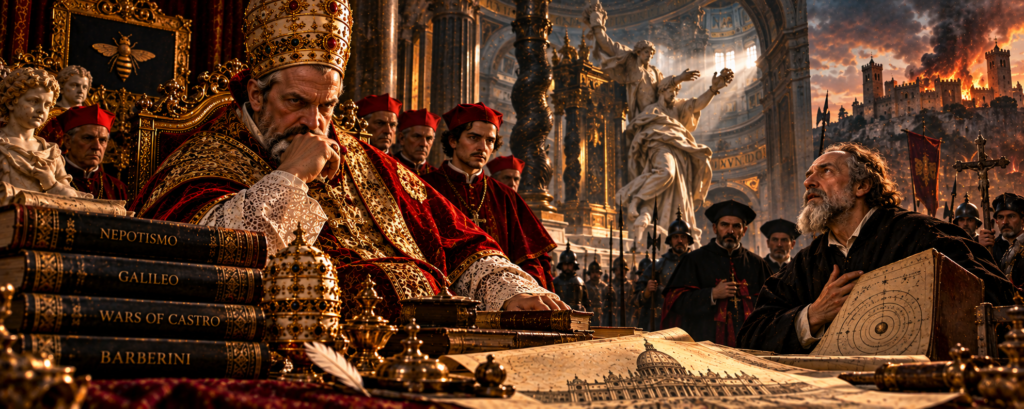
Urban VIII: The Pope Who Condemned Galileo, Enriched His Family, and Bankrupted Rome
Pope Urban VIII (1568–1644) | Reigned 1623–1644
The Pope Who Turned Against His Friend
On June 22, 1633, an elderly scientist knelt before the Roman Inquisition and formally renounced the astronomical ideas that had made him famous. Galileo Galilei was nearly seventy years old, suffering from poor health, and exhausted by months of interrogation and uncertainty. His offense was not discovering a new planet or inventing a dangerous machine, but defending a model of the universe in which Earth moved around the Sun. The tribunal declared him vehemently suspected of heresy, and the man who had transformed humanity’s understanding of the heavens was sentenced to imprisonment, subsequently commuted to confinement under house arrest.
The humiliation was made more extraordinary by the identity of the pope reigning over Rome. Urban VIII had once been Galileo’s admirer, protector, and intellectual acquaintance. Before becoming pope, he had praised the scientist’s discoveries and defended his reputation in learned circles. Galileo had every reason to believe that the election of his powerful friend in 1623 might finally allow him to discuss the Copernican universe more openly.
Instead, their relationship ended in one of history’s most notorious confrontations between religious authority and scientific inquiry. Galileo’s book was prohibited, his arguments condemned, and his remaining years restricted by ecclesiastical judgment. Urban did not personally sit as the sole judge at Galileo’s trial, but he exercised decisive authority over the proceedings and supported the punishment. The pope who had once celebrated Galileo’s intelligence became inseparably associated with his disgrace.
Yet Galileo’s condemnation was only one controversy in a pontificate filled with ambition, political intrigue, and extraordinary extravagance. Urban VIII ruled for twenty-one years, transforming Rome into a magnificent showcase of Baroque art while enriching his relatives on a staggering scale. He appointed nephews to powerful positions, elevated his family into the highest ranks of Italian aristocracy, and poured enormous resources into palaces, fortifications, and military preparations. His government eventually became entangled in a disastrous war against the Farnese dukes of Parma, a conflict that damaged papal finances and left his successors struggling with the consequences.
The contrast between magnificence and misgovernment was difficult to ignore. Under Urban, Rome acquired extraordinary works of art, including Gian Lorenzo Bernini’s monumental bronze canopy inside St. Peter’s Basilica. At the same time, the papal treasury accumulated serious debts, ordinary subjects faced mounting financial pressures, and powerful relatives benefited from the machinery of ecclesiastical government. The pope who commissioned masterpieces also presided over a war that exposed the limits of papal military power.
Urban was not simply a corrupt fool who happened to occupy the papal throne. He was educated, intelligent, politically experienced, and genuinely interested in literature, theology, science, and the arts. He possessed formidable personal confidence and believed that the papacy should command respect from Europe’s greatest rulers. His tragedy, and the tragedy of those affected by his decisions, was that this confidence could harden into arrogance when challenged.
By the time Urban died in 1644, his reputation had been badly damaged. His family possessed immense wealth and influence, but the Papal States were burdened by financial problems and the humiliating consequences of war. Galileo remained a symbol of intellectual authority punished by religious power, while the Barberini name had become synonymous with nepotism and extravagant ambition. Urban VIII had made Rome more magnificent, but he had also demonstrated how destructive an ambitious pope could become when personal pride, family interests, and political authority were allowed to reinforce one another.
Maffeo Barberini: The Making of an Ambitious Churchman
The future Urban VIII was born Maffeo Barberini in Florence on April 5, 1568. His family belonged to the prosperous commercial and professional elite, possessing considerable wealth and connections without enjoying the ancient hereditary prestige of some Italian princely houses. The Barberini had established themselves through business, property, and ecclesiastical service. Their position offered opportunities for advancement, but the extraordinary heights they would eventually reach were far from guaranteed.
Maffeo’s father, Antonio Barberini, died when the boy was still young. His mother, Camilla Barbadori, played an important role in his upbringing and education. She ensured that her son received the instruction necessary for a promising career. The young Barberini demonstrated intellectual ability and developed interests that would remain important throughout his life.
He studied with the Jesuits and later attended the University of Pisa, where he received a doctorate in law. His education combined legal training with the religious and humanistic culture of late sixteenth-century Italy. He became proficient in Latin and developed a lasting enthusiasm for poetry. Unlike some earlier popes whose reputations rested primarily upon military ambition or family power, Barberini possessed genuine intellectual accomplishments.
His uncle Francesco Barberini, an influential ecclesiastical official in Rome, helped introduce him to the Roman Curia. Family patronage therefore played an important role in Maffeo’s own rise. The connection provided opportunities that might otherwise have remained inaccessible. The future pope learned early that personal ability and powerful relatives could be an extremely effective combination.
Barberini’s career advanced under Pope Clement VIII. He received administrative appointments and became involved in diplomatic affairs. His work brought him into contact with influential churchmen and European courts. These experiences helped develop the political confidence that would later characterize his pontificate.
In 1604, Barberini was appointed papal nuncio to France. The position required him to represent the Holy See at the court of Henry IV, whose conversion to Catholicism had helped end decades of religious warfare in France. Barberini developed relationships with French political figures and became familiar with the complicated rivalry between France and the Habsburg powers. His experiences encouraged a diplomatic outlook that did not automatically identify Catholic interests with those of Spain or the Holy Roman Empire.
Pope Paul V elevated Barberini to the College of Cardinals in 1606. The appointment placed him among the senior figures of the Church and made him eligible for election to the papacy. He later served as bishop of Spoleto and held additional administrative responsibilities. His career demonstrated both political competence and an ability to cultivate influential relationships.
Barberini also moved comfortably within Rome’s intellectual and artistic circles. He admired literature, supported learned discussions, and maintained relationships with scholars. His interest in science was genuine, although it operated within the religious assumptions of his time. Among the intellectuals whose work attracted his attention was Galileo Galilei.
The Cardinal Who Admired Galileo
Galileo had already become famous before Barberini became pope. His telescopic observations had revealed mountains on the Moon, satellites orbiting Jupiter, and phases of Venus that challenged traditional assumptions about the heavens. His discoveries transformed astronomical debate and brought him international recognition. They also intensified controversy over the Copernican model, which placed the Sun near the center of the planetary system.
Barberini admired Galileo’s intelligence and scientific accomplishments. Their relationship developed within the educated circles of early seventeenth-century Italy, where astronomy, philosophy, theology, and courtly patronage frequently overlapped. Galileo needed influential supporters because his discoveries challenged established intellectual authorities. Barberini possessed precisely the kind of position that could provide protection.
The cardinal was not alone in appreciating Galileo’s work. Some Jesuit astronomers confirmed important telescopic observations, even while disagreeing with his interpretation of their implications. Catholic intellectual life was more diverse than the later image of a uniformly anti-scientific Church suggests. The central controversy concerned whether the Earth’s motion could be defended as physical truth rather than merely discussed as a mathematical hypothesis.
Barberini’s support was especially valuable because he possessed considerable influence within the Roman Curia. He had demonstrated sympathy toward Galileo during earlier controversies and praised his intellectual achievements. Galileo regarded him as an important ally. Their relationship created expectations that would later prove tragically misplaced.
The situation changed in 1616, when Church authorities formally rejected the unrestricted defense of heliocentrism. The Roman Inquisition judged the proposition that the Sun stood motionless at the center of the universe to be contrary to accepted interpretations of Scripture. Galileo was instructed not to hold or defend the Copernican position. The precise wording and legal significance of an additional injunction recorded in the case file would become a central issue during his later trial.
Barberini did not become pope until seven years after these restrictions were imposed. He therefore inherited a controversy that had already developed under Paul V. His earlier sympathy for Galileo did not necessarily mean that he accepted heliocentrism as established physical truth. He could admire the scientist while remaining unwilling to challenge the Church’s authority over the interpretation of Scripture.
Nevertheless, Galileo hoped that Barberini’s election would improve his position. A pope personally interested in scientific discussion seemed preferable to one who regarded astronomical controversy primarily as a threat. Their earlier relationship suggested that the new pontiff might permit a more open debate. The expectation would encourage Galileo to pursue a publication that ultimately brought him before the Inquisition.
The friendship between the two men therefore became one of the most consequential relationships of Urban’s reign. It began with intellectual admiration and the promise of patronage. It ended with condemnation, humiliation, and confinement. The transformation reveals how dangerous personal relationships could become when intellectual disagreement collided with institutional authority.
The Conclave of 1623: A New Dynasty Takes the Throne
Pope Gregory XV died on July 8, 1623, leaving behind a papacy shaped by the influence of his nephew Ludovico Ludovisi. The College of Cardinals assembled to elect a successor amid intense political maneuvering. French and Spanish interests competed for influence, while powerful Roman families sought to protect their positions. The election would determine which faction gained control over one of Europe’s most important religious institutions.
Maffeo Barberini emerged as an attractive candidate. His diplomatic experience in France gave him useful connections, while his reputation as an educated and capable churchman appealed to influential cardinals. He was not a youthful outsider, but neither was he so elderly that his pontificate seemed certain to be brief. His political skills helped him navigate the competing interests within the conclave.
On August 6, 1623, Barberini was elected pope. He chose the name Urban VIII, becoming the first pontiff of that name in more than four centuries. His election represented an extraordinary victory for the Barberini family. A household that had risen through commerce, professional achievement, and ecclesiastical service now possessed direct access to the highest office in the Catholic Church.
The election took place during a dangerous summer in Rome. Fever and disease affected the city and complicated the conclave. Barberini himself became seriously ill after his election, delaying the ceremonies associated with his coronation. For a time, there were concerns that the new pontificate might end almost before it had begun.
Urban recovered, and his coronation eventually took place on September 29. The ceremonies celebrated the continuity of papal authority and the beginning of a new reign. Behind the religious pageantry, however, a political transformation was already underway. The Barberini family was preparing to occupy positions of extraordinary power.
Urban was fifty-five years old and possessed substantial administrative experience. He had worked in diplomacy, served as a bishop, and participated in the intellectual life of Rome. His election did not represent the elevation of an inexperienced favorite. It placed a capable and ambitious churchman in a position where his personal decisions could affect millions.
The new pope believed strongly in the dignity and independence of his office. He wanted the papacy to remain a significant political power rather than become subordinate to Europe’s monarchies. He also intended to strengthen the territorial government of the Papal States. These ambitions would shape his foreign policy, financial decisions, and military preparations.
Yet Urban’s most immediate priority involved his own family. Within weeks, relatives began receiving important appointments and honors. The pattern resembled the nepotism practiced by earlier popes, but the scale of Barberini advancement would become extraordinary. The new pontificate was already developing into a family enterprise.
The Barberini Nephews: A Family Takes Control of Rome
Urban VIII’s nepotism became one of the defining features of his reign. He elevated relatives to positions of authority within the Church and the government of the Papal States. His nephews received ecclesiastical offices, military commands, financial advantages, and opportunities for aristocratic advancement. The concentration of power made the Barberini one of the most influential families in Italy.
Francesco Barberini, the pope’s nephew, became a cardinal in October 1623. He was still in his twenties and had not spent decades acquiring the experience normally associated with senior ecclesiastical leadership. His relationship to Urban was the decisive factor in his rapid advancement. He soon became the principal cardinal-nephew and an important figure in papal administration.
Francesco was intelligent, educated, and capable of handling complex diplomatic responsibilities. He developed considerable influence over government affairs and became involved in negotiations with European powers. His abilities made him more than a ceremonial beneficiary of family privilege. Nevertheless, his position depended upon the extraordinary advantages provided by his uncle.
Another nephew, Antonio Barberini, was elevated to the cardinalate in 1627. He became involved in ecclesiastical administration and later held important military and diplomatic responsibilities. His advancement created another powerful branch of family influence within the papal government. The presence of multiple Barberini cardinals strengthened the household’s ability to control appointments and political decisions.
Urban also promoted his brother Antonio Barberini, a Capuchin friar, to the College of Cardinals in 1628. The appointment further increased the family’s representation among the Church’s senior officials. It demonstrated how the pope could distribute ecclesiastical dignity among relatives with very different backgrounds. The cardinalate became another instrument of family advancement.
Taddeo Barberini, another nephew, pursued a primarily secular career. He received military and political appointments and became Prince of Palestrina. His marriage to Anna Colonna connected the Barberini with one of Rome’s most distinguished aristocratic families. The alliance helped convert the temporary advantages of a papal pontificate into hereditary prestige.
The family also acquired substantial property. Urban’s relatives accumulated estates, residences, and valuable financial resources that strengthened their position within Italian society. Their wealth supported magnificent artistic commissions and an increasingly elaborate aristocratic lifestyle. The Barberini became a dynasty whose fortunes were inseparable from the papal throne.
The scale of their advancement provoked criticism. Contemporary observers recognized that important offices and financial opportunities were being concentrated within one household. Rivals resented the family’s influence, while foreign diplomats understood that negotiations often required dealing with Barberini relatives. The pope’s personal government became increasingly difficult to distinguish from the political interests of his family.
Urban defended the importance of trusted relatives in government. He believed that family loyalty could protect the papacy from interference by powerful monarchies and rival factions. Yet the arrangement created conflicts of interest that would become increasingly dangerous. When the family’s ambitions collided with those of other Italian rulers, the consequences would extend far beyond court politics.
The Barberini Bees and the Transformation of Rome
The Barberini family adopted three bees as its heraldic emblem, and under Urban VIII those bees became almost impossible to escape in Rome. They appeared on buildings, monuments, fountains, decorations, and works of art associated with the pope and his relatives. The emblem advertised the family’s authority and cultural prestige. It also served as a reminder that the city was being transformed under Barberini patronage.
Urban possessed a genuine passion for architecture and artistic magnificence. He believed that the visual splendor of Rome reflected the dignity of the Catholic Church. Magnificent buildings could demonstrate the power of the papacy to visitors, diplomats, and ordinary residents. Art therefore became an important instrument of religious and political communication.
The pope’s most celebrated artistic relationship was with Gian Lorenzo Bernini. The young sculptor and architect possessed extraordinary talent, and Urban recognized his potential. Their collaboration would help define the visual character of Baroque Rome. Bernini received commissions that transformed churches, public spaces, and papal monuments.
Among the most important projects was the enormous bronze baldachin above the high altar of St. Peter’s Basilica. Its twisted columns and elaborate decoration created a dramatic focal point beneath Michelangelo’s great dome. The work combined religious symbolism with the artistic ambition of the Barberini court. It became one of the defining masterpieces of Baroque architecture.
Urban also supported the construction and decoration of churches, palaces, and public monuments. His patronage helped transform Rome into a city of theatrical spaces and monumental artistic statements. The resulting works attracted admiration and reinforced the papacy’s cultural prestige. Many remain among the most celebrated achievements of seventeenth-century art.
Yet the magnificence carried substantial costs. Large commissions required materials, labor, and financial resources. The Barberini family’s own residences and collections also consumed enormous sums. Their wealth allowed them to compete with Europe’s most powerful aristocratic households.
The contrast between artistic splendor and public financial pressure became increasingly visible. Rome acquired magnificent monuments while the papal government accumulated debt and faced growing military expenses. The city’s appearance advertised prosperity even as its treasury confronted serious difficulties. Urban’s artistic legacy therefore cannot be separated entirely from the financial policies of his reign.
The Barberini bees eventually became symbols of both achievement and excess. They represented the family’s cultural patronage and the extraordinary beauty of Baroque Rome. They also reminded critics of the wealth and influence accumulated by papal relatives. The same emblem could inspire admiration or resentment depending upon who encountered it.
The Pantheon: When Ancient Rome Became a Quarry
One of the most controversial episodes of Urban’s artistic patronage involved the Pantheon, the ancient Roman temple that had survived as a Christian church. Its massive bronze architectural elements represented valuable material in a city where metal was expensive. The papal government ordered the removal of bronze from the building’s portico during Urban’s reign. The decision provoked criticism that would become part of the Barberini family’s enduring reputation.
The removed bronze was used for several purposes, including military production and architectural projects. The precise distribution of the material has sometimes been simplified in popular accounts. A familiar story claims that the bronze was stripped from the Pantheon specifically to create Bernini’s baldachin in St. Peter’s Basilica. That explanation is misleading because the relationship between the Pantheon bronze and the baldachin was more complicated.
Some of the metal was used in the production of cannon for Castel Sant’Angelo. Other material was associated with architectural and decorative projects. The removal nevertheless represented a significant intervention in one of antiquity’s most important surviving monuments. Critics regarded it as an act of destructive appropriation.
The controversy produced one of Rome’s most famous satirical sayings, accusing the Barberini of doing what the barbarians had failed to accomplish. The remark captured public resentment toward the family’s treatment of ancient monuments. Its precise authorship is uncertain, and it should not be presented as the documented statement of a particular individual without evidence. Nevertheless, the sentiment became closely associated with Urban’s reputation.
The episode illustrates the contradictions of Baroque patronage. Urban wanted to glorify Rome and the Catholic Church through magnificent architecture. Yet achieving that magnificence could involve dismantling elements of the ancient city. The papacy acted as both protector and exploiter of Rome’s cultural inheritance.
The removal also reflected military priorities. Bronze was valuable for artillery, and Urban invested heavily in fortifications and weapons. The papal government faced a Europe increasingly shaped by warfare. Ancient architectural materials could therefore become resources for contemporary military power.
The Pantheon controversy became a powerful symbol because it united several criticisms of Urban’s reign. It involved artistic ambition, military expenditure, disregard for ancient heritage, and the prominence of the Barberini family. The episode also demonstrated the limits of papal authority over public opinion. Even a pope could become the subject of biting Roman satire.
Urban’s defenders could argue that the material served important religious and defensive purposes. His critics saw the removal as another example of a government willing to sacrifice public heritage for its own ambitions. The disagreement reflected broader tensions within his pontificate. Rome was being transformed, but not everyone welcomed the methods used to achieve that transformation.
Galileo Returns to Rome: A Friendship Renewed
Galileo greeted Urban’s election with considerable optimism. The new pope had admired his work and maintained friendly relations with him for years. Galileo believed that this personal connection might create opportunities unavailable under previous pontificates. He hoped to discuss the Copernican system without provoking another confrontation with ecclesiastical authorities.
In 1624, Galileo traveled to Rome and received several audiences with Urban. Their conversations addressed astronomy, philosophy, and the relationship between scientific arguments and religious authority. The pope appeared willing to permit discussion of the Copernican model under certain conditions. Galileo returned to Florence encouraged by the possibility of publishing a major work.
Urban’s position was not an unrestricted endorsement of heliocentrism. He remained unwilling to allow Galileo to present the Earth’s motion as an established physical truth contrary to the restrictions imposed in 1616. The pope emphasized that divine omnipotence placed limits upon human claims to certainty about the structure of the universe. Scientific explanations could be discussed, but they should not be treated as necessarily demonstrating how God had arranged creation.
Galileo believed he could work within these boundaries. He planned a dialogue comparing the traditional Earth-centered system with the Copernican model. The literary format would allow competing arguments to be presented through different characters. He hoped that the strength of the scientific reasoning would become apparent to readers.
The project was ambitious. Galileo had spent decades studying astronomy, motion, and the physical world. He believed that the evidence increasingly favored the Earth’s movement. His work challenged not only traditional cosmology but also the intellectual authority of scholars who relied heavily upon Aristotelian philosophy.
The relationship between Galileo and Urban remained outwardly cordial during the early stages of the project. The scientist had reason to believe that his powerful patron would protect him from excessive hostility. Yet the political environment was becoming more dangerous. The Thirty Years’ War was intensifying, and the pope faced growing criticism from rival Catholic powers.
Urban’s own temperament also mattered. He possessed strong opinions and expected respect for his authority. Intellectual disagreement could become politically sensitive when it appeared to challenge the dignity of the papal office. Galileo’s confidence in his arguments would eventually collide with Urban’s determination to preserve ecclesiastical control.
The seeds of the later disaster were therefore already present. Galileo believed that scientific evidence could justify a more open discussion of heliocentrism. Urban believed that the Church’s authority and the limits of human knowledge had to remain central. Their friendship could survive disagreement only while neither man believed the other had crossed an unacceptable boundary.
The Book That Changed Everything
In 1632, Galileo published Dialogue Concerning the Two Chief World Systems. The book presented an extended discussion of the traditional Ptolemaic system and the Copernican model. Its arguments unfolded through conversations among three fictional characters. The work combined scientific reasoning, literary skill, and sharp criticism of intellectual positions Galileo considered weak.
The character Salviati generally presented arguments favorable to the Copernican system. Sagredo served as an intelligent participant who evaluated competing claims. Simplicio defended traditional positions associated with Aristotelian cosmology. The structure allowed Galileo to dramatize the scientific debate while maintaining the appearance of a balanced discussion.
In practice, the Copernican arguments received powerful support. Galileo used observations and reasoning to challenge the traditional assumption that Earth remained motionless. His discussion of the tides was intended to provide physical evidence for Earth’s movement, although that particular explanation was scientifically incorrect. The book nevertheless represented a major contribution to the public debate over cosmology.
The publication had received ecclesiastical permissions, but the circumstances surrounding those permissions became controversial. Officials had expected Galileo to observe restrictions concerning the presentation of heliocentrism. The final text appeared to many readers to favor the Copernican system more strongly than the authorities had intended. The dispute over what had been authorized became central to the subsequent investigation.
Urban was particularly angered by the book’s treatment of an argument he had emphasized during his conversations with Galileo. The pope had maintained that God’s unlimited power meant that natural phenomena could not necessarily prove one particular cosmic arrangement. A version of this argument appeared near the conclusion of the dialogue, placed in the mouth of Simplicio. Because Simplicio often appeared intellectually outmatched, the presentation could be interpreted as insulting.
Later accounts frequently claim that Urban believed Galileo had deliberately portrayed him as a fool. The possibility is plausible, and the episode likely contributed to the pope’s anger. Nevertheless, the surviving evidence does not justify reducing the entire trial to a simple story of personal revenge over one fictional character. The conflict involved theological authority, previous restrictions, publication procedures, and the political pressures surrounding the papacy.
Urban ordered an investigation into the circumstances of the book’s publication. A commission examined whether Galileo had violated earlier instructions. The inquiry uncovered a record of the 1616 injunction, which appeared to prohibit Galileo from teaching or defending the Copernican position. The legal significance of that document became a major issue.
Galileo’s hopes of protection rapidly disappeared. The pope who had once welcomed him now supported proceedings that could destroy his reputation and freedom. The scientist was ordered to appear before the Roman Inquisition. A friendship that had seemed to offer security had become a source of extraordinary danger.
The Summons to Rome
Galileo received orders to travel to Rome and answer questions concerning his book. By this time, he was elderly and suffering from significant health problems. The journey from Florence was difficult, particularly during a period when disease and quarantine restrictions complicated travel. His supporters attempted to secure delays or accommodations.
The Roman authorities nevertheless insisted that he appear. The matter had become too important to be settled through correspondence alone. Galileo’s book had challenged restrictions associated with the authority of the Church. The pope expected the scientist to submit to the judicial process.
Galileo eventually arrived in Rome in February 1633. He stayed initially at the residence of the Tuscan ambassador, whose government attempted to protect him through diplomatic intervention. The Grand Duke of Tuscany had long supported Galileo’s work. Yet even princely patronage could not override the authority of the Roman Inquisition.
The proceedings began in earnest during the spring. Galileo faced questions about his understanding of the 1616 restrictions and the intentions behind his book. He maintained that he had not deliberately violated the Church’s instructions. His defense emphasized the distinction between presenting arguments for discussion and personally asserting forbidden conclusions.
The tribunal examined the relationship between the published dialogue and the earlier injunction. The records suggested that Galileo had been instructed not to hold, teach, or defend the Copernican doctrine. Galileo possessed a certificate from Cardinal Robert Bellarmine describing the restrictions imposed in 1616. The apparent differences between the documents complicated the legal interpretation.
Historians continue debating aspects of the 1616 injunction and the fairness of the subsequent proceedings. The surviving records do not support every dramatic claim that later writers have made about the trial. Nevertheless, the central reality is clear. Galileo was being prosecuted for defending a cosmological position that Church authorities had restricted.
Urban’s role was decisive even though he did not personally conduct every interrogation. The pope exercised authority over the Holy Office and participated in important decisions concerning the case. His anger toward Galileo and determination to defend ecclesiastical authority shaped the political environment of the proceedings. The trial cannot reasonably be separated from his pontificate.
For Galileo, the situation was terrifying. His scientific reputation, personal freedom, and remaining years were at stake. He had entered Rome hoping to explain his work and preserve his standing. Instead, he faced a tribunal whose judgment could permanently destroy his position within Catholic intellectual life.
The Trial of Galileo: Faith, Authority, and Fear
The Roman Inquisition questioned Galileo during several sessions in 1633. The proceedings focused upon whether he had violated the restrictions imposed in 1616 and whether his book effectively defended heliocentrism. Galileo attempted to explain that the dialogue presented competing arguments rather than an unequivocal endorsement. The tribunal remained unconvinced.
The case involved a complicated relationship between scientific evidence and theological authority. Church officials regarded the Copernican system as problematic because it appeared to contradict established interpretations of Scripture. Galileo believed that observations and mathematical reasoning justified reconsidering traditional cosmology. The conflict therefore concerned who possessed authority to determine the meaning of physical reality.
The proceedings also reflected the political atmosphere of Urban’s reign. The pope faced criticism from powerful Catholic interests over his diplomatic policies during the Thirty Years’ War. His authority was being challenged in several areas. A public confrontation with Galileo offered an opportunity to demonstrate that ecclesiastical restrictions could not be disregarded.
It would be too simple to claim that Urban prosecuted Galileo solely to distract from political problems. The surviving evidence does not establish such a single motive. Nevertheless, the wider political pressures help explain why the pope may have been particularly unwilling to tolerate an apparent challenge. The controversy unfolded within a government increasingly sensitive to questions of authority and reputation.
Galileo eventually acknowledged that his book could appear to favor the Copernican position more strongly than he had intended. His statements reflected the pressure of the proceedings and the need to protect himself from a harsher judgment. The tribunal did not accept his explanations as sufficient. The case moved toward condemnation.
The question of torture has generated considerable confusion. Galileo was threatened with torture during the proceedings, but the surviving records do not establish that he was physically tortured. Claims that he was stretched on the rack or subjected to elaborate physical torment are unsupported. The threat itself, however, was a serious instrument of judicial pressure.
The tribunal ultimately judged Galileo vehemently suspected of heresy. The sentence required him to abjure the condemned position and prohibited his book. He was also sentenced to imprisonment, which was subsequently commuted to a form of house arrest. The judgment marked a devastating defeat for the scientist.
Urban’s responsibility was substantial. The pope had supported the investigation, exercised authority over the proceedings, and accepted the resulting punishment. He was not merely an uninvolved ruler whose officials acted independently. His government had transformed an intellectual controversy into a judicial condemnation.
June 22, 1633: Galileo Kneels Before the Inquisition
The formal sentencing took place on June 22, 1633, at the Dominican convent of Santa Maria sopra Minerva in Rome. Galileo appeared before the assembled authorities and heard the judgment against him. The sentence condemned his conduct and required him to renounce the forbidden position. His scientific reputation had become entangled with a public demonstration of ecclesiastical power.
Galileo formally abjured his support for the condemned doctrine. The ceremony was intended to establish his submission to the Church’s authority. It also served as a warning to others who might challenge restrictions imposed by the Roman Inquisition. The spectacle transformed a dispute over astronomy into an act of religious discipline.
The judgment did not mean that Galileo had been convicted of every theological offense imaginable. The tribunal declared him vehemently suspected of heresy, a specific category within inquisitorial procedure. This distinction matters because later retellings sometimes exaggerate the formal terms of the sentence. The consequences were nevertheless severe.
His book was prohibited, and his freedom was restricted. The scientist who had once moved among powerful patrons now faced confinement for the remainder of his life. He was initially permitted to reside under supervision in Siena. He later returned to his villa near Florence, where he remained under house arrest.
The famous story that Galileo muttered that Earth nevertheless moved after his abjuration is not supported by contemporary evidence. The remark appeared in later traditions and became a symbol of intellectual defiance. Its historical authenticity is doubtful. The actual circumstances of the trial were sufficiently dramatic without inventing a final act of rebellion.
Galileo’s punishment also requires careful description. He was not confined continuously in a dark prison cell until his death. His house arrest allowed limited personal and intellectual activity under restrictions. Nevertheless, he remained deprived of ordinary freedom and subject to ecclesiastical supervision.
Urban did not reverse the judgment. The former friendship between pope and scientist had effectively collapsed. Galileo’s appeals and the efforts of supporters did not secure full rehabilitation during his lifetime. The sentence remained a defining consequence of Urban’s pontificate.
The trial became one of the most enduring controversies in the history of the Catholic Church. It demonstrated the danger of allowing religious institutions to impose judicial penalties upon scientific arguments. It also revealed how personal relationships could become entangled with the defense of institutional authority. Urban’s name would remain associated with Galileo’s condemnation long after the political disputes of his reign had faded.
Galileo’s Final Years: A Prisoner Who Continued Thinking
After his condemnation, Galileo spent time in Siena under the supervision of Archbishop Ascanio Piccolomini. The archbishop treated him with considerable kindness and helped restore his confidence after the ordeal. Galileo eventually received permission to return to his villa at Arcetri, near Florence. His freedom remained restricted, but he was no longer confined within the immediate environment of the Roman tribunal.
His physical condition deteriorated during the following years. He suffered from chronic illness and eventually became blind. The loss of sight was particularly cruel for a man whose telescopic observations had transformed astronomy. Nevertheless, his intellectual activity did not cease.
Galileo continued working on problems involving motion and mechanics. His later research developed ideas that would influence the foundations of modern physics. He relied increasingly upon assistants and correspondents as his health declined. His scientific career survived the attempt to silence his most controversial astronomical arguments.
In 1638, his Discourses and Mathematical Demonstrations Relating to Two New Sciences appeared in print outside Italy. The work examined important questions concerning motion and the strength of materials. It became one of Galileo’s most significant scientific achievements. Its publication demonstrated that the condemned scientist remained capable of major intellectual contributions.
The book’s appearance also revealed the limitations of ecclesiastical censorship. Restrictions imposed in Rome could not completely prevent ideas from circulating through Europe’s expanding publishing networks. Protestant territories offered opportunities unavailable within Catholic jurisdictions. Scientific debate increasingly crossed political and confessional boundaries.
Galileo died on January 8, 1642, at the age of seventy-seven. Urban VIII was still pope. The scientist’s death did not bring an immediate reversal of the judgment against him. His reputation remained contested within Catholic institutions.
Over subsequent centuries, Galileo became a symbol of the conflict between intellectual inquiry and religious authority. The historical reality was more complicated than a simple struggle between science and faith, since many religious scholars contributed to scientific development. Nevertheless, the injustice of his condemnation became increasingly difficult to defend. Urban’s role remained central to the controversy.
The tragedy lies partly in the relationship that preceded the trial. Galileo had once regarded Urban as a friend capable of protecting intellectual discussion. The pope had admired his work and encouraged him under certain conditions. Their relationship ended with the scientist confined and the pontiff associated with one of the most notorious judicial decisions in scientific history.
The Thirty Years’ War: A Pope Between Catholic Powers
While Galileo faced the Inquisition, much of Europe was being devastated by the Thirty Years’ War. The conflict had begun in 1618 and would continue until 1648, four years after Urban’s death. Its causes included religious division, dynastic rivalry, territorial ambition, and disputes over the constitutional structure of the Holy Roman Empire. The war eventually involved many of Europe’s major powers.
Urban inherited a papacy whose predecessors had supported Catholic interests in central Europe. Gregory XV had encouraged the Habsburg cause and supported the transfer of the Palatine electoral dignity to Maximilian of Bavaria. Urban adopted a more cautious and complicated diplomatic position. He feared that an overwhelming Habsburg victory might leave the papacy politically dependent upon Spain and the emperor.
The Habsburg dynasty possessed extensive territories and considerable military power. Its Spanish and Austrian branches could exert enormous influence over Italian affairs. Urban wanted the Holy See to remain independent rather than become an instrument of Habsburg policy. His concern shaped his relations with France, Spain, and the Holy Roman Empire.
France was Catholic but increasingly opposed to Habsburg dominance. Cardinal Richelieu, the powerful minister of Louis XIII, pursued policies intended to weaken the dynasty’s influence. This strategy sometimes involved cooperation with Protestant powers. The resulting alliances complicated the idea that the Thirty Years’ War was simply a conflict between Catholic and Protestant states.
Urban’s position attracted criticism from Catholic rulers who expected stronger papal support. Habsburg representatives complained that the pope failed to provide sufficient assistance against Protestant enemies. His reluctance to commit fully to their cause appeared suspicious to those who regarded the conflict primarily as a religious struggle. The pope insisted upon preserving his independence and the broader interests of the Church.
His policy was not equivalent to openly embracing Protestantism. Urban remained committed to Catholic doctrine and the defense of ecclesiastical authority. He also provided limited assistance and pursued diplomatic initiatives intended to influence events. Nevertheless, his unwillingness to support Habsburg ambitions without reservation created serious tensions.
The conflict demonstrated the limits of religious solidarity. Catholic rulers could pursue political interests that brought them into opposition with one another. Urban’s fear of Habsburg dominance sometimes outweighed the desire for a decisive Catholic military victory. His diplomacy reflected the complicated realities of European power politics.
The consequences were significant for the papacy’s reputation. Some Catholic contemporaries regarded Urban as insufficiently committed to their cause. Others considered his caution necessary to preserve the independence of the Holy See. The controversy contributed to an atmosphere of political suspicion that would shape the later years of his pontificate.
The Pope, Richelieu, and the Fear of Habsburg Domination
Urban’s relationship with France was shaped by his earlier diplomatic experience. He had served at the French court and developed connections with influential political figures. These relationships encouraged a degree of sympathy toward French interests. They also made him suspect in the eyes of Spanish and imperial representatives.
Cardinal Richelieu pursued a foreign policy designed to prevent Habsburg encirclement of France. His strategy involved diplomatic pressure, financial support for enemies of the Habsburgs, and eventually direct military intervention. Although Richelieu was a Catholic cardinal, he was willing to cooperate with Protestant powers when French interests required it. The policy exposed the growing importance of state power in European diplomacy.
Urban understood the danger of allowing Spain and the emperor to dominate Italy. The Papal States were surrounded by territories influenced by powerful dynasties. A decisive Habsburg victory could reduce the pope’s ability to act independently. His caution therefore reflected genuine political concerns.
Yet the pope’s position also created moral and religious difficulties. Catholic armies and communities in central Europe expected support from Rome. Protestant military victories could threaten Catholic institutions and populations. Urban’s diplomatic calculations sometimes appeared indifferent to those concerns.
The papacy attempted to present itself as a mediator among Catholic rulers. Urban wanted to preserve the possibility of negotiation rather than become a subordinate ally of one dynasty. His representatives participated in diplomatic efforts intended to limit conflict. These initiatives achieved only limited success.
The wider war continued to intensify. Sweden entered the conflict under Gustavus Adolphus, and French involvement expanded. Armies devastated territories through siege, requisition, disease, and displacement. The suffering of civilians became one of the defining features of the conflict.
Urban’s policies cannot be blamed for the entire catastrophe. The war had begun before his election and involved decisions made by numerous rulers. Nevertheless, his government participated in the diplomatic calculations that shaped the conflict. His determination to preserve papal independence sometimes conflicted with the expectations of Catholic allies.
The episode reveals a pope who behaved as a political sovereign as well as a spiritual leader. Urban’s decisions were influenced by fears of territorial domination and the balance of European power. His religious commitments remained important, but they did not determine every diplomatic choice. The papacy was operating within the same world of rivalry and ambition as Europe’s secular monarchies.
A Pope Preparing for War
Urban’s fear of external threats encouraged extensive military preparations within the Papal States. He invested in fortifications, artillery, and defensive infrastructure. Important positions were strengthened to protect papal territory against potential invasion. These projects consumed substantial financial resources.
Castel Sant’Angelo, the fortress overlooking the Tiber in Rome, received attention as part of the defensive program. The papal government also improved fortifications at Civitavecchia, the important port on the Tyrrhenian Sea. Other strategic locations were strengthened. Urban wanted the Papal States to possess the military capacity necessary to defend their independence.
The government also expanded its ability to produce weapons and ammunition. Military preparations required metal, labor, and specialized facilities. The demand for artillery contributed to the controversial removal of bronze from the Pantheon. The pope’s artistic and military ambitions were therefore connected through the use of valuable materials.
These investments reflected genuine concerns about European instability. The Thirty Years’ War had demonstrated how quickly military conflicts could spread. Italian territories remained vulnerable to intervention by powerful foreign armies. Urban believed that defensive preparations were essential.
Yet military expenditure placed increasing pressure upon the papal treasury. Fortifications were expensive to construct and maintain. Soldiers required payment, weapons needed supplies, and administrative costs continued accumulating. The government had to find revenue to support its ambitions.
Taxes and borrowing became important instruments of papal finance. The administration relied upon established mechanisms for raising money and managing public debt. Such measures could provide immediate resources while creating long-term obligations. The burden would become increasingly serious as Urban’s reign continued.
The military program also strengthened the political importance of Barberini relatives. Family members received commands and administrative responsibilities associated with defense. Their positions connected private ambition with public military policy. The arrangement created opportunities for conflicts of interest.
Urban’s preparations were intended to preserve independence, but they also encouraged a dangerous confidence in military power. The papacy possessed substantial resources, yet it was not equivalent to the great military monarchies of Europe. Its forces could be vulnerable when confronted by determined opponents. That weakness would become painfully apparent during the War of Castro.
The Farnese Family: An Old Dynasty Meets a New One
The conflict that eventually devastated Urban’s reputation involved the Farnese family, one of Italy’s most important aristocratic dynasties. The Farnese had risen to extraordinary prominence during the sixteenth century, particularly under Pope Paul III. They possessed territories, titles, and political connections that made them powerful figures within Italian affairs. Their status rested upon a combination of hereditary authority and earlier papal patronage.
By Urban’s reign, the Farnese ruled the duchies of Parma and Piacenza. They also controlled Castro, a territory located within the wider geographical sphere of papal influence. The relationship between the Farnese and the papacy was complicated by financial obligations, territorial claims, and questions of sovereignty. These disputes created opportunities for confrontation.
Odoardo Farnese became duke of Parma in 1622. He was young, ambitious, and determined to defend his family’s position. His relationship with the Barberini became increasingly hostile. The two dynasties represented competing interests within Italian politics.
The Barberini were relative newcomers to the highest aristocratic ranks. Their extraordinary advancement depended upon Urban’s pontificate. The Farnese possessed older titles and established territorial authority. The contrast encouraged rivalry over precedence, prestige, and political influence.
A dispute over ceremonial treatment during Odoardo’s visit to Rome contributed to worsening relations. The details of the incident have sometimes been exaggerated in popular accounts. It would be misleading to suggest that an entire war resulted from a single insult at court. The underlying conflict involved debts, territorial ambitions, and the political rivalry between the two families.
The Farnese also faced serious financial difficulties. Their debts were connected with arrangements involving revenues from Castro and obligations to creditors. The papal government possessed mechanisms for intervening when financial obligations were not met. These mechanisms became instruments of political pressure.
Urban’s nephews were deeply involved in the dispute. Their interests and ambitions contributed to the escalation. The pope’s willingness to support his family transformed a complicated financial disagreement into a confrontation between sovereign powers. The consequences would prove disastrous.
The rivalry illustrates the danger of combining papal government with dynastic ambition. Urban was responsible for protecting the interests of the Church and the Papal States. His relatives possessed their own political and financial objectives. When those interests became intertwined, compromise grew increasingly difficult.
The Road to Castro: Debt, Pride, and Political Ambition
The immediate origins of the War of Castro involved disputes over financial obligations and the status of Farnese territories. The duchy of Castro had been used in arrangements connected with substantial debts. Creditors possessed claims that could become politically significant. The papal government sought to enforce obligations and assert authority.
Odoardo Farnese resisted what he regarded as excessive interference. He believed that the Barberini were using financial disputes to undermine his position. The papal court viewed the duke as defiant and unwilling to respect legitimate claims. Each side increasingly interpreted the other’s actions as evidence of hostile intentions.
The conflict was intensified by questions of prestige. The Farnese considered themselves established princes entitled to appropriate respect. The Barberini possessed the power of the reigning pope and expected recognition of their authority. Ceremonial disagreements became symbols of deeper political rivalry.
Urban’s nephews had reasons to favor a forceful policy. Success against the Farnese could strengthen Barberini influence and demonstrate the family’s military power. Territorial advantages might also provide opportunities for further enrichment. The distinction between public policy and private ambition became increasingly blurred.
The papal government eventually moved toward military action. In 1641, papal forces occupied Castro. The intervention transformed a financial and political dispute into an armed confrontation. Odoardo refused to accept the loss of his territory.
The pope’s government presented its actions as the enforcement of legitimate authority. Farnese supporters regarded the occupation as aggression driven by Barberini ambition. Both sides sought allies and attempted to justify their positions. The conflict began drawing other Italian rulers into the dispute.
The danger was obvious. The Papal States were not isolated from the political system of Italy. Venice, Tuscany, and Modena had interests in preventing excessive papal expansion. A victory that strengthened Barberini power could threaten the independence of neighboring states.
Urban nevertheless continued supporting a confrontational policy. His confidence in papal authority and military preparations encouraged the belief that the dispute could be resolved through force. The decision would expose the limitations of his government’s resources. What began as a struggle over Castro became a wider Italian war.
The First War of Castro: A Pope Goes to Battle
The War of Castro developed into a major conflict during the early 1640s. Papal forces attempted to maintain control over the disputed territory and pressure Odoardo Farnese into submission. The duke sought support from neighboring rulers who feared the expansion of papal power. The resulting alliances transformed the confrontation into a regional war.
Venice, Tuscany, and Modena became involved on the side opposing the papacy. Their participation reflected concerns about political balance rather than a shared religious opposition to Rome. All were Catholic powers. The conflict therefore demonstrated how dynastic and territorial interests could override religious solidarity.
Urban’s government faced the prospect of fighting several Italian states simultaneously. The papal army possessed fortifications and artillery, but its military capacity was limited. Sustaining a prolonged conflict required enormous expenditure. The treasury was already under pressure from earlier military preparations.
The war involved troop movements, sieges, and the occupation of contested territories. Civilians experienced disruption as armies requisitioned supplies and imposed burdens upon local communities. Agricultural production and commerce suffered in affected regions. The consequences extended beyond the ambitions of the ruling families.
Odoardo Farnese proved more resilient than Urban’s advisers had expected. He refused to surrender his claims and maintained resistance despite papal pressure. His allies helped prevent the papacy from achieving a decisive victory. The conflict increasingly exposed the weaknesses of Barberini strategy.
The papal government responded with further military expenditure. Additional resources were required to maintain forces and defend threatened positions. Borrowing and taxation increased the financial burden. The costs accumulated without producing the political result Urban desired.
The pope’s authority also suffered. A pontiff who claimed to represent the spiritual unity of Catholic Europe was fighting Catholic princes over territory and financial obligations. The conflict made the papacy appear increasingly like an ordinary Italian principality pursuing dynastic interests. Its religious prestige did not guarantee military success.
The war became a damaging demonstration of the limits of papal power. Urban possessed enormous spiritual authority and considerable political resources. Yet he could not simply impose his will upon determined neighboring rulers. The Barberini family’s ambitions had helped create a confrontation that the papal government struggled to control.
Excommunication as a Weapon of War
Urban’s government used ecclesiastical sanctions as part of its confrontation with Odoardo Farnese. The duke faced excommunication during the conflict. The measure transformed a territorial dispute into a matter involving the spiritual authority of the Church. It also demonstrated the extraordinary powers available to a pope who governed both as religious leader and temporal sovereign.
Excommunication was a serious sanction within Catholic society. It excluded an individual from full participation in the sacramental life of the Church and carried substantial social and political consequences. In earlier centuries, popes had used such measures against kings and emperors. Urban’s decision belonged to that tradition of ecclesiastical pressure.
The use of spiritual sanctions in a dispute involving Barberini interests was particularly controversial. Critics questioned whether the pope was defending legitimate ecclesiastical rights or using religious authority to support a family-centered political conflict. The distinction was difficult to establish because the Papal States possessed both spiritual and temporal dimensions. The same ruler could act as pope and prince.
Odoardo’s resistance demonstrated that excommunication did not guarantee submission. Catholic rulers could challenge papal political demands while continuing to identify themselves with the Church. The conflict exposed the weakening ability of ecclesiastical sanctions to settle territorial disputes. Political alliances and military resources often proved more decisive.
The episode also damaged Urban’s moral authority. A pope who had condemned Galileo for challenging ecclesiastical restrictions now used spiritual penalties in a struggle involving territorial power. The two controversies were different in their legal and historical circumstances. Nevertheless, both revealed Urban’s determination to defend the authority of his office.
The sanctions did not resolve the conflict. The duke continued resisting, and neighboring Catholic states maintained their opposition to papal expansion. The war became increasingly expensive and politically embarrassing. Urban’s government found itself unable to translate spiritual authority into military victory.
The use of excommunication therefore illustrates one of the central contradictions of the papacy. The pope possessed religious powers intended to govern the spiritual life of Catholics. He also ruled territories and pursued political objectives that could conflict with those of other Catholic princes. When those roles overlapped, spiritual sanctions could become instruments of temporal policy.
Urban’s decision remains controversial because it occurred within a war deeply influenced by dynastic rivalry. The sanctions were not simply a neutral response to theological disagreement. They formed part of a struggle over power, territory, and financial obligations. The episode strengthened the impression that the Barberini papacy had become dangerously entangled in family ambition.
The War Turns Against the Barberini
As the conflict continued, the papal government struggled to achieve its objectives. The coalition opposing Urban possessed significant military resources and political determination. Papal forces faced setbacks, while the costs of maintaining the war continued rising. The pope’s confidence in his ability to impose a settlement proved increasingly misplaced.
The conflict also threatened the security of papal territory. Enemy forces operated in regions where the government had expected to exercise control. The possibility of wider invasion created anxiety in Rome. Military preparations that had consumed enormous resources now faced a serious test.
The Barberini family remained closely associated with the war. Urban’s nephews occupied important positions within the government and military administration. Their involvement made it difficult to separate the conflict from the family’s political interests. Critics increasingly blamed them for encouraging a disastrous confrontation.
The pope’s determination to continue the struggle prolonged the financial damage. The government required additional funds to support troops and fortifications. Borrowing increased, and existing revenues were placed under greater pressure. The costs accumulated at a time when the Papal States already faced substantial obligations.
The war also damaged the papacy’s diplomatic position. Catholic rulers who might otherwise have supported Rome were unwilling to endorse Barberini expansion. The coalition opposing Urban demonstrated that religious allegiance did not require submission to papal territorial ambitions. The pope’s political authority was being challenged by states that remained firmly Catholic.
The conflict eventually moved toward negotiation. Urban’s government could not secure the decisive victory it had sought. The military balance and financial pressures made continued warfare increasingly difficult. The prospect of a settlement became unavoidable.
The peace concluded in 1644 restored Castro to the Farnese. The outcome represented a major disappointment for Urban and his relatives. The papacy had spent enormous sums without achieving the permanent territorial advantages that might have justified the expenditure. The conflict ended with the Barberini politically weakened.
The humiliation was especially severe because Urban had presented himself as a powerful ruler capable of defending papal independence. His military preparations had created expectations of strength. The War of Castro revealed the limitations of that power. The pope’s final months were overshadowed by the consequences of a conflict that had damaged both his finances and his reputation.
The Financial Disaster: A Treasury Under Siege
Urban VIII’s pontificate left the Papal States with serious financial problems. The costs of military preparations, fortifications, and the War of Castro placed enormous pressure upon public resources. Artistic commissions and the maintenance of an elaborate court added further expenses. The government increasingly relied upon borrowing and fiscal measures to meet its obligations.
Papal finance was already complicated before Urban’s election. The government possessed established systems of taxation, public debt, and revenue collection. Earlier pontificates had accumulated obligations that required continuing payments. Urban inherited these structures and expanded their use.
The scale of borrowing increased significantly during his reign. Public debt rose as the government sought resources for military and administrative expenditure. Interest payments became an increasingly important burden. The treasury faced growing difficulty balancing ordinary revenues against accumulated obligations.
The War of Castro intensified the crisis. Maintaining armies and supplying military operations required substantial sums. The conflict produced no lasting territorial gain sufficient to offset its costs. The government therefore emerged with greater debt and a damaged political position.
Taxes and other revenue measures placed pressure upon the population. The burden was not distributed equally across society. Wealthy families and ecclesiastical institutions possessed advantages unavailable to ordinary subjects. The financial consequences of government policy could therefore fall heavily upon those with limited political influence.
The contrast with Barberini wealth became particularly controversial. The pope’s relatives had acquired offices, property, and aristocratic status during the pontificate. Their private fortunes remained substantial even as public finances deteriorated. Critics regarded this imbalance as evidence that family interests had been protected at the expense of the state.
It would be inaccurate to claim that every financial problem resulted directly from money transferred to the Barberini. Military expenditure, administrative costs, and inherited obligations all contributed to the crisis. Nevertheless, the family’s enrichment occurred within a government whose finances were increasingly strained. The contrast was politically damaging.
Urban’s successors inherited the consequences. The Papal States faced substantial debt and the need to manage obligations accumulated during his reign. The Barberini family, meanwhile, possessed wealth and connections that could survive the pope’s death. The financial legacy became one of the strongest arguments against Urban’s government.
Rome’s Magnificence and Its Hidden Price
The Rome of Urban VIII was a city of extraordinary artistic achievement. Bernini’s sculptures and architectural projects helped create the dramatic visual language associated with the Baroque period. Churches, fountains, and palaces displayed the ambitions of the papacy and its leading families. Visitors encountered a city increasingly shaped by theatrical magnificence.
The pope regarded these projects as expressions of religious authority. Art could inspire devotion, celebrate the saints, and communicate the triumph of Catholicism. Magnificent architecture also demonstrated the political importance of Rome. The city remained a center of international diplomacy and religious pilgrimage.
Urban’s patronage contributed to a remarkable cultural environment. Artists received commissions that allowed them to develop new techniques and ambitious designs. The resulting works became enduring treasures. Their artistic value cannot be dismissed simply because the patron’s political conduct was controversial.
Nevertheless, magnificence required resources. The Barberini court maintained an elaborate lifestyle supported by substantial wealth. Public building projects consumed materials and labor. Military preparations competed with artistic expenditure for financial support.
The resulting contrast became one of the defining features of Urban’s reign. Rome’s monuments advertised power and prosperity, while the government accumulated debt. The city’s appearance could conceal the financial pressures underlying its transformation. The magnificence was real, but so were the costs.
The Barberini family benefited from the prestige created by these projects. Their heraldic bees appeared throughout Rome, linking artistic achievement with dynastic identity. The family’s name became associated with some of the city’s most celebrated monuments. Cultural patronage helped preserve its reputation beyond the political controversies of the pontificate.
Yet the same monuments could remind critics of excessive ambition. The Pantheon controversy demonstrated that artistic projects could provoke resentment. The family’s palaces and collections became symbols of wealth accumulated through ecclesiastical privilege. Public admiration and political hostility existed side by side.
Urban’s artistic legacy therefore remains inseparable from his broader government. He helped create one of the most magnificent periods in Roman cultural history. He also presided over policies that strained public finances and enriched his relatives. The beauty of Baroque Rome emerged within a political system capable of extraordinary extravagance.
The Barberini Palace: A Monument to Family Power
The Palazzo Barberini became one of the most important architectural symbols of the family’s rise. The residence was developed into a magnificent palace reflecting the household’s new aristocratic status. Its scale and decoration demonstrated the wealth accumulated during Urban’s pontificate. The building also served as a statement of political importance.
The project involved leading architects and artists of the period. Carlo Maderno, Francesco Borromini, and Gian Lorenzo Bernini contributed to its development. Their work helped create a residence that combined architectural innovation with aristocratic grandeur. The palace became a showcase of Baroque artistic ambition.
One of its most celebrated decorations was Pietro da Cortona’s enormous ceiling fresco depicting the triumph of Divine Providence. The painting glorified the Barberini family through elaborate allegorical imagery. It presented their rise within a visual language of divine favor and political magnificence. The work became one of the defining masterpieces of Baroque painting.
The symbolism was unmistakable. The family’s authority was represented as part of a grand providential order. Artistic magnificence helped transform political success into an image of legitimacy. The Barberini were not merely wealthy relatives of a pope. They were presenting themselves as a dynasty whose prominence belonged within the sacred and political hierarchy of Rome.
The palace also reflected the importance of private family wealth. Urban’s relatives used their resources to create a residence capable of rivaling those of established aristocratic houses. The building strengthened their social position. It also preserved their prestige after the pontificate ended.
Critics could interpret the palace as evidence of excessive enrichment. Its magnificence contrasted with the financial pressures facing the Papal States. The family’s wealth appeared especially striking during the years of costly military conflict. The residence became another symbol of the relationship between public authority and private advantage.
Yet the palace also contributed to Rome’s cultural heritage. Its architecture and decoration remain important achievements of seventeenth-century art. The artists involved produced works whose significance extends beyond the political ambitions of their patrons. The building therefore embodies the complicated relationship between artistic greatness and institutional privilege.
Urban’s legacy cannot be reduced to either admiration or condemnation. The Palazzo Barberini demonstrates the extraordinary cultural achievements made possible by papal patronage. It also reveals how a family could use ecclesiastical power to establish lasting aristocratic magnificence. The same building celebrates artistic genius and exposes the ambitions of its patrons.
Urban VIII and the Control of Sainthood
Urban’s pontificate also produced important changes to the procedures governing beatification and canonization. The Church had long recognized saints through processes that varied considerably across time and place. Popular devotion sometimes developed around individuals before formal ecclesiastical approval. Urban sought to impose greater central control over these practices.
His government issued regulations concerning public veneration and the recognition of sanctity. The measures restricted unauthorized cults and emphasized the authority of Rome in determining who could receive formal religious honors. They also strengthened procedures intended to examine claims of miracles and heroic virtue. The reforms contributed to the development of a more centralized system.
The changes reflected Urban’s broader concern with ecclesiastical authority. He wanted religious practices to remain subject to institutional supervision. Popular enthusiasm alone was not sufficient to establish public recognition of sainthood. The Church’s hierarchy would determine which claims deserved approval.
These reforms were not simply expressions of personal vanity. They addressed genuine problems involving inconsistent practices and disputed claims. Greater procedural clarity could protect the institution from questionable assertions. Urban’s government therefore made significant contributions to the regulation of Catholic devotional life.
Nevertheless, the emphasis upon centralized authority resembled other aspects of his pontificate. Urban believed strongly in the power of the papal office to regulate religious matters. His government sought to strengthen control over intellectual debate, ecclesiastical administration, and public devotion. The same impulse could produce useful reform or oppressive restriction depending upon the circumstances.
The Galileo case illustrates the darker side of that determination. The pope’s insistence upon defending ecclesiastical authority contributed to the condemnation of a major scientific thinker. His reforms to canonization procedures, by contrast, addressed institutional problems through administrative regulation. Both developments reflected a government deeply concerned with control.
Urban also supported missionary activity and religious education. He strengthened institutions associated with the spread of Catholicism beyond Europe. His pontificate therefore included genuine religious initiatives alongside political controversies. These achievements complicate any interpretation that portrays him as concerned exclusively with wealth and family power.
The broader pattern remains revealing. Urban’s government sought to make the papacy more authoritative, organized, and magnificent. Yet the concentration of power could encourage rigidity and personal ambition. His reforms demonstrate the potential benefits of strong leadership, while his controversies expose its dangers.
The Missions and the Global Church
Urban VIII continued the development of Catholic missionary institutions established under his predecessors. Gregory XV had created the Congregation for the Propagation of the Faith in 1622. Urban expanded its activities and supported efforts to coordinate missionary work. His government regarded the global spread of Catholicism as an important responsibility.
In 1627, Urban established the Collegium Urbanum, an institution intended to train clergy for missionary service. The college became associated with the preparation of priests for work in regions beyond the traditional centers of European Catholicism. Its creation strengthened the institutional foundations of missionary activity. The project became one of the more constructive achievements of his pontificate.
The papacy also sought to reduce dependence upon the missionary privileges granted to particular European powers and religious orders. Competition among Catholic institutions could complicate evangelization. Urban’s government attempted to strengthen Roman oversight. The resulting policies contributed to the centralization of missionary administration.
Missionary activity during this period was closely connected with European expansion. Catholic priests traveled through regions shaped by trade, diplomacy, and colonial conquest. Their work could involve education, religious instruction, and the establishment of local communities. It could also become entangled with coercive political structures and unequal relationships between Europeans and indigenous populations.
Urban’s pontificate included measures intended to protect certain indigenous peoples from enslavement. In 1639, a papal document condemned the enslavement of indigenous populations in specified regions of the Americas. The measure reflected concerns about abuses associated with colonial expansion. Its effectiveness was limited by the political realities of European empires.
The policy should not be exaggerated into a comprehensive abolition of slavery. The Church’s historical relationship with slavery remained complicated, and the document addressed particular circumstances and populations. Nevertheless, the intervention represented an important attempt to restrict abuses. It demonstrates that Urban’s government could act in defense of vulnerable communities.
These missionary initiatives provide a necessary counterweight to the darker aspects of his reign. Urban was not indifferent to religious administration or the global responsibilities of the Church. His government supported institutions that would continue operating long after his death. Such achievements deserve recognition.
Yet they also reveal the contradictions of his pontificate. The pope could support protections for indigenous peoples while enriching his relatives and pursuing a destructive territorial war. He could strengthen missionary education while presiding over Galileo’s condemnation. Urban’s government combined genuine religious commitment with policies that damaged his reputation.
The Pope Who Could Not Accept Being Challenged
Urban VIII possessed a powerful sense of personal and institutional dignity. His education and political experience gave him confidence in his judgment. He believed that the papacy should command respect from rulers, cardinals, scholars, and ordinary subjects. Challenges to his authority could therefore become intensely personal.
The Galileo controversy demonstrates this tendency. Urban had once admired the scientist and encouraged discussion under certain conditions. When the published dialogue appeared to exceed those limits, the pope reacted with anger. His concern involved not only astronomical doctrine but also the apparent disregard of restrictions associated with his authority.
The War of Castro revealed a similar determination. The pope’s government became involved in a dispute with Odoardo Farnese that might have been resolved through negotiation. Instead, the confrontation escalated into military conflict. Urban continued supporting a forceful policy even as the costs increased.
The two episodes were not identical. Galileo’s case concerned religious doctrine, intellectual freedom, and inquisitorial procedure. Castro involved territorial sovereignty, debt, and dynastic rivalry. Nevertheless, both reveal the dangers of a ruler unwilling to tolerate perceived defiance.
Urban’s supporters could argue that he was defending legitimate authority. The Church possessed established procedures for regulating doctrine, while the Papal States had legal and territorial interests. A pope who failed to enforce those claims might appear weak. The difficulty lay in determining when firmness became destructive inflexibility.
The political culture of seventeenth-century Europe encouraged rulers to defend their dignity aggressively. Monarchs and princes regarded public humiliation as a threat to their authority. Urban operated within that environment. His behavior was therefore not unique, although his position gave his decisions exceptional consequences.
His confidence also contributed to genuine achievements. He pursued ambitious artistic projects, strengthened institutions, and attempted to preserve papal independence. A less determined ruler might not have accomplished as much. The qualities that supported his successes could also encourage disastrous misjudgments.
Urban’s legacy therefore illustrates the dangers of concentrated personal power. His authority allowed him to commission masterpieces and reform institutions. It also allowed him to support the prosecution of Galileo and continue a costly war. The consequences depended heavily upon his judgment, temperament, and willingness to accept criticism.
The Final Years: Debt, Defeat, and Growing Resentment
By the early 1640s, Urban’s government faced serious difficulties. The War of Castro had consumed enormous resources and damaged the papacy’s political position. Public debt continued to burden the treasury. The Barberini family’s wealth and influence attracted increasing criticism.
The pope was also growing old. He had ruled for nearly two decades, and the demands of government were considerable. His health deteriorated as the conflict with the Farnese continued. The final years of his pontificate lacked the confidence that had characterized its beginning.
The military situation remained unfavorable. The coalition opposing the papacy demonstrated that Urban could not impose his will upon neighboring Catholic rulers. Negotiations became increasingly necessary. The prospect of a humiliating settlement overshadowed the government.
The peace of 1644 ended the conflict without securing the decisive advantages the Barberini had sought. Castro was restored to the Farnese. The papacy had spent enormous sums and suffered political embarrassment. The outcome strengthened criticism of the pope’s military policy.
Urban’s financial legacy was equally troubling. The government had accumulated substantial obligations that would burden his successors. The costs of war and military preparations had intensified existing fiscal pressures. The contrast with the family’s private prosperity became increasingly difficult to defend.
The pope’s relatives also faced an uncertain future. Their wealth was substantial, but their political influence depended upon Urban’s survival. A new pontiff might investigate their conduct or seek to reduce their power. The family needed to protect its position before the political landscape changed.
Urban’s final months were therefore marked by anxiety and disappointment. His artistic achievements remained visible throughout Rome, but the political consequences of his decisions were becoming increasingly apparent. The pope who had sought to strengthen papal authority had instead exposed its military and financial limitations. His government was approaching its end under a cloud of controversy.
The contrast with his election in 1623 was striking. Urban had entered the papacy as an educated and ambitious reformer with considerable diplomatic experience. He would leave behind a magnificent artistic legacy and a damaged political reputation. His family had prospered, but the institution he governed faced serious financial problems.
July 1644: The Death of Urban VIII
Urban VIII died on July 29, 1644, at the age of seventy-six. He had ruled for nearly twenty-one years, making his pontificate one of the longest of the seventeenth century. His death ended an era of extraordinary Barberini influence. It also opened the door to political retaliation against the family.
The pope left behind a complicated legacy. His artistic patronage had transformed Rome and supported some of the greatest achievements of the Baroque period. His religious initiatives had strengthened missionary institutions and contributed to the regulation of Catholic devotional life. His government had also pursued diplomatic policies intended to preserve papal independence.
Yet the controversies were impossible to ignore. Galileo’s condemnation remained a profound injustice. The War of Castro had damaged papal finances and political prestige. The Barberini family’s enrichment had created resentment among rivals and observers who regarded the concentration of wealth as excessive.
Urban’s death also exposed the vulnerability of papal dynasties. His relatives had accumulated extraordinary advantages, but their political protection depended upon the reigning pope. Once Urban was gone, opponents could challenge their position. The transition to a new pontificate threatened the family’s security.
The conclave elected Giovanni Battista Pamphili as Pope Innocent X in September 1644. The new pope belonged to a family with its own political ambitions and connections. His election marked the end of Barberini dominance within the papal court. It also created opportunities for investigations into the previous government’s conduct.
The Barberini faced serious accusations concerning their administration and financial activities. Their opponents sought to examine the wealth accumulated during Urban’s reign. The resulting political pressure eventually drove important family members into exile. Their fortunes became entangled with the rivalry between France and the papacy.
Urban’s death therefore did not end the consequences of his policies. His relatives continued struggling to preserve their wealth and influence. The Papal States continued managing the financial burdens of his government. The Galileo controversy remained part of the Church’s intellectual history.
The pope’s magnificent tomb in St. Peter’s Basilica eventually became another monument to Barberini patronage. Bernini’s design celebrated Urban’s authority through elaborate sculpture and symbolic imagery. The monument preserved the grandeur of the pontificate. It could not erase the controversies that had accompanied it.
The Barberini After Urban: Wealth Without Protection
The election of Innocent X transformed the political position of the Barberini family. Relatives who had exercised extraordinary influence under Urban now faced a government less sympathetic to their interests. The new pope’s administration examined aspects of their financial conduct. Accusations concerning public money and military expenditure became central to the dispute.
The Barberini defended themselves against allegations of wrongdoing. Their supporters argued that their actions had been legitimate and that political enemies were exploiting the change of pontificate. The controversy involved complicated financial records and competing interpretations of administrative responsibility. It should not be reduced to an assumption that every accusation was proven.
Nevertheless, the political danger was serious. Francesco and Antonio Barberini eventually sought refuge in France. Their connections with the French court provided protection against pressure from Rome. The episode demonstrated how former papal families could become dependent upon foreign monarchies after losing their privileged position.
The family’s exile also revealed the international consequences of papal nepotism. The Barberini possessed relationships with European rulers that extended beyond the Papal States. Their wealth and influence made them valuable political allies. The dispute therefore became entangled with wider diplomatic rivalries.
The family’s fortunes eventually improved. Reconciliation with the papal government allowed important members to return to Rome. Their property and aristocratic connections helped preserve their position. The Barberini remained an influential family long after Urban’s death.
The episode illustrates the instability of power based upon a reigning pope. During Urban’s lifetime, his relatives could exercise extraordinary authority. After his death, they became vulnerable to investigations and political retaliation. Their survival depended upon the wealth and alliances accumulated during the pontificate.
The Barberini therefore followed a pattern familiar from earlier papal dynasties. Temporary access to supreme ecclesiastical authority had been converted into lasting aristocratic status. The family endured even when its political dominance ended. Urban’s nepotism achieved its central dynastic objective.
The consequences for the papacy were less favorable. The institution inherited debt, political resentment, and the need to manage disputes created by the previous government. The Barberini preserved much of their private position while the public costs remained. The contrast became one of the most damaging aspects of Urban’s legacy.
Was Urban VIII a Wicked Pope?
Urban VIII is one of the strongest seventeenth-century candidates for the Wicked Popes category because his controversies were numerous, consequential, and closely connected. His reign combined extraordinary nepotism, costly warfare, financial mismanagement, and the condemnation of Galileo. These were not isolated incidents occurring under an otherwise insignificant pontificate. They formed part of a government characterized by ambition and a powerful determination to defend papal authority.
His nepotism was particularly extensive. Urban elevated relatives to the cardinalate, military commands, and important administrative offices. The Barberini accumulated wealth, property, and aristocratic prestige that transformed their family position. Their influence became so extensive that the distinction between papal government and dynastic interest was frequently blurred.
The War of Castro represented a major political failure. The conflict emerged from financial disputes, territorial ambitions, and rivalry between the Barberini and Farnese families. Urban’s government escalated the confrontation into military action and eventually faced a coalition of Catholic states. The resulting peace restored Castro to the Farnese and left the papacy burdened by substantial costs.
The financial consequences were serious. Military expenditure and borrowing increased the government’s obligations. Public debt became a major problem for Urban’s successors. The contrast between the family’s private wealth and the treasury’s difficulties damaged the pope’s reputation.
Galileo’s condemnation remains the most famous controversy of the pontificate. Urban had once admired the scientist and maintained a friendly relationship with him. Yet he supported proceedings that forced Galileo to abjure heliocentrism and spend his remaining years under house arrest. The episode became an enduring symbol of religious authority suppressing scientific inquiry.
Nevertheless, Urban’s achievements should not be ignored. His patronage helped create some of the greatest works of Baroque art. He supported missionary institutions, reformed aspects of canonization procedure, and attempted to preserve papal independence during a period of European instability. His government possessed genuine administrative and cultural accomplishments.
The question is not whether Urban was entirely wicked or entirely admirable. Historical figures rarely fit such simple categories. His personal religious commitment and intellectual interests existed alongside ambition, favoritism, and damaging political decisions. The same pope could admire science, commission masterpieces, and support the punishment of a scientist whose conclusions challenged ecclesiastical authority.
Urban’s place among the Wicked Popes therefore rests upon the consequences of his government. His decisions damaged individuals, strained public finances, and exposed the dangers of concentrated power. His family’s enrichment demonstrated the persistence of institutional nepotism. His reign became a warning about what could happen when papal authority served both religious objectives and dynastic ambition.
The Pope Who Made Rome Magnificent and Left It Burdened
Urban VIII’s pontificate presents one of the most striking contradictions in the history of the papacy. His artistic patronage transformed Rome into a magnificent Baroque capital. His family supported artists whose works remain celebrated centuries later. The resulting monuments continue attracting admiration from visitors who may know little about the political controversies behind their creation.
Yet the same reign produced serious financial and political damage. The War of Castro consumed resources and exposed the weakness of papal military power. Public debt increased, while the Barberini accumulated extraordinary private wealth. The government that commissioned magnificent buildings struggled with the consequences of its own ambitions.
The contrast was not unique to Urban. Earlier popes had enriched relatives while supporting major artistic projects. The papacy had long functioned as both a spiritual institution and a territorial government. Urban’s reign demonstrated how dangerous that combination could become when family interests dominated political judgment.
His treatment of Galileo adds another dimension. Urban was not ignorant of science, nor was he incapable of appreciating intellectual achievement. He had admired Galileo and supported him before their relationship deteriorated. The tragedy arose partly because personal pride and institutional authority became more important than allowing scientific arguments to be examined freely.
The pope’s determination to defend his authority also shaped his political decisions. He sought to preserve independence from the Habsburg powers and strengthen the Papal States. These objectives were not inherently unreasonable. Yet his willingness to pursue a costly war against the Farnese revealed the dangers of excessive confidence.
Urban’s government therefore illustrates how genuine ability can coexist with serious misjudgment. He possessed education, diplomatic experience, artistic taste, and administrative ambition. Those qualities contributed to important achievements. They did not prevent him from making decisions that damaged the institution he governed.
His legacy also raises questions about the relationship between cultural magnificence and political morality. The beauty of Bernini’s works does not justify the condemnation of Galileo or the costs of the War of Castro. Equally, those controversies do not diminish the artistic achievements of the period. Historical judgment requires recognizing both realities.
The Barberini bees remain scattered across Rome, decorating monuments that survived long after the family’s political dominance ended. They commemorate a dynasty that used papal authority to achieve extraordinary wealth and prestige. They also symbolize a pontificate whose magnificence concealed serious financial and political problems. Urban VIII left Rome more beautiful, but his successors inherited the burden of his ambitions.
The Pope Who Wanted Everything
Urban VIII began his pontificate with extraordinary advantages. He was educated, politically experienced, intellectually curious, and supported by a powerful network of relatives and allies. His election placed him at the head of an institution capable of shaping religious life across the world. He possessed the authority to reform, the resources to build, and the influence to negotiate with Europe’s greatest rulers.
He used those opportunities with remarkable ambition. His family became one of Italy’s wealthiest and most influential dynasties. Rome acquired magnificent monuments that remain among the greatest achievements of Baroque art. The papacy strengthened important religious institutions and continued participating in the political struggles of Europe.
Yet Urban’s ambition repeatedly exceeded the limits of prudent government. His relatives accumulated extraordinary wealth while the public treasury faced growing obligations. His determination to defend papal authority contributed to Galileo’s condemnation. His support for military action against the Farnese led to a costly and humiliating war.
The contrast between his achievements and failures is especially striking because he was not an ignorant or incapable ruler. Urban understood diplomacy, appreciated intellectual achievement, and possessed considerable administrative experience. He had the qualities necessary for effective leadership. His failures therefore cannot be explained simply as the mistakes of a foolish man.
Instead, his pontificate reveals the dangers of power reinforced by personal confidence and family loyalty. Urban believed strongly in the dignity of his office and the legitimacy of his ambitions. He surrounded himself with relatives whose prosperity depended upon his authority. The resulting government could become resistant to criticism and increasingly committed to defending its own decisions.
Galileo’s fate remains the most haunting example. The scientist had once enjoyed Urban’s friendship and admiration. He believed that the new pope might allow a more open discussion of the universe. Instead, he was forced to renounce his position before the Inquisition and spend his remaining years under restrictions imposed by the Church.
The War of Castro offers a different but equally revealing lesson. Urban’s government transformed a dispute involving debt, territory, and dynastic prestige into a military conflict. The papacy spent enormous resources and ultimately failed to secure its objectives. The pope’s relatives retained substantial wealth, while the institution inherited financial burdens.
Urban died in 1644, leaving behind a city transformed by art and a government weakened by debt and controversy. His family survived the political dangers that followed his death, preserving much of the wealth and prestige accumulated during his reign. Galileo’s reputation continued growing, while the judgment against him became one of the most criticized decisions in the history of the Church. The pope’s magnificent monuments endured, but so did the consequences of his mistakes.
His story is therefore not simply about a corrupt pope who enriched his relatives or a religious ruler who condemned a scientist. It is about the extraordinary possibilities and dangers of concentrated authority. Urban VIII possessed the power to create beauty, strengthen institutions, and influence the course of European history. He also possessed the power to punish intellectual disagreement, pursue destructive wars, and distribute public advantages among his family.
The final irony is that Urban’s greatest achievements and most notorious failures emerged from the same determination to make the papacy powerful and magnificent. He wanted Rome to command admiration, his family to possess lasting prestige, and his authority to remain beyond challenge. He achieved much of the magnificence he desired, but the cost was enormous. The pope who filled Rome with masterpieces left behind a warning that beauty, wealth, and religious authority cannot redeem every decision made in their pursuit.
Centuries later, visitors still stand beneath Bernini’s towering bronze canopy in St. Peter’s Basilica, admiring one of the great artistic achievements of Urban’s reign. Elsewhere, Galileo’s name remains associated with the struggle for intellectual freedom, while the War of Castro survives as a cautionary episode in the history of papal ambition. The Barberini bees continue to decorate the city, reminders of a family that rose to extraordinary heights through the power of one man. Urban VIII made Rome magnificent, but his legacy asks whether a ruler should be remembered primarily for the beauty he created or for the damage he was willing to inflict in order to preserve his power.