
Henry IV of Castile: The Impotent King, the Princess They Called a Bastard, and the Conspiracy That Destroyed His Crown
King of Castile and León, 1454–1474
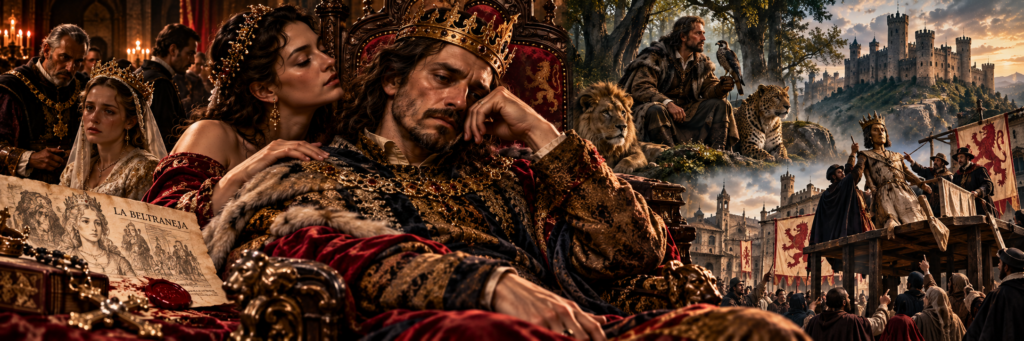
On June 5, 1465, a group of powerful Castilian noblemen gathered outside the walls of Ávila to perform one of the strangest acts of rebellion in medieval European history. They had constructed a wooden platform and placed upon it an effigy representing their king, Henry IV of Castile. The figure wore the symbols of monarchy, including a crown and other royal insignia. Before an assembled audience, the rebels publicly condemned their sovereign, accusing him of failures that supposedly made him unworthy of the throne. They then stripped the figure of its royal authority and cast it down, symbolically removing Henry from power.
The extraordinary ceremony became known to history as the Farce of Ávila, although the men who organized it considered their actions deadly serious. They were not merely insulting an unpopular king. They were attempting to overthrow him, invalidate his daughter’s claim to the succession, and replace him with his younger half-brother, Alfonso. The spectacle transformed accusations about Henry’s masculinity, sexual conduct, political judgment, and religious loyalties into a public declaration that he had forfeited his right to rule. It was political theater designed to accomplish what armed rebellion had not yet achieved.
Henry himself was still alive, still possessed supporters, and still exercised authority over significant portions of Castile. His enemies could not simply remove him by constructing an effigy, but they understood that monarchy depended upon more than military strength. A king needed legitimacy, public recognition, aristocratic cooperation, and the appearance of possessing qualities appropriate to his office. By publicly humiliating his image, the rebels hoped to destroy those foundations. Their ceremony was an attack not only upon Henry’s government but upon the very idea that he deserved to be king.
Few medieval monarchs suffered such a sustained assault upon their personal reputation. Henry was accused of impotence, sexual misconduct, cowardice, religious impropriety, and an almost complete inability to govern. His marriage was ridiculed, his closest companions were portrayed as corrupting influences, and his only acknowledged daughter was branded illegitimate. Even his physical appearance and private habits became political weapons. A ruler who preferred hunting retreats and diplomatic negotiation to spectacular displays of military aggression found himself condemned as weak, unnatural, and unworthy of his ancestors.
Yet behind the hostile descriptions stood a considerably more complicated man. Henry was not demonstrably insane, nor is there reliable evidence that he suffered from a psychiatric disorder that explains his reign. He was a politically embattled monarch whose personality, relationships, health, and decisions were relentlessly scrutinized by opponents seeking to control the succession. Some criticisms reflected genuine weaknesses in his government, while others were exaggerated or deliberately constructed to discredit him. His story reveals how accusations of personal abnormality could become instruments of political destruction.
The consequences extended far beyond his lifetime. When Henry died in December 1474, his daughter Joanna and his half-sister Isabella became the centers of competing claims to Castile. The resulting succession war helped determine the future of the Iberian kingdoms and contributed to the rise of Isabella I and Ferdinand II, the rulers later celebrated as the Catholic Monarchs. Henry’s reputation as an inadequate king became deeply embedded in the historical narrative surrounding their achievements. The man remembered as Henry the Impotent had lost more than control over his court; he had lost much of the battle over how posterity would understand his reign.
A Prince Raised in the Shadow of a Weakening Crown
Henry was born on January 5, 1425, at Valladolid, the son of King John II of Castile and Maria of Aragon. He entered a royal household already dominated by powerful aristocratic factions, court rivalries, and disputes over the distribution of political authority. His father possessed legitimate royal power but frequently struggled to exercise it independently of influential advisers. The most prominent was Álvaro de Luna, whose extraordinary position at court made him both indispensable to John II and deeply resented by competing noble families. Henry grew up watching a monarchy in which personal relationships could determine the fate of ministers, nobles, and entire political factions.
John II’s reign was marked by repeated confrontations with aristocratic interests, particularly those associated with the powerful Infantes of Aragon. These princes possessed extensive political ambitions within Castile and challenged the influence of Álvaro de Luna. Their rivalries generated periods of instability that affected the royal household and the future succession. Henry was not raised in a political environment where the king’s authority was unquestioned. Instead, he inherited a system in which powerful nobles expected to negotiate, constrain, and sometimes openly defy royal decisions.
The young prince eventually became involved in the political struggles surrounding his father. As Prince of Asturias, he acquired his own household, advisers, and supporters, including men who would later become central to his reign. Juan Pacheco, who rose to become Marquis of Villena, established a particularly influential relationship with him. Pacheco was ambitious, politically skilled, and deeply involved in the factional maneuvering of the Castilian aristocracy. His proximity to Henry would later provide opportunities for advancement while also creating resentment among rival nobles.
The Battle of Olmedo in 1445 illustrated the violence underlying these disputes. Royalist forces defeated opponents associated with the Aragonese faction, but the victory did not permanently resolve the struggle for control of government. Court politics continued to revolve around alliances, appointments, territorial rewards, and the shifting relationship between John II and Álvaro de Luna. The favorite eventually fell from power and was executed in 1453. His downfall demonstrated how quickly a figure who appeared almost untouchable could become vulnerable when royal favor and political support disappeared.
Henry inherited more than a kingdom when his father died in 1454. He inherited a political culture in which aristocratic leagues could challenge the crown, royal favorites could become objects of hatred, and the legitimacy of government depended upon maintaining difficult relationships among competing elites. His later problems were not created entirely by his personality. They emerged from institutional weaknesses and factional traditions that had developed before his accession. Nevertheless, the decisions he made within that environment would determine whether the monarchy recovered its authority or descended into another crisis.
A King Who Refused to Play the Expected Part
Henry became king on July 21, 1454, at the age of twenty-nine. Medieval kingship required more than issuing orders and presiding over councils. A ruler was expected to display courage, magnificence, generosity, religious devotion, and the ability to command powerful men. Hunting, military leadership, ceremonial appearances, and public displays of wealth all contributed to the image of a successful sovereign. Henry’s conduct sometimes departed from these expectations, and hostile chroniclers turned those differences into evidence that he was fundamentally unsuited to rule.
Contemporary descriptions often portray Henry as physically imposing but personally reserved, with habits that seemed inconsistent with conventional aristocratic ideals. Some accounts criticize his clothing, manners, and preference for relative privacy. Others emphasize his interest in hunting and his tendency to spend time away from the most demanding aspects of court ceremony. Such observations require caution because medieval chroniclers frequently used physical appearance and personal habits to express moral judgments. A ruler described as awkward, poorly dressed, or withdrawn was often being presented as politically deficient rather than simply recorded as an unusual individual.
Henry’s apparent preference for hunting retreats became an especially prominent feature of his reputation. He maintained an interest in the wooded landscapes around Segovia and other royal residences, where hunting offered both recreation and a temporary escape from factional pressures. Royal hunting was not unusual or inherently eccentric; it was a central activity of medieval aristocratic culture. The difference lay in how Henry’s enemies interpreted his enthusiasm. They portrayed his time away from court as neglect of government, suggesting that he preferred animals and forests to the responsibilities of kingship.
Stories that he disappeared alone into wilderness for weeks, slept habitually beneath the stars, or suffered from severe lifelong social anxiety go beyond what the surviving evidence can securely establish. Such descriptions may preserve elements of his preference for seclusion, but they should not be presented as verified accounts of a psychiatric condition. A monarch’s movements were shaped by political security, household logistics, hunting customs, and the demands of itinerant government. Even a relatively private king traveled with attendants and depended upon an extensive royal establishment. The romantic image of Henry wandering completely alone through the forests is therefore misleading if treated literally.
His interest in animals was another subject of comment. Henry maintained royal hunting establishments and was associated with exotic animals, including lions, whose presence conveyed prestige and princely power. Medieval rulers sometimes collected unusual creatures as demonstrations of wealth, diplomatic connections, and dominion over nature. Such collections were not unique to Henry, and their existence does not establish irrational behavior. More sensational claims that he routinely allowed dangerous predators to roam freely among terrified courtiers require stronger evidence than hostile anecdotes provide. His animal interests may have appeared unusual to some observers, but they were also connected to recognizable traditions of royal display.
The contrast between Henry’s personality and aristocratic expectations became politically significant because his enemies could transform unconventional behavior into accusations of weakness. A king who disliked certain ceremonial obligations might be described as incapable of commanding respect. A preference for negotiation could become cowardice, while an interest in private recreation could be presented as abandonment of government. These judgments were not neutral descriptions. They reflected an aristocratic political culture in which the appearance of authority mattered almost as much as its actual exercise.
The Marriage That Became a National Humiliation
Long before Henry became king, his marriage had already become a source of controversy. In 1440, he married Blanche of Navarre, daughter of John II of Aragon and Blanche I of Navarre. The union was politically important because it connected prominent Iberian dynasties and offered opportunities for diplomatic cooperation. Both spouses were young, and the marriage was expected eventually to produce children who would secure the succession. Instead, it remained childless and became the foundation of one of the most damaging reputations attached to any Castilian monarch.
After approximately thirteen years, the marriage was annulled in 1453. The ecclesiastical proceedings addressed the absence of consummation and included testimony concerning Henry’s alleged inability to have sexual relations with Blanche. The explanation involved an alleged impediment attributed to supernatural causes, sometimes described in later accounts as a spell or enchantment. Such language reflected the legal, religious, and medical assumptions available in the fifteenth century. It should not be mistaken for proof that witchcraft was believed by everyone involved or that the proceedings established a modern medical diagnosis.
The annulment record has attracted extraordinary attention because it contains testimony suggesting that Henry’s difficulties were specific to his marriage rather than necessarily universal. Some witnesses claimed he was capable of sexual relations with other women. These statements were relevant to the legal effort to explain why the marriage had not been consummated, but their reliability is difficult to assess. Witnesses operated within a political and ecclesiastical environment where the desired outcome could influence testimony. The proceedings therefore reveal how Henry’s sexual capacity became a matter of public investigation without conclusively establishing every private fact alleged.
The political consequences were severe. Medieval monarchy depended heavily upon legitimate succession, and a king unable to produce children faced increased pressure from relatives and rival factions. The failure of Henry’s first marriage allowed opponents to question his masculinity and suitability for kingship. In a society where virility was closely associated with military strength and authority, allegations of impotence could become politically devastating. The issue was not simply whether Henry could father children. It was whether a ruler perceived as sexually inadequate could command the respect expected of a king.
The annulment also created a problem that would return with far greater force after Henry’s second marriage. Once his alleged impotence had entered the political record, any future child could become vulnerable to accusations of illegitimacy. Opponents did not need to prove that Henry was incapable of fatherhood. They only needed to persuade enough influential people that the possibility was doubtful. The first marriage therefore supplied the foundation for a later campaign that would threaten the entire succession. What began as an ecclesiastical dispute over a childless union eventually became a weapon in a struggle for the Castilian crown.
The Mystery of Henry’s Body: Illness, Appearance, and Medical Speculation
Henry’s physical appearance has long fascinated historians because contemporary descriptions portray him as unusually built and because his remains were examined in the twentieth century. His burial at the Monastery of Santa María de Guadalupe became the subject of renewed attention when his remains were investigated in 1946. Subsequent discussions of his physical condition have included suggestions of skeletal abnormalities, facial differences, and possible endocrine disorders. These interpretations have sometimes been used to explain his reported sexual difficulties and aspects of his behavior. Yet the evidence is considerably less definitive than sensational accounts suggest.
Some medical writers have proposed conditions involving abnormal skeletal development or hormonal function, including acromegaly and other endocrine disorders. Such hypotheses attempt to connect historical descriptions with possible physical abnormalities. However, diagnosing a fifteenth-century ruler retrospectively presents major difficulties. Contemporary portraits and chronicles were not produced as clinical records, while the condition and identification of remains require careful evaluation. Without sufficiently documented medical findings, it is impossible to establish a specific disease with confidence.
Claims that Henry definitely suffered from McCune-Albright syndrome, a pituitary tumor, severe kidney stones, pronounced spinal deformity, or a particular hormonal imbalance should therefore be treated as hypotheses rather than established facts. These conditions have distinct medical characteristics and cannot simply be combined into a single explanation for every reported symptom. Nor does a proposed endocrine disorder automatically establish the cause of impotence, infertility, mood changes, or political behavior. Historical medicine is especially vulnerable to overinterpretation when researchers begin with a ruler’s reputation and search for a disease that appears to explain it.
The same caution applies to descriptions of Henry’s temperament. Hostile accounts sometimes portray him as indecisive, irritable, withdrawn, or unusually passive. These characteristics may reflect genuine observations, but they were recorded within politically charged narratives. It is not possible to determine from such descriptions whether he experienced clinical depression, social anxiety, chronic pain, or another condition. A king surrounded by conspiracies might become cautious without suffering from a psychiatric disorder. Political frustration and physical discomfort may have influenced his conduct, but their precise relationship cannot be reconstructed.
The temptation to medicalize Henry’s reign is understandable because his physical reputation and political failures became so closely connected. If an illness could explain his sexual difficulties, his reserved manner, and his inability to control rebellious nobles, the historical mystery might appear resolved. Yet such an explanation risks replacing one oversimplification with another. Henry’s problems involved political institutions, aristocratic ambitions, dynastic uncertainty, and deliberate propaganda. Whatever his physical health, he remained an active participant in those conflicts. His body became a political battlefield because his enemies understood that the legitimacy of the monarchy could be attacked through the perceived legitimacy of the man who wore the crown.
Joan of Portugal: A Second Marriage and a Desperate Need for an Heir
In 1455, Henry married Joan of Portugal, daughter of King Edward of Portugal and sister of King Afonso V. The marriage offered diplomatic advantages and renewed hopes for a legitimate heir. Unlike his first union, the second marriage eventually produced a child, but the birth did not end the controversy surrounding Henry’s sexual capacity. Instead, it intensified the struggle over the succession. The queen herself became the target of allegations that would haunt her daughter for the rest of her life.
Joan arrived at a court where her husband’s first marriage had already established a damaging reputation. Her position was therefore unusually vulnerable. A queen was expected to provide legitimate heirs, maintain appropriate conduct, and preserve the dignity of the royal household. Any suggestion of sexual impropriety could threaten not only her personal standing but the rights of her children. Henry’s opponents understood this vulnerability and eventually exploited it with extraordinary effectiveness. The queen’s body, like the king’s, became a subject of political accusation.
On February 28, 1462, Joan gave birth to a daughter, also named Joanna. The birth should have strengthened the monarchy by providing an acknowledged successor. Henry recognized the child as his daughter, and she was initially accepted in arrangements concerning the succession. Yet doubts about her paternity soon became central to aristocratic opposition. The question of whether Joanna was the king’s biological child would dominate Castilian politics for more than a decade.
The accusations against Joan of Portugal became increasingly vicious. Hostile writers described alleged affairs and misconduct, using the queen’s reputation to undermine the child’s legitimacy. Some allegations concerned events that occurred after Joanna’s birth and therefore cannot logically establish her paternity. Nevertheless, they were incorporated into a broader narrative portraying the royal household as morally corrupt. The purpose was to persuade influential Castilians that the succession could not safely pass through Henry’s daughter. The queen’s private reputation became inseparable from the future of the kingdom.
Joanna la Beltraneja: The Princess Whose Birth Started a War
The most damaging allegation concerning Princess Joanna was that her biological father was not Henry IV but Beltrán de la Cueva, one of the king’s favored courtiers. Beltrán had risen rapidly in royal service and received substantial honors, making him a natural target for aristocratic resentment. His prominence allowed opponents to suggest that he enjoyed inappropriate intimacy with the queen and that the king had accepted another man’s child as his own. The accusation became so influential that Joanna acquired the nickname la Beltraneja, a reference to her supposed descent from Beltrán. The name was not a neutral identification but a political insult intended to deny her legitimacy.
There is no conclusive evidence establishing that Beltrán de la Cueva fathered Joanna. The accusation must be understood within the political struggle surrounding Henry’s authority and the succession. His first marriage had ended amid allegations of impotence, and his enemies used that history to make the new claim appear plausible. The argument was circular but effective: because Henry had supposedly been impotent, Joanna could not be his daughter, and because Joanna was allegedly illegitimate, Henry’s recognition of her proved his weakness or corruption. The accusation required little direct evidence once it became embedded in political propaganda.
Beltrán’s rise contributed to the resentment of other powerful nobles, particularly Juan Pacheco, whose influence had previously been substantial. Court favorites were often attacked because their access to the monarch threatened established aristocratic interests. Beltrán’s appointment as master of the Order of Santiago was especially controversial because the office carried immense prestige and resources. Opponents could present his advancement as evidence that Henry had abandoned proper government in favor of personal attachment. Sexual rumors made the political attack more damaging by transforming favoritism into alleged moral disgrace.
Joanna herself was a child when these accusations began to determine her future. She had no control over the rumors surrounding her conception or the political interests of the men who repeated them. Her legitimacy depended upon royal recognition, dynastic law, and the willingness of powerful factions to accept her position. As opposition to Henry intensified, those foundations became increasingly unstable. The princess was transformed from an acknowledged heir into the central object of a national dispute. Her childhood unfolded under the shadow of accusations that would eventually cost her the crown.
The nickname la Beltraneja became one of the most successful pieces of political propaganda in late medieval Iberian history. It condensed a complicated succession dispute into a single insulting label. Every repetition reminded listeners of the allegation that Joanna was the daughter of a royal favorite rather than the king. The name survived because the faction that opposed her ultimately prevailed. Yet its endurance should not be mistaken for proof of the accusation. Historical memory often preserves the language of victors long after the evidence supporting their claims has been questioned.
The King’s Favorites: Juan Pacheco, Beltrán de la Cueva, and the Politics of Intimacy
Henry’s relationships with influential male courtiers became another major source of hostile commentary. Juan Pacheco, Marquis of Villena, had been associated with Henry since his years as prince and possessed considerable political skill. His influence depended upon access to the king, control of appointments, and the ability to negotiate among aristocratic factions. Over time, however, the relationship deteriorated as other men gained royal favor. Pacheco increasingly aligned himself with opposition forces and became one of the principal architects of the rebellion against Henry.
Beltrán de la Cueva represented a newer circle of royal influence. His rapid advancement threatened established nobles who resented the distribution of offices and rewards. In medieval politics, the rise of a favorite could be interpreted as an attack upon the collective interests of the aristocracy. Powerful men expected a share in government and regarded exclusion from the king’s confidence as a political injury. Henry’s preference for particular advisers therefore created conflicts that extended beyond personal jealousy. The struggle over access to the monarch became a struggle over the distribution of power.
Hostile writers also used sexual insinuation to attack Henry’s relationships with male companions. Accusations concerning his masculinity, virility, and alleged sexual conduct circulated in an environment where such claims could destroy political credibility. These allegations should not be treated as reliable evidence of his sexual orientation or private behavior. They belonged to a recognizable tradition of political defamation in which rulers were portrayed as morally disordered to justify resistance. A king accused of failing to perform conventional masculine roles could be represented as incapable of performing the duties of monarchy.
The attacks were particularly effective because they connected several accusations into a single narrative. Henry was supposedly impotent with women, excessively attached to male favorites, incapable of military courage, and unable to control his household. Each allegation reinforced the others, creating an image of a ruler whose private life explained his public failures. The narrative was politically useful precisely because it seemed comprehensive. It transformed separate disputes over marriage, appointments, and military policy into evidence of a defective personality. Once established, the image could survive even when individual claims remained unproven.
The historical reality was more complicated. Henry made appointments, negotiated alliances, sponsored campaigns, and attempted to manage a difficult aristocracy. His reliance upon favorites may have contributed to factional conflict, but it was not unique among medieval monarchs. Nor does the existence of close male relationships establish the sexual allegations circulated by enemies. The court was a political institution built around personal access, patronage, and loyalty. Henry’s favorites became controversial because they possessed influence that other nobles wanted for themselves. Sexual scandal was one weapon in that competition.
The King Who Preferred Diplomacy to Slaughter
Henry’s military policy toward Granada became another target for critics who expected a Christian king to pursue aggressive warfare against the neighboring Muslim kingdom. The Nasrid emirate remained the last substantial Muslim-ruled state in the Iberian Peninsula, and campaigns against it offered opportunities for religious prestige, territorial expansion, and aristocratic reward. Henry conducted military operations along the frontier, but his approach did not always conform to the expectations of nobles who favored decisive battles and spectacular victories. He sometimes relied upon raids, destruction of agricultural resources, pressure upon fortified positions, and negotiation. These methods could appear unsatisfactory to warriors seeking immediate glory.
The strategy was not inherently irrational. Medieval warfare frequently involved devastation of crops, orchards, settlements, and economic resources in order to weaken an opponent without risking a major pitched battle. Such operations could be cruel toward civilian populations while remaining militarily calculated. Henry’s preference for certain forms of pressure therefore cannot simply be equated with cowardice. His campaigns reflected the practical difficulties of attacking fortified territory and sustaining armies in challenging conditions. Nevertheless, they did not always produce the dramatic conquests expected by critics.
Aristocratic dissatisfaction grew when military campaigns appeared expensive without delivering sufficient rewards. Nobles who contributed troops expected opportunities for honor, plunder, land, and advancement. A king who avoided major confrontations could frustrate those expectations even when his strategy possessed a rational basis. Henry’s opponents used this frustration to portray him as timid and incapable of fulfilling the martial obligations of Christian kingship. The accusation fitted neatly into the broader campaign against his masculinity. Military caution became another supposed symptom of personal inadequacy.
Henry’s relations with Muslim and Jewish subjects also attracted criticism. Like other Iberian monarchs, he governed a society containing communities with different religious traditions and employed individuals whose skills were valuable to royal administration. Political opponents sometimes portrayed such relationships as evidence of improper religious sympathies. Yet cooperation across religious boundaries was a longstanding feature of Iberian political life, even amid warfare and discrimination. Employing Jewish officials or negotiating with Muslim rulers did not necessarily indicate unusual religious beliefs. These practices could reflect administrative needs, diplomatic calculations, and established traditions.
The accusations nevertheless carried political force. In a society where Christian kingship was closely connected with religious identity, opponents could use charges of excessive familiarity with Muslims or Jews to question a ruler’s moral authority. Such rhetoric helped transform policy disagreements into allegations of cultural betrayal. Henry’s enemies could present his diplomacy as weakness and his administrative choices as evidence of religious impropriety. The result was another layer of hostility surrounding his reign. His conduct was judged not only by its practical outcomes but by whether it conformed to an increasingly politicized ideal of royal behavior.
The Nobles Strike Back: The Road to Rebellion
By the early 1460s, dissatisfaction with Henry’s government had developed into organized aristocratic opposition. Powerful nobles resented the influence of royal favorites, disputed the distribution of offices, and challenged the king’s management of political affairs. The succession question provided an especially effective means of mobilizing resistance. If Joanna could be declared illegitimate, the crown might pass to Henry’s younger half-brother Alfonso. Supporting Alfonso allowed rebels to claim that they were defending legitimate monarchy rather than merely pursuing their own ambitions.
The opposition included influential figures such as Juan Pacheco and Alfonso Carrillo, Archbishop of Toledo. Their involvement gave the movement considerable political and ecclesiastical weight. The rebels issued demands concerning royal government, appointments, and the succession, presenting themselves as defenders of the kingdom against misrule. Henry attempted negotiation, but concessions often encouraged further demands rather than restoring stability. The conflict became increasingly difficult to resolve because both sides questioned the other’s intentions. Every compromise risked being interpreted as weakness.
In 1464, negotiations at Cigales and subsequent political arrangements reflected the growing pressure upon Henry. The king was compelled to confront demands that affected the position of his daughter and the influence of his advisers. The question of Alfonso’s place in the succession became central. Henry’s opponents sought recognition of the young prince as heir, undermining Joanna’s claim. These negotiations did not settle the dispute because the underlying struggle concerned control of the monarchy itself. The rebels wanted a king whose authority could be shaped by their interests.
The crisis revealed the fragility of Henry’s position. He possessed hereditary legitimacy, but his opponents controlled substantial resources and could mobilize armed supporters. His attempts to preserve peace through negotiation sometimes produced temporary settlements without eliminating the threat of rebellion. Critics interpreted this as indecision, while defenders might regard it as an effort to avoid civil war. Both perspectives overlook the structural difficulty of governing a kingdom where powerful nobles could challenge royal decisions through force. Henry’s predicament was political before it was personal.
The rebellion eventually moved beyond negotiation into open symbolic confrontation. The nobles decided to declare Henry unworthy of kingship and elevate Alfonso in his place. Their decision required a public demonstration capable of transforming political opposition into a claim of legitimate authority. The ceremony at Ávila provided that demonstration. It was designed to humiliate Henry, rally supporters, and announce that the rebels no longer recognized him as king. The spectacle would become the defining image of his troubled reign.
The Farce of Ávila: A Crown Torn From an Effigy
The deposition ceremony at Ávila in June 1465 was carefully staged. A wooden platform was erected outside the city, and an effigy representing Henry was dressed in royal garments and adorned with the symbols of sovereignty. Leading rebels publicly announced accusations against the king, presenting his alleged failures as justification for removal. The figure was then stripped of its insignia in a sequence intended to symbolize the loss of royal authority. Finally, it was cast down, and Alfonso was proclaimed king by the rebel faction.
The ceremony drew upon the political importance of symbols in medieval monarchy. Crowns, swords, scepters, and royal garments represented more than personal possessions. They embodied the authority of the office and the legitimacy of the person who held it. Removing them from an effigy allowed the rebels to dramatize their claim that Henry had forfeited his right to rule. The act was theatrical, but its purpose was practical. It sought to persuade nobles, towns, and foreign observers that a transfer of sovereignty had occurred.
The rebels’ accusations combined political grievances with attacks upon Henry’s character. His alleged impotence, the disputed legitimacy of Joanna, the influence of favorites, and perceived failures of government all contributed to the justification. The ceremony therefore represented the culmination of years of hostile propaganda. Personal allegations had been transformed into a formal argument for deposition. The king’s private life became evidence in a public trial conducted by his enemies. The fact that Henry remained alive and politically active did not prevent them from claiming that his authority had ended.
The immediate result was not a peaceful succession but a divided kingdom. Alfonso’s supporters recognized him as king, while Henry retained loyalists and continued to exercise power. Castile entered a period in which competing royal claims existed simultaneously. The conflict involved military operations, negotiations, shifting alliances, and local struggles for control. The ceremony at Ávila did not resolve the crisis; it intensified it. By publicly rejecting Henry’s legitimacy, the rebels made reconciliation more difficult and increased the likelihood of prolonged conflict.
The event became known as the Farce of Ávila partly because later observers regarded the symbolic deposition as grotesque or absurd. Yet dismissing it as mere comedy obscures its seriousness. Medieval political authority depended upon recognition, ritual, and the willingness of influential groups to accept a ruler. The rebels attempted to manipulate those foundations through public performance. Their actions demonstrated that propaganda could become an instrument of constitutional change when backed by sufficient military and aristocratic power. Henry’s effigy was thrown down because his enemies hoped the real king would soon follow.
Two Kings in One Kingdom: The Civil War of Henry and Alfonso
Following the proclamation of Alfonso, Castile experienced a period of competing royal authority. Henry retained support among important towns and nobles, while Alfonso’s faction controlled other territories and institutions. The conflict was not a simple contest between a legitimate monarch and a united aristocracy. Noble families divided according to local interests, personal rivalries, and calculations about future rewards. Some changed allegiance as circumstances shifted. The resulting instability affected administration, taxation, military operations, and the everyday lives of subjects caught between rival authorities.
The Battle of Olmedo in 1467 became one of the most significant military encounters of the conflict. The engagement involved forces supporting Henry and those aligned with Alfonso, but its outcome did not produce a decisive settlement. Both sides continued to claim political legitimacy, and the kingdom remained divided. The battle illustrated the limits of military confrontation when neither faction possessed sufficient strength to impose lasting control. Henry’s survival demonstrated that he was not entirely powerless, despite the hostile image constructed by his enemies. Nevertheless, his inability to eliminate the rebellion reinforced perceptions of weakness.
The conflict also exposed the ambitions of the nobles who had elevated Alfonso. Supporting a young claimant offered opportunities to influence government and secure appointments. Alfonso’s age made him potentially more manageable than Henry, whose attempts to exercise independent authority had alienated powerful figures. The rebellion therefore cannot be understood solely as a moral response to alleged royal misconduct. It was also a struggle over who would control the machinery of government. The language of legitimacy concealed competing interests in land, offices, and political influence.
In July 1468, Alfonso died unexpectedly at approximately fourteen years of age. His death transformed the succession dispute because the rebel faction lost the claimant around whom it had organized. Rumors of poisoning circulated, as often occurred after sudden royal deaths, but there is no secure basis for concluding that he was murdered. The disappearance of Alfonso created an opportunity for Henry’s half-sister Isabella to become the new focus of opposition. She possessed a strong dynastic claim and was old enough to make political decisions of her own. The struggle over the crown entered a new phase.
Isabella’s response proved crucial. Rather than immediately accepting the title of queen from the rebels, she pursued negotiations with Henry. Her caution reflected an understanding that legitimacy could be strengthened through recognition by the reigning monarch. She also had to navigate the ambitions of nobles who hoped to use her claim for their own purposes. The death of Alfonso therefore did not end the crisis, but it altered the balance of power. Henry now faced a politically capable half-sister whose future choices would determine the fate of his daughter.
Isabella Enters the Struggle: A Sister Against a Daughter
Isabella was born in 1451, the daughter of John II of Castile and his second wife, Isabella of Portugal. She was Henry’s younger half-sister and had spent much of her early life within the uncertain politics of the royal family. Her position became increasingly important as the succession dispute developed. After Alfonso’s death, she emerged as the principal alternative to Joanna. Her supporters could present her as a legitimate member of the royal dynasty whose claim was not burdened by allegations of illegitimacy. The contrast was politically powerful even though Joanna’s paternity had never been conclusively disproved.
In September 1468, Henry and Isabella reached an agreement at the meeting traditionally associated with the Bulls of Guisando. Under the arrangement, Isabella was recognized as heir to the Castilian throne, while Henry retained his position as king. The settlement temporarily reduced the danger of open conflict, but it did so at the expense of Joanna’s claim. Henry’s willingness to recognize Isabella has often been interpreted as evidence that he doubted his daughter’s legitimacy. That conclusion is not necessary. A ruler facing rebellion might make concessions to preserve peace without accepting the accusations used by his opponents.
The agreement also imposed expectations concerning Isabella’s marriage. Royal marriages were matters of state because they could alter alliances and determine the political future of the kingdom. Henry wanted to influence the choice of husband, while Isabella and her advisers pursued their own interests. The issue soon became a new source of conflict. Isabella’s marriage would determine whether Castile remained aligned with Henry’s preferred diplomatic arrangements or moved toward a different political future. The succession dispute therefore became inseparable from the question of international alliances.
In October 1469, Isabella married Ferdinand of Aragon, the heir to the Aragonese crown. The marriage was arranged without Henry’s approval and violated the expectations surrounding their earlier settlement. It strengthened Isabella’s political position by connecting her to a powerful neighboring dynasty. Henry responded by rejecting the arrangement and renewing his support for Joanna’s succession. The reconciliation achieved at Guisando collapsed, and the kingdom again faced competing claims. The marriage that would later become central to the history of Spain thus emerged from a bitter family conflict.
Henry’s position became increasingly difficult because he could not simultaneously satisfy the interests of his daughter, his half-sister, and the rival noble factions. Recognizing Isabella threatened Joanna’s future, while restoring Joanna’s claim alienated Isabella’s supporters. The king attempted to preserve dynastic authority through negotiation, but the competing claims had acquired independent political momentum. Isabella’s marriage to Ferdinand gave her faction resources and diplomatic opportunities that Henry could not easily neutralize. The succession dispute was moving beyond his control. His final years would be dominated by the consequences.
The Queen, the Favorite, and the Scandal That Would Not Die
The allegations surrounding Joan of Portugal and Beltrán de la Cueva continued to influence politics throughout Henry’s reign. The queen’s reputation suffered from hostile narratives that portrayed her as sexually unfaithful and morally irresponsible. Some chroniclers described later relationships and children attributed to her, using these claims to reinforce doubts about Joanna’s legitimacy. Yet allegations concerning the queen’s later conduct cannot establish the identity of Joanna’s father in 1462. The distinction was often ignored by political writers because their purpose was persuasion rather than impartial investigation.
Beltrán’s position also remained controversial. His advancement had angered nobles who believed that royal favor should be distributed differently, and the paternity accusation made him a permanent symbol of alleged corruption. The nickname attached to Joanna ensured that his name remained associated with the succession dispute. Even when the political circumstances changed, the rumor retained its usefulness. Opponents of Joanna could invoke it without presenting new evidence. The accusation became part of the political language through which her claim was discussed.
The sexual dimension of the scandal was particularly damaging because it attacked the king’s ability to fulfill one of the central obligations of hereditary monarchy. A ruler could lose battles or appoint unpopular advisers and still retain legitimacy. The suggestion that he could not father an heir threatened the continuity of the dynasty itself. By portraying Joanna as another man’s child, Henry’s enemies transformed a personal allegation into a constitutional argument. The claim offered a justification for transferring the succession to Alfonso and later Isabella. Its political consequences were therefore far greater than those of an ordinary court scandal.
The case demonstrates how medieval propaganda could exploit uncertainty. No reliable method existed to establish biological paternity with the certainty available through modern genetic testing. Royal recognition, marriage, testimony, and political acceptance determined legitimacy in practice. Henry acknowledged Joanna, but powerful opponents refused to accept his recognition as sufficient. Their challenge rested upon the earlier allegations concerning his sexual capacity and the later rumors surrounding the queen. The resulting dispute could not be settled through evidence alone because the factions had strong political reasons to maintain their positions.
Joanna’s reputation suffered most severely from this uncertainty. She was repeatedly described through an insulting nickname that reduced her identity to an accusation against her mother. Her legal and dynastic position became dependent upon the political success of men who claimed to defend her rights. The eventual triumph of Isabella’s faction ensured that the hostile label survived in historical memory. Joanna was remembered less as a royal daughter with a contested claim than as a supposed impostor. The persistence of that portrayal reveals how thoroughly the victors shaped the language of the succession dispute.
The Final Years: A King Surrounded by Enemies
By the early 1470s, Henry’s government was weakened by years of rebellion, factional competition, and uncertainty over the succession. The kingdom had endured competing royal claims, military conflict, and repeated negotiations that failed to produce lasting stability. Henry still possessed supporters and continued to exercise authority, but his ability to impose a definitive settlement had diminished. The rivalry between Joanna and Isabella increasingly overshadowed other questions of government. Every major political decision carried implications for the future crown.
The king’s relationship with Isabella remained strained after her marriage to Ferdinand. Henry regarded the marriage as a challenge to his authority and renewed efforts to secure Joanna’s recognition. Supporters of the princess sought alliances that could strengthen her position, including connections with Portugal. Isabella and Ferdinand, meanwhile, cultivated their own network of Castilian nobles and urban supporters. The succession dispute became a contest between political coalitions rather than merely a disagreement within the royal family. Henry’s death would remove the last possibility that he might impose a settlement personally.
His health and physical condition have attracted considerable speculation, but the precise causes of his final decline remain uncertain. Contemporary descriptions suggest that he experienced illness during his later years, yet they do not provide a reliable basis for diagnosing a specific disease. Later medical interpretations have attempted to connect his death with the conditions proposed to explain his appearance and sexual difficulties. Such arguments remain speculative. The political consequences of his illness are clearer than its medical details. A king whose succession was disputed could not afford prolonged uncertainty about his survival.
Henry died in Madrid on December 11, 1474, at the age of forty-nine. His death ended a reign of twenty years marked by aristocratic rebellion, contested legitimacy, and persistent attacks upon his character. He left behind a daughter whom he had recognized as his heir and a half-sister whose supporters were prepared to claim the throne. The political settlement that might have prevented conflict had collapsed years earlier. Castile therefore entered a new crisis almost immediately. The struggle that had defined Henry’s reign would continue after his death, now without the man whose reputation had supplied its original justification.
The War of the Castilian Succession: Joanna Against Isabella
Following Henry’s death, Isabella moved quickly to secure the crown. She was proclaimed queen at Segovia in December 1474, asserting her right to succeed her half-brother. Her claim rested upon her dynastic position, earlier recognition as heir, and the support of influential political factions. Joanna’s supporters rejected the succession, maintaining that she was Henry’s legitimate daughter and rightful heir. The competing claims produced the War of the Castilian Succession, which lasted from 1475 to 1479. The conflict would determine not only who ruled Castile but the balance of power across the Iberian Peninsula.
Joanna’s cause received support from Portugal, whose king, Afonso V, sought to strengthen his position through marriage to the princess and intervention in Castilian politics. Afonso was Joanna’s maternal uncle, and their proposed union required ecclesiastical dispensation because of their close relationship. The Portuguese intervention transformed the succession dispute into an international war. Isabella and Ferdinand opposed the alliance with forces drawn from their own supporters and territories. The conflict involved military campaigns, sieges, diplomatic negotiations, and efforts to secure recognition from towns and nobles.
The Battle of Toro in 1476 became a major episode in the war. Its military outcome was complex and has been interpreted differently by historians, but Isabella and Ferdinand successfully used the campaign to strengthen their political position. Their supporters presented the battle as a significant victory, and the momentum of the conflict increasingly favored Isabella’s claim. Joanna’s faction gradually lost important support within Castile. Portuguese intervention continued, but the prospects of restoring Joanna diminished. The struggle demonstrated that military events could acquire political significance beyond their immediate battlefield results.
The war ended through negotiations culminating in the Treaty of Alcáçovas in 1479. Isabella’s position as queen of Castile was recognized, while Joanna’s claim was effectively abandoned in the settlement. Joanna eventually entered religious life in Portugal, although her royal identity and disputed rights remained matters of historical interest. Her defeat ensured that the accusations surrounding her birth would continue to shape her reputation. The woman whom Henry had acknowledged as his daughter never ruled the kingdom she claimed. Her life became one of the most poignant consequences of the propaganda campaign directed against her father.
Isabella’s victory had immense historical significance. Her marriage to Ferdinand linked the crowns of Castile and Aragon through their joint dynastic rule, although the two kingdoms retained distinct institutions and laws. Their reign would witness the conquest of Granada in 1492, the expulsion of Jews who refused conversion, the expansion of royal authority, and the sponsorship of Columbus’s Atlantic voyage. These developments helped transform the political landscape of Iberia and the wider world. Henry’s disputed succession therefore became a turning point in European history. The defeat of Joanna cleared the path for rulers whose achievements would overshadow his troubled reign.
The Making of a Failed King: How Isabella’s Victory Shaped Henry’s Memory
The triumph of Isabella and Ferdinand influenced how later generations understood Henry IV. Their supporters had strong reasons to emphasize the weaknesses of his government and the alleged illegitimacy of Joanna. If Henry was remembered as incapable, corrupt, and dominated by favorites, Isabella’s accession could appear as the necessary restoration of order. The contrast between a failed predecessor and successful successors became a powerful historical narrative. Henry’s reign was increasingly presented as a period of disorder preceding the achievements of the Catholic Monarchs.
This interpretation did not require every hostile story to be invented. Henry’s government had experienced serious political failures, including aristocratic rebellion, contested succession, and the inability to establish lasting authority over powerful factions. These problems were real and had consequences for Castile. Yet the historical narrative often transformed them into evidence of personal inadequacy rather than examining the structural difficulties of fifteenth-century monarchy. The role of ambitious nobles could be minimized, while Henry’s unconventional habits were exaggerated. The result was a portrait of failure that served the legitimacy of those who followed him.
The accusations concerning his sexuality were especially enduring. The epithet the Impotent reduced his identity to the alleged failure of his first marriage and the disputed paternity of Joanna. It became an apparently simple explanation for a complicated political crisis. Yet the surviving evidence does not conclusively establish that Henry was incapable of fathering children, nor does it prove that Joanna was illegitimate. The persistence of the label demonstrates how political insults can become embedded in historical terminology. Once repeated across generations, they may appear to be established facts rather than contested accusations.
His supposed eccentricities underwent a similar transformation. Hunting retreats became evidence of pathological withdrawal, unconventional dress became rejection of royal dignity, and military caution became cowardice. His relationships with favorites were interpreted through sexual insinuation, while his employment of religious minorities was used to question his Christian identity. These themes reinforced one another, creating a coherent but deeply hostile image. The historical Henry became a figure whose every action could be explained through the assumption that he was fundamentally defective. Such narratives reveal as much about the expectations of his critics as about the king himself.
Modern historical interpretation has increasingly emphasized the political purposes of these portrayals. Henry’s reign is now examined within the broader context of aristocratic power, royal administration, dynastic legitimacy, and the transition toward the monarchy of Isabella and Ferdinand. His personal conduct remains relevant, but it is no longer sufficient to explain the crisis. The kingdom’s instability developed from competing interests that would have challenged many rulers. Henry’s inability to overcome those pressures was consequential, but it does not justify accepting every allegation circulated by his enemies. His reputation must be understood as a product of both historical events and the struggle to control their meaning.
Was Henry IV of Castile Mad?
The evidence does not support describing Henry IV as clinically insane. His reign was marked by unusual personal habits, allegations of sexual incapacity, factional conflict, and political decisions that critics considered weak or irrational. None of these circumstances establishes a psychiatric disorder. His reported withdrawal from ceremonial life may reflect temperament, preference, political frustration, or the biases of hostile observers. His physical appearance and possible medical conditions remain subjects of historical speculation rather than definitive diagnosis. The label of madness therefore obscures more than it explains.
Henry’s reputation was shaped by expectations concerning masculinity and kingship. A medieval ruler was expected to demonstrate military courage, sexual virility, public magnificence, and command over powerful men. Henry’s conduct sometimes failed to satisfy those ideals, and his opponents exploited the discrepancy. Allegations of impotence undermined the succession, while accusations involving male favorites challenged his public image. His preference for negotiation could be presented as cowardice, and his private interests could be described as neglect. These criticisms formed a political narrative designed to delegitimize him.
The succession dispute reveals the practical power of that narrative. Joanna’s legitimacy depended upon acceptance of Henry’s paternity, but his enemies had already established a reputation that made doubt politically useful. The nickname la Beltraneja converted an unproven accusation into a durable identity. The Farce of Ávila then transformed the accumulated allegations into a symbolic deposition. Each stage demonstrated how personal defamation could support increasingly direct challenges to royal authority. The campaign did not merely damage Henry’s reputation; it helped create the conditions for civil war.
Nevertheless, portraying Henry solely as an innocent victim of propaganda would also be misleading. His government struggled to manage aristocratic rivalries, and his concessions sometimes failed to produce lasting stability. The rise of favorites generated resentment, while his handling of the succession contributed to uncertainty. He did not succeed in establishing a political settlement that could survive his death. These failures deserve examination without relying upon sexual insults or retrospective psychiatric speculation. A ruler can make serious political mistakes without being mentally ill, just as his enemies can exploit genuine weaknesses through dishonest accusations.
Henry’s story belongs in the history of troubled monarchy because it demonstrates how the appearance of abnormality could become politically destructive. His opponents did not need to prove that he was mad. They needed to persuade influential Castilians that he lacked the qualities necessary for kingship. By attacking his body, marriage, sexuality, friendships, and personal habits, they created a portrait of a ruler supposedly incapable of legitimate authority. The campaign succeeded because it connected private scandal with public succession. Henry’s reputation became one of the weapons through which his dynasty was challenged.
The King History Remembered as Impotent
Henry IV of Castile inherited a monarchy already weakened by aristocratic competition and the political traditions of his father’s reign. He attempted to govern through alliances, favorites, negotiation, and military pressure, but his authority was repeatedly challenged by nobles who possessed the resources to resist him. His first marriage ended amid allegations of impotence, while his second produced a daughter whose legitimacy became the central question of Castilian politics. The resulting campaign against his reputation attacked nearly every aspect of his identity. By the time the rebels staged the Farce of Ávila, Henry had become the subject of a political narrative designed to make his removal appear necessary.
The king’s personal habits contributed to his vulnerability because they differed from the expectations of a martial aristocratic society. His preference for hunting retreats, his reserved manner, and his approach to warfare could be interpreted as signs of weakness. His physical appearance and possible medical difficulties supplied additional material for speculation. Yet the most sensational claims concerning his behavior often depend upon hostile sources or later exaggeration. There is no reliable basis for diagnosing him with a psychiatric disorder or treating every unusual anecdote as established fact. The historical record reveals a politically embattled ruler, not a demonstrably insane one.
His enemies achieved something more enduring than a temporary rebellion. They transformed uncertainty about his private life into a challenge to the legitimacy of his daughter. Joanna’s claim was weakened by accusations that could not be conclusively proved, while Isabella emerged as the principal alternative. Henry’s death left the dispute unresolved, and the resulting war determined the future of Castile. Isabella’s victory established a new political direction that would profoundly influence Iberian and world history. The triumph of her faction also ensured that Henry’s failures would be remembered in ways that strengthened the legitimacy of his successors.
The contrast between Henry and the Catholic Monarchs became central to his historical reputation. Their reign was celebrated for political consolidation, military conquest, and the expansion of royal authority, while his was portrayed as an age of weakness and disorder. This interpretation contains elements of truth but also reflects the interests of those who benefited from his defeat. Henry’s reign experienced genuine instability, yet the aristocrats who condemned him helped create that instability. His daughter was branded illegitimate through accusations that remain unproven. His personal conduct was judged according to political standards designed to exclude him from the ideal of kingship.
The tragedy of Henry IV lies partly in the fact that he never escaped the image constructed by his opponents. His attempts to preserve peace could be called cowardice, his private preferences could be described as madness, and his failure to satisfy aristocratic expectations could be treated as proof that he was unfit to rule. The accusations became so deeply embedded in historical memory that they often overshadowed the political realities of his reign. Even centuries later, the name Henry the Impotent continues to evoke scandal before government, rumor before evidence, and personal humiliation before dynastic struggle.
Henry IV did not lose his crown in the dramatic ceremony at Ávila, but the rebels succeeded in something nearly as important: they made his legitimacy appear negotiable. His daughter inherited the consequences, his sister inherited the opportunity, and the victorious dynasty inherited the power to shape the story. The king who had been accused of weakness, perversity, and madness became a convenient explanation for the disorder that preceded Isabella’s triumph. His life offers a disturbing lesson about monarchy and historical memory: a ruler need not be insane to be destroyed by accusations of madness, and a political lie repeated often enough can outlive the people who invented it.