
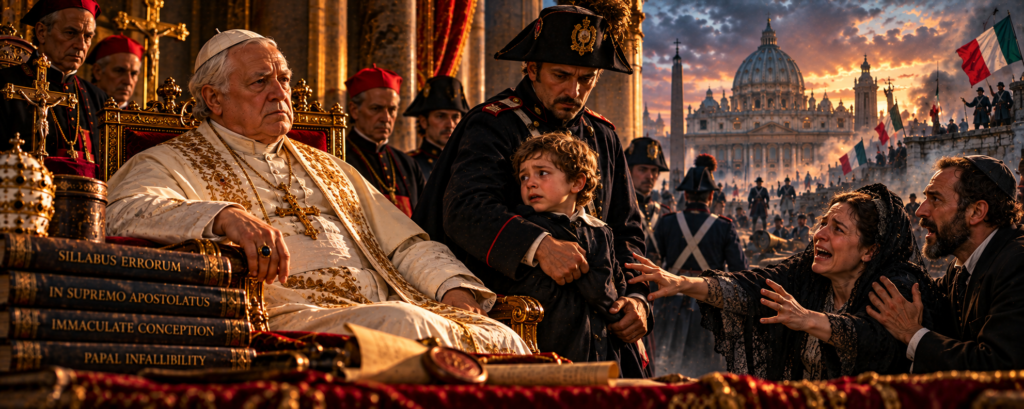
Pius IX: The Pope Who Stole a Jewish Child and Declared War on the Modern World
Pope Pius IX (1792–1878) | Reigned 1846–1878
The Night They Came for Edgardo Mortara
On the evening of June 23, 1858, papal police arrived at a Jewish family’s home in Bologna with an order that would horrify much of Europe. The family had committed no crime, and the officers were not searching for weapons, stolen property, or revolutionary literature. They had come for a little boy named Edgardo Mortara, who was not yet seven years old. His parents were about to discover that a religious ceremony allegedly performed without their knowledge years earlier had placed their son beyond their legal protection.
Edgardo’s parents, Salomone and Marianna Mortara, were Jewish, and they had raised their children within their faith. Several years earlier, a Catholic servant named Anna Morisi claimed to have secretly baptized Edgardo when she believed he was dangerously ill. She had not obtained his parents’ permission, and the family had continued raising him as Jewish without knowing that the baptism had supposedly occurred. Under the laws and religious assumptions governing the Papal States, however, the allegation had consequences that would destroy the family’s peace.
Catholic authorities considered baptism an indelible sacrament that made the recipient a member of the Church. Papal law also restricted the upbringing of baptized children by non-Catholic parents, creating a devastating conflict between religious jurisdiction and parental rights. Once officials accepted the servant’s account, they concluded that Edgardo could not remain in a Jewish household. The child was therefore removed from his family by representatives of a government ruled by the pope himself.
His parents protested, pleaded, and appealed for help. Their struggle attracted international attention, drawing criticism from Jewish communities, liberal politicians, newspapers, and prominent figures across Europe and the United States. Yet the man who possessed the authority to reverse the decision refused to surrender the boy. That man was Pope Pius IX, the spiritual leader of millions of Catholics and the temporal ruler whose government had taken Edgardo from his parents.
The Mortara affair became one of the most disturbing controversies in modern papal history. It exposed a system in which a religious claim could override the wishes of a child’s parents, even when the parents had never consented to the ceremony upon which that claim rested. The scandal also revealed how far Pius IX had traveled from the hopeful reformer celebrated at the beginning of his reign. By 1858, he had become a determined defender of papal authority against liberalism, nationalism, religious equality, and the political transformation of Italy.
Yet the story of Pius IX cannot be reduced to the abduction of one child, however shocking that event remains. His thirty-one-year pontificate witnessed revolutions, assassination, exile, foreign military intervention, the collapse of the Papal States, and a bitter confrontation between the Catholic Church and the emerging modern political order. He proclaimed the dogma of the Immaculate Conception, convened the First Vatican Council, and presided over the definition of papal infallibility. By the time he died in 1878, he had become both a revered religious figure and one of the most controversial sovereigns in Europe.
His story begins, remarkably, not with repression but with hope.
Giovanni Maria Mastai-Ferretti: The Man Before the Pope
The future Pius IX was born Giovanni Maria Mastai-Ferretti on May 13, 1792, in Senigallia, a town on Italy’s Adriatic coast within the Papal States. He belonged to a noble family, although his upbringing was not that of a prince destined to command armies or govern kingdoms. His youth unfolded during an extraordinary period of European upheaval, when revolutionary France challenged monarchies, churches, and political traditions across the continent. By the time he reached adulthood, the papacy itself had experienced humiliation, occupation, and the imprisonment of its rulers.
Mastai-Ferretti initially considered military service, but health difficulties complicated his plans. He experienced episodes of illness traditionally described as epileptic seizures, although the precise medical nature of his condition cannot be established with certainty from surviving accounts. His religious vocation eventually became the defining direction of his life. He was ordained a priest in 1819 and began a career that would carry him far beyond his native region.
Unlike some churchmen whose experience remained confined to the Roman Curia, Mastai-Ferretti encountered the wider world. He participated in a papal diplomatic mission to Chile during the 1820s, an unusual experience for a future nineteenth-century pope. The journey exposed him to political and religious conditions in a region emerging from Spanish colonial rule. Although the mission achieved limited diplomatic success, it broadened his experience beyond the familiar structures of Italian ecclesiastical government.
His advancement continued after his return to Europe. He became archbishop of Spoleto in 1827 and later bishop of Imola, gaining a reputation for pastoral concern and personal generosity. During periods of political unrest, he sometimes showed sympathy toward individuals caught in the machinery of repression. These experiences helped create the impression that he might represent a more conciliatory form of papal leadership.
Pope Gregory XVI made him a cardinal in 1839. By then, the Papal States had become notorious among liberal critics for censorship, political surveillance, and resistance to constitutional reform. Gregory’s government had repeatedly relied upon Austrian military intervention to suppress rebellion. The contrast between that stern political order and Mastai-Ferretti’s more approachable reputation would become important when the next papal election arrived.
Mastai-Ferretti was not a revolutionary democrat, nor did he advocate the destruction of papal temporal sovereignty. He remained a committed Catholic churchman who believed in the authority and independence of the Holy See. Nevertheless, his temperament appeared more flexible than that of Gregory XVI. Many observers hoped he might reconcile traditional papal government with at least some demands for administrative and political reform.
That hope would carry him to the papal throne.
The Pope Who Made Italy Believe in Miracles
Gregory XVI died on June 1, 1846, leaving behind a state troubled by political dissatisfaction and a growing nationalist movement. The conclave that followed elected Mastai-Ferretti on June 16, and he took the name Pius IX. At fifty-four, he was relatively young for a pope, and his reputation encouraged expectations of change. Across Italy, liberals and moderates watched Rome with unusual excitement.
Pius quickly took measures that appeared to justify their enthusiasm. In July 1846, he granted an amnesty to many political prisoners and exiles, an act celebrated by people who had suffered under the previous government’s repressive policies. He supported certain administrative reforms and encouraged improvements in public institutions. His actions suggested that the papacy might finally recognize the need for political adaptation.
Celebrations erupted in cities across the peninsula. Portraits of the new pope appeared among crowds demanding reform, and nationalist activists began imagining possibilities that would have seemed absurd under Gregory XVI. Some hoped Pius might support an Italian federation headed morally, if not politically, by the pope. Others believed he could become the symbolic leader of an Italian national revival.
The enthusiasm was genuine, but it rested partly upon wishful thinking. Pius supported reforms intended to strengthen papal government, not a revolution that would dissolve it. He did not enter office intending to establish a secular republic or surrender the Church’s temporal independence. His admirers often projected their own ambitions onto a man whose political principles remained more conservative than they realized.
Nevertheless, his early reforms were significant. He permitted the creation of a civic guard, relaxed aspects of censorship, and established consultative institutions intended to improve administration. In March 1848, he granted the Papal States a constitutional statute providing for representative bodies within a system that preserved substantial papal authority. These measures marked a genuine departure from the atmosphere associated with Gregory XVI.
For a brief period, Pius IX became one of the most popular public figures in Italy. His name appeared in patriotic demonstrations, and reformers praised him as a ruler capable of bridging the divide between Catholic tradition and national progress. The spectacle was extraordinary because the papacy had long been associated with resistance to revolutionary nationalism. Now the pope himself seemed to stand near the center of Italy’s political awakening.
The celebrations concealed an approaching disaster. The demands of the nationalist movement were expanding faster than Pius was willing or able to accommodate. Reformers increasingly wanted not merely better administration but a new political order. The pope would soon discover that enthusiasm could turn into fury when expectations went unmet.
The Revolutions of 1848
In 1848, revolution swept across Europe with astonishing speed. Governments fell, constitutions were demanded, nationalist movements mobilized, and established rulers struggled to retain control. France overthrew its monarchy, while uprisings shook Vienna, Berlin, Milan, Venice, and other cities. Italy became one of the central theaters of the upheaval.
The crisis placed Pius IX in an impossible position. Many Italian nationalists wanted war against Austria, which controlled Lombardy-Venetia and exercised enormous influence across the peninsula. They expected the pope, celebrated as a patriotic reformer, to support the struggle for Italian independence. Yet Pius was also the spiritual leader of Catholics living within the Austrian Empire.
A pope declaring a national war against a Catholic power would create profound difficulties. Pius could sympathize with Italian aspirations without accepting that his spiritual office should become an instrument of nationalist warfare. His reluctance disappointed activists who had imagined him as the champion of a united Italy. The tension between his universal religious responsibilities and his position as an Italian sovereign became impossible to conceal.
On April 29, 1848, Pius delivered an address that effectively rejected the idea of a papal war against Austria. He emphasized the universal nature of his spiritual office and refused to become the leader of an anti-Austrian crusade. To conservative Catholics, his position could appear principled and necessary. To Italian patriots, it felt like a devastating betrayal.
The reaction was immediate and bitter. The pope who had recently been celebrated in patriotic demonstrations was now accused of abandoning the national cause. Radical activists demanded further political changes, while moderate reformers struggled to maintain influence. The government became increasingly unstable.
Pius had not suddenly transformed from a liberal revolutionary into a reactionary monarch. Rather, the revolution exposed limits that had existed within his political outlook from the beginning. He had been willing to reform papal government but not to surrender its essential sovereignty or subordinate his religious office to nationalist ambitions. His supporters had mistaken limited reform for a commitment to unlimited political change.
That misunderstanding would have terrible consequences. The atmosphere in Rome became increasingly tense as revolutionary pressure mounted. Political disagreements moved from newspapers and public meetings into the streets. Before the year ended, violence would drive the pope from his capital.
The Murder of Pellegrino Rossi
Pellegrino Rossi was an experienced political figure who became head of the papal government during the crisis of 1848. He sought to restore order, stabilize administration, and navigate the competing pressures threatening the Papal States. His policies attracted fierce opposition from radicals who considered him an obstacle to their ambitions. The atmosphere surrounding his ministry became increasingly dangerous.
On November 15, 1848, Rossi was assassinated in Rome while arriving for a parliamentary session at the Palazzo della Cancelleria. He was attacked with a knife and died from his wounds. The killing shocked the government and demonstrated how far political violence had escalated. Responsibility for the assassination became entangled in revolutionary politics, and later accounts have differed over the precise organization behind it.
The murder was followed by intense pressure upon the pope. Crowds gathered, armed demonstrators threatened the papal palace, and the government struggled to maintain control. Pius found himself increasingly isolated and fearful for his safety. The reforms that had once made him popular had failed to protect him from revolutionary anger.
On November 24, Pius fled Rome in disguise and traveled to Gaeta, within the Kingdom of the Two Sicilies. His departure marked a dramatic humiliation for the papacy. The sovereign who had been hailed as a national hero was now an exile from his own capital. The political experiment that began with amnesties and celebrations had ended in assassination and flight.
For Pius, the experience became a defining personal trauma. He had attempted reforms, granted concessions, and allowed greater political participation, only to witness revolutionary violence and the collapse of his authority. The lesson he drew was not that reform had been insufficient, but that liberal political movements could become uncontrollable and dangerous. His earlier optimism would never fully return.
His opponents interpreted events differently. They believed that papal reluctance to embrace national independence had undermined the reform movement and provoked popular anger. Some argued that the pope’s insistence upon retaining ultimate authority made meaningful constitutional government impossible. The assassination of Rossi was a crime, but it did not settle the political dispute that had produced the crisis.
The events of November 1848 permanently damaged the relationship between Pius IX and Italian liberalism. He would eventually return to Rome, but he would not return as the same political figure. The cheerful reformer celebrated two years earlier was giving way to a pope increasingly determined to defend the Church against the modern revolutionary world.
The Roman Republic and the Fall of Papal Government
With Pius absent from Rome, revolutionary leaders moved toward a new political settlement. Elections were held for a constituent assembly, and on February 9, 1849, the Roman Republic was proclaimed. Papal temporal government was declared ended, although the pope’s spiritual authority was not necessarily rejected by everyone supporting the republic. The distinction between religious leadership and political sovereignty became central to the conflict.
The republic attracted some of the most prominent figures of Italian nationalism. Giuseppe Mazzini became one of its leading political authorities, while Giuseppe Garibaldi played an important military role in its defense. The government pursued reforms intended to replace clerical political rule with republican institutions. For supporters, Rome had become a symbol of national liberation.
The republic’s existence presented Pius with a profound challenge. His territorial sovereignty had been overthrown, and the city traditionally associated with papal authority was now governed by political revolutionaries. He regarded the loss not merely as a personal humiliation but as a threat to the independence of the Holy See. Restoring his government became a central objective.
European powers intervened in the crisis. France, under President Louis-Napoléon Bonaparte, sent troops to Italy, officially motivated in part by the desire to restore papal authority. The intervention was complicated by French domestic politics and international rivalry, but its military consequences were unmistakable. French forces attacked the Roman Republic.
Garibaldi and the republican defenders resisted fiercely. Fighting around Rome caused casualties and destruction, while the republic struggled against superior military power. The French eventually captured the city in July 1849. The republican experiment had lasted only a few months.
Pius did not immediately return. He remained away while arrangements were made for the restoration of papal government. When he finally entered Rome in April 1850, he returned under the protection of foreign military power. The contrast with his triumphant election celebrations could hardly have been greater.
The Roman Republic became a turning point in his political philosophy. Pius had witnessed constitutional reform develop into revolutionary demands, the assassination of a minister, his own flight, and the abolition of his temporal government. He concluded that liberal nationalism threatened the very foundations of papal independence. His future policies would reflect that conviction.
Yet the restoration also created an enduring political problem. The pope had regained his capital through the intervention of foreign soldiers, reinforcing nationalist claims that papal government survived only because powerful European states protected it. The political legitimacy of the restored regime remained contested. The battle for Rome had ended, but the struggle over Italy’s future had not.
The Return of the Old Order
After returning to Rome, Pius IX abandoned much of the political experimentation associated with the opening years of his pontificate. The constitutional system introduced in 1848 was not restored in its earlier form. Political authority returned to a more centralized structure dominated by papal officials and clerical institutions. The government placed renewed emphasis upon security, order, and resistance to revolutionary activity.
Political opponents faced surveillance, arrest, exile, and prosecution. Censorship again restricted publications considered dangerous to religion or government. The administration regarded revolutionary nationalism as a continuing threat rather than a movement whose grievances might be resolved through broad political participation. The experiences of 1848 and 1849 had convinced Pius that concessions could endanger the state.
His defenders believed the restoration was necessary. They remembered Rossi’s assassination, the collapse of government, and the violent confrontation that had followed. They argued that revolutionary movements had demonstrated their unwillingness to respect lawful authority. A strong government, they believed, was essential to prevent another catastrophe.
Critics saw a very different picture. The pope who had once inspired hopes of reform now presided over a government associated with repression and foreign military protection. Political prisoners became symbols of resistance, and reports of harsh treatment circulated throughout Europe. The Papal States increasingly appeared to liberals as an obstacle to constitutional government and Italian unity.
The restored regime also remained dependent upon France. French troops stationed in Rome helped protect the pope from renewed revolutionary attack. This arrangement provided immediate security but deepened the perception that papal sovereignty rested upon foreign bayonets. The contradiction would haunt Pius until the final collapse of his temporal power.
The political transformation was particularly bitter because Pius had once been celebrated by many of the people who now opposed him. His early popularity made the later confrontation feel like a personal betrayal on both sides. The pope believed reformers had rewarded his generosity with revolution. The reformers believed he had abandoned the future they thought he represented.
The consequences reached beyond politics. The restored government also revived or reinforced restrictions rooted in the older confessional order, including discriminatory measures affecting Jewish communities. The Church’s claim to religious authority remained intertwined with the state’s power to regulate private lives. That combination would soon produce the most notorious scandal of Pius IX’s reign.
The Jews of Rome and the Restoration of Discrimination
For centuries, Jews living under papal government had been subjected to restrictions that distinguished them from Catholic subjects. In Rome, the Jewish ghetto had been established in 1555 under Pope Paul IV, confining Jewish residents to a designated district and imposing limitations upon their economic and social lives. Later governments modified aspects of the system, while the revolutionary and Napoleonic periods temporarily challenged older restrictions. By the nineteenth century, Jewish emancipation had become an increasingly important issue across Europe.
Pius IX initially appeared willing to relax certain discriminatory measures. During the reforming phase of his pontificate, restrictions affecting Rome’s Jewish population were eased, and in 1848 the ghetto’s gates were removed. These changes encouraged hopes that the papal government might eventually accept greater civic equality. Such hopes were consistent with the broader atmosphere of political optimism surrounding his early reign.
The revolution and restoration changed that trajectory. After Pius returned to power, restrictions upon Jewish residents were restored or reinforced, and the older system of discrimination remained in place. Jewish communities continued to face limitations associated with the confessional character of papal government. The promise of emancipation had been sharply curtailed.
The issue was not simply personal prejudice, although anti-Jewish assumptions were deeply embedded in the society and religious culture of the period. The Papal States operated under a legal framework that treated Catholicism as the privileged religion and denied equal civic status to those outside it. Jewish families lived under laws that could interfere with residence, employment, education, and family life. The system rested upon the belief that religious difference justified unequal legal treatment.
By the middle of the nineteenth century, however, such arrangements were increasingly controversial. Liberal governments and Jewish emancipation movements argued that citizenship should not depend upon religious identity. The papal government resisted that principle because it challenged the traditional structure of a Catholic confessional state. The resulting conflict placed Rome at odds with political developments elsewhere in Europe.
This background is essential to understanding the Mortara affair. Edgardo’s removal did not emerge from a sudden personal whim or an isolated misunderstanding. It occurred within a legal and religious system that gave Catholic authorities extraordinary power over the status of baptized children. The same system denied Jewish parents protections that modern readers would regard as fundamental.
Pius IX did not invent those laws, but he chose to defend their application when confronted with an international scandal. That distinction matters because inherited injustice does not absolve a ruler who possesses the authority to change or suspend it. The pope could have treated the case as an opportunity to reconsider a deeply troubling policy. Instead, he made the preservation of ecclesiastical authority the central issue.
The consequences would reach into one family’s home in Bologna. What began as a servant’s account of a secret baptism became a confrontation between parental love and the power of the papal state. The Mortara family would discover that the law recognized their son’s alleged baptism more strongly than it recognized their right to raise him.
The Secret Baptism
Edgardo Mortara was born in Bologna on August 27, 1851, into the Jewish family of Salomone and Marianna Mortara. His parents raised him within their religious tradition, and there was no suggestion that they had consented to his conversion. During his infancy, however, a Catholic servant named Anna Morisi later claimed to have performed an emergency baptism. According to her account, she believed the child was gravely ill and feared he might die without receiving the sacrament.
The alleged ceremony was performed privately, without the knowledge or permission of Edgardo’s parents. Morisi was not a priest, but Catholic sacramental theology recognizes that under certain circumstances a layperson can validly administer baptism. The Church’s rules concerning emergency baptism therefore made her claim potentially significant. Whether every detail of her account was accurate has remained a subject of historical discussion, especially because the ceremony was not witnessed by the family.
Several years passed before the matter came to the attention of ecclesiastical authorities. Accounts differ in some details concerning how Morisi’s disclosure reached officials, but the essential sequence is clear. Her statement was investigated and accepted by the authorities responsible for enforcing religious law. They concluded that Edgardo had been baptized and therefore belonged to the Catholic Church.
The legal reasoning was devastating. Under the prevailing rules of the Papal States, a baptized child was not supposed to be raised in a non-Catholic household. The authorities therefore treated Edgardo’s continued residence with his Jewish parents as an unacceptable religious situation. His parents’ lack of consent to the baptism did not prevent officials from asserting jurisdiction over him.
This was the central injustice of the affair. A secret ceremony allegedly performed by someone outside the family was used to override the rights of the parents who had raised the child. The law gave decisive weight to a religious act the parents had neither requested nor witnessed. Their son’s identity was effectively reclassified by the state without their participation.
The episode also revealed the dangerous implications of the Church’s understanding of baptism when enforced through temporal power. Within Catholic theology, baptism was regarded as spiritually permanent. Within the Papal States, that theological belief could become the basis for police action. The result was a system in which sacramental claims could justify separating a child from his family.
The Mortaras had no meaningful opportunity to prevent the alleged baptism because they did not know it had occurred. They could not undo the ceremony under Catholic teaching, and their religious objections carried little weight before the authorities. Once the officials accepted Morisi’s account, the family’s position became almost impossible. The government had already decided which religious identity mattered.
June 23, 1858: A Family Torn Apart
When papal officers arrived at the Mortara home, the family initially struggled to understand what was happening. They were informed that Edgardo had supposedly been baptized and could no longer remain with his Jewish parents. The announcement transformed an ordinary evening into a nightmare. Salomone and Marianna faced the possibility of losing a child to a government whose authority they could not effectively challenge.
The removal was not simply a symbolic assertion of religious jurisdiction. Officers physically took Edgardo away from his family and placed him under Catholic supervision. The child was transported from Bologna to Rome, where he would be educated within the Church. His parents were left to pursue appeals against an institution that considered the separation justified.
Contemporary accounts describe the family’s distress, although individual scenes and conversations have been retold with varying degrees of embellishment. The central facts require no invented dialogue. A Jewish child was removed by papal authorities against his parents’ wishes. The separation was enforced because officials believed he had received a valid Catholic baptism.
Edgardo was taken to the House of Catechumens in Rome, an institution associated with the instruction and conversion of non-Catholics. His education would now be directed toward Catholic religious life. The authorities regarded this as the proper care of a baptized child. His parents regarded it as the theft of their son.
The difference between those perspectives was enormous. For the Church officials involved, Edgardo’s baptism created obligations that superseded his family’s wishes. They believed that returning him to a Jewish household would endanger his Catholic upbringing. For the Mortaras, no religious claim could justify taking a child from loving parents who had committed no offense.
The case exposed the coercive power behind the papal government’s religious assumptions. Had the Church possessed only spiritual authority, it could have taught that Edgardo was baptized without necessarily possessing the police power to remove him. Because Pius IX was also a territorial sovereign, ecclesiastical decisions could be enforced by officers of the state. The distinction between religious conviction and government coercion disappeared.
Edgardo’s parents refused to accept the loss. They sought assistance from Jewish organizations, sympathetic Catholics, diplomats, and political figures. Their campaign would carry the story far beyond Bologna and Rome. Within months, the fate of one child had become an international controversy over religious freedom, parental rights, and papal power.
The World Demands Edgardo’s Return
News of the Mortara affair spread rapidly through European and American newspapers. Jewish communities organized protests and appeals, while liberal commentators condemned the papal government’s actions. The controversy attracted attention because it appeared to demonstrate the dangers of allowing religious authorities to exercise coercive political power. The child’s removal became a powerful symbol in the wider struggle over civil rights.
Prominent political figures expressed concern, and diplomatic pressure mounted upon the papal government. Napoleon III’s France was particularly important because French troops were helping protect Pius IX’s temporal authority in Rome. The emperor therefore possessed influence that ordinary petitioners lacked. Yet even pressure from powerful governments failed to secure Edgardo’s return.
The affair also reached the United States, where newspapers and public figures debated the implications of the abduction. American Jewish communities joined international efforts to draw attention to the case. The controversy resonated with broader discussions about religious liberty and the rights of minority communities. It also intensified criticism of the Catholic Church among some Protestant and secular commentators.
Not every critic approached the affair from the same motives. Some genuinely defended Jewish civil rights and parental authority. Others used the scandal to attack Catholicism more broadly, sometimes drawing upon existing anti-Catholic prejudice. Distinguishing these motives is important because the injustice of Edgardo’s removal does not make every contemporary polemic fair or reliable.
Catholic defenders of the papal decision argued that the Church had a sacred responsibility toward a baptized child. They believed the spiritual consequences of returning Edgardo to Jewish upbringing outweighed the parents’ claims. Some portrayed the boy’s developing Catholic identity as confirmation that the authorities had acted correctly. These arguments reveal the religious assumptions behind the decision, but they do not erase the coercion through which the separation began.
Pius IX remained unmoved by repeated demands for the child’s return. His refusal transformed the scandal from a dispute involving subordinate officials into a defining controversy of his pontificate. The pope possessed the authority to intervene, yet he defended the principle that the baptized child belonged within the Catholic community. International outrage only strengthened the perception that he was placing ecclesiastical authority above ordinary human bonds.
The case became especially damaging because Pius had once been celebrated as a reformer. The man who had granted political amnesties and encouraged hopes of liberalization now refused to return a Jewish child to his parents. For critics, the contrast seemed to reveal the true nature of papal government. The early promise of religious and political tolerance appeared to have been replaced by uncompromising authoritarianism.
Pius IX and the Boy He Would Not Release
Pius IX took a personal interest in Edgardo Mortara after the child was brought to Rome. The pope encountered him within the Catholic institutions responsible for his upbringing and became associated with his religious development. Supporters later emphasized the affection Pius showed toward the boy. Critics saw that relationship as a disturbing extension of the original separation.
The pope’s position rested upon the conviction that Edgardo’s baptism had made him Catholic. Within that framework, returning him to his Jewish parents would mean allowing a baptized child to be raised outside the Church. Pius regarded this as unacceptable. His refusal was therefore not merely a political calculation intended to defy liberal critics, although political considerations became inseparable from the controversy.
This makes the affair particularly unsettling. Pius appears to have believed that keeping Edgardo within Catholic care served the child’s spiritual welfare. He did not need to hate the Mortara family in order to defend a policy that devastated them. His certainty about religious duty allowed him to discount the suffering produced by his decision.
The family’s appeals continued for years. They sought opportunities to see Edgardo and attempted to persuade authorities to reconsider. Visits and communications occurred under circumstances controlled by the institutions responsible for the boy. The parents never regained the ordinary freedom to raise their son.
As Edgardo grew older, he increasingly identified with Catholicism. He eventually entered religious life and became a priest, taking the name Pio Maria. This later development has sometimes been presented by defenders of Pius IX as evidence that the original decision was justified. Yet an adult’s eventual religious convictions do not retroactively establish that removing him from his parents as a child was morally acceptable.
The distinction between Edgardo’s later choices and his childhood circumstances is essential. He was educated within Catholic institutions from a young age after being forcibly separated from his Jewish family. His religious identity developed within that environment. Historians can acknowledge the sincerity of his adult faith without ignoring the coercion that shaped his upbringing.
Edgardo maintained his Catholic identity throughout his adult life and died in 1940. His later writings and statements reflected devotion to the Church and gratitude toward Pius IX. These sources provide important evidence of how he understood his own life. They do not eliminate the suffering experienced by his parents or settle the ethical questions surrounding his removal.
The Mortara affair remains disturbing precisely because it resists an easy ending. The boy did not simply grow up to reject the institution that had taken him, nor did the family’s struggle produce the reunion they sought. Instead, the separation became permanent, and Edgardo embraced the religious world into which he had been placed. The tragedy lies partly in the fact that his adult convictions and his parents’ violated rights can both be acknowledged without contradiction.
The Parents Who Never Won
Salomone and Marianna Mortara spent years trying to recover their son. Their campaign required persistence against an institution possessing religious authority, legal power, diplomatic influence, and the protection of foreign troops. They appealed to public opinion because the courts and officials of the Papal States offered little hope. Their struggle became one of the most widely discussed family tragedies of nineteenth-century Europe.
The couple faced an extraordinary imbalance of power. They were private citizens belonging to a religious minority whose legal status was restricted. Their opponent was the pope, sovereign of the state and head of a worldwide religious institution. The government that had taken their child was also the government responsible for deciding whether the action had been lawful.
International publicity brought sympathy but not the result they wanted. Diplomatic protests could embarrass the papacy, and newspapers could expose the injustice to millions of readers. Neither could compel Pius IX to reverse his decision. The pope’s refusal demonstrated how little practical protection public outrage could offer when a sovereign was determined to maintain his position.
The family’s suffering also became entangled in the wider political campaign against papal temporal rule. Italian nationalists pointed to the affair as evidence that ecclesiastical government was incompatible with modern civil rights. Jewish emancipation advocates emphasized the vulnerability of minorities under confessional laws. Liberal commentators treated the case as a warning about the dangers of religious coercion.
Those political uses did not make the family’s grief any less genuine. The Mortaras had not initiated an ideological campaign against the papacy. They wanted their child returned. Their private catastrophe became an international cause because the government refused to recognize their parental claim.
The case also raised uncomfortable questions for Catholics who supported religious liberty. If baptism could be imposed secretly upon a child and then used to remove that child from non-Catholic parents, what protection existed for minority families? If the state could enforce ecclesiastical claims against parental wishes, where did religious authority end? The Mortara affair exposed these questions with unusual clarity.
Pius IX never gave the family the answer they sought. His refusal endured despite criticism from governments, newspapers, and religious communities across the world. The child remained within Catholic care and eventually entered the priesthood. The parents’ campaign ended without restoring the family life that had been taken from them.
For this reason, the Mortara affair occupies a central place in the darker history of the nineteenth-century papacy. It was not an isolated act of personal cruelty committed in secret. It was a public defense of institutional power against a family’s most intimate rights. The scandal revealed what could happen when religious certainty was backed by the coercive authority of the state.
The Last Executions and the Violence of Papal Justice
The Mortara affair was not the only controversy surrounding Pius IX’s government. The restored Papal States maintained a criminal justice system that included capital punishment, political prosecutions, and severe penalties for offenses against public order. Such practices were not unique to Rome, but they became increasingly controversial as liberal movements challenged traditional forms of state violence. The papacy’s spiritual identity made the use of coercive punishment particularly striking to its critics.
Giovanni Battista Bugatti, the famous papal executioner known as Mastro Titta, continued serving during part of Pius IX’s reign. His career had begun decades earlier and extended until 1864. He became a grim symbol of the state’s power to take life. His recorded executions included criminals convicted of serious offenses, and it would be inaccurate to portray all those condemned as political martyrs.
Nevertheless, executions remained part of the machinery of papal government. The state claimed the authority to punish through imprisonment and death while also presenting itself as the guardian of Christian morality. Contemporary critics increasingly questioned whether such powers should remain in the hands of an ecclesiastical sovereign. The issue contributed to broader arguments over the legitimacy of temporal papal rule.
One of the most controversial episodes occurred in 1868, when Giuseppe Monti and Gaetano Tognetti were executed after being convicted in connection with a bombing in Rome during the previous year’s revolutionary disturbances. The attack had killed papal soldiers, and the government treated the offense as a grave crime. Their execution nevertheless became a nationalist cause célèbre. Critics portrayed the men as martyrs of Italian unification.
The distinction between political motive and criminal violence is important. The bombing caused deaths, and a government had legitimate grounds to prosecute those responsible. Yet the executions occurred within a political struggle in which the papacy was fighting to preserve its sovereignty. Nationalists therefore interpreted the punishment as part of a broader campaign of repression.
The controversy intensified the hostility surrounding Pius IX’s government. His defenders argued that maintaining public order required punishment for deadly attacks. His opponents condemned the use of capital punishment by a state whose temporal authority they considered illegitimate. Both sides understood that the conflict extended beyond the fate of individual prisoners.
By the late 1860s, the Papal States were increasingly isolated. Most of the Italian peninsula had already been unified under the Kingdom of Italy, while Rome remained under papal rule. Political violence and repression unfolded against the background of a state fighting for its survival. The executions became symbols of that desperate struggle.
The papacy would soon lose the power to enforce criminal law across Rome. Within two years of the Monti and Tognetti executions, Italian troops would enter the city. The old system of papal temporal justice was approaching its end. Its final years left memories of punishment and political conflict that continued shaping the pope’s reputation.
The Immaculate Conception and the Growth of Papal Authority
While political crises consumed the Papal States, Pius IX pursued major theological initiatives. On December 8, 1854, he proclaimed the dogma of the Immaculate Conception through the apostolic constitution Ineffabilis Deus. The teaching affirmed that Mary had been preserved from original sin from the first moment of her conception by a singular grace of God. It should not be confused with the virgin birth of Jesus, a separate Christian doctrine.
The proclamation reflected longstanding Catholic devotion and theological debate. Pius had consulted bishops before issuing the definition, and support for the teaching was widespread within Catholic communities. For many believers, the declaration was a moment of profound religious celebration. It demonstrated the pope’s determination to exercise his spiritual authority even while his temporal position remained politically insecure.
The event also foreshadowed later developments concerning papal infallibility. Pius presented a definitive teaching on faith through the authority of the papal office. The declaration strengthened the visibility of Rome as the center of Catholic doctrinal life. It also reinforced the distinction between the pope’s spiritual authority and the political sovereignty increasingly threatened by Italian nationalism.
This theological activity complicates the story of Pius IX. His pontificate was not merely a long retreat into political reaction. It also witnessed intense religious revival, renewed devotional practices, missionary activity, and the expansion of Catholic institutions. Many Catholics regarded him as a courageous defender of their faith against hostile secular governments.
That devotion was genuine, but it coexisted with controversies that damaged the papacy’s reputation outside Catholic circles. The same pope celebrated for defining Marian doctrine would later become notorious for refusing to return Edgardo Mortara. Supporters and critics therefore saw dramatically different aspects of his reign. Neither perspective alone captures the whole picture.
Pius increasingly interpreted the struggles of his age through a spiritual framework. Revolutionary nationalism, secular liberalism, and challenges to ecclesiastical authority appeared to him as interconnected threats. Strengthening Catholic identity became one response to political weakness. The more uncertain the papacy’s territorial future became, the more emphatically Pius asserted its spiritual authority.
The Immaculate Conception proclamation was not a reaction to the Mortara affair, which occurred four years later. Nevertheless, both episodes reveal the importance Pius attached to the Church’s understanding of religious truth and sacramental authority. In one case, that conviction produced a theological definition welcomed by millions. In the other, it contributed to the defense of a child’s forced separation from his parents.
The contrast is central to understanding his pontificate. Religious certainty could inspire devotion, charity, and spiritual renewal. When combined with coercive state power, it could also produce grave injustice. Pius IX embodied both possibilities.
The Syllabus of Errors: Rome Against the Modern World
On December 8, 1864, Pius IX issued the encyclical Quanta cura, accompanied by the Syllabus of Errors. The Syllabus assembled eighty propositions that had been condemned in earlier papal documents. Its subjects included rationalism, religious indifferentism, relations between Church and state, political authority, and various claims associated with liberal modernity. The publication became one of the most controversial statements of the nineteenth-century papacy.
The document did not present a single systematic philosophical argument. Instead, it collected propositions rejected in earlier contexts, making interpretation dependent upon the original sources and circumstances. This structure contributed to confusion and controversy. Critics frequently read the list as a sweeping declaration of war against modern civilization.
The most famous proposition concerned the claim that the Roman pontiff could and should reconcile himself with progress, liberalism, and modern civilization. Its condemnation became a powerful symbol of papal resistance to the political ideas transforming Europe. Newspapers and liberal commentators seized upon it as evidence that Pius opposed the modern world itself. Catholic defenders argued that the condemned terms referred to specific anti-religious forms of liberalism rather than every possible improvement in human society.
The distinction matters historically, but it does not erase the document’s strongly anti-liberal character. Pius rejected ideas associated with religious indifferentism, unrestricted state supremacy over the Church, and political arrangements he believed threatened Catholic truth. His position reflected experiences of revolution, exile, and conflict with governments attempting to reduce ecclesiastical influence. The Syllabus translated those fears into a public statement of doctrinal resistance.
For many Catholics, the document offered clarity in an age of ideological confusion. They believed secular governments were attacking religious institutions, confiscating church property, and attempting to subordinate the Church to political authority. Pius appeared as a defender of spiritual independence. His refusal to compromise became a source of admiration.
For liberals, the same refusal confirmed their worst suspicions. They saw the papacy as hostile to freedom of conscience, religious equality, constitutional government, and intellectual progress. The Mortara affair had already provided a vivid example of the consequences of confessional authority. The Syllabus seemed to offer the intellectual justification for that broader system.
The controversy widened the distance between Rome and modern liberal politics. It also influenced debates within Catholicism, where thinkers differed over how the Church should respond to constitutional states and religious pluralism. Some emphasized resistance to secularization, while others hoped for forms of accommodation. Pius gave greater support to the former approach.
The Syllabus therefore belongs beside the Mortara affair in understanding his darker legacy. One controversy concerned the fate of a particular child, while the other concerned the principles by which religion and political authority should interact. Together, they revealed a pope determined to preserve ecclesiastical claims against the expanding language of individual liberty. His resistance would continue even as his territorial kingdom disappeared.
The Risorgimento and the Destruction of the Papal States
The movement for Italian unification, known as the Risorgimento, gradually transformed the political map of the peninsula. During the 1850s and 1860s, the Kingdom of Sardinia-Piedmont emerged as the principal force behind the creation of a unified Italian state. Political leaders such as Camillo di Cavour pursued diplomacy, war, and alliances to weaken Austrian influence and absorb neighboring territories. Giuseppe Garibaldi and other nationalist figures contributed through military campaigns and revolutionary action.
The Papal States occupied a central position in this struggle. Their territory divided northern and southern Italy, making them a major obstacle to complete unification. Pius IX refused to surrender his temporal sovereignty because he believed it protected the independence of the Holy See. Nationalists increasingly regarded that refusal as incompatible with the creation of a modern Italian nation.
In 1859 and 1860, nationalist advances and political upheavals undermined papal control over much of central Italy. Several territories formerly governed by the pope were incorporated into the expanding Italian state. Pius condemned these annexations and refused to recognize their legitimacy. The loss was devastating because it reduced the Papal States from a substantial central Italian territory to a much smaller domain centered upon Rome.
The process involved military conflict. Papal forces attempted to resist the advance of nationalist armies, while foreign volunteers rallied to defend the pope. At the Battle of Castelfidardo in September 1860, Piedmontese forces defeated the papal army. The defeat accelerated the collapse of papal authority over the Marches and Umbria.
In March 1861, the Kingdom of Italy was proclaimed under Victor Emmanuel II. Rome remained outside the new kingdom, but Italian nationalists regarded it as their rightful capital. The pope’s refusal to surrender the city became one of the central unresolved questions of Italian unification. His survival depended heavily upon French military protection.
Pius regarded the territorial losses as acts of robbery against the Church. He argued that the pope required independence from secular rulers in order to exercise his universal spiritual mission freely. His concern was not entirely without foundation, because European governments had repeatedly attempted to control or intimidate the papacy. Nevertheless, the extent of territory required for that independence was a political question rather than an unavoidable theological conclusion.
The conflict became increasingly bitter. Nationalists accused Pius of obstructing Italy’s future, while papal supporters condemned the annexations as attacks upon legitimate sovereignty. Religious devotion and political nationalism became entangled in a struggle that divided families and communities. The pope’s temporal power survived, but only within shrinking boundaries.
By the late 1860s, the end was approaching. Rome remained protected by French troops, but the international situation was changing rapidly. The survival of papal sovereignty depended upon decisions made in Paris and other European capitals. Pius could defend his principles, but he could no longer determine the political future of Italy.
Mentana and the Last Defense of Rome
In 1867, Giuseppe Garibaldi attempted another campaign against papal Rome. His volunteers hoped to capture the city and complete the process of Italian unification. The papal government resisted, supported by French military assistance. The confrontation culminated in the Battle of Mentana on November 3.
Papal and French forces defeated Garibaldi’s volunteers. French troops possessed modern Chassepot rifles, whose effectiveness became associated with the battle. The victory preserved papal control over Rome for the moment. It also demonstrated once again that foreign military power remained essential to the pope’s survival as a territorial sovereign.
For Pius, the victory could be interpreted as providential protection. His supporters celebrated the successful defense of the Holy See. The pope remained in Rome, and the nationalist attempt had failed. The political system he defended appeared to have survived another crisis.
Yet the victory was deceptive. France’s commitment to protecting Rome depended upon circumstances beyond the pope’s control. Napoleon III faced growing political and military difficulties, while Prussia was emerging as a powerful rival. The balance of European power was shifting.
Garibaldi’s defeat also failed to extinguish Italian nationalism. The movement had already achieved the unification of most of the peninsula. Rome remained the symbolic prize, and its exclusion from the kingdom continued to provoke dissatisfaction. The papacy could win battles without resolving the larger conflict.
The events of 1867 also intensified political repression within the remaining papal territory. Revolutionary plots and violent attacks contributed to an atmosphere of fear. The government pursued suspects and punished those convicted of serious crimes. The executions of Monti and Tognetti the following year became part of this bitter final struggle.
Pius remained determined to resist annexation. He regarded surrender as a betrayal of the rights of the Holy See. His supporters admired that determination as heroic steadfastness. His opponents saw it as a refusal to recognize political reality.
Within three years, the foreign military protection upon which he depended would disappear. The final confrontation would arrive not because Pius changed his mind, but because France could no longer defend him. The fate of Rome was about to be decided by a war fought far beyond Italy.
Vatican I and the Definition of Papal Infallibility
As the political future of Rome grew increasingly uncertain, Pius IX convened the First Vatican Council. The council opened on December 8, 1869, bringing bishops from across the Catholic world to Rome. Its proceedings addressed questions of faith, reason, ecclesiastical authority, and the challenges confronting the Church. The most famous outcome would be the formal definition of papal infallibility.
The doctrine did not mean that the pope was incapable of making mistakes in ordinary life. It did not declare every papal political decision correct or every personal judgment beyond criticism. The definition concerned specific circumstances in which the pope, speaking ex cathedra as supreme pastor and teacher of all Christians, definitively proclaimed doctrine concerning faith or morals to be held by the whole Church. The distinction is essential because the doctrine has frequently been misunderstood.
The proposal nevertheless generated intense debate. Some bishops supported a formal definition as a necessary defense of papal authority in an age of political and religious upheaval. Others questioned whether the timing was wise or whether the doctrine should be defined in the proposed manner. Opposition did not always mean rejection of the underlying theological concept. Concerns also involved pastoral consequences and relations with other Christian communities.
Pius strongly favored the definition. His pontificate had repeatedly demonstrated the vulnerability of the papacy’s territorial power, while Catholic devotional life increasingly emphasized loyalty to Rome. The council offered an opportunity to articulate the pope’s spiritual authority with exceptional clarity. The contrast between political weakness and doctrinal assertion was striking.
On July 18, 1870, the council approved the constitution Pastor aeternus, which defined papal infallibility under the specified conditions. The declaration became one of the most consequential theological developments of the modern Catholic Church. It also contributed to divisions, including the emergence of Old Catholic movements that rejected the definition. The council’s work was interrupted shortly afterward by the political crisis surrounding Rome.
The timing was extraordinary. While bishops debated the authority of the pope, European war was preparing to destroy the political structure that had supported papal sovereignty for centuries. France and Prussia were moving toward confrontation. The troops protecting Rome would soon be needed elsewhere.
Pius had secured a major statement of spiritual authority just as his temporal power approached collapse. The two developments were not identical, and the doctrine of infallibility cannot be reduced to a political compensation for lost territory. Nevertheless, their proximity became one of the defining ironies of his reign. The pope would lose his kingdom almost immediately after presiding over the solemn definition of a central claim concerning his teaching office.
The Mortara affair also remained part of the broader debate over papal authority. Critics questioned how an institution claiming special protection in matters of faith could defend the forced removal of a child. Catholic theologians could distinguish doctrinal infallibility from disciplinary and political decisions, but that distinction did not resolve the moral controversy. The pope’s spiritual authority and his temporal conduct remained painfully intertwined in the public imagination.
September 20, 1870: The Fall of Rome
In July 1870, war erupted between France and Prussia. Napoleon III withdrew French troops from Rome as his government confronted a major military crisis. Within weeks, French armies suffered catastrophic defeats, and the emperor himself was captured at Sedan. The power that had protected Pius IX’s temporal sovereignty was collapsing.
The Italian government recognized the opportunity. Rome remained outside the Kingdom of Italy, but the withdrawal of French protection removed the principal obstacle to annexation. Italian troops advanced toward the city in September. Pius refused to surrender his sovereign rights voluntarily.
The pope instructed his forces to offer limited resistance sufficient to demonstrate that the city was being taken by force. On September 20, Italian artillery breached the walls near Porta Pia. Fighting occurred, and soldiers on both sides were killed or wounded. The military outcome was never seriously in doubt.
Italian troops entered Rome, ending the pope’s effective temporal rule over the city. The event marked the culmination of the Risorgimento and the collapse of the Papal States as a substantial territorial power. Rome was subsequently incorporated into the Kingdom of Italy and became its capital. Pius IX remained within the Vatican, refusing to recognize the legitimacy of the annexation.
The fall of Rome was an extraordinary historical reversal. For centuries, popes had ruled territories in central Italy, negotiated with kings, raised armies, collected taxes, and exercised criminal jurisdiction. That political world had now disappeared. The pope remained head of the Catholic Church but no longer possessed the same territorial sovereignty.
Pius interpreted the annexation as an injustice. He rejected arrangements offered by the Italian government, including the 1871 Law of Guarantees, which attempted to define the pope’s position and privileges within the new political order. He regarded himself as a prisoner of the Vatican. The resulting dispute between the papacy and the Italian state became known as the Roman Question.
The phrase “prisoner of the Vatican” reflected Pius’s political position rather than literal confinement in an ordinary prison. He remained within the Vatican precincts as a form of protest and refused to accept the new settlement. His successors continued this stance for decades. The dispute would not be formally resolved until the Lateran Treaty of 1929 established Vatican City as a sovereign state.
For Pius, the loss represented the defeat of a cause he had defended throughout his pontificate. For Italian nationalists, it was the completion of a historic struggle. For the Catholic Church, it began a new era in which spiritual authority would operate without the extensive territorial government inherited from the medieval and early modern papacy. The consequences would be profound.
Edgardo Mortara After the Fall of the Papal States
The collapse of papal temporal power changed the legal environment surrounding Edgardo Mortara. By 1870, however, he was no longer the small child taken from Bologna twelve years earlier. He had grown up within Catholic institutions and was preparing for religious life. His identity had developed in circumstances profoundly different from those his parents had intended.
When Italian troops entered Rome, the political authority that had enforced his separation from his family disappeared. Yet Edgardo did not simply return to Judaism or resume the childhood that had been interrupted. He continued pursuing his Catholic vocation. His later life would be devoted to the priesthood and religious work.
This outcome has sometimes been used to argue that the original abduction should not be judged harshly. Such reasoning confuses the later convictions of an adult with the rights of a child and his parents at the time of removal. A person can sincerely embrace a religion learned during a coercive upbringing. That sincerity does not establish that the coercion was justified.
Edgardo’s later testimony also deserves careful historical treatment. He defended Pius IX and interpreted his life through Catholic religious convictions. Those statements are important evidence of his own understanding, not merely propaganda to be dismissed because they complicate the story. Yet they cannot speak for his parents or erase the suffering caused by their separation.
The Mortara family had sought to raise Edgardo within Judaism. Their wishes were overridden by a government that claimed religious authority over him. No later decision by Edgardo could change the fact that the original removal occurred without parental consent. The injustice concerned the coercive action itself.
The case therefore remained controversial long after the Papal States disappeared. It became a lasting example in debates about religious liberty, the rights of parents, and the relationship between Church and state. Historians continued examining the legal procedures, diplomatic correspondence, and competing accounts surrounding the affair. Its emotional power endured because the central conflict was so stark.
Pius IX’s defenders could point toward Edgardo’s adult devotion as evidence of spiritual benefit. His critics could point toward the suffering of the Mortara family as evidence of institutional cruelty. Both aspects belong to the historical record, but they do not carry the same ethical implication. The adult man’s faith deserves recognition, while the child’s forced removal remains a violation of parental rights.
The fall of papal government ended the legal system capable of repeating the Mortara affair in the same manner within Rome. That transformation was one of the most consequential results of the disappearance of the Papal States. Religious institutions could continue teaching and converting without possessing the same sovereign power to seize children. The distinction between spiritual persuasion and state coercion became far clearer.
The Prisoner of the Vatican
After 1870, Pius IX spent his remaining years refusing to accept the political settlement imposed upon him. He remained within the Vatican and continued protesting the annexation of Rome. His position attracted sympathy from Catholics who regarded the loss of papal territory as an attack upon the Church. It also frustrated those who believed reconciliation with the Italian state was necessary.
The pope’s isolation was partly political and partly symbolic. He was not held in a prison cell, but he chose not to exercise ordinary public freedom in a way that might imply acceptance of Italian sovereignty. His self-imposed confinement became a visible protest against the new order. The image of an elderly pope refusing to leave the Vatican appealed strongly to his supporters.
Catholic devotion to Pius intensified during these years. Pilgrims, bishops, and political supporters expressed solidarity with the pontiff they regarded as unjustly deprived of his kingdom. The loss of territory strengthened the emotional bond between many Catholics and Rome. Pius became a symbol of religious resistance to secular nationalism.
His opponents saw the situation differently. They argued that the pope had lost a political sovereignty incompatible with modern Italian unity. The Italian state offered guarantees intended to protect his spiritual functions, although Pius considered them insufficient. The dispute therefore concerned the nature of independence rather than the survival of the Catholic Church itself.
Pius continued governing the Church through its spiritual institutions. His pontificate remained active in matters of doctrine, appointments, missions, and religious administration. The loss of territorial power did not end the papacy. In some respects, it accelerated the development of a more centralized spiritual institution whose influence extended across national boundaries.
Yet the pope never accepted the loss as legitimate. He regarded the Italian government as having seized property and sovereignty belonging to the Holy See. His refusal shaped Catholic political attitudes in Italy for decades. The Roman Question became one of the defining conflicts between Church and state.
The final years of Pius IX were therefore marked by an extraordinary contradiction. He had lost the kingdom he spent much of his life defending, yet his spiritual authority remained immense. He was politically defeated but religiously revered by millions. His legacy would be shaped by both realities.
The man who had once inspired Italian nationalism ended his life refusing to recognize the Italian state that nationalism had created. Few political reversals could have been more complete. The reforming pope of 1846 had become the prisoner of the Vatican. His long pontificate had carried him from popular celebration to revolutionary exile, restoration, repression, and final territorial defeat.
Death and a Bitter Legacy
Pius IX died on February 7, 1878, at the age of eighty-five. He had reigned for more than thirty-one years, making his pontificate the longest reliably documented papal reign in history. During those decades, Europe had undergone extraordinary political transformation. The world he entered as pope in 1846 had largely disappeared by the time of his death.
His successor, Leo XIII, inherited a Church still struggling with the consequences of the Roman Question. The papacy no longer governed central Italy, but its spiritual influence remained extensive. Relations with liberal governments, nationalist movements, and modern political institutions continued to present serious challenges. Pius had left behind theological achievements alongside political conflicts that would occupy his successors for generations.
His reputation divided contemporaries almost as sharply as his policies had. Devoted Catholics praised his courage, piety, and defense of the Church against secular aggression. Liberals condemned his resistance to constitutional government, religious equality, and Italian unity. Jewish communities remembered the Mortara affair as a profound injustice.
The controversy did not disappear with his death. His beatification in 2000 revived criticism of his role in the Mortara case and his government’s treatment of Jews. Supporters emphasized his religious life and spiritual achievements, while opponents questioned the wisdom of honoring a pope associated with the forced removal of a Jewish child. The debate demonstrated how deeply the nineteenth-century scandal remained embedded in historical memory.
Beatification does not constitute a declaration that every political decision or personal judgment made by a historical figure was correct. Within Catholic practice, it concerns the Church’s judgment about holiness and the recognition of a person’s religious life. Nevertheless, public recognition of Pius inevitably raised questions about how his controversial actions should be understood. The Mortara affair made those questions especially difficult to avoid.
His theological legacy was substantial. The Immaculate Conception and the First Vatican Council became defining features of modern Catholic doctrine. His resistance to secular nationalism helped shape Catholic political identity during a period of intense confrontation. His long reign also coincided with the Church’s adaptation to a world in which the pope no longer possessed extensive territorial sovereignty.
Yet political and religious achievements cannot erase the suffering associated with his government. The restoration of restrictions upon Jewish communities, the suppression of political opposition, and the Mortara affair remain essential parts of his historical record. A serious account must examine them without reducing the entire pontificate to a single scandal. The complexity of his life makes the moral questions more difficult, not less important.
Pius IX was not a pope notorious for Renaissance-style sexual corruption or dynastic extravagance. His controversy arose from conviction, authority, and the use of political power to defend religious claims. He believed himself responsible for protecting the Church against forces he regarded as destructive. That certainty became one of the most consequential features of his reign.
How Wicked Was Pius IX?
Pius IX belongs among the strongest nineteenth-century candidates for the Wicked Popes category because his record includes a particularly clear example of institutional injustice. The Mortara affair involved the forced removal of a Jewish child from his parents under the authority of the papal government. The pope knew of the controversy and refused repeated demands for the boy’s return. The decision cannot be dismissed as a misunderstanding committed by distant officials without his knowledge.
His broader political record reinforces the controversy. After the revolutions of 1848, Pius abandoned much of his earlier reforming approach and restored a more repressive system of government. Political opposition faced restrictions, and papal sovereignty remained dependent upon foreign military protection. The government also maintained discriminatory laws affecting Jewish residents.
These policies reflected genuine fears. Pius had experienced assassination, revolution, exile, and the overthrow of his temporal government. Nationalist movements were actively attempting to absorb his territories into a unified Italian state. His concern for the independence of the Holy See was not imaginary.
Yet understandable fears do not justify every response. A government can legitimately defend itself against violence without suppressing peaceful political reform. A religious institution can affirm its theological beliefs without using police power to separate children from their parents. Pius repeatedly struggled to distinguish between defending spiritual authority and preserving coercive temporal privileges.
His supporters could point toward significant achievements. He strengthened Catholic devotional life, defined major doctrines, convened an ecumenical council, and provided spiritual leadership during a period of upheaval. Millions of believers regarded him as a courageous defender of their faith. Those accomplishments deserve recognition within a balanced historical account.
Nevertheless, the Mortara affair reveals a fundamental moral failure. Pius placed the Church’s claim over a baptized child above the rights and suffering of that child’s Jewish parents. He defended the decision even when international outrage made its consequences unmistakable. The scandal demonstrates how sincere religious conviction can become oppressive when combined with unchecked political authority.
His reign also illustrates the dangers of interpreting every demand for political liberty as a threat to religion. Pius initially embraced limited reform but later became increasingly hostile toward liberalism after revolutionary events convinced him that compromise was dangerous. His experiences explain the transformation, but they do not make every resulting policy wise or just. The tragedy lies partly in how fear narrowed his ability to recognize legitimate grievances.
Pius IX was therefore not a simple villain. He was a deeply religious man whose spiritual achievements existed alongside decisions that caused profound suffering. His political defeat did not erase his theological influence, and his theological influence does not absolve his political conduct. The contradictions are inseparable from his historical significance.
The Pope Who Lost a Kingdom but Would Not Return a Child
Pius IX began his pontificate surrounded by cheering crowds who believed he might help create a freer and more united Italy. He ended it within the Vatican, refusing to recognize the nation that had absorbed his territories and destroyed his temporal sovereignty. Between those two moments lay revolution, assassination, exile, restoration, repression, war, theological transformation, and one of the most disturbing family tragedies in modern papal history. Few popes experienced such a dramatic reversal of political fortune.
His early popularity was not entirely undeserved. He granted amnesties, encouraged reforms, and briefly appeared willing to reconsider aspects of papal government that had become increasingly difficult to defend. Yet the revolutions of 1848 exposed the limits of his political imagination. When reform became entangled with nationalism and revolutionary violence, he retreated toward a more uncompromising defense of traditional authority.
That retreat shaped the remainder of his reign. Censorship, political repression, foreign military protection, and resistance to Italian unification became defining features of the restored Papal States. His government preserved discriminatory restrictions affecting Jewish communities and defended religious laws increasingly rejected elsewhere in Europe. The conflict between spiritual authority and civil liberty became impossible to ignore.
The Mortara affair remains the clearest expression of that conflict. A servant’s alleged secret baptism became the legal justification for removing a Jewish child from his parents. The family’s protests reached governments and newspapers across the world, yet Pius refused to reverse the decision. He believed that the child’s spiritual status outweighed the parents’ right to raise him.
Edgardo Mortara eventually became a Catholic priest and defended the pope who had kept him within the Church. His adult convictions deserve to be understood as part of his own life rather than dismissed because they complicate the narrative. But they cannot undo the circumstances of his childhood removal. His parents had never consented to surrender him, and the papal government had used its coercive power to ensure that they could not prevent it.
That distinction is the moral center of Pius IX’s story. Religious belief may shape how individuals understand salvation, identity, and duty, but belief becomes something different when enforced against unwilling families through the machinery of government. Pius could sincerely believe he was protecting Edgardo’s soul while inflicting profound suffering upon his parents. The sincerity of the conviction did not remove the injustice of the act.
The pope’s political fate offers another irony. He spent decades defending territorial sovereignty as essential to the independence of the Church, yet the papacy survived the destruction of the Papal States. Its spiritual influence continued after Italian troops entered Rome in 1870. The institution endured without the extensive political kingdom Pius had fought so fiercely to preserve.
He never accepted that loss. To the end of his life, he regarded himself as the victim of an unjust seizure of papal territory. His supporters saw a courageous pontiff defending sacred rights against secular aggression. His opponents saw a ruler who had resisted political liberty until history finally overtook him.
Both the devotion and the criticism became part of his legacy. Pius IX was a major architect of modern Catholic identity, a central figure in the definition of papal infallibility, and a pope whose long reign transformed the relationship between Church and state. He was also the sovereign who defended the forced removal of Edgardo Mortara. No responsible historical account can erase either side.
Perhaps the most haunting contrast is between the power Pius lost and the power he refused to relinquish. He could not prevent Italian armies from taking Rome, could not preserve the territorial kingdom of his predecessors, and could not stop the political transformation of the peninsula. Yet when a Jewish mother and father begged for the return of their little boy, he possessed the authority to grant their request and chose not to exercise it.
The Papal States eventually vanished, the Kingdom of Italy endured, and the political world Pius had defended passed into history. The Mortara family never recovered the childhood that had been taken from their son. That private tragedy outlived the public struggle over papal sovereignty and remains one of the most powerful reminders of the dangers of religious authority enforced through state power. Pius IX lost his kingdom to the modern world, but his darkest legacy lies in the child he would not give back.