
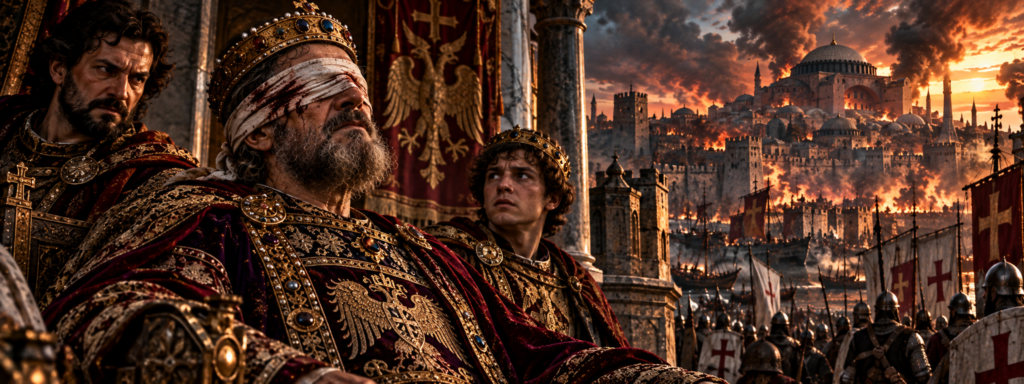
Isaac II Angelos: The Blinded Emperor Who Reclaimed His Throne and Died as Constantinople Fell Apart
The Betrayal of a Brother, the Return of a Broken Emperor, and the Palace Conspiracy That Helped Destroy the Byzantine Empire
Isaac II Angelos (c. 1156–January 1204) was Byzantine emperor from 1185 to 1195 and again from 1203 until his death in January 1204. His life was marked by palace conspiracies, family betrayals, military disasters, and one of the most catastrophic political crises in Byzantine history. He first seized the throne after killing a powerful imperial official and helping overthrow the notoriously brutal Andronikos I Komnenos. Ten years later, his own brother, Alexios III Angelos, deposed him, ordered him blinded, and imprisoned him while taking the imperial crown for himself. Isaac remained a prisoner until the Fourth Crusade reached Constantinople in 1203, when the flight of Alexios III allowed the blinded emperor to return to power alongside his son, Alexios IV. Their restoration, however, depended upon promises to the crusaders that the impoverished Byzantine treasury could not easily fulfill. Within months, Constantinople descended into religious hatred, financial desperation, street violence, and another palace conspiracy. Isaac died in January 1204, shortly before or during the upheaval that destroyed his son’s government. Contemporary and near-contemporary accounts connect his death with illness, distress, and the terrifying circumstances of the coup, but the precise cause remains uncertain. Claims that he was deliberately strangled are not securely established, and his death should not be confused with the documented killing of his son, Alexios IV, who was strangled after being overthrown.
The Emperor Who Returned From the Darkness
By January 1204, Isaac II Angelos had experienced almost every humiliation that could be inflicted upon a Byzantine emperor without actually killing him. He had worn the imperial crown, lost it to his own brother, suffered the destruction of his eyesight, and spent eight years imprisoned while another man ruled the empire in his place. Against all expectations, he had then returned to the throne, restored not by a loyal Byzantine army but by a vast expedition of western crusaders whose presence threatened to tear Constantinople apart. His second reign should have been an extraordinary triumph over betrayal and imprisonment, but instead it became the final nightmare of a man whose family had helped bring the empire to the edge of destruction.
The imperial palace was no longer a place of security. Western soldiers occupied positions around the capital, Venetian ships dominated the waters, and the people of Constantinople increasingly regarded their restored rulers as servants of foreign interests. Isaac’s son, Alexios IV, had promised enormous sums of money and military assistance to the crusaders in exchange for their support, but fulfilling those promises required resources the imperial government could not easily provide. Taxes, confiscations, religious disputes, and mounting resentment transformed the restoration into a crisis that neither father nor son could control.
The city itself seemed to be turning against them. Fires had devastated neighborhoods, hostility between Greeks and Latins had become increasingly violent, and influential officials began searching for a ruler who could free Constantinople from its humiliating dependence upon the crusaders. The emperor’s blindness and deteriorating health made him especially vulnerable. Although he possessed the title and ceremonial dignity of a Roman emperor, effective power increasingly rested with his son and the men competing for influence around them.
Among those men was Alexios Doukas, later known as Alexios V Mourtzouphlos. He understood the growing anger against the restored imperial family and recognized an opportunity to seize power. As opposition intensified, the palace became a place of suspicion, where officials who outwardly served the emperors could secretly prepare their destruction. The government that had been restored by foreign intervention was now threatened by betrayal from within.
Isaac did not survive the final collapse. He died in January 1204 as the conspiracy against his son reached its decisive stage, leaving historians uncertain about the exact medical circumstances of his death. Some narratives associate his final illness with fear and emotional distress, while later retellings have sometimes presented more dramatic explanations. What can be established is that he died during the crisis that ended his family’s restoration, and that Alexios IV was subsequently imprisoned and murdered by strangulation.
Only weeks later, the crusaders would attack Constantinople again. In April 1204, the city that had resisted so many enemies throughout its history was captured and subjected to a devastating sack. Palaces, churches, homes, and sacred treasures were plundered, and the Byzantine Empire was fractured into competing states. Isaac did not live to witness the final destruction, but his reigns, his brother’s betrayal, and his son’s disastrous bargain with the crusaders had all become entangled in the chain of events that led to it.
His story is therefore more complicated than that of an emperor murdered by an assassin or executed by a successful usurper. Isaac was a ruler whose violent deposition, mutilation, restoration, and death were inseparable from the political struggles that destroyed his dynasty’s authority. His precise manner of death remains disputed, but the palace upheaval that ended his second reign belongs to the blood-soaked history of Byzantine imperial succession. Few rulers ever recovered a throne after being blinded, and fewer still discovered that restoration could be more disastrous than defeat.
An Empire That Still Called Itself Rome
To understand Isaac’s extraordinary rise and fall, it is necessary to understand the empire he inherited. In the late twelfth century, Constantinople remained the capital of the Roman Empire, although modern historians generally refer to the state as Byzantine. Its rulers considered themselves Roman emperors, its government preserved institutions inherited from antiquity, and its inhabitants lived within a political culture shaped by centuries of imperial tradition. The city itself stood among the richest and most impressive urban centers in the medieval world.
Constantinople’s position between Europe and Asia made it a center of commerce, diplomacy, and military power. Its enormous walls had resisted numerous sieges, while the Bosporus and Golden Horn provided access to maritime trade routes. Churches, monasteries, palaces, and markets filled a city whose population and wealth impressed visitors from across Europe and the eastern Mediterranean. The imperial court possessed elaborate ceremonies intended to express the sacred dignity of the emperor.
Yet beneath that grandeur, serious weaknesses had developed. The empire faced pressure from neighboring states, competition with western commercial powers, and recurring struggles among aristocratic families. Its armies increasingly depended upon complicated arrangements involving provincial troops, mercenaries, and foreign allies. Maintaining military strength required money that the government could not always raise without provoking resistance.
The eleventh and twelfth centuries had witnessed both recovery and renewed instability. The Komnenian emperors, particularly Alexios I, John II, and Manuel I, had restored much of the empire’s international influence after earlier crises. Their governments relied heavily upon family connections, aristocratic alliances, and the distribution of offices and privileges. This system could produce effective leadership under a capable ruler, but it also encouraged powerful relatives to regard imperial authority as something they might claim for themselves.
The death of Manuel I Komnenos in 1180 created a dangerous succession crisis. His young son Alexios II inherited the throne, while competing factions struggled to control the government. Anti-Latin resentment intensified in Constantinople, where merchants and residents from western Europe had acquired commercial privileges and influence. The resulting political turmoil allowed Manuel’s cousin Andronikos Komnenos to seize power.
Andronikos initially presented himself as a reformer who would rescue the empire from corruption and foreign influence. His government soon became associated with political persecution, executions, and increasingly violent efforts to eliminate opponents. The young Alexios II was murdered, and Andronikos took the imperial crown for himself. The new emperor’s rule created an atmosphere in which members of the aristocracy feared arrest, mutilation, or death.
Isaac Angelos would emerge from this dangerous environment. He was not the obvious heir to the throne, nor did he begin his career as the leader of a powerful military rebellion. His accession would arise from a sudden act of violence that triggered a popular uprising. The man who later died amid a palace conspiracy first became emperor by helping destroy another ruler whose reign had descended into terror.
The Angelos Family: Noble Blood and Dangerous Connections
Isaac belonged to the Angelos family, an aristocratic house whose position had been strengthened through marriage into the Komnenian dynasty. His paternal grandfather, Constantine Angelos, had married Theodora Komnene, a daughter of Emperor Alexios I Komnenos. This connection gave Isaac and his relatives a place within the extended imperial aristocracy. They were not direct heirs to the throne, but their family possessed the prestige and relationships that could make imperial ambition possible.
Isaac’s father, Andronikos Doukas Angelos, had participated in the political and military affairs of the empire. The family’s fortunes were affected by the rivalries that developed during the final years of the Komnenian dynasty. Members of the aristocracy could gain wealth and office through imperial favor, but they could also lose everything when political circumstances changed. Such uncertainty encouraged both loyalty and conspiracy.
The surviving sources provide limited information about Isaac’s childhood and education. His approximate birth date is generally placed around the middle of the twelfth century, but the exact year is uncertain. He grew up within a political world where family connections were essential to advancement. His later career suggests familiarity with aristocratic networks and the expectations of imperial government.
Isaac’s relationship with his elder brother Alexios would become one of the defining tragedies of his life. Both men belonged to the same noble family and benefited from its connections. Yet their ambitions eventually collided in a betrayal that destroyed Isaac’s first reign. The brother who should have been among his closest supporters would become the man responsible for his mutilation and imprisonment.
The Angelos family’s rise also reflected broader changes within Byzantine politics. The imperial office had become increasingly connected to aristocratic competition, with powerful families seeking influence through marriage, military command, and palace appointments. The emperor’s personal authority remained enormous in theory, but his survival depended upon the loyalty of relatives and officials who might possess ambitions of their own. Isaac would discover that family ties offered no reliable protection against political betrayal.
His first opportunity came during the increasingly oppressive reign of Andronikos I Komnenos. The emperor’s persecution of suspected opponents created an atmosphere of fear among aristocratic families. Isaac himself became a target of imperial suspicion. The confrontation that followed would transform him from a threatened nobleman into the ruler of Constantinople.
Andronikos I: The Emperor Who Ruled Through Terror
Andronikos I Komnenos had seized the throne in 1183 after exploiting the political weakness of the government established for the young Alexios II. His rise was accompanied by violence against opponents and hostility toward the Latin population of Constantinople. The massacre of Latins in 1182, which occurred during the upheaval surrounding his advance toward power, left a lasting legacy of bitterness between Byzantines and western Europeans. The event would later become part of the background to the Fourth Crusade.
Once emperor, Andronikos attempted to control the aristocracy through intimidation and punishment. He pursued suspected conspirators, ordered executions, and used mutilation against opponents. His policies reflected both a desire to eliminate corruption and an increasingly destructive suspicion of powerful families. The surviving sources, especially the historian Niketas Choniates, portray his reign as descending into tyranny.
The murder of Alexios II removed the young emperor whose authority Andronikos had initially claimed to protect. Andronikos then established himself as sole ruler and attempted to secure the succession through his own family. Yet his government remained vulnerable to opposition. Powerful aristocrats resented his persecution, while military failures damaged his legitimacy.
In 1185, the Norman kingdom of Sicily launched a major invasion of Byzantine territory. Norman forces captured Thessalonica, the empire’s second most important city, and subjected it to devastating violence. The disaster intensified anger against Andronikos and raised fears that Constantinople itself might be threatened. His government appeared increasingly incapable of protecting the empire.
Andronikos responded to the crisis with further suspicion and repression. Officials associated with the imperial government sought to arrest individuals believed to pose a threat. Isaac Angelos became one of those targeted. The emperor’s efforts to eliminate potential enemies would instead trigger the uprising that destroyed him.
The confrontation occurred in Constantinople in September 1185. An imperial official named Stephen Hagiochristophorites was sent to arrest Isaac. The attempted arrest did not proceed as intended. Isaac resisted violently, killing the official and fleeing toward the sanctuary of Hagia Sophia.
That act changed the course of Byzantine history. Isaac had killed a representative of the emperor and could expect severe punishment if captured. Yet the violence occurred at a moment when public resentment against Andronikos was already intense. Instead of being quietly arrested, Isaac became the focus of an uprising that swept through the capital.
A Killing in the Streets of Constantinople
The killing of Stephen Hagiochristophorites was the immediate event that propelled Isaac Angelos toward the throne. According to the surviving narrative tradition, the official attempted to arrest Isaac on behalf of Andronikos I. Isaac resisted and killed him, then sought refuge in Hagia Sophia. The incident transformed a private act of resistance into a public political crisis.
Hagia Sophia was more than a church. It was the spiritual heart of Constantinople, closely associated with imperial ceremony and the religious identity of the empire. Seeking sanctuary there could place an individual under the protection of sacred space and attract public attention. Isaac’s flight therefore created an opportunity for opposition to gather around him.
The people of Constantinople were already deeply dissatisfied with Andronikos. His persecution of aristocrats, the military disaster at Thessalonica, and fears of further repression had weakened his authority. News of Isaac’s resistance spread through the city. Crowds gathered, and the confrontation developed into a broader movement against the emperor.
Isaac did not begin the day as the recognized leader of an organized revolution. His accession emerged from the rapid collapse of Andronikos’s government and the willingness of the population to support an alternative ruler. Members of the clergy and influential groups participated in the changing political situation. The momentum of the uprising eventually carried Isaac to the imperial throne.
Andronikos attempted to respond but discovered that his authority had disintegrated. The emperor fled Constantinople, hoping to escape the rebellion and preserve his life. His flight marked the effective end of his reign. Isaac was proclaimed emperor as the capital transferred its allegiance.
The violence did not end with Andronikos’s removal. The former emperor was captured and returned to Constantinople, where he suffered a horrifying public death. The surviving accounts describe mutilation, humiliation, and prolonged abuse before he was killed. Although the details are preserved through hostile narratives, there is no doubt that his overthrow ended in extreme violence.
Isaac’s accession was therefore inseparable from bloodshed. He had killed an imperial official, inspired an uprising, and inherited a throne secured through the destruction of his predecessor. The brutality inflicted upon Andronikos demonstrated how quickly imperial dignity could disappear once political protection collapsed. Isaac would later experience a different form of the same vulnerability.
The new emperor entered the palace as a symbol of deliverance from tyranny. Yet the empire he inherited was deeply troubled, and his own political position depended upon the support of groups whose loyalty could change. His first challenge was to restore military security and political confidence. The circumstances of his accession had given him the crown, but they had not solved the problems that threatened the state.
The First Reign: A Throne Won in Blood
Isaac II began his first reign in September 1185 amid widespread hopes that the violence of Andronikos’s government had ended. His accession removed a ruler whose increasingly oppressive policies had alienated much of the aristocracy and population. Yet the new emperor inherited serious military and financial problems. The Norman invasion remained an immediate threat, while the empire’s internal administration had been weakened by political upheaval.
The Byzantine army soon achieved an important victory against the Normans. Forces commanded by Alexios Branas defeated the invaders near Demetritzes in November 1185, helping secure the empire against the immediate danger. The victory strengthened Isaac’s position and reduced the threat to Constantinople. It also demonstrated that capable military commanders remained essential to imperial survival.
Isaac’s government attempted to restore political normality after the terror associated with Andronikos. Aristocratic families that had suffered persecution sought renewed influence, while officials competed for appointments and rewards. The emperor needed to balance these demands without allowing powerful relatives or commanders to dominate him. His ability to manage court politics would prove inconsistent.
His reign was marked by significant expenditure and controversial fiscal decisions. The imperial government needed money for military operations, diplomacy, and the maintenance of the court. Yet taxation and financial demands could provoke resentment among provincial populations. Such grievances would contribute to one of the most important developments of his reign: the restoration of an independent Bulgarian state.
Isaac also pursued dynastic diplomacy through marriage. His second wife, Margaret of Hungary, took the name Maria after marrying him in 1186. The marriage connected the Byzantine imperial family with the Hungarian monarchy and served important diplomatic purposes. Yet the celebrations and financial demands associated with imperial politics became entangled in broader resentment over taxation.
The emperor’s court was criticized by contemporary writers for extravagance, favoritism, and administrative weakness. Niketas Choniates, whose historical narrative is indispensable for this period, offers a frequently critical portrait of Isaac and his government. His observations are valuable, but they also reflect the judgments of an educated official writing after the empire’s catastrophic collapse. The criticism should therefore be considered alongside the difficult circumstances Isaac inherited.
Isaac was not entirely without military successes or political achievements. His government survived serious rebellions and maintained the imperial capital during a period of mounting pressure. Yet his inability to prevent territorial losses and aristocratic conspiracies weakened confidence in his leadership. The problems of his first reign would eventually create the opportunity for his brother’s betrayal.
The Bulgarian Revolt That Isaac Could Not Crush
One of the most consequential developments of Isaac’s first reign was the uprising that led to the establishment of the Second Bulgarian Empire. In 1185, the brothers Theodore-Peter and Asen emerged as leaders of a revolt against Byzantine authority in the Balkan territories. The rebellion was associated with grievances over taxation and imperial administration, although its causes were more complicated than a single financial demand. It soon developed into a sustained challenge to Constantinople’s control.
The revolt began in a region where Byzantine authority had long depended upon military presence, local cooperation, and the management of diverse populations. The leaders drew upon Bulgarian and Vlach communities and used difficult terrain to resist imperial campaigns. Their movement acquired religious and political symbolism that strengthened its appeal. What initially appeared to be a provincial uprising became the foundation of a revived Bulgarian state.
Isaac attempted to suppress the rebellion through military expeditions. Byzantine forces achieved some temporary successes, and the emperor personally participated in campaigns against the insurgents. Yet the rebels proved difficult to eliminate. They could withdraw into mountainous regions, gather support, and return when imperial armies departed.
The uprising exposed weaknesses in Byzantine control of the Balkans. Maintaining authority required reliable troops, effective commanders, and sufficient financial resources. The empire also faced threats elsewhere, limiting its ability to concentrate entirely upon Bulgaria. Repeated campaigns consumed resources without producing lasting submission.
The Bulgarian leaders gradually consolidated their position. Their success demonstrated that Constantinople could no longer assume permanent control over territories once firmly incorporated into the empire. The emergence of a powerful neighboring state changed the political balance of southeastern Europe. The consequences would endure long after Isaac’s first reign ended.
The revolt also damaged Isaac’s reputation. An emperor who had come to power amid hopes of restoring order was now associated with the loss of territory. Critics could portray the rebellion as evidence of poor administration and excessive taxation. Military commanders who believed themselves more capable might become increasingly willing to challenge the government.
Isaac’s difficulties in Bulgaria therefore contributed to the broader instability of his reign. The emperor faced a conflict that could not be resolved through a single victory or negotiation. Each unsuccessful campaign weakened his authority and increased the importance of ambitious generals. The political danger would become particularly evident in the rebellion of Alexios Branas.
Alexios Branas: The General Who Nearly Took His Crown
Alexios Branas had played an important role in defeating the Norman invasion in 1185. His military success gave him prestige and influence at a time when Isaac’s government desperately needed capable commanders. Yet the same reputation that made him valuable also made him dangerous. In Byzantine politics, a victorious general could become a potential emperor.
In 1187, Branas rebelled against Isaac II and attempted to seize the throne. His movement gathered support and advanced toward Constantinople, creating a serious threat to the government. The emperor faced the possibility of losing power only a short time after his own accession. The rebellion demonstrated how unstable the relationship between imperial authority and military leadership had become.
Isaac relied upon loyal forces and foreign military assistance to resist the challenge. Among those involved in the defense was Conrad of Montferrat, a western nobleman whose military abilities became important during the confrontation. Conrad had entered Byzantine service and married into the imperial family. His participation reflected the complicated relationships between Constantinople and western aristocratic networks.
The decisive fighting ended with Branas’s defeat and death. Contemporary accounts describe Conrad playing a prominent role in the battle, including a direct confrontation with the rebel commander. The details are preserved in narrative sources that emphasize individual heroism, so their most dramatic elements require caution. Nevertheless, the rebellion was crushed, and Isaac retained the throne.
The episode temporarily strengthened the emperor’s position. He had survived a major military challenge and prevented another change of ruler. Yet the rebellion also revealed the fragility of his authority. A commander who had recently defended the empire against foreign invasion had turned his army against the government.
Isaac’s dependence upon foreign military figures also carried political risks. Western nobles could provide valuable assistance, but their presence complicated relations with a population already suspicious of Latin influence. The memory of anti-Latin violence remained strong, and religious differences contributed to mutual distrust. These tensions would become far more dangerous during the Fourth Crusade.
The Branas rebellion was therefore an early warning of the forces that would eventually destroy Isaac’s first reign. Military prestige, aristocratic ambition, and foreign involvement could all threaten the stability of the throne. Isaac survived this challenge, but he did not eliminate the underlying political conditions. His own brother would later exploit them with devastating success.
The Third Crusade and the Emperor’s Dangerous Diplomacy
Isaac’s reign coincided with the Third Crusade, launched after Saladin’s capture of Jerusalem in 1187. Western European rulers organized major expeditions toward the eastern Mediterranean, and their armies needed routes through or around Byzantine territory. Constantinople therefore faced a complicated diplomatic challenge. The empire was Christian, but its interests did not always align with those of the western crusaders.
The German emperor Frederick I Barbarossa led a large army overland toward the eastern Mediterranean. His route brought him into Byzantine territory, where disputes over supplies, security, and diplomatic intentions created serious tensions. Isaac feared the consequences of allowing a powerful foreign army to move freely through the empire. The crusaders, meanwhile, suspected Byzantine hostility and obstruction.
The relationship deteriorated into confrontation. Frederick’s forces occupied positions and threatened Byzantine interests, while Isaac attempted to manage the danger through diplomacy and military measures. The conflict demonstrated how easily a crusading expedition could become a threat to Constantinople itself. The empire’s strategic position made it both a necessary partner and a potential obstacle.
Isaac also maintained diplomatic contacts with Saladin. Such relations were not inherently unusual, since Byzantine emperors had long negotiated with Muslim rulers when political circumstances required it. Yet western crusaders could interpret these contacts as evidence of betrayal. Religious identity did not eliminate the competing strategic interests of Christian and Muslim states.
Eventually, an agreement allowed Frederick’s army to cross into Asia Minor. The immediate crisis passed, but the episode deepened mutual suspicion between Byzantines and western Europeans. The crusaders had experienced the empire as an unreliable or hostile power, while Constantinople had witnessed the danger posed by a large western army. These memories would influence later relations.
Isaac’s handling of the Third Crusade reflected the difficult position of the Byzantine Empire. Its rulers needed to protect their territory while avoiding unnecessary conflict with powerful Christian monarchs. They also had to maintain diplomatic flexibility in a region divided among competing states. Such policies could appear prudent from Constantinople and treacherous from the perspective of western crusaders.
The experience foreshadowed the catastrophe of 1203–1204. A western expedition would again approach Constantinople, but this time it would arrive with a claimant to the Byzantine throne and a direct interest in changing the government. Isaac’s family would become the instrument through which crusading forces entered imperial politics. The tensions that had complicated the Third Crusade would return in far more destructive form.
The Brother Who Smiled Before Taking Everything
Isaac’s most devastating betrayal came from his elder brother, Alexios Angelos. The two men belonged to the same aristocratic family and had benefited from their shared connections. Isaac had become emperor in 1185, while Alexios remained an important member of the imperial household. Yet family loyalty proved incapable of restraining political ambition.
By 1195, Isaac’s authority had weakened through military difficulties, financial problems, and dissatisfaction among influential commanders. The emperor was preparing another campaign against the Bulgarians when his brother moved against him. Alexios secured support among members of the military and aristocracy. The conspiracy developed while Isaac was away from the security of Constantinople.
The betrayal was particularly shocking because it came from within the imperial family. Alexios was not a distant rival or foreign invader. He was Isaac’s own brother, a man who owed much of his position to the dynasty established after the overthrow of Andronikos. His decision to seize the throne transformed a family relationship into a struggle for survival.
Alexios was proclaimed emperor as Alexios III Angelos. Isaac was arrested and deprived of his authority. The coup succeeded without the kind of prolonged civil war that might have allowed Isaac to gather substantial resistance. The speed of the transition demonstrated how far his political support had deteriorated.
The new emperor then ordered Isaac blinded. In Byzantine political practice, blinding was a recognized method of incapacitating a defeated ruler or claimant. The punishment was intended to make the victim physically unsuitable for imperial office and reduce the likelihood of restoration. It could also serve as a terrifying warning to other potential opponents.
For Isaac, the punishment was devastating. He had been emperor for nearly ten years and had survived rebellions, military crises, and political conspiracies. Now his own brother had taken his crown and destroyed his eyesight. The man who had once commanded the Roman Empire was reduced to a prisoner whose future depended upon the mercy of the usurper.
Alexios III allowed Isaac to remain alive, but survival came at the price of imprisonment. The former emperor was confined, eventually associated with the Blachernae palace complex, while his brother occupied the throne. His son Alexios, however, remained a potential dynastic claimant. That surviving claim would later attract the attention of western crusaders and transform Isaac’s personal tragedy into an international crisis.
Blinded and Imprisoned: Eight Years in the Shadow of the Throne
Isaac’s imprisonment after 1195 was one of the most humiliating reversals suffered by a Byzantine emperor. He had lost his throne to his brother and been deliberately blinded to prevent his return. The punishment removed him from public life while preserving him as a living reminder of the coup. His survival depended upon a government that had every reason to fear his restoration.
Blinding possessed a long and disturbing history in Byzantine political practice. It was used against emperors, generals, and aristocratic rivals because physical impairment could undermine a claimant’s eligibility or ability to rule. The punishment was not always effective in eliminating political influence, but it imposed severe suffering and often ended a public career. Isaac would eventually become one of the most extraordinary exceptions.
The surviving sources provide limited information about his daily imprisonment. They do not offer a complete record of his treatment, his conversations, or his emotional state during those years. It is therefore impossible to reconstruct every detail of his confinement. What can be established is that he remained politically powerless while Alexios III governed the empire.
His son Alexios grew increasingly important as a potential alternative to the reigning emperor. The younger Alexios possessed a dynastic claim through his father and could appeal to those who regarded the deposition of Isaac as illegitimate. Yet he lacked the military strength necessary to overthrow Alexios III independently. Recovering the throne would require powerful allies.
The government of Alexios III was marked by financial weakness, territorial losses, and political dissatisfaction. Contemporary writers criticized his administration for extravagance and ineffective leadership. The empire continued to face pressure from neighboring powers while the authority of Constantinople weakened. Such conditions created opportunities for rival claimants.
Isaac remained imprisoned as the political situation deteriorated. His blindness made an independent return to power appear almost impossible. Yet the existence of his son preserved the possibility of dynastic restoration. The father who could no longer lead an army might still become emperor again if others acted in his name.
The opportunity would emerge through the Fourth Crusade. A western military expedition originally intended for the eastern Mediterranean became entangled in Byzantine dynastic politics. Isaac’s son would promise enormous rewards in exchange for assistance. The resulting bargain would restore the blinded emperor while placing Constantinople in unprecedented danger.
Alexios IV: The Son Who Went Looking for an Army
Isaac’s son Alexios escaped from the control of his uncle’s government and sought support in western Europe. His objective was to recover the Byzantine throne for his father and himself. The young prince possessed a recognizable dynastic claim, but he lacked the military resources necessary to enforce it. He therefore turned toward powerful western rulers and the crusading expedition gathering for the Fourth Crusade.
The Fourth Crusade had originally been organized to attack Muslim-controlled territory, with Egypt emerging as a principal strategic objective. Its leaders contracted with Venice to provide ships and transport for a large army. Yet the expedition encountered serious financial difficulties when fewer crusaders arrived than expected. The resulting debt to Venice created opportunities for the diversion of the campaign.
The crusaders had already attacked Zara in 1202, a Christian city on the Adriatic coast that had rebelled against Venetian authority. The attack was controversial and drew papal condemnation. It demonstrated that financial and political pressures could redirect a crusading army away from its stated religious objectives. The expedition was therefore vulnerable to further diversion.
Alexios offered the crusaders an extraordinary bargain. In exchange for restoring him and his father to power, he promised a large payment, military assistance, provisions, and the submission of the Byzantine Church to Roman ecclesiastical authority. The promises were designed to appeal to the crusaders’ financial needs and religious ambitions. Yet their scale raised serious questions about whether the Byzantine government could fulfill them.
The prince’s proposal also depended upon a dangerous assumption. He and his supporters apparently believed that the people of Constantinople would welcome the restoration of Isaac’s dynasty or at least accept it once Alexios III was removed. The reality would prove far more complicated. Many Byzantines regarded western military intervention as a threat rather than liberation.
The crusader leadership eventually accepted the proposal, although the decision was controversial within the expedition. Some participants objected to attacking or threatening a Christian empire instead of proceeding toward the original crusading objective. Others believed that the promised financial and military support would make the campaign possible. Venetian interests also played an important role in the decision.
The agreement transformed a family dispute into an international military crisis. Isaac’s son had invited a powerful foreign expedition to intervene in Byzantine succession. The crusaders now possessed a political justification for approaching Constantinople, while the young prince depended upon them for restoration. Neither side fully controlled the consequences of the bargain.
For Isaac, still imprisoned and blinded, the arrangement offered an extraordinary possibility. His son might succeed where he could not, forcing Alexios III from the throne and restoring the legitimate dynasty. Yet the price of that restoration would be paid by an empire already weakened by years of misgovernment and military pressure. The crusaders were approaching Constantinople not as ordinary allies, but as creditors expecting enormous rewards.
The Fourth Crusade Arrives at Constantinople
In 1203, the Fourth Crusade reached Constantinople with Isaac’s son Alexios among its supporters. The appearance of the western fleet and army created an immediate crisis for Alexios III. The capital’s defenses remained formidable, but the government lacked the confidence and military organization necessary to confront the expedition effectively. The crusaders hoped that the presence of the young prince would encourage the city to accept a change of ruler.
The response was disappointing. The people of Constantinople did not rise enthusiastically in support of the claimant. Many inhabitants regarded the crusaders with suspicion or hostility, remembering earlier conflicts with western Europeans. The prospect of foreign troops determining the imperial succession was deeply unsettling. The prince’s dynastic claim did not automatically translate into popular support.
The crusaders therefore moved toward military action. Venetian ships played an important role in operations against the city’s maritime defenses, while the western army attempted to pressure the government from land. The campaign exposed weaknesses in the leadership of Alexios III. Despite possessing the resources of Constantinople, the emperor struggled to organize an effective response.
Fighting developed around the city, and the crusaders succeeded in establishing positions that threatened its defenses. The Venetian fleet demonstrated its ability to support assaults against fortified areas. Fires and destruction increased the suffering of the population. The political situation inside Constantinople became increasingly unstable.
Alexios III eventually fled the capital in July 1203. His departure was a devastating admission of failure and removed the immediate obstacle to the restoration of Isaac. The government needed a ruler who could negotiate with the crusaders and restore order. Officials therefore turned to the imprisoned former emperor.
Isaac was brought out of confinement and restored to the imperial throne. The man who had been blinded and imprisoned by his brother eight years earlier was once again recognized as Roman emperor. His restoration was extraordinary because the mutilation intended to end his political career had failed to prevent his return. Yet he was physically weakened and dependent upon forces beyond his control.
The crusaders insisted that Isaac’s son also be recognized as emperor. Alexios was crowned as Alexios IV, creating a joint government between father and son. The arrangement appeared to satisfy the dynastic claim that had justified the intervention. Yet it also placed the imperial government under immediate pressure to fulfill the promises made to the western army.
The restoration therefore contained a fatal contradiction. Isaac and Alexios IV owed their crowns to foreign soldiers whom many Byzantines despised. Those soldiers expected money, supplies, and religious concessions that the government could not easily provide. The new emperors had recovered the palace, but they had not recovered control over the political forces surrounding it.
The Blinded Emperor Returns to His Palace
Isaac’s restoration in 1203 was one of the most remarkable reversals in Byzantine imperial history. For eight years, he had lived as a blinded prisoner while his brother ruled in his place. The punishment inflicted upon him in 1195 had been intended to make restoration impossible. Yet the collapse of Alexios III’s government returned him to the throne.
The surviving accounts describe Isaac’s return within the context of the crusaders’ intervention. He was restored after his brother fled Constantinople, but his authority depended upon an unstable political settlement. The western expedition expected recognition of the promises made by his son. The people of Constantinople expected protection from the foreign army.
Isaac’s blindness created practical limitations. He could no longer perform the duties of a military commander or exercise the same direct supervision over government that he might have possessed during his first reign. His age and health also appear to have reduced his ability to manage the crisis. The surviving narratives portray him as increasingly dependent upon his son and advisers.
The restoration nevertheless carried considerable symbolic importance. Isaac was the legitimate predecessor of Alexios III, and his return could be presented as the correction of a dynastic injustice. His son represented continuity and the possibility of future leadership. Together, they offered a government that might reconcile imperial tradition with the demands of the crusaders.
Yet the arrangement was deeply unstable. The western army had intervened to restore the dynasty, but it remained outside Constantinople expecting payment. The imperial treasury could not easily satisfy the enormous financial obligations promised by Alexios IV. Every attempt to raise money risked increasing resentment among the population.
Isaac also faced the legacy of his first reign. He had been associated with military failures, financial problems, and the weakening of Byzantine authority. His restoration did not erase those memories. Many inhabitants may have regarded the Angelos dynasty as part of the empire’s difficulties rather than the solution.
The new government therefore began with limited public confidence. It possessed the imperial palace and ceremonial legitimacy, but its survival depended upon satisfying incompatible demands. The crusaders wanted payment and religious concessions, while the population wanted the foreign army removed. Isaac and Alexios IV struggled to meet both expectations.
The emperor who had returned from blindness and imprisonment discovered that the throne had become a place of extraordinary danger. His first reign had ended through betrayal by his brother. His second would end through a conspiracy encouraged by the very crisis that restored him. The palace had changed hands, but the political culture of betrayal remained.
The Promises That Could Not Be Kept
Alexios IV’s agreement with the crusaders became the central problem of the restored government. He had promised a vast payment in exchange for military assistance, along with supplies, military support, and religious concessions. These commitments were made before he possessed control of the imperial treasury. Once restored, he discovered that fulfilling them would be far more difficult than promising them.
The Byzantine government had experienced years of financial weakness under Alexios III. The treasury did not contain unlimited reserves, and the empire’s revenues were already under pressure. Raising the sums expected by the crusaders required extraordinary measures. Such measures threatened to alienate the very population whose support the restored dynasty needed.
The government attempted to gather money through taxation and the collection or appropriation of valuable objects. Religious institutions possessed precious metal, ornaments, and ceremonial treasures that could be converted into funds. Confiscating or melting such objects could provide resources, but it also provoked intense resentment. The population increasingly associated the restored emperors with sacrilege and foreign demands.
The crusaders, meanwhile, expected the promises to be honored. Their expedition had already suffered financial difficulties, and the agreement with Alexios IV offered a solution. Delays and partial payments increased frustration. The western leaders were unwilling to abandon their claims without compensation.
Religious obligations created another source of conflict. Alexios IV had promised to bring the Byzantine Church under Roman ecclesiastical authority, but such a settlement could not simply be imposed without opposition. The division between eastern and western Christianity involved longstanding theological, institutional, and political disagreements. Many Byzantines regarded submission to Rome as unacceptable.
Isaac and his son therefore faced a crisis with no easy solution. Paying the crusaders required resources that increased domestic resentment. Refusing payment risked provoking the foreign army that had restored them. Religious concessions threatened to undermine their legitimacy among clergy and population alike.
The government’s weakness became increasingly visible. Officials competed for influence, the population grew hostile, and the crusaders remained a threatening presence. The restored dynasty had regained the throne but lacked the political independence necessary to govern securely. Its survival depended upon satisfying creditors whose demands could not be met without damaging the empire.
The tragedy was that Alexios IV’s promises had been made to recover his father’s crown. The bargain succeeded in removing Alexios III and restoring Isaac, but it created obligations that undermined the restored government almost immediately. The son had rescued his father from imprisonment by placing the empire under foreign pressure. The price of restoration was becoming impossible to pay.
Constantinople Turns Against Its Emperors
The relationship between the restored emperors and the population of Constantinople deteriorated rapidly during the second half of 1203. The city had endured military pressure, fires, and the presence of a powerful foreign army. Its inhabitants increasingly blamed Isaac and Alexios IV for the crisis. The dynasty that had returned as a symbol of legitimate restoration became associated with humiliation and danger.
Anti-Latin resentment played a major role. Constantinople had a long history of tensions between Greek inhabitants and western merchants, particularly Venetians and other Italians who enjoyed commercial privileges. Religious differences intensified suspicion, while memories of earlier violence remained powerful. The presence of crusading soldiers near the city brought these tensions to the surface.
The crusaders also distrusted the Byzantines. They expected payment and support, but the government struggled to fulfill its promises. Delays encouraged accusations of deception and bad faith. The two sides increasingly regarded one another as enemies rather than allies.
Violence erupted in and around the capital. Fires devastated large sections of Constantinople, destroying homes, businesses, and religious buildings. Some of the destruction resulted from fighting and attacks involving western forces and the city’s inhabitants. The suffering intensified public anger and made reconciliation increasingly difficult.
The restored emperors were trapped between hostile groups. They could not simply expel the crusaders without risking another assault upon Constantinople. Yet continued cooperation with the western army made them appear dependent upon foreigners. Every political decision threatened to alienate one side or the other.
Isaac’s physical condition further weakened the government. His blindness and declining health limited his ability to intervene directly in the growing crisis. Alexios IV assumed much of the practical responsibility for dealing with the crusaders and the population. The younger emperor lacked the experience and political support necessary to manage the situation successfully.
Opposition began to organize within Constantinople. Influential officials and military figures recognized that the restored dynasty was losing legitimacy. Some believed that a new emperor could unite the population against the crusaders. Others saw an opportunity to advance their own ambitions.
By the beginning of 1204, the government was approaching collapse. The crusaders remained outside the city, demanding payment, while the inhabitants increasingly demanded resistance. The palace was filled with uncertainty and suspicion. Isaac had recovered the throne, but he could no longer rely upon the loyalty of the city he ruled.
The Fires That Consumed the Queen of Cities
The fires that devastated Constantinople during the crisis of 1203–1204 became among the most visible signs of the restored government’s failure. The city contained densely populated neighborhoods, markets, workshops, churches, and aristocratic residences. Fire could spread rapidly through areas where buildings stood close together. The destruction displaced inhabitants and damaged the economic life of the capital.
One major fire occurred during the crusaders’ initial operations against Constantinople in July 1203. Fighting around the city’s defenses created conditions in which flames spread beyond the immediate military objectives. The destruction demonstrated the vulnerability of the capital despite its formidable walls. Even when the city resisted conquest, its inhabitants could suffer enormously.
Further fires followed during the deteriorating relationship between the crusaders and the population. In August 1203, violence involving westerners and Byzantines contributed to another devastating conflagration. The fire spread across extensive areas and destroyed property on a massive scale. Contemporary descriptions emphasize the scale of the suffering and the damage inflicted upon the city.
The fires had political consequences beyond the immediate destruction. Families lost homes, merchants lost goods, and religious communities saw buildings damaged or destroyed. Such losses intensified resentment against the foreign army and the rulers who had brought it to Constantinople. The restored dynasty became associated with a catastrophe that ordinary inhabitants could see in the ruins around them.
The destruction also deepened hostility between Greeks and Latins. Each side accused the other of violence and betrayal, while the possibility of peaceful cooperation diminished. Religious differences became entangled with material suffering and fear. The atmosphere grew increasingly dangerous for western residents within the city and for Byzantines exposed to crusader retaliation.
Isaac and Alexios IV could not easily repair the damage. The government lacked sufficient resources to compensate the population while also satisfying the crusaders’ financial demands. Its authority was weakened by the perception that it could neither protect the city nor remove the foreign army. The fires therefore became symbols of political helplessness.
The catastrophe also affected the psychology of the capital. Constantinople had long been regarded as a city protected by its walls, sacred institutions, and imperial traditions. The sight of devastated neighborhoods challenged that confidence. The population increasingly demanded a ruler who would confront the westerners rather than negotiate with them.
By January 1204, the destruction had helped create an atmosphere in which another palace coup became possible. The restored emperors were blamed for the city’s suffering, and their opponents could present rebellion as an act of salvation. Isaac’s second reign was collapsing amid the ruins of a capital he had once hoped to reclaim. The fires had not destroyed Constantinople entirely, but they had helped destroy the political legitimacy of its rulers.
Alexios Doukas: The Man Waiting in the Shadows
Alexios Doukas, later known as Alexios V Mourtzouphlos, emerged as one of the most important figures in the final crisis of Isaac’s reign. He belonged to the Byzantine aristocratic and political world and held positions that gave him access to the imperial government. His nickname, Mourtzouphlos, is commonly associated with the appearance of his eyebrows or expression, although the precise explanation is uncertain. He would become the man who overthrew Alexios IV and seized the throne.
The surviving accounts portray him as ambitious, politically resourceful, and increasingly associated with opposition to the crusaders. He understood the hostility of Constantinople’s population toward the foreign army. He also recognized the weakness of the restored emperors. These circumstances created an opportunity for a determined conspirator.
Alexios Doukas had access to the palace and its political networks. Such access was essential because a successful coup required more than public anger. The conspirators needed to control the emperor’s person, secure important officials, and establish an alternative government. Palace politics remained central to Byzantine succession even during a crisis involving foreign armies.
The restored dynasty was especially vulnerable because its legitimacy had become entangled with the crusaders. Alexios IV depended upon the western army that had restored him, while the population increasingly demanded resistance. A conspirator who promised to defend Constantinople could attract support among those who regarded the government as compromised. Mourtzouphlos exploited this political environment.
His rise also reflected the weakness of Isaac’s position. The older emperor was blind and increasingly ill, while his son struggled to manage the crisis. Neither possessed a secure base of military loyalty capable of preventing a palace conspiracy. The imperial household had become a dangerous environment in which apparent servants could become enemies.
The final confrontation developed during January 1204. Opposition to the restored emperors intensified, and competing figures were considered as possible replacements. The political situation moved rapidly toward another change of ruler. Mourtzouphlos positioned himself to take advantage of the collapse.
The coup that followed ended the Angelos restoration. Alexios IV was seized and imprisoned, while Mourtzouphlos established himself as Alexios V. Isaac died during the same period of upheaval, although the exact sequence and medical cause remain uncertain. The father and son who had recovered the throne through foreign intervention were removed within months.
Mourtzouphlos’s accession did not save Constantinople. His government attempted to resist the crusaders, but the military and financial situation had become desperate. The western army would soon attack the city again. The conspirator who overthrew the restored emperors inherited the catastrophe they had failed to prevent.
January 1204: The Palace Begins to Collapse
By January 1204, the restored government had lost much of its remaining authority. The crusaders were increasingly frustrated by unpaid obligations, while the population of Constantinople demanded resistance to foreign pressure. Isaac’s blindness and deteriorating health limited his role in the crisis. Alexios IV remained the principal representative of a dynasty that had become deeply unpopular.
The political atmosphere was filled with fear and suspicion. Officials who had supported the restoration began reconsidering their loyalties. Religious leaders and influential citizens were increasingly unwilling to accept continued dependence upon the crusaders. The possibility of another imperial succession became a subject of urgent political maneuvering.
Opposition movements developed within the capital. Some groups sought an alternative ruler who could confront the western army and restore Byzantine independence. The surviving sources describe efforts to identify and proclaim a new emperor during the crisis. The rapid succession of political initiatives demonstrates how completely confidence in the restored dynasty had collapsed.
Alexios IV faced an impossible position. He needed the crusaders’ support to remain emperor, but that support made him unacceptable to much of the population. Attempts to satisfy the western army required money and concessions that intensified domestic opposition. Refusing those demands risked provoking military retaliation.
Isaac’s condition made the situation still more precarious. He had been restored as the senior emperor, but he could not provide the military leadership or political authority necessary to resolve the crisis. His son was increasingly isolated, and the palace was vulnerable to conspiracy. The family had recovered its position without recovering the means to defend it.
Mourtzouphlos moved against the government as the crisis reached its decisive stage. The coup involved the seizure of Alexios IV and the establishment of a new imperial authority. The surviving narratives differ in some details of the sequence, but the broad outcome is clear. The restored dynasty was overthrown, and Alexios V took power.
Isaac died in January 1204, close to the collapse of his son’s government. Contemporary and near-contemporary accounts associate his death with illness and the distress of the political crisis. The exact timing relative to every stage of the coup is not consistently presented in modern summaries. It is therefore safer to describe his death as occurring amid the final upheaval rather than to invent a precise dramatic sequence.
The palace that had witnessed Isaac’s restoration only months earlier became the setting of another dynastic disaster. His son was imprisoned, his government was destroyed, and the emperor himself was dead. The Angelos family had once again been defeated by a conspiracy from within Constantinople. This time, however, the consequences would extend far beyond the fate of a single ruler.
How Did Isaac II Angelos Actually Die?
The circumstances of Isaac II Angelos’s death require particular care because later accounts often combine his fate with that of his son. Isaac died in January 1204 during the political crisis that overthrew the restored Angelos government. He had been blinded in 1195 and was in poor health during his second reign. The surviving evidence does not establish that he was deliberately murdered by strangulation.
Some historical narratives connect his death with the shock and distress caused by the collapse of his government. Such descriptions reflect the dramatic circumstances in which he died, but they should not be treated as a modern medical diagnosis. Fear and emotional distress may have accompanied his final illness, yet the precise physiological cause cannot be determined. The sources do not provide the evidence necessary to identify a specific fatal condition.
The possibility that prolonged imprisonment contributed to his deteriorating health is also reasonable but difficult to prove. Isaac had spent eight years confined after being blinded by his brother. Such experiences could have imposed serious physical and psychological burdens. Nevertheless, historians cannot establish a direct medical chain connecting those years to his death in 1204.
The claim that Isaac was strangled appears to arise in part from confusion with the fate of Alexios IV. The younger emperor was seized during the coup of Alexios V and subsequently killed by strangulation in February 1204. His murder is a well-established part of the historical narrative. Isaac’s death, by contrast, is generally reported as occurring during the upheaval amid illness or distress.
The distinction matters because the two deaths reveal different forms of political violence. Alexios IV was deliberately eliminated after being overthrown, making his death a clear example of regicide. Isaac died during the collapse of the same government, but the available evidence does not securely demonstrate a deliberate killing. His fate belongs to the violent context of the coup without requiring an unsupported murder claim.
The historian Niketas Choniates provides an indispensable account of the period, but his narrative must be read with attention to chronology and interpretation. Western eyewitness and near-contemporary accounts also describe the collapse of the restored government, although they vary in detail and perspective. Together, these sources establish the political catastrophe but do not provide a definitive medical explanation for Isaac’s death. The uncertainty should remain part of any responsible account.
It is therefore misleading to state confidently that Isaac was strangled or murdered by Alexios V. Such claims go beyond what can be securely established. It is equally misleading to present his death as an ordinary event unrelated to the coup. He died during a period of extreme political pressure, after months of crisis and shortly before the murder of his son.
Isaac’s death was tragic precisely because the historical facts are already extraordinary. He had survived blinding, imprisonment, and the loss of his throne, only to return through the intervention of foreign crusaders. His restoration placed him at the center of a crisis that he could not control. He died as that restoration collapsed, leaving his son to face the more clearly documented violence of the new regime.
The Murder of Alexios IV: The Son Who Paid for His Father’s Crown
Alexios IV survived his father’s death only briefly. After the coup of Alexios V Mourtzouphlos, the young emperor was imprisoned and deprived of power. His restoration had depended upon the crusaders, but their presence now made him dangerous to the new government. As long as he remained alive, the western army could claim to be acting on behalf of a legitimate emperor.
Alexios V therefore faced the problem that had haunted Byzantine usurpers for centuries. A deposed ruler could become a rallying point for political or military opposition. Imprisonment might prevent immediate action, but it did not eliminate the claimant’s symbolic importance. The new emperor needed to secure his position while confronting the crusaders outside the city.
In February 1204, Alexios IV was killed by strangulation. The murder removed the most immediate dynastic claimant associated with the crusaders’ intervention. It also gave the western army a powerful justification for further military action against Constantinople. The man whose promises had brought the crusaders to the city was now dead at the hands of the government that replaced him.
The killing was a clear act of political elimination. Alexios IV had been overthrown, imprisoned, and deliberately murdered. His death therefore belongs directly within the history of Byzantine regicide. Unlike the uncertain medical circumstances surrounding Isaac’s death, the violent fate of the younger emperor is firmly established.
The murder also completed the destruction of the restored Angelos government. Isaac was dead, Alexios IV had been strangled, and Alexios III remained outside Constantinople after fleeing the city. The dynasty had lost the imperial throne once again. Its attempt at restoration had ended in a catastrophe that threatened the survival of the empire itself.
For the crusaders, the murder reinforced the belief that the new Byzantine government could not be trusted. The western army had expected payment and assistance from Alexios IV, but his overthrow destroyed the political arrangement upon which those expectations rested. The crusaders now faced the possibility of leaving without compensation or attempting to seize the city. Their leaders chose the latter course.
The death of Alexios IV therefore helped transform a dynastic intervention into a campaign of conquest. The crusaders no longer possessed a cooperative emperor through whom they could pursue their demands. Alexios V attempted to defend Constantinople, but his government lacked the resources necessary to overcome the western expedition. The city moved toward its final confrontation.
Isaac did not live to witness his son’s murder. His own death had occurred amid the collapse of the government they shared. Yet the two fates became inseparable in historical memory. The father had been blinded and imprisoned by his brother, restored by foreign soldiers, and overtaken by another palace conspiracy, while the son who rescued him was murdered by the next usurper.
April 1204: The City That Survived Empires Falls to Crusaders
The final catastrophe came in April 1204, when the crusaders launched their decisive assault upon Constantinople. The city had resisted powerful enemies for centuries, including Arab armies and numerous regional rivals. Its walls, strategic position, and naval defenses had made it one of the most difficult cities in the medieval world to conquer. Yet years of political instability and the immediate crisis of the Fourth Crusade had weakened its ability to resist.
Alexios V attempted to organize the defense. He faced a western army and Venetian fleet experienced in siege warfare, while the population remained exhausted by months of violence and uncertainty. The government lacked the financial and military resources necessary for a prolonged confrontation. The political legitimacy of the new emperor was also fragile.
The crusaders attacked the city’s defenses in April. Venetian naval operations played an important role in the assault, allowing attackers to reach positions along the maritime walls. Fighting intensified as the western forces sought to establish a foothold inside Constantinople. The defenders resisted, but the city’s military position deteriorated.
On 12 April 1204, the crusaders achieved a decisive breakthrough. Alexios V fled, and organized resistance collapsed. The western army entered Constantinople, ending the city’s immediate independence under the existing Byzantine government. The conquest marked one of the most consequential events in medieval history.
The sack that followed was devastating. Churches, monasteries, palaces, and private homes were plundered, while inhabitants suffered violence, displacement, and humiliation. Sacred objects and valuable works of art were seized or destroyed. The scale of the destruction shocked observers and left a lasting legacy of bitterness between eastern and western Christians.
The crusaders established a new political order, creating the Latin Empire of Constantinople. Byzantine territories were divided among western rulers and their allies, while surviving Byzantine elites established successor states elsewhere. The Empire of Nicaea, the Despotate of Epirus, and the Empire of Trebizond emerged as important centers of Byzantine political continuity. The Roman Empire had not disappeared entirely, but its capital had been lost.
Isaac II had died only months before the catastrophe. His first reign, his brother’s usurpation, and his son’s bargain with the crusaders had all contributed to the political chain that brought the western army to Constantinople. Yet responsibility for the sack cannot be assigned to a single ruler or family. The disaster resulted from the interaction of crusader ambitions, Venetian interests, Byzantine dynastic conflict, financial pressures, and military decisions.
The fall of Constantinople transformed Isaac’s death into part of a much larger tragedy. He had recovered the throne through the intervention of the very forces that eventually conquered the city. His second reign ended before the final assault, but the political settlement that restored him had already collapsed. The emperor who returned from blindness and imprisonment became one of the last rulers of Constantinople before its conquest by the Fourth Crusade.
The Brother, the Son, and the Empire They Could Not Save
The story of Isaac II Angelos is inseparable from the actions of his brother Alexios III and his son Alexios IV. Each man sought or held the imperial throne, and each contributed to the political crisis that weakened the empire. Their relationships reveal how dynastic ambition could destroy the very institutions that made imperial power valuable. The Angelos family rose through aristocratic connections but became associated with one of the most disastrous periods in Byzantine history.
Alexios III’s betrayal in 1195 was the first decisive rupture. By overthrowing and blinding Isaac, he destroyed the established succession and created a surviving rival whose claim could later be revived. His government failed to restore political confidence or military strength. When the crusaders arrived in 1203, he fled rather than successfully defend the capital.
Alexios IV attempted to reverse that betrayal. He sought western assistance to restore his father and recover the dynasty’s authority. His actions were understandable within the brutal logic of Byzantine succession, where displaced claimants often depended upon foreign allies. Yet the promises he made to the crusaders created obligations that the restored government could not easily fulfill.
Isaac himself occupied a tragic position between these two men. His brother had destroyed his first reign, while his son recovered the throne through a bargain that threatened the empire. The blinded emperor possessed ceremonial authority but limited practical power. He could neither undo the betrayal of 1195 nor control the consequences of the restoration in 1203.
The family conflict also encouraged foreign intervention. Alexios IV’s claim provided the crusaders with a political justification for approaching Constantinople. Their financial needs and strategic interests made the proposal attractive. Once involved, they became powerful actors in Byzantine politics whose demands could not be easily dismissed.
The restored dynasty’s failure intensified internal opposition. The population resented the crusaders, while the government depended upon them for survival. Alexios V exploited that contradiction and overthrew the Angelos emperors. His coup eliminated the immediate dynasty but did not remove the foreign army.
The resulting sequence was devastating. Isaac died, Alexios IV was murdered, and the crusaders conquered Constantinople. Alexios III remained a displaced ruler whose earlier betrayal had helped create the conditions for the crisis. The family that had competed for the imperial crown witnessed the destruction of the political order that made the crown meaningful.
The tragedy was not simply that the Angelos rulers were ambitious or divided. Byzantine history contained many examples of dynastic conflict without producing a catastrophe on the scale of 1204. What made this crisis exceptional was the involvement of a powerful foreign expedition with enormous financial expectations. The family’s internal struggle became the opening through which outside forces entered and ultimately conquered the capital.
Was Isaac II Responsible for the Fall of Constantinople?
Isaac II Angelos has often been included among the Byzantine rulers whose failures contributed to the weakening of the empire before 1204. His first reign was marked by territorial losses, military rebellions, and financial difficulties. His restoration in 1203 depended upon the Fourth Crusade, whose intervention ultimately led to the sack of Constantinople. Yet assigning him direct responsibility for the catastrophe would oversimplify a much more complicated history.
Isaac inherited serious problems in 1185. The empire had already experienced political upheaval, aristocratic conflict, and military pressure under the final Komnenian rulers. The Bulgarian revolt developed from structural weaknesses that could not easily be resolved through a single campaign. His government faced challenges that would have tested a more effective ruler.
Nevertheless, his policies and appointments contributed to instability. Contemporary writers criticized his administration for favoritism, extravagance, and poor military judgment. His inability to prevent the consolidation of Bulgarian independence weakened imperial authority in the Balkans. Rebellions such as that of Alexios Branas demonstrated the fragility of his political support.
The betrayal of 1195 was not Isaac’s decision. Alexios III seized the throne and ordered his brother blinded, creating the dynastic crisis that later attracted foreign intervention. Isaac became a prisoner rather than an active participant in the government that followed. Responsibility for the usurpation therefore rests with the brother who carried it out and the supporters who enabled it.
The restoration of 1203 was organized primarily through the actions of Alexios IV and the crusader leadership. Isaac benefited from the intervention, but he had spent years imprisoned and blinded. The surviving evidence does not establish that he personally devised the bargain that brought the crusaders to Constantinople. His practical influence over the negotiations was necessarily limited.
Once restored, however, Isaac shared the imperial title and became part of the government responsible for managing the crisis. The dynasty accepted the obligations created by Alexios IV’s promises. Its inability to satisfy the crusaders while retaining public support contributed to the collapse. Isaac’s physical condition limited his role, but it did not remove the political consequences of his restoration.
The sack of Constantinople also depended upon decisions made by the crusaders and Venetians. Their leaders chose to attack the city, first to restore the Angelos dynasty and later to conquer it. The financial and political interests of the expedition shaped those decisions. Byzantine weakness created opportunities, but foreign military action transformed the crisis into conquest.
Isaac should therefore be understood as both a participant in and a victim of the empire’s decline. His first reign contributed to political instability, while his brother’s betrayal and his son’s restoration placed him at the center of the final crisis. He did not single-handedly destroy Constantinople, nor was he an innocent figure untouched by the policies of his government. His life illustrates how the failures of successive rulers could accumulate until a single international crisis overwhelmed the state.
The Strange Cruelty of Byzantine Imperial Succession
Isaac’s career reveals the extraordinary violence that could accompany succession in the Byzantine Empire. He became emperor after killing an imperial official and helping overthrow Andronikos I. He lost the throne when his brother organized a conspiracy and ordered him blinded. He returned to power through foreign intervention, only to die during another palace upheaval.
Such reversals were not unique to his reign. Byzantine history contained numerous examples of rulers mutilated, imprisoned, exiled, or executed after losing power. Blinding was particularly associated with attempts to prevent defeated claimants from returning. The punishment reflected the belief that physical impairment could undermine the dignity or practical capacity required of an emperor.
Yet Isaac demonstrated that mutilation did not always eliminate a political claim. His restoration in 1203 showed that dynastic legitimacy could survive even severe physical punishment. The crusaders recognized his previous imperial authority and used his son’s claim to justify intervention. The blindness that had ended his first reign did not prevent him from wearing the crown again.
The restoration also exposed the limitations of ceremonial legitimacy. Isaac could be proclaimed emperor, but his physical condition and the political circumstances prevented him from exercising secure authority. His government depended upon foreign military support and struggled to satisfy conflicting demands. The imperial title alone could not guarantee effective control.
His brother’s betrayal was especially revealing. Alexios III had been a member of the same family whose fortunes depended upon Isaac’s accession. Yet he seized the throne when military and aristocratic support made the opportunity possible. Family loyalty collapsed before the promise of imperial power. The punishment inflicted upon Isaac ensured that the betrayal would remain physically visible for the rest of his life.
The fate of Alexios IV repeated the pattern in another generation. The son restored his father through foreign assistance but was overthrown by Alexios V. His imprisonment and strangulation demonstrated that the elimination of rival claimants remained a central feature of imperial politics. The dynasty’s attempt at restoration ended with another deliberate killing.
The difference in 1204 was that the internal struggle occurred under the pressure of a foreign army capable of conquering Constantinople. Earlier coups had changed emperors while leaving the imperial capital and institutions intact. This time, the succession crisis contributed to the destruction of the political order itself. The violence that had long accompanied imperial politics became entangled with an international catastrophe.
Isaac’s death therefore belongs to a broader history of dynastic conflict rather than to a simple story of assassination. His exact medical cause of death remains uncertain, but his life was repeatedly shaped by deliberate political violence. He survived the mutilation intended to destroy his claim and returned to power through a foreign intervention that ultimately proved disastrous. The throne he recovered could not protect him from the collapse of the empire around him.
The Last Months of a Broken Emperor
The final months of Isaac’s life were marked by extraordinary contrasts. He had returned from eight years of imprisonment to the imperial palace, yet the restoration offered little security. His blindness remained a permanent reminder of his brother’s betrayal. His son occupied the throne beside him, but the government depended upon foreign soldiers whose demands threatened the capital.
The surviving sources portray Isaac as physically weakened during his second reign. His health appears to have deteriorated as the political crisis intensified. The precise nature of his illnesses is not established, and historians cannot reconstruct his medical condition in detail. Nevertheless, he was clearly unable to provide the kind of active leadership required by the emergency.
The emperor’s ceremonial status could not conceal the government’s weakness. Alexios IV struggled to satisfy the crusaders, while the population increasingly demanded resistance. Fires and violence devastated the city, deepening resentment against the restored dynasty. The palace became a place of political anxiety rather than triumph.
Isaac had already witnessed the destruction of his first reign through betrayal. He now faced the collapse of his second through a different combination of forces. His son had restored him, but the bargain that made restoration possible was destroying their legitimacy. The father and son were trapped within a political arrangement that neither could easily escape.
The rise of Alexios Doukas demonstrated how quickly support could disappear. Officials who had served the restored government began seeking alternatives. The population’s anger created opportunities for conspirators who promised to confront the crusaders. The imperial household became increasingly vulnerable to betrayal from within.
Isaac died in January 1204 as the government approached or underwent its final collapse. The surviving narratives do not permit a confident reconstruction of his final moments. They associate his death with illness and the distress of the political upheaval, but do not securely establish deliberate strangulation. The distinction matters because the murder of his son occurred separately and is much more clearly documented.
His death spared him from witnessing the final fate of Alexios IV and the sack of Constantinople. Yet it also meant that his extraordinary restoration ended without lasting political achievement. He had recovered the crown but not the stability that might have made the restoration meaningful. The empire remained in crisis, and the dynasty’s remaining authority disappeared almost immediately.
The tragedy of Isaac’s final months lies in the contrast between survival and helplessness. He had survived a punishment intended to end his political life and returned to the throne against extraordinary odds. Yet the crown no longer gave him the power to control events. The emperor who had once escaped his brother’s prison died while another conspiracy destroyed the government he had regained.
A Death Overshadowed by the Destruction of an Empire
Isaac II Angelos died during one of the most consequential political crises in Byzantine history. His death occurred only months before the crusaders captured Constantinople and established the Latin Empire. The catastrophe that followed overshadowed the personal fate of the former prisoner who had briefly recovered his throne. Yet his story remains essential to understanding how the crisis developed.
His first reign had exposed weaknesses in Byzantine military and political organization. The Bulgarian revolt, aristocratic rebellions, and tensions with western powers all contributed to the difficulties facing the empire. His brother’s coup in 1195 deepened the instability by creating a displaced emperor and a surviving dynastic claimant. The resulting family conflict remained unresolved for eight years.
Alexios IV’s appeal to the Fourth Crusade transformed that internal dispute into an international confrontation. The western army possessed the strength necessary to intervene, while the young prince offered financial and religious rewards. The agreement restored Isaac but placed the government under obligations it could not easily fulfill. The restoration therefore created the conditions for another crisis.
The restored dynasty’s failure intensified hostility within Constantinople. The population resented the crusaders, while the western army demanded payment. Fires and violence destroyed neighborhoods and deepened mistrust. The government lost the support necessary to survive.
Isaac’s death came as the political situation reached its breaking point. His son was overthrown and subsequently strangled, while Alexios V attempted to organize resistance against the crusaders. The new government could not overcome the military and financial disadvantages facing it. Constantinople fell in April 1204.
The conquest fractured the Byzantine Empire and transformed the political map of the eastern Mediterranean. Western rulers established the Latin Empire, while Byzantine successor states preserved elements of imperial continuity elsewhere. Constantinople would not return to Byzantine control until 1261. Even then, the empire would never fully recover the power and resources lost through the catastrophe.
Isaac’s life therefore connects the late Komnenian world with the destruction of the Byzantine capital. He had risen through the collapse of Andronikos I’s government, ruled during the emergence of the Second Bulgarian Empire, and suffered betrayal by his own brother. His restoration through the Fourth Crusade placed him at the center of the events that led to the sack. His death marked the end of a personal struggle that had become inseparable from the fate of the state.
The uncertainty surrounding his final illness does not diminish the significance of his death. He was not securely documented as a victim of deliberate strangulation, but he died amid a violent palace upheaval that destroyed his dynasty’s government. His son was murdered, the usurper failed to defend the city, and the crusaders conquered Constantinople. The emperor who had once returned from political oblivion became one of the final figures in the tragedy of 1204.
The Emperor Who Reclaimed His Crown but Lost His Empire
Isaac II Angelos began his imperial career in an atmosphere of violence and fear. In 1185, he killed an official sent to arrest him, sought sanctuary in Hagia Sophia, and became the focus of a popular uprising against Andronikos I Komnenos. The rebellion succeeded, and Isaac emerged as emperor after the destruction of his predecessor’s government. His accession offered the promise of stability after years of political persecution, but the problems facing the empire proved difficult to overcome.
His first reign was marked by military challenges, aristocratic rebellions, financial difficulties, and the rise of an independent Bulgarian state. He survived the rebellion of Alexios Branas and navigated the dangerous diplomacy of the Third Crusade. Yet his authority weakened as military failures and political dissatisfaction accumulated. In 1195, his own brother Alexios seized the throne, ordered him blinded, and imprisoned him.
For eight years, Isaac lived as a defeated emperor whose political career appeared finished. The mutilation inflicted upon him was intended to prevent restoration, while his brother occupied the imperial palace. Yet his son Alexios preserved the family’s claim and eventually sought assistance from the Fourth Crusade. The resulting agreement brought a western army to Constantinople and transformed the dynastic dispute into an international crisis.
In 1203, Alexios III fled the capital, and Isaac was restored to the throne alongside his son. The return of a blinded emperor after years of imprisonment was extraordinary, but the restoration proved dangerously unstable. The crusaders demanded the enormous rewards promised by Alexios IV, while the population increasingly resented foreign interference. Financial desperation, religious hostility, and devastating fires undermined the government.
By January 1204, the restored dynasty had lost much of its remaining support. Alexios Doukas Mourtzouphlos emerged as the leader of a conspiracy that overthrew Alexios IV and established a new government. Isaac died amid the final upheaval, with contemporary and near-contemporary accounts associating his death with illness and distress. The precise medical cause remains uncertain, and deliberate strangulation is not securely established.
His son suffered a more clearly documented violent fate. Alexios IV was imprisoned and murdered by strangulation in February 1204, eliminating the claimant whose promises had brought the crusaders to Constantinople. The western army subsequently attacked the city, capturing it in April and subjecting it to a devastating sack. The Byzantine Empire was fractured, and the imperial capital passed into Latin hands.
Isaac’s story reveals the destructive power of dynastic ambition when combined with military weakness and foreign intervention. His brother destroyed his first reign through betrayal, while his son’s attempt to restore him created obligations that undermined the second. The emperor himself survived extraordinary suffering but could not control the forces that returned him to power. His personal tragedy became entangled with the political catastrophe that transformed the eastern Mediterranean.
The most disturbing irony is that Isaac’s restoration, the event that should have represented his greatest triumph, became the beginning of the final disaster. He had endured blindness, imprisonment, and the loss of his crown, only to return to a palace surrounded by enemies and a city consumed by resentment. His son had rescued him from political oblivion, but the price of that rescue threatened the survival of Constantinople itself. The throne had been recovered, yet the empire beneath it was collapsing.
Isaac II Angelos spent eight years in darkness because his own brother wanted the imperial crown, and when he finally emerged from imprisonment, he discovered that the throne had become more dangerous than the prison he had escaped. His son brought an army from the West to restore him, but that army demanded a price the empire could not afford, turning liberation into dependence and triumph into catastrophe. As conspirators gathered inside the palace and Constantinople burned with anger, the blinded emperor died without seeing the final destruction approaching his city. His son was strangled, the crusaders returned as conquerors, and the capital of the Roman Empire fell into foreign hands only months later. Isaac had achieved what almost no mutilated Byzantine ruler could hope to accomplish: he had reclaimed the crown that betrayal had stolen from him, only to discover that recovering a throne meant nothing when the empire itself was slipping away.