
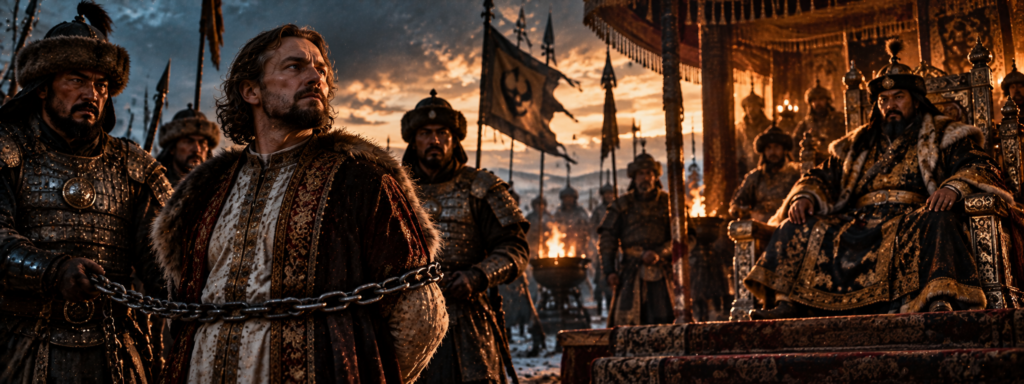
Mikhail of Tver: The Grand Prince Condemned by the Golden Horde and Murdered in Captivity
The Deadly Rivalry Between Tver and Moscow, the Captured Sister of a Mongol Khan, and the Political Execution of a Russian Prince Who Became a Martyr
Mikhail Yaroslavich of Tver (1271–22 November 1318) was Prince of Tver from 1285 until his death and Grand Prince of Vladimir from 1304 until 1318, a member of the Rurikid dynasty and one of the most powerful rulers of northeastern Rus’ during the period of Mongol domination. The son of Yaroslav Yaroslavich, a former Grand Prince of Vladimir, and Princess Xenia, Mikhail inherited a principality that was becoming an increasingly important rival to Moscow. He married Anna of Rostov, later venerated as Anna of Kashin, and their children included Dmitry Mikhailovich, Alexander Mikhailovich, and Konstantin Mikhailovich, all of whom became involved in the bitter dynastic struggles of the fourteenth century. His reign was dominated by competition for the grand princely title, disputes over tribute and political authority, and an increasingly dangerous rivalry with Yuri Danilovich of Moscow. After defeating a Moscow-led army at the Battle of Bortenevo in 1317, Mikhail took several important prisoners, including Yuri’s wife Konchaka, a sister of Khan Uzbeg of the Golden Horde. Her subsequent death in captivity became the basis for accusations against him, and Mikhail was summoned to the Horde to answer charges of disobedience, withholding tribute, and responsibility for her death. Following a politically charged judgment, he was held under guard and killed on 22 November 1318, a date traditionally given in the Julian calendar. His death became one of the defining episodes in the struggle between Tver and Moscow, while his willingness to face the khan rather than expose his principality to retaliation helped establish his later reputation as a martyr and saint of the Russian Orthodox Church.
The Prince Who Rode Toward His Own Execution
By the autumn of 1318, Mikhail Yaroslavich of Tver had every reason to fear what awaited him at the court of the Golden Horde. He had defeated the army of his most dangerous rival, humiliated Moscow on the battlefield, and captured a woman whose family connections made her one of the most politically sensitive prisoners in northeastern Rus’. That woman was now dead, and the accusations surrounding her death had reached the court of Khan Uzbeg. The prince who had emerged victorious from battle was about to discover that military success meant very little when his enemies could appeal to a power greater than his own.
Mikhail was not traveling to an ordinary royal court where disputes might be resolved between equals. The Golden Horde exercised overlordship over the principalities of northeastern Rus’, and its khan possessed the authority to recognize or remove their rulers. Princes who wished to govern securely needed the khan’s approval, particularly when competing for the prestigious title of Grand Prince of Vladimir. Mikhail had spent much of his political life navigating this dangerous relationship, but the accusations now directed against him threatened not merely his position but his life.
His rival, Yuri Danilovich of Moscow, had powerful reasons to seek his destruction. Their struggle for the grand principality had become a contest involving military campaigns, political maneuvering, and repeated appeals to the Horde. Yuri had strengthened his position through marriage to Konchaka, the khan’s sister, who had taken the Christian name Agafia. Her death while held by Mikhail’s side transformed a regional conflict into a matter of personal significance for the ruling family of the Horde.
The circumstances of Konchaka’s death remain uncertain. Later accounts accused Mikhail of poisoning her, but no reliable evidence establishes that he ordered her murder. Illness or another cause is entirely possible, and the surviving narratives were shaped by political hostility and religious interpretation. What is certain is that her death gave Yuri a devastating accusation to place before the khan.
Mikhail could have attempted to avoid the summons. He possessed supporters, fortified towns, and a principality that had demonstrated its military strength. Yet refusing to appear before the khan risked exposing Tver to punitive action by the Horde. The prince faced a choice between personal danger and the possibility of collective suffering for the people under his rule.
According to the religious tradition that developed around his death, Mikhail understood that he might not return. The narratives emphasize his willingness to sacrifice himself rather than bring destruction upon his land. Such accounts were written to celebrate his Christian virtue, and their descriptions of his thoughts and conversations cannot be treated as direct records. Nevertheless, the political dilemma they describe was real.
The journey ended in captivity, humiliation, and execution. Mikhail was condemned after proceedings dominated by the power of the khan and the influence of his political enemies. He was restrained and moved with the Horde’s encampment before being killed by men acting under the authority of the ruling court. The prince who had once commanded armies and contested the leadership of northeastern Rus’ died far from Tver, stripped of the protections that had accompanied his rank.
His death did not end the rivalry between Tver and Moscow. Instead, it deepened a conflict that would claim the lives of his descendants and reshape the political future of the region. The struggle that destroyed Mikhail was not simply a dispute between two ambitious princes. It belonged to a larger contest over who would become the dominant power in northeastern Rus’ under the shadow of the Golden Horde.
A Land Ruled Beneath the Shadow of the Mongols
To understand Mikhail’s fate, it is necessary to understand the world into which he was born. The Rus’ principalities of the late thirteenth century were still living with the consequences of the Mongol invasions of the 1230s and 1240s. Cities had been devastated, rulers had been killed or displaced, and the political balance of the region had been fundamentally altered. The surviving princes now operated within a system in which the khans of the Golden Horde exercised decisive influence over their affairs.
The Horde did not administer every town of northeastern Rus’ directly. Local princes continued to govern their territories, collect revenues, maintain courts, and conduct political rivalries. Their authority, however, was constrained by the need to acknowledge the khan’s supremacy and fulfill obligations of tribute and service. A ruler who defied the Horde risked military intervention, removal from office, or death.
The title of Grand Prince of Vladimir was particularly important. It carried prestige rooted in the political traditions of northeastern Rus’ and was associated with senior authority among competing rulers. The khan’s recognition, usually expressed through a patent of appointment known as a yarlyk, became essential to securing the title. Rival princes therefore had strong incentives to cultivate influence at the Horde’s court.
This arrangement created a political environment in which military strength alone could not guarantee success. A prince might defeat his rival in battle yet lose his position through an unfavorable decision by the khan. Diplomatic gifts, personal connections, tribute payments, and accusations of disloyalty could become as important as soldiers and fortifications. The court of the Horde was therefore a place where the future of entire principalities could be decided.
The relationship was not simply one of constant warfare between Mongols and Russians. Trade, diplomacy, taxation, and political cooperation formed important parts of the system. Some Rus’ princes relied upon Horde support to defeat their domestic enemies. Others sought to limit the burden of tribute or preserve greater independence while avoiding open rebellion.
The consequences for ordinary people could be severe. Rivalries between princes sometimes invited armed intervention by the Horde, bringing destruction to towns and villages caught in the conflict. Tribute obligations placed demands upon local economies, while disputes over collection created opportunities for abuse. The political decisions of rulers therefore affected communities far beyond their courts.
Mikhail’s career unfolded within these conditions. He inherited a principality that had opportunities for expansion but remained vulnerable to the decisions of the khan. His ambitions required him to compete with other Rurikid princes while maintaining an acceptable relationship with the Horde. These competing demands would eventually become impossible to reconcile.
The central tragedy of his life was that he could not escape the political system that gave him authority. The Horde had recognized his grand princely position, yet the same power could withdraw that recognition and condemn him. His enemies understood this vulnerability. They would eventually use it against him.
The House of Tver and the Rise of a Dangerous Principality
Mikhail was born in 1271, shortly after the death of his father, Yaroslav Yaroslavich, who had ruled Tver and held the grand princely title. His mother, Xenia, played an important role in his early life and the preservation of the family’s position. The surviving accounts of his childhood are limited, but his upbringing took place within a dynasty accustomed to political competition. His inheritance connected him to both the ambitions and the dangers of Rurikid rule.
Tver occupied an advantageous position in the network of rivers and trade routes of northeastern Rus’. Situated along the upper Volga, it possessed opportunities for commercial development and political influence. The principality had emerged as an important center during the thirteenth century. By the time Mikhail reached adulthood, it was increasingly capable of challenging neighboring powers.
The region’s economic resources contributed to its growing importance. River connections facilitated movement, trade, and communication with other towns. Agricultural settlements and local elites provided the foundations of princely revenue. Tver’s political ambitions therefore rested upon more than dynastic prestige.
Mikhail became prince of Tver while still young, traditionally dated to 1285. His early government developed during a period of continuing rivalry among the descendants of Alexander Nevsky and other branches of the Rurikid dynasty. Alliances shifted frequently, and princes competed for recognition from the Horde. The ability to preserve local stability while navigating these conflicts was essential.
Tver’s growth made it an increasingly serious competitor to Moscow. During the late thirteenth century, Moscow was still one principality among several seeking greater influence. Its later dominance should not be projected backward as though it had been inevitable. At the beginning of Mikhail’s career, Tver possessed considerable advantages and a strong claim to regional leadership.
The rivalry was intensified by geography. Tver and Moscow occupied territories connected through important routes and neighboring political interests. Expansion by one could threaten the ambitions of the other. Their rulers also belonged to competing branches of the same broad dynasty.
Mikhail inherited not merely land but a political opportunity. A capable ruler of Tver might become the leading prince of northeastern Rus’. Such leadership would require influence over other cities and recognition from the khan. The grand princely title became the central prize.
The rise of Tver therefore created both promise and danger. Its resources gave Mikhail the ability to challenge rivals, but its success also attracted hostility. Moscow would become his most determined opponent. The struggle between the two principalities would eventually destroy him.
The Young Prince and the Burden of Inheritance
Mikhail’s father died before his son could know him, leaving the young prince to inherit a dynastic identity without the personal guidance of the man who had established it. His mother, Xenia, became an important figure in the family tradition surrounding his upbringing. Later religious narratives emphasize her piety and the Christian education she provided. Although such accounts are shaped by the prince’s later sanctity, they reflect the importance of family and religious institutions in princely life.
A young ruler in medieval Rus’ depended upon experienced advisers, military retainers, and local elites. His authority came from dynastic legitimacy, but effective government required cooperation from men who controlled resources and influence. The period of minority could expose a principality to intervention by ambitious relatives. Preserving Tver’s independence was therefore a significant achievement.
The political world surrounding Mikhail was filled with examples of disputed succession. Princes frequently challenged relatives for territories and titles. Agreements could be broken when military or diplomatic circumstances changed. The Horde’s ability to recognize rulers added another level of uncertainty.
Mikhail’s early political experience taught him the importance of maintaining alliances. He needed support within Tver and recognition beyond it. The interests of neighboring principalities could not be ignored. His later conflicts with Moscow emerged from a political culture in which competition was normal rather than exceptional.
The young prince also inherited the prestige of his father’s grand princely career. Yaroslav Yaroslavich had held one of the most important titles in northeastern Rus’. That family history strengthened Mikhail’s later claim to the grand principality. It also encouraged expectations that he would seek authority beyond Tver.
The surviving sources provide relatively little information about his private thoughts or daily life. Historians can reconstruct his political circumstances more securely than his personality. Later descriptions of his humility, courage, and religious devotion must be considered within the traditions that developed after his death. They should not be mistaken for a complete psychological portrait.
Nevertheless, his subsequent career reveals a ruler capable of sustained political competition. He maintained Tver’s position, secured the grand princely title, and defeated powerful rivals. These achievements required organization, resources, and political judgment. He was not merely a passive victim awaiting the tragedy of 1318.
His early life prepared him for a world in which authority had to be defended repeatedly. The same experience that enabled him to strengthen Tver also drew him into increasingly dangerous competition. By adulthood, his ambitions had become inseparable from the struggle for Vladimir. That struggle would bring him into direct conflict with Moscow.
Anna of Rostov: Marriage, Family, and the Dynasty That Would Suffer
Mikhail married Anna, a princess associated with Rostov, in 1294. Their marriage connected important Rurikid families and helped strengthen dynastic relationships. Anna would later become known as Anna of Kashin and receive recognition as a saint in the Russian Orthodox Church. Her life was deeply affected by the political violence that destroyed her husband and several of their sons.
Royal marriages in medieval Rus’ were political institutions as well as personal relationships. They could create alliances, secure claims, and reinforce cooperation between ruling families. A princess entering a new household brought connections that might prove valuable in future disputes. The marriage of Mikhail and Anna belonged to this wider dynastic system.
The couple had several children, including Dmitry, Alexander, and Konstantin, who later became prominent in the struggle over Tver and the grand princely title. Their family would experience extraordinary suffering during the following decades. Mikhail’s execution was only the beginning of a series of political tragedies. The rivalry with Moscow and the Horde would continue to claim lives across generations.
Anna’s later religious reputation was shaped by these losses. Orthodox tradition remembers her endurance, widowhood, and eventual monastic life. Her story became associated with patience amid political catastrophe. The historical details of her later years are intertwined with devotional accounts, but the family’s repeated exposure to violence is well established.
The marriage also reveals how closely personal and political life were connected. A ruler’s wife and children were not insulated from his disputes. Dynastic marriages could strengthen political claims, but they also made family members valuable hostages and targets. The capture of Yuri’s wife in 1317 would demonstrate this danger with devastating consequences.
Mikhail’s sons inherited both his political ambitions and his enemies. They grew up within a household whose position depended upon competition for power. The execution of their father transformed that rivalry into a personal grievance. Subsequent events would show how difficult it was to escape the cycle.
Anna survived Mikhail by many years. She witnessed the continuation of dynastic conflict and the deaths of family members who remained entangled in the politics of the Horde. Her later withdrawal into religious life became central to her memory. The contrast between her spiritual reputation and the violence surrounding her family is one of the most striking aspects of the period.
The family history prevents Mikhail’s execution from being understood as an isolated event. His death shaped the lives of his wife and children and intensified the hostility between rival dynasties. The consequences continued long after his body was returned to Tver. His household became both a political faction and a family marked by repeated tragedy.
Moscow: The Rival That Refused to Remain Small
Moscow’s rise during Mikhail’s lifetime was not inevitable. At the beginning of the fourteenth century, it was a growing principality competing with more established centers. Its rulers belonged to the descendants of Alexander Nevsky and sought to expand their territory and influence. Their ambitions brought them into increasingly direct conflict with Tver.
Daniel of Moscow, the founder of the Moscow branch of the dynasty, had strengthened the principality during the late thirteenth century. His sons continued that policy. Yuri Danilovich, who became prince of Moscow after his father’s death in 1303, proved particularly ambitious. He would become Mikhail’s principal rival.
The two rulers competed for influence over neighboring territories and the grand princely title. Their rivalry was intensified by the fact that both possessed dynastic claims and access to political supporters. Neither could simply ignore the other. The success of one threatened the position of the other.
Moscow’s strategic location offered advantages in trade and communication. Its rulers also proved adept at acquiring territory and cultivating relationships with the Horde. These developments gradually strengthened its position. Yet Tver remained a formidable competitor with significant resources and prestige.
The contest between the principalities was not merely a struggle between two cities. It involved the wider political organization of northeastern Rus’. The ruler who secured the grand princely title could claim senior authority and potentially influence tribute collection and relations with the Horde. The stakes were therefore substantial.
Mikhail’s position initially appeared stronger. He possessed the prestige of Tver and a senior dynastic claim to Vladimir. Yuri, however, was determined to challenge him. The conflict became increasingly personal as political competition intensified.
The later triumph of Moscow has sometimes shaped historical interpretations of the rivalry. Accounts written from a Moscow-centered perspective could portray its rise as natural or providential. Such narratives obscure the genuine uncertainty of the early fourteenth century. Tver might plausibly have become the dominant power under different circumstances.
Mikhail’s death was one of the turning points that weakened Tver’s prospects. Yet even after 1318, the rivalry remained unresolved. His sons continued to contest Moscow’s position. The struggle would require further executions, uprisings, and political reversals before Moscow gained lasting superiority.
The Grand Principality of Vladimir: A Crown Granted by the Khan
The death of Grand Prince Andrei Alexandrovich in 1304 created a major political opportunity. Mikhail of Tver and Yuri of Moscow both sought the grand princely title. Their claims reflected competing interpretations of dynastic seniority and political entitlement. The decision ultimately depended upon the authority of the Golden Horde.
Mikhail traveled to the Horde to secure recognition. The khan at that time was Toqta, whose court exercised decisive influence over the succession. Mikhail received the grand princely title, strengthening his position among the rulers of northeastern Rus’. His success was a major victory for Tver.
The appointment did not end Yuri’s ambitions. Moscow continued to challenge Mikhail’s influence, and disputes arose over territory and political authority. The grand princely title was prestigious, but it did not automatically compel every rival to obey. The holder still needed military strength and diplomatic skill.
Mikhail’s recognition by the Horde illustrates the dependence of Rus’ rulers upon external authority. He possessed dynastic legitimacy and substantial resources, yet his position required the khan’s approval. The same system that elevated him could later be used to destroy him. His career therefore contained a fundamental vulnerability from the beginning.
The rivalry also involved disputes over Novgorod, whose commercial wealth and political importance made it a valuable ally or opponent. Control over appointments and influence in the city could strengthen a prince’s position. Novgorod’s own institutions and elites, however, resisted domination by outside rulers. Mikhail’s attempts to exercise authority there contributed to further conflict.
The grand princely title brought responsibilities as well as prestige. The ruler needed to maintain acceptable relations with the Horde and fulfill obligations associated with tribute. Disputes over payments could become politically dangerous. Rivals could accuse one another of withholding revenue or disobeying the khan.
Mikhail’s position remained strong for several years, but Yuri continued to seek opportunities. The political landscape changed after the death of Toqta and the accession of Uzbeg in 1313. A new khan meant new relationships and new possibilities for ambitious princes. Yuri recognized that the balance of influence could be altered.
The contest for Vladimir therefore moved increasingly toward the Horde’s court. Military strength in Rus’ remained important, but personal connections with the khan became decisive. Mikhail had secured the title through one political arrangement. Yuri would attempt to replace it with another.
Khan Uzbeg: The Ruler Who Could Make and Destroy Princes
Uzbeg Khan, who ruled the Golden Horde from 1313 to 1341, was one of the most powerful figures in the political world of northeastern Rus’. His authority extended across vast territories and influenced the fortunes of numerous subordinate rulers. He strengthened Islam’s position within the Horde while maintaining complex relationships with Christian communities and the Rus’ principalities. His reign became a decisive period in the development of Horde power.
For Mikhail and Yuri, Uzbeg’s accession created both danger and opportunity. A new khan could reconsider earlier appointments and cultivate different political allies. Princes therefore had strong incentives to visit his court and seek favor. The ability to secure recognition could determine control over the grand princely title.
The khan’s authority was not merely ceremonial. He could grant or withdraw political privileges, demand tribute, and authorize punitive action. His representatives and military commanders could intervene in disputes among the Rus’ princes. A ruler who lost his confidence risked severe consequences.
The court of the Horde was also a place of intense competition. Visiting princes presented claims, accusations, and requests for support. Gifts and personal relationships could influence outcomes, although the precise workings of particular decisions are often difficult to reconstruct. Political success required understanding a world of power very different from the local courts of Tver or Moscow.
Yuri Danilovich proved adept at cultivating Uzbeg’s favor. His efforts eventually included a marriage alliance with the khan’s sister. This connection transformed the rivalry with Mikhail. Yuri was no longer merely a competing Rus’ prince but a relative by marriage of the ruling family of the Horde.
The marriage increased the political danger facing Mikhail. A conflict with Yuri could now affect the honor and interests of the khan’s family. The capture of Yuri’s wife would therefore carry implications far beyond an ordinary battlefield defeat. Mikhail’s later predicament cannot be understood without this relationship.
Uzbeg’s motives in the final judgment against Mikhail remain difficult to determine. The khan may have accepted accusations concerning tribute, disobedience, and Konchaka’s death. He may also have considered the political advantages of replacing one grand prince with another. The surviving sources do not permit a confident reconstruction of his private reasoning.
What is clear is that Uzbeg possessed the power to determine Mikhail’s fate. The prince could argue his case, but he could not compel an independent judgment. His life depended upon the decisions of a ruler whose authority he had previously acknowledged. The system of Horde overlordship had become a mechanism of personal destruction.
Yuri Danilovich: The Rival Who Found a Powerful Ally
Yuri Danilovich of Moscow was not content to remain subordinate to Mikhail’s grand princely authority. He sought recognition, influence, and the political advantages associated with Vladimir. His ambitions were supported by Moscow’s growing resources and his willingness to cultivate the Horde. Over time, his rivalry with Mikhail became one of the most bitter political conflicts of the period.
Yuri’s marriage to Konchaka, the sister of Khan Uzbeg, was a major diplomatic achievement. She received the Christian name Agafia, and the union strengthened Yuri’s connection to the ruling family of the Horde. Such a marriage carried enormous political significance. It placed Moscow’s prince in a relationship that could influence the khan’s view of disputes within Rus’.
The marriage also reflected the flexibility of political and cultural relationships under Horde rule. The ruling family of the Horde was Muslim, while Yuri was an Orthodox Christian prince. Dynastic alliances could cross religious boundaries when political interests encouraged them. The marriage was therefore both unusual and strategically valuable.
Yuri’s strengthened position allowed him to challenge Mikhail more aggressively. He obtained support from the Horde and sought recognition as grand prince. The struggle intensified because Mikhail was unwilling to surrender his established authority. Both rulers believed they possessed legitimate grounds for their claims.
The conflict eventually moved from diplomacy to military confrontation. Yuri returned to Rus’ with support associated with the Horde, including the official Kavgady. Their presence increased the political significance of the campaign. An attack upon Mikhail now involved forces connected to the khan’s authority.
Yuri’s motives were not simply personal hatred. The grand princely title offered substantial political advantages, and Moscow’s expansion depended upon overcoming rivals. Yet the conflict became increasingly personal as the two princes confronted one another. Their families and reputations became entangled in the struggle.
The later death of Konchaka transformed Yuri’s position. Her captivity and death gave him grounds to accuse Mikhail before Uzbeg. The accusation was politically devastating because it concerned the khan’s own sister. Whether Yuri sincerely believed Mikhail had murdered her cannot be established with certainty.
Yuri’s success at the Horde would ultimately lead to Mikhail’s destruction. Yet the rivalry did not end with the execution. Mikhail’s sons inherited the grievance, and Yuri himself would later die violently. The struggle between the two families became a cycle in which political ambition and personal revenge reinforced one another.
The Road to Bortenevo
By 1317, the rivalry between Mikhail and Yuri had reached a dangerous stage. Yuri had strengthened his position at the Horde and returned with political and military support. Mikhail faced the possibility of losing the grand princely title he had held for more than a decade. The conflict threatened the position of Tver itself.
The presence of Kavgady, an important Horde official, increased the stakes. His involvement signaled that Yuri’s campaign possessed connections to the khan’s authority. Mikhail could not treat the approaching forces as merely the private army of Moscow. Defeating them might create political consequences at the Horde.
Mikhail nevertheless prepared to resist. His principality possessed military resources and supporters capable of confronting the invading force. The conflict was fought within a region where towns and villages could suffer from the movement of armies. The political ambitions of rulers again threatened ordinary communities.
The campaign culminated near Bortenevo in December 1317. The battle became one of the most important military events in Mikhail’s career. His forces defeated Yuri’s army, producing a dramatic reversal of the political situation. The victory demonstrated that Tver remained a formidable power.
The defeat was humiliating for Yuri. His military effort had failed despite the support associated with the Horde. The result weakened his immediate position in Rus’. Yet the battle also created circumstances that would prove fatal for Mikhail.
Among the prisoners taken by Mikhail’s side was Konchaka, Yuri’s wife and the khan’s sister. Her capture transformed the consequences of the battle. A military victory over Moscow now involved the detention of a member of Uzbeg’s family. The political danger was enormous.
Kavgady was also caught up in the aftermath of the defeat, although accounts of his treatment vary. His status as a Horde official made the outcome especially sensitive. Mikhail needed to manage the prisoners carefully while protecting his victory. Every decision could influence the khan’s response.
The Battle of Bortenevo therefore became a victory with a hidden catastrophe. Mikhail had defeated his rival on the battlefield, but the prisoners he acquired created new vulnerabilities. The death of one of them would soon overturn the meaning of the victory. What appeared to be Tver’s triumph became the beginning of its prince’s downfall.
The Battle of Bortenevo: Victory With a Fatal Price
The battle near Bortenevo in December 1317 was a decisive military success for Mikhail of Tver. His forces confronted the army associated with Yuri of Moscow and defeated it. The victory demonstrated that Mikhail retained substantial military strength despite Yuri’s growing influence at the Horde. For a moment, Tver appeared to have secured its position.
The surviving accounts emphasize the importance of the defeat suffered by Yuri’s forces. The Moscow prince was unable to impose his authority through the campaign. Mikhail’s army captured valuable prisoners and demonstrated its ability to resist. The battle strengthened his immediate prestige among supporters.
Yet the political consequences were more complicated than the military result. Yuri had connections to Khan Uzbeg through marriage, and the campaign involved Horde interests. A defeat suffered by forces associated with the khan could not be treated as an ordinary local dispute. Mikhail needed to consider how his actions would be interpreted at the Horde’s court.
Konchaka’s capture was the most dangerous consequence. As the khan’s sister, she possessed a status that made her treatment a matter of exceptional sensitivity. Her detention placed Mikhail in a position where any harm to her could become a political weapon. The risks existed even if he intended to treat her honorably.
The battle also involved the capture or detention of individuals connected to the Horde’s military and diplomatic apparatus. Mikhail’s victory therefore threatened to embarrass more than Yuri alone. It raised questions about the authority of those who had supported Moscow. The consequences would depend upon how the events were reported to Uzbeg.
Mikhail may have believed that his victory would strengthen his negotiating position. Defeating Yuri demonstrated that Moscow could not easily dominate Tver. The prisoners might also have offered leverage in political discussions. Yet the advantages depended upon their safe treatment and the khan’s willingness to accept the outcome.
The victory did not produce lasting security. Instead, it created the circumstances for accusations that would destroy Mikhail. The political world of the Horde could reverse the meaning of events. A prince who won in battle could lose through diplomacy and judicial proceedings.
Bortenevo therefore occupies a tragic place in Mikhail’s biography. It was one of his greatest military achievements and the event that set his final crisis in motion. The battle showed his strength, but its aftermath exposed his vulnerability. The prince who defeated Moscow would soon stand accused before the khan.
Konchaka: The Captive Princess Whose Death Changed Everything
Konchaka, also known by her Christian name Agafia, was the sister of Khan Uzbeg and the wife of Yuri Danilovich of Moscow. Her marriage had strengthened Yuri’s political position and connected Moscow directly to the ruling family of the Golden Horde. Her capture after the Battle of Bortenevo therefore carried extraordinary significance. She was not merely the spouse of a defeated prince but a member of the khan’s family.
The circumstances of her captivity are not described consistently in the surviving sources. She was held by Mikhail’s side after the battle, but the precise conditions of her detention remain uncertain. Some accounts suggest that she was treated according to her status. Others emphasize the political hostility surrounding her capture.
Konchaka died while in captivity. The cause of her death is unknown. Later accusations claimed that Mikhail had poisoned her, but no reliable evidence establishes deliberate poisoning. The possibility of illness or another natural cause cannot be excluded.
Her death nevertheless created an immediate political crisis. Yuri could present the event as a crime committed against his wife and the khan’s sister. Such an accusation had emotional and dynastic significance. It also provided a powerful argument for removing Mikhail from the grand princely title.
The accusation of poisoning was particularly damaging because it implied deliberate murder rather than accidental death. In medieval political culture, poisoning carried associations with treachery and concealed violence. A ruler accused of poisoning a high-status captive could be portrayed as dishonorable and dangerous. The charge therefore threatened Mikhail’s reputation as well as his political position.
The surviving evidence does not establish that Yuri fabricated the accusation knowingly. He may have believed that his wife had been murdered, or he may have used an uncertain death to advance his political objectives. The sources do not allow his private motives to be determined. What matters historically is that the accusation became central to the case against Mikhail.
The khan’s response was decisive. Konchaka’s death was no longer a private tragedy within Yuri’s household. It became a matter involving the honor and authority of the Horde’s ruling family. Mikhail now faced a political danger that military strength could not resolve.
The death of Konchaka transformed the rivalry between Tver and Moscow. Before Bortenevo, the conflict had centered upon titles, territory, and political influence. After her death, it also involved an accusation of murder against the khan’s sister. The dispute had become potentially fatal.
The Accusation of Poisoning
The claim that Mikhail poisoned Konchaka became one of the most consequential allegations in the political history of early fourteenth-century Rus’. It offered Yuri a means of transforming a military defeat into a diplomatic advantage. The accusation placed Mikhail in conflict with the family of Khan Uzbeg. It also created a narrative in which the victorious prince of Tver could be portrayed as a criminal.
Poisoning accusations were difficult to prove in the medieval world. Medical knowledge was limited, and many illnesses could produce symptoms interpreted as evidence of deliberate harm. Political enemies could exploit uncertainty surrounding an unexpected death. The accusation against Mikhail must therefore be treated with caution.
The sources that preserve the charge were shaped by competing political and religious interests. Accounts sympathetic to Mikhail reject his responsibility and portray him as the victim of false accusations. Other traditions emphasize the seriousness of Konchaka’s death. Neither perspective supplies modern forensic evidence capable of establishing the cause.
The political usefulness of the allegation is undeniable. Yuri had lost the Battle of Bortenevo and needed to recover his position. Accusing Mikhail of murdering the khan’s sister provided a powerful argument for intervention. The charge could overshadow the military defeat and redirect attention toward the conduct of the victorious prince.
The accusation also placed Mikhail in a difficult defensive position. He could deny wrongdoing, but he could not reverse Konchaka’s death. He could explain the circumstances of her captivity, yet the khan might still regard him as responsible for her safety. The political imbalance between the parties made the danger especially severe.
Other accusations accompanied the poisoning claim. Mikhail was charged with withholding tribute and resisting the khan’s authority. These allegations connected the personal tragedy of Konchaka’s death to the broader obligations of Horde overlordship. The case therefore combined political disobedience with an accusation of murder.
The combination was devastating. A prince accused only of rivalry with Moscow might negotiate or seek renewed recognition. A prince accused of disobeying the khan and killing his sister faced a much greater threat. Yuri’s position at the Horde gave the charges additional force.
Whether Konchaka was murdered remains unresolved. The historical certainty lies in the accusation and its consequences, not in proof of poisoning. Mikhail was condemned in a political environment where his rival possessed powerful connections. The charge became one of the instruments of his destruction.
The Summons From the Horde
After the events of Bortenevo and Konchaka’s death, Mikhail was summoned to the Horde to answer accusations against him. The summons placed him in an extremely dangerous position. Refusal could be interpreted as disobedience to the khan, while compliance exposed him to the influence of his enemies. The prince faced a dilemma with no safe solution.
Mikhail possessed reasons to remain in Tver. His principality had demonstrated military strength, and his supporters might have defended him against local rivals. Yet open defiance of the Horde risked bringing a punitive campaign upon the region. The destruction that could follow would affect far more people than the prince himself.
The religious narratives surrounding his death emphasize this dilemma. They portray Mikhail as choosing to travel to the Horde rather than endanger his subjects. His decision becomes an act of self-sacrifice, anticipating the martyrdom that followed. The speeches attributed to him in these accounts should be understood as literary expressions of the tradition rather than verbatim records.
The underlying political danger was real. The Horde possessed the military capacity to punish disobedient princes. Mikhail could not assume that Tver would withstand a major campaign without severe suffering. His personal safety therefore had to be weighed against the security of his principality.
The journey also required him to leave the territory where his authority was strongest. At the Horde’s court, he would be surrounded by officials and rivals whose loyalties were uncertain. His military resources could not accompany him in a form capable of challenging the khan. He would be dependent upon political argument and the willingness of others to hear it.
Mikhail’s decision to appear was consistent with the obligations imposed upon Rus’ rulers under Horde overlordship. Princes regularly traveled to the khan’s court to secure appointments or resolve disputes. Such journeys were dangerous but politically necessary. The extraordinary feature of Mikhail’s case was the severity of the accusations awaiting him.
The summons also offered Yuri an opportunity to press his claims. The Moscow prince had powerful connections through his marriage and could present his case directly. The rivalry would now be decided in an environment favorable to him. Mikhail’s military victory at Bortenevo no longer guaranteed political advantage.
The journey toward the Horde became the final stage of Mikhail’s political career. He was leaving behind his family, his capital, and the people whose interests he claimed to defend. The chronicles later portrayed the departure as the beginning of a deliberate sacrifice. Historically, it was a decision made under the pressure of an unequal political relationship.
A Trial in Which the Verdict Was Never Truly Safe
Mikhail’s case was heard within the political and judicial environment of the Golden Horde. He faced accusations connected to Konchaka’s death, tribute obligations, and disobedience to the khan. The proceedings were dominated by the authority of Uzbeg and the influence of officials associated with the dispute. The surviving sources do not provide a neutral transcript of the hearing.
Accounts sympathetic to Mikhail portray the proceedings as unjust. They emphasize false accusations, hostile witnesses, and the prince’s inability to obtain a fair judgment. Such narratives reflect the religious tradition that developed around his death. They must be read critically, but they also reveal the political imbalance facing him.
The charge concerning Konchaka was particularly serious. Her death involved the khan’s own family and could be interpreted as an insult to his authority. Mikhail denied responsibility in the traditions that preserve his defense. The historical record does not establish that he ordered her death.
The tribute accusations were also politically important. The Horde depended upon revenue from subordinate territories, and failure to fulfill obligations could be treated as rebellion or disobedience. A prince accused of withholding payments risked losing the khan’s confidence. The charge therefore provided a separate basis for punishment.
Kavgady’s role in the proceedings is emphasized in several accounts. His earlier involvement in the campaign against Tver connected him personally to the conflict. Sources sympathetic to Mikhail portray him as a hostile participant in the prince’s condemnation. The exact extent of his influence remains difficult to establish independently.
The proceedings were not equivalent to a modern trial conducted before an independent judiciary. The khan possessed supreme political authority, and judicial decisions were closely connected to state interests. Mikhail’s fate depended upon a ruler who could appoint or remove princes. The balance of power was overwhelmingly against the accused.
Mikhail was condemned. The judgment marked the collapse of his position as grand prince and exposed him to execution. His military achievements and dynastic status could no longer protect him. The authority that had once recognized him now sanctioned his destruction.
The trial became central to his later reputation as a martyr. Religious writers portrayed him as a righteous prince suffering under false accusations. The historical record supports the conclusion that the proceedings were politically charged, but it does not allow every accusation or defense to be verified. The essential outcome is clear: Mikhail was placed under guard and ultimately killed by order of the Horde’s ruling authority.
Chains, Humiliation, and the Long Wait for Death
After his condemnation, Mikhail was held under guard. The religious accounts describe restraints, humiliation, and the gradual destruction of his former status. A prince who had commanded armies was reduced to a prisoner dependent upon the decisions of his captors. The contrast became one of the central themes of his martyrdom narrative.
The sources describe a wooden restraint placed around his neck, often interpreted as a heavy wooden collar or stock. Such devices were intended to restrict movement and publicly mark a prisoner’s loss of freedom. The image of a grand prince subjected to this treatment was especially powerful. It demonstrated how completely his authority had been stripped away.
Mikhail was reportedly moved with the Horde’s encampment during his captivity. The details of the journey and the precise locations associated with his final weeks are not equally secure in every account. The broad tradition places him under guard while awaiting the final decision. His fate remained dependent upon the khan.
The narratives emphasize his religious devotion during this period. He is portrayed praying, receiving spiritual counsel, and preparing himself for death. Such descriptions belong to the conventions of medieval hagiography, in which the suffering of a righteous person is interpreted through Christian faith. They reveal how his death was remembered rather than providing a complete record of his private thoughts.
The humiliation also had political significance. Publicly restraining a grand prince demonstrated the supremacy of the Horde over its subordinate rulers. Mikhail’s rank offered no immunity. His treatment served as a warning to other princes who might challenge the khan’s authority.
The waiting itself became part of the punishment. A condemned prisoner could not know whether mercy, further interrogation, or execution would follow. The uncertainty increased the psychological burden. Mikhail’s former power had been replaced by dependence upon the will of others.
His family remained far away in Tver. The surviving accounts do not permit a detailed reconstruction of their communications during his captivity. Nevertheless, the political consequences of his detention would have been obvious. His sons faced the prospect of inheriting a principality weakened by their father’s condemnation.
The final weeks of Mikhail’s life therefore combined political defeat with personal suffering. He had entered the Horde as a ruler attempting to defend his position. He remained there as a condemned prisoner. The transition from grand prince to captive was complete.
November 22, 1318: The Execution of Mikhail of Tver
Mikhail Yaroslavich was killed on 22 November 1318, according to the traditional dating preserved in the chronicles. His execution took place while he was in the custody of the Golden Horde. The order is attributed to Khan Uzbeg’s authority, although the immediate killing was carried out by men acting within the Horde’s political and military environment. The event ended one of the most important princely careers of the early fourteenth century.
The religious narrative of his death describes a violent attack upon the restrained prince. His captors entered and assaulted him, inflicting fatal injuries. Some accounts identify a particularly brutal final blow or the removal of his heart. These details belong to the medieval tradition and cannot all be independently verified.
The killing was not an ordinary death in battle. Mikhail was a prisoner who had been condemned after political proceedings. He was unable to defend himself with the resources of his principality. His execution therefore represented the direct exercise of the Horde’s authority over a subordinate ruler.
The brutality emphasized in the chronicles served an important purpose. It contrasted the prince’s suffering with the cruelty of his enemies. The narrative presented him as a Christian ruler enduring injustice and death. This interpretation became central to his later canonization.
The historical certainty is that Mikhail died violently in Horde custody after being accused and condemned. The precise sequence of blows, the identities of every participant, and the words spoken during the execution are less secure. Medieval authors often reconstructed such scenes to convey moral and religious meaning. A responsible account must preserve that distinction.
The date became a focal point of remembrance. Orthodox tradition commemorated Mikhail’s death as martyrdom. His execution was understood not merely as political defeat but as a sacrifice associated with his refusal to expose his people to destruction. The religious meaning grew in importance over subsequent centuries.
For Tver, the immediate consequence was the loss of its most powerful ruler. Mikhail had held the grand princely title and successfully resisted Moscow in battle. His execution removed the figure who had led the principality’s political ambitions. The succession now passed into the hands of his descendants under difficult circumstances.
For Moscow, the outcome created an opportunity. Yuri’s principal rival was dead, and the grand princely title could be secured through the khan’s favor. Yet the political victory came at a terrible cost to relations between the two dynasties. Mikhail’s sons would not forget the circumstances of their father’s death.
The Body of a Condemned Prince
After Mikhail’s execution, his remains became the subject of further political and religious significance. The chronicles describe the treatment and eventual return of his body through a narrative shaped by reverence for the murdered prince. His death had occurred far from Tver, in territory controlled by the Horde. Bringing him home was therefore an important act of dynastic and communal remembrance.
Accounts of the body’s treatment emphasize the indignity of his execution and the desire of supporters to honor him. Some details are presented in miraculous or devotional terms. Such elements reflect the development of his cult as a martyr. They should not be confused with independently verifiable observations.
The return of his remains to Tver occurred after the execution, traditionally dated to 1319. His body was eventually buried in the Transfiguration Cathedral, the principal religious building associated with the ruling dynasty. The burial connected his memory to the political and spiritual identity of the city. It also provided a focus for later veneration.
A ruler’s burial was an important public event in medieval Rus’. It affirmed dynastic continuity and allowed a community to honor its dead prince. In Mikhail’s case, the burial also carried an implicit political message. The man condemned by the Horde was remembered in Tver as a victim of injustice.
His remains became associated with religious devotion. Later accounts described miracles and signs of sanctity connected to his memory. Such traditions contributed to his recognition as a saint. The historical significance lies in the growth of that veneration and its role in Tver’s identity.
The contrast between the Horde’s judgment and Tver’s remembrance was striking. To the khan’s court, Mikhail had been a condemned political offender. To his supporters, he became a righteous ruler destroyed through false accusations. These competing interpretations reflected the conflict that had led to his death.
His burial also gave his descendants a powerful symbol. They could present their father as a victim of Moscow’s political maneuvering and Horde injustice. His death became part of the dynastic grievance that shaped later events. The memory of the execution was therefore politically active rather than merely commemorative.
Mikhail’s body returned to the city whose ambitions he had defended. His political authority was gone, but his memory continued to influence the struggle for power. The prince who had been humiliated in captivity became an honored figure in Tver. His death acquired a significance that his enemies could not easily control.
Yuri of Moscow Wins the Title but Inherits a Blood Feud
Mikhail’s execution removed Yuri’s principal rival for the grand princely title. Yuri secured recognition as Grand Prince of Vladimir, strengthening Moscow’s position. The outcome appeared to reward his political efforts at the Horde. Yet the victory did not bring lasting peace.
Mikhail’s sons inherited their father’s political claims and resentment toward Moscow. The execution had transformed a contest for titles into a family grievance. Dmitry Mikhailovich, in particular, became determined to challenge Yuri. The rivalry continued through diplomatic and political maneuvering.
The Horde remained the decisive arena. Both dynasties sought recognition from the khan, and accusations concerning tribute and political conduct continued to influence appointments. The system encouraged competition because the grand princely title could be transferred from one family to another. The death of one ruler did not eliminate the ambitions of his heirs.
Yuri’s position was also vulnerable. His relationship with the Horde had helped him defeat Mikhail, but continued favor depended upon fulfilling obligations and maintaining political support. Rivals could challenge him through the same methods he had used. The political advantage was therefore unstable.
The conflict eventually brought Yuri and Dmitry into direct confrontation at the Horde’s court. The setting was especially significant because it was the same political environment in which Mikhail had been condemned. The younger generation continued the struggle under the authority of the khan. The memory of the execution remained central.
In 1325, Dmitry Mikhailovich killed Yuri Danilovich while both were at the Horde. The act was widely understood in connection with the earlier death of Mikhail. Dmitry’s revenge did not secure his safety. He was subsequently executed by order of Uzbeg in 1326.
The sequence was grimly repetitive. Mikhail had been killed in Horde custody after accusations advanced by his rival. Yuri was later killed by Mikhail’s son at the Horde. Dmitry then suffered execution under the same overarching authority. The political system that encouraged princely competition became the setting for successive deaths.
The blood feud illustrates the failure of violence to resolve the rivalry. Each death created new grievances and new opportunities for retaliation. Moscow and Tver remained locked in competition. The struggle would continue until broader political developments shifted the balance decisively.
Dmitry of Tver: The Son Who Avenged His Father
Dmitry Mikhailovich inherited more than a dynastic claim. He inherited the memory of his father’s execution and the conviction that Yuri of Moscow had played a central role in it. His political career developed within a family marked by grief and resentment. The struggle for the grand princely title became inseparable from the desire for revenge.
Dmitry eventually secured recognition as Grand Prince of Vladimir, demonstrating that Tver remained capable of challenging Moscow after Mikhail’s death. The Horde’s favor could shift, and Yuri’s position was not permanent. Political competition continued through appointments and accusations. The younger prince sought to restore his family’s prestige.
The rivalry culminated in 1325 when Dmitry killed Yuri at the Horde. The murder was a dramatic reversal of the earlier events. Yuri, who had benefited from Mikhail’s condemnation, now died at the hands of Mikhail’s son. The act transformed political grievance into direct personal violence.
The precise circumstances of the killing are preserved in chronicles that vary in emphasis. The central fact is that Dmitry killed Yuri while both were within the Horde’s political environment. The act was not a battlefield victory. It was a violent confrontation that violated the authority of the khan’s court.
Uzbeg did not allow the killing to go unpunished. Dmitry was detained and eventually executed in 1326. His death repeated the fate of his father in a different form. The family had lost two prominent rulers through violence connected to the Horde.
The cycle of retaliation demonstrates the danger of personalizing political disputes. Mikhail’s execution created a grievance that Dmitry sought to answer through murder. Yuri’s death then exposed Dmitry to the khan’s punishment. The attempt to avenge one execution produced another.
The tragedy also weakened Tver. Losing successive rulers disrupted political continuity and created opportunities for Moscow. The principality retained resources and ambitions, but repeated crises damaged its position. Its rivals could exploit the instability.
Dmitry’s fate became part of the larger story of Mikhail’s family. The execution of the father did not end the struggle; it helped determine the son’s actions. The political violence of one generation shaped the next. The consequences of 1318 continued to unfold.
Alexander of Tver and the Catastrophe of 1327
Another of Mikhail’s sons, Alexander Mikhailovich, became a central figure in the continuing rivalry. He inherited a political world shaped by the deaths of his father and brother. Tver remained an important principality, but its relationship with the Horde and Moscow was increasingly dangerous. Alexander’s career would bring another major crisis.
In 1327, an uprising erupted in Tver against a Horde presence associated with the official Chol-khan, also known in some traditions as Shevkal. The revolt involved violence against members of the Horde’s party. The precise circumstances and causes are described differently in the sources. The event nevertheless provoked a devastating response.
The Horde organized a punitive campaign against Tver, with Moscow’s ruler Ivan I Kalita participating. The resulting destruction severely weakened the principality. Towns and settlements suffered, and Alexander was forced to flee. The crisis marked a major turning point in the rivalry between Tver and Moscow.
The uprising was not simply a continuation of Mikhail’s personal feud, but the earlier conflicts formed part of the political background. Tver had experienced repeated confrontations with the Horde and Moscow. Its rulers had struggled to preserve autonomy while competing for grand princely authority. The events of 1327 exposed the dangers of that position.
Alexander eventually returned to political life, but his security remained uncertain. In 1339, he and his son Fyodor were executed at the Horde. Their deaths extended the family’s tragic history. Another generation had suffered the consequences of political conflict under Horde overlordship.
The repeated executions of Mikhail’s descendants became central to the memory of the Tver dynasty. His family experienced a sequence of losses that later religious writers interpreted through themes of suffering and endurance. The political reality was a prolonged struggle for power in which defeat could mean death. The human cost was enormous.
Moscow benefited from Tver’s weakening. Ivan Kalita strengthened his position through cooperation with the Horde and the accumulation of resources. The grand princely title became increasingly associated with Moscow. The balance that had once favored Tver shifted.
The catastrophe of 1327 and the executions of 1339 demonstrate the long consequences of Mikhail’s rivalry. His death in 1318 was not the final chapter. It was one event in a chain of political violence that helped determine the future leadership of northeastern Rus’. Tver’s decline and Moscow’s rise were shaped by these repeated crises.
Ivan Kalita and Moscow’s Patient Victory
Ivan I Kalita, a younger brother of Yuri Danilovich, emerged as one of the most successful rulers of Moscow during the decades following Mikhail’s execution. His political strategy differed in important ways from the direct confrontation that had characterized Yuri’s rivalry with Tver. He cultivated the Horde’s favor and strengthened Moscow’s economic and administrative position. His success helped transform a contested principality into an increasingly dominant regional power.
The punitive campaign against Tver in 1327 created an opportunity for Moscow. Ivan participated in the response organized under Horde authority. The destruction weakened a major rival and altered the political balance. Moscow gained advantages that would prove enduring.
Ivan’s relationship with the Horde was central to his success. He secured political recognition and developed influence connected to tribute collection. These arrangements strengthened his resources and position. They also demonstrated how cooperation with the khan could be used to advance local ambitions.
The contrast with Mikhail is revealing. Mikhail had secured the grand princely title and defeated Moscow in battle, yet he was destroyed through accusations and political judgment at the Horde. Ivan pursued a strategy that relied heavily upon maintaining the khan’s confidence. The difference did not reflect a simple moral distinction between resistance and submission. Both rulers operated within the same system and sought to protect their dynastic interests.
Moscow’s growing wealth also contributed to its rise. Resources could support political patronage, territorial acquisition, and military strength. The principality gradually developed advantages that made future competition increasingly difficult for rivals. Its success was cumulative rather than instantaneous.
Tver did not disappear as a political power. It continued to possess rulers, institutions, and regional influence. Yet the repeated crises of the early fourteenth century damaged its prospects. Moscow’s position became progressively stronger.
The outcome has sometimes encouraged historians to portray Moscow’s victory as inevitable. Such interpretations overlook the uncertainty that existed during Mikhail’s lifetime. Tver had possessed a genuine opportunity to become the leading principality. The political decisions and violent events of the following decades helped determine which rival would prevail.
Mikhail’s execution therefore belongs to the larger history of Moscow’s emergence. His death weakened one of its most formidable opponents and intensified a conflict that ultimately favored his rivals. Yet the process involved many subsequent events. The tragedy of 1318 was a turning point, not a complete explanation.
Was Mikhail Murdered for Politics or Executed for a Crime?
The central question surrounding Mikhail’s death concerns the relationship between the accusations against him and the political interests of his enemies. He was charged with serious offenses, including responsibility for Konchaka’s death and failure to fulfill obligations to the Horde. His condemnation occurred in a court where political authority and judicial power were closely connected. The surviving evidence does not establish that he committed the alleged poisoning.
The political benefits to Yuri are clear. Mikhail’s removal allowed Moscow’s ruler to secure the grand princely title. The accusation concerning Konchaka provided a powerful argument because she was the khan’s sister. Yuri had both personal and political reasons to pursue the case. These circumstances make the proceedings deeply suspect from a historical perspective.
Yet political advantage alone does not prove that every accusation was knowingly fabricated. Konchaka did die in captivity, and the khan may have regarded Mikhail as responsible for her safety. Disputes over tribute also formed part of the political environment. The surviving sources do not provide enough independent evidence to reconstruct every aspect of the case.
The religious tradition surrounding Mikhail presents him as innocent and unjustly condemned. This interpretation became central to his sainthood. Hagiographical narratives emphasize his humility, Christian faith, and willingness to suffer for his people. Their purpose was to commemorate a martyr rather than conduct a neutral investigation.
The historical Mikhail was also a political actor. He had competed for the grand princely title, engaged in military conflict, and sought to preserve Tver’s authority. His victory at Bortenevo was achieved through warfare against a rival supported by the Horde. He was therefore deeply involved in the political struggles that produced the crisis.
The distinction between political execution and assassination is important. Mikhail was not killed by an unknown attacker acting without official authority. He was condemned and executed within the political system of the Golden Horde. His death nevertheless belongs to the broader history of rulers deliberately eliminated through political violence.
The case demonstrates how legal proceedings could become instruments of power. A ruler might be condemned under accusations that served the interests of rivals. The absence of independent judicial safeguards made the outcome dependent upon the authority of the khan. Mikhail’s fate was determined in an environment where politics and punishment were inseparable.
The most defensible conclusion is that Mikhail was executed after a politically charged judgment, with Konchaka’s death serving as a central accusation. The evidence does not prove that he poisoned her. His rival benefited directly from the outcome. The execution therefore remains a powerful example of how dynastic competition could become fatal under Horde overlordship.
The Making of a Martyr
Mikhail’s death quickly acquired religious significance in Tver. The prince had been executed far from home after accusations that his supporters regarded as unjust. His willingness to appear before the khan despite the danger became central to the story. Religious writers interpreted his suffering through the traditions of Christian martyrdom.
The narratives emphasized his concern for his people. He was portrayed as choosing personal danger rather than exposing Tver to punitive destruction. This theme transformed a political decision into an act of spiritual sacrifice. The prince became an example of a ruler who accepted suffering for the welfare of his community.
His captivity also contributed to the martyrdom narrative. The wooden restraint, humiliation, prayers, and final execution were described in language associated with Christian endurance. The contrast between worldly power and spiritual dignity was central. Mikhail lost his political authority but was presented as preserving his faith.
The account of his death was shaped by the literary conventions of medieval hagiography. Speeches, prayers, and descriptions of inner resolve served moral and devotional purposes. They cannot all be treated as verbatim historical records. Their significance lies in how the community understood and remembered the event.
Mikhail’s veneration developed around his burial in Tver. His remains became associated with religious devotion, and accounts of miracles contributed to the growth of his cult. He was eventually recognized as a saint within the Orthodox tradition. His feast day preserved the memory of his execution.
The saintly image also served the political identity of Tver. A murdered prince could become a symbol of the principality’s suffering and legitimacy. His memory contrasted the righteousness of Tver with the actions of its enemies. Religious devotion and political remembrance therefore reinforced one another.
Mikhail’s wife Anna also became a saint, creating a remarkable family legacy of religious veneration. Her endurance amid the deaths of her husband and sons contributed to her reputation. The family’s suffering became part of Orthodox historical memory. Their political defeats were transformed into narratives of spiritual perseverance.
The development of Mikhail’s cult demonstrates how medieval communities could reinterpret political catastrophe. A prince condemned by the Horde became a revered martyr in his homeland. His death was no longer merely a defeat in the struggle for Vladimir. It became a story about faith, sacrifice, and the moral limits of earthly power.
The Saint of Tver and the Memory of a Lost Political Future
Mikhail’s religious reputation became inseparable from the identity of Tver. The city had lost a ruler who once held the grand princely title and challenged Moscow for leadership. His execution became a symbol of the dangers facing the principality. His veneration offered a way to preserve dignity after political defeat.
The memory of Mikhail also reflected the wider competition between regional historical traditions. Moscow’s rise eventually shaped the dominant narratives of northeastern Rus’. Tver’s history could be overshadowed by the success of its rival. The cult of Mikhail preserved an alternative memory centered upon a prince who had once possessed a credible claim to supremacy.
His story was not simply one of political failure. Mikhail had strengthened Tver and demonstrated its military capacity. His victory at Bortenevo showed that Moscow could be defeated. His downfall resulted from the interaction of warfare, diplomacy, dynastic marriage, and Horde authority. The outcome was contingent rather than predetermined.
The saintly image emphasized his moral victory over worldly defeat. He had lost his title and life, but his supporters believed that his conduct revealed spiritual greatness. This interpretation allowed the community to remember him as more than a victim. His death became a source of religious meaning.
The political history remains more complicated. Mikhail was an ambitious ruler who participated fully in the competitive system of his time. He sought the grand princely title and fought to preserve it. His rivalry with Moscow contributed to violence that affected many people. His martyrdom tradition does not erase these realities.
The continuing importance of his memory demonstrates the power of historical interpretation. The same event could be understood as a lawful execution by the Horde, a political victory for Moscow, or the martyrdom of a righteous prince. Each perspective reflected different interests and values. Historians must distinguish them without assuming that one narrative supplies every answer.
Mikhail’s execution also reminds us that the rise of Moscow was accompanied by the destruction of competing political possibilities. Tver was not an insignificant obstacle destined to disappear. It possessed resources, prestige, and capable rulers. The deaths of Mikhail and his descendants helped weaken that alternative.
The prince’s memory therefore belongs to both religious and political history. He became a saint, but he was also a ruler whose death altered the balance of power. His execution was remembered because it combined personal suffering with consequences for an entire region. The tragedy extended far beyond the man who died.
The Golden Horde’s Deadly Court
Mikhail’s execution was not an isolated example of the dangers faced by Rus’ princes at the Horde’s court. The system of overlordship placed local rulers in a position of dependence upon the khan’s favor. Political disputes could be settled through appointments, removals, or punishments. The consequences could be fatal when accusations involved disobedience or threats to Horde authority.
The court was a place of opportunity as well as danger. Princes traveled there to secure recognition and strengthen their claims. Diplomatic success could elevate a relatively weak ruler above more powerful rivals. The same environment could destroy a prince who lost political support.
The case of Mikhail demonstrates the instability of such arrangements. He had previously benefited from Horde recognition and held the grand princely title for years. Yet his position could be overturned when Yuri gained influence and serious accusations emerged. The authority that legitimized his rule also possessed the power to end it.
The Horde’s decisions were shaped by its own political interests. The khan needed tribute, loyalty, and stability among subordinate rulers. Supporting one prince against another could help maintain influence over the region. The rivalry between Tver and Moscow therefore offered opportunities for intervention.
The marriage of Yuri and Konchaka made the conflict unusually personal. A member of the khan’s family became directly involved in the struggle. Her death created a crisis that combined dynastic honor with political authority. The resulting judgment against Mikhail reflected the dangers of such entanglements.
The executions of Dmitry and Alexander of Tver in later decades reinforced the pattern. Members of the same dynasty repeatedly died through decisions made at the Horde. Their fates demonstrated the vulnerability of local rulers who depended upon external recognition. The struggle for power could become a struggle for survival.
Yet the Horde should not be portrayed as a single unchanging force motivated only by cruelty. Its political system involved complex institutions, competing interests, and changing policies. Rus’ princes themselves actively participated in that system and used it against rivals. Mikhail’s death emerged from these interactions rather than from a simple confrontation between two separate civilizations.
The tragedy lies in the combination of local ambition and overwhelming external authority. Mikhail and Yuri competed for a title that the khan could grant or withdraw. Their rivalry brought Konchaka into captivity and created the accusations that destroyed Mikhail. The court of the Horde became the place where a regional political struggle ended in execution.
The Long Shadow of November 1318
Mikhail’s death marked a decisive moment in the history of Tver, but its consequences unfolded over decades. His sons continued the struggle against Moscow, seeking to preserve the family’s claims and avenge their father. Their efforts brought further political conflict and violent deaths. The execution of 1318 became the beginning of a prolonged dynastic tragedy.
Dmitry’s killing of Yuri in 1325 demonstrated how deeply the grievance had shaped the next generation. His subsequent execution showed that revenge could not escape the authority of the Horde. Alexander’s later struggles and death in 1339 extended the pattern. The family repeatedly paid for its involvement in the contest for supremacy.
Tver’s political position gradually weakened as Moscow accumulated advantages. The destruction following the uprising of 1327 was particularly damaging. Moscow’s rulers cultivated Horde support and expanded their influence. The balance of power shifted in ways that Mikhail could not have anticipated.
The rivalry nevertheless remained significant because it revealed that Moscow’s later dominance was not inevitable. At the beginning of the fourteenth century, Tver was a formidable competitor. Mikhail had secured the grand princely title and defeated Moscow in battle. His downfall depended upon specific political circumstances, including Konchaka’s death and Yuri’s influence at the Horde.
The execution also illustrates the vulnerability of rulers within systems of overlapping authority. Mikhail governed Tver and held the grand princely title, but he remained subordinate to the khan. His political power could not protect him when the higher authority turned against him. The hierarchy that supported his status ultimately enabled his destruction.
His religious memory offered a different kind of survival. The prince who lost his life at the Horde became a saint honored in Tver and beyond. His suffering was interpreted as an act of Christian endurance. The memory of his death continued long after the political struggle had changed.
The story also reveals the human cost of dynastic competition. The conflict involved rulers and titles, but its consequences affected families, towns, and communities. Military campaigns and punitive expeditions brought suffering to ordinary people. The deaths of princes were only the most visible expressions of a broader instability.
Mikhail’s execution therefore belongs to a larger history of political violence, contested legitimacy, and the rise of Moscow. It was both a personal tragedy and a turning point in regional power. The prince who had once appeared capable of leading northeastern Rus’ died as a condemned prisoner. His enemies gained advantages, but the struggle continued to consume lives.
The Grand Prince Who Won the Battle and Lost His Life
Mikhail Yaroslavich of Tver spent his political career competing for authority in a world where dynastic legitimacy, military strength, and the favor of the Golden Horde were inseparable. He inherited a growing principality, secured the grand princely title of Vladimir, and defended Tver against the ambitions of Moscow. His position made him one of the most powerful rulers of northeastern Rus’ during the early fourteenth century. Yet his authority depended upon a political system in which the khan could determine the fate of princes. The power that had helped establish his position would eventually become the instrument of his destruction.
The Battle of Bortenevo in 1317 appeared to confirm Mikhail’s strength. He defeated the forces associated with Yuri Danilovich of Moscow and demonstrated that Tver remained capable of resisting its rival. The victory, however, brought into his custody Konchaka, the wife of Yuri and sister of Khan Uzbeg. Her subsequent death transformed the political situation. Mikhail was accused of poisoning her, although the surviving evidence does not establish that he ordered her murder.
The accusation gave Yuri a powerful advantage at the Horde’s court. Mikhail faced charges concerning Konchaka’s death, tribute obligations, and disobedience to the khan. His decision to answer the summons exposed him to a political environment in which his enemies possessed influence and the khan held supreme authority. The proceedings ended in condemnation. On 22 November 1318, Mikhail was killed while in Horde custody.
His death did not resolve the rivalry between Tver and Moscow. Instead, it intensified a struggle that would claim the lives of his sons and weaken the principality he had worked to strengthen. Dmitry Mikhailovich killed Yuri in 1325 and was executed the following year. Alexander Mikhailovich later faced his own political disasters and was executed in 1339. The family became trapped in a cycle of revenge, accusation, and punishment that extended across generations.
The political consequences were profound. Tver gradually lost ground as Moscow strengthened its position through diplomacy, resources, and cooperation with the Horde. The execution of Mikhail removed a ruler who had possessed a credible claim to regional leadership. His death helped alter the balance of power, although Moscow’s eventual dominance resulted from many subsequent developments. The tragedy of 1318 was one turning point in a much longer transformation.
Mikhail’s memory survived through a different tradition. In Tver, he was remembered as a righteous prince who accepted personal danger rather than expose his people to destruction. His captivity and execution became the foundation of a religious narrative of martyrdom. He was honored as a saint, and his wife Anna also became a revered figure within Orthodox tradition. Their family’s suffering acquired a spiritual significance that extended beyond the political struggles of their lifetime.
The historical Mikhail was neither a ruler without ambition nor merely a helpless victim. He fought for the grand princely title, challenged Moscow, and participated in the political system of the Horde. His decisions carried consequences, and his military victory at Bortenevo created the circumstances of his final crisis. Yet the evidence does not establish that he murdered Konchaka, and the proceedings that condemned him were inseparable from political rivalry. His death illustrates how easily accusations could become instruments of destruction when judicial authority and political power were concentrated in the same hands.
Mikhail of Tver’s story remains haunting because his greatest military victory became the beginning of his downfall. He defeated Moscow on the battlefield, but the death of a captive princess allowed his enemies to carry the struggle into the court of a ruler whose authority he could not challenge. The grand prince who had commanded soldiers and governed an important principality was reduced to a prisoner, restrained and condemned far from home. His execution did not bring peace, and the bitterness surrounding it continued to destroy members of his family for decades. Yet the political defeat that ended his life also created the memory through which he would be remembered as a martyr. Mikhail had sought power in a world where the Golden Horde could make and unmake rulers, and in the end he discovered the terrible limits of the authority he had fought to possess. He won the battle that should have secured his position, only to lose the political struggle that followed. His enemies could take his title and his life, but they could not prevent the story of his death from becoming part of Tver’s enduring identity. The prince who rode to the Horde hoping to defend his name never returned alive, and the struggle that destroyed him helped shape the future of northeastern Rus’ for generations.