
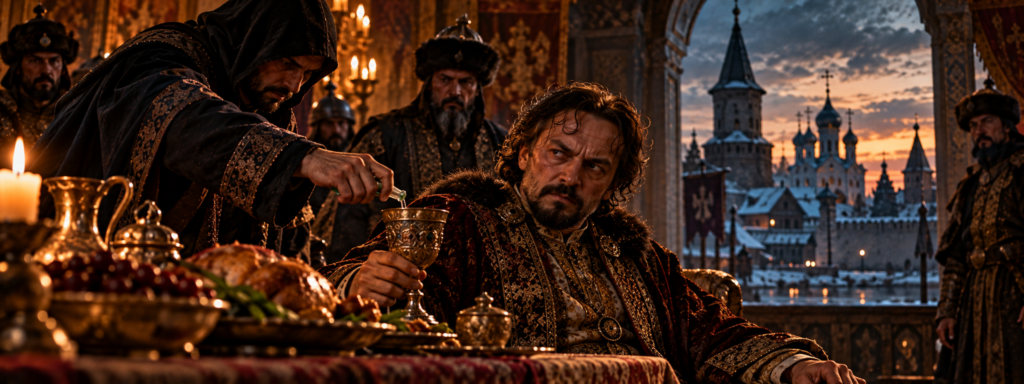
Dmitry Shemyaka: The Poisoned Prince Who Blinded His Cousin and Fought for the Throne of Moscow
Civil War, Betrayal, a Blinded Grand Prince, and the Deadly Poisoning That Ended One of Medieval Russia’s Most Ruthless Dynastic Feuds
Dmitry Yuryevich Shemyaka (died 17 July 1453) was a Russian prince of the Rurikid dynasty, the son of Yuri Dmitrievich of Zvenigorod and a grandson of Dmitry Donskoy, the celebrated Grand Prince of Moscow. He ruled important territories within the Muscovite princely domain, including Galich, and twice briefly held power in Moscow, most notably from 1446 to 1447 during a bitter civil war against his cousin, Vasily II. His struggle for the grand princely title formed part of a succession crisis that had divided the ruling family since the death of Vasily I in 1425. Shemyaka became notorious for his role in the seizure and blinding of Vasily II in 1446, an act that gave his rival the enduring epithet Vasily the Dark. After losing Moscow, Shemyaka continued resisting Vasily from northern territories and eventually found refuge in Novgorod. He died there on 17 July 1453, reportedly after eating poisoned chicken, in an assassination traditionally attributed to agents acting for Vasily II. The poisoning is described in medieval chronicle traditions, although the precise chain of responsibility and the details of the conspiracy cannot be independently verified. His death ended one of the most dangerous challenges to the consolidation of Muscovite power and left behind a reputation shaped by ambition, political violence, and the ruthless struggle between competing branches of the ruling dynasty.
A Poisoned Meal in Novgorod
In the summer of 1453, Dmitry Shemyaka was living in Novgorod, far from the Moscow throne he had once occupied and still hoped to recover. The city offered a degree of protection that had become increasingly difficult to find elsewhere. His armies had suffered reversals, his supporters had been pressured into submission, and the cousin he had once captured and blinded was firmly back in power. Yet Shemyaka remained alive, politically dangerous, and unwilling to disappear quietly into the margins of history.
Then came the meal that would end his life. According to the best-known chronicle tradition, poison was introduced into a chicken prepared for the exiled prince, and the substance reached him through the household responsible for his food. The account places the poisoning within a conspiracy associated with Moscow and identifies intermediaries who allegedly arranged for the deadly substance to reach Shemyaka’s cook. The story has the intimate horror of a medieval court murder: a man who had survived years of warfare, captivity, betrayal, and pursuit was brought down by something placed upon his table.
The precise sequence of the poisoning is not beyond dispute. Medieval chronicles sometimes preserve valuable information about political murders while also incorporating accusations shaped by loyalty, hostility, and the desire to explain an unexpected death. The traditional account strongly associates the plot with the interests of Vasily II, but it does not provide the kind of independently corroborated evidence that would establish every participant’s responsibility by modern standards. What is certain is that Shemyaka died in Novgorod in July 1453, at a moment when his removal served the political interests of the ruler who had defeated him.
His death was not simply the elimination of a troublesome exile. Shemyaka had been one of the most formidable opponents of Vasily II during a civil war that lasted for decades and repeatedly threatened to tear the Moscow principality apart. He had seized the capital, exercised grand princely authority, negotiated with rival rulers, and commanded supporters who believed his branch of the dynasty possessed a legitimate claim to power. Most notoriously, he had participated in the decision to blind Vasily, turning a political struggle into a personal vendetta that neither man could easily abandon.
The final irony was extraordinary. Shemyaka had once held his cousin helpless and ordered a punishment intended to make him incapable of ruling. Instead, the blinded prince returned to power, rebuilt his political position, and ultimately outlived the man who had mutilated him. By 1453, Vasily II no longer needed to defeat Shemyaka in a dramatic confrontation before the walls of Moscow. His rival could be removed in a distant city, through a method that left no battlefield and no public execution.
The poisoned meal became a fittingly sinister conclusion to a conflict in which family relationships had repeatedly been sacrificed to political ambition. The cousins had grown up within the same ruling dynasty, inherited competing interpretations of legitimate succession, and spent much of their adult lives struggling for the same throne. Their feud had produced imprisonments, confiscations, broken oaths, military campaigns, and acts of extraordinary cruelty. In the end, the prince remembered for blinding his rival died by a method that required neither an army nor a sword.
A Dynasty Divided Before His Birth
To understand Dmitry Shemyaka, it is necessary to understand the family that produced him. He belonged to the descendants of Dmitry Donskoy, the Grand Prince of Moscow whose victory over a Horde army at Kulikovo in 1380 became one of the most celebrated events in Russian historical memory. Dmitry Donskoy’s achievements strengthened Moscow’s prestige, although the victory did not end the political authority of the Mongol successor states over the Rus’ principalities. His descendants inherited both an expanding political inheritance and a complicated problem of succession.
The difficulty lay in the relationship between older dynastic customs and the growing preference for direct inheritance from father to son. Earlier Rurikid succession traditions had often recognized claims based upon seniority within a ruling family, allowing brothers and other relatives to compete for senior positions. Over time, Moscow’s rulers increasingly sought to preserve authority within a direct father-to-son line. These competing principles could produce sharply different answers to the question of who should inherit the grand princely title.
Dmitry Donskoy’s son Vasily I succeeded him as Grand Prince of Moscow in 1389. Another son, Yuri Dmitrievich, received substantial territories and retained an important place within the dynasty. Yuri was the father of Dmitry Shemyaka, making Shemyaka a grandson of Dmitry Donskoy and a first cousin of Vasily II. Their close relationship did not make the succession dispute less dangerous; it supplied both men with powerful arguments about their rights.
When Vasily I died in 1425, his son Vasily II was still a child. Yuri Dmitrievich, as the younger brother of the deceased ruler and an experienced prince in his own right, advanced a competing claim to the grand princely title. Supporters of Vasily II emphasized the right of the deceased grand prince’s son to inherit his father’s position. Yuri’s claim drew upon older traditions of seniority and the political standing of an adult member of the dynasty.
Neither interpretation was simply an invented excuse. The succession traditions of medieval Rus’ had developed over centuries and had never been entirely free from competing claims. Political circumstances, military strength, the decisions of powerful nobles, and recognition from the Horde could all influence the outcome. What made the dispute particularly destructive was that each side could present its position as legitimate while treating the other as an unlawful usurper.
Dmitry Shemyaka was born into this unresolved tension. He did not create the original succession dispute, and his later ambitions cannot be understood as a sudden personal obsession disconnected from his family’s history. His father had already become the principal challenger to the direct line represented by Vasily II. Shemyaka would eventually inherit that challenge, along with the bitterness created by years of warfare.
Yuri of Zvenigorod: The Father Who Challenged Moscow
Yuri Dmitrievich was no minor nobleman attempting to overthrow a distant monarch. He was a son of Dmitry Donskoy, the ruler of important appanage territories, and an experienced political figure whose position gave him a plausible claim to senior authority. His principal centers included Zvenigorod and Galich, territories that supplied the resources needed to support a serious challenge. He possessed dynastic prestige, military connections, and a family of sons who would become deeply involved in the struggle.
The political world of early fifteenth-century Moscow was not yet a unified state governed by an unquestioned hereditary monarch. The grand prince exercised considerable authority, but other members of the ruling family retained their own lands, revenues, and military followings. These appanage princes could act as allies, rivals, or independent political players depending upon circumstances. Their existence made dynastic disputes particularly dangerous because a claimant could possess the resources necessary to challenge the ruler militarily.
Yuri’s rivalry with Vasily II was initially shaped by negotiation and political maneuvering. Both sides sought recognition and support, including from the rulers of the Horde, whose authority remained significant in northeastern Rus’. The dispute was therefore not confined to Moscow’s internal affairs. It intersected with the wider political relationships that had shaped the region since the Mongol conquest.
The conflict eventually developed into open warfare. Yuri’s supporters argued that his senior dynastic position justified his claim, while Vasily’s supporters defended the rights of the direct heir. Military victories could temporarily settle possession of Moscow, but they did not resolve the underlying disagreement. Each reversal created new grievances and opportunities for retaliation.
Shemyaka and his brothers grew up within this political environment. Their father’s ambitions offered the possibility of extraordinary advancement, but also exposed them to the dangers of defeat. A victory could make them members of the ruling branch in Moscow. A defeat could threaten their lands, political standing, and personal freedom.
The family was also divided by differences among Yuri’s sons. Vasily Yuryevich, later known as Vasily Kosoy, and Dmitry Shemyaka would not always pursue identical strategies. Their rivalries and disagreements complicated the broader struggle against Vasily II. The conflict was therefore not a simple confrontation between two perfectly united dynastic camps.
Yuri’s determination established the political inheritance that Shemyaka would later pursue. The younger prince would inherit his father’s claim and the conviction that the Moscow throne could legitimately belong to their branch of the family. He would also inherit enemies who regarded that claim as a threat to the political stability of the grand principality. The resulting struggle would consume much of his life.
The Wedding Insult That Helped Ignite a Civil War
One of the most famous episodes in the early stages of the conflict occurred at the wedding of Vasily II in 1433. The ceremony should have been an occasion for dynastic celebration and political reconciliation. Instead, it became associated with a public humiliation that intensified the hostility between the ruling family and Yuri’s sons. The incident demonstrates how easily disputes over status and honor could become politically explosive.
According to chronicle accounts, Vasily Yuryevich appeared at the wedding wearing an ornate golden belt associated with an earlier episode of dynastic property and alleged theft. The belt was recognized or identified by members of the court, and the situation became a source of public embarrassment. Sophia of Lithuania, the mother of Vasily II, reportedly removed the belt from Vasily Yuryevich in front of the assembled guests. The precise details of the belt’s earlier history are complicated by chronicle tradition, but the public insult became central to the story.
Dmitry Shemyaka was connected to the incident through his presence and his relationship with the humiliated prince. The brothers reportedly left the wedding in anger, and the episode contributed to the escalation of hostilities. It would be misleading to claim that a single belt caused the entire civil war, because the succession dispute had existed for years. Nevertheless, the confrontation supplied an immediate grievance within a political environment already charged with resentment.
Honor mattered enormously among medieval ruling families. Public humiliation could undermine a prince’s prestige, suggest inferiority, and damage relationships with supporters. The alleged removal of the belt was therefore more than a dispute over jewelry. It symbolized the contested status of Yuri’s sons within the ruling dynasty.
The incident also reveals the importance of women within dynastic politics. Sophia of Lithuania was not a passive observer of her son’s political struggle. As the mother of the young grand prince, she played a significant role in defending his position and representing the interests of the ruling household. Her reported intervention at the wedding became one of the most memorable episodes of the conflict.
The confrontation helped turn existing hostility into renewed warfare. Yuri’s sons aligned themselves with their father’s cause, and the struggle for Moscow intensified. What had been a ceremonial gathering became part of the narrative of a dynasty breaking apart. The incident would be remembered because it captured the extraordinary fragility of family relationships at the center of political power.
For Shemyaka, the wedding controversy belonged to the beginning of a long career of conflict. He was still a young prince, but he had already become involved in a struggle that would define his political future. The insult to his brother reinforced the sense that their family was being denied its rightful standing. The consequences would extend far beyond the wedding hall.
Moscow Falls Into the Hands of Yuri
In 1433, Yuri Dmitrievich defeated Vasily II and occupied Moscow, achieving the political ambition that had driven his challenge. The victory demonstrated that the young grand prince’s position was far from secure. Yuri possessed sufficient military strength and support to seize the capital. Yet occupying Moscow proved easier than establishing an uncontested rule.
Vasily II retained supporters, and Yuri faced difficulties maintaining the political coalition needed to govern. The grand princely title carried prestige, but legitimacy also depended upon the willingness of nobles, towns, and other princes to accept the ruler. Yuri’s victory did not automatically erase the claims of his nephew. The struggle continued through negotiations and renewed conflict.
Yuri eventually relinquished Moscow, only to return to the struggle and recover the city in 1434. His political career during these years reflected the unstable balance between military success and dynastic legitimacy. Neither side could secure a decisive settlement. Each change of ruler deepened mistrust.
Dmitry Shemyaka and his brothers participated in the wider conflict, although their relationships with Yuri and one another were not always harmonious. Their political ambitions overlapped but did not always coincide. The struggle for Moscow created opportunities for each of them to pursue influence. It also generated tensions over who should lead the family after Yuri.
In June 1434, Yuri died while holding Moscow. His death abruptly transformed the political situation. The man who had provided the central leadership for the rival branch of the dynasty was gone. His sons now had to decide whether to continue his challenge or seek accommodation with Vasily II.
The succession within Yuri’s branch became contentious. Vasily Kosoy attempted to claim the grand princely title, but his brothers did not consistently support him. Shemyaka and Dmitry Krasny pursued their own interests, at times cooperating with Vasily II against their elder brother. The resulting divisions weakened the family at a moment when unity might have strengthened its position.
Yuri’s death therefore did not end the civil war. It redistributed the ambitions that had driven it. His sons inherited competing claims, political resentments, and territories that could sustain further resistance. Shemyaka would eventually emerge as the most formidable surviving challenger to Vasily II.
Brothers Against Brothers: The Fall of Vasily Kosoy
After Yuri’s death, Vasily Yuryevich attempted to continue the struggle for Moscow. His claim was opposed not only by Vasily II but also by members of his own family. Dmitry Shemyaka and Dmitry Krasny did not simply submit to their elder brother’s leadership. Their decisions reveal the fragmented nature of the rival dynastic coalition.
Vasily Kosoy’s struggle continued through military campaigns and political reversals. He attempted to maintain his position, but the balance increasingly shifted against him. The conflict culminated in his capture by forces loyal to Vasily II in 1436. His defeat removed one of the most important claimants from the struggle.
The punishment inflicted upon him was blinding. Vasily II ordered the mutilation of his cousin, who thereafter became known as Vasily Kosoy, or Vasily the Cross-Eyed. The act was intended to destroy his ability to challenge the grand princely title. It also introduced a particularly brutal form of political punishment into the family’s immediate experience.
Blinding possessed a long history as a method of disabling political rivals, especially in Byzantine and other medieval political traditions. It could render a claimant less suitable for rulership without necessarily requiring his execution. The punishment was nevertheless a devastating act of bodily violence. Its political purpose was to remove an opponent while leaving him alive.
For Shemyaka, the blinding of his brother became an important part of the family’s history. Although he had not consistently supported Vasily Kosoy, the mutilation demonstrated what defeat could mean in the struggle for Moscow. The political contest was no longer confined to the loss of territory or titles. A defeated prince could suffer permanent physical destruction.
The episode would acquire a grim significance ten years later. In 1446, Shemyaka would participate in the seizure and blinding of Vasily II. The parallel between the two acts was unmistakable, although their immediate political circumstances differed. Violence that had once been used against Yuri’s branch of the family would eventually be turned against the ruling grand prince.
The fall of Vasily Kosoy also altered Shemyaka’s position. With his elder brother politically disabled, he became an increasingly important representative of Yuri’s surviving line. His territories and dynastic claim gave him the means to continue the struggle. The feud had not ended; it had merely changed its principal participants.
Shemyaka’s Rise: From Appanage Prince to Dangerous Rival
During the years following the defeat of Vasily Kosoy, Dmitry Shemyaka developed into a significant political figure in his own right. He controlled important territories and possessed a dynastic claim rooted in his father’s challenge to Vasily II. His position was strengthened by the weakening or disappearance of other claimants within his branch of the family. Yet his relationship with the grand prince remained unstable.
The surviving chronicles describe periods of negotiation, tension, and conflict between Shemyaka and Vasily II. Their disagreements involved territorial rights, political obligations, and the larger question of authority within the Moscow principality. Shemyaka was not merely an ambitious courtier seeking influence over the ruler. He belonged to a competing branch of the ruling dynasty and possessed resources that could support military resistance.
The political structure of Muscovy made such resistance possible. Appanage princes retained lands and followers, while local elites could shift their allegiance according to circumstances. A grand prince might exercise senior authority without possessing complete control over every territory associated with the dynasty. The resulting system encouraged negotiation but also made civil war a recurring possibility.
Shemyaka’s reputation for ambition developed within this environment. His enemies portrayed him as a dangerous and unreliable figure, while his supporters could regard him as the defender of legitimate dynastic rights. Later historical narratives, written from the perspective of Moscow’s eventual consolidation, often treated his resistance as an obstacle to political unity. Such interpretations must be distinguished from the more uncertain political choices facing contemporaries.
The rivalry was also shaped by the legacy of previous violence. Vasily II had ordered the blinding of Vasily Kosoy, while Shemyaka’s family had repeatedly challenged the grand princely title. Neither side could assume that defeat would lead to generous treatment. The possibility of permanent punishment made compromise more difficult.
Shemyaka’s political calculations were therefore inseparable from fear. A rival who submitted might lose his lands or be imprisoned, while one who continued resisting risked military destruction. His later actions suggest that he believed control of Moscow offered the strongest guarantee of his position. The struggle became increasingly dangerous because both cousins had reasons to regard the other’s survival as a threat.
By the mid-1440s, the political balance was about to change dramatically. Vasily II would suffer a humiliating defeat at the hands of a Tatar force, creating a crisis that Shemyaka could exploit. The grand prince’s captivity and subsequent release would provoke suspicion among his own subjects. Shemyaka would use that discontent to launch the most successful challenge of his career.
The Disaster at Suzdal: Vasily II Falls Into Captivity
In 1445, Vasily II suffered a major military defeat near Suzdal against forces led by the sons of Ulugh Muhammad, the ruler associated with the emerging Kazan Khanate. The battle exposed the vulnerability of Moscow’s military position and resulted in the capture of the grand prince. His defeat was a serious political humiliation. A ruler whose authority depended partly upon military leadership had fallen into enemy hands.
The captivity created uncertainty throughout the principality. Vasily’s supporters needed to secure his release, while his rivals could exploit the disruption. The terms of his eventual ransom and the obligations associated with his return became subjects of controversy. Later accounts emphasized the burden of payments and the presence of Tatars connected with his release.
The episode was politically dangerous because it could be interpreted in different ways. Vasily’s supporters could argue that his release was necessary to restore legitimate authority and prevent further instability. His opponents could portray the arrangements as evidence that he had endangered the principality through excessive concessions. The financial and political consequences of the ransom became useful weapons in the struggle for support.
Shemyaka recognized the opportunity. The grand prince’s defeat weakened his prestige, while resentment over the ransom created an audience for accusations against him. Other princes and dissatisfied members of the political elite could be drawn into a coalition against Vasily. The crisis supplied the conditions for a coup.
The precise motives of every participant remain difficult to reconstruct. Some may have genuinely feared the consequences of Vasily’s arrangements with the Tatars. Others had dynastic grievances or personal ambitions. Political opposition in medieval courts rarely emerged from a single cause.
The captivity also exposed the fragility of Vasily’s authority. He had survived earlier challenges from Yuri and Vasily Kosoy, but his position remained dependent upon the loyalty of powerful men. Military defeat could rapidly alter those loyalties. Shemyaka was preparing to exploit that vulnerability.
When Vasily returned, he faced a political environment more dangerous than the one he had left. His enemies could now combine older succession claims with new accusations concerning his conduct. The stage was set for a dramatic seizure of power. The next confrontation would produce one of the most notorious acts of cruelty in the history of the Moscow dynasty.
February 1446: The Grand Prince Is Seized
In February 1446, Shemyaka and his allies moved against Vasily II. The grand prince was away from Moscow on a religious visit to the Trinity Monastery of St. Sergius when the conspiracy unfolded. The location added a particularly disturbing dimension to the seizure because it was associated with one of the most revered religious institutions of northeastern Rus’. A place of pilgrimage became the setting for political betrayal.
The conspirators seized Moscow and moved to capture Vasily. Shemyaka’s alliance included Ivan of Mozhaisk, another prince whose interests were aligned against the grand prince. Their action was not a spontaneous uprising but a coordinated attempt to remove Vasily from power. The conspirators understood that possession of the capital and control of the ruler were essential to success.
Vasily was captured and brought under the authority of his enemies. The man who had held the grand princely title since childhood was now a prisoner of his own relatives. His earlier defeat at Suzdal had weakened his position, but the coup transformed political vulnerability into personal helplessness. He could no longer rely upon his title to protect him.
The seizure also involved the wider ruling household. Vasily’s family and supporters became targets of political pressure, and the conspirators sought to secure control over the institutions of government. The coup therefore extended beyond the imprisonment of one man. It was an attempt to transfer the entire structure of grand princely authority to Shemyaka.
The surviving accounts of the capture were shaped by the political and religious traditions that later developed around Vasily’s suffering. Some details were emphasized to portray the conspirators as sacrilegious and treacherous. The central facts, however, are clear. Shemyaka participated in a successful coup that removed Vasily II from power.
The next decision would define Shemyaka’s historical reputation. Capturing a rival was one thing, but determining what to do with him was far more consequential. Execution could provoke resistance and religious condemnation, while release might allow Vasily to recover his position. The conspirators chose a punishment intended to destroy his ability to rule without immediately taking his life.
That punishment was blinding. The act would transform the political rivalry into a personal feud marked by permanent physical injury. It would also give Vasily II the name by which he remains widely remembered. The prince who emerged from captivity would be known as Vasily the Dark.
The Blinding of Vasily II: A Crime That Defined a Reign
Vasily II was blinded in February 1446 after his capture by Shemyaka and his allies. The punishment was intended to make him incapable of returning to power and to eliminate the threat posed by his dynastic claim. In medieval political culture, bodily mutilation could serve as an alternative to execution when rulers wished to disable a rival permanently. The act was nevertheless extraordinarily brutal.
The chronicles describe the blinding as a deliberate political punishment rather than an accidental injury sustained during captivity. Shemyaka bore responsibility as the principal beneficiary and leader of the coup, although the physical act was carried out by others. The distinction between ordering violence and personally inflicting it does not diminish the political responsibility involved. Vasily’s mutilation became inseparable from Shemyaka’s reputation.
The punishment also carried a terrible family irony. Ten years earlier, Vasily II had ordered the blinding of Shemyaka’s brother Vasily Kosoy. Now a similar punishment was inflicted upon Vasily himself. The parallel became one of the most striking features of the dynastic feud.
Blinding was meant to achieve a practical political result. A ruler who could not see might be considered less capable of commanding armies, administering government, or appearing as the embodiment of princely authority. The conspirators apparently expected Vasily’s physical condition to prevent him from recovering the throne. They underestimated both his determination and the loyalty he could still command.
The act also created a powerful narrative of suffering. Vasily had been seized while engaged in religious observance and subjected to a punishment that could be portrayed as both cruel and unlawful. His supporters could use the mutilation to strengthen their case against Shemyaka. The physical injury became a source of political legitimacy for the victim rather than a guarantee of his defeat.
The chronicles and later historical accounts sometimes present Shemyaka’s conduct through a strongly moralizing framework. He appears as the ambitious cousin who violated family bonds and inflicted a horrifying punishment upon the rightful ruler. This interpretation reflects the eventual triumph of Vasily’s line, but the underlying violence was real. Shemyaka’s decision gave his opponents an enduring symbol of his cruelty.
The blinding also transformed the relationship between the cousins. Political compromise became even more difficult after an act of permanent mutilation. Vasily could hardly regard Shemyaka as an ordinary rival who might safely retain substantial independent power. Shemyaka, in turn, had reason to fear what would happen if the blinded prince recovered his position.
The punishment failed in its intended purpose. Vasily survived and eventually returned to power, demonstrating that physical disability did not necessarily destroy political authority. His recovery would become one of the defining developments of the civil war. Shemyaka had inflicted a wound that could never heal, but he had not eliminated the man who would ultimately defeat him.
Shemyaka Takes the Throne of Moscow
After Vasily’s capture and blinding, Dmitry Shemyaka assumed power in Moscow. He had achieved what his father Yuri had struggled to secure and what his branch of the dynasty had pursued for decades. The grand princely title was now within his grasp. Yet the circumstances of his accession created serious problems for the legitimacy and stability of his rule.
Shemyaka’s authority depended upon the success of a coup that had removed the reigning grand prince through violence. He possessed a dynastic claim, but he also needed the support of nobles, religious leaders, and important towns. Some accepted his position, while others remained loyal to Vasily. The political landscape was therefore divided from the beginning.
The blinding of Vasily complicated Shemyaka’s efforts to secure broader acceptance. The punishment had been intended to neutralize his rival, but it also provoked sympathy and resentment. Religious figures could regard the treatment of the captive prince as an offense against Christian morality and dynastic order. Political supporters who might tolerate a change of ruler could still recoil from the cruelty of the method.
Shemyaka also faced the problem of Vasily’s surviving family. The blinded prince remained alive, and his sons represented the continuation of the direct ruling line. Their existence made it difficult to establish an uncontested succession. Removing Vasily from the throne had not removed every possible claimant.
The new ruler attempted to govern through the institutions and relationships available to him. His authority extended from possession of Moscow and recognition by supporters, but it remained vulnerable to defections. The political system was still sufficiently fragmented for powerful figures to change allegiance. Shemyaka could not simply command universal obedience.
The period also exposed the difference between seizing power and consolidating it. Military success and control of the capital provided an immediate advantage, but durable authority required legitimacy and political cooperation. Shemyaka had achieved the first without securing the second. His enemies were already working to reverse the coup.
Vasily’s captivity therefore became a central problem. Keeping him imprisoned risked further resentment, while releasing him could allow opposition to gather around his person. Shemyaka needed a solution that would neutralize his rival without provoking greater instability. His eventual decision would prove disastrous.
The prince who had ordered Vasily’s blinding was about to discover that the punishment had not destroyed his cousin’s political value. Instead, it had created a figure around whom opponents of Shemyaka could unite. The new grand prince’s greatest victory contained the seeds of his defeat.
The Blinded Prince Who Refused to Disappear
Vasily II survived his mutilation and remained a politically important figure. His blindness did not erase his dynastic claim or the loyalty of those who regarded him as the legitimate grand prince. Supporters continued to see him as the ruler whose authority had been unlawfully seized. His suffering could strengthen their commitment rather than weaken it.
Shemyaka eventually released Vasily from captivity under arrangements intended to limit his political ambitions. The blinded prince was assigned Vologda, a territory that could provide a place of residence without immediately restoring his former power. The decision was meant to reduce political tension and secure a settlement. Instead, it allowed Vasily to rebuild his position.
The surviving accounts describe oaths and agreements associated with Vasily’s release. Such arrangements were common in medieval political settlements, but they depended upon the willingness of both sides to honor them. Vasily’s supporters increasingly treated the agreements as invalid or unjust because they had been imposed under coercive circumstances. The moral and political legitimacy of the settlement became contested.
Religious authorities played an important role in the process. Clerics sympathetic to Vasily could present his suffering as evidence of injustice and encourage resistance to Shemyaka. The church was not a single political actor with uniform interests, but influential religious figures could affect the legitimacy of competing rulers. Their support mattered greatly in a society where political authority was closely connected to religious expectations.
Vasily also retained valuable family and political connections. His wife, Maria Yaroslavna, and his children represented the continuation of the ruling line. Loyal nobles and military commanders could gather around him. His physical disability did not prevent others from acting on his behalf.
The blinded prince’s recovery was therefore a political achievement rather than a miraculous reversal of physical injury. He could not regain his sight, but he could regain allies, resources, and recognition. Shemyaka’s decision to release him created the opportunity for that recovery. The punishment intended to make Vasily powerless had failed to eliminate his authority.
The struggle now entered a new phase. Shemyaka held Moscow but faced a growing coalition determined to restore his cousin. Vasily possessed a powerful claim strengthened by the circumstances of his suffering. The balance was shifting again.
The eventual reversal would become one of the most consequential moments in the civil war. A blinded ruler would return to the capital, while the prince who had mutilated him would be forced into retreat. The outcome would demonstrate that political legitimacy could survive even the most severe bodily punishment.
The Return of Vasily the Dark
By late 1446 and early 1447, opposition to Shemyaka had gathered sufficient strength to challenge his control of Moscow. Vasily II received support from powerful figures who regarded his removal as illegitimate or politically dangerous. The coalition against Shemyaka included men whose loyalties were shaped by dynastic claims, religious considerations, and practical interests. Their combined pressure undermined the usurper’s position.
Shemyaka’s control of the capital proved increasingly difficult to maintain. He had secured power through a dramatic coup, but the political coalition supporting him was not strong enough to withstand the return of Vasily’s supporters. The blinded prince’s claim remained compelling to many members of the ruling elite. Shemyaka could not eliminate that claim merely by possessing Moscow.
In 1447, Vasily II recovered the grand princely throne. His return marked a remarkable reversal of the events of the previous year. The man whom Shemyaka had attempted to disable permanently was once again the recognized ruler of Moscow. His blindness became part of his political identity rather than the end of his career.
The restoration was not achieved without struggle. Shemyaka retained territories, supporters, and the ability to continue resisting. The civil war therefore did not end with Vasily’s return. The conflict shifted from the immediate possession of Moscow to a prolonged struggle against the remaining power of Shemyaka.
Vasily’s experience had also changed the political stakes. He had been captured, blinded, and deprived of his throne by a close relative. Such an act made future reconciliation extraordinarily difficult. The restored grand prince had strong reasons to regard Shemyaka as a permanent threat.
Shemyaka’s position was equally dangerous. He had ordered a punishment that could not be forgotten, and his rival now possessed the authority to retaliate. Surrender might mean imprisonment, mutilation, or death. Continued resistance offered uncertain prospects but preserved some chance of survival.
The result was a conflict increasingly shaped by the impossibility of trust. Political agreements could be negotiated, but both sides had reasons to suspect betrayal. The family relationship that once connected the cousins had become a source of bitter hostility. The struggle continued because neither man could easily accept the other’s security.
Vasily’s restoration also strengthened the principle of direct dynastic succession within Moscow. His recovery demonstrated that the ruling line could survive even a successful coup and severe personal injury. Shemyaka’s rival claim remained dangerous, but its political prospects were diminishing. The balance of power was moving toward the consolidation of Vasily’s authority.
The Civil War That Would Not End
After losing Moscow, Shemyaka continued resisting Vasily II through military campaigns, political negotiations, and the use of territories that remained under his influence. His struggle was not a brief final gesture by a defeated claimant. It continued for years and required sustained efforts by Vasily’s government to contain him. The persistence of the conflict demonstrates that Shemyaka retained meaningful political resources.
The northern territories of the principality became particularly important. Their distance from Moscow and their connections with regional elites offered opportunities for resistance. Shemyaka could seek support from towns, military followers, and political figures dissatisfied with Vasily’s authority. The geography of northeastern Rus’ allowed the conflict to continue beyond the immediate surroundings of the capital.
The war involved shifting allegiances and repeated negotiations. Some supporters of Shemyaka eventually submitted to Vasily, while others remained loyal to the rival prince. The grand prince used military pressure and political settlements to weaken opposition. The surviving chronicles record a complicated sequence of campaigns and agreements rather than a single decisive battle.
The struggle also affected ordinary communities. Military campaigns could disrupt trade, damage settlements, and impose burdens upon inhabitants who had little control over dynastic disputes. The princes fought for authority, but the consequences were experienced by townspeople, peasants, merchants, and religious institutions. Civil war made political instability a feature of daily life.
Shemyaka’s continued resistance reflected both ambition and fear. He had once held Moscow and could still claim a place within the ruling dynasty. Yet his responsibility for Vasily’s blinding made the possibility of peaceful retirement uncertain. The longer the struggle continued, the more difficult it became for either side to accept a compromise.
Vasily’s government increasingly sought to isolate Shemyaka. Military victories weakened his territorial base, while political agreements reduced his support. The grand prince also benefited from the growing preference among important elites for a stable central authority. Shemyaka’s claim became less attractive as the costs of continued war mounted.
The conflict gradually shifted against him. He could still evade complete destruction, but recovering Moscow became increasingly unlikely. His political position depended upon finding allies outside the areas firmly controlled by Vasily. The struggle that had once brought him to the throne was becoming a fight for survival.
By the early 1450s, Shemyaka’s prospects had narrowed dramatically. He had lost the capital, suffered military reversals, and faced growing pressure from the restored grand prince. His remaining hope lay in territories and political relationships beyond Moscow’s immediate control. The road toward Novgorod was becoming increasingly important.
Novgorod: The Last Refuge of a Defeated Prince
Novgorod occupied a distinctive position in the political world of medieval Rus’. It was a wealthy commercial city with institutions and traditions that differed from those of the hereditary principalities. Its political life involved powerful boyar families, assemblies, and negotiations with neighboring rulers. The city possessed enough autonomy to offer refuge to political figures who had fallen into conflict with Moscow.
For Shemyaka, Novgorod represented an opportunity to survive beyond Vasily’s immediate reach. The city had economic resources, political connections, and an interest in preserving its freedom of action. Supporting or sheltering a rival claimant could provide leverage in relations with Moscow. Yet such protection also carried risks.
Novgorod’s rulers had to balance their interests carefully. Openly supporting Shemyaka could provoke military pressure from Vasily II, while abandoning him might reduce the city’s ability to negotiate independently. The decision was therefore not simply an act of generosity toward an exiled prince. It belonged to the wider contest over the relationship between Moscow and Novgorod.
Shemyaka’s presence also had symbolic significance. He had once ruled Moscow and remained a member of the Rurikid dynasty. His survival offered a possible alternative to Vasily’s authority. Even without a strong army, he could serve as a focus for opposition.
The political situation made his continued existence dangerous to Moscow. A rival claimant could become useful if Vasily faced another military defeat or internal crisis. Novgorod’s resources might allow Shemyaka to rebuild support. The grand prince therefore had reasons to regard the exile as an unresolved threat.
The surviving evidence does not establish every detail of Shemyaka’s activities during his final months. He remained politically significant, but the extent of his practical ability to resume the struggle is uncertain. Later accounts often interpret his death through the assumption that Moscow sought to eliminate him. That interpretation is plausible within the political context, but individual claims require careful examination.
Novgorod nevertheless became the setting for the final act of the feud. The city that offered Shemyaka refuge could not guarantee his safety within his own household. A prince who had survived armed conflict could still be vulnerable to servants, food preparation, and private access. The danger had moved from the battlefield to the dinner table.
The contrast was extraordinary. Shemyaka had spent years fighting for the most prestigious title in northeastern Rus’, yet his final fate would be determined far from Moscow. His enemies no longer needed to confront him in open battle. The struggle had entered the shadowy world of alleged political poisoning.
The Conspiracy of the Poisoned Chicken
The traditional account of Shemyaka’s death describes a conspiracy involving poison introduced into food prepared for him in Novgorod. The story is preserved in chronicle traditions that identify individuals allegedly connected with the delivery of the substance. One frequently cited version associates the plot with a Moscow agent named Stepan Borodaty and a clerk or official connected to Vasily’s government. The poison was reportedly passed to a member of Shemyaka’s household responsible for preparing his meals.
The account is memorable because of its domestic setting. Shemyaka had survived political imprisonment, military campaigns, and years of pursuit, but the alleged murder required access to his food rather than his defenses. A cook could approach the prince in ways that an armed enemy could not. The household became the place where political hostility could be transformed into a fatal act.
According to the familiar narrative, the poison was placed in chicken intended for Shemyaka’s meal. The detail has been repeated in later histories and popular accounts because it gives the assassination a vivid and unsettling character. Yet the surviving sources do not provide modern forensic confirmation of poisoning or an independently verified record of every participant. The chicken story should therefore be presented as a chronicle account rather than an unquestionable reconstruction.
The alleged involvement of Moscow is central to the interpretation of the death. Vasily II had powerful reasons to desire Shemyaka’s removal. His rival had seized the throne, ordered his blinding, and continued resisting after losing Moscow. The disappearance of such an opponent would strengthen the restored grand prince’s position.
Political motive, however, is not identical to proof of a specific order. The chronicles associate the poisoning with agents serving Moscow’s interests, but they do not preserve a surviving written command from Vasily II authorizing the murder. Nor do they provide the kind of independent evidence that would establish the entire conspiracy beyond dispute. The distinction matters because political murders were often explained through accusations against the victim’s most obvious enemy.
The alleged method nevertheless fits the political circumstances. Shemyaka was protected by distance and by Novgorod’s political environment, making a straightforward military seizure difficult. Poison could reach him without requiring an army to enter the city. A covert operation would also avoid the public consequences of another dramatic act of princely violence.
The story reflects a wider medieval fear of poisoning within elite households. Food preparation required trust, and rulers depended upon servants who could possess intimate access to their bodies and daily routines. Accusations of poisoning were therefore especially powerful because they suggested betrayal from within. Whether every detail of Shemyaka’s final meal is accurate, the tradition captures the vulnerability of a prince whose political enemies remained determined.
The alleged conspiracy became part of Shemyaka’s enduring reputation. His life had been marked by visible acts of political violence, most notably the blinding of Vasily II. His death, by contrast, was remembered as secretive and indirect. The contrast gave the feud a dark conclusion: the man who had mutilated his rival in captivity was himself allegedly destroyed through betrayal at his table.
July 17, 1453: The Death of Dmitry Shemyaka
Dmitry Shemyaka died in Novgorod on 17 July 1453, according to the commonly accepted date. His death ended his active challenge to Vasily II and removed one of the last major claimants from the rival branch of the Moscow ruling dynasty. The traditional explanation is poisoning, specifically through contaminated food prepared for him. The precise medical cause and every detail of the alleged conspiracy remain dependent upon medieval narrative sources.
Some accounts describe Shemyaka becoming ill after consuming the poisoned meal and dying after a period of suffering. The chronology and symptoms are not documented with sufficient precision to support a modern medical diagnosis. It would therefore be misleading to identify a particular poison or describe specific physical effects as established facts. The historical tradition is clear about the allegation of poisoning, but less secure about its mechanism.
The death occurred at a politically convenient moment for Vasily II. Shemyaka had been driven from Moscow and had lost much of his ability to challenge the grand prince directly. Nevertheless, his survival continued to represent a possible source of instability. His removal eliminated a claimant whose dynastic position could be exploited by dissatisfied elites or foreign powers.
The news of his death reportedly reached Moscow and was received with satisfaction by the ruling side. Later accounts connect the announcement with rewards or advancement for individuals associated with the alleged plot. Such details strengthen the traditional interpretation of political assassination, although their exact significance remains subject to the reliability of the chronicles. The sources do not provide an independently verifiable record of the grand prince’s private reaction.
For Shemyaka’s household, the death marked the end of years of uncertainty. His family had followed a prince whose fortunes shifted from territorial power to the grand princely throne and then to exile. His death removed their principal political protector. The consequences would extend to his widow, children, and remaining supporters.
The assassination tradition also reveals the personal nature of the feud. Vasily and Shemyaka were cousins, descendants of the same celebrated ruling house. Their conflict had begun within a dispute over inheritance and developed into a struggle involving imprisonment, mutilation, and repeated warfare. The alleged poisoning was the final act in a relationship that had become impossible to reconcile.
Shemyaka’s death did not immediately solve every political problem facing Moscow. Novgorod remained powerful, regional elites retained interests of their own, and the grand principality continued to face external challenges. Yet the removal of Shemyaka greatly reduced the danger posed by the rival dynastic claim. The civil war that had dominated the reign of Vasily II was approaching its conclusion.
The prince’s death was therefore both personal and political. A man who had once ruled Moscow died in exile, far from the throne he had sought. His enemies gained security, while his supporters lost the figure around whom their resistance had gathered. The poisoned meal became the symbol of a dynasty’s final defeat.
Did Vasily II Order the Poisoning?
The question of Vasily II’s responsibility is central to any account of Shemyaka’s death. The grand prince possessed an unmistakable political motive. Shemyaka had captured him, ordered his blinding, seized his throne, and continued resisting after his restoration. Removing such an enemy would strengthen Vasily’s authority and reduce the possibility of another civil war.
The traditional chronicle account connects the poisoning to agents associated with Moscow. It describes a covert operation in which poison reached Shemyaka through intermediaries and a member of his household. Later historians have frequently treated the episode as an assassination organized on Vasily’s behalf. The narrative is therefore not a modern invention disconnected from medieval sources.
Nevertheless, the degree of certainty must be stated carefully. The surviving accounts were written in political environments where the actions of rival princes were interpreted through loyalty and hostility. They do not preserve a direct order from Vasily II or an independently verified confession establishing every participant’s role. The historical evidence supports the existence of a strong assassination tradition, but not an absolute reconstruction of the chain of command.
The political context makes the accusation plausible. Vasily had spent years attempting to suppress Shemyaka’s resistance, and the exiled prince remained a potential threat. A covert killing in Novgorod would remove that threat without requiring a costly military campaign. The method described in the chronicles fits the interests of the restored grand prince.
At the same time, political convenience alone cannot prove responsibility. Medieval rulers often benefited from the deaths of rivals without necessarily ordering them. Other individuals could possess motives of their own, including the desire to gain favor with the ruling court. The distinction between an operation directly ordered by Vasily and one undertaken by supporters acting in his interests remains important.
The reported rewards associated with the news of Shemyaka’s death have been interpreted as evidence of official approval. Such details deserve attention, but they must be evaluated within the limitations of the sources. A reward might indicate gratitude, prior involvement, or the political value of the information. It does not automatically establish every stage of the alleged conspiracy.
The most responsible conclusion is that Shemyaka was traditionally believed to have been poisoned through a plot connected to Moscow, with Vasily II widely regarded as the ultimate beneficiary and probable political sponsor. The precise extent of his direct involvement cannot be demonstrated beyond dispute. Presenting that uncertainty does not weaken the story; it preserves the difference between historical evidence and dramatic reconstruction.
The accusation has endured because it fits the terrible logic of the feud. Shemyaka had attempted to destroy Vasily’s ability to rule through blinding, and Vasily ultimately survived to see his rival eliminated. The alleged poisoning offered a method of vengeance that was quieter than the violence of 1446 but no less consequential. Whether Vasily personally issued the order or benefited from the actions of his supporters, Shemyaka’s death marked the final defeat of his challenge.
The Widow and Children Left Behind
Shemyaka’s death affected more than the political struggle for Moscow. He left behind a family whose future had been shaped by his ambitions and defeats. His wife, Sophia Dmitrievna, belonged to the aristocratic world of the northern principalities, and their children inherited the consequences of their father’s political position. The family could no longer rely upon Shemyaka’s military power or dynastic claim for protection.
His son Ivan Dmitrievich continued the family’s line but did not recover the Moscow throne. The political circumstances that had allowed Shemyaka to challenge Vasily II were rapidly disappearing. The restored grand prince possessed stronger control over the capital and greater support among important elites. The prospects for another successful challenge from Yuri’s descendants had diminished.
The family also faced the practical consequences of exile and political defeat. Lands, revenues, and relationships could be disrupted when a prince lost his position. Supporters might seek reconciliation with the victorious ruler, while relatives could find their claims weakened. The death of the principal claimant often accelerated the collapse of a political faction.
Sophia’s position illustrates the vulnerability of women within dynastic conflicts. Marriage connected noble families and strengthened political alliances, but it also exposed wives and children to the consequences of their husbands’ ambitions. A prince’s defeat could transform the security of an entire household. The surviving sources provide limited information about Sophia’s private experience, and it would be speculative to invent her reactions to the poisoning.
The fate of Shemyaka’s descendants also demonstrates the narrowing political possibilities for rival branches of the Moscow dynasty. Earlier generations had possessed substantial appanage territories and credible claims to senior authority. By the middle of the fifteenth century, the restored grand princely line was increasingly capable of limiting those challenges. Shemyaka’s death accelerated that development.
His family remained part of the wider Rurikid world, but their political future no longer centered upon an immediate struggle for Moscow. The grand princely title had become more firmly associated with Vasily II and his descendants. The civil war had demonstrated the dangers of divided dynastic authority. The victorious line would seek to prevent similar challenges.
The household that survived Shemyaka therefore inherited a legacy of defeat rather than triumph. His brief possession of Moscow could not secure the throne for his children. His military campaigns had failed to establish a lasting alternative political center. His death removed the figure who had kept the rival claim alive.
The human consequences are easy to overlook amid the dramatic events of the civil war. Behind the struggle between cousins stood families whose lives were repeatedly disrupted by captivity, exile, and violence. Shemyaka’s widow and children belonged to that history. The poisoning ended the prince’s life, but its consequences continued for those who survived him.
The Strange Reputation of Shemyaka’s Justice
Dmitry Shemyaka’s name acquired an enduring association with corrupt or arbitrary judgment in Russian historical tradition. The expression commonly translated as “Shemyaka’s judgment” became linked to the idea of an unjust or absurd legal decision. This reputation developed through later literary and folkloric traditions rather than a straightforward record of his judicial administration. It therefore requires careful distinction from documented events during his rule.
The satirical tale known as The Tale of Shemyaka’s Judgment became an important part of Russian literary culture. It depicts a judge whose decisions are influenced by misunderstanding, self-interest, or corruption. The story’s humor depends upon the exposure of judicial absurdity. Its connection to the historical prince is complex and should not be treated as proof that he personally decided cases in the manner described.
The association nevertheless reveals how Shemyaka’s reputation developed after his death. His political career had been marked by rebellion against the ruling line, the seizure of Moscow, and the blinding of Vasily II. Later memory could easily transform such a figure into a symbol of unjust authority. The satirical tradition reinforced an image already shaped by the victory of his enemies.
The phrase also demonstrates how historical names can acquire meanings beyond the lives of the individuals who bore them. A ruler remembered for political violence may become associated with broader ideas of tyranny or injustice. Over time, the literary image can overshadow the complicated historical person. Shemyaka’s actual career becomes reduced to a moral example.
A responsible historical account must resist that simplification. Shemyaka was a claimant within a genuine dynastic succession dispute, not merely a fictional embodiment of corruption. His family possessed arguments for its political position, and the civil war involved violence committed by both sides. Vasily II himself had ordered the blinding of Shemyaka’s brother Vasily Kosoy.
None of this excuses Shemyaka’s treatment of Vasily in 1446. The blinding was a deliberate act of political mutilation intended to remove a rival from power. It remains one of the defining facts of his career. Yet historical interpretation becomes distorted when every aspect of his life is explained through a later reputation for injustice.
The literary tradition is therefore valuable as evidence of memory rather than direct biography. It reveals how Shemyaka’s name became associated with arbitrary power and corrupt judgment. It does not establish the details of his actual court proceedings. The distinction matters because the prince’s historical reputation was shaped by the political outcome of the civil war.
Shemyaka’s memory became a warning about the dangers of unlawful ambition and cruel government. The victorious Moscow dynasty had little reason to preserve a sympathetic image of the man who had blinded Vasily II. Later storytelling reinforced the moral condemnation. The historical prince remained more complicated than the legend that grew around his name.
Vasily the Dark: The Victim Who Became the Victor
Vasily II’s recovery after his blinding was one of the most remarkable political developments of the civil war. His enemies had attempted to destroy his ability to rule through permanent physical injury. Instead, he regained Moscow and gradually consolidated his authority. The punishment intended to end his career became part of the story of his survival.
His blindness required him to depend upon trusted supporters and established political relationships. Military commanders, advisers, family members, and religious figures could act on his behalf. The grand prince’s authority therefore did not depend solely upon his personal ability to lead armies or perform every administrative task. His position rested upon a broader network of loyalty.
The restoration also strengthened the legitimacy of his direct dynastic line. Vasily’s supporters could portray him as a rightful ruler who had suffered unjust violence and returned through determination and divine favor. Such narratives were politically useful, but they were grounded in the undeniable fact of his mutilation. Shemyaka had supplied his rival with a powerful symbol of suffering.
Vasily’s victory did not make him a gentle or forgiving ruler. He had previously ordered the blinding of Vasily Kosoy, and his government pursued Shemyaka through years of conflict. The political culture of the period accepted forms of coercion and punishment that modern readers would regard as exceptionally brutal. Both sides participated in a struggle where dynastic survival could justify severe violence.
The difference was that Vasily ultimately secured the political coalition needed to prevail. His supporters controlled Moscow, strengthened his position, and gradually reduced the resources available to Shemyaka. The rival prince’s death removed the most persistent remaining threat. Vasily could then devote greater attention to consolidating authority.
His reign also helped prepare the way for the political achievements of his son Ivan III. The struggle against rival branches of the dynasty demonstrated the dangers of fragmented princely authority. The victorious line increasingly sought to restrict the independence of competing claimants. The experience of civil war contributed to the longer process of Muscovite centralization.
Shemyaka’s death therefore benefited more than one ruler. It strengthened the political future of Vasily’s descendants and reduced the likelihood of another challenge from Yuri’s branch. The grand princely title became more securely associated with the direct line. The succession dispute that had erupted after 1425 was approaching its end.
The irony remained extraordinary. Vasily II had been blinded by his cousin and temporarily deprived of his throne. Yet he survived, returned to power, and outlived the man responsible. Shemyaka had attempted to make his rival incapable of ruling, only to discover that the blinded prince could still defeat him.
The Civil War and the Making of Moscow
The conflict between Vasily II and Dmitry Shemyaka was part of a broader transformation in the political structure of northeastern Rus’. Earlier generations had accepted a system in which different branches of the Rurikid dynasty possessed substantial territories and competing claims. The civil war demonstrated how dangerous that arrangement could become when the grand princely succession was disputed. The eventual victory of Vasily’s line strengthened the movement toward more concentrated authority.
Moscow’s rise had already been underway for generations. Its rulers accumulated territories, cultivated relationships with the Horde, and gradually expanded their influence over neighboring principalities. The civil war interrupted that process but did not reverse it permanently. Instead, the conflict helped reveal the political costs of allowing rival appanage princes to challenge the grand princely title.
Shemyaka represented an older pattern of dynastic competition in which a powerful collateral branch could claim senior authority. His father’s position as a son of Dmitry Donskoy gave the family a plausible basis for its ambitions. Yet the political future increasingly favored the direct line descending from Vasily I. The defeat of Shemyaka marked a significant step in that development.
The war also altered relationships between rulers and elites. Nobles, military commanders, and religious figures had to choose between competing claimants. Their decisions could determine the outcome of campaigns and political negotiations. The eventual consolidation of Vasily’s authority depended upon the support of these groups.
The conflict was costly for the population. Military campaigns disrupted trade, damaged settlements, and created insecurity across the territories involved. Political instability could affect taxation, landholding, and the ability of communities to maintain ordinary economic life. The struggle for a dynastic title therefore had consequences far beyond the ruling family.
Novgorod’s role in the final stages of the conflict also foreshadowed future tensions. The city had provided refuge to Shemyaka and remained an important center of political autonomy. Moscow’s rulers increasingly sought to extend their influence over such territories. The eventual incorporation of Novgorod under Ivan III would occur decades later, but the rivalry already reflected competing visions of political authority.
The death of Shemyaka did not immediately create a unified Russian state. The process of centralization remained incomplete, and significant political challenges continued. Nevertheless, his removal weakened one of the most dangerous alternative claims to Moscow’s leadership. The victory of Vasily’s line helped establish the conditions for later expansion.
Shemyaka’s historical significance therefore extends beyond the dramatic details of his poisoning. His career represents a major struggle over the nature of succession and political authority. His defeat contributed to the consolidation of Moscow under a more dominant ruling line. The civil war that consumed his life became part of the history of the state that eventually emerged from it.
The Politics of Poison: Why a Meal Could Be More Dangerous Than an Army
Poisoning occupied a particularly sinister place in medieval political imagination. Rulers could defend themselves against armies through fortifications, soldiers, and alliances, but food and drink created vulnerabilities that were difficult to eliminate. A trusted servant could possess access that no enemy soldier could obtain. The fear of poison therefore reflected the intimate dangers of elite households.
The alleged assassination of Shemyaka fits this pattern. He had survived military defeat and found refuge in a city beyond Moscow’s immediate control. His enemies could not easily seize him without political consequences. A covert poisoning offered a means of removing him without a public confrontation.
The method also avoided the symbolic difficulties of another execution or blinding. Vasily II had already suffered mutilation at Shemyaka’s hands, and an openly ordered punishment might have renewed controversy over dynastic violence. A death attributed to poison could eliminate the rival while leaving room for uncertainty about responsibility. Such ambiguity was politically useful even when suspicion remained widespread.
The traditional account depends upon betrayal within Shemyaka’s household. A cook or servant responsible for food preparation allegedly became the means through which the poison reached the prince. The story therefore combines political conspiracy with the collapse of domestic trust. The victim’s ordinary routine became the instrument of his destruction.
Medieval accounts of poisoning require particular caution because the accusation was difficult to verify. Sudden illness could be interpreted as evidence of deliberate poisoning, especially when the victim possessed powerful enemies. Chroniclers might preserve genuine information about a conspiracy, but they could also repeat rumors that fit political expectations. The distinction between documented death and alleged method must remain clear.
In Shemyaka’s case, the poisoning tradition is historically significant even where details remain uncertain. It demonstrates how his contemporaries or later chroniclers understood the end of the feud. His death was not remembered simply as an unexplained illness. It became associated with the political interests of Moscow and the secret removal of a dangerous rival.
The story also reflects the transformation of Shemyaka’s position. Earlier in his career, he commanded forces and seized the capital through direct action. By 1453, he was vulnerable to a covert attack within his place of refuge. The contrast reveals how thoroughly his political fortunes had declined.
The poisoned meal became the final symbol of the civil war’s cruelty. The struggle had begun with competing claims to a throne and developed through battles, captivity, and mutilation. It ended with the alleged corruption of a prince’s food. The violence had moved from public warfare into the private spaces of everyday life.
Assassination, Revenge, and the Limits of Historical Certainty
Dmitry Shemyaka’s death belongs within the history of political assassination because the traditional account describes a deliberate poisoning intended to eliminate a rival claimant. The alleged plot was connected to agents serving the interests of Vasily II, and the victim’s removal had clear political consequences. The method differed from battlefield killing or public execution. It was remembered as a covert act carried out through intermediaries.
The historical classification nevertheless requires qualification. The poisoning is reported in medieval chronicle traditions, but the precise medical cause of death and every detail of the conspiracy cannot be independently verified. It is therefore more accurate to describe Shemyaka as reportedly poisoned than to present the full chicken narrative as an unquestionable forensic reconstruction. The distinction preserves historical accuracy without dismissing the traditional account.
Vasily II’s motive was substantial. Shemyaka had seized his throne, ordered his blinding, and continued resisting for years after losing Moscow. His survival threatened the stability of the restored grand prince’s rule. The death of such an enemy was politically advantageous.
Yet motive and benefit do not automatically establish direct responsibility. The surviving sources do not preserve an indisputable order from Vasily authorizing the poisoning. They associate the plot with Moscow and identify alleged intermediaries, but the evidence remains dependent upon chronicle transmission. A careful historian must distinguish between a plausible political conclusion and a fact established beyond dispute.
The event also belongs to the history of revenge. Shemyaka had inflicted permanent injury upon Vasily in 1446, and the grand prince had strong personal reasons to hate him. The alleged poisoning can therefore be interpreted as the final retaliation in a long feud. Whether personal vengeance or political calculation predominated cannot be determined with certainty.
The two motives were not mutually exclusive. Medieval dynastic politics often blurred the distinction between family grievance and state interest. Removing Shemyaka could satisfy personal hostility while strengthening Moscow’s political stability. The same act could serve both purposes.
Shemyaka’s death also illustrates the dangers faced by defeated claimants. Exile did not necessarily end a political rivalry, especially when the claimant retained supporters and a legitimate dynastic connection. A ruler who wished to secure his position might regard the continued existence of such an opponent as intolerable. The result could be assassination rather than reconciliation.
The tragedy is that the feud had become almost impossible to resolve peacefully. Shemyaka had blinded Vasily, and Vasily had returned to power. Each man’s survival threatened the other. The alleged poisoning brought the struggle to an end through the removal of one of its principal participants.
Was Dmitry Shemyaka a Villain or a Victim of His Times?
Dmitry Shemyaka has often been portrayed as one of the villains of medieval Russian history. His role in the blinding of Vasily II made him an obvious target for condemnation. His repeated attempts to seize or recover Moscow contributed to a reputation for ruthless ambition. Later literary traditions associated his name with corrupt judgment and arbitrary power.
There is substantial historical justification for criticism of his actions. The seizure of Vasily in 1446 was a deliberate political coup, and the blinding was an act of severe bodily violence. Shemyaka sought to eliminate his cousin’s ability to rule through permanent mutilation. The cruelty of that decision should not be minimized.
Yet a complete account must also acknowledge the political world in which he acted. His father Yuri possessed a genuine dynastic claim rooted in the succession traditions of the Rurikid dynasty. Vasily II himself had ordered the blinding of Shemyaka’s brother Vasily Kosoy. The conflict involved violence and coercion on both sides.
Shemyaka’s ambitions were therefore not simply those of an outsider attempting to overthrow a universally accepted ruler. He belonged to a powerful branch of the ruling family and inherited a claim that had been contested for decades. His supporters could regard him as a legitimate alternative to Vasily. The political outcome eventually favored the direct line, but that outcome was not predetermined when the struggle began.
The historical record is also shaped by the victory of Vasily’s descendants. The ruling line that emerged triumphant had reasons to present Shemyaka as a dangerous usurper. Later chroniclers and writers could interpret his actions through the moral framework of illegitimate rebellion. Such perspectives require scrutiny, even when the underlying acts of violence are well established.
Shemyaka’s death adds another layer of complexity. The man remembered for ordering a cruel punishment was himself reportedly murdered through a covert conspiracy. His final years were marked by military defeat, displacement, and political vulnerability. He became a victim of the same ruthless struggle in which he had participated.
It would be misleading to excuse his actions entirely by describing him as a product of his times. Medieval political culture permitted severe punishment, but individual rulers still made choices. Shemyaka chose to participate in the blinding of Vasily, and that decision had enormous consequences. Historical context explains the act without making it morally insignificant.
The most accurate portrait is therefore neither a simple villain nor an innocent victim. Shemyaka was an ambitious dynastic claimant who pursued power through methods that included betrayal and mutilation. He also lived within a political system where defeat could bring imprisonment, loss of territory, or death. His career demonstrates how personal ambition and structural instability could reinforce one another.
The End of the Cousins’ War
The death of Dmitry Shemyaka in 1453 removed the most persistent rival to Vasily II’s authority. The civil war that had begun with the succession dispute after Vasily I’s death in 1425 had consumed nearly three decades. It had involved multiple generations of the ruling dynasty, repeated changes of power, and acts of extraordinary violence. Shemyaka’s removal brought the long struggle close to its conclusion.
Vasily II emerged as the surviving victor. He had endured military defeat, captivity, the loss of Moscow, and permanent blindness. His return to power demonstrated the strength of his political support and the resilience of the direct ruling line. The death of Shemyaka reduced the danger of another challenge from Yuri’s descendants.
The conflict also left a legacy of mistrust within the dynasty. Brothers and cousins had repeatedly fought over the grand princely title, and political settlements had failed to produce lasting peace. The experience encouraged efforts to strengthen central authority and reduce the independence of rival appanage princes. The political structure of Moscow would continue changing in the decades ahead.
Shemyaka’s defeat contributed to that transformation. His claim represented a competing interpretation of dynastic succession that had once possessed substantial political support. Its collapse strengthened the position of Vasily’s descendants. The direct line became increasingly dominant.
The civil war also demonstrated the importance of political coalitions. Military victories alone had not guaranteed lasting power for Yuri or Shemyaka. Vasily’s recovery depended upon supporters who continued to recognize his legitimacy after his blinding. The eventual outcome reflected the ability of one faction to maintain broader and more durable support.
For Novgorod, Shemyaka’s death removed a politically useful but dangerous exile. The city remained an important center of autonomy, yet Moscow’s growing strength posed an increasing challenge. The relationship between the two powers would become more contentious in the following decades. Shemyaka’s final refuge therefore belonged to a wider history of political competition.
The poisoned meal also left a lasting image of the conflict’s brutality. A war that had begun over succession ended with a prince reportedly murdered through food prepared in his own household. The method suggested that political enemies could reach a defeated claimant even when armies could not. The struggle had become so bitter that exile offered no guarantee of safety.
The end of Shemyaka’s career was therefore more than the death of one ambitious prince. It marked the defeat of a rival dynastic project and strengthened the political future of Moscow’s ruling line. The civil war had reshaped the principality through violence and repeated crises. Its conclusion helped prepare the way for the more centralized authority that would emerge under later rulers.
The Prince Who Blinded His Enemy and Died by Poison
Dmitry Shemyaka was born into a dynasty whose political ambitions had already created a dangerous succession dispute. His father Yuri challenged the claim of Vasily II, and the conflict divided the ruling family into competing branches. Shemyaka inherited that struggle and eventually became one of its most formidable participants. His career was shaped by the conviction that his family possessed a legitimate claim to Moscow’s grand princely title. The pursuit of that claim would consume much of his life.
His rise unfolded through warfare, political alliances, and the gradual elimination of other claimants. The defeat and blinding of his brother Vasily Kosoy demonstrated the brutality of the conflict and the dangers facing those who lost. Shemyaka nevertheless continued pursuing power, eventually exploiting the crisis created by Vasily II’s capture near Suzdal. In 1446, he seized Moscow and participated in the decision to blind his cousin. The act became the defining crime of his political career.
The punishment was intended to make Vasily incapable of ruling, but it failed. The blinded grand prince survived, recovered political support, and returned to Moscow in 1447. Shemyaka lost the capital and spent the following years resisting from territories beyond the restored ruler’s immediate control. His political position weakened through military defeats, defections, and the gradual consolidation of Vasily’s authority. The prince who had once occupied the throne became an increasingly isolated claimant.
By 1453, Shemyaka had found refuge in Novgorod, where he remained a potential threat to Moscow. The traditional account of his death describes poison introduced into chicken prepared for his meal, allegedly through a conspiracy involving agents associated with Vasily II. The precise details cannot be independently verified, and the surviving sources do not establish every participant’s responsibility beyond dispute. Nevertheless, the poisoning tradition has endured as the accepted explanation in many historical narratives. Shemyaka died on 17 July 1453, and his death removed the most dangerous surviving rival to Vasily’s rule.
The political consequences were significant. The long civil war had demonstrated the instability created by competing dynastic claims and the independence of powerful appanage princes. Shemyaka’s defeat strengthened the direct ruling line and contributed to the consolidation of Moscow’s authority. His death also reduced the possibility of another major challenge from Yuri’s descendants. The struggle that had consumed nearly three decades was finally approaching its end.
Shemyaka’s reputation remained dark. His role in the blinding of Vasily II became inseparable from his name, while later literary traditions associated him with corrupt and arbitrary judgment. Yet his career was more complicated than the image of a simple villain. He belonged to a dynasty with genuine competing succession claims and lived within a political culture where imprisonment, mutilation, and betrayal were familiar instruments of power. His actions were cruel, but they emerged from a conflict in which his enemies had also employed severe violence.
The alleged poisoning gave his story a final irony. Shemyaka had attempted to destroy his cousin through a punishment intended to make him politically helpless. Instead, Vasily survived and ultimately emerged victorious. The man who had ordered the blinding of a rival died in exile, reportedly through a conspiracy carried out by servants and political agents. His fate suggested that the struggle had moved beyond open warfare into a world where even the privacy of a meal could become deadly.
In the end, Dmitry Shemyaka became both the architect and the victim of one of medieval Russia’s most destructive dynastic feuds. He had inherited a claim to Moscow, fought for it across decades, and briefly achieved the power his father had sought. Yet his greatest victory contained the act that would define his downfall: the blinding of Vasily II, a punishment meant to end his cousin’s political life but which instead strengthened the moral and dynastic case against him. The blinded prince returned to power, while Shemyaka was driven from the capital and forced to seek refuge beyond Moscow’s reach. When death finally came in Novgorod, it arrived not through a dramatic battle or a public execution but, according to the chronicles, through poison concealed in an ordinary meal. The man who had once held the fate of Moscow in his hands could no longer trust the food placed before him. His death ended a generation of civil war and helped secure the future of the dynasty he had tried to displace, leaving behind a grim lesson about the struggle for power: a prince might defeat his enemy, mutilate his body, and seize his throne, yet still discover that victory was temporary and vengeance could outlive the man who first inflicted it.